So now we have the unprecedented situation of a Supreme Court nominee that the Senate is ignoring. That’s one more tick in the “Countdown to Augustus” I’ve been talking about since 2013: the slow degradation of the norms and traditions that make the Republic work, leading up to the moment when our system of government becomes so dysfunctional that large numbers of people will be happy to see a strongman sweep it all away.
This year the significance of the countdown is highlighted, because one of our presidential candidates seems to be auditioning for the role of Caesar, and doing quite well with it so far.
I’ll pull all those threads together in this week’s featured post “Tick, Tick, Tick … the Augustus Countdown Continues”. That should be out around 9 EST.
In the weekly summary, I’ll discuss the Garland nomination and the state of the presidential race in both parties, touch base with a series of ongoing stories I’ve sifted before, and link to a video of Tim Wise very concisely describing how the rich have used race to divide the working classes since the 1600s, before closing with a viral video of Obama hosting Hamilton.
This week’s featured post is “My Racial Blind Spots“, where I try to answer the question that Don Lemon asked Bernie and Hillary.
This week, I’m feeling trolled
If I had to pick a moment when I started on the path that led to current-events blogging and eventually to the Weekly Sift, it would be one beautiful summer day in (as best I can reconstruct it) 2000. I was walking through a lovely stretch of woods, but all I could do was rage about the issues I’d been hearing about on TV: Elián González, the Microsoft antitrust trial, and some other things I can’t even remember now. Then I had one of those view-yourself-from-the-outside experiences, and I thought: “This is nuts. I’m in an idyllic setting and I’m miserable. Why am I letting CNN control my emotions like this?”
I resolved to be more mindful about bringing my own values and my own interests and my own point-of-view to the news, rather than letting somebody else control my attention. I would strive to focus on the issues that I found to be important, rather than the ones that had been chosen for me. And when I did think about the “hot” issues, I would do it as myself, not as an outrage machine programmed by somebody else.
Three years later, I felt good enough about my relationship to the news that I started sharing it by blogging. Eventually that became a weekly thing, and in 2008 I started the Weekly Sift. But that summer walk in the woods has continued to be a touchstone: Am I really bringing my own intelligence to the news, or am I just reacting? Am I absorbing events and processing them, or is stuff just bouncing off of me like another wall in the echo chamber?
Right now, I’m finding this presidential campaign to be a challenge, and I suspect many of you are too. I feel two black holes trying to draw me in: First, the mainstream horse-race coverage of the presidential campaign, where polls and tactics and spin are all that matters, and speculation about who will win eclipses thinking about whether any of these people would be good at this job, or what their administrations would mean for this country and the world.
Neither of those black holes should be ignored, because there’s a lot of important stuff to think through: Who wins this election seems really important. And the Trump candidacy represents something different from all the major campaigns of my lifetime, one that it’s not obvious how to respond to.
But at the same time, I keep noticing that my affect is all wrong: I don’t want to think, I want to react. I want to get whipped up and whip everybody else up too.
That’s what it feels like when I’m being trolled. When somebody has trolled me, responding always seems desperately important, as if taking a moment or two to consider other options would be an act of cowardice and risk catastrophic loss of face.
But I’ve come to believe that those are precisely the times when it’s most important to take that moment, and use it to connect with your higher ideals, your deeper values, and the wide sweep of your life. After remembering the fullness of who you are, you can return to the current circumstances ready to apply your full creative intelligence, rather than do the knee-jerk thing the troll is probably counting on you to do.
So this week the featured post is about something else, because there’s a lot more to pay attention to than polls and the Donald. But of course, that stuff is happening too. So take a moment, and then we can plunge in.
OK, now let’s talk about violence
We’re not used to violence at American political rallies, and I hope we don’t get used to it. But it’s important to remember that the violence we’ve seen so far has been more threat than reality. It’s a dark cloud and a few sprinkles, not a rainstorm.
A few protesters inside the Trump rallies have been pushed or punched by Trump supporters, and a number have been dragged away by the security people, but I know of no serious injuries. Trump has talked about violence by protesters, but so far that seems to be mostly in his fevered imagination. The protesters who got inside the Chicago rally and caused its cancellation intended to be noticed and (in some cases) loud, but their prepared tactics focused on resisting violence, not using it. (I’ve heard several interviews where protesters talked about linking arms, a tactic that makes it hard for anybody to drag you away, but doesn’t threaten others.)
So far, the most noticeable violence has been in Trump’s rhetoric: He has talked about wanting to punch a protester in the face, instructed supporters to “knock the crap out of them“, offered to pay the defense costs of supporters who fight with protesters (he’s still deciding whether to follow through on that promise), and so on. He may eventually get violence on the scale he’s asking for, with people carried out on stretchers, but so far he hasn’t.
The Trump spokesman who announced the Chicago cancellation said it had been done after “meeting with law enforcement”, but (like so much that comes out of the Trump campaign) this seems to be misleading at best. Chicago Police deny advising cancellation, and had been confident of their ability to maintain order until thousands of Trump supporters were told they came all this way for nothing, with the implication that those protesters were to blame.
To me, the point of cancelling the Chicago rally was to change the media narrative about violence: Trump wants to shift blame onto the protesters and make himself the victim rather than the villain.
and the First Amendment
The line from the Trump campaign is that the protesters “shut down our First Amendment rights“. This is based on a perverse notion of the First Amendment that conservatives have been pushing at least since Sarah Palin in 2008:
If [the media] convince enough voters that that is negative campaigning, for me to call Barack Obama out on his associations, then I don’t know what the future of our country would be in terms of First Amendment rights and our ability to ask questions without fear of attacks by the mainstream media.
As I define it in “A Conservative-to-English Lexicon”, First Amendment rights means “The right of a conservative to speak and write publicly without criticism.” The real First Amendment, though, works like this: If Trump wants to speak, he has a right to do so. But if other people want to protest non-violently, they have a right to do that too. Depending on how public the event is and whether protesters are inside or outside, Trump’s campaign may then have the right to demand they leave. But if the prospect of being heckled causes Trump to cancel a speech, that’s on him. Nobody has taken away his rights.
Trump’s exaggerated claim on First Amendment rights is widely shared among his followers. In a Frank Luntz focus group on Fox News, one Trump supporter complained that “You can’t even speak the truth any more or you’ll be called a racist or a bigot.” And the woman next to him chimed in: “I have a right to my opinion without being labeled something.”
No she doesn’t. This pernicious misconception of free speech survives from the days of overt white supremacy, when anyone who disagreed with the status quo was too intimidated to speak up.
In fact, you have no right to speak your mind “without being labeled something”. You do have a right to speak your mind, but if what you say convinces other people that you’re a bigot, an idiot, or whatever else, they have a right to speak their minds too.
Imagine if the same extended interpretation of the First Amendment applied to liberals: When Trump called Sanders a communist, he’d have been violating Bernie’s First Amendment rights. And that’s obviously ridiculous, even to a liberal like me.
Until the Chicago protests, everybody was talking about Sanders’ upset victory in Michigan
Last week I speculated that blacks, older voters, and middle-aged women looked like a winning coalition for Hillary Clinton, and said that Bernie Sanders would have to dent that somehow to pull out a Michigan win.
I also repeated Nate Silver’s reading of the polls: He wasn’t going to.
But he did. According to the exit poll, Clinton still carried the black vote, but not by the enormous margins she had been running up in the South. Michigan blacks went for Clinton 68%-28%, which is way less than in Tuesday’s other Democratic primary, Mississippi, where blacks chose Clinton 89%-11%.
Overall, independents made the difference. Only 69% of the Democratic primary electorate described themselves as Democrats, and they went for Clinton 58%-40%. Self-described independents went for Sanders 71%-28%.
In terms of delegates, Clinton continued moving towards nomination: She picked up 95 delegates and Sanders 71. According to the 538 model, Clinton is running 13% above a minimal victory pace, down slightly from 14% a week ago.
Nobody knows what this means for tomorrow’s primaries in Illinois, Ohio, Florida, and North Carolina. In all those states, Clinton leads in the polls … just like she did in Michigan. The most unpredictable one has got to be Illinois: Like Michigan, it’s an open primary, so independents could make the difference. Also, local issues come into play: Bernie’s supporters are being credited/blamed for shutting down the Chicago Trump rally, which could move voters in either direction. Also, the unpopularity of Mayor Emanuel might drag Clinton down, and an unusually hotly contested states attorney primary is bringing Black Lives Matter voters to the polls.
and Trump keeps rolling (in BS)
Tuesday, after winning in Mississippi and Michigan, Donald Trump had the oddest victory celebration ever. He held a press conference instead of a rally (as he’s been doing lately), and called reporters’ attention to a table of “successful” Trump products to counter Mitt Romney’s claim that “a business genius he is not“.
That would be weird enough: At a moment when most candidates would be praising the wisdom of the voters and thanking all the volunteers whose hard work produced this important victory, Trump did an infomercial for his brand. But it’s actually weirder than that, because as The Daily Show’s Jordan Klepper (and all the other reporters who bothered to investigate) discovered: “It’s all bullshit.” None of the products was what he said it was.
and you might also be interested in
This week’s guns-make-us-safer story is about Jamie Gilt, a Florida mom who had been boasting on Facebook about how much her 4-year-old son enjoys target shooting. (I mean: guns and preschoolers. What could possibly go wrong?)
Tuesday, she was driving with the boy in the back seat when he apparently got hold of a handgun on the floor and fired it through the driver’s seat, hitting his mother in the back. She survived.
Trying to display some former-First-Lady solidarity and find something nice to say about Nancy Reagan during the coverage of her funeral, Hillary came up with this:
It may be hard for your viewers to remember how difficult it was for people to talk about HIV/AIDS back in the 1980s. And because of both President and Mrs. Reagan—in particular Mrs. Reagan—we started a national conversation.
Which is kind of the reverse of how things actually happened. A few hours later, she issued a statement walking it back. The Atlantic‘s “Gaffe Track” draws the moral:
Don’t speak ill of the dead, but don’t make things up about them, either.
The way conservative media preys on older people and changes their characters for the worse has been noted before, but now there’s a documentary about it, “The Brainwashing of My Dad” by Jen Senko.
I think the Supreme Court roadblock is going to cost incumbent Republicans in purple states, particularly if Trump is their nominee. I’ve seen this commercial about our NH incumbent senator:
Donald Trump wants the Senate to delay filling the Supreme Court vacancy so he can choose the nominee next year. And Senator Kelly Ayotte is right there to help. Ayotte joined Trump and party bosses in refusing to consider any nominee, ignoring the Constitution.
If you want to know what Republican one-party rule looks like, check out Kansas, where all notions of constitutionality and fair play have gone out the window.
President Obama’s job approval, which has been negative in the RCP polling average since June, 2013, is positive again.
One advantage I believe the Democrats are going to have this fall: Our convention is going to be inspiring and heart-warming. President Obama will get the send-off he deserves, the loser of the nomination struggle will make an impassioned speech about the importance of uniting to win, the VP will be somebody we can take pride in, and the entire week will highlight the positive human values that Democrats share.
By contrast, even if the Republicans manage to unite behind Trump and avoid a scorched-earth battle, their convention is going to be about scapegoating and raising anger, probably worse than the public-relations disasters of 1964 and 1992. The unpredictable, barely coherent ramble that makes a Trump rally speech so entertaining is going to play badly as an acceptance speech. It’s not going to be pretty.
A religion professor at Mercer University finds that the popularity of Trump and Cruz represent two distinct failures of Christian teaching. In Cruz he sees a failure of commission, a distortion of Christian priorities that is nonetheless taught in many churches and has been part of right-wing politics for many years. But Trump looks like a failure of omission. Churches aren’t teaching Trumpism, but their members aren’t getting the moral foundation for resisting it:
In the Christian moral formation of these supposed Christians they have not been offered an adequate inoculation against this kind of politics. What they needed was instruction in a version of Christianity with ironclad commitments to civility, solidarity, justice, mercy, compassion, rule of law, and human rights, commitments so strong and so well-engrained in believers that to support someone like Trump would be unthinkable. But they have not received that inoculation.
Lots of people have noticed that President Obama is aging, as presidents tend to do. But I don’t hear nearly as much talk about the far more remarkable fact that Michelle isn’t.
A couple of weeks ago I was having a medical test that gave me a lot of time to chat with the tech, a 50-ish woman who for some reason wanted to talk politics even though she claimed to have no interest in it. She had voted for Trump in the NH primary on the advice of her husband, who pays much more attention to such things than she does. But now she was having second thoughts. Trump seemed “dumb” and “a bully”, while John Kasich was looking much nicer.
I thought I might learn more from her than she would from me, so I didn’t interrupt.
She didn’t justify either her decision to vote for Trump or her subsequent regret by mentioning any policy at all. Not the wall, not the Muslim ban, not trade, not jobs, not America’s role in the world — nothing. Her son had served in both Iraq and Afghanistan (and is safely home now), but she didn’t talk about either finishing the job in those countries or avoiding similar boondoggles in the future.
For all non-political purposes she seemed like an intelligent, well-intentioned person. But presenting a policy argument to her would have been like talking to somebody who doesn’t follow baseball about whether the Red Sox overpaid for David Price or would have done better to spend that money last year to hang on to Jon Lester. (If you have no idea what I’m talking about and don’t see why you should, that’s the point.)
So consider this note a follow-up on the voter model I presented in “Say, you want a revolution?“. If you’re politically active, you need to understand that the voters may not be who you think they are, and their support or opposition probably doesn’t mean what you think it means.
I wonder if it’s significant that the final line of the Game of Thrones trailer is: “Apologies for what you are about to see.”
Their answers weren’t all that impressive, and I suppose I shouldn’t have expected them to be. After all, the question resembles the standard “What is your biggest weakness?” challenge that job interviewers have been throwing at applicants forever, usually with disappointing results.
Probably nobody’s answer to Lemon’s question would be 100% accurate, because your biggest blind spots are always the ones you aren’t aware of, what Donald Rumsfeld used to call the “unknown unknowns“. If you can describe a blind spot, you’ve already taken a step towards filling it in.
So while it would be easy to stand in judgment over Bernie and Hillary’s answers, the more interesting question is: How would I answer Don Lemon? What are my racial blind spots?
Blind spots come mainly from the holes in a person’s experience, and I certainly have some. As a white person, I have been in the racial majority almost everywhere I’ve gone. I grew up in a mostly white neighborhood, went to mostly white schools, and earned my living in mostly white workplaces. In stores I (mostly) stand in line with other whites. If I find myself sitting next to a stranger at a bar, it’s usually another white. On TV dramas, I mostly watch white people deal with the problems of other white people. And on TV news shows — Don Lemon notwithstanding — I mostly watch whites interview other whites.
Being white may not be mandatory in my world, but it is normal.
I understand that not every white person’s experience is that limited. You might have been the one white guy on your high school basketball team, or the lone white waitress at a Mexican restaurant, or something like that. But I never was.
And that (lack of) experience gave me this blind spot: Thinking about race seems optional to me.
But I think about that stuff when I choose to. I have, for example, read Maya Angelou’s I Know Why the Caged Bird Sings. And while I was reading, I thought a lot about growing up black in the Jim Crow South. But as soon as I put that book down, Angelou’s reality vanished for me as completely as Westeros does when a Game of Thrones episode ends.
And so, I have a hard time grasping that thinking about race isn’t optional for American blacks. To be black in America is to be constantly aware that many of the people around you are white, and that they might at any moment start reacting strangely to your blackness.
I just finished reading Democracy in Black by Eddie Glaude Jr. Mostly it’s a book about politics written by a Princeton professor. But a few personal stories sneak in. At one point in his childhood, Glaude’s family moved from the black part of their small Mississippi town to the “good” part, a section occupied by whites and a few upwardly mobile black families. On his first day in the new neighborhood, Glaude and another boy were playing in the dirt with their toy trucks, until the boy’s father came out and yelled at his son: “Get over here. Stop playing with that nigger.”
Another story concerned Glaude’s son Langston, who he sent to Brown. Langston’s urban studies class was assigned to visit a rich Providence neighborhood and make various observations. But in a wealthy neighborhood, a young black man sitting on a park bench with a notebook draws police attention, and being an Ivy League student or the son of an Ivy League professor is no excuse. With a hand on a weapon, a policeman intimidated Langston until he voluntarily left.
You can listen to stories like that (which nearly all blacks seem to have) and think: “Those are just isolated incidents. I’ll bet that doesn’t happen very often.” But how often would it have to happen before you came to the conclusion that you had to be on your guard all the time?
Blacks can never “check out” of race. They can’t say, “Today I’m just going to be a human being and forget about being black.”
But I can forget about race whenever I want, and so sometimes it seems strange to me that they don’t. “I don’t see race,” a lot of whites say, and I know what they mean: Of course I notice that the new guy at work is black, but it’s not a thing. I’m not going to go all In the Heat of the Night on him and act like black people shouldn’t have these sorts of jobs. I’m not going to harass him or insult him or treat him badly in any conscious way. If somebody makes it a thing, it’s not going to be me.
Because that’s how my blind spot tempts me to think about race: It’s optional. I can choose not to think about being white and he can choose not to think about being black, and then there won’t be any race problem.
But the new guy can’t just stop thinking about being black, any more than I could stop thinking about being white if somebody dropped me into the middle of Africa. What’s more, he shouldn’t, for the sake of his own safety. What if, when the policeman put his hand on his gun, Langston Gaude hadn’t thought about being black, and instead had thought about being an American citizen in a place where he had every right to be? Might he not have become the next Eric Garner or John Crawford?
That’s what “the talk” is about: Making sure that when the police show up, your black son will never forget that he’s black.
If you’re black in America, you never know when your blackness is going to become an issue. And if it is becoming an issue, you’d better not be slow to catch on, because you’ll need to implement some strategy — challenge, retreat, deflect, avoid — before things get out of hand.
Of course, race wouldn’t seem optional to me if I didn’t also have a second blind spot: a belief that unconscious racism doesn’t count. If I’m not trying to be a racist, well, that should be good enough. So of course it would be wrong for me to say (or even to think) “I don’t want to hire that guy because he’s black.” But if I just have a bad feeling about him, while one of his white competitors impresses me for no quantifiable reason — what’s wrong with that? Don’t I have a right to have hunches about people?
Sure I do. But before I act on those hunches, I ought to take into account the ways my thinking and feeling have been shaped by the cultural stereotypes built up over centuries. Even today, being black in America is like playing golf on a course that is more sandtrap than fairway. Getting to the green isn’t impossible, but just about anything blacks do exposes them to negative judgment, because there’s a very narrow path between lazy and pushy, between too sloppy and too flashy, between looking stupid and being a know-it-all, between refusing to stand up for yourself and being scary. That cellphone he’s taking out of his pocket looks like a gun because … well, it just does. And when Barack Obama acts like he’s President of the United States, it looks uppity. Who does he think he is?
We may not call people niggers any more, but the stereotypes that were designed to keep niggers in their place are still with us.
But if unconscious racism is something I have to take into account, then I have to think about race all the time. And that’s another thing to project onto blacks and resent: Why do they make everything about race? Why can’t we just be people together?
There’s an answer to that, but I hate to hear it: One big reason we can’t just be people together is that I don’t know how. I know how to pretend that I’m doing it. I know how to act as if I didn’t notice race. I know enough not to use certain words or tell certain kinds of jokes. I think I know how to get past my unconscious racism with individual people, eventually, once I get to know them. (But whether that’s true or not, you’d have to ask them.)
But I don’t know how to be people together with everyone, regardless of race. All I know is how not to notice when I’m failing. I can just take all that evidence and shove it into a blind spot.
I stopped myself from writing a Trump-centered featured article for the third straight week. I know the buzz was all about the cancelled Chicago rally and the potential for violence whenever he speaks, but I’m trying to resist being trolled. I think it’s completely within Trump’s power to generate a new reason to talk about him every week, and I refuse to do that from now to November.
So this week’s featured article is a step back from the news cycle, or maybe a tangent off of it. I start with a debate question Don Lemon asked Bernie and Hillary, and rather than argue that one of them answered better than the other, I try to answer it myself: What are my racial blind spots?
The weekly summary starts with a meditation on the tendency for my attention to get captured by bright shiny objects like Trump or speculating about polls, and the need to occasionally take a step back to make sure this is really ME thinking, rather than the news cycle thinking through me. Having done that, I still have to discuss violence at Trump rallies and what’s going on in the primaries, but I hope I’m doing it with more perspective.
I also have another guns-make-safer link, a comment on President Obama’s rising job approval, and a conversation I had with a low-information voter, before closing with an amusing take on what our election process must look like from, say, Finland.
After Super Tuesday, the question in both parties has been: “Is it over?”
I’ve been amazed by the number of pundits I’ve heard say something equivalent to: “Unless something changes, the leaders will end up winning” — as if this were the kind of wisdom people should pay them for. (A better version is sometimes attributed either to Yogi Berra or a Chinese proverb: “If you don’t change, you’ll end up where you’re headed.”)
The most intelligent answer to the question comes, as it so often does, from Nate Silver’s 538. Using a model of which states are good for which candidates, they’ve traced a most-likely-path-to-the-nomination for each candidate. In other words: If a candidate were going to just barely win a majority of the pledged delegates — phrasing the question that way puts to the side what the Democratic super-delegates will do — how many would you expect come from each primary or caucus? And how does that compare with the number of delegates that candidate has gotten in the contests decided so far?
Neither of those leads is all that intimidating in an absolute sense, given that something like 2/3 of the delegates are still to be chosen. But what is making Trump and especially Clinton seem inevitable is that some underlying trend has to change before anybody can beat either of them. Cruz or Rubio has to catch fire, or Sanders has to become competitive among black voters, or something.
If you can’t say exactly what that “something” is or why it’s going to start happening now (when it hasn’t been happening so far), the current trend feels locked in. That’s why George Orwell observed, “Whoever is winning at the moment will always seem to be invincible.”
I will say this about the Democratic race: I think the results so far show that blacks plus older voters plus middle-aged women is a winning coalition for Clinton. Sanders can’t turn things around unless he breaks that somehow.
A sports analogy: Sanders’ situation is like a running football team (i.e., a slow-and-steady offense) that falls behind. At some point the team has to drop its running game plan and start passing, because time is running out. It’s not that Sanders can’t win at this point, but that he can’t win just by continuing to do what he’s been doing. Pushing the analogy further, Clinton could still blunder into losing, as the other team could if it committed a string of turnovers.
Tomorrow’s Michigan primary is a good test. If Sanders were to become competitive among blacks and pull off a win in Michigan — which in an abstract sense ought to be perfect for his economic message — the race would be wide open. Clinton’s lead would then look like a regional Southern thing.
But the polls say that’s not going to happen. The RCP average of polls in Michigan has Clinton up by 22 points, and the poll most favorable to Sanders still has him trailing by 11. Nate Silver gives Clinton a 99% chance of winning in both Michigan and tomorrow’s other primary, Mississippi.
About the super-delegates: My personal opinion is that if Clinton and Sanders wind up virtually tied, the super-delegates will put Hillary over the top. But if Sanders has any advantage larger than a round-off error, the super-delegates will come around as well.
Last week I discussed Clinton’s strong showing among black voters from the point of view of “What do I know? I’m a white guy.”
I’ve got something better this week. Dopper0189 on Daily Kos explains “Why black voters vote the way they do“. It’s a long post with a lot of different insights, very few of which I would have guessed.
The big thing I learn from dopper0189 is that you can’t win over the black community with an if-you-build-it-they-will-come approach. Even if your policies seem (to you) like they would obviously benefit many blacks, you have to go out and sell those policies to the black community in very specific terms. This isn’t because blacks can’t make the connections themselves, but because they’ve seen those connections fail so many times. Plans that are targeted at “everybody” somehow wind up defining “everybody” in a way that leaves them out. That goes all the way back to Social Security, which originally made no provision for household servants or field workers or many other black-dominated jobs.
Going forward, let’s look past Bernie for a minute, to 2020 or 2024. If a future progressive candidate is going to marshal the kind of black support that it seems s/he ought to get, it’s going to take a lot of work over a period of time. The candidate is going to have to start building those relationships well before the campaign, the way Hillary did.
and you might also be interested in
Trump introduced his healthcare plan. It’s about what I expected: A collection of ideas that have been hashed over in Republican circles for years — like circumventing state regulators by letting insurance companies sell from whatever state they want (presumably the one that most tilts the field in their favor) — plus a number of promises and assurances that the specified proposals don’t deliver. Vox comments:
He says, “We must also make sure that no one slips through the cracks simply because they cannot afford insurance. We must review basic options for Medicaid and work with states to ensure that those who want healthcare coverage can have it.”
There’s a hint of a promise there that under Trumpcare, everything will be fine. Everyone will have access to health insurance, should they desire it. But there’s nothing in Trump’s proposal that takes him from point A to point B. There’s no explanation of whether the government will pay for this care and how they’ll deliver it
Two things stand out: TrumpCare eliminates ObamaCare’s guarantee that people with pre-existing conditions can buy insurance on reasonable terms. And rather than the subsidies ObamaCare offers to help poor and working-class people buy insurance, Trump offers only a tax deduction for premiums. So if you aren’t currently paying income tax, you get no help buying health insurance; and if you are paying income tax, those who pay a higher rate benefit more from the deduction.
Unemployment continues to fall: down to 4.9% in February. That’s the lowest rate since February, 2008, when President Bush’s economic collapse was just getting started.
Critics from Bernie Sanders to Ben Carson sometimes express skepticism about the unemployment rate, since it doesn’t count would-be workers too discouraged to look for a job, part-time workers who want full-time work but can’t find it, and various other people who have reason to be disappointed in the job market.
But as I’ve explained before, the Bureau of Labor Statistics keeps track of those folks too. It publishes a variety of unemployment measures, prosaically denoted U-1 through U-6. U-1 is people unemployed for more than 15 weeks (currently 2.1%, flat since October, down from 2.5% a year ago). The unemployment rate you see in the headlines is U-3, while U-6 is the broadest measure of unemployment.
U-6 in February was 9.7%, which sounds bad compared to 4.9%, but also reflects a big improvement in the job market when you make apples-to-apples comparisons: A year ago U-6 was 11%. It hasn’t been this low since May, 2008, and it peaked at 17.1% in late 2009 and early 2010.
Governor Bobby Jindal writes in the WSJ that President Obama is to blame for Donald Trump. That is true in the same sense that President Lincoln was to blame for the KKK. If he’d just left slavery alone, the backlash against abolition would never have been necessary.
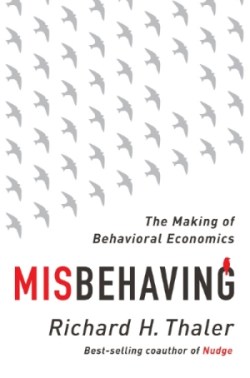
I’ve got a book recommendation: Misbehaving, the making of behavioral economicsby Richard H. Thaler. The standard economics (that you may have learned in college) is based on the notion that markets are made up of rational actors who use all the publicly available information to make the best possible individual decisions. Everybody knows that’s not strictly true, but since the 1950s economists have held that it’s a good-enough assumption for making economic predictions.
Since the 1970s, Thaler’s career has revolved around poking holes in that worldview. In other words, he’s been looking for and documenting situations where the quirky decision-making of real human beings leads to results very different than the rational-actor models constructed by economists.
Not only is that an interesting topic that has all sorts of fascinating real-world applications (including the over-valuing of high draft picks in the NFL), but Thaler is a marvelous story-teller. His stories — of experiments in human decision-making, and of his attempts to introduce more realistic thinking into the stuffy and self-important world of academic economists — are consistently amusing. The book’s ongoing theme is that whether you are talking about contestants on Dutch game shows or University of Chicago business school professors choosing offices in a new building, people are funny — and you can’t really understand the world until you account for the predicable ways that people are funny.
The title has a wonderful double meaning: Economic models can fail when humans “misbehave” by not making the supposedly rational choices the model calls for. But by pointing out such embarrassing glitches, Thaler was also “misbehaving” according to the community standards of economists. So his career is a story of successful rebellion.
Finally, there’s political significance to the revolution Thaler has been leading: Idealizing markets, and exaggerating the powers of the people who participate in them, tempts a person to turn all of society’s decision-making over to “the Market”. For decades, economists’ false assumptions have biased their analysis in favor of market-based solutions. But people who are still making those simplistic Econ-101 arguments in favor of free markets are behind the times. They are, as Keynes observed, “slaves of some defunct economist”.
and let’s close with some tongue-in-cheek advice to black filmmakers
Donald Trump seems to be riding high. But the right anti-Trump message is finally getting out.
I’ll go out on a limb and say we’re at Peak Trump* here. There’s no real sign of it yet in the polls, and he may yet get a bounce out of the unpopular GOP establishment taking the gloves off against him. Even if Saturday’s voting didn’t go as well for Trump as Super Tuesday, none of his Republican rivals has any obvious path to the nomination. So it’s still possible that the GOP will stumble its way to a Trump candidacy in the fall.
Pundits have been predicting the end of Trump from the moment he announced, and so far all of them have been wrong. But I have a simple reason for believing that the threat of President Trump is finally receding: The right anti-Trump message has emerged and is starting to catch on.
The bad boyfriend. Up until now, arguing with Trump supporters has been like telling your 17-year-old daughter that her 29-year-old boyfriend is no good for her: It’s obvious to you, but everything you say just reinforces the me-and-him-against-the-world mystique that has been driving the relationship from the beginning.
So it didn’t work to laugh at the sheer absurdity of President Trump. Pointing out that he was violating all standards of political decorum — or that his facts were wrong and his proposals nonsensical — didn’t work. Being offended on behalf of Mexicans or Muslims or blacks or Jews or the disabled or Megyn Kelly didn’t work. His target supporters don’t identify with any of those groups, and Trump-supporting women probably think Kelly is a little too smart and pretty and full of herself.
Trump supporters are mostly white straight Christians — many (but not all) working class or less educated — who feel like all the trends are running against them and nobody will speak up for them. The fact that the same people who look down on them disapprove of Trump, and that Trump hasn’t been afraid to piss off all those other groups (and didn’t apologize when he was condemned for it) — that just made his supporters love him more.
You know what finally gets through to the 17-year-old? Meeting her boyfriend’s previous three teen-age girlfriends, the ones he dumped when they got pregnant. They look just like her — or at least they used to, before the single-mom lifestyle started to drag them down. Realizing that he told them all the things he’s telling her … that starts to mean something.
And that’s the message that’s emerging: Not that Trump is crude (which he is) or racist (which he is) or a proto-fascist (which he is) or unprepared for the presidency (which he is) or any of that. But he’s a con-man, and he hasn’t been conning Mexicans or Muslims or Megyn Kelly (who is too smart to fall for his bullshit). No, his career is all about conning the kind of people who support him now.
The Trump University scam. An article in Time describes the victims of his Trump University scam (who are now suing him) like this:
They seem to be middle-class or lower-middle-class people anxious about their financial situations and aspiring to do better. In other words, they are the exact group that Trump the candidate is trying to appeal to. … [Trump University] shortchanged thousands of vulnerable consumers, a large portion of whom were elderly, targeted with messages that Trump University was their ticket to avoiding spending their final years working as greeters at their local Walmart.
Trump U raked in $40 million ($5 million of which went straight to Trump) by promising that Trump would handpick mentors (“terrific people, terrific brains … the best of the best”) who would teach his “secrets” of how to make quick money in real estate. Under Trump’s guidance, you’d turn fast profits on deals that wouldn’t expose you to any risk, because somebody else would finance them. (You know: the same way Mexico is going to pay for that wall.)
In fact, the instructors had no real estate experience, had never met Trump, and their training was in how to up-sell students into ever-more-expensive courses: from free afternoon presentations to expensive weekend workshops and then to even more expensive mentorships — none of which would lead to any easy real-estate scores. Trump’s secret to gaining limitless wealth was always just over the horizon, in the next course.
the playbook [for Trump U instructors] spells out how that [weekend] session was meant to up-sell those $1,495 attendees into mentorship programs costing $9,995 to $34,995. It even uses the term “set the hook” to describe the process of luring people at the free preview session to take the three-day $1,495 course. Once their quarry was on the hook for $1,495, the message to be hammered home beginning on the second day of that program was that three days wasn’t nearly enough time to get the students out there making Trump-like deals. Only the more expensive mentorships could do that.
As in his campaign, Trump’s alleged wealth was part of the con: He didn’t need your money; he was going to give Trump U’s profits to charity. But he didn’t. (CNN also can’t figure out what happened to the money Trump supposedly raised for veterans’ charities.)
The Tampa scam. If Trump U were a unique example, Trump’s attempts to explain it away might be believable. But there’s also Trump Tower Tampa, the glorious-but-imaginary condo project pictured to the right. TTT bilked a bunch of middle-class and upper-middle-class Floridians out of their deposits –including a number of retirees who have no way to make that money back. According to Trump, the building was going to be
so spectacular that it will redefine both Tampa’s skyline and the market’s expectations of luxury.
Except he never built it. In fact, he was never going to build it. All he invested in the project was his name, which he licensed to the developers. When the project went bust in the Florida real estate crash — isn’t a real estate genius like Trump supposed to foresee things like that? — he walked away with his licensing fees ($3 million and a lawsuit that claimed he should get another million) and lost nothing.
But his insulation from any possible loss wasn’t revealed to the buyers before they signed their contracts. Quite the opposite.
At a gala reception attended by 600 dignitaries and well-heeled guests, Trump continued to give the impression that he was actively involved in the project. He had a “substantial stake,” he told reporters, and would have increased it but for the fact that the tower was selling so well.
When the project went bankrupt without having built a single condo, the big losers were the people who had trusted the Trump name enough to put down deposits. Jay Magner, the owner of a dollar store, says:
I lost $130,000. I didn’t know people could take your money and not build the building.
Jay McLaughlin, a physical therapist from Connecticut, also lost his money:
The main reason we went into this was Trump. We had no idea he was just putting his name on it and not backing it financially.
The Baja scam. The same story played out with the Trump Ocean Resort Baja Mexico, south of Tijuana. It was supposed to be a luxury resort with a view of the Pacific. Trump licensed his name to the project, and marketed it as if the whole idea had been his to start with. With his help, the developers collected millions in deposits, mostly from Californians. But when it went bust, Trump told a different story to the LA Times:
Trump told The Times that the developers were to blame, saying he merely licensed his name to the 525-unit oceanfront project and was not involved in building it.
Maybe the condo buyers would have wanted to know that fact before they plunked down their money. And those blameworthy developers — shouldn’t a real estate genius like Trump be vetting those guys? Isn’t that precisely the kind of thing the Californians dreaming about their Trump oceanfront condos were trusting him to do?
Do you think he told them that he knew nothing about the developers other than the fact that they paid him money? Or did he claim that they too were “terrific people, terrific brains … the best of the best”?
And you know how Trump claims he never settles lawsuits? He settled that one. Lawyers for his victims said they were “very pleased with the outcome”.
There is no you-and-Trump, except in your mind. That’s the message that is eventually going to get through to Trump’s supporters: It’s not you-and-him against the world. In reality, there is no you-and-him against the illegal immigrants who want to steal your job, against the Muslim terrorists who want to kill you, against the Republican establishment that’s been selling you out, or against the politically correct liberals who keep calling you a bigot. It’s not even you-and-him against the Megyn Kellys who wouldn’t go out with you in high school, or who got to be cheerleaders when you didn’t.
That 50-foot wall between us and Mexico, or the trade deal that will bring all those jobs back from China, or the deportation force that will round up 11 million undocumented immigrants and send them back to Mexico — those are like the luxury condos in Tampa and Baja, or the real estate profits that Trump U graduates were supposed to start making. They’re fantasies he dangles that will never manifest in reality. Afterwards, when you remember how few details he gave you and how quickly he changed the subject whenever anybody tried to get those details, you’ll wonder why you ever believed in them.
That’s how it is when you get conned.
You-and-him is a fantasy he’s happy to let you believe in until he gets what he wants. Then he’ll be on to his next scam, and the marks in that scam will look a lot like you — just like the marks in his previous scams look a lot like you.
The wrong arguments. The stories of Trump’s previous cons have been out there for a while, but they’re only beginning to get the attention they deserve. Up until recently, Trump’s rivals had been ignoring him while they maneuvered towards a 1-on-1 match-up they believed they’d win, while his critics had focused on his apparent political weaknesses — his basic ignorance of anything related to public policy, his loose relationship with the facts, his conservative apostasy, his bigotry, and his un-presidential temperament.
What those critics didn’t appreciate was that Trump’s supporters share a lot of those weaknesses. Denigrating Trump also denigrated a lot of his target audience, and bound them closer to him. If he’s stupid, then they’re stupid — and they’re sick of being called stupid.
Even less effective were the articles written by people who are afraid of Trump. Trump’s target audience are people who feel small and ignored. But if Trump inspires fear, then identifying with Trump lets them experience the thrill that people are afraid of them. What could be more appealing?
Donald Drumpf. But now critics are starting to realize that you have to take out Trump’s apparent strengths. That’s the essence of John Oliver’s amazing takedown. Oliver shows clips of Trump fans enthusing about their hero: He tells it like it is. He says what he means. He’s telling the truth. He’s funding his own campaign. He’s strong and bold. He’s a great businessman.
And then Oliver systematically pops all those bubbles. The Donald Trump we think we know is the “mascot” for the Trump brand, which is a triumph of marketing and image-making over reality.
Oliver reviews the scams I detailed above, and closes by exploding the hype of the Trump brand: It’s not even really his family’s name. Generations ago, an ancestor changed it from Drumpf, which Oliver describes as “the sound made when a morbidly obese pigeon flies into the window of a foreclosed Old Navy.”
Drumpf is much more reflective of who he actually is.
So if you are thinking of voting for Donald Trump, the charismatic guy promising to make America great again, stop and take a moment to imagine how you would feel if you just met a guy named Donald Drumpf, a litigious serial liar with a string of broken business ventures and the support of a former Klan leader who he can’t decide whether or not to condemn.
Would you think that he would make a good president, or is the spell now somewhat broken? And that is why tonight, I am asking America to make Donald Drumpf again.
Oliver has acquired the web site donaldjdrumpf.com, where you can buy this attractive hat.
Even Romney. Mitt Romney has always been a little tone-deaf, and I doubt Donald was quaking with fear when Mitt announced he would speak out. But even his unprecedented denunciation of Trump (skip the first 2:30 of the video, or just read the transcript) — when was the last time a party’s most recent nominee publicly denounced its current front-runner in such vitriolic terms? — eventually found the right note:
But you say, wait, wait, wait, isn’t he a huge business success? Doesn’t he know what he’s talking about? No, he isn’t and no he doesn’t.
Look, his bankruptcies have crushed small businesses and the men and women who work for them. He inherited his business, he didn’t create it. And whatever happened to Trump Airlines? How about Trump University? And then there’s Trump Magazine and Trump Vodka and Trump Steaks and Trump Mortgage. A business genius he is not.
… I predict that despite his promise to do so, first made over a year ago, that he will never ever release his tax returns. Never — not the returns under audit; not even the returns that are no longer being audited. He has too much to hide.
… Here’s what I know. Donald Trump is a phony, a fraud. His promises are as worthless as a degree from Trump University. He’s playing the members of the American public for suckers. He gets a free ride to the White House and all we get is a lousy hat.
Suckers. The right response to a Trump supporter isn’t to show fear or get angry or paternalistically explain what the facts actually are or how the world really works. The right response is pity: You poor sucker.
Identifying with Donald Trump isn’t making his fans look strong. It’s showing everybody just how weak and foolish they are. This obvious flim-flam man has taken advantage of their insecurities, and is conning them the way he has conned so many people like them in the past.
Those poor suckers. They think Trump is standing up for them. But nobody is laughing at them harder than he is.
* While doing the final edit on this post, I discovered George Will is also talking about “Peak Trump“. Given Will’s record as a seer, that gave me a moment of doubt. But I’m sticking with my prediction.
This week I’m going out on a limb and announcing “Peak Drumpf”, the moment when the threat of President Donald Trump looks scariest, and then begins to fade. The reason I expect things to start turning against the Donald is not that Mitt Romney finally marched into battle against him, and certainly not that Ted Cruz or Marco Rubio has finally started to catch fire. I think it’s still possible that the GOP will stumble its way into nominating Trump.
But what makes me optimistic about the Donald’s ultimate fall is that the right message to use against him has finally emerged and started to spread: He’s a con-man.
Here’s why that’s important: The victims of Trump’s past cons (like Trump U or the condo projects that took people’s deposits and never built any condos) aren’t Mexicans or Muslims or anybody else his followers resent or fear; the victims are people just like them, and the kinds of things he said to con them sound just like what he’s telling his supporters now.
“Peak Drumpf” still needs a little bit of work, so let’s say it gets posted around 9 EST.
We’re in that three-week period where the nominations are going to be wrapped up, so the weekly summary is also going to be full of presidential politics: the least presidential debate in America history, where the nomination races stand, a better notion of why black voters aren’t backing Bernie, and Trump’s healthcare plan.
Non-race-for-the-White-House stuff includes a fun book about (believe it or not) behavioral economics, more good news about unemployment, and the simple change that would have made Straight Outta Compton an Oscar-winner.
We were trying to do some modeling on which states Trump is strong and weak in — there’s now enough polling across different states to do that — and the best correlate we could find for Trump’s support is Google searches for the N-word.
This week’s featured post is “Trump is an opportunistic infection“. If you happen to be near Billerica, Massachusetts this Sunday morning at 11, I’ll be at First Parish Church updating one of my best social-justice sermons, “Who Owns the World?”
This week everybody was talking about the primary/caucus results
The week saw two wipe-outs: Trump dominated in the Nevada caucuses, getting 46% of the vote and destroying the idea that his support had a ceiling well below that. And Clinton had an even more impressive victory in South Carolina, defeating Bernie Sanders nearly 3-to-1, 74%-26%.
Tomorrow is the first multi-primary day. Both parties have contests in Arkansas, Georgia, Massachusetts, Oklahoma, Tennessee, Texas, Vermont, and Virginia, while Alabama has only a Republican primary.
Republicans. Until Tuesday, the conventional wisdom among Republicans was that the other candidates were vying to get into a one-on-one runoff with Trump, where the non-Trump candidate would surely win. And so here in New Hampshire, I saw countless anti-Rubio and anti-Cruz ads — and even anti-Christie and anti-Kasich ones — but virtually no attack ads against Donald Trump. Trump himself advertised very little, but held big rallies and did his usual impressive job of drawing free media attention. The others tore each other apart and Trump won.
Since Tuesday, Rubio in particular has been going after Trump, sometimes with some very personal ridicule, but Trump looks set to sweep the Super Tuesday states tomorrow anyway, with the possible exception of Cruz’ home state of Texas.
If that holds, I have a hard time seeing how Trump loses the nomination. Not just because his position is so commanding, but because I don’t know what scenario I’m counting on if I bet against him. Is Rubio suddenly going to become the dynamic candidate of Republican establishment fantasies, rather than the lightweight he otherwise seems to be? And as I explain in this week’s featured post, the best arguments against Trump are off-limits to Republicans.
Democrats. After Sanders’ big victory in New Hampshire, pundits talked about Clinton’s minority “firewall”: Hispanics in Nevada and blacks in South Carolina. Sanders supporters countered that while their candidate may have been slow to catch on among non-white Democrats, now that he was seen as a viable threat to Clinton the polls would change.
Nevada was inconclusive for that thesis: The caucus entrance polls said Sanders won the Hispanic vote, but by a margin well within the margin of error. Nonetheless, Nevada’s black vote came in overwhelmingly for Clinton and put her over the top.
But in South Carolina the firewall held, by a margin even larger than the Clinton people expected. Blacks increased their share of the primary electorate from 55% in 2008 to 61% in 2016, and Clinton got even more of their support than Barack Obama did: 84% rather than 78%. It’s official: Bernie Sanders has a black problem. You can argue that the problem arises through no fault of his own — he has a good civil rights record and hasn’t been race-baiting — but it’s there.
People ask me why this is, to which my first answer is: “I’m a white guy, what do I know?” If pressed, my second answer is that the slow, stuttering, back-and-forth progress of racial justice in America makes Bernie’s promise of “political revolution” sound like pie-in-the-sky to many blacks, while Clinton’s message (that progress is hard, and that we have to be as focused on defending what Obama has accomplished as we are on going further) seems more realistic. But if that doesn’t sound right to you, I’ll retreat to my first answer.
As for what to expect tomorrow, Nate Silver’s primary-prediction model gives Clinton a better-than-98% chance of winning Arkansas, Georgia, Tennessee, Texas, and Virginia. The model gives her an 88% chance in Massachusetts and 75% in Oklahoma. It predicts a Sanders victory only in his home state of Vermont (99%).
Obviously, if that happens Clinton will have a huge lead in delegates come Wednesday morning. Does that mean the race will be over for all practical purposes? Not necessarily.
An interesting tool for analyzing the race is Nate’s list of state-by-state benchmarks. The methodology here is interesting: He’s projecting who would win each state by how much if the race were a 50-50 tie nationally. Nate’s list shows that tomorrow’s primary states are ones you would mostly expect to be good for Clinton, though she seems to be polling above his benchmarks. A better run of states for Sanders happens after March 15.
Nonetheless, another 538 analyst, Harry Enten, sees South Carolina as a major setback for Sanders: Until then, he had been gaining on the benchmark totals he needed to pull even, but in South Carolina he lost by nearly 50% rather than the 20% loss the benchmark predicted.
Tomorrow night, the state I’m going to be watching is Virginia, which should be a swing state in the fall. Nate’s benchmark is for Clinton to win by 9%. If the margin is less than that, Bernie might still make a comeback.
BTW, I’ll repeat a point I first mentioned a few months ago: The way you beat a bully is by making people laugh at him, and the Democrats have a great comedian in Senator Al Franken. Wouldn’t he be the perfect VP candidate if the Republicans nominate Trump?
and the Supreme Court
In something of a shocker, news leaked out of the White House the Republican Governor Brian Sandoval of Nevada was being vetted for the Supreme Court. Sandoval favors business over labor, but also seems pro-environment and is said to have “moderate” views on abortion, whatever that means. In short, he’s exactly the kind of compromise you might expect Republicans to leap on, if they were at all inclined to do that kind of thing.
Apparently they aren’t. Floating Sandoval’s name didn’t move the needle at all, and the governor removed himself from consideration a few days later.
If Obama’s plan was to appoint Sandoval, Democrats might want to take their chances on winning the next election instead. But if he was just trying to show America how unreasonable the Republican position is, he succeeded.
while some discussed the undisguised racism among Trump supporters
Just before the South Carolina primary, a pro-confederate-flag protest turned into a spontaneous Trump rally. A reporter for the Young Turks interviewed participants, who warned of “ethnic cleansing” against whites and expected Trump to do something about it.
In Iowa, fans at a white high school began chanting “Trump! Trump! Trump!” after losing a basketball game to a team with more non-white players. It’s hard to say exactly what they meant by it, but apparently his name either invokes white pride or is supposed to intimidate non-whites.
The important question is whether these examples are just random anomalies, or if they point to some larger phenomenon. Tuesday, when Chris Hayes interviewed Trump supporters at the Nevada caucuses, he found a bunch of nice people, some of whom had decided that Trump’s more outrageous statements were just showmanship and not to be taken seriously. (However, my personal experience indicates that a lot of racists are nice people when they talk to a pleasant white man like Chris.)
One way to research this question is through polls. For example, Public Policy Polling found that 38% of Trump supporters in South Carolina wish the South had won the Civil War, and various other polls have turned up additional disturbing results. But again, these results may be anecdotal, or may be blaming Trump for bad attitudes that could be found among many candidates’ supporters.
Nate Silver’s 538 web site specializes in poll-watching. A regular feature of the staff’s weekly podcasts is to review news stories about polls and ask whether they represent a good or bad use of the underlying data. Thursday’s podcast was headlined “Racism among Trump’s supporters“, and the overall conclusion is that yes, there is something in this data. Nate Silver said:
I resisted for a long time the notion, because again it is kind of a default for people on the Left, that “Oh, this is all about race.” But, like, I have almost come full circle the other direction, to where I think the media is not talking about this enough. And I think the centrist Joe-Scarborough pundits who are like “Oh, Trump will really shake things up” [have] to acknowledge the fact that some of this support is a result — maybe not a majority, I think probably just a plurality — but some of the support is a result of … of some of the worst impulses that Americans can have. And to indulge that, I think, is something people should be thinking about more carefully.
while I was struck by
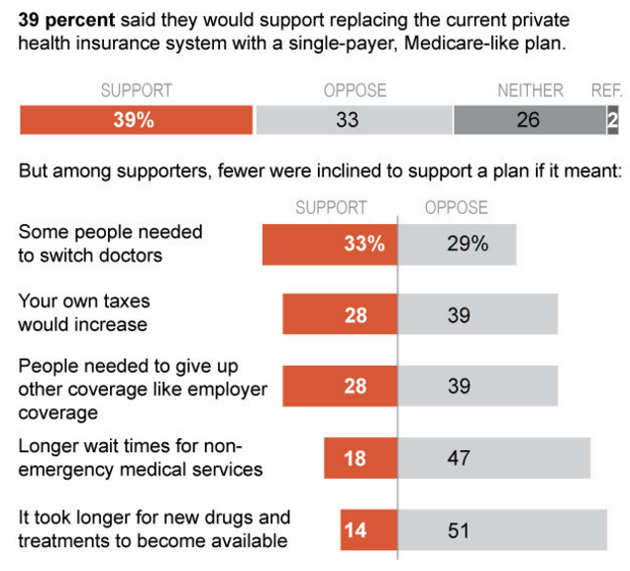
a poll from AP-GfK, based on interviews between February 11 and 15. Most of the poll consists of typical questions: whether the country is on the right or wrong track, how well President Obama is doing his job, how important various issues are, and so on.
But things get interesting on page 21, when they ask:
Would you favor or oppose replacing the current private health insurance system in the United States with a single government-run and taxpayer-funded plan like Medicare for all Americans that would cover medical, dental, vision, and long-term care services?
A plurality favors the program, 39%-33%, which sounds good for ambitious liberals. But then they start filling in details, and approval drops.
What I think we’re seeing here is the low-engagement voter problem that I discussed a few weeks ago in “Say — you want a revolution?” Large numbers of voters have not thought through the issues well enough to have a coherent position. So if you ask them the wrong question and take their answer too seriously, you can easily get misled.
Republicans run into this problem when they ask people about government spending. Polls show that by a wide margin people believe the government spends too much. But when you get specific about what to cut, you find that the public also supports just about everything the government spends money on. What do they want less of? Bridges to nowhere, welfare for able-bodied adults who refuse to work, foreign aid to countries that hate us, and subsidized art projects that offend them — all of which adds up to way less than 1% of the budget. The other 99-point-something percent they’re fine with.
That’s why Republicans have learned not to specify their cuts, but to run on across-the-board reductions that make somebody else pick the victims. As Ben Carson put it: “Now anybody who tells me there’s not 3 to 4 percent fat in virtually everything that we do is fibbing to themselves.” Does that mean he wants to cut your Mom’s Social Security or your uncle’s veteran benefits by 3-4%? No, of course not! How can you think such a thing?
The contradiction that gets Democrats in trouble is that people love progress, but they hate change. Maybe there’s a great plan to improve public schools — and God knows that schools in general need improvement — but if your kid likes his teacher and has some friends in his class, you’re going to look at that plan skeptically. And I know that American health care is way too expensive and doesn’t cover everybody, but personally I understand how my insurance plan works and I like my doctor, so do I really want to shake things up?
Tell people that you’re going to improve things, and they’ll love it. Tell them that their own lives are going to have to change in incompletely specified ways that are probably going to be more positive than negative, and they’ll doubt you.
That’s how the insurance companies beat HillaryCare in 1993. That’s why ObamaCare’s worst press was about people whose insurance plans got cancelled. Almost invariably, the people in those stories eventually got a better deal, but that didn’t matter. They were forced to change, and change is scary.
In 2017, Medicare-for-All will have exactly the same problem. Will masses of people take to the streets to demand Congress pass it? Will filibustering senators fear the wrath of the American people in the 2018 elections? I’m skeptical.
I also think it’s interesting to speculate on what the same question might mean to different respondents. For example, on page 14 of the AP-GfK poll you find: “Which party do you trust to do a better job of handling the U.S. image abroad?” The numbers are close: 27% trust the Democrats more; 26% the Republicans, which is not a statistically significant difference.
But I suspect those two groups of people aren’t really answering the same question at all. If you’re a Democrat, probably the “image abroad” you worry about is that we’re crazy assholes: We start wars for little-to-no reason; we torture people; we want veto power over other countries’ revolutions; we think the rules that apply to every other nation in the world shouldn’t apply to us. So you want Democrats in office to make us behave like good citizens of the world.
But if you’re Republican, probably the image you worry about is that we’re pushovers; you want Republicans in office to convince foreigners not to mess with us. If we have to drop bombs and waterboard people to get that point across, so be it.
For decades, the GOP has been killing off its demagogue-detecting and bullshit-rejecting antibodies. Now it’s helpless.
As Donald Trump moves ever closer to their party’s nomination for president, many Republicans are trying to understand or explain what has happened. Various metaphors have been thrown around: It’s a “hostile takeover“, or a “class war“, or a “populist uprising“.
Here’s a more accurate comparison: Trump is like the opportunistic infections that attack people whose immune systems have been compromised. A healthy political party could have thrown off Trump’s candidacy with barely a sniffle, but today’s GOP is in grave danger.
Over the last few decades, the Republican Party has been systematically destroying all the habits and mores and traditions and standards that keep a political party stable and allow it to play a constructive role in governing a great republic like the United States. Those things function like antibodies: They may be invisible to the naked eye, but they head off outbreaks of all sorts of destructive nonsense.
Now they’re gone, and Donald Trump is running wild.
Rather than change its own plutocratic policies, the GOP has scapegoated undocumented immigrants for working-class impoverishment. (If you’ve been losing at poker and wonder if someone’s been cheating you, don’t accuse the Mexican who’s been sweeping the floor. Look at the guy with all the chips.) It has pushed self-serving economic fantasies like “tax cuts pay for themselves” and biological fantasies like the female body “shutting down” to make pregnancy-by-rape impossible. It has looked the other way while hucksters and con-men fleeced its faithful. It has struck down any traditional notions of fair play; beating Obama has been the important thing, and only wimps appeal to gentlemanly traditions and rules of decorum. (If it’s OK to yell “You lie!” during the State of the Union, what’s wrong with endorsing a shout-out that Ted Cruz is a pussy?)
In short, the GOP has devolved from the Party of Lincoln — or more recently the Party of Eisenhower — to the Party of Truthiness. (Truthiness, coined by Stephen Colbert, is the seductive notion that what your gut wants to believe must be true, independent of any facts or science or expert opinion.) The result is that the party’s base has no immune system that would reject a candidate like Trump.
With all the legitimate arguments of political discourse unavailable, other candidates were left to fight each other and wait for Trump to go away. And when Marco Rubio recently decided he finally had to take Trump on, the only weapon at hand was to tease him like a third-grader, suggesting that he wet his pants during a debate.
While many “establishment” Republicans fruitlessly look for a miracle drug to cure Trump fever without also taking down Cruz, Rubio, and half their Senate candidates, others are beginning to surrender. It’s just one election; maybe it won’t be so bad.
But this is where the compromised-immune-system analogy has something to teach: People whose immune systems have been crippled by AIDS or chemo-therapy seldom catch just one disease. Even if some massive dose of political antibiotics could flush Trump out of the Republican system, the underlying problem is still there: The Republican base cannot detect and reject hucksters. It cannot tell fact from fantasy. It values posturing and bombast over the skills necessary to govern a republic. It seeks scapegoats rather than solutions. It winks and nods at racism and white entitlement.
As long as that remains true, new Trumps will arise in 2020 and 2024, and any qualified Republican candidate offering real solutions will be defenseless against them. The Republican Party doesn’t just need to find a way to deal with Donald Trump. It needs rebuild its immune system.
This week, big victories by Trump in Nevada and Clinton in South Carolina set the stage for tomorrow’s Super Tuesday primaries, and have pundits speculating about whether the nomination races are over or not.
But while those sound like similar situations, the possibility that it may be too late to stop Trump is causing far more anguish among Republicans than anything Democrats might be feeling (or would be feeling if Sanders were threatening to sew up the nomination).
All sorts of metaphors are floating around about what Trump represents to the Republican Party. (“hostile takeover” seems to be one of the most popular.) In this week’s featured post I suggest one I find more accurate: “Trump is an opportunistic infection”, the kind that only people with compromised immune systems are vulnerable to. Mainstream Republican candidates can’t get any traction against Trump because over the last few decades the Party has systematically de-legitimized all the fact-checking and expert opinion and separation-of-reality-from-fantasy necessary to take him down. So the GOP’s problem is not just one guy: Unless and until they figure out a way to restore the immune system of their base, they’ll be vulnerable to Trump-like infections in all future elections as well. That post is pretty much done, so it should appear shortly.
In the weekly summary, I’ll examine whether the shift in pundit opinion is justified: Is it all over but the shouting? Is it likely to be over tomorrow? (Probably not, I think, though Trump and Clinton are on the verge of building significant leads.) I’ll also discuss an interesting poll demonstrating the variability of people’s opinions about single-payer health care, and what that means for the viability of Sanders’ signature proposal. Also, Nate Silver’s crew discusses the polls showing disturbing levels of racism among Trump supporters, Obama floats a strange Supreme Court trial balloon, and we’ll close with a Game of Thrones mash-up. Expect that around 11 EST or so.

 If I had to pick a moment when I started on the path that led to current-events blogging and eventually to the Weekly Sift, it would be one beautiful summer day in (as best I can reconstruct it) 2000. I was walking through a lovely stretch of woods, but all I could do was rage about the issues I’d been hearing about on TV: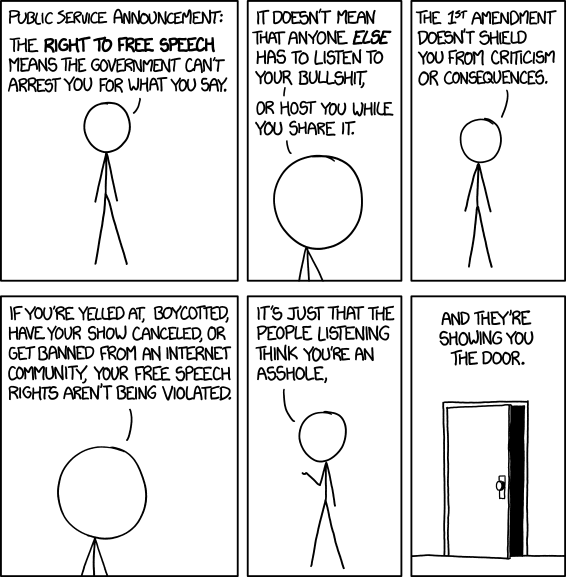


 I’ve got a book recommendation:
  The Tampa scam. If Trump U were a unique example, Trump’s attempts to explain it away might be believable. But there’s also