Concessions to Reality

The GOP’s increasing preference for callow, reckless candidates represents a culmination of the anti-government, anti-politics, anti-intellectual direction of the conservative movement. Although it overlaps with the GOP’s rightward shift, it presents a unique threat to American democracy because it espouses not mere preference for smaller government, but a visceral hatred of functioning government and the practice of politics. This mindset abhors concessions to objective reality, expertise, or political adversaries domestic and foreign.

Ben Adler

Half the republicans in congress want to continue using their position to benefit the wealthy, while the other half of the republicans in congress just want to burn the country down out of spite. Together they have a majority in the House, so they get to pick the Speaker.

Bill Palmer

This week’s featured post is “What the Speakership Battle is About“.

This week everybody was talking about the chaos in the House Republican caucus

Most of what I think is covered in “What the Speakership Battle is About“. But there is one more angle to consider: Who does this help in the Republican presidential race?

I think there’s a clear answer: Ted Cruz. Ultimately what’s going to come out of this is a Speaker who is still committed to keeping the government open and not breaching the debt ceiling. This result will aggravate the Republican base’s sense of persecution and alienation from the party establishment, which is Ted Cruz’ issue.

In general, I agree with Steve Benen at Maddowblog: Cruz is right where he wants to be.

and the Trans-Pacific Partnership

I’ve been avoiding making much comment on the TPP, because I’m neither for or against trade deals on principle. Some deals might be good, some might be bad. We need to see the details.

So far, we can’t. For a long time the agreement hadn’t been finalized and the text wasn’t available, so everybody was just speculating based on leaks. Well, the agreement is set now, but it will still be 30 days or so before the text is public. So rather than give a definitive up-or-down opinion on it, I’ll outline the different points of view from which the agreement should be judged.

The foreign-policy perspective. This comes through if you read Hillary Clinton’s Hard Choices, which covers her Secretary of State years, when the TPP negotiations got going. From this perspective, the point is to keep China from controlling Pacific trade.

Other than the United States and maybe Japan, none of the other countries in the TPP is big enough to negotiate evenly with China. So China was trying to put in place one-on-one agreements with each country that more or less let it define the terms of trade. By pulling many Pacific countries (other than China) into a trade union with the U.S. and Japan, we create international standards — for intellectual property, the rule of law, environmental and labor protection, as well as market openness — that we can then ask China to live up to if it wants to join.

The labor perspective. Relaxing trade barriers has two contradictory effects: It opens our economy to more imports, which could cost jobs. But it also opens up markets for our exports, which could create jobs. In general, I believe past deals have worked against the American worker, but you have to wonder whether all the exportable jobs are gone already.

Another issue is labor standards. If the other countries in the TPP have to treat their workers better, that’s both good in itself and removes an unfair advantage foreign manufacturers have over American manufacturers.

The environmental perspective. Again, it’s potentially two-sided. The treaty will presumably include some environmental standards that, again, should be both good in themselves and will remove a source of unfair competition. But a country’s environmental standards can also portrayed as unfairly favoring local industries over foreign ones, and the treaty will give foreign corporations standing to challenge them in court. I suspect the balance will turn out to be negative, but, again, we need to see details.

and still talking about guns

I’m coming to think that the value of continuing to talk about gun control is that it draws gun-rights cockroaches into the light, where the sheer ugliness of their worldview can repel the general public. Like Erick Erickson: denouncing “beta male gun control policies”:

Instead of mimicking Australia and Great Britain with their gun confiscation programs, our leaders should think differently. The best gun control in this country is an armed, honest citizenry who can shoot straight. Instead of gun free zones, we should allow law abiding, concealed carry permit holders to go where they wish with their guns.

Like, say, the law-abiding permit-holding woman who started shooting in a Home Depot parking lot Tuesday because a shoplifter was getting away. I feel safer already, just knowing that people like her are out there defending law and order. But I think I won’t dawdle in Home Depot parking lots.

Here’s what Ted Nugent says to the “losers” who “get cut down by murderous maniacs like blind sheep to slaughter”:

Here’s the answer. Quit acting like helpless sheep afraid of a simple tool. Get a damn handgun. Practice with it. Train with it. Learn to carry it hidden and discreetly. And when attacked by a bear or cougar, don’t “try to look big” – just shoot the damn thing.

If someone is approaching you with the intent to do grave bodily harm, and you will know it when it happens, try to escape to the best of your ability, but if there is no escape, pull out your weapon and aim for center mass and start shooting. Keep on shooting until you believe the threat to be over.

That “you will know it” idea is central to a lot of right-wing fantasies — like Ben Carson’s rush-the-shooter fantasy — where the complexity of real life vanishes. In fact, shooting situations are chaotic, and if you find yourself in one, you’ll probably have no idea what’s going to happen next. In this respect, it’s similar to the ticking-bomb torture fantasy, where you know there’s a bomb, you know this guy knows where it is, and you know he’ll tell you if you torture him. In real life, you never have that kind of certainty.

And if Carson hadn’t made the common NRA talking point (about disarming the public being the first step towards Nazi tyranny), we wouldn’t have the opportunity to point out that it’s completely false. Hitler actually relaxed Germany’s gun laws.

And while Carson was only implying that Germany’s Jews were responsible for their own deaths, Fox News’ Keith Ablow went all the way there:

If Jews in Germany had more actively resisted the Nazi party or the Nazi regime and had diagnosed it as a malignant and deadly cancer from the start, there would, indeed, have been a chance for the people of that country and the world to be moved to action by their bold refusal to be enslaved.

In other words: We didn’t fail Europe’s Jews in the Holocaust, the Jews failed us. Good to know.

So keep talking, gun defenders. You’re impressing the public, but probably not in the way you think.

and you also might be interested in …

Televangelist Jim Bakker — who has managed to stay out of jail these last 20 years — still has a TV show. On this episode, he promoted the idea that Satanic baby-sacrifice rituals are taking place in Planned Parenthood clinics.


Trevor Noah fantasized about pro-life politicians bringing the same level of passion to preventing deaths by gun violence, and then made this amazing comparison: Pro-lifers are “like comic book collectors. Human life only matters until you take it out of the package.”


Kevin McCarthy’s Benghazi gaffe has given Hillary Clinton an opportunity to mount a counter-attack against the efforts to tar her with scandal. You know the jig is up when even Bill O’Reilly won’t play any more. Appearing on Fox News’ afternoon show The Five, O’Reilly laughed at the Benghazi Committee’s claims to be non-partisan:

If you think those guys, those Republicans on that panel, don’t want to bring down Hillary Clinton, you’re six years old. Of course, they do.

Some of the best defenses of Clinton are written by Peter Daou and Tom Watson on the blog Hillary Men. They completely demolished that headline from August claiming that the word voters most often associate with Hillary is liar.

According to Quinnipiac, 178 respondents answered “liar” in a poll that – wait for it – had 666 registered Republicans taking part. Other popular negative answers included “bitch,” “Benghazi,” and “criminal.”

So what the poll showed is not that “voters” think Clinton is a liar, but that Republicans reliably repeat widely distributed Republican talking points.


In case you’ve lost track of what we know and don’t know about Benghazi, Vox has it covered.

but I want to highlight a blast from the past

The Weekly Sift‘s readership has nearly quadrupled in the last two years, so I’m realizing that most of my readers have never seen some of the better posts from years past. If you want to understand how liberal reporters end up producing conservatively slanted coverage, take a look at 2011’s “Liberal Media, Conservative Manipulation“.

and then close with something hilarious

The Danish travel firm Spies Rejser has a solution for Denmark’s low birth rate, targeted at the Danish mothers who are waiting impatiently to be grandmothers: Send your son or daughter on a sunny, active vacation where they’ll be likely to get it on. “Do it for Mom. Do it for Denmark.”

What the Speakership Battle is About

The Freedom Caucus wants a speaker who will back its next blackmail play.


Anybody who writes about the chaos in the House Republican caucus should start by admitting how much we in the general public don’t know. The 247 Republicans in the House form a group about the size of a medium-sized church or high school, so decisions can easily turn on the secret meetings of small cliques, phone conversations between leaders of factions, or even the private decisions of individuals. We don’t really know, for example, why Kevin McCarthy pulled out of the race for speaker. [1] We don’t know just how badly John Boehner wants to be done with it all. We don’t know what kinds of pressure can be brought on Paul Ryan to take the job, or whether it will succeed. (For all I know, it may already have succeeded or failed by the time you read this.)

So predicting exactly how events will play out, who’s going to wind up as speaker, how long the process will take, and so on — that’s for Beltway reporters who have inside information, and even they probably won’t know until just a few hours before the public announcements. (That ignorance won’t stop them from speculating, though.)

But in addition to the “inside baseball” of the House Republicans, there is also what stats geek Bill James once dubbed “outside baseball” — the kinds of deductions you can make from publicly available information. Outside baseball can’t tell you what the major players are thinking, but it can describe the external reality they have to deal with.

Getting to 218. Keeping with the Bill James theme, let’s start with numbers: The House has 435 members. The speaker is elected by the whole House, so the winner needs 218 votes. The way that has worked since time-out-of-mind is that the majority party has a private meeting beforehand, decides on its candidate, and then votes for him or her as a bloc on the House floor. (That majority-party meeting is what blew up Thursday, when McCarthy suddenly dropped out.)

But now we run into the Republican Party’s internal friction. The House Freedom Caucus is essentially the Tea Party faction within the Republican caucus. The HFC is generally described as having around 40 members, 36 of whom are listed in the Wikipedia article. So any Republican nominee they decide not to support falls short of 218.

In theory, Democrats could provide the handful of votes necessary to put a less-conservative candidate over the top, but why should they? Why not let the GOP’s squabbles fester and keep making embarrassing headlines? So the prospective speaker would have to offer Democrats some concession in exchange, and that would create an issue that could reverberate through a series of Republican primary challenges across the country: The “establishment Republicans” would rather make a deal with Democrats than with their “true conservative” base.

But the House needs a speaker to function, so at some point in a hung-up process, Democrats might help out just to get the House running again and avoid the bad things — government shutdowns, debt-ceiling crises — that happen when no laws are being passed. Similarly, at some point the non-HFC Republicans might fear the wrath of the country even more than primary challenges, so they’d be willing to deal with Democrats. Up to that point, though — and I think it’s still a long way off — the HFC is in a position to block any speaker it doesn’t like; except Boehner, who is already speaker and doesn’t need to win a new election.

O tempora! O mores! When you realize how easy it is for a small group to disrupt the election of a speaker, you start to wonder why this doesn’t happen all the time. For example, Democrats had only 233 seats in 2007, so any 16 renegade Democrats could have blocked Nancy Pelosi’s election. Democrats also have factions, and radical members from districts so safe they don’t have to fear bad publicity, so why didn’t a couple dozen far-left Democrats hold up Pelosi until she committed to defunding the Iraq War or passing single-payer health care or something?

The answer isn’t anything in the rules, it’s embodied in our political mores and taboos: You just don’t do that. When the party picks its candidate, you back him or her. That’s what it means for a member of Congress to belong to a party.

Or at least, that’s what it used to mean. One long-term issue hardly anybody talks about is the ongoing breakdown in our political systems’ mores and taboos. (I’ve written about it here and here.) In practice, no republic — especially not one with all the checks and balances our system has — can survive for long on its rules alone. It also needs a broad unwritten consensus on the bounds of reasonable behavior. Every year, our political mores and taboos unravel just a little bit more. [2] As a result, Congress gets more unwieldy, and the President [3] and the Supreme Court [4] keep expanding their reach so that the country continues to function.

People argue about this, but to me it’s obvious who’s unraveling the unwritten consensus: the Far Right. Combining a sense of entitlement with apocalyptic exaggeration, Tea Party rhetoric justifies its members in doing whatever it takes to get their way. Same-sex marriage, the national debt, ObamaCare, abortion — they’re all end-of-the-world issues, and God is on the Tea Party’s side. So if getting your way means refusing to do your job, telling outrageous lies, shutting down the government, or threatening to crash the economy, well, that’s just what you have to do.

The Blackmail Caucus. After Republicans took over the House in the wave election of 2010, the newly ascendant Tea Partiers began pushing a new legislative tactic: blackmail.

It’s important to understand the difference between ordinary political bargaining and blackmail. In ordinary bargaining, I push for what I want and you push for what you want; eventually we compromise on something that contains a little of each, balanced according to our relative strengths. But in blackmail, you push for what you want and I push something nobody wants, because I’m counting on you to surrender rather than let it happen.

So, for example, suppose I’ve kidnapped your daughter. I don’t want to shoot her; that wouldn’t accomplish anything for me and could expose me to a death sentence someday. In fact nobody wants me to shoot her; shooting her serves no useful purpose for anybody. But I’m counting on the fact that your distaste for seeing her dead is much stronger than mine, so you’ll do what I want.

That pretty well describes the debt ceiling crises of 2011 (when Obama paid the ransom) and 2013 (when he didn’t and John Boehner made the House back down). If the federal government ever hits the debt limit, checks will start bouncing and world markets will lose faith in U.S. bonds, with catastrophic effects for the global economy. (As Henry Blodgett summarized, “In relatively short order, therefore, the United States will stiff about 40% of the people and companies it owes money to.”) Nobody wants that, but Ted Cruz and his allies in the Freedom Caucus believed in 2013 that President Obama wanted it even less than they did, so he’d have to give in and defund ObamaCare. [5]

That was all perfectly legal. Nothing in the Constitution says that a faction in Congress can’t blackmail the rest of the country, but it used to be taboo. Now the Tea Party considers it an acceptable tactic. [6]

The Boehner problem. From the Tea Party point of view, the problem with John Boehner is that he doesn’t have enough backbone to shoot the hostages. So when Obama refused to blink in 2013, Boehner gave in and let a clean debt-ceiling resolution pass the House. Again just last month, when the Freedom Caucus was pushing to shut down the government over Planned Parenthood funding (funding that most of the country supports), Boehner again let a clean continuing resolution come to the floor, which passed with mostly Democratic votes. So the government is funded through December 11, and the current debt ceiling should last until November 5.

After Boehner blinked in the 2013 stare-down, conservatives started rumbling about ousting him as speaker. Part of the reason for announcing his resignation last month was to allow him to keep the government open without fear of retribution: You can’t fire me, I’ve already announced I’m quitting.

The open question is whether Boehner will take advantage of the Party’s inability to replace him, and just ignore the Freedom Caucus going forward. [7] He could, for example, let a clean debt-ceiling bill come to the floor and negotiate a longer-term budget deal with the Democrats.

What the Tea Party wants from the next speaker. Now we’re in a position to understand why I think the contest for the speakership is being completely mis-covered by the mainstream press. Their focus has been entirely on who. Initially, would Kevin McCarthy be more acceptable to the Freedom Caucus than Boehner? And then later, could Paul Ryan or somebody else satisfy them?

All that talk ignores the Freedom Caucus’ published desires: not a who, a what. They want the next speaker committed to backing their next blackmail play, when the debt ceiling comes up again in a few weeks or the government runs out of money in December.

That comes through clearly when you read the questionnaire the Freedom Caucus prepared for speaker candidates. Question #15 seeks a commitment from the new speaker not to allow another continuing resolution and not to allow appropriation bills to pass if they fund “Planned Parenthood, unconstitutional amnesty, the Iran deal, and Obamacare.” Question #13 lists provisions that should be attached to any debt-ceiling increase, including “significant structural entitlement reforms” (i.e., Social Security and Medicare cuts), and seeks a commitment to “not schedule the consideration of another vehicle that contains a debt limit increase”.

A number of the questions concern the process by which bills come to the floor, but the gist of them is that Freedom Caucus members should have an easier time attaching amendments (i.e., ransom demands) to debt-ceiling or government-funding resolutions.

So it’s not about personalities or trust or being “one of us”. The next time the Tea Party tries to hold the country hostage, they don’t want the Speaker to tell them no. It doesn’t matter whether the “no” comes from John Boehner or Paul Ryan or even Freedom Caucus Chair Jim Jordan. Who doesn’t matter. They want a commitment that the next speaker will shoot the hostages.

I don’t think they’ll get it. (I think that’s what Kevin McCarthy meant when he told National Review that HFC members “wanted things I couldn’t deliver”.) If they stick to their guns — and so far I don’t see any reason to think they won’t — then I don’t see anything moving until we get close to November 5, when Democrats and the Republican establishment will have to unite against them, either to elect a new speaker or to back Boehner’s debt-ceiling resolution.

That will energize a string of Tea Party primary challenges against establishment Republicans, which may have been the point all along. The ultimate goal of the Tea Party isn’t to defund Planned Parenthood or even ObamaCare, it’s to complete their takeover of the Republican Party. They’re playing a long game, and even a defeat in the speakership battle could work to their advantage.


[1] In addition to the surface explanation (that McCarthy didn’t think he could put together the 218 votes to win), there’s a conspiracy theory going around. So far it has zero direct evidence behind it, but at least makes some kind of narrative sense (i.e., it would fit right into a political novel like Advise and Consent).

On Tuesday, North Carolina Congressman Walter Jones sent an odd letter to the caucus chair, Cathy McMorris Rodgers:

With all the voter distrust of Washington felt around the country, I’m asking that any candidate for Speaker of the House, majority leader, and majority whip withdraw himself from the leadership election if there are any misdeeds he has committed since joining Congress that will embarrass himself, the Republican Conference, and the House of Representatives if they become public.

The letter has a weird I-know-something vibe to it, but doesn’t even hint at what Jones thinks he knows. The Week‘s columnist Matt Lewis tentatively suggests what it might be:

Many conservatives are buzzing over rumors — and let’s be clear, they are unsubstantiated rumors that both parties deny — that McCarthy had carried on an affair with Rep. Renee Ellmers (R-N.C.).

The Hill reports that congressmen were receiving emails from activists threatening to expose the affair, and that McCarthy was asked about the rumors Tuesday in a meeting with Texas Republicans.

[2] For example, the filibuster has been around just about forever, but generations of senators held a consensus that a filibuster was only appropriate on the one or two occasions in his life when a senator was willing to stake his career on an issue. So, for example, nobody filibustered Medicare.

Today, filibusters are routine, leading journalists to cover them as if the Constitution said that it takes 60 votes to pass anything through the Senate.

[3] If we wind up in a dictatorship, it won’t be because the public is disarmed or the government takes over the health care system, but because the President and the electorate simultaneously lose patience with the logjam in Congress. Imagine President Trump facing the collapse of the economy due to a debt-ceiling crisis and saying, “I’m sorry, you guys, but this is over.”

[4] The connection between congressional dysfunction and the Supreme Court’s expanded role is more subtle, but equally clear. Take Chief Justice Roberts’ decision saving ObamaCare in 2012: He ruled against the individual mandate penalty as a fine, but said it would be constitutional as a tax. In the old days, a judge would then count on Congress to fix the law. But that’s impossible now, so Roberts had a choice between killing ObamaCare and reinterpreting the text as if it had been fixed.

This kind of thing is happening more and more: Rather than give Congress instructions on how to make a law constitutional (knowing that such amendments can’t possibly pass in the current environment), the Court just fixes laws through interpretation.

[5] The other important thing to keep in mind is how against democracy this whole plan was. ObamaCare had been a major issue in the election of 2012, and President Obama had been re-elected handily. (In fact, Democratic candidates for the House also got more votes than Republican candidates, but gerrymandering maintained the Republican House majority.) So Republicans had taken their anti-ObamaCare message to the voters and lost.

[6] President Obama recently made a statement that emphasized just how one-sided blackmail tactics are:

I know, for example, that there are many Republicans who are exercised about Planned Parenthood. … But you can’t have an issue like that potentially wreck the entire U.S. economy, anymore than I should hold the entire budget hostage to my desire to do something about gun violence. I feel just as strongly about that. And I think I’ve got better evidence for it. But the notion that I would threaten the Republicans, that unless they passed gun safety measures that would stop mass shootings, I’m going to shut down the government and not sign an increase in the debt ceiling, would be irresponsible of me and the American people rightly would reject that.

Nothing in the Constitution prevents a president from making a demand like that, but Democrats still believe blackmail tactics should be taboo.

[7] President Obama has gotten much bolder after the 2014 elections, entering what I’ve been calling the aw-fukkit phase of his presidency. Boehner could join him there.

The Monday Morning Teaser

It’s another week where it’s obvious what to cover: The chaos in the effort to replace John Boehner as speaker. Ever since Boehner announced his resignation, everyone I talk politics with has been asking me what’s going on (as if I know), and that only intensified after Kevin McCarthy’s surprise withdrawal from the race.

Naturally, I don’t have any inside information about what Paul Ryan is going to do or how quickly the speaker-selection process will play out, but after taking a step back and looking at the broader context, I think the story is being mis-covered in the mainstream media: For the Far Right, I don’t think the issue is who the Speaker will be, it’s whether they can get a commitment to back their next attempt to blackmail Obama with a government shutdown or debt-ceiling crisis.

“What the Speakership Battle is About” probably will post around 9 EDT.

In the weekly summary, there’s the Trans-Pacific Partnership, the continuing arguments about guns, anticipating tomorrow’s Democratic debate, and a few other things. I’m running a little late on that, so it probably won’t post before noon.


Political Choices

Somebody, somewhere will comment and say, Obama politicized this issue. Well, this is something we should politicize. … This is a political choice that we make, to allow this to happen every few months in America.

President Obama, responding to the Umpqua Community College shooting

Maybe gun purchasers should have to undergo an invasive ultrasound & be informed by a doctor of the possible consequences of their actions.

Anna Marie Cox

This week’s featured post is “Bernie’s Epistle to the Falwellites“. (It includes how I think the pro-choice position should be explained to conservative Christians. Probably I should break that out into a separate article sometime.) The talk I gave last week at the Unitarian Church of Quincy, Illinois — addressing the question of how I follow the news so closely without getting depressed — is here.

These last two weeks, everybody has been talking about John Boehner’s resignation

He’ll leave Congress at the end of October. In the short term, resigning made it easier to avoid a government shutdown: Boehner allowed a clean continuing resolution to reach the floor, where it passed even though most Republicans voted against it. The new deadline is December 11, on the new speaker’s watch, and I expect a shutdown then.

The process for electing a new speaker begins Thursday. The Atlantic explains.

The race for speaker is a two-part process. On October 8, Republicans will gather behind closed doors to elect their leader by secret ballot. To win, McCarthy needs just a majority of the conference, or 124 votes. The formal election for speaker, however, occurs at the end of the month on the House floor, in public. McCarthy’s bigger problem would come if a faction of more than 29 Republicans refuses to vote for him on the floor, which would cause the House to be deadlocked. That’s how Boehner’s conservative opponents had tried to oust him in January, when 25 Republicans voted for someone else.

The leading candidate is Boehner’s second-in-command, Kevin McCarthy of California.

and the Pope’s visit

Pope Francis gave a speech to Congress. It would not have been appropriate for him to make a ringing call to political action, and he didn’t. But the four Americans whose examples he praised — Abraham Lincoln, Martin Luther King, Dorothy Day, and Thomas Merton — gave the speech a liberal tone. He called for abolition of the death penalty, and warned against “every type of fundamentalism, whether religious or of any other kind”. He connected Europe’s Syrian refugee problem with our own Hispanic immigrant situation:

We must not be taken aback by their numbers, but rather view them as persons, seeing their faces and listening to their stories, trying to respond as best we can to their situation. To respond in a way which is always humane, just and fraternal. We need to avoid a common temptation nowadays: to discard whatever proves troublesome.

He quoted from his anti-global-warming encyclical Laudato Si, without saying the words global warming or climate change, but talking about “environmental deterioration caused by human activity”. He also expressed worries about the institution of marriage, but without referring to same-sex unions:

Yet I cannot hide my concern for the family, which is threatened, perhaps as never before, from within and without. Fundamental relationships are being called into question, as is the very basis of marriage and the family. I can only reiterate the importance and, above all, the richness and the beauty of family life.


A sideshow of the Pope’s visit was his meeting with Kim Davis, which her lawyers tried to spin into an expression of support. An official statement from the Vatican says otherwise:

Pope Francis met with several dozen persons who had been invited by the Nunciature to greet him as he prepared to leave Washington for New York City. Such brief greetings occur on all papal visits and are due to the Pope’s characteristic kindness and availability. The only real audience granted by the Pope at the Nunciature was with one of his former students and his family. The Pope did not enter into the details of the situation of Mrs. Davis and his meeting with her should not be considered a form of support of her position in all of its particular and complex aspects.

Esquire‘s Charles Pierce suspects the episode was engineered by conservative American clergy who resent Pope Francis’ change in emphasis away from issues like abortion and same-sex marriage. (CBS Chicago agrees.) It’s a conspiracy theory, but a plausible one.

and guns

The shooting at Umpqua Community College in Roseburg, Oregon left ten people dead, including the shooter.

In his remarks afterwards, President Obama seemed to lose patience with the political logjam that prevents even the slightest increase in gun regulation. Possibly as a result, there has been more media discussion of guns than any time since the Sandy Hook shooting.

A few articles worth your attention: Vox has an insightful collection of charts about gun violence. Jeffrey Toobin explains the history of the Second Amendment, and why the idea that it protects an individual right to own guns is a recent development. The Armed With Reason blog takes on the notion that we need guns to defend against central-government tyranny, which it describes as “a fundamental misreading of how authoritarian regimes actually come to power”. (To which I’ll add: The Dutch have only about 4 guns per hundred people, compared to our 89, but somehow Dutch democracy survives.)

and the Planned Parenthood witch hunt

As is so often the case, it takes a comedian to do justice to this story. Here’s Seth Meyers:

Planned Parenthood President Cecile Richards “testified” to a House committee Tuesday, though as Slate summarized:

Richards didn’t end up testifying so much as simply absorbing a barrage of questions that she would begin to answer only to be interrupted, criticized, and/or talked over by Republican congressmen

Slate compiled a video of all the times Richards got interrupted. In some sense the hearings worked for both sides: Republican congressmen got to show their base how tough they are, while the rest of the country saw them ask a well-composed woman difficult questions, then badger her rather than let her answer.

In what was supposed to be one of the gotcha moments of the hearing, Rep. Jason Chaffetz (R-UT) confronted Richards with this graph (minus the attribution to an anti-abortion group, which one of Richards’ assistants was sharp enough to recognize and whisper in her ear in time for her to point it out).

If you look at the right-hand side for more than a second or two, you might wonder why 327,000 seems much larger than 935,573. Vox studied the source numbers a little longer, and came up with this more complete and accurate chart.

So, like most organizations, Planned Parenthood’s mix of services changes over time. But the impression that abortions are soaring while non-abortion services are falling is not accurate.


There’s a larger a framing problem in the way the defund-Planned-Parenthood campaign is discussed. Republicans talk about the $500 million of federal funds the organization receives as if there were a “Planned Parenthood” line in the federal budget, and they were just trying to cut that line or redistribute those funds to other women’s-health organizations.

In fact, the government doesn’t fund Planned Parenthood, it funds some of the non-abortion services Planned Parenthood provides. FactCheck.org explains:

Planned Parenthood’s government funding comes from two sources: the Title X Family Planning Program and Medicaid. About $70 million is Title X funding, Planned Parenthood spokesman Tait Sye told us. The rest — about $293 million — is Medicaid funding, which includes both federal and state money.

So if you’re a Medicaid patient and you think you might have an STD, you can get tested and treated at a Planned Parenthood clinic and PP will get reimbursed by Medicaid. In order to “defund” Planned Parenthood, the government would have to specify that it reimburses clinics for those services except for Planned Parenthood. Such a provision can be phrased in ways that circumvent the constitutional ban on bills of attainder — ACORN ultimately lost its claim in a similar case — but the spirit of Constitution is clearly being violated.


Missouri has completed its investigation of charges that Planned Parenthood is illegally trafficking in fetal body parts, and found no wrong-doing. This tracks with previous results in four other states.


Carly Fiorina continues to insist she wasn’t lying about the grisly body-parts-harvesting video she claims she saw. She could instantly resolve this controversy in her favor just by posting a link to the video. From the fact that she hasn’t, you have assume that she can’t. Nobody else has been able to find it either, including the people who supposedly made it.


Interestingly, the witch hunt doesn’t seem to be working with the American people. Polls consistently show a majority in favor of Planned Parenthood continuing to receive federal reimbursements for the work it does.

and greedy corporate behavior

Two examples got a lot of attention: Volkswagen’s cheating on the emission tests on its diesels, and Turing Pharmaceuticals’ price-gouging on drugs.

According to the EPA:

a sophisticated software algorithm on certain Volkswagen vehicles detects when the car is undergoing official emissions testing, and turns full emissions controls on only during the test. The effectiveness of these vehicles’ pollution emissions control devices is greatly reduced during all normal driving situations. This results in cars that meet emissions standards in the laboratory or testing station, but during normal operation, emit nitrogen oxides, or NOx, at up to 40 times the standard.

So this isn’t just fudging a number somewhere, it was a systematic attempt to fool the EPA. The result of the cheating is that VW was able to avoid the trade-off between fuel economy and smog, allowing VW’s diesels to post MPG ratings far beyond other cars in their class. Apparently, VW was also cheating in Europe, and other car companies (like BMW) may be implicated in similar schemes.

The victim here was not some nebulous concept like “the environment”. Chances are, some people died because of it, and health care costs increased.

The gouging on drug prices, by contrast, was perfectly legal, and pointed out flaws in the system rather than criminality. Turing acquired Daraprim, a drug used to fight parasitic infections that can be fatal to AIDS patients, and jacked up the price from $13.50 a tablet to $750.

Turing’s founder Martin Shkreli instantly became what Mother Jones called “the poster child for evil scum”.

That’s because he was perfect for the role. He’s a Wall Street hedge fund guy. He was fired by a firm he founded when the board accused him of using the company as a “personal piggy bank to pay back angry investors in his hedge fund.” He looks like a callous young punk. And instead of hiding behind a PR flack, he happily gave interviews where he all but told the world to fuck off and pay his price if they wanted Daraprim.

MoJo’s explanation of Shkreli’s strategy — they call it “regulatory arbitrage” — is fascinating: The drug has been around forever and isn’t protected by patent, so theoretically anybody could compete with Turing. In order to do so, though, you’d have to prove to the FDA that your manufacturing process produced a version that was safe and effective. That would require testing, which would take time and money. And when you finally got your approval, Turing could sandbag you by cutting its price again. So what sane company would bother?

This kind of thing is happening all over: There are lots of well-established needed-but-low-volume drugs that have only one approved manufacturer. For a big drug company like Merck or Johnson & Johnson, jacking up the price isn’t worth the bad publicity. But a small company can buy the rights, charge more-or-less whatever it wants, and make a huge profit.

So, for example, you’ve probably taken the antibiotic doxycycline at some point in your life. (I know I have.) In the last 18 months, its price has gone from about 3 cents a pill to over $5 a pill. There has been no change in the drug’s legal status or cost of production.

The attention these recent cases have drawn has renewed interest in letting Medicare and Medicaid bargain directly with drug manufacturers — because it makes no sense to pay the market rate when that rate is being set by a monopoly. In a larger sense, it points out the fundamental absurdity of establishing a “market price” for saving someone’s life.

Considering VW and Turing together just re-emphasizes a point I made several years ago: Corporations are sociopaths. When the system is set up to reward good behavior and catch and punish malefactors, they’ll behave well. But if they could make more money by kidnapping toddlers and selling them into slavery, they would. According to the prevailing understanding of corporate ethics, CEOs would be remiss in their fiduciary duty to their stockholders if they ignored the growth opportunities in the toddler slave market.

and you also might be interested in …

No matter what kinds of crowds he draws or how high his poll numbers go, Bernie Sanders can’t get the mainstream media to acknowledge that lots of people like what he’s saying. A recent poll showed that Clinton’s lead over Sanders had shrunk from an astronomical 60 points in June to seven points. CNBC headlined this not as “Sanders surges” but as “Clinton loses ground”.

When the story is “Clinton loses ground” you can segue into the bogus email scandal, whereas if the story were “Sanders surges”, you might have to talk about something real, like single-payer healthcare, free college, and a job-creating push to rebuild America’s infrastructure. Can’t have that, can we?


Trevor Noah’s first week as host of The Daily Show demonstrated that he has his own style, which will take some getting used to if you were expecting a Jon Stewart clone. But his take-down of Donald Trump was amazing.


Whenever you point out that voter-ID laws are really voter-suppression laws, somebody who already has a driver’s license is bound to ask: “How hard is it to get an ID?”

Well, in Alabama it just got harder.

Due to budget cuts, Alabama Law Enforcement Agency said that 31 satellite DMV offices would no longer have access to driver’s licenses examiners, meaning that residents will need to travel to other counties to apply for licenses.

Coincidentally, 8 of the 10 counties with the highest percentage of black voters will be affected, including every county where blacks make up at least 75% of the electorate. But going to another county to get a license isn’t that high a hurdle … if you can drive there.


Jeb Bush gave the usual excuse for why his tax plan favors the rich: Since they pay the most in taxes, any cut is going to benefit them disproportionately.

Tax cuts for everybody is going to generate a lot more for people who are paying more. I mean, that’s just the way it is.

Matt Yglesias points out why that isn’t true, and gives an example where everyone gets a tax cut, but the very rich don’t get a bigger cut than anybody with a taxable income of at least $9225.

In general, the reason Republican tax cuts favor the rich is that they always cut the rates. But if you leave the rates alone and stretch the brackets, that effectively caps the cut for any individual. Yglesias’ example (which stretches the 0% bracket) is one of many such possibilities.


Donald Trump’s tax plan also is a bonanza for the rich. Are you surprised?


You might think that an MD like Ben Carson would be less anti-science than the other Republican candidates. You’d be wrong. Recently an anti-evolution talk he gave to a Seventh Day Adventist group in 2012 began getting attention. It was full of amazing misrepresentations of the big bang and evolutionary theory.

There is, for example a well-worked out theory of the evolution of the eye, and has been for decades. But Carson sums it up like this: “according to the theory [of evolution] it [the eye] had to go pukh! and there was an eyeball, overnight, just like that, because it wouldn’t work in any other way.”

It’s one thing when somebody decides they don’t believe current science. It’s something else when they authoritatively misrepresent it to an audience.


WaPo’s fact-checker goes after the frequently repeated idea that the Muslim doctrine of taqiyya allows Muslims to lie about their faith to gain political advantage. (They nail Ben Carson for this, but they could have picked any number of people.) The reality is much less sweeping:

the Koran suggests that a person who faces religious persecution can withhold the identity of their faith in order to avoid bodily harm or death.

Carson mentioned taqiyya as a reason not to support Muslim candidates, even if they appeared to reject imposing Sharia on Americans. WaPo awarded him four Pinocchios, its lowest rating for truthfulness.

and let’s close with something fascinating

If you’re old enough, you remember when crayon boxes had colors like Flesh, that tacitly assumed all children were white. And of course, the original color of band-aids was based on assumptions about the skin it was supposed to blend in with. But I had never understood the racial assumptions behind color photography until Vox explained it.

Early color film didn’t have the dynamic range of today’s film (or digital sensors), so not all parts of the spectrum got equal coverage. Kodak knew that people mostly wanted to photograph other people, so they tuned their system for “skin” tones — white people’s skin tones. Photography’s implicit racial bias didn’t start changing until the 1970s, and then not necessarily to accommodate darker-skinned people: The makers of chocolates and wood furniture complained that the differences between their dark-brown and light-brown products weren’t showing up in pictures. Even today, your camera’s facial-recognition software may work better for white faces.

To me, this is a great example of how racial privilege works, and why it doesn’t require the kind of conscious hatred most whites imagine when they hear the word racism. In a situation where it is difficult to serve everybody, of course the privileged classes — whites in this case, but men, straights, Christians, and so on in others — will get served first. And they won’t even have to notice: If you were a white family in the 1960s and didn’t have any black friends you wanted to photograph, your “photographic privilege” was invisible to you. You just took pictures, and when they turned out well you assumed everybody else’s did too.

The 2016 Stump Speeches: Bernie’s Epistle to the Falwellites

[This article is part of a series on the speeches of 2016 presidential candidates. A previous Bernie Sanders speech was discussed here.]

I finally got around to watching Bernie Sanders’ speech to the students at Liberty University on September 14. [video, transcript]. I wasn’t as impressed as I had expected to be.

The most impressive thing is that he was there at all. Presidential candidates usually only talk to audiences of their supporters, and when they go to foreign territory it is often only so that their supporters can see them talking tough to the opposition (like Mitt Romney’s speech to the NAACP in 2012). But I think Bernie went to the center Jerry Falwell’s empire in an honest attempt to make converts, or at least to show that he wasn’t the Devil. More candidates, on both sides of the political spectrum, should show their flags in hostile territory. I’d love to see Hillary Clinton explain her views to an NRA convention, or Donald Trump speak to La Raza.

For their part, the Liberty University people treated Sanders with respect. He got a generous introduction from President Falwell — Jerry’s son — the audience did not boo or heckle, and some Sanders’ supporters from outside the university community were allowed to attend.

Sanders made an attempt to speak his audience’s language. He quoted the Golden Rule from Jesus’ Sermon on the Mount. He quoted the verse from Amos that Martin Luther King often quoted, about justice rolling down like a river. And the rest of his speech was a litany structured around the phrase “There is no justice when …” that confronted the audience with the facts of income inequality in America.

I applaud him doing that. I think conservative Christians too often let themselves rationalize the economic process in America, without really confronting the results of that process.

But I think he made three mistakes. The first is that he gave a very traditional speech/sermon, standing at a podium with a printed text, speaking in the tone and cadence of a 19th-century orator who needs to make sure his voice carries to the back of the auditorium. Liberty University students are used to much higher production values than that. (Compare Ted Cruz’ announcement speech at the same venue, where he walks around the stage and speaks without notes, in a tone that suggests he is talking to each student individually.) Liberty is a place to give a TED talk, not a Cross of Gold speech.

Second, his message about income inequality is all statistics and no stories. As Stalin is supposed to have said, “One death is a tragedy, a million deaths is a statistic.” When I read the conversion stories of people raised in the Religious Right who subsequently leave that movement, it’s never a statistic that turns them around, it’s confronting the human reality of people that their theology has written off. (In Rachel Held Evans’ memoir Evolving in Monkey Town — I think I’ve got the right source, but my memory might have shifted the story from somewhere else — she tells about being on a mission trip to China, looking out the bus window and realizing that according to her theology, all those millions of people out there are going to Hell. It’s the first time that she realizes deep down that “the Damned” aren’t minions of the Devil, they’re mostly just people trying to live their lives as best they can.)

Similarly, what I would want to get across to the Liberty students is the human reality of poverty in America, the fact that many poor people are already doing the best they can, and that they don’t need a lecture about values and character, they need help. That is best communicated in stories. Then you can bring in statistics and argue that they need help on a scale that individual charity can’t give, a scale that nothing but government is big enough to provide.

And only then should you reach beyond the giving-help idea, and ask why our system produces so many people who need so much help. Could we organize society differently, so that more people could succeed with less help?

Finally, while I give him credit for submitting to a Q&A at the end, he didn’t seem very well prepared for the obvious question: Why does he talk so much about protecting our society’s children, but not want the government to protect the unborn?

What he says is not bad as far as it goes: He points out the inconsistency of wanting a small government that will stay out of people’s personal lives, but also wanting that government to regulate pregnancy. But that attack on the conservative position doesn’t defend the consistency of his own views. He also doesn’t confront the question on the religious/political grounds from which it came.

Here’s what I would say: Our society and our laws recognize that something makes a human life different than an animal life, so that killing a human is murder, while killing a cow or pig is just agriculture. That difference is not something you can point to on an ultrasound — that humans have hearts or feel pain — because animals have all the same organs and suffer just like we do. For most of a pregnancy, most of us would be hard pressed to tell the difference between an ultrasound of a human fetus and a chimpanzee fetus.

Religions talk about this ineffable something as a soul, but throughout history religions have had different teachings about when the soul enters the body. Jesus doesn’t talk about the issue in any records we have, but in his day just about everyone believed the soul entered the body at the quickening, the time when a woman first feels her fetus move in the womb. Some religious leaders have taught it happened later, even as late as the first breath, as the Bible describes in Genesis 2:7. More recently, many denominations have begun to teach that the soul enters the body at conception.

A basic American principle that goes back to the Founders is that the federal government should not be adjudicating theological disputes, or taking the side of one sect against another. This is a principle whose value I think we can all see, because as satisfying as it might feel sometimes to imagine the government imposing our theology on everyone else, it would be so much worse to have the government impose somebody else’s theology on us.

That’s why I believe decisions about abortion should be made not by legislators or bureaucrats, but by individual women and their families, in consultation with the medical and spiritual advisers they choose.

The Monday Morning Teaser

I’m back from my week off (which wasn’t really a week off; I gave a talk in the Midwest which I’ll link to in the weekly summary). A lot happened: the Pope came and went; Speaker Boehner announced his resignation; not coincidentally, the government shutdown got delayed until December, when it’s the new speaker’s problem; we had yet another mass shooting; two big corporate-greed stories broke: the VW diesel-emissions fraud, and the jacking-up-drug-prices story; the witch-hunt against Planned Parenthood continued; and Alabama made the boldest voter-suppression move yet.

Meanwhile, I have a promise to keep from two weeks ago: reviewing Bernie Sanders’ speech at Liberty University. So maybe I’ll get on with that and leave the rest to the weekly summary. So “Bernie’s Epistle to the Falwellites” should come out by 8 EDT, and the weekly summary around 11.

Scary and Unscary

NO SIFT NEXT WEEK. The next set of articles will appear on October 5.

It’s not hard to scare people, but it’s extremely difficult to unscare them.

Dr. Paul Offit, on vaccines

This week’s featured post covers Wednesday’s Republican debate: “Three Hours in Bizarro World“.

This week everybody was talking about Ahmed Mohamed

I’m assuming you’ve heard the basics of the story of Ahmed Mohamed and his clock-that-wasn’t-a-bomb. Now that social media has brought national attention to the story and given Ahmed a happy ending — despite a recent backlash — the narrative has taken on a fairy-tale quality. So let me draw the moral: When you’re young and relatively powerless, the small-minded people who control your immediate environment may seem to define reality, but they don’t. There’s a larger world out there, and sometimes it may come in on your side.

There’s another lesson to learn from the self-congratulating response the local officials had. For example, the letter to parents sent out by the high school principal acknowledges no mistakes, makes no apologies, and implies that Ahmed did something against the school’s code of conduct. It goes on to suggest:

this is a good time to remind your child how important it is to immediately report any suspicious items and/or suspicious behavior they observe to any school employee so we can address it right away.

Such policies are sometimes called “see something, say something” — the PopeHat blog refers to them as “willful paranoia” — and Ahmed’s story underlines how they are inherently discriminatory. What people think they “see” — a Muslim kid with a bomb, for example — depends on what they expect to see. And that, in turn, depends on the stereotypes in their heads. So see-something-say-something is a paved road that runs directly from the unspoken bigotry from our collective unconscious to bigoted action in the physical world.

For a completely different example of how this works, consider the death of John Crawford III. Crawford was a 22-year-old black man shopping in a Walmart near Dayton, Ohio. The store video shows him pick up a toy gun and then wander around talking on his cellphone, doing nothing particularly threatening or out of the ordinary. But a white shopper “saw something” — a thug with a gun — and “said something” by calling 911. The police showed up expecting to face armed resistance, “saw” Crawford with a rifle, and gunned him down before he had a chance to understand what was happening.

Maybe the scariest part of Ahmed’s story is the way that Islamophobes — Bill Maher, Sarah and Bristol Palin, Fox News — still want to support the school and police response, or at least blunt the sympathy Ahmed has received.

The most satisfying part? That’s easy: The fact that Ahmed gets to move to a school that wants him, while officials at his former school get no chance for a no-hard-feelings reconciliation scene in front of cameras. So Mr. Principal, Ms. Mayor, and all the rest of the Irving, Texas power structure — guess what? Sometimes when you screw up, you don’t get to define it away. You know what you did? You reinforced the country’s negative stereotypes, not of Muslims, but of white Texans.

and the continuing backlash against Black Lives Matter

Capitalizing on the success of its mythical War on Christmas, Fox News has invented a War on Cops and blamed BLM for it — ignoring a decades-long decline in police deaths that has made it safer to be a policeman now than at any time since the 1960s.

Also, none of the violence-against-cops incidents that are supposed to be part of the War on Cops has been credibly linked to BLM. No one at BLM has endorsed them or taken credit for them. So both aspects of the “BLM is fighting a war on cops” meme are false: There is no War on Cops, and BLM isn’t trying to start one.

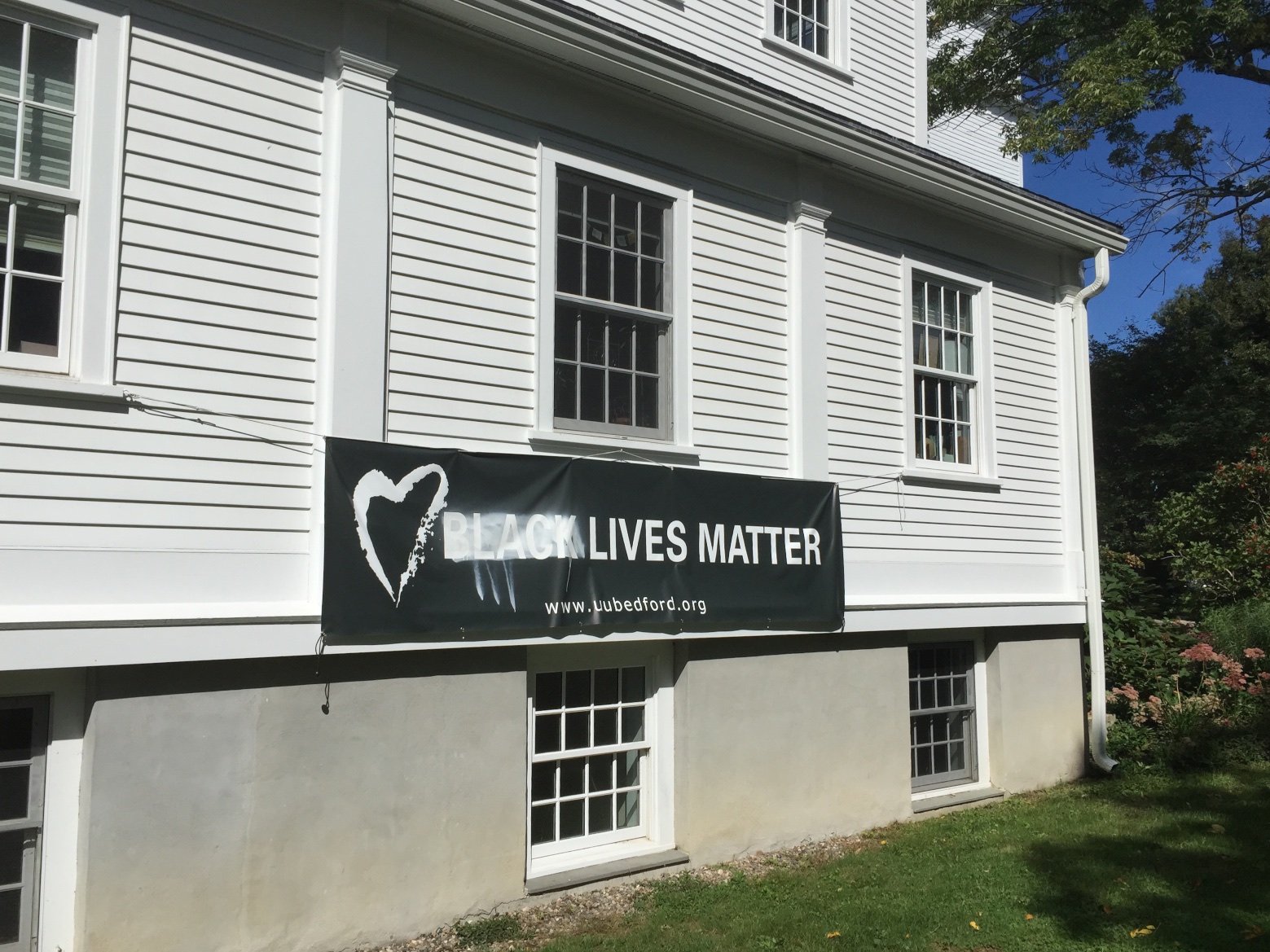
One effect of the War on Cops meme is to justify aggressive actions against BLM and its allies, one of which hit home for me this weekend. My church (First Parish in Bedford, Massachusetts) has been displaying a Black Lives Matter banner on the side of our colonial-style building. Saturday night it was vandalized, as shown below. The church has a predominantly white professional class membership and sits in the middle of politically blue New England. But that didn’t protect our banner.

It turns out such vandalism is fairly common. If you google “church black lives matter banner vandalized”, you’ll find a bunch of them — including a church in Bethesda, Maryland whose banner was vandalized twice and then stolen.

This kind of thing may seem like a harmless prank if you haven’t thought about it much, but when it happens to you it feels like a warning shot: People don’t like what you’re saying, and they know where you live. They’re not afraid to break the law to shut you up.

banner

My church yesterday.

and the Republican debate

This is how dedicated I am to staying on top of the news: I watched the whole effing three hours of it. (If you have done something bad recently and need to punish yourself, you can too: Here’s the video and transcript.) My horror at the more-or-less complete denial of reality is covered in “Three Hours in Bizarro World“.

My general impressions about the horse-race aspects of the debate pretty much tracked everyone else’s: If I turned off my internal fact-checker, Fiorina looked impressive. She was confident and authoritative; she handled the men well. Rubio also looked strong.

Trump was Trump; if you liked him before, you probably still like him. But he did seem to shrink as the debate got more wonky. So if I were the RNC, I’d push for wonkier questions in future debates, and hope that makes him look like the short kid in a game of keep-away.

I can’t judge Ben Carson, probably because I have so little in common with his target audience. I thought he was unimpressive in this debate, but that’s what I thought about the last debate, and his support jumped afterward.

If I had to pick out a loser, I’d choose Scott Walker. Nothing he said was memorable. He has mastered boilerplate conservative rhetoric, but can’t put any zing into it. I couldn’t tell whether Bush did himself any good or not.


The first post-debate poll more-or-less validated everybody’s first impressions: Fiorina up, Trump still leading, but with less support, Carson slipping, Rubio up a little, and Walker crashing.

and Bernie Sanders at Liberty University

I want to write about this speech, but the story got crowded out by the Republican debate. I’ll get to it. In the meantime, you can watch for yourself.

One comment I will make: Liberals need to do more of this. We shouldn’t write people off just because they happen to live in a conservative stronghold or belong to a conservative demographic.


One way you can tell that Bernie Sanders is becoming a more credible candidate is that the Right has begun trying to take him down. Up until now, they’ve been expressing a grudging respect for him, because they saw him as damaging the candidate they were really worried about, Clinton.

But last Monday the WSJ printed a scary headline about the $18 trillion price tag for Sanders’ proposals over the next decade. The Nation looked at that a little closer: Most of that $18 trillion is the $15 trillion that creates a Medicare-for-all single-payer healthcare system. So that’s not a new expense for the American people, it’s just a shift of resources from private insurance to public insurance.

Then you get to figure in the fact that Medicare has proven to be more efficient than private insurance.

According to Gerald Friedman, an economist at the University of Massachusetts at Amherst who authored the analysis cited by the Journal, that transition would reduce American healthcare costs by almost $10 trillion over 10 years through economies of scale, better control of pharmaceutical costs, and savings on administrative bloat. … Sanders’s Medicare expansion would cost $15 trillion, but without it American businesses and taxpayers would spend $20 trillion over the same period, while still leaving millions uninsured.

So, not that scary after all.


I mean, I couldn’t really be so shallow as to choose a candidate based on who has the coolest t-shirt, or advise you to do the same, but … isn’t this a seriously cool t-shirt?

and Republican candidates and Muslims

Donald Trump raised eyebrows by not challenging a questioner at a New Hampshire rally who said that Muslims are “a problem in this country” and that “we know our current president is one”. Further, President Obama is “not even an American”. The guy asked “when can we get rid of them?” Them in this case seems to refer to training camps where Muslims learn to “kill us”, though some people have interpreted them to mean American Muslims. It’s also a little vague whether the questioner intended to say that such camps are here in America.

Trump gave an evasive answer about how “We’re going to be looking into that and plenty of other things”. Sunday on ABC’s This Week, Trump refused to answer questions about the incident.

But other Republicans did answer questions. Ben Carson said he believes President Obama is a Christian and said “I certainly would not have accepted the premise of a question like that.” But he went on to say that a candidate’s faith should matter to voters “if it’s inconsistent with the values of America. … But if it fits within the realm of America and [is] consistent with the Constitution, no problem.”

In a subsequent interview, he was more explicit: “I do not believe Sharia is consistent with the Constitution of this country.” He added that if a Muslim candidate “publicly rejected all the tenants of Sharia and lived a life consistent with that, then I wouldn’t have any problem.”

Nobody ever asks the follow-up questions I’d like to hear: Are some versions of Christianity — Dominionism, say? — also inconsistent with the Constitution? If not, what’s principle distinguishes Dominionism from Sharia?

but only liberals were talking about Jade Helm 15

which ended Tuesday without establishing martial law in Texas or any other state. Or at least that’s what they want us to think. Maybe martial law was established, but we all don’t notice because of mind-control beams from the cell towers or something.

My Google search of Alex Jones’ Infowars site didn’t turn up anything about the Jade Helm 15 military exercise since mid-July, but back in March he was warning: “This is in preparation for financial collapse, or maybe Obama not leaving office.”

JH-15 exemplifies how the extreme right wing keeps its followers in perpetual fear: Instead of a Jade Helm retrospective admitting that none of the wild predictions had panned out, Tuesday’s Infowars was full of new warnings about the dangers of taking in Syrian refugees, who might be jihadi infiltrators.

Same pattern for the NRA: You never see a retrospective about how Obama will be out of office in a year and a half, but he still hasn’t taken away anybody’s guns. No, no — the gun seizure is going to start any minute now. It’s been any-minute-now for six and a half years.

The Right is like an apocalyptic cult. No such cult ever throws a party to celebrate the fact that the world didn’t end when it was supposed to — next Monday, by some accounts — much less reviews what they got wrong and or draws the lesson that everybody should be more skeptical the next time somebody thinks he sees signs of the End. There’s never any time for that, because there’s always a new apocalypse to worry about, and its countdown clock is getting dangerously close to zero.

and you also might be interested in …

Arnold Schwarzenegger has been named as the new host of Celebrity Apprentice. The punch line to that story is so obvious I can’t even figure out who said it first: Donald Trump has lost his job to an immigrant!


August numbers are in: 2015 is still on pace to be the hottest year on record. If trends continue, it will break 2014’s mark by a considerable margin.


How climate-change deniers sound to normal people.


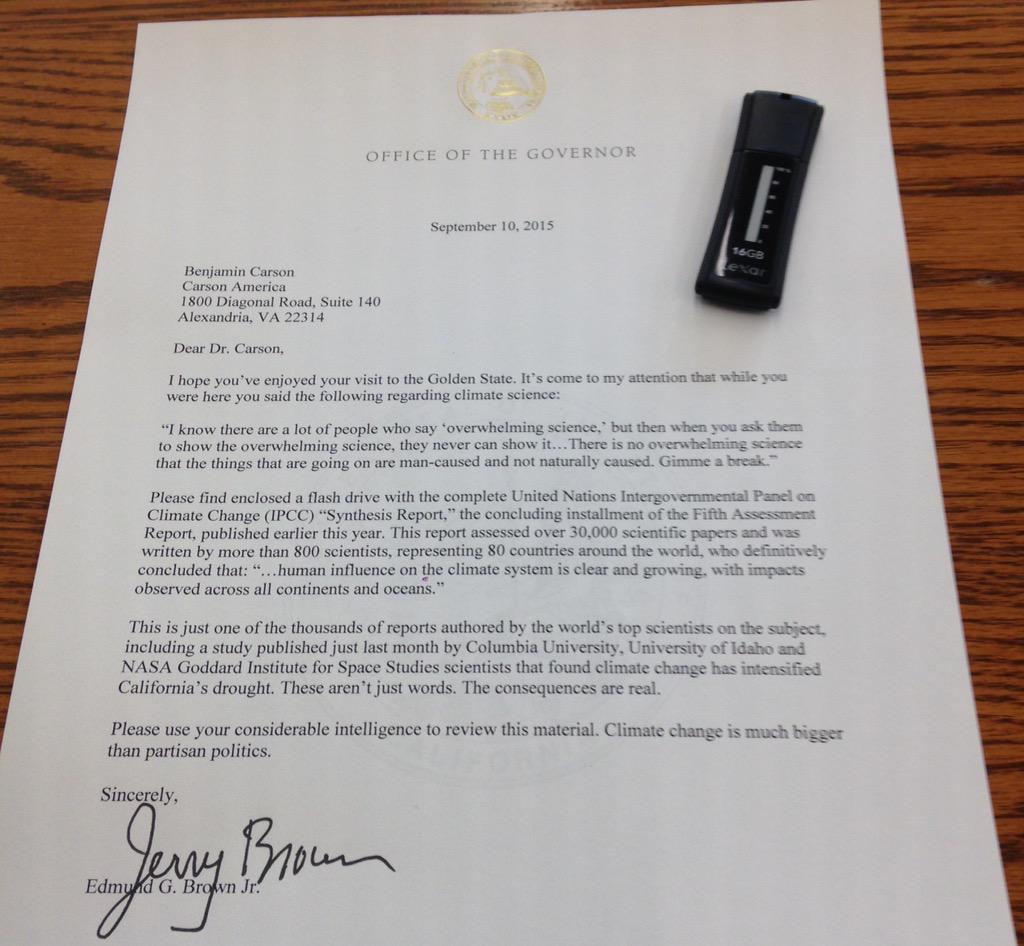
While I’m talking climate change, you have to love Jerry Brown’s response to Ben Carson’s statement: “I know there are a lot of people who say ‘overwhelming science’, but then when you ask them to show the overwhelming science, they can never show it.”

Brown wrote Carson a letter on official Governor of California stationery, and enclosed a thumbdrive containing the most recent report of the UN’s Intergovernmental Panel on Climate Change.


AP points out the obvious: Republican rhetoric about inequality doesn’t influence the tax plans they propose, in which tax cuts overwhelmingly go to the richest. Citizens for Tax Justice does the numbers on Jeb Bush’s proposal: The poorest 20% of taxpayers would see an average cut of $227, while the richest 1% would get an average cut of $82,392.


Vox connects the media’s credulousness at Jeb’s tax claims with its hyperfocus on Clinton’s emails, and recalls what happened in 2000: Every little wardrobe choice by Al Gore got dissected for evidence of inauthenticity, while W’s absurd claims that his tax cuts were fair and wouldn’t wreck the budget went unanalyzed.


National Review‘s current disgust with Donald Trump’s followers prompts Jeet Heer at The New Republic to look at the history of the “snobs vs. slobs” struggle inside the conservative movement. The often-repeated story that William F. Buckley excommunicated the John Birchers (I think I’ve repeated that one myself) is a little more complicated.

and let’s close with something

A horror becomes an adventure if you live to post the video. Here, a driver escapes the fires in Anderson Springs, California.

Three Hours in Bizarro World

Republican presidential debates have made fact-checking obsolete.


In a typical political debate, fact-checkers play the same role that referees do in football: They apply standards and call penalties. And like referees, they depend on the fact that violations are fairly rare. The football-refereeing system works because, even on plays that draw flags, 20 or 21 guys do more or less what they are supposed to do, making the one or two violations stand out. But nobody could referee a game in which all the players ran around the field doing whatever.

In the same way, fact-checking works pretty well when the checkers just need to catch those half-dozen-or-so moments when somebody misquotes a statistic or gets a date wrong. If a debater cherry-picks data to “prove” a point, or oversimplifies a complex situation, a checker can introduce additional information to give readers a more complete picture — as long as it doesn’t happen too often.

But when standards of truthfulness and accuracy vanish as completely as they did in Wednesday night’s Republican presidential debate (here’s the video and transcript), fact-checking is out of its league. When the consensus of participants is that they would rather discuss an alternate reality, picking out a handful of “errors” the next morning just doesn’t address the situation.

So, for example, the debate’s most memorable moment, the one that caused a lot of observers to pick Carly Fiorina as the “winner”, was her denunciation of Planned Parenthood. In that short speech, she didn’t simply quote some numbers out of context or use an unjustified pejorative term, she invented an entire scene from the undercover videos attacking Planned Parenthood, described it in graphic detail, and then dared Barack Obama and Hillary Clinton to watch it. [1]

And Fiorina looked most presidential when she rattled off all the things America should be doing to intimidate Putin out of meddling further in Syria — unless you realize that President Obama is pretty much doing all that already.

It’s 9-11. Do you know who your president is?

Or consider the evening’s biggest applause line: when Jeb Bush responded to Donald Trump’s characterization of his brother’s presidency as “a disaster”: “You know what? As it relates to my brother, there’s one thing I know for sure. He kept us safe.”

Well, except for that one time, when (after ignoring warnings in intelligence briefings) President Bush lost far more Americans to terrorism in one day than President Obama has in seven years, and then in response lost thousands more American soldiers attacking a country that had nothing to do with 9-11 — removing a secular government that was keeping Islamic radicals in check and neutralizing Iran’s biggest rival in the region — while letting Osama bin Laden escape and stay hidden until Obama nailed him years later.

If that’s what you mean by “keeping us safe”, then sure, President Bush totally kept us safe. And the audience at the Reagan Library loved it, though what I heard them applauding was not Jeb himself, or even W’s record, but a candidate’s willingness to stand tall and spit in the face of an uncooperative Reality. That’s the quality Republicans seem to be looking for in a president this time around.

As for the Planned Parenthood videos, Ted Cruz had his own fantasies:

On these videos, Planned Parenthood also essentially confesses to multiple felonies. It is a felony with ten years’ jail term to sell the body parts of unborn children for profit. That’s what these videos show Planned Parenthood doing.

In a word: no. Even after being doctored, the videos don’t show that, “essentially” or any other way. If they did, a political smear campaign against the organization wouldn’t be necessary; you could just prosecute them.

Speaking of prosecution, Chris Christie didn’t just repeat his previously debunked lie about being appointed U.S. district attorney on September 10, [2] he spun a crowd-pleasing fantasy about prosecuting Hillary Clinton for the wildly overblown email “scandal”.

The question is, who is going to prosecute Hillary Clinton? The Obama White House seems to have no interest, the Justice Department seems to have no interest. I think it’s time to put a former federal prosecutor on the same stage as Hillary Clinton.

(APPLAUSE)

And I will prosecute her during those debates on that stage for the record we’re talking about here. The fact she had a private email server in her basement, using national security secrets running through it, could have been hacked by the Russians, the Chinese, or two 18-year-olds on a toot wanting to have some fun. [3]

Then there was Donald Trump connecting vaccines to autism — a well-studied theory that has been pretty thoroughly debunked. [4] Ben Carson, a doctor who knows better, briefly alluded to that reality, but then acquiesced to Trump’s implication that the currently recommended schedule of vaccines might cause harm, even if the individual vaccines are safe. He did not comment when Trump then told an anecdote about a child whose autism appeared shortly after vaccination. Rand Paul, who has an M.D. from Duke, volunteered his support to Trump: “I’m also a little concerned about how [vaccines are] bunched up.” [5]

No one then protested when Mike Huckabee segued from “controversies about autism” to another topic. Because there are no scientific facts on Bizarro World, there are just “controversies” — like climate change or evolution — that people can believe whatever they want about.

So how do you “fact check” that exchange? That’s not just one lineman jumping offside, it’s a rugby scrum breaking out in the middle of a field goal attempt. Throwing a flag just won’t cover it.

With all that going on, who has time for the ordinary job of a fact-checker? Like flagging Scott Walker’s absurd exaggeration that his pamphlet on healthcare is “an actual plan” to repeal and replace ObamaCare, which puts him in a position “on day one” to “send a bill up to Congress”. [6] Or ridiculing Marco Rubio’s non sequitur that “America is not a planet” as an excuse for doing nothing about climate change. Or pointing out Donald Trump’s often-repeated falsehood about birthright citizenship, that

Mexico and almost every other country anywhere in the world doesn’t have that. We’re the only ones dumb enough, stupid enough to have it. [7]

Compiling a list of errors for this debate would be misleading. Such lists imply that the rest was more-or-less correct, like the football plays that don’t draw penalties. But the specific divergences from reality that I have called out are like Jonathan Swift’s fleas: the closer you examine the text, the more you will find, without limit.

So I deny any claim that I have “fact-checked” the Republican debate. I spent three hours in Bizarro World, and while I was there I saw some strange things. But there was much, much more to see.


[1] How, I wonder, are Obama and Clinton supposed to accept Fiorina’s dare, when even the makers of the video can’t produce the scene she has conjured up?

[2] It’s not fair to mention that lie without also busting Carly Fiorina’s ridiculous secretary-to-CEO claim. Fiorina temped as a secretary during summer vacations from Stanford. Paul Krugman comments:

If her life is a story of going from “secretary to C.E.O.,” mine is one of going from mailman to columnist and economist. Sorry, working menial jobs while you’re in school doesn’t make your life a Horatio Alger story.

I picked up a few extra bucks as a busboy one New Year’s Eve, and then just a few years later I had a Ph.D. in mathematics! If that’s a rags-to-riches story, then just about every successful person in America has one.

As the pro-Carly site fromsecretarytoceo.com will tell you, she grew up in “a modest, middle-class family”, i.e., her father, Joseph Tyree Sneed III, was dean of Duke Law School before becoming Deputy Attorney General and then a federal judge.

Let’s not even get into her record as CEO of HP. The WaPo has that covered.

[3] The image of national security being endangered by Hillary’s emails seems to be completely bogus. The heart of the issue has been described by The Wall Street Journal as a “bureaucratic turf war over complicated issues of classification”, i.e., whether information that the State Department considered unclassified at the time should have been reclassified, after input from other departments.

David Ignatius talked to experts whose opinions mirror what I remember from when I had a security clearance:

First, experts say, there’s no legal difference whether Clinton and her aides passed sensitive information using her private server or the official “state.gov” account that many now argue should have been used. Neither system is authorized for transmitting classified information. Second, prosecution of such violations is extremely rare. Lax security procedures are taken seriously, but they’re generally seen as administrative matters.

Where I used to work, a security violation — like leaving a secret document overnight in your desk drawer rather than locking it up in an approved safe — could earn you and your boss a very uncomfortable meeting with the security department. Repeated violations like that could probably get you fired, though I didn’t know anybody that happened to. But criminal charges were reserved for intentional espionage, not screw-ups. So the Obama administration and the Justice Department “have no interest” in prosecuting Clinton because there is no reason to do so.

[4] Autism tends to get noticed at about the same age as certain vaccines are administered. That seems to be the whole connection between the two. So there are bound to be a number of children whose autism is discovered shortly after they get vaccinated. If that correlation-in-time happens to your child, I’m sure the evidence against vaccinations seems compelling. But eliminating that kind of illusory causality is why we do scientific studies.

[5] The New York Daily News asked the head of New York City’s health department to comment:

The CDC guidelines aren’t willy-nilly. Infants are at greater risk of complications from these diseases. That’s why we give the vaccinations to infants. There’s no evidence to support the notion that too many shots are being given too quickly. An infant’s immune system can handle it. … What we do know is that when parents delay immunizations, it puts their children at risk of acquiring life-threatening infections.

But conservative “news” site Breitbart.com headlined this exchange differently: “Donald Trump, Ben Carson, and Rand Paul Foil Jake Tapper Vaccine Ambush“. By working together, the candidates saved Bizarro World from a reality-based invasion.

[6] For example, here’s Walker’s complete section on services for long-term illnesses like Alzheimer’s:

One of the greatest threats to middle-class American families is the obligation to pay for long-term services and supports (LTSS) for seniors who develop chronic or disabling medical problems. My plan would reform existing regulations to better protect middle-class families from financial hardship and to prepare for future LTSS. It would also deregulate the current Long-Term Care insurance market to allow the private sector, including health insurers, to offer products that reflect consumer demands for assistance at home. When LTSS and acute care services are coordinated, the cost of each can be lowered.
Does that sound like it’s ready to be passed into law “on day one”?
[7] In reality, it’s a New World vs. Old World thing. European countries by and large don’t have birthright citizenship, but most countries in the Western Hemisphere do, including Mexico and Canada. This has been pointed out often enough that Trump either doesn’t want to know it, or does know it and lies about it anyway.

The Monday Morning Teaser

I wanted to write about Bernie Sanders speaking at Liberty University — I really did — but I couldn’t stay away from the bright shiny object of the Republican debate. Watching it was one of those what-color-is-the-sky-on-your-planet experiences for me, a departure from reality that ordinary fact-checking just can’t cope with. So this week’s featured article is “Three Hours in Bizarro World”. It should be out around 8 EDT.

The weekly summary has a lot to cover: Ahmed Mohamed’s clock-that-wasn’t-a-bomb, of course; the escalating attacks on Black Lives Matter; Jade Helm 15 ending as the simple military exercise the Pentagon always said it was, without overthrowing democracy-as-we-know-it; a few notes on Bernie Sanders in lieu of a full analysis of his message to Evangelical Christians; and a bunch of other stuff, before closing with a harrowing escape from California wildfires. I still have a lot of paragraphs to finish and references to check, so let’s guess that appears around noon.

BTW, I won’t be sifting in the coming week. But if you happen to be in west central Illinois (or across the Mississippi in northeastern Missouri or southeastern Iowa) Sunday morning, you can hear me talk at the Unitarian Church of Quincy.

Invoking 9-11

Invoking 9/11 to attack diplomacy with Iran would be like criticizing Nixon going to China because of Pearl Harbor.

Chris Hayes

This week’s featured post continues the 2016 Stump Speech Series with Ben Carson.

This week everybody was talking about the Iran deal

which is going to go into effect, now that Senate Democrats have stuck together to block a resolution of disapproval. Meanwhile, the House defeated a resolution of approval, which seemed mostly a moot point after the Republican leadership decided not to bring a resolution of disapproval to the floor. Even if a disapproval resolution could pass the House, the vote on the approval resolution indicated that Democrats had enough votes to sustain a veto.


Ted Cruz organized a rally against the Iran deal, but was upstaged by Donald Trump. I agree with TPM contributor Jason Stanford‘s assessment:

The pity of this all [i.e., Trump’s rhetoric about “winning”] is that the Iran deal shows how America can lead (and win!) in an increasingly disorganized world. We negotiated with Iran from a position of strength. We had support from our European allies. We had Iran’s billions in our banks. Behind door number one was Iran giving up their nuclear weapons program. Behind door number two was Iran becoming the next destination for Drone Airlines. The United States gave up nothing in this deal. In exchange for their own money, Iran gave us what we wanted: an Iran without The Bomb.

This is what winning looks like. This is our enemy surrendering their weapons without a fight not because they love us but because they know they would not survive the fight.

As I said.


The White House couldn’t resist pointing out that Dick Cheney is the last person we should be listening to about diplomacy or the Middle East.

and Kim Davis getting out of jail

at least until she starts refusing marriage licenses to gay couples again. She appears to be walking a fine line: She won’t issue such licenses herself, but she won’t prevent deputies from doing so, as long as the licenses are attributed to a court order rather than her authority as county clerk. She doubts whether such licenses are valid, but I’m not sure who would have both the standing and the inclination to test that in court. So it looks like same-sex couples in Rowan County, Kentucky will indeed get the equal protection of the laws.


Mike Huckabee made a political spectacle out of Davis release (and managed to shut Ted Cruz out). Watching the rally outside the jail, or the clips from it shown on the news networks, you might have imagined that Huckabee played some role in freeing her. But no, he was just cashing in on her publicity stunt.

An amazing amount of nonsense is being repeated about the Davis story, and you can find almost all of it in Huckabee’s comments. For example, he emphasized the unfairness of Davis being held without bail.

Jeffery Dahmer got bail, the Boston Stranger got bail, John Wayne Gacy got bail. Kim Davis, because of her convictions, was not given bail.

But bail is for people who are still innocent until proven guilty, even if what they’re charged with is horrible. Contempt of court is a finding of the judge, who has already ruled, so the comparison to Dahmer is silly — Dahmer didn’t get bail after he was found guilty.

In general, bail for contempt of court would be nonsensical, because sitting in jail until you comply with the court’s order is the whole point.

And then there’s this Huckabee gem:

If somebody needs to go to jail, I’m willing to go in her place and I mean that because I’m tired of watching people being just harassed because they believe something of their faith.

Of course, jailing Huckabee would make absolutely no sense, since he wasn’t the one defying a court order. Punishing one person for the deeds of another is substitutionary atonement, which doesn’t even make sense in religion, much less in law.


Nobody who defends Davis wants to answer questions about how far their religious-freedom principle applies. On MSNBC’s Morning Joe, co-host Mika Brzezinski asked the same question I raised last week: Can a clerk who takes Jesus’ denunciation of divorce seriously refuse to issue marriage licenses to divorced people? Huckabee danced and dodged and never did answer.

Ben Carson was asked the same question by Fox News’ Megyn Kelly, and also danced, but not quite as well:

This is a Judeo-Christian nation, in the sense that a lot of our values are based on a Judeo-Christian faith. And when there are substantial numbers of people who actually believe in the traditional definition of marriage — I’m one of them, doesn’t mean that I don’t think other people can do whatever they want to do, but I don’t actually believe that they have a right to force their way of life upon everybody else, nor would I try to force my way of life upon everybody else.

To the extent that response means anything at all, Carson seems to be claiming special rights for conservative Christians, because there are “substantial numbers” of them and because he believes that their faith defines the nation. I think that’s what just about all of Davis’ supporters believe, but most don’t want to admit it.


Apparently this billboard just went up in Davis’ home town.

I made a similar point once:

You can accurately describe American marriage after 1981 in a lot of ways, but “traditional marriage” is not one of them. I don’t know of any traditional society where husbands and wives have been equal under the law.

or maybe twice:

In the case of same-sex marriage, the main thing that has changed since the Founding era isn’t the Supreme Court, it’s opposite-sex marriage. In 1789, any gay or lesbian couple claiming they had a right to marry would have been laughed out of John Jay’s Supreme Court, and rightfully so. That’s because in a truly “traditional” marriage husband and wife are legally distinct roles that can only be filled by people of the appropriate gender.


One proposed solution to Kim Davis’ problem is the First Amendment Defense Act. Walter Olson explains what’s wrong with it: The FADA explicitly grants rights to anyone who “believes or acts in accordance with a religious belief or moral conviction that marriage is or should be recognized as the union of one man and one woman, or that sexual relations are properly reserved to such a marriage.”

In other words, your rights under FADA depend on whether you have the proper beliefs.

Astoundingly, the protection would run in one direction only: It would cover those who favor traditional definitions of marriage, while leaving those who might see merit in same-sex marriage or cohabitation or non-marital sex perfectly exposed to being fired, audited or cut off from public funds in retaliatory ways.

In real-life governance, of course, there is no reason to think that wrongful pressure on dissenters cuts only one way: Some federal employees get targeted by their bosses for leaning right, others for leaning left. Under FADA, however, only one side gets to run to court complaining of ill treatment.

Olson concludes:

FADA as currently drafted isn’t really an accommodation law. It’s an our-guys-win law.


It looks like a shoot-out over Kim Davis will be avoided, but right-wing crazies are coming closer and closer to insurrection. Oath Keepers — one of the groups of armed wackos that intimidated federal agents out of enforcing the law on public-land-moocher Cliven Bundy — announced that it was sending armed guards to protect Kim Davis from being arrested again, if she went back to defying the court. What could possibly go wrong with that plan?

Fortunately, Davis rejected the offer and seems to be trying to avoid giving the court grounds for re-arrest rather than angling to go out in a hail of gunfire. So this time we were just one lunatic short of that scenario.

One aspect of the armed-patriot movement that never gets enough attention is its white privilege. Imagine Black Lives Matter defying a court order and the New Black Panthers sending armed guards to protect BLM leaders from arrest by U.S. marshals. Is there any chance that wouldn’t end in a bloodbath? And wouldn’t the same people who support Oath Keepers and Kim Davis now be cheering when it did?


While we’re talking about insurrection, a poll finds that 43% of Republicans could imagine supporting a military coup in the United States.

but not enough people are talking about Republican attempts to sabotage the next climate-change agreement

The Paris Climate Conference starts in November. Wikipedia says

The conference objective is to achieve a legally binding and universal agreement on climate, from all the nations of the world.

If you’ve been listening to the campaign speeches of Republican candidates, one of the biggest objection they make to the United States taking any action against climate change is that one nation acting along can’t accomplish anything.

Carly Fiorina:

What all the scientists also tell us is that a single state, or single nation acting alone can make no difference acting alone. … California can be the most onerous regulatory regime in the world, which they are, and it won’t make a bit of difference in climate change.

Rick Santorum:

Is there anything the United States can do about it? Clearly, no. Even folks who accept all of the science by the alarmists on the other side, recognize that everything that’s being considered by the United States will have almost – well, not almost, will have zero impact on it given what’s going on in the rest of the world.

Marco Rubio:

America is a country, it’s not a planet. So we can pass a bunch of laws or executive orders that will do nothing to change the climate or the weather but will devastate our economy.

So you might expect Republicans to applaud the prospect of getting the rest of the world to act in concert. I mean, you could imagine U.S. climate rules driving jobs away to India, but new world rules aren’t going to send jobs to Mars.

Well, guess again. Politico reports:

Top Republican lawmakers are planning a wide-ranging offensive — including outreach to foreign officials by Senate Majority Leader Mitch McConnell’s office — to undermine President Barack Obama’s hopes of reaching an international climate change agreement

Jonathan Chait asks and answers the obvious question:

Why would Republicans try to persuade the rest of the world to keep pumping carbon dioxide into the atmosphere? One reason is that, while other countries transitioning to low-emission fuels may not cost American consumers anything, it definitely costs American fossil-fuel companies. People who own large deposits of coal and oil want to sell it abroad. The Republican climate-change strategy has been hatched by a group of Republican politicians and fossil-fuel lobbyists so tightly intermingled there seems to be no distinction between the interests of the two.

… In any case, the old conservative line, with its explicit or implicit promise that international agreement to reduce emissions might justify domestic emissions cuts, has suddenly become inoperative. The speed at which Republicans have changed from insisting other countries would never reduce their greenhouse-gas emissions to warning other countries not to do so — without a peep of protest from within the party or the conservative movement — says everything you need to know about the party’s stance on climate change.


I haven’t figured out a good way to research the question I’m asking, so I’m mainly just trusting my own (possibly nostalgic) impressions. But didn’t politics used to stop “at the water’s edge“? In the Obama Era, congressional efforts to torpedo American diplomacy have become normal. But I can’t remember anything similar in past administrations, certainly not supported by the leadership of the party out of power.

and you also might be interested in …

Today’s Great Moment in Irony:


Jon Chait has turned optimistic on climate change.


Surprise! “Jeb Bush’s Tax Plan is Mostly a Giveaway to the Rich“. Who could have predicted?

While the full details are still vague, the basic outline lowers the corporate tax rate, offers a reduced tax rate on money corporations have stashed overseas, cuts the top individual rate from 39.6% to 28%, and ends the estate tax altogether, so that dynasties of inherited wealth can dominate America even more than they do now.

You might wonder what will replace that revenue and prevent the kind of massive deficits his brother’s tax cuts caused. Growth! It didn’t work for W, but Jeb’s tax cuts will boost GDP growth to 4% per year. Because he says so.


The New Yorker‘s Amy Davidson did the research I only fantasized about, and answered the conservatives who have been comparing the Supreme Court’s same-sex marriage decision to Dred Scott.

In fact they have backwards “which side in the marriage debate has inherited the Dred Scott legacy”: In the 7-2 decision saying that blacks could never be citizens and had “no rights which the white man was bound to respect”, the majority 7 were interpreting the law the way today’s conservatives do, and the dissenting 2 were making the arguments of today’s liberals.

In particular, the Dred Scot 7 invoked original intent, arguing that since the man who wrote “all men are created equal” was a slave-owner, clearly the Founders did not intend the so-called “rights of man” to extend to blacks. Chief Justice Taney wrote that

No “change in public opinion” about the races “should induce the court to give to the words of the Constitution a more liberal construction.”

Today’s conservatives argue that letting same-sex couples marry degrades the institution of marriage. In 1857, Justice Daniel made the same argument about blacks and the institution of citizenship.

Justice Kennedy’s rhetoric about the “dignity” of same-sex relationships is often mocked as his own moral invention rather than a strictly legal argument. Justice McLean’s Dred Scott dissent had similarly lofty rhetoric:

A slave is not a mere chattel. He bears the impress of his Maker, and is amenable to the laws of God and man, and he is destined to an endless existence.

McLean made a living-Constitution argument that would be familiar to today’s liberals:

McLean acknowledged both the sorry racial views of the Founders’ time and the allowance for slavery in the Constitution, but he suggested that the language used could have a better meaning in a freer era. Madison, he noted, was careful to keep out of the Constitution words that “convey the idea that there could be property in man.” (Indeed, the Constitution never refers to a “slave” but to a “person held to service or labor.”) There was always more of a debate about slavery, and a consciousness of wrong, than Taney let on. The Constitution has, built into it, a hope for change.

This is a rich article and has much more to it. Go read it.

and let’s close with something sentimental

Namely, a celebration of Dads.