The Trump Administration: What I’m watching for

So far, I haven’t been tempted to protest against President-elect Donald Trump, at least not yet. If I am angry at all right now, it is at the swing-state voters who put him in office, not at him for taking advantage of our ridiculous Electoral College system, which allowed him to win when Hillary Clinton got more votes (about 1.7 million more, at last count). But demonstrating support for immigrants, Muslims, gays, and others who feel threatened by a Trump administration is a different matter.

Mostly for the sake of my own sanity, I have resolved not to react to things Trump hasn’t done yet. So, for example, in this week’s summary post I will comment on the appointments he has made, but not on the people he is rumored to be considering. During the next four years, I expect to see plenty of actions worth objecting to. But this will be a marathon, not a sprint, so I see no reason to jump the gun.

That said, I am also not naively hoping for the best. I am watching the Trump administration closely, and will be quick to object as soon as there are actions worth objecting to. Here is a list of the primary things I’m watching for, starting with the most mundane:

Taking credit for Obama’s accomplishments. President Obama has left his successor a country in much better shape than the one he inherited from President Bush. Republicans in general and Trump in particular have refused to give Obama credit for his accomplishments, or even to recognize good news when it appeared. Now Trump is in a position to acknowledge American success and take credit for it.

So, for example, ISIS has been losing territory for some while now. Mosul, its last stronghold in Iraq, is cut off and likely to fall in the next few months. Its de facto capital of Raqqa is under attack in Syria. If events continue on their current path, sometime in 2017 President Trump will be able to declare victory in the territorial struggle, though ISIS will continue to be a significant underground movement. That victory will be the result of Obama’s strategy, but I expect Trump to crow about how “America is winning again.”

Similarly, expect Republicans to suddenly notice that the number of undocumented immigrants is dropping, gas prices are down, unemployment is low, and that rates of murder and other major crimes are at their lowest levels in decades. Already, Gallup reports that Republicans have drastically changed their opinion about how well the economy is doing: “Just 16% of Republicans said the economy was getting better in the week before the election, while 81% said it was getting worse. Since the election, 49% say it is getting better and 44% worse.”

The beauty of this (from Trump’s point of view) is that no lying is necessary. On the contrary, all he has to do is stop lying about the state of country, and bask in the glow of instant success.

Taking credit for averting dangers that never existed. This has already started. Trump is taking credit for keeping a Kentucky Ford plant from moving to Mexico, when Ford never had a plan to move it. Who knows what he’ll prevent next? War with Belgium, maybe. By May, he will have decisively beaten winter.

In the conspiracy-theory swamps where many Trump supporters live, this will be incredibly easy: All they have to do is celebrate the end of things that never existed to begin with: You know those FEMA detention camps where anti-Obama dissidents were going to be sent? Trump closed them! They’re gone.

I’m reminded of a joke about a political leader answering charges of nepotism. Asked why his mother was on the public payroll, he explained that she oversaw the government’s anti-tiger policy. “But there are no tigers for a thousand miles,” the interviewer objected. “Don’t thank me,” the leader responded. “Thank Mom.”

Profiteering. This picture is worth a thousand words:
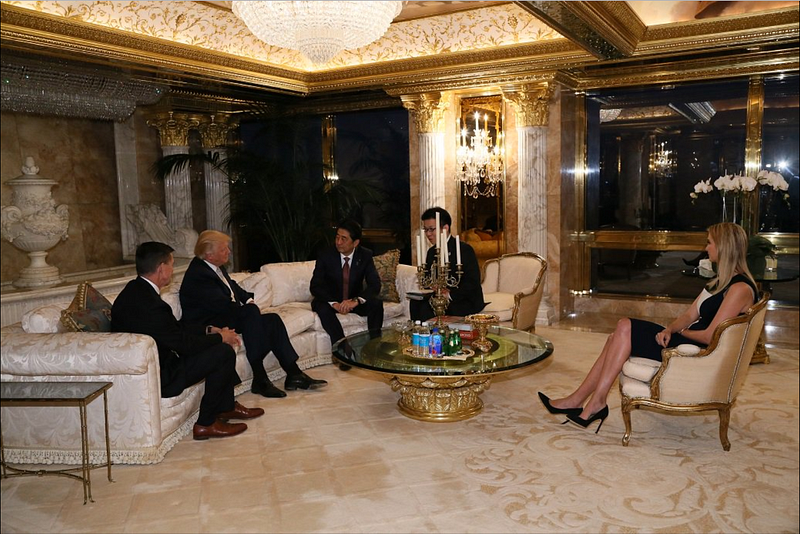
It’s President-elect Trump’s first meeting with a foreign head of state: Japanese Prime Minister Shinzo Abe. And who is that in the chair on the right? Ivanka Trump, the daughter who is expected to take control of Trump’s business interests.

It’s a staged photo, and the message it sends is unmistakable: There will be no distance between Trump’s government and Trump’s profit-making enterprises. The Trump children have all played significant roles in the transition, so many officials in the new administration will be in their debt. And presumably they will continue to have their father’s ear after the inauguration, even as they negotiate deals in foreign countries.

This week, Trump also met with three businessmen who are building Trump-branded properties in India. Two are sons of a member of India’s Parliament.

What this means is that there is a wide-open door for foreign governments to bribe President Trump: Go to Ivanka (or maybe even directly to Donald) and cut a lucrative deal to build a new Trump Tower in your capital city. Or if you are afraid the President is going to do something you don’t like, threaten to cancel such a deal.

This kind of thinking is toxic:

In interviews with a dozen diplomats … some said spending money at Trump’s hotel is an easy, friendly gesture to the new president.

“Why wouldn’t I stay at his hotel blocks from the White House, so I can tell the new president, ‘I love your new hotel!’ Isn’t it rude to come to his city and say, ‘I am staying at your competitor?’ ” said one Asian diplomat.

So if you’re competing against a Trump business, you’re competing against the Trump administration. It’s one enterprise now.

All this runs afoul of the Emoluments Clause of the Constitution, which conservatives were inclined to interpret strictly when imagining President Hillary Clinton. Unless Trump has some amazing plan he hasn’t announced yet, his violation of the Clause looks likely to be far more blatant than anything Clinton did or was even accused of doing. So we’ll soon see which conservatives have actually been serious about that uphold-the-Constitution rhetoric.

Changing the electorate. All through the campaign, conservative voices like Laura Ingraham have been referring to the Trump campaign as “the last chance, last stand for America as we know it”. The racial dog whistle there is pretty obvious: “America as we know it” is White America, and the electorate becomes a little less white every year.

To a certain extent that process can be slowed down by preventing non-white immigrants from becoming citizens. But that won’t change the demographics, because the non-white population is younger and more inclined towards large families. So if you really want to preserve the United States as a white-majority nation, you have to prevent non-whites from voting.

That has been the Republican strategy for several years now. As soon as the Supreme Court opened the door, states governed by Republicans began changing election rules to make it harder to vote, especially for blacks, Hispanics, poor people, and college students. Fortunately, this year courts struck down the most outrageous attempts to rig the electorate, like North Carolina’s.

The court said that in crafting the law, the Republican-controlled general assembly requested and received data on voters’ use of various voting practices by race. It found that African American voters in North Carolina are more likely to vote early, use same-day voter registration and straight-ticket voting. They were also disproportionately less likely to have an ID, more likely to cast a provisional ballot and take advantage of pre-registration.

Then, the court, said, lawmakers restricted all of these voting options, and further narrowed the list of acceptable voter IDs. “… [W]ith race data in hand, the legislature amended the bill to exclude many of the alternative photo IDs used by African Americans. As amended, the bill retained only the kinds of IDs that white North Carolinians were more likely to possess.”

Unfortunately, the federal Justice Department plays a big role in bringing such cases to court, and under Attorney General Sessions it’s likely to get out of that business. (Sessions’ home state of Alabama has been one of the worst offenders, and he has not raised a word of protest.) Then there’s the question of how President Trump’s appointees will stack the courts.

Winking at right-wing paramilitary groups. To be honest, I’ll be relieved if we make it through the next four years with nothing worse than financial chicanery. Much darker stuff is possible.

When we think of fascist governments, we usually picture the police doing things like destroying the printing presses of critical newspapers and dragging their editors off to jail. But that kind of thing only happens at a much later stage. Early on, fascist violence is unofficial: Organized thugs destroy the printing press and send the editor to a hospital, not a jail. Police are not involved, but they show no interest in catching the people who are.

Right-wing violence in America was already a problem before Trump: There are groups that support firebombing abortion clinics and murdering doctors. Hate crimes against blacks, immigrants, or Muslims are usually portrayed as the work of isolated maniacs, but in fact killers like Dylann Roof and Wade Michael Page have had far stronger relationships with organized hate groups than, say, Omar Mateen had with ISIS. The Bundy gang in Nevada has openly challenged the federal government with armed resistance.

An Oathkeeper "protecting" Ferguson

An Oathkeeper “protecting” Ferguson

During the campaign, Trump frequently praised violence and valorized violent responses from his followers. My question is whether this will continue after inauguration and if violent Trump supporters will organize in a brownshirt fashion. Or perhaps already existing groups — Oathkeepers, for example — will shift into this role. Militia groups that organized to resist imaginary “tyranny” from Obama might welcome the opportunity to support an actual tyranny of their own.

And if this happens, how will Trump react? He could condemn such a development, or he could suggest targets to his paramilitary supporters by labeling people as “traitors” or using some similar language.

Richard Engel drew on his observations of other countries to describe the signs of creeping authoritarianism to Rachel Maddow.

If you start to hear the word “traitor” being used a lot about the opposition, that’s a red flag. If those criticisms escalate to “cancer”, that’s an even worse sign. So I think we should be listening for things like that. After that, the next stage would be mass rallies by his supporters that look potentially intimidating. And after that, to see if there’s any kind of call for a referendum to go right to the people to get around the constitutional system.

Subverting government agencies for political advantage. If Trump does intend to push America in an authoritarian direction, institutional forces within the government might resist — or not.

I don’t expect Trump to carry through on his promise to appoint a special prosecutor to go after the Clintons. The whole point of the accusations against Hillary was to defeat her politically and neutralize the Clintons as a political force — not to pursue justice or enforce the law. That political mission has been accomplished now, and attempting to prosecute her would only demonstrate how baseless the charges were.

But the mere fact that he would suggest such a thing is gravely troubling. In America, prosecutions bubble up from investigators, they don’t come down from the President. He has also threatened antitrust action against Amazon because its founder (Jeff Bezos) also owns The Washington Post, which Trump found too critical.

FBI Director Comey’s highly unusual commentary on the Clinton email server problem — ordinarily, an investigation that didn’t produce prosecutions would not be revealed to the public, and certainly not late in an election campaign — as well as the leaks from inside the FBI about some nebulous Clinton Foundation investigation, suggests that there has been considerable political corruption of the FBI already.

The FBI, CIA, NSA, SEC, IRS, and other agencies all have considerable power to make Trump’s critics miserable, as well as to provide valuable information to his business interests. Will they be asked to do so, and will they give in?

Paying Putin back. Trump and Vladimir Putin both know that Trump could not have won without Putin’s help. The Russian hack of DNC and Clinton campaign emails was a major factor in the campaign. We have since found out that the Trump campaign was in regular contact with Russian officials. This should come as no surprise, since former Trump campaign manager Paul Manafort had previously received millions of dollars from pro-Russian organizations in Ukraine.

Two questions immediately come to mind: Will the Russian government continue committing crimes for Trump’s benefit? And what do they want in return?

Obvious ways to pay Putin back include: supporting the Russian-allied Assad regime in Syria, turning a blind eye to further encroachments in Ukraine, or letting Putin dominate our NATO allies in Estonia, Latvia, and Lithuania.


Did I miss anything important? What else should we be on the lookout for?

The Monday Morning Teaser

So here we are, living in the Chinese curse of interesting times, the kinds of times we used to scare the 18-year-olds with. “If you don’t vote, we could wind up …”.

Here we are.

Like most people I know, I’ve been suffering occasional attacks of rage or depression. But it’s also oddly energizing sometimes. If you ever had fantasies of being a hero, well, gear up; the villains are taking the field. It feels like we’re in a trilogy, somewhere around the end of Book Two. Ancient evils have jumped out of history books and grainy newsreels, and are appearing on live TV. Their words and ideas are coming out of the mouths of our neighbors.

Who thought we’d have to deal with this in our lifetimes?

For some while now, everything that you can think to do about the situation is going to seem hopelessly inadequate. But it’s important that you do it anyway. That’s how it is at the end of Book Two. You’re a Hobbit with all of Mordor in front of you, or an Ewok facing a galactic empire. The idea that you’re going to turn things around is laughable. And a lot of the stuff that people think to do will come to nothing, just like it seems. But some of it won’t, and if anybody can say for sure which is which, I haven’t met them yet.

So anyway, today I plan to type a bunch of words onto a screen. It’s what I can think to do. You think that seems hopelessly inadequate? Tell me about it.

The featured post will be a list of the things I’m watching for out of the Trump administration. As bad stuff starts to happen, it’s important that we spot it quickly and see it for what it is. My list starts with mundane stuff (like taking credit for Obama’s accomplishments) and progresses through to scarier things (like winking at right-wing paramilitary groups and paying Putin back for his help in the campaign). I don’t think we should be jumping at shadows by reacting to things Trump hasn’t done yet, but we definitely need to be watching those shadows and preparing ourselves to respond quickly if something comes out of them.

That should come out sometime between 9 and 10 EST.

The weekly summary has a lot to cover, particularly the appointments Trump has been making. (To quote the Sundance Kid, “Who are those guys?”) But also, settling the Trump U lawsuit, the Hamilton flap, whether Democrats should support Trump’s infrastructure plan, that alarming graph about sea ice, and a few other things. And I’ll close by letting They Might Be Giants sing us out.

How did my home town become Trumpland?

[OK, I said I wasn’t going to do a Sift this week, and mostly I’m holding to that. But this single article just popped out.]

On the morning of Election Day, my wife and I cast our ballots in New Hampshire and then started driving west, heading to Quincy, Illinois, where I grew up. I didn’t think I was on a research trip. I just thought we would be visiting friends and that I would give a talk at the local Unitarian church.

We listened to the early returns on the radio, then stopped for the night in Erie, Pennsylvania. I went to bed comparatively early, around midnight. Ezra Klein had just explained why there probably weren’t enough uncounted Democratic votes in Wisconsin to erase Trump’s lead, and I decided I didn’t need to see any more.

At least Illinois was a blue state, called for Clinton shortly after the polls closed. But it differs from Ohio, Wisconsin, and Michigan mainly in that Chicago is a bigger city than Cleveland, Milwaukee, or Detroit. Once you get past the Chicago suburbs, you’ll find rural areas and small towns just like the ones that made Trump president.

Small towns like Quincy. It has roughly 40,000 people, a population level that has been fairly constant since it was a Mississippi riverport boom town in the 1840s. It is a small regional center, the biggest town for a hundred miles in any direction, and it dominates Adams County, which has a total population of 67,000. The vote totals from Adams County look like this:

Trump      22, 732
Clinton      7,633
Johnson    1,157
Stein              248

The people I had come to see are all liberal Unitarian Universalists, and their problems put mine in perspective. Like most Democrats, I felt kicked in the stomach by the election results. Trump’s victory didn’t feel like an ordinary defeat; even nearly a week later, it feels like a rejection of everything I believed America stood for. I have been looking at my country, wondering what had happened to it and where it might be headed. But my friends in Quincy are looking out their doors and feeling surrounded by the Trump signs in their neighbors’ yards. They weren’t surprised to see their town go Republican (and truthfully, neither was I), but Trump? Their neighbors?

If I were a real journalist, I would have spent my week interviewing local Trump supporters at random and telling you what they said. But to be honest, I didn’t have it in me. And over the last few months I’ve seen a number of such interviews on television and learned relatively little from them. (Some different language is being spoken, and I can’t crack it. Wednesday morning, during breakfast back at the hotel in Erie, I overheard a table of people telling each other that Hillary was corrupt, but Trump just wanted to do what was right for America. I don’t know how anyone can look at Trump’s long history as a con man and come to that conclusion, but I suspected that asking that question wouldn’t have gotten me an enlightening answer.)

Instead, I did what I usually do in Quincy: I walked. It’s a very walkable town, much of it unchanged since I was a boy. But some of it has changed, and as I walked I thought about that in a new way.

By now, Quincy has exported most of two generations of intellectual talent. At my high school reunions, people mostly fall into three groups: the few who inherited local family businesses and are doing fine; a much larger group that got a college education, moved away, and are mostly also doing quite well; and a third group of probably about the same size that didn’t go to college, stayed, and are surviving. (The people who don’t survive, I suppose, don’t show up at reunions.)

Like any regional center, Quincy requires trained professionals — the town’s biggest employer is the local hospital — which it mostly imports. A few years ago, when I was coming home often and spending far too much time with my parents’ doctors, those doctors were mostly Asians. (The doctors I remember from growing up were old white men with names like Brenner and Johnson.) When I would read articles in the local paper about my old high school, the prize-winning kids would often not have the Germanic names of old Quincy families, but names I associate with China or India.

In the mid-20th century, Quincy was a manufacturing center. My Dad worked in one of the factories, which had been owned by a local family; the corporate headquarters was one building over from the manufacturing plant. The company has long since been sold to ADM, headquartered in Chicago 300 miles away. I doubt it employs nearly so many people now, or that the high school graduates who work there make enough money to own a house and send their children to college. Most of the town’s other factories are either gone completely or are shadows of their former selves.

One other striking difference from the town of my youth is the subdivisions of McMansions on the east side of town, in areas that I remember as fields. When I saw them starting to go up, I was incredulous: Who in Quincy could afford them? I knew there were old families with old money, but surely not this many of them. But strangely, every year, there were more of them and they got bigger.

Eventually somebody explained it to me: Outsiders were retiring here. Quincy has a comparatively low cost of living (thanks in part, I imagine, to my high school classmates working for not much money), and low construction costs. If you sell your three-bedroom in St. Louis or Chicago, you can afford to build your dream house in Quincy.

I’ve known all this for a while, but I had never put it together before. This time, as I walked I wondered: All those people who stayed here without a family business to inherit, how did the town look to them? The promising kids who move away and never come back. The good jobs going to foreigners and to corporate climbers who are spending a few years in the sticks in hopes of returning to headquarters at a higher level. The acres of mansions that you can’t figure out who lives in them. How do they feel about all that?

The word that popped into my mind was colonized. Like this wasn’t their town any more.

Trump supporters have been telling us this for a while, of course. They’ve been saying “We need to take our country back.” But I had always interpreted that as metaphor, having something to do with gay rights and racial integration. But maybe they very literally feel like the natives in a colonial empire.

With Some Exceptions

Many forms of Government have been tried and will be tried in this world of sin and woe. No one pretends that democracy is perfect or all-wise. Indeed, it has been said that democracy is the worst form of government except all those other forms that have been tried from time to time.

Winston Churchill (1947)

No Sift on November 14. The next new articles will appear November 21.

This week’s featured posts are “I don’t know why we’re having this conversation” and “Election Night 2016: an hour-by-hour returns-watching guide“.

This week everybody was talking about the end of the campaign

Facing a need to sum up at the end of the campaign, I was surprised by my own reaction. For weeks I’ve been wishing Clinton would close on a more positive note, forgetting Trump and making a case for infrastructure, health care, equal pay, combating climate change, ending mass incarceration, a higher minimum wage, and all the other stuff she should start working on as soon as she’s sworn in.

But when it came time for me to write my closing words on the election, I didn’t do that either. Talking policy seemed to miss the point; I would just be contributing to the illusion that Trump is a normal candidate, and justifying people who vote for him because they disagree with Clinton’s ideas.

But disliking ObamaCare or having an expansive interpretation of 2nd-Amendment rights is no excuse for voting for Trump. His open courting of bigots, his justification of violence, his refusal to admit that any process that defeats him could be legitimate, his lack of respect for truth or fair play — these are fundamental threats to democracy, no matter what you think about taxes or government spending. If you’re conservative, I’m sorry the Republican Party didn’t give you a candidate that you can vote for in good conscience. But it didn’t. I wish you better luck in 2020, but right now I need your help to save the American Republic.

For nearly a year, I’ve been wavering over whether fascist is the right word for Trump. (There are similarities and differences.) But forget the semantics and look at what we can see: Trump’s political style is based on dominance and intimidation, on appealing to a racial/cultural “us” who have to stay on top of a threatening “them” at any cost, on fanning a sense of racial/cultural grievance that justifies any response as just doing back to them what they do to us. Call it fascist or don’t, but it’s not democratic and it’s not republican.

Look at this closing ad Trump put out:

When Trump made the speech these remarks come from, he was criticized for evoking Elders-of-Zion-like themes of an international conspiracy of bankers and media elites. This ad doubles down on that, illustrating his remarks with close-ups of Jews like George Soros, Janet Yellen, and Lloyd Blankfein.

Al Franken, who is a Jew, labeled this kind of dog whistle “a German shepherd whistle”.

I think it’s an appeal to some of the worst elements in our country as a closing argument. And I think people who aren’t sensitive to that, or don’t know that history, may not see that in that, but that’s what I immediately saw.

Don’t think American neo-Nazis aren’t seeing the same thing Franken is.


Ezra Klein lists several admiring statements Trump has made about dictators, and draws this conclusion:

It’s not just that Trump admires authoritarians; it’s that the thing he admires about them is their authoritarianism — their ability to dispense with niceties like a free press, due process, and political opposition.

In other words, it’s not that they make the trains run on time, but that they make the trains run on time. Klein also quotes this pithy statement from political scientist Julia Azari:

The defining characteristic of our moment is that parties are weak while partisanship is strong.

So the Party elite couldn’t stop Trump from getting nominated, and then they almost had to line up behind him. Trump ran against the Republican establishment, but now he’s supported by the vast majority of Republicans.


I think there’s a pretty good case for calling Putin’s regime in Russia fascist, and he certainly sees something in Trump. Here Samantha Bee goes to Russia to find out where the disinformation she sees on Facebook is coming from.


Jon Stewart describes his Twitter battle with Trump.

and the FBI

The big news of yesterday was that FBI Director Comey sent another letter to Congress, which basically said “Oh, never mind.”

Since my letter [of October 28], the FBI investigative team reviewed all of the communications that were to or from Hillary Clinton while she was Secretary of State. Based on our review, we have not changed our conclusions that we expressed in July with regard to Secretary Clinton.

Skeptics have wondered how it was possible to review tens of thousands of emails in a week or so, but that should be obvious: Computers threw out the ones that weren’t to or from Clinton, as well as the duplicates of emails the FBI had already evaluated. Apparently that left a  manageable number for human agents to read.

If the FBI had functioned correctly, this whole process would have begun and ended weeks ago, and would not have merited public comment.

While I’m glad Comey got this done before the election, his massive intervention in the election is still a big deal, and his never-mind letter doesn’t undo the damage he did and continues to do. Two days before the election, no politician wants the headline to be that she’s not a criminal, even if the alternative would be worse.

and DAPL

Protest against the Dakota Access Pipeline continues, and is being met with arrests and police tactics like pepper spray. The effort is led by the Standing Rock Sioux tribe, but includes representatives from many other tribes, as well as environmental activists of all sorts.

This issue deserves more attention than election-obsessed people like me have been giving it. But I’ll make some simple points that are sometimes lost in the press coverage, such as it is.

It’s being billed as a Native-American-rights issue, and it is one, but that’s just one piece of the puzzle. The point of opposing pipelines in general is that any money spent on fossil-fuel infrastructure increases the sunk costs of fossil fuel use, and insures that we’ll be using fossil fuels that much longer. A lot of the issues I discussed three years ago in regard to the Keystone XL Pipeline apply here: Eventually, we’re going to have to decide to leave some fossil fuels in the ground. The more infrastructure we build, the harder that decision will be.

Entangling environmental issues with indigenous-people’s rights is an intentional strategy. Typically, indigenous peoples have rights on paper, but lack the political power to enforce them. Conversely, environmentalists know how to apply political pressure, but often can’t prevail legally because of private property rights. A strategy that appears in Naomi Klein’s This Changes Everything (I don’t know if it’s original to her or she’s just popularizing it) is to combine the two: Environmentalists need to find points where the fossil fuel industry wants to run over indigenous rights, and make common cause with the tribes.

and you might also be interested in

The Bridgegate defendants are guilty on all counts. Bridgegate should serve as a reminder of what a real scandal looks like and how it should be dealt with: People are accused of specific actions that break specific laws, and evidence is assembled to show that they really did those actions.

Contrast this to the long list of Hillary pseudo-scandals, which get more and more vague the longer they stay in the headlines. This week I saw an anti-Clinton bumpersticker saying “Benghazi: We will never forget”. I’ve been reading about Benghazi investigations for more than four years, and I still can’t tell you exactly what Clinton is supposed to have done wrong.


Jonathan Chait is pessimistic about the post-Trump Republican Party, saying that it has entered an “age of authoritarianism”.

the version of the party that survives the likely wreckage of November will be a rage machine no less angry or united than the one that sustained eight years of unrelenting opposition to Obama. That rage will again shake the creaky scaffolding of the Madisonian system of government. Trumpism is the long historical denouement of a party that has come to see American democracy as rigged. And what one does to a rigged system is destroy it.


Jay Rosen describes how journalists confuse objectivity with even-handedness. This problem has come to a head in this election, because of Trump:

By openly trashing the norms of American politics, by flooding the campaign with wave after wave of provable falsehood, by convincing his supporters to despise and mistrust the press, by encouraging them to believe in a rigged election — rigged in part by the people who are bringing them the news — Trump has made it a certainty that when honest journalism is done about him it also works against him.

So if your coverage is even-handed, it’s pro-Trump. Even if it looks pro-Clinton to your Trump-supporting readers.


AP nailed down something that ought to be scandalous: Trump’s wife broke U.S. immigration laws. Matt Yglesias explains why it’s no big deal to Trump’s supporters: She’s white.

there’s really nothing so surprising about the Melania story. Trump doesn’t like immigrants who change the American cultural and ethnic mix in a way he finds threatening and neither do his fans. Europeans like Melania (or before her, Ivana) are fine. I get it, David Duke gets it, the frog meme people get it, everyone gets it.

But it does raise the question of why mainstream press coverage has spent so much time pretending not to get it. Why have we been treated to so many lectures about the “populist appeal” of a man running on regressive tax cuts and financial deregulation and the “economic anxiety” of his fans?

If we all knew what this was about from the beginning — and I think we pretty clearly did — why has there been so much reluctance to say it clearly?

and let’s close with something artful

From beyond the grave, Salvador Dali’s “The Persistence of Caffeine”.


Update. I almost forgot about something I promised (in the returns-watching guide) to explain: Nate Silver’s argument with the other prediction gurus.

Nate’s estimate of Clinton’s odds of victory is 68.5%, and has been around 64% much of the week. The NYT has Clinton at 84%, and the Princeton Election Consortium says 99%. It’s a little more complicated than this, but Nate’s view differs from the more optimistic (for Clinton) assessments in two ways. First, he believes polling is just a more uncertain business than other people do. There might well be some systemic way that we’re doing polling wrong, and nobody will know until the returns come in.

Second, he believes the state polls are more correlated than the other prognosticators. For example, if Clinton had a 50% chance of winning Florida and 50% of winning North Carolina, and either state would put her over the top, you might think that gives her a 75% chance of victory. But what if whatever tips Florida to Trump is the exact same thing that will tip North Carolina? Then you believe the two will fall together, and so Clinton’s odds of winning either or both is only 50%.

I’ve wanted to believe the other guys, but in my heart I believe Nate is right about this.

Election Night 2016: an hour-by-hour returns-watching guide

General stuff to know going in

While there are important races up and down the ballot — not to mention referenda in many states — the two big national questions that will be decided tomorrow are

  • Who’s going to be president?
  • Which party is going to control the Senate?

If a huge Democratic wave develops, Democrats could theoretically also take the House, but nobody really expects that. (Afterwards, it will be interesting to add up vote totals and see which party’s candidates got more votes. In 2012, Democratic House candidates got more votes, but Republicans maintained their majority through gerrymandering.)

The presidential race is leaning to Clinton, though she is not in as good a position as Obama was in 2008 or 2012, and a Trump upset still can’t be ruled out. The Senate looks like a true toss-up; we’ll just have to wait and see — probably until Nevada’s race gets called sometime after midnight (on the east coast).

Senate. If Clinton wins, the Democrats need to net four seats to gain control. (VP Tim Kaine’s vote would break a 50-50 tie.) Two pick-ups are considered very likely: Tammy Duckworth winning in Illinois and Russ Feingold in Wisconsin. The third seat is probably Katie McGinty in Pennsylvania, who is favored. The fourth would be Maggie Hassan in New Hampshire, which is a coin flip. If all that happened, Democrat Catherine Cortez Masto would still have to hang on to the seat Harry Reid is retiring from in Nevada. Masto is favored there, but just barely. It’s not impossible that Democrats could also pick up seats in Indiana, Missouri, and North Carolina, but all those candidates are underdogs. Stranger things have happened than Marco Rubio losing his seat in Florida, but I wouldn’t bet on it.

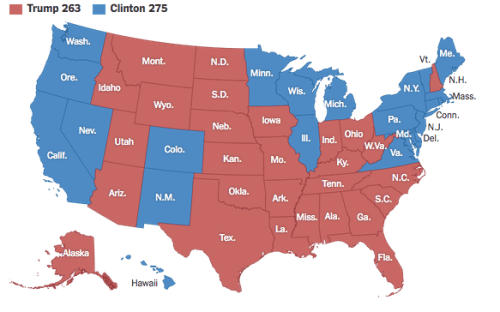
Presidency. Here are two graphics you’ll want to refer to as returns come in and states get called. The first is the minimal Clinton win map from the NYT’s Upshot column.

screen-shot-2016-11-06-at-6-41-32-am

Any result that deviates from that map — except for 1 electoral vote in Maine, which we’ll talk about later — is a clear signal that the election is not going to go down to the wire. If Trump wins Pennsylvania, say, or Clinton wins Florida, it might be over early.

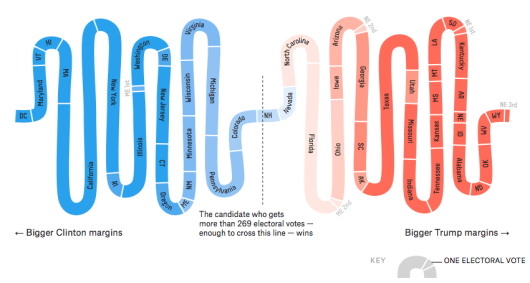
The other important graphic (which I think is brilliant in a pure visual-presentation-of-information sense) is the snake from Nate Silver’s 538 site:

screen-shot-2016-11-07-at-6-21-00-am

The two sites disagree on whether Nevada or New Hampshire is the last state Clinton needs to win. I favor the Upshot in this case, because Nate’s model only counts polls, while the Upshot is also factoring in the huge Hispanic early-voting turnout in Nevada, so a Clinton win in Nevada seems more likely, all things considered. 538’s Harry Enten seems to agree with this analysis. (Nate Silver has a whole other argument going about the overall probability of a Clinton win, which he places lower than just about anybody but rabid Trump supporters. I’ll explain that disagreement in the weekly summary.)

What happens when on Tuesday night

Before 6 p.m. you’ll see some novelty returns from small precincts (like Dixville Notch in New Hampshire), and it’s possible that some exit polls will leak out. (Don’t trust them. The early exit polls in 2004 had Kerry winning.) But nothing genuinely newsworthy will happen before the first official poll-closing times at 6.

In general, the networks will not declare a winner in a state until all the polls in that state are closed, and will declare a winner right away only if the exit polls are stunningly one-sided. The closer a state appears to be, the more votes the statisticians will need to see counted before they’re sure which way it’s going.

Almost all the states will be called within two or three hours of their polls closing, and probably all of them within five or six hours. But really, really close races, the kind that need recounts, may not be decided for days or even weeks. (Remember Florida in 2000.)

So here’s how I expect the returns to come in.

6:00 p.m. EST: parts of Indiana and Kentucky. You’ll see some raw vote totals start coming in (and probably favoring Trump), but no projections will be made about electoral votes. Clinton 0, Trump: 0

7 p.m.: the rest of Indiana and Kentucky, Vermont, Virginia, South Carolina, Georgia, parts of New Hampshire and Florida. Almost immediately, Indiana, Kentucky, and South Carolina should be called for Trump and Vermont for Clinton. Georgia should eventually go for Trump and Virginia for Clinton, but are likely to be more competitive. So that’s the first sign of how the presidential race is going: How close are the early returns in Virginia and Georgia?

Florida and New Hampshire are the really important important states here, but again, they’re not going to be called until all the polls have closed. (Florida looks like a 7 o’clock state at first glance, but check out that part of the panhandle under Alabama.)

Indiana is the first of the competitive Senate races: Evan Bayh (D) against Todd Young (R). I’d expect the decision to take a while in all the toss-up races; but if it’s called right away in either direction, that could be a signal of how the night is going. Trump 28, Clinton 3.

7:30 p.m.: Ohio, West Virginia, North Carolina. West Virginia should go immediately to Trump. Ohio and North Carolina should both be close and take longer to be decided. Trump needs to win both of them to have any chance. If either goes early to Clinton, we’re looking at a romp, but I wouldn’t expect that. If either goes early to Trump, it’s probably going to be a long night.

North Carolina is another close Senate race, with Richard Burr (R) favored over Deborah Ross (D), but not by much. Trump 33, Clinton 3.

8 p.m.: the rest of Florida and New Hampshire, Maine, Massachusetts, Rhode Island, Connecticut, New Jersey, Pennsylvania, Delaware, Maryland, District of Columbia, Michigan, Tennessee, Alabama, Mississippi, Illinois, Missouri, Kansas, Oklahoma, most of Texas, and parts of the Dakotas.

A bunch of this list should go right away, or before long: Maine, Massachusetts, Rhode Island, Connecticut, New Jersey, Delaware, Maryland, D.C., and Illinois for Clinton; Tennessee, Alabama, Mississippi, Kansas, Oklahoma for Trump.

Texas looks like an 8 o’clock state on the map, but there’s a tiny fragment under New Mexico that stays open until 9.

I’ll also guess that Georgia (Trump) and Virginia (Clinton) come in as expected.

Florida and New Hampshire should take a while. Trump absolutely has to have Florida, so if it goes to Clinton, whenever it goes, we have a winner. New Hampshire isn’t part of Clinton’s minimum-victory map, but if she wins it she won’t need Nevada later on.

Pennsylvania and Michigan are traditionally Democratic states where Trump thinks he has a chance, but the polls disagree. Missouri will eventually go to Trump, but maybe not right away. As with Virginia, how long they take to come in is a sign of how the night is going. If Trump wins either Pennsylvania or Michigan, he probably wins the election unless Clinton takes Florida. (That’s an unlikely combination, because it requires last-minute voters to break in opposite directions in different states.)

Maine is the first of two special cases, Nebraska being the other. Both award two electoral votes for winning the state, and one for each congressional district. Maine as a whole is going to Clinton and Nebraska to Trump, but Maine’s 2nd district is in the likely-Trump category. (That 1 electoral vote might matter.) So in the total so far, I’m awarding 3 of Maine’s electoral votes to Clinton but hanging back on the last one.

New Hampshire, Pennsylvania, and Missouri are the Senate races to watch. There’s an outside chance that Marco Rubio loses in Florida, but only if it’s a big night for Democrats across the board. Conversely, the Democrats have to have the Illinois Senate seat (Duckworth) to have any chance of taking back the Senate. Probably she wins almost immediately.

Clinton 91, Trump 88. Still waiting: Florida, North Carolina, Ohio, Pennsylvania, New Hampshire, Michigan, Missouri, and that 1 vote in Maine.

8:30. Arkansas to Trump. Trump 94, Clinton 91.

9 p.m. the rest of Texas and the Dakotas, New York, Louisiana, Wisconsin, Minnesota, Nebraska, Wyoming, Colorado, New Mexico, Arizona.

Texas is supposed to be closer than usual, but it’s probably not that close. I’ll concede it to Trump right away (especially since the bulk of the state has been counting votes already since 8). Trump also gets the Dakotas, Louisiana, Nebraska, and Wyoming.

Clinton gets New York. She’ll get Wisconsin, Minnesota, and New Mexico eventually, but it might take a while. Trump will get Arizona and that last vote in Nebraska eventually, but not yet. Colorado is one of the states that the election hinges on; Clinton has to have it. If Trump takes Colorado,there are still ways that he can lose, but he would have the inside track.

By now, I’m guessing that Pennsylvania and Michigan will have come in for Clinton and Missouri and that last Maine vote for Trump.

Democrats have to have the Wisconsin Senate seat (Feingold) and the Republicans have to have Arizona (McCain). If either goes the other way, so will the Senate. By now the Pennsylvania or New Hampshire Senate races might have been called either way.

Trump 164, Clinton 156. Still waiting: Florida, North Carolina, Ohio, New Hampshire, Wisconsin, Minnesota, Colorado, New Mexico, Arizona.

10 p.m. Iowa, Montana, Utah, Nevada, part of Idaho and Oregon. Montana goes to Trump immediately. Usually Utah would also, but the McMullin third-party effort makes this year interesting.

Of the waiting states, Arizona and that last Nebraska vote goes to Trump; Wisconsin, Minnesota, Colorado, and New Mexico to Clinton.

Probably the others are called about now too, but it’s hard to say how they’ll go. Probably Ohio goes for Trump (if Clinton gets it, the election is essentially decided). The others I’m going to start calling unpredictable.

Trump 197, Clinton 190.

unpredictable: Florida, New Hampshire, North Carolina

still waiting: Iowa, Utah, Nevada.

11 p.m. California, Washington, Hawaii, the rest of Oregon and Idaho. California, Washington, Oregon and Hawaii go for Clinton almost immediately. Idaho goes to Trump.

Iowa and Utah probably come in for Trump by now. Iowa is usually close and has only gone for Republicans once (Bush in 2004) since Reagan took it in 1984. But it has an extra-large segment of whites without college degrees, a.k.a. the Trump base.

Clinton 268, Trump 213.

unpredictable: Florida, New Hampshire, North Carolina.

So if any of the unpredictable states have come in for Clinton, she wins at 11. If they’ve all gone for Trump, it’s 268-261 and we’re all still biting our nails.

Midnight. No new states, but this is probably when Nevada comes in for Clinton, who wins with 274 electoral votes, even if she’s lost the unpredictable states. By now I’ll bet we still don’t know who won the Senate. There’s bound to be one Senate race that keeps everybody up until 3 a.m., though I can’t predict which one it is.

1 a.m. Alaska. Trump’s victory path includes winning Nevada, which I don’t think he will. But if he has won Nevada, Florida, New Hampshire and North Carolina, then Alaska puts him over the top with exactly 270. (Unless, by some miracle, McMullin has won Utah. Then it’s 268-264-6, and the election is headed to the House.)

I don’t know why we’re having this conversation.

In order to persuade Trump voters, I’d have to understand them first. Believe me, I’ve tried.


For months I’ve been imagining the closing argument I would post the day before the election: a devastatingly persuasive case why voters should choose Hillary Clinton over Donald Trump.

To a large extent I’d be preaching to the choir, of course, since most of my regular readers already agree with me. (That’s true for just about all bloggers.) But I’m sure a lot of them have friends or relatives who are undecided or leaning towards Trump. My convincing analysis would be something they could forward or quote, or maybe it would just help them marshal their thoughts before making some argument of their own.

It was a pleasant fantasy. But now it actually is the day before the election, and I have to admit failure: I can’t hope to convince Trump voters, because I can’t understand them. I can’t fathom why we are even having a national conversation about making Donald Trump president. Why did anyone ever think that was a good idea?

I’ve tried to understand. I’ve spent months listening to the Trump supporters I happen to run into, watching interviews with them on TV, reading books and articles about them, and even quieting my own revulsion as I listen to Trump so that I can look deep inside myself for something that responds to his message.

I got nothing.

As guys with erectile dysfunction often say: This doesn’t usually happen to me. I didn’t support John McCain or Mitt Romney, but I understood how other people could. (In 2012 I wrote an article claiming that Romney could win if he’d run as a problem-solver rather than an ideologue. I even included a campaign speech he could give.) Sure, I often thought “I don’t agree with that” or “I don’t think that’s true” when I watched McCain or Romney. But with Trump it’s different. All I can think is “What the hell is wrong with that guy?”

So I have no idea what his supporters are thinking. I can repeat some words back to you, but I can’t grasp why anyone believes them.

“Politicians have screwed this country up. Maybe it’s time to give one of our top businessmen a chance.” This could be the start of an interesting national conversation, if Trump were a top businessman. But he’s not, he just plays one on television. [1]

Yes, I know, Trump is rich. [2] But that’s because he was born rich. He inherited a New York real estate empire from his father, and the last few decades have been good to the New York real estate market. On the other hand, just about everything he’s done on his own, outside his father’s shadow — the bankrupt casinos, the failed airline, the mortgage company he opened just before the real-estate bubble popped — has been a disaster. Romney was right about Trump: “A business genius he is not.”

Now, I have to admit, he did pull off one good trick: He turned inherited wealth into celebrity, and then turned celebrity back into wealth (by charging people for the right to put his name on things he had nothing to do with). But you know who else has mastered that maneuver? Paris Hilton. Strangely, no one ever tells me that Paris Hilton should be president.

What else is he good at? He’s good at getting government subsidies. He’s good at avoiding taxes. He’s good at stiffing the small businessmen who work on his projects. He’s good at scamming middle-class people out of their money. If that’s the kind of stuff you admire in a businessman, then I guess Trump is your guy.

But the businessmen I admire see into the future. They change our lives by creating new products and new ways of doing things. They build opportunity for others. They bring prosperity to their communities, and enrich lots of other people, not just themselves. [3]

Donald Trump has never done any of that.

He’s also never done anything remotely like being President of the United States. And whatever you think of government service, President is not an entry-level job. We need somebody who can go in already knowing the major players, the major issues, and the nuts-and-bolts of how government functions. That’s not Trump, as you can see whenever anyone pushes him past the slogan level. [4]

I think Trae Crowder (a.k.a. the Liberal Redneck) nails something here:

Look, it’s like this. Think of your football team. Imagine y’all have been bad for years and years — not a stretch in my case. And imagine they fire the coach, and they come to you as a fan base and they say, “Look. You’re gonna love this new guy. He promises we’re gonna win twice as many games. We’re gonna score all kinds of points. He’s gonna go get our touchdowns back from the Mexicans. It’s gonna be awesome.”

You’d be like “Hell, yeah. That’s what I’m talkin’ about. So where’s he coming from? Where’d he coach at before this?”

And they’re like, “Oh, actually he’s not a football coach. He’s a European soccer coach with the emotional intelligence and fingers of a fucking six-year-old. Also, he rapes.”

You’d be like, “What the fuck? No. Why would we do that? That would be an embarrassment to our program, to everything we stand for. No.”

Wouldn’t you?

“He’s not politically correct.” When did avoiding political correctness become a blanket excuse for being an asshole?

When Trump waves his arms around to make fun of a disabled man, when he suggests that Natasha Stoynoff isn’t attractive enough to assault, when he critiques Hillary Clinton’s butt in front of thousands of cheering fans, when he says that an Indiana-born Hispanic judge can’t be fair to him because “he’s a Mexican“, when he taunts a bereaved mother of a decorated Muslim-American soldier — that’s not “politically incorrect”. He’s just an asshole.

“He’s one of us.” You were born filthy rich? You attended expensive private schools? You’ve spent a bunch of your life hanging around with supermodels in Manhattan nightclubs? No? So how exactly do you feel similar to Donald Trump or imagine that he identifies with you?

Not only don’t I think Trump is “one of us” (whoever you think “we” are). I wonder if he even knows any of us, other than as flunkies he can boss around.

“But Hillary is so awful!” Really? Did you happen to watch the Benghazi hearings on TV?

This was like the eighth investigation of Benghazi, so by then every little detail had already been analyzed to death. And to hear folks like Sean Hannity or Rush Limbaugh tell it, Hillary had practically murdered those four guys with her bare hands. So a Republican-controlled House committee finally gets Clinton right where they want her: testifying under oath on national TV, where they can finally make her answer for every horrible thing she did.

And you know what? They didn’t lay a glove on her.

That’s a typical Hillary Clinton “scandal”. Fox and Breitbart and so forth are really good at ginning up wild charges and whipping their audiences into frenzies of rage. But when someone has to back those claims up with real evidence … there never was any.

Now we’re watching the same thing happen with her emails. (Remember how we got into the emails? That was where Republicans were going to find the smoking gun that nailed her for Benghazi. Seen it yet?) Again: lots of wild charges, lots of rage. Actual wrongdoing? Not so much.

For comparison, Trump faces a real court case that he managed to put off until after the election: his Trump University fraud. (He’s going to lose that lawsuit, because he really did defraud those people.) You know whose family foundation is a seething pile of corruption? Trump’s, not Clinton’s. Whose friends in the media have been hushing up scandal? Trump’s. His wife broke those immigration laws that he supposedly cares so much about enforcing. And the guy he tapped as the head of his transition team — the guy who is going to staff the new administration, in other words — is Chris Christie. Christie staffed his own administration in New Jersey with people who just got convicted of felonies.

What else could you be thinking? I can’t guess. Maybe you’re for Trump because you like being on the same side as the KKK and Vladimir Putin. Maybe you think American politics needs more playground insults like “Lyin’ Ted” or “Crooked Hillary”. Maybe you enjoy being told that you that you didn’t just see what you saw or hear what you heard. Maybe you’re sick of political spin and would rather hear a candidate tell whopping lies instead.

I know, I’m grasping at straws here, because I really don’t understand.

Donald Trump as President of the United States? I’ve got nothing to say. Why are we even having this conversation?


[1]  To get a sense of just what a manufactured character the “Donald Trump” of The Apprentice is, listen to the men who manufactured him: the show’s editors.

Setting up story beats to justify the contestant that Trump ultimately fired required editorial gymnastics, according to the show’s editors. Manipulating footage to invent a story point that did not exist organically is common in reality TV editing, although with The Apprentice, it proved a tremendous feat.

“We’d often be shocked at whomever Trump chose to fire,” Braun explained. “Our first priority on every episode like that was to reverse-engineer the show to make it look like his judgment had some basis in reality. Sometimes it would be very hard to do, because the person he chose did nothing. We had to figure out how to edit the show to make it work, to show the people he chose to fire as looking bad — even if they had done a great job.”

[2] Though probably not as rich as he says he is. He claims to be worth $10 billion, but some estimates place his net worth at less than a billion. You have to wonder why he has systematically avoided revealing anything (like tax returns) that could give us a clearer idea of his actual wealth.

[3] For enriching other people, look at Sam Walton or Bill Gates. Lots of ordinary folks are millionaires because they got close to those guys early in their careers and then hung on to their stock options. But the most frequent story you hear from people who have worked with Trump over the years is that he cheated them somehow.

[4] Take his signature issue, immigration: Do we need a “deportation force” to round up all 11 million undocumented immigrants and force them to leave? Or do we just focus on the “bad ones”, as President Obama is already doing? Trump says different things at different times, because he’s never really thought about how any of this works.

The Monday Morning Teaser

So here we are: the last Sift before Election Day. If you haven’t voted already, make sure to do it tomorrow. (And no, you can’t vote online, no matter what that dirty-trick ad said.)

Two featured posts this week: One is my usual Election Night returns-watching guide, with an hour-by-hour discussion of what is likely to be happening when. In the past, readers have reported finding this guide comforting, because given that so much of the Democratic vote is on the west coast, the Republican candidate typically leads most of the night. It helps to know that lead has already been foreseen and doesn’t necessarily mean anything bad is happening.

The other is, well, a meta-discussion of my failure to understand the Trump vote. For months I thought I’d end the campaign with a clear and persuasive piece about why to vote for Clinton rather than Trump. I pictured my regular readers (who probably don’t need much convincing) forwarding it to their wavering friends, or using its points to bolster their discussions with low-information voters who still hadn’t decided.

I failed at that, because it’s just impossible for me to persuade people I don’t understand. And in spite of all the reading and listening I’ve done over the last year, I still don’t understand why anybody thinks Donald Trump should be president. I don’t know how the whole idea got this far, or why it passed the laugh test.

But I couldn’t come to this point and just ignore that the election is happening tomorrow, so I wrote what I’m thinking, understanding that it won’t persuade anybody. The piece is called “I don’t know why we’re having this conversation.”

That piece should be out around 9 EST, and the returns-watching guide maybe 10 or 11. The weekly summary will be out at noon. And then I’m taking a week off. Maybe by November 21 I’ll have a handle on what it all meant.

About the Nation

If one half of the people is bent on proving how wicked a man is and the other half is determined to show how good he is, neither half will think very much about the nation.

– Walter Lippmann, A Preface to Politics (1913)

This week’s featured post is my attempt to forget the campaign for a moment and worry about the nation: “What’s up with ObamaCare (other than premiums)?“. Next week’s Sift will come out the day before Election Day, so I’ll have my quadrennial viewer’s guide, where I combine Nate Silver’s state-by-state analysis with a list of poll-closing times, and tell you what to look for when.

This week everybody was talking about Hillary’s emails again

When it broke Friday that the FBI was looking at a new batch of emails related to Hillary Clinton, I (like most people I know) had a moment of panic: Would this be the stroke of fate that inflicts President Trump on the world?

Then I went through a period of regretting the bad timing, but feeling like it was nobody’s fault. We actually knew nothing about these new emails, so it was a pure Rorschach Test: If it was already an article of faith to you that Hillary has done something horrible and the smoking gun must be somewhere, then the fact that it hadn’t been found anywhere else meant this must be it. But for everybody else, these were just more emails, probably no different from all the previous ones.

After about a day, I hit the stage of “WTF, Comey?”. I’m still there. You can see a similar evolution in Josh Marshall’s Editor’s Blog on TPM: From here to here to here.

The problem, in a nutshell, is that early on in the investigation of Clinton’s email server, Comey decided this was a unique case that required a degree of public disclosure well outside the FBI’s usual practice. You could already see that in his July announcement and the testimony before Congress that followed it. Ordinary practice would be some terse announcement that the FBI had found no evidence that would warrant a prosecution, maybe illuminated by some discussion of the importance of intent in comparable cases.

Instead, he launched into a legally irrelevant criticism of Clinton’s “carelessness” in handling classified information. That would be an appropriate comment to make if he were a government inspector general or a congressional committee, not an FBI director. The FBI investigates crimes, not carelessness, and the role of the FBI director does not include being a moral authority.

The letter he wrote Friday to the chairs of congressional committees (all Republicans, since they are the majority) was the kind of thing the FBI doesn’t do at any time, much less when it’s likely to affect an election in a week and a half. It was basically an announcement that he might at some future time have new information. Totally vacuous in itself, it served only to create doubt that can’t possibly be resolved by Election Day.

The Justice Department has policies about this, for very good reasons. In its crime-investigating role, we allow law enforcement officials to violate people’s privacy in all sorts of ways. One of their corresponding responsibilities is to be circumspect in how they use that information.

So anyway, now we’re in exactly the kind of hell those policies are supposed to avoid: Relying on anonymous leaks to assess what, if anything, this new information might be or mean, and whether or not it should change how we vote. The NYT has a good summary of what we know and don’t know.

As far as Clinton’s email server in general, I haven’t changed the opinion I wrote in June. A more up-to-date version of a similar point of view is here.


To me, the nightmare scenario is that this vague letter tips the election to Trump, and then a month from now Comey reports to us again and says, “Oh, never mind, it turns out these emails were all duplicates of ones we already had.”

In the unlikely event that these emails reveal some previously unsuspected crime of President-elect Clinton, she could be impeached. But if Comey’s interference elects Trump, there’s no recourse.


Matt Yglesias:

The only way the email story could get any worse for Clinton would be if some kind of actual wrongdoing were unearthed at some point.


The Clinton-related emails released by WikiLeaks are a different story entirely, but I’m sure they blend together in the public mind. These are mostly from the account of Clinton campaign manager John Podesta, and have nothing to do with the State Department. They are not subject to a legitimate investigation, but were hacked, probably by the Russian government.

These releases also have no smoking guns, but produce a constant dribble of negative headlines. People in their private emails say stuff that would look bad if they said it in public, and worse if it’s quoted out of context. That’s not news.

The latest batch inspired a lot of headlines suggesting that Bill Clinton profited personally from the Clinton Foundation, but (as so often happens) when you look at the supporting evidence it doesn’t really say that. A Clinton insider, Douglas Band, who worked in Hillary’s State Department, used his Clinton contacts to build a consulting business after he left the State Department. He encouraged his corporate clients both to give to the Clinton Foundation and to invite Bill Clinton to give paid speeches. Chelsea Clinton didn’t like possible implications of the way he was mixing business and his Foundation ties, so she started an internal audit. Band defended himself by arguing that Bill’s conflicts of interest were worse than his. (He sounds like Trump trying to excuse his sexual assaults: Don’t look at me, look at Bill.) That’s what leaked.

What we’re left with is the already-known fact that many corporations both gave money to the Foundation and paid Bill or Hillary to give speeches. None of this is odd: Corporations give money to charitable foundations, ex-presidents and ex-secretaries-of-state give a lot of paid speeches, and the Clintons’ fees seem to be in line with what people of their fame typically ask. No money has gone from the Foundation to the Clintons, and so far no one has come up with unwarranted government favors the companies might have been paying for. I’ve covered all this in detail before; in short, it’s “pay-for-play” scandal without either pay or play.

In all the responsible reporting, what is considered newsworthy is the possibility that some other bit of evidence might come out that will make these dots line up in a sinister pattern. We keep getting teased with that speculation, but the reality of it continues not to arrive.


Before this campaign, my opinion of WikiLeaks was somewhere between ambivalent and positive. I thought the mass release of State Department cables could be dangerous to some people who deserved better, but it also made public a lot of stuff that the public ought to know.

But in its anti-Clinton campaign, WikiLeaks has gone far beyond its original role as a force for transparency. It could have released whatever Russia gave it in one big dump, letting the rest of us sort through it the way people sorted through the State Department cables. That would be transparent: We got stuff, we passed it on.

Instead, by dribbling stuff out bit by bit as Election Day approaches, and using its twitter feed to frame its revelations as salaciously as possible, WikiLeaks has become just another partisan player, and Julian Assange just another foreigner trying to manipulate our election.

Buzzfeed has an article from a former WikiLeaks insider, about Assange’s “score” to settle with Hillary Clinton.


Most of what WikiLeaks has released is more gossip than whistle-blowing: Did you hear what so-and-so said about you? But Bernie Sanders isn’t taking the bait:

Trust me, if they went into our emails — I suppose which may happen, who knows — I’m sure there would be statements that would be less than flattering about, you know, the Clinton staff. That’s what happens in campaigns.


One sign that Republicans had given up on a Trump victory, at least until the FBI announcement: They were already talking about impeaching President Clinton.

and the acquittal in the Bundy trial

I have a hard time wrapping my mind around the verdict in the Bundy trial in Oregon: Not guilty all around, with the jury unable to make a decision on one charge of theft of government property. The L.A. Times attributes the verdict to the prosecutors’ overconfidence, while acknowledging the verdict’s overall absurdity.

“My client was arrested in a government truck, and he was acquitted of taking that truck,” said defense attorney Matthew Schindler, who still sounded in disbelief Friday morning.

The defense cast the Malheur occupation as a legitimate protest, but to my mind a protest turns into something else as soon as you start waving guns around. The Bundy brothers themselves will be sent to Nevada to face charges over the 2014 armed standoff at their father’s ranch. Presumably those prosecutors will not be so confident now, so we’ll have a test of the overconfidence theory.


Does anybody doubt what will happen next? Anti-government yahoos around the country will be emboldened to do even more outrageous things. We might as well have posted “Welcome Armed Occupiers” signs outside of every government workplace in the country.


About the Bundy’s theory that federal ownership of so much land in the western states is illegitimate: Once you get west of the Ogallala aquifer, the vast majority of land wouldn’t have supported American-style settlers, or much of anything beyond the economy the Native Americans already had, without massive federal spending on dams, roads, and railroad subsidies. To this day, most residents of the mountain states are not paying anywhere near the true cost of the water they use. (See the classic book Cadillac Desert.)

Native American claims are in a different category, but if any white people want to claim that federal lands in the West should belong to them, or to their state, I think they need to explain how the investment of the out-of-state taxpayers is going to be repaid.


At Vox, German Lopez said what I’ve been thinking:

It is impossible to ignore race here. This was a group of armed white people, mostly men, taking over a facility. Just imagine: What would happen if a group of armed black men, protesting police brutality, tried to take over a police facility and hold it hostage for more than a month? Would they even come out alive and get to trial? Would a jury find them and their cause relatable, making it easier to send them back home with no prison time?


Lots of people made a comparison to the Native American protest of the Dakota Access Pipeline.

you might also be interested in

The next time someone asks about your dream job, consider the prospect of replacing Philip Galanes as host of The New York Times‘ “Table for Three” series. His job is to invite interesting people to lunch in twos, talk to them, and publish the conversation.

In the latest edition of the series, he takes historian Doris Kearns Goodwin and MSNBC’s Rachel Maddow to the Gotham Lounge of Manhattan’s Peninsula Hotel, and asks them about how the 2016 election compares with other elections in US history. The NYT picks up the check, no doubt.

As Dire Straits put it: “That ain’t workin’. That’s the way you do it.”


Racist incidents are up in Britain after Brexit. Here’s some advice on how to interrupt them.

In general, people who create confrontations have some kind of drama in mind; they are like directors of a play. Sometimes you can screw that up without becoming part of the confrontation yourself: Stand in the wrong place, ask one of the participants for directions, etc. If you have an accomplice, you can stage your own competing play: have a screaming break-up scene.


CNN discusses the plague of fake news sites whose purpose is to get you agitated enough to share the link on social media. Some are partisan disinformation sites, but a bunch are subtle news parody sites, like Newslo or Business Standard News, whose stories sound credible because they’re just one or two steps beyond what’s actually happening. (You’d think people would notice the BS logo and take a step back, but apparently not.)

When these first started cropping up, I thought they were clever — like The Onion but a little more of an inside joke. But now, two or three times a day I feel obligated to inform some outraged Facebook friend that s/he has been punked. Usually I’m the 10th commenter after 9 other people have taken it seriously. I think some real damage is starting to happen.

When you share something, you’re lending your credibility to it; friends are more likely to be taken in by something if they know you believe it. That gives you some responsibility to check things out before you spread them.

Here’s a tip: Real news stories happen in a real world that lots of people see. So a real news story almost never appears on just one site. (That’s doubly true if the story involves some famous person, and the site is one you’ve never heard of.) Before you share some outrageous claim, boil it down to a few words and do a Google search. If the thing really happened, you should see a bunch of similar articles about it.


Take the Illinois senate race off the board. Mark Kirk just finished himself off.


At one level you have the dozen-or-so women who have accused Trump of some form of sexual assault (similar to the general description he gave Billy Bush on the famous tape). At another level entirely, there are a host of instances that aren’t remotely criminal, but reinforce the picture of him as a self-absorbed asshole.

This one, for example. It’s 2009, and the 16-year-old son of John Travolta and Kelly Preston has just died. That launches Trump into reminiscing on the Trump University blog about the time he put the moves on Preston and she turned him down, in spite of the fact that “my track record on this subject has always been outstanding”. Because that’s what you do when somebody loses her child.


Voter suppression is usually one of those phrases that only someone’s enemies use. Nobody ever comes out and says they’re trying to suppress the vote.

Except the Trump people. I guess this is a new example of telling it like it is.

Instead of expanding the electorate, Bannon and his team are trying to shrink it. “We have three major voter suppression operations under way,” says a senior official. They’re aimed at three groups Clinton needs to win overwhelmingly: idealistic white liberals, young women, and African Americans. Trump’s invocation at the debate of Clinton’s WikiLeaks e-mails and support for the Trans-Pacific Partnership was designed to turn off Sanders supporters. The parade of women who say they were sexually assaulted by Bill Clinton and harassed or threatened by Hillary is meant to undermine her appeal to young women. And her 1996 suggestion that some African American males are “super predators” is the basis of a below-the-radar effort to discourage infrequent black voters from showing up at the polls—particularly in Florida.


Here’s one of those stories that cuts across sports, business, media trends, and cultural change: TV ratings are down for both pro football in the US and the pro soccer in the UK. (It’s harder to get a clear sense of how college football’s ratings are doing, because its broadcasting is more decentralized than the pros, with individual conferences having their own networks in addition to national-network coverage.) Everybody has a theory about what this means, but none of them are compelling yet.


While we’re talking sports, the most offensive thing about the Cleveland Indians isn’t that they’re called “Indians”, it’s that the Chief Wahoo logo. Check out the parody “Caucasians” shirt.


Here’s the conclusion I draw from Megyn Kelly’s confrontational interview with Newt Gingrich: If you’re a woman on the Right, you can be appreciated for carrying the men’s water. But as soon as you want to turn the conversation to something that you find important, you’re just a woman.

and let’s close with something nostalgic

I spent the late 70s and early 80s in Chicago, about the time Steve Goodman was writing “A Dying Cub Fan’s Last Request“. Like most Cub fans of that era, my best baseball memory is a loss: I was in Wrigley Field’s right field bleachers the day the Phillies beat us 23-22 in 10 innings.

What’s up with ObamaCare (other than premiums)?

President Obama’s legacy accomplishment has problems that can be patched up. But will they be?


In the insurance business, the big thing you worry about is a vicious cycle called a “death spiral”. It goes like this:

  1. An insurance company realizes it isn’t making enough money because it’s paying more claims than expected. In other words, the risk pool is riskier than it predicted.
  2. It tries to increase profits by raising premiums.
  3. Supply-and-demand works in the usual way, so the increased price causes fewer people to want the product. But because of the unique properties of insurance, the people who drop coverage are mostly the ones who think they are less likely to make claims; the insurance was worth it to them at the old price, but not at the new. Meanwhile, the high-risk customers, the ones who will want insurance at virtually any price, all stay.
  4. As the low-risk customers defect, the risk pool gets even riskier. So the insurance company is back at Step 1, paying too many claims to make the profit it wants.

To a certain extent this cycle happens whenever an insurance company underestimates risk or overestimates the number of people who will want its coverage. But usually the effect damps out. In other words, each time around the cycle, fewer and fewer people drop coverage at Step 3, so after some small number of price hikes, a new equilibrium is reached: The higher premium covers a smaller, riskier insurance pool while still leaving the company a profit.

But in a death spiral, the cycle never damps out and there is no new equilibrium. Or, more precisely, the equilibrium point everything trends towards is zero: No one is covered, so the zero premiums balance the zero claims.

Now let’s talk about ObamaCare: Millions of people have signed up for insurance through the ObamaCare exchanges, but not as many as expected. In particular, not as many young, relatively healthy people have signed up. So the total covered population is sicklier than the insurance companies had planned on, and they’re not making money the way they thought they would.

So Step 2 is starting to happen: Last Monday, a report from the Department of Health and Human Services (HHS) said that baseline premiums on the ObamaCare exchanges would be going up 22% on average. In addition, some insurance companies have decided to pull out of the ObamaCare marketplace in a various states, reducing competition and making it easier for the remaining insurers to raise premiums.

That raises the question: Is this a blip that will quickly settle out into a new equilibrium, or is it the start of a death spiral?

It’s hard to get good information on this, because everyone knows which answer they want: Conservatives want a death spiral, and liberals want a blip.

Underenrollment. Let’s start with numbers. Back in 2010, the Congressional Budget Office projected much higher enrollment than we’ve seen.

CBO and [the Joint Committee on Taxation] project that, under current law, 6 million people in 2014 will receive insurance coverage through the new exchanges. Over time, more people are expected to respond to the new coverage options, so enrollment is projected to increase sharply in 2015 and 2016. Starting in 2017, between 24 million and 25 million people are expected to obtain coverage each year through exchanges, and roughly 80 percent of those enrollees are expected to receive subsidies for purchasing that insurance.

That didn’t happen. 2016 enrollment through the exchanges was about half the projection, around 10.4 million, and (prior to the premium increases) the most optimistic estimates projected around 13 million for 2017.

You can argue about why. Maybe the carrots (subsidies) and sticks (the individual mandate’s tax on the uninsured) weren’t as compelling as they should have been. Or maybe the scorched-earth nature of Republican resistance made a partisan issue out of decisions that (in an alternate universe) might have seemed public-spirited. Larry Leavitt pictures that alternate universe:

Imagine a world where the ACA passed with significant bipartisan support and there was a national effort involving politicians of all stripes and figures, and athletes, all encouraging people to get insured. That is not the world we live in. It’s more like what happened in Massachusetts [with RomneyCare].

Instead, we saw something altogether unprecedented in American history: a well-funded ad campaign trying to convince people to avoid a government program that had already been enacted into law. Who can forget the Koch Brothers’ creepy Uncle Sam who was going to “play doctor” with you?

For comparison, try to imagine it’s 1942 and some anti-war billionaires blanket the country with creepy Uncle Sam posters to convince people not to buy war bonds, or it’s 1966 and ads interrupt The Beverly Hillbillies to scare seniors out of signing up for Medicare. Nothing remotely like that happened or could have happened under the political culture of those eras. But it did for us.

Premiums. One important thing to realize about ObamaCare premiums is that up until now they’ve been running under the original projections.

There are a variety reasons for that: In part, it’s that healthcare inflation in general has been lower since the Affordable Care Act started coming into effect.

But a piece of it is also that insurance companies lowballed their initial offers, hoping that once people had health insurance they’d be reluctant to give it up or switch companies. The LAT’s Michael Hiltzik reports:

Some big insurers have found that their initial estimates of customer costs were unduly optimistic. They set premiums lower than they should have, sometimes to buy market share, and incurred losses as a result. Rate-increase requests in the double-digit range for 2017 are the harvest

So what looks like a malfunction in the program might just be premiums getting back to the level they should have been at to begin with.

Subsidies. One reason to think that the premium increases won’t start a death spiral is that most of the people who use the federal exchanges get some amount of subsidy. As their premiums go up, their subsidies do as well. So the sticker shock is diminished.

The people to watch are the ones whose incomes are too high to qualify for subsidies. According to Leavitt, that’s about 15% of the people who use the federal exchanges, but also almost seven million other people whose premiums are based on the rates on the federal exchanges (and whose business the insurance companies are figuring in when they set their premiums). If those people start cancelling their policies, then we could be back in the death-spiral scenario. But if they decide that they like having health insurance and are willing to pay the higher premium to keep it, then everything should be fine.

Fixes. Even if the vicious cycle starts, there are fairly simple ways to stop it — if that’s what everyone wants to do. Basically, the problem, if there turns out to be one, is that the incentives aren’t right yet: The subsidies need to be higher or extend to people with somewhat higher incomes. Or the individual-mandate penalty on the uninsured (the one you would pay when you file your 1040 income tax form) needs to be higher.

Other things could be done to lower insurer costs: The sign-up periods might be tighter and more strictly enforced, to prevent people from abusing the system by waiting until they get sick to get covered. Price controls could prevent profiteering by big pharmaceutical or medical-device companies. The bundle of services that need to be included in an ObamaCare policy could shrink.

Or you could change the market in other ways: In parts of the country (like Arizona) where premiums are rising faster because fewer companies compete, adding a public option (i.e., something like letting you buy into Medicare even if you’re not 65 yet) would increase competition.

Or if you want to go whole hog, the entire health-insurance system could be replaced by some kind of single-payer system, as Bernie Sanders campaigned on, and as gets better outcomes for less expense in just about any other advanced country.

The problem is getting any of that through Congress. So far, Republicans have refused to cooperate in making any mid-course adjustments to ObamaCare, in hopes that it will crash. This also is brand new in American politics. Previous programs like Social Security, Medicare, and even the prescription-drug benefit that President Bush added to Medicare in 2003 all have required tweaks as they got up and running. Once a program had been passed into law, Congress typically has accepted it and tried to make it work. But scorched-earth opposition to ObamaCare continues six years after the law passed: The only change Republicans are willing to consider is repeal.

We can’t go back. In the same way that President Obama’s economic critics often conveniently forget how the economy was collapsing when he took office, critics of ObamaCare forget how the old healthcare system was collapsing under the middle class. The poor could get Medicaid, but health insurance was increasingly out of reach for people who weren’t covered through their employers, and employers faced rising pressure to wriggle out of rapidly increasing premiums.

As a result, the number of Americans with no health insurance at all was approaching 50 million. Millions more Americans had “junk insurance” — low-maximum-benefit policies that would quickly be exhausted by any major illness, or short-term policies the insurer could refuse to renew if you got seriously ill. (Many of the much-publicized horror stories about premiums that skyrocketed when ObamaCare took effect were from people who previously had junk insurance. They didn’t pay much, but they would still face bankruptcy if they got seriously ill.) No one knows how many people were trapped in jobs they couldn’t leave because their pre-existing conditions would prevent them from qualifying for health insurance with a new employer.

In 2009, Time correspondent Karen Tumulty drew the lesson from her brother’s inability to pay for his medical care, even though he had insurance when he got sick.

What makes these cases terrifying, in addition to heartbreaking, is that they reveal the hard truth about this country’s health-care system: just about anyone could be one bad diagnosis away from financial ruin.

As the so-called “gig economy” grows, the lifetime-employment ideal of the 20th century is realized for fewer and fewer people, exposing more and more people to gaps in their healthcare coverage that they may not be able to fill due to pre-existing conditions. So going back to the system that was already starting to fail in 2010 would be trading a fixable death spiral for an inescapable one.

Replace? “Repeal and replace” has been the Republican slogan since 2010, but the “replace” part never materializes. Some vague ideas are thrown around: insurance competition across state lines, health savings accounts, and so on. But the discussion always stops short of an actual bill that the CBO could analyze and members of Congress could be asked to support or oppose.

Most likely that’s because the numbers don’t work, either in an accounting sense or a political one. Paul Ryan and Mitch McConnell know they can’t assemble their fractious troops behind any specific proposal. And if they did, the resulting plan would vastly increase the number of uninsured people, while leaving those with insurance vulnerable to losing it if they get sick or change jobs.

The basic vision of ObamaCare — private health insurance made universal through a system of government mandates and subsidies — was created by conservatives who wanted an alternative to a single-payer system. More than 20 years later, those are still the only two viable ideas out there. If you really want to replace ObamaCare, single-payer is your only choice. If that’s not what you want, then you should help fix ObamaCare.

The Monday Morning Teaser

This week two major issues hit the headlines, one (rising ObamaCare premiums) that has substance, and another (the emails on the Abedin/Weiner laptop) that I suspect doesn’t, but is more sensational. Which to spend my time on? These are the kinds of inner conflicts that test a blogger’s mettle.

It’ll probably kill this week’s traffic numbers, but I opted for the boring issue that probably means something: The featured post will be “What’s Up With ObamaCare (other than premiums)?” So: 2017 premiums on the ObamaCare exchanges will be up an average of 22%. Could this be the beginning of the so-called “death spiral” insurance people dread? What’s that mean, anyway? If one is starting, what can be done to stop it? Given that things can be done, will they be?

That post is just about finished, so it should be out around 9 EDT.

Of course, I do have to cover the emails — not just the FBI angle but WikiLeaks too — but that will be in the weekly summary, where I can link to other people who say just about everything worth saying. (Basically, I had the same reaction as a lot of folks: 24 hours of Chicken Little, followed by “WTF, Comey?”) Also in the summary: the Bundy acquittal (another WTF moment), Trump’s voter suppression effort, the conclusion to draw from that bizarre Newt Gingrich interview with Megyn Kelly, tips from across the pond on disrupting racism, and a few other things, closing with a nostalgic look back at being a Cubs fan in the late 70s, when an exciting loss was practically the best thing you could hope for.