The assumptions behind the United States’ Israel policy are obsolete, and many were never realistic. It’s time to go back to Square One and rethink.
Since its founding seventy years ago, Israel has consistently been more of a symbol or a fantasy to Americans than a real place. I can’t pretend to grasp the full significance it has for American Jews, but for the rest of us Israel has meant the Holy Land, a way to make right the collective guilt we felt for doing so little to avert the Holocaust, the heroic Sabras of Leon Uris’ Exodus, a demonstration of the West’s superiority to the decaying Orient, a Cold War destination for talented Jews abandoning the Soviet Union, a David-and-Goliath story of one tiny country standing up to larger ones, and many other things that have been (at best) tangentially related to a real country of real people.
For Evangelical Christians, the founding of Israel started a prophetic clock ticking down to the End Times, when all the Jews who don’t convert will be sadly wiped out, but the rest of us will get to live in Jesus’ Millennial Kingdom. Socialists have idealized the kibbutzim. The alt-Right sees Israel simultaneously as the place they will someday deport American Jews to, and as a model for the ethno-religious state white Christians could make here and in Europe. For globalists, the peace we will someday broker among Israel, its indigenous Palestinians, and its Arab neighbors will prove the righteousness of American power in a unipolar world. For neo-cons, Israel represents a no-nonsense approach to the terrorist threat, unclouded by the hazy illusions of political correctness.
All these constructions are built on a foundation of stereotypes, both positive and negative, about Jews. They are God’s chosen people, the invisible and infinitely manipulative Elders of Zion, both the relatives and the accusers of Jesus, the fast talkers who can sell anything, the source of inexplicably many of the West’s foundational thinkers, or the bankers who always win because they have backed both sides. You can hear echoes of these ancient, quasi-supernatural Jewish powers whenever a conversation turns to Mossad or AIPAC or the Rothschilds or that nebulous collection of “Jews who control the media”. Ordinary notions of possibility and impossibility melt away; they’re Jews, who knows what they can do?
From the beginning, Israel has been both the beneficiary and the victim of the fantasies we project onto them. The benefits have been tangible: billions in American aid every year, American military technology, and the protection of both the American nuclear umbrella and the US veto in the UN Security Council. But our illusions have also been freighted with expectations: Israel should be better than other countries, and should be condemned and even punished when it isn’t.
During the 1948 war that established Israel as a country, Arabs terrified by both real and imagined Jewish atrocities fled the war zone, creating a refugee population that under international law has a right to return home. Since the 1967 war created the Occupied Territories, Israel has ruled a subject population that it treats badly.
But lots of countries are in violation of some international law or another, and lots have subject populations that they treat badly. (Some countries treat all their people badly.) Try being Shia in a Sunni country like Saudi Arabia, or Sunni in a Shia country like Iraq. Hindus and Muslims oppress each other in India and Pakistan. In Myanmar, the Buddhist majority is pushing Muslim Rohingya out of the country, even though they have nowhere to go. Americans, if we bother to inform ourselves about these situations at all, wring our hands helplessly. We don’t organize boycotts or insist that our church or university’s endowment divest holdings tainted by association.
In recent years, Israel’s internal politics have taken a disturbing rightward turn, with growing intolerance and disregard for abstract principles of justice. But so have Hungary’s and Poland’s and (let’s be honest) our own. What fault can you find in Netanyahu that isn’t also present in Trump?
Recent events have been hard to square with American illusions about Israel. Two weeks ago, the United States dedicated a new embassy in Jerusalem, abandoning a long-held bipartisan policy that such a move should wait for a peace treaty putting the status of Jerusalem on a firm international foundation. While this was happening, Palestinian protesters rushed the fence that keeps them trapped in Gaza, and Israeli snipers shot them down by the dozens.
Viewed through one lens, the shooting was entirely justified: The protesters — all hostile, some armed, all attempting to cross an international border — constituted an invading army, or at least an invading mob. Viewed through another, it was a gross overreaction: The Israelis had ample warning and held all the cards; surely they could have devised some less lethal method of crowd control without endangering their soldiers or citizens. Gazan lives, it seems, don’t matter.
For decades, the United States has tried to restrain Israel’s more extreme tendencies. We have discouraged building settlements on disputed territory, pushed for cease-fires, and sometimes even brokered treaties like the Camp David Accords. We have styled ourselves as the holders of the vision of peace, and so we have consistently urged Israel not to do things that can never be undone.
We don’t do that any more. UN Ambassador Nikki Haley was full-throated supporter of the Israeli snipers. “No country in this chamber would act with more restraint than Israel has,” she told the Security Council. If the Trump administration believes this, it is chilling. It suggests that’s Trump’s wall might someday be manned by snipers indiscriminately gunning down Mexicans because some of them might be MS-13 gangsters.
Increasingly, it is clear that there isn’t going to be a negotiated peace. Gaza is the new model of resolution: Israel will dictate terms. It will set boundaries for zones of Palestinian autonomy, and will decide what that autonomy consists of. Like the reservations the US created for Native Americans, the Palestinian zones will not be economically viable, at least not for the number of people assigned to live there. The best land and the water rights will be reserved for Israeli settlements. As with the Native American reservations, non-viability will be a feature. America hoped its Indians would eventually assimilate into second-class citizenship in white society; Israel hopes that Palestinians will self-deport to Jordan or Egypt or anywhere Israel doesn’t have to deal with them.
All of these developments should raise a question: What is the US role going forward? For decades, Americans have believed that our aid gave us leverage, which we could use to nudge all parties towards a peace agreement. But if we’re not nudging and there isn’t going to be an agreement, what is our aid for? What are we buying? What are we supporting? Why?
I am not proposing answers to those questions. But I am urging all Americans, whether you think of yourself as pro-Israel or anti-Israel or neutral, to rethink your view from first principles. What if we all stopped thinking about Israel in mythic or symbolic terms and instead just thought of it as a country like any other country? In some ways it is like us and in some ways not. In some ways we share its interests and in other ways we don’t. It does things that deserve our support and things that deserve our condemnation.
Like any other country.
When we let go of all the fears and fantasies that we have projected onto Israel, what is left? How should we respond to the reality of Israel as country like any other country?
Lately I’ve been reading a lot about the class divide in America — a topic that has been on my mind for several years, but has acquired a new significance in the Trump Era. Probably all this research will eventually result in a long article where I try to find some deeper insight, but in the meantime I’ll just summarize what I’ve been reading, in case you want to read along with me.
A great place to start is “The 9.9% is the New American Aristocracy” by Matthew Stewart in The Atlantic. Wealth, as many authors have shown, is increasingly accumulating in the top tenth of a percent. But beneath that layer of plutocrats is the rest of the top 10%, which mostly consists of educated professionals with a decent amount of economic security, who have pleasant homes in safe neighborhoods with good schools, read magazines like The Atlantic, and do physical labor only to the extent they want to. (I wasn’t born into this class, but that’s where I am now. I suspect most — but not all — of my readers are 9.9-percenters also.)
Collectively, we control more than half of American’s wealth, a percentage that has held fairly steady for decades. The gains of the top .1% mostly haven’t come from us, but at the expense of the bottom 90%. Stewart says:
By any sociological or financial measure, it’s good to be us. It’s even better to be our kids. In our health, family life, friendship networks, and level of education, not to mention money, we are crushing the competition below. But we do have a blind spot, and it is located right in the center of the mirror: We seem to be the last to notice just how rapidly we’ve morphed, or what we’ve morphed into.
What we’ve morphed into is a hereditary aristocracy; it’s increasingly hard for people not born into this class to join. On its surface, the system looks like a meritocracy, but we’ve gamed it. Winning the race requires the kind of preparation that only aristocratic kids are in a position to get. Like Jane Austen’s aristocrats, we have a strong tendency to intermarry, closing off that point of entry. We also feel very little guilt about leaving the classes below us in the dust: In the Game of Life, we tell ourselves, they just didn’t measure up. (Chris Hayes made a similar point several years ago in The Twilight of the Elites.)
The middle-working class — let’s leave the boundaries of that vague for now — consists of people who didn’t make it into the aristocracy, but have what Joan Williams in her book White Working Class calls “settled lives”: They aren’t college educated, but they are consistently employed and have stable homes with (mostly) solid families. They typically have jobs rather than careers, and they get their identities from family and community (often a church community) rather than from their professions. (Even if you have lucrative lifelong employment as a plumber or electrician, it’s what you do, not who you are.)
Members of this class take a lot of pride in the disagreeable things they’ve had to do to stay out of poverty — the long hours of unrewarding work, the desires they’ve had to suppress, the dreams they’ve had to defer, etc. — and they picture poor people as lacking the same moral stamina. (That’s why it aggravates them when government programs let the undeserving poor enjoy some of the same rewards they take pride in earning. Liberals, they feel, are trying to erode the significance of their moral achievement.) They have different cultural values than the aristocrats and are annoyed by our belief that they tried to be us, but just failed. They don’t actually want to be us, but they envy our generational stability, because (as the kinds of jobs that underwrite settled lives go away) they see no guarantees that their children won’t be poor.
They also resent the hell out of us, much more than they resent the .1%. The plutocrats are like distant kings, but working-class folks have to deal with aristocrats every day. We’re their bosses and the doctors who talk down to them. We’re their hard-to-please clients, the consultants who come in to tell them that they’re doing it all wrong, and the experts who observe and interview them in hopes of replacing them with machines. We’re the talking heads on TV who use big words and insist that they’d agree with us if only they had read enough books to know what they’re talking about.
Trump made it to the White House by playing on that resentment. (Historically, the 9.9% has been split between the parties or even leaned Republican. But many never-Trump conservatives are 9.9 percenters, and congressional seats in professional-class suburbs are viewed by Democrats as pick-up opportunities.) Since taking office he has done virtually nothing to help the working class — not even the white working class. But he remains popular among them because he gives voice to their resentment of the 9.9%.
Williams’ point is that we aristocrats should try harder to understand and show respect to the working class, which is true as far as it goes. But The Washington Post’s Paul Waldman points out a disagreeable truth: Professional-class liberals — or even just reality-based anti-Trump conservatives — are kidding themselves if they think respect is some kind of “magic key that Democrats can use to unlock the hearts of white people who vote Republican”. No matter how respectful a candidate or a set of policies might be, that message will never get through the filter of “an entire industry that’s devoted to convincing white people that liberal elitists look down on them.”
If you doubt this, I’d encourage you to tune in to Fox News or listen to conservative talk radio for a week. When you do, you’ll find that again and again you’re told stories of some excess of campus political correctness, some obscure liberal professor who said something offensive, some liberal celebrity who said something crude about rednecks or some Democratic politician who displayed a lack of knowledge of a conservative cultural marker. The message is pounded home over and over: They hate you and everything you stand for.
Essentially, conservative media is like the community gossip who constantly starts conversations with “Did you hear what so-and-so just said about you?” No matter how respectful the bulk of us may eventually learn to be, somebody somewhere is always going to be dissing working-class whites, and Fox News will make sure that they hear about it.
Even when that disrespect is absent, it is easily manufactured. Waldman points out how out-of-context quotes were used to skewer Barack Obama and Hillary Clinton. Everyone knows that Clinton thinks working-class Trump voters are “deplorable”, and Obama believes they are “clinging to guns and religion”.
Finally, the consequences of this class divide are discussed in Ganesh Sitaraman’s book The Crisis of the Middle-Class Constitution. Unlike previous republics, the United States didn’t write the class struggle into its constitution: Rome, for example, balanced an aristocratic Senate against the veto-wielding Tribunes of the People. Britain separated the House of Commons from the House of Lords. America didn’t do anything like that.
Instead, the Founders counted on relative equality of wealth and the presence of a large middle class to maintain a balanced society. Those are the conditions our system of government is designed for, and at various key points in American history (the homestead era, the Progressive Era, the New Deal) the government made deliberate choices that preserved the middle class and prevented either plutocratic domination or a revolution of the dispossessed.
Now we’re in an era of increased concentration of wealth and power by the .1%. Now more than ever, if we’re going to preserve our system of government, we need the 9.9% and the working class to band together against the domination of the super-rich. But how is that going to happen?
OK, I’m back. I’ve been off leading a Sunday service about “Why Be a Congregation?” and watching my nephew graduate from law school. (Yay, Mike!)
Did I miss anything?
Well, the whole Korea negotiation saga, the fizzling of the US/China trade war, a long string of scoops detailing the corruption of the Trump regime, more aggressive attempts to derail the Mueller investigation, some primaries that set up interesting races for the fall, another school shooting, and maybe a few other things.
I’ll get to those in the weekly summary, which I’m aiming to have come out between noon and 1, EDT. But there are also two featured posts.
Part of what I’ve been doing while traveling is a bunch of background reading about class and inequality. Eventually I suspect that’s going to lead to a long article where I try to reach some deeper insight, but for now I’ll just outline what I’m reading in case you want to read along. That will be “Outlines of a Reading Project on Class”, and it should come out between 9 and 10.
The other news event that happened these last three weeks was an opening ceremony for the new US embassy in Jerusalem. That pageantry happened simultaneously with the lethal Israeli response to protesters trying to cross the Gaza border. To me, the whole tableau symbolized that the assumptions underlying US policy towards Israel are obsolete now. Many were never realistic, but were based on a variety of positive and negative mythic roles that Americans have assigned to Israel and/or the Jews. So whatever your position on Israel, I suggest it’s time to go back to first principles and rethink, as if Israel were just a nation with no more mythic significance than any other nation has. That article is “It’s time to let Israel be a country”, and I aim to get it out before 11.
No Sift the next two weeks. New articles will appear May 28.
The bottom line — which will remain true no matter how much the Kochs spend trying to convince you otherwise — is that what looks like a big giveaway to wealthy investors is, in fact, a big giveaway to wealthy investors.
From the beginning I have resisted paying too much attention to the Stormy Daniels story — or publishing pictures of her in low-cut tops — because to the extent that it’s about sex I just don’t care. People who cared about Bill Clinton’s affairs should have to explain why they don’t care about Trump’s. But I don’t care about either one.
Increasingly, though, the Stormy story has come to exemplify other disturbing features of Trump and his administration: financial corner-cutting, and an approach towards lying that doesn’t even seek deceive so much as destroy the idea of a knowable truth.
This week, Rudy Giulani began giving interviews in his role as Trump’s new lawyer. He soon offered a new story of Trump’s role in the $130K hush money Daniels was given by Michael Cohen, and then a new story after that, only to have Trump say that Giuliani didn’t have his facts straight. By Sunday’s interview with ABC’s George Stephanopoulos, Giuliani was treating the simplest questions as deep philosophical mysteries. When did Trump know about the payment? Apparently the question is unfathomable.
It could have been recently, it could have been awhile back. Those are the facts that we’re still working on and that, you know, may be in a little bit of dispute. This is more rumor than anything else.
Remember: Giuliani is not a reporter dealing with a hostile source; he’s a lawyer representing a client.
In general, it’s getting harder and harder to get a straight story from anybody in the administration about much of anything. Vox compiled a timeline of the different things we’ve been told about the Daniels payoff: It didn’t happen (January 12); Cohen paid it using his own money (February 13); Trump knew nothing about it (April 5); Cohen was representing Trump when he made the payment (April 26); Trump repaid Cohen (May 2). Since then we’ve heard that Trump repaid Cohen, but by paying a $35K monthly retainer without knowing what it was for. Or maybe he did know.
The latest version suggests that Cohen might have been running a deniable slush fund for the Trump campaign.
What never seems to happen, though, is that a person with knowledge walks us through the story from beginning to end, and takes responsibility for that story hanging together for the long haul.
Sarah Huckabee Sanders defended previously telling the press corps that Trump didn’t know about the payment by saying “We’re giving you the best information that we’re going to have. Obviously the press team’s not going to be as read-in, maybe, as some other elements, at a given moment, on a variety of topics. But we relay the best and most accurate information that we have.” Translation: Trump lied to her too.
My growing impression is that in TrumpWorld the concepts of truth and lie are meaningless. We are all told whatever will best placate us at the moment, by people who may not know any more than we do. If at some future moment we become agitated again, we’ll be told something else.
Parkland survivor Cameron Kasky compared what Trump told the NRA Friday to what he told the Parkland families soon after the shooting.
If he’s in front of families, he might say something in support of common sense gun reform. But then when he’s at the NRA, he’ll say something to get a big cheer.
Vox’ Dara Lind recalls numerous moments when the press reported that Trump was considering some action — changing his legal team, firing Rex Tillerson, firing H. R. McMaster — Trump vociferously denounced the report as fake news, and then shortly thereafter he did the thing he had denied considering.
With their actions, Trump and his White House have forfeited the right to have any influence on which stories about the president should or should not be believed. If they have no scruples about when and about what to lie, the only responsible alternative is to assume, always, that their statements have no relationship whatsoever to the truth.
Then we get to the strange story of Trump’s former doctor, Harold Bornstein, the one who signed a letter claiming that “If elected, Mr Trump, I can state unequivocally, will be the healthiest individual ever elected to the presidency.”
He now tells us that Trump dictated that letter himself, and that Bornstein just signed it.
A few weeks after the inauguration, Bornstein claims, Trump sent a lawyer and his bodyguard to his office to take Trump’s medical records by force, in what he characterized as a “raid” and Press Secretary Sarah Huckabee Sanders called “standard operating procedure“. The BBC quotes Dr. Arthur Caplan, a professor of bio-ethics at NYU:
In the US, medical records are joint property. They do belong to the patient who can have a copy, but the doctor keeps one too because if an issue comes up about malpractice, they have to have the record. You can’t just come in and take away everything.
The big question we’re left with is: Do we actually know anything trustworthy about Trump’s health? The report from his White House doctor, Ronny Jackson, also included an unprofessional level of flattery. (“He has incredibly good genes. … If he had a healthier diet over the last 20 years he might live to be 200”.) Jackson was then rewarded with a cabinet nomination, though he later had to withdraw.
and impeachment
Rep. Adam Schiff of California, the ranking Democrat on the House Judiciary Committee, wrote an op-ed in the NYT Friday urging Democrats not to “take the bait” on impeachment. He points out that impeachment is both a legal and a political process, and requires both a legal and a political justification:
while that political standard cannot be easily or uniformly defined, I think in the present context it means the following: Was the president’s conduct so incompatible with the office he holds that Democratic and Republican members of Congress can make the case to their constituents that they were obligated to remove him? … This is a very high bar, and it should be.
If I were a Democrat running for Congress, I’d be talking about checks and balances rather than speculating about impeachment. The problem with the Republican Congress is that it doesn’t want to know what Trump did or is doing. It tolerates Trump’s blatant attempts to influence the Justice Department. It winks and nods at the various ways Trump is making money off the presidency. The House Intelligence Committee’s investigation — now concluded — was more interested in harassing whistleblowers and intimidating investigators than in finding out whether anyone in the Trump campaign committed treason, or if Putin has some illicit hold on Trump himself.
At the same time, the evidence publicly available at this moment is more smoke than fire. It raises questions but does not by itself constitute proof of high crimes and misdemeanors, the constitutional standard for impeachment. The Mueller investigation may or may not have such evidence; that remains to be seen. But any Democrat who says, “Vote for me and I’ll vote to impeach Trump” is going too far.
With regard to Trump, my recommended message would be: “Trump is not trustworthy, so we need a Democratic Congress to keep an eye on him and to make sure he fulfills his constitutional responsibility to faithfully execute the laws. We’ll insist that he produce his tax returns, as every other recent president has. We’ll investigate whether he’s violating the Emoluments Clause of the Constitution. We’ll protect the Mueller investigation from improper interference until it can produce a full report.”
“Will that lead to impeachment? That will depend on facts we don’t know yet. But if you ever want to know the facts, you have to elect a Democratic Congress, because Republicans have proved already that they are more loyal to Trump than they are to America. A Republican Congress will continue to cover for him and make excuses for him, rather than be the kind of watchdog the Founders intended Congress to be.”
and the role of parties in primaries
At the end of April, The Intercept published an article about the Democratic Congressional Campaign Committee, the official Democratic group responsible for winning House elections. It is chaired by Minority Leader Steny Hoyer, who ranks just behind Nancy Pelosi among House Democrats.
The article centers on a tape of Hoyer trying to convince a progressive candidate to drop out of the race, clearing the primary for a moderate Democrat that Hoyer believes has a better chance to win the general election.
The article itself has a tone that suggests there is something illegitimate about this kind of pre-primary interference, that the national party ought to stay neutral and let the local voters decide for themselves. Some of the social media discussion this article provoked made that case more explicitly: The national party shouldn’t be trying to “rig the primaries” by helping one candidate over another.
The contrary viewpoint was expressed by author Elaine Kamarck in Thursday’s NYT. In her view, national parties in America are far less controlling than those in other democratic countries, and are already virtually abdicating their responsibility.
This is not to say that there is no role for primaries. But the pendulum between the party’s leaders choosing its candidates and primary voters choosing them has swung so far in the direction of the voters that even the smallest, most modest efforts to intervene in nomination races are deemed illegitimate.
Personally, I have trouble getting excited about this issue for a simple reason: If Steny Hoyer and a little money can stop you, then you’re not the revolutionary grass-roots candidate you claim to be. Look at what has happened on the Republican side: Trump-style populists like Roy Moore have repeatedly routed the more mainstream candidates Mitch McConnell tries to pre-select, to the point that it’s not clear whether Mitch’s endorsement helps more than it hurts.
Speaking of primaries and parties, Republicans are facing some strange dynamics.
Blankenship’s corner-cutting on safety regulations was the primary cause of the Upper Big Branch mine disaster, which killed 29 people in 2010. Blankenship escaped conviction on the biggest charges against him and spent a mere one year in prison, so he’s ready for the Senate.
I’m Don Blankenship, and I’m proud to say that my vision and leadership created countless new job opportunities in the fields of search and rescue, emergency surgery, funeral services, and many more. From trauma specialists and morticians all the way down to the manufacturers of vigil candles, gravestones, and sympathy cards, I’m committed to putting West Virginians to work. I’ve even created 29 new coal mining jobs. Can Mitch McConnell say the same?
In California, Diane Feinstein may end up running against an explicit anti-Semite.
Aghast at the possibility of being represented by a Senate candidate whose platform calls for “limiting representation of Jews in the government” and making it U.S. policy that the Holocaust “is a Jewish war atrocity propaganda hoax that never happened,” California Republican leaders were quick to denounce Little.
“Mr. Little has never been an active member of our party. I do not know Mr. Little and I am not familiar with his positions,” Matt Fleming, a California Republican Party spokesman, said in a statement. “But in the strongest terms possible, we condemn anti-Semitism and any other form of religious bigotry, just as we do with racism, sexism or anything else that can be construed as a hateful point of view.”
Should they be rigging the primary like that?
but you should read this hard-to-pigeonhole article
“The Spy Who Came Home” in The New Yorker. Patrick Skinner was a CIA operative in Afghanistan and Iraq. Then he came home to be a beat cop in Savannah.
“We write these strategic white papers, saying things like ‘Get the local Sunni population on our side,’ ” Skinner said. “Cool. Got it. But, then, if I say, ‘Get the people who live at Thirty-eighth and Bulloch on our side,’ you realize, man, that’s fucking hard—and it’s just a city block. It sounds so stupid when you apply the rhetoric over here. Who’s the leader of the white community in Live Oak neighborhood? Or the poor community?” Skinner shook his head. “ ‘Leader of the Iraqi community.’ What the fuck does that mean?”
“We have to stop treating people like we’re in Fallujah,” he told me. “It doesn’t work. Just look what happened in Fallujah.”
The deadline for re-affirming the Iran nuclear deal is Saturday. In the Boston Globe, Harvard Kennedy School professor Matthew Bunn offers suggestions for building new agreements on top of the existing one, but presents this warning about simply walking away from the existing agreement.
if Trump walks out of the deal on May 12, the United States will be isolated. Few others will join the US sanctions, diluting the pressure that could be brought to bear on Iran. And in Iran’s internal debates, the advocates for engagement with the West would be discredited, probably making any new or better deal impossible for years to come. Iran would be freed from the deal’s nuclear limits and could begin building up its capability to produce nuclear bomb material. That could leave Trump with few choices between accepting an Iran on the edge of nuclear weapons or launching yet another war in the Middle East.
The nomination of Gina Haspel to be CIA director will reach the Senate floor soon. The nomination is controversial because of the still-not-fully-explained role she played in torturing detainees and/or covering up that torture. Here’s how Trump is framing that:
My highly respected nominee for CIA Director, Gina Haspel, has come under fire because she was too tough on Terrorists. Think of that, in these very dangerous times, we have the most qualified person, a woman, who Democrats want OUT because she is too tough on terror.
Think about that: She’s under fire because of suspicion that she broke the law against torture, putting the US in violation of the Convention Against Torture that President Reagan signed and the Senate ratified. But in Trump’s book, breaking the law is fine if you break it over the heads of the right people.
The Krugman quote at the top concerns Apple’s announcement that it will buy back $100 billion of its own stock. This will benefit Apple’s shareholders, but do virtually nothing to create jobs or grow the US economy.
This is turning out to be typical of how corporations are spending the windfall they got from the Trump tax cut. The political hype was that companies with big offshore profits would now bring that money back to the US to build new factories, hire more workers, and pay them higher wages. Several companies made happy headlines by announcing $1000 worker bonuses immediately after the tax bill passed. But such actions represent only a tiny fraction of the corporate tax-cut windfall.
Unemployment went below 4% last month, a number not seen since the end of the Clinton administration. Basically, the unimpressive but steady job growth that started under Obama has continued under Trump. Unemployment peaked at over 10% in October, 2009, and has been headed down since then. Looking at the Fed’s graph, it’s hard to spot the Obama/Trump changeover.
Iowa just passed a law banning abortions after a fetal heartbeat can be detected. That threshold is usually crossed at around 6 weeks, when many women do not even realize they are pregnant. So for most practical purposes abortion will have been banned in Iowa when the law takes effect on July 1.
Abortion-rights groups will ask courts to block the bill, but that seems to be the point: generating a legal case that will give the Supreme Court an opportunity to reverse Roe v Wade.
Liberals are often urged not to poke the bear with proposals that are unlikely to become law, but will validate conservative fears: sweeping gun bans, for example. For some reason, conservatives don’t operate under the same restrictions.
The NYT’s conservative columnist Bret Stephens makes the case for the US continuing as the world policeman.
The world learned on Sept. 1, 1939, where the mentality of every-country-for-itself leads. Our willful and politically wounded president is leading us there again. A warning to countries that have relied too long and lazily on the promises of Pax Americana: The policeman has checked out. You’re on your own again.
One standard feature of conservative health-care plans (at least for the conservatives who even bother to have a plan any more) is high-deductible insurance. The idea is that Americans will be less wasteful with their use of the healthcare system if they have what Paul Ryan calls “skin in the game”.
High deductibles do decrease Americans’ use of healthcare. However, sometimes the result is that people who need care forego it.
Women who had just learned they had breast cancer were more likely to delay getting care if their deductibles were high, the study showed. A review of several years of medical claims exposed a pattern: Women confronting such immediate expenses put off getting diagnostic imaging and biopsies, postponing treatment.
And they delayed beginning chemotherapy by an average of seven months, said Dr. J. Frank Wharam, a Harvard researcher and one of the authors of the study, published earlier this year in the Journal of Clinical Oncology.
The NYT article gives anecdotes of patients facing financial choices, but doesn’t say whether the study documented the effect of income. I have to suspect that the delayed or neglected care centered mainly on poorer households.
While high-deductible plans are meant to encourage people to think twice about whether a test or treatment is necessary and if it can be done at a lower price, “it’s also frankly to impede their use of these services,” said Dr. Peter Bach, the director of the Center for Health Policy and Outcomes at Memorial Sloan Kettering Cancer Center.
Shortly after he took office, Trump issued a drain-the-swamp executive order that was supposed to prevent people who leave the administration from going straight into lobbying. ProPublica studied how well that is working. It looks like there are ways around the order, but that it’s not totally useless either. Somebody who took Trump at his word will likely be disappointed, but since I thought the executive order was complete BS, I’m surprised in a mildly pleasant way.
Jared Kushner is still fixing errors in his financial disclosure forms.
and let’s close with a song parody
No, not one of mine this time. It’s “Confounds the Science” to the tune of “Sounds of Silence”.
But some things that look like hypocrisy to liberals are actually something else: Conservatives have repurposed phrases that used to mean one thing to express some other idea entirely. Both the speaker and his target audience know exactly what he means, and there’s no inconsistency between that meaning and his actions. It’s just that liberals never got the memo.
So let me catch you up on what two phrases you’ve known and loved in the past mean now when conservatives say them.
Religious liberty or religious freedom means special rights for Christians. Thursday, the Republican National Committee asked everyone on Twitter to thank Donald Trump “for his commitment to religious freedom”. One commenter expressed skepticism about Trump’s commitment to religious freedom by adding “unless you happen to be Muslim”.
I’m sure many people thought that commenter had launched a devastating barb, exposing a blatant example of Republican hypocrisy. Because we all know what religious freedom used to mean: Even if your religious community is small and powerless, no one can stop you from meeting. The government can’t tax you to support the views of other sects, or use the public schools to indoctrinate your children in the majority faith. In any legal proceeding, your religion does not count against you.
In the old sense, there is no more powerful opponent of religious freedom in America than Donald Trump, who ran on the promise to keep Muslims out of the United States, and who has signed numerous executive orders trying to work around the clear unconstitutionality of that idea.
But in conservative circles, that’s not what religious freedom means any more. Here’s what it means now: People who root their misbehavior in the teachings (or even just the common prejudices) of popular Christian sects can get away with things that no one else can.
Today, religious freedom means that you can violate anti-discrimination laws that protect LGBT people, if you claim that your bias against them is the historical bias of your popular Christian sect. (You can’t exempt yourself from racial discrimination laws, though, because Christian sects that believe in racial discrimination aren’t popular any more.) You can refuse to do your job as a pharmacist, if the drugs your customer wants are implicated in behaviors your popular Christian sect disapproves of. You can limit the healthcare choices of your employees, if those choices would be sins according to your popular Christian beliefs.
None of these rights can be claimed by non-Christians, or even by members of unpopular Christian sects, except by happy accident. (Zoroastrians might be able to claim special rights in situations where their teachings happen to agree with Baptists or Catholics.) Imagine, if you can, pacifist Quakers trying to claim the same distance from war that Baptists want from abortion — not simply that they not have to do the killing themselves, but that they be kept clear from any connection to it. Imagine Hindus insisting that the FDA not inspect beef, because their tax dollars should not contribute to the killing of cattle. Such “rights” are ridiculous; they would be laughed at if anyone dared to claim them.
Special rights properly belong only to members of popular Christian sects. Everyone knows this. Some are even open about it, like Bryan Fischer of the American Family Association, who offers this interpretation of the First Amendment:
By “religion,” the founders were thinking of Christianity. So the purpose was to protect the free exercise of the Christian faith. It wasn’t about protecting anything else.
The rule of law means getting undocumented Hispanics out of the country by any means necessary. Tuesday, Vice President Pence was the headliner for a rally in Tempe, Arizona organized by the pro-Trump group America First Policies. As headliners often do at political events, he gave a shout-out to some of the local politicians in the audience, including former Maricopa County Sheriff Joe Arpaio. Arpaio probably would be in jail now if Trump hadn’t pardoned him, but instead he is running for the Senate.
A great friend of this president, a tireless champion of strong borders and the rule of law — Sheriff Joe Arpaio, I’m honored to have you here.
For centuries, the rule of law meant that laws applied equally to everyone, and were not subject to the whims of whoever happened to be in power. It was related to the longer phrase a government of laws and not of men.
Arpaio’s career as sheriff is the paradigm for out-of-control law enforcement that is the exact opposite of the rule of law in its traditional sense. His legitimate job as county sheriff had nothing to do with border enforcement, but he squandered his office’s resources on that issue, harassing countless law-abiding Hispanic-American citizens (as well as Arpaio’s political enemies) along the way, and compiling a dismal record dealing with the crimes that were actually within his jurisdiction. His shoddy care for and outright cruelty towards his prisoners showed a similar lack of respect for his duties under the law, and resulted in the county paying tens of millions of dollars in settlements to mistreated prisoners (or their surviving family members). For details, see “The Long, Lawless Ride of Sheriff Joe Arpaio” and several other articles I collected after Trump pardoned Arpaio.
Arpaio is a “champion of the rule of law” only in one sense: He wants undocumented Hispanics out of the country.
Attorney General Jeff Sessions is a defender of the rule of law in a similar sense: His attempts to punish sanctuary cities may themselves be illegal, but they serve the goal of pushing undocumented Hispanics out of the country. Much of what ICE is doing now is also of questionable legality, but its actions are directed against undocumented Hispanics, so it is defending the rule of law.
The Newspeak problem. The problem with assigning new meanings to words and phrases is that the old meanings might still be important. (I’d hate to be a high school history teacher trying to cover “The Gay 90s“.) If the neologism takes, it may drive out the original meaning, making the issues related to that concept difficult or even impossible to discuss.
To a large extent, that is the point of Newspeak: to win arguments by making the opposing position inexpressible, or to avoid dissent entirely by keeping possible objections out of mind.
The rule of law is still being fought over, and rightfully so. In this era, when Trump is trying to claim the Justice Department as his own rather than the country’s, and is pressuring law enforcement officials to stop investigating him and start investigating his political enemies (or investigate again if they didn’t find anything the first time), it’s very important to have a term that captures the original meaning of the rule of law. We desperately need judges and prosecutors and law-enforcement officers who are loyal to the laws of the United States rather than to the President. Anything that makes that issue harder to talk about is a threat to American democracy.
But sadly, the old meaning of religious freedom and religious liberty is all but lost in popular discourse. There is still some small overlap, when Christians are genuinely persecuted in other countries, but many Americans, particularly conservatives, are just confused when atheists don’t want their children pressured to pray in public settings, or Muslims are denied the right to build a mosque somewhere. They don’t see how religious freedom can even apply to someone who isn’t Christian. To them, a religious freedom issue is whether the Christian clerk who refuses to process same-sex marriage licenses gets to keep her job, not whether a Muslim woman can wear her hijab to the airport without fear of being profiled as a terrorist.
To fight back, I think we must constantly retranslate the new usages back into older terms, and refuse to recognize them as legitimate. The Masterpiece Cakeshop case, for example, has nothing whatsoever to do with religious freedom; it’s about Christians claiming the special right to break discrimination laws. Denying federal funds to sanctuary cities does not defend the rule of law, it tears down the rule of law.
You know what would have defended the rule of law? Letting Joe Arpaio go to jail for his crimes rather than pardoning him.
I’m on the road again, relying on the hotel WiFi, so this morning’s Sift may experience unexpected delays.
This week I ran across two statements that, according the way I use language, were so outrageous as to be almost humorous: The RNC praised Donald Trump’s “commitment to religious freedom”, and Mike Pence called Joe Arpaio “a champion of the rule of law”. Neither, however, was trying to be amusing or shocking. Both were saying things that seemed true to them.
Puzzling over that led me to a larger theme: Both religious freedom and the rule of law are centuries-old phrases that conservatives have repurposed to mean something new. People who know the new usages say things to each other that appear ridiculous to those who don’t. To us, it may look like Pence and the RNC are being dishonest or hypocritical, but actually they’re just misappropriating words. If you’re going to argue with them, you need to know what they’re really saying.
That’s the topic of this week’s featured post, “Speaking in Code: two phrases that no longer mean what they used to”. It should be out before 10 EDT, hotel WiFi willing.
The weekly summary has to cover the barrage of lies and contradictions that came out of the administration this week, particularly from Trump’s new lawyer, Rudy Giuliani. More and more, I’m thinking of the administration as running a new kind of disinformation campaign. Previous administrations have presented a spin on the truth, possibly bolstering weak points in their defenses with lies (or, more likely, statements that deceive while being technically true). But the Trump administration seems to be doing away with truth completely. Often they have no version of events, but simply label somebody else’s version as “fake news”. Rather than present a narrative, they just say things, and tomorrow they may say different things without acknowledgement or apology.
In addition, I’ll discuss Adam Schiff’s warning against “taking the bait” of impeachment, the debate over what role party establishments should play in primaries, the bizarre candidates who might be emerging from those primaries, the problems caused by high-deductible health insurance, how the economy is doing, and a few other things. I’ll try to get that out by noon.
The same analysts who invariably describe waves of unarmed revolt as spontaneous and uncontrolled spend endless hours speculating on which candidates might enter into elections that are still years away. They closely track developments in Congress, in the courts, and in the White House. They carefully study the arts of electioneering, lobbying, and legislative deal making — processes that dominate public understanding of US politics and that are shaped by elite values and practices. In doing so, they appeal to realism. This is how the system works, they tell us. This is how the sausage gets made. But is this really how change happens?
This week’s featured post is “Change Can Happen Faster Than You Think.” It reviews what I think is a very important book: This is an Uprising by Mark and Paul Engler, which walks you through half a century or more of the theory and practice of nonviolent organizing.
This week everybody was talking about Korea
The leaders of North and South Korea met at the border Friday and signed a joint declaration agreeing to a number of laudable goals, like negotiating a peace treaty to finally put an official end to the Korean War (since 1953 there has been an armistice, but the countries are still officially at war), denuclearization of the Korean peninsula, and reunification of families divided between the two nations. The details are to be worked out later.
But the details are the hard part, which is why it’s too soon to get really excited about this agreement. It’s a little like when an estranged married couple meets for lunch and decides they want to get back together. That’s hopeful, but they’re still going to have to resolve the issues — kids, careers, money, blame and forgiveness for past events — that split them up to begin with.
We were here in 1992, when North Korea signed a denuclearization agreement with South Korea. Again in 1994, when North Korea signed a denuclearization agreement with the United States. And in 2005, when North Korea signed a denuclearization agreement with its four neighbors and the United States. And then there was 2012, when North Korea signed another agreement with the United States.
But she also is mildly hopeful: The way North Korean media covered the meeting between North Korean President Kim and South Korean President Moon “sends a powerful message to the people of North Korea: This is a process Kim is personally invested in.”
Realizing the promise of this agreement will involve some concessions from the United States, like ending economic sanctions against North Korea and pulling our troops out of South Korea. We’re unlikely to make those concessions unless we’re confident we can verify that North Korea has gotten rid of its nukes (and maybe its ballistic missiles as well). Whether North Korea will submit to the kind of intrusive inspections we will want is probably going to be the sticking point. And what if they demand that we abandon our nuclear weapons as well?
As for why the Korea negotiations are happening now, James Fallows recommends this analysis by Patrick Chovanec. The Guardian suggests another reason for Kim’s willingness to halt nuclear tests: His testing site may be out of commission anyway.
and Trump administration scandals
Michael Cohen pleaded the Fifth Amendment in the civil case that Stormy Daniels has brought against him and President Trump. The judge granted Cohen’s motion to delay the trial for 90 days to see if Cohen is indicted. Presumably, his legal liability (and hence the scope of his Fifth Amendment claims) will be easier to assess then.
To no one’s surprise, the House Intelligence Committee’s Republican majority released a report that found no evidence of collusion between the Russian government and the Trump campaign. It’s easy to not find evidence when you don’t really look.
My colleagues had a habit of asking three questions: Did you conspire, did you collude, did you coordinate with Russians? And if the answer was “no,” they were pretty much done.
Schiff’s assessment is backed up by the report itself.
Finding #25: When asked directly, none of the interviewed witnesses provided evidence of collusion, coordination, or conspiracy between the Trump campaign and the Russian government.
So: We asked them and they said they didn’t do it. What more could the American people expect from us?
Some key witnesses, like Paul Manafort, were never questioned at all. Donald Trump Jr. was allowed not to answer questions (about his father’s role in crafting the false statement responding to the initial report of Junior’s Trump Tower meeting with Russians) by claiming a plainly bogus “attorney-client privilege”. (Neither of the Trumps are lawyers, but there was a lawyer in the room somewhere. When mob bosses try this trick, courts don’t let them get away with it.) Several Trump-administration witnesses refused to answer questions, and the committee did not press them.
The report’s clever phrasing papers over these huge gaps.
We reviewed every piece of relevant evidence provided to us and interviewed every witness we assessed would substantively contribute to the agreed-upon bipartisan scope of the investigation.
If evidence wasn’t provided or witnesses refused to tell them anything, the committee simply accepted that limitation and moved on. The “agreed-upon bipartisan scope of the investigation” apparently did not include actually figuring out what happened.
Scott Pruitt testified before Congress about his conflicts of interest and his misspending EPA funds on first-class travel, round-the-clock personal security, and remodeling his office. He acknowledged nothing, blamed his staff, and attributed criticism to those who disagree with his policies. (If you think that the Environmental Protection Agency should protect the environment, there’s a lot to disagree with.)
I finally got around to reading the NYT article from last week about Pruitt’s pre-EPA career in Oklahoma. Pruitt virtually defines “the swamp” that Trump keeps saying he wants to drain. No smoking gun stands out above the general run, but the article is one long story of friends helping friends, business deals that always come out well for Pruitt, and a pro-business politician doing things that save businesses huge amounts of money. Corners are cut along the way, but it’s all much more gentlemanly than simple bribery. And of course, Pruitt spends large amounts of taxpayer money on himself, just as he has been doing at EPA.
In the same way that Scott Pruitt sees his job at the EPA as protecting businesses from environmental regulation, Mike Mulvaney at the Consumer Financial Protection Board works to protect banks and payday lenders from consumer-protection laws. Addressing his primary constituents at an American Bankers Association conference on Tuesday, Mulvaney told the ABA that “what you do here [i.e., give money to legislators who support bank-friendly laws] matters.” He explained why by pointing to his own practices when he was in Congress.
We had a hierarchy in my office in Congress. If you were a lobbyist who never gave us money, I didn’t talk to you. If you were a lobbyist who gave us money, I might talk to you.
I can’t claim I’m shocked to hear that some politicians’ attention is for sale. But it is stunning to find one so jaded that he doesn’t even see the point of pretending otherwise. For Mulvaney corruption is not an evil to be deplored or rooted out; it’s just life.
I’m not sure whether this counts as scandalous or just unhinged, but Trump called in to Fox & Friends Thursday morning and spoke almost nonstop for half an hour. The hosts frequently looked uncomfortable and frozen, tried (and often failed) to interrupt him, and finally pushed to end the conversation before Trump did himself any more damage. This was yet another scene no one could have imagined in any previous administration: TV news personalities trying to get the President of the United States to shut up.
As a result, we all got to see for ourselves the conversational style that James Comey described in his book: “The barrage of words was almost designed to prevent a genuine two-way dialogue from ever happening.”
Trump’s ramble did huge damage to his position in the Stormy Daniels case. Trump and Michael Cohen have contended that Daniels’ non-disclosure agreement is with Cohen, who paid the $130K hush money himself without Trump’s knowledge. But Trump admitted that Cohen “represents me like with this crazy Stormy Daniels deal, he represented me.”
Trump and Cohen also want to keep both Robert Mueller and the US attorney for the Southern District of New York from examining the material the FBI took when it raided Cohen’s office, claiming that it is protected by attorney-client privilege. SDNY prosecutors, on the other hand, have argued in court that Cohen actually did very little legal work for Trump or anyone else. Trump backed up the SDNY claim:
Michael is a businessman. He’s got a business. He also practices law. I would say probably the big thing is his business … I have many attorneys … He has a percentage of my overall legal work — a tiny, tiny little fraction.
Finally, two tidbits underline how bizarre the whole thing was: Trump started by saying it was Melania’s birthday. Then he admitted that he hadn’t gotten her anything yet beyond a card and flowers, because “you know, I’m very busy”. Then he rambled until the hosts cut him off, as very busy men often do on their wives’ birthdays.
And this exchange about CNN is either priceless or symptomatic:
KILMEADE: I’m not your doctor, Mr. President, but I would — I would recommend you watch less of them.
TRUMP: I don’t watch them at all. I watched last night.
Trump is claiming that Jackson has been wronged by his critics, but he’s also apparently not getting his old job back as White House physician.
By now we know that Trump does not care about the qualifications of the people he appoints, and frequently picks people just because he likes them or they look the part. (HUD ought to be led by a black, so why not Ben Carson? He knows nothing about public housing or urban planning, but so what?) Well, he likes Jackson, who looks impressive and is both a doctor and a rear admiral in the Navy. So what if he had never managed a large organization, and the VA has almost 400k employees and an annual budget just under $200 billion?
That by itself should have been enough to make the Senate think twice about confirming this nomination, but it soon became clear that Trump’s people had not done the most basic kind of vetting. Senators found many accusations against Jackson, which The Washington Post breaks into three categories:
Being sloppy about giving out and accounting for prescription drugs, including prescribing to himself.
Turning the White House Medical Office into a terrible place to work.
Being drunk on duty.
As WaPo emphasizes, these are merely accusations at this stage rather than proven facts. (However, the accusers are not random partisans coming out of the woodwork. Most are career Navy.) But a competent White House would at least have known that such issues would arise, and would have been prepared to address them. The Trump White House wasn’t.
Also worth noting: During the campaign, fixing the VA was a central part of Trump’s message. (In a speech to the VFW, he pledged to “take care of our veterans like they’ve never been taken care of before.”) If he cared about any cabinet position, he should have cared about this one.
New and better trade deals were a key promise of Trump’s 2016 campaign. But the deadline for imposing his tariffs on steel and aluminum is approaching, and other countries are not caving in to his demands.
and the new memorial to victims of lynching
From the moment that terrorists killed nearly 3,000 people on 9-11, it was obvious that there would someday be a memorial to them. And there is — how could there not be?
Now think about the more than 4,000 African-Americans who were lynched. They didn’t die all at once or all in one place, but they also were victims of terrorism. As Brent Staples puts it:
The carnivals of death where African-American men, women and children were hanged, burned and dismembered as cheering crowds of whites looked on were the cornerstone of white supremacist rule in the Jim Crow-era South. These bloody spectacles terrified black communities into submission and showed whites that there would be no price to pay for murdering black people who asserted the right to vote, competed with whites in business — or so much as brushed against a white person on the sidewalk.
The memorial houses 800 steel blocks, each 6 feet tall, suspended from above, and arranged in a square surrounding a grassy courtyard. There’s a monument for each county where racial killings occurred, including one from Carroll County, Miss., “where nearly two dozen people were lynched,” [Bryan] Stevenson [of the organization that created the memorial] says. They resemble elongated gravestones, etched with the names of victims.
Thinking of them as gravestones must be particularly eerie, since the visitor sees them from below.
The “lynching memorial”, as it is being called, is particularly timely given the controversies over the thousands of Confederate monuments scattered throughout the country, and especially the South. “Preserving history” is the excuse frequently given for forcing majority-black cities to give places of honor to men who fought to keep their citizens’ ancestors enslaved, or for punishing cities that remove such monuments. But until recently, what has been preserved is a very distorted view of history.
This was not an accident, but rather was an organized campaign by Southern state and local governments to whitewash the history of slavery and the Civil War. Virginia textbooks commissioned during the 1950s and still in use into the 1970s, taught school children lessons like:
Enslaved people were happy to be in Virginia and were better off than they would have been in Africa. Abolitionists lied about slavery in the South. … After the Civil War, carpetbaggers and scalawags came down to Virginia to oppress white Virginians. However, some ‘broad-minded’ Northerners came to understand and appreciate true Virginia and came to agree that Negroes were not ready to govern themselves.
Several Southern states celebrate an official Confederate Memorial Day: Today in Mississippi, last Monday in Alabama and Georgia. As far as I know, no state specifically honors the Southerners who have the best claim to Civil War heroism: slaves who escaped, joined the Union Army, and returned to liberate their people. They are the real heroes; Robert E. Lee and Stonewall Jackson aren’t in the same league.
The Senate confirmed Mike Pompeo as Secretary of State. Individually, the Tillerson-to-Pompeo switch probably doesn’t mean much. But with Bolton replacing McMaster as National Security Adviser, it’s ominous. I worry that at some key moment, no one in the room will regard war with Iran as a bad thing.
Incel, a contraction of “involuntarily celebate”, is a specific type of misogyny: Heterosexual guys who can’t find willing sexual partners blame women in general. They also aren’t wild about the guys who do manage to find partners.
Incels are a small spin-off group from the “pick-up artist” community, which [journalist David] Futrelle defines as men “obsessed with mastering what they see as the ultimate set of techniques and attitudes — known as ‘Game’ — that will enable them to quickly seduce almost any woman they want.”
Incels are men who researched pick-up artistry and found that the techniques did not work as advertised. So they have become embittered and have organized a deeply misogynistic and strange online community who believe, as Futrelle explains, “that women who turn down incel men for dates or sex are somehow oppressing them.”
Incels differentiate themselves from “Chads and Stacys,” their contemptuous term for men and women who have heterosexual sex on a regular basis.
Shortly before his attack, the Toronto guy characterized himself on Facebook as a “recruit” in “the Incel Rebellion” and hailed Incel hero Elliot Rodger, who killed six people in 2014 in an attack that centered on a sorority house, and then committed suicide. Rodger’s 137-page manifesto (which I’m intentionally not linking to) is supposedly a primary text in the Incel movement.
I wrote about Rodger at the time, not realizing he would symbolize a movement. I think that post holds up well. (It leans on Arthur Chu’s “Your Princess is in Another Castle“, which rambles, but also holds up well.) As long as men think of women’s bodies as prizes — and feel cheated if we don’t get the rewards we think we’ve earned — rape and other forms of misogynistic violence are never going to go away.
A Palestinian father living in Gaza explains why he risks his life to participate in the Great Return March, a protest on Gaza’s border with Israel.
Bill Cosby was found guilty of three counts of aggravated indecent assault, after nearly half a century of accusations. The New York Times Editorial Board draws what I think is the right conclusion: Convicting a rich and famous man of sexual assaults that happen behind closed doors is possible now, but it’s still really, really hard.
[S]ince it happened only after scores of women suffered in silence for decades, and only in the midst of a global reckoning with sexual violence, even a “victory” like this verdict suggests that the abused still face a desperately uphill battle.
Paul Ryan’s firing of the House chaplain (apparently for a prayer encouraging Congress to seek “benefits balanced and shared by all Americans” just before the vote on the tax bill), looks like another place where his political philosophy is incompatible with his Catholicism. That was a theme I explored years before he became Speaker in “Jesus Shrugged: Why Christianity and Ayn Rand Don’t Mix“.
Lots of people have noticed Trump’s silence about the Waffle House shooting and wondered: Would he have had more to say if all the races were reversed? What if a black guy (or a Muslim or Hispanic immigrant) had walked into a restaurant, killed four white people, and then gotten stopped and chased away by an unarmed white hero? You think that might have drawn Trump’s attention?
My own guess is that Trump just couldn’t see the Waffle House story. Heroes and victims are white Christians; villains are some other kind of people. Nothing else registers.
In WestWorld, when the robots are confronted with something that ought to make them question their programmed worldview, they just can’t process it. “It doesn’t look like anything to me,” they say. That’s how I imagine Trump responding to the Waffle House story.
HUD Secretary Ben Carson wants to raise the rent on poor families in government-assisted housing, especially the poorest ones.
Under current law, most tenants who get federal housing assistance pay 30 percent of their adjusted income toward rent, and the government kicks in the rest up to a certain amount. According to the HUD plan unveiled Wednesday, the amount many renters would pay jumps to 35 percent of gross income. In some cases, rental payments for some of the neediest families would triple, rising from a minimum of $50 per month to a minimum of $150, according to HUD officials. Some 712,000 households would see their rents jump to $150 per month under the proposal, the officials said.
Carson also proposes to allow states more options to impose work requirements on people who otherwise qualify for subsidized housing. This might sound sensible if you have a certain view of poor people: that they would rather sponge off the government than work. (I have no numbers on this; I suspect it’s true for some, but probably a lot fewer than Carson thinks.) From my point of view, the big thing HUD needs to be careful about is setting up a poverty trap: If you get thrown out of your apartment because you’re not working, how are you ever going to fix that? Once you’re homeless, it gets a lot harder to find a job.
The next time you pass homeless people on the street, try to picture them walking into a McDonalds and applying for a job. What manager would hire them? How much prep would be necessary to become presentable in a business context? Where would a homeless person do that prep?
Telling the poor to “shape up or else” is an appealing fantasy for some people. The problem is with the “or else”, because often it’s a state from which there is no recovering.
Two weeks ago, I drew your attention to a fairly depressing book, How Democracies Die by Steven Levitsky and Daniel Ziblatt. This week I want to balance that with a more hopeful book, This is an Uprising by Mark and Paul Engler.
From the title you might think it’s a manifesto, but actually it’s a study of how nonviolent action works, and how the thinking of nonviolent activists has developed over the last century or so. Along the way, it makes a convincing parallel argument: Nonviolence does work; sometimes it works on a scale and at a speed that its practitioners never envisioned; and it could work even better if more people understood the mechanics of it.
By the time you finish the book, you’ll probably know a lot more than you did about Gandhi, Martin Luther King, the resistance to Milosevic in Serbia, the Arab Spring, Occupy Wall Street, the campaign for same-sex marriage, how ACT UP provoked action on the AIDS epidemic, and several other movements. You’ll see them warts and all: the doubts and uncertainties of the leaders, the key strategic decisions, the strokes of good and bad luck, and the disappointments as well as the achievements.
Nonviolence is an effective strategy, not just a bid for moral superiority. Each chapter makes a point and illustrates it with the story of a character or a movement. The introduction (Martin Luther King’s Birmingham campaign) and first chapter (Gene Sharp, the man who made nonviolent studies academically respectable), focus on a very basic precondition for understanding nonviolence: You have to grasp that it is a strategic choice, and that, like war, it has tactics that can be learned.
That may seem obvious once you say it out loud, but a lot of pre-Sharp discussion of nonviolent action implicitly assumed otherwise: Nonviolence was often equated with pacifism and framed as a fundamentally moral choice, a sacrifice of practicality to idealism. Its effectiveness was left to God, who presumably would eventually help causes that were deserving enough. Successful nonviolent movements were (and often still are) described as “spontaneous” and regarded as inexplicable, as God’s actions often are. (The Englers don’t use this example, but pre-Civil-War abolitionism was caught in this dilemma, seeing few options other than the violence of John Brown or high-minded attempts to change the hearts of individual slaveowners.)
Sharp documented how unarmed uprisings could produce remarkable and sometimes counterintuitive results. Whereas violent rebellions play to the strengths of dictatorships — which are deft at suppressing armed attacks and using security challenges to justify the creation of a police state — nonviolent action often catches these regimes off guard. Through what Sharp calls “political jiu-jitsu,” social movements can turn repression into a weakness for those in power. Violent crackdowns against unarmed protests end up exposing the brutality of a ruling force, undermining its legitimacy, and, in many cases, creating wider public unwillingness to cooperate with its mandates.
King’s success in Birmingham did not just happen. It was a well-thought-out campaign that created an ever-escalating public crisis. The city’s lack of any answer other than violent repression, and the demonstrators’ willingness to suffer that violence, created a national narrative that led not just to (fairly small) concessions from Birmingham’s business community, but to a sea change in the nation’s willingness to accept Jim Crow. Congress soon passed the Civil Rights Act and the Voting Rights Act.
Structure and Movement. The second chapter discusses two competing views of how nonviolent action can create positive change. One school (associated with Saul Alinsky) focuses on long-term community organizing that builds power step-by-step. (A typical Alinsky slogan is “Organized people can beat organized money.”) The canonical example is the neighborhood group that comes together to demand a stop sign at a dangerous corner, and then (having achieved that victory), looks for the next improvement it can win for its members. A labor union is another classically Alinskyite organization.
The second school (the Englers use Frances Fox Piven as a key theorist) focuses on mass movements: big demonstrations made up of people who may or may not have a deep understanding of the issues they are protesting, and who may or may not be committed for the long term. The important thing is that a lot of people show up, not that they have a long-term plan.
The book was published in 2016, so it could not use the Women’s March the day after Trump’s inauguration as an example, but it would have fit. People marched for a lot of different reasons, and shared more vaguely defined hopes and fears rather than a specific set of demands. But they showed up by the millions.
The two styles of action appeal to different kinds of activists, and at times can seem like competitors or even enemies. Community organizers sometimes resent the big movement activists who come to town, get a lot of attention, and then leave, taking the TV cameras with them even though the underlying problems remain. Mass-movement people, conversely, can see the community organizers — with their stop signs and other incremental demands — as lacking vision. They are so concerned about preserving the marginal gains of their organizations that they aren’t willing to reach for revolutionary change.
Working together. But what if the two types of activists saw each other as complements rather than competitors? This notion is exemplified (in the third chapter) by the Otpor — Serbian for “resistance” — movement that ousted Serbian dictator Slobodan Milosevic.
Otpor actually represented a third wave of mass protests: The first had failed in 1991-1992, and the second in 1996.
“The school of organizing I came from was the student protests,” says [Otpor organizer Ivan] Marovic. “This organizing school was totally impulsive. It put no emphasis on establishing connections between people. It was about getting the greatest number of people and bringing them out on the street.
“We could draw out 10,000, sometimes 20,000 people, just from the university,” he explains. “The problem with this way of organizing is that it couldn’t last long, and we couldn’t take it outside our familiar terrain” — namely the prominent college towns.
Conversely, the opposition political parties had long-term members and enduring structure, but “couldn’t reach people who weren’t already connected to their networks. They couldn’t bring in people from the outside like we could with our protests.”
Otpor’s answer was to create not a hierarchical structure, but an organizational culture that made it “well organized but decentralized”. (Compare to Wikipedia. The strength of Wikipedia is in its easily grasped goals and methods, which allow tens of thousands of volunteers to contribute without an extensive management structure.)
The founders had intentionally created a sort of DNA that was replicated as Otpor chapters spread. … They had a clear strategy, a brand, and a vision of what they wanted to accomplish. They had a distinct set of tactics that people could pick up and use, as well as well-defined boundaries within which local teams expressed their independence.
Through humorous stunts, Otpor drew attention to just how widespread discontent was. Then came big demonstrations scattered around the country. Otpor graffiti was so simple that Milosevic didn’t even have to be named. (“It’s spreading.” “It’s time.” “He’s finished.”) Its leaders did not propose to take over the country themselves, and the movement did not stand for a governing philosophy. The purpose was simply to oust Milosevic. The plan was simple:
In short, activists would compel the regime to call elections; they would create massive turnout around a united opposition candidate; they would join other nongovernmental organizations in carefully monitoring election results so they could document their victory; and they would use mass noncompliance — leading up to a general strike — if and when Milosevic refused to step down.
It couldn’t have worked without both mass demonstrations and organized opposition parties. But the mass movement was already going by the time the parties needed to play their part. Under mass pressure and against their usual patterns, they got in line by compromising on a single challenger, and events played out as intended.
Change inside democracies. Bringing down an already unpopular dictator is one thing, but changing the direction of a democracy is something else entirely. That’s why the fourth chapter centers on the United States’ amazingly fast turnaround on gay rights, and particularly on same-sex marriage. From 1996, when the Senate passed the Defense of Marriage Act 85-14, to 2015, when the Supreme Court legalized same-sex marriage nationwide with the support of a large (and growing) majority of the public, was not even 20 years. (In 2012 I thought I was being bold predicting that “Everybody will support same-sex marriage by 2030”. I now think that was pessimistic.)
How did that happen? Not the way we were taught in Civics class.
Rather than being based on calculating realism — a shrewd assessment of what was attainable in the current political climate — the drive for marriage equality drew on a transformational vision. It was grounded in the idea that if social movements could win the battle over public opinion, the courts and the legislators would ultimately fall in line.
Changing public opinion would seem to suggest changing minds one-by-one. But that’s not exactly what happened either. And that’s the lesson of the fourth chapter: Society is neither a monolith nor a cloud of disconnected individuals. Using an architectural metaphor, the Englers say that the social order is held up by institutional pillars. Likewise, individual identities are shaped by the institutions those individuals identify with.
The battle for marriage equality was not fought mind-by-mind so much as institution-by-institution: In the media, first gay characters became accepted, and then it became safe for gay celebrities to come out. In religion, no church wanted to hold down the liberal flank of the anti-gay coalition. Unitarians accepted same-sex unions and gay clergy, then Episcopalians and Congregationalists, then Presbyterians and Lutherans. The battle was fought in associations of psychologists and therapists, professional organizations of doctors and lawyers, among educators and adoption professionals, within the military, and in many similar venues. Eventually, young people growing up in an era of increasing openness could barely grasp what the big deal had been.
In the same way that a dictator like Milosevic depended on a collective belief that nothing could be done about him, the second-class status of gays depended on each person feeling like there was no point in taking gay rights seriously, because it would never happen anyway. Instead, by focusing on these smaller venues, one group of people after another were put in the position that they personally were holding back the tide. Each institution that flipped pushed the onus onto the next.
Part of the process of transformational change is that once an issue has won, its righteousness becomes common sense. After this happens, people will commonly deny that the change was ever a big deal to begin with. They will contend that the shift was an inevitable by-product of historical forces, that it would have happened even without a struggle, and that the lessons that one can draw from it are therefore limited.
Momentum. In pragmatic political action, what counts is the concessions that authorities are eventually forced to yield. Whether the action succeeded or failed is judged by whether the pipeline gets built or the workers get a raise.
But transformational movements are always playing to a larger audience. If an action draws attention to a larger issue and can be spun as a momentum-building win, even comparatively meager concessions can amount to a major victory. Gandhi’s Salt March was resolved fairly cheaply by the local powers-that-be, but was a key step in the larger campaign for India’s independence.
The salt tax was hardly the heart of British power in India, and the modest agreement Gandhi eventually made did not eliminate it. But it was an issue whose symbolism everyone could grasp: The British had claimed control of the basic stuff of life, and British laws prevented Indians from providing for themselves. And whatever deal came out of the negotiations, the symbolism of Gandhi (in Winston Churchill’s account) “striding half-naked up the steps of the Vice-regal palace” to negotiate as an equal with a British Lord was a victory in itself. Biographer Geoffrey Ashe wrote:
In the people’s eyes, the plain fact that the Englishman had been brought to negotiate instead of giving orders outweighed any number of details.
King’s Birmingham campaign had a similar outcome: modest concessions from the Birmingham business community, but a huge national boost in momentum for the Civil Rights movement.
The Englers point to the importance of framing the result: Ideally, the movement sets goals that it can judge for itself, rather than objective goals that outside news media can declare unmet. Otpor referred to this practice as “Declare victory and run.”
Disruption, sacrifice, escalation. After the financial collapse of 2008, many well-established and well-funded organizations tried to get the public interested in economic inequality. Labors unions tried, national pundits tried, and the issue largely didn’t take off — until Occupy Wall Street.
It’s easy to look back and proclaim OWS a failure: It elected no candidates and passed no laws. The occupations are gone now and the system is largely unchanged. The Trump administration is busily rolling back what few post-2008 regulations did get passed. But OWS shifted the national conversation; its message of the 99% and the 1% has stuck, and we have not heard the last of it. David Graeber, who talked about his OWS experiences in The Democracy Project, stated a different way of judging success: “transformations of political common sense”.
OWS succeeded in getting the inequality issue on the table because — unlike the well-crafted arguments of pundits or the ad campaigns of established political organizations — they were disruptive and dramatic. In cities all over the country, people had to walk around the encampments and governments had to decide how long they would let them continue.
Disruption gets attention, but by itself it can be counterproductive: The public might just get mad at the disruptors and continue to ignore the issue they’re trying to raise. What counters that in a well-designed protest is that the protesters lives are disrupted more than anyone’s. By enduring hardship and the possibility of arrest or violence, protesters demonstrate their commitment and earn the public’s sympathy.
This kind of sacrifice is often described as an attempt to reach the heart of the enemy, but actually it works to raise the energy of friends.
When people decide to risk their safety or to face arrest, their decisions have the effect of mobilizing the communities closest to them. … Disruption is a crucial means for making sure that demonstrations are not overlooked. Sacrifice, meanwhile, makes it more likely that observers will side with the movement participants rather than those who move against them.
Established organizations, like unions or political parties, have too much to lose to engage in significant disruptions; they can be sued for their assets or their hard-won access and privileges can be taken away.
Finally, a successful mass protest needs a path of escalation. Occupy began as a few people camping in a park near Wall Street, but it quickly morphed into “Occupy Everywhere”.
Whirlwind. The goal of mass protest is to arrive at a state the Englers call “the whirlwind” — moments when previously “impossible” things are happening on a regular basis, the old political common sense is useless in predicting the future, and new possibilities open up. In 1989, for example, it seemed impossible that the East German government could fall, the Berlin Wall could be torn down, and Germany could reunify. In 1989, it happened.
Political scientist Aristide Zolbert describes them as “moments of madness” — periods of political exuberance when “Human beings living in modern societies believe that “all is possible”.
Whirlwind moments are usually triggered by some unpredictable event, like the Tunisian street vendor who set himself on fire and sparked the Arab Spring, or the shooting of Michael Brown that ignited the Ferguson protests. That unpredictability is a large part of what makes the whirlwinds themselves seem spontaneous and unplanned. But the Englers argue that “potential trigger events happen all the time”. What’s rare is a community ready to exploit one.
For example, Rosa Parks was far from the first African-American to refuse to give up her seat on a bus. But she did it at a moment when the Montgomery black community and the Civil Rights movement were ready.
Chance offers up possibilities for revolt; movements make whirlwinds.
Particularly inspired leaders sometimes come up with ways to make their own sparks, as Gandhi did in the Salt March. Other times the trigger events actually are foreseeable: Otpor foresaw that Milosevic would steal the election they had pushed him to hold.
Whirlwinds, however, do not last, and the visions they inspire at their peak are often not realized. That’s why afterwards it can be hard for activists to give themselves credit for what actually was accomplished. (In his model of the process, Bill Moyer — not to be confused with Bill Moyers the journalist — included “perception of failure” as a predictable stage.) But they should not lose heart.
A movement that is building popular support need not worry if its initial moment in the spotlight passes and the fickle news media turns its attention elsewhere. Instead, its active supporters can ready themselves to ignite fresh waves of protest when the opportunities arise.
Division, violence, and discipline. A movement need not become popular to achieve its purpose. ACT UP, for example, used divisive and aggravating tactics to force a reluctant nation to recognize the AIDS epidemic. Often the group raised more hostility than support, but what it really garnered was attention for an issue the mainstream would rather have ignored.
Asked in 2005 if he thought ACT UP’s tactics had been alienating, [activist Larry] Kramer responded with characteristic indignation. “Who gives a shit? I’m so sick of that. You do not get more with honey than you do with vinegar. You just do not.”
Protest is nearly always polarizing to some extent, because often the purpose of a protest is to dramatize injustices previously swept under the rug. Martin Luther King, for example, was often criticized as a troublemaker who disrupted previously peaceful cities.
Yet there is a danger here. For polarization to work to the advantage of a social movement, advocates cannot delude themselves into thinking that public reaction does not matter or that “anything goes” is a viable strategy. Activists can take the risk of being called rude and rash as a result of pursuing confrontation. But if a movement is to remain effective, it must be another thing as well: disciplined.
The cautionary example here is Earth First!, whose tree-spiking tactic sometimes resulted in injury for sawmill workers. (Logging companies could have avoided this by not logging areas that had been spiked, but they typically were not the ones blamed.)
If a movement’s tactics are so divisive and widely condemned that they overshadow the issue at hand and foster sympathy for the opposition, polarization works against it. Judi Bari, who turned Earth First away from spiking, never became a pacifist. But she recognized
People who put their bodies in front of the bulldozer are depending on prevailing moral standards and the threat of public outrage to protect them from attack. Unfortunately, prevailing public opinion in the country, at least in the timber region, is that if sabotage is involved, they have a license to kill. Until that changes, mixing civil disobedience and monkey-wrenching is suicidal.
It may at times be tempting to answer government violence with violence. But Gene Sharp cautioned:
It is important for the actionists to maintain nonviolent discipline even in the face of brutal repression. If the nonviolent group switches to violence, it has, in effect, consented to fight on the opponents own terms and with weapons where most of the advantages lie with him.
Ecology of radical organization. The book closes with a chapter explaining that many different types of groups are necessary to achieve lasting change.
Not all efforts to create change prevail over the long term. But those that do tend to see themselves as part of an ecology that is made healthier when different traditions each contribute: mass mobilizations alter the terms of public debate and create new possibilities for progress; structure-based organizing helps take advantage of this potential and protects against efforts to roll back advances; and counter-cultural communities preserve progressive values, nurturing dissidents who go on to initiate the next waves of revolt. …
The point of momentum-driven organizing is not to deny the contributions of other approaches. But it is to suggest a simple and urgent idea: that uprising can be a craft, and that this craft can change our world.
A lot of the books I recommend on this blog are depressing, or at least have depressing themes or titles. One recent example was How Democracies Die, which I reviewed three weeks ago. How cheery. Even if the conclusion is that the United States still has time to reverse the recent decline in democratic norms and values, the fact that we have to consider the issue at all is a bit dismal.
This week, though, I’m looking at an optimistic book: This is an Uprising by Mark and Paul Engler. It’s also, I think, a very important book: a primer on the theory and practice of nonviolent action. By considering what went right and wrong in all sorts of movements from the Montgomery Bus Boycott to the Arab Spring, it argues against the idea that big protest movements “just happen” when the time is right, “spontaneously”.
Politics as usual is full of depressing compromises with the powers that be. Activists are constantly warned to be “reasonable”, and to seek goals that are “possible” rather than to push for a radical transformation of society. And yet, more and more often we are confronted by problems — like climate change — where what is “possible” most likely won’t get the job done.
What the Englers remind us in this book is that there are moments — whirlwinds, they call them — when what is politically possible drastically changes: the British leave India, the Berlin Wall is torn down, same-sex marriage is accepted by the majority. Whirlwind moments, they claim, don’t just happen. There is a craft to sparking and exploiting them.
I’ve written a fairly lengthy summary of the book. It should be out before 10 EDT.
The weekly summary will discuss the Korea negotiations, the barrage of Trump scandals, the new lynching memorial, Bill Cosby, Incels, and a few other things before closing with Food & Wine’s guide to the best coffee in every state. Let’s figure that for 11 or so.
— Jake Tapper, responding to the revelation
that Michael Cohen’s mysterious third client is Sean Hannity
This week’s featured posts are “Comey’s Book” (For a guy who has spent most of his life chasing criminals, James Comey is an excellent writer.) and “Flipping the Script on Fossil Fuels“. (As sustainable-energy technologies improve, it’s now the fossil-fuel defenders who stand against economic progress.)
This week everybody was talking about North Korea
In anticipation of the Trump/Kim summit that is supposed to happen sometime in May or June, the North Korean government made some encouraging announcements:
These included a declaration that North Korea was satisfied with its existing nuclear warhead designs, and that it had discontinued all nuclear and intercontinental-range ballistic missile (ICBM) tests and closed its nuclear test site at Punggye Ri. Kim also announced that North Korea would suspend nuclear testing, and reiterated his commitment not to use nuclear weapons “unless there is [a] nuclear threat,” and to stop the proliferation of nuclear technology.
While Kim did say that Pyongyang supported the vision of “global disarmament,” this is a common trope in North Korean propaganda and suggests that North Korea will soon call for tit-for-tat arms control with the United States.
In other words, if Trump asks Kim to give up all his nuclear weapons, the answer may be: “I will if you will.” From North Korea’s point of view, the point of this summit meeting is to showcase Kim and Trump as equals. Kim isn’t going to submit to an unequal deal.
There are a number of ways around the pledges Kim just made, some of which North Korea has used to dodge past agreements. So while the recent announcements should be seen as a good sign, they shouldn’t be read as more than that.
the United States cannot accept these measures as a victory—they’re a starting point for forging a verifiable cap on Pyongyang’s arsenal. A hard cap can keep America and its allies safer while Trump negotiates a more comprehensive agreement—something that can only happen if the president does not give in to overconfidence and optimism.
and kids protesting against guns
One of the hardest tasks in political organizing is to turn a protest into a protest movement. Something happens and people want to express themselves, so a bunch of them show up for a demonstration. But what happens then? How does that momentary outrage turn into the kind of persistent force that politicians have to recognize and respond to? (More on that next week.)
That’s the challenge faced by the students who became gun-control activists after the Parkland school shooting on Valentine’s Day. They promoted a national school walkout to mark the one-month anniversary on March 14, and then held the massive March for Our Lives rally in Washington, DC (with mirror rallies around the country) on March 24.
Friday was another school walkout, this time to mark the anniversary of the Columbine shooting. I haven’t found any estimate of how the number of students participating compared to the March 14 walkout, but the amount of media attention definitely seemed down. This summer, I think, will be key. Will they keep their momentum, or will this all be a memory by the time schools starts again in the fall?
A man wearing only a green jacket shot three people dead at a Waffle House. One person later died at a hospital where two others are being treated for injuries. Police say the suspect fled on foot, and is still on the loose.
The reason more people aren’t dead is that an unarmed bystander — a good guy without a gun — took action.
When the shooting momentarily stopped, a Waffle House customer took advantage of the moment. James Shaw Jr. told reporters, “At that time I made up my mind … that he was going to have to work to kill me. When the gun jammed or whatever happened, I hit him with the swivel door.” Shaw then wrestled the gun away, and threw it behind the counter — prompting the gunman to leave.
There’s a perverse effect through which every mass-shooting story causes more people to say, “I need a gun to protect myself.” It’s hard to figure out how to counter that, because (even though violent crime of all sorts has been falling for decades), you never read a story saying “Everybody in Our Town was Safe Today”.
Except this one: The 75th precinct in East New York “regularly logged more than 100 murders a year” during the 1990s. Last year there were 11, and none so far in 2018.
Sometimes such turnarounds happen because the underlying population changes. The neighborhood suddenly becomes fashionable and a bunch of rich people move in, pushing the previous residents out. But that doesn’t seem to be the case here.
those kinds of changes have been slow to reach more distant places like East New York, a predominantly black and Latino neighborhood that still struggles with severe poverty and leads the city in robberies this year.
and Barbara Bush
Barbara Bush died Tuesday at the age of 92. She was the matriarch of the Bush clan, wife of the first President Bush and mother of the second. She was First Lady from 1989 to 1993.
Most of the respect and attention her life received this week was due to its own merits. The Wife-and-Mother-of-Presidents Club, after all, includes only Barbara Bush and Abigail Adams. (If you happen across a little girl named, say, Cynthia Collins, you might want to keep an eye on her.) But I think it also reflects nostalgia for an era not so long ago, when public life had a dignity it now conspicuously lacks, and when we expected our leaders to exemplify values we aspire to.
Barbara and George were married for 73 years, and have now been parted in the way their vows anticipated, by death. To a large extent, it’s impossible to see inside other people’s marriages, even those of your close friends. Marriages of public figures may be very different than they appear from the outside. But everything we do know about the Bushes points to a relationship of deep mutual respect.
The Bush marriage was a traditional one. Barbara left Smith College when she became a wife, and never developed a resume of her own, or sought a career outside the home as George rose through a series of ever-more-impressive jobs. Not everyone wants such a life today, and one huge virtue of our era is that women who don’t want to walk that path are not forced onto it. (My own marriage of 34 years is quite different, and I would not trade it.) But nonetheless I find it inspiring to see that the path can be walked. Every successfully concluded life should give us hope.
and James Comey
His book A Higher Loyalty appeared in bookstores Tuesday. One featured post is my response after reading it.
The really striking thing in all this speculating, though, is the number of Trump supporters who seem genuinely worried that Cohen will flip on Trump. The Atlantic’s David Graham draws the obvious conclusion: Even Trump’s friends believe he’s guilty of something.
these people are at least aspirationally standing up for Trump, and yet their comments have a clear subtext of guilt. They all start with the premise that Trump has something to hide. You can’t flip on someone unless you’ve got something to offer prosecutors. Usually, the defenders of suspects in prosecutors’ cross-hairs loudly proclaim their innocence, and insist that the investigation will ultimately vindicate them. But Trump’s chorus is singing from a different hymnal.
Attorney-client privilege is one issue that might keep federal investigators from examining some of the stuff seized in the raid on Michael Cohen’s offices. But whether that applies at all depends in part on how much law Cohen actually practices. (The privilege only applies to conversations that are genuinely about legal work that the attorney is doing for the client. The mere fact that somebody is a lawyer doesn’t mean that whatever you say to him or her is privileged.) The government has claimed Cohen doesn’t really practice much law, and so the judge wanted to know who Cohen’s clients are. There was Trump, and another rich Republican who tried to cover up an affair with a Playboy playmate, and somebody Cohen didn’t want to name.
Last Monday, the unnamed client was revealed: Fox News host Sean Hannity, who had been constantly denouncing the raid on Cohen’s office without revealing to his audience that he might have a personal interest in the story.
On a legitimate news network, Hannity would have been in big trouble, and probably would have been fired. (Journalists aren’t supposed to report on stories they are involved in. At a bare minimum, Hannity should have disclosed his relationship to Cohen and let his viewers judge for themselves whether to trust his objectivity.) On Fox, not so much. The network announced he has its “full support“.
Quartz chided journalists who claimed to be “stunned” by Fox’ lack of ethical discipline.
Really? Stunned? Let’s be clear: Fox News is not, and never has been, a news organization. And while Hannity is an influential person on television—and one many listen to—he is not a journalist. That some media observers saw Fox’s non-response to the Hannity debacle as anything other than a sad inevitability shows that we still have a ways to go to normalize those two facts.
By far the best response to the Hannity revelation came from CNN’s Jake Tapper: “Go home, 2018. You’re drunk.”
and whether Trump will fire either Mueller or Rosenstein
Rumors continue to swirl that Trump is about to fire either Special Counsel Robert Mueller or Deputy Attorney General Rod Rosenstein, who appointed Mueller and oversees his investigation. At the same time, it doesn’t actually happen, so I wonder if we’re getting de-sensitized to Trump’s threats. (For comparison: I almost forgot that today is supposed to be the Rapture. People keep predicting it and it keeps not happening, so it’s hard to raise any excitement about it. Even the embarrassment of people who take such prophecies seriously has become old news.)
Democrats in Congress have been worrying about this all along, and several have promoted legislation that would give Mueller some protection against arbitrary firing. But only a handful of Republicans have been willing to go along, until recently. This week the Senate Judiciary Committee is expected to vote on a bipartisan proposal put together by Republican Thom Tillis and Democrat Chris Coons. It might well pass, and then things get interesting.
Majority Leader Mitch McConnell has been adamant that he will not bring the bill to the floor of the Senate. Like Paul Ryan in the House, McConnell claims legislation isn’t necessary, because Trump isn’t going to fire Mueller anyway. (But that could also be an argument for passing the bill: It puts no real restriction on Trump, because he wasn’t going to fire Mueller anyway.) But I’m not sure how anyone can read tweets like this one from Friday and have that kind of confidence.
Sometimes McConnell points out that the effort is doomed anyway, because Trump will veto the bill even if Congress passes it. That’s probably true, but Congress’ position would be on the record: Don’t fire Mueller. Let the investigation take its course. The same logic explains why the Senate should pass it even if the House won’t: at least the Senate’s position will be on the record, and Trump will have been warned.
But even ignoring his bogus arguments, I think I understand McConnell’s thinking: This is a no-win vote for Republicans facing re-election. If they vote against it, they’re spineless partisan hacks bowing down to Trump. If they vote for it, they tick off base voters that they’ll need in November. Much better to just say it isn’t going to happen.
Unless it happens, of course. That would be a true disaster for Republicans facing the voters, and the no-win decision would come back to them in spades: Trump has put himself above the law. Are you going to do something about it or not?
Other people might respond also: The Washingon Post claims that Attorney General Sessions has told White House Counsel Don McGahn that he might resign if Rosenstein gets fired.
That threat lends some credence to a claim James Comey made in an interview with Rachel Maddow Tuesday: The only way Trump could shut down the Russia investigation is to fire the whole Justice Department and the whole FBI.
And that brings up an important question: What are you going to do if Trump fires Mueller or Rosenstein? Nobody Is Above the Law rallies are planned all over the country, to be triggered either by a firing or by Trump pardoning key people who could be witnesses against him. If the triggering event happens before 2 p.m. the rallies start at 5 p.m. local time. If after 2 p.m., the rallies start at noon the next day.
Check for a rally in your area here. I’m planning to go to Veteran’s Park in Manchester. I’ll be the guy in the blue hat that says “Are We Great Again Yet?”
and corruption
There’s an everyday aspect to Trump’s corruption of the presidency that it’s easy to lose sight of. Here and here, for example, he turns the visit of Japanese Prime Minister Shinzo Abe into glittering advertisements for his Mar-a-Lago club, which you can join if you’re willing to hand him $200,000. (Chris Hayes has dubbed Mar-a-Lago “the de facto bribery palace”. For just a few hundred thousand “you can personally lobby the president on whatever you want”.)
The videos end with the symbol of the White House, so I assume they were made with public funds. Each has had more than a million views. I have to wonder what advertisements of similar reach would have cost Trump, if they didn’t come as a perk of his job.
Gail Collins quotes Trump speaking to the press with Abe, and then asks:
People, which part of this makes you most unnerved? The fact that the president doesn’t make any sense when he talks or the fact that he devoted a large part of a press conference with the head of one of our most important allies to promoting his resort?
Neither the press-conference testimonial nor the promotional videos Trump made on the White House’s dime tells us how much Prime Minister Abe’s visit cost the two governments, or how much of that money wound up in Trump’s pocket. This was Abe’s second visit to Mar-a-Lago. (The picture above is from the first.) By contrast, President Obama last met Abe in a pair of joint appearances: at Hiroshima and Pearl Harbor. He did not personally profit from either one.
and you also might be interested in …
The Senate is considering a number of Trump nominees. Mike Pompeo is expected to lose a committee vote today, but be approved by the Senate anyway. Gina Haspel as head of the CIA and Ronny Jackson as VA chief will come up in early May.
Long article in Politico about Trump’s relationship with Christian TV networks., which is even more incestuous than his relationship with Fox News. TBN and CBN don’t even have to pretend to be objective.
Jeff Sessions’s attempt to keep federal funds away from so-called “sanctuary cities” is not legal. Three judges appointed by Republicans unanimously ruled against the Trump policy on Thursday.
“The Attorney General in this case used the sword of federal funding to conscript state and local authorities to aid in federal civil immigration enforcement. But the power of the purse rests with Congress, which authorized the federal funds at issue and did not impose any immigration enforcement conditions on the receipt of such funds,” [Judge Ilana] Rovner wrote, in an opinion joined by Judge William Bauer. “It falls to us, the judiciary, as the remaining branch of the government, to act as a check on such usurpation of power.”
The rule of law is tricky that way. If you want other people to obey the law, you have to obey it yourself.
While we’re on that topic, Trump’s tweets hit a new low on Wednesday:
There is a Revolution going on in California. Soooo many Sanctuary areas want OUT of this ridiculous, crime infested & breeding concept.
In church yesterday, I found myself sitting one seat away from the woman my congregation is currently sheltering against deportation. I have not interacted with her much myself, but by all accounts she’s a lovely woman who is the mother of American citizens. (One of the kids is old enough to look after the others while Mom is away, but it’s far from an ideal situation.) She’s been living in a small apartment in our church for four months now, as the appeal of her deportation order churns through the system. (That’s the point of the sanctuary movement: to keep ICE from spiriting people away before their cases are heard. DACA recipient Juan Manuel Montes, for example, “had left his wallet in a friend’s car, so he couldn’t produce his ID or proof of his DACA status and was told by agents he couldn’t retrieve them. Within three hours, he was back in Mexico, becoming the first undocumented immigrant with active DACA status deported by the Trump administration’s stepped-up deportation policy.”)
The whole point of Trump’s rhetoric is that people like Maria or Juan aren’t really human — they infest America and breed — so the rest of us shouldn’t care what the government does to them any more than we care about termites.
One widely shared Barbara Bush quote said that she couldn’t understand how women could vote for Trump. She was talking about the way he had insulted Megyn Kelly, but this week we saw a more policy-driven reason for skepticism. Under Trump, the US delegation to the UN Commission on the Status of Women has been turned over to the most zealous culture warriors ever. Official US positions, BuzzFeed reports, are more conservative than even Russia or the Arab countries.
“They were against the whole concept of sexuality education,” the UN official said, adding that the US also opposed the phrase “harm reduction,” which in the context of CSW means “accepting the fact that young people have sex and trying to teach them how to do it safely rather than just abstinence only,” the official explained. The US wanted “no mention of sexuality at all,” the official said.
US representative Valerie Huber would allow no mention of contraception, abortion, or sex education in the consensus statement. She pushed for abstinence education and teaching women “refusal skills”.
“She spoke of ‘trying to get women to make better choices in the future,’ which is that terrifying and outmoded idea that women make bad sexual choices and that what happens to them is their fault,” one of the delegates who attended the meeting told BuzzFeed News.
Ever notice how conservatives talk about “law and order” while liberals talk about “justice”? That’s because laws protect the established order, which is often unjust.
A fluid mechanics course at Lamar University came up with a fun way to demonstrate the properties of non-Newtonian fluids. It’s a simple formula — two parts corn starch to one part water, with some food coloring mixed for the sake of appearance — but it behaves in a weird way. It resists sudden motions, behaving like a solid when you jump on it or beat it. But it’s a liquid, so if you stay still you will sink into it.


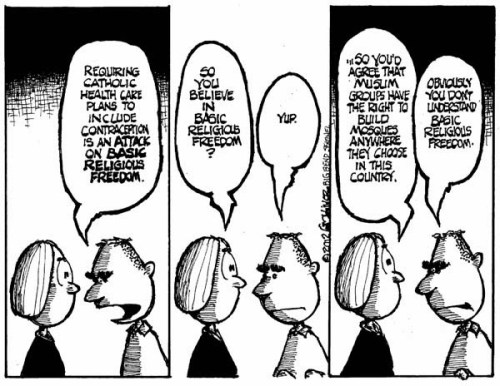

 To no one’s surprise, the House Intelligence Committee’s Republican majority released a