The Monday Morning Teaser

So the government shutdown is official now: It’s Monday morning and a bunch of people aren’t going to work.

As I always say, a weekly blog can’t do breaking news very well. If you want the absolute latest on what deal is being negotiated or how likely it is to pass, check CNN or the Washington Post.

Immigration is at the heart of the shutdown battle, especially whether Trump will start deporting the Dreamers in March. He has said he doesn’t want to do that, but he also hasn’t gotten behind any agreement to let them stay. As Democrats insist on making them part of a budget deal, Trump’s rhetoric has shifted to lumping them in with all “illegal immigrants”, which he has been blaming for crime and terrorism since he started running for president.

The featured post is an answer to one recent piece of that: a recent Homeland Security/Justice Department report that supposedly backs up Trump’s claim that “the vast majority of individuals convicted of terrorism and terrorism-related offenses since 9/11 came here from outside of our country”. But the claim is a lie, and so the report can only back it up by doing some truly egregious manipulation of statistics, as I’ll explain in “Lies, Damned Lies, and Trump Administration Terrorism Statistics”. That’s pretty much done and should be out soon.

There may or may not be a second featured post, which is my way of saying that I had an idea, but may not get it together in time. The idea was to mark Trump’s first year by looking back at the post “The Trump Administration: What I’m Watching For“, which I wrote two weeks after the election, and see whether the things I was worried about came to pass. (In general, yes.) A shorter version of that may get folded into the weekly summary, or I might push it off until next week.

The weekly summary will have the nuts-and-bolts of the failure to avoid a shutdown — no, I have no clue how long it will last — together with a bunch of other stuff that isn’t getting much attention. (Can you believe how fast everybody stopped talking about Trump’s lawyer paying off a porn star not to talk about their affair? If that story had been about Obama, it would have been THE big scandal of his administration. We’d still be talking about it years later.)

In particular, I want to call your attention to an interview with Jay Rosen, one of the best observers of the news media; he points to the difference between Troubles (what people worry about in their lives) and Issues (what the political debate is about) and observes that “when Issues don’t speak to Troubles, and Troubles don’t connect to Issues, you have a crisis in democracy”. If you want to sum up the background situation that made Trump’s election possible and allows his administration to be such a threat to America-as-we-have-known-it, you really can’t do much better.

The uncertainty about the second featured post means that I don’t know when anything will appear, other than the terrorism-statistics post, which will be out soon.

Undertones

The immigration debate has always carried with it an undertone of racism. I’m not attributing this to everyone who holds the position, but there’s a sense in which [opposition to] immigration is driven by a deep anxiety about the browning of America. That “how will we stem the tide?”, that “this is no longer a white nation.” … What Trump did yesterday was to make explicit the racist undertone of this debate.

– Eddie Glaude, speaking on MSNBC’s “Morning Joe” (1-12-2018).

This week’s featured post is “The Real Immigration Issue“.

On MLK Day, I always like to link to a piece I wrote in 2013 to warn conservatives against cherrypicking King’s quotes. The real Martin Luther King was a radical: “MLK: Sanitized for Their Protection“.

This week everybody was talking about shithole countries

(More about this in the featured post.) Even in a presidency full of jaw-dropping moments, Trump’s statement about “shithole countries” was extreme.

Trump made the remarks Thursday during a meeting with lawmakers in the Oval Office in which they discussed protecting immigrants from Haiti, El Salvador and African countries as part of a bipartisan deal on the status of undocumented young U.S. immigrants, The Washington Post reported.

“Why are we having all these people from shithole countries come here?” Trump said, according to people in the room, including Sen. Richard J. Durbin (D-Ill.). Trump then reportedly suggested that the United States instead should bring in more immigrants from countries such as Norway.

The most appalling thing here is not Trump — at least not any more; it’s not news that he’s a racist, or that he expresses himself crudely, or that his presidency is a constant embarrassment to the United States of America — it’s how few conservative or Republican voices speak out against him, even when he is so clearly in the wrong. For example, most members of his council of evangelical advisors made no comment, and the ones who did were supportive, like Baptist mega-church pastor Robert Jeffress:

“I support his views 100 percent, even though as a pastor I can’t use that language.” The United States, Jeffress said, has every right to restrict immigration according to whatever criteria it establishes, including race or other qualifications. “The country has the right to establish what would benefit our nation the most,” he said. “I don’t think there’s anything racist about it at all.”

You read that right: Explicitly screening immigrants according to race would not be racist. What rabbit hole have we gone down here?

Jeffress was not alone in seeing a problem of bad language rather than evil intentions. Others saw only Trump’s style, which is just different from what previous presidents have led us to expect. Fox News’ Jesse Watters:

This is how the forgotten men and women in America talk at the bar. This is how Trump relates to people.

There’s a core of truth there, but Watters is leaving out something important: This is how racists talk at the bar, and how Trump relates to racists.

James Fallows imagines if previous presidents had acted like Trump.

Suppose, contrary to known (to me) fact, Eisenhower had said to Senators in WH meeting during Little Rock school deseg controversy, “why are these n****s so pushy and demanding?” Suppose that legislators meeting JFK, LBJ, or even Nixon at WH during nonstop 1960s civil-rights tensions had heard a sitting president refer to black neighborhoods as shitholes or used code word ‘Nigra.’ Those comments would *certainly* have “connected with the base” in states that were fighting de-segregation. They would have reflected what “a lot of people were thinking.”

But I don’t think you’d have found (or would find, if you went back and looked) *mainstream* news outlets that would explain away, from a sitting president, outright racist language. This kind of “connecting with the base” rationalization is a new thing, and bad. Every civilization has ugly elements, which leaders are supposed to help their society rise above rather than egg on.


The one positive thing to come out of this: The mainstream media debate over whether it is proper to describe Trump’s remarks or Trump himself as “racist” seems to be over: They are and he is.


At first the White House didn’t even deny Trump’s comment. Its initial statement said that “Certain Washington politicians choose to fight for foreign countries, but President Trump will always fight for the American people.” Eventually, Trump got around to denying it sort of, and a few of the Republicans in the room backed him up. The striking thing to me, though, is that most of the people in the room were Republicans, and only a handful of them defended their president. Lindsey Graham didn’t specifically quote Trump, but more-or-less backed up the published accounts of the meeting.


I’ll give the last word on this to the Nazi website, The Daily Stormer, as quoted by The Hill:

This is encouraging and refreshing, as it indicates Trump is more or less on the same page as us with regards to race and immigration.

and the Hawaiian false alarm

I can’t decide whether the explanation is totally believable or totally unbelievable:

Around 8:05 a.m., the Hawaii emergency employee initiated the internal test, according to a timeline released by the state. From a drop-down menu on a computer program, he saw two options: “Test missile alert” and “Missile alert.” He was supposed to choose the former; as much of the world now knows, he chose the latter, an initiation of a real-life missile alert.

Couldn’t somebody have designed in one of those “Are you sure you want to do this?” boxes? If there’s a Doomsday Device somewhere, I hope its user interface is more forgiving.

Anyway, cellphones all over the state got a text: “BALLISTIC MISSILE THREAT INBOUND TO HAWAII. SEEK IMMEDIATE SHELTER. THIS IS NOT A DRILL.”

A more detailed message scrolled across television screens in Hawaii, suggesting, “If you are indoors, stay indoors. If you are outdoors, seek immediate shelter in a building. Remain indoors well away from windows. If you are driving, pull safely to the side of the road and seek shelter in a building or lay on the floor.”

The false warning sparked a wave of panic as thousands of people, many assuming they had only minutes to live, scrambled to seek shelter and say their final goodbyes to loved ones. The situation was exacerbated by a 38-minute gap between the initial alert and a subsequent wireless alert stating the missile warning was a mistake.

and DACA

The “shithole countries” remark came during a meeting in which Dick Durbin and Lindsey Graham were presenting a bipartisan compromise to avoid deporting the Dreamers, now that the program through which President Obama had protected them (DACA) has been ended by President Trump. Trump rejected their proposal, but so far there isn’t any other plausible plan out there.

DACA is one of many issues in a larger negotiation aimed at avoiding a government shutdown, which is otherwise is scheduled for Friday. The “shithole” meeting came two days after a televised meeting with lawmakers of both parties, in which Trump at various times put forward all possible positions.

538’s Perry Bacon thinks he knows what the ultimate compromise has to look like:

Even with the divides in both parties, the potential outlines of a bipartisan deal on immigration are obvious: some kind of permanent legal status and path to citizenship for Dreamers but with limits on their ability to sponsor relatives who also want legal status; an expansion of the physical barriers between the United States and Mexico; and the hiring of some additional border agents and other immigration enforcement personnel.


Meanwhile a court delayed the end of DACA by ordering the administration to keep renewing permits while the court rules on the legality of Trump’s order.

and Oprah 2020

Oprah’s speech at the Golden Globes, which I also linked to last week, started speculation about whether she wants to be president. That, in turn, sparked much pro-and-con arguing among Democrats. Some Democrats like the idea of challenging Trump with a better outsider: more famous, more accomplished, smarter, more articulate, more in touch with ordinary Americans, and just generally a better human being. Others hate the idea of nominating an inexperienced celebrity: Government is a serious profession, and calls for people who know what they’re doing; the fact that the Republican electorate decided to be irresponsible in 2016 is no reason for us to be irresponsible too.

Count me in the middle here. I get the attraction of Oprah 2020. If I could custom-design a Democratic candidate to run against Trump, I think a charismatic black woman who already has a following among whites might be a good start. I’m surprised that there might be one available.

The question is how much we should be willing to give up to get those features. I’m willing to give up a little, but not a lot. Specifically, I would run Candidate Oprah through the same tests as any other candidate. She’ll have to articulate a vision, show mastery of the issues, and lay out some detailed programs before I’d consider voting for her. (In 2016, Trump did have a vision — a reprehensible one — but he never demonstrated an understanding of issues or programs. He still hasn’t.)

Her lack of government experience is a factor, but not a decisive one for me. Over the centuries, the Presidency has grown to be such a big job that in fact no one is qualified for it, not even someone as smart and experienced as Hillary Clinton. Our system requires us to vote for an individual, but in practical terms we are always electing a team. While it’s true that Trump doesn’t know what he’s doing, the larger problem is that Team Trump also doesn’t know what it’s doing, and even when it does, Trump won’t leave his subordinates alone to do what they know how to do. (That’s a big piece of the lesson from Fire and Fury.) That’s why, for example, the administration keeps putting out executive orders that the courts overturn, and issuing directives that the generals refuse to implement. It’s also why there still is no Trump healthcare plan.

So Oprah’s inexperience would cause me to look more skeptically at Team Oprah, but I’m willing to be convinced if collectively they stand for something I can support and demonstrate varieties of expertise that Oprah lacks as an individual.

A lot of the anti-Oprah writers point to the pseudoscience that her TV show frequently promoted. Again, I see that as an issue, but not an insurmountable one: Her TV show was intended to engage people’s interest with ideas they weren’t seeing elsewhere, not to establish government policy. So I would be watching her campaign to see if similar tendencies emerged. Candidate Oprah would of course be asked about politically relevant science issues, and her answers should be critically examined. But if the answers she gives as a candidate stand up to scrutiny, if (unlike Trump) she shows appropriate humility and appreciates that she needs to lean on expert advice, I wouldn’t hold against her the stuff she promoted as an entertainer.

but you should pay attention to gerrymandering

A variety of cases are making their way up the ladder of federal courts. TPM has a good explanation of where they are and what they mean. The Texas case is about racial gerrymandering to limit the influence of Hispanic voters. But the North Carolina case opens a new front by directly confronting partisan gerrymanders, whether they are racially motivated or not. (As we increasingly have a party for whites and a party for non-whites, it’s hard to tell the difference.)

In 2012, Republicans won just 49 percent of the statewide vote but snagged nine of 13 House seats. Two years later, with 54 percent of the vote, they won 10 of 13 seats.

and you also might be interested in …

Trump continues to threaten to pull out of President Obama’s nuclear deal with Iran, but not to do it. Our side of the deal involves waiving sanctions against Iran, which the President needs to do every 120 days. Trump waived the sanctions again, but warned that this is the last time.

He continues to promise his base that he will get a new deal that is tougher on Iran. But no one else seems to think this is likely. In fact, Obama’s deal does important stuff:

Under the agreement, Iran agreed to eliminate its stockpile of medium-enriched uranium, cut its stockpile of low-enriched uranium by 98%, and reduce by about two-thirds the number of its gas centrifuges for 13 years. For the next 15 years, Iran will only enrich uranium up to 3.67%. Iran also agreed not to build any new heavy-water facilities for the same period of time. Uranium-enrichment activities will be limited to a single facility using first-generation centrifuges for 10 years. Other facilities will be converted to avoid proliferation risks.

None of our allies involved in the deal have expressed an interest in pulling out. The European Union’s chief foreign affairs representative, Federica Mogherini, said on Thursday:

The deal is working, it is delivering on its main goal which means keeping the Iranian nuclear program in check and under close surveillance. Iran is fully complying with the commitments made under the agreement.


Thanks to a Trump pardon, Joe Arpaio isn’t in jail. So why shouldn’t he be a senator? If you want background, I suggest Rolling Stone’s 2012 article “The Long, Lawless Ride of Sheriff Joe Arpaio“. Arpaio represents not “law and order”, but blatant bigotry acting in defiance of law and order.


Fascinating case in New Hampshire: The Border Patrol found marijuana by conducting no-probable-cause searches that would be illegal under New Hampshire law, and would also be illegal under federal law anyplace that wasn’t within 100 miles of a border. They turned the weed over to local police in Woodstock, NH, who charged the possessors with a crime. A state court now has to determine whether the evidence is admissible.

At stake is the possibility that American freedoms might seriously erode within a 100-mile band around the border. Already the Border Patrol can set up random checkpoints anywhere in that 100-mile band and ask for your ID. (I know a naturalized U.S. citizen from the U.K. who was stopped on an interstate highway in Vermont. He wasn’t driving, so he didn’t think he needed to be carrying his driver’s license. But his British accent created a problem that took some time to clear up.) It’s one thing to be asked to ID yourself and answer some questions when you cross the border. But if you just live near a border, you can be going about your everyday business and suddenly find yourself under search. If anything they find can be turned over to local police for prosecution … that doesn’t sound much like America, does it?

and let’s close with one last dance

iHeartRadio put together a celebration of performers who died in 2017, assembling clips of them dancing.

The Real Immigration Issue

“Illegal” immigration has always been a red herring. The more fundamental question is whether the United States will continue to be a country dominated by English-speaking white Christians.


When an issue sharply divides America, we tend to avoid discussing our real division, and instead fight proxy wars about side issues. So, for example, our legislatures and our election campaigns seldom engage the real debate about abortion: A large chunk of the country strongly believes that abortion is a difficult decision that a pregnant woman needs to make for herself, possibly in consultation with her husband, parents, friends, and doctors. Another large chunk believes that abortion is a form of murder and so the government should forbid it, possibly punishing the people involved.

But day-to-day, neither of those positions is discussed by our pundits or politicians. Instead, they raise smaller, related issues that they hope will push the battle lines in the direction they want: Should late-term “partial birth” abortions be legal? Should abortion be legal after a fetus has a detectable heartbeat or can experience pain? (And when is that?) Should abortion (or forms of birth control that could result in the loss of a newly-fertilized ovum) be covered under Medicaid or ObamaCare? Such debates are like the occasional shooting wars that erupted out of the Cold War. The underlying struggle — the U.S. vs. the U.S.S.R. — always stayed under wraps, while the actual battles were fought in Korea or Vietnam or Angola.

For a long time, something similar has been going on with regard to immigration. Anti-immigration politicians and pundits want to talk about “illegal” immigration: the people (usually estimated to number around 11 million) who live in the U.S. without official permission. Some sneaked across one of our borders and have never had any legal status, while an almost equal number came through our ports-of-entry legally as tourists and then overstayed their visas. But however they got here, the anti-immigration folks say, they should leave. It’s nothing personal or racial; it’s just about the rule of law and maintaining border security. And even more than the generic undocumented immigrant, they want to talk about criminals like the M-13 gang, the people President Trump primarily blames for the “American carnage” he made the centerpiece of his inaugural speech.

Meanwhile, pro-immigration politicians and pundits want to talk about the Dreamers: undocumented residents who were brought here as children and know no other country. Or about refugees who came (or want to come) from Syria or Haiti or some other country stricken by natural disaster or war. Or Latin American children whose parents sent them away to America rather than see them forced to become either soldiers or prostitutes for local drug gangsters. Whatever your views on immigration in general, pro-immigration voices say, these are human beings in trouble who deserve our compassion.

It’s easy to get drawn into the details of any of these issues, and find yourself listing victims of illegal-immigrant crime, or correcting misconceptions about DACA or the refugee-screening process. But it’s always worthwhile to remember that these aren’t the fundamental issues; these are proxy wars, and the energy behind them comes from somewhere else.

The more important groupings, the U.S/U.S.S.R. of this struggle, look more like this:

  • One side likes living in a multi-cultural society, and believes that America is stronger because it draws ambitious, freedom-loving people from all over the world.
  • The other side sees the U.S. as a white, Christian, English-speaking country. They believe we can tolerate and assimilate a certain number of people who don’t fit that description, but beyond a certain point (and we’re getting well beyond it now) we will lose our national identity.

Occasionally, some comparatively trivial comment draws the line between these two groups very sharply. For example, when the founder of Latinos for Trump said: “My culture is a very dominant culture. It is imposing and it’s causing problems. If you don’t do something about it, you’re going to have taco trucks on every corner.”

The second group knew exactly what he was talking about: The America they grew up in is in danger of being overrun by people who eat differently, speak differently, and probably live totally different lives than they do. “I’m losing my country,” they believe. But the first group responded to the taco-truck vision with something like: “That would be fabulous. I can never find taco truck when I want one.” Or a truck that sells falafels or sushi or samosas.

Unsurprisingly, this is largely a rural/urban split. If you grew up someplace like San Francisco or New York City, being surrounded by people of all colors chattering in all sorts of languages feels normal, and the idea that this represents a threat to the essential identity of America seems absurd. (Whites are already a minority in California. But when I’ve been there, it still feels like America to me.) But if you’re accustomed to living in a small town that has only recently begun to have a sizeable non-white minority, that not-like-us presence can seem dangerous. Who knows what is going on inside those mosques and temples, or what is being discussed in those foreign languages? Maybe they’re insulting us, making fun of us, or plotting some violence against us. How would we know?

The result is a bit perverse: The native-born English-speaking whites who seem to be in the most danger of being overrun by immigrants — the ones in the polyglot cities — are precisely the ones most comfortable with a vision of a multi-cultural future. But those in the least danger are the ones easiest to rile up against Sharia law or M-13 gangsters or taco trucks on every corner.

The Trump administration has consistently put forward policies that reflect the nativist, keep-America-white position. But they  haven’t promoted it openly, hiding instead behind rhetoric about illegal or criminal immigrants. However, look at what they’ve done:

All of these actions are directed at legal immigrants and visitors. They submit (or have submitted) to a legal process, we know who they are, we have a chance to investigate them. We just don’t want them here.

Even with regard to undocumented immigrants, the Trump administration’s actions belie its rhetoric. The rhetoric is all about criminals, “really bad dudes” as Trump has said many times. The reality is quite different. ICE frequently targets undocumented people living otherwise normal lives, supporting families by working exhausting low-wage jobs. This week, ICE launched a nationwide campaign of raids not on drug dens or underworld hangouts, but on 7-Elevens — 98 stores in 17 states. That brown-skinned girl making your Slushie is the threat Trump wants to protect you from.

Unless some deal is reached — and Trump insists on getting a price for this “concession” — the government is going to start deporting Dreamers in March. (Or at least it was, until a court ordered the administration to keep taking renewal applications. “These allegations raise a plausible inference that racial animus towards Mexicans and Latinos was a motivating factor in the decision to end DACA,” the judge wrote. The administration is obeying the order while it seeks to reverse it on appeal.) There is nothing criminal about Dreamers; the decision ignore the legal immigration process was their parents’, and a felony or significant misdemeanor would make them ineligible. They are no threat to national security or public order. The only reason to expel them is that Americans don’t want them. Or at least some Americans don’t.

We can only hope that Trump’s recent comment about “shithole countries” will shift the immigration debate onto the fundamental issue that is really at its core: Is America a set of ideals that anyone can adopt, or is it an ethnic tribe you need to be born into? Is it about a democratic form of government pledged to defend individual rights? Or is it about being white, speaking English, and loving Jesus?

Because what Trump was questioning at the time were plans for legal immigration from Africa, from Haiti, and from El Salvador. “Why are we having all these people from shithole countries come here? … Why do we need more Haitians?” He then asked why we couldn’t have more immigrants from countries like Norway instead. [1]

It’s not that we have no room left for immigrants, it’s that they’re wrong color. They don’t fit the “ideal American” stereotype many of us carry around in our heads. They make white English-speaking Christians feel like they’re losing their country.

That’s the real issue. It’s the issue Trump’s immigration policy is based on, why his base stands by him. It’s an issue we need to debate, without getting distracted by the red-herring issues of documentation.


[1] In general, people don’t leave their home countries if life is going well there. That applies to most white Americans also. (Consider, for example, the Irish Potato Famine or the pogroms that brought many Eastern European Jews to this country.) It’s also the answer to Trump’s question about bringing in more Norwegians: Life is good in Norway, so few of them want to come here.

The Monday Morning Teaser

What better way to celebrate Martin Luther King’s birthday than to spend several days discussing whether we want to accept immigrants from the “shithole countries” in Africa, or whether we should instead try to attract more Norwegians?

Ordinarily, I try to follow the principle Rachel Maddow laid out at the beginning of the Trump administration, and not waste too much energy on he-said-a-bad-thing stories. He’s been saying bad things from the beginning, everybody knows he says bad things, and even so, enough people voted for him that the Electoral College was able to make him president.

This bad thing, though, is a little different: It sums up a lot of what his administration has been doing, and breaks through his own misleading rhetoric. Too often, Trump and his followers hide behind opposition to illegal immigration. They pretend that the problem has something to do with national security and the rule of law: We just can’t have all these people ignoring our immigration procedures and coming across our borders without filing the proper paperwork and waiting their turn. Who knows what kind of criminals might be coming in?

But the shithole discussion was about legal immigration: How many people do we want to let in from where? The shithole comment puts a theme around a number of Trump actions that have nothing to do with anything illegal: cutting the number of well-screened war-refugees we’ll accept from Syria, sending back refugees from natural disasters in Haiti and El Salvador, and so on. Those people got in legally, and we know exactly who they are. They haven’t been causing any more trouble than our native-born citizens do.

The problem is that they’re not white. Trump’s America is a country for whites, and especially for English-speaking Christian whites. Every black or brown or Muslim or Spanish-speaking person we let in dilutes that America. It’s not that we’re too crowded, it’s that we should be reserving our open space for more Norwegians and other Europeans.

That’s the point of view that motivates the immigration policies of Trump and his base, and yet it rarely gets discussed openly. Maybe now it will. So this week’s featured post will be “The Real Immigration Issue”.

I’m way behind this morning. (I spent most of the week writing the MLK Sunday sermon I gave yesterday. You’ll see the text eventually.) So it probably won’t come out until 11 or so. The weekly summary — DACA, Oprah 2020, the Hawaiian false alarm, gerrymandering, and some other things — might not be out until 1.

If you want something to read in the meantime, look at a post I wrote in 2013 about the real Martin Luther King, the one who had a radical message for America, and wasn’t the why-can’t-we-all-just-get-along guy that we so often hear about today.

Convictions

Not only would Trump not be president, almost everyone in the campaign agreed, he should probably not be. Conveniently, the former conviction meant nobody had to deal with the latter issue.

– Michael Wolff, Fire and Fury

This week’s featured post is “Visions of a Future Gift Economy“, which discusses Cory Doctorow’s recent novel Walkaway.

This week everybody was talking about Fire and Fury

Michael Wolff’s book shipped Friday, days after excerpts appeared in New York magazine and Wolff’s account of writing the book came out in Hollywood Reporter. I like Masha Gessen’s summary of what the book tells us:

The President of the United States is a deranged liar who surrounds himself with sycophants. He is also functionally illiterate and intellectually unsound. He is manifestly unfit for the job. Who knew? Everybody did.

I’m about 1/4 of the way through Wolff’s book, and I feel a consistent cognitive dissonance as I read it: It’s simultaneously shocking and unsurprising. If not these exact incidents, many similar ones have been reported over and over again. We all knew. We didn’t even have to rely on reporting; Trump’s tweets are not the work of a sound and capable mind, much less the “stable genius” he tells us he is. (What actually stable genius would say such a thing?) Read them yourself.

James Fallows points out that Trump’s unfitness for the presidency was already “an open secret”.

Who is also in on this open secret? Virtually everyone in a position to do something about it, which at the moment means members of the Republican majority in Congress.

They know what is wrong with Donald Trump. They know why it’s dangerous. They understand—or most of them do—the damage he can do to a system of governance that relies to a surprising degree on norms rather than rules, and whose vulnerability has been newly exposed. They know—or should—about the ways Trump’s vanity and avarice are harming American interests relative to competitors like Russia and China, and partners and allies in North America, Europe, and the Pacific.

They know. They could do something: hearings, investigations, demands for financial or health documents, subpoenas. Even the tool they used against the 42nd president, for failings one percent as grave as those of the 45th: impeachment.

They know. They could act. And they don’t.

Josh Marshall:

We are now back on to the feverish debate about whether or not Donald Trump is mentally ill or suffering from the onset of dementia. The most important thing to know about this debate is that it simply doesn’t matter. … All the diagnosis of a mental illness could tell us is that Trump might be prone to act in ways that we literally see him acting in every day: impulsive, erratic, driven by petty aggressions and paranoia, showing poor impulsive control, an inability to moderate self-destructive behavior. He is frequently either frighteningly out of touch with reality or sufficiently pathological in his lying that it is impossible to tell.


Trump fired back by threatening to sue both the publisher and Steve Bannon, which reinforces my belief that he gets bad legal advice. David Graham at The Atlantic explains why a suit is a bad idea. First, suing the publisher is likely to do accomplish nothing more than to increase the book’s sales.

In order to win, Trump would likely have to prove that Wolff and the publisher printed information that they knew was false. In the United States, it’s very hard to win a libel suit against a publisher or media outlet—as Trump knows well, since he has repeatedly complained that libel laws need to be loosened for plaintiffs. Many of the most damaging quotes to emerge from the book so far, like Bannon’s description of the June 2016 Trump campaign meeting with a Russian lawyer as “treasonous,” or aides repeated assessments of the president as unintelligent and distracted, are matters of opinion and not fact, and therefore not subject to libel laws.

Take, for example, the quote where Bannon says Ivanka is “dumb as a brick”. In order to sue Wolff for that, Trump would have to prove not that his daughter is smarter than a brick, but that Bannon didn’t say the quote.

Whether Bannon is vulnerable depends on how sweeping his non-disclosure agreement with Trump is. But even if it’s iron-clad and Bannon’s statements to Wolff violate it, Trump would be foolish to go to court.

If a lawsuit did go forward, however, Trump would open himself up to defense lawyers poring through all sorts of information he probably doesn’t want made public. Presidents are largely immune to litigation while in office, but if Trump initiated a suit, he’d open himself up to discovery.

“It would be an opposition researcher’s dream,” Abrams said. “The sort of discovery which would result from a challenge to this book, which deals with issues as broad as the president’s intelligence, would allow enormous discovery. His college grades! It’s very hard to minimize the potentially relevant areas that discovery could go into.”

Trump tried such a suit once before, in 2007 against the author of the book Trump Nation. It didn’t go well. While being deposed under oath, he was forced to recant 30 public lies.


Stephen Miller creeps me out, so I have not watched his CNN interview, the one Jake Tapper ended early, resulting in Miller needing to be escorted out of the studio. Maybe your stomach is stronger than mine. If I were casting a movie and needed somebody to play a fascist toady, Miller would be hard to top.

and the investigations of Trump

There have been a number of recent developments. The NYT reported Thursday on Trump’s attempts to dissuade Jeff Sessions from recusing himself from the Russia investigation. Anonymous sources say Trump sent White House Counsel Don McGahn to lobby Sessions against recusal, and quote him saying that it was Sessions’ job to “protect” him from the investigation. Trump also talked positively about AGs “protecting” their presidents in an on-the-record interview with the NYT in late December.

Sessions, in turn, reportedly tried to dig up dirt against then-FBI-Director James Comey, presumably to undermine the FBI’s investigation of Trump. Also, notes taken by then-Chief-of-Staff Reince Preibus apparently back up some of Comey’s claims about his interactions with Trump.

All of this supports the theory that Comey’s firing was part of a larger effort to obstruct justice.


The Republican conspiracy theory focused on Fusion GPS and the Steele dossier largely unraveled. The heart of that theory was that the original FBI investigation of the Trump campaign’s possible collusion with Russia was based on the Steele dossier, which was partially paid for with money from the Clinton campaign. If that were true, it would point to a dangerous politicization of the FBI.

But it’s not true. Another NYT scoop says the FBI investigation began with a tip from Australian intelligence: Trump campaign advisor George Papadopoulos (who has already pleaded guilty and is cooperating with Mueller) bragged to an Australian diplomat at a London bar that Russia had dirt on Hillary Clinton. The diplomat initially thought nothing of it, but when such dirt started to come out, he reported the meeting.

Meanwhile, the founders of Fusion GPS published an op-ed saying that Congress already knows better than some of the conspiracy theories that Republican congressmen have been trafficking in, because they have already testified extensively under oath.

Yes, we hired Mr. Steele, a highly respected Russia expert. But we did so without informing him whom we were working for and gave him no specific marching orders beyond this basic question: Why did Mr. Trump repeatedly seek to do deals in a notoriously corrupt police state that most serious investors shun?

What came back shocked us. Mr. Steele’s sources in Russia (who were not paid) reported on an extensive — and now confirmed — effort by the Kremlin to help elect Mr. Trump president. Mr. Steele saw this as a crime in progress and decided he needed to report it to the F.B.I.

We did not discuss that decision with our clients, or anyone else.

They request that Chairman Grassley of the Senate Judiciary Committee release the transcript of their sworn testimony, but Grassley has refused to do so.


Meanwhile, Republicans in Congress seem more interested in punishing the whistle-blowers than in understanding how Russia interfered in the 2016 election and trying to prevent future interference. Senators Grassley and Graham made the criminal referral resulting from the Judiciary Committee’s investigation — against Christopher Steele, the author of the dossier whose contents were leaked to the public a year ago. The only bank records Congress has subpoenaed are those of Fusion GPS, Steele’s employers.


Meanwhile, the Justice Department has become less resistant to political pressure from Republicans. Investigations into the Clinton Foundation and Hillary Clinton’s emails have re-opened. It would be one thing if these investigations were based on some new information, but so far that seems not to be the case. It looks like Benghazi all over again: If the last investigation didn’t find anything criminal, it must be time to launch a new investigation. There appears to be no way to clear the Clintons.

We can’t lose sight of the larger irrelevance of these issues: Bill and Hillary Clinton are private citizens now. If there’s some legitimate reason to investigate or prosecute them, fine. But none of that has any political significance any more, and nothing that might be uncovered about the Clintons would justify ignoring Trump’s law-breaking.

and you also might be interested in …

Oprah’s speech at the Golden Globes.

For too long, women have not been heard or believed if they dared to speak their truth to the power of those men. But their time is up.

Other people are wondering if Oprah’s time is arriving. It’s hard to picture anybody better equipped to channel anti-Trump outrage.


It’s amazing how fast Trump nuclear-button tweet got knocked out of the headlines by other outrageous stuff. The best response to it was Stephen Colbert’s Viagrageddon commercial:


When Susan Collins voted for Trump’s no-billionaire-left-behind tax cut that also repealed ObamaCare’s individual mandate, she insisted that she hadn’t just caved, she had made a savvy deal: In exchange for her vote, she was promised that Congress would pass other legislation to keep the ObamaCare marketplaces from collapsing. Many observers (including me) concluded that she’d been rolled. In fact that additional legislation would never pass; or if it ever did, it would only be as part of a larger package requiring new concessions. Her vote had bought nothing.

Collins was enraged by that assessment, calling it “unbelievably sexist“.

“I cannot believe that the press would have treated another senator with 20 years of experience as they have treated me,” she told reporters. “They’ve ignored everything that I’ve gotten and written story after story about how I’m duped.”

But maybe people wrote that because she was duped. TPM reports:

When Sen. Susan Collins (R-ME) first announced she would support the GOP tax bill that killed Obamacare’s individual mandate, she insisted that three separate health care measures to prop up the Affordable Care Act and protect Medicare recipients be passed before she cast her vote. She then amended her demand, saying the bills had to pass before the tax bill came back from the House-Senate conference committee. She then insisted — after voting for the tax bill — that the policies pass by the end of 2017. When it became clear that wasn’t possible in the face of staunch opposition from House conservatives, she expressed confidence they would become law in January.

Now, Collins is moving the goalposts yet again.

In an interview with Inside Health Policy published Thursday, Collins said she hopes the policies she proposed will pass and be implemented before 2019, when the repeal of the individual mandate is expected to shrink the individual insurance market by several million people and drive up premiums by at least 10 percent.


Drug policy has long been the most obvious place where Republicans abandon their states-rights rhetoric. Drugs are bad, and so laws against them are good, even if they are federal laws that trump more permissive state laws.

In recent years, states like Colorado have relaxed their marijuana laws, to the point that their are retail marijuana shops like Local Product in Denver. At the New Year, marijuana laws changed in California and a few other states. The Obama administration had turned a blind eye to states legalizing marijuana. Federal law still banned it, but the Obama Justice Department decided it had better things to do than fight with states about weed.

The result has been something that Republicans ordinarily would applaud: Entrepreneurs started new businesses and created new jobs. What’s more, legally grown local marijuana keeps dollars in the country and lowers our real balance of payments deficit. (This may not show up in the official stats, because importing marijuana has always been off the books.) MarketWatch — a news site targeted at investors rather than potheads — projects that U.S. marijuana could be a $50-billion-a-year industry by 2026.

But this week Jeff Sessions announced that the oppressive hand of job-killing big-government regulation is coming back. He did not go so far as to order U.S. attorneys to crack down on those who grow or sell or use marijuana, but he rescinded Obama-era hands-off guidelines and instructed them to use their own judgment.

This policy change is expected to crimp the expansion of the legal marijuana industry, making bankers and other investors more skittish about risking their money. It will also give U.S. attorneys, who often go on seek higher office, a new temptation for corruption: Hey, Mr. Marijuana Mogul: Do you want to contribute to my campaign for governor, or should I arrest you?


Speaking of job-killing regulations, Slate points out that some jobs ought to be killed: the ones based on fleecing the public. The article points to the now-reversed regulation requiring financial advisors to act in their clients’ best interests.

Yes, these rules and regulations might technically kill jobs. But which jobs, and in order to accomplish what? Protections of this sort chase dodgy sellers out of the marketplace. If that’s job killing, good riddance.

Deregulation, in turn, paves the way for the return of these jobs for financial snake oil salesman.

Deregulation also spawns the need for regulatory sherpas—self-anointed “experts” hired by frightened members of the public who lack the time and sophistication to test the quality of (newly deregulated) drinking water, food, or prescription drugs.

Does the country really need a cottage industry of private testers and verifiers to help Americans get through the day? These are not jobs we need, nor ones we should want.


Israel’s response to Trump’s announcement that the American embassy will move to Jerusalem is to move further in the direction of annexing the territory it conquered in 1967. The NYT quotes Public Security Minister Gilad Erdan:

We are telling the world that it doesn’t matter what the nations of the world say. The time has come to express our biblical right to the land.

Whenever the Israel/Palestine conflict comes up, it’s worth remembering that there are only four long-term solutions:

  • two sovereign states
  • one democratic state in which all Jews and Palestinians are voting citizens
  • one undemocratic state in which half of the population rules the other half
  • ethnic cleansing

If you’re not for option 1, you’re implicitly for one of the other three.


Remember the commission that Trump established to prove his claim that 3-5 million people voted fraudulently in 2016, so he might have won the popular vote after all? Never mind. Trump disbanded the commission Wednesday. In the tweet announcing his decision, he continued to assert “substantial evidence of voter fraud”, though he has never produced any evidence for that claim.


One of Roy Moore’s accusers just had her house burn down. Maybe it’s a coincidence.


One of the key worries of never-Trump Republicans is coming true: College Republican groups are losing traditional Republicans and being taken over by Trumpists. That’s a trend that could affect the GOP for decades to come.

and let’s close with something remarkable

As any home-owner will tell you, construction projects take forever. Maybe they don’t have to: This house assembles itself in 10 minutes.


Visions of a Future Gift Economy

Cory Doctorow’s recent novel Walkaway imagines a world where scarcity is unnecessary and generosity is a feasible way of life.


When you take a mountaintop view that lets all the gritty details blur into insignificance, most of our political arguments come down to two visions of how an economy might function. We might have a capitalist market economy, where good things are scarce and people compete to obtain them (and possibly fail to obtain necessities like food or medical care). Or we might have a socialist command economy, where central planners figure out how the work all of us do is going to produce the goods and services all of us need.

Our current economy is a blend of the two — a mostly capitalist economy sitting over a socialist safety net that is maintained by a tax-supported central government — and our endless political debates are about where the capitalist/socialist boundary should be. Do we want higher taxes and a sturdier safety net, or lower taxes and a flimsier safety net?

There is, however, a completely different third vision, which for most of human history has sounded kind of crazy: an anarchist gift economy, in which people compete not to obtain scarce goods, but to give the most impressive gifts.

Christmas dinner. Gift economies already exist in little niches, on very small scales. For example: the pot-luck family Christmas dinners I remember from when I was growing up. If you approached the dinner like the homo economicus of capitalist theory, you’d bring the minimal dish to get yourself in the door, and then pig out on what everybody else brought. The obvious result, as any economist could predict, would be a tragedy of the commons: Everybody would bring less and less as the years went by, until Christmas became a celebration of scarcity rather than abundance.

If such an outcome didn’t kill Christmas entirely, it would probably lead to a socialist revolution: A central planning committee would make sure we all got enough to eat by telling everyone exactly what to bring, specifying quantity and quality very precisely, and checking that no one cheated. So food would be plentiful again, but even so, the joy of the season might get lost.

In fact, though, neither of those things ever happened. Instead, my aunts competed with each other to bring the most appealing dishes, probably secretly hoping that everybody would eat their food first and only eventually get around to sampling what the other aunts brought. The way you won Christmas wasn’t to get the best deal for your household, it was to give the best gift. As a result, the common table was anything but tragic; we all stuffed ourselves and there was plenty left over.

Sweat and scale. Critics will ask how that example scales up, and they’ll have a point. The general human condition was laid out thousands of years ago in Genesis: “In the sweat of thy face shalt thou eat bread.” Ever since we got kicked out of Eden, good things have required work, and work has been disagreeable. Christmas dinners are one thing, but in general nobody’s going to do the world’s work voluntarily, just so other people can have nice stuff.

Imagine, for example, being a New York gentleman shopping for a shirt around 1850 or so: The raw cotton has come from slaves working under the lash, and has been turned into thread and cloth and finally a shirt in factories where teen-age Irish immigrant girls get respiratory diseases from breathing the lint spewed out by the big machines. None of them would have put themselves through that just to give you a shirt.

And yet, as technology hands more and more of the economy’s grunt work off to machines, gift-economy niches are expanding, especially in any area that involves information or the internet. Wikipedia is a darn good encyclopedia. Linux is a top-notch operating system. They both required huge amounts of human effort to create, but they’re gifts; they exist (and are continuously updated) because people want to make themselves useful, even if they’re not paid for it. [1]

Facebook and other social-media platforms are a fascinating hybrid of economic models: Mark Zuckerberg got fabulously wealthy by putting a capitalist interface around a gift economy. Nobody (other than maybe a few of his personal friends) uses Facebook because they want to interact with Zuckerberg. We use it to see the interesting, clever, and entertaining things other people post for free. Like my aunts at Christmas, we compete with each other to provide more and better free content. The ads that have made Mark a zillionaire are the friction that we tolerate for the chance to give and receive each other’s gifts.

Goods and services. Still, Linux-programming nerds are a special case, and a real economy is more than just clever tweets or cute cat videos. What about services that require time and effort here and now? Will people provide that for free?

Yeah, they will. Look at retired people, especially professionals who did something more interesting than purely physical labor. Often they keep doing similar work on a smaller scale for nothing. Retired public school teachers teach art classes at the community center, or mentor at-risk students one-on-one. Retired business executives give free advice to small start-ups. Retired doctors and nurses help out at free neighborhood clinics, or go off to disaster areas like Haiti after the earthquake or Puerto Rico after the hurricane.

When you ask such people why they stopped working for pay, the answer usually isn’t that they wanted to do nothing; it’s that the jobs available were too exhausting and constraining. The workplace wanted too much out of them, or left too little room for the parts of the job they most enjoyed. Young people describe the same situation from the opposite side: It’s not hard for them to think of ways to use their talents to help people and make stuff, or even for them to get excited about doing so. What’s difficult is figuring out how to get paid for it.

Anyone involved with a volunteer organization knows that people will even step up to do physical labor as long as there’s not too much of it. If you require long hours of drudgery day after day, you’ll have to pay somebody. But if you want a bunch of people to paint the new school or clean out the church basement, you can usually get that done by volunteers. If not for the thought that some big corporation would be making money off of us, I could imagine people volunteering to help at UPS during the holidays, as long as we could do it on our own terms. “Hey, I’m not doing anything Tuesday. You want to go deliver some Christmas presents?”

Material goods. OK, but what about real stuff? Physical things are different from information or services.

But not as different as they used to be. 3D printing is still in its infancy, but it looks like a bridge between the information-wants-to-be-free world of the internet and the sweat-of-thy-face world of physical objects. Most of what you can make now falls under the broad heading of “cheap plastic crap“, but you only have to squint a little bit to see future printers that are more like general fabricators: They’ll use a greater variety of materials, and weave them together on smaller and smaller scales, until we have something approaching the replicators of Star Trek.

In the future, you might acquire a shirt by getting your torso scanned, choosing from a set of designs somebody posted free to the internet, and having your general-purpose home fabricator assemble the shirt molecule-by-molecule, using one or two of your worn-out shirts as raw material. No slaves. No wheezing red-haired girls. Just energy (which you might have gotten free from the wind or sun), computing power (so cheap that it’s barely worth accounting for), and gifts from other people.

It’s a stretch, but you can imagine even food working that way eventually: Get some organic molecules by throwing your grass clippings into the fabricator, and take out a beef stroganoff — or maybe at least some edible substance that is tasty and nutritious. In the meantime, people love to garden or raise chickens or tend bees. A lot of them happily give their surplus away. At the moment, that’s not nearly enough to feed the world. But such small-scale producers might come a lot closer if they didn’t need to have jobs or sell their produce for money. If you needed traditional food merely as a garnish, and got your basic nutrition elsewhere, the gift culture might provide it.

In short, some desirable things — beachfront homes, original copies of Action #1 — might always be scarce and remain part of a market economy. But it’s possible to imagine the market and gift economies switching places: Markets might become niches, as gift economies are now.

Capitalism and the surplus population. Compare the gift economy’s trends to what technology is doing to the capitalist economy. Picture a capitalist economy as a set of concentric circles: The innermost one consists of the relatively small number of people who increasingly own everything. They can afford to get whatever they want, so there has to be a next circle out, consisting of the people who produce goods and services for the rich: food and clothing, obviously, but also yacht designers, heart specialists, estate planners, physical trainers, teachers for their kids, bodyguards, and so on.

It takes a lot of people to provision a single oligarch, but if the central circle is small enough, the next one out will still be just a fraction of the general population. Those second-circle people may not be rich like the central circle, but they will need to be paid enough to buy a number of the things they want. So a third, even larger circle of people becomes necessary to produce goods and services for them.

And so on.

It would be pleasant to imagine that these circles expand forever, each new circle spreading the wealth to the next circle out, until everybody can be paid to do some useful work. But as the inner circle gets smaller and smaller, and as more and more work is done by machines, probably the process ends long before it includes everybody. So you wind up with a final outer circle of surplus population: people the economy has no real use for. It’s not that they have no skills or don’t want to work or have some moral failing that makes them unemployable. It’s just math. The people with money can get everything they want without employing everybody, so a lot of other people wind up as ballast. [2]

If you’re a bleeding-heart type, you might get sentimental about those surplus people. But put yourself in the shoes of an oligarch: The prevailing moral code won’t tolerate just letting the extra people starve, so somebody has to maintain them through either charity or taxes, even though they’re entirely useless. Imagine how you must resent all those parasites, who have no connection to your productive economy, but still want to be supported by it! [3]

Now we’re in the world of Cory Doctorow’s Walkaway.

Walkaway. The novel takes place in the late 21st and early 22nd centuries, by which time several of the trends we can see now have gone much further. Large numbers of people compete for a relatively small number of jobs, and the people who get those jobs are increasingly desperate to keep them. If you weren’t born rich, getting enough training to compete for the good jobs involves taking on debts that you may never get a good enough job to pay off. The economy has contracted around a few major economic centers, leaving large sections of the U.S. and Canada virtually empty.

Increasing numbers of people who get fed up with this situation “go walkaway”: They set out for the empty areas, hoping to find a way to make a life for themselves outside the “default culture”, which the Walkaways come to call Default. Fortuitously, the UN has responded to a variety of refugee crises over the decades by developing technologies that make it easy to establish settlements quickly: cheap wind and solar generators, small fabricators you can use to make bigger fabricators, shelter designs that don’t require skilled construction, and so on. Computing power and internet connectivity are easy to set up, and from there you can get whatever expert advice you need from professionals who find their Default jobs unfulfilling.

Walkaway settlements display that unique combination of order and anarchy you may recognize if you’ve spent any time at Burning Man or an Occupy encampment or working on an open-source project. There are elaborate social processes aiming at consensus, but if you can’t resolve a conflict you walk away from it: Take a copy of the source code and go create your own version of Linux if you want; maybe other programmers and users will come to like your vision better, or maybe not.

The Walkaway lifestyle is a mixture of hardship and abundance. The prevailing aesthetic is minimalistic, but everything you actually need is freely available. If somebody really wants your stuff, let them have it and go fabricate new stuff. If a group of assholes shows up and wants to take over the settlement, walk away and build a new settlement.

Doctorow’s most interesting insights involve the values implied by Default and Walkaway. Default is based on scarcity, and a person’s claim on scarce goods revolves around having special merit. [4] So everyone in Default is constantly striving to be special, to convince themselves that they’re special, and to prove their specialness to others. The hardest thing to adjust to in Walkaway is that you’re not special; you’re like everybody else. But that’s OK, because everybody deserves a chance to live and be happy.

Without spoiling anything, I can tell you that three things drive the plot:

  • An oligarch’s daughter goes walkaway, and he wants to reclaim and deprogram her.
  • Researchers at “Walkaway U” (a loose collection of scientists who mainly need computing power and don’t want their research controlled by oligarchs) solve the problem of simulating brains and uploading a person’s consciousness into software, thereby creating a version of immortality. Not only do the oligarchs want this technology — that would be easy, since nobody is keeping it from them — they want it to be expensive intellectual property that only they can afford to use.
  • Default culture is starting to fall apart, as more and more of the people it relies on stop believing in it. [5]

Default had tried to ignore Walkaway, and then to smear it as a dangerous place full of rejects and criminals. [6] But the plot-drivers cause Default to start seeing Walkaway as a threat.

Reflections on scarcity. One thing I take away from the novel is to be more skeptical of scarcity. Systems tend to justify themselves, so it’s not surprising that a system based on managing scarcity would concoct ways to create unnecessary scarcity. Much of our current culture, I think, revolves around making us want things that only a few people can have. [7] The vast majority that fails to acquire these things are defined as losers, and they/we deserve whatever bitter result they/we get.

Ditto for the idea that work is disagreeable. Maybe we’re making work disagreeable. Because good jobs are scarce, employers can demand a lot and treat workers badly. If, instead, we could fully engage everybody’s talents and energies, maybe the work we each needed to do wouldn’t be that demanding. We might even enjoy it.

So I’m left with a series of provocative questions: What if scarcity isn’t the fundamental principle of economics any more, or won’t be at some point in the near-to-middle future? What if God’s post-Eden curse — “In the sweat of thy face shalt thou eat bread” — came with a time limit? What if our sentence is up?


[1] This blog is a gift: no subscriptions, no ads, no click-here-to-donate buttons, not even a means to collect and sell your data. It’s really this simple: I want to write it and I hope you enjoy reading it. If you want to do me a favor in return, spread my gift to your friends.

[2] Once this process gets started, a vicious cycle makes it worse: The larger the surplus population, and the more capable people it contains, the more competition there is for the available jobs. This drives down wages, and shrinks all the circles further. For example: The less the second circle gets paid, the fewer goods and services it can command. Consequently, the third circle doesn’t have to be as big. And so on.

[3] In case you’re struggling to put words around the flaw in this way of thinking, I already did: The mistake is the assumption that the oligarchs own the world, and that a baby born into poverty has no claim on either the natural productivity of the planet or the human heritage that created technological society. The oligarchs assume they are the sole rightful heirs both of the Creator and of all previous generations of inventors.

[4] Characters in the novel dispose of the “meritocracy” view of capitalist society very quickly: The view is based on circular logic, because “merit” is defined by whatever the system rewards. So Donald Trump is on top because he has merit, but the only observable evidence of his merit is the fact that he’s on top.

[5] The collapse of Soviet Communism is probably a model here. The Soviet system maintained the appearance of vast power right up to the last minute. When people respect you mainly for your power, the first signs of weakness quickly snowball.

[6] Recall the mainstream reaction to Occupy Wall Street.

[7] The archetypal example of this is the the Prize in Highlander: “In the end there can be only one.” Reality TV tells us this story over and over: The Bachelor will pick only one woman. Only one performer will become the next American Idol. And so on.

The Monday Morning Teaser

So I appear to have gotten away with taking Christmas and New Year’s off. For two weeks, the breakneck speed of news during the Trump Era slowed down. For example, Trump did not fire Robert Mueller, in spite of all the rumors predicting that he would as soon as Congress started its holiday break.

Then after New Year’s, it all started up again. Tuesday, in a weirdly hermaphroditic hybrid of implicit sexual imagery, Trump taunted Kim Jong Un by tweeting about the size and functionality of his nuclear button. Wednesday, the first excerpts of Michael Wolff’s new book Fire and Fury hit the internet. The full book came out Friday, and since then the whole administration has been consumed by the need to reassure Trump’s base that in fact they don’t all secretly believe that Trump is a moron and they aren’t all constantly working to corral him as if he were a hyperactive child. (Trump himself announced that he is in fact a “stable genius”, which is something that I can’t imagine an actually stable genius ever saying. The very statement is evidence against itself.)

New evidence that Trump obstructed justice came out, the founders of Fusion GPS shot down the Republican conspiracy theories about the Steele dossier (while daring Senator Grassley to release their sworn testimony to the Judiciary Committee; he didn’t, and instead sent a letter to the Justice Department recommending that they investigate Steele for possible crimes), and congressional Republicans doubled down on the strategy of undermining all the investigations into Russia’s interference in the 2016 election. Meanwhile, Congress is on the clock to avoid a bunch of self-inflicted disasters, like a government shutdown or the deportation of the Dreamers.

So there’s all that to cover, but I’m going to leave it (and a few other things) for the weekly summary. The featured post steps back to take a longer view. Over the break, I read Cory Doctorow’s recent novel Walkway, which envisions a future economy based on giving rather than competing for scarce resources. That sounds crazy, but little niches of the current economy are already based on gifts, and technological trends make their expansion sound somewhat less crazy. As we settle in for the capitalism/socialism death match, it’s worth remembering that those aren’t the only two possibilities.

So “Visions of a Future Gift Economy” should post around 8 EST. I’m less sure about the scheduling of the weekly summary, but I think it will be out before 11.

Profit and Loss

The next new posts will appear on January 8.

“What shall it profit a man,” Jesus asked, “if he gain the whole world and suffer the loss of his own soul?” The current Republican Party seems to not understand that question.

– David Brooks, “The GOP is Rotting” 12-7-2017

This week’s featured post is “Should We Care What Happens to the GOP’s Soul?

Through no doing of my own, it turns out that the next two Mondays are Christmas and New Years. I’ve interpreted that as a sign from the Calendar Gods that I should take a two-week break (something I haven’t done in years). I reserve the right, though, to put out a special edition if something happens that I can’t stop myself from commenting on.

This week everybody was talking about Roy Moore’s defeat

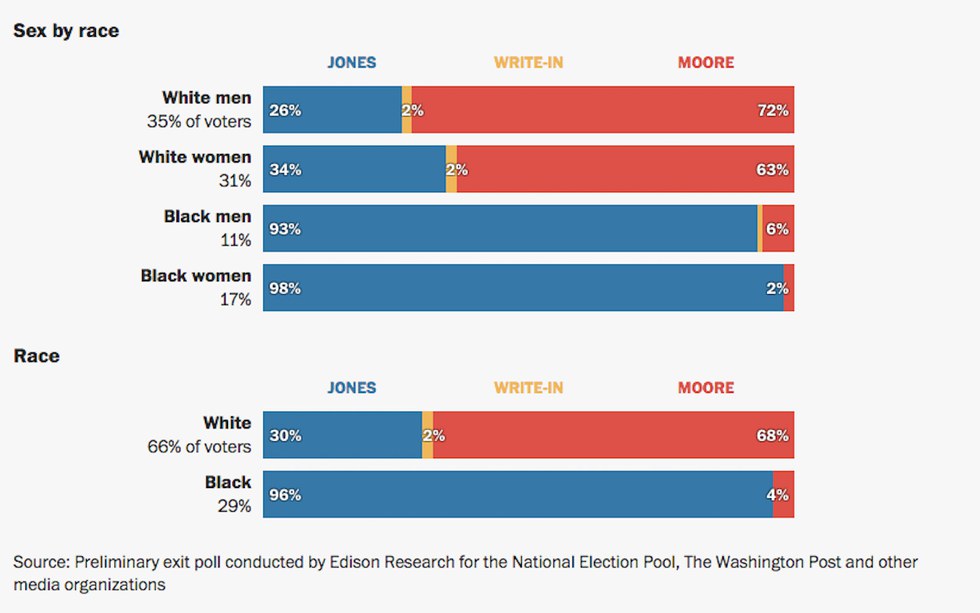
When Trump appointed Jeff Sessions attorney general, I don’t think anybody at the RNC was worried about hanging on to his Alabama Senate seat, and I doubt anybody at the DNC imagined waging anything more than a nuisance campaign. And yet, here we are: Doug Jones is going to be the next senator from Alabama, the first Democrat since Richard Shelby won in 1992 and then switched parties.

Pundits and operatives of all persuasions are trying to discern the lessons of the Jones/Moore race. To a certain extent that’s foolish, because so much of this race isn’t repeatable. I mean, wasn’t Jones clever to run against a molester of 14-year-olds who is nostalgic about slavery? Democrats should try that nationwide!

Still, there is at least one thing worth noting: Always field a candidate, because you never know what might happen. Sessions ran unopposed in 2014. (A write-in candidate spent $4500 and got less than 3% of the vote.) If no Democrat had gotten onto the ballot this time, Moore would have won no matter what voters found out about him.

A second lesson is just an extension of the first: Run hard, even if victory seems unlikely. That big turnout in the black community didn’t just happen. A combination of star power (Cory Booker, NBA great Charles Barkley, and a robocall from President Obama) and hard work by many, many volunteers made the difference.


One mistake I’m seeing in the Democratic discussion is the tendency to interpret Jones’ victory in light of the interminable Bernie/Hillary debate. It shows the importance of turning out the Democratic base, say Bernie folks, while Hillaryites note the importance of fielding a moderate candidate who didn’t rile up Republican partisanship.

In my mind, there is still a debate to be had about the 2018 campaign, but it’s not primarily a progressive/pragmatic debate. It’s a national/local debate. Should Democrats nationalize the 2018 campaign around progressive proposals like single-payer healthcare and a $15 minimum wage? Or should each candidate target his own state and district with a message that’s in the local mainstream?

In a special election, going local is the obvious choice, which is what Jones did. (I know some progressives believe their message would sell in a red state like Alabama, but I’m still waiting to see an example.) But whether 2018 should be a bunch of local elections or a national one like 1994’s Contract With America is still debatable.


This, however, is just foolish: Because Jones hasn’t endorsed single-payer healthcare or a $15 minimum wage or free college, he’s “a terrible candidate”.

Come election day, Alabamians will have the sacred honor of participating in the democratic process by voting for either a child rapist or a weak-kneed white blob in a suit to go work on Capitol Hill for some unknown corporate donor. Personally, I can’t say that I will be taking part.

Thank God 671K Alabama voters didn’t agree.

Every election asks voters a question. It may not be the question you wanted to be asked, but it’s the only question you’re going to get in that cycle. Answer it.


Naturally, Jones’ victory has produced conspiracy theories about out-of-state ringers being bused in. (It was the same story last year in New Hampshire, where both Clinton and Maggie Hassan won narrow victories.) John Rogers, co-creator of the thieves-working-for-the-greater-good TV show Leverage, addressed the theory, because “very few things piss me off like sloppy heist plotting”.

He points out all the logistics that would be required to engineer a 20,000-vote upset, when no one could be sure a week ahead of time that the election would even be that close. Somebody, he observes, would have to recruit tens of thousands of ringers, rent hundreds of buses (with drivers) to transport them, provide them with registered identities to claim  and ID to verify those identities (all of which the conspiracy had in reserve just in case the GOP nominated somebody beatable like Moore), and then drive them to polling places in a state with a hostile Secretary of State — all with nobody noticing.

Nobody leaks. Nobody tells a friend. Not a single slip-up. That is some fucking OPSEC.

Similar points were made in response to the 2016 New Hampshire conspiracy theory:

“Who drove the buses?” asked William Galvin, the Massachusetts secretary of state, who does not believe the voter fraud theories. “Who owns the buses? Where did the buses leave from? Who paid to rent the buses? You give us some specifics and we’ll investigate it.”

That rational critique didn’t dissuade anybody from trotting the theory out again in Alabama, and I’m sure it will keep resurfacing every time a Democrat wins a close election.

BTW: The theory specifically says that black people were bused in to cast illegal votes; that explains the unusually high black turnout. Apparently it doesn’t make sense to Republicans that blacks might vote in large numbers against a candidate who expresses nostalgia for the days of slavery.

and tax reform

Thursday, it briefly looked like the package might be in trouble. But Friday, both Marco Rubio and Bob Corker announced they would vote for it, so it looks likely to pass this week. Corker’s support is particularly dismaying. He didn’t vote for the tax reform package the first time around in the Senate because (by every serious analysis) it would increase the national debt by more than $1 trillion dollars. Nothing has changed to fix that, but Corker appears to have decided that it just doesn’t matter; his lifetime as a deficit hawk was a lie.

Of course, it is only a matter of time before Republicans declare the debt to be an existential crisis again, and demand cuts in safety-net programs to deal with it. Paul Ryan is already talking about it.


Assuming this tax bill passes, I hope Democrats treat it the way Republicans have treated ObamaCare: It has to be repealed, no matter how long it takes.

The combination of tax reform and Doug Jones gives 2018 a particularly clear storyline. Republicans are unlikely to pass any other major legislation, so they will go into the midterm elections exactly one achievement: a tax bill that borrows a bunch of money to benefit the rich.


Remember how this was supposed to simplify taxes to the point where you could just send the IRS a postcard rather than fill out a complicated return? Well, never mind. That didn’t happen.


One loophole inserted at the last minute will apparently save a lot of money for Trump, Jared Kushner, and a number of Republican senators.

and attacks on the Mueller investigation

It continues to be an open question whether Trump will allow himself to be investigated, and whether congressional Republicans will back him if he decides to place himself above the law.

California Congresswoman Jackie Speier told local PBS station KQED:

I believe the President wants all of this shut down. The rumor on the Hill when I left yesterday was that the president was going to make a significant speech at the end of next week. And on Dec. 22, when we are out of D.C., he was going to fire Robert Mueller.

White House lawyer Ty Cobb denied the rumor (though I’ve often suspected that Trump doesn’t tell everything). It’s hard to tell if this is a somebody-slipped-me-inside-information rumor, or a that’s-what-I’d-do-if-I-were-wannabee-tyrant rumor.

In recent weeks, right-wing media has ramped up a campaign to undermine public trust in the Mueller investigation, pointing to anti-Trump private opinions of some investigators as evidence of professional bias. Republicans in Congress have fanned these flames, most notably in their questioning of Assistant Attorney General Rod Rosenstein, the person who actually could fire Mueller, but sees no cause to. Ben Wittes at the Lawfare Blog comments:

Most importantly, there is no serious suggestion that any step taken by Mueller’s shop is unjustified. The Mueller investigation will ultimately be measured by its work product, not by the text messages or campaign contributions of its staffers from before the investigation even existed.

The professionalism of the Mueller probe is a stark contrast with the House investigation of Hillary Clinton, which leaked like a sieve, often inducing news organizations to publish damaging stories about Clinton that had to be walked back once more complete information became available. Going back a bit further, the Starr investigation of President Bill Clinton was transparently partisan, writing up its findings in the most salacious way possible, and delaying its exoneration of Clinton’s Whitewater dealings until after a midterm election.

Trump himself has been running down the FBI, the Justice Department, and virtually the entire federal law enforcement system. His claims put him at odds with his own appointees, including FBI Director Christopher Wray and Attorney General Jeff Sessions.


A bunch of the Republican criticisms of the FBI go back to the Clinton email investigation. It’s part of their dogma that Hillary did something horribly wrong, so the fact that the FBI didn’t find it brings the whole organization into suspicion, rather than causing Republicans to doubt their conspiracy theory.

Anybody who kept a close eye on the publicly available information could have predicted that Clinton wouldn’t be charged with anything, as I did in June, 2016.


Saturday, Trump lawyers charged that Mueller had illegally gotten thousands of the emails of the Trump transition team. The claim looks baseless. In particular, the point of raising the charge publicly seems to be to get political mileage out of a claim that won’t fly in court. The WaPo quotes a GWU law professor:

if Trump’s team had a valid legal claim, there is a standard avenue to pursue — they would file a sealed motion to the judge supervising the grand jury and ask the judge to rule the emails were improperly seized and provide a remedy, like requiring Mueller’s team to return the emails or excluding their use in the investigation.

“You go to the judge and complain,” he said. “You don’t issue a press release or go to Congress. It appears from the outside that this is part of a pattern of trying to undermine Mueller’s investigation.”


All along during the Russia investigation, the most compelling reason to think Trump and his people did something wrong has been their own behavior. They have consistently lied about their contacts with Russians, and now, as Mueller’s investigation begins to close in on them, they try to destroy public trust in it.

and net neutrality

The FCC made it official: Net neutrality is dead. Fred Benenson paints a clear picture of what that will mean by 2020:

Negotiating internet access will feel a lot like negotiating your television cable or cellphone bill. You’ll be forced to untangle various packages relating to different sites and services you might use, pay for ISP-branded content you probably don’t care about, and get that sinking feeling at the beginning of every month that, one way or another, you’re overpaying.

Instead of simply worrying about how much internet you use or how fast you need it to be, you’re going to have to worry about what kind of internet you use. Premium sites like Netflix and YouTube will likely cost more, you’ll be nickel-and-dimed for the use of free apps like iMessage and FaceTime, and unfettered access to the full internet will be more expensive.

Start-ups, facing even higher barriers of entry, will be forced to spend money partnering with telecom companies. Fewer of them will survive. And the start-ups that do survive will spend an unnecessarily high amount of their income paying to survive. This is great news for established companies like Facebook and Google that will always be able to afford internet tolls. They will cement their already dominant position against newer but better sites and services.

and you also might be interested in …

The Washington Post tells a very disturbing story of Trump’s refusal to listen to the intelligence services’ evidence of Russian interference in the 2016 election, or the possibility that future elections will be undermined.

The result is without obvious parallel in U.S. history, a situation in which the personal insecurities of the president — and his refusal to accept what even many in his administration regard as objective reality — have impaired the government’s response to a national security threat. The repercussions radiate across the government.


It sounds like parody, but it isn’t: The Trump administration is telling the CDC what words to avoid in its budget requests: vulnerable, entitlement, diversity, transgender, fetus, evidence-based and science-based.

Whatever conservatives fantasize that liberals are doing, it seems, they will do in reality when they get power. This, for example, really is an example of political correctness trumping freedom of speech and thought.


An important article by Amy Sullivan in the NYT about “Fox Evangelicals” — people for whom “Evangelical” is a tribal identity rather than a theology.

She quotes a study by Lifeway Research, comparing the number of people who call themselves Evangelicals to the number who hold four theological beliefs commonly thought to define Evangelicalism: the authority of the Bible, importance of evangelism, Jesus’ death as payment for sin, and Jesus as the only path to salvation. Only about half of self-identified Evangelicals strongly agreed with all four.

One significant difference between Fox and Biblical Evangelicalism is the attitude toward fear. Fox Evangelicals are driven by fear of outsiders, and see a corresponding need for weapons. The Bible, by contrast, calls for welcoming the stranger and says to “Be not afraid.”

That disconnect underscores the challenge many pastors face in trying to shepherd congregants who are increasingly alienated from traditional Gospel teachings. “A pastor has about 30 to 40 minutes each week to teach about Scripture,” said Jonathan Martin, an Oklahoma pastor and popular evangelical writer. “They’ve been exposed to Fox News potentially three to four hours a day.”

Martin points to a key difference between second-generation leaders like Franklin Graham and Jerry Fallwell Jr. and their famous fathers.

There was a lot I didn’t agree with him on, but I’m confident that it was important to [Jerry Falwell] Senior that he grounded his beliefs in Scripture. Now the Bible’s increasingly irrelevant. It’s just “us versus them.”

My comment: To the extent that Evangelicalism has become an identity masquerading as a religion, it will dovetail with fascism, which is an identity masquerading as an ideology. In both cases, beliefs are merely instrumental; the important thing is that my people stay on top.


I passed through Richmond this week, and saw the Confederate statues on Monument Avenue. When you see them close up, the argument that this is about “history” is hard to swallow. They’re there to celebrate the defenders of slavery. I mean, where’s the General Grant statue? He reclaimed Richmond for the United States. Isn’t that history?

and let’s close with something almost familiar

Stephen Colbert inserts himself into Silence of the Lambs.

Should We Care What Happens to the GOP’s Soul?

A healthy democracy needs a reality-based conservative party. We haven’t had one for a very long time.


For more than a year, thoughtful Republicans have been posting warnings about the state of their party’s soul. A few days before the recent Alabama Senate election, David Brooks was particularly eloquent:

“What shall it profit a man,” Jesus asked, “if he gain the whole world and suffer the loss of his own soul?” The current Republican Party seems to not understand that question. Donald Trump seems to have made gaining the world at the cost of his soul his entire life’s motto.

The question came up during the 2016 Republican primaries, when Trump began pulling away from the crowded field, in spite of — or maybe because of — his blatant racism, sexism, xenophobia, and disregard for truth. It came up again at the Convention, when Ted Cruz briefly took a principled stand before eventually slinking back into line. Evan McMullin’s and Gary Johnson’s third-party campaigns attempted to appeal to a more upright form of conservatism, and managed to shave off a few votes here and there, but had little effect on the election’s outcome.

And then, in the campaign’s final month, the Access Hollywood video came out; it showed the inheritor of the mantle of Lincoln bragging about sexual assault and infidelity. More than a dozen women soon came forward to give the specifics of the assaults Trump had only alluded to. Briefly, party stalwarts like Paul Ryan tried to distance themselves from Trump, without actually denouncing him. Behind the scenes, religious-right heartthrob Mike Pence offered himself as a last-minute alternative. But Trump held firm: Both he himself and the women who accused him had been lying. (“Locker room talk“, he called it — an innocent variety of fib similar to fishermen’s stories.) In spite of his own words, no pussies had actually been grabbed.

Across the country, Republicans — especially the white Evangelical Christians who had denounced Bill Clinton with such vigor two decades before — stood firm behind their man. Despite losing the popular vote by  larger margin than any victor in U.S. history, Donald Trump was President of the United States.

But even that was just the beginning, as Brooks acknowledged.

There is no end to what Trump will ask of his party. He is defined by shamelessness, and so there is no bottom. And apparently there is no end to what regular Republicans are willing to give him. … That’s the way these corrupt bargains always work. You think you’re only giving your tormentor a little piece of yourself, but he keeps asking and asking, and before long he owns your entire soul.

And so congressional Republicans completed the theft of a Supreme Court seat by approving Neil Gorsuch. They went along with Trump’s appointment of cabinet secretaries who were either unqualified — like Rick Perry (who didn’t even know what the Energy Department does), Ben Carson (whose main qualification to run HUD seemed to be his race), and Betsy DeVos — or conflicted, like Putin-approved Rex Tillerson, whose company (Exxon) stood to profit massively from his intention to relax sanctions on Russia. They showed no interest in Trump’s unprecedented conflicts of interest and lack of transparency, slow-rolled both the House and Senate investigations into the Trump campaign’s collusion with Russia, and have increasingly cooperated with Trump’s craven effort to discredit the Mueller investigation. Brooks comments:

Trump may soon ask them to accept his firing of Robert Mueller, and yes, after some sighing, they will accept that, too.

But ultimately, what shall it profit them?

Roy Moore. Fundamentally, there are two kinds of moral codes. One insists that you do the right thing, but the other has a lesser demand: Before you do the wrong thing, you have to agonize about it. Again and again, Republicans have demonstrated the second kind of morality.

I had expected the pattern to play out once again with regard to Roy Moore. Faced with a financially corrupt pedophile who has no respect for the rule of law and pines for the days of slavery, both national and Alabama Republicans would agonize greatly, but ultimately they would come through for their party. Alabamans would elect him and the Senate would seat him.

I was wrong, sort of. Apparently, some Republicans finally reached their limit with Roy Moore. Not many, but just enough that a big turnout in the black community could push Doug Jones over the top: According to the exit polls, Moore got 91% of the Republican vote and 80% of white born-again Christians. Statewide, he lost by a mere 21K votes out of a little more than 1.3 million. 649K Alabamans voted for him.

Turning point? So it’s possible that future historians will look back on the Moore debacle as a turning point, when Republicans began to reclaim their party’s soul, as inside-the-tent critics like Charlie Sykes and Jeff Flake have been pleading for them to do.

Or maybe not. Maybe there’s no soul to go back to, or if there is, it’s been lost much longer than the GOP’s internal critics realize. As Ezra Klein observed, the problem didn’t start with Trump and Moore:

It is tempting to split today’s Republican Party into factions, to see Trump as a bizarre aberration, to see his voters as alienated and marginal, to see Roy Moore as an inexplicably Alabaman phenomenon, and to frame establishment Republicans as fundamentally normal politicians suffering through an abnormal moment. This is wrong.

Trump could flourish in the Republican Party precisely because “normal” Republicans like McConnell and Ryan spent years dismissing the facts they didn’t like, undermining the institutions and information sources that contradicted them, indulging the conspiracies and falsehoods they found convenient.

No reputable economic analysis predicts that the cuts in the current tax reform proposal will pay for themselves through growth, but virtually all Republicans voting for the bill say otherwise. They also say that global warming isn’t happening, or that fossil fuels can’t be blamed for it, or that nothing can be done about it anyway. They blame poverty on the poor’s lack of motivation, promote the myth of voter fraud, and insist that guns have nothing to do with mass killings. And racism? What racism? We don’t see any racism.

No major faction in today’s GOP is taking a firm stand on the side of reality, or proposing realistic conservative solutions to problems that actually exist. The intra-party debate is entirely about which fantasies and falsehoods they will run on. In such an environment, best and most brazen liar — Trump, in this case — always wins.

Should we care? For a liberal Democrat like myself, it can be tempting to take a pass-the-popcorn attitude when a kook like Moore wages a primary battle against a swamp creature like Luther Strange, or Mitch McConnell faces a Bannonite revolt.

Maybe, from our point of view, crazier is better. Doug Jones probably wouldn’t have beaten Strange, no matter how corrupt the deal that put him in the Senate. Claire McCaskill might have lost to someone saner than Todd Legitimate-Rape Akin. Harry Reid might have gone down, had the Nevada GOP not gone off the deep end with Sharron Second-Amendment-Remedies Angle. And who knows? An establishment figure like John Kasich or Marco Rubio might have beaten Clinton cleanly, without the distortions of the Electoral College or James Comey or Russia.

In any particular election, Democrats probably do better against off-the-wall crazy candidates than against mainstream Republicans. And yet, after each such race, the national conversation seems a little crazier. Even in defeat, I’ve come to believe, such candidates pollute our political discourse. After Roy Moore’s loss, will it be easier or harder for Republicans to nominate the next Roy Moore, and maybe even to elect him? I suspect the answer is easier. Crazy ideas seem less crazy the second and third and fourth times you’re asked to take them seriously.

That’s why lately, in spite of the prospects in this election or that one, I’ve been rooting for Republicans to get their act together. The Republic needs a reality-based conservative party, and we haven’t had one for a very long time.

Disraeli or Hitler? For historical perspective, it’s worth looking at the recent book Conservative Parties and the Birth of Democracy by Daniel Ziblatt. In it, Ziblatt examines the very different paths that various European countries took towards democracy between 1848 and the 1950s. Some nations evolved gradually but steadily, with an ever-larger electorate and the ever-increasing power of elected officials over aristocrats and generals. But other countries spent that century ping-ponging from revolution to counter-revolution and back again.

What was the difference? All the countries went through economic ups and downs. All of them experienced the internal tensions of capitalists out-pacing landed elites, and labor organizing itself against capital. All of them endured foreign-policy disasters, deaths of important leaders, and corruption scandals. Why was the path to democracy so much rockier in Portugal or France than in Sweden or the Netherlands? And why, for that matter, has the Arab Spring turned out so much better in Tunisia than in Egypt?

The book retells the political history of Europe during that key century to argue for a counter-intuitive thesis: The difference between the easy-path countries and the zig-zag countries was whether or not the old-regime aristocrats and rising capitalists organized themselves into a politically viable conservative party. Where they did, that party might win or lose as circumstances changed. But where they didn’t, eventually the privileged classes would try to protect their interests through extra-constitutional means.

After a wide-ranging defense of his thesis, Ziblatt then zeroes in on two cases to examine in detail: Britain and Germany.

The aristocratic dilemma and its obvious-in-retrospect solution. By definition, an aristocracy is a small class that wields a lot of power. By its nature, it will fear “mob rule” and try to block or delay democratic evolution. But what happens when it can’t avoid yielding power to democratic institutions like a Parliament chosen by a broad-based electorate? Is its goose cooked, or will it find some acceptable (to itself) way to change with the times?

In every country that transitioned to democracy, some kind of conservative political party developed to represent upper-class interests. And that worked fine as long as the electorate was only a little bit larger than the aristocracy itself. The various upper-class and professional-class people who owed loyalty to a local lord would vote that lord (or his chosen representative) into Parliament. But the continuing pressure for democracy resulted in ever-larger expansions of the electorate, each of which required the conservative party to form a larger coalition if it hoped to stay viable.

First they welcomed in the capitalists, but there aren’t very many of them either. Then respectable shop-keepers, small farmers who owned their land, and so on. But eventually working-class people got the vote and became the majority, which led to a dilemma: How do you convince factory workers to vote to preserve upper-class privileges?

The obvious-in-retrospect answer, which you can see very clearly in the development of the British Tories, and which still echoes in America’s religious right today, is to ally with the established church in a coalition to preserve “traditional values”. The conservative party, then, will rally around symbols of patriotism and faith, make a God-and-Country pitch, and hope to appeal to enough workers to keep itself competitive. [1]

Particularly as workers move into the middle class, the conservative party can make a persuasive argument to defend the status quo: If you want to preserve what you have, help everybody else (including the rich) preserve what they have.

How conservative parties fail. In the zig-zag countries, though, the conservative parties failed to make this transition. Rather than put forward a broad traditional-values-and-the-status-quo appeal, they stayed more insular, and relied instead on the unfair advantages their legacy position gave them (like the ability to rig elections or block reform through an anti-democratic upper house). Landed aristocrats didn’t play well with industrialists, and churches developed their own parties. [2] Rather than accept democracy gracefully, the German Conservative Party (DKP) was known to be “more monarchist than the Kaiser”.

What’s fascinating in Ziblatt’s narrative is that he makes heroes out of a class we often think of as villains: the professional politicians and party organizers. Those larger coalitions came about precisely in the countries where a conservative party establishment developed organizational power that allowed it to keep the grass-roots forces (like anti-Irish or anti-Jewish racism) in check, and to resist being dominated by single-issue pressure groups and individual donors. But in Germany, a weak party establishment at the DKP (and its Weimar successor, the DNVP, German National People’s Party) was unable to keep candidates focused on “serious” issues like economics and foreign policy when anti-Semitism could raise more energy, particularly in the rural areas.

The decision that ultimately proved suicidal for the DNVP, though, was to let its own hold on reality slip and instead embrace a comforting popular mythology: Dolchstosslegende,  the theory that Germany only lost World War I because its valiant army was stabbed in the back by traitors on the home front, who were often portrayed as Jewish.

Once the competition shifted to who could tell the most compelling and energizing myth, Germany’s aristocrats and conservative intellectuals were lost. They had hoped to harness popular grass-roots mythology and prejudices against Weimar’s Social Democrats and Communists. But Hitler and his Nazis were much better equipped for that job. What DNVP politicians indulged in as a vice, Hitler saw as a virtue. Freed to tell whatever story he and his public wanted to hear, he was far more convincing.

Sunrise, sunset. Ziblatt is focused on why democracy might fail to take hold in a country, not how it might decay, so he says nothing about contemporary America. But I find the parallels to Trump and Trumpism unavoidable: The conservative role that Ziblatt sees as necessary for a healthy democracy needs a sane and sensible conservative party to fill it. We don’t have one.

In any democracy, some people are going to believe that change is happening too fast, and that old ways that have worked well enough for a long time should not be cast aside lightly. Some sizeable slice of the electorate is going to feel that the reality of what they are being asked to give up is more valuable than the gains they are being promised. Some voters will be skeptical of government programs, or will want to use the power of government to keep what they have rather than right ancient wrongs that seem intractable anyway. Others will grow tired of the governing coalition, whatever it is, and want a change of faces, but not a revolution.

Those people need a place to go, a party that represents them without raising their deepest fears and exploiting their darkest passions. The Republican Party, the party of people like Dwight Eisenhower and Gerald Ford, used to be such a place.  It no longer is.

Two generations of leaders — from Richard Nixon and Ronald Reagan, through the two Presidents Bush, and up to Mitch McConnell and Paul Ryan — thought they could harness the electorate’s darker, more virulent impulses without being tainted by them. During elections, they could dog-whistle to racists, delegitimize journalism and science, and wink at myths from the Trilateral Commission to global-warming-is-a-hoax to Birtherism — and then govern like rational men.

They never saw Trump coming. The vices they indulged in during campaign season are the virtues he practices every day. He leads the rabble they merely exploited, and glories in the adulation of those they were ashamed to be seen with.

Germany only made it to a stable democracy after it crashed and burned; and for decades democracy only took hold in the part occupied by the armies of foreign democracies. Spain, Portugal, France, and Greece had to endure periods of autocracy, sometimes multiple periods. I don’t know any examples of corrupted conservative parties that reformed themselves without disaster.

I may not be optimistic, but still I have to hope that our Republicans can be the first. If they’re going to reform, though, they need to understand where they are: A simple return to the pre-Trump status quo will just lead to another Trump. They need to go back much further. A less virulent strain of mythology won’t do the trick. For the sake of America, the party needs to return to solid standards of truth and fact. It needs to confront real issues rather than manufactured ones, and propose plausible conservative solutions.


[1] Somehow, I had let What’s the Matter With Kansas? convince me that this kind of coalition was unusual.

[2] One disadvantage Germany had was its more-nearly-even Catholic/Protestant split. British Tories could ally with “the Church”; German conservatives had to choose one church or the other.

The Monday Morning Teaser

For the last few weeks, I’d been treating Roy Moore’s victory as a done deal. Alabama’s mainstream Republicans, I was sure, would bemoan their fate and agonize about their choice, but in the end they’d do what Republicans always do and vote Republican, no matter how reprehensible Moore was. And mostly they did, but there were just enough defectors that a big turnout of black voters could push Doug Jones over the top.

I’m using that upset as a current-events hook for an article I’ve been working on for a while: a discussion of Daniel Ziblatt’s book Conservative Parties and the Birth of Democracy. Ziblatt is a historian and his book is about the evolution of democracy in Europe from 1848-1950, but it’s hard not to make the connection to the Trump era in America. Ziblatt claims that countries that developed a healthy conservative party (like Britain) had a smooth evolution towards democracy, while countries without such a party zig-zagged from revolution to counter-revolution (like Germany).

Ziblatt’s focus is the rise of democracy, but it’s an obvious extension to wonder about its decline: We have a very unhealthy conservative party, one that has come unmoored from its traditional stances. The party leadership can’t stand up to outside forces (i.e., big donors and pressure groups like the NRA), while its base has drifted towards being a personality cult.

It’s tempting for Democrats to react with glee when the GOP nominates beatable candidates like Roy Moore, but it’s also an ominous development: Democracy needs a healthy conservative party, and America has a sick one. I’ll examine that idea in more detail in “Should We Care What Happens to the GOP’s Soul?” That should be out around 9 EST.

The weekly summary has a lot to cover: not just the nitty-gritty of the Jones/Moore results, but also tax reform, the attacks against the Mueller investigation, the end of net neutrality, seven words Trump won’t let the CDC use, and more. It will be out later than usual, maybe not until after noon.