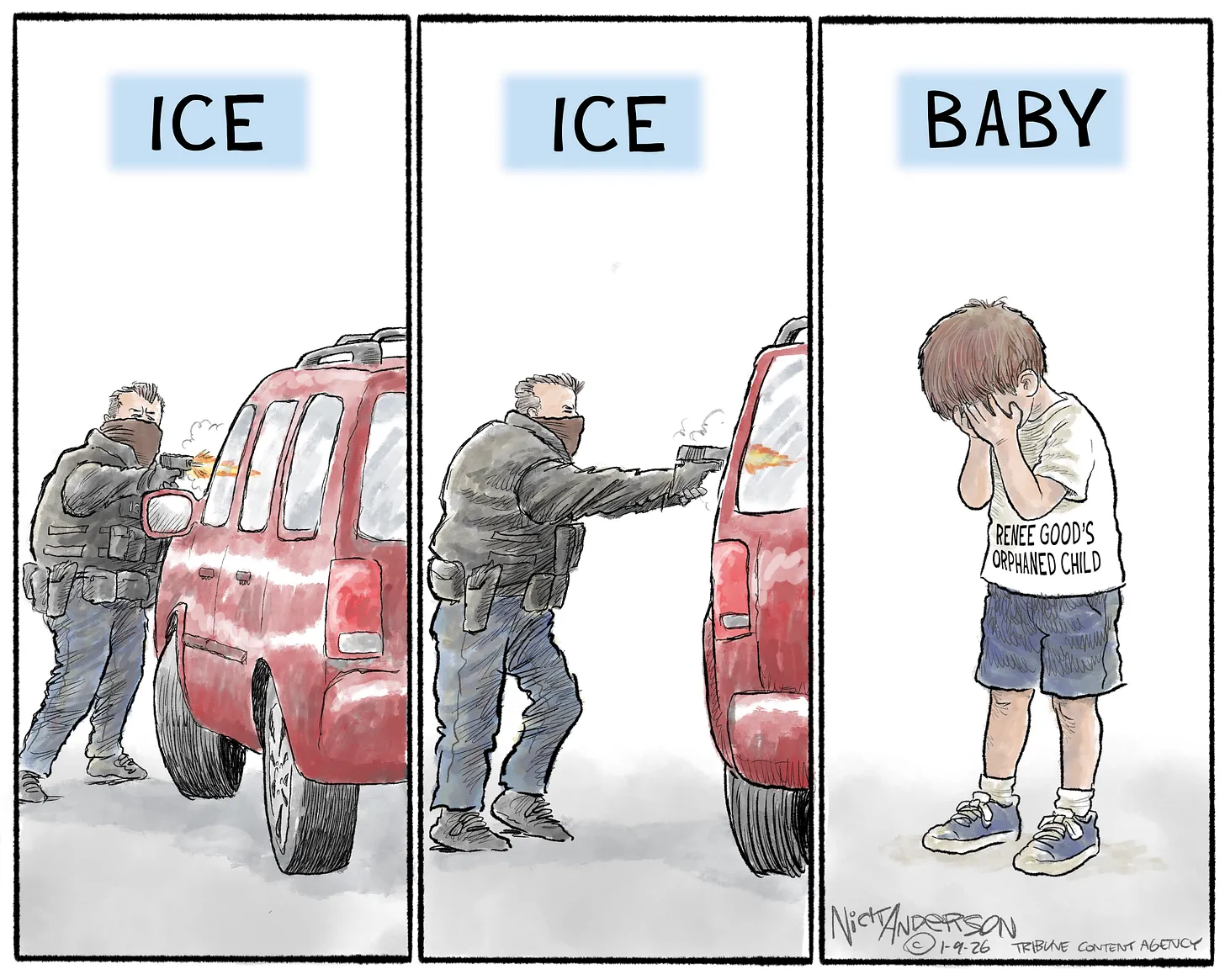
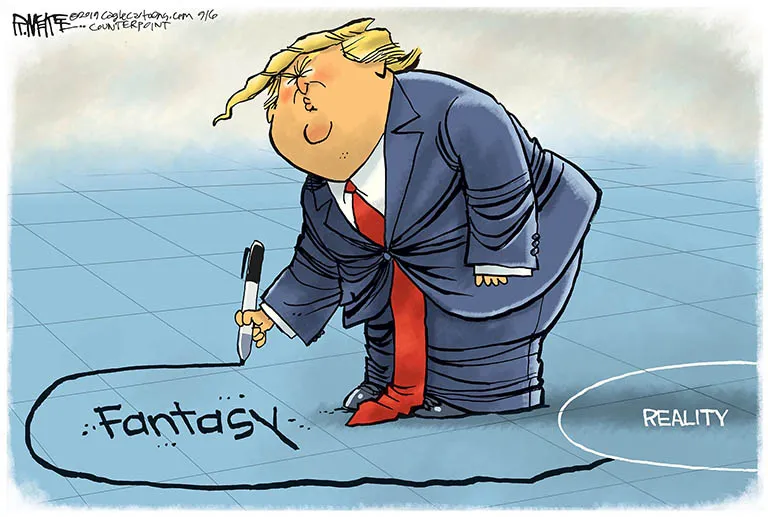
They’re telling you to believe them and not your eyes. … So the message from this administration is clear: only they determine the truth, and when their forces come to your city, obey or die. And if you die, you clearly didn’t obey.
Trump’s assault on American democracy. A woman got in ICE’s way, so they killed her. Then the top people in the regime smeared her. See the featured post.
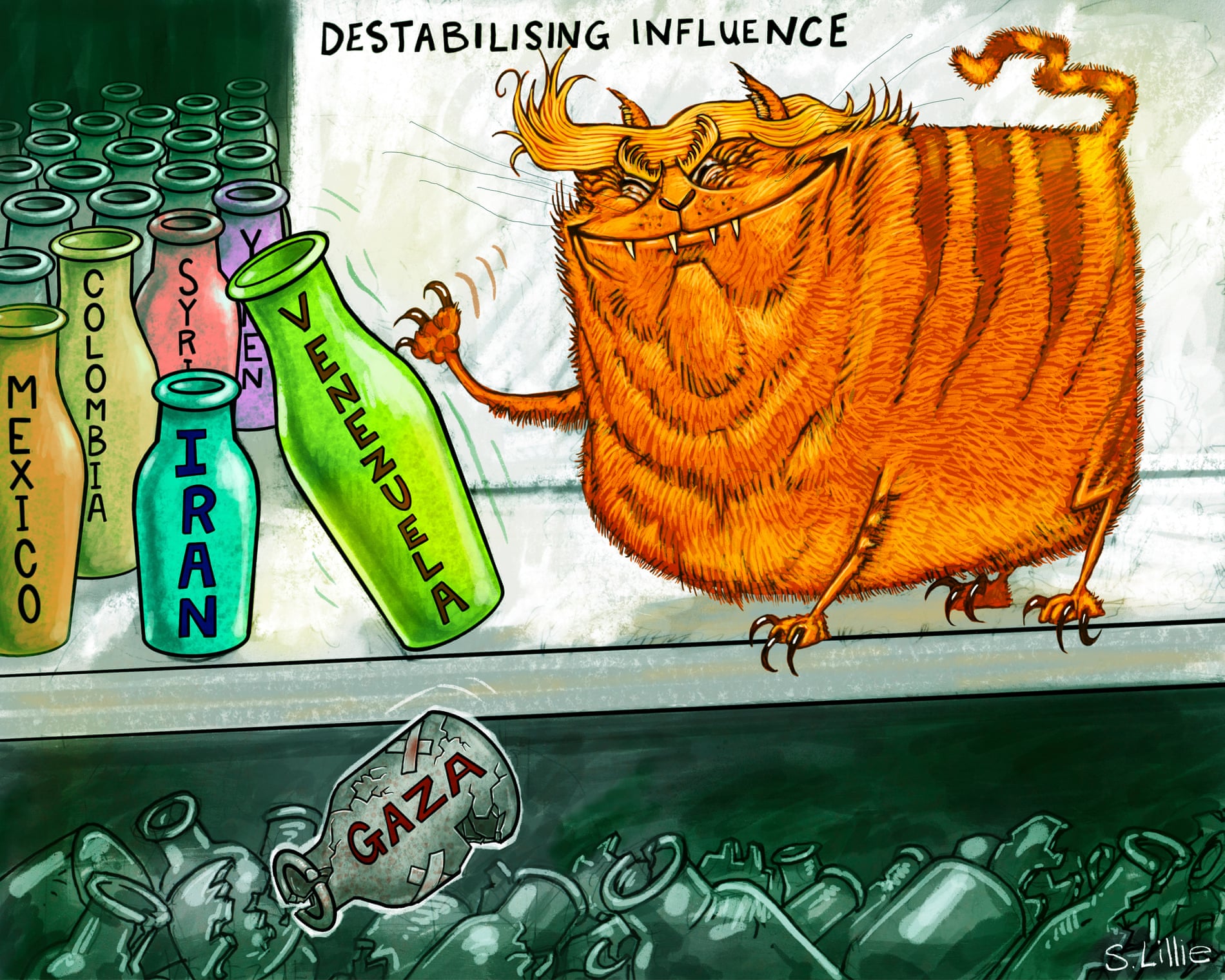
War. With the regime so enthused by its Mission-Accomplished moment in Venezuela, we all wait to see where they’ll strike next: Cuba, Colombia, Greenland?
This week’s developments
This week everybody was talking about ICE killing Renee Good
“The hateful rhetoric has caused a lot of this violence,” Homan said in a Sunday interview on “Fox News Sunday” with host Jacqui Heinrich. “So I said way back in March if the hateful rhetoric doesn’t decrease, there will be bloodshed, and, unfortunately, I was right, and it’s not over. There will be more bloodshed unless we decrease the hateful rhetoric.”
Homan added that “I don’t want to see anybody die,” asking Minnesota leaders to “work with us” despite allegations from Frey and Walz that federal officials have not collaborated with them in investigating the incident.
If everyone would just do what he tells them, nobody would have to die. Lots of thugs say things like that.
The day after Renee Good’s death, ICE agents shot two people in Portland, Oregon. ICE claims they had “ties” to the Tren de Aragua criminal group, whatever that means.
DHS said the duo “weaponized their vehicle against Border Patrol” and the agent fired at them in self-defense.
That seems to be what ICE says whenever they shoot somebody in a car. Maybe sometimes it’s true, but there have definitely been times where evidence shows they lied. There is no independent video of the Portland incident, but two eye-witnesses fail to support the ICE narrative.
One witness in the Portland shooting said he heard five gunshots fired in the parking lot of a Southeast Portland medical office after federal officers boxed in a Toyota truck that had pulled into the lot Thursday afternoon.
The man had been seeking care at the office near Adventist Health hospital when he said he saw the officers follow the truck into the lot at 10201 S.E. Main St. and approach it.
One officer pounded on the truck’s window and the driver appeared scared, the man said. The driver then backed up and moved forward, striking a car behind him at least twice, before turning and speeding off, he said.
About five shots rang out from the contingent of officers as the truck raced away, he said.
Back in October, Pro Publica wrote about the dangers of rapidly expanding ICE’s size and mission while simultaneously scrapping all independent oversight.
We’re still waiting for things to shake out on the ground. So far, the US isn’t occupying Venezuela, but Trump is acting as if he had the country completely pacified. Maduro is in US custody and facing trial, but his VP is now in charge and the rest of Maduro’s government remains in place. How cooperative they will be is still not clear.
If the point was to seize Venezuela’s oil, the Trump regime doesn’t seem to have thought it out very well. The country’s oil infrastructure is in bad shape, and US oil companies haven’t expressed much interest in fixing it. The CEO of ExxonMobil called the Venezuelan oil industry “uninvestable”.
Meanwhile, the tactical success of the Maduro operation has emboldened the regime. Trump has threatened to cut off the supply of oil Cuba has been getting from Venezuela, warning them to “make a deal, BEFORE IT IS TOO LATE”. As usual, Trump’s threats contain no specific demands, so it’s not clear what Cuba is supposed to do.
Once again, it’s not clear what Trump specifically wants — and in particular, what he wants that he can’t get from Greenland as a territory of our NATO ally Denmark. Trump claims to be worried about Russia or China taking over Greenland, but it’s not clear why we can’t defend as part of NATO.
The United States should have Greenland as part of the United States. There’s no need to even think or talk about this in the context that you’re asking of a military operation. Nobody’s going to fight the United States militarily over the future of Greenland.
The Oslo-based Iran Human Rights group raised its toll to 192, while HRANA, a rights group based in Washington, said it had confirmed the deaths of nearly 500 protesters and almost 50 security personnel.
and you also might be interested in …
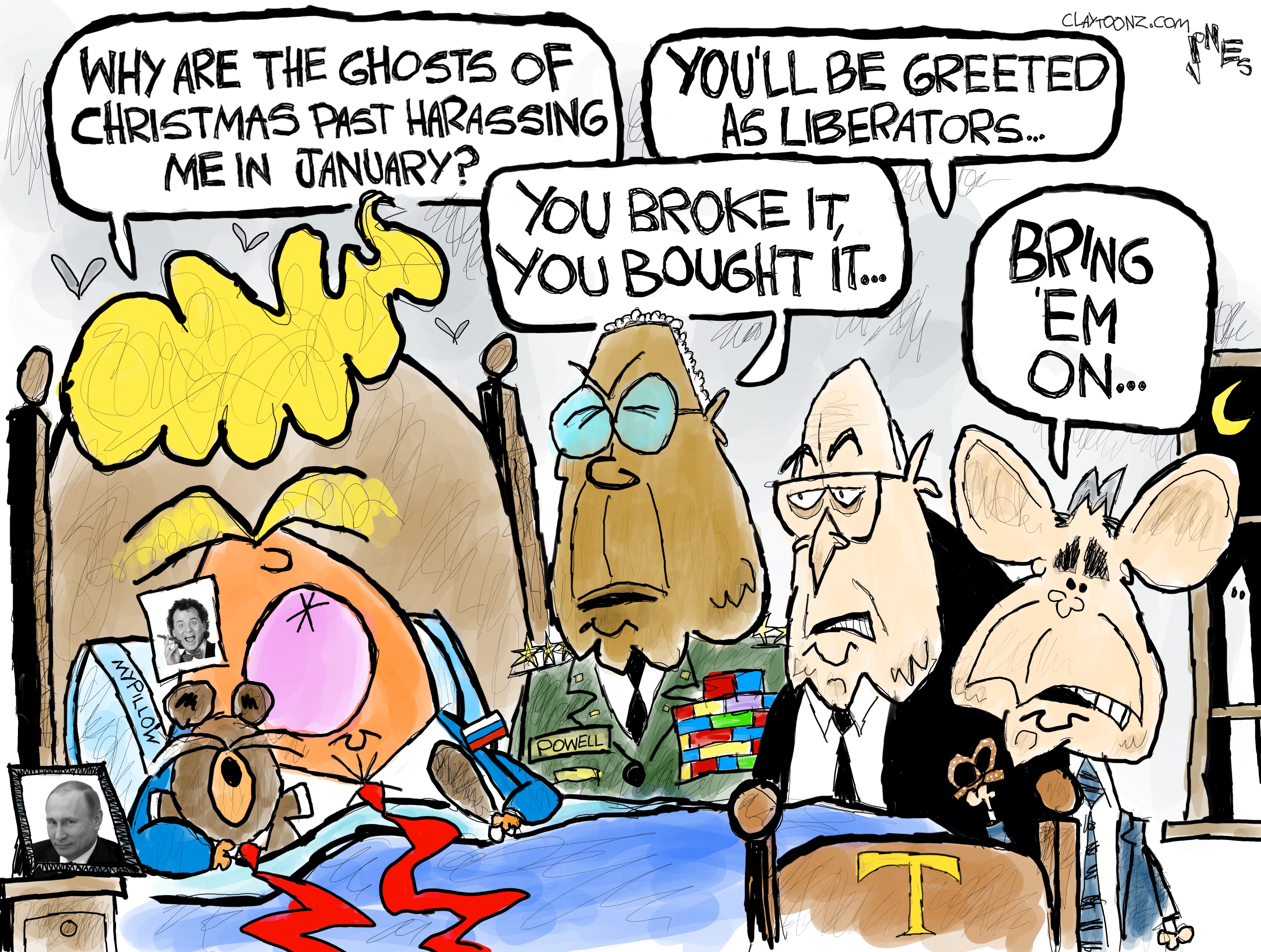
Anybody who stands in Trump’s way is going to have the Justice Department go after them sooner or later. Now it appears to be the turn of Fed Chair Jerome Powell.
In a highly unusual move, Powell disclosed that the US Department of Justice (DoJ) served the agency with subpoenas and threatened a criminal indictment over testimony he gave to a Senate committee about renovations to Federal Reserve buildings.
Calling the probe “unprecedented”, Powell said he believed it was opened due to Donald Trump’s anger over the Fed’s refusal to cut interest rates despite repeated public pressure from the president.
So Elon Musk’s artificial intelligence company, xAI, has its own chatbot, Grok, which offers this amazing free-market feature: If you give it a picture of a person and ask it to give you an image of the same person naked, it will. Wired reports:
Paid tools that “strip” clothes from photos have been available on the darker corners of the internet for years. Elon Musk’s X is now removing barriers to entry—and making the results public.
So you might publicly or privately undress a celebrity like Taylor Swift, your colleague at work, your colleague’s 13-year-old daughter, or anybody else.
Grok’s website and app, which are are separate from X, include sophisticated video generation that is not available on X and is being used to produce extremely graphic, sometimes violent, sexual imagery of adults that is vastly more explicit than images created by Grok on X. It may also have been used to create sexualized videos of apparent minors.
Is that a problem? Well, Elon’s people came up with this solution: They took the image-generating engine out of Grok’s free version. So if you want sexualized images of your pretty niece, you’ll have to upgrade to the paid subscription.
If you think this is an occasion for regulation, two governments agree with you: Malaysia and Indonesia, which aren’t the countries we usually count on to lead the world. Why hasn’t Europe acted? Well, maybe because X is an American company, and the Trump regime has threatened reprisals against attempts to regulate the US tech lords.
Financial Times found an interesting way to strike back without breaking its own policies against pornography: It used Grok to produce clown-face images of X executives.
I’m waiting for some curmudgeon to do this research: Prove that computer-generated deepfakes are hurting the economy by causing young men to lose their visual imaginations. That’ll get some action. “In my day, if you wanted to picture your teacher naked, you had to work at it.”
“I find myself in the middle of some sort of rom-com plot,” he says. “For me to be able to see my doctor to tend to my autoimmune disease, I had to marry my best friend — it’s like some weird twisted plot of Will and Grace.”
and let’s close with something too, too cute
After a week like this one, we can all use some baby animals.
Wednesday in Minneapolis, ICE agent Jonathan Ross shot American mother Renee Good three times, killing her. There is so much to be upset about here, it’s hard to pick a focus. So I’ll start by listing a few and justify them later.
The shooting was senseless and had no legitimate justification. (See below.)
Despite the presence of numerous law enforcement officers, Ross was not taken into custody and was allowed to drive away with his weapon.
DHS Secretary Kristi Noem immediately lied about the incident, pushing a narrative that painted Good as a “domestic terrorist” and made Ross the victim of her attack. President Trump and Vice President Vance quickly reinforced this lie. Noem repeated her gaslighting in an interview with Jake Tapper Sunday.
ICE agents have subsequently shown extreme disrespect for Good and those mourning her. One agent (possibly Ross) can be heard to say “fucking bitch” immediately after the shooting, while another later kicked over candles mourners had set up to honor Good. (What kind of asshole does that?)
Those things are all true and objectionable, but most of them are being well discussed elsewhere. This morning, I want to take a step back and look at something else: the ability of right-wing media to keep telling a story conflicting with widely available evidence, and the apparent belief inside the MAGA news bubble that objective reality does not exist; what you think happened is simply a matter of who you choose to believe and what evidence you choose to examine.
To me, analyzing the videos of this shooting should resemble what happens in instant-replay review during a sporting event. A questionable play has happened, and then the refs examine the available video. Typically, one or two camera angles aren’t definitive: Looking at them, you can still imagine outcomes favorable to either team. But then you get the angle that makes everything clear. (Here’s the ball, here’s the goal line. It either did or didn’t cross. Or: Here’s the shooter when the clock hits zero. The ball either is or isn’t out of his hand.) Once you’ve seen the definitive angle, the other angles don’t matter any more. You don’t go back to a previous shot and say, “Sure, but in this one the other conclusion still seems possible.”
In this case, there are several decisive moments and angles, all consistent with each other. Like this one, which is a still from a bystander video analyzed in detail by the New York Times:
Ross is the agent behind the agent by Good’s door. His feet are clearly visible to the left of the vehicle, while the front wheels are steering right. (The orientation of the wheels is hard to see in this shot, but clearer when you see the continuous video.) So two conclusions are obvious: (1) Good was not trying to run Ross over, as Noem claimed. Her wheels were pointed away from him. (2) Ross was not in any danger of being run over.
Trump posted a different video along with his claim that “Based on the attached clip, it is hard to believe he is alive, but is now recovering in the hospital.” It is a distant video that lets you imagine that anything could have happened — exactly the kind that the football refs would ignore. And in fact, Ross was not harmed, something that is obvious from video of him walking up and down the street seconds later. (It’s possible he was brushed as the car went by, but nothing more.)
Still, you might imagine that Ross believed he was in danger, even though he wasn’t. That conceivably might justify a self-defense claim for his first shot. (The bullet hole is on the left side of the windshield, consistent with him standing close to the left front wheel, and not directly in front.)
But there are two problems with that justification: First, he’s in front of the car because he moved there. Moving into danger so that you can use that danger as an excuse to kill someone does not usually fly in court.
But even more damning: He shoots twice more. His second shot is through the open window in the driver’s door, and his third comes from behind as Good is trying to drive away. In other words: the SUV has already missed him. Shooting as your alleged assailant runs away is not self defense.
You could also imagine that Ross got scared, panicked, and fired three times before he realized he was safe. Even if true, that’s not much of an excuse. At the very least, a guy with responses this bad should never again have a job where he carries a gun. And if I were a prosecutor, I would see what degree of murder I could make stick.
So far I’ve just been drawing clear conclusions from objective evidence. But now I’ll say what I believe in my heart really happened: ICE’s stated mission is to round up deportable immigrants, but that’s not the whole story. Another part of its mission is to intimidate American citizens, particularly citizens in majority-Democratic cities who might be inclined to protest against Trump’s policies. Intimidation is why they wear masks. (They claim it’s to avoid reprisals, but that excuse doesn’t hold water. Local police and FBI agents also investigate dangerous gangs, but they don’t wear masks. Why are ICE agents more cowardly?) And if you watch ICE behavior, it’s clear what rules of engagement the agents been given: If somebody isn’t sufficiently intimidated, escalate the confrontation until they are.
Renee Good’s primary offense was not being intimidated. When agents gave her conflicting orders, she didn’t freeze, she started to drive away. This made Ross angry, and so he killed her, with “fucking bitch” as her epitaph.
Other ICE agents know this. That’s why they are using Good’s death to further intimidate potential protesters. Here, an agent warns a woman sitting in her car not to “make a bad decision and ruin your life”. Nice life you’ve got there; be a shame if anything happened to it.
What has truly amazed me, though, is not that liars will lie. I never trusted Noem or Vance or Trump or ICE, so seeing them gaslight the country is not the least bit shocking. (A columnist for National Catholic Reporter had a different reaction to Vance: “The vice president’s comments justifying the death of Renee Good are a moral stain on the collective witness of our Catholic faith.”)
What amazes me is the number of people who simply repeat what the regime tells them, either not looking at the evidence or (even worse) looking at it and seeing what they have been told to see.
Friday evening, my church organized a vigil for Good. We stood on our town common and quietly held candles with a few signs. According to a reporter for the local online news, 77 people (some church members and some not) attended, which is not bad for a hastily organized event in a small town.
When I came home from the vigil, I saw the Facebook comments on an article that announced it. (122 at last count.) Many of the commenters repeated the regime gaslighting: Why were we holding a vigil for a woman who tried to kill a federal officer? When others disputed this characterization and pointed to the videos proving otherwise, they were answered by vague references to other videos that supposedly support the regime gaslighting. (Like this one: It does not support the regime, but apparently they looked at it and thought it did.)
I wonder what DHS expects its sheep to see in a video it posted yesterday. It shows the street the shooting happened on, during the three minutes before the shooting. There’s a snowy middle-class residential neighborhood, a lot of honking cars moving slowly, pretty much what you’d expect from the videos already out. Absolutely none of the “violent rioters” a DHS official had mentioned.
Maybe the point of such a video is just that it exists. I could point to a brick and claim that it proves I’m right about something. And if you’re sufficiently sheeplike, you might say, “It must be true. He showed me proof.”
I find all this disturbing on a deep level. Apparently, many of our fellow citizens are living in a world where there is no objective reality. There is just disagreement, and some people are powerful enough to make their version of events stick.
A second disturbing feature in the comments I saw was the claim that Good was responsible for her own death, because she didn’t obey ICE agents’ commands. First off, I’m not sure what authority ICE agents have to give commands to US citizens. But suppose they can. The penalty for civil disobedience is not summary execution. Apparently, a number of Americans think it should be.
Normally, I’m pretty well armored against the news. I watch bad things happen week after week and do my best to summarize them without letting them ruin my mood. This week was tougher. I had been softened up a little last week by the attack on Venezuela and the Trump administration’s complete disregard for Congress and its laws. And then on Wednesday, an ICE agent murdered a woman who had the audacity not to obey his commands. Our government’s instant response, without waiting for evidence to emerge, was to smear the victim as a “domestic terrorist” who bore full responsibility for her own death.
The right-wing media machine played its assigned role perfectly, repeating Noem, Trump, and Vance’s baseless claims that this video or that one backed up their self-justifying narrative. (They didn’t.) Better angles that showed what really happened were ignored.
And here’s the crushing fact: For some significant portion of the population, it worked. They’re out there repeating the regime’s narrative as if it were established fact.
So anyway, other people have covered the basic facts of the shooting reasonably well. But I feel like I have to comment on our nation’s epistemological crisis: The regime can deny things that are clearly shown on video, and make its sheep see what they are told to see. I find that deeply disturbing.
That’s the gist of the featured post: “Renee Good and Our Epistemological Crisis” should be out shortly.
That still leaves a lot for the weekly summary: Venezuela, Iran, the exaggerated “scandal” of Minnesota fraud, Grok, and a few other things. That may take me until 1 or so EST.
We’re in the euphoria period of acknowledging across the board that Maduro was a bad guy and that our military is absolutely incredible. This is exactly the euphoria we felt in 2002 when our military took down the Taliban in Afghanistan, in 2003 when our military took out Saddam Hussein, and in 2011 when we helped remove Muammar Gaddafi from power in Libya.… Let’s let my Republican colleagues enjoy their day of euphoria, but they’re going to wake up tomorrow morning, knowing, oh my God, there is no plan here any more than there was in Afghanistan, Iraq, or in Libya.
– Rep. Jim Himes, ranking Democrat on the House Intelligence Committee
Trump’s assault on American democracy. All year, Trump has been pushing Congress aside in all sorts of ways. This week, he completely obliterated Congress’ role in decisions about war and peace.
War. This week the ongoing war in Ukraine and the not-quite-peace in Gaza took a back seat to Trump’s illegal attack on Venezuela. But Israel is once again harassing groups that try to bring aid into Gaza.
This week’s developments
This week everybody was talking about the attack on Venezuela
The featured post makes the case that the way the Trump administration ignored and even lied to Congress about its Venezuela policy constitutes a constitutional crisis, which a self-respecting Congress would answer with impeachment. (Not that I expect that to happen.) There’s still a lot we don’t know about what the administration intends going forward (or if they even have a clear intention). But a few things are immediately clear
The mission was a tactical success. Plucking a foreign leader out of his seat of power without killing him is never easy. The people who planned and executed this mission must be very good at their jobs.
Maduro was a bad guy. Critics of the attack shouldn’t fall into the trap of lionizing Maduro or making him a victim. He stayed in power by stealing the 2024 election (and probably the 2018 election as well), and has ruled as a dictator. Venezuelans running from oppression have created a refugee problem for several countries.
None of the administration’s justifications for the attack add up. Maduro was an illegitimate leader, but so are the leaders of many countries. He may have been involved in the drug trade, but Trump just pardoned former Honduran President Juan Orlando Hernández for convictions on very similar charges. Just about everything Trump has ever said about Venezuelan refugees or Venezuelan gangs operating in the US has been a pure flight of imagination.
The attack was illegal under international law. The UN charter recognizes two justifications for going to war: self-defense, and when the war has been authorized by the UN Security Council. As Oona Hathaway of Yale Law School and the American Society of International Law put it: “The dangerous thing here is the idea that a President can just decide that a leader is not legitimate and then invade the country and presumably put someone in power who is favored by the Administration. If that were the case, that’s the end of international law, that’s the end of the U.N. charter, that’s the end of any kind of legal limits on the use of force. And if the President can do that, what’s to stop a Russian leader from doing it, or a Chinese leader from doing it, or anyone with the power to do so?”
There is no plan for what happens next. During a press conference Saturday morning, Trump said: “So we are going to run the country until such time as we can do a safe, proper, and judicious transition. … [F]or us to just leave, who’s gonna take over? I mean, there is nobody to take over.” But Max Boot was unconvinced: “What is he talking about? There are no indications that U.S. troops are preparing to occupy Venezuela. … Maduro was not a one-man band. He presided over a large apparatus of oppression that includes the army, the national guard, the national police, the intelligence service and the Colombian guerrilla group ELN. All of those forces remain intact after the U.S. raid.”
If we learned anything from the expensive fiascos in Afghanistan and Iraq, it should have been that you don’t take down a country’s government without having a plan for what comes next.
I wonder what’s going on in the minds of Trump voters who thought “America First” meant that we were done with pointless foreign wars.
Josh Marshall speculates on what’s going on at the White House:
I don’t think there’s any actual reason we’re invading Venezuela or trying to decapitate its government or whatever we’re doing. I think there are two or three different factions in the government each pushing a very hostile policy toward Venezuela for differing reasons. Meanwhile, Trump thinks it’s cool and has a personal beef with Maduro. That combination of factors created a lot of forward momentum within the U.S. government with nothing pushing back in the opposite direction. That gets you to today. My point is that it’s a mistake to think there’s a “real” reason mixed in with other subterfuges and rationales, or that it’s important to find out which one the “real” reason is. It’s not that linear or logical.
TPM did its annual celebration of the year in corruption, the Golden Dukes. Best General-Interest Scandal: Trump’s $300 million ballroom. Biggest Journalism Fail: the NYT’s anti-Mamdani campaign.
Meanwhile, the NYT reviewed a year of Trump’s attempts to “crush dissent”.
In case you’re wondering how the other half thinks, conservative WaPo pundit Marc Thiessen lists the 10 worst and 20 best things Trump did in 2025. Second-worst thing: He didn’t give the Pentagon enough money. Sixteenth best thing: “He brought many of the nation’s elite universities to heel.” #4 is his mostly mythical “peacemaking” record, while #6 is his attack on Venezuela.
and the Supreme Court
A week ago yesterday, Face the Nation had an extended panel discussion about the year behind and the year ahead. In their final go-round (at about the 22:40 mark) about over- or under-reported stories, legal analyst Jan Crawford picked out the corruption of the Supreme Court — that it is “in the tank for Trump” — as an over-reported story.
Not only is that narrative over-reported, it is patently false, and it is dangerous for the institution and the public’s faith and confidence in the rule of law.
The people making the in-the-tank charge did not take that criticism lying down. On his Law Dork blog, Chris Geidner described Crawford’s statement as “shockingly devoid of substance”. She gave no examples and did not point to any specific case where someone has criticized the Court unfairly.
In particular, she did not account for the obvious corruption of Clarence Thomas, who has taken literally millions of dollars worth of favors from people (like Harlan Crowe) who want to influence the Court. (Thomas has tried to hide behind a “hospitality from friends” loophole in rules about reporting gifts. But Crowe’s “friendship” only manifested after Thomas ascended to the Court.)
Josh Marshall fleshes out that response to Crawford, observing that defenders of the Court like to use a very narrow definition of corruption that focuses on bribery in exchange for specific favors.
The secondary and older definition is the act of taking something in its healthy form, in its prescribed and proper form, and pervert it into something different. The corruption of the Court is bound up with both those definitions. What the current Supreme Court has done is take the proper and constitutional role of the Court and wrench it into something very different. That very different thing is corrupt, unconstitutional and undermines democratic self-government itself. It has moved from a final Court of appeal, which reviews cases and renders decisions by a range of possible jurisprudential philosophies — more conservative or liberal, progressive or libertarian — and changed it into a body which follows no consistent or coherent mode of interpretation or even the most basic procedures and processes for how cases are supposed to make their way from trial courts and finders of fact up through the appellate process. It is a “choose your own adventure” jurisprudence, mixing and matching doctrines based on desired outcomes, frequently manufacturing entirely new ones based on ignoring the explicit language of the constitution itself. And all for the consistent purpose of advancing the partisan and/or ideological interests of the Republican Party.
What both writers find most dangerous about Crawford’s statement is the implication that the Court’s corruption itself does not threaten democracy, but pointing out the Court’s corruption does. Yes, the rule of law is less secure when the public doubts the honesty of the courts. But the solution to that problem is to call the Court back to honesty, rather than cover up its dishonesty.
In his more-than-eight-hour of testimony, Smith insisted he had no political motivations in indicting Trump, and said he believed “we had proof beyond a reasonable doubt in both cases” that he brought.
“If asked whether to prosecute a former president based on the same facts today, I would do so regardless of whether that president was a Republican or a Democrat,” he said in his opening statement. Smith later told an unnamed committee staffer he would have indicted Biden or Barack Obama over similar evidence.
Trump wants to keep harassing the people who investigated him, but all he’s doing is keeping the story alive. And that’s bad for him because all the investigations were justified and he was guilty.
Now, just weeks later, after the Carlson/Heritage fiasco appeared to have blown over, it bubbled back up in spectacular fashion at the main stage at Turning Point USA’s mega conference, dubbed “AmericaFest.” Podcaster Ben Shapiro used his speech to attack his fellow conservative influencers, from Tucker Carlson and Candace Owens to Megyn Kelly and Nick Fuentes himself. That led others to clap back at Shapiro, turning “AmFest” into a circular firing squad of grievance among the right’s top influencers.
Owens responded on her podcast by proving Shapiro’s point, referring to dangerous Talmudic conspiracies.
The Heritage Foundation’s president defended Carlson’s Fuentes interview, causing more than a dozen staffers to defect to Mike Pence’s rival think tank.
Vox finds a proximate cause in Elon’s changes to X/Twitter. Musk took down the guardrails at Twitter, encouraging the growth of disinformation, conspiracy theories, and personal attacks. Once, these changes helped right-wing posters “own the libs”. But liberals have largely left X for BlueSky and other greener pastures. Now, the best way to raise traffic (and get payments from Elon) might be to goad rival right-wingers.
It’s hard not to laugh at someone like Christopher Rufo being hoisted by his own petard.
“On the right, the public mind is now shaped by the X algorithm,” right-wing activist and X power-user Christopher Rufo recently wrote, arguing that X has usurped the role formerly held by Fox News. But, he went on, “the platform’s algorithm seems increasingly hijacked by bad actors who peddle baseless conspiracies” for “clicks, dollars, and shares.”
but I want to talk about the future of small towns
In mid-December, I made a trip back to my hometown (Quincy, Illinois), a small city of about 40,000 people that is the regional center of a rural area stretching about 50 miles in any direction. That radius takes in smaller cities like Hannibal, Missouri and Keokuk, Iowa, but if you need any citylike service — from a hospital to a good Indian restaurant to a big box store — probably you go to Quincy.
My community within Quincy is comprised almost entirely of people from the local Unitarian church. I didn’t grow up in that church, but it includes nearly everybody I go back to visit (now that my parents are gone). The church is a left-leaning citadel inside a county that voted 70% for Trump every time he ran. People attend largely because they need a place where liberals can feel safe saying what they think.
So I can’t claim that I have spent much time talking to Quincy’s MAGA majority. But simply being there gives me occasional bursts of insight into their worldview. This time something crystalized for me that I probably should have seen a long time ago: The Democratic Party has no message for towns like this.
Think about it. If I support MAGA, I can tell a story about how my vote is going to help this community thrive: Immigrant workers are going to leave the country, and tariffs will keep out foreign products. So we’ll return to a time (like the 1950s) when Americans made products for other Americans. Factories will boom again, and jobs will be plentiful.
Now, so much is wrong with that vision that there’s virtually no chance of things working out that way. The ultimate effect of Trump’s policies won’t be to shift money from immigrant workers to native-born workers. Instead, money will flow from ordinary people to the oligarchs who own the machines and algorithms. I don’t believe many of those oligarchs call Quincy their home. Meanwhile, the people who do live in Quincy will have to make do with holes in their safety net, without well-funded schools, and without decent health insurance.
But as vaporous as the MAGA fantasy is, it’s still a narrative that you can believe in if you need to believe in something. If somebody asks how your policies are going to help Quincy thrive, MAGA at least has a story to tell.
What’s the Democrats’ story? As best I can suss it out, we offer to help Quincy’s young people pay for college, so they can get qualified for decent-paying jobs somewhere like Boston (where I wound up). In other words: We’ll help your kids escape from the hellhole you call home. If you’re lucky, they’ll make enough money that they can come visit you at Christmas.
That’s not going to win many votes. We need a story of how people from small towns can succeed and prosper in those towns.
I have a few ideas about that, but nothing like a complete program. For now, I’d just like to get more people sitting with the question.
Trump’s super PAC raised over $100 million in the second half of 2025, mostly in big contributions from people who expect favorable treatment from his administration. Together with his wife, the founder of Open AI gave $25 million. Crypto.com tossed $20 million Trump’s way.
Other donors included a nursing home entrepreneur seeking an ambassadorship, a vape-maker, a pro-cannabis group and a woman whose father was seeking a deal from prosecutors to settle charges that in 2020 he bribed Puerto Rico’s governor at the time.
Anti-abortion politicians always deny that they want to go after women, but then there’s this:
A Kentucky woman has been charged with fetal homicide after police say she admitted to terminating her pregnancy at home. Kentucky State Police arrested 35-year-old Melinda Spencer on charges of fetal homicide in the first degree, abuse of a corpse and tampering with physical evidence.
Apparently, Spencer confessed to clinic workers, who ratted her out to the police. Her “crime” was to obtain abortion drugs through the mail, induce her own miscarriage, and then bury the fetus in her back yard.
The trans University of Oklahoma instructor who was put on leave for giving zero to a Christian student essay has now been officially removed from all instructional duties.
This story has been in the news for about a month, but I hadn’t paid any attention until recently. So I read the assignment, an abstract of the article the essay was supposed to comment on, and the essay itself.
My conclusion: A failing grade was justified, but a zero was probably harsh. Out of the 25 points available, I’d have graded it somewhere in the single digits. I mean, she did turn in an essay, the essay was made up of coherent English sentences, and an opinion was expressed, if not justified. Maybe five points.
The central problem is that the essay doesn’t really address the assignment. The social-science article the essay is supposed to be commenting on was a study of the relationship between “gender typicality” and popularity in high school, and exploring the extent to which the poor mental health associated with gender atypicality is inherently part of gender atypicality, versus how much is due to teasing, bullying, and other social responses.
The student essay is almost entirely a personal emotional response to gender atypicality itself, and repeatedly makes the religious point that gender roles were established by the Creator. Teasing to enforce these gender roles is “not necessarily … a problem”. Did the student read any more of the article than the abstract I read? Not clear.
Personally, I’m reminded of a failing grade a friend of mine got on an essay for a college course on Indian philosophy. His essay responded to the questions in the assignment, but only from the point of view of Western thinkers. Similarly, he wrote coherent English sentences that had something to do with the general topic, but didn’t demonstrate any course-related knowledge.
My conclusion: Removing the instructor is much worse overkill than zeroing the essay. Have somebody else regrade the essay and give the instructor a lecture about sensitivity to the prevailing winds of Christian domination. Right-wing Christians are encouraging their students to walk around with chips on their shoulders, looking for a fight. It’s unwise to give them such a clear target.
Trans News Network interviews former NYT editor Billie Jean Sweeney, who describes how the NYT’s hostile attitude towards trans coverage was pushed down from above.
Guess what? Jeff Bezos’ Washington Post disapproves of taxing billionaires. California is considering a ballot initiative for a wealth tax, and some billionaires are already relocating to dodge it. “California will miss billionaires when they’re gone”, the WaPo editorial board writes, pointing out that it’s better for a state to collect low taxes from billionaires rather than none after they leave.
And that’s true as far as it goes, but it misses the more important point: We need national taxes on billionaires precisely so that they can’t play one state off against another.
Similarly, the nations of the world need to come together on a global corporate tax scheme, so that corporations can’t play one country off against another. Here’s how it could work: If you want to be a corporate tax haven like the Cayman Islands, fine. But you don’t get to use the international banking system or trade with the countries who participate in the global tax regime.
You see this kind of argument all the time: Nobody should challenge the rich and powerful because they’ll use their wealth and power to make your effort counter-productive. That argument is always presented in a matter-of-fact of-course-the-world-works-this-way manner, and the possibility that the world can and should work differently is never discussed.
As I often point out: A one-person weekly blog is a bad place to cover breaking news. This morning, the attack on Venezuela is in that nebulous zone between breaking news and an ongoing story: US forces attacked Caracas early Saturday morning, seized President Nicolás Maduro, and apparently left. We can see the general outline of what happened, but what it all means and where it’s all going is still very cloudy.
At the same time, we can’t just wait for the dust to settle, because this is an emergency moment not just for Venezuela, but for America.
For almost a year now, Trump has been pushing Congress into irrelevancy, and the Republican majorities in both houses and in the Supreme Court have been letting him do it: Congress no longer controls government spending. Agencies set up by Congress to be independent of the President have been taken over. The deadlines laid out in the Epstein Files Transparency Act have been ignored. The Education Department established by Congress has been all but eliminated.
And now, Congress has been shoved out of any role in making decisions of war and peace.
Apologists for the administration will tell you that this is nothing new. Ever since World War II (the last war officially declared by Congress), Congress’ constitutional power to declare war has been in tension with the President’s constitutional power as commander in chief. [1] Exactly where the boundary lies — what the President can do on his own and what requires congressional authorization — has been a topic of legitimate debate. A rule of thumb has been that decisions that need to be made quickly belong to the President, while longer commitments require Congress.
Congress asserted its power in the War Powers Act of 1973, which set clear limits on presidential discretion. Subsequent presidents have refused to recognize the constitutionality of the WPA, but have generally respected its boundaries as a matter of good form and sound politics. [2] So, for example, President Bush II sought congressional approval before invading both Iraq and Afghanistan. Lesser military actions have sometimes been initiated without Congress.
But the Venezuela attack is completely outside the bounds of previous constitutional debates. Not only did Trump not seek authorization from Congress, but the congressional “Gang of 8” — leaders of both parties in both houses, who by law are required to be kept informed — did not know about the attack until it was underway. Worse, briefings by Marco Rubio and Pete Hegseth actively misinformed congresspeople about the administration’s intentions. [3] In short, Trump has given Congress no role whatsoever in this decision to go to war.
If Congress were taking seriously its constitutional obligation to preserve our system of checks and balances, it would immediately launch an impeachment. But unfortunately, Republicans in Congress are mostly taking an all’s-well-that-ends-well view: Maduro was bad and he is out now. The mission itself was a stunning display of tactical brilliance. So we should all just be happy with our military success.
The problem with that view is that nothing has ended yet. Immediately, power has not passed to the opposition leaders whose election victory Maduro stole. Instead, Maduro’s vice president Delcy Rodríguez has taken charge of a governing structure that is very much intact. So far, she has sent signals in both directions, denouncing the US attack as “an atrocity that violates international law”, but also saying she want the US government to “collaborate with us on an agenda of cooperation”.
Trump, meanwhile, has said several times that the US is going to “run” Venezuela now and “fix” it. No one in the administration seems to know exactly what that means, or whether American troops will have to occupy the country and take casualties. He seems to imagine that he can manage Rodriguez with threats. But even if he can, will Rodriguez’ people let her stay in power as an American puppet?
Rep. Jim Hines, the ranking Democrat on the House Intelligence Committee (which makes him one of the uninformed Gang of 8) summed up pretty well:
We’re in the euphoria period of acknowledging across the board that Maduro was a bad guy and that our military is absolutely incredible. This is exactly the euphoria we felt in 2002 when our military took down the Taliban in Afghanistan, in 2003 when our military took out Saddam Hussein, and in 2011 when we helped remove Muammar Gaddafi from power in Libya. … Let’s let my Republican colleagues enjoy their day of euphoria, but they’re going to wake up tomorrow morning, knowing, oh my God, there is no plan here any more than there was in Afghanistan, Iraq, or in Libya.
[1] This is one of many situations where the Founders lived in a different world than we do now. The early United States had only a minuscule standing army. So any president who wanted to go to war first had to convince Congress to raise and supply a larger force. But World War II made the US a global superpower, so recent presidents have always had large military forces to command.
[2] One of the lessons of Vietnam was that it’s hard to sustain a war without popular support. Getting Congress to buy in is usually part of a larger effort to sell a war to the general public.
[3] Senator Chris Murphy (D-CT) told CNN’s “State of the Union” yesterday:
I can certainly tell you that the message that [Rubio and Hegseth] sent was that this wasn’t about regime change. When they came to Congress — and they literally lied to our face — they said, “This is just a counternarcotics operation. This is about trying to interrupt the drug flow to the United States.” Right around that same time, the White House Chief of Staff [Susie Wiles] said publicly if we ever had boots on the ground in Venezuela, of course, we would have to come to Congress.
Observe how quickly the Peace President becomes the War President. Saturday morning US forces raided Caracas and seized Venezuelan President Nicolás Maduro, who will face drug charges later today in New York. In the wake of that move, confusion reigns. Secretary of State Marco Rubio paints the attack as a simple law enforcement operation, while President Trump frames it as a successful conquest, saying repeatedly that we will “fix” and “run” Venezuela now.
Certainly I’m in no position to resolve the uncertainty about what’s happening or is about to happen in Venezuela. But instead I want to focus on what this episode means for America: Trump has once again sidelined Congress and ignored its constitutional powers. If checks and balances were working the way the Founders intended, Congress would defend its role by launching an impeachment. Obviously, that’s not happening.
Today’s featured post is going to flesh all that out. I haven’t titled it yet, but I’ll predict that it posts between 10 and 11 EST.
That leaves quite a bit for the weekly summary: reviewing all the year-end looking-ahead/looking-back articles, Jack Smith’s testimony to Congress, and the growing fault lines in the MAGA movement. Additionally, I want to raise the question of what the Democratic Party’s message to small-town and rural voters should be. I’ll try to get that out by 1.
Trump’s assault on American democracy. He’s trying to move CNN into the hands of an oligarch ally, and is maneuvering us towards war with Venezuela without consulting Congress.
Climate change. Based on the theory that what you don’t know can’t hurt you, the administration is planning to close the National Center for Atmospheric Research in Boulder, due to its “climate alarmism”.
Gaza and Ukraine. I didn’t run across anything new this week. Probably I was too busy with Christmas stuff.
This week’s developments
This week everybody was still talking about the Epstein files
Friday was the deadline that the Epstein Files Transparency Act had set for the Justice Department to release all of its files about Jeffrey Epstein, with a few minor exceptions, mostly related to protecting the identities of the young women who were Epstein’s victims.
But the EFTA is just a law, one passed overwhelmingly by Congress and signed by President Trump himself. Why should the Justice Department consider itself bound to obey? So of course, DoJ waited until the final day to release anything at all. When it did, the release was not complete, and appeared to be much more heavily redacted than mere victim-protection could account for. (One 119-page document is entirely redacted. One commenter characterized the release as a whole as “more blacked out than Pete Hegseth on New Years Eve”.)
on Friday morning, Todd Blanche, the deputy attorney general, went on Fox News to say that the department wouldn’t actually be releasing all of the files on Friday as required by the law. “I expect that we’re going to release more documents over the next couple of weeks, so today, several hundred thousand, and then over the next couple weeks, I expect several hundred thousand more,” Blanche said on Fox News. “There’s a lot of eyes looking at these and we want to make sure that when we do produce the materials we are producing, that we are protecting every single victim.”
By the time the department eventually did release thousands of pages of materials on Friday evening – not the hundreds of thousands Blanche promised – many of the documents had been heavily or completely redacted. Other than a few pictures, the materials made no mention of Trump, even though attorney general Pam Bondi reportedly told Trump earlier this year his name was in the files.
Some of the pictures released did include former President Bill Clinton, an apparent effort to support Trump’s gaslighting that the Epstein affair was a Democratic scandal, not a Trump scandal. Trump doesn’t seem to grasp that whattaboutism won’t get him out of this jam. “Democrats did it too” or even “Democrats did worse” isn’t a valid excuse. If Democrats are also guilty, expose them too.
The two sponsors of the EFTA, Republican Thomas Massie and Democrat Ro Khanna, both denounced the partial release, which fails to identify anyone who victimized the girls other than Epstein, who is dead, and Ghislaine Maxwell, who is already in prison for sex trafficking (after apparently trafficking the girls to no one, if what has been released is the whole story).
What can Congress do to force DoJ to obey the law? Not much, apparently. It could find Pam Bondi in contempt of Congress, but her own department would then be responsible for prosecuting her, which it would not do. Congress could impeach her, if it had the will to do so (which is doubtful). But Bondi could make the impeachment moot by resigning. Again, whatever Trump is hiding would stay hidden.
The only penalty Trump can be forced to pay is political, which they apparently believe they can mitigate by continuing to dribble out files little by little.
and war with Venezuela
Step-by-step, we are marching into a war with Venezuela. First we blew up their fishing boats, which may or may not have been smuggling cocaine and may or may not have been headed towards the US.
On December 10, the US seized a Venezuelan oil tanker. And then Tuesday, Trump announced an oil blockade of Venezuela. He did it in a Truth Social post that was barely coherent, making references to “the Oil, Land, and other Assets that they previously stole from us”.
It’s tempting to sanewash this by looking for some plausible reference — maybe the nationalization of Venezuela’s oil by Maduro’s predecessor Hugo Chavez. But nations all over the world (Saudi Arabia, for example) have nationalized their oil industries without getting attacked. And why oil previously claimed by an oil company should be “ours” is a bit of a stretch.
But while I think justifications like that should be put to administration spokespeople, I’m not going to assume Trump’s post makes sense at all until some official source explains it.
Here’s something more people should be saying: The recent moves make it clear that the attacks on boats were never about drugs, they were about regime change. And changing the Maduro regime is about getting control of Venezuela’s oil. Without the oil, Maduro could be five times as tyrannical and nobody in the Trump administration would care.
and the Bondi Beach shooting
On December 14, a father and son opened fire on a crowd gathered for a Hannukah celebration at Bondi Beach in Australia. 15 people were killed and 40 injured. The father was killed by police and the son badly wounded. No official statement of motive has surfaced, but antisemitism seems like an obvious guess.
I find two things noteworthy here: First, antisemitism really is rising around the world. I know some people falsely claim that any criticism of the current Israeli government is antisemitism, but you can brush off that canard and still recognize that antisemitism is real.
I’ll repeat what I’ve often said before: You can think whatever you want about Netanyahu or Hamas, but that’s no excuse to bring the war here. American Jews and American Muslims or Arabs are not the problem, and violence against them will not solve anything or prove anything. Ditto for Australians.
Second: Pro-gun people have been crowing about how Australia’s more rigorous gun restrictions didn’t stop this mass shooting. But they’re not thinking this through. The shooters used a bolt-action rifle and a shotgun, rather than semi-automatic weapons, because that’s what they could get their hands on in Australia. Because of that restriction, they only got off 83 shots in something like ten minutes. With American AR-15s, they could have unleashed hundreds of rounds and killed many more people. The 2017 Las Vegas shooter, by himself, fired over a thousand rounds and killed 60.
These kinds of restrictions make a difference, as do limits on the sizes of gun magazines. Shooters are most often stopped when they have to reload. The more bullets they have available without reloading, the longer it will take to stop them.
and Trump’s sad sick week
The Rob Reiner post, the strange plaques Trumpifying past presidents, the self-serving national address, and then the Trump-Kennedy Center. All in three days. The featured post covers these incidents, emphasizing how Trump’s attempts to aggrandize himself just make him smaller.
Vance’s conversion to Trumpism has been “sort of political”
OMB head Russell Vought is “a right-wing absolute zealot”.
The destruction of the White House’s East Wing is just the beginning. “I think you’ll have to judge it by its totality because you only know a little bit of what he’s planning.”
There is no evidence to support Trump’s claims about Bill Clinton and Jeffrey Epstein.
The component parts of the Big Beautiful Bill are popular. “That will be a very big deal in the midterms.”
Blowing up boats in the Caribbean isn’t about drugs, it’s about pressuring the Maduro government in Venezuela.
Trump’s attacks on the high seas don’t needs congressional approval, but an attack on the Venezuelan mainland would.
Trump believes Putin wants all of Ukraine, not just the provinces he has claimed so far.
If Vance runs in 2028, he’ll be the Republican nominee.
Trump hasn’t been asleep in cabinet meetings. He’s just resting his eyes.
He insults female reporters because “He’s a counterpuncher. And increasingly, in our society, the punchers are women.”
Trump won’t run for a third term.
Trump doesn’t wake up thinking about revenge against enemies like James Comey, “But when there’s an opportunity, he will go for it.”
Amazingly, Trump has not denounced her.
and pro-Trump media consolidation
Viktor Orbán’s government in Hungary is often cited as a model for Trump’s authoritarian takeover. A key piece of Orbán’s strategy was to make sure the major media outlets wound up in friendly hands, creating a state media unofficially.
Trump has been doing the same thing, partly by acquisition, partly by coopting the oligarchs who already own media properties. And so:
The US’s second-richest man (Jeff Bezos) owns The Washington Post, and blocked the Post’s endorsement of Kamala Harris in 2024.
The US’s third-richest man (Mark Zuckerberg) owns Meta, which controls Facebook.
The fourth-richest (Larry Ellison) controls Skydance, which owns Paramount, which owns CBS. His hand-picked news baron is Bari Weiss. She just spiked a 60 Minutes episode exposing the Trump gulag in El Salvador. Ellison also has wound up controlling the US version of TikTok.
Now Ellison’s empire is bidding against Netflix for Warner/Discovery, which controls CNN, among other notable media properties. Trump is in a position to influence how this goes: He could hint that DoJ would sue to stop a Netflix acquisition as a violation of antitrust laws, but let the Paramount bid go through.
and you also might be interested in …
To no one’s surprise, Republicans in Congress still have no solution to the ObamaCare insurance premiums that are set to skyrocket. The House did pass a bill roughly along the lines I told you about in November: You can lower your premiums by buying the kind of junk insurance that the Affordable Care Act made illegal. You won’t be insured if anything really bad happens to you or your family, but you can tell yourself you have insurance. And even that won’t get through the Senate.
North Carolina’s legislature is one of the most gerrymandered in the country. That’s how a state that has had Democratic governors since 2017 and that Trump carried by a mere 3% in 2024 has substantial and rock-solid Republican majorities in both houses of the legislature: 30-20 in the Senate and 71-49 in the House.
It’s a great frustration to NC Republicans that you can’t gerrymander a statewide office like the governorship. So they’ve done the next best thing: Taken away nearly all the power of the governor and moved it to the legislature.
In essence, they have disempowered their own voters: The voters can control which party gets the governorship, but control of the legislature is baked into the maps.
The Democratic Party is about to go through its usual pattern in the Texas Senate race:
A firebrand progressive (Jasmine Crockett, who I love to watch on TV news shows) will excite the base and win the primary.
The national party will decide she can’t win and will refuse to put any resources into the race.
She’ll lose.
The finger-pointing will start: Was the problem that she’s too liberal or that the national party sabotaged her?
I’m not taking a side here, I’m just pointing to the pattern. Until the Party goes all-in on one of these races, we won’t know whose intuition is right.
Data from Freedom of the Press Foundation’s Press Freedom Tracker shows that every single investigation or social media tirade Carr has launched against licensees’ speech – be it 60 Minutes’ editing of its Kamala Harris interview, Jimmy Kimmel’s remarks about Charlie Kirk’s death, or Comcast’s accurate reporting that contradicted Trump’s lies about the Kilmar Abrego García’s immigration case – has involved content that upset Trump.
Everything Trump does to aggrandize himself just makes him smaller.
From the time he came down the escalator in 2015, Donald Trump has gloried in his ability to get a rise out of people like me. All our howls of outrage, all the shocked shouts of “He can’t say that!”, have been music to his ears. But lately he’s been losing his touch. Donald J. Trump, once the greatest troll of the social-media era, has jumped the shark. The realization that he is past his sell-by date seems to be driving him ever further off the deep end.
I catch on slowly, so I didn’t notice until his Rob Reiner tweet.
I don’t know if Gen Z even knows who Reiner was, but several of his movies — The Princess Bride comes to mind — became cultural touchstones for my generation. They didn’t often make the critics’ lists of all-time greats, but you could quote them decades later and people would know what you meant.
So Monday, Reiner and his wife were found dead in their home, apparently murdered by their troubled son in the kind of tragedy that touches every parent somewhere deep: What if my kid had inner demons that all my attention, all my love, all the resources I could bring to bear, were helpless to exorcise?
And Trump’s response Tuesday morning was to make this tragic murder all about himself: Reiner died because his Trump Derangement Syndrome made the people around him crazy. The President of the United States went on at some length in that vein.
When I read that post, I was surprised to realize that it didn’t make me angry. No “How can he say that?”. No desire to strike back with some cutting insult.
His tweet wasn’t outrageous. It was pathetic. What a sick, sad little man.
The next two days backed up that assessment. Wednesday we found out about the presidential plaques now lining the colonnade connecting the White House residence to the Oval Office. It’s a newly installed “walk of fame” with plaques for Trump (twice, since he’s both the 45th and 47th president) and his predecessors.
But of course, the plaques for past presidents are not really about them, they’re about him. Andrew Jackson, for example, was “unjustifiably treated unfairly by the Press, but not as viciously and unfairly as President Abraham Lincoln and President Donald J. Trump would, in the future, be.” Ronald Reagan “was a fan of President Donald J. Trump long before President Trump’s Historic run for the White House.”
Joe Biden — who committed the unpardonable sin of kicking Trump’s ass by seven million votes in 2020 — got the nastiest treatment, with the plaque proclaiming him “by far, the worst president in American history”, and representing him not with a portrait, but with a picture of an autopen. The plaque declares that Biden became president “as a result of the most corrupt election ever” and “brought our nation to the brink of destruction”. Barack Obama is characterized as “one of the most divisive political figures in American history” who presided over “a stagnant economy” until his handpicked successor was defeated by Trump. Bill Clinton’s plaque also ends with the defeat of his wife by Trump.
Am I angered? No, I’m embarrassed for my country. Trump probably pictures himself impressing foreign dignitaries by leading them along this walk. In fact, they also will be embarrassed, like your friends are when your senile grandpa starts bragging about things they all know he never did. By casting his plaques in brass, Trump probably imagines them being read decades or even centuries from now. But of course they will vanish the instant he is gone, because they are sad and pathetic. They reflect badly on the White House and whomever its future occupants might be.
Wednesday night, Trump gave a nationally televised address. Typically, presidents demand time from the major networks either when there is something of substance to announce (like a the raid that killed Bin Laden) or some tragedy that calls for a presidential response (like like the Challenger disaster). Prior to Trump, addresses like this were non-partisan: The President was acting as president, speaking to or for all of us, and not as a politician revving up his base.
But that kind of compartmentalization is foreign to Trump’s nature. He demanded national attention Wednesday not because Americans needed to know something, but because his ego was hurting: The economy is doing badly and the American people are increasingly blaming him for it.
His 18-minute address (about the same length as JFK’s Cuban missile crisis speech) contained no news worth mentioning — no major developments, no policy initiatives. (The one apparent announcement turned out to be flim-flam: His $1776 “warrior dividend” to members of our military isn’t new money; it comes out of funds already appropriated for housing allowances.) The self-justification started in his first line: “Good evening America. 11 months ago I inherited a mess, and I’m fixing it.” From there he launched into the kind of self-contradictory excuses you might hear from an 8-year-old: I wasn’t fighting, and besides, he started it.
Everything is wonderful, and the fact that it’s not wonderful is Joe Biden’s fault.
Most presidential addresses call for a fact-check, but that would not do this speech justice. A reverse fact-check would be more appropriate: Try to pick out some statements that are true. It’s a challenge. Sentence after sentence, clause after clause, is a travelogue from a fantasy world where Trump is a world-defining super-president.
What a sick, sad little man.
Thursday, his handpicked board at the Kennedy Center for the Performing Arts attached his name to this once-iconic institution. It’s now supposed to be known as the Trump-Kennedy Center for the Performing Arts. But like the Department of Defense, the Kennedy Center was named in the statute that Congress passed to establish it, so Trump and his board of puppets have no power to rename it. The Washingtonian reports:
While the board’s “change” is basically just another flashy marquee that Trump has hung up in service of his inner real-estate developer, it’s likely to accelerate the tangible decline of the Kennedy Center’s reputation. Ticket sales have nosedived since the president took over in February, which has taken a palpable toll on the performers who work there—including the National Symphony Orchestra’s principal violist, who recently spoke to Washingtonian about his experience serenading half-empty audiences.
Maddening? No, pitiable.
One frequent discussion topic among my friends is how long it will take to undo the damage Trump has done to this country. Some of it, of course, can never be undone. The children who died of hunger or disease after he gutted USAID are beyond the help of future administrations. And we’ll never get back the four wasted years in the battle against climate change (plus a little from his undoing the small progress Biden had made).
I can’t guess how many responsible presidents will have to come and go before our allies trust us again. Or how long the CDC or the Kennedy Center will need to rebuild their reputations. How long before the Presidential Medal of Freedom becomes an honor again? Or until all the demons of bigotry he unleashed can be put back in their bottles? And what about our national sense of decency? Our respect for one another? To rebuild them will require decades of nurturing.
But Trump has never really cared about that kind of thing. He cares about promoting his name and about dictating the names others use. He cares about buildings and decor and gaudy gilding.
And I think he’s starting to realize that all those things will begin vanishing the instant he loses power. No one will ever again talk about the Gulf of America, or the Department of War, or the Trump-Kennedy Center. (JFK’s niece wants to wield a pickaxe to remove Trump’s name herself.) If he leaves before his term is up — this is precisely the situation Section 4 of the 25th Amendment was written for — not even Vance will want anyone to see those ridiculous plaques. The tasteless gilding of the White House will go away, and even his over-priced ballroom will be used for some other purpose and carry some other name.
As soon as he’s gone, the whole country (even most of the people who voted for him) will start pretending he was never there.
I think he’s starting to realize that, and so he’s been turning his Trumpiness up to 11. Every effort to aggrandize himself just makes him shrink faster, but he can’t help himself. It’s like he’s constantly screaming: “You can’t forget me!”
But we will, Donald. We will.
Maybe a small reminder will survive here or there. Perhaps, as in Shelley’s Ozymandias, somewhere the ruins of a statue will survey the wasteland of his legacy.
So Friday was the deadline that the Epstein Files Transparency Act set for DoJ to release everything it had on the Jeffrey Epstein case, except for material that would identify his victims. Guess what? It didn’t. None of the files that mention Trump were released, and Deputy AG (and former Trump personal lawyer) Todd Blanche kicked the can a bit further down the road by promising the rest of the files in “a couple of weeks”.
I mean, the EFTA is just a law, and when has the Trump DoJ cared about the law? Expect Blanche’s couple of weeks to become a month or more. And when that excuse runs thin, DoJ can start exploiting apparent loopholes in the EFTA and litigating its interpretations up through the courts. Whatever Trump is hiding can stay hidden for quite a while yet.
But that’s not the main thing I’m writing about this week, because from Tuesday to Thursday we saw a remarkable display of pathos by the President of the United States. His sick sad response to the Rob Reiner murder came on Tuesday. Wednesday we learned about the ridiculous “walk of fame” he has installed on the White House collonade: cast-in-brass plaques about Trump and all his predecessors, interpreting American presidential history through the lens of Trump’s ego. (Ronald Reagan was a fan of Trump. Andrew Jackson was treated unfairly by the press of his day, but not as badly as Trump has been.)
Wednesday night he demanded (and got) free air time from the major networks to make the most trivial national address in American history: Thanks to him, the economy is doing great, and the fact that it’s not doing great is Joe Biden’s fault. Thursday, his puppet board put his name on the Kennedy Center.
Once, this kind of nonsense would have angered me. But now I just feel sad for him, and embarrassed for my country. Every time he tries to aggrandize himself, he gets a little smaller. As soon as he’s gone, we’re all going to forget him as quickly as we can. That realization is driving him to ever more extreme aggrandizement, which shrinks him all the more.
So this week’s featured post calls out the theme: “Three days in the life of a pathetic man”. It should be out shortly.
The Epstein files will be covered in the weekly summary. Also the moves towards war against Venezuela, the Bondi Beach shooting, the Brown/MIT murders, Susan Wiles’ unfortunate Vanity Fair interviews, Bari Weiss’ continuing efforts to turn CBS into Fox News, and a few other things, closing with a new Randy Rainbow song. I’ll try to get it out by noon.
No Sift next week. The next new articles will appear on December 22.
The degree to which America is clearly a country that is open for sale is also really remarkable. But countries that are buying your goodwill by bringing cash to the president, that is a different form of leadership than the kind where we’re guaranteeing their security and trying to have a decent world order for all of us.
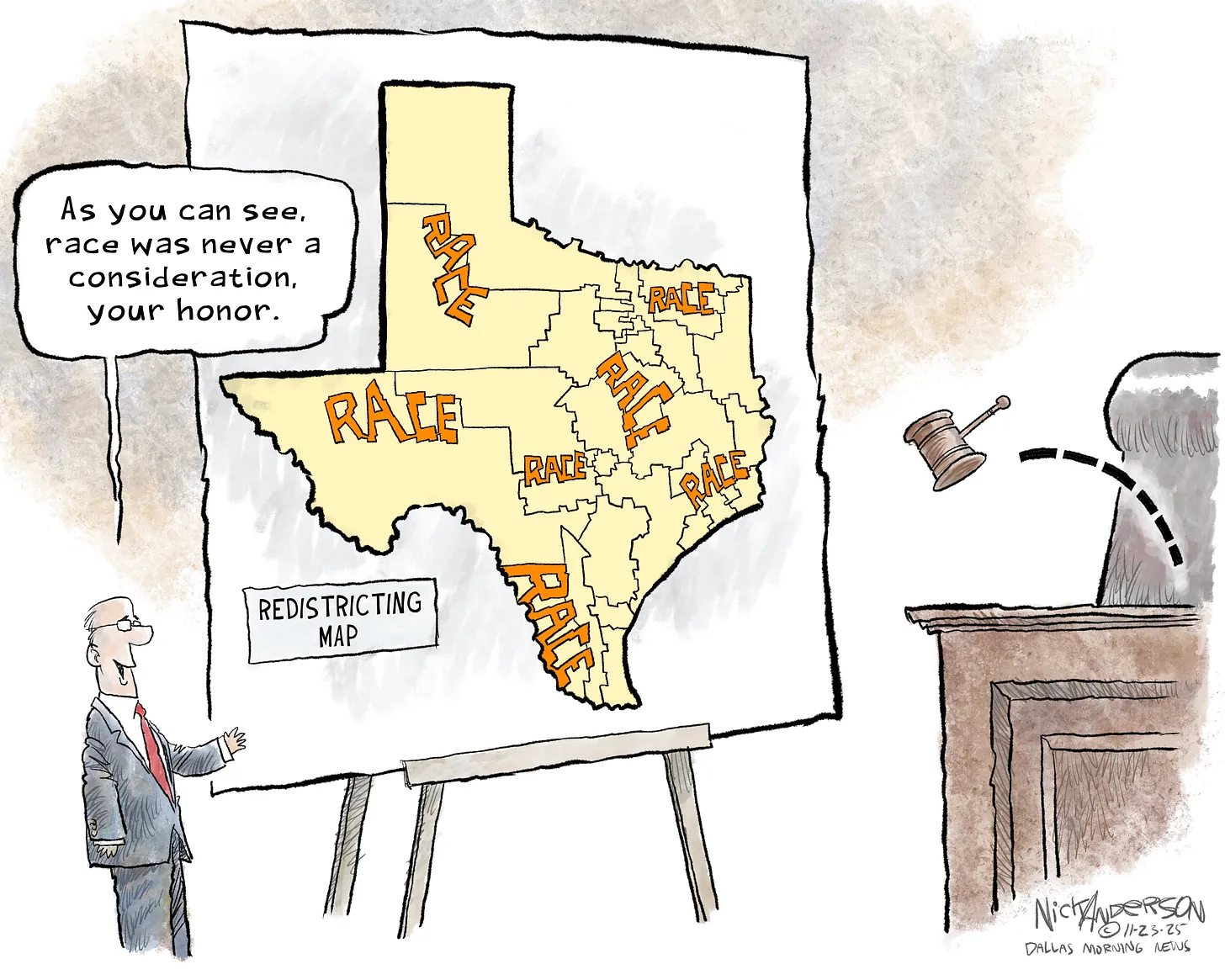
Trump’s assault on American democracy. Thanks to the Supreme Court, Texas will conduct its 2026 congressional elections with a racially gerrymandered map.
Climate change. There are interesting and somewhat ironic developments in geothermal power. Details in a short note below.
Both Gaza and Ukraine fell off my radar this week.
This week’s developments
This week the focus was on Pete Hegseth
Secretary of War Defense Pete Hegseth is under fire from two directions:
Did he really give a “kill everybody” order that led to an attack on two men clinging to the wreckage of their boat? (If we’re not at war, that’s murder. If we are, it’s a war crime.)
The DoD inspector general’s report on Signalgate says Hegseth violated military regulations and endangered pilots engaging in an attack, but apparently stops short of finding a crime. The loophole here is that Hegseth himself had the power to declassify the information he released, even if it was irresponsible to do so.
Thursday, members of the House and Senate Armed Services and Intelligence Committees were briefed on the September 2 attack where a boat was sunk and then a second attack killed survivors clinging to the wreckage. All the reactions I’ve seen quoted followed party lines. Democrats like Mark Warner said the video was “very disturbing”, while Republican Tom Cotton said:
I saw two survivors trying to flip a boat loaded with drugs bound for the United States back over so they could stay in the fight, and potentially, given all the context we’ve heard of other narco-terrorist boats in the area coming to their aid to recover the cargo and recover those narco-terrorists
To me, the phrase “stay in the fight” is telling. What fight? Who were the boatmen trying to fight against?
The bottom line here is that eventually the video will come out, and the American people can resolve this argument for themselves. The question is whether people will be able to simply use their eyes, or will they see the scene through a haze of dehumanizing labels like “narco-terrorist”?
As for the legality of the whole boat-sinking campaign, Ron Filipkowski sums it up well:
The US government is summarily executing people on a weekly basis without telling the American people any of their names or presenting any proof of their guilt, for alleged crimes that do not carry the death penalty in the US.
An important related article: Overmatched by the NYT editorial board. It discusses how our big complicated and expensive military systems repeatedly fail us in war simulations where we try to defend Taiwan against China.
The basic problem was identified already in James Fallows’ 1981 book National Defense: We need small, simple weapons that are easy to produce in large numbers, but our procurement system favors big, complex weapons that are hard to keep running and hard to replace if they get damaged in battle.
It’s been decades since I read that book, but I think I remember one key example: how Nazi Germany lost the tank war in Russia. Individually, the Russian tanks were no match for the German Tigers and Panthers. But the Russian tanks (and the Shermans imported from America) were easy to make and maintainable by any good street mechanic, while the German tanks were much more complicated and much harder to fix if they broke down.
At some point, which may already have arrived, swarms of hypersonic drones will be able to overwhelm an aircraft carrier like the Gerald Ford, which we just deployed to the Caribbean.
and the Supreme Court
It shouldn’t be surprising when the Court ignores facts, laws, and precedents to give the Republican Party an advantage, but for some reason I still was taken aback when the Court OK’d the Texas congressional map that lower courts had found violated legal guarantees against racial gerrymandering.
I’ll leave the details of the case to Paul Waldman, but the gist is that the district court held extensive hearings about whether the new Texas map was drawn according to race, and found that it was. By precedent, higher courts are supposed to defer to a lower court’s findings of fact unless they spot a clear error. (There’s a reason for that: Higher courts don’t have as much time to devote to assembling and evaluating evidence. The district judge saw and heard the witnesses, while the justices could only read the transcripts.) But the Supreme Court ignored that provision, claimed that the lower court should have given more deference to the State of Texas, and then invoked the Purcell doctrine, that courts should not change maps on the eve of an election.
But of course, as Justice Kagan points out in her dissent, it was the Texas legislature that wanted to change maps, and the legislature that controlled the timing. Letting the old map stand would have disturbed nothing and confused no one.
If Purcell prevents such a ruling, it gives every State the opportunity to hold an unlawful election. The District Court, once again aptly, made the point: Were judicial review so broadly foreclosed, then to implement even a “blatantly unconstitutional map,” the “Legislature need only to pass” it on a schedule like this one. That cannot be the law—except of course that today it is.
This is yet another abuse of the Court’s “shadow docket”, a preliminary finding that applies in this case only and may be reversed eventually. But a temporary finding is all Texas Republicans need to deliver more House seats to Speaker Johnson.
Waldman goes on to argue that Democrats have to start running against the Supreme Court.
Any Democrat who says “Voters don’t really care about this stuff” needs a good smack in the head. The answer to that problem is to make them care. Republicans do this all the time; if they have something they wish was on the agenda, they force it on the agenda, no matter how ridiculous it is or how removed it is from people’s lives. How many Americans cared five years ago about whether some middle school trans kid a hundred miles from where they live wanted to play softball? But they care about it now, because Republicans made them care.
Democrats need to do the same with the Supreme Court — loudly, angrily, personally, relentlessly. If they don’t, the next Democratic president is utterly screwed.
and geothermal power
Normally, you think about geothermal power in places like Iceland or New Zealand — places with volcanoes, where hot lava is close to the surface. But the center of the Earth is 5000 degrees Celsius, so you can find heat just about anywhere if you drill deep enough.
For years that’s been considered impractical, but maybe not much longer. Ironically, the technology to make this work has been developed by the oil and gas industry. Want to drill deep as cheaply as possible? The oil companies know how. Want to get water through rock so you can heat it in the depths? That’s been solved by the fracking companies.
The small print below the “ICE WAS HERE” sign says that the Holy Family is safe inside the church’s sanctuary, and gives the number of a hotline to report local ICE activity.
At a time when there is a ridiculous backlog of asylum cases, Trump has been firing immigration judges. The immigration courts that decide such cases are not part of the judicial branch, but belong to the Department of Justice. So DoJ is looking to recruit.
DHS is trying to help by posting DoJ recruitment ads on its Facebook page. The scary thing is what their ads tell you about the kind of people they’re looking for. Here’s one:
The text that goes with it is: “Deliver justice to criminal illegal aliens. Become a deportation judge. Save your country.”
If you’re not up on comic-book-based movies, that’s Judge Dredd. Wikipedia describes him like this:
Judge Dredd is a law enforcement and judicial officer in the dystopian future city of Mega-City One, which covers most of the east coast of North America. He is a “street judge”, empowered to summarily arrest, convict, sentence, and execute criminals.
So if you fantasize about summarily arresting, convicting, sentencing, and executing “criminal illegal aliens”, the Trump regime has just the job for you.
I’m not sure what to make of this theory, but it sounds plausible: James Throt, who claims to be a neuropathologist from the UK, says that the lasting neurological effects of Covid changed our brains, reducing our executive function and making us less empathetic. He claims you can see the change in behavior on dating apps.
Since 2020, apps report the same pattern: shorter messages, less reciprocity, fewer follow-ups, lower meet-up rates & a collapse in sustained conversational ability. This isn’t just “people being tired”. It’s a measurable degradation of attention, initiative & social cognition.
It might also explain why the public so easily falls for the regime’s depersonalization of vulnerable groups like immigrants or the trans community.
Speaking of depersonalizing attacks, Jamelle Bouie looks at Trump’s smearing of all Somali immigrants.
It’s hard to let go of the Trump MRI story, because what he says about it doesn’t add up. There’s no such thing as a “routine” MRI, and it’s hard to believe doctors did one without telling him what they were looking at or for.
Joyce Strong, a nurse, puts clues together and says he probably got a CT-based vascular imaging with contrast. She’s speculating, but her guess is that the testing was motivated by what I’ve been calling Trump’s symptoms of dementia — babbling, falling asleep at meetings, random outbursts, and so on.
A Virginia state-run liquor store was ransacked by a masked bandit on Friday evening, authorities said, leaving a trail of broken spirit bottles strewn across the shop floor.
Apparently this kind of thing happens from time to time. The article also includes a 2016 video from Tennessee of another racoon doing something similar.