Category Archives: Weekly summaries

Each week, a short post that links to the other posts of the week.

Limits

No Sift the next two weeks, but new posts will appear April 8.

[That’s why today’s Sift is a little extra-long.]

Like most rights, the right secured by the Second Amendment is not unlimited. From Blackstone through the 19th-century cases, commentators and courts routinely explained that the right was not a right to keep and carry any weapon whatsoever in any manner whatsoever and for whatever purpose.

 — Justice Anton Scalia, “District of Columbia v. Heller” (2008)

This week everybody was talking about the new Pope …

and especially about the symbols of his humility, like riding the bus with the rest of the cardinals instead of using a fancy popemobile, eating simple food, dropping by the hotel he was leaving to pick up his own luggage, and so on. That fits with choosing the name Francis and how he has lived as Cardinal Bergoglio. It’s also what you might expect from the first Jesuit pope.

That symbolism that could communicate something important about how he wants to run the Catholic Church — maybe a way to tell the clergy that Catholicism isn’t all about them — or it could just be the trappings of a public image. Too soon to tell.

The good part of Francis’ record is that he cares about the poor, and more generally about economic justice and the inequality of wealth. Popes usually do — something conservative Catholics like Paul Ryan tend to ignore. In general, 20th and 21st century popes have been far more socialist than, say, Barack Obama. But National Review tells the right-wing faithful not to worry:

His counting poverty as a social ill should not be misconstrued as sympathy for statist solutions to it or, indeed, as support for any determinate political program.

On the other hand, his social beliefs are pretty discouraging. Francis isn’t likely to soften the Church’s opposition to reproductive rights, gay rights, or female priests. However, he apparently did not say: “Women are naturally unfit for public office.” A lengthier version of that quote has been floating around the internet all week, but Snopes can’t find any prior record of it. (Always check Snopes.com before you forward something outrageous.)

Bergoglio was bishop of Buenos Aires during the “Dirty War” the Argentine junta waged against its own people. The Church in general has apologized for its behavior during that era, and the New Republic describes conflicting reports about Bergoglio’s role. So far, though, no smoking gun.

Some prominent human rights activists have come to Bergoglio’s defense. Argentine Nobel Peace Prize winner Adolfo Perez Esquivel, who was jailed and tortured by the dictatorship, told the BBC’s Spanish-language service that Bergoglio “was not an accomplice of the dictatorship. … There were bishops who were accomplices of the Argentine dictatorship, but not Bergoglio.”

On the other hand, he also didn’t stand up against the regime, which undermines his moral authority.

BTW, popes are like world wars. Francis doesn’t become Francis I until there’s a Francis II.

and Senator Portman’s switch on same-sex marriage

Rob Portman, the other guy Mitt Romney considered after Paul Ryan, announced in the Columbus Dispatch that he now supports same-sex marriage. He started reconsidering two years ago when he found out that his son was gay.

At the time, my position on marriage for same-sex couples was rooted in my faith tradition that marriage is a sacred bond between a man and a woman. Knowing that my son is gay prompted me to consider the issue from another perspective: that of a dad who wants all three of his kids to lead happy, meaningful lives with the people they love, a blessing Jane and I have shared for 26 years.

Dick Cheney had a similar awakening for similar reasons in 2004, so this may be the way Republicans fulfill my prediction that everybody will support same-sex marriage by 2030. And while I’m glad to see the switch, the self-centered reasoning still bugs me. When will a Republican change his mind — on anything — out of compassion for other people’s families?

Matt Yglesias’ tweets were merciless:

Did Rob Portman used to think that gay people didn’t have dads?

and

As Dr King said, I have a dream that some day all injustices that personally impact members of my immediate family will be resolved.

Anil Dash tweeted:

Eventually one of these Republican congressmen is going to find out his daughter is a woman, and then we’re all set.

which inspired Kevin Drum to note that Republicans with daughters do vote slightly better on women’s issues. And which Republican senators voted for the Violence Against Women Act? A handful of men and all five women.

and Paul Ryan’s back-from-the-dead budget

My comments are in a separate post: “I Read the Ryan Budget“.

but I also wrote about the Keystone Pipeline

The case against the pipeline involves one key point that people don’t want to hear: If we’re not going to totally wreck the climate, we have to leave some fossil fuels in the ground. The Canadian oil sands would seem to be the perfect candidate. And if not, then what is our plan? I flesh that argument out in “A Hotter Planet is in the Pipeline“.

and you also might be interested in …

As the 10-year-anniversary approaches, more and more people are looking back at the Iraq War. David Frum shares this revelation: The reason the war looked so poorly thought out was that nobody ever thought it out.

For a long time, war with Iraq was discussed inside the Bush administration as something that would be decided at some point in the future; then, somewhere along the way, war with Iraq was discussed as something that had already been decided long ago in the past.

Paul Krugman points out this absurdity: In 2003, millions around the world were protesting the looming invasion, and yet

To this day, pundits who got it wrong excuse themselves on the grounds that “everyone” thought that there was a solid case for war. Of course, they acknowledge, there were war opponents — but they were out of the mainstream.

The trouble with this argument is that it was and is circular: support for the war became part of the definition of what it meant to hold a mainstream opinion. Anyone who dissented, no matter how qualified, was ipso facto labeled as unworthy of consideration.

He notes the same circularity in today’s budget debate. If you don’t think cutting the deficit is a major priority, you’re out of the mainstream. Your opinion is unworthy of consideration, even if you’ve got a Nobel Prize in economics.


Rick Perlstein describes the outrageous state of those click-through contracts you don’t read when you buy software.

Recently I sat down to talk to an activist who’s doing something about it. When Theresa Amato of Faircontracts.org, who sat with me recently for an interview, told me about this business of companies reserving—and exercising—the right to change contracts after their customers have signed them, and courts upholding that right, I paused a bit. I said I was speechless. “Yes,” she replied. “You should be speechless. And so should everyone.” She laughs—in a laughing-to-keep-from-crying kind of way: “To call this fine print ‘contracts’ is almost a misnomer.” She corrects herself: “It is a misnomer, according to contract theory, because there’s no mutual consent there.”


Matt Yglesias points out that the time to avoid the next bank bailout is now, when the banks are taking profits out of the system. In bad times, when they don’t have money to cover their debts, it will be too late.

Meanwhile, I haven’t figured out what the Cyprus thing is all about yet.


Noam Chomsky didn’t invent this idea, but this is about the clearest expression of it I’ve heard:

 If you want to privatize something and destroy it, a standard method is first to defund it, so it doesn’t work anymore, people get upset and accept privatization. This is happening in the schools. They are defunded, so they don’t work well. So people accept a form of privatization just to get out of the mess.


Speaking of schools, Atlantic calls attention to something that always seems to get left out of American articles on Finland’s world-leading school system: The Finns don’t allow privately funded schools. So the rich can’t opt out of the public system and spend more on their own kids.

Across the board, Finland does exactly the opposite of what our school reformers want: no standardized tests, lots of teacher independence, little competition between schools. It seems to work.


This week’s indictment of American democracy: According to a ABC/Washington Post poll, 91% of Americans support universal background checks for gun buyers. But when the bill came up in the Senate Judiciary Committee Tuesday, every Republican voted against it. It passed 10-8 on a party-line vote, but in the full Senate it won’t get past a filibuster without at least a few Republican votes.

So how does a major party unanimously defy 91% of the public? Well, look at a different news story: Scott Brown was known as “Wall Street’s favorite senator“, even though Wall Street is not particularly popular with his constituents in deep-blue Massachusetts. But now that the voters have thrown him out, Brown is doing better than ever. Monday he joined law firm Nixon Peabody, which lobbies for (among others) Goldman Sachs. He also has a gig at Fox News and makes good money speaking at conservative and corporate events. None of that would have happened if he had honestly represented his constituents.

In short, Scott Brown’s real career is as a conservative, not as a servant of the people. He furthered that career by defying the voters to maintain his conservative bona fides. That’s what the 8 Republicans on the Judiciary Committee are doing.


While we’re talking about guns and Republicans: In only a few short months Ted Cruz has become my least favorite senator. Everybody has some personality trait they just can’t stomach; mine is arrogant stupidity. Like Joe Scarborough said: “When you’re condescending and you don’t even have the facts right … I’ve got a problem with that.”

Cruz’s interaction with Senator Feinstein Thursday was classic arrogant stupidity. First, he addresses Feinstein as if she might never have heard of the Second Amendment before. Then he makes two asinine analogies — comparing Feinstein’s assault-weapon ban to Congress specifying that “the First Amendment shall only apply to the following books” or “the Fourth Amendment’s protection against searches and seizures could properly apply only to the following individuals”.

The First Amendment already doesn’t apply to child pornography. The Fourth Amendment is already riddled with exceptions (like email stored in the cloud). And if the Second Amendment won’t let Congress put any limit on weapons (see the Scalia quote above) then how are we going to protect airliners from shoulder-fired surface-to-air missiles?

After Feinstein slaps him down, Cruz responds with the classic “I admire your passion”, as if the considered response of a 20-year Senate veteran was just the sputtering of an emotional female.

Maybe Cruz’s response reminded Rachel Maddow of Alex Castellanos saying “I love how passionate you are” to her on Meet the Press last April. Whatever the reason, Rachel was in rare form Friday: She devoted a 17-minute segment to new details on the Newtown shooting, their relevance to Feinstein’s assault-weapon ban, and Feinstein’s history of being present at a colleague’s assassination, culminating in Rachel dishing a full heaping of scorn on Cruz’s ignorance and sexism.


It’s probably not fair to judge CPAC by one or two white supremacists, outrageous as they were. But this video looks like it might be a fair representation of how young conservatives think about climate change.


It turns out even monkeys reject unfair treatment.


Chris Hayes is leaving my favorite weekend show (Up) and taking over the prestigious 8 p.m. weekday slot starting April 1. Here’s one of the many great things about Chris: He doesn’t use the standard old-white-guys Rolodex.

Alms from the Poor

The “working poor,” as they are approvingly termed, are in fact the major philanthropists of our society. They neglect their own children so that the children of others will be cared for; they live in substandard housing so that other homes will be shiny and perfect; they endure privation so that inflation will be low and stock prices high. To be a member of the working poor is to be an anonymous donor, a nameless benefactor to everyone else.

— Barbara Ehrenreich, Nickel and Dimed (2001)

This week everybody was talking about … well, actually nothing really caught on

I couldn’t get excited about the death of Hugo Chavez, maybe because I never got that excited about him when he was alive. I did like the discussion Chris Hayes had about Chavez Sunday, because it seemed like he really wanted to know who this guy was and what he meant for Venezuela, rather than to force him into a stereotype.

And I don’t have a lot of hope for the next Pope, so that story didn’t grab me either.

so I wrote about dysfunctions in media and democracy

Who Do Representatives Represent?” looks at a fascinating new study: Politicians on both sides tend to think their districts are more conservative than they actually are. An earlier study said that legislators’ votes are influenced mainly by the opinions of the wealthy, so I wondered this is all one phenomenon: Maybe politicians correctly estimate the positions of the constituents they really represent — the rich.

How Bubbles Look From the Inside” considers how you could tell if you were living inside a news bubble, cut off from actual reality. Day-to-day, you probably couldn’t. But the tenth anniversary of the Iraq invasion reminds us that a fantasy world is vulnerable to sudden shocks from events that are too big to spin.

and you also might be interested in

As President Obama’s proposal to raise the minimum wage faces predictable opposition (in spite of its popularity — another one of those dysfunctions of democracy), the public should educate itself about the realities of minimum-wage life. If you didn’t read it when it came out in 2001, I suggest picking up Barbara Ehrenreich’s Nickel and Dimed, where she makes three attempts (in Florida, Maine, and Minnesota) to find entry-level jobs and live on her wages for a month.

Middle-class people have trouble grasping the reality of what economists call poverty traps: when you can’t raise enough money to live cheaply. If you don’t have security-deposit-plus-first-month’s-rent for an apartment, you’ll have to rent a motel room week-to-week. It won’t have a kitchen or refrigerator, so you’ll have to eat fast food. Maybe the only car you can afford guzzles gas. Or you can’t afford a car at all, so you can’t get to the better-paying job opportunity. At Ehrenreich’s lowest point, she’s working seven days a week and can’t find a food bank that is open when she can go.

Ehrenreich has a tough time even though she has many advantages: She’s white, healthy, and physically fit. Low-wage jobs are plentiful during the boom at the end of the Clinton administration. She only has to support herself, not a child or parent. Because she’s only trying to survive for a month, she doesn’t face the unpredictable-but-unavoidable challenges that eventually derail even the thriftiest minimum-wage budget: illness, injury, car repair, or toothache. As you read, you’ll simultaneously sympathize with Ehrenreich and realize (as she does) that real minimum-wage workers have it much worse.

And while Ehrenreich takes pride in her ability to work hard and keep up, she quickly realizes that her Ph.D. brain doesn’t stand out. No manager or co-worker ever says, “You’re really smart” or “You pick this up fast.”


Ezra Klein explains why Obama can’t make a deal with Republicans. Here’s a clear case of a Republican saying that a deal would be possible if only Obama would accept X. Informed that Obama accepted X some while ago, he still says there’s no deal.


Tod Kelly compares Portland, Oregon to a nearby city in Washington, concluding that people actually like paying taxes if it buys them visible public amenities.


If you’re stuck for examples of “wasteful government spending”, you can always pick on some science project, because it’s easy to make them sound stupid. If there’d been an NSF in colonial American, somebody would have denounced that wasteful grant to fund a guy flying a kite during a thunderstorm.


The economy added an unexpectedly high number of jobs in February and the unemployment rate fell to 7.7%, the lowest number in four years. But Fox News found a way to spin this gold into straw.


New research indicates that global temperatures are higher than they’ve been in 4,000 years and are near an 11,000-year high. (That would be the highest temperatures ever, if you’re a young-Earth creationist.)

Even that understates the severity of the situation, because the real problem is the speed of change, not the absolute temperature. The NYT brings in Penn State climatologist (and Climategate smear victim) Michael Mann for comment:

Dr. Mann pointed out that the early Holocene temperature increase [12,000 years ago] was almost certainly slow, giving plants and creatures time to adjust. But he said the modern spike would probably threaten the survival of many species, in addition to putting severe stresses on human civilization.

“We and other living things can adapt to slower changes,” Dr. Mann said. “It’s the unprecedented speed with which we’re changing the climate that is so worrisome.”

The picture explains it:


Steven Lloyd Wilson captures how so many fans of Orson Scott Card’s fiction feel about his ever-uglier political activity: sadness, puzzlement, revulsion. I’m a firm believer that the artist is not the art, and that a lot of world’s great achievements were probably created by people I wouldn’t choose to hang around with. (Yeah, Frank Miller is probably a fascist, but I still like Dark Knight Returns.) At some point, though, what I know about the author starts to interfere with my appreciation of the work. Card has reached that point. I wish I knew less about him.


Continuing the human-interest theme: NYT Magazine has a brilliant feature on an aging physics professor with previously harmless levels of cluelessness and self-delusion. Then an online-romance scam pulls him into a drug-smuggling plot.


A new study claims that religion may help criminals rationalize their crimes. I like the interpretation of Slate’s Justin Peters: It’s not that this is the Great Definitive Study — it’s based on a small sample and blah-blah-blah. But the idea that prison ministries help rehabilitate criminals is also based on pretty flimsy research.

As that Bureau of Prisons report put it, while “religious programs in the correctional setting have been the single most common form of institutional programming for inmates,” nobody really knows whether those programs are effective.


You know you’re in trouble when your defense is that you miscalculated your opportunism.

That’s more-or-less where Jeb Bush is on immigration, which is supposed to be his signature issue. For years, he’s been projecting an image as the reasonable Republican, the one most likely to forge a workable compromise with Democrats. This week we saw that the image is the point, not the policy.

Bush’s book Immigration Wars came out Tuesday, and the shocker was that his proposal — legal residency for undocumented immigrants, but no path to citizenship —  is more conservative than bipartisan Senate framework that came out in February. (It calls for “a tough but fair path to citizenship”.)

But as soon as he’s questioned about it, Bush flip-flops, saying that he could support a path to citizenship. Explanation? “We wrote this book last year, not this year.” In other words, at the time the book was written, the Republican nominee’s immigration proposals (self-deportation) were so extreme that Bush could stake out a centrist position without calling for citizenship. But by the time the book is out, the center has moved. So Bush moves too. He has never really been for or against citizenship; he just wants to be in the center.

So this whole discussion has nothing to do with immigration; it’s about running for president.


Rand Paul does an old-fashioned talking filibuster, holding the floor of the Senate for nearly 13 hours. Eric Holder responds with one word:

It has come to my attention that you have now asked an additional question: “Does the president have the authority to use a weaponized drone to kill an American citizen not engaged in combat on American soil?” That answer to that question is no.

I’m torn about Paul’s filibuster. Many of the points he was making were points I’ve made here: It’s very dangerous to allow the executive branch to assemble a “kill list” without oversight from somebody who doesn’t answer to the President. (Even a secret “star chamber” court would be better, if it had independent judges.)

But Paul was also phrasing his questions in ways that made them unanswerable. (Holder’s version puts in key caveats, like “not engaged in combat”.) At a time when well-armed Americans — many of whom seem to have Paul’s sympathythreaten revolution if the political process doesn’t go their way, the President can’t categorically swear off military operations inside the U.S.


Last month, Elizabeth Warren was expressing her concern that “Too big to fail has become too big for trial.” This week, Eric Holder basically admitted she was right:

I am concerned that the size of some of these institutions becomes so large that it does become difficult for us to prosecute them when we are hit with indications that if you do prosecute, if you do bring a criminal charge, it will have a negative impact on the national economy, perhaps even the world economy.

So when you set out to regulate the banking system, your very first principle should be not to let any bank get too big to regulate.


The Menendez prostitution scandal is looking more and more bogus, vindicating news outlets that refused to break it.


OK, everybody knows that news stations sometimes edit tape to make a public figure look bad. But a 4-year-old?

Taking Chances

[Political economy] does not treat the whole of man’s nature as modified by the social state, nor of the whole conduct of man in society. It is concerned with him solely as a being who desires to possess wealth, and who is capable of judging the comparative efficacy of means for obtaining that end.

— John Stuart Mill,
Essays on Some Unsettled Questions of Political Economy (1830)

In life, we take chances on one another. We trust, and we behave in trustworthy ways. Not always; not with everyone. But much more often than the cynical and unflattering views of human nature and interaction would predict. And when we do, it turns out that we thrive; at the least we do better than when we do not trust anyone.

— Yochai Benkler, The Penguin and the Leviathan (2011)

This week everybody was talking about the Voting Rights Act

The Supreme Court heard arguments Wednesday about whether to strike down one of the bill’s key sections. There’s a fairly narrow legal point at issue, but the arguments about that point set off much wider arguments about racism, voter suppression, and federalism.

A little history you may already know: After the Civil War, the 15th Amendment was added to the Constitution. It’s short and to the point:

Section 1. The right of citizens of the United States to vote shall not be denied or abridged by the United States or by any State on account of race, color, or previous condition of servitude.
Section 2. The Congress shall have power to enforce this article by appropriate legislation.

That worked for a while, but then the southern states figured out how to circumvent it via the Jim Crow laws, which set up a variety of procedural hurdles that white-supremacist local officials could use to keep blacks from voting.

In the mid-20th century, the Supreme Court started overturning discriminatory laws, but it couldn’t keep up with white-supremacist legislatures. That’s why the Voting Rights Act of 1965 contained Section 5: States or towns with a history of voter suppression (explained well here and pictured in red on the map) would need prior federal approval before they changed their voting procedures. In the pre-clearance hearing, they’d have to establish that the change would not have the effect of disenfranchising minority voters.

Just last year, Texas’ Voter ID law was blocked because the people who did not already have the mandated ID were disproportionately Hispanic, and the IDs were harder to get in parts of the state where many Hispanics lived.

Everybody recognizes that it’s an extreme step for the federal government to treat some states differently from others. But the 15th Amendment empowers to Congress to enforce the right to vote “by appropriate legislation”. The argument is over what’s appropriate.

In the past, the Court has found the VRA appropriate, given the problem it was trying to solve. However, John Roberts has never liked the VRA and clearly believes it isn’t appropriate any more: Now that blacks in the South vote — sometimes in higher percentages than whites — he clearly believes they can protect their right to vote through the ordinary channels that protects minorities in other states. He asked:

is it the government’s submission that the citizens in the South are more racist than citizens in the North?

My personal answer would have been “Well, duh.” But Roberts apparently believes this is a crushing point.

His attack is part of a larger strategy: On the surface it may look like you could solve Roberts’ problem by extending Section 5 to cover the whole country. But then Roberts could question Section 5 as too broad: How can it be appropriate to interfere in the affairs of states that don’t have a history of disenfranchisement? (He made precisely that argument when he was in the Reagan administration.)

One thing that is clear is that the nature of disenfranchisement has changed. In the Jim Crow era, whites disenfranchised blacks because they were black. Current voter suppression efforts have a partisan angle: Republicans disenfranchise blacks and Hispanics because they are likely to vote for Democrats.

The race/party relationship is particularly pronounced in the South. In Alabama, for example, Romney won 84% of the white vote and Obama 95% of the black.

and the Violence Against Women Act

which passed the House and will be re-authorized as law. I can guess what you’re thinking: “Seriously? This is what a victory looks like these days?” I mean, women also managed to keep the right to vote (in spite of the National Review) and to own property without their husbands’ approval. Pop the champagne!

The VAWA didn’t used to be controversial, for the obvious reason that nobody (in public, at least) is for violence against women. It was last reauthorized in 2005 without a lot of fanfare and signed by that notorious leftist George W. Bush. The Senate passed it this time 78-22 — the 22 all being white male Republicans — but then it got hung up in the House. House Republicans objected to three new provisions: extending the domestic violence protections in the law to same-sex couples, giving temporary visas to battered immigrant women who entered the country illegally, and letting courts on Native American reservations try rape cases.

I haven’t been able to fathom whether opposition was based on substantive objections, or just reactions against buzzwords: illegal immigrants! lesbians! Indians judging white people!  (That was a weird one: Senator Grassley really said “on an Indian reservation, [a jury is] going to be made up of Indians, right? So the non-Indian doesn’t get a fair trial.” I don’t know whether anybody asked him if a Native American can get a fair trial from a white jury.)

Ordinarily, Speaker Boehner won’t let a bill come to the floor unless a majority of the Republican caucus supports it — that’s called the Hastert Rule — but I think he realized that the Tea Party lemmings were headed for a cliff on this one, so he arranged for the Senate bill to get a vote after the Republican alternative failed. All 199 Democrats and 87 Republicans voted for the Senate bill, with 138 Republicans against.

But we should be talking about Detroit’s emergency manager

Think of it as the municipal equivalent of being sold into slavery to pay your debts.

Under Michigan’s emergency manager law (which existed before Governor Snyder, but got much more draconian during his administration), if a city or town gets into sufficiently difficult financial shape, the governor can appoint an emergency manager whose powers supersede ordinary politics. The elected officials become empty suits, contracts with the unions don’t count any more, the manager can sell parks or other municipal properties to whomever for whatever he can get.

It has happened to several small-to-medium-sized Michigan cities before, but now the state is taking over the big enchilada, Detroit.

The voters rejected the law by referendum in November, but the legislature just passed it again — with a clever gimmick that shields it from repeal by referendum. Add in gerrymandered state legislature districts, and the law becomes virtually voter-proof.

Everyone should be paying attention, because this is one scenario for the death of democracy: Well-to-do people move to suburbs and gated communities, leaving the poor behind in a city with a crippled tax base. The state cuts aid for local things like schools and waits for a recession to put the city in financial trouble. Then the state takes it over and throws out the elected officials.

Who thought this up? A think tank funded by billionaires.

Indiana has passed its own emergency manager law. (Indiana’s emergency managers can void union contracts to resolve financial problems, but they can’t raise taxes.) Other Republican-controlled states may follow.

and the larger implications of Justice Scalia’s “racial entitlement” remark

which ThinkProgress’ Ian Millhiser explained. In the oral arguments on the Voting Rights Act (see above), Justice Scalia brushed off the wide majorities (98-0 in the Senate) that reauthorized the VRA in 2006 by saying

Whenever a society adopts racial entitlements, it is very difficult to get out of them through the normal political processes.

(Millhiser has the longer version.) I’m sure you can fill in your own objection to the idea that voting is a “racial entitlement”. But the subtext of his statement is that legislators who secretly disapprove of the VRA nonetheless vote for it because they are intimidated by the threat of being accused of racism. (Conservatives often complain about the power and unfairness of accusations of racism, as if this were a bigger problem than racism itself.)

Appearing on the Daily Show, Rachel Maddow gave her interpretation of Scalia’s remark: He’s a troll.

He knows it’s offensive. He knows he’s going to get a gasp from the court room, which he got. And he loves it. He’s like the guy on your blog comment thread who is using the N-word — “Oh did I make you mad? Did I make you mad? Did I make you mad?” — he’s like that.

But Millhiser’s interpretation is more sinister. One justification for abandoning judicial restraint is that the political process is broken. In such a case, the judge views himself as the last line of defense against injustice. In that context, Scalia’s logic plugs into some other popular notions on the Right, namely Romney’s 47% and the idea that Obama bought the election by giving out favors to “the takers” in society.

Millhiser’s analysis:

it’s not hard to predict how a judge who agrees with both Romney’s view of welfare and Scalia’s view of when judges must destroy democracy in order to save it would react to the modern welfare state. With his racial entitlement comment, Scalia offered a constitutional theory that would allow movement conservatives to strike down the entire American safety net.

To me, it’s interesting where Scalia doesn’t see a broken political system unable to reverse injustice. He favors unlimited corporate political spending and rejects attempts to overrule entrenched corporate entitlements, like the essentially infinite copyright that Disney has on Mickey Mouse.

But I wrote about what capitalism is doing to us

It’s kind of a multiple-book review called Nobody Likes the New Capitalist Man.

and you also might be interested in …

The sequester started. For the next week or so it’s easily reversible, but the House shows no interest.


The New Yorker’s John Cassidy has a good summary of the Bob Woodward flap.


Mark Hurst pictures Google Glass as a giant step down the road to universal surveillance.


I know that Congressman-Gohmert-said-something-stupid could be a weekly feature, but this stood out:

Slavery and abortion are the two most horrendous things this country has done but when you think about the immorality of wild, lavish spending on our generation and forcing future generations to do without essentials just so we can live lavishly now, it’s pretty immoral.

I suppose if you accept the unBiblical and very-very-weird theological idea that fertilized eggs have souls, abortion could be in a class with slavery. But the debt?

First, I question whether any purely monetary event could be as immoral as slavery (or the Native American genocide, which Gohmert seems to have forgotten). And second, I go back to Warren Mosler’s point: All the goods and services produced in the future will be consumed in the future. Our grandchildren will not be sending stuff back in time to pay for our “lavish” lifestyle, any more than we are sending stuff back to 1944 to pay for World War II.

And finally, if lavish living were the problem, the obvious solution would focus on those living lavishly: the rich. Instead, Gohmert’s party wants to cut food stamps.

Oh, and one more thing: If we’re really worrying about future generations, shouldn’t we focus on global warming instead? In a true fiscal emergency, a future government could renounce its debt. But it can’t renounce its atmosphere.


You know those arguments we have about guns? We could have people study those questions and report back to us. Oh wait — we started to do that and the NRA made us stop.


Noted fake-historian David Barton is branching out. He used to lie about the Founders and religion. Now he’s lying about the Founders and guns.


Molly Ball: Five false assumptions of political pundits.


Appearances

If governments cannot be led to understand the ideas presented here, then their citizens may be denied vital health, education, and other benefits because they appear to be unaffordable, when in fact they are not.

— William Baumol, The Cost Disease (2012)

This week everybody was talking about the sequester …

… which I admit has gotten tedious. We’ve had so many of these artificial crises.

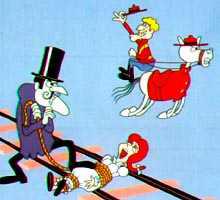
Oversimplifying only slightly, let’s review: Since the summer of 2011, Snidely Whiplash (the Republican majority in the House) has been trying to provoke the final showdown with Dudley Do-Right (President Obama) by tying Nell (the American economy) to the railroad tracks. Dudley showed up, but the fight keeps taking longer than either expected. So they keep agreeing to move Nell further and further down the tracks to give themselves more time.

At the end of each episode, they’re still fighting, the train is coming, Nell is struggling … but it gets harder and harder to take the whole melodrama seriously.

What the Republicans have been demanding since Episode 1 is spending cuts. OK, the sequester delivers spending cuts. But they’re really stupid spending cuts, so the Republicans are trying to convince everybody that it’s all President Obama’s fault. For some reason, few people are buying that line.

You might wonder why we need to keep having these artificial crises. Simple: so far the deficit isn’t causing any real problems. For four years now, Obama’s critics have been predicting inflation, high interest rates, a crash in the dollar, and “bankruptcy” because nobody would buy our bonds any more. If any of that were happening, nobody would have to gin up an artificial crisis.

Second, people who want to cut spending keep running into Truth #1 from my Six True Things Politicians Can’t Say: Most government money is well spent. For decades they’ve been building the myth that the government budget is this vast rat hole that consumes money and helps nobody. That makes for great rhetoric, but runs you into trouble when somebody wants you to cut some real waste, because the waste just isn’t there: Even the politically disastrous Ryan Budget had a whole bunch of blank spaces in it where the real cuts happened.

So instead we’ve wound up with across-the-board cuts. The idea is that if the CDC is spending billions of dollars, there must be waste in there somewhere. And the best alternative the Republicans have come up with is to give President Obama the power to specify the cuts instead.

Republicans giving Obama more power? Anything is better than having to take responsibility for foolish cuts.

but I wrote about Baumol’s cost disease

In a very interesting book, elderly economist William Baumol explains why long-term increases in government spending may not be the problem everyone seems to think it is. My review of his book is in What if there’s no spending problem?

and the Cruz/McCarthy similarity

Senator Cruz: Do you now or have you ever resembled Joe McCarthy?

The Cruz/McCarthy comparison started because of Cruz’s innuendo-laden attacks on Defense Secretary nominee Chuck Hagel. National Review delivered a characteristically mature I’m-not-but-what-are-you response:

Senator Cruz has ably and aggressively executed his duty as a United States senator to advise on and consent to a nominee to the momentous post of civilian head of the United States military. He has not, as Senator McCarthy was reputed to have done, slandered an honorable man by cavalierly associating him with an odious and politically radioactive “ism.” But we can think of some Senate Democrats and cable-TV hosts who have.

[Notice the “reputed to have done”. These days it’s controversial on the Right whether McCarthyism is anything to be ashamed of. Maybe Tailgunner Joe was just a maligned patriot.]

Jane Mayer of the New Yorker then pointed out that it’s not just this one incident. Cruz has a history of McCarthyism, most overtly in a 2010 speech he gave to the Koch-funded Americans for Prosperity, when he claimed that 12 members of the Harvard Law School faculty “would say they were Marxists who believed in the Communists overthrowing the United States government.” Like McCarthy’s 57 Communists in the State Department, Cruz’s 12 seemed to be a number plucked out of the air, based on nothing.

Rachel Maddow covered this extensively Friday, and did something conservatives practically never do when they throw words like Marxist, socialist, and communist at President Obama — she defined her terms.

McCarthyism isn’t just a generic term for boorish behavior, for boorish right-wing behavior even. McCarthyism is a particular thing. It is making outlandish scandalous allegations against people in public life, and distracting from the fact that you have no evidence to back up those allegations by making the allegations really specific, which makes it seem like they must be coming from some factual basis, when in fact you are just making it up. After making the allegation publicly in a big showboaty way, you then demand that the person against whom you have made this allegation clear his name.

It’s not name-calling when you define the term in a precise and historically appropriate way, and then establish that it applies. At that point it’s just categorization: Cruz practices McCarthyism.

A Cruz spokeswoman answered Mayer’s article — not to Mayer, of course, or to Maddow, but to Glenn Beck’s The Blaze (which sees McCarthyism only as “a reference to Sen. Joseph McCarthy’s notorious and aggressive pursuit of Communists in the 1950s.” As if the problem was that Cruz is pursuing Harvard Law School communists too aggressively.)

Senator Cruz’s substantive point was absolutely correct: in the mid-1990s, the Harvard Law School faculty included numerous self-described proponents of ‘critical legal studies’ — a school of thought explicitly derived from Marxism – and they far outnumbered Republicans.

So they had ideas “derived from Marxism”. But what about “the Communists overthrowing the United States government”? The Blaze makes this excuse for Cruz:

It’s not clear precisely what kind of Communist “overthrow” Cruz said the professors supported — an actual physical takeover or, given the academic setting, a kind of intellectual one with an emphasis on ideas.

So HLS professors had legal theories that reminded Cruz of Marx, and they were hoping those ideas would be adopted if enough people in our democracy came to support them. And so Cruz was totally justified in saying that they were “Marxists who believed in the Communists overthrowing the United States government.”

I’m glad he cleared that up.

and you might also be interested in …

Speaking of slandering Chuck Hagel, a reporter explains how he became the source for the Friends-of-Hamas rumor.


It’s hard to know what to do with the level of crazy that slithers just below the surface of the gun debate. It’s wild enough that the NRA’s Wayne LaPierre can’t talk about universal background checks (which the NRA used to support) without jumping straight to gun confiscation, which no one seems to be proposing, as best I can tell. (I haven’t even run into liberals fantasizing behind the scenes about gun confiscation. As best I can tell, there is no constituency for it.)

But then you run into discussions like this one on the Talk to Solomon Show on the Conservative Political Network. Here, gun confiscation is just the first step in a long series of speculations that seem to be based on nothing, leading up to a race war. The confiscation order is supposed to turn gun-owning white patriots into criminals who can then be killed in a series of Ruby-Ridge-like incidents. And here’s the ultimate phase of Obama’s fiendish plan:

I believe they will put together a racial force to go against an opposite race resistance, basically a black force to go against a white resistance, and then they will claim anyone resisting the black force they are doing it because they are racist.

A federal force of armed blacks is coming for your guns, and you’ll be called a racist if you resist. And you’re imagining this because … why, exactly?

This is a real challenge for democracy, I think. What can you do when one side just refuses to debate anything that’s actually being proposed?


The same people who will tell you that separation-of-church-and-state is bogus will also tell you that teaching kids yoga violates separation-of-church-and-state.


The Onion explains a great mystery: Chinese hackers have been been vandalizing the Drudge Report for 15 years.

“They make the whole site look like garbage, they publish all this incendiary trash, and meanwhile I have to sit here with my name on this thing—it kills me,” said the popular blogger


I would have made sure this report got out in time for Valentine’s Day:

Bottlenose dolphins call out the specific names of loved ones when they become separated, a study finds.


In These Times calls attention to the perennial problem of wage theft: What if your employer just doesn’t pay your wages?

One of the ways that we’ve been cutting “wasteful government spending” and “job-killing regulation” in recent decades is to severely cut back — or even eliminate entirely — the government offices a short-changed worker can complain to. Whatever you may think about President Obama’s proposal to raise the minimum wage, it’s not going to mean much if an employer can just refuse to pay.


A self-described white guy explains why there’s no White History Month.


And finally, a mind-reader gives a lesson in internet safety:

Right to Continue

No business which depends for existence on paying less than living wages to its workers has any right to continue in this country.

 — President Franklin Roosevelt
Statement on the National Industrial Recovery Act (1933)

This week everybody was talking about the State of the Union

It was a good speech (text and video here) that has been well covered elsewhere. Immigration reform and gun control were already on the national agenda, but President Obama also made some new proposals:

Do something about climate change. Ideally, Congress would pass something like the old McCain-Lieberman cap-and-trade bill. “But if Congress won’t act soon to protect future generations, I will.” Grist suggests that threat/promise is empty, but David Roberts lists things Obama could do.

Preschool available to all. The research behind early education is impressive. In the Perry Preschool study, “123 African Americans born in poverty and at high risk of failing in school” were randomly divided into two groups; one got an intensive pre-kindergarten program at ages 3 and 4, and the other didn’t. The groups have been followed (so far) until age 40.

(More details in this Chris Hayes segment.) If that’s any measure of what can be accomplished, then making the program available to anybody who wants it — especially at-risk kids from poor families — is a no-brainer. Independent of any improvements to the kids’ life experience, the government might ultimately save money by spending less on them (for prisons, welfare, unemployment …) over their lifetimes.

Raise the minimum wage from $7.25 to $9 and index it to inflation. Obama framed this as a moral issue:

a family with two kids that earns the minimum wage still lives below the poverty line. That’s wrong.

Republicans mostly responded with economic arguments: Raising the minimum wage would kill jobs and cause inflation. The inflation claim effect isn’t that worrisome, because minimum-wage work is a vanishingly small part of the cost of production of most products, and the price of many products has little to do with the cost of production anyway.

Whether the proposal would kill jobs depends on why people are making minimum wage. If it’s because an hour of their labor adds only $7.25 to their employer’s output, then employers will fire them rather raise them to $9. On the other hand, if they produce more than $9 of value, but they make $7.25 because they are powerless people competing against a large pool of other powerless people for whatever jobs they can get, then businesses will just suck it up and pay them more.

The fact that wages in general haven’t been keeping pace with productivity for two decades tells me we’re probably in the non-job-killing situation, and economists (at least the ones driven by data rather than ideology) mostly agree. (BTW, this either/or analysis also answers the snarky comment: If it’s that easy, why not raise the minimum wage to $50? The reason people don’t make $50 is probably different than the reason they don’t make $9.)

Even at $9, the purchasing power of the minimum wage would still be lower than it has been many times in the past. Tennessee Republican Congresswoman Marsha Blackburn embarrassed herself by saying that Obama’s proposal would keep teen-agers out of the workforce, and then reminiscing about working for $2.15 when she was a teen. Of course, that was “somewhere between $12.72 and $14.18 an hour in today’s dollars.”

A nonpartisan commission to improve the voting experience in America. This was either a too-timid response to a serious problem or an attack on the sovereignty of the states (who have a God-given right to make people in minority neighborhoods wait as long they want) depending on who you listen to.

and the unresponsive responses …

Tea Party Republican Marco Rubio gave the Republican response (text, video), and Tea Party Republican Rand Paul gave the Tea Party response (text, video). The main thing I learned was that Republican still live in a bubble.

Instead of responding to the President’s actual speech, Rubio and Paul continued the Clint Eastwood tradition of debating an Obama only Republicans can see. Apparently, the invisible President Obama denounced the free enterprise system and called for government to take over the economy, so Republicans were proud of Rubio’s and Paul’s able defense of the American way of life. But if you live outside the Republican bubble and watched the visible President, you had to wonder what the hell they were talking about.

Marco, I can’t let this lie pass:

In fact, a major cause of our recent downturn was a housing crisis created by reckless government policies.

In actual fact, no, unless you mean reckless de-regulation of Wall Street, which I think is the opposite of what you’re trying to imply. The Barney-Frank-did-it version of the financial collapse is some of that “math you do as a Republican to make yourself feel better.” No one can stop Republicans from blaming regulation for a crisis brought on by de-regulation, but they can’t make it true no matter how many times they repeat it.

And that’s what’s really wrong in GOP-land: They’ve never come to terms with the failures of the Bush administration. (Also they haven’t understood the young voter or embraced 21st-century technology, as Robert Draper pointed out in the NYT Magazine this week.)

When Democrats got clobbered in 1980, 1984, and 1988, they did some genuine soul-searching and decided they had to overcome the big-government mindset of LBJ’s Great Society. They had to own up to the stagflation of the Carter years and get past the Vietnam Syndrome that made the electorate unwilling to trust a Democrat as commander-in-chief. The result was President Clinton’s move to the center in the 1990s, his announcement that “the era of big government is over“, welfare reform, fiscal seriousness that eventually led to a budget surplus, and Senators Kerry, Clinton, and Biden voting to authorize the Iraq War.

Whether you agree with that shift or not, it was real and had consequences. So far, GOP reform isn’t and doesn’t. Nothing in Rubio’s speech (or Romney’s campaign) would have been out of place in the Bush administration. Hell, Republicans still listen to Dick Cheney.

Voters can’t forgive them if they won’t repent.

but I want to talk about evolution …

In honor of Charles Darwin’s birthday (last Tuesday), I thought I’d address the swing voters to whom creationist arguments sound sort of reasonable. Evolution/Creation for Non-Eggheads.

and food …

Fascinating Supreme Court case about Monsanto’s ability to control its seeds. Legally, genetically engineered seeds are treated like software. They’re sold with a licensing agreement that prevents farmers from using their harvest for next year’s seeds. Growing one seed into many seeds — as farmers have done since dawn of agriculture — is like making your own copies of copyrighted software.

But Monsanto’s Roundup-ready soybeans now dominate the market to such an extent that if you buy a random truckload of soybeans from a grain elevator, chances are most of them are Roundup-ready. A 300-acre farmer did that, and planted the beans he bought. Monsanto is suing him.

As I’ve occasionally pointed out before, our food system has gotten really crazy. A new book Foodopoly describes it as an hourglass: lots of farmers at one end and lots of eaters at the other, but between them a narrow bottleneck controlled by a few big corporations. Increasingly, corporations make the major decisions and people are powerless.

Genetic engineering is a good case in point. Chances are you never decided to start eating Monsanto’s genetically engineered grains; maybe you don’t even realize you do. But most corn seed is Monsanto’s now, which means most high-fructose corn syrup is GE. And HFCS is in everything.

Farmers are controlled on one side by seed corporations, who are closing off all other ways to get seeds. On the other side, the market for farm crops is controlled by big suppliers who serve big retailers like WalMart and McDonalds. They impose their standards on the farmers, who have no alternative buyers. This is a detailed example of the general monopsony problem described in Barry Lynn’s Cornered.

and you might also find this interesting …

Hubris: Selling the Iraq War — tonight at 9 on MSNBC. Rachel Maddow hosts.


This kind of thing was just what I was hoping for when Elizabeth Warren ran for the Senate. She’s not rude or abusive. She’s not a Joe McCarthy-like bully. But she’s got a good question to ask and she’s going to stick with it.


You’ve got to wonder if the NRA is even trying to win elections any more. Maybe the whole point is to pander to the tiny slice of the population that buys lots and lots of guns. In an op-ed for the Daily Caller (fact-checked by Joe Nocera), Wayne LaPierre presents a personal arsenal as the only rational response to the looming collapse of America into post-apocalyptic barbarism.

Nobody knows if or when the fiscal collapse will come, but if the country is broke, there likely won’t be enough money to pay for police protection. And the American people know it.

Hurricanes. Tornadoes. Riots. Terrorists. Gangs. Lone criminals. These are perils we are sure to face—not just maybe. It’s not paranoia to buy a gun. It’s survival.

Don’t forget the zombies, Wayne.


Slate explains why pro-gun people keep saying that bats and hammers kill more people than guns (as a Georgia congressman did after the State of the Union). A long time ago someone made the true point that in America bats and hammers kill more people than AK-47s. (That would probably change if every Little Leaguer carried an AK-47 or they became a standard part of every home toolkit, but never mind.) Exaggeration took over from there, and since fact-checking is a liberal conspiracy, this absurd claim is now a permanent part of the public discussion.


But some guns really are cool, like this supersonic ping-pong-ball gun.


The folks at Saturday Morning Breakfast Comics understand that S&M might be a little different after you’ve had ten years to figure out what really tortures your spouse.


During Winter Storm Nemo, Brian Maffitt pointed a movie projector out the window and projected “The Lorax” onto the falling snow. He added music and got something that isn’t recognizable as Dr. Seuss, but it’s beautiful and peaceful in that log-burning-in-the-fireplace way.

Violations

What we need to do is optimize transparency on these issues, but at the same time, optimize secrecy.

— CIA Director nominee John Brennan, testimony to the Senate Intelligence Committee

Even in using the word doublethink it is necessary to exercise doublethink. For by using the word one admits that one is tampering with reality; by a fresh act of doublethink one erases this knowledge; and so on indefinitely, with the lie always one leap ahead of the truth.

— George Orwell, 1984

I believe that every American has the right to know when the government believes it has the right to kill them. 

— Senator Ron Wyden (D-Oregon), letter to John Brennan

Catch-22 states that agents enforcing Catch-22 need not prove that Catch-22 actually contains whatever provision the accused violator is accused of violating.

— Joseph Heller, Catch-22

This week everybody was talking about targeted killings

In particular: When can a president send a drone or a strike team to kill an American citizen he thinks (or says) is a terrorist? How can we square the war-fighting power the Constitution grants a president with a citizen’s constitutional right to due process of law? When does traitorous-death-in-battle shade over into execution-without-trial?

And the answer is: It’s a secret. Maybe if you discovered the conditions under which the government could kill you, the government would have to kill you.

OK, that was flip. Here’s what’s actually true: The memo that explains the Obama administration’s reasoning process on killing Americans has not been released to the public. It hasn’t even been released to Congress, though by Friday the Senate Intelligence Committee had received a copy, and the parallel House committee has been promised one. The rest of Congress will remain in the dark.

Like most liberal bloggers, I was all over this kind of thing when President Bush was doing it. A few (notably Glenn Greenwald and Marcy Wheeler) stayed on it when Obama continued (or sometimes even expanded) Bush’s policies. I came back to the topic now and then (Execution Without Trial when Anwar al-Awlaki was killed in 2011, and again last June in Who Can Obama Kill?), but never gave it the week-in-week-out attention that I had in the Bush years.

This week, the hearings to confirm John Brennan as CIA Director brought it all back to center stage. Reading and watching the coverage, I think it’s important to keep the right issues in mind. Don’t get distracted by the technology of drones, because this isn’t a technological issue. And while you should definitely pay attention to the who-can-Obama-kill issue, there’s something even more important to keep your eye on, because it concerns one of the deepest and oldest principles of democracy and the rule of law: The law should never be secret.

I lay this out in more detail in Secret Laws II: It’s just as bad when Obama does it.

and the weather …

We had some snow in the northeast. Maybe you heard about it.

and guns and immigration …

About that path to citizenship: House Republicans would rather have a permanent underclass.


The NRA says we don’t need new gun laws, we just need to enforce the laws we have. But it also lobbies to undermine the enforcement of gun laws at every turn, both by underfunding the ATF and by tying ATF agents up in red tape. USA Today has the details.


Republicans still live in their own universe. PPP asked 508 Republican primary voters “What do you think is a bigger safety threat in America: guns or violent video games?” [It comes late in the survey. If you follow the link, scroll way down.]

Guns 14%
Video games 67%
Not sure 19%

Steve Benen, God bless him, responds as if evidence and logic matter.

Gaming is a huge cultural phenomenon in countries like South Korea, England, Japan, and Canada — and they’re all playing many of the same games Americans enjoy — and yet, none of these countries comes close to the U.S. when it comes to deadly shootings. … [S]ocieties with fewer guns have less gun violence, whether they’re playing “Halo” or not.

(Benen also responded with evidence and logic when a Fox News “expert” claimed that solar energy works in Germany because it’s so sunny there.)

Being more cynical, I question whether any Republicans believe video games are more threatening than guns, or if ideology just obligates them to say so. If there are two open seats on the subway — one next to a stranger with a gun, the other next to a stranger with a video game — do two-out-of-three of Republicans really feel safer taking the seat next to the gunman?


Anti-NRA political advertising seems to be working in Illinois.

and you also might be interested in …

If the Pope expected his resignation to make his critics let up, I’m sure he’s disappointed.


It’s not just the filibuster or voter suppression or rigging the electoral college, Republicans have a comprehensive strategy for minority rule.


That hype about energy independence: to the extent it happens at all, it’s only temporary.


Sam Killermann is compiling examples of privilege: middle-to-upper-class privilege, male privilege, and Christian privilege.


My father was a white farmer (well, ethnically European farmer — the exposed parts of his face and arms got pretty brown by August) who drove a tractor and a pick-up truck, so I was touched by the Dodge Ram Super Bowl commercial based on the Paul Harvey prose-poem “So God Made a Farmer”.

But that points to one more example of privilege: A Super Bowl commercial full of people like me seems normal. Here’s the same Paul Harvey narration with a slideshow of (the far more numerous) Latino farmers.

I like that response. It expresses no hostility towards white farmers or Paul Harvey or even Dodge. It just rights the balance.

And TV critic David Hinckley provided what Paul Harvey used to call “the rest of the story”.

[F]or almost a century America has been driving the person Harvey and this ad are celebrating, the family farmer, out of business. … [The ad] felt a little like erecting a beautiful statue to a species we are hunting into extinction.

And of course there were parodies like, “So God Made a Banker.


This week in hypocrisy. Ron Paul is using the machinery of world government against his fans.

For years now, RonPaul.com has been a Ron Paul fan site, promoting Paul’s ideas, books, candidacy etc., but not owned or run by Paul himself. It’s been an active site, with numerous postings getting thousands of comments.

Now Paul has decided he wants to own the URL. The current owners have offered him RonPaul.org (which they also own) for free, but they want $250,000 for RonPaul.com — and they’ll throw in their 170,000-name mailing list, which they claim is worth the quarter million on its own.

Instead, Paul has filed a case with the World Intellectual Property Organization under rules designed to root out cyber-squatters — the kind of people who register JethroTull.com for no other purpose than to sell it to the band for an exorbitant price.

“Ron Paul,” his filing claims, “enjoys a national reputation in the United States as premier advocate for liberty in American politics today.” Or at least he used to.


Dick Cheney, the mastermind behind the Iraq War, criticized President Obama for appointing “second-rate people” like John Kerry and Chuck Hagel to key national security posts.

My current supply of snark is insufficient to generate a proper response.


Bill Maher schools Donald Trump on why you should never start an absurd argument with a comedian. It’s their turf.


Every now and then you see an idea that has to be somebody’s ultimate fantasy. Here’s one: a TED talk by a supermodel. It’s actually pretty good.


And every now and then, people convince you that they’re even worse than you thought. Here’s one: a writer at redstate.com cuts through all that nonsense about concussions and dementia and gets to the heart of why liberals seem to be down on football: President Obama wants us to be a nation of pansies, because real men with balls threaten his power.


Slate’s Mark Joseph Stern keeps it real: The pro-gun “Sandy Hook father” isn’t really a Sandy Hook father. And the actual anti-gun Sandy Hook father didn’t really get “heckled”.


If nobody is dancing at your Occupy/Tea Party Unity party, cue this up.


Being Them

It’s easy sometimes for the [immigration] discussion to take on a feeling of us versus them. And when that happens, a lot of folks forget that most of us used to be them.

— President Barack Obama (Tuesday)

This week everybody was talking about immigration

The early part of a new presidential term is a magic moment for discussing the country’s real problems and what might be done about them. At the beginning of Obama’s first term we talked about how to stimulate the economy and expand access to healthcare. This time we’re talking about guns, immigration, and (maybe soon) climate change.

There’s no guarantee anything will get done, but isn’t it wonderful to be talking about something real? “Why can’t we do this all the time?” you wonder, and I have no answers.

So this week a bipartisan group of senators presented their immigration framework and President Obama responded by presenting his. (A bipartisan group in the House is still working on its plan.) Each has four parts, and the parts are remarkably similar: border security, a path to citizenship for people currently in the country illegally, and stopping undocumented workers from getting jobs are mentioned in both. Obama talks about “streamlining our legal immigration system” while the senators’ proposal seems a little more specifically business-focused: “admitting future workers to serve our nation’s workforce needs” — but those goals seem compatible.

At this point, both proposals are just lists of principles; there is no actual immigration bill yet. So a lot can still go wrong. Maybe the details will be hard to hash out, or maybe the two sides aren’t as serious as they look. We’ll see.

Republicans and the Hispanic vote. The one lesson Republicans seem to have learned from November is that they need more Hispanic votes. But opinions on how to get them vary.

Some think it will be enough to showcase more Hispanic names and faces. Put Marco Rubio or maybe Ted Cruz on the 2016 ticket, they think, and the Hispanic problem goes away. (The same people thought Sarah Palin would bring Hillary Clinton’s female supporters to John McCain. It didn’t work out.)

Another school believes Republicans just have to change their rhetoric. Stop talking about “sending them all back” or “anchor babies”, stop taking public stands against immigration reform, and presto!

Another faction thinks it’s pointless even to try. National Review promotes the same you-aren’t-good-enough-to-vote-for-us message that worked so well for Mitt Romney:

While many [Hispanics] are in business for themselves, they express hostile attitudes toward free enterprise in polls. They are disproportionately low-income and disproportionately likely to receive some form of government support. More than half of Hispanic births are out of wedlock. Take away the Spanish surname and Latino voters look a great deal like many other Democratic constituencies. Low-income households headed by single mothers and dependent upon some form of welfare are not looking for an excuse to join forces with Paul Ryan and Pat Toomey. Given the growing size of the Hispanic vote, it would help Republicans significantly to lose it by smaller margins than they have recently. But the idea that an amnesty is going to put Latinos squarely in the GOP tent is a fantasy.

Finally, somewhere inside the GOP may lie a faction that genuinely wants to represent Hispanic Americans and solve the nation’s immigration problem. Maybe they will succeed, or maybe the party will be happy just to have a plausible way to blame the Democrats when immigration reform fails yet again. We’ll see.

Guest workers. Most pundits are focusing on border security, but I think the detail most likely to sink the whole plan is how to handle “guest workers” — people we allow to enter the country to do a job, and then send back home without any chance for permanent residency or citizenship.

Guest workers make sense in two circumstances: if our need for workers is genuinely temporary (as it was when so many of our citizens were overseas fighting World War II), or if the workers themselves have no interest in staying. (A young Mexican might want to come north for the tomato harvest or to work in a kitchen for a year or so, and then go home with a little spending money.) But if we’re bringing in workers to fill a long-term need, then it should be up to them whether they want to stay and pursue citizenship. Otherwise we’re just giving the business community an exploitable working class that can’t vote.

The labor market. I am sick of hearing about “jobs Americans won’t do”. This is the only kind of market failure conservatives believe in. I believe that there are many jobs Americans won’t do for a Mexican wage, but there is a market-clearing wage that will get those jobs done in America by Americans.

People who believe in jobs-Americans-won’t-do point to the experience of Georgia and Alabama, where anti-immigrant laws resulted in crops rotting in the fields. To me, this is what would happen in any import-dominated market if imports (in this case, imported workers) were suddenly cut off. If we banned imports of, say, laptop computers, there would be a shortage in the stores until the domestic manufacturers tooled up. But that wouldn’t imply that “there are products American companies won’t make”.

What we found out in Georgia and Alabama is that low-skill work like harvesting vegetables isn’t no-skill work. You can’t take random people out of the unemployment line and expect them to have the required skill and stamina. Again, if you are paying an illegal-immigrant wage and people aren’t sure whether the immigrants will come back or not, native Alabamans and Georgians are not going to invest a lot of effort in improving their harvesting.

If growers had to pay an American wage to get their vegetables harvested, a lot of current arrangements wouldn’t make sense, and it would take a while for the market to adjust. (Maybe there are some crops that it doesn’t make sense to grow in America, or maybe consumers will have to get used to paying higher prices.) But many industries suffer cost shocks of one sort or another, and the market works it out eventually.

That’s exactly what markets are good at, as conservatives ought to know.

If we discover that we are generally short of workers after the market settles on an American wage for jobs currently being done by undocumented immigrants, then we need more documented immigrants who have the option of seeking citizenship, not guest workers.

… and we’re still talking about guns

which is kind of amazing when you think about it. Six weeks after Sandy Hook, the NRA still hasn’t managed to shut this down.

Different this time?

Increasingly, the NRA is having trouble defending itself and its minions, much less achieving its goals. Groups like the Coalition to Stop Gun Violence, Mayor Bloomberg’s Independence USA PAC, and Mayors Against Illegal Guns (whose SuperPAC also has Mayor Bloomberg’s financial backing) are making politicians pay a price for their NRA A-rating. Here, CSGV goes after Georgia Democratic Congressman John Barrow, using footage from his own pro-gun campaign ad.

IndependenceUSA ran this ad against Debbie Halvorson, a candidate running in a special election congressional primary in Chicago:

In a debate, one of Halvorson’s rivals said, “I got an F (grade) from the NRA, something I’m proud of.”

This doesn’t work all over the country yet, but it doesn’t have to. In recent years, the NRA’s agenda has gotten support from representatives whose constituents lean the other way, just because there has been no perceived price to giving in to the powerful gun lobby. Now there is.

The NRA itself is facing an increasing level of criticism. Long-term, the most damaging charge is probably this one, taken from an article by Tim Dickinson in the current Rolling Stone:

Billing itself as the nation’s “oldest civil rights organization,” the NRA still claims to represent the interests of marksmen, hunters and responsible gun owners. But over the past decade and a half, the NRA has morphed into a front group for the firearms industry, whose profits are increasingly dependent on the sale of military-bred weapons like the assault rifles used in the massacres at Newtown and Aurora, Colorado.

On paper the NRA is governed by its members, but member-power is hard to exercise. NRA members did not, for example, elect their most visible spokesman, CEO Wayne LaPierre, who has served since 1991. He was chosen by a 76-member board. One-third of that board comes up for election each year, when members who have been paying dues for at least five years are presented with a slate of candidates chosen by a 10-member nominating committee (which I think is also chosen by the board). Theoretically it would be possible for the members to change leadership by electing write-in candidates, but in practice it’s hard to imagine. One charismatic reformer in one election couldn’t do it. A reform movement would have to field a slate of candidates over several years, and by the second year gun-industry money would pour into the incumbent campaigns.

Dickinson lays out the money trail, estimating that corporate donors like Ruger, Beretta, Browning, and Remington have given the NRA $52 million in recent years.

Much like elite funders of a major political party, these Golden Ringers enjoy top access to decision-makers at the NRA. Their interests, not the interest of the $35-a-year member, rule the roost. “They’ve got this base of true believers that they mail their magazines out to,” says policy analyst Diaz. “But the NRA is really about serving this elite.”

It’s one thing for a politician to point to an A-grade from the NRA as support from America’s sportsmen. It’ll be a different matter entirely if the public comes to see it as evidence that s/he has been bought by the firearms industry.

This kind of thing — turning an organization’s support into a negative — has happened before: Conservatives did it to the ACLU, most notably in the Dukakis/Bush race of 1988. ACORN was driven out of existence entirely. They’re trying — unsuccessfully, so far — to do the same to Planned Parenthood.

I can’t remember liberals ever pulling this trick off against a conservative organization. But it deserves to happen to anybody, it deserves to happen to the NRA.


Stephen King has written a very interesting piece called “Guns”. It’s available as a Kindle single for 99 cents, or Amazon Prime members can borrow it for free.

The most interesting section is when King discusses his own role in school shootings and what he did about it. As a teen-ager, he wrote a school-shooting novel called Rage. More than one school shooter, King discovered years later, had been reading Rage.

He does not apologize for writing it, because he believes it expresses a certain truth about the teen-boy experience. And he doesn’t believe that his novel “broke” the shooters; rather “they found something in my book that spoke to them because they were already broken.”

Nonetheless he did take Rage off the market, because it’s an “accelerant”, as he puts it.

I didn’t pull Rage from publication because the law demanded it; I was protected under the First Amendment, and the law couldn’t demand it. I pulled it because in my judgment it was hurting people, and that made it the responsible thing to do.

Ultimately, King’s proposals are similar to President Obama’s: background checks, assault weapon ban, ban on large magazine clips, and so on. But what’s most interesting is how he imagines these changes coming about: Gun owners (like him) need to demand them — in spite of the NRA — because it’s the responsible thing to do.


The Atlantic takes on the argument that the Second Amendment is a defense against tyranny. When people make that claim, they’re usually picturing the Minutemen, who really were a “well-organized militia” accountable to the community. (They also didn’t have much to do with winning the Revolutionary War.) But self-selected gangs of armed civilians are only effective defenders of democracy in fantasies like Red Dawn.

The right parallel in American history isn’t Lexington and Concord in 1776, it’s Bleeding Kansas in 1856-58, when pro- and anti-slavery gunmen traded atrocities.

a citizen uprising at any point in the foreseeable future would probably not involve like-minded constitutionalists taking up arms to defend democracy and liberty. It would more likely be a matter of one aggrieved social group attacking another. And for the most criminal and vicious members of society, the rationale of “protecting” their own rights would be a convenient justification for straight-up looting, robbery, and bloodshed.


The week’s stupidest controversy happened after the New Republic asked President Obama “Have you ever fired a gun?” and Obama replied “Up at Camp David, we do skeet shooting all the time.”

Since this off-hand remark was apparently the most important thing happening in America, conservatives from Fox News to Congress to CNN’s Erin Burnett demanded proof. Even the WaPo’s fact-check column weighed in, as if this were a claim about Saddam’s weapons of mass destruction or something.

“If he is a skeet shooter, why have we not heard of this?” asked Congresswoman Marsha Blackburn. “Why have we not seen photos?” — a question that Jon Stewart rephrased as: “Why won’t the black man half the country lives in fear of release a picture of himself with a gun?”

Maybe they were hoping for another Dukakis-in-a-tank photo. But Obama doesn’t look too bad. BagNews (a blog focused on analyzing political imagery) comments:

the critics and conservatives have short-sightedly forced Obama into releasing one of the most advantageous photos of his presidency.

Are they happy now? Or can we expect Donald Trump and Sheriff Arpaio to declare the picture a fake? StoptheACLU.com notes that the photo was posted “after all the uproar” and says that in spite of the White House’s claims  “When this photo was taken is anybody’s guess.” Why didn’t I think of that? Obama must have flown someplace where the leaves are still green so that he could fake a photo to end this damaging “uproar”.

… and you also might be interested in …

Wednesday, the Sift’s most popular post of all time (“The Distress of the Privileged“) got its 200,000th page view.


As the fiscal debate shifts to the defense cuts in the looming sequester, it’s worth taking a look at how our defense spending compares with the rest of the world.

You’ll sometimes see a smaller number — something in the $525 billion range — but that’s just “core” defense spending. It leaves out the cost of the wars we’re fighting, plus defense-oriented spending that appears in the intelligence or energy budgets. Columbia Journalism Review lays out the range of numbers that have some claim to measure “defense spending”. Even the $711 billion pictured above leaves out stuff like military pensions.


If you watched the Super Bowl, maybe you saw an ad for SodaStream, the company that wants you to save money and the environment by carbonating your own water, adding flavorings yourself, and reusing the same bottles many times.

But you didn’t see this cute ad, because CBS censored it, apparently because it directly makes fun of Coke and Pepsi, who are much bigger CBS advertisers.

It was OK for Pepsi to make fun of Coke in past Super Bowl ads, but that’s Goliath-on-Goliath action. In the “free” market (where CBS is “free” to censor ads it doesn’t want to show), Davids have to play by different rules. If you want a marketplace where everybody plays by the same rules … that requires government regulation. And (as we all know) regulation kills “freedom”.


Be careful what “news” articles you share on Facebook; the satire at The Daily Currant is getting harder and harder to separate from real life. I was almost fooled by Lehman Brothers CEO Arrested For Accounting Fraud, and the headlines Ann Coulter Refuses to Board Airplane With Black Pilot and Rush Limbaugh Denied Service at Mexican Restaurant are kinda-sorta plausible (especially if you never liked those two anyway). As you get deeper into the stories, though, you ought to catch on — like when Tim Pawlenty is quoted saying this about the Lehman arrest:

“I don’t mind being tough on crime. But I would prefer if the government stuck to prosecuting black and Latino people for drug offenses.”


But the pastor who stiffed the waitress at Applebee’s — that really happened. And the story just keeps getting worse.

It wasn’t enough for Pastor Alois Bell to cross out the 18% automatic tip that Applebee’s computer generates for large parties. (The $34.93 is Bell’s part of a split check, not the total.) It wasn’t even enough to add “I give God 10%. Why do you get 18?” and append “Pastor” to her signature.

When a photo of the ticket went viral on Reddit and the story was picked up by news sites all over the country, Bell had a chance to turn the other cheek, or maybe even treat the waitress to a Triple Chocolate Meltdown and see if they can’t laugh about this together now that it’s in the past. I mean, WWJD?

[OK, Jesus probably wouldn’t stiff a waitress and then brag about tithing in the first place, but WWJD is supposed to apply to all kinds of situations Jesus would never get into.]

We all picture Jesus in our own ways, but I doubt he would call Applebee’s and demand that everyone responsible for the embarrassment be fired, as Bell did. So the $3.50-an-hour waitress who photographed and posted the check (not the stiffed waitress, at least) is out on the street. I’m sure that will solve Bell’s public relations problem.

Fortunately for Pastor Bell, her God is more merciful than she is. A less forgiving deity might demand that everyone responsible for His embarrassment be “fired”.


I don’t watch HBO’s Girls. I tried in Season 1, but I’m not young enough, female enough, or New Yorky enough to get into it.

But Season 2 has sparked some fascinating discussion of Lena Dunham’s nude scenes. Now, naked women on HBO is old news. (Game of Thrones rarely makes it through half an episode without somebody’s breasts getting into the picture somehow.) But unlike the babes of Westeros, Dunham doesn’t have the kind of body you see in the Sports Illustrated swimsuit issue. She looks … the way the rest of American 20-somethings look without their clothes.

Apparently that’s a problem for some people. And their problem is an interesting topic for the rest of us. The Independent’s Nat Guest (a woman) writes:

there’s something progressive – almost revolutionary, in fact – about the approach to nudity in Girls. Rather than being sexualised flesh, designed to titillate, this is matter-of-fact flesh; uninhibited flesh that owns its own sexuality, and reminds us that there can be other reasons for nudity other than satisfying the male gaze.

The Atlantic’s Ta-Nahisi Coates (a man) described Girls as

one of the most democratic – and everyhuman – depictions of sex to ever exist in pop culture. The more I thought about this, the more important it became to me.


This head-slapping video demonstrates that we’ve all been using Chinese take-out containers wrong.


What does “white privilege” mean? It means being able to carry a nice TV a few blocks to your friend’s house after dark — without worrying how you’ll look to the police. What does “Christian privilege” mean? Crystal St. Marie Lewis explains:

For Christians in America, religious privilege means boarding an airplane while holding their Bibles in plain view without incurring suspicion. The same isn’t true for people who “look like” Muslims in our country.

Privilege is seldom the kind of thing that makes you strut around thinking, “Damn, I’m privileged.” Usually it’s the stuff that you can do without thinking about it at all — and other people have to be very careful about.


Since I’m unlikely to make it to Kamchatka myself, AirPano watches the erupting volcanoes for me.

Spiegel explains how remarkable this is:

Given that volcano experts don’t believe that the four volcanoes are being fed from the same magma source, the parallel eruptions would seem to be the geological equivalent of winning the lottery.


And finally, can you watch an Oscar-nominated romantic comedy in six and a half minutes? Yes, you can.

Here On Earth

History tells us that while these truths may be self-evident, they have never been self-executing; that while freedom is a gift from God, it must be secured by His people here on Earth.

— Barack Obama, Second Inaugural Address

This week everybody was talking about the inauguration and the second term

I cover President Obama’s speech itself — the best of his presidency — in President Obama Tells the Progressive Story of America. Short version: There are two ways, fundamentalist and progressive, to turn history into myth. We’re used to hearing the Tea Party tell the story of America as a fundamentalist myth. In the 2nd Inaugural, Obama told it as a progressive myth.

Naturally, conservatives were offended.

… and filibuster reform

which didn’t happen. Or rather, it sort of happened, but not so you’d notice.

There are several problems with the filibuster as it existed in the last Congress.

  • 41 senators could keep 59 senators from accomplishing anything. That hasn’t been changed and wouldn’t have changed even under the Udall/Merkley reform proposals that Reid watered down.
  • Far less than 41 senators could stop 60+ senators from accomplishing things that aren’t worth making a big deal over. The process for ending a filibuster was so cumbersome that (even if the votes were there), the majority leader might decide that it wasn’t worth the Senate’s time. The Reid/McConnell compromise (which passed overwhelmingly), streamlines this process. So the monkey-wrenching power of a handful of senators has gone down.
  • Filibustering had very little political price. Udall/Merkley would have changed this, but Reid/McConnell doesn’t. In the very old-fashioned “Mr. Smith Goes to Washington” filibuster, senators had to take the floor and keep speaking. It was an endurance test, but more than that it gave the press something to cover. The majority of the electorate (who often agree with the majority of the Senate being thwarted by the filibuster) could see exactly who was standing in their way. But the more recent version of the filibuster was largely procedural and hence invisible. The press often covered filibusters in the passive voice; bills “were blocked”. Sometimes even the fact of the filibuster wasn’t covered; the press just took for granted that 60 votes were needed to pass anything in the Senate, as if that were in the Constitution.

So we got only the reforms that make the majority leader’s life easier. Harry Reid described the old system this way:

I want to go to it on a Monday, they make me file cloture, that takes till Tuesday. Then it takes two days for the cloture vote to ‘ripen,’ so now it’s Thursday, and even if I get 60 votes, they still have 30 hours to twiddle their thumbs, pick their nose, do whatever they want. So, I’m not on the bill by the weekend, and in reality, that means next Monday or Tuesday.

That’s the part that he thinks he’s fixed.

As if in a political novel, a federal appeals court immediately made it clear why filibuster reform is necessary by throwing out President Obama’s recess appointments of officials whose nominations had been filibustered. In particular, everything the National Labor Relations Board did in 2012 is now suspect, because without the recess appointments it didn’t have a quorum to act.

If the Supreme Court upholds the appeals court ruling, President Obama (and future presidents) will have no recourse if 41 senators decide to obstruct the normal functioning of government using an strategy that had no precedent before the Republicans began using it against Obama.

Throughout American history, the Senate’s constitutional power to “advise and consent” to presidential nominations had been applied individually: On the rare occasions when a nominee was rejected, it was because of a scandal or some other reason unique to that particular person. But Obama’s nominations have been blocked strategically. He can’t get new members appointed to the NRLB or put someone in charge of the Consumer Financial Protection Bureau because Republicans don’t want those bodies to function. It’s nothing personal; Jesus Christ could not be confirmed as head of the CFPB.

So if you are trying to form a union right now and your company fights you in illegal ways, you don’t have much recourse because we don’t have a valid NLRB you can appeal to. Republicans haven’t and couldn’t raise the votes to repeal our labor laws, but they can monkey-wrench the parts of government that enforce those laws.

This is a tactic that the American people would recognize as illegitimate if it came to their attention, as it would if Republicans had to mount an old-fashioned Mr. Smith filibuster. In that case, some group of senators would have to be the faces of the filibuster, appearing on TV as the people who are making our government not work. Democracy would have a chance to correct the problem.

But even that reform was too much to ask for.

… and Hillary Clinton’s testimony about Benghazi

from which we learned essentially nothing. Neither Republicans nor Democrats showed any interest in figuring out how to prevent future Benghazis. Republicans played to their conspiracy-theory-loving base, and Democrats buttered up a possible future president. Jon Stewart covered the hearing with an appropriate level of disgust.

The most over-the-top statement came from Rand Paul, who called Benghazi “the worst tragedy since 9-11“. Apparently he slept through the entire Iraq War.

Clinton came out untouched. Feministing says her performance was a model of how to deal with mansplaining.

and you also might be interested in …

Here’s where we’ve gotten in the same-sex marriage argument: The lawyers in favor of the Defense of Marriage Act and California’s Prop 8 are arguing that opposite-sex couples pose a unique threat to society, because they can produce “unplanned and unintended offspring”. According to the LA Times:

they argue that it is reasonable for the law to steer opposite-sex couples toward marriage, including by giving them extra benefits. “It was rational for Congress to draw the line where it did,” Clement said, “because the institution of marriage arose in large measure in response to the unique social difficulty that opposite-sex couples, but not same-sex couples, posed.”

Got that, gays and lesbians? You can’t get the benefits of marriage because your potential promiscuity is less socially disruptive than when straights sleep around. By June we’ll find out whether the Supreme Court finds this argument persuasive.


It looks like the debt ceiling won’t be an issue until the middle of May. Obama stood firm and Boehner blinked.


In last summer’s post “I Read Everything About Paul Ryan So You Don’t Have To“, points 5 and 6 were “Ryan’s reputation as a deficit hawk is undeserved” and “He’s not as smart as he thinks he is.” Well, his interview with Ezra Klein Wednesday proved both.


Slate’s Richard Hasen thinks the Republican plan to gerrymander the Electoral College won’t come to anything. I want to believe his argument, but it depends on Republicans either (i) deciding that they believe in democracy, or (ii) realizing that the American people do. If they turn out to be both evil and clueless, they’ll go through with it. (At least in Virginia, they’re backing down.)

But they’re bragging about having held onto the House in spite of the voting public. A Republican memo crows about the Party’s gerrymandering prowess:

Republicans enjoy a 33-seat margin in the U.S. House seated yesterday in the 113th Congress, having endured Democratic successes atop the ticket and over one million more votes cast for Democratic House candidates than Republicans.

I do agree with one of Hasen’s points: That Republicans are considering this plan at all shows that they realize conservatism is unpopular. They wouldn’t need to plot how to win with a minority if they believed the majority of the American people agree with them.


At his confirmation hearing last week, Secretary of State nominee John Kerry didn’t dodge on climate change.

You want to do business and do well in America? We’ve got to get into the energy race. Other countries are in it… This is a place for us to recognize what other countries are doing and what our states that are growing are doing, which is there’s an extraordinary amount of opportunity in modernizing America’s energy grid.


“Other countries are doing it.” Solar panels over irrigation canals generate power, conserve water (by reducing evaporation), don’t occupy crop land, and create jobs. America could do stuff like this, if we were an advanced country like India.


Occasionally we do stuff here: My wife’s home town is pioneering the smart grid.


Grist thanks Donald Trump for saying such stupid things about global warming that straw men are not necessary.


You know why the climate-denier movement won’t die? Dark money.


TPM founder Josh Marshall doesn’t like the way almost every anti-gun-violence article starts “I’m a gun owner, but …” He doesn’t own a gun, doesn’t want to own a gun, has never shot a gun, and figures that makes him representative of about half the country. Why should that point of view be left out of the discussion?


Last week I talked about how Republicans in Congress turned against their own ideas as soon as Obama proposed them. Now that trend may be reversing in a strange way: Republicans may reclaim their ideas and just refuse to recognize that Obama ever proposed them. If Obama plays along, something might get done.

The test case is immigration reform, where Marco Rubio is proposing something remarkably similar to the plan Obama borrowed from George W. Bush.


Last week I also called your attention to the idea of a “false flag operation”, which is a staple of paranoid conspiracy theories, particularly the ones where the government is conspiring to take our guns.

Well, occasionally liberals believe in false flag operations too: Here’s Rachel Maddow speculating that an anti-Chuck-Hagel ad by anonymous “liberals” is actually a conservative ad in disguise.


I had to get this in before football is over for the year.


And finally, this mystical city appears out of the fog once every hundred years. No, wait, it’s Vancouver.

Too Simple

The process by which banks create money is so simple that the mind is repelled. — John Kenneth Galbraith (1975)

This week everybody was talking about guns again

In an effort to save their party from its lunatic fringe, even Republicans were talking about gun control. Frank Luntz:

The Second Amendment deserves defending, but do Republicans truly believe that anyone should be able to buy any gun, anywhere, at any time? If yes, they’re on the side of less than 10 percent of America.

Mark McKinnon lists some of Mayor Bloomberg’s gun-control proposals, notes that they don’t affect “hunting, recreation, or self-defense” and then asks:

[I]f the ideas are reasonable and don’t limit legitimate activities, then why not consider them?

But gun-advocate rhetoric takes place in a binary frame where (1) no restrictions and (2) total confiscation are the only real options. So when Vice President Biden said that some action might happen through executive order, gun-nuts went nuttier: Obama was threatening confiscation by executive order! Alex Jones:

1776 will commence again if you try to take our firearms! It doesn’t matter how many lemmings you get out there in the street begging for them to have their guns taken. We will not relinquish them. Do you understand?

No, it won’t by 1776 again. It will be 1791.

I wonder if Luntz and McKinnon have noticed something that the NRA hasn’t: The binary frame used to work in the NRA’s favor, because the NRA would win an all-or-none choice. But maybe we’ve hit a tipping point, where if you force the public to choose between the status quo and confiscation, confiscation might win. Maybe the NRA should be the side looking for reasonable compromise.


The most extreme part of the gun debate isn’t about hunting or home-defense at all. It’s about the right of the People to overthrow the government by force — even if it’s the government the People just elected. As Kevin Williamson put it in National Review:

There is no legitimate exception to the Second Amendment for military-style weapons, because military-style weapons are precisely what the Second Amendment guarantees our right to keep and bear.

This was Myth #6 (“The Second Amendment Allows Citizens to Threaten the Government”) in Garrett Epps’ recent constitutional law book Wrong and Dangerous. The Economist’s “Democracy in America” column characterized it as “the right to commit treason” and noted that

Popular militias are overwhelming likely to foster not democracy or the rule of law, but warlordism, tribalism and civil war. In Lebanon, Pakistan, the Democratic Republic of the Congo, Mali, Colombia, the Palestinian Territories and elsewhere, we see that militias of armed private citizens rip apart weak democratic states in order to prey upon local populations in authoritarian sub-states or fiefdoms. Free states are defended by standing armies, not militias, because free states enjoy the consent of the governed, which allows them to maintain effective standing armies.

Undeniably, this is not how the Founders expected history to play out. But that’s how it has played out. A popular militia resisting authoritarian takeover and restoring democracy

is a thing that happens in silly movies. It is not a thing that happens in the world.

Atlantic’s Conor Friedersdorf notes that the conservative movement that promotes this Second-Amendment myth shows no inclination to support rights that actually do deter tyranny.

If you were a malign leader intent on imposing tyranny, what would you find more useful, banning high-capacity magazines… or a vast archive of the bank records, phone calls, texts and emails of millions of citizens that you could access in secret? Would you, as a malign leader, feel more empowered by a background check requirement on gun purchases… or the ability to legally kill anyone in secret on your say so alone? The powers the Republican Party has given to the presidency since 9/11 would obviously enable far more grave abuses in the hands of a would be tyrant than any gun control legislation with even a miniscule chance of passing Congress. So why are so many liberty-invoking 2nd Amendment absolutists reliable Republican voters, as if the GOP’s stance on that issue somehow makes up for its shortcomings? And why do they so seldom speak up about threats to the Bill of Rights that don’t involve guns?

In reality, the greatest threat to our democracy are the Alex-Jones and Sharron-Angle types who want to take up arms because their candidate lost the election.


Jon Stewart characterized the attitude blocking reasonable gun control as the fear of “imaginary Hitlers”. Gun-nuts’

paranoid fear of a possible dystopic future prevents us from addressing our actual dystopic present.


Like climate change and voter fraud, the gun-policy debate takes place largely in Bizarro World, as gun-rights advocates freely make up whatever facts they need and cite each other as references for them. Here are two debunking articles to keep bookmarked:

  • The Hitler Gun Control Lie (Salon). No, Hitler did not take away the German people’s guns. Actually, the Nazi regime weakened the gun restrictions it inherited from the Weimar Republic. (Stalin wasn’t big into disarming the public either.)
  • Mythbusting: Israel and Switzerland are not gun-toting utopias (WaPo). Gun advocates point to Israel and Switzerland as “societies where guns are reputed to be widely available, but where gun violence is rare”.  In non-Bizarro-World, American gun-control advocates would love to have the laws of Israel or Switzerland.

The NRA’s Wayne La Pierre says, “The only thing that stops a bad guy with a gun is a good guy with a gun.” I guess he never saw Witness.


And let’s give the last word to The Onion:

Following the events of last week, in which a crazed western lowland gorilla ruthlessly murdered 21 people in a local shopping plaza after escaping from the San Diego Zoo, sources across the country confirmed Thursday that national gorilla sales have since skyrocketed.

… and trillion-dollar coins

This idea has been bouncing around since before the last debt crisis (and I’ve linked to explanations of it several times), but this week it crossed over from a fringy what-if to a policy option that Serious People need to have an opinion about.

I collect a number of those opinions in The Trillion-Dollar Coin Hits the Big Time. (Most boil down to: It’s nutty, but it’s better than defaulting.)

A side-effect of this discussion is that more and more of the public is coming to understand how money really works. Long-time Sift readers have had cause to remember my review of Warren Mosler’s book in the summer of 2011.


James Fallows suggests The Two Sentences That Should Be Part of All Discussion of the Debt Ceiling:

  1. Raising the debt ceiling does not authorize one single penny in additional public spending.
  2. For Congress to “decide whether” to raise the debt ceiling, for programs and tax rates it has already voted into law, makes exactly as much sense as it would for a family to “decide whether” to pay a credit-card bill for goods it has already bought.

An analogy I’ve used before: It’s like eating out when you don’t have cash, but then refusing to pay with your credit card because you’re taking a principled stand against running up more debt. The time to take the principled stand is when you decide what you’re going to do, not when the bill comes.

… which once again brings up the issue of unraveling social norms

The coin and the debt-ceiling hostage crisis it’s supposed to avert are both examples of something I’ve tried (and mostly failed) to describe before: unraveling the norms that make society governable. Maybe Chris Hayes expresses it better:

Behavior of individuals within an institution is constrained by the formal rules (explicit prohibitions) and norms (implicit prohibitions) that aren’t spelled out, but just aren’t done. And what the modern Republican Party has excelled at, particularly in the era of Obama, is exploiting the gap between these two. They’ve made a habit of doing the thing that just isn’t done.

He goes on to give examples: filibustering everything the Senate does, refusing to confirm qualified candidates to positions because you think the position shouldn’t exist, and now “using the debt ceiling as a bargaining chip with which to extract ransom”.

He might also mention the proposal that Republicans should rig the Electoral College in states where they control the legislature. The point, pretty clearly, is to be able to win presidential elections even if the People vote for the other guy. (That’s what would have happened in 2012 under at least one plan: Obama gets 5 million more votes, but Romney becomes president.) It’s all perfectly legal, but this is the United States. We don’t do things like that. Or at least we didn’t used to.

The meta-question of the trillion-dollar coin is whether Democrats should strike back with their own inside-the-rules-but-outside-the-norms actions, recognizing (as Chris puts it) that “There is no way to unilaterally maintain norms.”

We need to get a handle on this trend somehow, because it doesn’t go anywhere good. That’s one of the themes in Colleen McCullough’s Masters of Rome series: Ultimately, even respect for the written law is just a norm. At some point you start to think, “Why shouldn’t I stick my enemies’ heads on spikes and display them in the Forum?”

… and racism

Republicans hate it when you point to the implicit racism in the intensity of their hatred for Obama and all his works. But Colin Powell went there Sunday on Meet the Press, talking about the “dark vein of intolerance” in the Republican Party. He pointed to voter suppression, to racial code phrases like “shucking and jiving” applied to Obama, and to Birtherism.

But racism is also part of the willingness to violate previously accepted norms (that I was just talking about). Republicans feel justified in doing things that just aren’t done because (until now) electing and re-electing a black president just wasn’t done. Racism is the ultimate root of the Tea Party certainty that we are in uncharted waters that require unprecedented means of resistance. Just voting and campaigning and giving money to your favored candidates isn’t enough any more. We need to arm ourselves and prepare for “Second Amendment solutions” because … because why, exactly?

If you doubt the racial subtext here, think about how different it would sound for a black CEO to threaten that if a white president’s policy “goes one inch farther, I’m gonna start killin’ people.” Fox News would play that clip 24/7 for weeks.

… and you also might be interested in

Mitch McConnell might face a primary because of the fiscal cliff deal. Good news for Democrats? An Aiken/Mourdock Tea Party wacko is much more likely to lose this otherwise safe Kentucky senate seat to a Democrat (Ashley Judd?). Or bad news? If the minority leader goes down in a primary, no Republican will ever again compromise or negotiate.


The Greek economic crisis has taken on symbolic importance in this country; in any discussion of the deficit conservatives are bound to say that overspending is turning us into Greece. But Foreign Policy provides a seldom-mentioned tidbit:

the [Greek] state is facing a revenue crisis, in part because of rampant tax evasion. In 2012, the European Commission estimated the size of Greece’s shadow economy to be 24 percent of GDP, resulting in an annual $13 billion loss in revenue.

And the Center for American Progress amplifies:

when Greece is properly placed in the context of its EU partners and neighbors, it becomes clear that its spending is very much in line with European norms. … In fact, total government spending for the European Union as a whole equaled 50.7 percent of GDP, actually a bit higher than Greece.

So Greece spends less of its national income on government programs than its sensible cousin Germany. And the Greek people work more. Maybe the lesson for the U.S. to learn from Greece isn’t that the safety net is unsustainable. It’s that you’ve got to collect taxes.


No matter how many disastrous gaffes they suffer, Republicans just can’t stop talking about rape. This Democrat is no feminist prize either.


Remember Roy Moore, the “ten commandments judge” who lost his job as Chief Justice of the Alabama Supreme Court by defying federal court orders? He’s back. The people of Alabama elected him chief justice again in November, and he was sworn in Friday. Remind me why we didn’t let Alabama secede.


The White House’s We the People project promises that if an online petition gets enough support

White House staff will review it, ensure it’s sent to the appropriate policy experts, and issue an official response.

Well, 34,000 people signed a petition asking for construction of a Death Star to begin by 2016. So the head of OMB’s Science and Space Branch responded with these criticisms: The Death Star project would increase the deficit. It has a fatal design flaw exploitable by a one-man ship. Plus “The administration does not support blowing up planets.”


Preparations

I have, already, spent far too much of my life preparing for violence. — Ta-Nehisi Coates, “On Living Armed

This week everybody was talking about the fiscal cliff deal

and where it all goes from here as we approach the debt ceiling. My take is here: Avoid the cliff, hit the ceiling. Short version: Who you think got the better of the fiscal cliff deal depends on what you think happens next. Republicans think the debt ceiling gives them the leverage now, and Obama disagrees. We’ll know by March.

… but I wrote about guns

Remember guns? It was all anybody could talk about a couple weeks ago. Let’s hope the issue hasn’t faded by the time Biden’s recommendations come in. One Nation, Under Guard: fantasy, reality, and Sandy Hook

… and you also might be interested in …

More and more it looks like Rick Perlstein was right: Right-wing media is as much about conning the sheep as it is about politics. This week’s evidence: Dick Armey says FreedomWorks paid Glenn Beck $1 million to say “nice things about FreedomWorks on the air”. Nice things that Beck’s listeners were supposed to believe he believed.


OK, cable news networks, here’s the political infotainment I really want to see: Pundit Wars. A politically diverse collection of pundits each starts with a stake of, say, $10,000. Each week the host presents a list of things that might or might not happen in near future, and each pundit quotes a likelihood. (“I think there’s a 30% chance we won’t get a debt-ceiling deal in time to prevent the government shutting down.”) Having all announced their numbers, they are then free to make bets with each other, quoting odds if necessary. (“I’ll give you 2-1 odds that we do get a debt-ceiling deal.”) If nobody takes initiative, the host may suggest some bets. (“You two have radically different expectations for a debt-ceiling deal. Why don’t you each put some money behind it?”) Then next week we see how everybody’s bets are doing.

Each week, we’ll see who really believes their own rhetoric. (If you’re just trying to get attention with your predictions, like Dick Morris with his “Romney landslide” nonsense, it’ll be obvious once the betting phase starts.) And over the course of a season, we’ll see who really knows what they’re talking about.

It’s kind of a reality-TV version of Intrade.


When violent crime started going down in the 90s, everybody had an explanation. Most of them would have predicted the crime rate to increase again by now, which hasn’t happened. But one explanation keeps gathering more and more evidence: changing to unleaded gasoline in the 1970s. Lead in a child’s bloodstream, it turns out, inhibits the growth of the part of the brain that controls aggression.

Remember this example the next time somebody tells you about the “cost” government regulations impose on the economy. That’s not just lost money. We bought something with it.


It’s looking like the election debacle has taken a long-term toll on Fox News.


Let’s end with something pretty: New Years in Dubai.