Category Archives: Weekly summaries

Each week, a short post that links to the other posts of the week.

Unsound minds

He speaks his mind, but his mind isn’t right.

— 13-year-old Jayka,
in “Kids React to Donald Trump

This week’s featured post is “Peak Drumpf“, where I make the case that we finally have the right anti-Trump argument.

This week everybody was talking about that strange debate

The best response to Trump’s nationally televised, out-of-the-blue claims about his genitalia is College Humor’s #TrumpShowUsYourPenis campaign.

It’s about transparency. He brought the subject up, and since fact-checkers have determined that so many of his other claims are false, this one requires evidence. The demand isn’t even partisan: If Hillary claimed to have a big penis, they’d want to see that too.

and the presidential race in general

After Super Tuesday, the question in both parties has been: “Is it over?”

I’ve been amazed by the number of pundits I’ve heard say something equivalent to: “Unless something changes, the leaders will end up winning” — as if this were the kind of wisdom people should pay them for. (A better version is sometimes attributed either to Yogi Berra or a Chinese proverb: “If you don’t change, you’ll end up where you’re headed.”)

The most intelligent answer to the question comes, as it so often does, from Nate Silver’s 538. Using a model of which states are good for which candidates, they’ve traced a most-likely-path-to-the-nomination for each candidate. In other words: If a candidate were going to just barely win a majority of the pledged delegates — phrasing the question that way puts to the side what the Democratic super-delegates will do — how many would you expect come from each primary or caucus? And how does that compare with the number of delegates that candidate has gotten in the contests decided so far?

On the Republican side, Donald Trump is running 5% ahead of his minimum winning pace. On the Democratic side, Hillary Clinton is 14% ahead of pace.

Neither of those leads is all that intimidating in an absolute sense, given that something like 2/3 of the delegates are still to be chosen. But what is making Trump and especially Clinton seem inevitable is that some underlying trend has to change before anybody can beat either of them. Cruz or Rubio has to catch fire, or Sanders has to become competitive among black voters, or something.

If you can’t say exactly what that “something” is or why it’s going to start happening now (when it hasn’t been happening so far), the current trend feels locked in. That’s why George Orwell observed, “Whoever is winning at the moment will always seem to be invincible.”

I will say this about the Democratic race: I think the results so far show that blacks plus older voters plus middle-aged women is a winning coalition for Clinton. Sanders can’t turn things around unless he breaks that somehow.

A sports analogy: Sanders’ situation is like a running football team (i.e., a slow-and-steady offense) that falls behind. At some point the team has to drop its running game plan and start passing, because time is running out. It’s not that Sanders can’t win at this point, but that he can’t win just by continuing to do what he’s been doing. Pushing the analogy further, Clinton could still blunder into losing, as the other team could if it committed a string of turnovers.


Tomorrow’s Michigan primary is a good test. If Sanders were to become competitive among blacks and pull off a win in Michigan — which in an abstract sense ought to be perfect for his economic message — the race would be wide open. Clinton’s lead would then look like a regional Southern thing.

But the polls say that’s not going to happen. The RCP average of polls in Michigan has Clinton up by 22 points, and the poll most favorable to Sanders still has him trailing by 11. Nate Silver gives Clinton a 99% chance of winning in both Michigan and tomorrow’s other primary, Mississippi.


About the super-delegates: My personal opinion is that if Clinton and Sanders wind up virtually tied, the super-delegates will put Hillary over the top. But if Sanders has any advantage larger than a round-off error, the super-delegates will come around as well.


Last week I discussed Clinton’s strong showing among black voters from the point of view of “What do I know? I’m a white guy.”

I’ve got something better this week. Dopper0189 on Daily Kos explains “Why black voters vote the way they do“. It’s a long post with a lot of different insights, very few of which I would have guessed.

The big thing I learn from dopper0189 is that you can’t win over the black community with an if-you-build-it-they-will-come approach. Even if your policies seem (to you) like they would obviously benefit many blacks, you have to go out and sell those policies to the black community in very specific terms. This isn’t because blacks can’t make the connections themselves, but because they’ve seen those connections fail so many times. Plans that are targeted at “everybody” somehow wind up defining “everybody” in a way that leaves them out. That goes all the way back to Social Security, which originally made no provision for household servants or field workers or many other black-dominated jobs.

Going forward, let’s look past Bernie for a minute, to 2020 or 2024. If a future progressive candidate is going to marshal the kind of black support that it seems s/he ought to get, it’s going to take a lot of work over a period of time. The candidate is going to have to start building those relationships well before the campaign, the way Hillary did.

and you might also be interested in

Trump introduced his healthcare plan. It’s about what I expected: A collection of ideas that have been hashed over in Republican circles for years — like circumventing state regulators by letting insurance companies sell from whatever state they want (presumably the one that most tilts the field in their favor) — plus a number of promises and assurances that the specified proposals don’t deliver. Vox comments:

He says, “We must also make sure that no one slips through the cracks simply because they cannot afford insurance. We must review basic options for Medicaid and work with states to ensure that those who want healthcare coverage can have it.”

There’s a hint of a promise there that under Trumpcare, everything will be fine. Everyone will have access to health insurance, should they desire it. But there’s nothing in Trump’s proposal that takes him from point A to point B. There’s no explanation of whether the government will pay for this care and how they’ll deliver it

Two things stand out: TrumpCare eliminates ObamaCare’s guarantee that people with pre-existing conditions can buy insurance on reasonable terms. And rather than the subsidies ObamaCare offers to help poor and working-class people buy insurance, Trump offers only a tax deduction for premiums. So if you aren’t currently paying income tax, you get no help buying health insurance; and if you are paying income tax, those who pay a higher rate benefit more from the deduction.


Unemployment continues to fall: down to 4.9% in February. That’s the lowest rate since February, 2008, when President Bush’s economic collapse was just getting started.

Critics from Bernie Sanders to Ben Carson sometimes express skepticism about the unemployment rate, since it doesn’t count would-be workers too discouraged to look for a job, part-time workers who want full-time work but can’t find it, and various other people who have reason to be disappointed in the job market.

But as I’ve explained before, the Bureau of Labor Statistics keeps track of those folks too. It publishes a variety of unemployment measures, prosaically denoted U-1 through U-6. U-1 is people unemployed for more than 15 weeks (currently 2.1%, flat since October, down from 2.5% a year ago). The unemployment rate you see in the headlines is U-3, while U-6 is the broadest measure of unemployment.

U-6 in February was 9.7%, which sounds bad compared to 4.9%, but also reflects a big improvement in the job market when you make apples-to-apples comparisons: A year ago U-6 was 11%. It hasn’t been this low since May, 2008, and it peaked at 17.1% in late 2009 and early 2010.


Governor Bobby Jindal writes in the WSJ that President Obama is to blame for Donald Trump. That is true in the same sense that President Lincoln was to blame for the KKK. If he’d just left slavery alone, the backlash against abolition would never have been necessary.

I’m left wondering if Jindal has found some way to blame Obama for the mess the Jindal administration left behind in Louisiana.
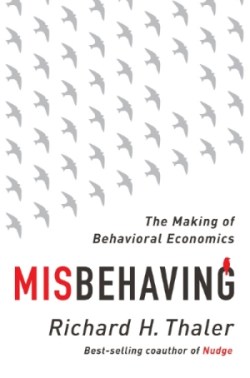

I’ve got a book recommendation: Misbehaving, the making of behavioral economics by Richard H. Thaler. The standard economics (that you may have learned in college) is based on the notion that markets are made up of rational actors who use all the publicly available information to make the best possible individual decisions. Everybody knows that’s not strictly true, but since the 1950s economists have held that it’s a good-enough assumption for making economic predictions.

Since the 1970s, Thaler’s career has revolved around poking holes in that worldview. In other words, he’s been looking for and documenting situations where the quirky decision-making of real human beings leads to results very different than the rational-actor models constructed by economists.

Not only is that an interesting topic that has all sorts of fascinating real-world applications (including the over-valuing of high draft picks in the NFL), but Thaler is a marvelous story-teller. His stories — of experiments in human decision-making, and of his attempts to introduce more realistic thinking into the stuffy and self-important world of academic economists — are consistently amusing. The book’s ongoing theme is that whether you are talking about contestants on Dutch game shows or University of Chicago business school professors choosing offices in a new building, people are funny — and you can’t really understand the world until you account for the predicable ways that people are funny.

The title has a wonderful double meaning: Economic models can fail when humans “misbehave” by not making the supposedly rational choices the model calls for. But by pointing out such embarrassing glitches, Thaler was also “misbehaving” according to the community standards of economists. So his career is a story of successful rebellion.

Finally, there’s political significance to the revolution Thaler has been leading: Idealizing markets, and exaggerating the powers of the people who participate in them, tempts a person to turn all of society’s decision-making over to “the Market”. For decades, economists’ false assumptions have biased their analysis in favor of market-based solutions. But people who are still making those simplistic Econ-101 arguments in favor of free markets are behind the times. They are, as Keynes observed, “slaves of some defunct economist”.

and let’s close with some tongue-in-cheek advice to black filmmakers

If they’d wanted Straight Outta Compton to win an Oscar, it should have centered on Paul Giamatti’s character.

If you’re not getting the joke, read David Sirota’s essay “Oscar Loves a White Savior“.

Decisive Races

We were trying to do some modeling on which states Trump is strong and weak in — there’s now enough polling across different states to do that — and the best correlate we could find for Trump’s support is Google searches for the N-word.

— Nate Silver, 538 podcast, 2-25-2016

This week’s featured post is “Trump is an opportunistic infection“. If you happen to be near Billerica, Massachusetts this Sunday morning at 11, I’ll be at First Parish Church updating one of my best social-justice sermons, “Who Owns the World?”

This week everybody was talking about the primary/caucus results

The week saw two wipe-outs: Trump dominated in the Nevada caucuses, getting 46% of the vote and destroying the idea that his support had a ceiling well below that. And Clinton had an even more impressive victory in South Carolina, defeating Bernie Sanders nearly 3-to-1, 74%-26%.

Tomorrow is the first multi-primary day. Both parties have contests in Arkansas, Georgia, Massachusetts, Oklahoma, Tennessee, Texas, Vermont, and Virginia, while Alabama has only a Republican primary.

Republicans. Until Tuesday, the conventional wisdom among Republicans was that the other candidates were vying to get into a one-on-one runoff with Trump, where the non-Trump candidate would surely win. And so here in New Hampshire, I saw countless anti-Rubio and anti-Cruz ads — and even anti-Christie and anti-Kasich ones — but virtually no attack ads against Donald Trump. Trump himself advertised very little, but held big rallies and did his usual impressive job of drawing free media attention. The others tore each other apart and Trump won.

Since Tuesday, Rubio in particular has been going after Trump, sometimes with some very personal ridicule, but Trump looks set to sweep the Super Tuesday states tomorrow anyway, with the possible exception of Cruz’ home state of Texas.

If that holds, I have a hard time seeing how Trump loses the nomination. Not just because his position is so commanding, but because I don’t know what scenario I’m counting on if I bet against him. Is Rubio suddenly going to become the dynamic candidate of Republican establishment fantasies, rather than the lightweight he otherwise seems to be? And as I explain in this week’s featured post, the best arguments against Trump are off-limits to Republicans.

Democrats. After Sanders’ big victory in New Hampshire, pundits talked about Clinton’s minority “firewall”: Hispanics in Nevada and blacks in South Carolina. Sanders supporters countered that while their candidate may have been slow to catch on among non-white Democrats, now that he was seen as a viable threat to Clinton the polls would change.

Nevada was inconclusive for that thesis: The caucus entrance polls said Sanders won the Hispanic vote, but by a margin well within the margin of error. Nonetheless, Nevada’s black vote came in overwhelmingly for Clinton and put her over the top.

But in South Carolina the firewall held, by a margin even larger than the Clinton people expected. Blacks increased their share of the primary electorate from 55% in 2008 to 61% in 2016, and Clinton got even more of their support than Barack Obama did: 84% rather than 78%. It’s official: Bernie Sanders has a black problem. You can argue that the problem arises through no fault of his own — he has a good civil rights record and hasn’t been race-baiting — but it’s there.

People ask me why this is, to which my first answer is: “I’m a white guy, what do I know?” If pressed, my second answer is that the slow, stuttering, back-and-forth progress of racial justice in America makes Bernie’s promise of “political revolution” sound like pie-in-the-sky to many blacks, while Clinton’s message (that progress is hard, and that we have to be as focused on defending what Obama has accomplished as we are on going further) seems more realistic. But if that doesn’t sound right to you, I’ll retreat to my first answer.

As for what to expect tomorrow, Nate Silver’s primary-prediction model gives Clinton a better-than-98% chance of winning Arkansas, Georgia, Tennessee, Texas, and Virginia. The model gives her an 88% chance in Massachusetts and 75% in Oklahoma. It predicts a Sanders victory only in his home state of Vermont (99%).

Obviously, if that happens Clinton will have a huge lead in delegates come Wednesday morning. Does that mean the race will be over for all practical purposes? Not necessarily.

An interesting tool for analyzing the race is Nate’s list of state-by-state benchmarks. The methodology here is interesting: He’s projecting who would win each state by how much if the race were a 50-50 tie nationally. Nate’s list shows that tomorrow’s primary states are ones you would mostly expect to be good for Clinton, though she seems to be polling above his benchmarks. A better run of states for Sanders happens after March 15.

Nonetheless, another 538 analyst, Harry Enten, sees South Carolina as a major setback for Sanders: Until then, he had been gaining on the benchmark totals he needed to pull even, but in South Carolina he lost by nearly 50% rather than the 20% loss the benchmark predicted.

Tomorrow night, the state I’m going to be watching is Virginia, which should be a swing state in the fall. Nate’s benchmark is for Clinton to win by 9%. If the margin is less than that, Bernie might still make a comeback.


BTW, I’ll repeat a point I first mentioned a few months ago: The way you beat a bully is by making people laugh at him, and the Democrats have a great comedian in Senator Al Franken. Wouldn’t he be the perfect VP candidate if the Republicans nominate Trump?

and the Supreme Court

In something of a shocker, news leaked out of the White House the Republican Governor Brian Sandoval of Nevada was being vetted for the Supreme Court. Sandoval favors business over labor, but also seems pro-environment and is said to have “moderate” views on abortion, whatever that means. In short, he’s exactly the kind of compromise you might expect Republicans to leap on, if they were at all inclined to do that kind of thing.

Apparently they aren’t. Floating Sandoval’s name didn’t move the needle at all, and the governor removed himself from consideration a few days later.

If Obama’s plan was to appoint Sandoval, Democrats might want to take their chances on winning the next election instead. But if he was just trying to show America how unreasonable the Republican position is, he succeeded.

while some discussed the undisguised racism among Trump supporters

Just before the South Carolina primary, a pro-confederate-flag protest turned into a spontaneous Trump rally. A reporter for the Young Turks interviewed participants, who warned of “ethnic cleansing” against whites and expected Trump to do something about it.

In Iowa, fans at a white high school began chanting “Trump! Trump! Trump!” after losing a basketball game to a team with more non-white players. It’s hard to say exactly what they meant by it, but apparently his name either invokes white pride or is supposed to intimidate non-whites.

The important question is whether these examples are just random anomalies, or if they point to some larger phenomenon. Tuesday, when Chris Hayes interviewed Trump supporters at the Nevada caucuses, he found a bunch of nice people, some of whom had decided that Trump’s more outrageous statements were just showmanship and not to be taken seriously. (However, my personal experience indicates that a lot of racists are nice people when they talk to a pleasant white man like Chris.)

One way to research this question is through polls. For example, Public Policy Polling found that 38% of Trump supporters in South Carolina wish the South had won the Civil War, and various other polls have turned up additional disturbing results. But again, these results may be anecdotal, or may be blaming Trump for bad attitudes that could be found among many candidates’ supporters.

Nate Silver’s 538 web site specializes in poll-watching. A regular feature of the staff’s weekly podcasts is to review news stories about polls and ask whether they represent a good or bad use of the underlying data. Thursday’s podcast was headlined “Racism among Trump’s supporters“, and the overall conclusion is that yes, there is something in this data. Nate Silver said:

I resisted for a long time the notion, because again it is kind of a default for people on the Left, that “Oh, this is all about race.” But, like, I have almost come full circle the other direction, to where I think the media is not talking about this enough. And I think the centrist Joe-Scarborough pundits who are like “Oh, Trump will really shake things up” [have] to acknowledge the fact that some of this support is a result — maybe not a majority, I think probably just a plurality — but some of the support is a result of … of some of the worst impulses that Americans can have. And to indulge that, I think, is something people should be thinking about more carefully.

while I was struck by

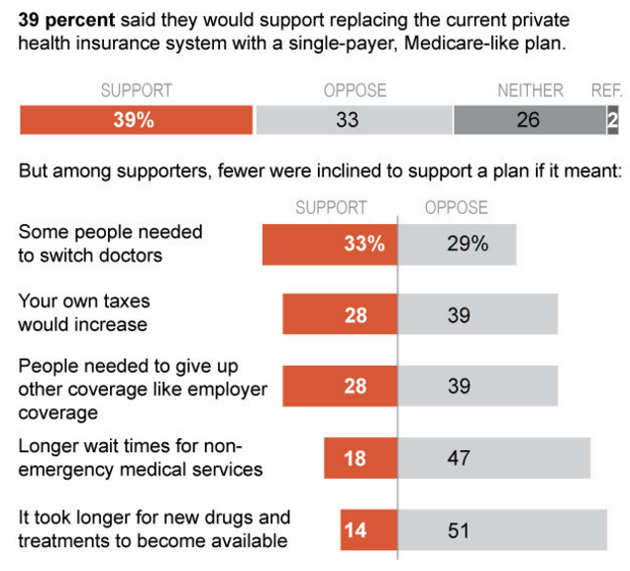
a poll from AP-GfK, based on interviews between February 11 and 15. Most of the poll consists of typical questions: whether the country is on the right or wrong track, how well President Obama is doing his job, how important various issues are, and so on.

But things get interesting on page 21, when they ask:

Would you favor or oppose replacing the current private health insurance system in the United States with a single government-run and taxpayer-funded plan like Medicare for all Americans that would cover medical, dental, vision, and long-term care services?

A plurality favors the program, 39%-33%, which sounds good for ambitious liberals. But then they start filling in details, and approval drops.

What I think we’re seeing here is the low-engagement voter problem that I discussed a few weeks ago in “Say — you want a revolution?” Large numbers of voters have not thought through the issues well enough to have a coherent position. So if you ask them the wrong question and take their answer too seriously, you can easily get misled.

Republicans run into this problem when they ask people about government spending. Polls show that by a wide margin people believe the government spends too much. But when you get specific about what to cut, you find that the public also supports just about everything the government spends money on. What do they want less of? Bridges to nowhere, welfare for able-bodied adults who refuse to work, foreign aid to countries that hate us, and subsidized art projects that offend them — all of which adds up to way less than 1% of the budget. The other 99-point-something percent they’re fine with.

That’s why Republicans have learned not to specify their cuts, but to run on across-the-board reductions that make somebody else pick the victims. As Ben Carson put it: “Now anybody who tells me there’s not 3 to 4 percent fat in virtually everything that we do is fibbing to themselves.” Does that mean he wants to cut your Mom’s Social Security or your uncle’s veteran benefits by 3-4%? No, of course not! How can you think such a thing?

The contradiction that gets Democrats in trouble is that people love progress, but they hate change. Maybe there’s a great plan to improve public schools — and God knows that schools in general need improvement — but if your kid likes his teacher and has some friends in his class, you’re going to look at that plan skeptically. And I know that American health care is way too expensive and doesn’t cover everybody, but personally I understand how my insurance plan works and I like my doctor, so do I really want to shake things up?

Tell people that you’re going to improve things, and they’ll love it. Tell them that their own lives are going to have to change in incompletely specified ways that are probably going to be more positive than negative, and they’ll doubt you.

That’s how the insurance companies beat HillaryCare in 1993. That’s why ObamaCare’s worst press was about people whose insurance plans got cancelled. Almost invariably, the people in those stories eventually got a better deal, but that didn’t matter. They were forced to change, and change is scary.

In 2017, Medicare-for-All will have exactly the same problem. Will masses of people take to the streets to demand Congress pass it? Will filibustering senators fear the wrath of the American people in the 2018 elections? I’m skeptical.


I also think it’s interesting to speculate on what the same question might mean to different respondents. For example, on page 14  of the AP-GfK poll you find: “Which party do you trust to do a better job of handling the U.S. image abroad?” The numbers are close: 27% trust the Democrats more; 26% the Republicans, which is not a statistically significant difference.

But I suspect those two groups of people aren’t really answering the same question at all. If you’re a Democrat, probably the “image abroad” you worry about is that we’re crazy assholes: We start wars for little-to-no reason; we torture people; we want veto power over other countries’ revolutions; we think the rules that apply to every other nation in the world shouldn’t apply to us. So you want Democrats in office to make us behave like good citizens of the world.

But if you’re Republican, probably the image you worry about is that we’re pushovers; you want Republicans in office to convince foreigners not to mess with us. If we have to drop bombs and waterboard people to get that point across, so be it.

and you might also be interested in

Andrew Hacker in the NYT magazine imagines teaching statistics for understanding the real world.

and let’s close with something creative

Trump in Westeros.

Carrying a Presidency to Term

Apparently, the GOP thinks that Black Presidents only get 3/5ths a term.

— a friend of Ken Wissonker

This week’s featured posts are “Replacing Scalia (or not)” and “The Apple/FBI question is harder than it looks“.

This week everybody was talking about how to replace Justice Scalia

I look (skeptically) at the arguments for delaying until after the election in “Replacing Scalia (or not)“. One argument I left out of that post: the idea that the voters should decide more directly, by making the nomination an issue in the presidential election.

That’s a bad idea for a bunch of reasons, but the biggest is that if the Founders had wanted the voters to elect Supreme Court justices, they would have written the Constitution that way. In fact, the Founders wanted to insulate the Court from politics as much as was practical in a government of the people. That was the reason for lifetime appointments, as Hamilton explained in Federalist #78.


Matt Yglesias outlines four approaches Obama could take in choosing a nominee, from “olive branch” to “declaration of war”.


Last week I talked about my personal reaction to Scalia’s death, and in particular wrestling with my feeling of joy in the removal of a powerful enemy.

It turns out I wasn’t the only person thinking about that issue. I’m on a Facebook group with a bunch of Unitarian Universalist bloggers (i.e., religious liberals), many of whom are ministers or ministers-in-training. Several of them wrote about their conflicted feelings concerning Scalia’s death.

At Head Above Holy Water, divinity student Michael Brown separated Justice Scalia, who was his legal and political enemy, from Anton Scalia the person, who (like everybody) was a flawed human being but nonetheless deserved compassion. Brown thinks about his internship as a hospital chaplain, when he was called to comfort dying people and their families, regardless of any differences of opinion or lifestyle.

Being awake and alive and sincere means recognizing complexity and honoring it.  Spiritual healing is rooted in recognizing the differences between one’s feelings and the universal need for harmony between living beings.  The boy I was who was scared, and scarred, by the bigotry Justice Scalia carried into the books of law has grown into a man who understands the beauty of contradictions.

May Justice Scalia, and Scalia the person, find peace.

Taking a conflicting view, Rev. Scott Wells pondered how to discuss Scalia’s death in front of his congregation, and particularly in front of those who had been wounded by Scalia’s judgments, or would have been wounded if those judgments had prevailed. (Wells himself is a married gay man, and reflects that due to the Windsor decision that Scalia opposed “my family is safer.” Getting theologically technical, Wells comes out of the Restorationist tradition of Universalism, where I’m more of an ultra-Universalist, like Hosea Ballou.) Wells sees eulogizing a powerful man in a way that ignores the damage he did as a triumph of “niceness over goodness”.

I would caution people to not forgive Scalia because it’s the nice thing to do, or expected of them. He did not repent of his action, nor seek your forgiveness. Quite the opposite. It is the way of the powerful to expect rules to apply to you and not to them. Do not comply. You are not the unreconciled party. And now that he’s gone, Scalia will have to manage with God’s docket; you do not have to plead to him, or for him.

“It is the way of the powerful to expect rules to apply to you and not to them.” That quote might show up at top of a weekly summary sometime.


But whether we mourn Scalia or not, we should still be fair to him. One quote I’ve seen bouncing around the internet — it was quoted in a comment on last week’s summary, and many other places — comes from his dissent in Edwards v. Aguillard, a 1987 case about teaching creationism in Louisiana schools. The quote starts “The body of scientific evidence supporting creation science is as strong as that supporting evolution. In fact, it may be stronger” and goes on from there.

Fortunately, another commenter (sglover) realized that the quote is out of context. At that point in his dissent, Scalia is not stating his own opinions, he is summarizing the case made by witnesses whose credentials “may have been regarded as quite impressive by members of the Louisiana Legislature”. His larger point is that the Court’s majority was too quick to assume that the legislature passed the pro-creationism law purely out of religious motives.

I still think he’s wrong, but his argument is much more subtle than the quote makes it appear.

and the primary/caucus results

Democrats. Clinton got a much-needed 53%-47% win in the Nevada caucuses. This narrow win in a small state only nets her four more delegates than Sanders, but a win of any sort should stop the steady drip-drip-drip of what’s-wrong-with-the-Clinton-campaign stories, at least until the Democrats vote in South Carolina this Saturday.

Diving a little deeper into the Nevada results yields some mixed messages. Nevada was supposed to test whether Bernie Sanders could break through with Hispanics, and he did: According to NBC’s entrance polls, 19% of the caucus-goers identified as Hispanic/Latino, and Sanders won that segment 53%-45%. Clinton’s margin came from African-Americans, who cast 13% of the votes, but went for Clinton 76%-22%. South Carolina, where blacks are a majority among Democrats, will test whether Sanders can change that result. If he can’t, his candidacy is doomed; it’s hard to see how white liberals, or even white-plus-Hispanic liberals, can carry Bernie by themselves.

A more subtle problem for Sanders was pointed out Saturday by Rachel Maddow, and then fleshed out on MaddowBlog by Steve Benen: When you ask Sanders’ supporters how he will get elected in the fall and how he will get Congress to pass his programs after he takes office, they talk about a “political revolution”. In other words, Sanders will energize previously apathetic or discouraged voters, creating a tidal wave of support from people whose opinions had not affected American politics until his campaign gave them a voice. (I critiqued that vision two weeks ago.)

But that’s hard to square with the fact that compared to the last contested Democratic campaign in 2008, turnout is down. Nevada continued that trend from Iowa and New Hampshire. To the extent that new voters are showing up, they are indeed voting for Sanders. And the 2008 Obama campaign did draw a lot of new voters to the polls, so comparisons to any year but 2008 are not bad. But so far the revolution does not appear to be happening.

Ever since I posted “Smearing Bernie: a preview” last month, I’ve been waiting for conservatives to start taking Sanders seriously as a possible Democratic nominee, and experimenting to see which attacks get traction.

A few themes are emerging. This video funded by two billionaires focuses on Sanders’ hurting small business and promising to raise taxes. An article by CNS (formerly Christian News Service) connects Sanders to Castro. Another theme that I’ve seen in several places is that Bernie is “a loser“; he was barely able to support himself until he started getting elected to public office. Attention is also being drawn to his personal history, particularly that he wasn’t married to his son’s mother. None of these attacks has gotten national play so far, so I don’t know what conclusions the attackers are coming to.

Republicans. Trump (33%) won a clear victory in South Carolina, while Rubio (22.5%) edged out Cruz (22.3%) for second. In spite of pulling out all the stops, including bringing in his brother, Jeb Bush (7.8%) was a distant fourth, narrowly beating John Kasich (7.6%) who barely campaigned in the state, and Ben Carson (7.2%).

As a result, Bush dropped out, ending the most expensive failure in American political history. Money, it turns out, can bring your message to the voters. But if you don’t have a message, you can’t buy one.

Ever since Bush began to fade, pundits have been predicting that the Republican electorate will eventually settle on Rubio. And Rubio’s second-place finish in South Carolina is a nice bounce-back from his disastrous New Hampshire results, giving yet another lift to the Rubio-wave-is-starting meme. But he still hasn’t won anywhere yet, and no one has identified where he’s going to start winning.

Cruz is still competitive — he even took the lead in one recent national poll — but he has to shake his head when he looks at these results: White evangelicals are supposed to be Cruz’ base; nobody has pandered to as many way-out-there preachers as Cruz has, and his father is one. Those voters turned out in large numbers: 67% of the Republican primary voters identified as evangelical or born-again white Christians. But Trump won that segment. The Trump/Rubio/Cruz breakdown was 34%/21%/26%.

It’s yet another example of how the Trump phenomenon is defying all conventional wisdom. Cruz has got to be wondering how he could possibly lose Southern evangelicals to a three-times-married New Yorker who can’t even name a particular Bible verse.

Digby reflects on why none of that — not even the Donald attacking W for 9-11 or picking a fight with the Pope — turns off his supporters.

As I’ve been writing for quite a while, the Trump phenomenon has exposed something completely unexpected about the Republican coalition, even to people who have spent years observing it. It comes more and more into focus every day: It turns out that a good many members in in good standing of the conservative movement don’t care at all about  conservative ideology and never have.

Small government, low taxes, family values, military toughness — a few people believed in all that literally, but for much of the conservative base those have always been symbols of something else.

The chattering classes like to say “the GOP base is frustrated because conservative leaders let them down so they are turning to Trump as a protest.” This misses the point. They did let them down but not because they didn’t fulfill the evangelical/small government/strong military agenda. They let them down because they didn’t fulfill the dogwhistle agenda, which was always about white ressentiment and authoritarian dominance. Trump is the first person to come along and explicitly say what they really want and promise to give it to them.

and Apple

Apple is challenging a court order requiring it to help the FBI crack the iPhone of one of the San Bernardino terrorists. That issue gets complicated in a hurry, so I’ve moved it to its own article.

and you might also be interested in

As the price of oil continues to fall and stay down, the long-term stability of oil-dependent countries like Russia and Saudi Arabia is being called into question. Both regimes look a little like crime syndicates, in which the leader commands the loyalty of his captains only to the extent that he can keep the money flowing. How much can the pool of money shrink without threatening that model?

In Atlantic, Sarah Chayes and Alex de Waal write “Preparing for the Collapse of the Saudi Kingdom“. The Economist looks at “If Russia Breaks Up“. Behind the firewall in Foreign Affairs, Alex Motyl speculates “Lights Out for the Putin Regime“, a scenario that David Marples disputes.


One of my Facebook friends raised the question: Why don’t more poor people vote? And of course there are obvious answers about voter suppression, transportation when you don’t own a car, and the inflexibility of work hours for minimum-wage jobs. But there’s another answer that doesn’t get nearly the attention it deserves, and gives me another chance to plug a classic speech by one of my friends, Tom Stites: The media covers political news from a  professional-class point of view, so politics is hard for a poor person to get interested in or see the point of.

Just to give one example: When new unemployment numbers come out, what does the media focus on? How this news affected the stock market, and whether it is good or bad for President Obama’s popularity. Rarely does it discuss what this means to you if you’re looking for a job or worried about losing the one you have.

If you’re poor, the underlying message of just about every news outlet is that the news is not for you. In particular, politics is not for you. It’s an overblown wrestling match between competing groups of professionals, none of whom really have your interests in mind.

Tom’s solution is the Banyan Project, which I plug every now and then: local news co-ops whose mission is to inform the bottom 50%.

and let’s close with a candidate you probably hadn’t considered

Our neighbor to the north announces its Canada-cy for President of the United States.

Bells

Any mans death diminishes me, because I am involved in Mankinde;
And therefore never send to know for whom the bell tolls; It tolls for thee.

— John Donne
Devotions Upon Emergent Occasions (1624)

Ding-dong, the witch is dead. — The Wizard of Oz (1939)

This week’s featured post is “Back to Ferguson“, which I’ll explain below.

In the aftermath of the New Hampshire primary, I’m taking a week off from presidential politics. Next week we’ll have the Democratic caucuses in Nevada and the Republican primary in South Carolina to talk about. Both happen Saturday.

This week everybody was talking about Justice Scalia’s death

Supreme Court Justice Antonin Scalia’s final act, as far as I was concerned, was to posthumously remind me that I am not as good a person as I like to think.

Good People, as I picture them, see death as the great leveler, the ultimate reminder of our common humanity. Like John Donne, they believe the bell tolls for them. Every death — even necessary ones like casualties in a just war or criminals killed in the act of trying to kill somebody else — is tragic: How sad it is that a situation might make a person’s death the lesser evil.

Under no circumstances would news of someone’s death cause a Good Person’s heart to take an involuntary leap of joy. Or inspire a Good Person to say, “I wonder if Justice Thomas will follow his lead this time too?”

Bad. Bad, bad, bad.

But at least my badness puts me in some good company. As Clarence Darrow wrote, “I have never killed anyone, but I have read some obituary notices with great satisfaction.”

Scalia’s career. You can read more complete obituaries of Scalia elsewhere. Here’s how I remember him: When President Reagan appointed him in 1986, he was alone on the Court’s far right wing. Outnumbered, he became famous for his thought-provoking dissenting opinions, which were principled, but based on principles different from the ones that motivated the rest of the Court. Liberals developed a kind of grudging admiration for him; you knew in your heart he had to be wrong, but it was often very hard to explain why. Anticipating his criticisms made us sharper — like iron sharpens iron, as the Bible says.

But late in his career, as part of a conservative majority, he became the Court’s most openly partisan judge. His opinions became elaborate rationalizations of why his side should win, regardless of principle. And so, he had a sweeping view of the Constitution’s commerce clause when that was necessary to keep marijuana illegal, but an unprecedently narrow view of the same text when he needed a reason to strike down ObamaCare. He waxed eloquent about legislator’s original intent when that was convenient, but violated it outrageously by finding corporate rights in places the authors of the Constitution clearly never intended. He was part of the nakedly political 5-4 majority that made George W. Bush president, a decision so unabashedly partisan that it explicitly warned future Courts not to use it as a precedent. He attended secretive meetings of the Koch Brothers’ donor network, as (enabled by Scalia’s vote in the 5-4 Citizens United decision) it raised vast sums of money to elect Republicans.

Beyond his unprincipled partisanship, Scalia will be remembered for undermining the traditional decorum of the Court. As he aged, he seemed less and less able to imagine that an intelligent, well-intentioned colleague might disagree with him, and showed less and less restraint in flinging oddly Victorian insults (like “argle-bargle” and “jiggery-pokery”) at their arguments.

Replacement? Mitch McConnell wasted no time in warning President Obama not to bother appointing a replacement.

The American people should have a voice in the selection of their next Supreme Court Justice. Therefore, this vacancy should not be filled until we have a new President.

Elizabeth Warren fired back:

Senator McConnell is right that the American people should have a voice in the selection of the next Supreme Court justice. In fact, they did — when President Obama won the 2012 election by five million votes.

She goes on to remind McConnell of the constitutional duties of the President and the Senate. I think that’s the right line here: Let’s follow the Constitution, which is pretty clear:

[The President] shall nominate, and by and with the Advice and Consent of the Senate, shall appoint Ambassadors, other public Ministers and Consuls, Judges of the supreme Court, and all other Officers of the United States.

So it’s simple: Obama should do his job by appointing someone and the Senate should do its job by voting on that nomination.

As much as the Republicans may hope for a Republican president whose appointments will cement the Court’s conservative majority for decades to come, I think that position is suicidal when it comes to holding the Senate. Take the NH seat: Senator Kelly Ayotte has been running not as a down-the-line Republican, but as an exemplar of New Hampshire’s traditionally independent common sense. (Along with another endangered Republican incumbent, Mark Kirk of Illinois, she is a founding member of a small group of Republican senators who recognize global warming.) If Mitch McConnell were running here, he would lose. Turning the race into a simple red/blue contest for control of the Senate, and hence the Court, helps Ayotte’s challenger, Gov. Maggie Hassan.

It also probably helps the eventual Democratic presidential nominee to have a court appointment riding on the outcome. Control of the Supreme Court — not just possibly someday, but immediately — would give either Hillary or Bernie a powerful uniting message after a divisive primary campaign.

Who, then? Various short lists of possible Obama appointees are floating around. At the top of most of them is Sri Srinivasin, who was approved by the Senate unanimously for his current job as a federal appellate judge.

If I were Obama, I would take McConnell’s obstruction threat seriously, and appoint whoever I thought would work best in a why-don’t-they-do-their-jobs attack ad. I’d be looking for a Mr. Rogers type: Somebody who exudes a sense of basic decency, who wouldn’t ring any alarm bells about affirmative action or political correctness.

Recess appointment. Unofficial reports say that Obama will not make a temporary recess appointment, which he could attempt since the Senate is currently not in session. But that path is filled with technicalities and possible disputes. SCOTUS blog summarizes:

The bottom line is that, if President Obama is to successfully name a new Supreme Court Justice, he will have to run the gauntlet of the Republican-controlled Senate, and prevail there.  The only real chance of that: if he picks a nominee so universally admired that it would be too embarrassing for the Senate not to respond.

My suggestion for a recess appointment: Sandra Day O’Connor. She retired to spend more time with her husband, who has since died, and she’s still active as a part-time substitute judge at the appellate level. As a replacement for Scalia, she would move the Court somewhat to the left. But it would be hard for Republicans to justify blocking a judge originally appointed by the sainted President Reagan.


Interesting sidebar here: The Court recently issued a stay blocking President Obama’s plan to limit the carbon emissions of power plants. That indicated that, when the case reaches them from its current location in an appellate court, the Supremes might be inclines to strike it down, almost certainly by the 5-4 ideological split it then had.

Without Scalia, though, and assuming a decision has to be made before he can be replaced, the Court will reach a 4-4 non-decision, and the lower court ruling will stand. The appellate court seems likely to uphold Obama’s action.

and the budget

Another example of the Republicans’ refusal to recognize Obama’s legitimacy as president is that the House is not planning to hold hearings on his budget proposal.

The Republican chairmen of the Senate and House budget committees said last week they were forgoing the decades-long tradition of hearing testimony from the director of the Office of Management and Budget, claiming they expected Obama’s budget to offer little in debt reduction.

and Oregon

The occupation of the Malheur Wildlife Refuge ended Thursday morning after 41 days, when the last four guys surrendered to the FBI. The occupiers got no concessions: The two ranchers whose re-imprisonment sparked the occupation remain in prison. No changes in federal land use policy have been announced. The leaders of the occupation have been arrested and charged.

A bonus was that Cliven Bundy, father of occupation leader Ammon Bundy and the center of a previous armed stand-off in 2014, has also been arrested and charged.

In a 32-page criminal complaint, prosecutors allege Bundy and his co-conspirators led a massive, armed assault against federal officers in April 2014 near the town of Bunkerville, Nev.

According to the U.S. attorney for Nevada, Bundy and his armed supporters on horseback effectively ambushed federal Bureau of Land Management officials as they were trying to round up 400 of Bundy’s cows illegally grazing on federal land.

The way the government backed down from that confrontation undoubtedly emboldened the Malheur occupiers. Bundy and his allies considered the 2014 showdown a victory. If the Malheur occupiers had walked away with concessions, that also would have been a victory, and quite likely would have led to an even more aggressive move in the future.

So far, it looks like the government has played this right: No police or government agents were killed. One occupier died in a confrontation that appears to have been largely of his own making. The government wanted a middle path between the 2014 Bundy showdown and Ruby Ridge; it seems to have found one.


Apparently the evangelist Franklin Graham (Billy’s son) played a role in the surrender of the final occupiers. I’ll be interested to see if he becomes a spokesman for the militiamen.

but more people should be paying attention to Ferguson

That’s covered in this week’s featured post “Back to Ferguson“. The Justice Department says policing in Ferguson has to change to uphold its citizens’ constitutional rights. Ferguson replies: We can’t afford it. So where does the buck stop?

and Darwin

Friday was Charles Darwin’s 207th birthday. That’s my annual reminder to review the evolution/creation discussion.

I said most of what I want to say about it three years ago in “Evolution/Creation for Non-Eggheads“. One thing to add since then: My friend (and occasional Sift commenter) Abby Hafer has published The Not-So-Intelligent Designer: Why evolution explains the human body and intelligent design does not. Her introduction says:

A few years ago, I realized that the whole intelligent design (ID) controversy is not a scientific issue, but a political one. … ID is not a theory, it is a political pressure group. …

Political issues require political arguments, and political arguments are different [from scientific arguments]. Political arguments must be short, easy to understand, memorable, and preferably entertaining.

In my case, I also want them to be true.

One point from the “Non-Eggheads” post I’d like to hit a little harder: If you ever listen to a Creationism/ID talk, you won’t actually hear an alternative scientific theory. Instead, such talks invariably focus on criticisms of evolution (most of which were made and answered in the 1800s). Why? Because they have no alternative scientific theory to present.

Let me give an example to flesh that out a little. According to current evolutionary theory, life on Earth has a single family tree. In other words, any two living things have a common ancestor if you go back far enough. A lot of work has gone into figuring out how that tree branches, what is more closely related to what, and when the common ancestors lived. That work is ongoing, and every now and then our picture of the tree shifts a little as new evidence emerges.

It’s fine to criticize that single-family-tree idea, but a real Creationist alternative theory would answer this very basic question: How many separate family trees are there, even approximately? And that leads to other questions: Did they all begin at the same time? What markers tell us that two living things are from different trees? Then you get to a bunch of more specific research topics: Do lions and house cats have a common ancestor? Collies and poodles? Polar bears and grizzlies? What about the 400,000 species of beetles biologists have postulated? Did 400,000 separate acts of creation lead to 400,000 family trees of beetles, or do some beetle species share a common ancestor?

That’s the kind of stuff a real “creation science” would be researching. You never hear about it, though, because there is no such research and no such theory. Creationist “scientific” organizations spend their money, as Abby says, constructing and popularizing political arguments rather than doing science.


Tax money is still supporting teaching Creationism in Louisiana, and probably other states as well.

and you might also be interested in

When Franklin Graham isn’t mediating between the FBI and crazy people, he’s touring America to rally religious conservatives to be more politically active.

I don’t think we’re going to make it another election cycle if we don’t get God’s voice back in the political arena. … I feel that we are going to have to meet our political obligations as Christians and make our voice known if America is to be preserved with the type of Christian heritage which has given us the liberties we now enjoy. For unless America turns back to God, repents of its sin, and experiences a spiritual revival, we will fail as a nation.

According to Graham, one “great sin that has been flaunted and celebrated” is same-sex marriage.

Here’s what continually amazes me about all the God-will-punish-us-if-we-don’t-turn-back prophecies: When was that God-fearing era we need to “turn back” to? When we were committing genocide against the Native Americans and holding millions of Africans in slavery? Or was it later, during the era of Jim Crow and lynchings? Or when we dropped atomic bombs on cities full of Japanese civilians?

I have a hard time picturing — much less respecting — a God who would shower us with blessings while we were doing all that stuff, but is going to drop us flat now that we’re letting same-sex couples live together in loving relationships.


This week’s guns-make-us-safer story: A guy in Texas opened fire on his neighbor’s puppy, who was trespassing on his lawn. A friend of the puppy’s owner shot back. The dog died. Neither human was wounded, but both are facing felony charges.

Guns don’t kill puppies. Crazy Texans with guns kill puppies.


One of David Wong’s “5 Ways to Spot a B.S. Political Story” is that it’s about “a lawmaker saying something stupid”. He points out that there are so many state legislators that on any given day one of them is bound to have said or done something ignorant or offensive. For that reason, I don’t call your attention to bad laws just because they get proposed in some legislature; I wait to see if they have any real support.

Well, this one does: Senate Bill 1556 made it out of a committee in the Tennessee Senate on 7-1 party-line vote. (That tells you something about the Tennessee Senate right there; there are barely enough Democrats to get one on every committee.) It allows counselors and therapists to refuse to counsel clients “as to goals, outcomes, or behaviors that conflict with a sincerely held religious belief of the counselor or therapist”. The counselor’s only obligation is to provide a referral.

According to the Chattanooga Times Free Press, the bill “seeks to protect conservative therapists from 2014 changes in the American Counseling Association’s code of ethics“, which states:

Counselors refrain from referring prospective and current clients based solely on the counselor’s personally held values, attitudes, beliefs, and behaviors. Counselors respect the diversity of clients and seek training in areas in which they are at risk of imposing their values onto clients, especially when the counselor’s values are inconsistent with the client’s goals or are discriminatory in nature.

This is yet another example of conservatives abandoning their ideal of “small government” when it proves inconvenient. In short, the counseling profession is not allowed to establish its own code of ethics free from government meddling.

and let’s close with something crazy

A huge controversy erupted after Beyonce sang “Formation” at the Super Bowl, while dressed to honor the Black Panthers. But there’s a background level of crazy here that I previously had not noticed: More than 800K viewers have seen a video detailing all the Illuminati symbolism in previous Super Bowl halftime shows. I mean, we all knew about Madonna (right?), but who suspected Katy Perry of being “a high-level Illuminati witch”? I’ll have to go back and look at her videos again.

Imperfections

While American democracy is imperfect, few outside the majority of this Court would have thought its flaws included a dearth of corporate money in politics.

— Justice John Paul Stevens,
dissenting opinion in Citizens United (2010)

This week’s featured post is “Say — you want a revolution?

This week I finally decided to vote for Bernie

You’ve seen me wrestle with this the last two weeks. On most issues, I agree with Bernie more than Hillary. But I also think the difference between the two is tiny compared to the difference between any Democratic candidate and any Republican candidate. (We can, for example, argue about whether Bernie’s ideas for breaking up the big banks are better or worse than Clinton’s plans to strengthen the Dodd-Frank regulations of Wall Street. But Republican candidates want to repeal Dodd-Frank, and go back to the system we had in 2008.) And I believe Clinton is the stronger general-election candidate for a number of reasons.

But for me the decisive factor comes back to what I wrote when I covered Sanders’ announcement statement back in May:

I think it’s way too early to make the unite-behind-a-winner argument. There has to be some point in the electoral process where people express their consciences and vote their ideals. Otherwise, the horse-race mentality becomes self-stoking: People won’t support a candidate they agree with because he can’t win, and he can’t win because the people who agree with him won’t support him.

It’s still too early. I want everyone to know that there is substantial support for more radical solutions than we’ve been offered in past election cycles. I want Clinton to know that if she’s the nominee in the fall. I want the media to know that, so they won’t take seriously Republican claims that Hillary is some kind of left-wing extremist, or that her positions are as far left as public discussion ever needs to go. I want the next set of Democratic presidential candidates to know that, so liberals will be emboldened to run and moderates will take their left flank into account.

My decision was made easier by Hillary’s narrow win in Iowa (which was not decided by coin flips — how do these things get started?). If she had suffered a surprising loss, especially a large loss, then another large loss in New Hampshire (which the polls are predicting) might send her campaign into a death spiral. I wouldn’t want to feel responsible for that.

As for those of you who vote later in the process, I don’t think my decision tells you much. I think pragmatism should be an increasingly important factor as the campaign goes on. Which way that pushes you and how that weighs against your idealism is something we all have to decide for ourselves.

but I wasn’t the only Democrat talking politics this week

The one thing that makes me nostalgic for the days when Hillary was supposed to coast to the nomination is the level of Democrat-on-Democrat belligerence I’m seeing. Given the people I hang with, I’m seeing it mostly as attacks on Hillary by Bernie supporters, but I’m told it goes both ways.

If I had the power to make a rule for the rest of the Democratic nomination process it would be this: Don’t repeat Republican rhetoric.

So Sanders supporters should not be gleefully finishing the character assassination that Richard Mellon Scaife’s right-wing Arkansas Project started against the Clintons in the 1990s. If you don’t trust Hillary, fine. But recognize that the Hillary-can’t-be-trusted meme dates back to a series of crap scandals that fell apart when their details came out, which nonetheless have left a grungy film on her image. (In last week’s episode of the TV show Billions, a lawyer explains the ineffectiveness of refuting a false charge after it makes headlines: “If someone says Charlie fucked a goat, even if the goat denies it, he goes to the grave as Charlie the Goat Fucker.”) If you refer vaguely to that untrustworthy image, rather than to specific Clinton statements you have specific reasons not to believe, you’re making use of Scaife’s propaganda.

The emails, BTW, are just the latest crap scandal. Last week I wondered whether similar security violations would show up in the emails of past secretaries of state, if anybody examined them through the same magnifying glass. Apparently, somebody else wondered that too, and it turns out they do.


Similarly, it’s fine for Clinton supporters to wish for more details about how Sanders would pay for his programs. But the notion that they can’t be paid for buys into the taxes-are-already-as-high-as-they-could-possibly-go message that Republicans have been trying to convince of us for decades.

Likewise, any kind of red-baiting should be off the table: Sanders’ policies are what they are and if  you want to criticize them on their merits, fine. But criticizing them because you have managed to attach a socialist or communist label to them … leave that to the Republicans. And if his defense policies don’t seem muscular enough for you, that’s a legitimate thing to discuss. But don’t imply that Sanders is somehow disloyal or doesn’t want to defend America. That’s Ted Cruz rhetoric.


I’m similarly disturbed by the Hillary-is-a-warmonger charge that gets thrown around. (That’s not Republican rhetoric, but the more it catches on, the harder it’s going to be to unite Democrats in the fall.) Admittedly, there is a policy difference between Hillary and Bernie: Hillary is likely to spend more on defense than Bernie, and to use American power more forcefully. And it’s worth taking into account that Hillary voted to authorize the Iraq War while Bernie opposed it.

But if you listen to the speech she gave in 2002 during the Senate debate on the authorization resolution, it’s not a rah-rah war speech.

This course if fraught with danger. … If we were to attack Iraq now, alone or with few allies, it would set a precedent that would come back to haunt us. In recent days, Russia has talked of an invasion of Georgia to attack Chechen rebels, India has mentioned the possibility of a preemptive strike on Pakistan, and what if China were to perceive a threat from Taiwan?

So, Mr. President, for all its appeal, a unilateral attack (while it cannot be ruled out) on the present facts is not a good option.

She supports the resolution in order to give President Bush all possible tools to pressure Saddam Hussein into compliance with UN inspections. So her 2002 position reflects the same approach to conflict that as Secretary of State she initiated (and Secretary Kerry completed) with regard to Iran: increasing pressure of all sorts to get the desired outcome without fighting. “I take the President at his word,” she says — that word being that Bush would do everything possible to disarm Saddam without war. That was her mistake.

Also, look at her husband’s administration: We didn’t fight a major land war during those eight years. (As The Onion put it after Bush replaced Clinton: “Our long national nightmare of peace and prosperity is finally over.”) Bombing was part of a ring-of-pressure that ended Serbia’s genocide against Bosnia and Kosovo, and forced the fall (and eventual war-crimes trial) of President Milosevic without a U.S. invasion. Actually, Bill Clinton’s most suspect military decision was the war he didn’t fight: He didn’t try to stop the Rwandan genocide.

So is a vote for Clinton a vote for war? I really don’t think so.

and New Hampshire is inundated with politicians

The Onion reports: “Plows Working Around Clock To Keep New Hampshire Roads Clear Of Campaign Signs”. It’s a joke, but that’s really what it feels like. I’m ready to unplug my phone.

Blogger Chuck Fager reflects on what the great New Hampshire poet Robert Frost might have said about all this.

Polls are predicting a large Sanders win in New Hampshire. But after that things really get interesting. So far, Sanders hasn’t shown much support from non-whites, who aren’t much of a factor in either Iowa or New Hampshire. But Hispanics are a large percentage of the Democrats in Nevada (caucus February 20) and blacks are the majority among Democrats in South Carolina (February 27 primary).

Even though those states currently look good for Clinton, it’s not unreasonable to expect Sanders to start picking up non-white support. Blacks were slow to warm to Barack Obama’s candidacy in 2008, but they did eventually come through for him. Sanders has already been endorsed by a few prominent blacks like Ben Jealous and Cornell West. Bill Clinton’s role in creating the mass-incarceration problem might start working against Hillary, even though her current positions on the issue are pretty good.

For what my opinion is worth — after all, I’m a white guy with a mostly white circle of friends, and so far I’ve refused to put my black and Hispanic acquaintances on the spot to represent their people — I suspect that belonging to an discriminated-against minority tends to make a voter cautious. Feeling like you have the freedom to fall in love with an idealistic-but-impractical candidate might be a symptom of privilege, comparable to a college student majoring in art history rather than business or engineering. If that’s the case, then Bernie can hope for a snowball effect with non-white voters: The more support he gets, the more viable he looks to people who will only support a viable candidate.

Or maybe the snowball will melt in Nevada and South Carolina, as snowballs tend to do.


As for the Republicans, Trump is expected to win, but beyond that things are unpredictable. As I predicted last week, the media decided that Rubio’s third-place finish in Iowa gave him momentum. But he had a truly embarrassing debate Saturday night, suffering mostly at the hands of Chris Christie, who was supposed to be fading. Some polls have John Kasich gaining.


A neurologist takes a whack at explaining why Ted Cruz creeps people out. He has “atypical” facial expressions: “Senator Cruz’s countenance doesn’t shift the way I expect typical faces to move.”

That doesn’t necessarily mean he’s insincere or psychopathic, but if watching him just makes you feel uneasy, that’s probably why. Tech-savvy people have joked that Cruz falls into the “uncanny valley” — that region of animation where human characters are accurate enough to seem like they ought to be human, but instead are just unnerving.

but there are advantages

So many important political people show up in New Hampshire just before the primary that you can have some really interesting encounters. (On election night in 2008, for example, I realized that the guy standing behind me at the bar was Senator Durbin.)

Last weekend, the local get-money-out-of-politics group, NH Rebellion, held a conference in Manchester. Both Hillary and Bernie were there, along with Kasich. (Trump was on the schedule, but I never heard whether he showed up or what he said.)

Somehow, maybe because hardly anybody else who got the email realized what a unique opportunity it was, or were just distracted by all their other opportunities, I wound at a table in a coffee shop with Rep. John Sarbanes, my own congressional representative (Annie Kuster), and half a dozen other people. Sarbanes — if the name rings a bell, you might be remembering his father the senator — is the guy in Congress leading the fight for the Government By the People Act, which is a way to do public financing of campaigns without a constitutional amendment and without running afoul of the Supreme Court. (It reflects a lot of the ideas Lawrence Lessig has been pushing.)

I’ll be talking about the merits of that proposal in future weeks, but for now I just want you to bookmark John Sarbanes, because he looks a lot like a future presidential candidate. He’s handsome, personable, smart, and relates well to small groups. He’s also on the right side of a major issue, and got there early.

One of the things Sarbannes described over coffee was how he’s been getting more congresspeople to talk about campaign finance reform (which the conventional wisdom has said for years that voters don’t care about; it’s an inside-baseball topic). He says he tells his colleagues not to talk about campaign finance instead of their usual issues, but to use it to “caffeinate” their usual issues: Instead of saying “we need to do something about climate change”, say “we need to do something about climate change and what’s stopping us is all the special-interest money lined up on the other side“. [The quotes are approximate; I wasn’t taking notes.]

and you might also be interested in

A federal grand jury has indicted 16 people in the Malheur Wildlife Refuge occupation. LaVoy Finicum, the only occupier who has died, is being hailed as a martyr by the kind of people who need that to be true. Cartoonist Matt Bohrs points out the difference between Finicum and the various young black men who have been gunned down by the authorities.

and let’s close with some north-of-the-border mischief

The Bank of Canada wants local Star Trek fans to stop Spocking their fives.

Eyes and Feet

Keep your eyes on the stars, but remember to keep your feet on the ground.

Theodore Roosevelt (1904)

This week’s featured post is “Undecided With 8 Days To Go“.

This week everybody was talking about the presidential race

The Iowa Caucuses start this evening. Most recent polls show a close race with a small advantage to Clinton. But Iowa has such a weird process that polling often gets it wrong.

On the Republican side, polls show that Cruz peaked about three weeks ago, and that Trump has regained a medium-sized lead, even though his numbers have been falling too for the last week. But since he never developed a ground game, nobody can say how many Trump supporters will get to the caucuses and stay long enough to make their votes count. Cruz is still running second, but fading. Rubio is third and rising, so it’s not impossible that he could finish second, or even first if Trump’s voters don’t show up.

Tomorrow, I expect the media to be saying that Rubio’s showing was the most surprising, and that he has momentum going into New Hampshire. But I don’t think I’ll be buying that interpretation if he doesn’t actually win. I think Obama/Clinton in 2008 showed that there is no “momentum”. Only votes and delegates are real.


Friday morning I tried to see Donald Trump in Nashua, but it turns out that having a ticket and being 45 minutes early wasn’t good enough; I was third in line when they announced that the room had reached its fire-safety capacity. Hundreds of people were still in line behind me, so I’m not sure what the point of having a ticket was.

But most of what I wanted to do was observe the crowd, so I got to do a little of that while standing in line. Everybody I saw was white, which isn’t that big a surprise in New Hampshire. Men outnumbered women, maybe three to one. Nobody was wearing or saying anything overtly racist or anti-Muslim. People didn’t bring signs and I didn’t see any protesters. We didn’t chant slogans or get rowdy. For a group of supposedly angry voters, we were all surprisingly docile as we waited in the sort-of-cold until we were told to go home.

The guys in front of me hadn’t definitely committed to Trump yet, but they thought Cruz had looked bad in the previous night’s debate, the one Trump boycotted. They agreed that Hillary Clinton has “no chance” and speculated about whether she’d be indicted for the email thing. They were sure she deserved to be indicted, but disagreed about whether Obama would allow it.


Speaking of Cruz, I loved Josh Marshall’s take on why he looked bad in the debate. (Josh was in Cruz’ residential college at Princeton, but in 2013 claimed not to recall him until his wife jogged his memory.)

My general sense is that it wasn’t that Cruz got attacked or that the attacks on him did any particular damage. It was that the spotlight was inherently bad for him. … This whole portion of the debate – which lasted for maybe the first 45 minutes or so – had the feeling of walking into a conversation at a party that’s just very awkward and uncomfortable – because it’s Ted Cruz holding court and pontificating. And you want to leave. Again, it’s not that the attacks were particularly biting or damaging. It’s just that you saw Cruz up close. And he’s not pleasant to be around.


I also don’t think Trump’s event competing with the debate did him any good. (I can’t imagine it playing well in Iowa when Trump called another rich New York developer up to the stage with his young trophy wife. I suspect Trump’s own marriage is not something middle-aged Iowa housewives want to dwell on too long.) So Trump and Cruz both looking bad recently is another reason Rubio could do better than expected.


We now have Trump’s plan for replacing ObamaCare: “We’ll work something out” with the doctors and hospitals, he says. I don’t know why no one had thought of that before.


A questioner told Ted Cruz about his brother-in-law, who didn’t have health insurance until ObamaCare, but started seeing a doctor too late and died of cancer. “What are you going to replace [ObamaCare] with?” he asked.

Cruz responded like this:

there are millions who had health insurance, who liked their health insurance and who had it cancelled because of Obamacare … millions are losing their insurance now and if we allow people to purchase across state lines, it will drive down the cost where they can afford it and get it earlier. [Your brother-in-law] would have gotten [health insurance] earlier if he could have afforded it earlier, but because of government regulations he couldn’t.

It’s worth pointing out that the regulation that raises costs the most is the government’s perverse insistence that health insurance actually cover you if you get sick. Policies that include ways for the insurance company to weasel out of covering sick people can be amazingly cheap. And if you never get sick, you never know.

and Flint

Exposé news stories have a stereotypical trajectory: There’s a problem that officials are sweeping under the rug, but journalists or whistleblowers uncover it. And then things get taken care of. The problem is fixed, victims get the help they need (better late than never), and the irresponsible officials are disgraced. Happy ending.

That doesn’t seem to be happening in Flint. The first part — problem, rug, uncovering — follows the script. And while Governor Rick Snyder hasn’t been forced to resign (yet), some lower-level people have, and I think Snyder’s political career is pretty much over. But the problem is a long way from fixed.

Here’s the gist: The emergency manager Snyder appointed to run Flint, supplanting the elected government,  decided to change the city’s water source. Rather than buy Lake Huron water from Detroit, they’d pump it out of the Flint River. Lots of towns use river water and it’s not a big deal, but you need to account for the fact that river water can be more corrosive. If you don’t treat the water somehow, it can leach lead out of pipes and slowly poison the people who drink it. (Flint’s water mains are iron, but many of the pipes that connect houses to the mains are lead.)

So now Flint is back to using Detroit’s water, and the long-term plan to have its own pipeline to Lake Huron is on track for completion in June. But that hasn’t solved the problem, because the lead didn’t come from the river, it came from the pipes. A lot of faucets in a lot of homes still have elevated lead — some many times higher than the recommended filters can handle — and nobody knows how long that will continue.

The sure solution is to find all the lead pipes and replace them, but that could cost hundreds of millions of dollars, which nobody is volunteering to pay. But waiting for the lead levels to come down on their own — drinking, cooking, and bathing with bottled water in the meantime — gets old in a hurry.

And then there are the long-term effects of lead exposure on children’s brains. Is the state going to take responsibility for that? How?

In the background of this whole story are issues of race and class. Flint is poor and mostly black. Poverty is why the city was in the financial trouble that got an emergency manager appointed in the first place. And whether the suffering of poor blacks registers with state officials the way wealthier white suffering would, well …

Wednesday, Rachel Maddow devoted her whole show to a townhall meeting in Flint, talking to local residents and various experts on water and plumbing and lead poisoning. That series of videos starts here.

and the arrest of Ammon Bundy

Tuesday night, the authorities finally did something about the militia occupation of the Malheur Wildlife Refuge near Burns, Oregon. The leaders of the occupation were arrested on their way to a community meeting set up by supporters in the nearby town of John Day. Unofficial spokesman Lavoy Finicum was killed.

Supporters have tried to make a martyr out of Finicum and claim that the government intentionally murdered him, but the FBI eventually released aerial video of the confrontation: Finicum’s truck stops for several minutes on the highway as police cars flash their lights behind it. Then the truck races forward until it gets to a police roadblock. At that point it tries to drive around the roadblock and gets stuck in the snow. Finicum gets out of the truck with his hands up (his passengers stay inside), but doesn’t appear to be surrendering as he sidles further off the road, away from police. When he reaches into his coat he gets shot. Police claim they found a handgun in his coat.

Ammon Bundy and his brother Ryan are among the arrested. They have been charged with a felony that seems designed for this situation (actually it was designed for Confederates seizing federal outposts in the Civil War): conspiracy to impede officers of the United States from discharging their official duties through the use of force, intimidation, or threats.

A handful of holdouts (maybe five) are still occupying the refuge. Like Bundy, they seem to grossly overestimate their negotiating position: They want to leave without charges, or maybe to be guaranteed a pardon. But the FBI is only interested in talking about how they’re going to surrender. The authorities seem to be tightening up a little more all the time; they’ve now cut off internet and cellphone access.

Bundy, meanwhile, has asked the remaining occupiers to go home, possibly because the judge in Portland can’t see offering him bail while there’s an armed camp he could try to run to.

This fight is ours for now in the courts. Please go home. Being in the system, we are going to take this opportunity to answer the questions on Art. 1, Section 8, Clause 17 of the United States Constitution regarding rights of statehood and the limits on federal property ownership.

Once again, he’s picturing himself as a sovereign citizen meeting the government on equal terms. But I predict his trial will concern the crimes the government has charged him with, not the crimes he charges the government with. (Regarding “the limits of federal property ownership”, I suspect that the State of Oregon might have standing to pursue this in a different court, but Bundy himself does not, and it certainly isn’t relevant here. Even in the appropriate venue, I think Oregon would lose that case.)

and you might also be interested in

Once again, headlines indicate that something maybe-sorta might come of the Clinton emails. But Dianne Feinstein still doesn’t think so.

The latest revelations that Secretary Clinton’s emails include classified information lack the same key information as previous reports. First, the 22 emails the State Department has labeled classified are part of seven separate back-and-forth email chains, and none of those emails chains originated with Secretary Clinton.

So: Seven times during her Secretary of State years, somebody sent her an email containing information that wasn’t marked classified at the time, but in hindsight should have been.

Reuters claims the info was “foreign government information”

The U.S. government defines this as any information, written or spoken, provided in confidence to U.S. officials by their foreign counterparts.

I wish we had a control on this experiment: If we looked at all the emails of some other State or Defense secretary chosen at random, how many similar examples would we find?


The best thing since President Bush’s “Is our children learning?


This white giraffe ought to be the center of a cult.
null

and let’s close with something timeless

It’s amazing how well the climactic speech of Charlie Chaplin’s “The Great Dictator” stands up after 75 years.

Expectations

Keep a light, hopeful heart. But ­expect the worst.

— Joyce Carol Oates

This week’s featured post is “Smearing Bernie, a preview“. When the right-wing media starts painting Bernie red, will the charge stick? Will it throw him off his game?

This week everybody was talking about the weather

To me, the remarkable thing about Winter Storm Jonas — other than the fact that New Hampshire was fine place to sit it out — was how far in advance it was forecast, and how closely it matched those forecasts. Days before the storm hit, I knew it was coming and that the worst of it would be just west of Baltimore. I didn’t expect 30 inches of snow at JFK Airport, but otherwise the meteorologists did pretty well.

and the Republican campaign starting to turn nasty

To be fair, if you are Hispanic or Muslim or female or gay, the Republican campaign has been nasty all along. But lately the candidates have started being nasty to each other.

Donald Trump actually used the word nasty to describe his closest rival, Ted Cruz.

He’s a nasty guy. Nobody likes him. Nobody in Congress likes him. Nobody likes him anywhere once they get to know him. He’s a very –- he’s got an edge that’s not good. You can’t make deals with people like that and it’s not a good thing.

Former Republican nominee Bob Dole agreed:

I don’t know how he’s going to deal with Congress. Nobody likes him.

That’s an unusual thing to say about a sitting senator. The Senate has clubby aspect to it, and you can always find people in the opposing party to say (of somebody like Joe Biden or Orrin Hatch) “I disagree with him, but he’s a good guy.” In Cruz’ case, it’s a challenge to find a senator in his own party who will tell you he’s a good guy.

And Cruz’ college roommate won’t either:

Ted Cruz is a nightmare of a human being. I have plenty of problems with his politics, but truthfully his personality is so awful that 99 percent of why I hate him is just his personality. If he agreed with me on every issue, I would hate him only one percent less.

So something odd is happening: For months, everyone has been predicting that the GOP establishment would unite against Trump. But if Cruz is the alternative, they’d rather unite against Cruz.


The NYT reform-conservative columnist Ross Douthat explains “The Way to Stop Trump“. Abstract arguments about his personality or his unfaithfulness to conservative orthodoxy or his ignorance of important issues don’t seem to shake Trump’s supporters. But Trump’s business success has left a trail of victims, many of whom are the white working-class “regular guys” Trump appeals to. Put them on camera, Douthat advises, and get people to empathize with them. Joe Sixpack types who cheer when Trump is nasty to Hispanics and Muslims might have second thoughts if they saw him being nasty to people like them. (Who’s the loser now, chump?)

Tell people that he isn’t the incredible self-made genius that he plays on TV. Tell them about all the money he inherited from his daddy. Tell them about the bailouts that saved him from ruin. Tell them about all his cratered companies. Then find people who suffered from those fiascos — workers laid off following his bankruptcies, homeowners who bought through Trump Mortgage, people who ponied up for sham degrees from Trump University.

But Douthat doesn’t seem to realize that there’s a reason Trump’s Republican rivals have been reluctant to go there: Empathy is a liberal emotion. Conservatives see empathy as weakness. (President Obama was ridiculed when he cited empathy as a reason for nominating Sonia Sotomayor to the Supreme Court. “President Obama clearly believes that you measure up to his empathy standard,” Senator Grassley said during her confirmation hearing. “That worries me.”)

Conversely, Republicans glorify strong leaders who can “make the tough decisions”. Those decisions are “tough”, not because they require personal risk or sacrifice, but because they require heartlessness: who to fire, whose benefits to cut, who to torture, how many innocent-bystander deaths are acceptable collateral damage, and so on.

One prior assumption of the Fox News Fantasy World is that conservative policies have no victims; anyone who gets hurt had it coming. So it enrages conservatives when you puncture their denial by finding actual victims and putting them on camera: the Sandy Hook parents, refugee kids, families thrown off food stamps, moms of dead soldiers, and so on. They think that’s cheating. Ann Coulter once famously denounced the widows of 9-11 first-responders (“I have never seen people enjoying their husband’s death so much.”) when they criticized the Bush administration. She saw “using their grief to make a political point” as a low blow.

So while I agree with Douthat that his strategy would work, I wonder if Trump’s Republican rivals are willing to break the empathy taboo. Democrats will, though, and that’s one reason Trump is a less formidable general-election candidate than current polls indicate.


Carly Fiorina has no chance of winning the nomination or being president, so I’m not going to cover her in any detail. But her talk in Hudson, NH Saturday morning was only a few minutes down the road, so I went. Maybe 125 people showed up, filling the local American Legion hall. The audience was polite and welcoming, but subdued.

I’m always interested to observe how a female candidate navigates the narrow passage between the Weak Little Girl and Cold Heartless Bitch stereotypes. (There’s no similar dilemma for men, which is one reason male candidates it easier.) In the debates, Fiorina has tried a little too hard to look like a strong leader and ended up sounding strident to me, so I wondered if she’d seem warmer in person. She does.

Unsurprisingly, her talk assumed the Fox News Fantasy World: ObamaCare is failing, our military has been gutted, capital-G Government is strangling the economy, the world doesn’t respect us any more, Christians are persecuted, government spending can be slashed without hurting anybody, Hillary doesn’t care about the four Americans who died at Benghazi, climate change is not worth bringing up, and so on.

Here’s what I found interesting: Carly is running primarily against Donald Trump and Hillary Clinton. (No other candidates were named.) She yoked them together as the two sides of “crony capitalism”: Politicians like Clinton sell favors and businessmen like Trump buy them.


Sarah Palin’s Trump endorsement had that unique Palin touch of incoherence, the kind that left Larry Wilmore asking, “Was she drunk?” (I don’t think so, but I understand why he wonders.) I believe Sarah envies rappers, so she comes out with stuff like this:

We are mad
and we’ve been had.
They need to get used to it.
We’re not gonna chill
In fact, it’s time to drill, baby, drill
down and hold these folks accountable.
And we need to stop the self-sabotage and elect
new, independent, a candidate who represents that
and represents America first — finally.

Pro-constitution.
Common sense solutions
that he brings to the table.
Yes, the status quo
has got to go.
Otherwise we’re just going to get more of the same.
And with their failed agenda
it can’t be salvaged
it must be savaged.
And Donald Trump is the right one to do that.

Where is William Shatner when you need him? Or Vanilla Ice? Huffington Post’s comedy editor published the notes for Sarah’s speech. And Tina Fey brought back her Palin immitation.

and the Democratic race more contentious

The main topic of discussion this week was Bernie Sanders’ single-payer healthcare plan, which the Clinton campaign presented as a threat to every healthcare advance since Medicare. Chelsea Clinton was the most explicit:

Sen. Sanders wants to dismantle Obamacare, dismantle the CHIP program, dismantle Medicare, and dismantle private insurance. … I worry if we give Republicans Democratic permission to do that, we’ll go back to an era — before we had the Affordable Care Act — that would strip millions and millions and millions of people off their health insurance.

Hillary herself said that Sanders would

take Medicare and Medicaid and the Children’s Health Insurance Program and the Affordable Care Act health-care insurance and private employer health insurance and he would take that all together and send health insurance to the states, turning over your and my health insurance to governors.

FactCheck.org and Politifact objected. Here’s Politifact’s judgment:

Under Sanders’ plan, Americans would lose their current health insurance. However, his proposal would replace their health insurance and cover the currently uninsured. The program would auto-enroll every citizen and legal resident, all of whom would be entitled to benefits. While the plan would give governors authority to administer health insurance within their states, it includes provisions to allow federal authorities to take over if the governors refuse to implement it.

It’s impossible to predict with certainty how Sanders’ plan would play out in real life. But Clinton’s statement makes it sound like Sanders’ plan would leave many people uninsured, which is antithetical to the goal of Sanders’ proposal: universal healthcare.

But while the Clinton campaign’s charges are indeed misleading and raise too much fear, they do point to some genuine issues:

  • Allowing the states to implement single-payer gives Republican governors too much room to monkey-wrench the program, as we’ve seen them do with ObamaCare. It’s hard to estimate how much damage a Scott Walker or Sam Brownback could do while still implementing enough of the program to keep the feds from taking over.
  • Sanders’ plan still lacks important details. Ezra Klein explored this in “Bernie Sanders’ single-payer plan isn’t a plan at all“, in which he described the proposal as “vague and unrealistic”.
  • Politically, it’s hard to imagine how the Sanders proposal could survive the FUD campaign the health insurance companies would undoubtedly launch. The central idea — that the government is going to take away something that may be working well for you (your healthcare coverage, whether it’s private or government-sponsored) and replace it with something better — requires maintaining an unlikely level of public trust in the face of a money-is-no-object opposition campaign.

That last point deserves some elaboration: ObamaCare squeaked through Congress largely because Obama promised: “If you like your healthcare plan you can keep it.” And even though that promise was kept for the vast majority (I know I kept my plan and my doctor), he paid a large political price for the cases where things turned out differently. Any new proposal that would force everyone to learn a new system and says “Trust me, it will be better” is going to run into trouble.

Making healthcare a human right is a core Democratic principle and should continue to be. But I don’t think we can get there by asking the American people to take a leap of faith-in-government. More likely, progress will be like walking a heavy bookcase across a room: Lift one side and pivot, then rock to the other side and pivot again, always letting the floor bear most of the weight. At each major step towards universal healthcare, the majority should be able to keep what they have while a minority changes; through a series of such steps — each fulfilling the promise that the changing minority betters its lot — we can walk the public over to single payer. I wish we were strong enough to lift the bookcase and carry it to its best location, but we’re not, and I can’t imagine that we will be in my lifetime.

With that in mind, I’d like to see Democrats push to restore the public option that was taken out of ObamaCare, maybe by allowing people of any age to buy into Medicare. Over time, the greater efficiency of the public option might drive private plans out of the market, leaving us with the single-payer system Sanders (and most Democrats) ultimately want. (This is essentially the case Paul Krugman made last Monday.)


Polls were all over the map, and either side could find one to say it was winning. Nate Silver’s model currently gives Clinton an 82% chance of winning Iowa and Sanders a 61% chance of winning New Hampshire. Nationally, the RCP national polling average has Clinton 51%, Sanders 38%.

and the Oregon occupation

They’re still there, and if the federal government has any plans, it isn’t sharing them. Oregon Public Broadcasting continues to be the best place to follow the story.

Oregon Governor Kate Brown seems to be losing patience with the FBI’s inaction. She describes the situation as “intolerable” and says “This spectacle of lawlessness must end.” We’re also starting to hear from the real victims: the federal employees who can’t do their jobs and may feel physically in danger. Also, the people who use the wildlife refuge for its intended purposes, like Oregon resident (and novelist) Ursula Le Guin.

The militia folks have started a “common law grand jury” to decide whether to indict local government officials for “multiple constitutional crimes”. As with everything else they do, they’re taking themselves incredibly seriously, warning reporters that it’s a “felony” to pry into the grand jury’s deliberative process.

OPB also offers a psychological analysis of the possible fault lines between the various leaders of the occupation.

My pure speculation about the federal strategy is that when they finally move, they want the public reaction to be “What took you so long?” Meanwhile, the occupiers keep posting evidence of their crimes online, making a prosecutor’s job pretty easy.

and you might also be interested in

This week’s guns-make-us-safer story comes from The Seattle Times: Thursday night, a man got drunk and took his (legal) concealed weapon to a showing of the Benghazi movie 13 Hours. He fumbled with it and it fired accidentally, wounding a woman he didn’t know. But of course, think of all the terrorists who were prevented from attacking the theater that night, for fear of meeting such a formidable patriot.

A second story comes from Mississippi, where on Saturday the wife of the owner of a gun store got into an argument (over a $25 fee) with a customer picking up a repaired gun. One thing led to another, and then led to a shootout. The owner and his son are dead. The customer and his son were taken to the hospital with life-threatening injuries.


Here’s a local view of the Flint water crisis.


The scientists at NOAA and NASA make it official: 2015 broke 2014’s record as the hottest year on record. By a lot.


The LA Times talks to some white Republicans in an Iowa diner: They think immigration’s a problem, but they don’t want to round up and deport the local Hispanic immigrants, even if they’re here illegally.

That rings with my memories of growing up in the rural Midwest: Folks are more extreme when they talk about abstractions than when they talk about people. There’s how you feel about “homosexuality”, and then there’s how you feel about your lesbian niece. I’m not surprised something similar happens with immigrants.


Here’s an insightful video about race, and the difference between being non-racist (easy) and anti-racist (hard).

and let’s close with something cool

The Swincar E-Spider, a different kind of all-terrain vehicle.

Standing Up

Our collective futures depend on your willingness to uphold your duties as a citizen. To vote. To speak out. To stand up for others, especially the weak, especially the vulnerable, knowing that each of us is only here because somebody, somewhere, stood up for us.

— President Barack Obama, the 2016 State of the Union address

This week’s featured posts are “The Positive Republican Message, Annotated” and “There’s a Lot to Know about the Militia Takeover“. As always on MLK Monday, I want to flash back to my attempt to guard the radical career of Martin Luther King against those who would reduce it one over-simplified quote: “MLK: Sanitized for Their Protection“.

This week everybody was talking about the State of the Union

Tuesday, President Obama gave his final State of the Union address. [video, text] I see it as the beginning of his victory lap: No matter what you may hear from the Republican presidential candidates, the United States is much better off than it was when he took office. Other than ObamaCare or the Iran nuclear deal, his accomplishments haven’t been flashy. But he came into office telling his administration “Don’t do stupid stuff” — like invading Iraq, say, or passing another huge tax cut for the rich — and for the most part they haven’t. It’s amazing how well America can do if the president isn’t doing stupid stuff.

No doubt the victory lap will peak with an appearance at the Democratic convention this summer. I expect the delegates to clap for a long, long time.


Another recent Obama broadcast is his “Guns in America” townhall conversation on CNN January 7. [video, transcript]

and Iran

This week President Obama frustrated yet again everyone who wants a war with Iran. Tuesday, Iran seized two American patrol boats and the ten sailors aboard them, claiming they had entered Iranian waters (which seems to be true). The next day the boats and the sailors were released without anyone needing to “unleash the full force and fury of the United States” as Ted Cruz pledged to do at Thursday night’s presidential debate.

At the time the nuclear deal with Iran was being debated in Congress, critics objected that the Obama administration was “leaving behind” several Americans held in Iran, including Christian minister Saeed Abedini and Washington Post reporter Jason Rezaian. The administration argued that those negotiations were better handled separately rather than putting everything together in an omnibus package. Well, Saturday, the United States and Iran completed a prisoner swap that included Abedini and Rezaian. They weren’t left behind.

It’s probably not a coincidence that Saturday also marked the end of economic sanctions against Iran, as the International Atomic Energy Agency verified that Iran had complied with its part of the nuclear deal. The sanctions had frozen Iran’s deposits in the international banking system, which have been estimated anywhere from $50-$150 billion.

Republican candidates try to make this sound like a U.S. payoff to the Iranians. For example, Donald Trump characterized the deal as: “They get $150 billion, plus seven [prisoners] and we get four [prisoners].” But the money was always theirs; we were simply holding it hostage. Obama “gave” the Iranians nothing.

What the end of sanctions will do is let Iran return to the international oil market. The anticipation of Iranian oil coming onto the market is part of why oil prices have been collapsing lately. So yes, President Obama does deserve some credit for gas prices falling below $2 a gallon.

and the continuing Oregon militia stand-off

I cover that in “There’s a Lot to Know about the Militia Takeover“.

and deaths of cultural icons

If you’re my age, chances are David Bowie meant something special to you. It was always hard to separate his life from his art, and now it is hard to separate his death from his art, as in the “Lazarus” video from his final album Blackstar.


Alan Rickman also died this week. For most people he’s Professor Snape, but I’ll always remember him as the Metatron in Dogma. Oh, that voice. Or maybe that voice up a few octaves.


I feel remiss in not having noted the death of Meadowlark Lemon when it happened at the end of 2015. Like all athletes who make it into their 80s, Meadowlark long outlived his glory days. Many young people probably know nothing about him, and possibly nothing about the Harlem Globetrotters in general, who still exist but aren’t the cultural force they once were.

The Globetrotters began in an era when American professional sports leagues were still segregated, and black athleticism was only safe for whites if it came wrapped in comedy. (In baseball, Satchel Paige was a similar package of athletic skill and comedic showmanship.)

In Meadowlark’s lifetime the NBA was open to blacks, but for working-class white boys of my generation it still was chancy to openly imitate black stars like Bill Russell or Oscar Robertson. (I never told anybody that my reverse lay-up was styled after a photo of Elgin Baylor. That’s one reason the “Be Like Mike” series of Gatorade commercials in the 90s — with kids of all races pretending to be Michael Jordan — could sometimes make me tear up.) But imitating a funny stunt by Meadowlark or his wild-dribbling teammate Curly Neal was OK.

and the Episcopal Church

The Episcopal Church is one of the oldest religious organizations in America, going back to the Church of England’s extension to the North American colonies. George Washington attended the Church of Virginia, which why a bust of him has been in the crypt of St. Paul’s in London since 1921. (I’ve seen it.)

Thursday, that centuries-old connection frayed, as a convocation of primates from the Anglican churches of 44 countries met in Canterbury, and suspended the Episcopal Church from participation in governance of the Anglican Communion. The primates’ official statement says:

we formally acknowledge this distance by requiring that for a period of three years The Episcopal Church no longer represent us on ecumenical and interfaith bodies, should not be appointed or elected to an internal standing committee and that while participating in the internal bodies of the Anglican Communion, they will not take part in decision making on any issues pertaining to doctrine or polity.

The “distance” arises from the Episcopalians’ increasing tolerance of homosexuality, which is particularly odious to the African Anglican leaders. An openly gay Episcopal bishop was elected in 2003, and same-sex marriages were officially recognized in July. The role of women is also an issue, though many other Anglican churches ordain women as priests. Katharine Jefferts Schori was presiding bishop of the Episcopal Church from 2006-2014.

Such issues have led to the formation of a rival Anglican Church in North America, which is not officially recognized by the Anglican Communion, but is recognized by numerous African Anglican churches.

It’s hard to see how this issue resolves in three years, or in anything other than a permanent separation, since Episcopalians don’t seem likely to back down. “We’re committed to being a house of prayer for all,” said current Presiding Bishop Michael Curry. The most eloquent expression of that position came from Jim Naughton, the former head of the archdiocese of Washington, D.C.: “We can’t repent what is not sin.”

The Daily Beast‘s Jay Michaelson sees the Anglican/Episcopal rift as

just the surface of a much deeper division, reflecting the polarization of Christian life in the 21st century.

and you might also be interested in

This week’s guns-make-us-safer story concerns an Ohio man who killed his son. The 14-year-old’s skipping-school plan involved sneaking back into the basement after apparently going out to catch the bus. His father heard a noise downstairs and shot at what he believed to be an intruder.


Sociologist Victor Tan Chen elaborates on the recent study showing declining life expectancy for working-class whites, predominately due to despair-related health problems (like suicide and addiction) in middle age. Chen focuses not just on the declining economic opportunities for less-educated whites (a problem they share with less-educated non-whites, whose life expectancy is still increasing), but the simultaneous decline in sources of community (like church or union membership), and in long-term marriages. When economic disaster strikes, a go-it-alone attitude and an ideal of rugged individualism may leave a person more vulnerable to despair than a better-connected person who is even worse off financially.


Charles Alan Martin tells how his thinking about Black Lives Matter has changed:

Up until this point, I’ve stubbornly held onto the presumption that BLM needed to somehow deliver their message in a way I could find palatable when, in reality, I wasn’t owed a damned thing.

I had a similar realization just before I wrote “Why BLM Protesters Can’t Behave“.


The debate over whether Ted Cruz is a “natural born citizen” of the United States — which the Constitution mentions as a requirement for the presidency — has heated up.

I admit, it’s satisfying to watch Cruz have to deal with this after all the completely baseless noise he and his fellow conservatives (like his Dad, for example) made about President Obama’s citizenship. I think this is a bullshit issue, but Cruz has made a career out of bullshit.

Even so, my position is simple: We have to respect the clear constitutional requirements (like being at least 35 years old), but any ambiguity should be interpreted to maximize voter choice. I will be very sad (and worried) if the American people elect Ted Cruz as our next president. But the place to stop him is at the ballot box; I don’t want to disqualify him on a technicality.

Cruz is also dealing with the revelation that he funded his Senate campaign with loans from Goldman Sachs, where his wife works, and didn’t report it properly. NPR explains the possible ramifications.

And I question how much influence David Brooks has on the Republican electorate, but the conservative NYT columnist wasn’t pulling any punches in “The Brutalism of Ted Cruz“:

Ted Cruz is now running strongly among evangelical voters, especially in Iowa. But in his career and public presentation Cruz is a stranger to most of what would generally be considered the Christian virtues: humility, mercy, compassion and grace. … He sows bitterness, influences his followers to lose all sense of proportion and teaches them to answer hate with hate. This Trump-Cruz conservatism looks more like tribal, blood and soil European conservatism than the pluralistic American kind.

BTW, “tribal, blood and soil European conservatism” sounds to me like a roundabout way of saying “fascism”.


And while I’m on that subject (again), here’s a fascinating historical tidbit from Robert O. Paxton’s The Anatomy of Fascism:

The term national socialism seems to have been invented by the French nationalist author Maurice Barrès, who described the aristocratic adventurer the Marquis de Morès in 1896 as “the first national socialist.” Morès, after failing as a cattle rancher in North Dakota, returned to Paris in the early 1890s and organized a band of anti-Semitic toughs who attacked Jewish shops and offices. As a cattleman, Morès found his recruits among the slaughterhouse workers in Paris, to whom he appealed with a mixture of anticapitalism and anti-Semitic nationalism. His squads wore the cowboy garb and ten-gallon hats that the marquis had discovered in the American West, which thus predate black and brown shirts (by a modest stretch of the imagination) as the first fascist uniform.

Keep that in mind as you watch Ammon Bundy and his fellow militia yahoos in Oregon.


Some insight into Trump supporters from a Muslim woman who attended a rally in a hijab.


Now that Michael Bay’s Benghazi movie 13 Hours is out, the long-debunked myths about Benghazi are likely to be trotted out again. Fortunately, Media Matters has put together a convenient video debunking yet again the four biggest Benghazi myths. Bookmark it, and use as needed in Facebook arguments.


Sky Palma@DeadStateTweets:

If you vote for a party that’s against government regulation, don’t be surprised if your tap water ends up poisoning you.

and let’s close with something you can start watching tonight

War and Peace, the miniseries.

Breaking Barriers

I am tired of the stranglehold that women have had on the job of presidential spouse.

Bill Clinton

No Sift next week. The next new posts will appear on January 18.

This week’s featured post is “Trump Supporters and Liberals: Why aren’t we on the same side?“.

This week everybody was talking about the old and new years

The New Yorker‘s John Cassidy picked out “Six Bits of Good News from 2015“, starting with how international cooperation stopped the Ebola epidemic in West Africa. And the long-term downward trend in global poverty continued.


I find all those best-books-of-the-year lists intimidating, not to mention depressing: If the list has 100 books on it, I’ve usually read about one, and if it’s just a top-ten list, I probably haven’t read any. That’s why I much prefer lists of what literate people (who aren’t all book critics) actually read and liked this year, even if it wasn’t new. Here are lists from the staff at Vox , The Week, and The Guardian.

My personal best reads of the year: The Half Has Never Been Told by Edward Baptist (nonfiction) and Forever by Pete Hamill (fiction). In teen/tween fiction, I’d pick Zombie Baseball Beatdown by Paolo Bacigalupi. Graphic novel: I agree with Alex Abad-Santos at Vox: Ms. Marvel. Best continuing comic-book series: Astro City. I also discovered the action/suspense novels of Greg Iles this year, and saw some surprising similarities between his old Southern riverport hometown of Natchez, Mississippi and my old Midwestern riverport hometown of Quincy, Illinois.


I saw so few movies this year that I can’t judge best-movie lists. But Cinema Blend‘s list is an intriguing mix of indie-art-house stuff and blockbusters.


TPM has announced the winners of 2015’s Golden Dukes, the annual awards given to “the year’s best purveyors of public corruption, outlandish behavior, The Crazy and betrayals of the public trust”. The grand prize winner is Dennis Hastert, for the revelation that all the while he was presiding over the House’s impeachment of President Clinton, he was paying hush money to a male student he molested when he was a wrestling coach. Says one contest judge:

But the sheer depravity, the utter lack of a moral compass, and the misuse of moral authority of Hastert’s pre-Congressional illegal acts, coupled with the hypocrisy of his work to end a presidency over consensual sex with an of-age partner and his efforts to deny rights to consensual partners of age who happen to be of the same sex, Hastert’s your guy, apparently.


More pundits should follow Steve Benen’s example: He rounds up his biggest mistakes of the year.


Science picks its top ten science images of 2015, including this shot of a new species of sea slug found on a reef in the Philippines.


Who can imagine, at this point, what wonders and blunders we’ll see in 2016?

and Bill Cosby and the affluenza teen

CNN has been obsessing over these two cases, but you shouldn’t. It’s good that prosecutors are finally listening to women (at least in this one case). It’s sad that a beloved cultural icon was such a sleaze in real life. But the Cosby case has very little impact on your life. The legal issues are kind of interesting, though.

The original affluenza defense was ridiculous; Ethan Couch was stupid to break the probation he was lucky to have in the first place; and what was his mom thinking in helping him run away to Mexico? But there are stories more deserving of your attention, like the next one:

and Tamir Rice

The Cleveland policeman who killed a 12-year-old boy playing with a pellet gun will face no charges. ThinkProgress identifies seven things everyone should know about the case.


Ta-Nehisi Coates discusses how police who kill citizens delegitimize police in general. If calling the police means that someone could wind up dead (with no one held accountable), then calling the police escalates conflict rather than leading to a resolution.

It will not do to note that 99 percent of the time the police mediate conflicts without killing people anymore than it will do for a restaurant to note that 99 percent of the time rats don’t run through the dining room. Nor will it do to point out that most black citizens are killed by other black citizens, not police officers, anymore than it will do to point out that most American citizens are killed by other American citizens, not terrorists. If officers cannot be expected to act any better than ordinary citizens, why call them in the first place? Why invest them with any more power?


I have a hard time apportioning the individual and collective responsibility in the Rice case. Obviously, Tamir Rice should not be dead and probably would not be dead if he were white. The officer who shot him at the very minimum should not be a cop any more, and probably should be convicted of something.

But I don’t want to pin the whole responsibility on the individual cop who pulled the trigger. There is the larger cultural problem of a police department that doesn’t value black lives. And beyond that, there’s the structural racism in our whole society, which casts black males as inherently dangerous. To most American whites, things just look different when blacks do them, a problem I illustrated with a collection of reactions to President Obama and his family in “What Should ‘Racism’ Mean?“.

I don’t doubt that when Officer Loehman looked at Rice, he saw a dangerous thug with a gun, and believed that he had a shoot immediately to defend himself. But why did he see and believe that? Why didn’t the possibility of a 12-year-old with a toy cross his mind? Or even the possibility that the “armed thug” might be talked down without violence?

Independent of what (if anything) happens to Loehman, Cleveland needs to take a hard look at how it trains its cops. All cities need to look at the us-against-them attitude within their police departments. (Why did Loehman’s partner back his story of giving Rice multiple warnings, when the video shows only two seconds between opening the car door and the first shot?) And we all need to examine our perceptual filters, to understand how we see blacks and whites differently.

and the Oregon militia stand-off

The Bundy militia is back in the news. Bundy’s son and some other armed yahoos have seized the headquarters of a national wildlife refuge in rural Oregon to protest something-or-other about land use. They have no hostages, but say they’re willing to use violence if the government tries to evict them by force.

“We are not hurting anybody or damaging any property.,” Ammon Bundy told [Oregon Public Broadcasting]. “We would expect that they understand that we have given them no reason to use lethal force upon us or any other force.”

Yeah, that can work sometimes if you’re white.


That Vox summary article includes the goodbye-to-my-family video of militiaman Jon Ritzheimer, who seems to think he’s going to his death. To me, it resembles the videos that Palestinian suicide bombers record. I’m not the only one who sees the similarities between our homegrown extremists and foreign terrorists: the nickname “Y’all Qaeda” is catching on, though it seems a little unfair to non-terrorist Southerners. #yallqaeda

Ritzheimer waves a pocket edition of the Constitution around as if it were sacred writ, but doesn’t say what it has to do with the issue at hand. I’ve read the Constitution too, and I don’t see the connection. Part of the constitutional system is that we have courts where we resolve such questions. I don’t recall any of the Founders saying that if my interpretation of the Constitution doesn’t win out, I’ll have to start shooting people.


Tempting as it is to imagine the government taking these guys by force, I’m applying the same frame I do to Al Qaeda or ISIS terrorism: The terrorists have a narrative, and we don’t want to play into it. I want them punished in a really boring and bureaucratic way that allows them no moment of glory whatsoever.

and the presidential campaign

Now that Donald Trump is promising to make Bill Clinton’s infidelities an issue in his campaign against Hillary, the next question is: What ever happened to Monica Lewinsky? Well, she’s become an activist against cyber-bullying, using her own experience to identify with young people who are being humiliated online. Here’s a TED talk she gave in March.

A marketplace has emerged where public humiliation is a commodity and shame is an industry. … The more shame, the more clicks. The more clicks, the more advertising dollars.


OK, maybe that’s the second-to-next question. The next question ought to be: How is this a reason to vote against Hillary? That’s what has Paul Waldman scratching his head:

What’s much harder to figure out is why Bill Clinton’s behavior provides a reason to vote against his wife. That’s the substance of the question, which still awaits an explanation.

I’m with Josh Marshall:

At the risk of stating the obvious, this is a tactic that may work great for Trump in a Republican primary – particularly with the people who make up Trump’s core constituency. But in a general election, with an electorate not driven by the things that drive Trump supporters, having a thrice married, philandering blowhard like Trump trying to beat up on a woman over her husband’s philandering, about which she is if anything the victim rather than the perpetrator, is almost comically self-destructive on Trump’s part.


Hillary’s charge that terrorist groups were using Trump’s anti-Muslim statements as recruiting tools apparently was based more on intuition than evidence (unless the testimony of these experts counts). Consequently, it was premature: At that time she said it, no one could find any examples of Trump appearing in terrorist recruiting videos (which isn’t exactly what Clinton charged anyway). But now they can.

It stands to reason. ISIS’ main message to Muslim youth is: There is no place for you in a world dominated by the West. Who makes that point better than Donald Trump?

and you might also be interested in

This week’s guns-make-us-safer story: Wednesday night, a Florida woman killed her 27-year-old daughter after mistaking her for an intruder. Now apply the guns-everywhere theory and imagine that the daughter had been armed and ready to shoot back when she saw a muzzle-flash in the dark. (She wasn’t.)


The Oregon bakers (the ones who think that discriminating against gays is part of their religious freedom) have finally paid their $135K fine plus interest. It wasn’t hard, because fans have sent them $515K, and the money is still coming in. Fox News’ Todd Starnes calls this “the price the Kleins had to pay for following the teachings of Jesus Christ.” I’m still searching for whatever teaching that is and where in the Bible Jesus taught it. If you know, please comment.


Steve Benen shares my view of the spying-on-Israel flap. Israel had somehow acquired inside information about our nuclear-weapons-development negotiations with Iran, and was feeding them to Republican congressmen to undermine the chances of reaching an agreement. You can say that we shouldn’t spy on our allies, but Israel wasn’t acting as an ally in this situation.

Netanyahu and his team tried and failed to derail the diplomatic efforts, but they still had hopes of sabotaging American foreign policy through Congress. For intelligence agencies, this created a real dilemma. On the one hand, the very idea of U.S. intelligence agencies spying on members of the U.S. Congress is a major problem. On the other hand, U.S. intelligence agencies spying on a foreign government actively trying to subvert American policy is about as common as a sunrise.

The tricky part, obviously, is the challenge facing intelligence officials when it’s American members of Congress who are coordinating – and to a degree, partnering – with a foreign government to undermine the foreign policy of the United States. Such a dynamic has no real precedent in the American tradition, but in the Obama era, radicalized congressional Republicans have made this rather commonplace.


BTW: about that agreement. Monday, Iran took one of the major steps towards implementation when it shipped 25,000 pounds of low-enriched uranium to Russia. According to Secretary Kerry, the “breakout time” Iran would need to construct a nuclear weapon has already tripled, from 2-3 months to 6-9 months.

As I pointed out at the time, we gave up nothing of ours to get that result. After it jumps through a few more hoops, Iran will get some of its own money back.


Paul Krugman points out that Obama’s re-election had other important consequences: Rich people paid more tax and more people had health insurance.

and let’s close with some New Year’s resolutions

AJ+ offers ten resolutions to actually make America great.

She starts in a good place: If you want to “make America great again”, you should define great and again. Are we talking about when black people couldn’t vote? When women weren’t in the workforce? When?

The Yearly Sift: 2015

The past is what you remember, imagine you remember, convince yourself you remember, or pretend you remember.

— Harold Pinter
review all the Sift quotes of 2015

look at “The Yearly Sift: 2014

Ordinarily, The Weekly Sift lives in the moment and comes together week by week. But at the end of every year, I look back to see if there’s any pattern in what I’ve been doing.

The themes

Looking back at the 48 Sifts between this one and the last Yearly Sift, several themes stand out. I’ve pulled three out into their own articles: the presidential race; the religion/morality/law complex that resulted from the Supreme Court’s same-sex marriage decision and continued in the “religious freedom” debate that followed; and the year-long debate over Black Lives Matter.

The books

Over the last few years, the number of book reviews has gone down, in favor of longer posts that pull together a larger reading program (“Not a Tea Party” is the model there.), or short recommendations that don’t stretch into a full article.

The full-fledged reviews this year were Islam Without Extremes by Mustafa Akyol, Creditocracy by Andrew Ross, The Half has Never Been Told by Edward Baptist, and How Propaganda Works by Jason Stanley. Ta-Nehisi Coates’ book Between the World in Me got reviewed in a segment of a weekly summary; I’m not sure why I didn’t break that out into its own article.

Posts that leaned heavily on particular books include “Small-government Freedom vs. Big-government Rights“, which leaned on After Appomattox by Gregory Downs. “What Just Happened?“, my discussion of Benjamin Netanyahu’s re-election in Israel, leaned on two books: My Promised Land by Ari Shavit and Goliath by Max Blumenthal. “You Don’t Have to Hate Anybody to be a Bigot” leaned on Almighty God Created the Races by Fay Botham

My analysis of Hillary Clinton’s campaign speeches was actually a report on a much larger reading project: Hillary’s It Takes a Village, Living History, and Hard Choices, as well as David Brock’s The Seduction of Hillary Rodham and Blinded By the Right.

Well-worth-reading books that I mentioned in weekly summaries but never worked into a larger article include: The Doubt Factory by Paolo Bacigalupi, Dallas 1963 by Bill Minutablio and Steven Davis, Why I am a Salafi by Michael Muhammad Knight 12-14, and What is Islam? by Shahab Ahmed 12-14

The mosts

Most popular posts. By far the most popular post, for the second year in a row, was “Not a Tea Party, a Confederate Party“. It had settled down from its original run last year, but then the Charleston shooting and the subsequent controversy over the Confederate flag set it off on an even bigger run. It got 300K hits this year, building its total to 485K. Whenever “Not a Tea Party” goes on a run, it carries along two posts it links to: “A Short History of White Racism in the Two Party System” (17K new hits/ 32K total) and “Slavery Lasted Until Pearl Harbor” (6K/11K). Each is worthwhile on its own.

The most popular new post (second overall) was another deep dive into American history: “You Don’t Have to Hate Anybody to be a Bigot” got 101K hits. All-time, it moved into third place behind “Not a Tea Party” and “The Distress of the Privileged” (52K new hits/ 394K total). “You Don’t Have to Hate Anybody” looks at how religion has been used to justify discrimination all through American history; the “religious freedom” argument currently being used to justify discrimination against gays and same-sex couples is virtually identical to religious arguments that justified discrimination against blacks and against interracial couples; there are also parallels with the religious justifications for slavery.

Two other popular posts this year were “Slurs: Who can say them, when, and why” about the proper usage (and non-usage) of words like nigger and bitch; (13K hits); and “The Political F-word” (10K hits), which compared Donald Trump’s campaign and following to various models of fascism.

Most prescient comments. The most prescient comment actually is from July of 2014, when I predicted not only the result of this year’s ObamaCare decision, but the 6-3 split:

I don’t think they’ll overturn the subsidies. … I can imagine Thomas, Alito, and Scalia going that way, but Roberts and Kennedy will be reluctant.

When Charleston-church-shooter Dylann Roof was characterized as a “lone wolf” despite his online contacts with white supremacist groups and his manifesto being full of standard white-supremacist rhetoric, I speculated:

Make the parallel to Muslim terrorists and ISIS. If a Muslim shooter had been browsing ISIS web sites and wrote a manifesto full of ISIS rhetoric, would we see him as a loner, or think of him as part of ISIS?

Well, we found out the answer to that after the San Bernardino shooting.

I also feel good about refusing to jump on the Jeb-Bush-inevitability bandwagon. I won’t claim to have seen Donald Trump coming, but back in June (when Jeb announced) I was skeptical:

What issues will he run on? His positions on immigration and education are unpopular with the Republican base. I have heard no specific suggestions for how he would fight ISIS or terrorism in general differently than President Obama. I really don’t think his blaming Obama for “the biggest debt ever” will stick, given that Obama has drastically reduced the deficit he inherited from Jeb’s brother.

Just before Hillary’s Benghazi Committee testimony, I predicted:

Republicans will browbeat her in order to look tough for their base, but Clinton will maintain her composure and look like the winner to most of the country.

Least prescient comments. Hands down, the least was my underestimation of the Trump threat. In July I wrote:

He really has no interest in being president, and when the campaign gets serious he won’t be there. So if his candidacy is getting you either excited or riled, don’t waste your energy. … [T]his campaign is a more elaborate bluff than he’s run in previous years, but it’s still a bluff. Look for him to find an exit sometime in December.

In October, I was still waiting for the bluff to unravel. I noted that Bush had started to put major money into New Hampshire, which would force Trump to do the same. “We’ll soon know whether Trump is serious or just running as a publicity stunt.” Well, Trump didn’t put serious money in then and still hasn’t.

Also, I consistently over-estimated how close we’d come to a government shutdown this year. No particular quote stands out, but there’s a general pattern.

I usually pick out a Best Post Nobody Read, but this year the good posts all did pretty well. I may have to change my definition of nobody.

The numbers

Since the last Yearly Sift, I put out 48 weekly sifts (49 if you include this one) and took three weeks off.

2015 continued 2014’s upward trend in the Sift’s readership. The most straightforward measurement of that growth is in the annual page-views:

2013: 215K

2014: 415K

2015: 777K (as of this morning)

As I comment every year, though, page-views is a deceptive measure, because it depends so heavily on the timing of viral posts, which can’t be scheduled or projected into the future. About 300K of 2015’s page-views came from the second run of 2014’s “Not a Tea Party, a Confederate Party“.

But other statistics support the growth story told by the page-views: The hits on the home page, weeklysift.com, come mostly from people who have it bookmarked, and so are at least semi-regular readers. That trend looks like this: 15.5K in 2012; 22.6K in 2013; 44.1K in 2014; and 98.3K in 2015.

WordPress tells me the blog has 3820 followers, up from 2281 last year. The number of comments is also up: 531 in 2013, 879 in 2014, and 1407 in 2015. Qualitatively, I feel like the commenting community is starting to move to another level. In previous years, the comment section was mostly a back-and-forth between me and individual readers. But this year the commenters often had interesting discussions completely on their own, without me needing to say much beyond what was in the original post.

Something really unusual happened in November: The blog got nearly 60K hits, but the home page was the only thing that got 10K or more. Ten different posts got at least a thousand views. That had never happened before.

and let’s close with something amusing