Category Archives: Weekly summaries

Each week, a short post that links to the other posts of the week.

Float and Sting

Float like a butterfly, sting like a bee.
The hands can’t hit what the eyes can’t see.

— Muhammad Ali

This week’s featured post is “Preserving the Cult of the Job Creator“.

This week everybody was talking about Muhammad Ali

who died Friday at age 74.

Boxing has declined in the last few decades, to the point that it’s now on the fringes of most sports fans’ attention. I had to look up who the heavyweight champion of the world is now, and didn’t recognize any of the names I saw.

If you grew up in this era of decline, you may not have any notion of what the heavyweight boxing title used to mean. I can’t think of anything to compare it to today. It had a mythic quality; the Champ wasn’t just a star athlete, he was the current avatar of some essential aspect of manliness. In recent years, probably no athlete has stood as high as Michael Jordan did in the 1990s, but even he was just a man playing a game. Half a century ago, the Champion of the World was more than that.

So it mattered who the Champ was, even if you didn’t care about boxing as a sport. That a black man like Joe Louis could be Champ in the 1930s and 40s (not just beating all comers, but representing America against foreigners like Nazi Germany’s Max Schmeling) didn’t just inspire his fellow blacks, but influenced many whites’ thinking about race, and probably played a role in the acceptability of the civil rights movement in the 1950s and 60s.

In pure sporting terms, Muhammad Ali was a figure on the scale of Tiger Woods or LeBron James. He changed his sport with a style that was light and graceful. Previous champions had been powerful punchers. But Ali’s quickness made opponents miss by embarrassing margins, letting him strike back while they were off balance.

And then there was his beyond-sports significance. Joe Louis had epitomized the soft-spoken black man who knew not to overstep. Satchel Paige played the minstrel and clown, hoping to avoid white hatred by keeping things light. Jackie Robinson understood that his play on the field could be his only response to racist abuse. But Ali got in America’s face. “I am the greatest!” he announced bluntly. He set the stage for the black-power turn in the civil rights movement. Why did a successful black have to be humble and take care not to offend? Why couldn’t he be as brash as any white man?

And why did he have to be Christian? Already celebrated as Cassius Clay, he rejected that as a “slave name” when he converted to Islam. By insisting that the public use his Muslim name, Ali blazed a path later followed by Kareem Abdul-Jabbar and many other sports stars.

At the height of his career, Ali refused to be drafted for the Vietnam War, catalyzing a national debate about whether black men should fight yellow men to maintain white men’s power. (“No Viet Cong ever called me nigger,” he said.) After being refused conscientious-objector status, he was convicted of draft evasion (later overturned by the Supreme Court on a technicality) and banned from boxing for more than three years.

Then he returned to take the championship back from Joe Frazier. The three Ali/Frazier bouts were Super-Bowl-level events; for a few days all other sporting news faded to insignificance.

So if Ali’s heyday happened before your time, this is what I would like you to understand: He filled a role in society that does not exist any more. There is literally no one like him.

and (yet again this week) Donald Trump

Whatever else you may think of Trump, he is a genius at drawing media attention. Hillary Clinton got a lot of buzz for her foreign-policy speech Thursday, but only because she was talking about Trump. Afterwards, conservatives criticized Clinton’s speech because it unveiled no new foreign-policy ideas … as if anyone would have covered an actual Clinton-doctrine speech that wasn’t about Trump.

Donald Trump’s ideas aren’t just different – they are dangerously incoherent. They’re not even really ideas – just a series of bizarre rants, personal feuds, and outright lies. He is not just unprepared – he is temperamentally unfit to hold an office that requires knowledge, stability and immense responsibility.


The Trump University fraud suits got major coverage this week. The basic story is the same one I summarized in March. What was new was how Trump doubled down on vilifying the judge in the San Diego suit, claiming that he must be biased against Trump because he is “Mexican” (actually an American born in Indiana to legal Mexican-immigrant parents). He also suggested that a Muslim judge might be also be biased against him.

Try to imagine any comparable situation. Picture, say, President Nixon denouncing Judge Sirica for being Italian, or Ted Cruz blaming the same-sex marriage decision on Justices Kagan, Breyer, and Ginsburg being Jewish.

The Atlantic notes an appellate court’s comment on a case in the 90s where similar objections were made:

“Courts have repeatedly held that matters such as race or ethnicity are improper bases for challenging a judge’s impartiality,” wrote the chief judge, Ralph Winter, a Reagan appointee. “Nor should one charge that a judge is not impartial solely because an attorney is embroiled in a controversy with the administration that appointed the judge. … Finally, appointment by a particular administration and membership in a particular racial or ethnic group are in combination not grounds for questioning a judge’s impartiality. Zero plus zero is zero.”

Vox makes this observation:

For a man who’s quick to claim that “the Hispanics” love him, Trump certainly seems quick to assume that actual Hispanics do not.

Trump’s other defense was to release a video in which Trump U customers praised the seminars they attended. AP discovered that these were not “typical” Trump U customers at all, but were “beholden to Trump” in some other way. For example, one owed Trump a favor for providing a blurb for her son’s self-help book. Another is a businessman who sells products through Trump’s golf courses, restaurants, and resorts.

As for why there are lawsuits in only two states, Vox reports: “State attorneys general who dropped Trump University fraud inquiries subsequently got Trump donations.” A former Texas official told The Dallas Morning News:

The decision not to sue him was political. Had [Trump] not been involved in politics to the extent he was at the time, we would have gotten approval. Had he been just some other scam artist, we would have sued him.


Tuesday, Trump lit into the press for doing its job too well.

Recapping the story from the beginning: Back in August, Fox News hosted a Republican debate. Megyn Kelly’s questions to Trump were tougher than he liked, so he tried to intimidate Fox into removing her five months later when Fox News held the last debate before the Iowa caucuses in January. Fox refused, so Trump boycotted the debate and staged a rival event, which he promoted heavily and billed as a fund-raiser for veterans groups. He claimed to raise $6 million, of which he supposedly donated $1 million himself.

In any other campaign, reporters would routinely ask the campaign office for proof that the money had been distributed, some staffer would assemble the paperwork and put out a press release, and that would be the end of it, probably without you ever hearing about the follow-up. But the Trump campaign didn’t do its part, so The Washington Post started contacting veterans groups to see if they’d gotten the promised money.

The Post’s David Fahrentholt first wrote about it in March, when he could only account for half the money. He came back to the topic on May 21, and got Trump’s campaign manager to admit that they only collected $4.5 million. He wouldn’t say whether Trump’s million was part of that or not.

Then on May 24, the checks suddenly went out.

Summing up: When Trump made a claim that garnered him good publicity, at least one hard-working reporter checked to see if it was actually true. It turned out to be only half-true, and the reporter’s scrutiny shamed Trump into making good on his promises. That’s good journalism. Any veterans group that got a check dated May 24 should send David Fahrenthold a thank-you note.

But Trump went into a tirade against the press corps as a whole, calling an ABC reporter “a sleaze”.


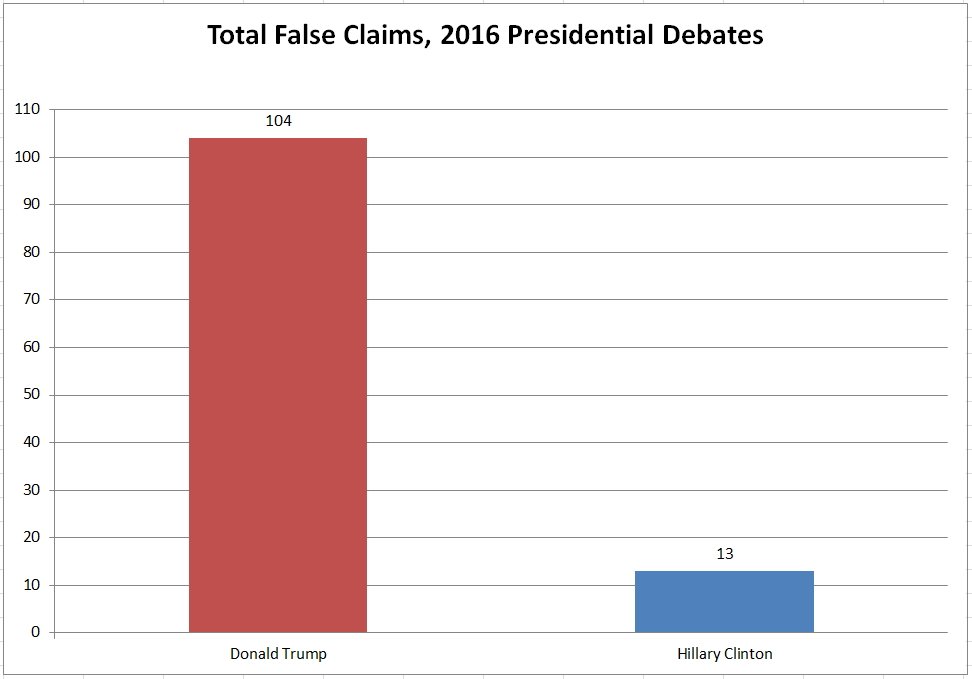
The unprecedented scale of Donald Trump’s disconnection from the truth has swamped ordinary notions of fact-checking. (PolitiFact has identified 29 Trump pants-on-fire lies, compared to 3 from Clinton and none from Sanders.) How the media should adjust has become a topic of discussion. Here, CNN tried out something new: fact-checking him in real time.


A number of American writers, some as famous as Stephen King and Amy Tan, published “An Open Letter to the American People” speaking out against Donald Trump. Unfortunately, it included this line:

Because American history, despite periods of nativism and bigotry, has from the first been a grand experiment in bringing people of different backgrounds together, not pitting them against one another

which Daniel José Older described as

not only empirically false, it’s a continuation of the ongoing legacy of sanitized lies America has shoved down its own throat since its creation

I guess I’d say that from the beginning, the two impulses have struggled for dominance. In every generation, America was bringing people of diverse backgrounds together in new ways, and also pitting people against each other. (“All men are created equal,” the slave-owner wrote earnestly.) Over time, I think the bringing-people-together impulse has been slowly winning out, as movements for abolition, women’s suffrage, civil rights, gender rights, gay rights, (and so on) attest. But I think it’s a mistake to minimize either the authenticity of the idealism that has animated Americans through the centuries or its consistent failure to fully manifest in a fair society.

And yes, electing Trump would be a lurch back towards nativism and bigotry.

and the Democrats

Tomorrow is the last big round of primaries, with only D.C.’s primary next week still left. California is the big one and may be close, but probably it will also be anticlimactic. New Jersey is in the Eastern time zone and Clinton should win it easily. That should give her more than enough delegates have the nomination already clinched before California is called.

Then Wednesday, we get to the moment everyone has been speculating about: What will Bernie do? At this point I think I’ll just wait and see.


Hard to say what’s going on with the general-election polls. Some show a close race between Trump and Clinton, while others don’t.

and the gorilla that got killed

Harambe, a gorilla at the Cincinnati  Zoo, was killed the Saturday before Memorial Day after a 3-year-old boy fell into the gorilla enclosure and seemed to be in danger.

This set off a storm of social media commentary because it wasn’t Harambe’s fault, maybe the boy could have been saved without killing the gorilla (though I wouldn’t want to be the guy who made that decision if the boy then died), and so on.

One major target was the boy’s mother, for not keeping better track of him. She has four children (who I assume were all at the zoo with her, though I haven’t seen anybody verify that explicitly). The fact that the family is black raised the old stereotype of irresponsible black women who have more children than they can manage. And it came out that the children’s father had served a year in jail on a drug charge, as if that had some relevance.

It’s a shame there isn’t more sympathy for a mother who clearly must have believed her child was about to die right in front of her.

My wife and I are that couple you know who likes kids but have none of their own, so we’ve had lots of conversations with parents who were letting their hair down. I think every parent I’ve known can tell a story about a moment when their kid was suddenly gone, and then just as suddenly reappeared someplace he or she couldn’t possibly be. Kids are ingenious little buggers who can spot momentary distractions and take advantage by moving really, really fast.

Here’s my negligent-adult story: I was out in the yard with a friend’s daughter. At one point she was standing securely on my shoulders, perfectly balanced between my raised arms, which she could grab if she got unsteady. But then she jumped off at a moment and in a direction that I completely did not expect. My dive to catch her was too slow, and we stayed in eye contact all the way to the ground, which seemed like a very long time. Landing on her back scared her and knocked the wind out of her, but she was otherwise unharmed.

All the stories I know personally are like that: The shield of adult protection momentarily fails, and something really bad could happen, but it doesn’t. Cars stop inches short, human or animal predators don’t happen to appear during the defenseless instant, the ER people get the stomach pumped out in time, and so on. That’s what happens almost every time adult vigilance fails. Some people get unlucky, but the rest of us (if we’re honest) have to admit this truth: If perfection were the standard, then nobody would deserve to have healthy children.

So the reactions I empathized with were like Amanda Marcotte’s:

The expectation that you spend the next 18 years of your life never being less than perfect for a moment is one reason I don’t want kids.

And Kimberley Harrington’s:

If you want to know why mothers — especially mothers in this country — are so batshit crazy, maybe it has something to do with the fact that we are blamed for every. god damn. thing. BY STRANGERS. Work full time? Why are you letting someone else raise your kid? Stay at home mom? Why aren’t you teaching them to be independent go-getters? Breastfeeding, formula feeding, fucking wilderness schools, grit, financial savvy, watching them all of the time, watching them none of the time, free range, Tiger Mom-ing ALL OF THE THINGS OH MY GOD INTERNET MAKE UP YOUR FUCKING MINDS.

but I need to fix a mistake

Last week I got taken in by some of the bad reporting on a case of an antibiotic-resistant infection. A commenter linked to a more accurate article from Ars Technica.

While, again, this isn’t exactly good news, it’s not catastrophic. There are several last-resort antibiotics, and doctors can try different combinations and strengths of prescriptions before an infection may be deemed untreatable.

The somewhat more detailed summary goes like this:

Thursday’s report of a mcr-1-based colistin-resistant bacterial infection in a US patient is concerning, but unsurprising. The plasmid based resistant gene threatens to spread to other bacteria, potentially to ones that are already resistant to last resort drugs, such as CRE. However, the trajectory of mcr-1‘s emergence and its contribution to drug resistant infection trends is not yet clear. For now, the case serves mostly to highlight the ongoing crisis of rising antibiotic resistance and furthers the need for better stewardship of old antibiotics and development of new ones.

My mistake in falling for — and worse, promoting — the more apocalyptic version of the story (that the bacteria was resistant to all antibiotics) demonstrates a type of error I think everybody needs to watch out for: I’ve been watching the erosion of antibiotic effectiveness for years now and trying to call my readers’ attention to it. So when reputable news outlets seemed to be saying that the disaster I’d been warning about was finally here, I didn’t check the details the way I should have.

and you might also be interested in

In case you missed it, here’s the town hall meeting President Obama had Wednesday in Elkhart, Indiana.

And he answered more questions afterward, like this one about gun control.


I guess it’s not that surprising to hear that there’s a 50th-anniversary Monkees album. But the fact that it’s getting good reviews is a shock.

and let’s close with something hopeful

José Picardo is a high school assistant principal who thinks the kids might be all right. In an article published on Medium, he recalled this photo that went viral on the internet last year, apparently showing teen-agers at the Rijksmuseum in Amsterdam staring into their phones while ignoring Rembrandt’s masterpiece “The Night Watch” on the wall behind them.

Lots of folks took the photo as “a perfect metaphor for our age”, in which young people are so addicted to technology that the beauty of the real world escapes them.

But what were they doing? Texting? Playing Angry Birds? Checking how many Likes their selfies were getting?

Not exactly.

It turns out that the Rijksmuseum has an app that, among other things, contains guided tours and further information about the works on display. As part of their visit to the museum, the children, who minutes earlier had admired the art and listened attentively to explanations by expert adults, had been instructed to complete an assignment by their school teachers, using, among other things, the museum’s excellent smartphone app.

Not Thrones and Crowns

When wilt thou save the people?
Oh God of mercy when?
The people, Lord, the people
Not thrones and crowns, but men.

— “Save the People” from Godspell

This week’s featured post is “The Election is About the Country, Not the Candidates“. I also wrote a column about Humanism for UU World.

This week everybody was talking about the presidential race

The Inspector General for the State Department put out a report on the Clinton email affair. I had a hard time finding an article that I thought put the proper importance on this story, neither overblowing it nor completely writing it off. I found myself more-or-less on the same page as The New Yorker‘s Ryan Lizza:

So this scandal is like so many that have dogged the Clintons: while it’s more molehill than mountain, it does genuinely revolve around a serious issue (Clinton’s commitment to transparency); her initial response was less than forthcoming; and the critics exaggerating the degree of wrongdoing have demonstrated more interest in damaging her politically than fixing the underlying government-wide problem that the e-mail imbroglio has revealed.


Two polls of the California Democratic Party came out last Monday: PPIC had Clinton up by 2%, 46%-44%. SurveyUSA had Clinton up by 18%, 57%-39%. The close-race poll makes a better headline than the it’s-not-close poll, so that’s the one that got all the attention.

Of course both polls were before the inspector general’s report on Clinton’s emails, which can’t have done her any good.


In North Dakota Thursday, Trump laid out his energy policy, which is all fossil fuels all the time, including coal.

He did not explicitly address the scientific legitimacy of human-caused climate change, but said, “We’re going to deal with real environmental challenges, not the phony ones we’ve been hearing about. … Regulations that shut down hundreds of coal-fired power plants and block the construction of new ones — how stupid is that?”

He also pledged to restart the Keystone XL pipeline project, cancel the Paris climate agreement, and stop the Obama/Clinton policy of foreign aid to help poorer countries adapt to climate change. (Just to give one example, by 2050 rising seas are expected to drive about 18 million Bangladeshis from their homes. Where will they go?)

It’s hard for me to get excited about the climate-policy differences between Clinton and Sanders when Trump is sounding like a Bond villain.


The biggest non-story of the week was the Trump/Sanders debate, which took over the news cycle for two whole days, even though it should have been completely obvious that Trump would never do it.

It got covered as Trump-and-Sanders-will-gang-up-on-Hillary, but that’s not where Bernie was headed, and probably wouldn’t have done him any good anyway. Sanders’ closing argument is that he’s the better candidate to run against Trump, so that’s what he would have been trying to prove. Agreeing with Trump about “crooked Hillary” would have turned off more Democratic voters than it attracted.

Trump, conversely, had nothing to gain. Sanders would be trying out liberal anti-Trump arguments, letting Clinton see how Trump handles them. And even if Trump managed a smashing victory, he would just have been scoring points against somebody he wouldn’t run against anyway.

Of course, Trump would accept the initial challenge, because that’s the image he wants to project. But just as obviously, he’d make up conditions that couldn’t be met so that he could back out. And that’s what happened.

Even Rachel Maddow, who ought to be smarter than this, devoted half of a 20-minute segment to this topic Thursday, and got all whipped up about it.


Violence between pro-Trump and anti-Trump people broke out outside Trump’s San Diego rally Friday night. There had previously been protests outside Trump’s Fresno rally.

If anti-Trump protests are going to be a thing — and it looks like they are — it seems likely that there will be more fights and arrests and so forth. No matter who is actually at fault, I suspect the anti-Trump people will get blamed.

That’s why I’m hoping that Clinton will distance herself from the anti-Trump protests, and denounce any violence in strong terms. Something like: “If you want to protest peacefully against Donald Trump, that’s your right as an American. But don’t do it on my account. If you want to work for my campaign, we have lots of more useful jobs for you to do.”


Jonathan Weisman describes how he became a social-media target of Trump-supporting anti-Semites. Meanwhile, BuzzFeed‘s Rosie Gray reports on the excitement Trump has raised at the white-nationalist American Renaissance conference. That’s not to claim that Trump is actively anti-Semitic or a white nationalist himself. But at some point you do have a responsibility to notice and comment on the things that are being done in your name.


Something Trump himself did do is use 12 minutes of a public rally to bash by name the judge who presides over the San Diego version of the Trump University fraud suit. (There’s a separate New York suit. Neither will go to trial before the election.) Trump described the judge as a “Mexican” and a “hater”.

I’m telling you, this court system, judges in this court system, federal court, they ought to look into Judge Curiel. Because what Judge Curiel is doing is a total disgrace, OK?

On and on like that for 12 minutes.

James Fallows makes the historical comparison:

When the results of an established process turn against them, presidents and presidential aspirants must defend the process. That’s the difference between rule-of-law and rule-of-men. Richard Nixon disagreed with the Supreme Court’s rulings against him but did not question their legitimacy or say he would try to get back at the Justices. Al Gore had far better logical and jurisprudential grounds for questioning the ruling in Bush v. Gore, but while he made clear that he bitterly disagreed, he of course complied. He did not mention the ethnicity of the Justices or say that they should be “looked into.”

I’ll take that a step farther: When you’re talking to a room filled with your rabid fans, and your speech is likely to get covered on national TV, how hard is it to imagine one lunatic deciding to impress you by doing something about that hater judge?


VoxLiz Plank takes on Trump’s talk about Hillary’s “woman card”, when he went on to say: “We’re petrified to speak to women any more.” She lists a number of things that women might be afraid of, like, say, rape, or having their concerns ignored by a Congress that is 80% male.

But yeah, men’s fear of being labeled as sexist when they clearly say things that are definitely sexist … definitely trumps the very well documented systemic sexism that women face every day.

and you might also be interested in

Obama went to Hiroshima and said this:

Those who died, they are like us. Ordinary people understand this, I think. They do not want more war. They would rather that the wonders of science be focused on improving life and not eliminating it. When the choices made by nations, when the choices made by leaders, reflect this simple wisdom, then the lesson of Hiroshima is done.

The world was forever changed here, but today the children of this city will go through their day in peace. What a precious thing that is. It is worth protecting, and then extending to every child. That is a future we can choose, a future in which Hiroshima and Nagasaki are known not as the dawn of atomic warfare but as the start of our own moral awakening.

It’s been great, these last seven years, to have a president I can take pride in.


One of those simple stats that speaks volumes: Home ownership is at its lowest rate since 1967. The millennial generation’s path through life is going to be different than previous generations.


Thursday, health officials announced the first incidence in the U.S. of a bacterial infection that is immune to all known antibiotics. This has been coming for a long time, but now it’s here.


Venezuela is spiraling downward.


An important lesson in structural racism: A Pro Publica investigation shows that a widely used algorithm to predict whether criminals will commit more crimes — producing “risk scores” that judges and parole boards use to decide on sentences — is biased against blacks. It over-estimates the risk that blacks will commit future crimes, and under-estimates the risk that whites will.

There’s no evidence that anybody did this intentionally, but factors that seem to make sense on an individual basis have the effect of reproducing the culture of mass incarceration.

Race is not one of the questions. The survey asks defendants such things as: “Was one of your parents ever sent to jail or prison?” “How many of your friends/acquaintances are taking drugs illegally?” and “How often did you get in fights while at school?” The questionnaire also asks people to agree or disagree with statements such as “A hungry person has a right to steal” and “If people make me angry or lose my temper, I can be dangerous.”

Since blacks are imprisoned at much higher rates than whites, their children will have worse risk scores. If you attend a bad public school, with lots of violence and drugs, it will count against you. And so on.


Due to some really bad reporting, a lot of people now believe that scientists have shown at long last that cellphones cause cancer. VoxBrad Palmer does the kind of careful science reporting that is too boring for most media outlets.

So here’s what happened, more or less: Researchers bombarded some rats with more cellphone radiation than any human is likely to be exposed to, and they did get more tumors of two particular types in those rats than in the control group. On the other hand, we’ve been conducting an unofficial experiment by having lots of humans use cellphones, and we’re not seeing the kinds of increases in cancer that we would if there were a large effect. (And BTW: the irradiated mice on average lived longer than the control group.)

In short, it’s the kind of study that should make people go “Hmmm”, not “OMG, we’re all going to die!”

Look: Science moves slowly. Individual studies are often wrong, and it’s rare for one paper to completely upend everything we know about a topic. There are very few genuinely “game-changing” studies. And reporters need to do a better job of putting this incrementalism in context — rather than preying on people’s fears for clicks.

and let’s close with something cute

At the end of a long day, Momma Raccoon makes sure all the kids get home safe.

One Purpose

Whether you voted for me or you voted for Barack, the time is now to unite as a single party with a single purpose. We are on the same team, and none of us can afford to sit on the sidelines. … Barack Obama is my candidate, and he must be our president.

Hillary Clinton, 2008 Democratic Convention (8-26-2008)

This week’s featured post is “Fears of Democratic Disunity: talking myself down“.

This week everybody was talking about a plane crash

The usual news sites can be confusing places to keep track of an unfolding story like the loss of EgyptAir Flight 804. They focus too much on what information is new today, and it’s often hard to tell whether they’re reporting or speculating. I recommend checking the Wikipedia page from time to time. That way you get the whole story as it is currently understood.

and whether the Democrats can unify

In the featured post, I let my fears run wild and then talk myself down.

while the Republicans unite around Trump

Interesting article in The Atlantic about Trump’s message to coal country versus Clinton’s.

[Trump’s] plan is very easy to envision: You’ll have your job back, and your old lives. This is the power of Trump’s blame-based worldview. When curing a community’s malaise is as simple as getting rid of the bad actor who caused it—in this case, Obama’s environmental regulations—the rewards feel more certain, more tangible.

“When you say, ‘I’m going to give your job back,’ that’s a very immediate solution to the problem,” said Erin Cassese, an associate professor of political science at West Virginia University. “If you want to find fault with Clinton’s plan or Sanders’s plan, it’s that they’re really vague. People don’t have a clear vision of what their lives are going to be like in four years. It’s more abstract, and that’s why it has less resonance with voters.”

The problem is that Trump’s plan has almost no chance of success. A U.S. president has no power to stoke global demand for coal, or pump up the price of natural gas; the most Trump could do is repeal Obama’s environmental rules, and economists agree that would have a minimal effect on employment.

In the fall campaign, that’s going to be the argument across the board. Clinton will offer a detailed program to make things better than they are now; Trump will pledge to make things right again, but offer either no plan or one based in fantasy. It’s going to be a serious test of the wisdom of the electorate.


Trump put out a list of the 11 white people he would consider nominating to replace Antonin Scalia on the Supreme Court. In general, conservatives consider this a good list and liberals don’t, but getting into that argument misses the obvious: Once in office, Trump will do what he wants, independent of anything he’s said in past or is saying now.

Look at what we’ve already seen: He publishes a tax plan, and then distances himself from it. One of his top surrogates now says his Mexican Wall would be “virtual” and his deportation promise “rhetorical”. As Kyle Kondik of Sabato’s Crystal Ball put it:

Tackling Trump on the issues will be tricky because he just changes his positions all the time.

So in January, if Trump pulls a Caligula and nominates his horse to the Court, I can imagine what he’ll say if anybody mentions this list. “That was a good list, a great list, and those 11 judges are really top people, totally first rate. But America’s Greatness — have you seen him? — what a horse he is!”

but a lot of important things have been happening the in the world while we’ve been focused on presidential politics (and bathrooms)

I haven’t given this stuff nearly the attention it deserves. Fortunately, Vox been on the case.

Brexit. The European Union is at a tricky point. Its member countries are unified enough that the EU limits the actions of the national governments, but not so unified as to provide the kind of benefits that, say, the states of the US see from our federal government. (For example, if our states had the kind of loose relationship EU countries do, Florida might have had to go bankrupt in the 2008 real estate crash, or New Jersey after Hurricane Sandy.)

Previously, this has come to a head with regard to the Greek economic crisis, and the “Greek exit” option got smushed down to “Grexit”. (Greece decided to stay in the EU for now.) Now Britain, a much larger, richer economy, is facing a referendum to leave the EU.

Britain has always had an ambivalent relationship with the European mainland, which is symbolized by the fact that it has retained the pound, rather than merge into the EuroZone. That limits some of the hassle of being in the EU, and would limit some of the impact of a Brexit. (For example, Britain’s national debt is in its own currency, which it could print if it needed a quick way out of a debt crisis. Greece, on the other hand, owes Euros, which it doesn’t control.)

Vox has a good explanatory article. An exit vote on the UK referendum on June 23 would trigger the negotiation of an exit agreement with the EU, which would then have to be approved. So the referendum is a move towards exit, but not a direct exit.

The biggest worry, though, isn’t Brexit itself, but the larger nationalistic process it might be part of.

Brexit is the British manifestation of a broader popular revolt against European integration that is gradually spreading across Europe. If the British people choose to abandon the EU at this vulnerable moment, it might well be the catalyst that causes the cancer of populism and disintegration — which is helping to drive this campaign in the UK — to metastasize across Europe at a dramatically faster rate.

The Brazilian impeachment. Brazil’s President Dilma Rousseff has been impeached by the Senate, which under the Brazilian system means that she immediately steps down until cleared.

This is a weird story about Brazil’s weird version of democracy, in which a clear majority of Congress is under investigation for corruption.

Ever since colonial times, Brazil has been dominated by wealthy elites who thought they could get away with anything — mostly because they usually did.

Rousseff probably will be removed permanently, and it’s hard to feel too bad about that, because she is corrupt. But she might well be less corrupt than either the people who are impeaching her or the VP who will take over.

The Zika virus. Brazil is also ground zero for an outbreak of the Zika virus.

But Zika isn’t just somebody else’s problem. There’s already been a death in Puerto Rico, and much of the Southern U.S. is at risk. The Obama administration has asked for $1.9 billion to fight the disease, but this apparently is the kind of “wasteful government spending” that Republicans feel obliged to block. The Senate is trying to pass a $1.1 billion bill, while the House is only willing to spend $622 million — and funding it by taking the money away from anti-Ebola work. God forbid that we increase our public health budget just because there’s a public health problem.

Puerto Rico. It looks like Congress will pass a bill to deal with the Puerto Rican debt crisis. Matt Yglesias describes the proposal as “in effect … bankruptcy” because the lenders and bond holders will get less than 100% of what they’re owed on paper. No federal money is appropriated to bail anybody out.

and you might also be interested in

Larry Wilmore appeared on Chris Hayes’ MSNBC show Wednesday, and an interesting point came up: We’re at the point where people will start wondering what history will make of the Obama administration.

Like Wilmore, I think Obama is going to come out pretty well. Not only is ObamaCare ultimately going to be remembered as a major accomplishment, but he’s going to get credit for the way he held things together in the face of the horrible conditions he inherited from Bush and unprecedented obstruction from the opposing party.

Anyway, more about that in January. But it seemed like a good time to review my end-of-term assessment of George W. Bush in 2009. I’m standing by all of it: In hindsight, I don’t see any reason to look more kindly on what he did.


Oklahoma’s legislature just passed a bill criminalizing abortion, but the governor vetoed it. I think of these sorts of laws as Lawyer Full Employment acts. The only thing they accomplish is to create court cases whose outcomes are known before they begin.


George Zimmerman just sold the gun he used to kill Trayvon Martin for $250,000. This looks to me like a pioneering transaction that brings a whole new market into the capitalist system. Imagine the possibilities: “Of course I didn’t hire that guy to kill my parents (and besides, there wasn’t enough evidence to convict him). But after I got my inheritance, how could I turn down the opportunity to own an artifact of such personal significance to my family?”

and let’s close with something unexpected

The sidewalks of Boston are covered with secret poems that you can only see when it rains.

Truth and Fantasy

I play to people’s fantasies. I call it truthful hyperbole. It’s an innocent form of exaggeration — and a very effective form of promotion.

— Donald J. Trump, The Art of the Deal (1987)

This week’s featured post is “Four False Things You Might Believe About Donald Trump“.

This week everybody was talking about the Trump-Ryan meeting

Trump dominated the news cycle even more than usual this week. His meeting with Paul Ryan was covered like an international summit, even though there was really nothing to say about it: We’re not sure what they talked about and nobody expected a clear result. It sounds like they have agreed to agree at some point in the future, though the content of that agreement has been left open.

In general, and with a few notable exceptions, this was the week when elected Republicans realized they have no choice: Trump is their nominee, and his positions are vague enough to leave room for imagining that he will do something they’ll like.


Trump is still refusing to release his tax returns, giving very implausible excuses for his refusal.

It’s hard to imagine what could be in there that is worse than what the media is already imagining. I think the most likely thing we’d learn is that he’s not nearly so rich as he claims. Using a separate source of information, Crane’s New York Business argues that his annual income must be less than $500K.


The NYT did a deeply researched article into Trump’s interactions with women. Trump thinks it’s a hit piece, but it actually captures some of the ambivalence of his character: On the one hand, Trump made room for women to advance in his organization, giving them opportunities they would not easily find elsewhere in the real-estate-development business. On the other, he feels like this should give him cover when he misbehaves, which he frequently does.


The other Trump news story falls into the WTF category: The Washington Post released a tape of a 1991 conversation in which Trump is posing as his own publicist and talking to a gossip columnist. The conversation is largely about all the women who either want Trump or want him back.

I’m a bit at a loss about how much importance to give this. It doesn’t fall into any of the usual political-scandal categories. It’s more like: “Who does that kind of thing?” I’m reminded of the damaging YouTube of John Edwards primping his hair.

Trump’s response is more telling than the story itself: He reiterated his threat that the Trump administration would start an antitrust case against Amazon, whose owner (Jeff Bezos) also owns the WaPo. Josh Marshall comments:

and polls

Lots of Democrats freaked when a Quinnipiac poll showed tight Clinton/Trump races in Florida, Ohio, and Pennsylvania — i.e., the states that have been the deciders in most recent elections.

Slate‘s Jamelle Bouie dug into the numbers to see what was going on, and discovered something interesting: Quinnipiac is assuming that these states will have a significantly whiter electorate than in 2008 or 2012.

The standard narrative for nonwhite voting in a presidential year is this: Before Barack Obama, blacks and Latinos turned out to vote in modest and static numbers. After Obama’s 2008 campaign, they began to vote in droves, transforming the American electorate. Now, with Obama and his historic candidacy off of the ballot, they’ll return to the sidelines.

Every part of this narrative is wrong.

To me, the compelling part of Bouie’s counter-narrative is the Hispanic vote, where turnout is traditionally low, but went up to 50% in 2008 and 48% in 2012. Somehow, I think Trump is going to inspire a lot of Hispanic voter turnout.

So the Q poll should be read as more of a cautionary tale than a prediction: If Democrats forget about non-white turnout, or if Clinton makes the mistake of competing too hard for the angry white voter and blurs the choice between herself and Trump, things could get close.


In general, you shouldn’t let yourself get too upset by any one poll. The media has a tendency to publicize polls precisely because they say something unexpected. (In the primaries, any poll showing Sanders unexpectedly close to Clinton made headlines, while polls showing Clinton comfortably ahead didn’t.) In practice, that means that the polls you’re most likely to hear about are the outliers, the ones fall outside the range of the other polls. Those are precisely the ones you should be most suspicious of.

and bathrooms

The Obama administration has sent a letter to all the school districts in the country, warning them that bathroom rules discriminating against transgender students (like the ones mandated in North Carolina by HB2) will be seen as violations of Title IX of the Civil Rights Act. Vox has an informative article about this.

[Until they are tested in court] the Obama administration’s guidelines are simply a legally non-binding guidance. Still, they suggest that the Obama administration will attempt legal action against violators. And if courts do ultimately rule in the administration’s favor, schools and states could lose billions in federal education funding for violating civil rights laws — a position no public official wants to be caught in.

The article also contains a map showing all the states where some kind of transgender-rights protection already exists. In other words, there’s no reason why opponents of trans rights need to make up hypothetical examples of men claiming to be trans so that they can enter women’s bathrooms and locker rooms for whatever nefarious purposes. If such things are going to happen, they should already be happening all over the country.

For example, last week I watched Bill O’Reilly raise these kinds of fears on his TV show. Bill’s show comes out of New York, where the law already includes protections of trans rights. So if trans rights cause a problem, he’s perfectly situated to report on that problem, not speculate hypothetically about it.


Religion writer Jonathan Merritt has written an interesting article about how the religious right is playing this issue. His claim is that they learned nothing from their battles against gay rights, and so they’re making all the same mistakes: They’re making abstract arguments based on dogma and stereotypes, and aren’t paying attention either to the experiences of real people or to what science is finding out.

When it comes to transgender issues, conservative Christians advocate for a privileged majority that is not currently under threat while ignoring the plight of an oppressed minority that is currently being harassed. Are you starting to see the parallels to the way Christian activists bungled the gay rights fight?

In the early 2000s I began predicting that the battle over gay marriage was already over. My conservative friends called me crazy, but time proved who was right. Because conservative Christians seem hellbent on perpetually making the same mistakes ad infinitum, today I’m predicting that the transgender conversation is over. And once again, conservative Christians will be the authors of their own demise.

Scare tactics only work until real experience starts to develop. Conservative Christians could claim anything they wanted about same-sex marriage leading to the fall of Civilization as long as no states had legalized it. But eventually you could go to Massachusetts or Canada and see for yourself that Civilization was doing just fine.

and you might also be interested in

Mistakes are bigger in Texas. This TCU typo is the worst since the commencement of the University of Texas Lyndon B. Johnson School of Pubic Affairs in 2012. I’m not making that one up either.


Also in Texas: An 8th-grade girl in Houston was held by police after she tried to buy her school lunch with a $2 bill her grandmother had given her. The bill failed the current counterfeiting test because it was printed in 1953. The link (from the local ABC affiliate) tells of numerous other cases in which school officials and police have treated students like adult felons rather than give them the benefit of the doubt while an anomaly is investigated. Oddly, this seems to happen almost entirely to non-white students.


West Virginia Democrats are a confusing bunch. In their presidential primary, they picked Sanders over Clinton 51%-36%. But on the same day, in the governor’s race, they nominated a billionaire coal baron who denies global warming and has a history of safety violations in his mines.

and let’s close with something big

A life-size Foosball game.

Say Never

This is a Joe McCarthy moment. People will be judged by where they stood at this time. Those who walked with Trump will be tainted forever after.

— David Brooks, “If Not Trump, What?” (4-29-2016)

This week’s featured post is “What Will Republicans Do Now?

If you’re wondering where I was last week, check out the Mayday service I gave at the Unitarian Church of Quincy, Illinois.

These last two weeks, everybody has been talking about the end of the Republican primary campaign

Two weeks ago, the plan to stop Donald Trump at the convention was still iffy, but didn’t seem completely daft. Then very quickly, Trump won the Middle Atlantic primaries by wide margins and Cruz collapsed in Indiana. Suddenly Cruz and Kasich were out and Trump was the last man standing.

I talk about the still-splintered Republican Party in the featured post.

Before Cruz went out, though, he unleashed the kind of scathing diatribe you can’t take back, calling Trump a “pathological liar” who “lies [with] practically every word that comes out of his mouth”.

In a response that I think comes straight out of a psychology textbook, his response is to accuse everyone else of lying. … And it’s simply a mindless yell. Whatever he does, he accuses everyone else of doing.

This is actually a sound insight. In particular, I think it applies to Trump’s recent attack on Hillary Clinton:

Frankly, if Hillary Clinton were a man, I don’t think she’d get 5 percent of the vote. The only thing she’s got going is the women’s card.

Reverse that and see how much better it fits. Would anyone support Donald Trump if he weren’t a white man? Isn’t he constantly playing the white man card, stoking up white male resentment against Hispanics, against women, against blacks, against Middle Easterners?

Another frequent Trump claim is that Hillary either will or should be indicted over the email affair. But the more we learn, the more clear it is that she broke no laws. It is Trump, on the other hand, who has a legal problem: The Trump University fraud lawsuit will be heard shortly after the election.

and political comedy

At his last White House Press Correspondents’ Dinner, President Obama proved once again that he has a career in stand-up waiting, if he wants it.

And Jimmy Kimmel did a funny but effective piece about climate change.

The Daily Show turned real Donald Trump quotes into a rap video.

That video illustrates one reason I think liberals will do better against Trump than conservatives did: Trump deserves to be laughed at, and we have much better comedians.

Meanwhile, the last week of the Ted Cruz campaign was full of unintentional yucks: Ted accidentally elbowed his wife in the face. His would-be VP, Carly Fiorina, diverted attention from the entrance of the Cruz family by falling off the stage. And in a WTF moment, Carly started singing. When Hollywood eventually makes a comedy about the 2016 campaign, those moments will have to be included.

and Puerto Rico

The first time I noticed that Puerto Rico had a debt problem was when I started seeing this ad:

It was paid for by one of those dark-money groups with an amorphous name: the Center for Individual Freedom. So of course you can trust everything they tell you.

To get a better idea of what’s involved, watch this John Oliver segment (which features Puerto-Rican-born Lin-Manuel Miranda of Hamilton).

The general theme here is the problem of colonialism: Puerto Rico may have its own government, but the rules it operates under are circumscribed by what Congress allows, and Congress often makes new rules affecting Puerto Rico either by accident (just failing to mention it in the law) or in order to achieve some purpose on the mainland, with the effect on the island being mostly an afterthought.

Right now, Puerto Rico owes $70 billion, or about $20,000 per person. The debt simply can’t be paid, and as the laws currently stand, the island’s government has to pay its bonds before providing services like public health and education. If they do that, it seems clear that people will die; that’s why they’re currently in violation of the law.

Mainlanders who want to write Puerto Ricans off because they’re Hispanics might want to think again: Since Puerto Rico is a U.S. territory, all its people are American citizens. They don’t have to cross any borders or jump any walls to resettle in your town; they just need a plane ticket.

and Cinco de Mayo

For an explanation of why wearing a sombrero, eating nachos, and drinking too much tequila is not a proper way for Anglos to celebrate Cinco de Mayo, listen to Liz Martinez , or watch this:

For what Cinco de Mayo really means, see Wikipedia.

For non-Hispanic Americans, Cinco de Mayo should be an annual opportunity to think about cultural appropriation, the tendency of powerful cultures to steal anything that looks like fun from less powerful cultures. (I discussed this a few years ago in “A Brief Meditation on White Twerking“.) Done badly, the powerful culture’s megaphone drowns out the authentic tradition, ruining practices and celebrations for the people they ought to belong to.

There are respectful ways to mark holidays of cultures you don’t belong to. For example, if you’re a Gentile and your Jewish friends invite you over for a Passover Seder, you can attend without worrying about cultural appropriation, as long as you don’t try to make yourself the center of attention. That’s way different from dressing up like Moses and inviting a bunch of other Gentiles over to eat matzo shaped like the 10 commandments and drink a lot of Manischewitz.


The question is who’s in control. One key symptom of privilege is the tendency to assume that you ought to be in control. If someone else is offended by what you do, you’ll be the judge of whether their objection is justified. You’ll examine your own intentions, and if you decide you meant well, that’s all that matters. If that doesn’t satisfy some people, well, that’s their problem.

You can see that process at work in Washington Redskins’ owner Daniel Snyder: He knows he doesn’t intend to insult Native Americans, so if they take offense they’re just wrong. “The truth is on our side,” he says.


A current example is Donald Trump’s Cinco de Mayo tweet. All the elements of cultural appropriation are on display: A white guy eats a white imitation of Mexican food while proclaiming (falsely, according to New York Eater, which judged the Trump Tower Grill’s taco bowls to be “an insult to Mexicans every bit as profound as Trump’s previous pronouncements”) that his people do it better than actual Mexicans. It’s textbook. No wonder California Republican Dennis Hollingsworth tweeted in response: “Holy guacamole, what a dipshit.”


Like Hollingsworth, many interpreted Trump’s tweet as a clueless attempt to reach out to Hispanic-American voters. (Reince Priebus’ generous interpretation was that Trump is “trying”.) But I see something more clever. Trump knows the Hispanic vote is beyond his reach. His actual purpose here is to convince other clueless Anglos that he’s not anti-Hispanic, so they can vote for him without feeling like bigots.

The goal was to get the response he got from Bill O’Reilly (and Neil Cavuto): that the objections to his tweet demonstrate the “political madness” of this campaign. No doubt O’Reilly’s aging white audience is saying, “Look at how crazy those people are! Trump says he loves them, and they’re mad.” Just what the Donald wanted.

and HB2

The plot thickens regarding North Carolina’s HB2 law, the one that polices the state’s bathrooms and prevents local governments from protecting any rights the state doesn’t recognize — particularly gay or trans rights.

Wednesday, the U. S. Justice Department sent Gov. Pat McCrory a letter notifying him that the law violates federal laws against sex-based discrimination in the workplace. The feds wanted assurance by today that North Carolina will not be enforcing the law, which Gov. McCrory is not going to give, calling the letter “Washington overreach”. Billions in federal funds are potentially at risk.

Basically, McCrory is taking the same path that Southern governors like George Wallace and Ross Barnett did during the civil rights era: calling for delay and invoking states rights.

One possible way out is if the city of Charlotte agrees to repeal the LGBT-rights ordinance that HB2 was passed to undo. Then the state might amend HB2 in some way acceptable to the Justice Department. So far, though, Charlotte seems to be taking the view that they didn’t make this problem.

and let’s close with something time-devouring

Polygraph has constructed the most addictive web site I’ve ever linked to. Start at any date you want (after 1958; 1997 is the default), and then watch (and hear) the Billboard Top 5 songs evolve week by week, with a running total of how many weeks each artist stayed at #1. “Maybe I’ll just watch another couple of months,” I say. “Aren’t the Beatles due to show up soon? How long will it take them to catch Elvis?”

Getting Through

Dearly beloved, we are gathered here today to get through this thing called life.

— Prince, “Let’s Go Crazy” (1984)

No Sift next week. New articles will appear May 9.

This week’s featured posts are “Beyond Bernie 2016” and “Why You Should Care About Felon Voting Rights“.

This week everybody was talking about the New York primary

The odds of a Clinton/Trump contest in the fall jumped considerably Tuesday, after both had landslide wins in New York. I describe just how completely this slams the door on Bernie’s chances (as well as the options on what to do next) in “Beyond Bernie 2016“.

Trump’s win was in some ways even more crushing, because Ted Cruz got no delegates at all from New York. Cruz is now in the same position as Kasich (or Paul Ryan, for that matter): His only path to the nomination involves stopping Trump from getting a first-ballot majority at the convention, then convincing other candidates’ delegates to switch to him on subsequent ballots. The last time a major party had a convention with more than one ballot was in a different political era entirely, when Adlai Stevenson won the 1952 Democratic nomination on the third ballot.

and Prince

If you weren’t music-conscious in the mid-80s, and haven’t had a friend introduce you to Prince’s music since, you’re probably puzzled by the overwhelming public response to his death (at age 57, two years younger than I am). He’s getting tributes not just from the music and pop-culture parts of the media, but from folks like Rachel Maddow and Josh Marshall.

Here’s what I think was unique about Prince: Other musicians typically envy pop hit-makers for their success, but not for their musical skills. Prince was the exception. He could play almost any rock instrument at a high level — check out the guitar solo that begins at the 3:30 mark here — and he had mastered the entire process that starts with a thought in somebody’s head and ends with music coming out of somebody else’s headphones. He didn’t just perform his songs, he wrote and arranged them, was his own studio band, and sometimes the mixer, engineer, and producer as well. He was famous for blatantly sexy songs, but he also could fit in with the Muppets.

And he was successful at all that. Wikipedia says: “At one point in 1984, Prince simultaneously had the No. 1 album, single, and film in the US; it was the first time a singer had achieved this feat.”

Prince also kept his local identity, and created a music industry in Minneapolis rather than move to an existing music capital like LA. The performances in his movie Purple Rain were filmed at Minneapolis’ First Avenue Club.

That’s why it’s so dismal to hear that he has died at a comparatively early age. But if the elevator tries to bring us down, at least we know what to do.

and you might also be interested in

There’s still another week of Confederate Heritage Month to celebrate over at Orcinus.


Whether or not our war against ISIS succeeds is not entirely up to us. It also depends on Iraq maintaining a stable government, which might be a challenge.


In Alabama, separation of church and state means that your daycare center can go virtually unregulated, if you claim it has a religious purpose. The Center for Investigative Reporting has been doing a series called “The God Loophole” about the problems that leads to.


The tenured Wheaton College professor who got in trouble for saying that Christians and Muslims worship the same God has reached an agreement to leave the school.


Now that Trump has opened the floodgates, we can expect to see Hispanic stereotypes in lower-office campaigns. Like this ad from a Kentucky Republican running for Congress.


You can tell you’re getting old when more and more news stories make you say, “I thought he was dead.” Well, it turns out Pat Boone is still alive, and calling for FCC regulations against blasphemy. What set him off was a Saturday Night Live skit, which is a fake movie trailer for a fake movie called God is a Boob Man, in which a Christian baker is pressured by the legal system to say that God is gay.

To appreciate it, you need to know what it’s satirizing. In 2014, a film God’s Not Dead was made for all those Christians who imagine that they’re persecuted. In it, a university philosophy professor “demands his students sign a declaration that ‘God is dead’ to pass.” One student resists, is vindicated, and the professor ultimately converts just before dying. Totally realistic, in other words.

That was successful enough that it’s getting a sequel, God’s Not Dead 2. (Who knows, maybe this is the beginning of a genre similar to the blaxploitation films of the 1970s, but for Christians. I’m visualizing Shaft with a Bible.) Here is its trailer, which you need to understand is not an SNL parody, no matter how much it sounds like one.

Parodying such nonsense is the blasphemy that Boone thinks TV stations should lose their licenses for broadcasting.

and let’s close with some reading suggestions

A few years ago, NPR polled its readers to find the 100 best fantasy and science fiction novels. But lists like that are a bit unwieldy: Where do you start? So the fanzine SF Signal created an interactive guide to help you figure out which one to read next. And that turned into this flow chart. Click to expand.

The Rhyme of the Ancient Democrat

All is in flux, nothing is stationary. … You could not step into the same river twice.

— Heraclitus, 5th century B.C.

What has been will be again. What has been done will be done again. There is no new thing under the sun. 

Ecclesiastes 1:9

History does not repeat itself, but it rhymes.

— attributed (probably falsely) to Mark Twain

This week’s featured post, “Do We Still Have to Worry About the McGovern Problem?” considers what lessons (if any) the landslide losses of 1972, 1984, and 1988 have for the Bernie Sanders candidacy in 2016.

This week everybody was talking about taxes

Or at least worrying about them. Today is the deadline for filing 2015’s federal income tax forms. If you’re missing it, don’t kick yourself, just get it done. You might have to pay a penalty, but you won’t go to jail.

Every year, Tax Day sets everyone wondering if there isn’t some better way to do this. It’s not just the money that gets siphoned off into the tax-prep industry, it’s all the time and stress that goes into the process. Sales tax just happens without you needing to fret about it. Property tax is a bill you pay — costly, maybe, but pretty straightforward. Income tax is an ordeal.

For Republicans like Steve Forbes, the resentment Tax Day raises is a chance to push a flat tax, which would be a gold mine for very rich people like Steve Forbes, but wouldn’t make taxes simpler for ordinary folks. (Flattening the tax just changes the numbers in the tax table. Every change that actually would simplify your taxes could be done without flattening the tax rates.)

But Elizabeth Warren has a plan that would make a real difference.

On Wednesday, she introduced a bill that would let people with simple taxes file for free without filling out a return — essentially, the IRS would do people’s taxes for them. Bernie Sanders is a co-sponsor; his rival for the Democratic presidential nomination, Hillary Clinton, said she supports the bill, too.

For a very large number of people, the 1040 just collects a lot of information the IRS already knows: It gets the same 1099 and W-2 reports that you do, and you told them last year how many dependents you have. It could run all that through its computers and send you a return. You could OK it and be done, or, if you wanted to take advantage of some deduction they don’t know about, you could submit an amendment.

Why isn’t this a no-brainer for Congress? Three reasons:

  • If you really want the pro-plutocracy flat tax, you want to hold genuine tax simplification hostage. Make people believe that a flat tax is the only answer to their pain.
  • The people who would benefit most from Warren’s plan are ordinary Americans who have no lobbyists.
  • The tax-planning and accounting industries are solidly against this kind of reform, and they do have lobbyists.

Tax Day is also a good time to review how money flows through the federal government. One factor that significantly dumbs down political discourse in the United States is that so few people have a clear idea how the government raises money or what it spends money on. (It’s amazing how many people think we could slash government spending by cutting foreign aid and defunding the National Endowment for the Arts.)

Here’s where the money came from in FY 2015, which ended last October.

Individual income is the tax you’re paying now. Payroll taxes are mainly Social Security and Medicare taxes.

And here’s where it went:

The difference between the two — around $450 billion, or 12% of total spending — was the deficit. Healthcare, Social Security, Defense, and interest on the national debt are pretty obvious, and among them account for 71% of spending. Other Mandatory is stuff like Food Stamps and unemployment compensation.

Non-Defense Discretionary is everything people ordinarily think about when they talk about cutting government spending. It’s only 16%, and includes everything from keeping the National Parks open to NASA to disaster relief.

but I was thinking about a bookstore in Asheville

An op-ed in Thursday’s NYT reminded me what a blunt instrument a boycott is. The owner of Malaprop’s Bookstore asked: “Why Should My Store Be Boycotted Over a Law That I Despise?” Malaprop’s has had to cancel author events, and out-of-state customers have been avoiding Asheville while North Carolina’s new anti-LGBT law HB 2 remains in effect.

This made me stop and think, because Asheville is a place I like to visit. I have a red coffee mug with the Malaprop’s logo on one side and “Eat. Sleep. Read.” on the other. Last December, a chunk of “Small-Government Freedom vs. Big-Government Rights” was written while sitting in Malaprop’s cafe section, drinking a Fire Distinguisher (a chili, cayenne, and cinnamon mocha), and using their wifi. (Yeah, I was in the South when I wrote that.)

Asheville as a whole is an unfortunate target, since it’s the cool, intellectual, artsy part of North Carolina. It’s Thomas Wolfe‘s “Altamont”, the home he couldn’t go back to after writing Look Homeward, Angel. And Asheville isn’t happy about the new law. The Asheville City Council has called for HB 2’s repeal. A parody news story says “Entire Fucking City of Asheville Moving Out of North Carolina“.

So yes, it’s a shame Asheville is catching flak for the bigots’ law. And yet … that’s kind of the point. Would the Asheville City Council have taken such a strong position on HB 2 without a boycott?

A law like HB 2 passes because a lot of the people who ought to know better believe that it isn’t really their problem. The boycott is the rest of us saying, “No, it is your problem.” I hope that all over the state, Carolinians who otherwise don’t prioritize LGBT rights, and who shrug and say “What can you do?” whenever the Christian Taliban pushes something through their legislature, are now saying: “This is why we can’t have nice things.”

I’m sorry the boycott is hurting such a cute and pleasant independent bookstore, but HB 2 is hurting a lot of innocent people. And while North Carolina figures out how to fix this, I’ll be looking forward to the next time I can sit in Malaprop’s with a stack of new books on the table, drink some ridiculous coffee concoction, and write a blog post. But don’t look for me there anytime soon.


The most amusing part of the boycott happened last Monday when the porn site xHamster announced it was blocking access to computers with North Carolina IP addresses. This could be more effective than you might think. Studies suggest that Bible Belt states consume more online porn than more liberal, less religious states. It’s that whole repression/rebellion cycle.

and the intersection of religion, law, and absurdity

According to a federal judge, Pastafarianism, the worship of the Flying Spaghetti Monster

is not a ‘religion’ within the meaning of the relevant federal statutes and constitutional jurisprudence. It is, rather, a parody, intended to advance an argument about science, the evolution of life, and the place of religion in public education.

I more or less agree in this particular case, in which a prisoner is asking the prison administration to make allowances for his Pastafarian practices. But if I were a judge, I wouldn’t have much confidence that I could in general draw a line that neatly separated “real” religions from ridiculous systems that people are just having fun with. Imagine, say, a group teaching that people require an absurd deity to properly respond to the absurdity of the human condition. The practitioners themselves might not be able to draw a line between the serious and unserious parts of their faith.


Wednesday David Corn recalled the time in 2007 when Ted Cruz, then state solicitor general, defended a Texas law banning the sale of dildos and vibrators. His office submitted a brief to a federal court claiming that Texas had a legitimate interest in discouraging “autonomous sex” and denying any

substantive-due-process right to stimulate one’s genitals for non-medical purposes unrelated to procreation or outside of an interpersonal relationship.

In response, Cruz’ Princeton roommate Craig Mazen (who has dogged him before) tweeted:

Ted Cruz thinks people don’t have a right to “stimulate their genitals.” I was his college roommate. This would be a new belief of his.

To me, masturbation looks like an issue where Cruz — who claims to be “a Christian first, American second” — may not be taking the Bible literally enough. Particularly Ecclesiastes 9:10 which says:

Whatever your hand finds to do, do it with all your might.

And if your hand needs to amplify its might with battery-powered tools, that doesn’t seem like much of a stretch.


John Kasich is supposed to be the nice, considerate Republican candidate. But in this video, shot in a Jewish bookstore, we see him “goysplaining” various pieces of the Old Testament to Talmud students, who politely refrain from telling him what a jerk he’s being when he asks them if they know about Joseph and Joshua. I was reminded of the time Rand Paul thought he could teach Howard University students about black history.


Tennessee’s Republican Gov. Bill Haslam vetoed a bill to declare the Bible to be the official state book.

If we believe the Bible is the inspired word of God, then we shouldn’t be recognizing it only as a book of historical and economic significance. If we are recognizing the Bible as a sacred text, then we are violating the Constitution of the United States and the Constitution of the State of Tennessee by designating it as the official state book.

That seems simple enough, but supporters of the bill are going to try to override the veto. To me, the vetoed bill is an example of dominance politics, a phrase I picked up from Josh Marshall, who uses it a little differently. This bill isn’t about solving any substantive problem of the citizens of Tennessee. It’s about one group of citizens proving to the others that they are on top and can grind everybody else’s noses in the dirt.


Mississippi now allows firearms in churches. Gov. Bryant signed the “Church Protection Act” Friday. Psalm 46 says, “God is our refuge and strength.” But just in case that isn’t enough, you might want to pack heat.

However, if you have a favorite gun, I’d recommend leave it at home, because the Psalm continues: “He breaketh the bow and cutteth the spear in sunder; He burneth the chariot in the fire.” I don’t know what He would do to a Glock, but I’m guessing it wouldn’t be pretty.

and you might also be interested in

All the recent polls that RCP keeps track of have Clinton and Trump up by double digits for tomorrow’s New York primary. According to Nate Silver, Clinton continues to run ahead of her minimum winning pace, while Trump is running behind.


You would never know it from watching the news reports, but there’s been a protest going on all week in front of the Capitol. About 900 Democracy Spring protesters have been arrested, including Lawrence Lessig.


I love this video criticizing Senate Republicans for refusing to hold hearings on Merrick Garland’s nomination to the Supreme Court. “I only do my job when I feel like it. That’s why I stand with the Senate.”


Paul Ryan is having the same problems that undermined John Boehner’s speakership, and with the same people, the so-called Freedom Caucus. Friday, the House missed its deadline for passing a FY 2017 budget. Because of the deal Boehner passed on his way out the door, this failure doesn’t necessarily put us on track for an across-the-board government shutdown in October. But it bodes ill for the appropriations bills that the committees should start producing in May. If any of them don’t pass by October, the corresponding segments of the government will shut down.


Digby has a fantasy: Sarah Palin on TV at the Republican Convention. Maybe she’ll compare herself to Bill Nye again, or just go off on another incoherent ramble.


David Neiwert’s Orcinus blog is marking Confederate Heritage Month by blowing away all the soft-focus Gone-With-the-Wind myths about the Confederacy. If Mississippi wants us to spend this month remembering the Confederacy, Neiwert wants to make sure we remember it as the horror it really was.

So far he has discussed such topics as lynching, slavery as the primary cause of the Civil War, just how brutal Confederate slavery was, how a slavery-defending war got sold to whites too poor to own slaves, the Andersonville POW camp, Nathan Bedford Forrest’s massacre of black soldiers trying to surrender, the KKK, and who the carpetbaggers really were.

Speaking of Forrest, who in addition to being a war criminal was also the first Grand Wizard of the KKK, the effort to remove his bust from the Tennessee State Capitol has turned into a general law defining a memorial-removal process, which looks like it could tie the whole thing up for a long time. Meanwhile, the bust remains on display.

and let’s close with a pop culture mash-up

Whitney Avalon has a whole series of Princess Rap Battles on YouTube. My favorite so far: Malificent vs. Daenerys.

Justice Delayed

The delay of justice is great injustice.

— John Musgrave (1646)

One of this week’s featured posts is another installment in what I’m coming to think of as my countdown-to-Augustus series “The Broken Senate is Breaking the Courts“. The other is my assessment of the Democrats’ chances of taking control of the Senate (and how you can help) in “What Can You Do about the Senate?

This week everybody was talking about bigotry

Mississippi became the latest state to decide that anti-gay and anti-transgender discrimination needs and deserves the protection of state law. The Mississippi bill is HB1523, the “Protecting Freedom of Conscience from Government Discrimination Act”, which is short enough to read in its entirety if you’re interested. To me the striking part of the law is Section 2:

The sincerely held religious beliefs or moral convictions protected by this act are the belief or conviction that:

(a)  Marriage is or should be recognized as the union of one man and one woman;

(b)  Sexual relations are properly reserved to such a marriage; and

(c)  Male (man) or female (woman) refer to an individual’s immutable biological sex as objectively determined by anatomy and genetics at time of birth.

In other words, HB1523 gives people special rights if their opinion falls on one side of a controversial issue, but not the other. (And why aren’t more people paying attention to (2b)? If you are a cohabitating heterosexual couple, somebody who sincerely believes you are “living in sin” can discriminate against you.) I can’t imagine that this will pass constitutional muster. If the government can’t legally penalize you for the content of your religious beliefs, then it can’t reward you for them either.

That specificity is necessary, though, in order to avoid the other horn of the legalized-discrimination dilemma: A general law protecting people whose religious beliefs justify discrimination would also protect racists. Plenty of religions have at one time or another taught that God created the races and intended them to remain separate. (I researched this last year in “You Don’t Have to Hate Anybody to Be a Bigot“.) So if your religious beliefs entitle you to discriminate against gays, why not against blacks?


If you’re confused by the law’s name, “government discrimination” refers to government enforcing non-discrimination; it’s a little Orwellian that way. In other words, if your religious beliefs make you want to refuse service to lesbians, and the government says you can’t do that, then the government is discriminating against you.

You know the drill: War is peace. Freedom is slavery. Yada, yada, yada.


If you’d rather just make fun of Mississippi’s effort to one-up North Carolina in the most-bigoted-state competition, Funny or Die has that covered.

and presidential politics

For the Democrats, same story as the last few weeks: Yes, Bernie is gaining ground on Hillary. No, he isn’t gaining nearly fast enough to get nominated.

I’m resisting writing about the details of the various disputes between the campaigns, because I doubt I’m getting a balanced view of them. My FaceBook feed and email lists all lean to the left, so I’m exposed to a lot more Bernie stuff than Hillary stuff. These last few weeks the conversation in general has gotten increasingly partisan and irrational, with unfair and downright petty charges going both ways. But because of where I sit, I hear a lot more Bernie irrationality than Hillary irrationality. (I’d give examples, but that just starts me down the rabbit hole.) If I start trying to correct it all, this is going to start sounding like a Hillary blog, which is not my intention.

In general, I’ve been defending Hillary against what I see as basically Republican attacks, like my occasional comments on the email pseudo-scandal. So far, Republicans haven’t been saying much about Bernie, so a comparable defense hasn’t been necessary.


On the Republican side, things are really starting to get interesting, in the horror-movie sense of interesting.

For a long time, pundits had been speculating that Donald Trump’s support had a ceiling, and that when the race came down to two or three candidates, he’d be in trouble. Well, that ceiling turned out to be considerably higher than most of us thought, but he finally seems to be bumping against it.

Nate Silver does what he does best: defines a stat that captures a vague notion we’ve all had. (This is where you see Nate’s background as a baseball stats guy. Baseball is full of vague notions — like clutch hitting, the value of a slick-fielding shortstop, or what it takes to get into the Hall of Fame — that you can’t talk about intelligently until you define some new stats.) The stat is Minimum Winning Vote Share: If all the other candidates got the exact number of votes they actually got, what percentage of the vote would your candidate have needed in order to win by one vote?

MWVS trends inexorably upward as the number of candidates shrinks. Trump’s MWVS in New Hampshire was only 19.5%. (His actual vote share was 35.2%, so he crushed the opposition.) But in 4 of the last 5 contests his MWVS has been over 40%. Trump’s 35.1% of the vote in Wisconsin is almost identical to his percentage in New Hampshire, but it earned him a decisive loss rather than a landslide win, because his MWVS had increased.

Nate then produces two charts: The increase in Trump’s MWVS as the primaries go on, and the increase in his vote percentage. Both trend upward, but MWVS is increasing much faster and looks like it has finally caught up.


In addition to having a ceiling somewhere south of 50% of Republicans, Trump’s nomination is also being called into doubt by how the inner workings of the Republican process are playing out. Getting from polls and primary votes to convention delegates turns out to be a much darker art than most of us realized, and Ted Cruz seems to be a lot better at it.

Trump has already started saying “The system is rigged.” And his supporters already feel cheated by government, by immigrants, by big business, by liberals, and so on. If Trump’s campaign ends up looking (to them) like a microcosm of the whole rigged country, the Republican Convention in Cleveland should be the most interesting convention since the Democrats were in Chicago in 1968. Again, that’s in the horror-movie sense of interesting.

and you might also be interested in

We found out how Trump plans to make Mexico pay for his wall.

The Republican presidential candidate’s campaign said in a memo that if elected in November, Trump would use a U.S. anti-terrorism law to cut off [remittances from immigrants] unless Mexico made a one-time payment of $5 billion to $10 billion for the wall.

The memo says the Mexican economy

receives approximately $24 billion a year in remittances from Mexican nationals working in the United States. The majority of that amount comes from illegal aliens.

Threatening to shut that off, Trump thinks, will bring Mexico to its knees. Vox takes a more nuanced look at the topic.

A few points: First, people should be very wary of the government finding creative uses for anti-terrorism powers. These laws were meant to keep international banks from laundering money for Al Qaeda. Using them to keep Jesus the Janitor from sending $20 a week to his grandma goes way beyond Congress’ intent.

Second, it demonstrates a pattern of thought that I’ve pointed out before: when you imagine taking decisive action against somebody and then ignore whatever they might do in response. That thinking often leads to conflicts where your opponent’s responses are actually much cheaper and simpler than yours, and so you will lose even if you are stronger and richer.

Trump’s whole wall is that way. A 30-foot wall can be defeated by a 31-foot ladder and a rope. Making the wall a foot higher is very expensive. Making a longer ladder and rope, not so much.

Similarly, maybe you can prevent Jesus from making a wire transfer or using some other 21st-century process. But are you going to open every Mexico-bound letter to find all the cash or debit cards?  What about friendly American citizens who will carry unsuspicious quantities of cash across the border for Jesus?

That leads to the security downside of lumping Jesus’ grandma in with Al Qaeda: Ordinary Americans might cooperate with a money-smuggling network if they thought they were benefitting Mexican grandmas. And once that network is up, maybe Al Qaeda will use it.


Ezra Klein’s “Is the media biased against Bernie Sanders?” reflects a lot of my own views of political coverage (which I expressed in a 2011 article “Liberal Media, Conservative Manipulation“, and which leans heavily on Jay Rosen’s “Why the Internet Weakens the Authority of the Press“). Klein’s answer to his own question is: It’s not that simple.

I believe that mainstream media contains very little conscious propaganda. Reporters at CNN or the NYT aren’t thinking “I want (or don’t want) Bernie Sanders to win, so I’m going to say this.” Instead, reporters (both individually and as a group) develop an unstated — and to a certain extent even unconscious — model of who these candidates are and what the larger narrative of the campaign is. That model influences which events get classified as news and how that news gets presented.

If you want to get technical, it’s not about bias so much as prejudice. Reporters aren’t pushing for or against a certain candidate, but they have made prior judgments that may cut either way, depending on the circumstances.

The judgment they’ve made about Sanders is that he’s authentic, but he’s a big-picture guy who doesn’t sweat the details. Clinton they see as calculating and occasionally slippery. That level of generalization doesn’t appear explicitly in news stories, but it influences coverage: If Hillary says something different from one day to the next, it gets covered as a tactical maneuver. If Bernie does the same thing, it’s because he hasn’t thought things through that well. Either candidate might regard that coverage as negative bias.

Rosen sees this as an inherent problem in the journalistic ideal of objectivity. By pretending to speak with an idealized objectivity that is more or less impossible for humans to achieve, subjective judgments are driven underground, where they arguably do more damage and are harder to correct. Klein puts it this way:

the model is, for the most part, hidden, and the accumulated inputs to the model are hard to explain or may not have been things an individual journalist was allowed to report on. The result is that coverage can feel confusing and biased, because the real rationale for the decisions being made about what to cover and how to cover it is obscured from the audience.

Klein’s article is unusual because of how introspective he is about his prior judgments on the candidates. So it is less “objective” than most campaign coverage, but probably communicates more insight.


In a nerdy but interesting 538 article, Ben Casselman explains how quadratic voting might improve the five-choice (strongly approve to strongly disapprove) polling scale.


WonkBlog’s Emily Badger points out how easy it is to come up with some “solution” for poor people’s problems that covertly assumes they have the same resources the rest of us take for granted. The example is simple: reusable cloth diapers. Yes, they can be cheaper than disposables, if you have the upfront money to buy them and a washing machine.

and let’s close with a gadget

It’s like the kids who grew up watching Transformers are old enough now to design real things.

Paying Hell

Your vote is supposed to count. Break that understanding and there will be hell to pay.

Josh Marshall

This week’s featured posts are “Crime and Punishment: Did Trump Spill the Beans on the Pro-Life Movement?” and “Where North Carolina’s New Law is Going“.

This week everybody was talking about the culture wars

The two featured posts cover the two main stories: whether banning abortion means punishing women who seek abortions, and North Carolina’s bathroom-regulating HB2 law that simultaneously prevents any local government from protecting gays and lesbians from discrimination.

What I didn’t mention in those posts was the economic backlash against North Carolina.


The transgender bathroom scare may not be as effective as some people believe.

and the presidential race

Tomorrow is the Wisconsin primary. Cruz is expected to win on the Republican side, and that injects more doubt into the race.


Josh Marshall makes an interesting point about the possibility that Trump may go to the convention with far more primary votes than anyone else, but not come out of it with the nomination.

Through 1968 — in my living memory in other words — nobody really expected their primary vote to decide the nominee of their party. Conventions had their smoke-filled rooms, where party bosses like Chicago’s Mayor Daley anointed a winner. That’s how it had always been done.

But since 1972 we’ve had a different system, where the people who vote in primaries think they’re actually choosing the nominee.

what most people never really thought through was that the clinch before the convention model was always based on fundamental party unity. A candidate didn’t win by winning. He or she won when they demonstrated that no other rival could win. After that, the money dried up for the also rans and they were ushered out of the race. This just wasn’t obvious before because we’d never seen this system operate under these different conditions.

But right now the Republican Party is fundamentally divided, and so the arcane rules of delegate selection are really starting to matter. In many states, delegates “won” by Trump in the primary are being named by the party establishment. Many of them are obligated to vote for Trump on the first ballot, but aren’t actual Trump supporters. If Trump can be stopped on the first ballot, his nomination prospects may be over. What happens then?

Over half a century, the national primary process has been enshrined as a national election process. It may be run by party rules and may have all sorts of obscure and nonsensical bylaws. But you vote in the same precinct station as you vote in real elections. For real people that means it’s an election, period. You vote and your vote is supposed to count. Break that understanding and there will be hell to pay. Whatever rules you can cite simply are not going to matter that much.


On the Democratic side, polls make Sanders a slight favorite to win in Wisconsin. If he does, the question will be whether he won by enough, given how far behind he is in the national delegate totals. Nate Silver has made a projection of how many delegates Sanders needs from each remaining contest if he’s going to win a majority of pledged delegates (leaving the superdelegates out of it). In that model, Sanders needs 50 of Wisconsin’s 86 delegates, and would probably have to win the popular vote by 16 points to get them.


Why does this keep happening? The Washington Post took the bait from a Republican congressperson who claimed to know, and reported that 147 FBI agents were working on the Clinton email case. That number echoed all over the media, creating the impression that as Chris Cillizza put it, “this investigation was far more wide-ranging than I, at least, believed”

As usual, the report turned out to be bogus. The WaPo had to back off, saying that no more than 50 agents were involved. NBC later was able to lower that number to 12.

But for some reason this game never gets old: A Republican congressman (or someone on his staff) feeds the media some scandalous “fact” about Clinton, which then gets reported as if it had some news value. When the story turns out to be false, the liar’s identity is protected.


This week the Sanders and Clinton campaigns threw charges and counter-charges about campaign contributions from the fossil fuel industry. MaddowBlog’s Steve Benen and the WaPo’s fact-checkers try to sort it all out.

and you might also be interested in

If black history gets its own month, why not Confederate history? In Mississippi, it does: April is Confederate Heritage Month.

On his Orcinus blog, Dave Neiwert has decided to take that seriously, using this month to make sure we don’t forget noteworthy aspects of our Confederate heritage, like lynching. Or the fact that the Civil War wasn’t about “states rights”, as neo-Confederates claim. The Confederacy was created to defend slavery, pure and simple.


The Apple/FBI controversy ends with a whimper rather than a bang: Never mind, Apple, we can do it without you.


If you’re wondering what people are thinking, when they support the Senate refusing to consider a Supreme Court nominee for the first time ever, it’s something like this: Obama’s nominee is going to do his bidding, with the result that “at least four million illegal immigrants would be rewarded with jobs, welfare, and other taxpayer-paid benefits”.

In other words, they’re looking at the Supreme Court not as a court of law, but as a super-Senate that votes for or against certain results.


A sign that we need a higher minimum wage, at the very least:

2014 was the first year that Pew studied in which median spending on [housing, food, and transportation] was higher than the median income for those in the lower third of income groups.

Increased housing costs were the immediate cause of the change.


Tough decision: Should I watch an Opening Day baseball game on TV this afternoon, or scrape the snow off my car?

and let’s close with a math experiment you can do at home

There was a time this guy might have been hung as a witch. Watch the “miraculous” thing he can do with a metal plate, a violin bow, and a can of couscous.

Common Mistakes

In going to war, it is a common mistake to begin at the wrong end: to act first, and wait for disaster to discuss the matter.

— Thucydides, History of the Peloponnesian War, 5th century B.C.

This week’s featured post is “Buying Back American Democracy“. And if yesterday’s church service left you feeling uninspired or maybe even a little alienated, check out the “Struggling With Easter” service I led three years ago.

Last week’s featured post “Tick, Tick, Tick … the Augustus Countdown Continues” turned out to be way more popular than I expected, with more than 8000 hits in its first week.

This week everybody was talking about terrorism

As you undoubtedly know, Tuesday morning three bombs went off in Brussels, two at the airport and one at a train station, killing 34 (including three suicide bombers) and injuring 300. The perpetrators had ISIS training, and some were connected with the Paris attacks in November.

Whenever something like this happens, I try to remind people of the points I covered in “Terrorist Strategy 101: a review“. What makes a terrorist attack different from all other kinds of warfare is that its targets have no military significance. In this case, for example, the attackers did not go after NATO headquarters (which is also in Brussels), or a Belgian air base. If they killed or injured any military personnel, it was by coincidence.

A terrorist attack is similar to a bank shot in pool. The attack itself accomplishes little that is useful to the attacking side, so its whole purpose is the bounce it leads to: the response from the side attacked. That’s why, if some response immediately leaps to mind, you always have to ask yourself: “Is this exactly what they want me to do?”

The pool of potential ISIS recruits consists of Muslims who feel that a world community dominated by the West has no place for them, and leaves them nothing but bad choices: They can be ruled by autocrats more loyal to Western money than to their citizens, like the House of Saud or the generals in Cairo. Or they can live in war zones like Syria or Iraq or Libya or Gaza. Or they can come to the West and join a despised and dishonored underclass.

ISIS’s terrorism aims to goad us into responses that expand their recruiting pool by justifying that view of Islam and the West. If they can get us to heap scorn on Islam in general, to ghettoize and demean immigrant Muslims in Western nations, to commit atrocities against innocent Muslims in the Middle East, or in some other way to make it harder for Muslims anywhere to find a place in our world order, then they’ve succeeded.

President Obama understands this, which is why he always seems so unresponsive after an attack. He generally says something equivalent to: We have a long-term strategy, which is to tightly focus our counterattacks on the people who threaten us and our allies. That strategy is going to succeed and so we’re going to stick with it.

Admittedly, that’s really unsatisfying. What anybody with mammalian hormones wants to hear is that we’re going to lay waste to everything that has even the faintest connection to the attackers, until they’re really sorry they riled us up. But that’s a sucker’s response; the whole point of the attack was to trigger it.


By contrast, Ted Cruz went straight for the sucker response:

We need to immediately halt the flow of refugees from countries with a significant al Qaida or ISIS presence.

We need to empower law enforcement to patrol and secure Muslim neighborhoods before they become radicalized.

We need to secure the southern border to prevent terrorist infiltration.

And we need to execute a coherent campaign to utterly destroy ISIS.

The bizarre implication of that second point is that we don’t just have a problem with terrorist individuals, like the couple who carried out the San Bernardino massacre, but that we face a threat from entire Muslim neighborhoods. Even weirder is Cruz’ belief that a heavier police presence in those neighborhoods can prevent “radicalization”, when it obviously would push in precisely the opposite direction: Nothing alienates people faster than being hassled by police because of their race or religion.

Vox connects this radicalized-neighborhood paranoia to the imaginary “no-go zones” in Muslim neighborhoods of European cities, a bit of dystopian nonsense Bobby Jindal invented after the Paris attacks. As so often happens in the conservative echo chamber, delusions don’t get corrected as facts emerge; instead, each delusion becomes a building block for the next one.

Cruz has spelled out his “coherent campaign to utterly destroy ISIS” before: carpet bomb areas that include large numbers of ISIS fighters, rather than being “politically correct” by trying not to kill innocent civilians. (Words that might substitute for “politically correct” here are humane or not a war criminal.) Killing their innocent wives and children might radicalize a few people too.

Trump similarly took the bait, reiterating his endorsement of torture and “knocking the hell” out of ISIS, whatever that means. The Chicago Tribune‘s Rex Huppke summarized the Cruz/Trump approach:

We see problem. We hit problem with big stick. Problem go away.

and Cuba

Bloody attacks and fist-waving responses are more eye-catching, but in the long run the most important thing that happened this week was probably President Obama’s trip to Cuba. He was the first American president to visit since President Coolidge came three decades before the Cuban Revolution.

Obama is doing what he can to normalize relations, but he can’t end the embargo against Cuba without an act of Congress, which he is unlikely to get because Congress is broken. At this point no one can argue that the half-century-long embargo has succeeded in overthrowing the Castro government, or that it will succeed if we stick with it just a little bit longer. It is one of those temporary policies that has continued through the decades precisely because it wasn’t working. If it had worked the way it was supposed to, Castro would have fallen in 1960 or 1962 and we’d have normalized relations with his successor.

This is something to remember when Donald Trump calls for a “temporary” ban on Muslim immigration “until we can figure out what’s going on“. Once something like that gets started, it can continue for half a century or more simply because no event allows us to declare victory and we can’t admit our mistake.

The Cuban embargo was such a mistake. In Cold War Europe, Communist East Germany had to limit travel to West Germany because it couldn’t let its citizens compare the two societies. Similarly, Communist Cuba would have had to prevent its citizens from measuring their lives against their cousins’ in Miami. But the embargo allowed Castro to blame us for the separation.


Everything Obama does is an outrage to conservatives, so this trip was too. Their outrage crystallized around this photo of Obama with a Che Guevara mural in the background.

How dare he! Of course it was fine for President Reagan to speak under a bust of Lenin at Moscow State University.

Or for the first President Bush to be photographed in Tiananmen Square with Mao’s image behind him.

But Obama and Che … that’s completely different!

This continues a pattern that goes back to the earliest days of the Obama presidency: When he does things that many previous presidents have done without incident — put his feet on a desk, take a vacation with his family, send a secular-themed Christmas card — it provokes outrage. It’s almost as if Obama himself were different, in some indefinable way, from all previous presidents. (I cataloged a bunch of examples of Obama-specific outrage two years ago in “What Should ‘Racism’ Mean?“.)

and the 2016 campaigns

The Sanders campaign has been saying for weeks that things would get better for them when the campaign got to the West, and they were right. Clinton may have won the Arizona primary, but Sanders put up huge margins in the caucuses in Utah, Idaho, Washington, Alaska, and Hawaii.

As a result, Clinton’s lead in pledged delegates shrank from 327 last week to 230. The amount that Clinton is running ahead of her minimum winning pace (according to Nate Silver’s model) fell from 112 to 92.

Unfortunately for Sanders, that nearly finishes the caucuses. (Participating in a caucus requires more time and effort than voting in a primary, which favors the candidate generating more enthusiasm.) Wyoming and North Dakota are the only state caucuses left. Worse, most of the remaining primaries are closed (i.e., restricted to registered Democrats), which favors Clinton. The big states still to come — New York, Pennsylvania, California — have large minority populations, which also favors Clinton.

The next contest is an open primary a week from tomorrow in Wisconsin. The limited recent polling indicates a small edge for Clinton. Two weeks later comes a closed primary in New York, where Clinton was a senator and recent polls have her up by around 30%. As I said last week, Clinton could still self-destruct in some way, but unless she does, it’s over.


If you thought the Republican race couldn’t go lower after the nationally televised discussion of Trump’s penis a few weeks ago, you were wrong. And it just keeps getting worse.

One point I’ll make about the smear-the-other-guy’s-wife exchange: Neither Melania Trump or Heidi Cruz has faced anything like the vitriol that has been unleashed on Michelle Obama these last eight years. Michelle has been a First Lady we should all be able to take pride in, but apparently she looks like a gorilla if you put your racist glasses on.


Thursday evening I was at a Massachusetts house party for Illinois Rep. Bill Foster, the only physicist in Congress. (If you’re a science type and aren’t excited by your local House race, check him out. He’s been winning close elections in a traditionally Republican district and needs your help.) Barney Frank spoke. Barney is expecting a 1964-scale landslide this fall, with Trump playing the Goldwater role.


Jamelle Bouie debunks “the myth of the Trump Democrat”. Trump’s favorable/unfavorable ratings among Democrats are roughly the same as Ted Cruz’, or about where Mitt Romney was four years ago. Likewise, among working-class white Obama voters, Trump and Cruz are about equally popular. In short, Trump’s working-class white support mainly comes from people who stopped voting for Democrats a long time ago.

Josh Marshall and Nate Silver make a similar point with different data: In those blue states where Trump’s appeal to working-class whites is supposed to turn things around, there’s no sign of that happening. Trump trails Clinton by wide margins in rust-belt states like Pennsylvania and Michigan. When he has won primaries in blue states like Massachusetts, he’s been doing it with a fairly small number of voters, due to a relatively small Republican electorate split among many candidates.

Summing up: It’s way too early to say that Trump can’t win in the fall, but the scenarios Democrats worry about aren’t showing up in the numbers yet.

and bigotry

Apparently the biggest emergency in North Carolina is something about bathrooms. Wednesday, the NC legislature was called back for a special session to deal with the horrifying prospect of Charlotte protecting LGBT rights. In a single day (which allowed 30 whole minutes for public comment), Republicans managed to introduce, hold hearings on, pass through both houses, and sign into law a bill that:

overturns Charlotte’s ban [on LGBT discrimination]: It also prevents any local governments from passing their own non-discrimination ordinances, mandates that students in the state’s schools use bathrooms corresponding to the gender on their birth certificate, and prevents cities from enacting minimum wages higher than the state’s.

So can we finally dispose of the myth that Republicans and conservatives favor local control over Big Government? If a city or town in North Carolina wants to protect LGBT rights or insist on workers being paid a living wage, the bigger government in Raleigh says they can’t. And if the consensus opinion at some state college is that they can deal with gender ambiguity in their bathrooms, well, forget about it; the bureaucrats have spoken. Conservative political correctness says that men are men and women are women, so that’s that. (BTW: What if there’s a typo on your birth certificate?)

In another context, I ran into a phrase this week that applies here: dominance politics. There is no actual problem here that needs solving, and certainly nothing that couldn’t wait for the legislature’s next regular session. The point of the bill, which is emphasized by the elimination of all normal procedure in its passage, is for Christian culture warriors to express their dominance.

Naturally, a backlash is brewing, as national and multinational businesses that have LGBT employees resist sending them to work in a state where they have been declared to be second-class citizens, with no rights which the majority is bound to respect.

and you might also be interested in

This week’s guns-make-us-safer story isn’t about somebody shooting somebody by mistake, it’s evidence that nobody really believes the NRA’s propaganda. As in 2012, the 2016 Republican Convention will ban guns. I mean, if a good guy with a gun is the best way to stop a bad guy with a gun, what could be safer than to crowd thousands and thousands of good guys with guns into an arena? As Colorado State Rep. Carol Murray put it:

when you have a gun-free zone, it’s like saying, ‘Come and get me.’

I shudder to think of all those unarmed Republicans huddled together with nothing but professional law enforcement to protect them, waiting helplessly for someone to come and get them. It’s just too horrible.


If you listen to Trump or Cruz speeches, you’ll frequently hear the prediction that Hillary Clinton will soon be indicted for her emails, or, if not, it will only be because the Obama Justice Department is blocking such an indictment.

One typical version of this Republican fantasy was in the March 20 New York Post. According to anonymous “associates in the private sector” who claim to have contact with unnamed FBI agents, who supposedly know the mind of FBI director Jim Comey (whether by talking to him directly or by hearing talk filtered through several other intermediaries), Comey “is getting stonewalled, despite uncovering compelling evidence that Clinton broke the law.”

The article is a near-perfect conspiracy theory: Since even its third-hand sources are anonymous, and neither the “compelling evidence” nor the laws allegedly broken are specified, nothing in the story can be checked against reality. And it makes no predictions that could be checked in the future: If nothing happens, that’s because Obama’s stonewalling succeeded.

A much more compelling analysis comes from Richard Lempert, one of the authors of the security manual for the Department of Homeland Security, who explains why Clinton won’t and shouldn’t be indicted: Whenever you identify a specific law that Clinton might have broken, and then check the known facts against the provisions of that law, there’s no crime.


The staff of Malheur National Wildlife Refuge is cleaning up and getting ready to reopen in a few weeks. Estimates of the costs to taxpayers stemming from the Bundy occupation are at $5.7 million and rising, not to mention the loss of time and data in environmental research projects, and the unquantifiable damage to archeological sites. This week, local media got its first look at how trashed the place was.

and let’s close with an intervention

Ireland gives America the girl-to-girl talk we really need. “Don’t give away your nuclear codes to the first megalomaniac that flashes his cash at you. You’re worth more than that, America. Have some self respect.”