Category Archives: Weekly summaries

Each week, a short post that links to the other posts of the week.

Looking Behind the Lies

A lie isn’t always a crime, but it is always an indication that the person telling it has something they want to conceal.

– Paul Waldman, “This is not how innocent people act

This week’s featured post is “Trials of Individual-1: a scorecard“.

This week everybody was talking about the President’s legal problems

A list of the various investigations and where they stand is in the featured post. Also of note has been the shifting defenses  offered by Trump and his supporters, which in nearly every case evolve according to this general pattern:

  1. Nothing happened.
  2. Whatever happened, Trump didn’t know about it.
  3. It wasn’t a crime.
  4. He had no way to know it was a crime.
  5. It’s not a serious crime.

When one step turns out not to be true, they move on to the next. We’ve gone through the whole list with the pay-offs to Stormy Daniels and Karen MacDougal to hide from voters the fact that Trump cheated on Melania with them. In particular, Orrin Hatch and Kevin McCarthy have made it to Step 5. (Though Hatch later tried to walk it back, retreating to the position that “I don’t believe the President broke the law.”)

Hatch:

I don’t think he was involved in crimes, but even then, you know, you can make anything a crime under the current laws if you want to, you can blow it way out of proportion, you can do a lot of things.

McCarthy:

If [Democratic Congressman Adam] Schiff is taking this beyond to go forward and say that there’s an impeachable offense because of a campaign finance problem, there’s a lot of members in Congress who would have to leave.

We can only wonder what step 6 will be, because there’s no reason to think that the current explanations are any more true than the previous ones.

The progression hasn’t yet played out all the way with regard to Russian collusion, but think about the steps we have already seen:

  1. It’s all fake news.” Trump had “nothing to do with Russia“. The campaign didn’t talk to Russians and Trump wasn’t doing business deals with them.
  2. Trump’s people (at least 14 of them, according to the Washington Post) were talking to Russians, but not about influencing the election. And Trump was trying to do a major business deal in Russia, but it didn’t happen, it was “very legal & very cool“, and “everybody knew about” it (in spite of Trump’s public denials in Step 1).
  3. Donald Trump Jr. arranged a meeting with Russians to talk about getting “dirt on Hilary Clinton” as “part of Russia and its government’s support for Mr. Trump”, and Paul Manafort and Jared Kushner also attended, but nothing came of it. WikiLeaks started releasing hacked DNC emails shortly thereafter, but the Trump campaign knew nothing about that. (Ignore whatever happened between WikiLeaks and Roger Stone.)

Again, there’s no reason to believe it stops here, or that it will stop with Step 5. To me it’s pretty obvious where this could go: “Sure, he committed treason, but it wasn’t TREASON treason.”

Trump supporters need to ask themselves if they’re willing to stick with him that far down the slippery slope. (For that matter, did you ever imagine you’d be defending what you’re defending now?) And if not, at what point short of that are they planning to get off?

and ObamaCare

A judge in Texas ruled the entire Affordable Care Act unconstitutional. This appears to me to be exactly the kind of activist-judge-legislating-from-the-bench that conservatives always accuse liberals of.

It’s worthwhile to look back at an 2012 article by Salon’s Andrew Koppelman “Origins of a healthcare lie“. The lie in this case is that the individual insurance mandate is somehow unconstitutional.

The constitutional limits that the [Affordable Care Act] supposedly disregarded could not have been anticipated because they did not exist while the bill was being written. They were invented only in the fall of 2009, quite late in the legislative process.

For now, the ruling will have no effect as the appeal works its way up the chain of courts. It should make it to the Supreme Court by next year, where it ought to be reversed. As the NYT’s Cristian Farias notes “all five justices who, in 2012, already determined that the Affordable Care Act was constitutional will still be there.” Please petition the deity of your choice that nothing happens to any of them.

Politically, I think this is a disaster for Republicans, one that they have made for themselves. It means that the 2020 campaign will begin (and possibly end) with millions of people facing either the loss of their health insurance or being shunted off into plans that won’t cover what they need. Meanwhile, neither Republicans in Congress nor the administration will have produced a health plan of their own, because “get rid of ObamaCare” is the only idea they’ve been able to agree on. (A large number of Republicans hold a position they can’t say out loud: People should only get the health care they can afford. If you’re not rich and you get something that requires an expensive treatment, too bad for you.) Any actual plan will expose the lie in the various contradictory promises Trump has made.

One anchor GOP candidates carried in 2018 was the need to claim that they supported the popular parts of ObamaCare (like coverage of pre-existing conditions) without being able to point to any viable plan that preserved those features of the law. That conservative judge has guaranteed that they’ll continue carrying that anchor for a while longer.

but I’ve been ignoring other countries lately

It’s hard for the US news media — myself included, in this case — to cover foreign affairs properly, for a number of reasons:

  • The US produces enough news of its own that it doesn’t need to import any. This has only gotten worse during the current administration. So a change of government in Brazil or Germany can get lost in a Trump tweet storm.
  • The American audience (and a number of American journalists, and a lot of times, myself) don’t have the background to appreciate foreign news events. So it’s a little like watching a sport when you don’t know the rules or the players. You can try to look them up and explain them on the fly, but it’s still hard to appreciate the action while it’s happening.

To catch up a little, let’s start in the UK. Brexit is scheduled to happen on March 29, but there is still no agreed-on plan for how it happens. Here’s the BBC’s chart of where things stand:
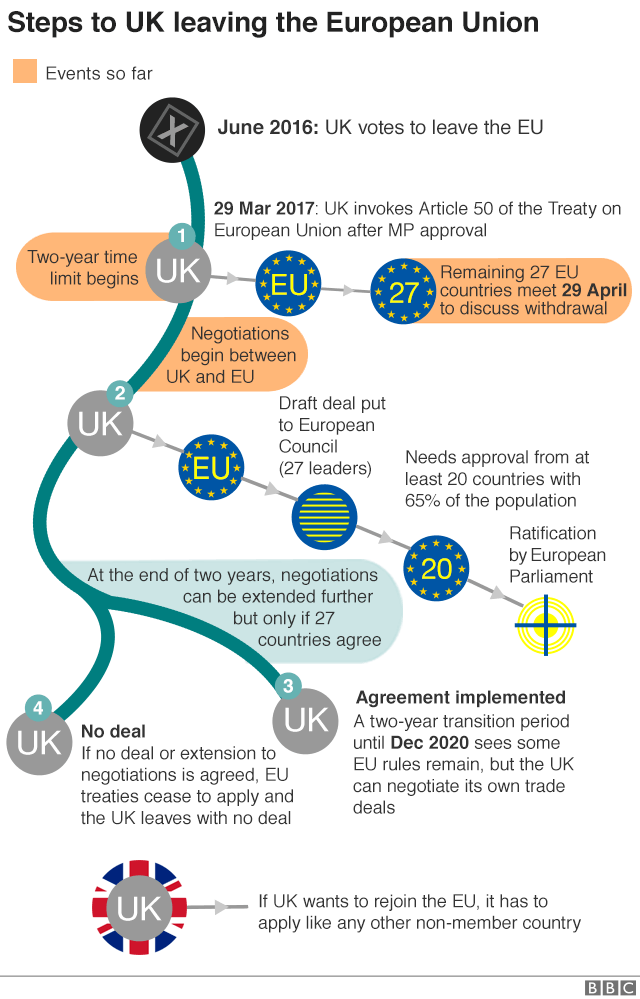
The problem is that at the time of the referendum Brexit was just a vague idea: Britain leaves the EU. That can mean a lot of different things, and no individual one of those things is popular. So the UK is in the curious situation where all the possible outcomes (PM May’s plan to leave the EU in name only, and remain subject to EU customs laws; leave for real and erect a national border between Ireland and Northern Ireland, possibly restarting the Troubles; Parliament deciding to oppose the Brexit referendum and stay in the EU; holding a new referendum on some particular Brexit plan) seem far-fetched.

I can’t help noticing the comparison to repealing ObamaCare, and why Republicans were never able to come through on the “replace” part of repeal-and-replace: ObamaCare is a specific program and “repeal” is a vague idea. As soon as Republicans tried to flesh out their specific replacement, it was less popular than ObamaCare.

The Brexit situation is at least producing some good humor, like Andy Serkis portraying some kind of Gollum/Theresa May synthesis.

Now let’s move to the yellow vest protests in France. Basically, it’s as if in 2016 the angry Trump and Sanders voters had gotten together and taken to the streets. Or maybe if Occupy Wall Street and the Tea Party found a common cause. It’s a strange mixture of left-wing and right-wing populism. It’s anti-government, but none of the opposition parties have managed to stake a claim on it. Crimethinc comments:

Clearly, neoliberal capitalism offers no solutions to climate change except to place even more pressure on the poor; but when the anger of the poor is translated into reactionary consumer outrage, that opens ominous opportunities for the far right.

The issue that seems to have touched off the recent protests is a green tax, a move “to increase fuel taxes to raise money for eco-friendly projects“. The Macron government has since backed off, but the protests — mostly non-violent, but occasionally violent — continue.

As in the US, there is a widespread but inchoate feeling that the system is working against ordinary people. It remains to be seen whether someone will manage to turn that view into a program that makes things better, whether some demagogue will ride the yellow vests to power, or whether the energy will dissipate without doing anything to decrease the general dissatisfaction.

In Germany, Angela Merkel won’t seek re-election when her term ends in 2021. She has already stepped down as head of her party, the Christian Democrats. Her replacement is Annegret Kramp-Karrenbauer.

The party has faced a dilemma, to either keep itself on the course set by Merkel – who was determined to secure the centre ground and has turned the CDU into a champion of gay marriage, a minimum wage and a quota for women in politics – or to take it more to the right in an attempt to win back the voters lost to the Alternative für Deutschland (AfD). … Kramp-Karrenbauer’s victory is a sign that the party wants to continue on the path set for it by Merkel. Nevertheless, Kramp-Karrenbauer has repeatedly said she would forge her own path, and is decidedly more socially conservative than her predecessor.

In Brazil, right-wing populist Jair Bolsonaro will take office on January 1. He plans to pull Brazil out of the UN’s Global Compact for Migration, and to develop the Amazon rain forest. In many ways a Brazilian version of Trump, we’ll see if he has a similar impact on Brazil’s rule of law.

Vox talks to North Korea watcher Van Jackson, who is not impressed with the “progress” Trump thinks he has made toward de-nuclearization. In his view, events are proceeding according to Kim Jong Un’s plan, not Trump’s.

He’s been pushing for simultaneously growing the economy and becoming a nuclear power. Now that he’s got the nuclear program where it needs to be, he’s decided to more aggressively pursue economic development, because that’s the other part of his strategy.

Pursuing economic development means getting sanctions relief. And how can you possibly get sanctions relief without pursuing a charm offensive?

So where we are today is because Kim reached what he sees as a position of strength.

… The structure of the confrontation has not changed. The nuclear situation has not changed. Sanctions have not changed. And frankly, they’re not likely to.

And finally, Yemen, where a war has combined with an ongoing famine to produce a truly horrifying situation. The UN has warned that 13 million people in Yemen are facing starvation in “the worst famine in the world in 100 years”

The famine is the direct result of the Saudi Arabian-led intervention in Yemen and blockade. Yemen was already the most impoverished nation in the Arabian Peninsula and the Middle East, and Al Hudaydah one of the poorest cities of Yemen, but the war and the naval blockade by the Saudi-led coalition and the United States Navy made the situation much worse. Fishing boats, the main livelihood of Al Hudaydah’s residents, were destroyed by Saudi airstrikes, leaving them without any means to provide for their families. As a result, one child dies every ten minutes on average. A UN panel of experts found that Saudi Arabia is purposefully obstructing the delivery of humanitarian aid into Yemen.

The particularly dismal thing about the US role in this tragedy is that so few Americans have any idea where Yemen is or why we’re involved in a war there. (Yemen’s civil war is a proxy war between Saudi Arabia and Iran. We’re on the Saudi side.)

The murder of Washington Post journalist Jamal Khashoggi by the Saudi crown prince has at least got people taking another look at our relationship with Saudi Arabia. Thursday, the Senate passed a resolution against US involvement in Yemen.

This joint resolution directs the President to remove U.S. Armed Forces from hostilities in or affecting Yemen within 30 days unless Congress authorizes a later withdrawal date, issues a declaration of war, or specifically authorizes the use of the Armed Forces. Prohibited activites include providing in-flight fueling for non-U.S. aircraft conducting missions as part of the conflict in Yemen.

The resolution is not being debated in the House, though, and Trump could veto it even if it passed the House, so it has no legal effect. It does, however, mark the willingness of at least a few Republican senators to break with Trump on this issue. No doubt it will come up again when Democrats take control of the House in January.

and you also might be interested in …

Interior Secretary Ryan Zinke is the latest corrupt official to leave the Trump administration. But in a virtual replay of Scott Pruitt’s exit, his replacement will be no improvement in policy terms: Deputy Secretary David Bernhardt is a former oil-industry lobbyist.


I’m trying not to make too much of the showdown in the Oval Office between Trump and Nancy Pelosi. I think Pelosi handled him well, but even so: Personality conflict is what Trump does; if we’re talking about whether our leader beat their leader, we’re on his turf.

Democrats need to stay focused on the people who gain or lose from what the government does, like the 7-year-old girl who died of dehydration while in the custody of the Border Patrol, or the millions who stand to lose their health insurance if ObamaCare really is ruled unconstitutional. Whether or not Pelosi got in the best line is of little importance by comparison.


Alexandria Ocasio-Cortez:

Double standards are Paul Ryan being elected at 28 and immediately being given the benefit of his ill-considered policies considered genius; and me winning a primary at 28 to immediately be treated with suspicion & scrutinized, down to my clothing, of being a fraud.

When I was discussing the ways that Hillary Clinton had to overcome sexism in 2016, one of the things I pointed to was the abundance of positive cultural stereotypes that are open to men with some weakness or character flaw: A duplicitous man can be a charming rogue, for example. An angry man can be a Jeremiah. No comparable framing is available to a woman.

In the Brett Kavanaugh hearings, both Kavanaugh and Lindsey Graham expressed anger in ways that would have made Christine Blasey Ford or Diane Feinstein appear to be raving. We’re used to seeing men as channels for righteous indignation. Women, not so much.

We’re seeing a similar thing here. An inexperienced man can be a whiz kid, a young gun, or a young Turk. None of those frames fits a woman. Some types open to young women are ingenue, mean girl, and damsel in distress — none of which are all that useful to a woman in a position of power.

It’s important to understand this as structural sexism. Even if nobody were consciously trying to mistreat Ocasio-Cortez, the same problem would be present: American men (and a lot of women as well) don’t know how to think about or talk about women in certain roles. So even when we think we are open to them playing those roles, our unconscious reactions will betray us if we don’t pay attention.


Another much-maligned female politician is Nancy Pelosi. She seems to have nailed down the support she needs to become Speaker when the new Congress takes office on January 3. To get the last few votes, she pledged to step down as Speaker after 2022.


Pro Publica looks at the IRS, whose budget and staff keeps shrinking. Meanwhile, audits are down and uncollected taxes are up, providing a “tax cut for tax cheats”.

Tax collection largely depends on the public’s voluntary cooperation, which could be endangered if people start to think that everyone else is cheating. That was largely the problem in the Greek economic crisis. It wasn’t that the Greek government spent too much money, it was that it couldn’t collect the taxes it was owed.


The Republican attempt to undo the 2018 election continues. Michigan has now passed a law that guts a referendum to raise the minimum wage and require paid sick leave. In states where the legislature is heavily gerrymandered, the only way voters can control the state government is through referenda and through state-wide offices like the governorship. But undemocratic Republican legislatures are doing their best to take power away from these voter-controlled institutions.

and let’s close with something memorable

In August, 2014, to commemorate the 100th anniversary of Britain’s entry into World War I, 888,246 red ceramic poppies (one for each of the British and colonial soldiers who died in that war) were arranged to flow out of a window in the Tower of London and fill the moat. The temporary exhibit (now gone) was called “Blood Swept Lands and Seas of Red”. It’s one of the most stunning views of the cost of war I’ve ever seen.

Making Truth Matter

This is the crisis of journalism, which I feel that journalists have not wrapped their heads around very well: It’s no longer particularly difficult to uncover the truth and write about it. All knowledge is public these days. Everything is out there. If you want to go find it, you can. The challenge is making truth matter.

– David Roberts
Why is this Happening?” 12-4-2018

This week’s featured post is “Why All the Bush Nostalgia?” In the end, I find that what I’m nostalgic for is a shared reality that is accepted by both major parties and forms the playing field for our political contests. Now 1/3 of the country lives in its own reality and is virtually unreachable.

The David Roberts interview quoted above plays a key role in that post. Near the end of that conversation, Chris Hayes sums up: The problem isn’t with conservatives as individuals — Roberts has just said that they’re not dumb — but with the social processes of the conservative community.

Remember: Everyone’s got confirmation bias. Everyone does motivated reasoning. We’re all doing that. But in the divorce, one side got the actual institutions that do a pretty good job of producing knowledge, and the other side didn’t get any of it. That’s the key here. … The institutional universe of developed rigorous processes of attempting to get at the truth, the entirety of that, more or less, ended on the left side in the epistemic divorce.

By “institutional universe” he means the scientific community, academia, and mainstream journalism.

This point is similar to the one I was making last week in my review of Network Propaganda.

This week everybody was talking about the Mueller investigation

A number of interesting court documents came out these last two weeks:

Some of these documents (particularly the Flynn memo) were only released to the public with substantial redactions, so there has been a lot of tea-leaf-reading in the media. I’m trying to avoid getting ahead of the facts, so I’ll just link to it without commenting.

One part that doesn’t require much interpretation, though, comes from the “Cohen’s illegal campaign contributions” section of the SDNY document:

During the campaign, Cohen played a central role in two similar schemes to purchase the rights to stories – each from women who claimed to have had an affair with Individual-1 – so as to suppress the stories and thereby prevent them from influencing the election. With respect to both payments, Cohen acted with the intent to influence the 2016 presidential election. Cohen coordinated his actions with one or more members of the campaign, including through meetings and phone calls, about the fact, nature, and timing of the payments. In particular, and as Cohen himself has now admitted, with respect to both payments, he acted in coordination with and at the direction of Individual-1. [my emphasis]

SDNY (not Mueller) is claiming that the president himself was part of that criminal conspiracy. The Trump Organization was also involved:

Executives of the Company agreed to reimburse Cohen … the Company then falsely accounted for these payments as ‘legal expenses.’


It’s fascinating to watch Fox News try to spin this. Here’s Byron York suggesting how Trump might claim that the payments to Stormy Daniels and Karen MacDougal weren’t illegal campaign contributions:

I think Trump’s biggest defense in the payoff case is: “I’ve been paying off women for years. … I didn’t start doing it when I ran for president.”

Basically, it’s an “I’m not a crook, I’m just a scumbag” defense. The Fox panel also invokes the same logical fallacy Trump himself often uses: that charges of non-Russia-related crimes indicate that prosecutors don’t have evidence of Russia-related crimes. But there’s no logical connection there.

Also, Cohen’s lying-to-Congress confession goes right to the heart of collusion: At the same time that Russia was hacking the DNC and putting together its social-media campaign to elect Trump, and Trump was calling for an end to sanctions against Russia, Trump’s people were negotiating with Putin to build Trump Tower Moscow. The outlines of a conspiracy case are starting to take shape.


Another campaign violation is coming out: There was illegal coordination between the Trump campaign and the NRA, which spent $30 million supporting him.

Reporting by The Trace shows that the NRA and the Trump campaign employed the same operation — at times, the exact same people — to craft and execute their advertising strategies for the 2016 presidential election. … “I don’t think I’ve ever seen a situation where illegal coordination seems more obvious,” said Ann Ravel, a former chair of the FEC who reviewed the records. “It is so blatant that it doesn’t even seem sloppy. Everyone involved probably just thinks there aren’t going to be any consequences.”


A point that everyone needs to keep in mind: Again and again, when Trump’s people were asked about contacts with Russia, they lied. Some lied to Congress, some lied to investigators, and Trump himself repeatedly lied to the public. Trump and his supporters still have not put forward a credible story that explains what motivated all these lies.


I posted this video when it came out in 2017, but it’s worth watching again.

and election fraud in North Carolina

Invariably, when one side starts making up stories about the other cheating, the result is cheating “to get even” on their own side. It’s no big deal any more, they think, because everybody is doing it.

In North Carolina’s 9th congressional district, Republican Mark Harris appeared to win by 905 votes. But there were some obvious shenanigans with absentee ballots. Once that was noticed, it became clear that something similar had happened in Harris’ narrow primary win over the incumbent congressman.

The state election board has refused to certify Harris’ victory, and could order a new election. This is the only seat in Congress that is still undecided.

and other Republican attempts to undo the will of the voters

After Democrat Roy Cooper won the North Carolina governorship in 2016, the gerrymandered Republican super-majority in the legislature changed a bunch of rules to take power away from the governorship. At the time this seemed like an extreme overreach, causing the Electoral Integrity Project to score North Carolina’s democracy as on a par with countries like Cuba and Indonesia.

But that’s become the model for how Republicans respond to losing elections.

In November, Wisconsin’s electorate ended eight years of Republican dominance in state government by choosing Democrats Tony Evers as governor and Josh Kaul as attorney general. Democrats also won races for secretary of state and state treasurer. … Having lost the governorship, [Republicans are] using a lame-duck session of the legislature to strip Evers of many powers they were perfectly content to see Republican Gov. Scott Walker exercise. Why are they doing this now? Because Walker, who was defeated by Evers, is still in office to sign their bills.

Among other things, the legislation would stop Evers from taking control of a state economic development agency that the Democrat has pledged to abolish, and it would make it harder for him to overturn restrictions Walker imposed on social benefits. It would also limit early voting (which helped the Democrats win by expanding turnout). For good measure, the legislature wants to prevent Kaul from withdrawing the state from a lawsuit against the Affordable Care Act — even though that’s exactly what Kaul told voters he would do.

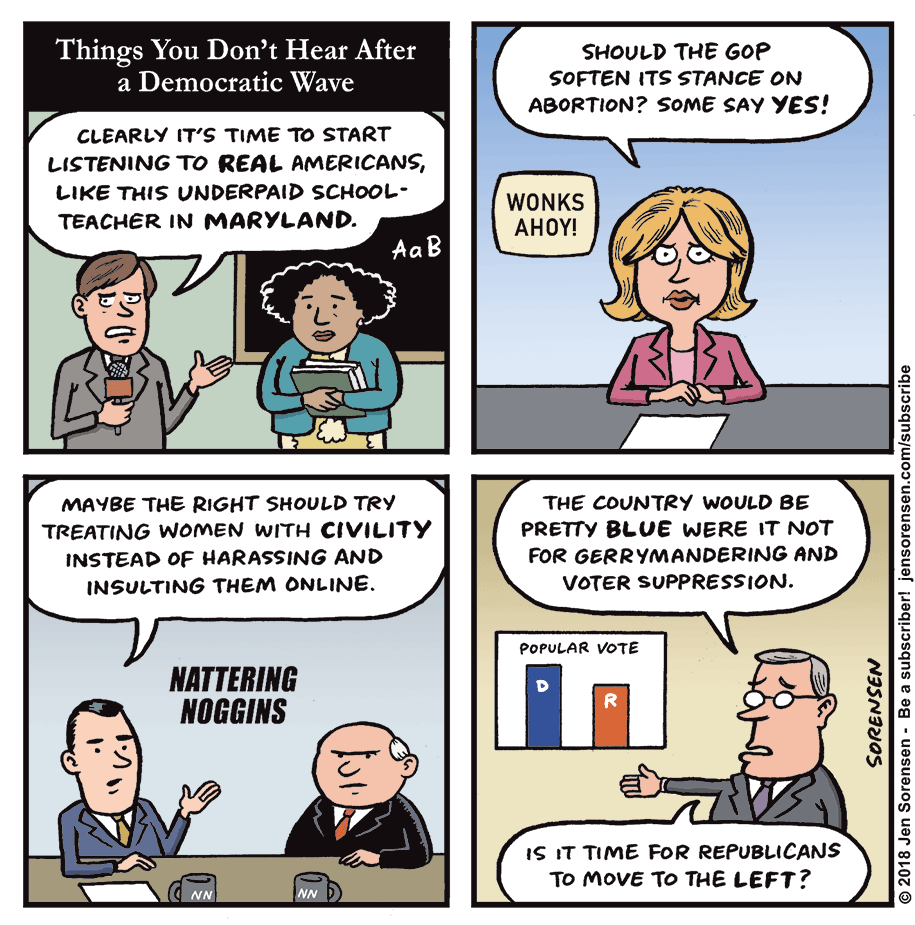
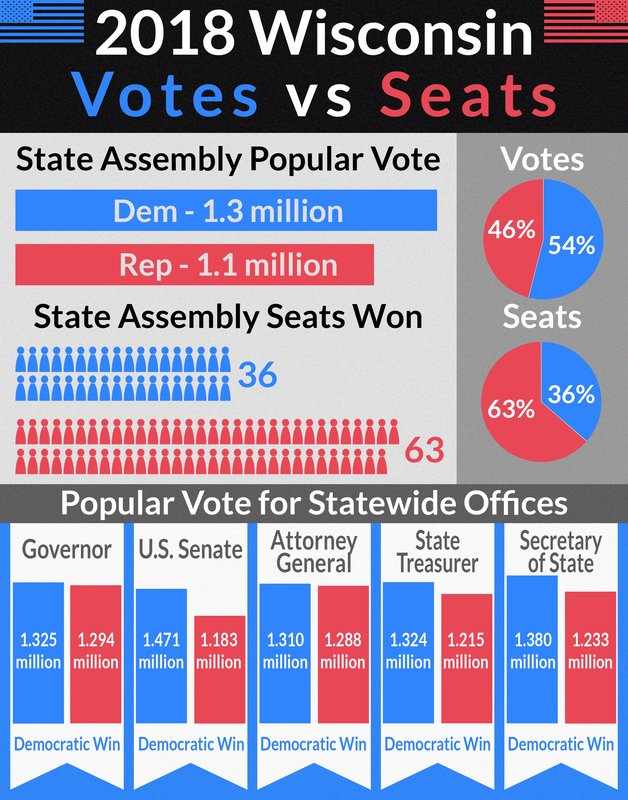
In addition to the plain bad sportsmanship of this, there’s another issue: The Republican majority in the legislature is already illegitimate.

The Democrats won the popular vote in State Assembly contests by a margin of 54 percent to 46 percent but emerged with only 36 seats to the GOP’s 63.

Something similar is happening in Michigan. In a variety of states, Republican legislatures are mucking around with laws passed by voter referendums. In Florida, for example, 65% of the electorate voted to restore voting rights to felons (other than murderers and rapists). But not so fast, voters. The Secretary of State has invented some problems with the language of the referendum, and so he is refusing to give instructions to local officials who need to implement the law.

Some counties say they will allow former felons to begin registering on January 8, but others may not. That could lead to lawsuits over the disparities in people’s voting rights based on the county where they live. Michael McDonald, a University of Florida professor and an expert in elections, predicted Tuesday that Detzner’s “resisting implementation of the restoration of felons voting rights…is going to lead to costly litigation for the state, with voters footing the bill.”

but you should still be paying attention to the climate

Carbon emissions are still rising: Up an estimated 2.7% in 2018, after a 1.6% rise last year. This breaks what had been a “three-year plateau”.

The United States is one of the culprits, with emissions up 2.5% after several years of declines. (The EU posts a decline.) That’s not as bad as India’s 6.3% rise, but there’s also much less excuse for it. (India is still trying to bring electricity to 300 million people.)

It’s important to keep the right baseline in mind: Leveling off is not nearly good enough to avoid climate disasters down the road. Carbon emissions need to be going down quickly. The NYT has some compelling graphics comparing the track emissions are on, where the Paris Agreement would put them, and what would be needed to keep global warming below 2 degrees centigrade.

Meanwhile, the Trump administration continues to go in exactly the opposite direction. This week they unveiled a plan to open 9 million acres of the American West to oil and gas drilling.

and you also might be interested in …

The New York Times points out just how revealing the location data collected by your cell phone apps can be. The data sold to advertisers may not say who you are, but who else spends the night at your house and then goes to your workplace? A separate article gives you instructions for turning off this data flow.


A hidden gem from a couple of weeks ago is Ezra Klein’s conversation with Peter Beinart on Klein’s weekly podcast. It’s the kind of conversation that a non-Jew like me seldom gets to hear: two smart, articulate, liberal American Jews talking to each other as Jews.

The conversation is multi-faceted, but centers on (in Klein’s words) “the strange, vulnerable space that many Jews, myself included, find themselves in today.” It covers fear of rising anti-Semitism; the debate over whether Jews are better off turning to the right and allying with the Evangelical Christians or to the left and allying with other religious communities (like American Muslims) who understand the need for religious tolerance; disillusionment with Israel’s right-wing drift; and a view of Judaism that emphasizes “the importance of remembering what it’s like to be a stranger in a strange land, of knowing that bigotry takes whatever forms it requires to justify itself, of maintaining humanity amid struggle.”


Here’s an interesting view from the other side: an anti-transgender-rights activist analyzes his side’s stunning (68%-32%) loss on a referendum to repeal a transgender rights law in Massachusetts.

The author faults his side’s reliance on the fear-mongering predator-in-the-bathroom argument, which he admits was “largely contrived”, i.e., based on nothing. He argues instead that conservatives need to target trans people directly:

three important points were not being presented to the public: (1) the LGBT movement’s “civil rights” argument has no basis whatsoever; (2) that “transgenderism” is actually a mental disorder and a destructive ideology, and (3) this law forces people to accept an absurd lie – men can never become women.

He makes an analogy to the same-sex marriage debate, which his side also lost: Rather than talk about side issues like “every child deserves and mother and and father”, they should have denigrated gays more:

they refused to argue that homosexuality was immoral, had terrible health risks, was fraught with addiction and mental health problems, etc.

Personally, I think that strategy only works as long as the denigrated group stays in the closet. Once people understand that they already know such individuals, they stop buying the argument that they’re all sick and immoral. (It’s hard to convince yourself that the nice gay couple across the street is a threat to Western civilization.)

Through my church, I know a couple of transgender young adults. They don’t seem mentally ill to me. And to the extent that they have any problems — what young adult doesn’t? — I don’t see how forcing them back into their previously assigned gender roles will help.


Forbes looks at the President’s self-dealing. Of the money contributed to Trump’s 2020 campaign, $1.1 million has been spent at Trump businesses. The article raises questions about how much value the campaign is getting for its money.


Price-fixing schemes prevent generic drugs from lowering your healthcare expenses as much as they should.


The former presidents and their wives shared a pew during the Bush funeral. During the recitation of the Apostle’s Creed, Trump and Melania were the only ones who didn’t join in. It’s often illuminating to think of Trump as a child, and that’s what I saw when the cameras panned past him: Church is boring, and he doesn’t endure boredom well. At least he didn’t fidget.


If Colin Kaepernick’s lawsuit against the NFL needed any more ammunition, the Washington Redskins have just provided it. Kaepernick — who has been criticized by President Trump for kneeling during the national anthem to protest police killings of young blacks — was still unsigned on opening day. But as the season goes on, more and more quarterbacks get injured and jobs open up. Kaepernick has not been offered any of them, despite being a Super Bowl quarterback still in his prime.

Washington was leading its division when it’s starting quarterback, Alex Smith, broke his leg. But rather than turn to Kaepernick, they moved back-up Colt McCoy into the starting role and signed ex-Jet Mark Sanchez to to be the back-up. (Sanchez is best known for the famous butt-fumble play against the Patriots, which made #2 on this list of all-time worst plays.) Things went badly, and the team fell to 6-6.

Even so, there were still many playoff scenarios when McCoy also got injured for the rest of the season. Of all the quarterbacks available during this time, Kaepernick has clearly been the best option. But instead they signed Josh Johnson, who “last threw a pass in 2011”.

Sunday, the Redskins fell behind the New York Giants 40-0 before losing 40-16. Their playoff chances are now virtually gone. Their fans need to start asking why staying on Trump’s good side was more important than winning.


Rex Tillerson made his first public appearance since being fired from the Trump administration.

On Thursday night, former Secretary of State Rex Tillerson said in a rare public appearance that he had to repeatedly tell Donald Trump that some of the things the president wanted to do were impossible because they were against the law or violated a treaty.

“I’d say here’s what we can do,” the former Exxon CEO said in a Houston speech. “We can go back to Congress and get this law changed. And if that’s what you want to do, there’s nothing wrong with that.”

Mr Tillerson called the president “a man who is pretty undisciplined, doesn’t like to read, doesn’t read briefing reports, doesn’t like to get into the details of a lot of things, but rather just kind of says, ‘This is what I believe.'”

Trump naturally couldn’t let that be the final word, so he struck back, tweeting that Tillerson was “dumb as a rock” and “lazy as hell”.

Trump never seems to get it: When you insult someone that YOU brought into the public eye, you’re just insulting your own judgment. As I commented after he called Stormy Daniels “Horseface”: Dude, you’re the one who had sex with her.


Trump continues to strip expertise out of the government: Nikki Haley may not have had foreign policy experience before she became UN Ambassador, but at least she had some kind of substance (having been governor of South Carolina). Her replacement, Heather Nauert, has none. She was a Fox News blonde until Trump made her a spokeswoman for the State Department. She looks good on TV, and that’s what counts in this administration.

“In terms of what we normally look for at the United Nations, her résumé is very thin,” David Gergen, the veteran presidential aide, told CNN’s Anderson Cooper on Thursday night. He said the role of U.N. representative was not a “communications job” but rather “a place where we conduct active diplomacy with nations around the world.”

Not any more, apparently.

and let’s close with something seasonal

This year once again, we’re debating “Baby, It’s Cold Outside”: Is it really a date rape song or not?

Here’s an analysis that I find persuasive: In the context of its era (the 1940s), it wasn’t. But that context is so lost by now that playing the song should require an explanation longer than the song itself. Here’s the conclusion:

So it’s not actually a song about rape. In fact it’s a song about a woman finding a way to exercise sexual agency in a patriarchal society designed to stop her from doing so. But it’s also, at the same time, one of the best illustrations of rape culture that pop culture has ever produced. It’s a song about a society where women aren’t allowed to say yes … which also happens to mean that it’s also a society where women don’t have a clear and unambiguous way to say no.

So I wouldn’t include it on my holiday play list, but now that I know how to listen to it, I also won’t be disgusted by it.

Political Asymmetry

No Sift next week. The next new articles will appear December 10.

To speak of “polarization” is to assume symmetry. No fact emerges more clearly from our analysis of how four million political stories were linked, tweeted, and shared over a three-year period than that there is no symmetry in the architecture and dynamics of communications within the right-wing media ecosystem and outside of it.

– Benkler, Faris, and Roberts, Network Propaganda

This week’s featured post is “The Media isn’t ‘Polarized’. It has a Right-Wing Cancer.” In it, I review the recent book Network Propaganda, which you can read for free online.

If you happen to be near Billerica, Massachusetts on Sunday, you can hear me speak at the Unitarian Universalist Church on “Men and #MeToo”.

This week everybody was talking about Trump vs. the law

A federal judge blocked the administration’s new asylum rules, which would have automatically denied asylum to anyone who crossed the border somewhere other than a recognized border crossing. In the ruling, he wrote:

Congress has clearly commanded in the [Immigration and Naturalization Act] that any alien who arrives in the United States, irrespective of that alien’s status, may apply for asylum – “whether or not at a designated port of arrival.” Notwithstanding this clear command, the President has issued a proclamation, and the Attorney General and the Department of Homeland Security have promulgated a rule, that allow asylum to be granted only to those who cross at a designated port of entry and deny asylum to those who enter at any other location along the southern border of the United States.

The rule barring asylum for immigrants who enter the country outside a port of entry irreconcilably conflicts with the INA and the expressed intent of Congress. Whatever the scope of the President’s authority, he may not rewrite the immigration laws to impose a condition that Congress has expressly forbidden.

So: There’s a law, the judge quotes it, and Trump’s policy obviously violates it.

Try to keep that in mind, because from there Trump did everything possible to try to make the controversy into yet another clash of personalities. Without responding to the question of whether he was violating the law, he denounced the “Obama judge” and the Ninth Circuit that he serves in. That prompted Chief Justice John Roberts to issue a statement directly contradicting the President:

We do not have Obama judges or Trump judges, Bush judges or Clinton judges. What we have is an extraordinary group of dedicated judges doing their level best to do equal right to those appearing before them. … The independent judiciary is something we should all be thankful for.

Trump argued back, and tweeted, and returned to the subject in a Thanksgiving call to the troops, claiming that “It’s a terrible thing when judges take over your protective services, when they tell you how to protect your border.” But it is the law that tells the President what to do. The judge is just reading the law.

Trump’s trolling has produced a bunch of drama and drawn a lot of media attention. But he still has not addressed the plain fact that his policy violates the law. The key conflict here is not Trump vs. an Obama judge or the Ninth Circuit or John Roberts or any other collection of Deep State enemies. It’s Trump vs. the law.


On Slate, Angelo Guisado explains why asylum seekers cross the border illegally:

the U.S. Customs and Border Protection systematically and unlawfully rejects their asylum attempts at official ports of entry.

The unwillingness of the Trump administration to process asylum claims at ports of entry led 450 would-be asylum seekers to camp out on the Mexican side of bridges leading to El Paso. Rather than deal with them according to the law, U.S. custom officials arranged with Mexican officials to have the migrants removed.

The administration says there is a deal with Mexico to keep asylum seekers on the Mexican side of the border until their asylum petition is granted. (Though the incoming Mexican government says there is no deal yet , and incoming House Oversight Committee Chair Elijah Cummings says “that’s not the law“.) I worry that the next step is to slow down the process even further, in hopes that people will give up.

In a tweet concerning an incident at the border on Sunday, Lindsey Graham tweeted about “the broken laws governing asylum”. But it’s not that the laws are broken, it’s that the administration keeps breaking them.


I know I don’t do breaking news well, and things often turn out to be different than they first appear, so I’m not going to say much about the tear gas attack against the would-be border-crossers Sunday. The Guardian has a lot of pictures.


In other legal news concerning Trump, the New York attorney general’s suit against the Trump Foundation will go forward. A state judge in New York denied a motion by the Trump family to dismiss the suit, which claims the Foundation “functioned as little more than a checkbook to serve Mr. Trump’s business and political interests.” The AG seeks to dissolve the Foundation and claim monetary damages from the Trump family.

One argument Trump’s lawyers made for dismissing the suit was of a piece with his continuing attack on our judicial system. Basically, the claim was that Trump can’t get a fair hearing in a state like New York, where he is unpopular. This is similar to the claim he made against Judge Curiel in the Trump University case, that Curiel couldn’t hear Trump fairly because he was “Mexican”. Judges, in Trump’s view, are not experts who rule on the law, they are just people expressing their opinions. They rule for or against him because they like or dislike him, and not because of facts and the law.


Earlier this month, another judge put a serious delay on the administration’s approval of the Keystone XL oil pipeline into Canada. The judge claims that government agencies “simply discarded” factual findings made under the Obama administration, without providing “reasoned explanations”.

“This has been typical of the Trump administration,” said Mark Squillace, an expert on environmental law at the University of Colorado Law School. “They haven’t done a good job dealing with the factual findings of the previous administration. The courts have been clear that you can change your position, even if it’s for a political reason. But you have to show your work, how you got from Point A to Point B.”

and Trump’s shrug at MBS murdering a Washington Post contributor

Again, ignore Trump’s blather and keep the basic facts in mind: It is increasingly clear that Saudi Crown Prince Mohammad bin Salman ordered the killing of Wsahington Post contributor Jamal Khashoggi, which took place October 2 at a Saudi consulate in Istanbul, where Khashoggi had gone to get documentation about his divorce so that he could remarry. (His Turkish fiance was waiting in the car.) Khashoggi was a Saudi journalist who had gotten on the wrong side of the Saudi government and had gone into voluntary exile. After some time in London he had moved to Virginia in June, 2017 and had been living as a legal permanent resident of the United States.

So an American president should have three issues with MBS: killing journalists whose only threat to you is what they might write, killing people who have left your country and are on the soil of our NATO ally, and killing people who live under our protection.

This week the White House put out a statement. It is poorly written, poorly thought out, full of falsehoods, and morally bankrupt. The gist of it is that America’s relationship with Saudi Arabia and with MBS as the heir apparent will go forward without a hitch. It makes two arguments:

  • Saudi Arabia is a necessary ally in the regional power struggle with Iran.
  • The Saudis are good customers of the U.S., particularly of the U.S. defense industry.

Apparently, this means they can do whatever they want and we just have to accept it. It’s hard to reconcile this passivity with Trump’s frequent invocation of how “strong” America has become under his rule. In response, Hawaiian Democrat Rep. Tulsi Gabbard tweeted:

being Saudi Arabia’s bitch is not “America First.”

Trump’s defense of MBS is similar to his defense of Vladimir Putin: We live in a nihilistic world where nothing can actually be known, so we might as well believe the people we want to believe. (As they say in Assassin’s Creed: “Nothing is true. Everything is permitted.“)

King Salman and Crown Prince Mohammad bin Salman vigorously deny any knowledge of the planning or execution of the murder of Mr. Khashoggi. Our intelligence agencies continue to assess all information, but it could very well be that the Crown Prince had knowledge of this tragic event – maybe he did and maybe he didn’t!

In a subsequent interview Trump hammered harder on this point: US intelligence agencies don’t really know anything, their leaders just “have feelings, certain ways“. Well, the Saudis have feelings too. (In the same interview, he said “if we went by this standard, we wouldn’t be able to have anybody as an ally”. Try to imagine how that statement goes down in Canada or the UK.)

Julian Sanchez parodied the White House statement’s style and logic:

Crucifixion is a terrible, terrible thing. Should never happen. And we may never know whether Jesus was guilty of crimes against Rome. Who can say? But thirty pieces IS a lot of silver, and it would be very foolish to turn it down.


Republicans as well as Democrats have spoken out against Trump’s position. I would characterize the bipartisan criticism like this: The question isn’t whether you believe in “America first”, but rather what you think America is, and where you think American strength comes from. If America is defined by blood and soil, and if its strength comes purely from money and arms, then Trump is right. But if you believe that America is primarily about ideals and values, that anyone who shares those ideals and values is our natural ally, and that our greatest strength comes from the power of those ideals and values, then he is surrendering America, not putting it first.

The next question is what Congress can do. Rep. Brad Stevens (D-CA) wants Congress to intervene in a deal to sell nuclear technology to the Saudis, making sure that the nuclear material can’t be used for weaponry. If the erratic and unpredictable MBS is going to be king, letting the Saudis go nuclear is not measurably better than letting the Iranians go nuclear.


BTW, you can’t overlook Trump’s personal financial interest in keeping the Saudis happy. The true operating principle here might be “Trump first!”


Matt Yglesias writes:

Since Trump is very clearly betraying American values, it’s tempting to accept the notion that he is implementing a trade-off that advances American interests. But “don’t murder our people” and “don’t use embassies located in allied countries as killing zones” are not airy values. They are interests too.

and the Mississippi Senate run-off

The run-off between Democrat Mike Espy and Republican Cindy Hyde-Smith is tomorrow. Given that it’s Mississippi, you’d think Hyde-Smith would have an easy time of it. But she’s doing her best to screw it up. The Senate will be Republican either way: 53-47 if she wins and 52-48 if she loses.

and what we learn from the midterm results

The Democrats’ lead in the House national popular vote keeps growing: It’s up to 8.1%, or just over 9 million votes. That’s bigger than any other recent “wave” election: 2010 (Republicans win by 6.8% or 6 million votes), 2006 (Democrats 8%, 6.5 million), 1994 (Republicans 7.1%, 5 million). But it still can’t touch the Mother of All Midterm Waves, the post-Watergate 1974 election, which Democrats won by 16.8%.

If the remaining undecided election (CA-21) goes to the Republican (who is currently slightly ahead), Democrats will have a 234-201 majority.


Here’s a way to judge the impact of gerrymandering nationwide: In 2016, Republicans won the House national popular vote, but only by 0.9%. That yielded a larger majority than the Democrats will have: 241-194. So a margin nine times bigger gives Democrats a smaller majority.


Nancy Pelosi seems to be doing what she does best: counting votes until she comes up with a majority.

I think Monica Hesse is onto something:

The Nancyness of Nancy Pelosi is like the Hillaryness of Hillary Clinton: It’s not a definition so much as a collection of amorphous descriptors — cackling, scheming, elitist, ex-wife-like — that nobody can ever quite articulate, other than to say they don’t like it.

With that in mind, I’ve been watching a different set of impossible standards attach to Alexandria Ocasio-Cortez as she gets ready to enter Congress. She doesn’t have enough money in her bank account, her clothes are too nice, and so on. How long before her Alexandrianity becomes similarly disqualifying? Before long, we’ll probably start hearing: “I don’t know what it is, I just don’t like her. She’s got too much baggage.”

The phenomenon here is something I would call bank-shot misogyny. Direct misogyny says “I don’t like her because she’s a woman.” Bank-shot misogyny relies on the fact that (due to the structural misogyny in our national conversation) mud tends to slide off men and stick to women. Then it asks, “Can’t we find someone with less mud on her?”


A number of articles have reminded us that presidents whose parties lose in midterm elections still often get re-elected: Reagan in 1984, Clinton in 1992, Obama in 2012.

But it’s hard to see how those examples will help Trump. In each case, the midterm loss caused the president to change course, to be more cautious, and to work harder to find common ground with the other party. It’s hard to picture Trump learning that lesson, because Trump never makes mistakes and all conflicts are somebody else’s fault, so there’s never anything for him to learn.


Not so long ago, Illinois and Missouri were both swing states, but they have gone in opposite directions: Illinois is now reliably blue, Missouri reliably red. Bill Clinton won Missouri twice, but Hillary lost it in 2016 by 18%. Republican presidential candidates won Illinois six straight times in 1968-1988, but have lost it seven straight times since. Trump lost it by 17%.

Now it looks like several other central states may be separating in a similar fashion. According to Nate Silver, Democratic House candidates won the popular vote in Pennsylvania by 10%, in Wisconsin by 8%, and in Michigan by 7%. Meanwhile, they lost in Ohio by 5.5%.

For decades, Ohio has been the ultimate swing state. (The last time its electoral votes went to the loser was to Nixon in 1960.) But that seems to be changing, so now it’s red even in a blue year. Virginia, conversely, has made a quick trip from reliably red (Bush by 8% in 2004) to solidly blue (Democratic House candidates by 10% in 2018). Ditto Colorado (Bush by 8% in 2000, Dem House by 10% in 2018).


A Washington Post article about Wisconsin politics shows a promising national model: Trump outrage motivated people to become active in politics, but once they got there they didn’t just try to spread Trump outrage. Instead they branched out into voting rights and progressive local issues.


There’s a weird idea going around that House Democrats either won’t or shouldn’t launch a bunch of Trump investigations “because voters have little tolerance for partisan witch hunts”.

I agree that Democrats shouldn’t try to drum up scandal out of nothing, as Republicans did during the Obama administration. (Benghazi deserved one investigation, not eight.) But there is plenty of legitimate wrongdoing and bad policy to investigate. There’s no need for witch-hunting when there’s a crime wave going on.

So Democrats shouldn’t chase wild rumors or grill Ivanka about her emails. But somebody needs to ask exactly how we started putting kids in cages at the border, and look into how Trump is profiting from his presidency. The wastes of money by various cabinet officials deserve public scrutiny. Once the Mueller Report comes in, the House should hold hearings to publicize its findings and to debate whether they merit further action. That’s not witch hunting, that’s Congress doing its job.

In short, Democrats should have high standards for what they investigate. But I think there’s plenty of material that meets high standards.

but we should all be watching the Justice Department

Tuesday, the New York Times reported that Trump had told White House Counsel Don McGahn that he wanted to order the Justice Department to prosecute Hillary Clinton and Jim Comey. McGahn reportedly told the president that this would be an abuse of power and could be grounds for impeachment.

Like all stories with anonymous sourcing, you have to maintain some degree of skepticism. I don’t believe the Times makes up sources (as Trump often claims), but anonymous leaks usually come from people trying to make themselves look good. McGahn looks good here, so he (or someone loyal to him) is probably the source.

Two things about this story are worrisome: First, it paints a picture of a president with authoritarian impulses, who is only being restrained by underlings who still believe in the rule of law. Second, McGahn has left the White House, and the Justice Department is in the hands of a Trumpist hack, Acting Attorney General Matthew Whitaker. If Trump pushes on the system again, it might yield to him.

And Whitaker has his own issues. A number of legal cases will force judges to rule soon on whether his appointment was legal. And somebody in Congress needs to ask him about this:

Before becoming Jeff Sessions’ chief of staff, acting Attorney General Matthew Whitaker received more than $1.2 million in salary from a conservative nonprofit that does not reveal its donors, according to financial disclosure forms.

That would be one of those justified investigations I talked about. No need to nail him to the wall, but get an answer: What was he paid for?

and the climate

A joint report issued by 13 federal agencies directly contradicts the administration’s rhetoric on global warming. Current policy is to loosen climate-change-fighting restrictions in order to spur economic growth. But the report emphasizes the cost of climate change: The report predicts

that if significant steps are not taken to rein in global warming, the damage will knock as much as 10 percent off the size of the American economy by century’s end.

… in direct language, the 1,656-page assessment lays out the devastating effects of a changing climate on the economy, health and environment, including record wildfires in California, crop failures in the Midwest and crumbling infrastructure in the South. Going forward, American exports and supply chains could be disrupted, agricultural yields could fall to 1980s levels by midcentury and fire season could spread to the Southeast, the report finds.

Meanwhile, Republican senators are holding the line on current GOP rhetoric: Doing anything about global warming will break the economy, which just sort of ignores the whole report. Doing nothing about global warming is going to break the economy.

And then there’s this:The NYT has a good article about the persistence of coal as a fuel for electrical plants, in spite of the environmental costs and economic competition from cleaner fuels.

and you also might be interested in

There are lots of rumors about what Robert Mueller might do next, but we’ll all know soon enough.


The stock market has been plunging lately (though it’s up so far this morning), but Trump econ advisor Larry Kudlow isn’t worried about a recession. Of course, he also wasn’t worried about a recession in 2008.


Paul Krugman points to a way forward on health care: Congress may be gridlocked, but a lot can be done in states that Democrats control:

The most dramatic example of how this can be done is New Jersey, where Democrats gained full control at the end of 2017 and promptly created state-level versions of both the mandate and reinsurance [two provisions of the ACA that Republicans have managed to undo at the national level]. The results were impressive: New Jersey’s premiums for 2019 are 9.3 percent lower than for 2018, and are now well below the national average. Undoing Trumpian sabotage seems to have saved the average buyer around $1,500 a year.

Now that Democrats have won control of multiple states, they can and should emulate New Jersey’s example, and move beyond it if they can. Why not, for example, introduce state-level public options — actuarially sound government plans — as alternatives to private insurance?

Insurance works better with a bigger population. So how about it, California?


Are you ready for your annual dose of humility? The NYT’s 100 Notable Books list is out. This year I have read exactly two of the novels: The Witch Elm by Tana French and Spinning Silver by Naomi Novik. Of the nonfiction books: zero.


“Money laundering” isn’t supposed to be this literal: Dutch police found $400K hidden in a washing machine.


Retired General Stan McCrystal writes about his decision to get rid of his portrait of Robert E. Lee.

We want to be proud of our past, so it’s tempting to look at only the best aspects of it. … There is, in the end, little point in studying a version of history that contains cartoons and monuments rather than real people with nuanced actions and decisions — people whose complexities can teach us about our own. As we come to learn more about our world and ourselves, it is crucial to reexamine our role models and our enemies. There is tremendous value in wrestling with the errors over which history commonly glosses.


This week included the strange tale of the 26-year-old American, John Chau, who went to the remote North Sentinel Island to attempt to convert the natives to Christianity. The natives killed him, as they have killed or tried to kill any outsiders who come to their island. North Sentinel sits in the Bay of Bengal as part of the Andaman chain, and is technically part of India. The Indian government has put it off limits and the Indian navy patrols to keep outsiders away. Chau had hired a fishing boat to stay offshore, and paddled in on a kayak.

This is one of those stories that people going to project their own values onto. To me it points out the hazards of living in a myth rather than in reality. With no common language and little common experience, Chau would have needed years to communicate even the most basic notions of his religion, and he seems not to have made preparations for that kind of stay. He apparently paid no attention to the possibility that he might bring diseases that could wipe the natives out. I picture him expecting some kind of Pentecost miracle, with himself as St. Peter. That lack of realism got him killed.


The Washington Post reported last Monday that Ivanka Trump (like Hillary Clinton) used a personal email account for public business. This is an apparent violation of the Presidential Records Act, because Ivanka isn’t just the president’s daughter, she has an official position in the White House. Like Clinton, Ivanka says that she did not understand the rules and had no ill intent. Like Clinton, she addressed the issue by having a lawyer review her records to separate the public emails from the private ones.

The point here shouldn’t be to make problems for Ivanka, but to point out how bogus a lot of the Hillary-email hoo-ha was (as I explained at the time). If the Presidential Records Act is anything like the Federal Records Act that Clinton ran afoul of, violations are not a go-to-jail offense.


George Lakoff’s advice on how to cover Trump:

Journalists could engage in what I’ve called “truth sandwiches,” which means that you first tell the truth; then you point out what the lie is and how it diverges from the truth. Then you repeat the truth and tell the consequences of the difference between the truth and the lie. If the media did this consistently, it would matter. It would be more difficult for Trump to lie.

Actually, it would still be incredibly easy for Trump to lie — he’s a natural — but he wouldn’t get as much benefit out of it.

and here’s something odd

While re-reading the Astro City comic book series this week — I know, I should be reading all that nonfiction on the NYT’s Notable Books list instead —  I ran across the strangely prescient issue #7, published in 2014: Winged Victory, the Astro City universe’s most Wonder-Woman-like character, is being framed as a fraud. Her biggest victories, it is claimed, were staged; the women she has been sheltering and teaching to defend themselves are actually being abused all over again; and so on. When WV goes to a microphone to defend herself, she is shouted down by protesters chanting — wait for it — “Lock her up!” Trump’s crowds didn’t start chanting that about Hillary until 2016.

I’m reminded of an episode of Zorro from 1959, where a Spanish captain gives a patriotic speech and comes darn close to JFK’s “ask not” quote from 1961.

and let’s close with some gross but bizarrely fascinating animal facts

Scientists at Georgia Tech now have an explanation for how wombats manage to poop out cubes. They’re the only known animals with stackable cubic poop.

But even wombat poop is not as amazing as whale earwax. Whales don’t have fingers they can stick into their ears, so their earwax just accumulates through their lives. (Never thought about that, did you?) And they’re huge, so ultimately they wind up with waxy plugs in their ear canals that can be as long as ten inches, plugs that The Atlantic compares to “a cross between a goat’s horn and the world’s nastiest candle”.

It turns out that an earwax plug contains a record of the whale’s life, if you know how to read it.

As whales go through their annual cycles of summer binge-eating and winter migrations, the wax in their ears changes from light to dark. These changes manifest as alternating bands, which you can see if you slice through the plugs. Much as with tree rings, you can count the bands to estimate a whale’s age. And you can also analyze them to measure the substances that were coursing through the whale’s body when each band was formed. A whale’s earwax, then, is a chronological chemical biography.

Researchers at Baylor University have begun studying whale earwax plugs, which coincidentally had been accumulating in museums for more than a century.

“Museums are notorious for collecting everything, and waiting for the science to catch up,” [biology professor Stephen] Trumble says. “We called Charles Potter at the Smithsonian Institution, and he said, ‘It’s interesting you called because we have pallets and pallets of these ear plugs sitting around, and we’re thinking of throwing them away.’ Instead of being thrown away, those ear plugs are now objects of wonder.”

Makes you curious about what else is occupying space in Smithsonian warehouses, doesn’t it?

Trumble and research partner Sascha Usenko measured stress hormones in the plugs, combined findings across numerous whales, and produced “a 146-year chronicle of whale stress”, which turns out to have an obvious-in-retrospect correlation with the output of the whaling industry. The exception is a peak during World War II, when whaling was down, but whales were probably being stressed by underwater explosions. Whale stress is back up lately, possibly in response to climate change.

Lies and Traps

The adage that there are two sides to a story makes sense when those who represent each side accept the factuality of the world and interpret the same set of facts. Putin’s strategy of implausible deniability exploited this convention while destroying its basis. He positioned himself as a side of the story while mocking factuality. “I am lying to you openly and we both know it” is not a side of the story. It is a trap.

– Timothy Snyder, The Road to Unfreedom

This week’s featured post, “The Big Picture: from Russia to Ukraine to Brexit to Trump“, looks at Timothy Snyder’s The Road to Unfreedom.

His analysis of the Putin/Trump style of propaganda has me rethinking how I cover Trump, so this week’s summary is an experiment: Putin and Trump say outrageous things in order to become the story themselves, shifting the focus away from the issues on the ground. Just this week, for example, Trump has blathered a lot of nonsense about the California wildfires. It would be easy to get focused on Trump’s nonsense, and lose sight of the fact that homes are burning, people are dying, and millions of Californians are dealing with a serious air-quality problem.

On the other hand, we shouldn’t all just ignore that our President is disinforming the public, which includes a segment that is inclined to believe him. So here’s what I’m trying this week: I will try to stay focused on the underlying issues. At places where Trump made headlines with a crap statement, I’ll mention that this happened, characterize it with a single adjective (like “Trump said something stupid about this”), and provide a link in case you feel that you must know what it was.

We can’t lose sight of the fact that Trump says ignorant and offensive things on an almost daily basis. But that’s not really news any more.

This week everybody was talking about undecided races

Almost all of them came to a conclusion this week (other than the run-off in the Mississippi Senate race, which will happen next Tuesday).

  • Republicans took both the governorship and the Senate seat in Florida.
  • Stacey Abrams admitted that Brian Kemp will be Georgia’s next governor. But after a long series of voter-suppression abuses by Kemp in his role as Secretary of State, Abrams refused to concede: “Let’s be clear, this is not a speech of concession. Because concession means to acknowledge an action is right, true or proper. As a woman of conscience and faith I cannot concede that. But my assessment is the law currently allows no further viable remedy.”
  • Democrat Kyrsten Sinema won the Arizona Senate race.

A number of close House races weren’t decided until this week, and three are still out. The most interesting was in Maine-2, where the state’s ranked-choice-voting system made a difference:

In this election, the initial round had GOP incumbent Bruce Poliquin winning 46.1 percent and [Democrat Jared] Golden receiving 45.9 percent. Third party candidates garnered 8 percent. After re-allocating these third party votes, the final result was 50.53 percent to 49.47 percent in favor of Golden.

The Republican loser is going to court, claiming that ranked-choice-voting is unconstitutional. But I don’t think he has any kind of a case. Here’s the sum total of what the Constitution says about House elections:

The House of Representatives shall be composed of Members chosen every second Year by the People of the several States, and the Electors in each State shall have the Qualifications requisite for Electors of the most numerous Branch of the State Legislature.

I don’t know how you read a ban on ranked-choice voting into that.

Think how much grief would be avoided if every state had RCV: If you want to vote Green or Libertarian or write in Bozo the Clown, fine. As long as you also express a preference between the Republican and Democratic candidates, you’ve got that base covered.

So here’s where we stand at the moment: Republicans control the Senate 52-47, with the Mississippi run-off pending. Democrats control the House 233-199 with three seats still undecided. The new Congress will be seated on January 3.

The current House popular vote count has the Democrats ahead by 7.7%, or more than 8.5 million votes. (Nate Silver expects it to get into 8-9% range when the final votes are tallied.) The Republican wave of 2010 had a margin of 6.8% or just under 6 million votes. The Republicans’ smaller 2010 victory gave them a larger 242-192 majority, because the system is rigged in their favor.


Don’t say it can’t happen: A Democratic challenger for a seat in the Kentucky legislature appears to have won by 1 vote.

and Nancy Pelosi

20 House Democrats have told the Washington Post that they won’t vote for Nancy Pelosi as Speaker. If they all follow through, that would keep Pelosi from having the 218 votes necessary to win. Most of the 20 are from purple districts where Pelosi had been demonized as a far-left liberal, but some are also progressives who think Pelosi is too close to big donors and too willing to compromise with the business interests Republicans represent. But if she isn’t re-elected, it’s hard to guess what happens next: Other candidates may be able to block Pelosi, but who has enough support to win?

I’m for Pelosi. She is a brilliant behind-the-scenes tactician. When she was Speaker before, she skillfully steered Obama’s agenda through the House, including a bunch of progressive measures that then died in the Senate, like a cap-and-trade bill to fight climate change and a public option for ObamaCare. She was key in the legislative maneuver that finally passed ObamaCare (after Scott Brown’s upset win for Ted Kennedy’s Senate seat ruined the original plan). Arguably, Democrats lost the House in 2010 because she had convinced members from conservative districts to risk too much.

While leading the minority these last few years, she has repeatedly run rings around Paul Ryan. By holding her caucus together against bills like ObamaCare repeal, the Trump tax cut, and the early versions of budget bills, she made it necessary for Ryan to hold his caucus together, something he was often unable to do.

It would be very strange for a party to get back into power and then reject its leader. Typically, a party leader is in trouble when his or her party loses seats. Tennis great Martina Navratalova (whose Twitter feed is highly political) summed up what I suspect a lot of women are thinking:

It is amazing,really. loses in the Senate and keeps his leadership role and makes the biggest democratic gain in the House since Watergate and they want her to quit. Go figure. A man loses and keeps his place, a woman wins and gets booted?!?

The point here isn’t that anti-Pelosi Democrats are against women having power. The dynamic is more complicated than that. Many Democrats are concerned about the baggage that comes from Pelosi being a decades-long target of Republican demonization — demonization that sticks to a woman more easily than a man. (We saw this with Hillary Clinton in 2016. Bill could abuse women and continue to be a charming scamp, but Hillary was tarred by her defense of Bill.) Others want someone who would cast a better public image, in an era when our subconscious image of a “leader” is still inescapably male. Alexandra Petri satirizes:

That’s not a woman thing, though. It’s just a her thing. I would have that issue with anyone who had her baggage, that same difficult-to-pin-down sense that something about her was fundamentally tainted. …

What I want is not impossible! I want someone who is not tainted by polarizing choices in the past, but who also has experience, who is knowledgeable but doesn’t sound like she is lecturing, someone vibrant but not green, someone dignified but not dowdy, passionate but not a yeller, precise but not mechanical, someone lacking in off-putting ambition but capable of asking for what she wants, not accompanied but not alone, in a day but not in a month or a year, when the moon is neither waxing nor waning, carrying a sieve full of water and a hen’s tooth. Easy!

That’s why I’m so worried about our current slate of choices. A woman, sure, but — Kamala Harris? Elizabeth Warren? Kirsten Gillibrand? There are specific problems with each of them, entirely personal to each of them, all insurmountable. We need someone fresh. Someone without baggage. Joe Biden, maybe. But female! If you see.

I can’t wait to vote for a woman in 2020. A nameless, shapeless, faceless woman I know nothing about who will surely be perfect.

If Pelosi isn’t progressive enough for you, who is the progressive candidate that the caucus can unite behind, and how does that Speaker not lose all the suburban Republican seats that Democrats just flipped? If she’s too far left for you, who is the more moderate candidate, and how does that candidate inspire young people to vote? How does this leadership struggle resolve without sparking a round of those Democrats-are-in-chaos stories that the media is always eager to write? Is that how we want the new Congress to introduce itself to the American people?

I think Nancy Pelosi represents an ideologically diverse party as well as anybody else can. And she also is good at her job. She should keep it.


In October, I was at a fund-raiser for Rep. Bill Foster of Illinois, who currently is one of the 20 planning not to vote for Pelosi. Foster made what I think is an excellent procedural suggestion: discharge petitions should be anonymous.

OK, that’s some inside baseball that needs an explanation. One of the maddening things about the House is that the Speaker can keep a bill from coming to a vote, even if a majority of the membership supports it. One example of this was the bipartisan comprehensive immigration reform that the Senate passed in 2013. It never got a vote in the House, despite the widespread belief that it would pass if it did. If the DREAM Act could have come to the floor any time in the last several years, it would have passed. But Republican speakers have repeatedly blocked it.

The way get around the speaker’s roadblock is a discharge petition: If a majority of the House signs a petition asking for a bill to come up for a vote, it does. But this almost never happens. The reason is that signing a discharge petition against a speaker of your own party is considered treason, and members who do this will be severely punished by losing their committee assignments, losing support from their party’s national campaign committee, and so on.

That’s why Foster thinks discharge petitions should be anonymous: Some neutral official could verify the petition and report the number of signatures without revealing who they are. It would make the House a little less dysfunctional.

and fires

Record-setting wildfires continue to burn in California. The death toll is up to about 80, but with more than a thousand people missing, that number is bound to go up. In San Francisco, masks and filters are necessary if you want to breathe normally.

Grist outlines the conditions that led to the fire that destroyed the town of Paradise:

According to local meteorologist Rob Elvington, the Camp Fire began under atmospheric conditions with “no analog/comparison” in history for the date. Northern California’s vegetation dryness was off the charts — exceeding the 99th percentile for any single day as far back as local records go. “Worse than no rain is negative rain,” wrote Elvington. The air was so dry, it was sucking water out of the land.

The problem is how global climate change is affecting the local climate: Summers are hotter and the winter rains come later.

Fire disasters on a scale recently considered inconceivable now appear to be the inevitable. Six of the 10 most destructive wildfires in California history have ignited in the past three years. In little more than a year, two other California towns (Redding and Santa Rosa) have been similarly devastated by fires. As long as we continue on a business-as-usual path, it’s a matter of where, not when, another California town will be erased from the map.


So Trump went out to view the damage and said something stupid, in case you haven’t had your daily dose of outrage yet.

But I think a better use of your time would be to watch this episode of Showtime’s “Years of Living Dangerously” from 2014.

It follows two story lines, one of which is Arnold Schwarzenegger interviewing people who fight brush fires and reflecting on how climate change has (in a very short period of time) turned California’s wildfire season into a nearly year-round event. (The other story line, Harrison Ford looking into deforestation in Indonesia, is pretty interesting too.)

and you also might be interested in …

The Brexit deadline hits in March, and it’s still not clear how it’s all going to resolve. Prime Minister May’s proposal has already led to resignations from her cabinet and might bring down her government. My opinion: The problem is that the British public was bamboozled by the Leave campaign. Now that it’s time to produce the unicorns and rainbows Brexit was supposed to bring, no one can find them.

As someone (I can’t remember who) observed, the structure of the Leave/Remain vote was screwed up. Leave was a “do something else” option rather than a plan. Any actual plan will result in a majority saying, “That’s not what I voted for.”


Supreme Court Justice Sonia Sotomayor on Brett Kavanaugh joining the Court: “The nine of us are now a family.” I am reminded of a line from Neal Stephenson’s Snow Crash: “It was like being in a family. A really scary, twisted, abusive family.”


Nothing is what it used to be, not even the kilogram.


A Pacific Standard reporter goes home to Michigan and reports on the effects of gerrymandering.


Trump responded to criticism from retired Admiral Bill McRaven by saying something childish. Here are details, if you need them.


The CIA has concluded that the murder of Washington Post columnist Jamal Khashoggi was ordered by the Saudi crown prince, Mohammed bin Salman. But Trump has a history of believing what he wants to believe rather than what the experts conclude. Just as he believes Putin’s denials of interfering in the 2016 election, and he believes MBS.


Jim Acosta has his White House pass back, following a court order. The judge didn’t rule on Acosta and CNN’s First Amendment claims, but found against the Trump administration on 5th Amendment grounds of no due process. So the White House is drafting a process for expelling reporters who ask hard questions and won’t take lies for answers.

Sarah Huckabee Sanders responded:

Today, [LIE] the court made it clear that there is no absolute First Amendment right to access the White House [/LIE]. In response to the Court, we will temporarily reinstate the reporter’s hard pass. We will also further develop rules and processes to ensure fair and orderly press conferences in the future. There must be decorum at the White House.

I will repeat something I’ve written many times: When Trump defines some standard of decorum that he is willing to live by, then he’ll be in a position to ask other people to uphold that standard. But if his rules say that other people have to behave while he can keep on doing anything he wants, the rest of us should just laugh at him.

For example, Sunday (in the middle of a tweet demonstrating that his complete ignorance of the legal issue he was discussing), Trump called incoming House Intelligence Committee Chair Adam Schiff by a derogatory name he probably hasn’t heard since junior high. That’s White House decorum, and there’s nothing Jim Acosta could do to lower it.

Meanwhile, Trump’s people are moving the goalposts on the First Amendment. Wayne Slater tweets:

Cory Lewandowski on : “There is no freedom of speech to ask any question you want or to ask it in a derogatory manner.” Actually, that’s what free speech is.


Remember the middle-class tax cut that Trump pulled out of nowhere just before the midterm elections? Surprise! It’s not happening. Chief Economic Adviser Larry Kudlow told Politico:

We’ve been noodling more on this middle-class tax cut, how to structure it, and even pay for it. I don’t think the chances of that are very high, because the Democrats are going to go after the corporate tax and all that stuff.

Kudlow is also skeptical of any infrastructure deal.

Anybody that thinks, you know, like this trillion-dollar [infrastructure spending] number, which is over 10 years — we don’t have that

The top Republican in the new Congress was blunter:

Senate Majority Leader Mitch McConnell (R-Ky.) on Wednesday flatly rejected the idea of doing a big infrastructure deal with Democrats. “Republicans are not interested in a $900 billion stimulus,” he told reporters.

As I suggested last week, Democrats in the House should pass an infrastructure bill. The American people should know that Democrats want to rebuild the country, but Republicans don’t.


Another story that has all but vanished (now that it can’t be used to bring Trump voters to the polls) is the migrant caravan. Migrants who hitchhiked rides rather than walking all the way have started to arrive in Tijuana, where they are waiting for caravan leaders. The bulk of the caravan is still hundreds of miles away.

A Methodist minister from San Antonio is traveling with the caravan and sharing his experiences on Facebook.

Refugees sharing their stories with the pastor tell of having their children kidnapped and other relatives killed in Central America. Their journey, Rogers says, is “not about a better life in American terms, it’s just about living.” Their goals, he adds, are to seek an education for their children and “be free from violence and rape and murder.” Rogers admits that claim may sound “extreme,” but says he has firsthand knowledge, obtained by being “willing to talk and learn,” that it’s “exactly what is going on here.”

Teen Vogue (whose articles often are deeper and more serious than its name would lead you to expect) also has a correspondent in the caravan.


Drain the swamp:

The Trump administration’s top environmental official for the Southeast was arrested Thursday on criminal ethics charges in Alabama reported to be related to a scheme to help a coal company avoid paying for a costly toxic waste cleanup.


It’s not hard to see why our national political discussions are so bizarre when you consider the history that many of our students have been taught:

Texas’ Board of Education voted Friday to change the way its students learn about the Civil War. Beginning in the 2019-2020 school year, students will be taught that slavery played a “central role” in the war.

The state’s previous social studies standards listed three causes for the Civil War: sectionalism, states’ rights and slavery, in that order. In September, the board’s Democrats proposed listing slavery as the only cause. … In the end, the Republican-led board landed on a compromise: Students will be taught about “the central role of the expansion of slavery in causing sectionalism, disagreements over states’ rights and the Civil War.”

But no doubt some Texas history teachers are reading this line and rolling their eyes about “political correctness”.


Stan Lee — the man who really told Peter Parker that “with great power comes great responsibility” — has died at age 95. Stan and artist Jack Kirby created the core of the Marvel Universe in the early 1960s. Unlike the previous generation of comic creators, Stan made heroes (Spider-Man, Hulk, Daredevil) with insecurities, self-doubts, and moral quandaries. His teams (Fantastic Four, Avengers, X-Men) had internal divisions. His villains (Dr. Doom, Magneto) had backstories that explained their choice of the dark side.

Another seminal figure in popular culture also died this week: writer William Goldman, who was responsible for The Princess Bride and Butch Cassidy and the Sundance Kid.

and let’s close with something unexpected

Finally, Roy Clark died this week at 85. People my age (and younger folks who watch re-runs on obscure cable stations) may remember him from the country comedy show “Hee-Haw”. Or maybe his hit “Yesterday, When I Was Young” rings a bell. But amidst the jokes and popular country songs, people sometimes overlooked that he could flat-out play the guitar. In a guest appearance on the sitcom “The Odd Couple”, he went outside his usual genre to show another side of his talent.

Battles in Progress

If the Georgia race had taken place in another country—say, the Republic of Georgia—U.S. media and the U.S. State Department would not have hesitated to question its legitimacy … Kemp’s asterisk win suggests that the battle for voting rights, which many imagined was over and done with in the last century, is still very much in progress.

Carol Anderson, Emory University

This week’s featured post is “A Legislative Agenda for House Democrats“.

This week everybody was talking about the midterm results

Early Tuesday evening, I was having 2016 flashbacks: The optimistic polls in Florida appeared to be wrong, and the first House toss-up race (Virginia-5) went to the Republican. The earliest returns came from Indiana, where Joe Donnelly was losing, dooming the admittedly unlikely Democrats-take-the-Senate scenario from the outset. The Blue Wave just wasn’t happening.

Then things got better. Votes are still being counted (especially mail-in votes in California), so no one has a precise estimate of the national popular vote in the House races yet. But Wikipedia’s running total currently has the Democratic margin at 6.5%. In 2010, an election everyone calls a Republican wave, the GOP won the House national popular vote by 6.8%. The Republican wave looked bigger, because it picked up 63 House seats that year compared to the Democrats’ 34-44 seats this year. (538 is estimating a final total gain of 38 seats.) In 2010, the GOP wound up with 242 seats. Democrats will probably wind up somewhere in the low 230s. The difference? Gerrymandering. Republican control on the state level has allowed them to construct a large number of secure districts.

As it stands now, Republicans have 51 Senate seats and Democrats 46, with three (Florida, Arizona, and Mississippi) still to be decided. Arizona will likely go Democratic and Mississippi Republican (after a run-off). So the final Senate composition will likely be either 53-47 or 52-48. (It was 52-48 before Doug Jones won the Alabama special election last year.)

In the House, Democrats have 225 seats (already more than the 218 needed for a majority) and Republicans 200, with 10 still undecided.

As we wait to see if Bill Nelson and Andrew Gillum can prevail in the Florida recount, let’s take a few moments to bid a very joyous good-bye to Kris Kobach, Scott Walker, Dana Rohrabacher, Dave Bratt, Peter Roskam, and Pete Sessions. Too bad Steve King couldn’t join you.

and the subversion of democracy

This year, Georgia went all-out to keep non-whites from voting, with the result that Secretary of State Brian Kemp looks likely to move up to the governorship. Emory University Professor Carol Anderson writes in The Atlantic:

In the end, it looks like Kemp won. It’s impossible to know if his attempts to restrict the franchise are what pushed him over the line. But if the Georgia race had taken place in another country—say, the Republic of Georgia—U.S. media and the U.S. State Department would not have hesitated to question its legitimacy … Kemp’s asterisk win suggests that the battle for voting rights, which many imagined was over and done with in the last century, is still very much in progress.


In September, “Cost of Voting in the American States” in Election Law Journal tried to quantify how difficult it was to vote in the various states in 2016. This graph summarizes the results:

The pattern is pretty clear: If you find it hard to vote, most likely your state — Mississippi, Virginia, Tennessee, Indiana, Texas — is governed by Republicans. (Virginia has since elected a Democratic governor, but he doesn’t have a majority in the legislature. North Carolina might rank higher if the Supreme Court hadn’t invalidated its voter-suppression law. It has since made another try.) The easiest states are more mixed, with red North Dakota and Iowa getting into the top five with blue Oregon and California and purple Colorado. (I think Fair Play is still a Midwestern value, though the South has lost it.)


This graphic captures just how gerrymandered Wisconsin’s state legislature is:

In short, the people of Wisconsin have lost all control of their legislature. Republicans will hold power because that’s just how it is. What the voters want doesn’t matter any more.

Wisconsin’s Republican state legislators are currently discussing whether to use their ill-gotten power to clip the wings of the voters’ newly elected Democratic governor. Following the model of North Carolina after Democrat Roy Cooper won the governorship in 2016, a special lame-duck session of the Wisconsin legislature could pass laws limiting the governor’s power, which current Republican Governor Scott Walker could sign before he leaves office.

Following that 2016 coup, the Electoral Integrity Project (which normally pays attention to third-world countries) stopped rating North Carolina as a democracy. Soon, Wisconsin may not count as a democracy either.

and the Justice Department

The morning after the election, Trump accepted Jeff Sessions’ resignation as Attorney General and replaced him not with either of the two Senate-confirmed subordinates (Deputy AG Rod Rosenstein or Solicitor General Noel Francisco), but with Sessions’ chief of staff Matthew Whitaker, who had previously been described as the White House’s “eyes and ears” in the Justice Department.

The big thing this does is put a Trump loyalist in the role of overseeing the Mueller investigation. Trump has repeatedly whined that Sessions should have “protected” him, rather than following Justice Department regulations and recusing himself from an investigation into activities he had been involved with. Now Trump has an AG who will put him first and the law second.

NYT conservative columnist Bret Stephens comments:

Of all the ways in which Donald Trump’s presidency has made America worse, nothing epitomizes it quite so fully as the elevation of Matthew Whitaker as acting attorney general of the United States. Intellectually honest conservatives — the six or seven who remain, at any rate — need to say this, loudly. His appointment represents an unprecedented assault on the integrity and reputation of the Justice Department, the advice and consent function of the Senate, and the rule of law in the United States.

He lists the ways: Whitaker is “unqualified”, “shady”, “a hack”, “a crackpot”, “barely legal”, and “dangerous”.

It says something about how atrocious this appointment is that even Trump is now distancing himself from Whitaker, falsely claiming not to know him despite the latter’s repeated Oval Office visits. It’s the Michael Cohen treatment. When a rat smells a rat, it’s a rat.

A number of questions immediately arise:

  • Is this legal? (Former Solicitor General Neal Katyal and George Conway say no: The appointment of an acting AG who has not been confirmed by the Senate “defies one of the explicit checks and balances set out in the Constitution, a provision designed to protect us all against the centralization of government power.” Stephens says he’s “not fully convinced” by this argument, which is why he called Whitaker “barely legal”.
  • Should Whitaker also be recused from overseeing the Mueller investigation, as Sessions was? Whitaker has a long history of public statements prejudging the Mueller investigation, and has connections to a major witness, Sam Clovis. Whether that legally adds up to recusal under Justice Department guidelines hasn’t been determined yet, though seven major Democrats in Congress have asked the DOJ’s ethics office to review the situation. It seems unlikely that Whitaker will recuse himself, whatever the rules say. Neal Katyal (who helped write the regulations defining a special counsel) also has an opinion on this: “But no one — and I mean no one — ever thought the regulations we wrote would permit the president to install some staff member of his choice from the Justice Department to serve as acting attorney general and thereby oversee the special counsel. Such a proposal would have been laughed off Capitol Hill within a nanosecond as fundamentally at odds with the most cardinal principle that no one is above the law.”
  • Assuming that the point of promoting Whitaker was to screw up the Mueller investigation, what can he do? Benjamin Wittes argues that he can’t do much. We’ll soon see whether he’s right.

and the latest attack on the free press

CNN’s Jim Acosta lost his White House press pass because he asked a question Trump didn’t like. (He challenged Trump’s false characterization of the migrant caravan as “an invasion”.) When Trump said “OK, that’s enough”, a female intern tried to take the microphone away from Acosta, who held up an arm to fend her off (while saying “Pardon me, ma’am.”).

Sarah Sanders later falsely accused Acosta of “laying hands on” the intern, and backed up her claim with a video that was later shown to have been doctored. (The speeded-up version makes Acosta’s arm move look like a blow.) Trump has explicitly threatened to expel other reporters as well.

This is really fascist stuff here, and I don’t think the White House press corps is reacting with the seriousness the incident deserves. Other reporters are certainly condemning the White House move, but they continue going in for briefings.

What the Acosta incident points out is that White House briefings have become Potemkin democracy. The administration spokespeople routinely lie, and if a reporter protests against being lied to, he or she will be ejected. By showing up, reporters become props in a propaganda exercise that falsely projects the appearance of a democratic government facing a free press.

and mass shootings

Less than two weeks after the Pittsburgh synagogue shooting, we had the Thousand Oaks country-music-bar shooting. I heard someone comment: “We should just leave the flags at half mast all the time.”

Scientific American pushes back against the notion that nothing can be done.

The right gun laws do prevent shootings, research strongly indicates. And these laws do not mean confiscating everybody’s guns. Here are [four] life-saving laws and the data that supports them.

The laws:

  • Require people to apply, in-person, at local law enforcement agencies for gun purchase permits.
  • Ban individuals convicted of any violent crime from gun purchase.
  • Make all serious domestic violence offenders surrender firearms.
  • Temporarily ban gun possession among individuals who have had, in the past five years, two or more convictions for DUI or another crime that indicates alcohol abuse.

None of that would prevent law-abiding people from defending their homes or teaching their children to hunt or doing any other benign gun-related activity.

but I’m trying to figure out the lesson of the mid-term elections

Going into the midterms, there were two theories of how Democrats should try to win:

  • Move to the center to appeal to moderate voters turned off by Trump.
  • Move to the left to inspire non-voters to turn out.

The 2018 election results didn’t settle that argument. In Texas, Beto O’Rourke ran a progressive campaign, got a huge voter turnout, and came closer to beating Ted Cruz than anyone would have thought possible a year ago. In Arizona, Kyrsten Sinema ran a centrist race (pledging to be “an independent voice” who would work across party lines) and appears to have won.

Five incumbent Democratic senators in red states — Claire McCaskill, Heidi Heitkamp, Joe Donnelly, Joe Manchin, and Jon Tester — ran as moderates: three lost and two won. (Manchin probably feels good about his vote for Brett Kavanaugh, but Tester is probably also happy with his vote against.)

In governors’ races, Andrew Gillum and Stacey Abrams tested the expand-the-progressive-electorate theory and got very close, though it still appears that they came up short. But in Kansas,

A Democrat, Laura Kelly, reached out to Kansas’ sizable contingent of moderate Republicans and touted the endorsement of two former Republican governors and two former Republican senators.

She won. So progressives and centrists alike can point to successes for their side and failures for the other.

Looking ahead, I believe the best Democratic presidential strategy is to somehow go both ways. (That’s my interpretation of Obama’s 2008 win.) We need a candidate who excites progressives without scaring moderates.


Lawrence Lessig claims the midterms teach a third lesson: Focus on good-government reforms. He attributes Beto’s attraction not to his progressive proposals, but to his commitment to refuse PAC money and rely on small donors. There’s nothing left, right, or centrist about wanting to represent the voters rather than the big donors.

and you also might be interested in …

Sunday was the 100th anniversary of the end of World War I. World leaders gathered in France to mark the occasion, but Trump blew off a ceremony honoring American war dead because it was raining. Chief of Staff John Kelly managed to get there by car.

The incident points out a longer-term issue that belies Trump’s claim to respect our military: He still hasn’t visited troops in a combat zone, claiming he has been “very busy” (though not too busy to play golf most weekends). President Obama had only been in office three months when he visited troops in Iraq, and George W. Bush went to Baghram Air Force Base in Afghanistan on several occasions.


Many observers (most amusingly John Oliver) have pointed out the injustices involved in the cash bail system. This is why California will eliminate cash bail next October. But Michelle Alexander (author of the central book on mass incarceration of black people, The New Jim Crow) points out that some of the obvious ways to replace the bail system have unintended consequences and open up new possibilities for abuse.


Firoozeh Dumas is coming home from Munich and dreads bringing her daughter back to an American public school. It turns out that when a rich country values education more than low taxes, as Germany does, its schools can do amazing things — without bake sales or students going door-to-door selling wrapping paper.


An update on European fascism: Warsaw has an annual fascist march. This year, Poland’s president and prime minister were in it.

In February 2018, National Radical Camp, one of the groups involved in organising tomorrow’s march protested in front of Warsaw’s Presidential Palace demanding the President sign the so-called Holocaust Law — a controversial bill which outlaws blaming Poland or Polish citizens for crimes committed during the Holocaust. They shouted slogans such as “Stop Jewish occupation of Poland” and “Go back to Israel”.

The Guardian reports on Sunday’s march:

Lining up in parallel columns, Polish soldiers stood side-by-side with members of the National-Radical Camp (ONR), the successor to a pre-war Polish fascist movement, and representatives of Forza Nuova, an Italian neo-fascist movement, as they were addressed by [President Andrzej] Duda at the march’s inauguration.

Poland is also considering a ban on “homosexual propaganda” similar to the one Russia imposed in 2013.

Better news: Poland’s ruling Law and Justice Party lost big in local elections in major cities.

The results show that Law and Justice can count on only roughly a third of the vote in Poland. If next year’s parliamentary election were held today, the party would be pushed out of power.

In Hungary, though, the Orban government just gets more entrenched. Virtually all the major news outlets have passed into the hands of government allies.

[J]ournalists I met in Budapest were struck by how quickly the press had changed, and that all it took to break this pillar of democracy was a combination of money and fear. “It’s not Russia,” Csaba Lukacs told me. “No one thinks that someone will be shot. Everyone thinks that he will lose his job. It’s enough.”

and let’s close with a post-election meditation

I’ve used this closing before, but I think it’s timely this week. If you got too wrapped up in the election and need to pull back, try this guided meditation.

Where the Party Ends

This is where the party ends.
I can’t stand here listening to you
and your racist friend.

– “Your Racist Friend” by They Might Be Giants

This week’s featured posts are “Why I’m Voting Straight Democratic“, “How the Midterm Elections Look with One Day to Go“, and “An hour-by-hour Guide to Election Night 2018“.

This week everybody was talking about tomorrow’s elections

The featured posts probably already go on at too much length, so I’ll not add to them here.

and birthright citizenship

One way Trump interrupts a news cycle that is going badly for him — like his rhetoric inspiring assassination attempts and an anti-Semitic massacre — is to make an outrageous proposal. This time the proposal was to undo an important part of the 14th Amendment by executive order. The 14th Amendment says:

All persons born or naturalized in the United States and subject to the jurisdiction thereof, are citizens of the United States and of the State wherein they reside.

The legal reasoning to circumvent this clear statement is pretty much of a sham. Garrett Epps explains:

The citizenship-denial lobby has focused on the words subject to the jurisdiction. Its members argue that citizens of foreign countries, even if they live in the U.S., are not subject to U.S. jurisdiction, and thus their children are not covered by the clause. To test this idea, ask yourself: If a foreign citizen rear-ends your car on your drive home today, will you, or the police, allow him to drive away on the grounds that a foreign citizen cannot be arrested, ticketed, or sued?
Foreign citizens are “subject to the jurisdiction” of our police and courts when they are in the U.S., whether as tourists, legal residents, or undocumented immigrants. Only one group is not “subject to the jurisdiction”—accredited foreign diplomats and their families, who can be expelled by the federal government but not arrested or tried.That’s who the framers of the clause were discussing in Section 1—along with one other group. In 1866, when the amendment was framed, Indians living under tribal rule were not U.S. citizens.

The idea that the authors of the 14th Amendment meant to exclude children of “illegal immigrants” from citizenship is anachronistic, because the term made no sense in 1866. The federal government wouldn’t have any immigration rules to speak of until the Page Act of 1875, which kept Chinese women out of the US.

Coverage of Trump’s claim fell into the “both sides” trap.

By reporting that an outlandish legal argument is, in fact, one on which “reasonable minds disagree,” journalists do not simply mislead their readers. They literally can change the outcome of a case raising that outlandish legal argument. They create space for judges who are sympathetic to Trump to reach the decision Trump wants. And they create an aura of legitimacy over such a decision even if it has no basis in law.

and Brazil

The global swing towards fascism continues. A combination of recession, corruption, and high crime led Brazilian voters to elect Jair Bolsonaro to be their president, starting January 1.

The opposition to Bolsonaro has been driven by his numerous discriminatory comments on race, gender and sexual orientation, as well as remarks in favour of torture and Brazil’s former military dictatorship, in power from 1964 to 1985, which have angered and alarmed millions of Brazilians.

Bolsonaro has described having a daughter as a “weakness”, told a congresswoman she was “too ugly” to be raped, claimed some black people were not “even good for procreation”, and said he would rather one of his four sons “die in an accident” than be gay.

and you also might be interested in …

Chris Hayes’ Why Is This Happening? podcast has the kind of depth that his weekend show used to. (Since moving to weeknights, he’s had to be more headline-oriented.) The Oct. 30 edition is an interview with Michael Tesler, co-author of Identity Crisis: The 2016 Presidential Campaign and the Battle for the Meaning of America.


Iran sanctions are back.


The emoluments lawsuit reaches the discovery phase. This is important, because it means that the plaintiffs will get to look behind the curtain into some of the Trump Organization’s books. Judge’s decision.

and let’s close with something unusual

At the Metropolitan Museum of Art in New York, break dancers perform in medieval armor. I don’t know what it means, but it looks cool.

Souls in Darkness

If the soul is left in darkness, sins will be committed. The guilty one is not he who commits the sin, but he who causes the darkness.

– Victor Hugo, Les Misérables

This week’s featured post is “12 Things to Remember Before You Vote“. That’s extra-long, so I’ll try to keep this shorter than usual.

This week everybody was talking about right-wing political violence

The window stickers on the mail-bomb suspect’s van window.

It’s hard to know which nightmare to discuss first: the unsuccessful attempt to assassinate 11 Democratic or liberal leaders, including two former presidents, with mail bombs, or the synagogue shooting in Pittsburgh that really did kill 11 people. One, if it had succeeded, would have been the worst single wave of political violence in America since the KKK attacks during Reconstruction. The other raises the specter of the world’s most persistent and virulent strain of hatred: anti-Semitism.

Focusing on either one ignores a crime that should ring similar alarm bells: A white man killed two black shoppers at a suburban Louisville grocery store, only minutes after trying to enter a black church and finding it locked. “Just to think that an hour and a half earlier we had 70 people in the church,” church administrator Billy Williams said.

In each case, you can look for causes in the psychology of the individuals involved, and undoubtedly you will find something. Individuals are responsible for their own actions. But at the same time, you have to ask “Why now?” In just about all times and places, I suspect, there have been angry misfits who fantasized about acts of violence against whichever people or groups they blamed for their misfortunes. But now, for some reason, the ineffable membrane between violent thought and violent action seems thinner than at any time since the riots and assassinations of 1968. Why?

To me, the answer seems obvious: The President of the United States devotes a great deal of his time and effort to spreading fear-raising conspiracy theories and labeling his critics as enemies of the nation. It’s not a coincidence that the mail-bombing suspect had turned the van he lived in into a Trump shrine. Or that the synagogue shooter saw the immigrants in the caravan crossing Mexico as “invaders“, and blamed Jews like George Soros for funding it. (The suspect in the synagogue shooting, to be fair, was not a Trump supporter. He believed many conspiracy theories Trump and the right-wing media helped spread, but blamed Trump for letting his daughter convert to Judaism and marry a Jew. “Trump is a globalist, not a nationalist. There is no #MAGA as long as there is a kike infestation.” Trump, in other words, is not MAGA enough for him.)

Trump’s defenders (like Hugh Hewitt) want to do a both-sides argument, lumping together right-wing murder and assassination attempts with liberals who refuse to serve Trump officials, or assail them verbally when they appear in public, like when Sarah Sanders was asked to leave the Red Hen Restaurant in Virginia.

These things are not the same“, Jennifer Rubin points out.

Violence is sending bombs to President Trump’s political targets. Violence is body-slamming a reporter who dares to ask a question. Violence is driving a car into a crowd, killing a young woman. Violence is killing unarmed African American youths. Violence is wife beating, sexual assault and child molestation (not demanding that accused wife beaters and sexual predators be held accountable and at the very least disqualified from high office.) Violence is forcibly separating young children from their parents (not calling out such treatment as inhumane).

Violence is not refusing to serve a White House press secretary dinner at a farm-to-table restaurant. It is not yelling at people in restaurants. It is not making mean jokes at a charity event. It is not peacefully occupying a government building to protest.

Hewitt is basically calling for a Henry II standard, which would have held the King blameless for asking “Will no one rid me of this troublesome priest?” shortly before someone killed Thomas Beckett.

But we don’t have a both-sides problem. We have an outbreak of right-wing violence that the president encourages.


Brian Klaas sums it up in a tweet-storm that starts like this:

There have always been violent extremists. But when attacks happened under Reagan or Clinton or Bush or Obama, you couldn’t point to insane anti-Semitic conspiracy theories they had recently spread. They didn’t praise neo-Nazis. They didn’t call reporters “enemy of the people”


I wish I had something insightful to say about the rising anti-Semitism, but I don’t get it. Most popular American bigotries make sense to me at some level: I can imagine the frame-of-mind of the people who hold those hatreds, point to personal experiences that I could have interpreted to fit those biases, and so on.

But the idea that the random Jews you can find by wandering into a synagogue are somehow to blame for America’s problems or my own … I just don’t get it. I don’t even know how to argue against it, because a mind that holds that thought seems foreign to me.

It doesn’t help that I have a tangential connection: The brother of one of the victims goes to my Unitarian church.

and caravans

When other networks were covering the bombs mailed to Democratic leaders, Fox and the rest of the conservative media was trying to flog the immigrant caravan story. The best discussion of this issue I found was from Beau of the Fifth Column:

but remember to vote

President Obama has no patience for your excuses.

and you also might be interested in …

The Washington Post published a gripping first-person account of an asylum-seeking woman who was separated from her 15-year-old daughter for nearly five months. The needless cruelty here is very striking.

Another WaPo article by former DHS adviser Scott Shuchart describes what was happening inside DHS when the family-separation policy was being implemented: He describes extreme levels of internal dysfunction and dishonesty, but mostly malfeasance by the political appointees, who were often warned ahead of time (by the career civil servants) of the problems they were about to cause.

But most culpable were the high-level appointees, unwilling to take ownership of what they’d decided to do; lying to their staffs in the expectation that nobody really cared what happened to poor Central American kids; cynical about the notion that most of us who swear an oath to uphold the Constitution actually mean it. I cast about for more to do, but within a month of that June meeting, I realized there was no way to keep my oath and my job.


A new study shows that a minimum-wage worker would need 2.5 jobs to afford a one-bedroom apartment.


Megyn Kelly is done at NBC’s Today show, after defending white people wearing blackface on Halloween.

I can’t say I have a lot of sympathy for either Kelly or NBC in this spat. NBC knew what it was getting with Kelly: someone who may not be aggressively racist, but has been consistently racially insensitive. In 2013, for example, Kelly jumped into a discussion about black Santa Clauses and said:

For all you kids watching at home, Santa just is white. … Just because it makes you feel uncomfortable doesn’t mean it has to change. You know, I mean, Jesus was a white man too. … He was a historical figure. That was a verifiable fact.

As I explained at the time, this was not just insensitive, it was ignorant. (Most likely, neither Saint Nicholas nor Jesus was white enough to get service at a Jim Crow lunch counter.) Kelly has a sharp mind, but she also has an oblivious white-people-are-the-center-of-the-universe worldview that she has never bothered to educate herself out of. When NBC hired her, that was already a verifiable fact.

You probably already understand why blackface is inappropriate Halloween makeup for whites, but I feel obligated to spell it out: It’s more the history of the thing than the thing itself. By wearing blackface, whites place themselves in the tradition of the minstrel show. You may think you’re honoring Martin Luther King or Barack Obama or whoever you’re supposed to be, but your intention is not the controlling factor. (Wearing an Obama mask, by contrast, does not evoke minstrelsy, and can be OK if done with respect.)

As I’ve tried to explain on several occasions, some words and symbols have such a strong historical resonance that your innocent intention can’t salvage them. You may believe a swastika just looks cool, and weren’t thinking about Nazism at all when you got that tattoo. It doesn’t matter; the symbol has a meaning independent of your intention.


In the Washington Post on Tuesday, Monica Hesse summed up what I’m now thinking about transgender policy and a lot of other sex-and-gender-related issues: Why exactly do we need to know what genitalia other people have, or what exactly they do with their biological equipment when they’re with consenting adults?

Hesse was responding to a leaked HHS proposal to define transgenderism out of existence:

The department argued in its memo that key government agencies needed to adopt an explicit and uniform definition of gender as determined “on a biological basis that is clear, grounded in science, objective and administrable.” The agency’s proposed definition would define sex as either male or female, unchangeable, and determined by the genitals that a person is born with, according to a draft reviewed by The Times. Any dispute about one’s sex would have to be clarified using genetic testing.

Other than the fact that it wouldn’t work because life is not that simple, there’s the question of what the policy is trying to accomplish. Hesse writes:

The most charitable interpretation for the government’s proposal is that we humans, as a species, have a need to organize things, and put them in categories. That we are uncomfortable with the unknown, and uncomfortable with being uncomfortable. That our aversion to this is so strong that we would rather ask unspeakably rude questions to strangers — So, are you a boy or a girl? So, who’s the wife in your same-sex relationship? — than accept that there are things we don’t need or deserve to know.

What if we allowed ourselves to remain uncomfortable? What if, instead of looking at other humans as something to be categorized, we saw in them a chance to appreciate the vastness of humanity?

As I’ve mentioned before, I experienced my own need to categorize when I watched the TV series “Billions“. The character Taylor does not claim to be either male or female. Part of me just couldn’t let that go: “What is s/he really?” It took some time for me to ask the next obvious question: “Why do I need to know?” But once I had asked that question, it started coming to mind in a lot of other situations.


Any closing I can think of seems inappropriate this week. I’ll try to do better next week.

The Real Voter Fraud

Given that extensive and well-documented history, it’s ridiculous to keep claiming that voter fraud occurs on a scale large enough to tilt elections, yet is somehow undetectable by law enforcement. But people keep claiming it and believing it because by doing so, they can keep trying to justify efforts to put more and more hurdles in the way of potential voters and by doing so alter the outcome of elections. That is the true voter fraud.

– Jay Bookman, “The True Voting Fraud

This week’s featured post is “This is why the Founders banned Emoluments“.

This week everybody was talking about Jamal Khashoggi’s murder

I focused on the Trump-administration-corruption angle in the featured post. But corruption is contagious. Trump allies in Congress and the media have been reacting as if Khashoggi were a young black man shot by police: They’re spreading negative rumors about him.

“Trump wants to take a soft line, so Trump supporters are finding excuses for him to take it,” said William Kristol, a conservative Trump critic. “One of those excuses is attacking the person who was murdered.”


The Khashoggi murder is the latest example of the corruption of Evangelical Christianity. Consider Pat Robertson:

“For those who are screaming blood for the Saudis — look, these people are key allies,” Robertson said. While he called the faith of the Wahabists — the hardline Islamist sect to which the Saudi Royal Family belongs — “obnoxious,” he urged viewers to remember that “we’ve got an arms deal that everybody wanted a piece of…it’ll be a lot of jobs, a lot of money come to our coffers. It’s not something you want to blow up willy-nilly.”

In short: Don’t worry about a little murder here and there if you can make some money selling weapons. As the Bible says: “He who lives by the sword is a good customer.” (I believe that’s in Paul’s Epistle to the Ferengi.)


In other Trump administration corruption: The new ambassador to South Africa is a Mar-a-Lago member. That means she wrote Trump a six-figure check to join and has paid fees every year since. She’ll be the fourth Mar-a-Lago member to become an ambassador. You gotta pay to play.

Ambassadorships have been sold before: They often go to big campaign contributors. What’s new in the Trump Era is that the money goes not to the Party or the Campaign, but straight into the President’s pocket.


While he was parroting Saudi rhetoric about Khashoggi, Trump was rallying in Montana with the GOP congressman who assaulted a reporter during his previous campaign. CNN’s Chris Cillizza writes:

even as we are dealing with an international incident revolving around the near-certain murder of a journalist by a government that didn’t like what he said and wrote about them, the President of the United States is praising a member of Congress who assaulted a journalist for asking him questions.

My take on this is that Trump envies MBS. If he could have a few reporters killed here and there, he believes he’d get much more favorable coverage.

and voter suppression

When your party represents a minority of the people, you need to keep people from voting if you want to hang onto power.

Kansas is deciding whether or not Kris Kobach, who basically has Mr. Voter Suppression as Kansas Secretary of State and as vice-chair of the Presidential Advisory Commission on Election Integrity, should become governor. But that election is already tainted.

Access to the ballot box in November will be more difficult for some people in Dodge City, where Hispanics now make up 60 percent of its population … [T]he city located 160 miles west of Wichita has only one polling site for its 27,000 residents. Since 2002, the lone site was at the civic center just blocks from the local country club — in the wealthy, white part of town. For this November’s election, local officials have moved it outside the city limits to a facility more than a mile from the nearest bus stop, citing road construction that blocked the previous site. …

A Democratic Party database compiled from state voter data shows Hispanic turnout during non-presidential elections is just 17 percent compared to 61 percent turnout for white voters in Ford County in 2014. Dodge City’s turnout is below the national turnout rate of 27 percent among Latino eligible voters in 2014, which in itself was a record low that year for the country, according to the Pew Research Center.


The Washington Post sums up the voter-suppression situation in Georgia, but buries some vital information deep in the article: “There is no evidence of wide-scale voter fraud in Georgia or elsewhere in the country.”

The Guardian goes deeper:

Under Georgia procedures, registered voters who have not cast ballots for three years are sent a notice asking them to confirm they still live at their address. If they don’t return it, they are marked inactive. If they don’t vote for two more general elections after that, they are removed from the rolls.

Georgia removed more than 534,000 voters that way in 2016 and 2017. Using databases employed by commercial mailing firms, analysts commissioned by [the Palast Investigative Fund] found that 334,134 of those citizens actually still live at the address they registered.

Greg Palast elaborates:

Their registration is cancelled. Not pending, not inactive – cancelled. If they show up to vote on 6 November, they will not be allowed to vote. That’s wrong. We can prove they’re still there. They should be allowed to vote.

A similar program has removed 55K voters from the rolls in the 3rd congressional district of Alabama since February, 2017.


North Dakota has a new law that requires you to present ID when you vote. The ID has to include your street address. But there’s a problem:

Many people on Native American reservations don’t have residential addresses; they use P.O. boxes, and that’s not enough at the polls anymore. Native Americans are about 5 percent of North Dakota’s 750,000 residents, and according to the Native American Rights Fund, they’re more than twice as likely as other voters to lack a form of identification acceptable under the new law.

Curiously, there seems to be no law anywhere that disproportionately makes it harder for upper-class white people to vote.

and Elizabeth Warren

I’m struck by how the trajectory of the Pocahontas-slur story is following the Birther myth about Obama. First it was supposed to be a scandal that Obama hadn’t released his birth certificate (which presidential candidates almost never have done in the past). Then he did, and it was the wrong kind of certificate, the short form rather than the long form. Then he released the long form, and there were conspiracy theories about how it was a forgery. When those claims didn’t take off, the scandal was that he wouldn’t release his college transcripts.

Haters gonna hate; no matter what Obama did, the charge that he was hiding something about himself just wouldn’t die. When one form of it was debunked, it just shifted into some other form.

Same thing with Warren. The original charge was that her claim of Native American ancestry was an affirmative-action fraud to advance her career. Then the Boston Globe investigated and found that, no, she hadn’t gotten any of her law-school professorships by claiming to be a Native American; in fact, the people who hired her didn’t know anything about that.

Then the charge morphed into a more general she-lied-about-who-she-is claim, and Trump dared her to take a DNA test. Now she’s taken the test, which supports her claim (and Trump now says he never offered to give her favorite charity $1 million if that happened). (BTW: The assertion in a Wall Street Journal op-ed that she has a typical amount of Native American DNA for European-Americans was debunked by the science journalist the article quoted.)

So now she’s supposedly misusing DNA tests, because being a Native American depends on tribal membership. I sympathize with the underlying point, when it’s being made by actual Native Americans and not opportunistic Republicans (who in other venues are trying to stop Native Americans from voting): You shouldn’t get to claim some share of the centuries-long suffering of oppressed peoples just because you had some distant ancestor nobody would ever know about if you didn’t tell them. (Suppose, for example, that my DNA test turned up some Jewish ancestry in addition to the Germans I know about. That lab result wouldn’t entitle me to a share of the victimhood of the Holocaust.)

But I don’t see what that point has to do with Warren, who simply has been telling her family’s stories without staking any claims on them. I’ve been listening to Warren’s speeches since she got into politics, and I have never heard her claim victimhood as a descendant of Native Americans, or urge people to vote for her because she’s Native American. Her heritage comes up in campaigns because her opponents bring it up.

The other day I challenged somebody on Facebook who claimed Warren benefited from claiming Native American ancestry, and in response  I got a reference to a Boston Herald story from 1996 saying that Harvard (not Warren) answered criticism about its diversity by quoting statistics that counted her as a Native American. That’s what the issue has shrunk to.

So the goal posts keep moving, as the Warren-haters stretch to find anything they can use as a reason to hate her.

but this strikes me as important

Eight Stories of Men’s Regrets” in Thursday’s New York Times.

A few weeks ago in “Two Ways Brett Kavanaugh Could Be a Hero“, I indulged in a fantasy where Kavanaugh confessed and apologized — or at the very least admitted that he did have a high school drinking problem and may have done things he doesn’t remember —  allowing the nation to have an honest discussion about whether he should still be held accountable for what he did when he was 17. We were having that conversation anyway, after all, but his continuing denials made it unserious in some fundamental way.

That honest public debate would be a step in the direction of healing the wounds that the #MeToo movement has revealed. However it came out — whether Kavanaugh ascended to the Supreme Court, remained where he is, or left public life entirely — it would be a service to the nation.

In a sermon “Men and #MeToo” that I gave September 30 at the Unitarian Church of Quincy, Illinois, I hit that point a little harder

Male shame has been the missing piece of the #MeToo phenomenon. When the #MeToo hashtag went viral almost exactly a year ago, what was shocking about it wasn’t any particular story of some man harassing or assaulting some woman. It was that almost every woman seemed to have a story to tell. Almost every woman had some direct experience that put her on her guard, that made her feel unsettled or insecure in a way that men have a hard time imagining.

What was eye-opening to men was to look around and realize that the women in their own lives – their friends and wives and mothers and sisters and daughters – had stories to tell. But very few men took the next step, and recognized that this can’t just be the work of a few bad men in ski masks. It has to be some large percentage of the male population.

And if President Trump’s defenders are right, that his bragging about all the sexual assaults he’s committed is just “locker room talk”, then millions and millions of men must have been in those locker rooms, talking like that, or approving of such talk, or at the very least letting it go by without comment. Where are the tweets of all those confessions? Where is that sense of shame about that?

What’s really needed, I think, to complete the #MeToo movement, is for men to confess and express our shame about what we’ve done or watched being done or allowed other men to do.

Somebody at The New York Times must have had the same thought.

and you also might be interested in …

Trump is pulling out of a nuclear treaty that Reagan and Gorbachev signed in 1987. He’s also threatening to pull out of the Universal Postal Union Treaty, which goes back to the Grant administration. (Seriously. We joined the UPU in 1875.) Vox explains what the UPU does and what Trump has against it.

You have to wonder if we’ll have any treaties at all by the time Trump leaves office.


The administration is also working on a sweeping plan to deal with transgender folk: Change the definitions so that they don’t exist any more! I want to make some snide suggestions about the groups they’ll want to define away next, but my sarcasm is failing me.


Mitch McConnell has finally noticed the rising federal deficit, but ignores what caused it: the massive tax cut for the rich that he passed last year. Here’s his comment:

[The deficit is] very disturbing, and it’s driven by the three big entitlement programs that are very popular: Medicare, Social Security and Medicaid. That’s 70 percent of what we spend every year. There’s been a bipartisan reluctance to tackle entitlement changes because of the popularity of those programs. Hopefully at some point here we’ll get serious about this.

This opens an I-told-you-so opportunity too big for me to pass up. From the 10-2-2017 Weekly Sift:

For decades now, Republicans have been dancing a two-step on taxes and spending:

  1. Cut taxes a little bit for most people and hugely for the very rich, promising that economic growth will make up the lost revenue.
  2. When the lost revenue stays lost, claim that the resulting deficits are an existential threat to the Republic, necessitating previously unthinkable spending cuts.

The result of the two-step is a set of policies that could never pass as a unit. …

The rhetoric selling the idea of the [tax cut] has been populist, but the actual bill will be elitist: The rich will profit, the middle class will get a pittance (probably only temporarily), and the deficit will skyrocket. That will set up new “emergency” proposals to slash benefits the middle class would never have agreed to sacrifice to the rich, if the tax cuts hadn’t created an artificial budget “emergency”.

Not that this prediction required brilliant insight. As Paul Krugman put it Thursday:

Any political analyst who didn’t see this coming should find a different profession. After all, “starve the beast” — cut taxes on the rich, then use the resulting deficits as an excuse to hack away at the safety net — has been G.O.P. strategy for decades.


Krugman goes on to point out something else: Paul Ryan’s superPAC is airing ads accusing Democrats of wanting to cut Medicare, as if Republicans were Medicare’s protectors. But it gets worse: Dean Heller, Josh Hawley, and Ted Cruz

voted to repeal the Affordable Care Act, which protects Americans with pre-existing medical conditions, or supported a lawsuit trying to strip that protection out of the act, and are now running on the claim that they want to … protect people with pre-existing conditions.

The point is that we’re now in a political campaign where one side’s claimed position on every major policy issue is the opposite of its true position.


When Trump referred to Stormy Daniels as “Horseface“, I thought: “Dude, you’re the one who had sex with her.”


During Trump’s recent 60 Minutes interview, we got a glimpse of this painting, showing Trump hanging out with previous Republican presidents:

In the Age of Photoshop, you knew what had to happen. People just couldn’t keep their hands off. Here’s my favorite fix: Trump hanging around with other abusers of women (though I wish they hadn’t left Lincoln in).

This one was pretty good too:


Russian interference in our political process continues. This week we learned of a new criminal complaint filed against Elena Alekseevna Khusyaynova.

So who is Khusyaynova? According to the government, she has been employed by a constellation of limited-liability companies linked to Russian oligarch Yevgeny Prigozhin—whose companies are said to have funded the IRA troll farm—and she has worked for the chief accountant of an overarching Russian influence campaign known as “Project Lakhta” since around April 2014.

And the conspiracy didn’t end when Trump was elected. It continues.

In total, the government alleges, Khusyaynova’s reports reveal that the project spent more than $35 million between January 2016 and June 2018, according to the complaint. From January to June 2018 alone, Concord records reveal more than $60,000 in spending on Facebook advertising, $6,000 on Instagram advertising, and $18,000 on “bloggers,” the complaint alleges.

and let’s close with something old made new

James Corden helps Alanis Morissette update “Ironic”.

Pace and Scale

While the pace of change that would be required to limit warming to 1.5°C can be found in the past, there is no historical precedent for the scale of the necessary transitions, in particular in a socially and economically sustainable way.

— The Intergovernmental Panel on Climate Change
Global Warming of 1.5°C

This week’s featured post is “The Media is Failing Us on Climate Change“.

This week everybody was talking about the weather

Hurricane Michael hit the Florida panhandle Wednesday as yet another “worst storm in 100 years“. These days, several places in the US each year have their worst storms in living memory. Michael was the fourth strongest storm to hit the US. You’d think people would start to notice.

Federal help seems slow to arrive.

Since the storm, there’s been no electricity and no water in Panama City. Emergency disaster relief was yet to be seen in strength as of Saturday morning and residents were growing more frustrated and desperate. Chantelle Goolspy sat in her car making phone calls to get help. Goolspy and many of her neighbors live in a public housing area in downtown Panama City that was badly devastated.

“We’re in need of food, water, anything, we’re not getting any help. The whole street needs help,” Goolspy told the Red Cross. “FEMA referred me to you. That person told me to call 211.”

One reason Michael did as much damage as it did was that it went through “rapid intensification” as it approached land, going from Category 1 to Category 4 (and nearly Category 5) in just 24 hours.

Climate scientists have begun to focus on hurricane rapid intensification as an increasingly prevalent feature in the world we’re entering. Simply put, with warmer seas, storms ought to be able to pull this off more often.

In a recent study in the Journal of Climate, researchers found more rapid intensifications in a simulation of a human-warmed world, and also that this would prove a key pathway toward more intense hurricanes in general.

As usual, it’s impossible to blame any particular storm on global warming, just as it’s impossible to blame any particular lung cancer on tobacco or any particular home run on steroids. It’s a systemic factor that increases risks.

and a missing journalist

Jamal Khashoggi, a dissident Saudi journalist who had been living in Virginia and writing for The Washington Post, disappeared October 2. He was last seen entering the Saudi consulate in Istanbul. It’s widely believed that the Saudis murdered him inside the consulate.

This has become an international incident involving Saudi Arabia, Turkey, and the United States. At first, President Trump expressed his usual disregard for non-citizen residents of the United States. An incident like this isn’t worth interrupting, say, arms sales:

This took place in Turkey and to the best of our knowledge, Khashoggi is not a United States citizen, he’s a permanent resident. We don’t like it, even a little bit. But as to whether or not we should stop $110 billion dollars from being spent in this country, knowing they [Saudi Arabia] have four or five alternatives, two very good alternatives, that would not be acceptable to me.

His further responses have resembled his reactions Russian interference in the 2016 election: He spoke to King Salman, who denied murdering Khashoggi, and Trump seems inclined to take him at his word (as he takes Putin). He repeated the Saudis “rogue killers” theory, which is a little like Trump’s fantasy of the 400-pound guy who hacked the DNC.

and the midterm elections

The Georgia governor’s election is a coin flip at this point, but Republican candidate Brian Kemp has a special advantage: He’s Secretary of State, and his office maintains the voting rolls.

Marsha Appling-Nunez was showing the college students she teaches how to check online if they’re registered to vote when she made a troubling discovery. Despite being an active Georgia voter who had cast ballots in recent elections, she was no longer registered.

“I was kind of shocked,” said Appling-Nunez, who moved from one Atlanta suburb to another in May and believed she had successfully changed her address on the voter rolls. “I’ve always voted. I try to not miss any elections, including local ones,” Appling-Nunez said.

She tried re-registering, but with about one month left before a November election that will decide a governor’s race and some competitive U.S. House races, Appling-Nunez’s application is one of over 53,000 sitting on hold with Georgia Secretary of State Brian Kemp’s office. And unlike Appling-Nunez, many people on that list — which is predominantly black, according to an analysis by The Associated Press — may not even know their voter registration has been held up.

The 53K would-be voters are about 70% black. Civil rights groups are suing.


Saturday, Senator David Perdue was campaigning for Kemp at Georgia Tech when a student tried to ask him about suppressing black votes. Perdue took his phone, then returned it and walked away.


The generic-ballot polls are going the way I expected: Republicans got a brief advantage by riling up their base over the Kavanaugh hearings. But that’s already fading while the Democratic anger is sustained.

but the ongoing sabotage of ObamaCare deserves your attention

In August, HHS issued a set of regulations to allow short-term health insurance policies that don’t meet the ACA minimum standards. The plans are as short as a year, and can be renewed for up to three years. But they have two big loopholes:

  • They don’t have to cover all the stuff ACA plans do.
  • If you do get sick, after three years, the insurance company can refuse to renew your policy, leaving you with a pre-existing condition and no insurance until the next ObamaCare open-enrollment date.

The upside of the policies is that they cost less — because companies don’t have to issue them to people with pre-existing conditions.

The essence of the idea here is to rob Peter to pay Paul. Paul, in this case, is a healthy person who

  • makes just slightly too much money to qualify for the subsidies in ObamaCare, or
  • lives in one of the states that still refuses to expand Medicaid and falls into the “Medicaid coverage gap“, making him ineligible for either Medicaid or the ACA subsidies.

In either case, the ACA required Paul to spend a serious chunk of his own money on health insurance that he believed (sometimes correctly, sometimes not) he wouldn’t need.

One provision of the Trump Tax plan passed last year is that Paul can go uninsured without paying a penalty. But under the new regulations, Paul can buy a short-term plan that covers him against the things he might worry about (like a broken leg), but not pay as much as an ACA plan costs. If he develops MS or some other expensive long-term condition, he’ll be in trouble, but he’s willing to take that risk, if it means that he’ll have thousands of dollars each year to spend on something else.

Peter is everybody else, but especially people with pre-existing conditions. Promoters of the short-term plans say that they just provide consumers with more options: If you want ACA-compliant insurance, you can still buy it. But that’s deceptive, because ACA-compliant plans will become more expensive as more and more healthy people leave the risk pool.

HHS projects that 500,000 people will shift from individual market plans to short-term plans in 2019 as a result of the proposed rule. … And by 2028, they expect the total increase in the short-term insurance population to reach 1.4 million, while the individual insurance market population is expected to decline by 1.3 million over that time. … HHS acknowledged that the people who are likely to switch to short-term plans will primarily be young and healthy. As a result of the sicker, older risk pool that will remain in the individual market, premiums will rise

The way that ObamaCare can ultimately fail is if it gets into what is called a “death spiral”: As premiums rise, more healthy people decide to risk going without ACA-compliant insurance, making the risk pool sicker and forcing premiums to go higher yet.

Ever since ObamaCare passed in 2010, Republicans have been trying to push it into that death spiral. It began with the 5-4 Supreme Court decision (written by Chief Justice Roberts) that let states opt out of Medicaid expansion, creating the Medicaid coverage gap. A series of additional court cases created doubt about the program, discouraging people from signing up. The Koch brothers spent millions of dollars on ads that further discouraged sign-ups. They prevented states from setting up exchanges, forcing that duty onto the federal government. They eliminated provisions like risk corridors that kept premiums down.

Since Trump took office, the sabotage has gotten worse. HHS has refused to spend money to promote ObamaCare by, for example, telling people when the enrollment periods are. Cost-sharing reductions are gone, further increasing premiums. The tax bill eliminated the penalty for going uninsured, motivating the healthiest people to leave the risk pool. And now, healthy people will have even more incentive to leave.

and so does the return of Iran sanctions

Trump announced on May 8 that the US was pulling out of the Iran nuclear deal. The serious effects of that decision will hit on November 4, when economic sanctions resume. NYT editorial board member Carol Giacomo writes a critical analysis.

The main difference between these sanctions and the ones that pushed Iran to negotiate with the Obama administration is that this time the US is going it alone.

Crucially, Mr. Trump has failed to enlist Britain, France, Germany, Russia and China — the major powers that joined the United States in negotiating the nuclear deal — in his anti-Iran crusade. The Europeans say the deal is in their national security interest; they resent that Mr. Trump has unilaterally upended it.

And now the Europeans are trying to save it by developing a financial mechanism that would skirt American sanctions by enabling their companies to trade oil in local currencies or barter rather than in dollars. The aim is to create an alternative way to move money in and out of Iran when Western banks, handcuffed by Mr. Trump’s sanctions, won’t do it.

All the parties face a moment of truth after Nov. 4, when, Mr. Trump has decreed, any country or company trading with Iran will be barred from doing transactions with American financial institutions.

On one hand, you have to wonder how effective these US-only sanctions will be, and whether the Iranian public will respond by revolting against its current government or rallying around it.

But I worry about this move for reasons that go way beyond Iran.

At its root, banking is about trust. The US dominates the international banking system largely because other countries and their citizens trust the soundness of the dollar and the rule of law that protects their dollar-denominated transactions. But nothing forces other countries into our system, and if we push that advantage too far, they’ll eventually create an alternative. In particular, we should be wary of any issue, like this one, that gives Europe and China a common cause against us.

Remember the larger picture: The Chinese economy is still far behind the US economy in a per capita sense, but in sheer size it is rapidly catching up and most likely will pass us in just a few years. In the long run, power follows money. So our long-term challenge is to use our waning power to construct a global system that is capable of constraining China when it eventually becomes the world’s most powerful country.

The worst thing that we can do in this situation is to wield our power in an arbitrary and self-centered way, making our former allies yearn for the day when we get pushed off our perch.

and you also might be interested in …

The US trade deficit with China set a record in September.


CNN’s way-too-early poll shows Joe Biden as the front-runner for the 2020 Democratic presidential nomination. I’m skeptical. Nate Silver, though, seems skeptical of my skepticism:

Hard to take these early polls seriously after they predicted that Hillary Clinton (!) and Donald Trump (!!) would be the party nominees in 2016.


Meanwhile Elizabeth Warren is taking on the “Pocahontas” issue.


Lynzy Lab has the perfect answer to those guys worried about false accusations.


Explanations of how Republican policies benefit the 1% are always more convincing when they come from members of the 1%, like Abigail Disney, Walt’s granddaughter. Illustrating the recent tax cut with footage from Scrooge McDuck was maybe just a little bit over the top, but I enjoyed it. Or, you could illustrate it with this graph from the Center for American Progress:


Sears Holding Company, which owns both Sears and K-Mart, is declaring bankruptcy. Once the dominant retailer in the country, Sears has lost $11.7 billion since its last profitable year in 2010. The New York Times has a lengthy obituary.


The NYT expose of how Trump got rich — by inheritance and evasion of taxes — raised a question: Some of what the Trump family did was legal and some illegal; which is the most scandalous?

It’s personally scandalous to do something illegal, but to the extent that the manipulations the Trumps pulled off are actually legal, or at the very least broadly accepted, that’s scandalous in a different way. Matt Taibbi explores that angle:

The parts I found most interesting were less about the rapaciousness of the Trump family per se than the myriad opportunities for gaming the system one presumes is available to everyone of this income level. The ordinary person cannot hire an outside appraiser to tell the IRS what it thinks he or she is worth, but the Trumps could systematically undervalue their properties for tax purposes (and then go back and overvalue them when it served their public relations needs).

The timidity that enforcement officials show toward the very wealthy is also a running theme in the story. When the Trump family claimed a $17.9 million building had fallen to $2.9 million, supposedly losing 83 percent of its value in just 18 days, the IRS auditor who caught it made them push the value back up by just $100,000.

The infamous $3.35 million casino chip scheme — an illegal multi-million-dollar loan under New Jersey law — inspired just a $65,000 fine.

And now the NYT finds that Jared Kushner also paid little-to-no tax over an 8-year period when his net worth was skyrocketing. Here the main avenue was a common (and legal) real-estate scam involving depreciation.

In theory, the depreciation provision is supposed to shield real estate developers from having their investments whittled away by wear and tear on their buildings. In practice, though, the allowance often represents a lucrative giveaway to developers like Mr. Trump and Mr. Kushner. The law assumes that buildings’ values decline every year when, in reality, they often gain value. Its enormous flexibility allows real estate investors to determine their own tax bills.

Ending the shennigans of the very rich was a big chunk of what Trump ran on in 2016. The system was rigged against ordinary people, he claimed, and he was just the guy to fix it.

The Trump tax cuts are fully paid for by: 1. Reducing or eliminating most deductions and loopholes available to the very rich.

He bragged that his business experience made him the perfect person to un-rig the tax system, because “I know the details of taxes better than anybody. Better than the greatest CPA.” As late as November of last year, he made this 4-Pinocchio claim at a rally in St. Charles, Missouri:

This is going to cost me a fortune, this thing, believe me. This is not good for me. . . . I think my accountants are going crazy right now.

But of course, that’s not what happened.

“The Trump administration was in a position to clean up the tax code and promised to get rid of some of the complexity that certain taxpayers use to their advantage,” said Victor Fleischer, a tax law professor at the University of California, Irvine. “Instead, they doubled down on those provisions, particularly the ones they have familiarity with to benefit themselves.”

and let’s close with something out of this world

Here’s what a category 4 hurricane looks like from space.

Actual Happenings

The truth is it’s women — women are the victims in this situation. It doesn’t mean you’ve got to be feeling sorry for women, but women are the victims and that’s what we’re trying to fix. But Trump has managed to turn that, and he’s turned it with everybody. He goes: “The real victims in this story is not the kids in the cages, it’s you. It’s you who — they’re coming to take your place. The real victim isn’t the refugee from Syria, it’s you, who’s going to get blown up by a terrorist bomb.” … People felt, because of Trump, like they were losing their country. They felt like America was losing. And feeling is oftentimes more powerful than what is actually happening.

Trevor Noah

This week’s featured post is “Are Men Victims Now?

This week everybody was talking about Brett Kavanaugh

After much Sturm und Drang, Kavanaugh was confirmed to the Supreme Court Saturday by a 50-48 Senate vote. All Republicans voted Yes except Lisa Murkowski of Alaska, and all Democrats voted No except Joe Manchin of West Virginia. (The votes don’t add up to 100 because Murkowski made a deal with Montana Senator Steve Daines. Daines, a Yes vote, wanted to go to his daughter’s wedding, so Murkowski, a No vote, agreed to cover for him by voting Present. In other words, they preserved the two-vote margin that would have existed if Daines had stayed in Washington. I don’t hold the Present vote against Murkowski; it was a collegial thing to do.)

Most of the people I know are struggling to accept this. Some are angry, some are depressed, and a lot of us bounce through a range of emotions.

Now that the Senate has made such a travesty of its responsibility to seek the truth, the onus passes to us. The reason they’re not supposed to do stuff like this is that the voters will vote them out. Well, that’s what we need to do now. There’s an election in four weeks, and we all need to do whatever we can to sway it. Vote, of course, but also (to the extent that you’re able) volunteer, give money, convince your friends to vote, and do whatever else you can think of.

If Republicans can do this and not pay a price in elections, then they really have won.


A issue I’ve been talking about on this blog since I retrospectively declared it a major theme of 2013 is minority rule. Democrats have won the popular vote in 6 of the last 7 presidential elections, and yet Republicans have appointed 5 of the 9 Supreme Court justices. The GOP Senate “majority” that approved Kavanaugh represents fewer citizens that the Democratic “minority”. Gerrymandering in the House means that Democrats probably will have to win at least 7% more votes than Republicans if they want to take control.

Looking ahead, the Supreme Court will hear a number of cases that bear on the GOP’s ability to maintain its minority rule: gerrymandering cases, techniques to suppress voting blocs likely to support Democrats, and so on. You have to wonder how many of those decisions will be 5-4 to maintain Republican power at the expense of democracy.

Paul Waldman writes in The Washington Post:

When he ran for president, Donald Trump told his voters that they were the victims of a rigged system. Nurture your rage, he urged them, and strike a blow against that system by voting for me. In truth, he was the product of the rigged system, not its enemy.


The Senate hearing last week with Kavanaugh and his main accuser, Dr. Catherine Blasey Ford, was set up to offer a he-said/she-said choice, but it didn’t seem that 50/50 to me. Dr. Blasey Ford was forthright and honest about the limitations of her memory, while Judge Kavanaugh was evasive and refused to admit the most trivially embarrassing things, even if he had to insult our intelligence to deny them. (We all know what the “Beach Week Ralph Club” was: a list of boys who drank until they threw up during Beach Week. What’s the point of claiming otherwise?) A good analysis of his testimony is in the Current Affairs article “How We Know Kavanaugh is Lying“.

The most likely scenario, in my view, is that Kavanaugh did drink to excess in high school, and that he did attack Blasey Ford. But he doesn’t remember it because (1) he was drunk, (2) it was a long time ago, and (3) the attack was too brief and unsuccessful to be memorable from his point of view.


That hearing also provided a clear lesson in male privilege, especially with regard to the expression of anger. If Blasey Ford had seethed and exploded like Kavanaugh did, or if Diane Feinstein had blown her top like Lindsey Graham, both would have been written off as hysterical women, and the substance of what they had said would have been ignored.


Several observers, including retired Justice John Paul Stevens (damn, I hope I have that many of my marbles at age 98), thought that Kavanaugh expressed too much partisan bias in his testimony to be an effective judge. Stevens implied that Kavanaugh’s publicly displayed political bias ought to lead him to recuse himself from so many cases that he would only “do a part-time job” on the Supreme Court.

I suspect he won’t recuse himself, and will vote in the way his bias points. To me, Kavanaugh is more of a political operative than a judge. When the Court hears politically sensitive cases about, say, gerrymandering or voting rights or the Trump investigation, I expect Kavanaugh’s rulings to maximize Republican power. He will examine the facts and the law only to the extent necessary to reach his desired outcome. (Feel free to quote this back to me and gloat if I’m wrong.)


Republicans consistently argued for an innocent-until-proven-guilty standard, which I think is ridiculous. James Fallows critiques this better than I could:

Proof beyond reasonable doubt is the right standard for depriving someone of liberty. Bill Cosby’s jury was satisfied on those grounds, and O.J. Simpson’s was not. But that has never been the standard for choosing a university president, or a CEO, or a four-star general, or a future marriage partner, or a Nobel prize winner, or a lifetime federal judge. With all their differences, the standard for these decisions is supposed to be: is this the best person for the role?

When you understand that, the only conceivable excuse for voting Yes on Kavanaugh is if you believe whole-heartedly that Dr. Blasey Ford is lying (along with the other women who have accused Kavanaugh), and that any Trump-appointed judge would face similar false charges (although Neil Gorsuch did not). Otherwise, Republicans ought to be able to find some other conservative judge untainted by serious, plausible charges.


I thought this Bruce MacKinnon cartoon was raw but devastating:


I don’t see the political logic for Susan Collins’ Yes vote. And I’m not just thinking about the $3 million and counting that has been raised for whoever challenges her in 2020.

If current projections hold, the Democrats will take the House in November. So when the new Congress starts in January, Democrats will have the ability to conduct investigations. At that point, a real Kavanaugh investigation will take place. Quite likely it won’t produce enough evidence to remove a sitting justice. (Two-thirds of the Senate would have to agree. My guess is a real investigation will find numerous false statements to Congress, but Republicans will see them lacking sufficient significance to count as perjury. Sexual assault charges will become more credible, but not rise to the beyond-reasonable-doubt standard Republicans will insist on.)

But it will be clear that senators who voted for Kavanaugh weren’t interested in finding the truth. That information will be available for some devastating attack ads against Collins. She’ll also have to take responsibility for whatever decisions Kavanaugh makes in the next two years, and I strongly suspect there will be some that expose her reading of his record and character (“Despite the turbulent, bitter fight surrounding his nomination, my fervent hope is that Brett Kavanaugh will work to lessen the divisions in the Supreme Court so that we have far fewer 5-4 decisions and so that public confidence in our Judiciary and our highest court is restored.”) as the wishful thinking it is.

Collins’ speech announcing her decision was full of misrepresentations of the case against Kavanaugh, like this:

There are some who argue that given the current Special Counsel investigation, President Trump should not even be allowed to nominate a justice. That argument ignores our recent history. President Clinton, in 1993, nominated Justice Ginsburg after the Whitewater investigation was already underway. And she was confirmed 96-3. The next year, just three months after Independent Counsel Robert Fiske was named to lead the Whitewater investigation, President Clinton nominated Justice Breyer. He was confirmed 87-9.

Clinton was suspected of participating in a shady real-estate deal. Trump is suspected of gaining the presidency by conspiring with an enemy power. The similarity escapes me. If the worst suspicions about Trump are true, then Russia has reshaped our Supreme Court.

Maine voter and NYT contributor Jennifer Finney Boylan judges Collins in the light of the long tradition of maverick senators from Maine, from Margaret Chase Smith to Angus King. In contrast, Boylan finds Collins to be

the kind of centrist who wants to please everyone. For Ms. Collins, it’s often meant voting with the most right-wing members of her party, even while attempting to occupy some imaginary moral high ground. … In [voting to confirm Kavanaugh], she has proved herself, in the end, to stand for nothing.


I also don’t see the logic for Joe Manchin, but maybe he’ll prove me wrong. I think red-state Democratic senators were in a no-win situation: A No vote energizes their opposition, while a Yes vote demoralizes their supporters. So Heitkamp and McCaskill (no) and Manchin (yes) probably all suffer.


Trump tweet Friday morning:

The very rude elevator screamers are paid professionals only looking to make Senators look bad. Don’t fall for it! Also, look at all of the professionally made identical signs. Paid for by Soros and others. These are not signs made in the basement from love!

The Washington Post fact-checkers gave this three Pinocchios. Trump and Chuck Grassley have decided to push an anti-Semitic conspiracy theory that has worked for right-wing dictators like Putin in Russia and Orban in Hungary.


Some of the responses to the Senate hearing were hilarious. The Pulp Fiction mash-up stood out. (If you’re at work, keep the volume low.)

So did Matt Damon’s SNL parody of Kavanaugh:

And Tom Toles added this cartoon

and where Trump’s money comes from

The New York Times published an enormous article detailing how Donald Trump got rich: Not by being the brilliant businessman he claims to be, but by inheriting his father’s empire while using illegal methods to dodge taxes.

If Congress were doing its job under the Constitution, this would be investigated. But Congress isn’t doing its job, and it won’t as long as Republicans remain in control. That’s why it’s so important for Democrats to win at least the House.

and a small sign that black lives actually might matter

The shooting of Laquan McDonald (which was captured on video) has resulted in a murder conviction for an on-duty Chicago cop. A white cop is going to prison for shooting a black teen-ager. In Chicago. This is huge. I know, it required overwhelming evidence and was only a second-degree murder conviction, but change has to start somewhere. Here’s the NYT’s description of the shooting:

After a truck driver reported that evening that someone was breaking into vehicles in a parking lot, police officers followed Laquan, who was carrying a three-inch pocketknife and refused to stop when they told him to. The pursuit — with Laquan walking down the street and officers on foot and in squad cars behind him — ended when Officer Van Dyke arrived in a car, stepped out and shot him repeatedly, even after his body was crumpled on the street.

The jury included only one black, but the 11 others also didn’t buy the usual police argument that the officer was just doing his job and feared for his life.

“It seemed kind of like he was finally giving the play after they had been rehearsing with him for weeks,” said one juror, a white woman, who noticed Officer Van Dyke “staring at us, trying to win our sympathy” when he testified. … “Police officers aren’t going to be as confident moving forward with taking their case to a jury, getting that heightened credibility just by being a police officer,” said Alan Tuerkheimer, a Chicago-based jury consultant. “That’s not a given anymore.”

Sadly, though, police are still more intent on defending their own than in winning back the public’s trust by getting bad cops off the street:

“This sham trial and shameful verdict is a message to every law enforcement officer in America that it’s not the perpetrator in front of you that you need to worry about, it’s the political operatives stabbing you in the back,” Chris Southwood, a state leader of the Illinois Fraternal Order of Police, said.

The case has already had political consequences. After the video was released,

The police superintendent was fired, the local prosecutor lost her re-election bid, and Mayor Rahm Emanuel announced shortly before the trial began that he would not seek re-election next year.

but I’m thinking about cyber attacks

The paragraphs in Bob Woodard’s Fear that I found most alarming got practically no coverage.

[Tom Bossert, Trump’s advisor for homeland security] knew the United States was already in a constant state of low-intensity cyber war with advanced foreign adversaries such as China, Russia, North Korea and Iran. These countries had the ability to shut down the power grid in United States cities, for example, and the only deterrent was to make clear that a massive cyber attack would not just be met with cyber-for-cyber symmetry.

The full force of the U.S. military, including nuclear weapons [my emphasis], would have to be a central part of the deterrent. Bossert liked to say, and he said it regularly, that the use of any element of national power would be justified. The United States had too much to lose in a high-consequence cyber attack. Bossert had repeated it so often that the president seemed to understand, but the import of this — nuclear weapons as a cyber deterrent — had not quite become part of the public debate.

No shit it hadn’t, and still hasn’t. The next time you read about some cyber vulnerability (and I’m about to tell you about one) you need to think about it as a place where a spark could set off nuclear war.

If we have a weakness that would require nuclear war as a response, you’d think we’d rapidly be trying to cover it, and that nuclear-war-type money — hundreds of billions, in other words — would be available. But no. The FY 2019 budget calls for $15 billion in cyber security, mostly focused on securing the federal government’s own systems. But power grids, the communication infrastructure, pipelines, and much of the financial system all lie in the private sector. Corporations definitely have their own reasons to want to stop hackers, but I don’t believe their motivation rises to avoiding-nuclear-war levels.

[Full disclosure: My wife, though mostly retired, still works in the computer-security industry. I doubt we would profit significantly from a big increase in cyber-security spending.]


China appears to have pulled off an amazing hack: The Chinese military built a microchip that surreptitiously got inserted onto motherboards built in Chinese factories for Supermicro, an American corporation whose

motherboards can be found in made-to-order server setups at banks, hedge funds, cloud computing providers, and web-hosting services, among other places. Supermicro has assembly facilities in California, the Netherlands, and Taiwan, but its motherboards—its core product—are nearly all manufactured by contractors in China.

… With more than 900 customers in 100 countries by 2015, Supermicro offered inroads to a bountiful collection of sensitive targets. “Think of Supermicro as the Microsoft of the hardware world,” says a former U.S. intelligence official who’s studied Supermicro and its business model. “Attacking Supermicro motherboards is like attacking Windows. It’s like attacking the whole world.”

… Since the implants were small, the amount of code they contained was small as well. But they were capable of doing two very important things: telling the device to communicate with one of several anonymous computers elsewhere on the internet that were loaded with more complex code; and preparing the device’s operating system to accept this new code.

About 30 companies appear to have been affected. Amazon and Apple are reported to have found the hack on their own. A certain amount of luck was involved.

and you also might be interested in …

The video of Trump climbing the stairs into Air Force One with paper stuck to his shoe is funny, but it points to a serious problem: Trump has surrounded himself with people who are afraid to tell him when he looks ridiculous. What else might they be willing to let him do, rather than burst his I-never-make-mistakes bubble?


In the wake of the revised NAFTA deal, now called USMCA, an NYT article by Neil Irwin claims to have found a strategy in the administration’s trade policies, which at times have looked almost random.

Now that the administration has shown it can get to yes with [Canada, Mexico, and South Korea], similarly patterned agreements with Europe and Japan are expected to come next. After revised deals with those allies are in place, the administration will most likely seek a concerted effort among them to isolate China and compel major changes to Chinese business and trade practices.

… A crucial question is whether the administration’s strategy of pummeling allies with attacks, threats and tariffs can yield not just revised trade agreements, but also the trust needed to undertake a concerted campaign against China.

A contrasting view comes from Robert Kagan in The Washington Post, who says we are “sleepwalking into war” with China. The problem is that Trump thinks only in terms of money, and doesn’t understand that “Trade, finance, diplomacy and military power are all aspects of comprehensive national power.”

Historically, however, economics and trade have always been an adjunct to geopolitics. Trade wars and economic competition were often precursors to real wars — Germany and Britain before World War I, for example, or the mercantilist competition among England, Spain and France in the 17th and 18th centuries.

… It’s not clear Trump administration officials quite see that their tough trade policies could lead down a path toward conflict. They are treating the trade dispute as a matter of punishing China for unfair trade practices and correcting imbalances. … It would be one thing if Trump’s trade policy were part of an overall geopolitical strategy to deal with a rising China, but it isn’t.

… In our current inward-looking myopia, we think about jobs and votes. The Chinese, as always, think about power. In case you didn’t recognize it, this is what sleepwalking into war looks like.

and let’s close with something symbolic

An 8-year-old girl found a pre-Viking sword in a lake in Sweden. If you have a good mythological imagination, you might muse on the timing. As patriarchy reasserts itself in North America …