Democracy is what we do to prevent political disagreement from turning into violent conflict. But the premise of Trumpist populism is that the legitimacy and authority of government is conditional on agreement with the political preferences of a shrinking minority of citizens — a group mainly composed of white, Christian conservatives.
This week everybody was talking about a new impeachable offense
Trump isn’t allowing us to see any details, but it sure looks like he tried to strong-arm Ukraine’s president into digging up dirt on Joe Biden. That’s the subject of the featured post, which also raises the question: If the line Trump isn’t allowed to cross isn’t here, then where is it?
and responding to the attack on Saudi Arabia
Only in the Trump administration does the possibility of a new and bigger war in the Middle East get pushed off the front pages in a few days.
The nine days since the drone-and-missile attack on oil-production facilities in Saudi Arabia have been a lesson in why the United States needs a foreign policy and foreign-policy professionals who specialize in particular regions.
Let us assume for the moment that Iran was behind the attack. (The administration and the Saudi government say it was, but I don’t see why I should trust either of them, given their past lies. The Saudi government has put forward ridiculous explanations of the Khashoggi murder, and Trump’s lies number in the thousands. But I also don’t see who else would have done this.) The US is then left with a wide choice of responses, from issuing a strongly worded statement to raining nuclear annihilation on the Iranians, and everything in between. Each possibility needs to be examined from a variety of viewpoints: Could the response be carried out successfully? What might Iran do then? What would the Saudis think? What would other countries counting on US protection think? How would our response affect the political situation inside Iran? What would the rest of the world think? and so on.
Who’s going to do all that analysis? Trump? I doubt it.
The reason we’re here now is that Trump’s worldview has a flaw typical of people who glory in their own power: He imagines that when he acts, his adversaries will have no options other than to give him what he wants. (We’ve seen this in the trade war with China: He’ll raise tariffs, and China will just have to give in.) And so with Iran: He walked away from Obama’s nuclear deal with Iran and imposed harsh sanctions, imagining that the Iranians would have no recourse other than to give him a better deal than Obama got.
This is a different recourse.
Trump may well imagine that some kind of military counterattack on Iran will be similarly unanswerable. We’ll bomb comparable oil facilities of theirs, or take out some part of their military infrastructure, or hit something else they value — and they’ll just have to take it. Like he tweeted shortly after taking office: “I will make our Military so big, powerful & strong that no one will mess with us.” How’s that working out?
One thing is predictable: Iran will not try to slug it out with us, hitting back at us in the same way that we hit them. If this gets into a tit-for-tat exchange, the Iranian moves will likely continue to widen the conflict into areas Trump has not considered.
One argument is not going to fly with the American people: that we should defend Saudi Arabia because they’re great customers who “pay cash“. President Bush always denied that we invaded Iraq for the oil, rightly understanding that such a transactional view of war cheapens the lives of our soldiers. But Trump goes right there:
This is something that’s much different than other Presidents would mention, Jon. But the fact is that the Saudis are going to have a lot of involvement in this if we decide to do something. They’ll be very much involved, and that includes payment. And they understand that fully.
If war-for-oil is bad, how much worse is it to imagine that your son or sister or other loved one might be dodging bullets purely for money?
And then we have to ask: Whose money?
With Trump refusing to release his tax returns and obstructing any investigation of his finances, we have no idea how much Saudi money he has taken or is still taking. Vox mentions a few of the things we do know:
But the truth is that nobody really has any idea how much money Trump gets from the Saudis or other Persian Gulf regimes. He owns a golf club in Dubai but its membership roster isn’t public information any more than the membership list at any of Trump’s other clubs is public knowledge.
The fact about the crown prince’s entourage’s visit to Trump’s hotel in New York happens to have leaked to the Washington Post, but we don’t know what kind of hotel stays haven’t leaked.
In fact, we know next to nothing at all about Trump’s financial relationships with anyone, other than that Trump refuses to do any kind of meaningful disclosure and shows no interest in avoiding either the appearance or the reality of impropriety.
In particular, we have no way of knowing whether those payments are ordinary market-rate fee-for-service transactions, or whether they are just cover for bribes.
We do know that Trump has been very solicitous of the Saudis, their horrific war in Yemen, and their murderous crown prince. He’s issued five vetoes since taking office; four of them have something to do with Saudi Arabia.
and the Climate Strike
Protestors around the world demanded action on climate change Friday. Demonstrations estimated at over 100,000 people happened in a number of cities from New York to Berlin to Melbourne. Worldwide, as many as 4 million people may have participated.
and a back-to-school video
The Sandy Hook Promise Foundation, a group founded by parents of children killed in the Sandy Hook massacre, released a video that brings the school-shooting problem into focus. Without advocating for any particular political outcome — neither a bill in Congress nor candidates who can stand up to the NRA — the video uses back-to-school products to contrast the hopes parents have for the new school year with the terrifying situations their children may actually face.
and Elizabeth Warren’s rise
Joe Biden and Bernie Sanders started far ahead of her, but Warren has consistently chugged along. The RealClearPolitics polling average has her pulling ahead of Sanders nationally (19.8% to 16.6%), though still well behind Biden (30.2%). Two of the three most recent Iowa polls have her leading Biden as well.
You may not have noticed, but Mayor DeBlasio has pulled out of the presidential race. He didn’t qualify for the third debate and wasn’t likely to be in the fourth one either.
and Israel
It’s still not clear who will lead the next government in Israel. Netanyahu’s Likud party got out-voted; it has only 31 Knesset seats compared to Blue and White’s 33. But it takes 61 votes to form a ruling coalition, so some intense politicking is going on. Netanyahu has looked dead before and come back, so it’s too soon to count him out.
and you also might be interested in …
Since the Clean Air Act of 1970, California has had the power to set stricter standards for auto emissions and fuel economy than the federal standards. Recently the state has tried to use that power to unite automakers behind standards closer to the Obama standards than the much lower standards the Trump administration has proposed.
Trump said the issue was an environmental one because “tremendous pollution”, including syringes used by homeless addicts to inject drugs, was flowing into the Pacific Ocean from Bay Area cities.
This seems to be more about Trump’s war with California than any concern with either the homeless or the environment. He provided no evidence to support the claims about syringes.
California does have a significant homelessness problem, caused by the combination of high rents and good weather. Living rough is a bit easier in Los Angeles than in Chicago.
Ben Carson is getting flack for his anti-trans comments. He claims to have heard complaints about “big hairy men” coming into women’s shelters claiming to be women. This is a common religious-right trope — that accepting transfolk enables men to get into bathrooms and other places where they can abuse women — but it seems to be more fantasy than reality.
This is a phenomenon I’ve talked about before with regard to guns. Right-wing policy is often based on responding to dark fantasies rather than to real events.
The new wall design, he says, “can’t be climbed.” Trump knows this because he had “20 mountain climbers … some of them champions” try to climb a prototype. Strangely, though, no one in the US mountain climbing community has ever heard of this test. Meanwhile, some Mexicans ran their own tests.
Abortions are down, from 16.9 per 1,000 women of reproductive age in 2011 to 13.5 in 2017. That’s “the lowest rate recorded since abortion was legalized in 1973”. The reason seems to be better contraception rather than increased restrictions on abortion.
If abortions were down because abortions are harder to get, you’d expect to see the difference mainly in the most restrictive states, and you’d also expect to see an increase in births. But the decline was across the board, and births went down as well as abortions.
The report is tentative about drawing conclusions about causes, but suggests that one possible explanation is an increase in “long-acting reversible contraceptive methods” like intrauterine devices and implants. One reason for that might be ObamaCare; such methods are more expensive, but are covered by ObamaCare policies.
The Pentagon has spent more than $184K at Trump’s Turnberry Resort in Scotland since 2017.
Is it wrong to laugh at this? I mean, it’s disturbing and alarming, but … seriously?
When the Rev. Dan Reehil, a Catholic priest, ordered the removal of all Harry Potter books from the parish school’s library, the St. Edward community demanded an explanation. Father Reehil responded by email, noting that he had “consulted several exorcists, both in the United States and in Rome,” and had been assured that the “curses and spells used in the books are actual curses and spells; which when read by a human being risk conjuring evil spirits into the presence of the person reading the text.”
Like many people who either have or know children, I’ve read big chunks of Harry Potter out loud. It seems like I would have noticed the evil spirits.
Obama ended junk health insurance, but Trump brought it back. An article in Bloomberg BusinessWeek tells the story of Marisia and David Diaz, who thought they were insured until David had a heart attack. They wound up owing a quarter of a million dollars for his treatment and surgery.
Come November, the rules on junk insurance will loosen even further, and boiler-room operations are gearing up to push more junk insurance on unsuspecting Americans.
This week everybody was talking about the attack on Saudi Arabia
Until Saturday, many of us foolishly imagined that the US could monopolize weaponized-drone technology for a while longer. But both drones and the weapons someone might put on them are comparatively cheap, and the science of them is far simpler than, say, nukes. Proliferation is inevitable.
Saturday, drones attacked Saudi Arabia’s oil facilities, at least temporarily knocking out about half of its oil production, or about 5% of the world total. Oil prices spiked by about 20% Monday morning, but settled back to about a 10% gain.
Yemen’s Houthi rebels, who Saudi Arabia is fighting in the Yemeni civil war, claimed responsibility for the attack. The Houthis are allied with Iran, and are known to use drones. The maximum range of Houthi drones is just barely long enough to put the attacked oil fields within reach. Nonetheless, the US is blaming Iran for the attacks.
A day after Secretary of State Mike Pompeo blamed Iran for the attack on Saudi oil facilities and argued there is “no evidence the attacks came from Yemen,” a senior administration official briefed CNN on information to back up Pompeo’s claims. Pompeo did not provide evidence, but the official pointed to satellite imagery provided to CNN showing the oil facilities were struck from the northwest, suggesting an attack from Iraq or Iran, among other information.
Iranian forces have a presence in Iraq. Iran denies attacking the Saudis, either from its own territory or from Iraq. Max Boot sees no reason to believe Pompeo’s claims “given how often the administration has lied about even minor matters”, but independently assesses that the Houthis “lack the sophistication to carry out such a surgical strike without a lot of help from their allies in Tehran”.
President Trump is threatening a military response against Iran, pending verification from the Saudis that Iran was responsible. Tensions between the US and Iran have been elevated ever since Trump pulled the US out of the agreement to keep Iran from acquiring nuclear weapons.
Matt Yglesias points out one of the problems Trump will have selling a war, if he decides to launch one: In addition to being president, “he also runs an opaque network of LLCs and does no financial disclosure, so we have no way of knowing how many cash payments he receives from the Saudi government.”
This is the first debate that put all the major candidates on one stage. To me, that had the subtle effect of making single-digit candidates seem stronger. Amy Klobuchar, Cory Booker, and Beto O’Rourke all had moments that sounded presidential.
I’d be surprised if the debate changed much at the top of the polls: Biden continues not to be the sharpest tool in the box, but he had no disqualifying gaffes and none of the attacks wounded him much. I could imagine that Warren stole some support from Sanders, but the effect was probably small, if it happened at all. (A 538/Ipsos poll more or less matches my intuition.)
I thought Castro’s “Are you forgetting what you said two minutes ago?” attack on Biden was unfair. The two of them were having a misunderstanding about the difference between “buying in” to Biden’s public option for healthcare and “opting in” rather than being enrolled automatically. Biden was clearly not forgetting what he had just said.
Beto’s most controversial moment was the strong position he took on assault rifles: As he has stated before, he supports not just banning new sales, but a mandatory buy-back of existing weapons.
Hell, yes, we’re going to take your AR-15, your AK-47. We’re not going to allow it to be used against our fellow Americans anymore.
I’ve spent the week in the upper South (North Carolina and Tennessee), where I heard several people tremble at the audacity of that, as if assault-weapon supporters were the majority of the country. This analogy has been made by many people before me, but often Democrats sound like victims of domestic abuse who are afraid that someone will set off their abuser. We worry that Beto’s threat will rile up AR-15 owners, and ignore the people who might be inspired to vote by the thought that somebody is finally going to get serious about mass shootings.
In a Republican debate, it would be no surprise at all to hear some candidate take extreme positions far more unpopular than Beto’s, say, that abortion should be criminalized, or that all 11 million undocumented immigrants should be rounded up and deported. No one worries that they will set off liberals; setting off liberals is considered a virtue in a Republican, not a vice.
It’s true that too many Americans are in jail, many of them for things that aren’t all that serious. But violent/non-violent is the wrong place to draw the line. More non-violent white-collar criminals should be in jail, but far fewer non-violent drug users.
Interesting poll from YouGov: They ran a ranked-choice poll, in which people listed their second, third, and fourth choices. Interestingly, Warren beat Biden in the ultimate face-off, even though Biden held a 33%-29% lead in the first round.
The poll suggests that Biden might be vulnerable in the later primaries, as the field starts to narrow. At the same time, though, we shouldn’t read too much into it for a number of reasons:
It’s just one poll, and different polls have diverged from each other quite a bit so far.
No state other than Maine currently does ranked-choice voting, so the poll doesn’t directly mimic any major primary.
Ranked-choice polling is in its infancy, so we don’t know yet how well it predicts people’s actual second and third choices. I might support Candidate A and imagine that B is my second choice, but if A drops out I might suddenly see the charms of C.
Another interesting polling quirk about Warren: She polls far better among people who care a lot about politics than among less involved people. This is true particularly in comparison to Bernie, who leads her substantially among those who are alienated from politics.
There are two obvious ways to interpret this: Either it’s a real division in the progressive electorate that will continue through the primaries, or support for Bernie over Warren depends largely on name recognition; as people get more information, they drift from Bernie to Warren.
Nate Silver favors the later interpretation, describing the political junkies who back Warren as “early adopters”.
and John Bolton
John Bolton, Mr. Walrus Moustache himself, is out as Trump’s national security advisor. Fired, quit — it depends on who you talk to. Incompatible differences. (It would be ironic if Bolton gets his long-desired war with Iran only after leaving the administration.)
Here’s a sign of the times: I agree with the Washington Post’s negative assessment of Bolton’s tenure as NSA (“chaos, dysfunction, and no meaningful accomplishments”), and yet I worry that he’s gone. I’m struggling to come up with an example of Trump getting rid of an official and replacing him with someone better. (OK: his second NSA, H. R. McMaster, was better than his first, Michael Flynn, who was being paid by foreign countries and should be going to jail soon. We can only hope that Trump NSAs are like Star Trek movies, where the even-numbered ones are superior.)
Mr. Bolton’s singular achievement was to dismantle a foreign-policymaking structure that had until then kept the president from running foreign policy by the seat of his pants. Mr. Bolton persuaded Mr. Trump he didn’t need the National Security Council to make decisions; it is no surprise that the president eventually felt confident deciding he did not need a national security adviser, either. Whether Mr. Trump names a replacement for Mr. Bolton does not matter: No one is going to convince the president he needs a system now, let alone the one that existed for 70 years.
The underlying problem here is that Trump doesn’t really want a national security advisor, and doesn’t respect the expertise that the National Security Council represents. The official role of the NSA is to chair the NSC. The job entails listening to the government’s top military and intelligence people, summarizing their diverse points of view fairly, and presenting that summary to the President. (The WaPo’s version: “to oversee a disciplined policymaking process that includes the State Department, the Pentagon and intelligence agencies”.) The ideal NSA is often described as an “honest broker” pulling together the collective wisdom of the country’s foreign policy establishment.
Trump doesn’t want any of that. He has no interest in a “disciplined policymaking process”. He doesn’t care what the national-security experts have to say about what is going on in the world and what the US should do about it. He wants to be told that the world is exactly the way he thinks it is, and that his instincts for handling it are brilliant. Bolton was a terrible NSA, but at least he would occasionally disagree with Trump or tell him things he didn’t want to hear.
the best thing about Donald Trump is that he seems instinctually skeptical of going to war. His hiring of Bolton was a strike against that. His firing of Bolton is a rare bright spot in his presidency.
Let’s just hope there’s enough pox for both houses.
and you also might be interested in …
These days the really badass people in American politics are Democratic women. It started two years ago with fighter-pilot Amy McGrath, who is currently running for the Senate against Mitch McConnell.
NYT reporters Robin Pogrebin and Kate Kelly didn’t drop the Brett Kavanaugh investigation after his confirmation vote. Yesterday the Times published an excerpt from their upcoming bookThe Education of Brett Kavanaugh. The excerpt concerns the accusation that didn’t get investigated, that “a freshman named Brett Kavanaugh pulled down his pants and thrust his penis at” Debbie Ramirez during a Yale party. If the NYT paywall has you stymied, Vox summarizes.
Josh Marshall heard the same thing I did in Kavanaugh’s testimony to the Judiciary Committee: He obviously lied about minor incidents mentioned in his high school yearbook.
There was no ambiguity. He was being scrutinized for a lifetime appointment to the Supreme Court and he was perfectly willing to lie under oath. The conduct was less egregious than the assault allegations. But the unambiguous evidence of willful and malicious deception was clarifying.
North Carolina is one of several states where gerrymandering maintains an entrenched Republican majority in the legislature against the will of the voters.
North Carolina has been one of the most gerrymandered states in the nation, both in congressional districts and state legislative ones. Democratic state legislators won a majority of the popular vote in 2018 but Republicans held control of both chambers.
Since late June, the state has been stuck in a legislative impasse; Cooper vetoed a two-year budget bill, arguing it underpaid teachers, awarded unnecessary giveaways to corporations and failed to include a Medicaid expansion.
Republicans previously had a veto-proof majority in the legislature, but their 2018 loss at the ballot box at least clipped that part of their power. Wednesday, however, they came up with a new trick: After telling Democrats that no votes would be held on the September 11 anniversary, they waited for Democrats to attend a commemoration ceremony and then voted to override Cooper’s veto.
The veto override still has to pass the Senate, where it will need either one Democratic vote or some new trick.
Michelle Goldberg reviews the sequel to Margaret Atwood’s The Handmaid’s Tale. She notes the difference between a dystopia envisioned in the 1980s and the kind of dystopia we’re moving towards today: We used to worry about tyrannies that tightly controlled information, and hoped that the truth would set us free. Today the truth sits in a garbage heap of misinformation. It’s free for the taking, if you could only recognize it.
Mr. Trump is openly hinting that CNN should be sold off in an effort to modify its coverage to something more of his liking. This is an increasingly common tactic among authoritarian leaders: no need to shutter a TV station, just find a friendly businessman or oligarch to buy it. Ask President Vladimir Putin of Russia, Viktor Orban of Hungary or Recep Tayyip Erdogan of Turkey how it is done.
More came out about #SharpieGate and the political pressure that produced that embarrassing Trump-over-science statement from NOAA. The NYT reported that
The Secretary of Commerce threatened to fire top employees at the federal scientific agency responsible for weather forecasts last Friday after the agency’s Birmingham office contradicted President Trump’s claim that Hurricane Dorian might hit Alabama, according to three people familiar with the discussion.
President Trump told his staff that the nation’s leading weather forecasting agency needed to correct a statement that contradicted a tweet the president had sent wrongly claiming that Hurricane Dorian threatened Alabama, senior administration officials said.
That led White House acting chief of staff Mick Mulvaney to call Commerce Secretary Wilbur Ross to tell him to fix the issue, according to the officials, who spoke on the condition of anonymity because they were not authorized to talk publicly about the issue.
This is not unusual. Trump regularly instructs government employees to cover up his mistakes or manufacture evidence for his lies.
documents obtained from Scottish government agencies show that the Trump Organization, and Mr. Trump himself, played a direct role in setting up an arrangement between the Turnberry resort and officials at Glasgow Prestwick Airport.
The government records, released through Scottish Freedom of Information law, show that the Trump organization, starting in 2014, entered a partnership with the airport to try to increase private and commercial air traffic to the region.
Mike Pence’s political action committee has spent $224K at Trump properties. His brother, Rep. Greg Pence, has spent $45K. The Daily Beast reports:
The spending by the Pence brothers reflects a broader trend taking place throughout the Republican Party, where officials are doling out campaign cash to properties and businesses associated with the president.
A decade ago, the major grift in conservative politics was to accumulate a list of gullible donors so that you could sell them miracle drugs the government has suppressed, or preparations for the coming collapse of civilization, or get-rich-quick multi-level marketing schemes. But it’s all more organized and much simpler now: Contribute money so that we can give it to Trump.
And while we’re talking about conservative grift, consider Jerry Falwell Jr.
I’ve been to that farmer’s market. It’s a bring-your-kids-and-dogs kind of event that is wholesome, upbeat … and would make an ideal site for a mass shooting, if you’re into that kind of thing. I’m sure the guy flashing his weapon felt very free, and that everyone else felt much less free. You have to wonder how many people saw the “freedom walker” and just went home.
Alexandria police were informed by R2BA-R ahead of time, and received complaints during the event, but there was nothing they could do. By Virginia law, such people aren’t doing anything wrong until they start shooting.
If you’re a prospective mass shooter these days, you don’t have to do so much of your own scouting and planning. Second Amendment activists will do it for you.
I get it that in America, there are gonna be people who are richer and people who are not so rich. And the rich are gonna own more shoes, and they’re gonna own more cars, and they may even own more houses. But they shouldn’t own more of our democracy.
This week everybody was talking about political chaos in the UK
(I was going to say “anarchy in the UK”, but I was afraid you had to be my age to recognize the Sex Pistols reference.)
The signature virtue of a parliamentary system is supposed to be that the government’s top executive, the prime minister, by definition has a majority in parliament. That avoids the kind of gridlock or constitutional crises that America’s presidential system is prone to.
Boris Johnson, however, has lost most of the votes in parliament since he became prime minister, including a big one on a bill that orders him to ask the EU for an extension of the October 31 Brexit deadline if a deal with the EU hasn’t been reached by October 19. That bill has been approved by the Queen and is an official law now.
21 members of Johnson’s Conservative Party voted against him on the bill, whose main purpose is to avoid the no-deal Brexit that Johnson seemed to be maneuvering toward. Johnson ejected them from the Party, so he now doesn’t have a ruling majority. Ordinarily, that would result in a vote of no-confidence and a new prime minister or maybe even a new election, but for a variety of reasons Johnson’s opponents don’t want either of those right now. So he’s sailing along without a majority behind him.
It doesn’t actually matter at the moment, because Parliament is now suspended until October 14, a controversial move Johnson made to try to limit Parliament’s ability to tie his hands.
Negotiate a deal with the EU. This seems unlikely, since talks have more-or-less broken down. The biggest hang-up is the Irish border, as I discussed last week. Johnson met with his Irish counterpart, Leo Varadkar, but “Varadkar said at a Monday morning news conference that Johnson had yet to give him any solid proposals.” There’s a reason for that: The kind of Brexit Johnson wants is incompatible with the Good Friday Accords that ended the civil war in Northern Ireland.
Do what Parliament asked him to do: request another delay. This would be humiliating, and Johnson has said he would “never” do it. But, like Trump, Johnson says a lot of things, and they don’t all mean what they appear to mean.
Resign. His replacement would probably delay Brexit, but Johnson could then run against that move and maybe win.
Go to jail. Sure, Parliament passed a law, but how serious is that anyway? Johnson could not ask Brussels for an extension, be cited for contempt of Parliament, and go to jail. But October 31 would arrive and a no-deal Brexit would go through.
One lesson here echoes the US’s recent troubles: Democracy depends on traditions and norms as much as constitutional provisions, because there are always anti-democratic options that aren’t taken because you just don’t do that. The system keeps going because everyone wants the system to keep going. If a country loses that, things fall apart.
and the CNN climate townhalls
Wednesday, CNN devoted seven hours of its schedule to asking ten Democratic candidates questions about climate change. I discuss my reaction in the featured post.
and another week’s worth of malfeasance
Previous administrations have all danced this dance with the media:
The president says something false or ridiculous. (They all do, sooner or later. Human beings are like that.)
The media points out the mistake.
Either the president or his spokespeople acknowledge the mistake.
The media moves on.
Again and again, President Trump has refused to dance: He is congenitally incapable of admitting a mistake, or of tolerating one of his people admitting he made a mistake. Instead, he repeats the false claim, has subordinates lie to support the false claim, and gets mad that the media refuses to move on.
After he loudly warned of the dangers of a caravan of migrants in 2018, administration officials cited a terrorism arrest statistic that was proven false. When Trump said he had ready a middle-class tax cut plan before the midterm elections, though nothing had been discussed, officials scrambled to craft a plan. When Trump fumed that the size of his inaugural crowd was reported to be smaller than his predecessor’s, White House press secretary Sean Spicer was forced to defend the false claim. And even when Trump mistakenly tweeted the nonsensical word “covfefe” late one night, the president, instead of owning up to a typo or errant message, later sent Spicer to declare, “I think the president and a small group of people know exactly what he meant.”
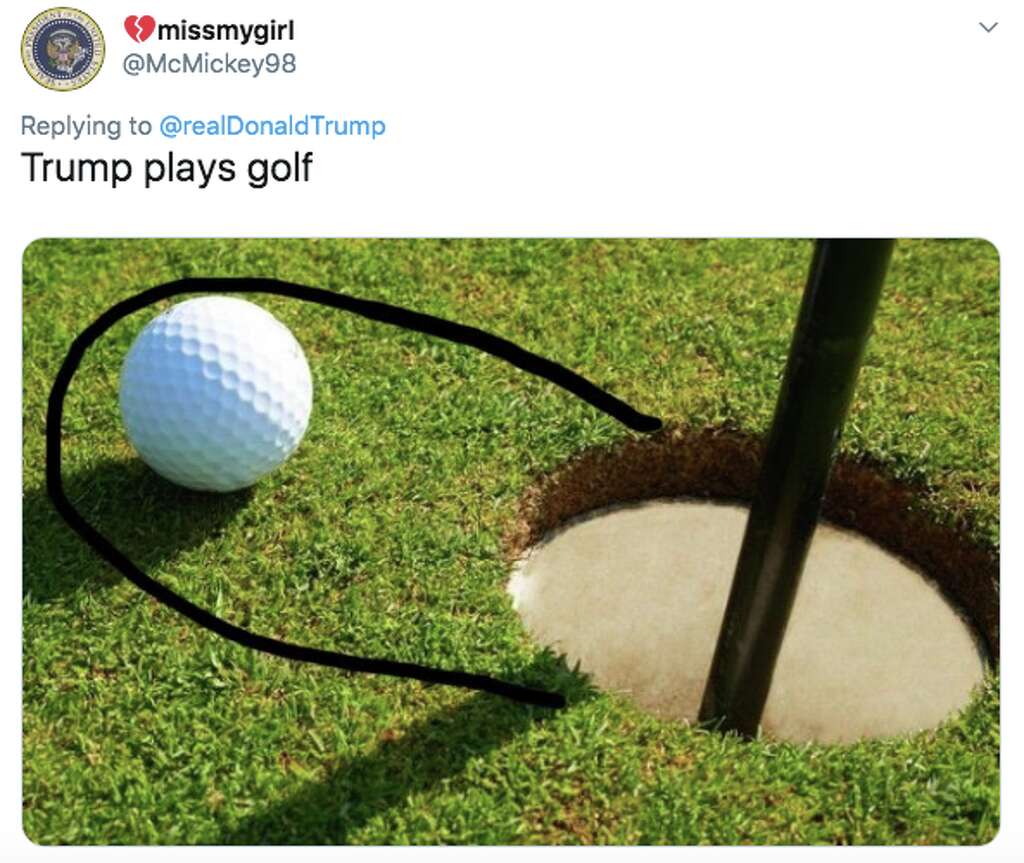
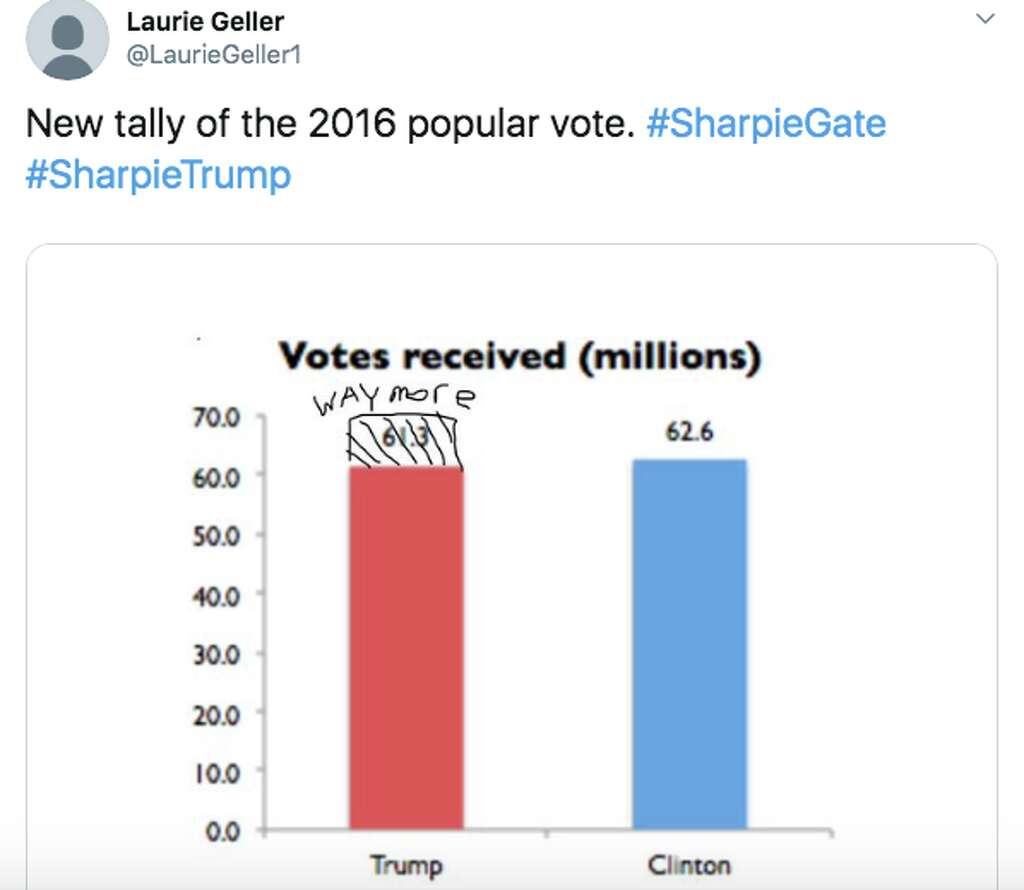
It got comical this week, as Trump refused to admit that his warning of Alabama being threatened by Hurricane Dorian was, at best, based on outdated information. In order to prove his point, he showed the press a NOAA map that he had crudely altered with a Sharpie, an action that is actually illegal.
As predictable and true-to-type as this series of events was, I find it disturbing. Fortunately, Hurricane Dorian was a problem that the lower-level processes of government were able to handle, so the comedy going on in the White House did little real harm. But what if Trump ever faces a Cuban-Missile-Crisis-level challenge? Will the president and his staff focus on the reality of the situation? Or will they spend all their time arguing that whatever the president did leading up to this situation wasn’t a mistake, even if it was?
This week we got two more examples of an ongoing scandal: the way that Trump uses the power of the presidency to enrich himself. The self-dealing started with his 2016 campaign, which had its offices in Trump Tower and paid rent accordingly. (This is still going on. If you’ve ever contributed to Trump’s campaign, a chunk of your money wound up in his pocket.)
After he became the nominee and then president, Republican Party events shifted to Trump properties, so that he could profit from them too. (If you’ve donated to a Republican congressional candidate, possibly some of that money has also wound up in Trump’s pocket.) The Trump International Hotel in D.C. has become the place for favor-seekers — both foreign and domestic — to hang out.
That all may be unsavory, but at least it’s private money. However, it is becoming more and more common for taxpayer money to also flow to Trump. Whenever he plays golf at Mar-a-Lago or Bedminster, for example, his entourage has to get rooms at his resort, and his security detail needs to rent golf carts to follow him around. When he meets foreign leaders at Mar-a-Lago, or if he succeeds in hosting the 2020 G7 at his Doral resort, public money flows to him.
Trump has suggested before that Cabinet officials and advisers stay at his properties while they are traveling. He himself has spent 289 days of his presidency at a Trump property, according to a CNN tally.
Trump himself stayed there on a previous visit, at a $3.6 million cost to the taxpayers.
One excuse frequently given is that Trump’s properties are more convenient for a security entourage, but Secret Service veterans say no.
A second incident that raises suspicion of corruption is Politico’s report that military flights have been refueling at the obscure Prestwick Airport in Scotland — the one closest to Trump’s Turnberry resort. Politico identified one occasion where a C-17 taking supplies from the US to Kuwait refueled at Prestwick and its crew stayed overnight at Turnberry. It seems likely this has happened many times, because the military ran up an $11 million fuel bill at Prestwick.
Typically, such flights refuel at US military bases. (There was one nearby in England.) Fuel is cheaper there, and housing is already paid for. But the president makes no money out of that arrangement.
The House Oversight Committee is investigating these stop-overs, and the Pentagon seems to be stonewalling.
“The Defense Department has not produced a single document in this investigation,” said a senior Democratic aide on the oversight panel. “The committee will be forced to consider alternative steps if the Pentagon does not begin complying voluntarily in the coming days.”
Here’s how far the Trump administration is willing to go to make climate change worse, and how the traditional independence of the Justice Department has been compromised. In the Barr DoJ, advancing the president’s political agenda is a higher priority than enforcing the law, as established by this: The four auto companies who agreed with California’s fuel-economy standards (51 mpg by 2026) rather than Trump’s lower ones (37 mpg) are now under antitrust investigation.
The investigation is particularly striking because the department has shown little interest in preventing corporations from engaging in actual anticompetitive behavior. This summer, for example, the department blessed T-Mobile’s acquisition of Sprint, a deal likely to harm mobile phone consumers and workers, and to impede innovation.
If the Justice Department wants to get serious about antitrust enforcement, there are plenty of places to get started. This investigation is an embarrassment.
and you also might be interested in …
The next Democratic debates are Thursday. The requirements were set higher this time, so only ten candidates qualified and they’ll all appear on the same stage. They’re the five I would have chosen myself: Biden, Warren, and Sanders, obviously. Harris and Buttigieg being the most likely to break into that top tier. Then Beto, Klobuchar, Booker, and Castro, all of whom bring resume and substance you’d expect of a major candidate. Of the outsider upstarts, only the most interesting, Andrew Yang. Marianne Williamson and Tom Steyer didn’t qualify.
All the white guys running to the right missed the cut: Hickenlooper, Bennet, Bullock, Ryan, Moulton, and Delaney won’t be there. Also missing this time around will be Gabbard, Gillibrand, De Blasio, and Inslee.
Hickenlooper, Moulton, Gillibrand, and Inslee have dropped out. The other non-qualifiers should give that some serious thought.
The Defense Department intends to ask for new money to refund these projects in next year’s budget, but Democrats are reluctant to appropriate money twice.
Recall how we got here: Congress refused to fund the border wall in last year’s budget, even after Trump shut down the government for 35 days. Instead, he declared a state of emergency — despite the fact that the only emergency on the border is the one he made — and used emergency powers to move money around. Congress voted to revoke the state of emergency, but Trump vetoed that resolution and there weren’t enough votes to override his veto.
Mitch McConnell, whose state is losing a new school for Fort Campbell, blamed Democrats.
We would not be in this situation if Democrats were serious about protecting our homeland and worked with us to provide the funding needed to secure our borders during our appropriations process
One fact is being left out the public discussion: Money for the wall was negotiable, if Trump had been willing to give the Democrats something they wanted, say, a resolution of the DACA situation. (The deal Trump offered didn’t resolve DACA, but included just a temporary reprieve from deportation.) But Trump didn’t want a negotiated settlement; he wanted a victory.
Here’s the Biden electability argument in a nutshell: A poll by the Marquette University Law School has Biden beating Trump in Wisconsin by 9 points. Sanders beats Trump by only four points. Harris and Warren are tied with Trump.
The clearest path to beating Trump in 2020 is for Democrats to flip back Pennsylvania, Michigan, and Wisconsin. Wisconsin is widely seen as the most difficult to win back, so the election could hinge on it.
At its best, the practice of politics is about taking steps that support people in daily life — or tearing down obstacles that get in their way. Much of the confusion and complication of ideological battles might be washed away if we held our focus on the lives that will be made better, or worse, by political decisions, rather than on the theoretical elegance of the policies or the character of the politicians themselves.
This week everybody was talking about cruelty, short-sightedness, and corruption
Some weeks, it seems like the Trump administration is trying to do as much damage as possible in its remaining two years. Here are some examples from just this week:
The EPA wants to allow more methane leaks at wells and pipelines.Methane is such a potent greenhouse gas that if too much leaks into the atmosphere during the production and transportation processes, natural gas can be worse for the climate than coal. The EPA’s move to roll back anti-methane-leak regulations undermines the strategy of using natural gas as a better-but-not-perfect bridge fuel while we develop more climate-friendly sources. That’s why even industry giants like Shell, Exxon, and BP support the Obama regulations the EPA wants to abandon.
Sick immigrants are being sent home to die. Every year, about 1000 immigrants facing deportation orders ask to stay in the US because they’re receiving medical care that isn’t available in their home countries. Many of them are children and many of the conditions are life-threatening. The Trump administration is canceling this “deferred action” program and has sent letters giving sick people 33 days to leave the country.
Not all children of Americans serving overseas will be citizens. Usually, when American parents have a child while they’re out of the country, that child is automatically a US citizen. The law makes an exception for Americans who had lived in the US less than five years before they left the country, but there’s always been an exception to the exception: If the reason you left the US was for the military or other government service, your kid is a citizen. But that exception-to-the-exception is being rolled back. “Who possibly thought this was a good idea?” asks an immigration lawyer.
Attorney General Barr is kicking back to the President. Barr has booked the Trump International Hotel in D.C. for a 200-person holiday party that he will pay for personally, at a cost upwards of $30K. (Barr’s Justice Department is also defending Trump against lawsuits claiming that foreign spending at the hotel is an unconstitutional emolument.) Kickbacks are a classic form of corruption: The political boss doles out jobs and contracts from the public treasury, and the people who get them give a chunk of the money back to the Boss. This is Tammany Hall stuff.
Trump is steering the next G7 to his struggling resort. Another classic form of corruption is for a public official to steer public contracts towards his allies in the business community. When the Boss owns the business himself, it eliminates the middleman. The US is scheduled to host the 2020 G7 meeting, and holding it at the Trump Doral Resort has many advantages — for Trump. It will draw a lot of foreign money (i.e. unconstitutional emoluments) to his property, give it lots of free publicity, and increase its prestige. Whatever advantages it has for the US or the G7 are much less clear.
Building the wall is more important than obeying the law.Reportedly, Trump has told his underlings to get his border wall built before the 2020 elections, and ignore laws that protect the environment and defend private property. He says he will pardon them. The White House did not deny that he said this, but claimed that he was joking.
Stay tuned. I’m sure there will be new outrages next week.
and a hurricane
As usual, I’m not going to try to compete with CNN and the Weather Channel on hurricane coverage. Dorian hit the Bahamas as a category-5 storm last night. The current prediction has it heading up Florida’s Atlantic coast towards Georgia and the Carolinas. Where or whether it will make landfall in the US is still uncertain.
Former Canadian Prime Minister Kim Campbell aroused a furor with a since-deleted tweet rooting for Dorian to hit Trump’s Mar-a-Lago resort in Palm Beach. (Dorian has turned north since then.) I generally disapprove of wishing harm on people, but I see her point here: Trump is so self-centered that nothing less than a personal loss will make him take climate change seriously.
and more shootings
Studies have shown that the public clamor to do something about gun violence tends to die down about three weeks after some horrific shooting. So that’s been the gun lobby’s strategy: stall for three weeks until public attention moves on.
Will something happen this time? Governor Gregg Abbott says “I’m tired of the dying of the people of the state of Texas. The status quo is unacceptable.” But does that mean he’ll actually do anything? (Texas actually loosened its gun laws, effective yesterday.) Promising action that never arrives — as Trump did after Dayton/El Paso — has become part of the delay-three-weeks playbook.
Congress returns from recess next week. Two very reasonable background-check bills have passed the House already, but Mitch McConnell has blocked any vote on them. There has been talk about a red-flag law or the renewal of the assault weapon ban that lapsed during the Bush administration. But will anything happen?
A California workplace has an expert come in to instruct the staff on what to do if there’s an active shooter. The expert is Kayley, a girl who has had to learn all this in school.
and the countdown to a no-deal Brexit
One extreme (but very unlikely) solution to the Brexit problem is the Celtic Union shown on the map: England could go its own way while Northern Ireland, Scotland, Wales, and Cornwall stay in the EU.
An only slightly less radical path is the one Prime Minister Boris Johnson (a.k.a. the Trump of England) is maneuvering towards: The UK busts out of the EU on October 31 with no deal.
The sticking point in getting a deal with the EU is what to do with Northern Ireland: The whole point of Brexit (at least in the minds of its major supporters) is to have hard borders, so that the UK can reclaim control over the people and products that come into the country from other EU nations. But the soft border between Ireland and Northern Ireland is at the center of the Good Friday Accords that ended the Troubles in Northern Ireland.
The EU has taken a hard line against a hard Irish border, because it feels an obligation to represent the interests of the country that is staying in the union: Ireland.
Johnson and his fellow Brexiteers have a very nuanced counter-offer: Fuck the Irish.
OK, that’s an exaggeration. Johnson is currently saying the exact opposite — that there won’t immediately be new border checks in Northern Ireland. But he won’t say what there will be, and ultimately there’s no way to achieve his Brexit goals without a border that checks passports and collects tariffs. So the real message is more like: “Trust us. We wouldn’t fuck the Irish, would we?” Like the American Trump, though, Johnson is not particularly trustworthy.
The previous Tory government of Theresa May spent three years trying to deny the intractability of this problem. So May finally recognized her predicament and got out the only way she could: by resigning. Her successor has a different way out: Don’t let Parliament get in the way, so that a no-deal Brexit can just happen on October 31 whether Parliament likes it or not. The Economist describes the situation like this:
This week opposition parties agreed that, when the Commons returned on September 3rd, they would try to hijack its agenda to pass a law calling for another extension of the Brexit deadline. But a day later Mr Johnson trumped them by announcing a long suspension of Parliament, from September 11th to October 14th, when a Queen’s Speech will start a new session. … At almost five weeks, it will be Parliament’s longest suspension before a Queen’s Speech since 1945.
That leaves two weeks for Parliament to do something to avert a no-deal Brexit. But that’s the rub: It would have to do something: revoke the UK’s request to leave the EU, form a new government … . And that’s been the problem from the beginning: Brexit has always been just a vague idea; as soon as you zero in on an actual scenario, support goes away.
What will linger either way is the deep sense of wrongness, of the government attempting to unfairly (if not unlawfully) game the constitution so as to prevent legitimate checks and balances. This will not end well, whatever happens.
Basically, Johnson’s maneuver takes a we-made-a-mistake situation and turns it into a somebody-screwed-us situation.
What’s so bad about no deal? The UK is an island nation, so naturally a lot of necessities are imported. Roughly half of the UK’s foreign trade is with the EU. No one is proposing to cut off that trade, but suddenly it will have to find new legal channels. Businesses in the EU will still want to export to the UK (and vice versa), but they won’t know how to do it while new standards and practices are worked out. Ports and crossings that were designed for an open border will suddenly have to start checking passports and collecting tariffs, which will lead to considerable delays.
Likely problems were listed in a government document that leaked a few weeks ago.
The FBI Inspector General released its report on James Comey’s handling of the memos documenting his interactions with President Trump. I’ll warn you: This is a mind-numbingly boring document. And that’s unfortunate, because it means that most people will rely on someone else to read it for them. That, in turn, means that most people will only hear the spin allowed into their usual news bubbles.
Let me summarize the general shape of story here, which I think everyone agrees on: While he was FBI director, Comey wrote memos after meetings with President Trump. At the time, he had classification authority over those memos, all but two of which he decided were entirely unclassified. The ones that he judged to include classified information, he handled correctly.
Just before Comey was to testify before Congress (i.e., after he was fired), a group at the FBI reviewed the then-unclassified memos and decided that six words of one and a paragraph of another should be classified at the lowest level, Confidential. The newly classified parts were moments when President Trump had been talking about foreign countries and leaders, and the FBI group reasoned that revealing those statements might cause embarrassment to the US, because some of the countries or leaders might feel slighted. [My opinion: This is a judgment call people might legitimately disagree on, and in any case, it isn’t a big deal.]
After leaving the FBI, Comey kept the memos he believed to be unclassified. He gave one to a friend in order to get its contents leaked to the media. (The newly classified parts weren’t leaked, but the friend saw the six classified words: names of countries.) He also gave his lawyers copies of the memos he retained, so they also saw the newly classified information. In any case, none of the classified information got out.
We found no evidence that Comey or his attorneys released any of the classified information contained in any of the Memos to members of the media.
Comey treated the retained memos as personal property rather than as government property that should be returned to the FBI. The IG finds fault with him for this, because Comey wrote the memos while he was FBI Director, and they concerned conversations he wouldn’t have had if he weren’t FBI Director.
That’s the whole story told in the report.
So what should we make of this? I suspect the IG is technically correct about the ownership of the memos. But let’s consider just how minor a technicality this is: Suppose Comey had returned the memos when he left the FBI (as the IG said he should), and then (as a private citizen) had gone to his computer and written down his memories of his conversations with Trump as best he could remember them at that time, leaving out any statements that might be classified. That document would be his personal property — similar to the my-days-in-the-White-House memoirs that get published all the time. Even if it contained all the unclassified information that was in the FBI memos, showing it to his lawyers or leaking it to the media would be unobjectionable.
Anyway, this is the situation that Rep. Peter King (R-NY) described on Fox News (in a clip Trump retweeted) as:
One of the most disgraceful examples of an abuse of power by a government official…when you read this report…this is a systematic effort to go after Candidate Trump, President Elect-Trump, and President Trump….you could virtually call this an attempted coup.
He can say stuff like this in complete confidence that the people listening to him won’t read the report, which says nothing of the kind. Meanwhile, Josh Marshall makes the opposite case: Comey was a whistleblower, not a leaker:
Comey was not simply within his rights but had an affirmative obligation to bring this information to light. Critically, he had no reason to believe that the others in the existing chain of command weren’t compromised by Trump’s corruption and efforts to end the investigation. Indeed, what we have subsequently learned gives every reason to believe they were compromised. The only reason this isn’t obvious is that we’ve had Trump’s denials, lying and gaslighting in our collective heads for the last two plus years.
Full disclosure: There’s a “Comey is my homey” t-shirt, which I suppose I could wear without too much exaggeration. We were at the University of Chicago at the same time: I finished my Ph.D. in math in 1984, and he got his law degree in 1985. I don’t remember running into him.
but I paid attention to a court ruling
A federal appeals court overturned a lower court ruling and OK’d the practice of the Pennsylvania House of Representatives, which bars non-theists from acting as “guest chaplains” and leading the opening prayer.
Granted, this is not the most important thing that happened these last two weeks. Atheism, humanism, and the various forms of religion-without-God will carry on in Pennsylvania, and it’s not even that big a blow to the separation of church and state (though it doesn’t help). But I bring it up as an additional example of something I discussed in my recent Second Amendment article: how the world can change out from under a practice or text, so that it is honestly not clear how best to carry forward some legal tradition.
The strongest argument for why opening prayers are not themselves banned by the First Amendment (as a government “establishment of religion”) goes back to the First Congress. The appeals court majority opinion (written by Judge Thomas Ambro) says:
Twice the Supreme Court has drawn on early congressional practice to uphold legislative prayer. It emphasized that Congress approved the draft of the First Amendment in the same week it established paid congressional chaplains to provide opening prayers.
However, the First Congress did not write down and vote on a policy that applied to all times and places. So it’s left to us to interpret the arguments they were having and extrapolate from them. One thing they didn’t do was insist that the opening prayer satisfy some particular orthodoxy. Ambro summarizes:
[O]ne might wonder whether a religious minister can accommodate the spiritual needs of a “secular agnostic” member of the Pennsylvania House. Or, for that matter, can a Catholic priest in the U.S. Senate accommodate the spiritual needs of Chuck Schumer, or a Jewish rabbi those of Mitt Romney? These questions are as old as the Republic, but they have been settled since the Founding. In the Continental Congress, John Jay and John Rutledge opposed legislative prayer on the theory that the delegates were “so divided in religious sentiments” that they “could not join in the same act of worship.” The two future Chief Justices could not see what an Episcopalian minister could possibly offer a Presbyterian or Congregationalist lawmaker. Their view lost out, however, when Samuel Adams countered that “he was no bigot” and would gladly “hear a prayer from a gentleman of piety and virtue,” no matter his denomination.
So we are left with the question of how far such ecumenism should stretch. In the First Congress, a Christian minister of any denomination could count as “a gentleman of piety and virtue”, and that was as far as the principle needed to go. (Congress wouldn’t have its first Jewish members until 1845, and I’m not sure when a woman first offered the opening prayer.) But how far should this traditional acceptance of pluralism stretch today, when religious diversity is so much greater?
Judge Ambro extends acceptance to all theists — and to Buddhists, for reasons that don’t entirely make sense — but no further.
Legislative prayer has historically served many purposes, both secular and religious. Because only theistic prayer can achieve them all, the historical tradition supports the House’s choice to restrict prayer to theistic invocations.
Judge Felipe Restrepo, on the other hand, is horrified that his colleague has just ruled on what prayer is and what purposes it serves, “which, in my view, are precisely the type of questions that the Establishment Clause forbids the government—including courts—from answering”. His dissenting opinion interprets the opening-prayer tradition differently:
Purposeful exclusion of adherents of certain religions or persons who hold certain religious beliefs has never been countenanced in the history of legislative prayer in the United States, and, therefore, viewed in the proper context, the Pennsylvania House’s guest-chaplain policy does not fit “within the tradition long followed in Congress and the state legislatures” because it purposefully excludes persons from serving as guest chaplains solely on the basis of their religions and religious beliefs.
I’m not attempting to resolve the judges’ disagreement — a job for the Supreme Court — but only to call attention to a more general point, which is the fundamental flaw at the heart of originalism: We can hope to understand what previous generations thought about their world. But when the world changes, we can’t hold a séance and ask how they want us to respond to our world.
and you also might be interested in …
Chinese police are getting increasingly violent against the Hong Kong protests. But the large-scale demonstrations have been going on for 12 weeks and show no signs of stopping. Vox has a good what-is-this-about article.
The NYT’s Roger Cohen seems to be making a pro-Trump point in “Trump Has China Policy About Right“, but he’s actually saying the same thing I’ve been saying: China is our main global competitor, it has been playing by it’s own rules, and it’s high time we confronted them about that. But at the same time, Trump is doing this in a very stupid way: chaotically and without allies.
Cohen’s assessment of “about right” involves grossly lowering his standards, as so many pundits do when they assess Trump. Trump “flails” and is “erratic”. His attempt to order American businesses out of China is “a trademark Trump grotesquerie”. Somehow that adds up to “about right”.
The next Democratic presidential debates are set for September 12, and stricter requirements have brought the roster down to 10 candidates, who will all be on stage at the same time: Biden, Booker, Buttigieg, Castro, Harris, Klobuchar, O’Rourke, Sanders, Warren, and Yang.
As you might guess from the quote at the top, I read Pete Buttigieg’s autobiography Shortest Way Home this week. If you enjoy listening to Mayor Pete talk (I do), you’ll enjoy his book. It’s engaging, thoughtful, and at times funny.
One funny moment is when he’s filling out paperwork for the Navy Reserve. Buttigieg asks an officer for advice on the question “Are you considered a key employee in your civilian workplace?” The officer explains that it’s for first-responders and the like. Pete still doesn’t know how to answer. “Who do you work for?” the officer asks. Pete says he works for the city. “Can anyone else do your job?” Not exactly, Pete answers. “So what are you, the mayor or something?”
It turns out that no, from the Navy’s point of view the mayor is not a “key employee”.
Later, a different officer asks Pete how his employer is handling his deployment, and Pete says they’ve been wonderful about it. The officer says there’s an award he can put them in for. When he finds out Pete works for local government, the officer says that’s perfect, because politicians love getting awards like that.
I also enjoyed watching him mix together his various worlds of experience: bringing his management consultant background into city government, observing like a mayor the Kabul government’s successes and failures in providing local services under difficult conditions, and so on. (One unstated theme of the book is that for a young guy, he’s done a lot of different things.)
One amusing example is when he brings the military concept of “training age” into dating. If you’ve just start to learn about something, your “training age” is young, even if your physical age is much older. Well, Pete took a long time admitting he was gay, and then even longer before he came out publicly. So when he starts to date (after 30), he admits that with respect to dating, his training age is “practically zero”.
and let’s close with something heart-warming
It’s always chancy to imagine what another species is thinking, but in this video it sure looks like a dolphin comes to a diver for help, patiently and trustfully endures having a hook removed from its flesh and fishing line untangled from its flipper, and then swims off.
This week’s featured post is “Follow-up to ‘How Should We Rewrite the Second Amendment?’” Last week’s post somehow went viral in the pro-gun world, earning me a stream of negative comments. Those comments are a window into the minds of people I don’t usually hear from.
One type of comment I forgot to cover in that piece. A number of commenters couldn’t imagine that I really was what I claimed to be: a person of generally liberal views who nonetheless was trying to figure out what the right policy might be. Clearly I was a confiscate-them-all anti-gun radical who was just trying suck people in by pretending to rationally evaluate a variety of views.
I don’t know if there’s any worthwhile response to that level of cynicism and closed-mindedness. I suspect there’s some projection going on. People who often argue in bad faith easily imagine that other people are doing the same thing.
This week everybody was talking about the Trump Show
He outdid himself this week, unleashing a variety and extremity of presidential craziness that used to exist only in satire. Republican strategist Rick Wilson described the President’s week like this:
A combination of waking hallucinations, verbal tics, lies surpassing even his usual fabulist standard, aphasias and lunatic blurtings
If you’ve been away from the news all week, looked at that list, and said “What?” you’ve understood how the rest of us have felt this week. It was seven days of “What?”
and the possibility that Trump’s trade war will start a recession
Bill Clinton famously felt your pain. Trump defender Lindsey Graham wants you to accept the pain this administration’s trade war is giving you.
The slowing economy and Trump’s tariffs’ role in slowing it was probably the main thing the Trump Show was supposed to distract us from. Experts are divided on whether a recession will hit before the election, but I think this is a technical debate that is going to go right over the heads of the electorate: Growth is slowing down, and is likely to keep slowing down. Whether it’s at .1% or -.1% on election day may matter to economists, but voters probably won’t be able to tell the difference.
Typically, recessions are not uniform across the country. Large chunks of rural America (the people Trump promised to help) are probably already in recession, while some hot spots may miss a recession entirely.
Wapo columnist Catherine Rampell notes one economic hazard we’ve never experienced before: Trump never admits his mistakes, so if his policies cause a recession, he’ll insist on doubling down on them.
The possibility of a synchronized global downturn would require some sort of coordinated global policy response, just as it did a decade ago during the Great Recession. But rather than evaluating how we got to the present situation, or how to make amends with the allies we might need to help get us out of it, we already know what Trump’s objective will be: proving his very wrong ideas were very right all along.
All the airtime went to Trump’s “joke” about being “the chosen one” to stand up to China, but the real problem with his Chinese trade war is not getting the attention it deserves. Yes, there are long-standing disputes about the trade deficit (which Trump misunderstands) and more importantly about protecting US intellectual property. You can make a good case that the US needed to pressure China to play by the established rules of international trade.
The point that often gets lost is that Trump has implemented this pressure in a very stupid way: with unilateral tariffs rather than acting in cooperation with the EU, Japan, and our other allies. (That was the direction President Obama was headed with the Transpacific Partnership that Trump pulled the US out of.) Not only does unilateral action have a smaller effect on China than pressure from all sides, but it’s also less effective psychologically and politically. The way Trump has set this up, he’s asking China to yield to the United States. For China, that’s a more humiliating option than changing its behavior in order to join the world community.
Xi can stand up to Trump and spin that to his own people as defending China’s honor against American aggression. That spin would be much less convincing if he were thumbing his nose at the whole world.
Our great American companies are hereby ordered to immediately start looking for an alternative to China, including bringingyour companies HOME and making your products in the USA.
Just about everybody who read that balked at the word ordered. Ordered? Since when does the president give orders to American businesses? I can barely imagine the wave of conservative outrage if President Obama had tried to order private corporations around.
For all of the Fake News Reporters that don’t have a clue as to what the law is relative to Presidential powers, China, etc., try looking at the Emergency Economic Powers Act of 1977. Case closed!
The president is not correct in this assertion. The Economic Powers Act allows the president of the United States to regulate commerce during a national emergency. It does not allow a president to order companies to close their factories in foreign countries, however. And as there has not yet been a national emergency declared with respect to Chinese trade, Trump’s present abilities to govern economic interactions with China are limited to measures like tariffs.
Whatever the EEPA allows, using it would have to follow the same pattern as Trump’s money-grab to build the wall:
Declare a specious national emergency.
Veto Congress’ attempt to cancel the emergency.
Keep the support of at least 1/3 of one house of Congress, so that the veto can’t be overriden.
That’s not exactly a recipe for one-man rule, but it’s close: rule by one man supported by 34 senators.
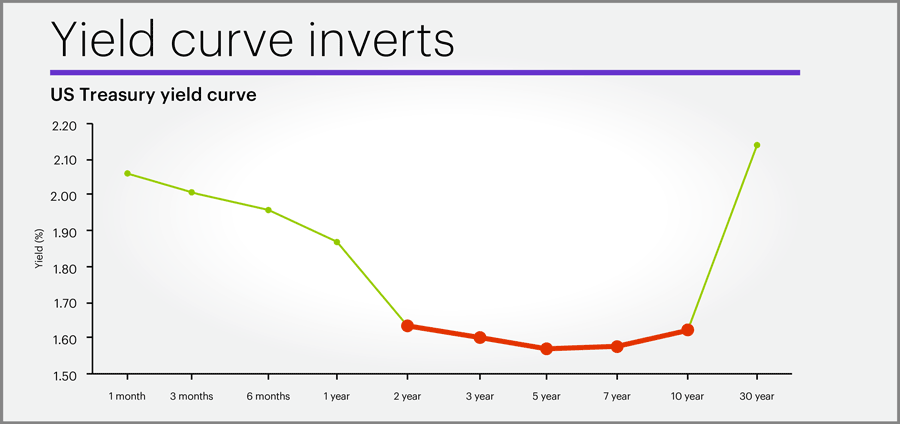
One problem we’ll face if a recession does start is that there’s not much to fight it with. Typically, governments shorten and mitigate the effects of a recession in two ways: fiscal and monetary. In other words, the government stimulate public-sector demand by running a deficit, and the central bank stimulates private-sector demand by cutting interest rates
Well, the fiscal stimulus got used up in tax cuts to big corporations and rich people like Trump himself. We’re already going to run a $1 trillion deficit next year without any special recession-fighting programs. How much higher do we really want that to go?
And by historical standards, interest rates are quite low already. Trump is complaining that it’s not fair that Germany gets to pay negative interest rates while his government pays positive rates. To me, that’s like complaining that your friend with a broken leg gets opiates while you don’t. We don’t want our economy to be in the situation Germany’s is.
and the Amazon region is on fire
The thousands of fires burning in the Amazon rain forest are calamitous for two reasons: First because they release lots of carbon dioxide into the atmosphere, and second because the forest may not grow back.
Scientists fear parts of the Amazon could pass a critical threshold and transform from a lush rainforest into a dry, woody grassland. And that could bring catastrophic consequences not only for people in South America, but also for everyone around the world.
Some of the fires are accidental, but a large number are intentional.
Instead of axes and machetes, people now use bulldozers and giant tractors with chains to pull down the Amazon’s towering trees. A few months later, they torch the trunks. It’s the only realistic way to remove such huge amounts of biomass, Morton said. “It’s slash and burn, 21st century.”
Thousands of acres at a time are being cleared for large-scale agriculture, he added. The land is primarily used as pasture for cattle — one of Brazil’s major exports — or for crops such as soybeans.
Some of the larger fires may be intentional deforestation fires that got out of control.
This is at least partly the consequence of Brazil’s electing Jair Bolsonaro as president.
Bolsonaro has railed against protections for indigenous land and promised to boost the country’s economy. He has also weakened the government’s capacity for oversight and indicated he would not go after farmers, loggers and miners who seize and clear forest.
Bolsonaro is sometimes referred to as “the Trump of Brazil”, and there are a number of similarities. For starters, his first response to reports of Amazon fires was to blame his enemies: environmentalists are setting the fires to make him look bad. Like Trump, he made the claim without citing any evidence.
More than a soccer field’s worth of Amazon forest is falling every minute, according to Brazil’s National Institute for Space Research, known as INPE. Preliminary estimates from satellite data revealed that deforestation in June rose almost 90% compared with the same month last year, and by 280% in July.
Bolsonaro called this report “a lie” and has fired INPE’s director.
and (coincidentally) David Koch
I think it’s unseemly to gloat over someone’s death. But I’m also not willing to pretend that none of David Koch’s evil deeds matter now, as if he were just an opponent in a game that his death brings to an end.
Koch Industries—that is, David and Charles Koch and their political network—has played an almost unparalleled role in helping to cast doubt on the basic science behind climate change; create doubt in the public mind that climate change is real; and particularly, most importantly, to cast doubt on the idea that government regulation can or should do anything to regulate greenhouse gas emissions.
As early as 1991, Republican President G. H. W. Bush was ready to start taking action on climate change. And as late as 2007, candidate John McCain was saying in his stump speech that the problem was real and demanded action. But the Kochs pretty well squelched the Republican willingness to face reality, and instead made rejection of climate science a litmus test on the right.
So this world we’re living in — with its wildfires in the Amazon, more powerful hurricanes, shrinking polar icecaps, and so on — is to a certain extent the creation of the Kochs. And that story doesn’t end with David’s death. In the coming decades, millions of climate refugees will be looking for homes, probably causing wars and revolutions as destination countries try either to accommodate them or keep them out. That’s part of his legacy too.
OK, I can’t help myself; I’m going to repeat somebody else’s snarky remark. Here’s Matt Binder on The Majority Report podcast:
Per his request, David Koch will be cremated along with the rest of planet Earth.
and the G7
Trump is once again proposing to let his patron, Vladimir Putin, back into the G7. This is a dumb idea for two major reasons:
Russia should never have gotten into the G7 in the first place, because G7 is a club of democratic nations with large economies. Russia does not qualify on either count. The point of including Russia in the 1990s was to encourage it to develop democratic institutions. That did not work.
Russia was ejected from the (then) G8 in 2014 to condemn its conquest of Crimea. It still holds Crimea, and is continuing to fight an aggressive proxy war against Ukraine. Since 2014, Russia has been promoting right-wing nationalist movements across the West, including aiding Trump in the US and Brexit in the UK.
The US hosts the next G7. Trump is talking about holding it at his own golf resort in Miami. He’s president, so why shouldn’t he make some money off of government events? Maybe our next president will own an aerospace company and award himself all the Air Force contracts.
and you also might be interested in …
Naturally, all Trump’s cultists had to tell us what a brilliant idea buying Greenland is. The WaPo’s Marc Thiessen wrote a column about it. (He focused on the strategic reasons for wanting Greenland, and completely ignored the Danish prime minister’s point: that we don’t buy and sell people any more.) And NRCC started fund-raising with a t-shirt showing Greenland as part of the US.
The higher hurdles to get into the September debate is driving some Democratic candidates out of the race: Seth Moulton joins Jay Inslee and John Hickenlooper on the sidelines.
Michael Bennet, who likely won’t be in the debate but so far seems to be staying in the race, slammed the DNC process for “stifling debate” and “rewarding celebrity”. I can’t raise much sympathy for him. In two debates and months of campaigning, he has done little to distinguish himself. What exactly does he bring to the discussion that no other candidate does? The “celebrity” candidates — I assume he means Michelle Williamson and Andrew Yang — may not have much in the way of presidential qualifications, but they each raise issues that other candidates don’t.
In my reading of the polls, only five candidates have proved that they have a real following: Joe Biden, Elizabeth Warren, Bernie Sanders, Kamala Harris, and Pete Buttigieg. So far, Cory Booker, Amy Klobuchar, Julián Castro, Beto O’Rourke, and Yang (but not Williamson) have also qualified for the third debate, with Tom Steyer, Tulsi Gabbard, and Kirsten Gillibrand still in the running.
The American people are ill-served when our leaders put forward unfounded allegations of voter fraud. To put it in terms that a former casino operator should understand: There comes a time when you need to lay your cards on the table or fold.
Monday, acting US Citizenship and Immigration Services Director Ken Cuccinelli announced the change:
Our rule generally prevents aliens, who are likely to become a public charge, from coming to the United States or remaining here and getting a green card. … Under the rule, a public charge is now defined as an individual who receives one or more designated public benefits for more than 12 months in the aggregate within any 36-month period. … Once this rule is implemented and effective on October 15th, USCIS Career Immigration Services Officers — what we call ISOs — will generally consider an alien’s current and past receipt of the designated public benefits while in the United States as a negative factor when examining applications.
Under current regulations put in place in 1996, the term “public charge” is defined as someone who is “primarily dependent” on government assistance, meaning it supplies more than half their income. But it only counted cash benefits, such as Temporary Assistance for Needy Families or Supplemental Security Income from Social Security. …
[Advocates for immigrants] said [the new rule] would penalize even hard-working immigrants who only need a small bit of temporary assistance from the government.
[The new criteria] will skew the process in favor of the highly skilled, high-income immigrants President Trump covets. Since its first days, the Trump administration has been seeking ways to weed out immigrants the president sees as undesirable, including those who might draw on taxpayer-funded benefits.
Wealth, education, age and English-language skills will take on greater importance in the process of obtaining a green card, which is the main hurdle in the path to full U.S. citizenship.
Say you’re an immigrant from Mexico who came here legally to join family members who are already permanent residents or citizens. Say you’re working a full-time minimum-wage job, plus odd jobs nights and weekends. You are a productive member of society. You are paying payroll taxes, sales taxes, vehicle registration fees and other government levies. Still, as hard as you work, you can’t make ends meet.
You may be legally entitled to health care through Medicaid. You may be entitled to food assistance through the SNAP program, formerly known as food stamps. You may be entitled to housing assistance. But according to the new Trump administration rule — set to take effect in two months — if you use any of these programs, you might forfeit the opportunity to ever obtain a green card making you a permanent resident. That means you also forfeit the chance of ever becoming a citizen.
I am certain that my family — my grandmother, mother and myself — had a credit score of zero when we arrived in 1976. There were no credit cards in the Soviet Union, and we didn’t have any money. We survived initially on handouts from the Hebrew Immigrant Aid Society (HIAS), whose help to more recent arrivals triggered the ire of the alleged Pittsburgh synagogue gunman. Luckily, my mother already spoke English, so she soon found a job. But my grandmother spoke only Russian and she was already retired. She got by with help from my family and her Supplemental Security Income and Medicare benefits. My family is far from rich, but we have been productive and repaid in taxes many times over the benefits my grandmother received — just as we repaid the aid from HIAS.
But if Trump had been in office then, I wonder whether my grandmother would have been barred entry or deported back to the U.S.S.R., where she had no one to take care of her? For that matter, I wonder whether any of us would have been allowed to come here given our unconscionable lack of a credit rating?
Here’s a factor anyone should be able to appreciate: In this era of super-bugs, when antibiotics are starting to lose their effectiveness, we shouldn’t be making people afraid to see a doctor. The most likely place for a really nasty plague to get started is among a group of people who either can’t afford healthcare or avoid it for some other reason. So discouraging people from signing up for Medicaid is a bad idea for all of us.
MARTIN: Would you also agree that Emma Lazarus’ words etched on the Statue of Liberty – give me your tired, your poor – are also part of the American ethos?
CUCCINELLI: They certainly are – give me your tired and your poor who can stand on their own two feet and who will not become a public charge. That plaque was put on the Statue of Liberty at almost the same time as the first public charge law was passed – very interesting timing.
Clarifying Tuesday evening to CNN’s Erin Burnett, Cuccinelli said that Lazarus’ poem had European immigrants in mind.
Of course that poem was referring back to people coming from Europe where they had class-based societies, where people were considered wretched if they weren’t in the right class, and it was written one year after the first federal public charge rule was written.
At best, he was denying that the poem’s “give me … your poor” refers to people who lack money, rather than just those who weren’t born into the aristocracy. At worst, he was dog-whistling to white supremacists. (Among white supremacists who are trying to sound respectable, “European” has become a less obviously racist way of saying “white”.)
Trevor Noah has figured out the true target of Trump’s hard line on immigration: He wants to deport Melania.
and two members of Congress who won’t be going to Israel
First, [Rep. Rashida] Tlaib and her colleague in the House, Minnesota Rep. Ilhan Omar were scheduled to visit Israel. They’re both supporters of the Boycott, Divestment and Sanctions (BDS) movement, which promotes boycotting Israel in protest of its human rights abuses against Palestinians.
But after some prodding from President Donald Trump, Israel barred the lawmakers from entering the country on Thursday. “It would show great weakness if Israel allowed Rep. Omar and Rep.Tlaib to visit,” the president tweeted.
The move sparked widespread outrage. Even the American Israel Public Affairs Committee was upset with the decision.
Friday morning, Israel said it would allow Tlaib to enter the country for a humanitarian visit so long as she didn’t promote protests during the trip. “This could be my last opportunity to see her,” Tlaib wrote of her grandmother in a letter. “I will respect any restrictions and will not promote boycotts against Israel during my visit.”
When I won, it gave the Palestinian people hope that someone will finally speak the truth about the inhumane conditions. I can’t allow the State of Israel to take away that light by humiliating me & use my love for my sity to bow down to their oppressive & racist policies.
The only real winner here is Tlaib’s grandmother. She doesn’t have to see her now!
He probably thought he had gotten the last word, but he didn’t reckon with Tlaib’s grandmother:
Ninety-year-old Muftia Tlaib, sitting in her garden in the village of Beit Ur Al-Fauqa, was not impressed. “Trump tells me I should be happy Rashida is not coming,” she said. “May God ruin him.”
The issue here is a bit bigger than Tlaib, her grandmother, Trump, and Netanyahu. Thomas Friedman comments:
Trump — with the knowing help of Israel’s current prime minister, Benjamin Netanyahu — is doing something no American president and Israeli prime minister have done before: They’re making support for Israel a wedge issue in American politics.
Few things are more dangerous to Israel’s long-term interests than its becoming a partisan matter in America, which is Israel’s vital political, military and economic backer in the world.
and the inverted yield curve
In general, the longer you want to borrow someone’s money, the higher the interest rate they will charge you. This seems as if it ought to be a natural law. After all, the two main common-sense justifications for charging interest are
the borrower gets to consume now while the lender delays his or her consumption,
and the lender is taking the risk that the borrower may not repay, or that by the time repayment happens, the currency the loan is measured in might have lost value.
Both of those considerations get weightier with time: The longer I have to delay my consumption the more I want to get paid for it, and the more time that passes before repayment, the more things can happen to interfere with it.
If you have one particular borrower — the US government, say — who owes money on a bunch of different time scales, you can plot out a “yield curve”: the interest rate on bonds that come due in 1 year, in 2 years, 10 years, 30 years, and so on. Given the discussion above, you’d expect the yield curve to slope upwards: longer maturities correspond to higher interest rates. And most of the time that’s true.
For investors, an inverted yield curve is like birds migrating in the wrong direction or the jungle going silent at a time when it usually chatters: It’s a sign that something is seriously wrong. (You might take a clue from the “since 2007” above. The economy got pretty ugly in 2008.) So the inversion touched off a fast 800-point loss in the Dow Jones average.
The panic is partly superstitious and partly legitimate. (Superstition matters in the stock market because traders are always trying to guess what other traders might do. So while of course I’m not superstitious myself, those other traders …) Here’s the legitimate part: Think about why some investor might be willing to accept a lower interest rate on a 10-year loan than a 2-year loan. And the answer is: He’s worried that when the 2-year loan comes due, interest rates might be lower than they are now.
Imagine, for example, that you could earn 2% on a 2-year loan but only 1.5% on a 10-year. (The actual inversion is much smaller than this, but I’m trying to keep the numbers simple.) So you invest $1,000 at 2% and get $20 per year in interest rather than the $15 you’d get on the 10-year loan. But then at the end of two years, you get your $1,000 back, and now an 8-year loan will only get you 1%. Then you’d say, “Damn, I wish I’d taken the 1.5%, because then I’d get $15 a year for the next eight years rather than $10.”
So an inverted yield curve reflects the market’s expectation that interest rates are likely to go down. Falling interest rates, in turn, mainly happen during recessions. (In December, 2008, short-term interest rates in the US were .25%.) So the inverted yield curve is predicting a recession.
The inverted yield curve is happening at the same time as another anomalous event: European government bonds are paying negative interest rates. Irish Times reports:
[O]ddities now abound. Danish lender Jyske Bank last week issued a 10-year mortgage bond at an interest rate of -0.5 per cent, meaning homeowners are being paid to borrow. Meanwhile, Swiss bank UBS is planning to charge its super-rich clients for holding on to cash.
So a lot of stock traders are just plain spooked, and I can’t say I blame them.
Another source of anxiety: Germany may already be in recession. A recession is usually defined as two consecutive quarters of negative growth. Germany has reported one.
But here’s an interesting spin on that: Countries where the workforce is shrinking (Germany is one), can simultaneously have a shrinking GDP and rising (or stable) incomes for individuals. Is it really fair to call that a recession? As populations stabilize in more and more countries, perhaps our targets for economic growth need to be adjusted.
That point is particularly significant for the United States. If Trump gets his way and immigration goes way down, but the birth rate stays low, GDP growth targets in the 3-4% range become unreasonable.
While they cheer Trump’s many efforts to chip away at LGBT rights, they are much more concerned with protecting their own right to maintain their opposition. They want to be able to teach their values without interference — some churchgoers fretted about school textbooks that refer to transgender identities without condemnation and about gay couples showing up in TV commercials every time they try to watch a show with their children.
This attitude explains a lot: Conservative Christians have pushed their boundaries out so far that it’s impossible for other people to live their lives without “interfering” with them. The old adage was: “Your freedom to swing your fist ends at my nose.” But Evangelicals don’t look at things that way. In order to be “free”, they have to control the textbooks the rest of us use and the TV the rest of us watch.
It’s a kind of freedom that not everybody can have. Just them.
Is there a way to reverse hostilities between the two cultures in a way that might provoke a truce? It is hard to see. Is it even possible to return to a style of evangelical politics that favored “family values” candidates and a Billy Graham-like engagement with the world, all with an eye toward revival and persuasion? It is hard to imagine.
Or was a truly evangelical politics — with an eye toward cultural transformation — less effective than the defensive evangelical politics of today, which seems focused on achieving protective accommodations against a broader, more liberal national culture? Was the former always destined to collapse into the latter? And will the evangelical politics of the post-Bush era continue to favor the rise of figures such as Trump, who are willing to dispense with any hint of personal Christian virtue while promising to pause the decline of evangelical fortunes — whatever it takes? And if hostilities can’t be reduced and a detente can’t be reached, are the evangelicals who foretell the apocalypse really wrong?
A number of articles talk about how tired Trump supporters are of being called racists. The Atlantic quotes a 50-year-old woman at a Trump rally in Cincinnati:
“I’m sick to death of it. I have 13 grandchildren—13,” she continued. “Four of them are biracial, black and white; another two of them are black and white; and another two of them are Singapore and white. You think I’m a racist? I go and I give them kids kisses like nobody’s business.”
This is a response I’ve run into fairly often in reading interviews: I can’t be racist because I have non-whites in my family (just like Trump can’t be anti-Semitic because of Jared and Ivanka). It’s an amped-up version of the some-of-my-best-friends-are-Jewish line that people would use when I was young.
I’m not sure why anyone thinks this is a get-out-of-racism-free card. The fact that you can make exceptions for people who are very close to you doesn’t mean that you don’t have prejudices. The essence of being close to someone is that you see that person as an individual, rather than as an example of a type. Your bigotry against the type may be completely untouched by your love for the individual.
It was an official presidential event, with Trump’s expenses paid by taxpayers, even though he gave a campaign speech. He ran down Democrats in general and “Pocahontas” [Elizabeth Warren] and “Sleepy Joe” [Biden] in particular. He told the union workers to vote their leaders out if they didn’t support his re-election. That sort of campaigning at taxpayer expense is illegal. “In a free and open democracy, the government doesn’t use taxpayer resources to keep itself in power,” [Jordan] Libowitz [of Citizens for Responsibility and Ethics in Washington] told Vox. “That’s what authoritarian dictatorships do.”
He lied about how well he’s doing in the polls, and “joked” about calling off the 2020 elections and going on to serve a 3rd and 4th term.
Esquire’s Jack Holmes claims one of the lies — that he’s responsible for the Veteran’s Choice program Obama signed into law in 2014 — was told for the 80th time.
Elaborating a bit on the first point, official events are things like ribbon-cuttings. Past presidents have used them in a general image-building sort of way: They give upbeat remarks about how well the country is doing, lay out their vision for the future, make generically patriotic remarks, and so on. If they stray into campaigning — asking for support, running down their opponents, etc. — their campaign or political party is supposed to reimburse the government for the trip’s expenses. Trump hasn’t done that.
Trump has made these claims before, and Weintraub has asked him to give his evidence to the FEC so that the alleged fraud can be investigated. But Trump has never responded, and has never provided any evidence in any forum.
The American people are ill-served when our leaders put forward unfounded allegations of voter fraud. To put it in terms that a former casino operator should understand: There comes a time when you need to lay your cards on the table or fold.
but I wrote about guns
The featured post is my attempt to rewrite the Second Amendment, and to explain why we need to rewrite it.
The New York City medical examiner has officially concluded that Jeffrey Epstein hanged himself. So of course all conspiracy theories immediately dried up (in some alternate universe).
Anyway, however he died, here’s hoping a full investigation tells the story of what he did, who helped him do it, and who went along for the ride. Democrats, Republicans — I don’t care.
A prison worker drove a truck into a crowd of Never Again Action protesters outside a private prison where ICE is holding immigrants. The crowd then surrounded the truck until prison guards pepper-sprayed them. The driver wasn’t arrested, but did later resign.
Nine of the 10 hottest Julys have occurred since 2005—with the last five years ranking as the five hottest. Last month was also the 43rd consecutive July and 415th consecutive month with above-average global temperatures.
Think about that: It’s been 34 years since the Earth has had a cool month.
The United Methodist denomination may split over LGBTQ issues.
That’s the fundamental con at the heart of Donald Trump. He says: “I’m going to hurt these people and I’m going to help you.” And he can deliver on the first part, but he’s done just about nothing on the second.
Facing criticism about the harmony between his anti-immigrant rhetoric and the manifestos of white-supremacist mass-murderers (discussed in more detail in the featured post), even President Trump wants to avoid the appearance of blocking action to limit gun violence. So he vaguely says he is for “intelligent” and “meaningful” background checks, and perhaps some measures to keep guns away from the mentally ill (though he relaxed such measures shortly after he took office). But he also tweeted that the NRA’s “very strong views” would be “fully represented and respected“. He made similar noises after the Parkland shooting and did nothing.
Mitch McConnell refused to interrupt the Senate’s recess to act on bills the House already passed, but promised that the Senate will “discuss” guns when it returns in September.
What we can’t do is fail to pass something. The urgency of this is not lost on any of us.
But it’s not clear what “something” might be, or if he will feel the same urgency after the heat dies down a little, as it presumably will by the time Congress reconvenes.
In general, Republicans want to blame our gun-violence problem on anything but guns: video games, mental illness, the lack of prayer in schools, and so on. But other countries have all that stuff and don’t have weekly mass shootings like we do. The difference is that we have lots and lots of guns.
Warren is going beyond some of the more commonly discussed ideas, such as stricter background checks or a ban on assault weapons. Her plan calls for creating a federal licensing system, limiting the number of firearms someone could buy, raising the minimum age to 21 for purchasing a gun, holding gun manufacturers liable (and, in some cases, even holding gun industry CEOs personally liable).
She also wants to raise taxes for gun manufacturers (from 10% to 30% on guns and from 11% to 50% on ammunition).
Additionally, Warren’s plan calls for $100 million annual investment into gun violence research. She points out that the frequency of automobile deaths in the United States declined with widespread safety measures, such as seat belts and air bags. With the same approach, she says, her goal of an 80% reduction in gun-related deaths could be achieved.
Hi. God here. I am contacting you in response to your prayers regarding the most recent and totally horrific mass shooting in a college/ high school/ elementary school/ bar/ nightclub/ park/ shopping mall/ concert/ movie theater/ parking lot/ church/ mosque/ synagogue. I have listened to your prayers, America, and I have come to the conclusion that they are cowardly, pointless, and shameful. Your prayers are not helping the victims or their families. Helping potential and actual gun violence victims is a bridge you could have crossed a long time ago, and you chose not to. You pray in order not to feel culpable in horrendous acts of violence. You pray in order to feel good. And for this, I say: fuck you.
and ICE raids
Wednesday, ICE raided seven different sites — mostly poultry processing plants — in Mississippi, arresting 680 people as undocumented immigrants. Owners and managers of the plants have not been arrested, and Time says “They might never be. They typically aren’t.”
leaving friends, neighbors and, in some instances, strangers to temporarily care for children who did not know whether they would see their parents again, according to CNN affiliate WJTV.
The morning raids at workplaces created confusion at schools around the state later in the day, as the children of people arrested were reportedly left uncertain where to go and what to do when their parents did not arrive to pick them up at the end of the day.
President Trump “doesn’t want undocumented people in the country,” said one worker, Jorge Castro, a 55-year-old immigrant from Ecuador without legal status who left the company in April after nine years. “But at his properties, he still has them.”
Many Trump Organization properties use the same in-house construction company: Mobile Payroll Construction LLC.
In January, Eric Trump … said the company was instituting E-Verify, a voluntary federal program that allows employers to check the employment eligibility of new hires, “on all of our properties as soon as possible.” And the company began auditing the legal status of its existing employees at its golf courses, firing at least 18.
But nothing changed on the Trump construction crew, according to current and former employees.
A spokeswoman for the Trump Organization said Mobile Payroll Construction is enrolled in E-Verify for any new hires. The company is still not listed in the public E-Verify database, which was last updated July 1.
And the story isn’t that tricky immigrants fooled Trump supervisors.
[Edmundo] Morocho said he was one of those laborers. He joined the crew of roughly 15 people in 2000. He said he earned $15 an hour, working Monday through Saturday.
“Nobody had papers,” Morocho said.
In fact, Morocho recalled, [Trump supervisor Frank] Sanzo instructed the crew to buy fake Social Security numbers and green cards in New York so they would have something to put in the Trump Organization files. Morocho said he bought his papers for $50 in 2002.
“Frank said, ‘You can go buy a Social in Queens. They sell them in Queens. Then come back to work. It’s no problem,’ ” Morocho said. “He knew.”
The Post has interviewed 43 undocumented workers who have worked on at least eight Trump properties.
That report (and others like it going back some while) raise an obvious question: Why doesn’t ICE ever investigate or raid a Trump property?
Acting Customs and Border Protection commissioner Mark Morgan doesn’t want to answer that question, saying only that the public doesn’t know what investigations have been done or are ongoing.
Vox called attention to an issue in the background of the immigration debate: At times like this, when the unemployment rate is so low, we don’t have enough low-skilled workers.
The main thing that came out of Trump’s swing through Dayton and El Paso Wednesday was new evidence of what a poor excuse for a human being he is. This isn’t a partisan issue. You don’t have to be liberal or conservative to know how to act when people are hurting.
I wish I could remember who captioned that Trump photo: “Staff finds missing mental patient.”
Trump himself tweeted out a video of his day that was prepared by the White House staff. It splices together scenes of Trump grinning broadly, surrounded by adoring people. (I’m reminded of the parody video The Daily Show did during the 2016 campaign. “Everybody loves me,” Black Trump says.) If you watch it, be sure to turn on the audio: The background music would be appropriate for an Avengers movie. It’s a video about Trump the Super-Hero, not the victims or the first responders or the strength of the community.
The clincher is the photo Melania tweeted of Trump smiling while she holds a baby whose parents were both killed in the shooting. Thumbs-up for you, little guy. You’re an orphan, but you’ll always be able to say you met the great Donald Trump.
and Biden’s ups and downs
Wednesday, Joe Biden gave a powerful speech [video, text] calling Trump out for his championing of white supremacist themes, and calling on the nation to prove that we are better than Trump thinks we are.
We’re living through a rare moment in this nation’s history where our president isn’t up to the moment, where our president lacks the moral authority to lead, where our president has more in common with George Wallace than he does with George Washington.
And he managed to strike the right balance between the greatness and the tragedy of America: that this nation represents a powerful vision, but has never fully lived up to it. Each generation must try to get closer than the previous one.
The most powerful idea in the history of the world, I think beats in the heart of the people of this country. It beats in all of us. No matter your race, your ethnicity, no matter your gender identity, your sexual orientation, no matter your faith, it beats in the hearts of the rich and poor alike, it unites America whether your ancestors were native to these shores, or they were brought here and forcibly enslaved, or they’re immigrants with generations back, like my family from Ireland or those coming today looking to build a better life for their families.
The American creed that were all created equal was written long ago, but the genius of every generation of Americans has open it wider and wider and wider to include those who have been excluded in a previous generation. That’s why it’s never gathered any dust in our history books. It’s still alive today, more than 200 years after its inception.
This kind of speech was what I had in mind last week when I wrote “Campaigning in a Traumatized Nation“. Democratic candidates need to recognize that the reason to vote Trump out isn’t just that he has the wrong policies and they have better ones. It goes deeper than that, and Biden talking about “the battle for the soul of this nation” is on the right track.
This set him up for Trump (who mangles his words even more often than Biden does) to say that Biden has “lost his fastball“.
I don’t want to run down Joe Biden. He’s the current Democratic front-runner, and I’m prepared to vote for him if he’s nominated. None of these misstatements suggest to me that he’s senile. It’s always been hard for Joe to get the right words out, and (as those of us who are aging understand) misplacing a word here or there is a long way from dementia. (I’m actually more alarmed by the word salads Trump so regularly serves up. Biden usually realizes when something didn’t come out right, while Trump seems to believe he’s making sense.)
But these sorts of mistakes raise the concern that Biden won’t provide the right contrast to Trump. The debates might look like two confused old men, each screwing up in his own way.
I understand many Democrats’ anxiety that Warren (who I think is much sharper than Biden) might be too liberal to attract the suburban Republicans who flipped in 2018, (though I also appreciate the counter-argument that a more radical message might raise turnout among younger and more alienated voters). But if you want a centrist, candidates like Amy Klobuchar and Cory Booker are very sharp. Going down the stretch, I would feel more confidence in either of them than in Biden.
and you also might be interested in …
Jeffrey Epstein apparently committed suicide by hanging himself in prison Saturday. In late July he was found unconscious in his cell with marks on his neck, so you’d think prison officials would have been on the lookout for a suicide attempt. His death raises questions about whether we will ever know the full extent of his trafficking of underage girls, who else might have been involved, or how exactly he wrangled a sweetheart deal with federal prosecutors the last time he was arrested.
As you’d expect, conspiracy theories are rampant: Powerful people (Trump if you’re liberal, Bill Clinton if you’re conservative) didn’t want him telling what he knows about them, and so on. It’s natural to wonder, and to insist authorities provide some answers about how this happened. But at the same time we have to admit that (at this point) none of us actually know anything.
That’s the fundamental con at the heart of Donald Trump. He says: “I’m going to hurt these people and I’m going to help you.” And he can deliver on the first part, but he’s done just about nothing on the second.
That’s the deal: You in Lordstown, you’re not going to get to keep your job. But instead, you’re going to get real acts of savage cruelty against some struggling families down in Mississippi, while Trump stuffs fatcats full of cash and parties with them in the Hamptons.
And meanwhile, all the structural inequalities in America, the great hollowing out of the industrial core and rural America, and the declining life expectancies for the first time since World War II, the 70,000 people we’re losing every year to opioids — all that will go on. Because Trump and his party and his donors could not possibly care less about all of that. “But look over here at the people I’m hurting, because that’s all you’re going to get.”
Two weeks ago, I suggested “Enough!” as the Democrats’ best anti-Trump slogan, and at least one Sift reader ordered some “Enough.” bumperstickers from Cafe Press. Looking at it, I think the period works better than the exclamation point I suggested.
This week Time used it to refer to mass shootings.
Here at the New York Times, we believe that all sides of the story should be tolerated and explored, from white supremacists being actually kinda cool if you think about it to people who believe that saying college campuses should be less PC is somehow an interesting use of 1,000 words. That’s why we’re expanding our editorial staff to include more dipshits. Because everyone, no matter how intellectually lazy their conservatism, deserves a column in our newspaper.
For the most part, American voters believe in democracy. But more and more, Republican legislatures do not.
And so we have situations like the one in Florida, where in 2018 voters overwhelmingly passed a referendum allowing felons (other than murderers and rapists) to regain their voting rights after they serve their sentences. Prior to that, a felony resulted in permanent disenfranchisement, and more than 10% of the population was disenfranchised. That 10% was disproportionately poor and black.
But now the Republican legislature and narrowly elected Republican governor Ron DeSantis have largely undone that expansion of democracy. The NYT reports:
The law, which took effect July 1, requires people with a felony conviction to pay off all costs, fines, fees and any restitution arising from their conviction before they are eligible to register to vote.
As the lawmakers surely knew when they wrote the law, they would be re-disenfranchising a large number of people who just had their rights restored. Only about one in five Floridians with criminal records have fully paid their financial obligations, according to an estimate by an expert in voting and elections at the University of Florida, who analyzed data from 48 of Florida’s 67 counties.
The 4/5ths who re-lose their rights are, of course, the poorest ones. The effect is similar to a poll tax.
The burden of these fines and fees falls heavier on black voters, who are poorer; more likely to be unemployed; and more likely to be arrested, charged and convicted. Before voters approved Amendment 4, one in five black Floridians of voting age were barred from voting because of a criminal conviction — twice the rate of whites.
… Florida Republicans, like their counterparts in other states and in Washington, D.C., are becoming increasingly comfortable with the perks of minority rule, like the ability to disregard what the majority of voters demand. They appear to know that when you can’t win on your ideas, you win by undermining democracy.
This is not just minority rule, but minority rule tipped towards whites. By passing laws like these, Republicans become the party of white supremacy in a very literal sense.
Here we see the kinds of young people who form “Team Mitch”, having their picture taken groping and choking a cardboard cut-out of Democratic Rep. Alexandria Ocasio-Cortez at the annual “Fancy Farm” political picnic in Kentucky. (The original caption: “Break me off a piece of that.”) McConnell denies they are campaign staff, but they seem to be volunteers; a different photo with many of the same young men appears on the official Team Mitch Instagram account. In that photo they’re holding giant headshots of Brett Kavanaugh, who I imagine was much the same at that age.
Kashmir is a Muslim-majority region that India regards as belonging to it, but Pakistan also claims parts of. It is remote and mountainous, and has mainly symbolic value to the two rival countries.
For decades India has tried to minimize tensions by allowing Kashmir a large amount of autonomy. But the Hindu nationalist government of Narendra Modi has changed that policy, making Kashmir a federal territory more directly under national rule. Kashmiris don’t like this change, but it’s unclear exactly how they’ll resist it.
Salman Rushdie‘s family is Kashmiri, though he was born in Mumbai. His novel Shalimar the Clown centers on Kashmir, and how external rivalries corrupt an idyllic land.
and let’s close with some perfect timing
The Moon decides to take a break by resting in a radio telescope dish.
Back of the writhing, yelling, cruel-eyed demons who break, destroy, maim and lynch and burn at the stake, is a knot, large or small, of normal human beings, and these human beings at heart are desperately afraid of something. Of what? Of many things, but usually of losing their jobs, being declassed, degraded, or actually disgraced, of losing their hopes, their savings, their plans for their children, of the actual pangs of hunger, of dirt, of crime.
– W. E. B. DuBois (1935)
quoted in Jon Meacham’s The Soul of America (2019)
This week everybody was talking about the Democratic debates
As I said in more detail in the featured post, I found this round of debates hard to watch. CNN’s moderators valued conflict above ideas, and the candidates were only rarely able to rise above that agenda. Particularly on the first night, round after round amounted to “Here’s a Republican talking point. Would any of you obscure centrist candidates like to pick it up and club the progressives with it?”
I’m not sure why Joe Biden can’t just say: “Men of my generation have seen enormous changes in our lifetimes, and those of us who have been paying attention have had to change our ideas about a lot of things.” I don’t know why he thinks he has to defend positions he wouldn’t take today.
and two mass shootings
It’s ironic that just last week, Ilhan Omar was taking heat for an interview in which she said that “if fear was the driving force behind policies to keep Americans safe” (a condition that was edited out of the viral video) “we should be profiling, monitoring and creating policies to fight the radicalization of white men.”
Saturday the nation saw yet another example of what she was talking about: a 21-year-old white man from a Dallas suburb opened fire in an El Paso WalMart, killing 20 and wounding 26. Minutes before, a white-supremacist manifesto (assumed to be his) appeared online, citing the “Hispanic invasion” of Texas.
They are the instigators, not me. I am simply defending my country from cultural and ethnic replacement brought on by an invasion.
Sunday in Dayton, another man killed nine people and wounded 27 in an attack that lasted on about 30 seconds. The gunman had an AR-15 with a 100-round magazine. (Is there any justification for a 100-round magazine being legal?) So far we don’t know his motive.
The entire nation is horrified by today’s senseless violence in El Paso. Elaine’s and my prayers go out to the victims of this terrible violence, their families and friends, and the brave first responders who charged into harm’s way.
This tweet demonstrates so much wrong-headedness.
This violence is not “senseless”; it appears to have had the very definite purpose of killing Hispanics, and is a direct response to the “invasion” rhetoric coming from McConnell’s party and president. Republicans used to be horrified that Obama refused to “name the enemy” as “radical Islamic terrorism“. When are they going to say the words “white supremacist terrorism”? When are they going to stop amplifying that enemy’s rhetoric?
Once again, Republicans respond to gun violence with “prayers” rather than legislation. But why should God help a country that is so unwilling to help itself?
I deployed to Afghanistan as a response to radical Islamic terrorism. We now face a different enemy that has also emerged from the shadows but demands the same focus and determination to root out and destroy. #WhiteSupremacistTerrorism should be named, targeted and defeated.
We cannot let those killed in El Paso, Texas, and Dayton, Ohio, die in vain. Likewise for those so seriously wounded. We can never forget them, and those many who came before them. Republicans and Democrats must come together and get strong background checks, perhaps marrying this legislation with desperately needed immigration reform. We must have something good, if not GREAT, come out of these two tragic events!
He looks to be supporting background checks, a very popular and painless remedy that Republicans have blocked in the past. But what he’s really saying is that he might be willing to support checks as part of a package that also included the immigration provisions that he really wants. He’s holding background checks hostage.
If you actually support something, you support it on its own. You don’t expect a pay-off.
Both President Trump and top House Republican Kevin McCarthy politicized the tragedy to use it against violent video games. This is a popular GOP/NRA talking point, because (let’s face it) the GOP is dominated by older people who never play video games. The point is absurd on its face, because the Netherlands and South Korea (which have more game players but fewer guns) don’t have our mass-murder problem. The graph below is a little hard to read, but the dot all by itself at the top is the US, while the outliers at the bottom-right are South Korea and the Netherlands. Canada, the country most culturally similar to the US, has slightly higher video-game spending, but way fewer gun murders.
Any individual nominated for appointment as Director of National Intelligence shall have extensive national security expertise.
But this is the Trump administration, so of course Ratcliffe had nothing of the kind. He auditioned for the DNI position during the Robert Mueller hearing by advancing the idea that Volume II of Mueller’s report, which listed the times when Trump may have obstructed justice, should never have been written, and was in fact illegal. So Ratcliffe has what Trump is seeking in a high-profile job candidate: He looks good on TV and is willing to spout nonsense in Trump’s defense.
By law, Deputy DNI Sue Gordon, a qualified intelligence professional, assumes the DNI role until the Senate approves a replacement. But this is the Trump administration, so the law may not matter. Trump reports that Gordon is being “considered” for the acting DNI job.
And so that first cabinet had James Mattis as Secretary of Defense, John Kelly as Secretary of Homeland Security, and Dan Coats as Director of National Intelligence — because even Donald Trump had to acknowledge that national security was important and demanded serious people at the top.
At the time, Paul Waldman proclaimed it “the worst cabinet in American history”, and summed up its members as:
a combination of ethical problems, inexperience, hostility to the missions of the departments its members are being called to lead, and plain old ignorance that is simply unprecedented
If you want a clear example of why Trump needs a DNI who will push him in the general direction of reality, consider this tweet from Friday:
Chariman Kim has a great and beautiful vision for his country, and only the United States, with me as President, can make that vision come true.
Trump continues not to admit that Russia helped him and is continuing to help him. Asked Thursday whether he mentioned the issue to Vladimir Putin in the wake of the clear alarm bells in Robert Mueller’s testimony, Trump treated the whole idea as an absurdity: “You don’t really believe this. Do you believe this?”
Jeff Sessions may have wanted to make America more like Alabama, but he was not the threat to the rule of law that Bill Barr is. When Trump instructed him to quash legitimate investigations and start bogus ones, Sessions refused. Unlike Barr, Sessions saw himself as the chief legal officer of the United States, not the personal attorney of Donald Trump.
Trump unexpectedly announced new tariffs on Chinese goods Thursday. China retaliated by letting its currency drop, which could destabilize a bunch of trading relationships around the globe. The Chinese government also suspended imports of American agricultural goods. Markets around the world are plunging today.
and Mitch McConnell
Mitch McConnell is up for reelection next year. It’s looking like he might face some vigorous opposition this time.
In addition to his own race, Mitch is likely to be the face of the Republican Party in every Senate race in the country. One of the attacks against McConnell is the nickname “Moscow Mitch” which he has earned by blocking all efforts to make our elections more secure from Russian interference.
He apparently hates that nickname, so of course everyone is going to back off and stop using it.
and you also might be interested in …
The Trump administration lost another court case: A district court judge in Washington invalidated the administration’s rule making immigrants ineligible for asylum if they cross the border somewhere other than a designated entry port.
The judge’s order makes what seems to me like a compelling argument. The Illegal Immigration Reform and Immigrant Responsibility Act of 1996 says:
Any alien who is physically present in the United States or who arrives in the United States (whether or not at a designated port of arrival and including an alien who is brought to the United States after having been interdicted in international or United States waters), irrespective of such alien’s status may apply for asylum
The Trump administration argued that its new rule did prevent people from applying for asylum; it just made them ineligible to receive it. The judge wasn’t buying that distinction.
With Trump bashing cities like Baltimore, 24/7 Wall Street’s list of the 25 worst places to live in America became topical again. It ranked counties according to an index based on poverty rate, bachelors degree attainment rate, and life expectancy. No urban counties make the list.
Nearly every county on this list falls into one of three categories: counties in Appalachian coal country, Southern counties along or near the Mississippi River, and those that lie within Native American reservations.
I could imagine quibbling with the criteria, maybe by adding some measure of violent crime. And at first I wondered about making bachelors degrees such a big component — until I tried to imagine living in a place like McDowell County, WV (#4 on the list), where only 4.9% have bachelors degrees. Picture that: There must be some teachers in the public schools. The federal government has to have some kind of presence. There has to be a doctor or two somewhere. Who else?
Amanda Marcotte, responding to an Atlantic article about Trump supporters who are “tired of being called racists”:
Time and again, the argument Trump supporters make against being called “racist” basically boils down to saying they’re fine with black people as long as they maintain a subservient, apologetic, inferior position.
Here’s something you didn’t know, because you’re not watching the right televangelists: The Impossible Burger is part of a “Luciferian” plot. The point is to “change God’s creation” (because normal hamburgers just happen, without any human intervention), and the ultimate goal is “to change the DNA of humans … to create a race of soulless creatures”. Don’t say you weren’t warned.
The Raw Data podcast “Kinetic Effects” is well worth listening to. It discusses how Russian disinformation campaigns work, including interference in the 2016 election. It concludes with this illuminating exchange.
Mike Osborne (host): What’s the one thing you want people to know about disinformation?
Kate Starbird (expert): This is such a hard one. But I think the most important thing is not that we become cynics or skeptics to the Nth degree. I think the most important thing is for us to start identifying whom we can trust, rather than backing away and stop trusting everybody.
Mike Osborne: The answer I thought you were going to give is that we are all vulnerable, that none of us are immune from disinformation.
Kate Starbird: Yeah, I’ve been saying that a lot. And I hate to leave people with that, because I think that almost feeds into the goals of disinformation, which are to have us back away, to have us not know that we can trust information, and back away from the political sphere, get back on our heels. And the society that doesn’t know where it can go for trusted information is a society that’s easily controlled. It’s more important for us to find people and sources and voices that we can trust, than for us to stop trusting everything.
As a person of faith, I strongly oppose any study of evolution as fact at all. I’m purely in favor of it staying a theory and only a theory. I won’t support any evolution being taught as fact at all in any of our schools.
What I represent is an America that still allows people to fulfill that American dream. … What I wanted people to know about my election is that this dream isn’t closed off.
Most of my reaction to Mueller’s testimony on Wednesday is in the featured post.
Mueller’s warning about Russian interference in our elections — that it’s real and they’re still doing it — made no impression on Mitch McConnell, a.k.a. “Moscow Mitch”, who killed two election-security bills that had passed the House: One would give states extra money to beef up the security of their election systems and insist on paper ballots (which can be recounted if something goes wrong with the voting machines); and the other would require candidates to notify the FBI if they are offered help by a foreign country.
Republicans are trying to portray these as partisan proposals, because they got almost no Republican votes in the House. But there’s nothing partisan about the content of the bills, unless Republicans believe they can’t win fair elections. For the same reason, McConnell killed H. R. 1, which would ban gerrymandering, eliminate anonymous political ads, and make many other admirable changes in our elections.
Last week the Squad, this week Elijah Cummings and Baltimore. Maybe Trump’s purpose is to cut off discussion of Bob Mueller, but if this is just his 2020 strategy — to turn the racism up to 11 — I think he’s starting too early. This is going to get really old by the time we vote.
Most of the time, the media treats Trump’s constant attacks on communities of color as bad in some abstract moral sense. But occasionally someone takes it personally.
Victor Blackwell’s response demonstrates why it’s important for the media to include a wide range of voices. White commentators from professional-class suburbs can tut-tut as much as they like about insults like this, but their words don’t have the power of someone who feels the sting personally.
Blackwell makes a point that you should note, even if you don’t feel like watching the full 2:42: Infested is a dehumanizing term that Trump reserves for communities of color. Whenever Trump refers to a place as being “infested” with something (drugs, rats, crime, etc.), invariably that place has a non-white majority. West Virginia might be poor, and it might be ground-zero of the opioid problem, but Trump would never call it “drug-infested”, because white people live there.
[CORRECTION. Jon Greenberg at Politifact emailed a link I had forgotten: In a 2017 phone call with the president of Mexico, Trump referred to New Hampshire as “a drug-infested den“. In some ways it doesn’t really refute Blackwell’s point, because the remark wasn’t intended for the public. (The call’s transcript was leaked to the Washington Post.) So I should probably revise the statement above to say that “whenever Trump refers in public“.]
Seth Mandel makes a similar point about Trump’s clash with ex-Republican Rep. Justin Amash.
See Trump didn’t go after Amash’s district in their dustup, which is like 80% white. That’s a bit of a tell.
This tweet also raises the notion that it’s weird for a President to “go after” any part of America. I’m sure there are meth-head-infested hell-holes in rural Alabama, but Obama never demonized them, or argued that their representatives shouldn’t criticize him until they fixed their districts.
A number of white Baltimorians also responded to Trump’s attack on their city. Director John Waters pointed to the cowardice of insulting people via Twitter. “Come on over to that neighborhood and see if you have the nerve to say it in person!” (That’s humorous, because Trump is a Twitter warrior. Can you imagine him having the courage to insult Colin Kaepernick or LeBron James face-to-face?)
And David Simon, creator of HBO’s Baltimore-centered “The Wire”, called Trump “a simplistic, racist moron”.
There’s an argument about how to respond to Trump’s appeals to racism.
Tim Wise describes what he learned from David Duke’s campaigns for governor and senator in Louisiana.
if a racist’s political opponent avoids the subject of race and tries instead to appeal to voters with proposals on health coverage and tax reform, that normalizes the racist, whether it’s Duke, Trump or someone else, by treating them like any other candidate, and treating the election at hand as if it’s merely a debate between two legitimate, contrasting public policy visions.
To win an election where the issue of race is front-and-center, anti-racists must make it clear to voters that when they cast their ballots, they are making a moral choice about the kind of people they want to be and the kind of nation in which they want to live.
We used all those words in 2016 — racist, demagogue, fascist — and he won. Voters saw indelible examples of this same behavior, and he won. The [North Carolina] rally wasn’t a new Trump, just a bloated one. And the coming election isn’t a referendum on his character, which voters have or haven’t made their peace with. Pointing at him and shouting the direst words from the darkest thesaurus will do limited if any good.
Stop talking so much about the America that he’s destroying and save that oxygen for the America that Democrats want to create.
I wonder if the answer isn’t to borrow an idea from the Serbian resistance to Milosevic: very simple slogans that became nationwide graffiti, like “It’s time” and “He’s finished”. Maybe the right anti-Trump message doesn’t have to detail anything about his racism, sexism, bullying, trolling, authoritarianism, or general boorishness. Just: “Enough!”. Everyone who sees it can decide for themselves what they’ve had enough of. Feel free to steal my version or make a better one of your own.
and you also might be interested in …
Another mass shooting yesterday, this time at the Gilroy Garlic Festival. If even these sorts of fun civic events aren’t safe any more, it says something terrible about our country.
The next round of Democratic presidential debates are tomorrow and Wednesday on CNN. Again, there are 10 candidates each night. The first night is headlined by Elizabeth Warren and Bernie Sanders, with Joe Biden and Kamala Harris on stage the second night.
The first night, I’ll be watching what Warren and Sanders do. On the one hand, they agree on a lot, so they could support each other’s points. On the other hand, there’s probably only room for one of them to make a serious run, so they could try to knock each other out.
On the second night, Joe Biden is the interesting one. The first debate showed that he can’t just coast; he has to put forward ideas and jostle with the other candidates. How does he plan to do that?
Friday, the Commerce Department released its GDP estimates for the second quarter. GDP growth was down to 2.1%, and the growth rate for 2018 as a whole was revised down from 3% to 2.5%. This is far from terrible, but it means that the economy is doing roughly the same under Trump as it did under Obama.
Unemployment rates are lower now because it’s later in the economic cycle; the economy has had more time to create jobs since the Great Recession. If you look at the graph of the unemployment rate since the recession, you can’t pick out any difference between Trump and Obama.
Growth under Trump has continued, but there’s no discernible Trump acceleration. What’s more, the data indicates that the growth we have been enjoying has come largely from traditional fiscal stimulus — under Trump, Republicans have stopped caring about budget deficits and spending has gone up while taxes have gone down — rather than from any supply-side magic or boost in investment.
In other words: The Trump tax cut may have stimulated the economy by raising the deficit, but the other stuff it was supposed to accomplish still hasn’t happened. (Business investment, for example, was actually down in the second quarter.) Exports, meanwhile, are a drag on the economy, as Trump’s trade war takes its toll.
Again, this isn’t awful performance any more than Obama’s was. It just points out that we’re getting nothing in exchange for having Trump as president. Nothing in exchange for what we’re giving up in terms of democracy, the environment, race relations, and our national dignity.
The Supreme Court has stayed the injunction of a lower court, and will allow Trump to expropriate $2.5 billion from the Defense budget to start building his wall. This is not a final ruling on the merits of the case, which is proceeding along with other cases.
Boeing needed the approval process on the Max to go swiftly. Months behind its rival Airbus, the company was racing to finish the plane, a more fuel-efficient version of its best-selling 737.
The regulator’s hands-off approach was pivotal. At crucial moments in the Max’s development, the agency operated in the background, mainly monitoring Boeing’s progress and checking paperwork. The nation’s largest aerospace manufacturer, Boeing was treated as a client, with F.A.A. officials making decisions based on the company’s deadlines and budget.
The two crashes that caused the planes to be grounded were caused by a software system [MCAS] that the FAA never examined closely. When MCAS was changed late in the process, making it activate more frequently and make bigger adjustments,
the company never submitted an updated safety assessment of those changes to the agency. … Under the impression the system was insignificant, officials didn’t require Boeing to tell pilots about MCAS. When the company asked to remove mention of MCAS from the pilot’s manual, the agency agreed.
A common libertarian argument says that a corporation’s reputation for safety is so valuable in the market that government oversight isn’t necessary. If that principle held anywhere, it would hold in a corporation like Boeing. But the argument assumes that the full import of decisions comes into play at all times. In actual corporations, though, individual decision-makers often are under pressure to cut corners and hope.
One thing Trump ran on in 2016 was that he would protect and even revive America’s coal industry. (“They want to be miners, but their jobs have been taken away and we’re going to bring them back, folks.”) Obama, he claimed, had been fighting a “war on coal”, regulating the industry out of business. Trump would put a stop to that war.
Well, the Trump administration has definitely rolled back regulations, valuing the dirtiest form of fossil fuel above the environment, and especially above combating climate change. But it turns out that over-regulation wasn’t really the problem: Coal companies are continuing to go bankrupt, with six bankruptcies since October.
Adam Ozimek explains how Trump-think works in these situations:
West Virginia coal miners, big news: we’re cracking down on immigrants. No longer will you live under the crushing burden of the 1.6% of your population that is foreign born.
Last month, the Potsdam Institute for Climate Impact Research said Europe’s five hottest summers since 1500 had all occurred in the 21st century – in 2002, 2003, 2010, 2016 and 2018.
Monthly records were now falling five times as often as they would in a stable climate, the institute said, adding that this was “a consequence of global warming caused by the increasing greenhouse gases from burning coal, oil and gas”.
A video of Rep. Ilhan Omar that has been edited to make her sound anti-white went viral inside the conservative bubble. It was shared by Senator Marco Rubio, who apparently doesn’t feel any obligation to verify the stuff he tweets. Here’s the original 10-minute Omar interview, which includes the quote at the top of the page.
In case you’re wondering what was left out in the edited version, it’s the hypothetical nature of her comment that police should be profiling and monitoring white men. They edited out the “if fear was the driving force behind policies to keep Americans safe”. She wasn’t trying to threaten white men (as the edited version implies); her point was that policies like Trump’s Muslim ban have more to do with bigotry than with fear of terrorism. And this much is true: More terrorist attacks in the US are carried out by white supremacists than by jihadists.
and let’s close with somebody else’s problem
Now that Boris Johnson is giving Trump competition in the wild-haired loose cannon division of the head-of-state Olympics, and the possibility of a no-deal Brexit looms, this Tracey Uhlman piece advertising “Paddy Passports” — EU-member Irish passports for British folk who still want to travel in Europe — is relevant again.
This week everybody was talking about Trump’s racism
In an email exchange, my friend and former editor Tom Stites summed up the pattern:
Trump makes blatantly racist statements. The responsible press and responsible leaders use racist in describing it. Trump’s confederate supporters think, See? All those elitists are calling me a racist! This pushes their victim buttons, and turns their anger on the responsible press and leaders.
Then Trump repeats that he’s about the least racist person you’ll ever meet, and he calls the Squad racists who hate Israel and the U.S. Trump’s racist supporters feel vindicated by their hero.
More of the press becomes confident using the word racist. Trump turns up the volume a bit and repeats his pot-stirring trick. The confederates respond.
Wash, rinse, repeat.
He’s a twisted genius at manipulation.
I’m sure you already know the basics: Last Sunday morning, Trump tweeted that the four members of “the Squad” — Democratic Congresswomen Alexandria Ocasio-Cortez (NY), Ilhan Omar (MN), Rashida Tlaib (MI), and Ayanna Pressley (MA) — should “go back and help fix the totally broken and crime infested places from which they came.” (Three of them were born in America, and the fourth — Omar — was naturalized as a teen-ager.) A few days later he watched in satisfaction as a rally crowd in Greenville, North Carolina chanted “Send her back” about Rep. Omar.
I’ve given my emotional reaction to this state of affairs in one of the featured posts. Now I’ll do the factual side.
Trump’s case against the Squad in general and Rep. Omar in particular is built on lies. There is simply no reason to believe that they “hate this country”. They criticize America, but so did Trump when he based his 2016 campaign on the claim that America isn’t great any more and that “The American dream is dead.”
If and when actual violence breaks out, Trump will claim innocence, as he did when a guy who agreed with his characterization of the “invasion” by migrant caravans gunned down 11 people in a Jewish synagogue.
Trump and his defenders have tried to claim that his tweets weren’t racist. However, federal guidelines specifically mention “Go back to where you came from” as an example of racial abuse.
AOC, Tlaib, and Pressley were born in the United States, so they’re doing exactly what Trump says they should: speaking out against the corrupt government of the country they come from.
Unlike Trump, each of the four congresswomen received a majority of the vote. Omar, in particular, got 78% of the vote in her district, or 267,703 votes in total. Does Trump want to “send back” those quarter-million Minnesotans too?
The Republican Party has decided to own Trump’s racism. National Review’s David French writes: “The near-total silence (at least so far) from GOP leaders is deeply dispiriting.” In a House vote to condemn the tweets, only four Republicans voted Yes. (One is retiring, and another probably will also.) Even most of the Republicans who criticized the tweets and the chant (Mitt Romney for example) were too intimidated to use the word racist.
As usual, Trump is creating a cloud of misdirection around himself. He responded to criticism of “Send her back” by lying, falsely claiming that he tried to stop the chant. But he then praised the chanters as “incredible patriots“.
Robert Kagan and David Brooks wrote remarkably similar columns pointing out how unworthy of the Founders Trump’s nativism is. The Founders believed they were basing their government on universal human principles, not on ethnicity or religion.
BTW, even if you think AOC’s policy proposals are too liberal, you’ve got to admit that she is an all-star at questioning financial big-wigs. Jared Bernstein points out how she got Fed Chair Jerome Powell to admit that the Fed may have been wrong all these years about the “natural” rate of unemployment.
The major sin that Rep. Omar and the rest of the Squad is supposed to have committed is anti-Semitism. Talia Lavin deconstructs that charge in an excellent GQ article “When Non-Jews Wield Anti-Semitism as a Political Shield“. She picks out Montana Senator Steve Daines, who wrote:
Montanans are sick and tired of listening to anti-American, anti-Semite, radical Democrats trash our country and our ideals. This is America. We’re the greatest country in the world. I stand with @realdonaldtrump.
Lavin notes just how unusual it is for Daines to stand up for Jews.
Daines has never made mention on his Twitter account of the anti-Semitic people and events in his home state—including [neo-Nazi] Richard Spencer, whose hometown is Whitefish, Montana, nor Andrew Anglin, who released a troll storm so vile on a Jewish woman living in Whitefish that a court awarded her $14 million in damages this week. Daines declined to tweet out a statement of solidarity after a white nationalist gunned down eleven Jews in a synagogue in Pittsburgh; Daines was silent after another white nationalist attack on a synagogue in Poway, just outside San Diego, earlier this year. But when an issue was made of the President’s naked racism, Daines rode up with a cargo of Jews—imaginary Jews, silent Jews, the easiest kind of Jews to employ—to defend him.
She also recalls Liz Cheney and Meghan McCain objecting on behalf of Holocaust survivors when border internment camps were called “concentration camps”.
Jews are not trees, not animals, not mute props to use as cudgels in a war of escalating rhetoric. We do not need to be spoken for, we who have been here since before this country was a country, and want to remain, and know no other home
Instead she pointed to Jewish protesters chanting “Never again is now”, who
defied those who would use Jews’ bloody history to deny present atrocities; those who would utilize Jews as weapons to silence anti-racists
Michelle Goldberg had more up-is-down examples, like Sebastian Gorka, who belongs to the pro-fascist Hungarian group Vitezi Rend, charging Jewish social-justice activist Max Berger with anti-Semitism. She concludes:
“When they start asking people to go back where they came from, that’s the first line of attack on the Jewish people over centuries,” said [J-Street President Jeremy] Ben-Ami. It’s terrifying enough to have a president who says such things. It’s an almost incalculable insult for Trump and his enablers to act as if he’s helping the Jews when he adopts the language of the pogrom.
The kernel of substance behind the charge is that the Squad has been critical of the Netanyahu government in Israel, and of Trump’s knee-jerk support for whatever Netanyahu wants. They have opposed an unconstitutional law restricting boycotts against Israel. Goldberg comments:
What we’re seeing is the absurd but logical endpoint of efforts to conflate anti-Semitism with anti-Zionism, and anti-Zionism with opposition to Israel’s right-wing government. Only if these concepts are interchangeable can Jewish critics of Israel be the perpetrators of anti-Semitism and gentiles who play footsie with fascism be allies of the Jewish people.
In addition, Omar got into trouble when one tweet (“It’s all about the Benjamins”) got too close to a classic anti-Semitic trope, implying that Jewish money determines US policy. When this was pointed out, she apologized. It was a real apology, not one of those phony I’m-sorry-if-you-took-offense apologies:
Anti-Semitism is real and I am grateful for Jewish allies and colleagues who are educating me on the painful history of anti-Semitic tropes. My intention is never to offend my constituents or Jewish Americans as a whole.
Meanwhile, Republicans repeat anti-Semitic tropes, don’t apologize, and none of the Republicans who got so upset about Omar’s tweet seem to care. Tuesday, for example, Senator Josh Hawley of Missouri railed against “the cosmopolitan elite”.
Gavriela Geller, the executive director of the Jewish Community Relations Bureau-American Jewish Committee, explained the troubling origins of Hawley’s rhetoric to the Kansas City Star.
“[References to a] shadowy elite class destroying the country from within, loyal only to ‘the global community,’ sound to many in the Jewish community eerily reminiscent of speeches from Germany in the 1930s,” she told the paper.
This is much like the infamous closing ad of the 2016 Trump campaign, in which Hillary Clinton was portrayed as conspiring with “global special interests … that have robbed our working class”. The people identified as Clinton’s co-conspirators were all Jews: financier George Soros, Fed chief Janet Yellen, and Goldman Sachs CEO Lloyd Blankfein.
and Iran
War is still not inevitable, but it seems to get closer week by week. This week’s crisis has to do with Iran’s seizure of a British tanker, in retaliation for Britain seizing an Iranian tanker.
Remember: Obama had an agreement with Iran, which Trump pulled out of and instead applied crippling sanctions. That’s how the current round of back-and-forth provocations started. If we wind up in a war, the cause-and-effect will trace back to Trump’s decision.
and the Moon landing
Yesterday was the 50th anniversary of the first manned landing on the Moon. At the time, science fiction authors confidently foresaw people landing on Mars sometime in the 1980s and going on from there. Arthur Clarke’s 2001 includes a Moon base, an excavation on one of Jupiter’s moons, and a mission to Saturn.
At the time, that didn’t seem particularly far-fetched. 12-year-old me would have been very disappointed to hear that the six planned landings would be the end of line, or that people in 2022 would mark the 50th anniversary of the last manned landing on the Moon.
Robert Mueller is going to testify Wednesday. I doubt he’ll say anything that isn’t already in his report, but since Trump and Barr did such a good job of distorting what the report said, much of the country may find his testimony shocking. The public reaction to this hearing will likely determine whether an impeachment inquiry happens.
Meanwhile, on Wednesday an impeachment resolution failed in the House 364-58. I know Speaker Pelosi doesn’t want to get out in front of the public on this issue, but her position hangs on the point that regular House oversight activities can assemble evidence for impeachment just as fast (or as slowly) as an impeachment inquiry would. That dam is going to break if Democrats don’t go to court soon to enforce subpoenas against people like Don McGahn and Hope Hicks.
Despite being confined to the embassy while seeking safe passage to Ecuador, Assange met with Russians and world-class hackers at critical moments, frequently for hours at a time. He also acquired powerful new computing and network hardware to facilitate data transfers just weeks before WikiLeaks received hacked materials from Russian operatives.
We still don’t know the extent to which the Trump campaign colluded with WikiLeaks, which now looks like a Russian middleman.
In previous weeks, I’ve talked at some length about how concentration camps evolve, and compared our current border camps to Abu Ghraib. A border patrol agent made a similar analogy in an interview with Pro Publica:
It’s kind of like torture in the army. It starts out with just sleep deprivation, then the next guys come in and sleep deprivation is normal, so they ramp it up. Then the next guys ramp it up some more, and then the next guys, until you have full blown torture going on. That becomes the new normal.
When NYPD kills a black man in New York, it’s just not that big a deal. The Justice Department announced that no charges will be filed against the officer whose banned chokehold killed Eric Garner in 2014. Meanwhile, the NYT wondered why the officer hasn’t been fired.
He chose to escalate an encounter, involving several officers, with an unarmed man over a minor violation, then used a dangerous and banned maneuver.
But, you know, it’s not like Garner was white or something. That would be serious.
This is what the “Black lives matter” slogan is all about, and why responses like “All lives matter” or “White lives matter too” or “Blue lives matter” miss the point: Again and again, we see incidents in which black lives seem not to matter.
A line-item veto by Alaska’s governor has cut state funding for higher education by 41%. Gov. Dunleavy is imposing the cut (along with many other budget cuts) so that he can keep a campaign promise to increase the dividend Alaska pays to its citizens. The state university might lose accreditation, but a short-term bonus to the citizens is apparently more important than that.
If you’re waiting for Tea Party types to start wringing their hands about the looming trillion-dollar deficits, you can stop. Rush Limbaugh now admits that concern about the deficit was all fake.
Nobody is a fiscal conservative anymore. All this talk about concern for the deficit and the budget has been bogus for as long as it’s been around.
Pardon me if I’m not impressed in any way by Rand Paul’s fiscal responsibility virtue signaling. Rand Paul presented tissue paper avoidance of the $1.5 trillion tax cut that added hundreds of billions of dollars to our deficit, and now he stands up at the last minute, after 15 years of blood, sweat, and tears from the 9/11 community to say that it’s all over now and now we’re going to balance the budget on the backs of the 9/11 first responder community.