Category Archives: Weekly summaries

Each week, a short post that links to the other posts of the week.

Obstacles

NO SIFT FOR THE NEXT TWO WEEKS. The next new articles will appear on January 30.

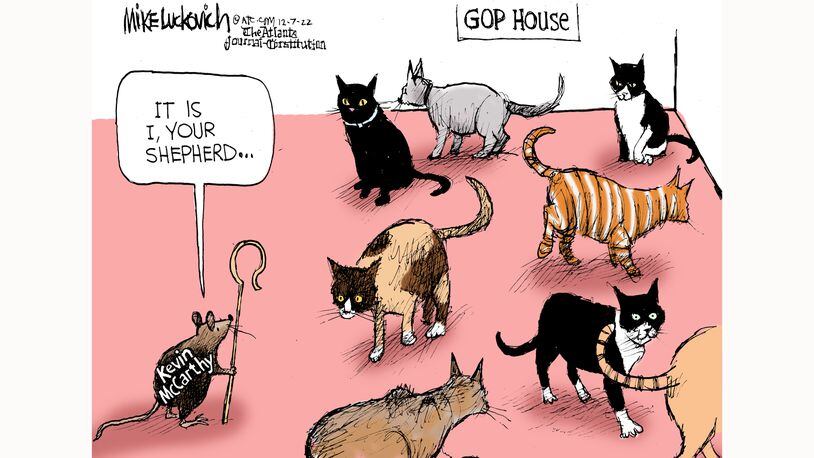
If we let everybody in the boat, if we row in the same cadence together, there is no obstacle this body can overcome for this nation.

Speaker Kevin McCarthy

This week’s featured post is “The Debt Ceiling: a (p)review“.

This morning I’m wondering what’s happening in Brazil

Yesterday afternoon, supporters of Brazil’s defeated former president Jair Bolsonaro occupied the National Congress, Planalto Palace, and Supreme Court in Brazilia. Congress and the Court are not in session and President Lula was elsewhere, so there is no hostage crisis.

This morning, I’m seeing claims that government forces have restored order and that government offices will open. Hundreds of rioters have been arrested. (As in our January 6 riot, the rioters were taking selfies and posting video, so they should be pretty easy to find and convict.)

Ever since Bolsonaro lost the a runoff election October 30, his supporters have been urging the Army to intervene, which it hasn’t done. Lula took office on January 1. This attack appears to be a more extreme plea to the Army, which is still not responding to it. I’m seeing claims that some police or other officials may have helped the rioters.

Supreme Court Justice Alexandre de Moraes ordered the immediate suspension of the governor of Brasília for 90 days, accusing him and the district’s head of public security of abetting the unprecedented attack on the country’s capital.

Bolsonaro himself is in Florida, where he went instead of attending Lula’s inauguration. Like Trump, he claims that his defeat was not a fair election. It looks like Bolsonaro’s most extreme supporters were victims of the same kind of reality distortion that QAnon brought to January 6. BBC quotes a Brazilian teacher of history and sociology:

They just get information from WhatsApp and Bolsonaro’s social media, so they are really disconnected from reality.

They believed that Bolsonaro would win the election easily, it did not happen, and then when Lula was elected, they believed that it would happen militarily, a coup d’etat, and Bolsonaro would become dictator of Brazil.

This is still breaking news, which I don’t have the resources to cover. Among the major news services, BBC seems to me to have the best coverage. If you want to sort through unvetted reports, search social media for #Brazil.

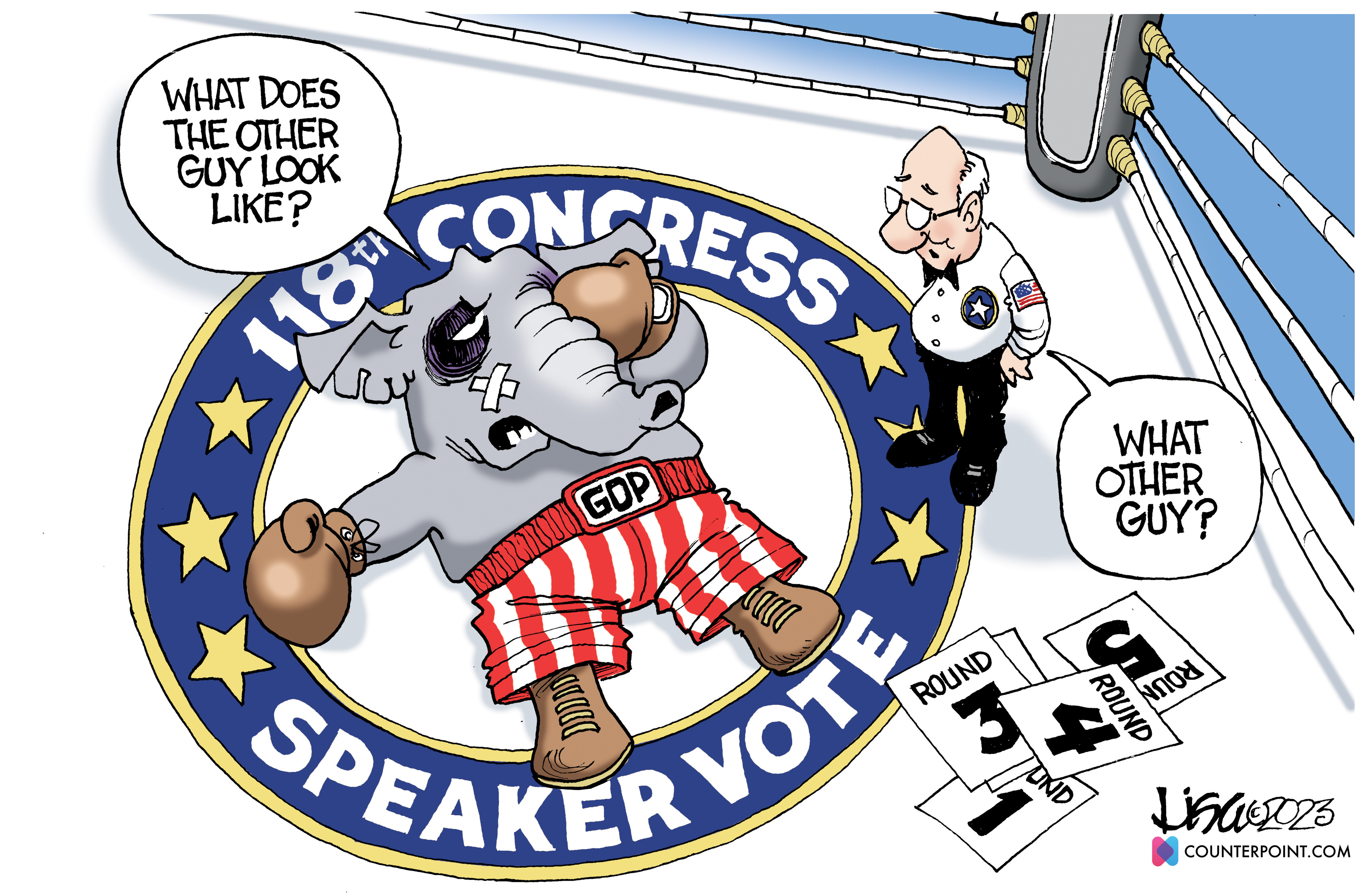
meanwhile, everybody has been talking about the Speaker election

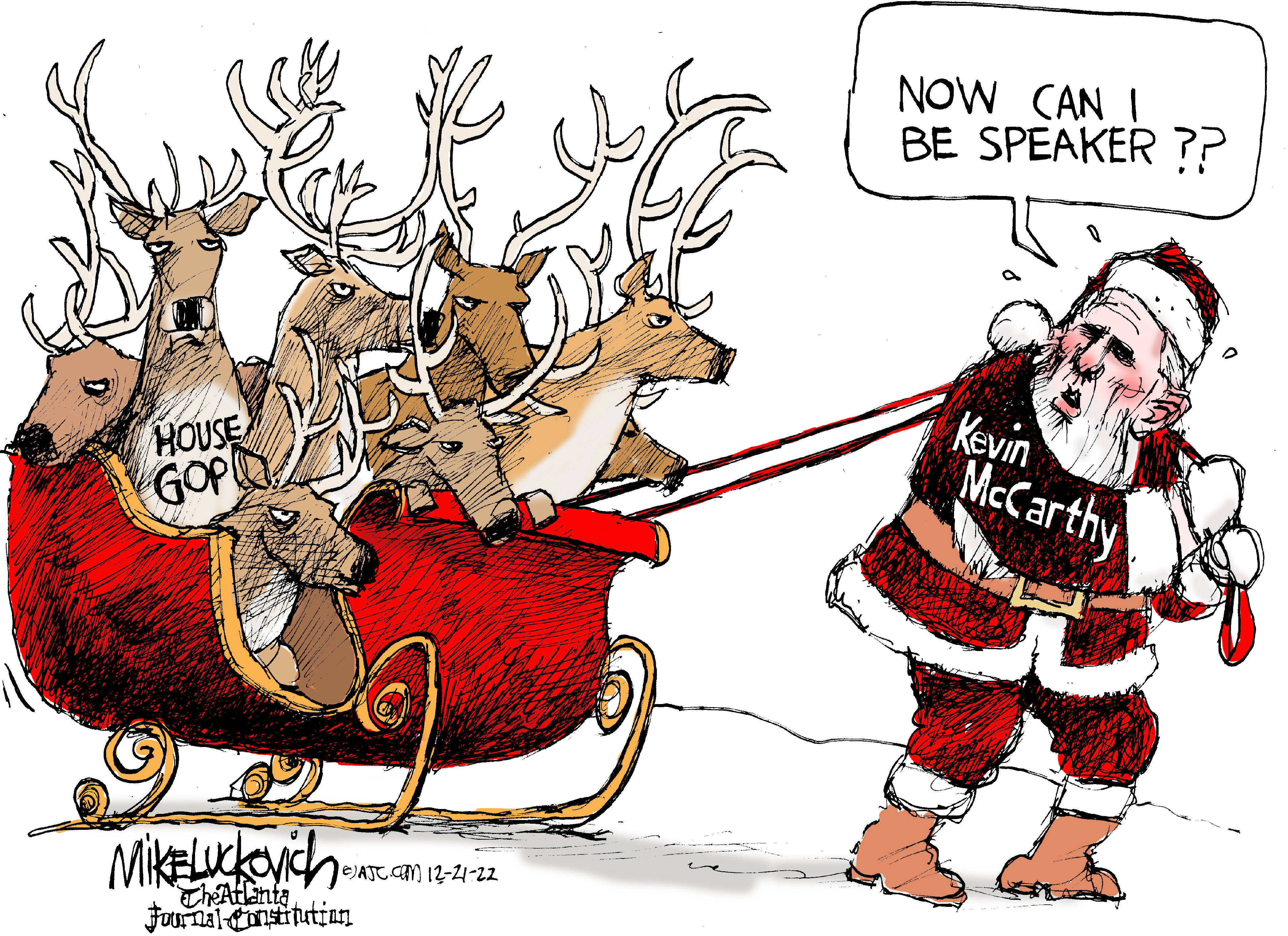
It took all week and 15 ballots, but Kevin McCarthy is finally Speaker of the House. The 15th ballot wasn’t complete until early Saturday morning, and then the newly elected congresspeople could finally be sworn in.

This afternoon we’ll see whether McCarthy has the votes to pass his rules package, which includes the concessions he made to the MAGA holdouts.
Democrat Katie Porter brought a good book for the occasion.

One benefit of listening to the various speaker-nomination speeches is getting to hear what the parties (or factions with the GOP) think their best talking points are. I was struck by two of McCarthy’s nominators — Steve Scalise and Kat Cammack — mentioning fentanyl overdoses as if this were a partisan issue. I mean, are Democrats for fentanyl overdoses?

Well, no. In a nutshell, Republicans try to turn every issue into the southern border. Crime is a border issue because immigrants are criminals. (They’re not, other than the one possible offense of crossing the border illegally.) Disease is a border issue because immigrants carry disease. (They don’t.) Fentanyl addiction is a border issue in the same way: It’s an excuse to militarize the border and maybe build Trump’s wall. Beyond that, it’s not clear Republicans have any interest in the problem, which is fundamentally a public-health issue, not a border-control issue.

Some Republicans go full-conspiracy-theory on the subject. Here’s J. D. Vance last April:

If you wanted to kill a bunch of MAGA voters in the middle of the heartland, how better than to target them and their kids with this deadly fentanyl? And, man, it does look intentional.


After McCarthy’s election, he gave a speech and then Democratic leader Hakeem Jeffries gave a speech. I think it’s safe to say that Jeffries outdid McCarthy: He used an acrostic technique that goes back the Psalms: One line for each letter of the alphabet.

He starts playing with the alphabet subtly at around the 8 minute mark, envisioning a country that “Provides for the Poor, Works for Working families …”. Around 13 minutes he pledges to the new Republican majority that Democrats will “try to find common ground whenever and wherever possible on behalf of the American people”. But he also pledges that Democrats “will never compromise our principles”.

What principles? That’s where the alphabetic litany starts: “House Democrats will always put American values over Autocracy, Benevolence over Bigotry, the Constitution over the Cult” … all the way to “Zealous representation over Zero-sum confrontation”.

And McCarthy? Well, just before the end he made a Freudian slip:

If we let everybody in the boat, if we row in the same cadence together, there is no obstacle this body can overcome for this nation.

I think your speechwriter wrote “can’t”, Kevin. But in this House, your version is probably more accurate.

Imagine Biden making that gaffe. Fox would spend the next week citing it as evidence of dementia.


McCarthy also repeated a promise he often made during the fall campaign:

Our very first bill will repeal the funding for 87,000 new IRS agents. You see, we believe government should be to help you, not go after you.

I’m afraid this first bill really will set the tone for McCarthy’s House, because it’s based on a lie: There is no funding to hire 87,000 new IRS agents, and the new resources the Inflation Reduction Act does send to the IRS don’t target middle-class Americans.

I’ve criticized the decision to release Trump’s tax returns to the public — he should do that, not Congress — but I do have to admit that nothing better illustrates the IRS’s need for more funding. Wealthy tax cheats like Trump know that if they make a big enough tangle of their finances, the IRS won’t be able to put enough auditors on the case to sort it out.

And that’s why McCarthy wants the funding repealed: If he represents anybody, he represents wealthy people who cheat on their taxes. That’s his base.


Michelle Goldberg commented on Marjorie Taylor Greene’s exasperation at the far-right Republicans who wouldn’t get in line behind McCarthy:

It was the embodiment of the Twitter meme: “‘I never thought leopards would eat MY face,’ sobs woman who voted for the Leopards Eating People’s Faces Party.”


Conservative commentator Noah Rothman argues that the chaotic nature of the speaker-election process and the insurgent demands for a weaker speakership is evidence against the charge that the GOP — and especially its MAGA/Freedom Caucus wing — is the “authoritarian” party.

He’s missing a key point: Fascists love weak governance when they are out of power. Any power center they don’t control should have its powers severely limited … until they do control it. Then, the sky’s the limit.

Case in point: Under Biden or Obama, presidential executive orders are tyranny, and presidential emergency powers are the worst tyranny of all. But in 2019, Andy Biggs urged President Trump to fund his border wall by declaring an emergency, usurping Congress’ power of the purse. (Trump did so.) Unchecked presidential power is wonderful if it’s his president.

Ditto for the Supreme Court. Judicial activism was horrible when the Court’s majority was liberal. But now that the Court is firmly in conservative hands, right-wing leaders no longer make “principled” denunciations of judicial activism.

Same thing here. Biggs was the first Republican to challenge McCarthy’s bid for speakership, and is a key member of the group trying to limit the speaker’s power. But that’s only because his faction represents a small percentage of the Republican caucus and has no chance to elect one of its own as speaker. If the tables ever turn, though, they’ll be looking for a very strong speaker indeed.

The lesson here is that authoritarians are not all the same, and in particular that fascists are not monarchists. Monarchists seek order; they believe that somebody needs to be in charge, and so they tend to fall in line behind the new king, whoever it turns out to be. But fascists seek power; they believe they should be in charge. So they’re for chaos when they’re out of power and order after they gain power. Any power center they can’t control should be weak. But power centers they do control should be strong.

and the debt ceiling

The featured post discusses the debt-ceiling standoff that is coming in the summer, and what the speaker election portends for it.

and the second anniversary of the insurrection
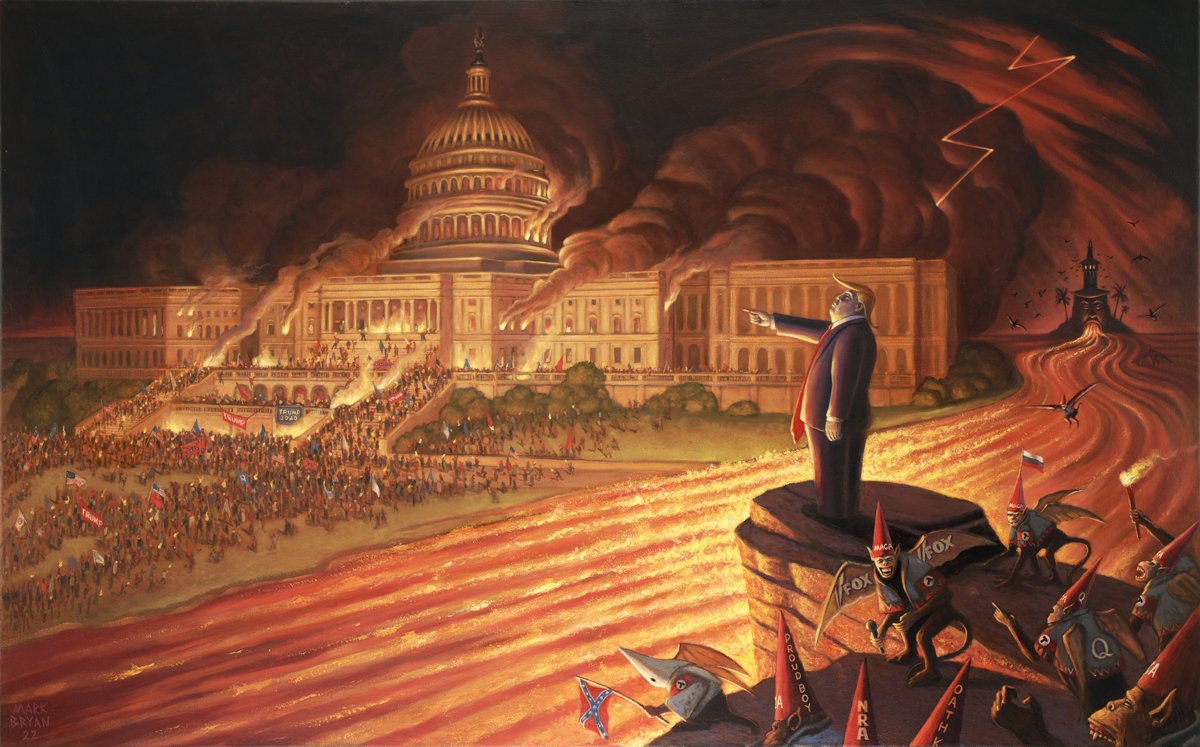
Friday, President Biden marked the second anniversary of the 1-6 insurrection by giving medals to 14 people who stood in the way of Trump’s attempt to stay in power after losing the 2020 election.

The group included law enforcement officers, current and former politicians and election workers who were targeted with threats following the 2020 presidential contest. Three of the medals were awarded posthumously to officers who had defended the Capitol on Jan. 6, 2021, and died afterward by injuries or by suicide.


I heard one commentator (I believe after a conversation with Nancy Pelosi) point out that if this were a presidential inauguration year, a January 6 riot wouldn’t be necessary. Because the House still had no speaker on January 6, it would have been incapable of counting electoral votes. What would happen next is anybody’s guess.


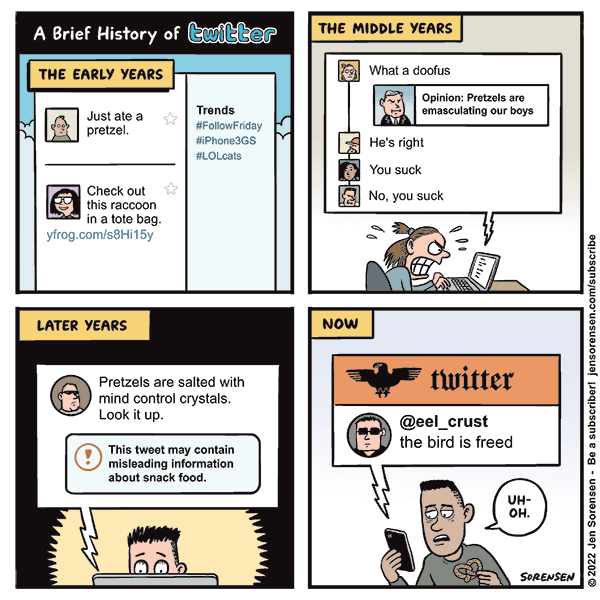
Elon Musk celebrated January 6 by restoring the Twitter account of one of the top conspirators, retired General Michael Flynn.


The Fulton County special grand jury investigating Trump’s attempt to interfere with the 2020 presidential election in Georgia has completed its work. Apparently, that means it has written a report that either does or doesn’t recommend indictments. The grand jury had no authority to indict on its own.

At the moment I don’t know whether any indictments have been recommended. This is breaking news this morning, so consult other sources.

and the pandemic

Covid appears to having another surge. Case numbers are mostly flat and hard to interpret, but everything else is increasing. Deaths are now over 500 per day again, after dipping into the 200s in early December. Hospitalizations and ICU cases are also up.

A scary article from BBC: An official in China’s Henan province says that 90% of the population — about 88.5 million people — have had Covid.

Mr Kan did not specify a timeline for when all the infections happened – but as China’s previous zero-Covid policy kept cases to a minimum, it’s likely the vast majority of Henan’s infections occurred in the past few weeks.

In late December, nearly half of the passengers on two flights from China to Milan tested positive.

and the economy

It’s hard to know how to interpret economic statistics during a time when the Fed is trying to fight inflation. Usually, it’s great news that the economy is creating jobs and wages are rising — which is what Friday’s jobs report showed: The economy added 223K jobs in December and unemployment matched its pre-pandemic low of 3.5%.

But the Fed’s inflation-fighting policy is to slow the economy with higher interest rates, so more jobs just means they’ll increase rates further until the slowdown takes effect.

and you also might be interested in …

Jim Jordan will chair the new House select committee to investigate “the weaponization of the federal government”, i.e. the investigation of Trump and his co-conspirators, like Jim Jordan.

This follows in the footsteps of the failed Durham investigation, and will probably proceed in much the same way: with great fanfare about the devastating evidence it is about to uncover, which will be greatly underwhelming when it appears.

Other than giving Fox News something to talk about, the main point of the Jordan committee will be to harass anyone who has had the effrontery to investigate Republicans, and to intimidate anyone who might do so in the future. A second goal will be to screw up any Trump prosecution.

It will be interesting to see if members of the January 6 Committee (now dissolved) will cooperate with Jordan. After all, Jordan defied a subpoena from them; why should they testify for him?

It’s also worth pointing out that Democrats don’t do this. Nobody was ever punished for all those bogus Benghazi investigations.


President Zelenskyy’s New Year message was as good a piece of wartime messaging as I can think of. I’m inspired, and I’m not even Ukrainian.


Police killings in the US were up in 2022. At least 1176 Americans were killed by police, up from 1145 in 2021. The 2022 total is a new record, according to Mapping Police Violence, which began keeping track of police killings in 2013.

On TV, police kill violent criminals in self defense or to keep them from killing someone else. But that’s not the typical case.

In 2022, 132 killings (11%) were cases in which no offense was alleged; 104 cases (9%) were mental health or welfare checks; 98 (8%) involved traffic violations; and 207 (18%) involved other allegations of nonviolent offenses. There were also 93 cases (8%) involving claims of a domestic disturbance and 128 (11%) where the person was allegedly seen with a weapon. Only 370 (31%) involved a potentially more serious situation, with an alleged violent crime.

I looked for something to compare these numbers to. In the 2019-2020 fiscal year, Australia set a record with 16 police shooting deaths. The US has about 13 times Australia’s population, so the Australian number looks comparable to 208 American deaths, or less than 1/5 of our total. Canadian police killed 36 people in 2020, which would be comparable to 312 Americans, or less than 1/3 our total.

Iceland — a bit larger than 1/1000th the size of the US — has had only one police killing in its history, which happened in 2013. At the US rate it would have about one a year.

I typically hear two explanations for the US’s high rate of police killings: American police are trained to have a “warrior mindset” (most other countries’ police aren’t), and American police are responding to a more dangerous environment, i.e. anyone they encounter might have a gun. In other words: An increased risk of being killed by police is one of the prices we pay for America’s high level of gun ownership.

For police, the huge number of guns in America also means that every single call is treated as if someone involved could be armed — and that an otherwise nonviolent wellness check, mental health call, or traffic stop could turn into a deadly encounter. US law generally allows police to use force because they merely perceive a threat, and the many firearms in civilian hands give police officers a reason to believe they’re in danger.


In other gun news, the federal ban on bump stocks was struck down by a federal appeals court.

Bump stocks are devices that allow a semi-automatic weapon to function like an automatic one, shooting a series of bullets on one trigger-pull. They were banned by the Trump administration after one was used in a mass shooting in Las Vegas that killed 58 people.


I’m still not interested in the British royal family.


Jackson, Mississippi is having another water crisis. The Guardian attributes the problems to “an aging and underfunded system that routinely fails to withstand extreme cold”. All 33 of Jackson’s public schools stayed closed Thursday and Friday (when they were supposed to return from Christmas break) due to low water pressure.

and let’s close with something sweet

Here’s a teacher’s story from 2018:

One of my first graders lost his mom 2 years ago as did I. On Wednesday he gave me a handwritten card saying both of our moms are angels together. Through tears, I tell him I’m having trouble reading it. He says to me, “Just sound it out.” 💕

Conclusions

One of the main conclusions of 2022 is that unpunished evil returns with even greater evil.

Kira Rudik, member of the Ukrainian Parliament

This week’s featured post is “Partying Like It’s 1942“.

This week everybody was talking about 2022

In the featured post, I raise a possibility (not a certainty) that I find intriguing: Hinge years, when bad trends turn around, look a lot like 2022. They’re scary to live through, because horrible possibilities are constantly looming. But again and again, the worst doesn’t happen.

In 2022 we dodged a lot of bullets: Ukraine didn’t fall, NATO didn’t collapse, and MAGA candidates didn’t sweep the midterms. Early in the year, a lot of people imagined it might end with Trump triumphant: in firm control of the GOP, 1-6 in the rearview mirror, the 2024 nomination his for the taking, and election-denying secretaries of state ready to hand him a victory whether the voters want him or not.

Before good things can start happening, bad things need to stop happening. A lot of bad things didn’t happen in 2022.


TPM awarded its annual Golden Dukes, which celebrate the cartoonishly corrupt and incompetent in American politics. This year’s winners:

Best Scandal, General Interest: Donald Trump, for the Mar-a-Lago documents

Best Scandal, Local Venue: the Patriot Front, for delivering themselves to the cops in a UHaul

Meritorious Achievement in the Crazy: Herschel Walker, for his vampire vs. werewolf speech

Most Cringe Campaign Ad/Meme: Dr. Oz, for his crudités

Most Convoluted Conspiracy Theory: Marjorie Taylor Greene, for Jewish space lasers*

Soon-to-be-forgotten Hero: Madison Cawthorne.

*I know: Jewish space lasers started in 2018, but she did have some tiff about it this year as well. And Lauren Boebert brought it up again. But really Italygate should have won in this category.

and Title 42

Title 42 is a 1944 law that lets the government to keep people from entering the US during a public health emergency. The Trump administration invoked it in March, 2020 to expel migrants at the southern border. The Biden administration has been trying to end the policy since May, but has been blocked by the courts. This week, the Supreme Court issued a stay, keeping Title 42 in effect until it can rule on a case it won’t even hear until February, and probably won’t rule on until June.

What’s embarrassing and infuriating about this whole story is the bad faith. Trump invoked this Covid emergency at a time when he was denying the seriousness of the pandemic in every other way. The point wasn’t to protect the country from Covid, which was already here and wasn’t any more prevalent among immigrants than among any other group. The pandemic was just a pretext for keeping immigrants out of the country.

Similarly today, the states that are trying to enter this case are the ones that have had the fewest Covid restrictions. They’re not trying to protect public health; they just don’t want immigrants.

And the Court’s majority is acting in bad faith as well, as Ian Millhiser explains on Vox. When the conservative majority likes the current administration’s policy (as it usually did when Trump was president), it acts swiftly to remove obstacles in the lower courts. When it doesn’t (as in the current case), it drags its feet and leaves obstacles in place.

In 2021, Trump-appointed Justice Amy Coney Barrett delivered a speech at the University of Louisville’s McConnell Center (named for Senate Republican leader Mitch McConnell), in which she announced that her goal was “to convince you that this court is not comprised of a bunch of partisan hacks.” But if that is truly her goal, she and her colleagues might want to consider applying the same scheduling rules to cases brought by Republicans that her Court applies to cases brought by Democrats.

and 1-6 Committee Transcripts

This week was characterized by document dumps bigger than any one person could possibly process. Let us agree to forgive each other for not reading all the 1-6 Committee’s interview transcripts or six years of Trump’s tax returns.

The main thing that has come through for me is that the Committee was very selective about what it included in its public hearings. If it had just wanted to tell outrageous stories, it had plenty that it didn’t use: Mark Meadows burning documents, for example.

and Trump’s taxes

I continue to be of two minds about this. Obviously, Trump should have released his taxes voluntarily long ago, as all other presidential candidates have since Nixon, and as he often promised to do. It is now clear that his excuses for not releasing them were lies.

I’m still not comfortable with a House committee releasing these documents on a party-line vote. As DoJ (I hope) gets ready to indict Trump, I want to be able to argue that everything done against him has been done in the public interest, and not for political advantage. In spite of the protests of MAGA Republicans, I believe the January 6 Committee’s actions can be defended on those grounds. Ditto for the FBI’s search of Mar-a-Lago.

Here, though, I’m not sure. The political point-scoring is obvious: He claims to be rich and a genius businessman, but he reported huge losses to the IRS that in many years resulted in him paying less tax than you did. Taxpayers who can’t afford complicated tax-avoidance schemes should be angry. Also: His income has come mainly from selling off properties inherited from his father; his own ventures have usually resulted in losses. He looks more like a clueless rich kid than like a brilliant businessman.

There is a public-interest angle, but it’s more subtle. Clearly the IRS has dropped the ball on auditing him, even though they are supposed to audit the president’s taxes every year. Exactly one auditor was assigned to his complicated return, and none of the audits have been completed. Somebody needs to figure out the IRS just lacks resources, or if it was succumbing to political interference.

A lot of things in his returns look suspicious, but they need to be investigated by someone who can demand to see receipts. We in the general public can just shake our heads and wonder.

and you also might be interested in …

Tomorrow we’ll find out whether Kevin McCarthy has the votes to become speaker. If he doesn’t, we’re in the land of political novels, because there hasn’t been a multi-ballot speaker election since 1923. Maybe that’s something we need to do every hundred years.

George Mason Professor Steven Pearlstein suggests that a bipartisan coalition pick a compromise speaker from outside the House. It’s part of a wonderful fantasy in which centrists depolarize Congress and try to do things the voters want done. I don’t believe in it for a second, but I enjoy picturing it.


Deaths this week: Pelé, Pope Benedict, and Barbara Walters. They were too late to make the annual Sgt. Pepper tribute to people lost during the year by Chris Barker.


The best account I’ve seen of Southwest Airlines’ recent problems is in the Seat 31B blog. Basically, Southwest tries to keep fares low and profits high by using its assets “efficiently”, which means that there’s no slack if anything goes wrong. It also has an antiquated IT system.

The only real way they have to [handle this situation] (because of the way they operate and their limited IT capabilities) is to stop for an entire day and set to work inventorying their assets and crews and then build out entirely new trips for everyone.


When I watch Republicans in Congress defend Trump, I often wonder whether they really believe what they’re saying. Elise Stefanik clearly doesn’t. The NYT has a fascinating piece about her “conversion” from a young moderate to self-described “ultra MAGA” member of the House GOP leadership. She made a career move, not an ideological reassessment; it’s actually not clear whether she has any political philosophy at all. I can’t remember who I heard describe her as a “House of Cards” character, but it fits.


I’ve been enjoying the images that my Facebook friends create using the new AI art tools. But I’ve also been wondering about the dark possibilities.

Cartoonist Sarah Anderson describes how disturbing it is to see strangers easily hijack your style and use it for purposes you would never approve. Her cartoons are on the internet, so they were included in AI training sets (for which she received no compensation). Now you can start making an imitation Sarah Anderson cartoon — expressing your views, not hers — by using her name as a prompt.


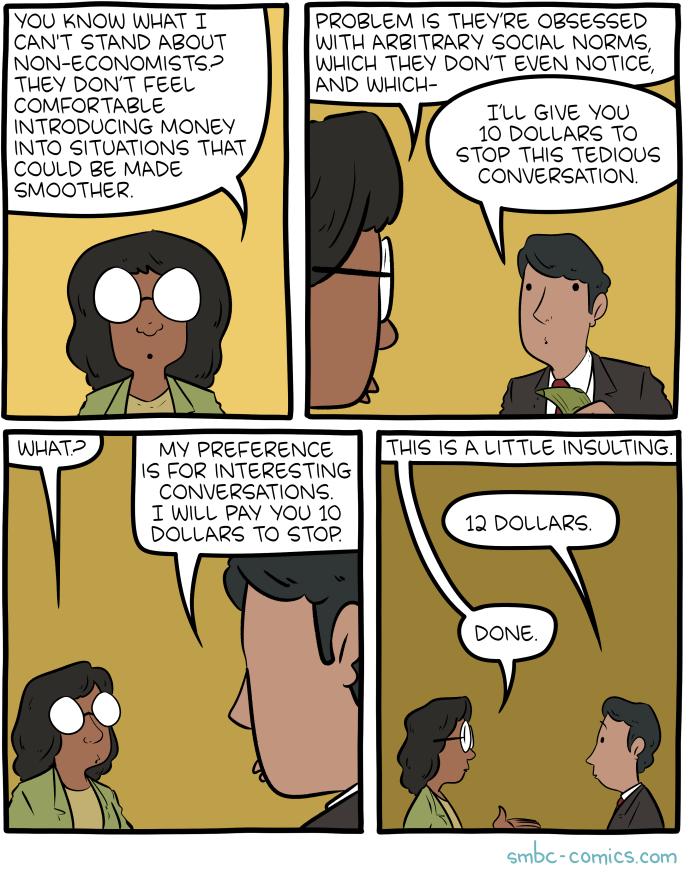
Speaking of online cartoons, have you read SMBC by Zach Weinersmith?


Paul Krugman has been analyzing Tesla, whose stock fell 65% in 2022 and is still selling at a lofty 35 times earnings. In his first column, he sticks with financial prospects, arguing that Tesla stock never deserved its high growth premium, because it lacks the “network externalities” of successful past tech growth stocks like Microsoft or Apple.

Decoding that: As Microsoft and Apple products became more popular, users got locked in. So if you have a bunch of iPhone apps, your next phone is probably also going to be an iPhone, even if you’re replacing your phone during a period when competing phones are better or cheaper or cooler. Ditto for your company’s Microsoft software.

That’s why, once they hit it big, Microsoft and Apple became profit-generating machines that justified the high prices their stocks had traded at in earlier years: Their products stay on top even through periods where they don’t deserve to, and the difficulty of switching induces users to pay near-monopoly prices.

But Tesla has nothing like that going for it. Maybe Tesla cars are better/cooler right now, so maybe you’ll buy one if you can afford it. But that kind of advantage is fleeting, and once it’s gone, nothing will stop you from buying something else the next time you need a car. So Tesla stock should be valued more according to its current or near-future earnings than by projected far-future earnings that may or may not manifest.

In his second Tesla column, Krugman looks at the likely effects of Elon Musk’s recent behavior. Using a variety of indirect measurements, he argues that Teslas are bought mainly by Democrats. (Counties with large Trump majorities, for example, have very few Tesla registrations.) Consequently,

Musk’s public embrace of MAGA conspiracy theories is an almost inconceivably bad marketing move, practically designed to alienate his main buyers.

Speaking purely for myself, I am considering buying an electric car in the next year or two, and Tesla used to be an attractive possibility. Now, a Tesla would have to be much, much better than competing alternatives to overcome the Musk stigma.


An NYT article on the failure of election-denier secretary-of-state candidates pointed to a difference in money:

A significant factor in the imbalance was Mr. Trump, who vocally promoted election denier candidates in Republican secretary of state primaries but put almost none of his money where his mouth was. Save America PAC, his leadership PAC, spent only $10,000 of its $100 million-plus war chest on secretary of state candidates who made it into the general election. A spinoff super PAC, MAGA, Inc., chose to spend money on races for Senate instead.

But even the spending on Senate races was a small percentage of his full war chest.

Here’s what I suspect: Trump has sucked up a significant portion of Republican fund-raising, but as a grift. Even money that his PACs apparently spend on candidates somehow finds its way back to the Trump Organization. (Quartz noticed this pattern back in 2015.) That creates friction for GOP candidates across the board.


It’s not new, but The New Yorker just pointed me to a 2018 article in which Molly Ringwald looks back at her breakout hits Pretty in Pink and The Breakfast Club.

I imagine that everyone in my generation (60-something) has had the experience of re-watching something we loved when we were younger and reflecting on how horrible parts of it are by current standards. I’m sure it’s even more complicated when you helped make the thing in question.

Ringwald does a good job of giving the past its due without excusing its flaws, and recognizing that the good and bad do not cancel each other out. That’s a complex attitude that we would all do well to master, particularly as we look back on American history.

Ringwald is focusing on adolescents and especially girls, but she describes a pattern that applies to Blacks, gays, and all sorts of groups that have had to struggle for recognition: First you’re invisible, then you’re a token, then you’re a stereotype, and then (maybe, eventually) you start to be seen as a person. With all its problems, each stage is an advance over the previous stage.

and let’s close with a countdown

As a teen-ager, I used to listen to AM radio on New Years Eve as they counted down the top songs of the year. What would be #1? I’ve been hooked on countdowns ever since (though I don’t do song-countdowns any more because I wouldn’t recognize most of them).

I still appreciate good humor and satire, though. So here’s McSweeney’s countdown of its most-read articles of 2022. My favorite is #4: “Selected Negative Teaching Evaluations of Jesus Christ“, which includes the comment: “Only got the job because his dad is important.”

Ringleaders and Foot Soldiers

Ours is not a system of justice where foot soldiers go to jail and the masterminds and ringleaders get a free pass.

Rep. Jamie Raskin

This week’s featured post is “Trump still has no counter-narrative“.

This week everybody was talking about Trump’s crimes

Last Monday, the 1-6 Committee held its last public hearing. The executive summary of its final report was released Monday, and the 800-page full report on Thursday

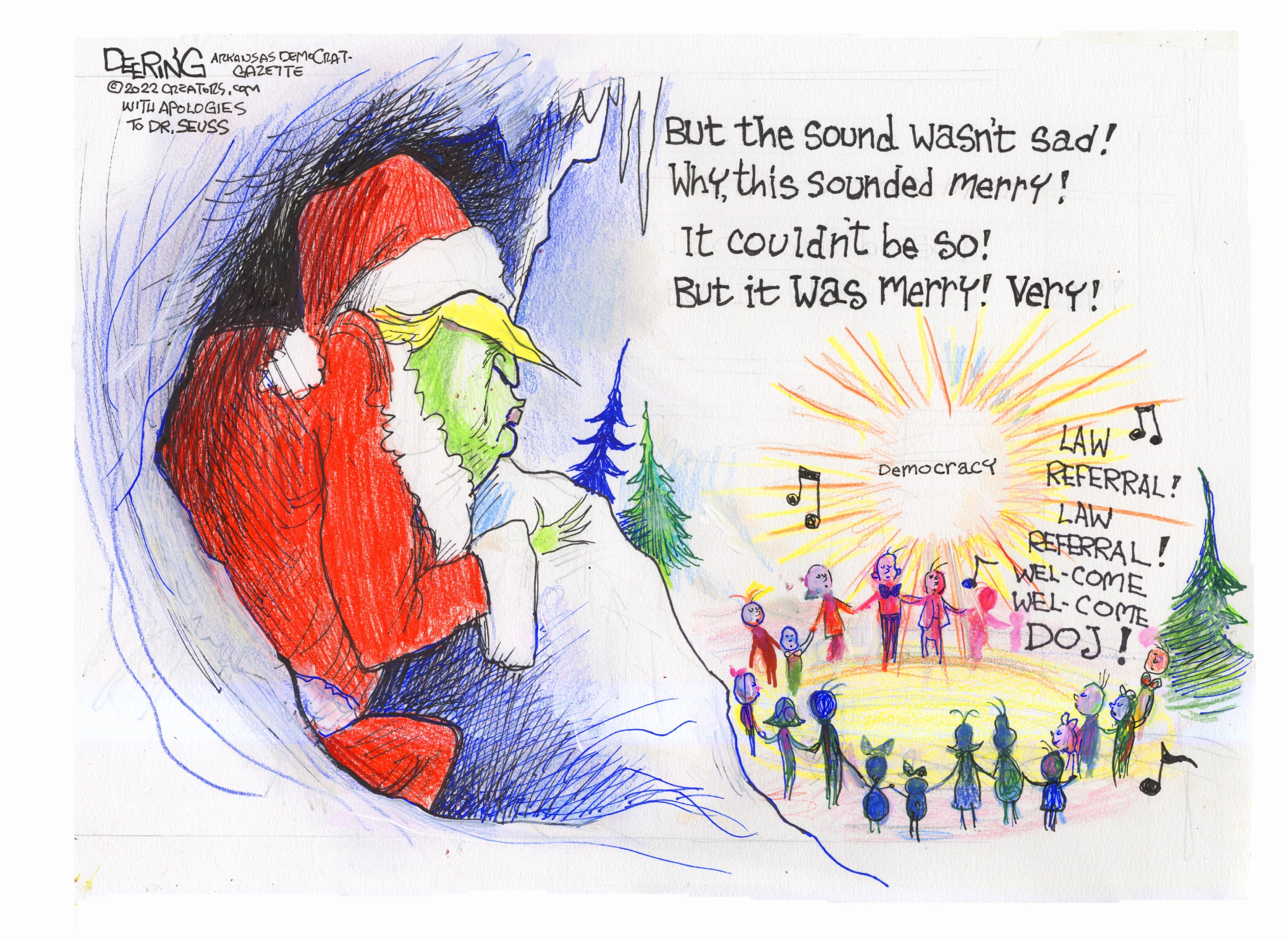
The committee also announced that it had made criminal referrals to the Justice Department.

The committee’s historic referral says there is sufficient evidence to refer Trump for four crimes: obstructing an official proceeding, conspiracy to defraud the government, making knowingly and willfully materially false statements to the federal government, and inciting or assisting an insurrection.

I summarize Committee’s version of the January 6 plot (and Trump’s lack of any credible response) in the featured post. Briefly, the Committee sees January 6 not as a one-day event, but as the unsuccessful culmination of Trump’s months-long scheme to remain in power after losing the 2020 election. In their telling, Trump knew he had lost the election, knew that his fraud claims were false, knew that his false-elector scheme was illegal, knew that the Constitution did not give Vice President Pence the powers Trump pressured him to exercise, and knew that his January 6 speech would incite violence.

Trump responds with ad hominem attacks on the Committee and its witnesses, and he encourages his people not to testify or provide documents. I don’t believe this is how innocent people behave.

In my view, the one part of this narrative where the evidence is not iron-clad (yet) is in Trump’s connection to those who organized the violence. Those arrangements appear to have gone through Trump’s consigliere Mark Meadows, and then through Roger Stone and Mike Flynn. None of those three have answered questions about this. Meadows has been cited for contempt of Congress for refusing to testify. Stone and Flynn testified, but repeatedly invoked the Fifth Amendment.

There is reason to hope that the Department of Justice will have better luck getting at least a little cooperation from one or more of them, most likely Meadows.


I am largely in agreement with David Frum, who observes how the responsibility for calling Trump to account for his crimes keeps getting passed from one body to another.

Robert Mueller believed he had no power to indict Trump for obstructing his investigation of Russian influence on the 2016 election. When Trump then tried to extort Ukrainian President Zelenskyy into investigating Biden, the House impeached him, but to his defenders in the Senate

Holding Trump to account should be somebody else’s job: in this case, the voters.

When the voters accepted that responsibility and voted to remove Trump from office (by seven million votes), he tried to overturn the election by fraud and ultimately by force. When those actions led to a second impeachment that could have banned him from holding any future office, Mitch McConnell admitted

There is no question that President Trump is practically and morally responsible for provoking the events of [January 6].

But he decided that accountability and consequences were still somebody’s else’s job.

We have a criminal justice system in this country. We have civil litigation. And former Presidents are not immune from being held accountable by either one.

Now, once again, Trump has been investigated by a body that had no power to indict him. The January 6 Committee could only make a referral to the Justice Department, which it has done.

That leaves nobody for DoJ to pass the buck to. The final decision rests with Jack Smith and Merrick Garland. If they choose not to indict Trump, that will be the end of any consequences. Trump will have proven he is above the law.

There has been some debate about whether the 1-6 Committee should have bothered with criminal referrals, given that the Justice Department has no obligation to follow up on them. I think the referrals are important from the point of view of history and narrative.

Every time some official body investigates Trump and then declines to do something, his supporters take that inaction as vindication. The same thing would have happened here, as in “The Committee made a bunch of noise, but in the end even they didn’t claim Trump had committed any specific crimes.”

And if the Justice Department would decline to indict Trump — for what it’s worth, I believe it will indict him, that I’m not sure what the charges will be — the historical record wouldn’t have any explicit claims against him beyond the second impeachment, which had to be put together quickly and missed the full breadth of the conspiracy to overturn the 2020 election.


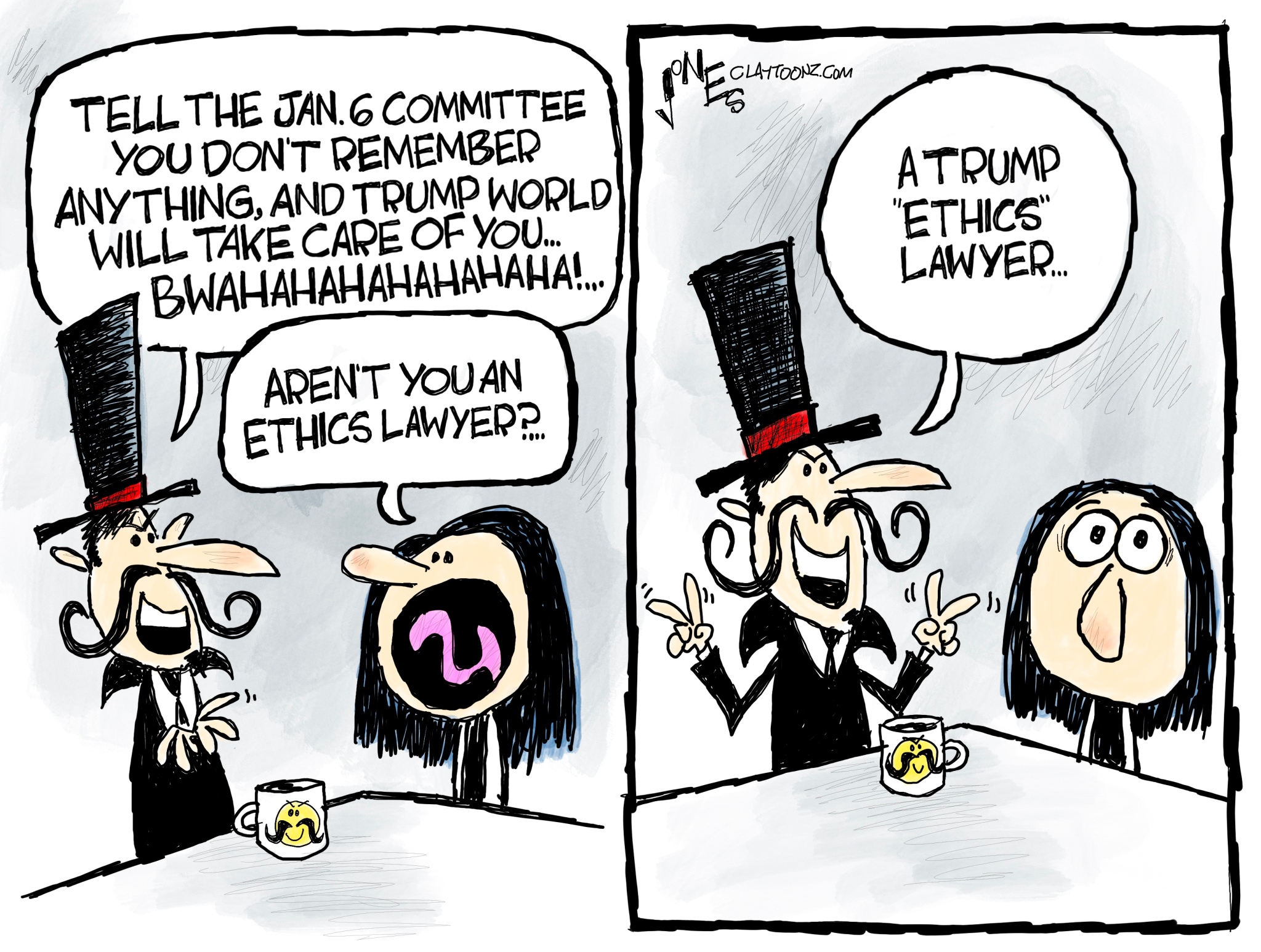
One sidelight of the report is an account of how Cassidy Hutchinson’s original TrumpWorld lawyer tried to influence her testimony.

Hutchinson stressed that he “never told me to lie,” but did say Passantino instructed her to say “I do not recall” and encouraged her to “use that response as much as you deem necessary.”

“I said, ‘But if I do remember things but not every detail, and I say I don’t recall, wouldn’t I be perjuring myself?'” Hutchinson asked Passantino, she told the committee. “Stefan said something to the effect of, ‘The committee doesn’t know what you can and can’t recall, so we want to be able to use that as much as we can unless you really, really remember something very clearly.”

… In a later conversation with Passantino on March 1, Hutchinson said he told her, “We’re gonna get you a really good job in Trump world,” and “We want to keep you in the family.”

The interview transcript also reveals Ben Williamson, another White House aide who was close to Meadows, told Hutchinson the night before her second deposition in March that “Mark wants me to let you know that he knows you’re loyal, and he knows you’ll do the right thing tomorrow and that you’re going to protect him and the boss.”

Hutchinson got a new lawyer before her second appearance before the Committee.


It was fascinating to watch how Fox News’ web site covered the criminal referrals. The news article disappeared from their front page quickly; it mentioned the four crimes by name, but gave no hint of the evidence behind the charges. The only person quoted was a spokesman for Rep. Jim Jordan, who characterized the referrals as “just another partisan and political stunt”.

The news article was quickly followed by an analysis article, which did not even list the charges. Instead, the article emphasized that a congressional referral “holds no official legal weight”, is just “theater”, and will be “ignored” by DoJ because it will be a “prosecutorial liability”.

Keep this in mind if you find yourself arguing with someone who mainly follows Fox News and other conservative media: The evidence against Trump has been systematically hidden from them.


The House Ways and Means Committee has voted to reveal six years Trump’s tax returns, as well as tax returns for eight of his businesses.

These returns are the outcome of a three-year court battle to enforce a fairly clear law, passed in 1924 after the Teapot Dome scandal, that allows certain committees of Congress to request individual tax returns from the IRS. Trump Treasury Secretary Steven Mnuchin refused to obey that law, and the case had to go all the way to the Supreme Court.

I am not sure why the returns had to be released to the public (though it’s worth noting that all major presidential candidate since Nixon have released their returns voluntarily, so it’s not like Trump has suffered some unprecedented injury). The New Yorker interviewed Ways and Means Chair Richard Neal about that.

Apparently, the failure to give Trump’s returns to Congress was not the only obligation that Trump’s IRS ignored. IRS policy requires that tax returns of presidents and vice presidents be audited annually, but audits of Trump’s taxes didn’t begin until after Neal requested the returns be released to his committee. (Audits of both Obama and Biden have been performed on schedule.) None of the Trump audits have been completed.

Neal phrases his responses carefully, but he clearly intends to leave the impression that it is necessary to release the returns so that the public can do the kind of auditing that the IRS hasn’t done. I have no idea whether that makes sense.

and President Zelenskyy’s visit to Washington

The Ukrainian president made a surprise visit to D.C. just before Christmas, and spoke to a joint session of Congress on Wednesday. He spoke in English and invoked iconic moments in America’s past struggles to achieve or defend freedom: Saratoga and the Battle of the Bulge. He thanked America for its support in both weapons and money, and asked for more.

Your money is not charity. It’s an investment in the global security and democracy that we handle in the most responsible way.

The MAGA right erupted in outrage. Matt Walsh tweeted “Get this grifting leech out of our country please”. Tomi Lahren tweeted: “No more money to Ukraine!!! We can’t fight this war for you for eternity!!!” (I’m puzzled how anyone could look at Ukraine’s bombed-out cities or consider its thousands of war dead and conclude that we are fighting this war for them. We’re helping to bankroll a war they are fighting for themselves with great courage. This is not like Afghanistan, where officials couldn’t surrender or leave the country fast enough as soon as we started turning off the money.) Tucker Carlson seemed deeply offended that Zelenskyy addressed Congress in his combat sweater (clearly the worst offense against America since President Obama’s tan suit).

The point was to fawn over the Ukrainian strip club manager and hand him billions more dollars from our own crumbling economy. It is hard, in fact, it may be impossible to imagine a more humiliating scenario for the greatest country on Earth.

As he so often does (and will if he becomes speaker), Kevin McCarthy seemed not to know what to do with himself.

Lawmakers rose to applaud. McCarthy, who vows to probe Ukraine’s use of U.S. funds, froze in his chair before eventually lumbering to his feet. … McCarthy’s unease was understandable. Zelensky’s joint-session address celebrated U.S. support for Ukraine’s defenses against Russian invaders, and many in McCarthy’s Republican caucus (whose votes McCarthy needs to become speaker) want to cut off U.S. aid. Most GOP lawmakers skipped the speech entirely, and a few in attendance — Lauren Boebert, Matt Gaetz, Tim Burchett — sat through it sulking. Other Republicans trashed Zelensky, calling him “the Ukrainian lobbyist” (Rep. Thomas Massie), “the shadow president” (Rep. Marjorie Taylor Greene) and a “welfare queen” (Donald Trump Jr.).

Trump and his cultists decided many years ago to side with Russia. It must be very frustrating that Putin has joined Hershel Walker, Keri Lake, and the Atlantic City Taj Mahal in the long list of slow horses Trump has bet on. Putin was supposed to be the prototype fascist strongman. The fact that he turns out to be surprisingly weak and ineffective is deeply embarrassing to fascists everywhere.

and the closing days of a sane Congress

The new Congress, with a Republican House majority, will take office on January 3. Meanwhile, the current Congress passed the bill that it had to pass to prevent a government shutdown. The $1.7 trillion bill will keep the military and a variety of other programs funded through the end of FY2023, i.e. September 30.

This is probably the last time between now and 2025 that the government will be funded without a hostage-taking drama.


One provision that made it into the bill was a revision of the Electoral Count Act. The revision makes clear the vice president’s role in counting electoral votes, eliminating any ambiguity that some future Trump might try to take advantage of. It also resets the threshold for challenging a state’s electoral votes. Previously, one member of each house was enough to start a debate about a state’s electoral votes. Now it will require 1/5th of each house.


Kevin McCarthy still doesn’t have the votes to become speaker. It’s hard to guess what kind of deal he can make with the five Freedom Caucus members who have pledged not to vote for him, because (unlike progressives that Nancy Pelosi had to negotiate with in past Congresses), they don’t seem to want anything in particular out of government, or even for the government to function at all.


One of the new Republican congressmen is George Santos of New York, who apparently isn’t who he says he is. In the simplest sense his name does appear to be George Santos, but beyond that, just about everything he told voters was a lie. He didn’t graduate from the college he claimed or work and the investment bank he claimed. One company he did work at is being investigated by the SEC for being a Ponzi scheme.

Santos is a Brazilian immigrant with a criminal record who was evicted from apartments in 2015 and 2017, but now somehow has enough money to contribute $700K to his own campaign. No one knows where his money comes from.

Kevin McCarthy appears to be standing by Santos, because his Republican majority is tiny and he needs every vote if he’s going to become speaker. As Adam Kinzinger said in his farewell speech to the House on December 15, today’s Republican Party has “embraced lies and deceit“.

and you also might be interested in …

Does Texas Governor Gregg Abbott know the true meaning of Christmas or what? His latest migrant-busing stunt resulted in three busloads of asylum seekers (not illegal immigrants; seeking asylum is recognized in US law) being deposited outside Vice President Kamala Harris’ residence at the Naval Observatory. (A private aid agency took the migrants to a local church. I don’t know what happened to them from there.)

“Governor Abbott abandoned children on the side of the road in below freezing temperatures on Christmas Eve without coordinating with any Federal or local authorities,” White House assistant press secretary Abdullah Hasan said in a statement. “This was a cruel, dangerous, and shameful stunt.”

Up to a point, I can sympathize with border states who feel that the burden of our immigration problem falls disproportionately on them. Wanting to slough that burden off on other states or the federal government is understandable. What I can’t sympathize with is Governor Abbott’s callous indifference towards the individuals involved. They may not be white and they may not speak English, but they are people.

Eric Swalwell tweeted:

Guess we know how Greg Abbott, a “practicing” Roman Catholic, would have treated Jesus, Mary & Joseph.


It’s also worth pointing out that Republican Thom Tillis and Democrat-turned-Independent Kyrsten Sinema worked out a bipartisan compromise proposal to that would cut the number of asylum-seekers in the US by putting more resources into the asylum-court process — smaller case backlog, faster decisions, fewer people waiting around for their cases to be heard. The proposal would in addition have given legal status to the “Dreamers” — children brought into the US illegally who have grown up here, most of whom know no other home.

The proposal died, largely because of a no-compromise attitude on the part of conservatives. It will not be revisited in the new Congress, because Kevin McCarthy has vowed not to consider any immigration reform compromise.

Amnesty is a nonstarter. It won’t be taken up by a House Republican majority.


Keri Lake’s lawsuit to overturn her election defeat in Arizona was thrown out. She lost.


Republicans lost the majority in the Pennsylvania House in the fall elections, but they could maneuver to hold the speakership. Power matters; the will of the voters doesn’t.


Maybe the problem of tall trucks should be handled the way we handle our gun problem.


This week I learned that chicken tikka masala is not a traditional Indian dish. One of the people credited with inventing it was a Pakistani immigrant who opened a restaurant in Glasgow in the 1960s. The NYT published his obituary Friday.


By this point in the season I get cynical about Christmas songs. I think “Last Christmas” is a jealousy ploy, and I doubt that “someone special” is a real person. I also don’t trust Mariah Carey: If she got me, she’d soon remember all the other stuff she wants for Christmas.

and let’s close with something cranky

Mark Woodley is a sports reporter for KWWL in Waterloo, Iowa, but when a blizzard hit he got drafted into storm coverage. He wasn’t happy about it.

Why the Sift is minimal this week

The main reason is that I’m still recovering from Covid. It’s a fairly mild case, but it has sapped my ambition. Saturday I realized I hadn’t gotten started yet, and asked, “Am I willing to put on a big push to catch up?” The answer was no.

A second reason is that this week’s news isn’t inspiring me. A lot of articles and news-show segments have been speculating about what the January 6 Committee will report, in particular whether it will make criminal referrals against Donald Trump for this or that crime. I admit that’s an intriguing topic, but if we can just hang on for a few more hours, the committee will tell us this afternoon. The full report will be available on Wednesday. So if you’re having fun speculating, don’t let me discourage you. But it’s not an efficient use of energy, particularly if you’re running short this week.

Or we could speculate about whether Kevin McCarthy will find the votes to become speaker, and what will happen if he doesn’t. Again, if you’re enjoying yourself, have at it. But hardly anybody who’s writing about this knows anything for sure. Here’s what I think I know: Nothing tells voters that you’re “ready to govern” like having a big internal conflict on Day 1, especially if it’s mostly about egos and has nothing to do with the voters’ lives.

Other big news stories have involved people who are intentionally trolling us. So Elon Musk tweets “My pronouns are Prosecute/Fauci.” And MTG told New York’s Young Republicans that if she and Steven Bannon had organized January 6, the Capitol invaders would have been armed, and “We would have won.” She then said she was joking, which was probably at least partly true. Fascists are famous for their sense of humor; I suspect many Nazis were laughing uproariously on Kristallnacht as they broke windows and burned Jewish shops.

The ambitious post that I didn’t have the energy to pursue asked the question: So how should we respond to such trolling? People say this stuff because they want to be the center of an outrage-storm, so if we get outraged we’re just playing the role they’ve assigned us. Since the trolls are not interested in an exchange of ideas, a detailed debunking is probably useless. Pointing out that these are horrible people is more wasted effort, because I suspect most of their fans already know that they’re horrible people.

When trolls are powerless to do anything more than get your goat, ignoring them is the right answer. But ignoring a soon-to-be-important member of the new House majority and the world’s second-richest man (who has turned a significant chunk of the public square into his personal fiefdom) is probably also a mistake.

So what, then? I have thoughts, but nothing resembling a complete answer. Feel free to contribute your thoughts in the comments. Maybe you’ll influence what I eventually do write.

A talk I’ve been working on for January — I’ll link to a full text after I give it — has me recalling how the Sift got started. Originally, it was just a list of links that I called “What impressed me this week”. I posted the list on Monday mornings as an easy product that would get my week off to a good start. (Over time, the tail came to wag the dog, and now my week is organized around getting the Sift out.)

So what follows is a throwback: With minimal comment, these are the links that caught my eye this week.

I’m not usually a Thomas Friedman fan, but his column “What in the World is Happening in Israel?” is worth your time.

Ron DeSantis wants a grand jury to investigate the pharmaceutical companies who produce and distribute Covid vaccines. He also is establishing a Florida “public health integrity committee” to second-guess the CDC. Chris Hayes points out that DeSantis is attempting to get between Trump (who wants credit for funding Operation Warp Speed) and his base (who believe all sorts of anti-vax conspiracy theories). Ironically, it’s Trump’s one clear life-saving accomplishment that makes him vulnerable. Lesson for future conservative presidents: Never do anything good, because other conservatives will use it against you.

Do I really need to comment on the Trump NFTs? Sad. Maybe the saddest thing ever produced in our Country.

Cory Doctorow summarizes Joseph Stiglitz’s report on the current inflation: It wasn’t caused by excess demand, so raising interest rates is the wrong way to solve it — and might make it worse. I have a yes-but reaction: Raising interest rates may not solve inflation, or might solve it but create too much collateral damage. But rates had been unreasonably low since the start of Covid, and needed to go up to more typical levels eventually.

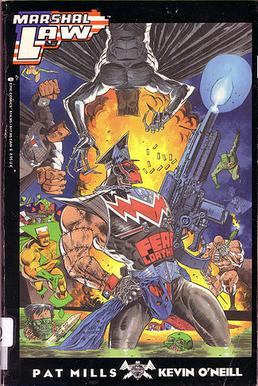
The one development that tempted me to sift this week was TPM’s series exposing the texts Republican congresspeople sent to Trump Chief of Staff Mark Meadows just before and after January 6. Both Rep. Marjorie Taylor Greene and Rep. Ralph Norman urged Meadows to urge Trump to declare “Marshall Law” which is not really a thing. (Martial law is literally the “law of Mars”, i.e., rule by the military.)

Vanity Fair’s Bess Levin explains that Greene and Norman asked for Marshall Law “because they’re both f–king idiots”, but I prefer to think that they intended to invoke the hero of this 1980s comic book.

The House Oversight Committee had a hearing about anti-LGBTQ violence and the Club Q shooting. If you’re a Republican, the problem can’t be guns and it can’t be right-wing eliminationist rhetoric against drag queens and transfolk, so how do you spin this? It’s about defunding the police, which no one anywhere near Club Q actually did.

The recent Musk/Twitter developments have made it clear that free speech was never the issue. Now that one of their own has control, right-wingers are fine with Twitter banning whoever Musk feels like banning, for whatever reasons he wants. This is a general trait on the right: Freedom means freedom for them. They will never, ever defend freedom for everybody.

Over on Mastodon, Simon Weiss makes a good point about the @ElonJet controversy:

There are many legitimate reasons to track Elon Musk’s flight coordinates, for example to offer him ads more relevant to his interests

Amanda Marcotte argues that the right-wing “cancel culture” and “woke mobs” rhetoric is psychological projection:

In reality, it’s left wing ideas that are suppressed out of a genuine fear of their persuasiveness. Books are banned from schools so kids won’t learn that LGBTQ people are normal or that racism is wrong. Musk openly argues that the “woke mind virus” must be “defeated,” which is to say that threateningly convincing ideas about human equality must be banished from the discourse, lest they win people over.

Until next week: Have a great Christmas, Solstice, Hanukah, or whatever you celebrate. Have fun, stay safe, and try to stay (or get) healthy.

Standards of Living

Part of the scam is to define basic bedrock standards of decency as “left” & then, lo, you find “left bias” everywhere you look. But that’s not bias, fellas. That’s just people trying to live in a society together.

David Roberts

So this week I have some first-hand experience of Covid to report. Shortly after Thanksgiving, I started a cold. So I took a home test for Covid and it was negative. Then a bit later, my wife seemed to catch my cold, but her Covid test was positive. So I took the more accurate PCR test, which was also negative. A few days later, my cold symptoms stopped fading and began to intensify, so I took another test: positive this time.

Anyway, I have good news and bad news about my experience. The bad news is that Covid is even easier to catch than I thought; my wife and I have been very careful and seem to have gotten it anyway. The good news is that, having had every possible booster and being generally in good health, my symptoms are pretty mild.

This week everybody was talking about the Georgia runoff

I expected more Republicans to stay home rather than vote for such an embarrassing candidate, so I had anticipated Warnock winning by a larger margin than 2.8% — something more like 55%-45%. (538 anticipated a smaller margin of 1.9%, which was not far off.) But one way or another, Rafael Warnock defeated Herschel Walker and won reelection, giving Democrats a net gain of one Senate seat in the 2022 midterms, and a 51-49 overall majority.

Watching the TV coverage was an odd experience: Before the polls closed, commentators explained how the vote had arrived in November: Early voting was counted first, and it favored Democrats. Then the smaller rural counties counted their same-day vote, which favored Republicans. Finally, the big counties around Atlanta reported their same-day vote, which again favored Democrats.

Combined with polls showing Warnock slightly ahead, that established pattern led to this expectation: a big Warnock lead early, possibly a small Walker lead in the middle, and then a Warnock surge to victory at the end. And that’s exactly what happened.

But after giving that analysis, the TV people mostly forgot about it and covered the incoming vote as if they were calling a horse race: “Warnock opens a lead, Walker comes charging back along the rail, now it’s Warnock, Walker, Warnock, Walker, and Warnock surges at the tape to win.”

Josh Marshall has a good point: Don’t watch TV on Election Night. The drama of a lead see-sawing back and forth was almost entirely an illusion.

We went into the night thinking the probable election outcome was X. The very first results supported the eventual outcome of X but were too limited to confirm it. As the results came in they continued to point to X with a mounting likelihood. With more and more data that mounting likelihood of X moved toward relative certainty. The point, as I noted, is that there was no drama as the statewide results lead sloshed back and forth between the two candidates.

Marshall recommends following the returns through the livefeeds of political pros, as he did. If you did that, you’d have gone into the evening kinda/sorta expecting Warnock to win, and then watching that likelihood slowly grow into a certainty.

Or you could do something else with your evening and check for results the next morning.


In total, Democrats lost nine House seats (and the majority) in the midterms, which probably cripples the Biden agenda going forward. But they also gained two governorships and four houses of state legislatures. So it was a mixed bag, rather than the “shellacking” President Obama took in his first midterm.

Walker’s loss puts the capstone on the other major story of the midterms, which is that Trump’s hand-picked candidates lost winnable elections all over the country.

Walker had been Trump’s personal choice as a Senate candidate in Georgia and turned out to be the only Republican statewide candidate to lose in the Peach State in 2022. … In other swing states, Trump-backed Senate candidates suffered embarrassing losses, including Blake Masters in Arizona and Mehmet Oz in Pennsylvania, along with a host of other candidates who embraced the former president’s lies about the 2020 presidential election.

In both Georgia and New Hampshire, governors who kept their distance from Trump easily won reelection, while Trumpy senate candidates lost. In Ohio, Trump’s senate candidate J. D. Vance won by 6.1%, but significantly trailed the rest of the Republican ticket. (Goverrnor DeWine, for example, won by 25%.) So maybe the argument that beats Trump in the 2024 Republican primaries is to let him blather, and then say: “Yeah, but we want to win this time.”

It’ll be interesting to see where Georgia goes in the coming years. In some ways, Warnock’s reelection resembles Claire McCaskill’s in Missouri in 2012: She faced a terrible opponent and won in a mostly red state. Six years later, the Missouri GOP had learned its lesson and ran a less obviously unsuitable candidate (Josh Hawley), who beat her.

The difference, though, is that Missouri was trending increasingly red in those years, while Georgia is trending blue now. A better Republican candidate could probably have beaten Warnock this time, but Georgia might look very different by 2028.


I’m not sure what to make of Kyrsten Sinema’s announcement that she is now an independent. She’s been pretty independent before this, and intends to caucus with the Democrats, so I’m not sure it makes much difference in the Senate.

She’s up for reelection in 2024 and seemed likely to lose a Democratic primary, so she’s probably trying to bluff the Democrats out of running a candidate against her, for fear of handing the seat to some MAGA Republican like Kari Lake. How credible that bluff is will depend on the polls: Will Sinema’s move garner enough support from independent Arizona voters to make her a credible general election candidate? If it doesn’t, I can’t believe she’d endure the embarrassment of a spoiler campaign where she got 6% of the vote. But we’ll see.


The next time you’re thinking about not voting because “What difference does it make?”, remember Kristin Kassner. The first count of the vote in her race for the Massachusetts House had her behind a five-term Republican by ten votes. That triggered a recount, which concluded that she actually won by one vote.

and Kevin McCarthy’s struggles

The Republicans’ 222-213 margin in the House means that any five GOP representatives can torpedo Kevin McCarthy’s election as speaker, which is still uncertain. (The vote is scheduled for January 3, when the new Congress opens.) Nancy Pelosi has been running the House quite effectively with a similar margin, but (to speak bluntly) she’s good at this and Kevin McCarthy isn’t.

Also, the Democrats’ progressive wing and the Republicans’ fascist wing are not mirror images of each other. The progressives want positive things that Pelosi could include in legislation. So, for example, enough pieces of the Green New Deal showed up in the Inflation Reduction Act to win progressive votes. But the MTGs and Paul Gosars don’t have a comparable agenda that McCarthy can write into a compromise. They want to burn it all down.

There’s still a chance that GOP moderates will refuse to let the extreme right wing call the tune, and will instead work out a deal with the Democrats to organize the House around some compromise speaker. But I’m not betting on that.

and Brittney Griner’s release

The deal to trade Russian black-market arms dealer Viktor Bout for American WNBA star Brittney Griner was announced Thursday. Griner arrived in the US Friday morning.

The press has speculated at length about why the deal happened now, but (without any inside knowledge) I ask this question: Can it really be a coincidence that it happened two days after the Warnock/Walker runoff, which marked the end of the US midterm elections? Griner’s return is the fulfillment of a promise from President Biden, and would have helped Democrats politically if it had happened sooner. I think the timing shows that Putin still knows which American party he’s rooting for.


Former US marine Paul Whelan remains in Russian prison. A Biden administration spokesperson said that Russia classifies him as a spy (which the US denies) and wanted Russian spies in return for him, a trade the US has been unwilling to make. “The choice was Brittney or no one at all.”

Conservative American media could not celebrate the return of Griner, who is Black, liberal, and married to another woman, so it focused instead on Whelan. Tucker Carlson said, “Paul Whelan’s case would be a priority for any American government”, ignoring the fact that President Trump also failed to secure his release, and was “not particularly interested” in his case, according to Fiona Hill, a Russia expert in the Trump administration.

Trump also didn’t own up to his own record, calling Griner “a basketball player who openly hates our Country”, and gaslighting us with the claim that Paul Whelan “would have been let out for the asking”. (So why didn’t you ask when you were president, Don?)

The “hates our country” charge against Griner, which has been widely repeated on the right, is based on something she said after George Floyd was murdered by a White Minneapolis policeman. She asked the WNBA to protest racism by not playing the national anthem before games. (Personally, I’d like to see all sports leagues stop playing the anthem, because there’s nothing patriotic about sporting events. We don’t play the anthem in movie theaters, so why sports arenas?)

Like many conservatives, Trump elevates the symbols of patriotism over the substance. He’ll posture about the flag or the anthem, but he won’t obey the laws, respect the Constitution, or pay his taxes. I’ll take Brittney Griner’s kind of patriotism over Trump’s any day.

and the Trump Organization’s tax fraud

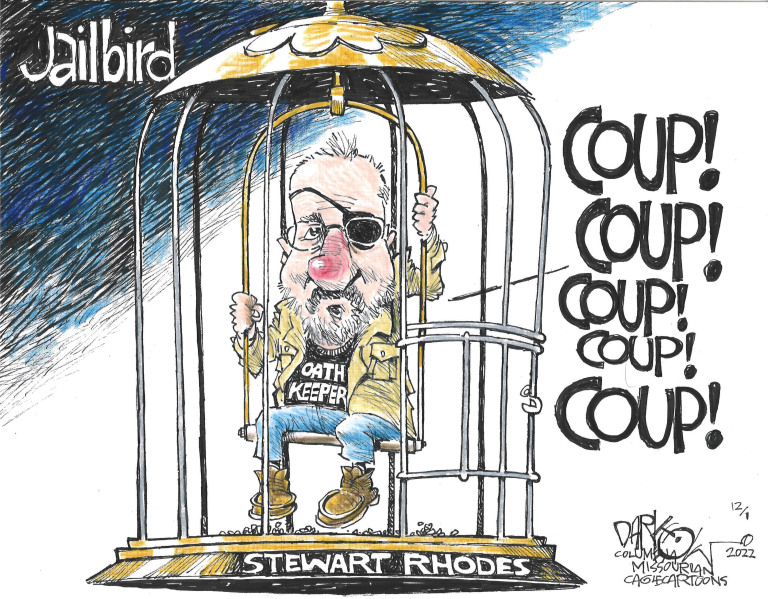
Last week brought the seditious conspiracy verdict against the leader of the Oath Keepers. This week the Trump Organization was convicted of criminal tax fraud. It was not the first Trump entity found to be engaged in dishonesty: In 2018, the Trump Foundation was dissolved by the State of New York, and in the same year Trump paid $25 million to settle civil fraud claims related to Trump University.

Predictably, Trump labeled the tax-fraud verdict as a “the Greatest Political Witch Hunt in the History of our Country“, blamed the crimes on his loyal CFO Allen Weisselberg, and said he would appeal.

I suspect Trump’s claim that his legal troubles are just politics is starting to wear thin among all but his most rabid supporters. As we know from the Durham investigation and Benghazi, political partisanship can start an investigation and maybe even muster an indictment or two. But getting a jury to convict requires enunciating a clear charge and proving it beyond a reasonable doubt to 12 ordinary people. The government did that in this case.

That’s more than just politics.

and the Supreme Court

The Court heard arguments this week in two cases with ominous implications. It’s always chancy to predict outcomes based on the questions the justices ask, but the Court seems likely to do the ominous thing in one case but maybe not the other.

In 303 Creative LLC v. Elenis , the Court’s conservative majority appears likely to gut anti-discrimination laws in favor of special rights for conservative Christians. The weirdest thing about this case is why it’s a case at all, much less what it’s doing at the Supreme Court. Ostensibly, it’s yet another case about a business owner who doesn’t want to serve same-sex couples, but there is no same-sex couple, and the business is mostly hypothetical.

There is only one face in this case—Lorie Smith, the web designer who has never made a wedding website for anyone, much less withheld a proposed wedding website from anyone due to their sexuality. (She just already knows that she will want to do that. Really!)

Fear of the Colorado Anti-Discrimination Act (CADA) is inhibiting her from offering wedding-website-design services, though, so she wants the part of it that would apply to her declared unconstitutional. Supposedly, this is a free-speech case. CADA wants to force her to create something that supports same-sex marriage, which is against her religious principles. Website design — even if it’s just a template whose content is filled in by the couple — is “speech”, so the law violates her free-speech rights.

I question a whole bunch of things in this case:

  • Whether Smith genuinely intends to create wedding websites, or if this entire case has been constructed to undermine anti-discrimination laws.
  • What part of the Bible says that Christians can’t create wedding websites for same-sex couples. (I think this case, like Masterpiece Cakeshop before it, arises from conservative spite over losing the battle to keep same-sex marriage illegal. It has nothing at all to do with Christian principles.)
  • Whether this broad interpretation of free-speech rights will ever apply to non-Christians “speaking” in favor of positions conservative Christians don’t share.
  • Whether any anti-discrimination laws at all can stand if Christians want to discriminate. (Remember, the judge who found in favor of Virginia’s interracial marriage ban — and was subsequently overruled — cloaked his racist argument in a Christian guise. “Almighty God created the races white, black, yellow, malay and red, and he placed them on separate continents. … The fact that he separated the races shows that he did not intend for the races to mix.”)

In oral arguments, the conservative justices mostly just refused to engage any of the case’s substantive issues, and instead just yucked it up, as you can do when all the harms you are threatening to cause are hypothetical.

So today’s hearing at the highest court in the land was about levity and mockery, and all the trivial examples of imaginary harms that will never come to pass. This is not just erasure of LGBTQ interests; interests which the state has an important and established interest in protecting. This is about mocking the obvious implications of creating a carveout from antidiscrimination laws with fatuous slippery slopes and petty humor.


The Court also heard arguments in Moore v Harper, which the Brennan Center sums up like this:

In Moore v. Harper, the Supreme Court will decide whether the North Carolina Supreme Court has the power to strike down the legislature’s illegally gerrymandered congressional map for violating the North Carolina Constitution. The legislators have argued that a debunked interpretation of the U.S. Constitution — known as the “independent state legislature theory” — renders the state courts and state constitution powerless in matters relating to federal elections.

ISL is a very weird theory, because it implies that with regard to federal elections, a state legislature is not bound by the state constitution that defines it and by whose authority it governs. Consequently, the state’s supreme court has no role to play in gerrymandering cases.

Extreme versions of ISL would allow state legislatures to ignore presidential election results and appoint their own slate of electors, which is what Trump urged Republican legislatures to do in 2020. This case does not ask the Court to make such a ruling, so the decision will almost certainly not go that far. But in the same way that the arguments in Dobbs set up future challenges to interracial marriage and other unenumerated constitutional rights, arguments in this decision could set up a Trumpian constitutional crisis in the future.

Justice Barrett and Chief Justice Roberts seem reluctant to back an extreme ISL, which is the good news. But Just Security’s Kate Shaw worries that even a compromise ruling could get ISL’s foot in the door.

and you also might be interested in …

There was really only one choice for 2022’s Person of the Year. Before 2022, Volodymyr Zelenskyy was just the guy being extorted on Trump’s “perfect” phone call. Now he’s the symbol of his nation’s heroic resistance to the Russian invasion.


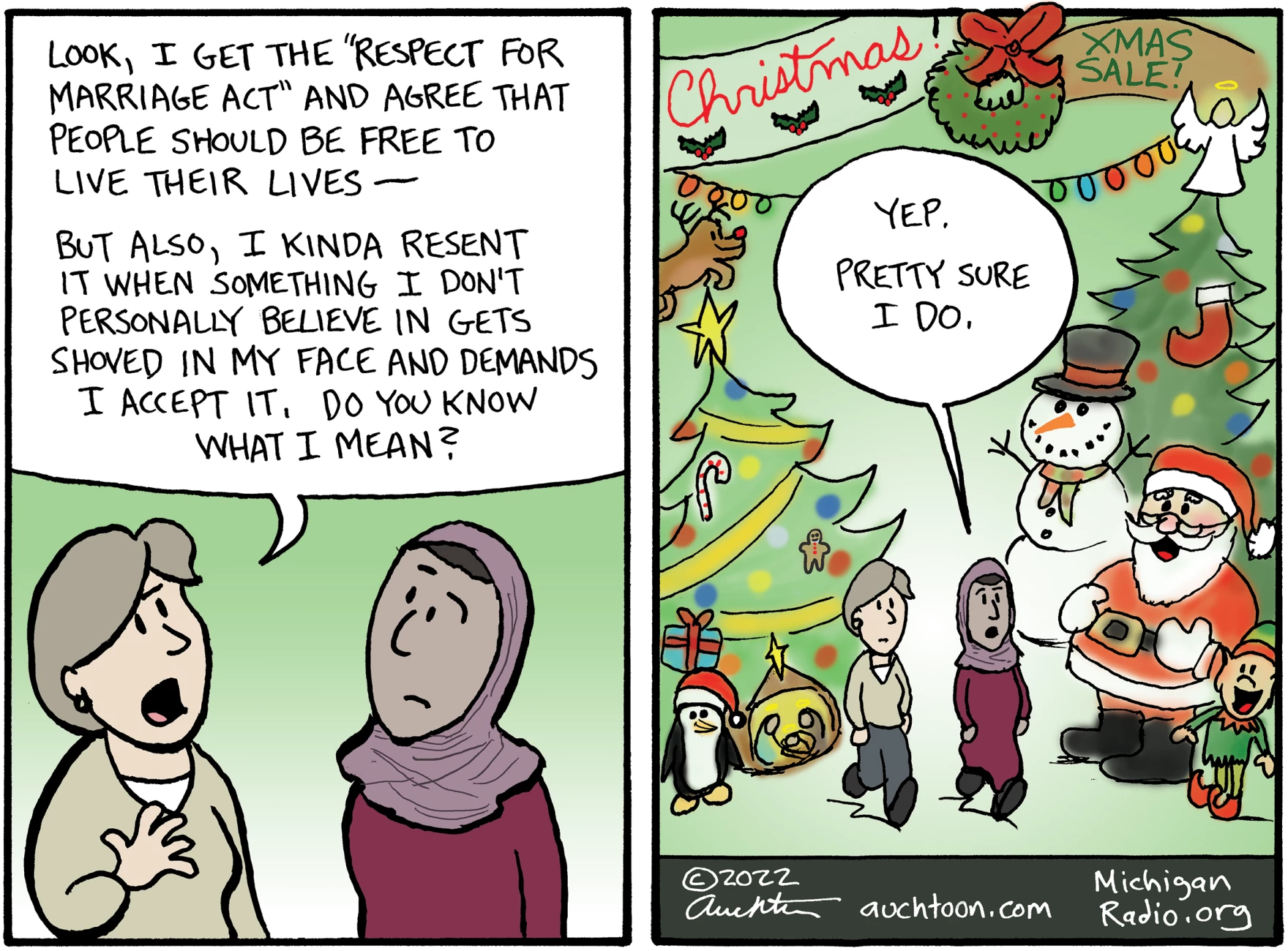
The Respect for Marriage Act, which repeals the parts of the Defense of Marriage Act that (before the Supreme Court’s Obergefell decision) allowed states to refuse to recognize same-sex marriages performed in other states, passed the House and should be signed by President Biden soon.

During the House debate, Rep. Vicky Hartzler (R-Mo) tearfully urged the House not to pass the bill.

I’ll tell you my priorities: Protect religious liberty, protect people of faith and protect Americans who believe in a true meaning of marriage. I hope and pray that my colleagues find the courage to join me in opposing this misguided and this dangerous bill.

After Hartzler’s speech went viral on right-wing outlets, she was answered by her nephew Andrew Hartzler, a gay man who had to endure Christian “conversion therapy” as a teen-ager. He had come out to his aunt in February, but “I guess she’s still as much of a homophobe.”

You want the power to force your religious beliefs onto everyone else. And because you don’t have that power, you feel like you’re being silenced. But you’re not. You’re just going to have to learn to coexist with all of us.


Wednesday, Germany arrested 25 people plotting a right-wing coup. The group involved, Reichsbürger, has been compared to QAnon, and so the plot has similar fantasy-world components that make it hard to take seriously. But Germany is taking it very seriously. Vox’ Zack Beauchamp interviews someone who’s been tracking the movement:

It sounds like something out of a novel: a cell of heavily armed German extremists plotting to overthrow the elected government and elevate a man called Prince Heinrich XIII to the throne of a new Teutonic monarchy.

On Wednesday, German police arrested 25 people attempting to do exactly that — including a former member of parliament from Alternatives for Deutschland (AfD), a far-right anti-immigrant faction.

The plot originated out of a movement called the Reichsbürger — literally, “Reich citizens.” They believe that every German state since World War I has been illegitimate, a corporation rather than an authentic government, and thus feel entitled to ignore its laws.

There’s a similar the-government-became-a-corporation conspiracy theory in the US, which was involved in several of QAnon’s Trump-restoration theories.


That wasn’t even the only coup attempt on Wednesday. In Peru, a president facing impeachment announced that he was dissolving Congress and instituting an “emergency government”. Fortunately, nobody bought it. The Constitutional Court refused to recognize the dissolution order, the Army didn’t back the emergency government, Congress went ahead with its impeachment, and the president was arrested on his way to seek asylum at the Mexican embassy.

That’s what they do in other countries: They arrest presidents who try to stay in office illegitimately.


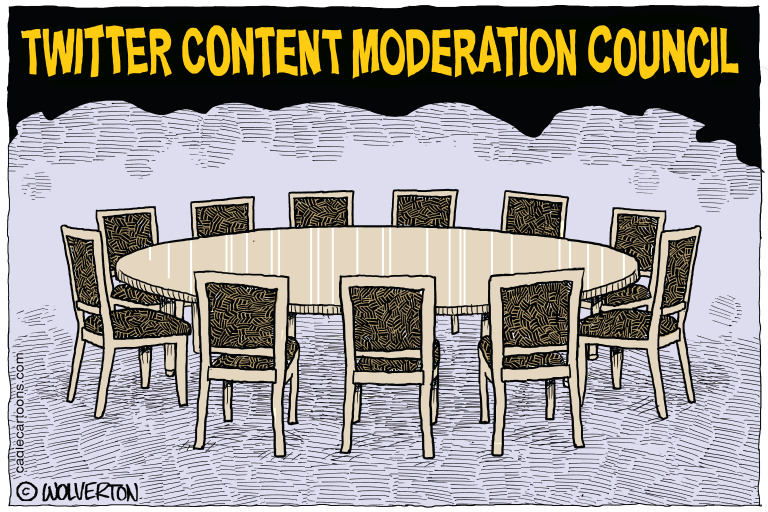
Like Trump, Elon Musk is a bright shiny object that would be easy to obsess over. This week, I’ll limit myself to one link.

the Twitter Files are best understood as an egregious example of the very phenomenon it purports to condemn — that of social-media managers leveraging their platforms for partisan ends. … The Twitter Files provide limited evidence that the social-media platform’s former management sometimes enforced its terms of service in inconsistent and politically biased ways. The project offers overwhelming evidence that Twitter’s current management is using the platform to promote tendentious, partisan narratives and conservative misinformation. In that sense, Taibbi and Weiss have performed revelatory journalism.

The full article (by Eric Levitz) does an in-depth takedown of Parts I (Matt Taibbi) and II (Bari Weiss) of the Twitter Files.

Well, OK, one more link. Josh Marshall:

[It’s] remarkable to me that literally with access to everything, even things ethically they shouldn’t have access to, they’ve surfaced basically nothing. one guy didn’t get boosted? libs of tiktok actually got special treatment? blowing the shit wide open guys.


Back in 1960, when Air Force Captain Joseph Kittinger proposed a parachute jump from 19 miles above the New Mexico desert, probably some worried friends warned him he would die.

Well, Friday they were proven right. Lung cancer got him at the age of 94. Kittinger retired as a colonel, and his record stood until 2012.


The Keystone Pipeline, which moves about 600K barrels of oil a day from Canada to Oklahoma, has spilled about 14K barrels into a creek in Kansas, about 150 miles from Kansas City.

Concerns that spills could pollute waterways spurred opposition to plans by TC Energy to build another crude oil pipeline in the Keystone system, the 1,200-mile Keystone XL, which would have cut across Montana, South Dakota and Nebraska.

President Biden revoked a construction permit shortly after taking office, and TC Energy cancelled the XL.


The Atlantic’s Adam Serwer points out the inconsistencies in conservatives’ “free speech” arguments:

In Citizens United, the Republican-appointed justices feared that restrictions on corporate electioneering amounted to state control of civic discourse, “muzzl[ing] the principal agents of the modern free economy.” But when the justices wrote that decision, they were thinking of corporations as allies of the conservative movement. The moment that perception changed, conservative views on corporate speech changed too. Last year, Republican Senate Minority Leader Mitch McConnell, a longtime champion of corporate electioneering, warned of state retaliation if private firms did not “stay out of politics,” by which he meant stop opposing Republican interests. It is wrong to “muzzle” the “principal agents of the modern free economy,” unless they do something Republicans don’t like. Then it’s fine.

and let’s close with something custom made

If you’ve heard of the late Bill Lishman, it’s probably because of the 1996 movie Fly Away Home, where he trained geese to imprint on his ultralight airplane and helped them learn a new migration route.

Bill died in 2017, but his widow is still living in the unique house the family designed and built in the countryside outside of Toronto. They cut the top off of a hill, built a series of interconnected igloo-like domes, and then rebuilt the hill over them, leaving just the skylights exposed to the weather. The round rooms mean that everything in them had to be custom-built, but Bill was a universally talented craftsman, so why not?

The Meaning of Woke

it would be the belief there are systemic injustices in American society and the need to address them.

Florida General Counsel Ryan Newman,
explaining what “woke” means to the DeSantis administration
(He thinks it’s a bad thing.)

There’s no featured post this week.

I’ve been battling a cold (or a minor case of Covid, the tests have been ambiguous, and either way I’ve almost recovered), which is my excuse for a number of failings:

  • the mental glitch that caused me to turn Douglas Rushkoff into Douglas Coupland halfway through last week’s “Two Glimpses into the Future“. Douglas Coupland is also an author, but how his name got into my head, I have no idea. He had nothing to do with Rushkoff’s Survival of the Richest.
  • not paying attention to comments, which meant that a comment by Neo on the weekly summary sat in limbo for several days. (That comment takes me to task for complimenting Alaska’s ranked-choice voting system, when STAR voting has several advantages.) I should explain this wrinkle in the WordPress software: When a comment has some number of links (Neo’s had four), WordPress kicks it into my “moderation” queue. I think this is supposed to be a spam-control feature, but it happens seldom enough that I forget to check the queue.
  • not getting enough research done to have a featured article this week.

This week everybody was talking about the Georgia runoff

In a runoff, turnout is everything. Early voting has set records (particularly in Democratic counties), and Election Day is tomorrow. I can easily imagine how in November, people who showed up at the polls to vote for Governor Kemp and the rest of the Republican slate might also vote for Herschel Walker. But I have a much harder time imagining Republicans going to the polls for the exclusive purpose of voting for Walker. He is, as this Warnock ad points out, an embarrassing candidate.

I’ve often said that speculation is a waste of both my time and yours, but I’m hopeful for a Warnock victory.

Shortly after the November election, I sent Warnock a contribution. So every time I hear Republicans complain that they’re being outspent, I’m like “That’s me, you losers!” I’m getting a lot of satisfaction for the amount of money I sent, especially if Warnock wins.

As you probably already know, Democrats will retain control of the Senate either way — either 51-49 or 50-50 plus VP Harris’ vote. The difference that makes is technical, but significant. Currently, all Senate committees are evenly split between the two parties. But if Warnock wins, Democrats will get a one-vote advantage on all committees. That matters for things like launching investigations and issuing subpoenas.

A Warnock victory would also mean that no single senator can veto what the rest of the Democratic caucus wants to do. Though probably anything Manchin or Sinema would object to is already doomed in the Republican House.

and a complete non-story about talks with Putin

Thursday, President Biden and President Macron of France held a joint press conference. The last question asked about the possibility of talking to Putin concerning Ukraine. Biden answered:

I have no immediate plans to contact Mr. Putin. Mr. Putin is — let me choose my words very carefully — I’m prepared to speak with Mr. Putin if in fact there is an interest in him deciding he’s looking for a way to end the war. He hasn’t done that yet. If that’s the case, in consultation with my French and my NATO friends, I’ll be happy to sit down with Putin to see what he wants — has in mind. He hasn’t done that yet.

So Biden didn’t bring up talking to Putin, his first response was that he has no plans to, and that he’ll only do so after Putin does something he hasn’t done yet. Even then, he’ll meet after consulting with France and our other NATO allies. Minutes before, the French president had said:

we will never urge the Ukrainians to make a compromise which will not be acceptable for them … If we want a sustainable peace, we have to respect the Ukrainians to decide the moment and the conditions in which they will negotiate about their territory and their future.

President Zelenskyy, meanwhile, has insisted that Ukraine won’t give up any territory.

There is only one condition for the negotiations: Russia must leave all captured territories.

So what is Biden supposed to say about talking to Putin? (Maybe something diplomatic, like: “Screw that guy. I’m not talking to him.”) He says he’ll talk to Putin if “he’s looking for a way to end the war”.

For some reason, Reuters interpreted this as a “trial balloon”. Russia then said it’s open to negotiations if the West “accepts its demands”, i.e., recognizes Russia’s ownership not just of Crimea, but also of the other Ukrainian provinces it has annexed (which its retreating forces don’t even fully occupy). Then Fox News’ wrote the headline: “Putin open to Ukraine talks after Biden signals willingness if Russia serious about ending war“.

Basically, each side has said that it’s willing to accept the other’s complete surrender. That’s not news.

and another bad week for Trump (and associated traitors)

Tuesday, two members of the right-wing paramilitary group Oath Keepers, including its founder Stewart Rhodes, were convicted of seditious conspiracy for their role in the January 6 riot, plus several other charges. Seditious conspiracy by itself carries a sentence of up to 20 years, and convictions for it are rare; this is the first guilty verdict since 1995.

The jury appears to have done its job carefully. There were five defendants and a list of charges, with each defendant guilty of some and not guilty of others. The deliberations took three days. So it’s hard to paint this jury as radical Trump-haters or a rubber stamp for the Justice Department. It sure looks like they went through the charge/defendant matrix cell by cell and asked “Did the government prove this charge against this defendant?”

To me, the main significance of this verdict is what it implies about future cases, including a possible charge against Donald Trump. In the Oath Keepers case, the Justice Department proved to a jury (beyond a reasonable doubt) that there actually was a conspiracy behind January 6; the attack on the Capitol wasn’t just a Trump rally that spiraled out of control. It also proved that the intention of the conspirators was seditious; the conspirators weren’t patriots, and they weren’t trying to protect democracy against a stolen election. Quite the opposite, they were trying to overthrow democracy.

What can be proved to one jury can be proved to others. Both the Oath Keepers and the Proud Boys (whose seditious conspiracy trial begins later this month) must realize they are facing serious jail time. So it must be very tempting to make a deal with the government, perhaps delivering the goods on people closer to Trump, like Roger Stone or Mark Meadows.

The verdict has political as well as legal importance. Since the insurrection, most Republican politicians and conservative pundits have tried to claimed January 6 was no big deal. Maybe Democrats on the January 6 committee were trying to make something out of it, but that was just politics.

Well, a guilty verdict is more than politics. This is a jury of ordinary Americans unanimously saying that January 6 was a very serious matter. The guilty parties weren’t just some people trespassing on government property: The attack was planned, and the planners intended to subvert the orderly transfer of power.

For contrast, look at the Durham investigation, which really was just politics. It produced only minor charges against minor characters — and never persuaded a jury that the “conspiracy” it was investigating existed at all. (Kevin McCarthy is planning a similar investigation of the January 6 committee, for all the good that will do. Bring it, Kevin.)


Ever since Trump-appointed Judge Aileen Cannon interfered in the Mar-a-Lago case (by appointing a special master to review the documents seized from Trump under a legal search warrant), I and a lot of other people have been yelling about favoritism and corruption: Cannon was clearly repaying her debt to Trump by bending the the law in his favor.

Well, it looks like the appeals court agrees. Thursday, a three-judge panel from the 11th Circuit Court of Appeals (two of whom were also appointed by Trump, but seem loyal to the law anyway) vacated Cannon’s order, and sent the case back to Cannon with instructions to dismiss Trump’s lawsuit.

The law is clear. We cannot write a rule that allows any subject of a search warrant to block government investigations after the execution of the warrant. Nor can we write a rule that allows only former presidents to do so. Either approach would be a radical reordering of our caselaw limiting the federal courts’ involvement in criminal investigations. And both would violate bedrock separation-of-powers limitations. Accordingly, we agree with the government that the district court improperly exercised equitable jurisdiction, and that dismissal of the entire proceeding is required.

Trump will undoubtedly appeal to the Supreme Court, but I don’t think they’ll take long to deny his motion. (They didn’t take long to reject his claim with regard to the classified documents seized in the search.) The law here really is clear, and the Constitution does not define any special rights for former presidents.

Presumably, the Mar-a-Lago investigation can soon proceed the way any other criminal investigation would.


Mark Meadows lost his case at the South Carolina Supreme Court, which refused to protect him from a subpoena to testify to the Fulton County grand jury investigating Trump’s attempt to overturn the result of the 2020 presidential election in Georgia. (Meadows is currently living in South Carolina.)

Because of a previous adverse ruling on his executive privilege claim, Trump’s White House Counsel Pat Cipollone testified to a Washington, D.C. grand jury Friday.

News stories on these kinds of cases leave out the obvious: Trump’s people fight so hard against subpoenas because they don’t want the full truth to come out. Deduce from that what you will. Personally, I believe that if they knew something that would exonerate Trump, they’d be begging to testify.


One sign that Trump has jumped the shark is that he keeps trolling the country harder and harder, in a vain attempt to regain the edginess he had in 2015. After seven years of watching his act, we’re not shocked any more if he calls Mexicans rapists or says that John McCain wasn’t a hero. So he’s got to turn it up to 11.

Last week we found out he had a pre-Thanksgiving dinner with a White supremacist, Nick Fuentes. (I was going to mention it in last week’s Sift, but it slipped my mind.) And then Saturday he called for “the termination of all rules, regulations, and articles, even those found in the Constitution” if that’s what’s necessary to undo the 2020 election and install him as president again.

What’s next? Maybe he’ll suggest genocide against the people who didn’t vote for him. Whatever.

Meanwhile, most Republicans in the House and Senate — stalwart defenders of the Constitution that they are — aren’t commenting. One or two are condemning the remarks, but Rep. Dave Joyce isn’t one of them.

Joyce, the chair of the influential Republican Governance Group in the House, was asked by ABC “This Week” anchor George Stephanopoulos to respond to Trump’s post on Saturday on his Truth Social platform.

Joyce initially declined to do so, saying the public wasn’t “interested in looking backwards.” But Stephanopoulos followed up and Joyce ultimately said that Trump’s comment shouldn’t be taken seriously but that it wouldn’t lead him to pull potential support for Trump’s 2024 comeback bid.

“I will support whoever the Republican nominee is,” Joyce said while noting he didn’t think Trump would manage to win the 2024 Republican presidential nomination.

“That’s a remarkable statement,” Stephanopoulos said. “You just said you’d support a candidate who’s come out for suspending the Constitution.”

“Well, you know, he says a lot of things,” Joyce said. “I can’t be really chasing every one of these crazy statements that come out about from any of these candidates at the moment.”

It doesn’t seem to have occurred to Joyce that the GOP could find candidates who don’t constantly make “crazy statements”.


Former prosecutor Dwight Holton imagines how this Trump statement might play in his own seditious conspiracy trial.

Now the defendant wants you to think that this is all a misunderstanding – that he never meant to subvert the Constitution when he urged his armed followers to go to Capitol Hill to “stop the steal.” “I’d never subvert the Constitution!” the defendant wants you to believe.

But we know that is not true – the evidence makes that crystal clear. We know that subverting the Constitution is right in this defendant’s wheelhouse. And you don’t have to take my word for it. We know he is ready to subvert the Constitution BECAUSE OF HIS OWN WORDS.

and the Twitter/Hunter flap

Twitter continues to go down the tubes under Elon Musk’s visionary leadership, but he has learned a trick from his new right-wing allies: Play the Hunter Biden card.

So at a time when the big Twitter-related stories are falling advertising revenue, Nazis getting their accounts back, and Musk deplatforming Ye (i.e. Kanye West, who is also starting to sound like a Nazi), Musk turned some internal Twitter correspondence over to Matt Taibbi, showing times when the 2020 Biden campaign asked Twitter to take down certain tweets about Hunter Biden based on material allegedly hacked from his famous laptop.

This is being hyped as yet another great Hunter scandal, but (unless there’s a lot more that hasn’t been revealed yet) it seems to fall apart pretty quickly: The tweets in question posted dick pics, which probably would have been taken down for anybody. Tim Miller explains.

A related concern is why the New York Post’s pre-2020-election story on Hunter’s laptop wasn’t the beginning of a big media firestorm. Philip Bump explains that: The authenticity of the laptop and its files was just sketchy enough to remind everyone of the 2016 DNC-emails story, which was based on Russian hacking for the purpose of getting Trump elected. The American media had been played once before, and was wary of getting played again.


The other thing the Hunter story proves is that people like Musk and Tucker Carlson either don’t understand the First Amendment or don’t want you to understand it. Nothing in the Hunter/Twitter story concerns the First Amendment. The Atlantic’s David French elaborates:

In October 2020, when the laptop story broke, Joe Biden was not president. The Democratic National Committee (which also asked for Twitter to review tweets) is not an arm of the government. It’s a private political party. Twitter is not an arm of the government; it is a private company.

This matters for a simple but profoundly important reason. The First Amendment regulates government conduct. It does not regulate private actors. …

This means the First Amendment protects Twitter, the Biden campaign team, and the Democratic National Committee. The “TWITTER FILES” released so far do not describe a violation of the First Amendment. Instead, they detail the exercise of First Amendment rights by independent, private actors.

Even when the government does get involved, it’s not a First Amendment violation unless some kind of coercion is involved. (An example French doesn’t give, but could: Police may ask media outlets not to publicize certain aspects of a murder case. As long as that’s just a request, it’s not a First Amendment issue.)

But there’s no evidence of any such coercion (at least so far) in the Hunter Biden story, and unless and until there is, the story of Hunter Biden’s laptop is the story of private individuals making decisions they were entitled to make. It is not the story of a government run amok.

Similarly, when Twitter decides to block the account of somebody (like Ye, for example), it’s not a First Amendment issue, any more than it’s a First Amendment issue when The New York Times decides not to print your letter.

A related concern is that the major social-media companies — Twitter, Meta, Google — have too much influence over our national conversation. But that’s an antitrust problem, not a First Amendment problem.

and you also might be interested in …

Both Iran and China seem to have yielded (at least a little) in response to public protests. Iran may be abolishing its morality police, and China is backing off of its zero-Covid policies.

What China does next is tricky, because its population is much more vulnerable to Covid than, say America’s. Fewer people have immunity from previous infections, and China’s vaccine is much less effective, particularly against Omicron variants.

Looking at the results achieved in countries around the world, hindsight makes the right strategy obvious: Lock down hard to limit the spread of the disease until an effective vaccine can be developed, then vaccinate everybody as quickly as you can and reopen.

An authoritarian government like China’s should have an advantage in dealing with a pandemic, and during the lockdown phase it did: China has had fewer deaths per capita than almost any other country. But it should have recognized the superiority of the MRNA vaccines and imported them. Then it could have used its authoritarian power to vaccinate everybody, and reopened its economy with comparatively little damage.


Tuesday, the Senate passed the Respect for Marriage Act. The House is expected to pass it this week, and President Biden is expected to sign it.

The bill is intended as a backstop in case the Supreme Court overturns its ruling in the Obergefell case, which mandates that same-sex marriages be performed in all 50 states. As Clarence Thomas pointed out in his concurring opinion in Dobbs, the logic the Court used to overturn abortion rights would also overturn same-sex marriage rights.

But this bill stops short of forcing states to perform same-sex marriages. Instead, it says that all states and the federal government must recognize marriages performed in other states. The Clinton-era Defense of Marriage Act allowed states not to recognize same-sex marriages from other states. (To me, that always looked like a violation of the Constitution’s Full Faith and Credit clause, but that’s a different argument.) That would once again be the law if this bill doesn’t pass and the Court overturns Obergefell.


According to the UK’s Office of National Statistics:

For the first time in a census of England and Wales, less than half of the population (46.2%, 27.5 million people) described themselves as “Christian”, a 13.1 percentage point decrease from 59.3% (33.3 million) in 2011; despite this decrease, “Christian” remained the most common response to the religion question.

“No religion” was the second most common response, increasing by 12.0 percentage points to 37.2% (22.2 million) from 25.2% (14.1 million) in 2011.


Back in August, Florida Governor Ron DeSantis suspended Hillsborough County State Attorney Andrew Warren (who was elected, not appointed) because Warren said he would not enforce the state’s 15-week abortion ban, and signed a statement supporting prosecutors in other states who refuse to enforce laws against gender-affirming care.

DeSantis summed up his objection by calling Warren a “woke ideologue”. “Woke” has been a buzzword for DeSantis, as it has been for much of the right. But does it mean anything, or is it just pejorative?

Warren challenged his suspension in court, and the trial was held this week, though there is no decision yet. During the trial DeSantis aides were asked what “woke” meant to them. I found DeSantis’ General Counsel Ryan Newman’s answer astounding.

Asked what “woke” means more generally, Newman said “it would be the belief there are systemic injustices in American society and the need to address them.”

Newman added that DeSantis doesn’t believe there are systemic injustices in the U.S.

If you had asked me what conservatives mean by “woke”, I would have given more-or-less the same answer. But I’m viewing them as a hostile outsider. I never imagined they would put it that way themselves.


While we’re on the subject, the NYT’s Jamelle Bouie has some interesting observations about the “woke capitalism” DeSantis objects to. Bouie thinks DeSantis should have read more Karl Marx. Then he would understand that capitalism inevitably upends established social relations and prejudices. You can have traditional values or you can have unfettered capitalism, but not both.

Conservatives, if their policy priorities are any indication, want to both unleash the free market and reserve a space for hierarchy and domination. But this will not happen on its own. The state must be brought to bear, not to restrain capital per se but to make it as subordinate as possible to the political right’s preferred social agenda.


The WaPo’s Ruth Marcus savages the judicial philosophy of originalism. Two criticisms seem particularly on-target to me:

  • Originalism encourages how-many-angels-can-dance-on-a-pinhead arguments about unknowable questions, like exactly what people in other eras thought some particular word meant. They may not have had a coherent view, and may have chosen a vague word precisely because they couldn’t agree on anything more specific.
  • Conservative judges apply originalism opportunistically to get the results they want. (The Founders’ hostility to corporations like the British East India Company, for example, goes out the window whenever the Court considers corporate rights.)

and let’s close with something family oriented

John Wilhelm has some very cute and expressive kids, a camera, and photo-manipulation skills. The three come together in imaginative ways. He calls this one “Catch It Like a Dog”.

Dependable Appeal

One of the uncomfortable truths that you find in the dark corners of our history is that fascism happens, recurrently. Movements and demagogues and media figures and elected officials promote elements of fascism: antisemitism, hatred of minority groups and immigrants, worship of strongman leaders, wishing for the end to elections, the end to rule by law — it comes up, repeatedly. It has a certain appeal to a certain percentage of the country, in a fairly dependable way.

– Rachel Maddow
Ultra, episode 8

This week’s featured posts are “Is Club Q just the beginning?” and “Two Glimpses into the Future“.

This week I staked out some turf on Mastodon: @DougMuder@newsie.social

The Weekly Sift Twitter account has been used almost entirely to announce new posts, so at least in the beginning I plan to use Mastodon the same way. I’m also going to stay on Twitter for the time being.

This week everybody was talking about mass shootings

The Wal-Mart shooting in Virginia followed the Club Q shooting in Colorado so quickly that the public didn’t really have time to process Club Q. So I try to do that in one of today’s featured posts. I wanted to make a clear point in that article — the campaign of anti-LGBTQ lies and particularly anti-trans lies is so vicious that it looks designed to set off a pogrom — so a lot of auxiliary details got left out.

Club Q is an LGBTQ club in Colorado Springs, which is a stronghold of the religious right. In 2021, MinistryWatch identified six different conservative Christian organizations with annual revenue over $100 million that have headquarters there, including James Dobson’s Focus on the Family. As far back as 2005, NPR’s All Things Considered portrayed Colorado Springs as “a Mecca for Evangelical Christians”. (Not long afterward, mega-church pastor Ted Haggard, who figured prominently in NPR’s piece, fell in a drugs-and-gay-sex scandal. He then started another church in Colorado Springs, which also eventually asked him to leave. He then started a third church that met in his home. I don’t know how that’s going.)


In his recent successful reelection campaign in Florida, Senator Marco Rubio answered questions from survivors of the Parkland shooting by pointing to his support for red-flag laws rather than a ban on assault weapons. But the Club Q shooting points out one problem of red-flag laws in the current political environment: The local sheriff is one of many in Colorado who refuse to enforce Colorado’s red-flag law. El Paso County is a “2nd amendment sanctuary”.

So if you’re a violent crazy person and you want to keep your guns, Colorado Springs is the place for you. The citizens must be so proud.


Assault-weapon bans work. The WaPo’s Robert Gebelhoff supports that idea, and adds five other things that work:

  • Keep guns away from kids.
  • Stop the flow of guns
  • Strengthen background checks.
  • Strengthen red flag laws.
  • Treat guns like we treat cars.

Each of Gebelhoff’s points is turned into specific proposals, complete with evidence to support the idea that it will make a difference in the number of gun deaths.

and the incoming GOP House majority

It’s still not clear how Kevin McCarthy is going to get enough votes to become speaker, or what he’ll have to promise to who.

I keep wondering when a dozen or two moderates will realize they could probably cut a better deal in coalition with the Democrats. That has happened in the Alaska legislature.

Meanwhile, the Democrats still have control for the next five weeks. Let’s hope they pass something that takes the debt ceiling off the table for a long time. Having a debt ceiling at all is kind of like having an easily-triggered self-destruct button on your car.

and Twitter

The claim that Elon Musk was going to create a “content moderation council” to decide who gets banned or reactivated was always just for show. Techdirt’s Mike Masnick elaborates:

For years, tons of people have believed, falsely, that it was the CEOs of these social media companies making the final call on what stays up and what stays down. … Indeed, part of the reason those same folks got so excited about Musk taking over, was that they believed (falsely) that he was going to get rid of all the moderation and so they’d be “freed.” Instead, what they have is exactly what they falsely feared was happening before: an impulsive, moody, vindictive billionaire, enforcing his own personal views on moderation. It’s deeply ironic, but his supporters will never recognize that Musk is doing exactly what they falsely believed Dorsey was doing before.

It’s also deeply stupid, because no CEO should be engaged in such day to day decision making on content moderation questions. The flow of questions is absolutely overwhelming.


Conservatives often claim that social media algorithms are biased against them, and that was one reason Elon Musk cited for wanting to take over Twitter. But it’s worth pointing out that people who have done research on the topic have found the exact opposite:

Our results reveal a remarkably consistent trend: In six out of seven countries studied, the mainstream political right enjoys higher algorithmic amplification than the mainstream political left. Consistent with this overall trend, our second set of findings studying the US media landscape revealed that algorithmic amplification favors right-leaning news sources.

I can think of two reasons for both the actual algorithmic bias and the inverted public perception of it:

  • The purpose of social-media algorithms is to generate responses and keep people engaged. The industry understands that negative emotions like anger and fear serve that purpose better than empathy and good will. Since the MAGAverse also emphasizes anger and fear, their interests align. I mean, what’s more likely to keep you clicking: AOC explaining the difference between pardons and expungements, or MTG speculating about Jewish space lasers?
  • When you think of people who have been banned from social media, the names that pop to mind are high-profile conservatives like Trump and MTG, rather than equivalently high-profile liberals. But that’s because no equivalently high-profile liberals have misbehaved to the same extent. For example, none of Biden, Obama, and Clinton have ever used Twitter to incite a riot that got people killed, as Trump did prior to January 6. Twitter’s then-CFO said, “Our policies are designed to make sure that people are not inciting violence.”

That second point is supported by this study:

In sum, these data indicate that the tendency of Twitter users to share links to misinformation sites prior to the 2020 US election was as predictive of post-election suspension as partisanship or ideology – because users who were Republican/conservative were much more likely to share low quality information than users who were Democrat/liberal.


If you subscribe to TPM, read Josh Marshall’s “Elon Musk and the Narcissism/Radicalization Maelstrom“. He documents Musk’s rapid radicalization in recent weeks.

He’s done with general “free speech” grievance and springing for alternative viewpoints. He’s routinely pushing all the far right storylines from woke groomers to great replacement.

Marshall makes an apt comparison to Donald Trump, who had vague “dark political impulses and beliefs going back decades,” long before the 2016 campaign. But during that campaign he filled in his views to move to where the applause was loudest and the worship the most intense, i.e., the far right. Musk is doing something similar, but at light speed.

If you’re not a TPM subscriber, check out “Elon Musk has gone full authoritarian” by Dustin Rowles, which covers much of the same ground.


Found on Mastodon: “50 Ways to Leave Your Twitter” by Jon Reed

You just pin your last tweet, Pete …

From there it kind of writes itself.

and protests

Iranian soccer players didn’t sing their national anthem at the World Cup, apparently in support of the protests that have been going on in that country for the last two months. A girls’ basketball team posted to Instagram a team photo in which none of them wore hijabs.


Chinese protesters want the Covid quarantines lifted. It doesn’t seem to be working. China recently had a record 31K new infections in a day, which is actually not that bad by American standards. (We’re averaging about 42K per day, with a much smaller population.) But our cases are less serious because of our vaccines. China relied on a homegrown vaccine, which was never as effective as the Pfizer or Moderna vaccines, and hasn’t been updated for Omicron.

In America, the point of lockdowns was to buy time for vaccines to arrive. It pretty much worked.

but I’d like to talk about two recent books

One of the featured posts discusses Yascha Mounk’s The Great Experiment and Douglas Rushkoff’s Survival of the Richest.

and you also might be interested in …

Rachel Maddow’s 8-episode podcast Ultra is complete now. You can binge the whole thing rather than parcel it out week-by-week. It’s the story of American fascists, some directly allied with the Hitler government, who plotted to overthrow democracy in the 1930s and 1940s. The pro-Nazi effort included a couple dozen members of Congress, as well as armed militias in various parts of the country.

Rachel’s theme, which she obviously intends as a lesson applicable to the present, is that the justice system by itself was not able to deal with these plotters, who had enough resources and behind-the-scenes influence to stymie prosecution even after the plot was uncovered. The big names in the plot — Senator Burton Wheeler of Montana and Rep. Hamilton Fish III of New York — never went to jail. (And yes, the Hamilton Fish Bridge on I-84 is indeed named after him and his son, Hamilton Fish IV. I’ve driven over it.) But they did get voted out after the scandal came to light.

yes, the courtroom might have maybe been a more satisfying place for these members of Congress to face consequences for what they had done. But the voters did it instead once they had the information they needed about what those members of Congress had been up to. It’s not jail-time accountability, but it is political accountability.

I’m sure she intends Ultra to be an argument against a let-Jack-Smith-do-it attitude towards Trump and our current crop of fascists. We need anti-fascist and pro-democracy activity at all levels.

What was required then, in the 1940s, was all of it. It was the plucky, creative, heroic efforts of clever, brave Americans, journalists, activists, lawyers, people of faith, citizens of all stripes who came to democracy’s aid when it needed them the most. That is what got us through back then. And now, almost a full century later, we get to learn from what they left us. We inherit their work.


Alaska’s ranked-choice voting system took weeks to produce final results, but they’re in: Democrat Mary Peltola held the House seat that she won in a special election earlier this year, once again defeating Sarah Palin. Republican Senator Lisa Murkowski held her seat against a Trump-backed challenger.

In spite of the delay, I’ve become a fan of Alaska’s system. They hold a jungle primary where all candidates are on the same ballot. The top four vote-getters move on to the general election, where voters are allowed to rank them. Votes are then tabulated in rounds. In each round, the lowest vote-getter is eliminated and his/her votes are distributed according to the voters’ rankings. After at most two rounds of redistribution, somebody has a majority.

There are grounds for criticizing this system. For example, a candidate who was the second choice of literally everyone could be eliminated for not getting enough first-choice votes, even though the preferences might indicate that the eliminated candidate would have won one-on-one races against each of the other three. (Something like this appears to have happened to Republican Nick Begich in the special election.) But no system is perfect; there’s an actual theorem that proves it. This system seems better than most, and is a real improvement over the way elections work almost everywhere else.

The major benefit is that a moderate candidate can win by getting support from people of both parties plus independents, even though that candidate would have lost either party’s primary. That’s what Murkowski appears to have done this time.


New York magazine’s Intelligencer explains the FTX crypto collapse at many different levels of sophistication. I’ll let you find your own level.

The thing I’m having trouble wrapping my mind around is that Sam Bankman-Fried’s net worth was estimated at $16 billion earlier this month, but more recently “Bloomberg Billionaires Index considered Bankman-Fried to have no material wealth.” Seems like he could have tucked a few hundred million under a floorboard somewhere.


Josh Marshall nails something in this tweetstorm about guys who label themselves “alpha males”, like conservative author Nick Adams.

An Alpha, to the extent the term has any meaning, is the guy who the other guys get behind. Girls are into him. Charisma. Big man on campus, etc. … Back in the real world, being alpha can’t ever be a “hard job” since that’s basically the opposite of what being an alpha is – dominant, powerful, assertive and – critically – the ability to pull those things off. … If you’re going around constantly saying you’re an “alpha” and how it’s just getting harder and harder to do and things are tough all over and everyone’s being such dicks to the “alphas” and wow inflation is so high I can’t afford the chicken wings at Hooters… well, you’re pretty clearly doing it wrong.

In other words, alphahood isn’t a lifestyle you can choose. It’s something that either shows up in your life or it doesn’t.


The NYT published its annual assault on my ego: The 100 Notable Books of 2022. Usually I’ve read one or two of them, but this year it’s zero. The WaPo lists ten best books, which I have also read none of.

and let’s close with something that saves time

I’ve closed before with John Atkinson’s cartoons, particularly his radically condensed versions of classic novels. As we enter into the Christmas season, it’s a good time to recall Atkinson’s retelling of Dickens’ A Christmas Carol.

The Unfinished Mission

I look forward – always forward – to the unfolding story of our nation: a story of light and love, of patriotism and progress, of many becoming one, and, always, an unfinished mission to make the dreams of today the reality of tomorrow.

Speaker Nancy Pelosi

This week’s featured post is “When can I stop writing about Trump?“.

This week everybody was talking about the new Congress

We finally have a result in the House: the Republicans will have a narrow majority, with somewhere between 3 and 11 more seats than the Democrats. (For comparison, Democrats came out of the 2020 elections with 9 more seats than the Republicans.) Kevin McCarthy was reelected leader of the GOP House caucus, but whether that means he has the votes to become speaker is still undetermined.

Successful Republican candidates ran on the issues of inflation and crime, so McCarthy immediately unveiled a legislative program to address those problems. NO, I’M KIDDING. Republicans immediately starting talking about investigating Hunter Biden.

At a press conference on Thursday, when a reporter began to pose a question about the plans of the coming Republican majority that was not linked to the Biden family, [incoming Chair of the House Oversight Committee James] Comer, from Kentucky, sprang forward to say, “If we could keep it about Hunter Biden, that would be great.”

This investigation is supposed to own the libs somehow, but I don’t know any Democrats who actually care about Hunter (other than, I assume, his Dad). Hunter is a private citizen who (unlike, say, Ivanka and Jared) has held no position in his father’s administration. In four years, the Trump Justice Department somehow failed to prosecute Hunter for anything, and there’s already a DoJ investigation and a grand jury hearing testimony about him in Delaware. But if McCarthy thinks the House can do better, he should have at it. (BTW: Marcy Wheeler’s opinion is that the “Hunter Biden laptop” is a forensic mess.)

If Hunter does wind up in jail someday, though, I don’t see that outcome having any effect on the country or even the government, other than making the President sad.

McCarthy promises investigations plural, but again, little in the way of legislation that will offer Republican solutions that the Democratic Senate will have to respond to. Other investigations might include harassing the Department of Justice for investigating Trump’s crimes (because the Durham investigation worked out so well), promoting conspiracy theories about the origin of Covid-19, examining Biden’s withdrawal from Afghanistan, and the state of our border with Mexico (which could be interesting if Republicans look at it honestly, which I suspect they won’t).

Marjorie Taylor Greene claims that she has gotten a promise from McCarthy to “investigate Speaker Nancy Pelosi and the Justice Department for their treatment of defendants jailed in connection with the Jan. 6 attack on the Capitol.” Because, you know, they’re all political prisoners who didn’t really do anything wrong, no matter what the juries say.


Will the GOP learn anything from its disappointing 2022 results? Looking at the lame-duck agenda of the Pennsylvania House, which will flip to the Democrats in January, Amanda Marcotte thinks not.

[Philadelphia District Attorney Larry] Krasner’s impeachment is just a symptom of this larger problem. We shouldn’t expect any Republicans, anywhere, to respond to these midterm losses by actively trying to deradicalize their party. If only. They’ll just double down on conspiracy theories and lies, in a last-ditch attempt to delegitimize the voters who keep rejecting them.


Josh Hawley’s WaPo op-ed is a somewhat mixed bag, but mostly proves Marcotte’s point. The GOP’s problem, Hawley thinks, is that it hasn’t been radical enough.

For the past two years, the Republican establishment in Washington has capitulated on issue after issue, caving to Democrats on the Second Amendment and on the left’s radical climate agenda (“infrastructure”).

“Caving to Democrats on the Second Amendment” is a reference to the very modest (and very popular) reform bill passed in June, which increased background checks for gun buyers under 21 and made it harder for domestic abusers to own guns. (Hawley is welcome to propose a “give guns back to domestic abusers” bill if he wants.) And I wonder what his alternative to “the left’s radical climate agenda” is. Let it burn?

The positive side of Hawley’s article is that he wants Republicans to stop threatening Social Security and Medicare, and siding with Big Pharma on insulin prices. But then there’s this:

Republicans will only secure the generational victories they crave when they come to terms with this reality: They must persuade a critical mass of working class voters that the GOP truly represents their interests and protects their culture. [my italics]

When he wrote the phrase “working class”, Hawley left out the modifying phrase “older White Christian”, which is clearly implied. A government that “protects the culture” against change is the essence of Orbanism, which appears to be the new model for Republican authoritarian government. That agenda is not just anti-immigrant, but also pro-fossil-fuel, pro-Don’t-Say-Gay, anti-trans, anti-voting-rights, and against any attempt to tell school children about America’s history of racism. I don’t think younger voters support that agenda, even in the White Christian working class.


What happened to the Impeachment 10, the ten Republicans in the House who voted for Trump’s second impeachment? Only one, Dan Newhouse of Washington, got re-elected. Dan Valadao of California got renominated and leads, though his race still hasn’t been called.

Four retired: Adam Kinzinger of Illinois, Anthony Gonzalez of Ohio, Fred Upton of Michigan, and John Katko of New York. Gonzalez’ district got eliminated when Ohio lost a seat after the 2020 census. Republicans held Kinzinger’s and Katko’s seats, but lost Upton’s.

Four lost primaries: Liz Cheney of Wyoming, Tom Rice of South Carolina, Jaime Herrera Beutler of Washington, and Peter Meijer of Michigan. Republicans held Cheney’s and Rice’s seats, but lost Beutler’s and Meijer’s.

So: One re-elected. One re-election still undecided. One seat eliminated. Four seats held by new Republicans. Three seats lost to Democrats. So Trump mostly got the scalps he was after, but at a cost to his party.

and Nancy Pelosi

She was going to have to give up the speakership anyway, now that the Republicans have won the majority and will take over the House in January. But she also announced that she won’t run to lead the House Democratic caucus, a position she has held since 2003. She has been speaker twice, 2007-2011 and 2019-2023.

Progressives like to bash Pelosi for favoring moderate positions, but I can’t think of an example during her speakership of a progressive bill that passed the Senate but got stuck in the House. If some part of the Obama or Biden agenda had a legitimate chance to become law, Speaker Pelosi passed it. She is widely given credit for the legislative maneuver that pushed ObamaCare over the finish line after the Democrats unexpectedly lost their filibuster-proof Senate majority.

I think Kevin McCarthy is about to show us just how difficult it is to be speaker when you have a narrow majority. (John Boehner and Paul Ryan had trouble governing with much larger majorities, or even predicting what their caucus was going to do.) Like Ginger Rogers matching Fred Astaire’s moves backwards and in heels, Pelosi has made speakership look easy these last few years, but it’s not.


It’s not just Pelosi stepping aside, but also her second and third in command, Steny Hoyer and James Clyburn. That clears a path for a new generation of Democratic leaders. The new minority leader is likely to be Hakeem Jefferies, a 52-year-old from New York. 58-year-old Katherine Clark of Massachusetts and 43-year-old Pete Aguilar of California are likely to join him in the Democratic leadership.


Pelosi’s resignation speech on the floor of the House included a classic Pelosi insult-by-omission.

It has been my privilege to play a part in forging extraordinary progress for the American people.  I have enjoyed working with three Presidents, achieving historic investments in clean energy with President George Bush, transformative health care reform with President Barack Obama, and forging the future – from infrastructure to health care to climate action – with President Joe Biden.

Wait. Wasn’t some fourth guy president during part of her speakership? Give me a minute. His name is right on the tip of my tongue.

and Trump

The featured post looks at the convergence of several Trump stories this week: the announcement of his candidacy, the surprisingly cool reaction that announcement got, Merrick Garland naming a special prosecutor to investigate Trump, and Elon Musk reactivating Trump’s Twitter account, which it’s not clear that he’s going to start using again.

and Twitter

This week Twitter continued to hemorrhage users, engineers, advertisers, and cash. MarketWatch reports on the engineers:

Elon Musk’s managerial bomb-throwing at Twitter has so thinned the ranks of software engineers who keep the world’s de-facto public square up and running that industry insiders and programmers who were fired or resigned this week agree: Twitter may soon fray so badly it could actually crash.

Musk ended a very public argument with nearly two dozen coders critical to the microblogging platform’s stability by ordering them fired this week. Hundreds of engineers and other workers then quit after he demanded they pledge to “extremely hardcore” work by Thursday evening or resign with severance pay.

The newest departures mean the platform is losing workers just at it is gears up for the 2022 FIFA World Cup, which opens Sunday. It’s one of Twitter’s busiest events, when tweet surges heavily stress its systems.

The Wall Street Journal describes the money situation:

Nearly 90% of its revenue last year came from advertising, and it traditionally has been the company’s main source of revenue. … The exodus of advertisers poses a threat for a company so reliant on that revenue stream. “As an online ad company, you’re flirting with disaster,” said Aswath Damodaran, a finance professor at New York University’s Stern School of Business. … Market-research firm Insider Intelligence Inc. recently cut its annual ad-revenue revenue outlook for Twitter by nearly 40% through 2024.

Meanwhile, Twitter has interest payments to meet. Musk financed $13 billion of his $42 billion purchase by loading the company with debt. That debt is at higher interest rates because the credit rating has dropped.

As for users, I am regularly seeing messages from my Facebook friends telling me their new Mastodon address. I rarely use Twitter for anything other than posting links to Weekly Sift articles, but I will probably try out Mastodon soon.

I’m thinking that this might turn into a big enough disaster to change the culture. Going forward, it’s going to be really hard to make the case that billionaires are rich because they’re so much smarter than the rest of us.

and you also might be interested in …

There was a lot of fear in the air Tuesday when a missile crossed the Ukrainian border and hit inside Poland. What if this was a deliberate Russian attack, a warning shot telling NATO to stop supporting Ukraine? Would NATO have to respond somehow? If it did, would we be be on some kind of tit-for-tat escalation path towards World War III?

Apparently not. The currently accepted theory is that Russia’s missile attacks on Ukraine led the Ukrainians to fire air defense missiles. One of those went astray and landed inside Poland, killing two people.

During the coverage of this incident I learned that Russian misfires (which this strike now appears not to be) are more and more likely as the war goes on. Russia has used up nearly all of its most accurate missiles and is now shooting off whatever it has left. For example, they’ve started using anti-aircraft and anti-ship missiles against land targets.

Strikes from a Russian S-300 air defense system “don’t have the ‘oomph’ to really hit hardened military targets and they don’t have the accuracy in a land attack role to even strike the building you want to hit,” [Ian] Williams [of the Center for Strategic and International Studies] said. “This really is just firing them into the ether and seeing where they land.”


It’s still too soon to say anything conclusive about the shooting at a Colorado Springs LGBTQ club Saturday night, but it has all the marks of a hate crime.

While no motive in the shooting has been disclosed by authorities, the violence comes amid heightened tensions for the LGBTQ community. Several drag events around the country have drawn protests and threats, with some protesters carrying firearms, and more than 240 anti-LGBTQ bills were filed in the first three months of this year, most of them targeting trans people.


The COP-27 climate conference in Egypt was a mixed bag. The decision to create a loss-and-damage fund is big, but the commitment to phase out fossil fuels didn’t happen.

and let’s close with something epic

A strangely acquired taste is the Epic Rap Battles of History on YouTube. My favorite so far is Eastern vs. Western philosophers.

Every County

Every county, every vote. … I never expected that we were going to turn these red counties blue. But we did what we needed to do. And we had that conversation across every one of those counties. And tonight, that’s why I’ll be the next U.S. senator from Pennsylvania.

John Fetterman

This week’s featured post is “Notes on the midterm elections“.

This week everybody was talking about the midterms

That’s the subject of the featured post.

I noticed this too late to include in that post, but it perfectly illustrates how unlikely MAGA Republicans are to learn from their mistakes. Like their object of worship, they don’t make mistakes, so how could they learn from them?

The American Greatness blog has put its finger on who’s to blame for MAGA candidates’ failure: the voters.

The problem here is voter quality.

The picture we got from Tuesday is that of a decadent, vegetative electorate easily swayed by platitudes and sentimental appeals, fervently attached to its entitlements. … Republicans performed well with married men and women—the people who should be the center of our civic life, while Democrats dominated with unmarried women and the twitchy, nihilist Gen Z. 

Again: voter quality.

The writer only expects things to get worse “after another 10 or 15 years of mass immigration have taken their toll”. He doesn’t say it, but the obvious answer is to give up on democracy entirely and take power by force.


David Frum recalls how after 2016, reporters from the “liberal media” went on tours of small-town diners to connect with the white-working-class voters that had surprised them by turning out for Trump. Lots of liberals (me, for example), read J.D. Vance’s Hillbilly Elegy in an attempt to understand. He wishes MAGA Republicans would do something similar now, but he doesn’t believe they will. He quotes historian Bernard Lewis:

The question, ‘Who did this to us?’ has led only to neurotic fantasies and conspiracy theories. The other question—‘What did we do wrong?’—has led naturally to a second question, ‘How do we put it right?’ In that question … lie[s] the best hope for the future.

and Twitter

It’s been stunning to watch how quickly Elon Musk has destroyed his reputation as a great businessman. The problem in a nutshell is that Twitter’s revenue comes from advertising, and most advertisers hate to have their ad next to hate speech. It’s just a bad association. So they got spooked when Musk described himself as a “free speech absolutist” and fired Twitter’s content-moderation people. That flight of advertisers tanked the company’s revenue, and now Musk is floating the possibility of bankruptcy.

One of the more interesting takes on this situation comes from Josh Marshall. Marshall’s TPM site used to be supported by advertising, but after years of trying to make an advertising model work he moved to a subscription model. (His Twitter article is behind his paywall, so I’ll quote liberally.)

Because of that, for upwards of fifteen years I had to deeply immerse myself not only in the advertising business generally but in the niche of advertising in political media. It was a huge part of my work for years and I had to understand it really, really well — because the existence of TPM depended on it. …

When I first got into advertising, TPM was hot. We had a big audience and it was pretty clear that it was just a matter of agreeing to sell this lucrative ad space. Our audience was educated, fairly well off. We would print money.

I soon realized it was quite a bit more complicated.

It’s not just that advertisers don’t want to be near hate speech or awful things. It goes way beyond that. They want to tell you about their brand when you’re in a good, comfortable, feel-good moment.

He points out that the Drudge Report had a huge audience for many years, but it never had high-quality advertisers, because it was “hot and contentious” and left its readers in an “agitated state”.

This aspect of the advertising business is actually a big, big reason for what we sometimes call “bothsides” journalism. This is often presented as an outmoded style of journalism. It’s really more a business model. In a politically polarized society advertisers are very, very cautious about giving any hint that they are taking sides in the great political or political factional controversies of the day.

So while it may look like Musk has gotten into the social media business, actually he has gotten into the advertising business, which he doesn’t understand.

He wants to be the world’s biggest troll, play to his new far-right/Trumpy fan base and have all the high dollar national brand advertisers flock to the platform he just wildly overpaid for. That was always an absurd proposition.


Wish I’d said this: “Buying Twitter is Musk’s invasion of Ukraine.” Guys who surround themselves with people who believe they are geniuses eventually start doing stupid things.


Wired explains how Twitter has become a “scammer’s paradise“.

and Ukraine

Ukrainian troops have taken Kherson, a key Black Sea port that the Russians occupied in the early days of the invasion. President Zelenskyy visited there today, and vowed that “We are step by step coming to all the temporarily occupied territories.”

I’m not an expert on Russian or Ukrainian culture, but I know that the folklore is full of heroes who confidently bluff and bluster. I remember Boris Yeltsin — backed by nobody in particular at the time — standing on a tank outside the Parliament building and announcing that he would see the leaders of the ongoing coup brought to justice. It worked.

It’s hard to imagine a bigger contrast of imagery than Zelenskyy touring a front-line city versus Putin sitting alone at the end of his long table. One of them is a folk hero and the other isn’t. I have to think that the people of both countries see that.


Last week I linked to Masha Gessen’s warning in The New Yorker that Putin might really use nukes. Now Alexander Gabuev is saying something similar in The Atlantic.

and Trump’s legal situation

Getting past the midterms has reawakened speculation about when or whether Trump might be indicted for a variety of crimes. (DoJ policy discourages indictments that might influence an election.) The source I trust most here is Marcy Wheeler. She’s been following the investigations closely, but tries to avoid making sensational claims that she’ll have to walk back later.

An indictment of Trump is not going to happen today. In the stolen document case, that’s likely true because DOJ will first want to ensure access to the unclassified documents seized in August, something that won’t happen until either the 11th Circuit decision reverses Judge Aileen Cannon’s decision to appoint a Special Master (that will be ripe for a hearing after November 17) or after a judgement from Special Master Raymond Dearie on December 16 that Cannon chooses to affirm. It’s not impossible, however, that DOJ will take significant actions before then — perhaps by arresting one or more of Trump’s suspected co-conspirators in hoarding the documents, or by executing warrants at other Trump properties to find the documents still believed to be missing.

The next most likely indictment to drop is in the fake-electors scheme, but Wheeler thinks there’s a layer of conspirators who will be indicted before Trump. Ditto for January 6. She isn’t sure what to predict about the Fulton County election-tampering investigation, which is still is fighting to get testimony from Lindsey Graham and a few other witnesses. (One objection I have to the media coverage of these battles: They’re being treated as if avoiding testifying is a normal thing to do, and few are drawing the obvious conclusion that Graham et al know things they don’t want investigators to know.)


Meanwhile, the lawyers who filed Trump’s massive (and quickly dismissed) lawsuit against everyone involved in starting the Trump/Russia investigation (i.e., Hillary Clinton, Jim Comey, and 29 others) have been sanctioned by the judge in the case. He ordered them to pay $50K to the court and $16K in legal fees to Charles Dolan, the defendant who asked for sanctions. Such sanctions are warranted under the law when a lawsuit’s claims are “objectively frivolous” and “the person who signed the pleadings should have been aware they were frivolous”.

The judge’s order says:

Plaintiff deliberately misrepresented public documents by selectively using some portions while omitting other information including findings and conclusions that contradicted his narrative. This occurred with the Danchenko Indictment, the Department of Justice Inspector General’s Report for Operation Hurricane, and the Mueller Report. It was too frequent to be accidental.

Every claim was frivolous, most barred by settled, well-established existing law. These were political grievances masquerading as legal claims. This cannot be attributed to incompetent lawyering. It was a deliberate use of the judicial system to pursue a political agenda.

But the courts are not intended for performative litigation for purposes of fundraising and political statements.


Trump’s last-ditch attempt to avoid showing his tax returns to the House Ways and Means Committee is at the Supreme Court. The six partisan Republican justices could do their buddy a solid just by dragging their feet until Republicans take over the House (assuming they do) in January. I expect the Court to avoid this unsavory option and make an actual ruling, but it’s an open question.


Trump’s former chief of staff and Homeland Security Secretary John Kelly is the latest ex-official to describe attempted wrong-doing. He doesn’t have a book to sell, but …

Mr. Kelly said he chose to respond now because Mr. Trump had publicly claimed last week that he had used the Justice Department and the F.B.I. to help Gov. Ron DeSantis win election in Florida in 2018. Mr. Kelly, who was Mr. Trump’s chief of staff at the time, said Mr. Trump never made such a request. If he had, Mr. Kelly said, it would have been an improper use of the Justice Department and the F.B.I.

(MSN fact-checked Trump’s statement and found “no evidence” to support it.) Kelly went on to describe other times when Trump wanted to misuse the IRS and other government agencies to help his friends or harm his enemies.

“I would say, ‘It’s inappropriate, it’s illegal, it’s against their integrity and the I.R.S. knows what it’s doing and it’s not a good idea,’” Mr. Kelly said he told Mr. Trump.

“Yeah, but they’re writing bad things about me,” Mr. Kelly said Mr. Trump told him.

A spokesman for Trump denied the claims, calling Kelly “a psycho”.


Meanwhile, Mike Pence does have a book to sell, so he’s finally dishing on Trump. Trump’s “reckless” words on January 6, he says, “endangered me and my family”. Maybe he should have told the Senate that during the second impeachment trial.

and you also might be interested in …

A Trump-appointed judge has blocked Biden’s student-loan forgiveness program. This case will have to work its way through the system before anybody sees debt relief.


A study in the New England Journal of Medicine compared Massachusetts school districts that dropped mask mandates to those that maintained them. Conclusion: masks work.

Among school districts in the greater Boston area, the lifting of masking requirements was associated with an additional 44.9 Covid-19 cases per 1000 students and staff during the 15 weeks after the statewide masking policy was rescinded.


Two more raped minors have had to leave Ohio to get abortions.


Remember that billion dollars Alex Jones is supposed to pay to the Sandy Hook parents? That was just the actual damages. A judge has added another $473 million of punitive damages.


Dean Baker points out something important: In the early years of the 21st century, health-care spending as a percentage of GDP was headed inexorably upward. That seemingly unstoppable trend caused economists to make a lot of ominous projections. But instead health-care inflation moderated, and the percent of GDP spent on healthcare is now below where it was in 2014, when ObamaCare was implemented.

This is an example of how good government is hard to campaign on. Democrats passed the Affordable Care Act in March of 2010, and then got clobbered in the 2010 midterms, largely because Republicans were able to raise so many fears about “death panels“, rationing, and all sorts of other things ObamaCare supposedly included.

So here’s to all the Democrats in Congress who lost their seats in 2010 because they did the right thing. The purpose of having power should be to use it well, not to hang onto it.


Friday wasn’t just Veterans’ Day, it was also Kurt Vonnegut’s 100th birthday. I recently passed through Indianapolis, Vonnegut’s home town, and went to the Vonnegut museum there. I particularly enjoyed reading Vonnegut’s rejection letters from publishers, which are framed and hung on the wall.

and let’s close with something powerful

Like a fleet of snowplows. Last year, the Minnesota Department of Transportation started a contest to name new snowplows. Predictably, the big winner was Plowy McPlowface.

But now that the obvious name is out of the way, things have gotten more interesting. The next generation of plows named by the public display much more creativity.

Runner-up names are also listed. My favorite is Sled Zeppelin.

Except for all the others

No one pretends that democracy is perfect or all-wise. Indeed, it has been said that democracy is the worst form of government — except all those other forms that have been tried from time to time.

– Winston Churchill

This week’s featured post is “Can conservatives be allies against climate change?

And if you’re wondering what I did with my week off, here’s the talk I gave.

This week everybody has been talking about tomorrow’s elections

Ordinarily, the day before an election I write a guide for people who plan to watch the returns come in, including things like poll closing times in various states, which early-reporting races are likely to be bellwethers for how the night is going, and so on.

I’m not doing that this time, because I’m not planning to watch, so I’m not sure that I want to encourage you to watch. Probably I won’t be able to resist briefly turning the TV on every hour or two, but I don’t think that an all-evening watch party will be good for my health and sanity.

It’s not that I’m sure my candidates will lose, although the polls have been trending that way for the last few weeks. It’s possible that the attack on Paul Pelosi (see next note) was a wake-up call to the electorate, that Obama’s tour of swing states will make a difference, or that the polls have been undercounting young women who previously haven’t voted, but will turn out to protect their reproductive rights. So there’s reason to hope, reason to vote, and reason to do whatever you can to encourage others to vote.

The reason I’m planning to restrain myself from watching the returns is that I have a bad attitude: I’m pissed at the American people. A lot of these races shouldn’t be close. Herschel Walker, for one, should not have gotten anywhere near the Senate, and the idea that he can run (against a minister like Rafael Warnock) as the “Christian” candidate should scandalize anyone who cares about Jesus or the churches founded in his name. And Ron Johnson didn’t just wink and nod as Trump tried to overthrow American democracy, he was an active participant in the plot to count the votes of fake electors. I could go on.

I didn’t used to feel this way. When John McCain in 2008 and Mitt Romney in 2012 ran against Barack Obama, for example, I had no doubt that I wanted Obama to win. But I also saw some virtues in McCain and Romney, and I understood how someone with different values could rate those virtues higher than Obama’s virtues. (During the 2012 primaries, I wrote “The Tragedy of Mitt Romney” about the candidate he could have been.)

This year, I’ve lost that vision and that generosity of spirit. I can’t twist a few knobs in my values and picture myself supporting Doug Mastriano or Kari Lake. How does that go? “Sure, he’s antisemitic, but …” or “I know she’s against democracy, but …”

With exceptions I can count on my fingers, the Republican Party is now a personality cult, and the man they worship is a fascist. I can’t get past that.

So anyway, there are polls. Nate Silver is currently giving Republicans an 83% chance to take the House and a 55% chance to take the Senate.

The key Senate races are Georgia (where Herschel Walker has a 58% chance of defeating Raphael Warnock), Nevada (Paul Laxalt has a 57% chance to defeat Catherine Cortez Masto), and Pennsylvania (John Fetterman has a 54% chance to defeat Mehmet Oz). Whichever party takes two of those three races probably wins the Senate.

and the Pelosi attack

The narrative here is pretty simple: Republican rhetoric has been demonizing Nancy Pelosi for decades, and we’ve known for a while that some of the more unhinged right-wing partisans take that demonic image very seriously. QAnon folks, for example, promote the libel that she (and other top Democrats) drink the blood of children. Some of the seditionists on January 6 were roaming the halls of the Capitol calling “Nancy … Nancy” like villains in a horror movie.

So early in the morning of Friday October 28, the Speaker’s 82-year-old husband woke up to find a man standing over his bed with a hammer, asking where Nancy was. He said he was there to “have a little chat” with Speaker Pelosi, and later told police he intended to kidnap the Speaker and break her kneecaps unless she told him “the truth”, whatever he imagined the truth to be.

Paul Pelosi then had a bizarre conversation with the attacker, during which he managed to call 911. When police arrived, the attacker hit Pelosi in the head with the hammer. We don’t have a lot of details about his injuries, but he needed surgery and didn’t get out of the hospital until Thursday.

It’s important to be clear on what Republicans are and aren’t responsible for here. The attacker looks to be a deranged loner, rather than part of an organized fascist group like the Oath Keepers or Proud Boys, or even the men recently convicted of plotting to kidnap Michigan Governor Gretchen Whitmer. No one is accusing Trump or any of the leaders of his cult with planning or carrying out the attack.

At worst, this seems to be “stochastic terrorism” — promoting the idea that your political enemies deserve violence, while knowing that you have violent followers who are likely to respond. The classic example is King Henry II saying “Will no one rid me of this troublesome priest?“, which resulted in the murder of Thomas Becket. Henry’s hands may have stayed clean, but he knew or should have known what might happen.

Even that judgment may seem a bit harsh, until you look at how Republicans reacted to news of the attack. Their immediate reflex was to make up and promote a false narrative in which the attack had nothing to do with politics, but instead reflected badly on Paul Pelosi himself.

The flood of falsehoods showed how ingrained misinformation has become inside the G.O.P., where the reflexive response of the rank and file — and even a few prominent figures — to anything that might cast a negative light on the right is to deflect with more fictional claims, creating a vicious cycle that muddies facts, shifts blame and minimizes violence.

Donald Trump Jr. quickly tweeted a joke about the attack, and Trump Sr. told an interviewer that there were “weird things going on in that household the last couple of weeks”, as if the Pelosis had done something to invite violence. Kari Lake got uproarious laughter by telling a campaign crowd “Nancy Pelosi, well, she’s got protection when she’s in D.C. Apparently, her house doesn’t have a lot of protection.” Lake did not appear shocked by the response, and did nothing to rein in the hilarity.

What should Republicans say? Well, here’s what Bernie Sanders said in 2017 (which is how far back you have to go to find any comparable liberal political violence) after the shooter of Steve Scalise turned out to have been a volunteer for the Sanders presidential campaign:

I am sickened by this despicable act. Let me be as clear as I can be. Violence of any kind is unacceptable in our society and I condemn this action in the strongest possible terms. Real change can only come about through nonviolent action, and anything else runs against our most deeply held American values. My hopes and prayers are that Representative Scalise, congressional staff and the Capitol Police Officers who were wounded make a quick and full recovery. I also want to thank the Capitol Police for their heroic actions to prevent further harm.

No jokes, no conspiracy theories, no implications that Scalise was asking for it somehow. No excuses about how “passionate” Sanders’ supporters are, or how “angry” the state of the country has made them. Just: This is wrong. Don’t do it.

Given the upswing in right-wing violence since Trump lost the 2020 election, I’d like to hear an even stronger statement:

If any of my supporters think they’re doing me a favor by physically attacking my political rivals, they’re wrong. If you’re involved in any ongoing plots, I want you to stop.

But Trump and the other MAGA Republicans won’t say anything like that, because don’t believe political violence is “unacceptable”. Quite the opposite: They’re counting on it.

https://www.facebook.com/photo/?fbid=10230123580292973&set=a.10214282881365400

and Twitter

So, after months of stop-and-start will-he-or-won’t-he, Elon Musk finally owns Twitter. He immediately fired a lot of people and announced a lot of intentions that may not manifest for some while, if ever. There’s some evidence that trolling and hate speech have already increased in anticipation of lower standards and more lax enforcement.

My personal experience of Twitter hasn’t changed yet, so I’m in a wait-and-see mode. I’m hearing a lot of people talk about closing their account and moving to some rival platform, but there’s not a simple Coke/Pepsi or iPhone/Android replacement.

What we need is a sagacious, media-savvy voice of sanity, and I’ll nominate James Fallows. He makes a few key points in his Substack post “Twitter is Our Future“.

  • He plans to stay on Twitter for the time being.
  • He’s not going to pay a monthly fee to maintain his “blue check mark” (which verifies that he is who he says he is), because those check marks benefit the system as a whole, not him as an individual.
  • Twitter is a “bellwether” for changing media platforms in general. Many online communities are going to be displaced as media sites change, but the process is happening much faster on Twitter.
  • While individual tweets aren’t reliable sources of information, they are valuable tips about what might be happening.
  • Musk himself is “like a rich football fan buying an NFL team and imagining that he can name draft-picks and call plays.” Fallows also quotes a line from The Great Gatsby: “They were careless people… they smashed up things and creatures and then retreated back into their money or their vast carelessness… and let other people clean up the mess they had made.”
  • No single site will replace Twitter, but “there will have to be many, and we’ll blunder and feel our way forward.”

The substitute most Twitter-refugees are choosing is Mastodon, which is not exactly the same thing. I haven’t tried it yet.

and nuclear threats

If the rest of the news wasn’t depressing enough this week, The New Yorker’s resident Putin expert, Masha Gessen, warns that we need to take his threat to use nuclear weapons seriously.

In the end, every “rational” case for why Putin won’t use nuclear weapons in Ukraine falls short. He is not afraid of losing support from his current allies, because he misapprehends Russia’s position in the world; he sees Russia as politically, economically, and militarily stronger than it is. Chinese and Indian leaders may express alarm at the use of extreme measures such as nuclear weapons, but to Putin this points to their lack of resolve—their weakness, not the Kremlin’s. And, if need be, he is prepared to make outlandish denials, no matter how implausible. …

The arguments that Putin won’t use nuclear weapons because doing so would endanger Russians, including himself, are blind to the fact that Putin believes he has the right, possibly the moral obligation, to sacrifice hundreds of thousands or millions of people. The argument that a nuclear strike wouldn’t help Putin achieve his strategic goals mistakes Russia’s strategic goals as anything but inflicting terror on Ukrainians. The losses the Russian military is suffering now can only motivate Putin to create more terror, against more people.

you also might be interested in …

The week’s good news was that Jair Bolsonaro narrowly lost his re-election bid in Brazil, and it looks like he’s going to accept that he has to leave office. Brazilian election officials made an interesting choice: They avoided the appearance of election shenanigans by going with electronic voting systems that produce instant results. In the long run, though, they’ve made real voting fraud easier, because the lack of paper ballots makes the system impossible to audit.


“Already?”

Benjamin Netanyahu is poised to reclaim the prime minister’s office following the recent elections. It’s tempting to shrug and say “We’ve been here before”, but actually we haven’t. This time his coalition includes some right-wing parties that used to be beyond the pale in Israeli politics.

Some members of his likely parliamentary majority believe in Jewish supremacy and support racist policies that may ultimately change the way the state of Israel protects the rights of its citizens, whether Palestinians who hold citizenship or leftists, activists, and critics who seek equal rights for Palestinians in the occupied territory.

NYT columnist Thomas Friedman says “The Israel we knew is gone.

Netanyahu has been propelled into power by bedfellows who: see Israeli Arab citizens as a fifth column who can’t be trusted; have vowed to take political control over judicial appointments; believe that Jewish settlements must be expanded so there is not an inch left anywhere in the West Bank for a Palestinian state; want to enact judicial changes that could freeze Netanyahu’s ongoing corruption trial; and express contempt for Israel’s long and strong embrace of L.G.B.T.Q. rights.


and let’s close with something moving

When the world gets to be too much, you can always dance, even if the music isn’t from your era.