“My goal today is to convince you that this court is not comprised of a bunch of partisan hacks,” the conservative Barrett said, according to the Louisville Courier Journal. She said the high court is defined by “judicial philosophies” instead of personal political views. “Judicial philosophies are not the same as political parties,” Barrett said.
Most of the legal experts who have appeared on MSNBC or CNN since then have more-or-less given that view the benefit of the doubt. Sure, some things have been hard to explain. In particular, the Court’s “originalist” rulings — “originalism” being one of the philosophies Barrett cited — have been suspiciously selective about the “history” that informed their majority opinions, and overall the originalist justices have shown little interest in history as it is taught by professional historians. On its shadow docket, the Court was far more responsive to the Trump administration’s requests to move quickly than it has been to the Biden administration. And then there’s Clarence Thomas, who takes six-figure gifts from billionaire “friends” he had never met before he ascended to the Court.
But hackery? No. Surely not. This is the Supreme Court we’re talking about.
These talking-head legal experts are almost entirely institutionalists: ex-prosecutors, retired judges, law professors, and even one ex-Acting-Solicitor-General. They’re deeply invested in the idea that the legal system works.
They’ve had a tough week.
Thursday, the Court heard oral arguments on Donald Trump’s claim that he has “absolute immunity” for anything he did as president. That claim is holding up his federal prosecution in the January 6 case.
Partisan delay. It’s already been clear that the Court has been shading the process in Trump’s favor. The original purpose of this immunity claim was to delay Trump’s trial past the election, so that he can order the Justice Department to dismiss the case if he becomes president again. Both the district court and the appellate court found no legal merit in “absolute immunity” — or in any kind of immunity that would cover this case — and the Supreme Court didn’t have to hear the appeal at all.
But instead, the Court has dragged its feet. Back in December, Jack Smith asked the Court to hear the appeal immediately, skipping the appeals court, so that Trump’s trial could get under way. They refused, waited for the appellate ruling, and then spent weeks deciding whether to review that ruling. When they finally did decide to hear the case, they scheduled oral arguments on the last day of the term for hearing arguments, burning as much time as possible.
But still, the institutionalist commentators told us, while the conservative majority might manipulate the calendar in a partisan fashion, it wouldn’t distort the law to favor Trump. Surely it would find, as both lower courts did, that there was no legal merit in this claim.
After Thursday’s hearing, though, that outcome is seriously in doubt. The conservative justices gave Trump’s attorney a far more sympathetic hearing than he deserved.
Breaking faith. Slate’s Dahlia Lithwick expressed a disillusionment I heard from many professional commentators:
As a blinkered institutionalist, I’m getting blowback along the lines of: “I told you so. They’re a bunch of partisan hacks.” I truly believed that at least seven members of the court would take the potential failure of democracy as a proposition seriously enough that the partisan valence of this case went away. That didn’t happen.
Former Assistant US Attorney Andrew Weissmann said, “Big picture: I’m in a very, very depressed mode.” And his podcasting cohost Mary McCord (a former Assistant Attorney General) replied “It’s been a rough several weeks of listening to Supreme Court arguments.”
Weissmann characterized the justices’ discussion of presidential immunity as “almost like a policy debate in Congress”. (It’s worth listening to this part, because you can hear the heartbreak in his voice.)
What was missing from that [discussion] was the text of the Constitution, the intent of the Framers, the history of the United States. I mean, it so belied the originalism/textualism credo of the so-called conservative justices. … And then, even within that policy debate, what was missing from the conservative justices was any record support, in terms of 200 years of history. …
It was remarkable to me the antipathy towards the actual criminal justice system that you were hearing from Alito and Gorsuch. Which was Alito saying, “You know, you can indict a ham sandwich.” I mean, this is our criminal justice system! … It was remarkable to me that you had people sitting in the Supreme Court denigrating the entire infrastructure of and edifice of our criminal justice system that they are a huge part of creating.
Alito had [Michael] Dreeben [representing the special prosecutor’s office] walk through the layers that protect a president from a frivolous or vindictive prosecution. Then he dismissed each one out of hand. So Dreeben said: First, you need a prosecutor who’s willing to bring charges; then you need a grand jury to indict; then there’s a criminal proceeding in open court where a jury of his peers decides whether he’s been proved guilty. And Alito just laughs it off as though it’s a big joke. Because we all know Justice Department attorneys are hacks who’ll do whatever they want, right? And a grand jury will indict a ham sandwich—nobody believes a grand jury will do anything worthwhile. And then, oh, sure a jury of his peers, like that’s going to do anything. [1]
This is the justice who is, by far, the most friendly to prosecutors and hostile to criminal defendants in case after case. Who could not for the life of him find a violation of the right to trial by jury or due process. But when the defendant is Trump, he suddenly thinks this entire system of criminal prosecution is such a bad joke that the Supreme Court has to step in and essentially quash this prosecution, because we can’t trust the system to work. The system that is incarcerating so many other people whose convictions Sam Alito just rubber-stamps.
And Lithwick replied:
I felt like that was the turn for me—it was Alito winking to Dreeben, saying, in short, “We both worked in the Justice Department; we know what a racket that crap is.” This was another one of those moments when I thought, sorry: Did one of the justices of the United States Supreme Court just imply that everything that happens at the Justice Department is hackery and rigged prosecutions? …
For his part, bribe-taking Clarence Thomas said little, but his very presence in the room said much: His wife Ginny traded texts with Mark Meadows in the lead-up to January 6. She probably won’t be called as a witness, but she could be. Under any sane system of ethics, he should have recused himself from this case.
But this is Clarence Thomas. He has no ethics. And this is the Supreme Court, where ethical standards have no enforcement mechanism. So there he sat. He will presumably vote on this case and perhaps even write a self-serving opinion.
Restraint? Another longstanding principle of conservative jurisprudence is judicial restraint: A court should decide the case brought before it, and not make wide-ranging rulings that are not needed to decide that case.
But Thursday, the conservative justices could not be bothered to discuss the actual case — Trump’s attempt to stay in office despite losing the 2020 election. Kavanaugh said as much: “I’m not as concerned about the here and now, I’m more concerned about the future.” Gorsuch echoed: “I’m not concerned about this case, but I am concerned about future uses of the criminal law to target political opponents based on accusations about their motives.” And Alito added: “I want to talk about this in the abstract.”
These justices seemed to take for granted that this case is precisely the kind of vindictive prosecution Trump’s lawyers warned about, and to discount entirely that a president might abuse his power to stay in office illegally, as a grand jury has indicted Trump for doing. These prior assumptions are entirely political assessments of the situation. They cited no facts of the case that would point in this direction, and no legal problems with the indictment.
What happens next? What seems likely to come out of these arguments is a ruling — probably on the very last day of the term in June, continuing to burn as much time as possible — that attempts to define a doctrine that is not really needed in this case, and has not been needed in the two centuries of American history so far: drawing a line between presidential acts that are immune from subsequent prosecution and those that are not. Having drawn this line, the Court can remand the case to Judge Chutkan with instructions to apply the new doctrine. Her ruling, whatever it is, can then be appealed back up the ladder, pushing the trial well past the election.
Fly free, Mr. Trump!
Jay Kuo, however, finds hope in an ironic place: Amy Coney Barrett. Barrett, Kuo reports, actually seemed to be paying attention to the case at hand, and might be looking for a way for the legal system to do its job, rather than grind its gears until the case is moot. So perhaps it will fall to her to fashion a way around the partisan hacks whose existence she denied in 2021.
As I remarked in my piece yesterday, so much of our future, and indeed even the plight of the world, has depended on just one or a few traditional conservatives still managing to do the right, principled thing. It might happen again here, who knows?
Barrett was interested in drawing a line between a president’s private acts and his officials acts.
Okay. So, in the Special Counsel’s brief, on pages 46 and 47, he urges us, even if we assume that there’s—even if we were to decide or assume that there was some sort of immunity for official acts, that there was sufficient private acts in the indictment for the trial to go, for the case to go back and the trial to begin immediately.
Barrett outlined scenarios that included much of Trump’s indicted conduct, such as the conspiracy to present false electors to Congress. Kuo speculates that Barrett might convince Roberts and the three liberal justices to support a majority opinion along these lines.
Another possible way forward consists of Judge Chutkan taking the remand and getting creative with it. In deciding which of Trump’s acts might fit the Court’s brand-new definition of immunity, she might have to hold an evidentiary hearing — not a trial — in which much of the prosecution’s case could be presented. It would not result in a jury verdict, but at least testimony from witnesses like Mike Pence and Mark Meadows could get onto the record.
This is decidedly a second-best (or third- or fourth-best) result. In a nation with an uncorrupted Court, a full trial would be completed and a jury verdict reached before the election. But we don’t live in such a nation. At least until Democrats can win enough elections to rebalance the Court — hopefully naming honest jurists with liberal philosophies rather than just more partisan hacks who lean left rather than right — we’re stuck with the corrupt Court we have.
[1] It’s worth pointing out that juries were the difference between the legitimate performance of Special Counsel Robert Mueller and the politically motivated Barr-Trump special counselship of John Durham. Mueller obtained convictions of a number of Trump associates like Paul Manafort and Roger Stone. But Durham’s drawn-out expensive investigation resulted in only two jury verdicts, both unanimous acquittals.
Juries are in fact what Trump is afraid of in his current cases. If his indictments were indeed the political witch hunts he claims, he should want a jury to expose this fraud to the voters. Instead, he seeks every delay possible, so that if a jury rules at all, it will come to late to inform the electorate.
Dangerous antisemitism or peaceful protest against genocide? You can find whatever story you want to read.
Protests against Israel’s US-backed war in Gaza have broken out on college campuses around the country, with a wide variety of responses from campus officials and police. Some of the tent encampments are being left alone, while on other campuses the demonstrators are being forcibly removed.
Similarly, press coverage has been all over the map. Some sources essentially repeat the Netanyahu claim that “antisemitic mobs have taken over the leading universities”, while others interview demonstrators with more sympathy.
Even the coverage from supposedly liberal sources has been mixed. I was listening to MSNBC’s “Morning Joe” on Wednesday when host Joe Scarborough cited the fact that students had not protested the mass killing of Arabs by Saddam in Iraq or Assad in Syria, clearly implying that Israel is being viewed differently because of antisemitism. I couldn’t decide whether Scarborough was being clueless or actively disingenuous: The obvious difference is that Israel is carrying out its operations with American funds, American weapons, and American support at the UN. Whether we see Israel’s Gaza war as just or unjust, Americans should view these Palestinian deaths differently because we are implicated in them.
Given this diverse press coverage, I should probably go visit an encampment and make my own judgment, but I haven’t. The conclusion I’ve come to from reading a variety of sources is that, as is true with any large group of people, you can find whatever you look for. If you look for antisemitism, you can find it, like the Columbia student who said “Zionists do not deserve to live.” He has been banned from campus.
The large majority of demonstrators, though, look to me to be exactly what they say they are: peaceful protesters who think the killing in Gaza is unjust, want it to stop, and want the US (and their universities) to stop supporting it.
Student protests on Columbia’s campus have been nonviolent so far. Representatives from the New York Police Department said during a press conference Monday that there had been some incidents in which Israeli flags were snatched from students and unspecified hateful things said. But they said that there have not been any reports of Columbia students being physically harmed or any credible threats made against individuals or groups associated with the university community ahead of the start of the Jewish holiday of Passover.
… On Tuesday, a student draped in an Israeli flag spoke to reporters from within the fenced-in area of the encampment. Jewish students who have been suspended from Columbia and Barnard stated that they had celebrated a Passover Seder within the encampment at a press conference.
Antisemitism should have no place in America — not on college campuses or anywhere else.
But there is nothing inherently antisemitic about condemning the ongoing bloodshed in Gaza that has so far killed at least 34,000 people, mostly women and children.
Protesting this slaughter is not hate speech. It is what should be done on a college campus — taking a stand against a perceived wrong, at least provoking discussion and debate.
In the end, you may decide that Israel’s actions in Gaza are entirely justified, given the horror of Hamas’ October 7 attacks and the likelihood of similar attacks in the future. (Or you might not.) But reasonable people can disagree about this, and they should be allowed to express their views in public.
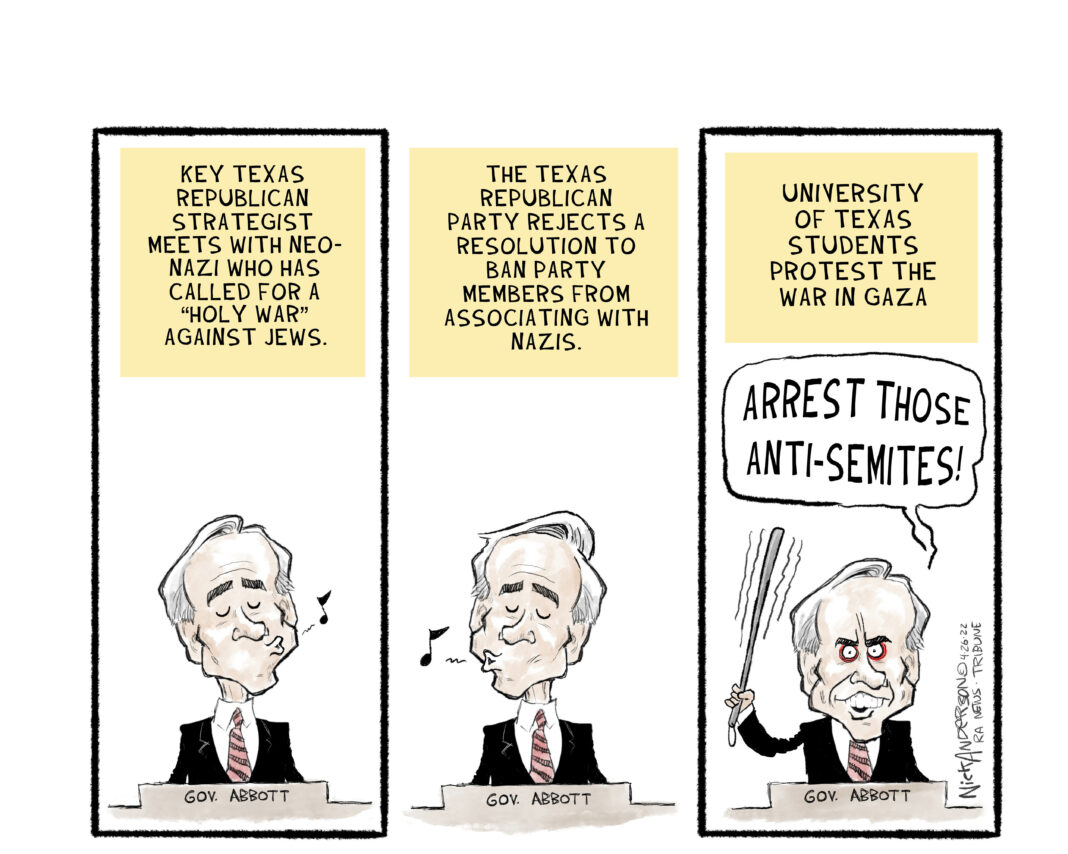
Many Republican politicians have responded cynically to the protests, trying to recreate Ronald Reagan’s successful demonization of campus protests during the Vietnam War. For example, it’s hard to take Texas Governor Greg Abbott seriously when he talks like this:
These protesters belong in jail. Antisemitism will not be tolerated in Texas. Period.
But Abbott is only intolerant of apparent left-wing antisemitism; he’s always been fine with right-wing antisemitism. Reporter Steven Monacelli of the Texas Observer comments:
I’ve seen no credible reporting of actual antisemitic incidents at the UT Austin protest. What I can tell you is that I’ve reported on numerous neo-Nazi events and Greg Abbott never once tried to put any of them in jail.
Before the trial started, I (and a lot of other people) thought prosecutors faced two big potential problems:
Their case depends on the jury believing Michael Cohen, who is a convicted perjurer.
Falsifying business records is only a felony if the false records were intended to support or cover up some other crime. Establishing that other crime might be difficult.
Well, I shouldn’t have worried. By the time Cohen takes the stand, he’ll just be coloring in a picture that has already been outlined by other evidence. Documents and more trustworthy witnesses will establish that meetings were held, topics were discussed, agreements were made, and money was paid. Very little of the case relies on believing things purely on Cohen’s say-so.
As for the other crime, at least one is already well on its way to being established. National Enquirer publisher David Pecker has told the jury that the catch-and-kill scheme that kept several bad-for-Trump stories out of publication was intended to influence the 2016 election, and that he knew at the time their agreement violated campaign finance laws.
Simultaneously, the defense looks weak. Trump’s apparent strategy is to challenge the prosecution’s points piecemeal, but his lawyers are offering no alternate narrative that pulls everything together. So it’s already easy to picture what will happen when the jury deliberates: Some juror will repeat the defense’s challenge to some detail in the prosecution’s case, and another juror will respond, “Maybe. But then why did this other thing happen?” If there was no agreement with Trump, why did The National Enquirer suppress stories that would have sold a lot of papers? If Trump didn’t order it, why did Michael Cohen borrow money to pay Stormy Daniels? (And what about that document where Allen Weisselberg added up all the numbers to arrive at Cohen’s reimbursement?) If there was no crime, then what did Cohen go to jail for? And so on.
To the extent that it tells a story at all, the defense is claiming that Trump did nothing wrong, while all around him other people were doing odd things they had no reason to do. Believing that is not impossible, I suppose, but it requires something well beyond reasonable doubt of the evidence presented. [1]
This scattershot approach is a tactic Trump uses in all his scandals: He never settles on a single explanation of what happened, leaving himself free to spin different stories at different times to different audiences: I didn’t do it. I did it, but it’s not illegal. Maybe it’s not legal, but everybody does it and gets away with it, so singling me out is political persecution. Biden, Hillary, Obama, or somebody else I don’t like has done worse. In fact, it was the right thing to do and I’m proud I did it; nobody else would have had the guts to do it.
That works in a political world of short news cycles and shifting attention spans, but in court it fails. (We’ve already seen it fail in his civil trials.) The jury is required to sit there for weeks and keep paying attention, so distracting them for a moment or two doesn’t get him off the hook. They get to see all the evidence, and they want to form a complete picture of what happened. So if one side can paint them a complete picture and the other side can’t, they notice.
[1] One thing I remember from my own jury experience was the judge’s explanation of “reasonable doubt”, which is literally doubt that has some rationality behind it. Just being able to imagine that the defendant might not be guilty is not good enough. That’s why evil-twin theories don’t usually fly in court.
If we can’t trust ordinary people to be jurors, then we’ve already given up on Democracy.
The central mission of a rising authoritarian movement is to destroy public trust in any institution that can stand in its way, and in particular, in any source of truth that is independent of the movement and its Leader. And so over the last few years the MAGA movement has told us that:
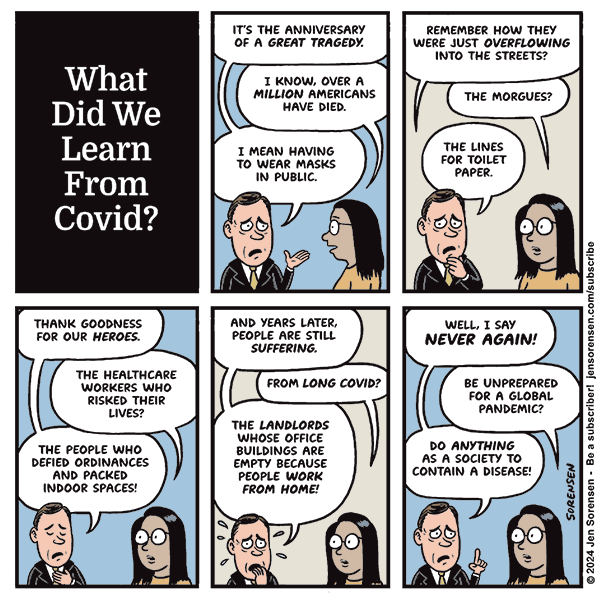
We can’t trust our public health institutions to guide us through a pandemic.
We can’t trust what climate scientists tell us about global warming.
We can’t trust the FDA’s opinion on the safety of abortion drugs.
We can’t trust historians to recount the story of American racism, or librarians to make sound decisions about books that discuss either race or sex.
We can’t trust women who tell us they were sexually assaulted, or any women at all to make decisions about their own pregnancies.
We can’t trust the news media to report simple facts (like the size of Trump’s inaugural crowd).
We can’t trust our secretaries of state and local election officials to count votes.
We can’t trust the FBI and the Department of Justice when they fail to find evidence of voting fraud.
We can’t trust our intelligence agencies when they tell us about Trump’s friend Vladimir Putin.
We can’t trust a judge of Mexican ancestry to oversee the Trump University fraud lawsuit, or any judges appointed by Democrats to handle Trump’s other trials.
And so on. Because in an authoritarian system, the Leader defines Truth. Only he can be trusted.
In each of these situations, we are presented with a Manichean choice: There is MAGA and there is the Deep State. There are Trump followers and Trump haters. If you are not one, you are the other — and that’s all that matters. No one can be trusted to simply do their job in a fact-based, objective, or professional manner.
This week we saw another example of that authoritarian trust-destroying mission: We can’t trust juries. Specifically, we can’t trust a jury of New Yorkers — or any jury convened in a blue state — to stand in judgment over the Great Leader himself. Most New Yorkers didn’t vote for Trump, and so by definition they are Trump haters who are incapable of listening to evidence and forming objective opinions about his guilt or innocence.
Already in August, Kellyanne (alternative facts) Conway was telling Fox News that Trump couldn’t get a fair trial in three of the four venues where he has been indicted — “the most liberal county in Georgia, D.C., New York City, all these places that voted against him”. Apparently only in south Florida, under the supervision of a judge he appointed himself, could Trump possibly get a fair shake. Because a courtroom is just another political arena where all that matters is the love or hate you feel for Donald Trump.
It’s important to push back on this insidious belief, because it strikes at the heart of any notion of Democracy. If ordinary people can’t be trusted, then they can’t be allowed to govern themselves. If they are too unreliable to be jurors, why should these same untrustworthy people be allowed to vote or protest or express themselves in any way at all? If ordinary people can only be trusted when they belong to the Leader’s party, then why let any other party compete for power?
There’s a reason that trial by jury goes back to the Magna Carta, and was guaranteed by the Founders in the Sixth Amendment. A belief in juries is fundamental to the whole project of Democracy.
Encouraging corruption. Once you convince yourself that an institution is inherently corrupt, the obvious next step is to make that corruption work for you rather than against you. So conservative talk-radio host Clay Travis made this plea to his listeners:
If you’re a Trump supporter in New York City who is a part of the jury pool, do everything you can to get seated on the jury and then refuse to convict as a matter of principle, dooming the case via hung jury. It’s the most patriotic thing you could possibly do.
In other words: Don’t answer the judge’s questions honestly, and once you get on the jury, don’t do your job with integrity. Don’t listen to the evidence and form an objective opinion. Refuse to convict “as a matter of principle”.
What principle would that be? That the Leader can do no wrong? That he is above the Law?
My plea is to the people of Manhattan that may sit on this trial: Please do the right thing for this country. Everybody’s allowed to have their political viewpoints, but the law is supposed to be blind and no respecter of persons. This is a trash case; there is no crime here; and if there is any potential for a verdict, they should vote not guilty.
But of course, there is a crime: falsification of business records, which is illegal in New York. Donalds knows this, just as he knows that Michael Cohen has already served time for his role in this illegal plot. If he truly believed Trump to be innocent, he could simply urge jurors to do their jobs with integrity, and express faith in the outcome. But he didn’t, did he?
Fox News has been doing its best to out the jurors, so that they can be vulnerable to intimidation and coercion from the violent MAGA faithful. In one case they have already succeeded: A juror who was seated on Tuesday came back Thursday asking to be excused because people had already begun to guess her identity. Fox host Jesse Watters had picked her out (by number) as a juror who might be difficult for Trump. (The evidence against her? She had blasphemed by saying: “No one is above the law.”) He then slandered (and Trump retweeted him) the jurors in general.
They are catching undercover Liberal Activists lying to the Judge in order to get on the Trump Jury.
In reality, Trump’s lawyers had caught people with liberal views saying that they could be objective. There is no reason to believe they can’t, beyond the dogma that all liberals are irrational Trump-haters.
In the face of this attack on a core democratic value, it’s important to reaffirm our faith in it, as Vox’ Abdallah Fayyad does:
Regardless of what the former president says, the demographics of New York or Washington, DC, won’t determine whether or not he will receive a fair trial. That will depend on how the prosecution makes its case, and whether the jurors will take their jobs seriously and evaluate the case on its merits rather than on their views of the defendant — something that juries are more than capable of doing.
That’s why Trump’s disingenuous attacks on the jury are dangerous: not because he’s questioning their potential fairness (juries can indeed be unfair, and defendants have the right to point that out), but because he’s broadly deeming some Americans — that is, anyone who doesn’t support him — as inherently illegitimate jurors.
If you believe in Democracy, the legitimacy of jurors doesn’t depend on who they voted for in 2020 or plan to vote for later this year or what they think of Donald Trump. Trials are not popularity contests. You can believe Trump is the scum of the Earth, and still evaluate fairly whether the prosecution has proved its case against him. As many a defense lawyer points out in summation: “You don’t have to like my client to find him not guilty.”
Could I be a juror? As I watched (from a distance) the Manhattan court’s effort to form a Trump jury, I did what I think a lot of people did: wondered how I would answer the questions prospective jurors were asked. In particular: Could I be objective? Could I listen to the evidence and arguments from both sides and reach a fair verdict?
I decided that I could. Now, as anyone who reads this blog or follows me on social media knows, I have a very strong negative opinion of Donald Trump. I have openly said that I think he’s guilty, not just in this case but in the other three cases as well. Had I been in that courtroom, the defense would undoubtedly have used one of their peremptory challenges to make sure I never came anywhere near the jury box. So how could I imagine being a fair juror?
Here’s how: I have a clear sense of the duties of a juror takes on. And the principle of trial by jury is more important to me than the fate of one man. Demagogues and grifters like Trump will come and go in American history, but trial by jury is something that I hope will endure through the centuries. I wouldn’t want to be part of screwing it up.
In particular, I believe that everyone accused of a crime deserves a fair trial, and that the prosecution has a responsibility to prove its case beyond a reasonable doubt. I also believe in the rules of evidence. As a juror, it wouldn’t matter to me what I had read in the news media or what I thought I remembered from the internet: The real evidence, the trustworthy evidence, isn’t what I heard on Fox News or MSNBC, it’s the evidence that shows up in court. And so when the trial ground to its conclusion, I would ask myself: Given what I’ve heard in court, has the prosecution proved its case? If it hadn’t, I would vote to acquit.
Now, I sincerely doubt that anything that might happen in this trial will change my opinion of Trump. At the end of the trial, I’m sure I will still believe he’s a fundamentally dishonest man who cares for no one but himself. I may even still believe that he’s guilty of the charges against him.
But if I’m a juror, that doesn’t matter. The question isn’t “Do you believe he’s guilty?” but “Has the prosecution proved he’s guilty.” If they haven’t, I could vote to acquit — even as I continued to hope that the prosecutors in one of his other cases would have more success.
Can this jury be fair? I have great faith that it can.
Part of my faith comes from having served on a jury several years ago in an emotionally fraught federal drug case. The defendant came from a household that in many ways exemplified the American dream: He and his wife were Hispanics who had worked their way into the middle class and were raising several children, all younger than 10. He worked in a local factory, and she was a nurse. The real bad guy here seemed to be the defendant’s brother, a career drug dealer that the government had been failing to make a case against. He sold drugs out of the defendant’s basement, and when the undercover cop showed up wanting to buy, he was too smart to sell. But the defendant trusted the cop, so the brother in essence said, “If you trust him, you sell to him.” The defendant did, and that was how he came to be on trial.
After the evidence was presented, we deliberated for an afternoon and most of the next morning. We were all over the map, and I had a very difficult night while I shouldered my responsibility. All of us sympathized with the wife and children. Several jurors who had been leaning not-guilty in the afternoon changed their minds overnight: By morning they were angry at the defendant for letting his brother sell drugs out of the house where his kids lived.
In the end, we answered the question we were given: Had the government proved that he sold the drugs? It had, and we convicted him. (We also had a meeting with the judge where we pleaded for him to sentence mercifully. I never checked whether he did.)
I learned a few things from this experience: First, the ritual of the court is powerful magic. You may come in with all sorts of impressions and opinions. But you very quickly learn to appreciate the awesomeness of the power you have been delegated and the responsibility it puts on you. (Spider-Man is right: With great power comes great responsibility.)
Second, no matter how different the individuals are, some kind of group loyalty develops. Not reaching a verdict feels like failure, and the jury doesn’t want to fail. We had each given a week of our time to this trial, and we didn’t want to believe our time had been wasted.
This is why I have faith in the Trump jury. Yes I can imagine all sorts of scenarios where somebody follows Clay Travis’ instructions: lies to the court so that they can get on the jury and rig the outcome. But that’s a harder mission to pull off than you might think.
My jury only met for a week. This one will probably sit for a month or more. During that time, they’ll share a lot of cups of coffee and more than a few lunches. They’re not supposed to discuss the trial until deliberation, but they’ll undoubtedly find other things to talk about: kids, jobs, the weather, TV shows. They’re going to see each other as people and develop a sense of common purpose.
Imagine spending that whole month with people while animated by a single malevolent thought: “I’m going to make sure you all fail. Because of me, this month we’ve all sacrificed will come to nothing.”
That would be a hard mission to carry out.
Even if you came onto the jury with a fairly strong belief in Trump, I think the ritual of the court and the camaraderie of the jury might well capture you. Every day you will look at Trump and realize that he is (as one prospective juror put it) “just a guy”, and not the great savior you imagined him to be. You will see him glower and bluster and doze off and treat you and your fellow jurors and the judge with disrespect. You will hear the prosecution witnesses assemble the case against him step by step. (You will have heard that the case is all politics, but in fact no one is talking politics. They’re presenting evidence.) When the defense takes its turn, you will hope for some grand revelation that shatters the prosecution’s case. And you will be disappointed.
During deliberation, you will have no real argument to make against your fellow jurors who want to convict. Over the month, you will have learned that they are not the frothing Trump-haters Fox News led you to expect. They’re just ordinary people trying to do their civic duty. Are you then going to look them all in the eye and admit that out of sheer stubbornness, you are going to make them fail?
Trump’s let-the-states-decide statement looked clever until Arizona actually decided.
All across the country, the abortion issue has been helping Democrats and hurting Republicans.
For decades it worked the other way: Pro-choice women were confident the Supreme Court would protect their rights, so they mostly ignored the extreme positions Republican politicians took and based their votes on other issues. But since the Dobbs decision reversed Roe v Wade last year, the intentions of elected officials matter again.
After taking their lumps in the 2022 elections, Republican politicians have been trying to figure out how to finesse the issue. How do they avoid the ire of female voters without alienating their personhood-at-conception base? Last fall, Virginia Governor Glenn Youngkin thought he had the formula: a “compromise” abortion ban at 15 weeks. But that idea went down in flames as Republicans lost control of the Virginia legislature.
Trump also has been searching for an answer. For a while he also toyed with a 15-week ban, but then last week he stalled for time, saying he’d make a statement this week. I was skeptical about this, because Trump often says he’s going to do something and then doesn’t. But in fact he did make a statement on Monday.
I don’t usually post Trump videos, but I think you need to see this to appreciate just how far off-the-rails this guy has gone. To start with, his make-up is comical; he almost looks like he’s wearing blackface. Then there are the obvious, how-stupid-do-you-think-we-are lies about how “all legal scholars, both sides, wanted and in fact demanded” the end of Roe, and Democrats “support abortion up to and even beyond the ninth month”. (In fact, Biden supports restoring the pre-Dobbs status quo, which drew a line at viability, i.e. 24-28 weeks. More radical people, like me, want the government to butt out completely and let women decide how to handle their own problem pregnancies. But describing that view as “support” for abortion is dishonest. I, for one, am neutral on abortion; I have never tried to persuade a woman to get one.)
He’s also proud of being opportunistic on the issue.
You must follow your heart on this issue. But remember: You must also win elections.
That let-the-states-decide position looked clever for about a day. But then a state decided: Tuesday, Arizona’s Supreme Court reinstated an 1864 law banning all abortions that aren’t necessary to save a woman’s life. (In the previous post, I explain why I believe this is a correct reading of a horrible legal situation. It’s the legislature, not the court, that should never have allowed this to happen.)
Then Trump had to scramble: He said Arizona went too far, and predicted the situation would be “straightened out”. Arizona’s mini-Trump, Senate candidate Kari Lake, completely reversed her position. Previously, she had specifically endorsed the 1864 law (by its number in the legal code). But now she says
I oppose today’s ruling, and I am calling on Katie Hobbs and the State Legislature to come up with an immediate common sense solution that Arizonans can support.
But Lake hasn’t said anything. As of this moment, neither Lake nor Trump (nor any other Republican who either has real power or is running to get it) has made an actual proposal to fix Arizona’s draconian abortion law. When it comes time to govern — and not just posture — that’s what you need to do: put a real proposal on paper and vote it up or down, knowing that you’ll make some people unhappy.
Are any Republicans, at either the state or national levels, ready to govern? That’s what the coming weeks will tell us.
The result is horrible, but it’s a correct reading of the the legislature’s mess.
Before he was appointed to the Supreme Court, Judge Oliver Wendell Holmes is supposed to have admonished an idealistic lawyer: “This is not a court of justice, young man. It is a court of law.” In other words, courts exist to apply the laws, not to fix them.
I was holding that idea in mind when I read the Arizona Supreme Court’s ruling reinstating an 1864 abortion law. Undoubtedly, this result — that all abortions are banned excepting only those that protect a woman’s life, and not excepting cases of rape or incest or even health consequences short of death — is horrible. But it could nonetheless be a correct reading of Arizona’s laws.
So here’s the timeline, as I understand it.
In 1864, the territorial legislature passed a law that said:
A person who provides, supplies or administers to a pregnant woman, or procures such woman to take any medicine, drugs or substance, or uses or employs any instrument or other means whatever, with intent thereby to procure the miscarriage of such woman, unless it is necessary to save her life, shall be punished by imprisonment in the state prison for not less than two years nor more than five years.
That wording got adopted as part of the penal code approved by the legislature in 1913, shortly after Arizona became a state.
The statute’s constitutionality got challenged in 1971, before Roe v Wade, and after some back-and-forth, an appeals court ruled it constitutional. Then the US Supreme Court’s Roe decision came in 1973, and Arizona courts recognized that the 1864 law was unconstitutional under Roe’s recognition of a federal constitutional right to abortion. But this didn’t stop the legislature from testing the boundaries of Roe.
Between 1973 and 2022, and conforming to the federal abortion right established in Roe, the Arizona Legislature codified dozens of abortion statutes in Title 36. … To the extent permitted by Roe and its progeny, all of these statutes restricted abortions, including adding many procedural requirements for physicians performing abortions.
In 2022, shortly before Dobbs was officially announced, the legislature passed S. B. 1164, which amended Title 36 of the state laws. The main thrust of S.B. 1164 was to ban abortions after 15 weeks, which would violate the rights established in Roe. This was one of many laws red-state legislatures passed after Trump’s three judges joined the Supreme Court. The purpose was to see if the new Supreme Court would chip away at Roe’s protections. What’s relevant for this case is the exact wording:
A. Except in a medical emergency, a physician may not perform, induce or attempt to perform or induce an abortion unless the physician or the referring physician has first made a determination of the probable gestational age of the unborn human being and documented that gestational age in the maternal patient’s chart and, if required, in a report required to be filed with the department . …
B. Except in a medical emergency, a physician may not intentionally or knowingly perform, induce or attempt to perform or induce an abortion if the probable gestational age of the unborn human being has been determined to be greater than fifteen weeks.
Notice that both provisions are phrased negatively: “a physician may not perform …”. Under the prevailing legal interpretation of 2022, i.e. Roe, the abortions not explicitly prohibited would be allowed. But nothing in S. B. 1164 says they are allowed. Quite the opposite:
This act does not: (1) Create or recognize a right to abortion or alter generally accepted medical standards. The Legislature does not intend this act to make lawful an abortion that is currently unlawful. (2) Repeal, by implication or otherwise, section 13-3603, Arizona Revised Statutes, or any other applicable state law regulating or restricting abortion
Section 13-3603 was the descendant of the 1864 law.
So then the Supreme Court’s Dobbs decision reversed Roe. This undid the 1973 finding that the 1864 law was unconstitutional, leaving the current state court to pick up the pieces.
Arizona’s Democratic attorney general argued that by banning abortions after 15 weeks, S. B. 1164 implicitly authorized them prior to 15 weeks, and implicitly repealed the 1864 law. A dissenting opinion in the decision agrees with this argument, but I think the majority got it right: There is no affirmative language in S. B. 1164 that authorizes any abortions.
I agree completely with the moral arguments denouncing this outcome: It’s barbaric that Arizona’s women’s rights are constrained by a law passed before statehood and before women had a right to vote. No court of justice would allow this. But we don’t have courts of justice; we have courts of law.
What can be done? The obvious way to repair this situation is for the legislature to do explicitly what the dissenting opinion thinks it did implicitly when it passed S. B. 1164: repeal 13-3603. That would leave Arizona with a 15-week abortion ban recognizing certain exceptions — maybe not the ideal outcome, but a far better one than the current situation.
Sometimes unrealistic fantasies raise questions that deserve serious answers.
The Washington Post’s “Tradwives, SAHGs and the dream of feminine leisure” is one of those rare articles that is way more interesting than its apparent topic. OK, there’s a “tradwife” trend of sorts: social media influencers who style themselves as classic 1950s housewives, and a parallel group of stay-at-home girlfriends (or what we used to call “kept women”). But this “trend” doesn’t represent all that many women, and you probably don’t need a major newspaper to tell you what to think about them. After all, if women had been happy in these kinds of roles, second-wave feminism would never have caught on.
But Monica Hesse takes a much more interesting approach. She doesn’t analyze tradwifery as a serious option, as in “Were women really happier before feminism?”. Instead, she approaches that vision for what it is: a fantasy. “I dream of feminine leisure”, say many of the tradwives and SAHGs. And then Hesse asks why that dream might be beguiling.
Her down-to-earth answer is simple: Life is hard these days.
The fact of the matter is that almost nobody who works for a living has the time they wish they did to look, feel or be their best, much less to cultivate a highly aesthetic relationship with a thing called ease.
What if the problem is not feminism but capitalism — specifically the American version, where work-life balance is a punchline? What if instead of 11 paid vacation days, as the average American gets, these women got the full month that is standard in the United Kingdom? What if instead of five (or six or seven) days a week, they worked the four days that countries such as South Africa and Belgium are piloting? Would that allow enough time to do a full skin-care regimen and pack a great suitcase? If college weren’t so ghastly expensive here, maybe that one lady’s daughter wouldn’t be so keen on the patriarchy as a route to leisure that bypasses the long, uphill road to financial independence.
It wasn’t fair when women had no choice to stay home. It’s not fair if women are working but are still doing the work of maintaining a home. It’s not fair if both men and women are trying to juggle it together and are still finding that there aren’t enough hours or dollars in a day.
Who wouldn’t dream of feminine leisure?
To her credit, Hesse also imagines the male side of this fantasy: Who wouldn’t want to return from work each evening to find a home in perfect order, dinner on the table, and a well-rested spouse ready to draw you into the “ease” she has been cultivating all day? (Now you just need a willing partner and a senior-vice-president salary to pay for it all.)
Hesse’s article expresses a point of view that could generalize: Maybe we’re approaching retro conservative fantasies all wrong. At root, most of them aren’t really about then, they’re critiques of now: Why does life have to be so hard? Why is it so hard to pay for college? To get a career started? To find a serious relationship partner and stay together? To afford a home? To fit children into the equation and offer them at least as good a chance as you had?
Maybe people who are trying to wish their way out of this box deserve our empathy rather than our condemnation. The various retro fantasies they indulge may not be fact-based or workable in practice, but at least they address the question: Life wouldn’t be so hard if some sugar daddy would take care of me. Or if immigrants and minorities hadn’t stolen my place in line. Or if everybody went back to Jesus. Or if the government stopped sending our money overseas. Or if we had a strong-man leader who could make our country great again (whatever era “again” is supposed to point to).
Maybe the best liberal response isn’t a screed about the evils of sexism or xenophobia or authoritarianism. Maybe we should skip past the specifics and give our own answer to the underlying question: Why is life so hard these days?
We do have such an answer, one that I believe is far more realistic and supportable than anything conservatives offer: Life is hard because sometime in the late 1970s, the US scrapped the controls that kept the rich from capturing all the growth in the economy.
We scrapped antitrust enforcement, so as a consumer you have to take whatever deal monopolies offer you. (The endless “choices” you face at the mall are often just different tentacles of the same octopus.) We scrapped unions, so as a worker you have no negotiating power. And we changed the tax system so that whatever the rich capture, they keep. The result is this graph, which every American voter should be able to draw on a napkin.
If hourly compensation had kept up, the average Americans would make more than double what they do now. So you could afford a one-income household, if that’s what your family wanted. Or you could save up for year-long sabbaticals and return to the workplace with new vision and energy. Or you could retire at 50 and see the world.
Corporate talking heads may denounce this point of view as “class warfare” or “socialism”, but such name-calling isn’t really a refutation. And it is nostalgic in a manner of speaking, but the point isn’t to recreate some past era; it’s to get back to the trends that held in the 50s, 60s, and early 70s, when economic gains were widely shared.
The Biden administration has finally begun to distance itself from the Netanyahu government. How much difference will that make?
Israel’s attack Monday night on a three-car convoy of the food-aid group World Central Kitchen brought to a head something that had been building slowly for a long time: American discontent with the war in Gaza.
Israel immediately said the attack, which left seven aid workers dead, was a mistake. But WCK Founder José Andrés wasn’t buying it:
This was not just a bad luck situation where, “Oops, we dropped a bomb in the wrong place.” … The airstrikes on our convoy I don’t think were an unfortunate mistake. It was really a direct attack on clearly marked vehicles whose movements were known by everybody at the [Israel Defense Forces].
The IDF’s investigation concluded that the army unit involved had believed the vehicles they were tracking from the sky had been taken over by Hamas gunmen, and that they were not aware of the coordination procedures put in place between the military and World Central Kitchen for that evening.
Andrés is calling for an independent investigation.
One reason this particular incident has had such an impact on world opinion is that it is part of a larger pattern.
Scott Paul, of Oxfam, said in a briefing with other relief organisations on Thursday before the results of Israel’s investigation were released: “Let’s be very clear. This is tragic but it is not an anomaly. The killing of aid workers in Gaza has been systemic.”
“Systemic” seems very carefully chosen. It does not necessarily mean “intentional”, but it includes that possibility. What “systemic” suggests to me is a kind of indifference: As things are, aid workers die on a fairly regular basis. This fact does not cause the system to change.
According to AP (which attributes the number to the UN) “at least 180 humanitarian workers have been killed in the war so far”. Those 180 are again part of a larger whole: around 33,000 Gazans, at least 13,800 of them children, have died since the war started. A much larger number of people are at risk due to the famine developing as insufficient quantities of food are brought in.
The larger numbers, though, are harder to form clear opinions about. Some of the 33K dead were the Hamas fighters Israel has every right to target. Some civilians were Hamas supporters, and some probably ventured into places they had been told to stay out of or ignored Israeli warnings about impending attacks.
But the seven WCK workers did everything right. They told the IDF what they were doing, which centered on delivering food to people who need it. They, like the 180 dead aid workers they joined, were people risking their lives to make sure strangers got food and medical care. We are, in short, talking about seven (and 180) of the best people in the world.
Until now, the Biden administration has chosen to keep its conflicts with the Netanyahu government behind closed doors. The public would hear reports that Biden was pressuring Netanyahu to be more forthcoming in negotiations over the ceasefire-for-hostages deal the US would like to broker, but publicly the US had Israel’s back at the UN and in every other public forum. Biden has paid a fairly large political price for this among progressive Democrats, especially young people. More recently, even longtime supporters of Israel, like Majority Leader Chuck Schumer, have begun criticizing Netanyahu.
Thursday, Biden and Netanyahu had a phone call. The White House account of that call had a significantly different tone: Biden was demanding specific actions, and threatening consequences if they didn’t happen.
President Joe Biden ticked through several things that he needed to see Israeli Prime Minister Benjamin Netanyahu do immediately: open up the Erez crossing into northern Gaza and the port of Ashdod in southern Israel for humanitarian aid; significantly ramp up the supplies getting in through Kerem Shalom.
For now, Israel seems to be doing what Biden asked. But it will take time to see whether anything has substantively changed: Will more aid get through to Gazans? Will the famine abate? Will an attack on Rafah produce a new spike in civilian casualties? Will some kind of ceasefire-for-hostages deal actually happen? And if nothing changes, will Biden follow through with the “changes in our own policy” Secretary Blinken has suggested?
I think it’s important to keep repeating a point I’ve been making from the early days of the Gaza conflict: Americans should not be bringing this war home. American Jews are not the Netanyahu government. American Palestinians are not Hamas.
Memo to the bigots. Israel does not set its policies or run its war from: Synagogues, Jewish community centers, Holocaust museums, Kosher grocery markets, Jewish-owned cafes & shops
Bringing a mob to scream outside these places is an act of hate and antisemitism, not protest.
The mifepristone suit from Amarillo is so embarrassingly bad that even the Court’s conservative majority can’t justify doing what it wants.
The anti-abortion-pill case that right-wing culture-war groups primed to get to the Supreme Court got to the Supreme Court. Oral arguments happened Tuesday, and did not go nearly as well as anti-abortion groups probably imagined when they filed the case. Even Amy Coney Barrett seemed skeptical.
There probably won’t be a decision until June, so there’s no sense going into great detail now. But there are a couple of things worth noting:
When you grease the way for a case to make it to the Supreme Court, you wind up with a greasy Supreme Court case. Legally, this was a bad argument that never should have come this far, and even some conservative justices seemed embarrassed by it.
US courts continue to entertain notions of “Christian conscience” that are so expansive as to be passive aggressive. The rest of us are expected to change our lives so that right-wing Christians can have a buffer zone around extensions of “conscience” they have intentionally constructed to control us.
I explained the greased slide that brought this case to the Supreme Court back when the case was first being heard in Amarillo, almost exactly a year ago: The Northern District of Texas, which contains Amarillo, has one judge who hears just about all the cases. That judge, Matthew Kacsmaryk, is a right-wing culture warrior who can be counted on to rule in the “right” way, independent of facts or the law. The Northern District sits inside Fifth Circuit, whose appellate court is not quite as lawless as Kacsmaryk, but has a similar right-wing bias and will not examine his rulings too closely.
So in this case, foes of abortion rights incorporated their group in Amarillo precisely so they could file their suit in Kacsmaryk’s court. (The Judicial Conference has since changed the rules to limit this kind of judge shopping.) Kacsmaryk did his part and issued a nationwide injunction stopping the sale of mifepristone. The 5th circuit cut that injunction down a little, leaving mifepristone legal but limiting the possibilities for prescribing it. The Supreme Court previously stayed both rulings pending its own examination of the injunction.
That’s what they were discussing Tuesday.
The big reason the case should never have come this far is the plaintiffs’ lack of standing. In non-legalese, they can’t show how the availability of mifepristone harms them, so there’s no injury for the court to try to correct.
According to the doctors, their concrete injury is that someone might take mifepristone, might experience medical complications, might go to the hospital for care, and then the physicians in question might have to complete the abortion despite their moral objections to doing so.
Standing is supposed to be real, not speculative. The injury is supposed to be either happening, or so close to happening that it seems bound to happen without an injunction. A maybe-maybe-maybe argument doesn’t give you standing. There’s a good reason for this requirement: Otherwise, judges could make pronouncements about any topic that interested them, and the awesome power our system gives the courts could be abused.
A lot of articles have covered the case’s standing issue. But I was pleased to see Dahlia Lithwick and Mark Joseph Stern raise the passive aggression issue in Slate. (They don’t use that terminology, which I started using in 2013.) Under questioning, plaintiff lawyer Erin Hawley (wife of the famously swift senator) made an even stronger claim than the quote above would imply. When you read “complete the abortion”, you probably pictured a woman taking mifepristone, her body starting to eject the fetus, but not quite succeeding in getting it out. She might then show up in an emergency room, where an ER doctor opposed to abortion might have to complete the removal of a fetus that is doomed but not yet entirely dead.
However, that grisly scenario is exceedingly unlikely. A far more likely complication (still rather uncommon) is that the woman takes mifepristone, miscarries, but then doesn’t stop bleeding afterward. In this scenario, the abortion is over, the fetus is dead, and now an ER doctor needs to treat a bleeding woman.
The plaintiffs don’t want to, because patching up a woman who has taken a drug to give herself an abortion would make them “complicit” in the abortion.
Hawley … then approached the lectern and cleared up any confusion: Yes, she insisted, treating a patient who has undergone a medication abortion violates the conscience of the plaintiff physicians even if there is no “live” fetus or embryo to terminate anymore. “Completing an elective abortion means removing an embryo fetus, whether or not they’re alive, as well as placental tissue,” Hawley told Kagan. So the plaintiffs don’t object just to taking a “life.” They also object to the mere act of removing leftover tissue, even from the placenta.
Of course, these doctors must remove “dead” fetal tissue and placentas all the time—from patients who experienced a spontaneous miscarriage. By their own admission, the plaintiffs regularly help women complete miscarriages through surgery or medication. Those women they will gladly treat. Other women, though—the ones who induced their own miscarriage via medication—are too sinful to touch. Before the plaintiffs can administer even lifesaving emergency treatment, they need to know the circumstances of this pregnancy loss: Spontaneous miscarriages are OK; medication abortions are not.
It’s impossible to imagine this logic being accepted in any non-abortion circumstance. Suppose a guy gets drunk and drives his car into a tree. When he shows up in the ER, would a doctor (maybe from a religious sect that forbids alcohol) refuse to treat him in order to avoid being complicit in his drunk driving? ERs don’t work that way. In any other circumstance, injured people show up and get treatment. The guy who stitches up participants in a barroom brawl doesn’t need to know what started it or who was right.
It is a twisted line of logic, one that should never have reached the Supreme Court in the first place. But it is also a product of the court’s past indulgence of outlandish claims about moral “complicity.” … All this is reminiscent of Little Sisters of the Poor, a case about a Catholic charitable group that was afforded an exemption from the Affordable Care Act’s contraception mandate. The Little Sisters were asked to check a box signaling to the government that they could not comply with the mandate, at which point the government would step in to cover their employees. But the Little Sisters refused, viewing this action—the checking of a box to opt out of coverage—as “complicity” in abortion because it would in turn trigger government payment for contraception (which they viewed as abortifacients). The Supreme Court and the Trump administration ultimately indulged the Little Sisters’ claim.
It may violate conservative political correctness to say so, but the Little Sisters were just being assholes in that suit. They invented an extravagant claim of conscience in order to screw up ObamaCare and interfere in other women’s lives.
Refusing to bake cakes or make web sites for same-sex weddings (other situations the Supreme Court has treated seriously) are similar examples of passive aggression. Going far beyond any legitimate Christian concern, such cases involve constructing an enormous hypersensitive conscience that will feel “complicit” in anyone’s behavior that it fails to control. Making the world safe for such a construction restricts the freedom of everyone else.
No non-Christian religious group would be allowed to do this. And Christians will keep extending such notions of “complicity” until courts tell them to stop. That should have happened a long time ago.
A higher retirement age, an abortion ban, more tax cuts for corporations and the rich, less regulation, an end to wokeness, and to burn as much fossil fuel as humanly possible. And that’s not all.
Wednesday, the House Republican Study Committee put out a report on its budget proposals for FY 2025, which begins in October. The mainstream media publicized a few of its more controversial features, like recommending an increase in the retirement age, federally banning abortion by giving fertilized ova 14th Amendment rights, and reversing nearly everything that would hasten the day when sustainable energy replaces fossil fuels.
But the report is 180 pages, and you can’t really appreciate the steady drumbeat of wrongheadedness until you read the whole thing (which I did). This article summarizes the report in some detail. But first, let me justify why this document deserves your attention.
How political parties communicate their vision. Ordinarily, there are several ways you can figure out what a political party stands for:
position papers of the party’s nominee
a detailed platform passed by the national convention
bills they pass in any house of Congress they control, even if those bills fail in the other chamber or get vetoed by the president
Unfortunately, none of that works with today’s GOP. Apparently, having an “Issues” page on your campaign website is an obsolete idea. Googling either “Donald Trump for President” or “Joe Biden for President” will take you to a fundraising page with no “Issues” tab. Adding “issues” to the search helps a little with Biden, but not Trump. The Biden search will lead you to a “Priorities” page at WhiteHouse.gov, but it’s a bit out of date. (Covid-19 is still the first priority mentioned.) For Trump you’ll be directed to various news outlets’ summaries of what he stands for, not an official statement by the Trump campaign.
Of course, you could instead listen to what Trump says in his speeches, if you can make any sense out of them, beyond grasping Trump’s desire for revenge against the long list of people he feels have wronged him. As I described last week (after his “bloodbath” remark), he tends to speak in word salads that allow his partisans to claim that he didn’t really mean whatever part of his speech you found alarming.
As for platforms, the Democrats passed a fairly detailed one in 2020, which (again) is a little out of date. For example, it says “We will maintain transatlantic support for Ukraine’s reform efforts and its territorial integrity.”, but that was before Russia’s full-scale invasion started.
The Republicans don’t even offer that much. Their 2020 “platform” complains a lot about the media misrepresenting the Party’s positions, but says “the 2020 Republican National Convention will adjourn without adopting a new platform until the 2024 Republican National Convention”. What it does say is that “the Republican Party has and will continue to enthusiastically support the President’s America-first agenda”. In short: We’re for a man, not a set of ideas.
But the Republican majority that has controlled the House in 2023-2024 is almost completely unable to pass legislation. Simply keeping the government open has been a struggle, which finally came to a conclusion Friday, halfway through FY 2024.
Instead, their time has been dominated by battles over the speakership and investigations of the Biden family that have produced little more than talking points to raise on Fox News. The only major bill I could find that passed the House and died in the Democratic Senate was the Secure the Border Act, which would have funded a border wall and reinstituted President Trump’s wait-in-Mexico immigration policy.
So OK, you might conclude that Republicans at least have a position on the border. Of course, when Democrats tried to offer them most of what they wanted on that issue, they turned it down, preferring to retain the border as a talking point rather than take any action on it. So maybe they care about the border and maybe they don’t.
There are other places you might look to find a Republican vision for the future, but most of them are by outside groups: The Heritage Foundation, for example, has put together Project 2025, which Mother Jones has described as “a blueprint for a wannabe-White-House-autocrat”. That vision calls for undoing any effort to avoid a climate catastrophe, dismantling the civil service, and a few other things.
But that’s the Heritage Foundation, not any official GOP group. So it’s deniable.
The House Republican Study Committee report, on the other hand, actually is something. This committee is not the whole Republican conference, but it’s close: Its membership includes 166 of the 218 (or so) House Republicans. By itself, it’s the “majority of the majority” of House Republicans’ Hastert Rule. The intro letter is promising (other than the apostrophe missing in its first line – “the President of the United States cognitive decline”):
The RSC budget for Fiscal Year (FY) 25 does not shy away from the severity of the challenges America faces. As any family knows, attempting to live within your means when you are in debt is challenging. The RSC budget provides a sober pathway to balance the budget, reduce prices, preserve the programs Americans have paid into, and create economic growth and opportunity. As in previous years, the RSC budget also celebrates the work of House conservatives who have fought for legislation that preserves American values, combats Biden’s woke and weaponized government, and protects the freedoms that should be enjoyed by every American.
So OK, let’s go. What’s in it? Let’s take the sections in order.
Deregulation. This is the first section of the plan, and I was immediately unimpressed. The section’s second paragraph is:
The cost of federal regulations in 2022 was estimated to be $1.939 trillion—amounting to 7.4 percent of GDP.[footnote 1] To contextualize, the total amount of individual income tax revenues for 2022 was $2.263 trillion.[2] Despite the high fiscal toll on the American people, the Biden administration has continued to push for regulation after regulation.
Footnote [1] is a report by the Competitive Enterprise Institute, a libertarian think tank known for climate-change denial. And while that report does contain the $1.939 trillion estimate, it sends you to another footnote, and I was unable to track down what this number really means.
In general, conservative estimates of the “cost” of regulation ignore any balancing consideration of the benefits. For example, a regulation forcing utilities to replace lead water pipes with something less toxic will cost them money. However, the children whose brain development is not compromised by that lead will grow up to be more intelligent, more productive, and less likely to commit crimes (because lead exposure affects impulse control). So even if we ignore moral considerations and just talk about dollars, those are real economic benefits that any honest appraisal would have to weigh against the costs. But the CEI doesn’t do that kind of stuff.
Among the specific Biden administration regulations the RSC report calls out is “A Green New Deal emissions proposal that will make vehicles significantly more expensive”. Again, the costs of not regulating carbon emissions are ignored: stronger hurricanes, more wildfires, longer droughts, etc. The RSC targets any effort to avoid or mitigate climate change by reducing fossil fuel dependence. So: more drilling, more pipelines, less conservation, more gas-guzzling vehicles, and less accountability for energy companies.
A long list of proposals are backward-looking slaps at Covid regulations like vaccine or mask mandates. These proposals would tie the hands of public health officials in the next pandemic, whatever it is.
Another long list of proposals remove restraints from banks and other financial industries, allowing them to resume many dangerous and deceptive practices that were exposed after the 2008 financial collapse. A perennial Republican proposal is to do away with the Consumer Financial Protection Bureau, because why would consumers ever need to be protected from predatory banks and other lenders?
But OK, reasonable people can disagree about whether current federal regulations are cost-effective, or whether we need less regulation rather than more. But the proposals endorsed in this section are unlikely to lead to wiser regulatory decisions. Most of them amount to regulating the regulators, binding agencies in red tape that will make it nearly impossible for them to stop corporations who decide to make money by, in effect, killing people.
Taxes. The second section is about tax reform. You might expect Republicans to object to Biden’s tax policies, and maybe trace them back to Obama’s policies.
But no. This section begins by decrying all the taxes ever collected from Americans.
By the end of 2024, the federal government will have taken $98.9 trillion in wealth out of the hands of Americans since 1789 through taxes and other revenue.[71] To the lament of Americans everywhere, the size of government and subsequent mandatory wealth transfers have increased dramatically since the ratification of the 16th Amendment in 1913, which gave the federal government the power to tax income. From the New Deal to the Great Society, the Left has continued to tap into Americans’ hard-earned dollars to fund a bloated federal government. Put simply, bureaucrats in Washington and Democrats in Congress believe they know how to spend your money better than you.
Preach, brother! Why couldn’t the government just leave me alone to build my own interstate highway system?
The simple fact is that through government we can buy things collectively that we can’t buy as individuals: parks, clean air, defense from invaders, public health projects, and stuff like that. Precisely where to place the boundary between the public and private sectors, and how to raise the money for public-sector investments, are also questions people of good faith might legitimately argue about. But “they believe they know how to spend your money better than you” is just a stupid way to look at these questions.
And when you talk about the “bloated federal government” created by the New Deal and the Great Society, what you’re really talking about are Social Security (from the New Deal) and Medicare and Medicaid (from the Great Society). Put together, those programs make up 45% of the federal budget.
Those all fit under the general description of insurance, something government provides much more efficiently than the private sector. (To see why this is, look at medical insurance. A private insurance company devotes much of its marketing budget to making sure they attract the right kind of clients — the ones who are unlikely to get sick. But Medicare insures everybody over 65, so it can’t manipulate its client base. Also, private insurance routinely undercovers preventative care, because a company might be paying to prevent a problem that won’t appear until after the client has switched to another company.)
The HSC report makes one point about the tax system that it’s hard to argue with: “Carve-outs for special interests embody corporate cronyism”, which is bad. However, I don’t think they see the same cronies I do, because a fundamental theme of their plan is to end “high rates of taxation on investments and savings”.
I just finished doing my taxes, and, as usual, I’m appalled: Being retired, most of my income consists of dividends and capital gains, which are taxed at rates far lower than what working people pay on their wages. So even though I benefit, I see the favorable rates on investment income as “carve-outs for special interests”. Treating wages and investment income the same is what seems fair and simple to me. (Typically, the hardest part of my taxes is filling out the “Qualified Dividends and Capital Gains Worksheet”. But it saves me thousands, so I do.)
Fairest of all is cracking down on rich people who cheat on their taxes — which is why I support the Inflation Reduction Act’s increase in the enforcement budget of the IRS. (The HSC report falsely refers to this as “Providing funding to hire 87,000 new IRS agents to spy on low-and middle-income Americans.”)
And continuing their pro-global-warming agenda, the RSC wants to repeal all the fossil fuel taxes in the Inflation Reduction Act, together with any tax breaks for sustainable energy sources.
The RSC also wants to eliminate federal inheritance taxes, a.k.a. “the death tax”. Since the threshold for filing estate tax is now $13.6 million, only the estates of very wealthy people pay this tax. (If you don’t think $13.6 million sounds like wealth, you’re out of touch with the American people.)
The RSC Budget would cut taxes by nearly $5.5 trillion over the next 10 years. The pro-growth effects of these tax reductions would result in $566 billion of additional revenue.
This is what George H. W. Bush correctly called “voodoo economics” when he ran against Reagan in 1980. The RSC’s voodoo is what lets it cut taxes and claim that it produces a balanced budget.
Poverty and Welfare. The RSC report has a clear view of why people are poor: They’re lazy and need to be pushed to work more.
The RSC Budget would require all federal benefit programs be reformed to include work promotion requirements that would help people move away from dependence and toward self-sufficiency.
Studies evaluating TANF and its predecessor’s work requirements found that the modest employment increases that occurred shortly after the requirements were first implemented faded over time (generally because most adults not subject to the requirements also found jobs, just a bit more slowly).[40] These requirements did little to reduce poverty and tended to increase rates of deep poverty (defined as income below half of the federal poverty line), rigorous evaluations found.[41] Families who lost cash assistance faced serious consequences that include higher rates of hardship, such as higher risk of homelessness, utility shutoffs, and lower school attendance among children.
Fundamentally, the Republican view of motivation is “Carrots for the rich. Sticks for the poor.” If you want rich people to do something, you have to give them a tax break or a subsidy. But if you want poor people to do something, you need to threaten them with a punishment.
But this paragraph is my favorite:
Despite two positive changes included in the Fiscal Responsibility Act, one unintended consequence was to exempt homeless individuals, veterans, and individuals aged 24 and under who were previously in foster care from the work requirement. The RSC budget supports revising existing SNAP law to ensure that these groups of people are subject to the work requirement if they do not have dependents. SNAP and our welfare system should embrace that work conveys dignity and self-sustainment and encourage individuals to find gainful employment, not reward them for staying at home.
Did you catch that? We need to be careful that we don’t reward homeless people for staying at home.
The RSC does not grasp the concept of a poverty trap, something constructive that people could theoretically do to escape poverty, but they can’t do practically because they’re too poor. For example, homeless people have trouble maintaining basic hygiene, which makes it very hard for them to get hired. But if they don’t somehow come up with jobs, we’re going to stop subsidizing their food. This is going to give them “dignity”.
Republicans also want to bundle all such programs into “block grants” that give states “flexibility to administer their own programs”. These bundles have a terrible history, because the poor can’t afford lobbyists. As a result, money in the grants tends to wind up being spent on all sorts of things other than poor people. This was at the root of the Brett Favre fraud in Mississippi.
They also want to turn child nutrition into block grants, and the report decries the “widespread fraud” in the free school lunch and breakfast program, i.e., some kids who aren’t quite poor enough are getting fed.
Defense. The RSC proposes a $895.2 billion FY 2025 defense budget, slightly more than Biden’s $850 budget. The report lists a number of things it wants to fund, but doesn’t say which ones are already in Biden’s budget.
One thing the RSC does want to do with the defense budget is fight its culture wars, eliminating any money for “woke training and programming”, such as teaching soldiers of different races, genders, and religions how to get along and respect one another. It worries about military aid to Ukraine and other nations going through international organizations that “have a history of promoting abortion or sexual orientation and gender identity programs”. It’s not enough that our money not go into such programs; the organizations associated with them are too tainted to use. It wants Defense strategy to ignore climate change, and cancels funding for efforts to run military bases on sustainable power by 2030.
DOD should not waste valuable taxpayer dollars on inefficient forms of energy. Energy needs should be met through the most cost-effective and tactically sound methods possible. The DOD should be prohibited from entering into any contract for the procurement or production of any non- petroleum-based fuel for use as the same purpose or as a drop-in substitute for petroleum. Further, the Armed Forces should be exempt from procurement requirements for clean-energy vehicles and renewable energy portfolio standards for DOD facilities.
The RSC wants to privatize as much of the military’s support positions as possible. This includes doing away with the independent school system on military bases, which is excellent.
There are long sections focused on China and Russia, but again, it’s hard to tell which proposals differ from what Biden wants to do. The report is strongly supportive of Ukraine, but does not mention that Republicans have been blocking funding since September.
The fact that Iran is “closer than ever before to a nuclear weapon” is somehow Biden’s fault, when it was Trump who cancelled the agreement that controlled Iran’s nuclear programs. The report describes Trump’s “maximum pressure” campaign against Iran as “successful”, even though this policy failed to produce the “better deal” Trump promised.
The Hamas attack on Israel is also somehow Biden’s fault, and had nothing to do with Trump’s decision to ignore the Palestinian problem entirely.
Conservative values. There’s a long section on abortion, beginning with
RSC celebrates the Dobbs v. Jackson Women’s Health Organization decision as a historic victory in the effort to defend innocent life and to return to the Constitution as it was written. … The RSC Budget applauds the following measures designed to advance the cause of life:
Then follows a long list of proposals various Republicans have advanced to limit women’s access to abortion, including ones that would federally block drug-induced abortions, prohibit abortions after the mythical six-week “fetal heartbeat”, recognize a newly fertilized ovum as a “person” under the 14th Amendment, ban abortions at 15-weeks due to mythical fetal pain, prohibit the use of fetal stem cells in research, prohibit any ObamaCare health insurance policy from covering abortion, prevent telehealth services from prescribing abortion drugs, deny federal funds to universities whose student health organizations provide abortions, and dozens of others.
The report endorses a similar list of anti-critical-race-theory proposals, which ban teaching or promoting “critical race theory” in all sorts of settings. No one can define CRT, but as best I can tell, any recognition of White privilege in America or any truthful recounting of America’s racial history violates these proposed laws.
A number of proposals to protect gun rights are lauded, including several that prevent the government from keeping track of who owns or purchases guns. The RSC also wants to defund red-flag rules that take guns away from domestic abusers, allow concealed carry across state lines, and remove regulations on silencers. The problem of mass shootings is not mentioned.
The report endorses the usual bunch of anti-trans proposals: targeting trans athletes, banning care options, mandating bathroom policies, etc. The section on the border is about what you’d expect: finish Trump’s wall, reinstitute Trump’s cruel and probably illegal treatment of migrants, etc. Some proposals (like hiring more asylum judges to process cases faster) were included in the border proposal Republicans tanked after Trump said he wanted the issue to campaign on. The RSC also wants to reinterpret the 14th Amendment so that it no longer guarantees birthright citizenship, despite what the text actually says.
Healthcare. The RSC wants to return to the bad old days before ObamaCare. The report calls for a “more market-oriented” approach to health insurance, and promises lower premiums by eliminating “ObamaCare mandates”. In other words, you could once again buy junk insurance that doesn’t cost as much but will vanish in a puff of smoke when you actually need it. States would be empowered to define what insurance plans have to cover, and insurance companies could sell across state lines. This would lead to a race-to-the-bottom among states, similar to what we saw with credit card regulation after interstate banking was approved. (There’s a reason why you have to send your payments to South Dakota.) Younger, healthier individuals could get lower-priced policies, taking them out of the insurance pool. The result would be exorbitantly expensive insurance for people who actually need care. The Inflation Reduction Act’s provisions to control drug prices would be repealed. Medicaid and the Children’s Health Insurance Program would be “streamlined” by turning them into block grants to the states.
Medicare. The RSC plan to “save” Medicare is essentially a privatization plan, where Medicare mainly provides premium supports for private insurance programs.
This plan ignores one essential fact about private health insurance: Competition between insurance companies does not center on providing better care at lower prices, but on luring healthier clients and discouraging sicker ones. Denying care is a double-win for an insurance company. Not only does the company not pay for the care, but patients who need care will be motivated to find other insurance.
Take cancer, for example. You don’t really know how good your plan’s cancer coverage will be until you get cancer. But at that point you have become an undesirable customer, so the company would rather you switched to some other insurance. Providing the kind of care and service that attracts people with cancer is a bad business model.
Social Security. The report points to the projection that the Social Security Trust Fund will run out of money in 2033, and correctly observes that there are three things to do about that: keep the program running with money from the general fund, raise taxes, or cut benefits. It rejects the first two options and proposes to cut benefits.
Recognizing political dynamite, the RSC refuses to cut current benefits for people already retired. However, Republicans would
force Congress to vote on cost-of-living increases every year, as opposed to the current system where COLAs are automatic
lower benefits for future retirees in a means-tested way
raise the retirement age as life expectancy rises.
None of these benefit cuts are quantified. And, as always, Republicans promise increased revenues from the (mythical) economic growth that their income tax cuts will promote. These days, though, they also add in the economic “growth” that will come from burning more fossil fuels (as long as you don’t have to account for the costs of climate change).
Raising the retirement age as people live longer and are able to work longer makes a certain intuitive sense. But there’s a problem: The gains in lifespan almost entirely benefit wealthier people. Working class and poor people, in general, have had only modest increases in life expectancy in recent decades.
[T]he study shows that in the U.S., the richest 1 percent of men lives 14.6 years longer on average than the poorest 1 percent of men, while among women in those wealth percentiles, the difference is 10.1 years on average.
This eye-opening gap is also growing rapidly: Over roughly the last 15 years, life expectancy increased by 2.34 years for men and 2.91 years for women who are among the top 5 percent of income earners in America, but by just 0.32 and 0.04 years for men and women in the bottom 5 percent of the income tables.
Also, while people who do primarily mental work can easily work into their 70s if they’re so inclined, people who do physical labor often don’t have that option. If you raise their retirement age, they’ll wind up eating cat food.
Budget reform. The RSC proposes a series of “reforms” that would lock the government into conservative priorities, no matter what the voters want. Like a constitutional amendment to cap revenues and force a balanced budget.
This proposal would bar annual spending in excess of 20 percent of GDP and prevent Congress from relying on tax increases to balance the budget, which is key to preserving a dynamic and innovative economy.
This is a seriously bad idea. For example, consider the recent pandemic. In FY 2020 (Trump’s last full year), federal spending was over 30% of GDP. That spending was what allowed Americans to stay home, and prevented many Americans from losing their homes when their jobs disappeared. If the government had been limited to 20% of GDP, Covid would have run wild and probably millions more Americans would have died. Millions of others would have been homeless.
Now start imagining various future climate-change doom scenarios — seas rising, farmlands turning to deserts, and so on. The government would just have to throw up its hands.
And not allowing Congress to raise taxes makes all sorts of policy changes impossible, whether voters want them or not. Republicans wouldn’t have to argue against Medicare for All or the Green New Deal, for example, because both would be constitutionally infeasible.
The RSC also proposes that the reconciliation process not be allowed to increase spending or taxes. In other words, if Republicans get control of the presidency and Congress, they can use reconciliation to pass their priorities (like the Trump tax cuts), but if Democrats get control, they can’t pass theirs (like the Inflation Reduction Act).
Other mandatory spending. There’s a grab-bag of stuff in here, most of which was too in-the-weeds for me to evaluate. However, I did notice the proposals to end student loan forgiveness, auction off the TVA’s non-nuclear assets, revoke the charters of home-loan guaranteeing agencies Fannie Mae and Freddie Mac, and reduce the benefits of federal employees.
Non-defense discretionary spending. Another grab-bag of (mostly) cuts. Stop the Forest Service from buying more land. Eliminate anything to do with “the left’s climate agenda”, or any program that can be tarred as “woke”. Eliminate the Consumer Product Safety Commission because it advances “Biden’s radical climate agenda, including attempting to ban gas stoves”. (This whole talking point is a canard. The footnote that supposedly supports it includes a CPSC spokesman saying the commission “isn’t coming for anyone’s gas stoves”.)
The RSC wants to cut funding for the Cybersecurity and Infrastructure Security Agency, not because cybersecurity isn’t a problem, but because CISA is trying to fight disinformation online. The Republican agenda is based on disinformation, so they see this as a threat. Similarly, Republicans want to eliminate Targeted Violence and Terrorism Prevention Grants, because the program doesn’t exempt right-wing terrorist groups. OSHA is targeted for cuts to get revenge for President Biden’s Covid vaccine mandates. Similarly, the US contribution to the World Health Organization is eliminated.
Of course Republicans want to cut funding for the EPA and leave the Paris Climate Accords. Also: stop funding Amtrak and prohibit spending on high-speed rail.
The report calls for eliminating the National Endowment for the Arts, National Endowment for the Humanities, and Corporation for Public Broadcasting, as well as cutting support for the Smithsonian (because the museum complex is too woke).
So there it is: the Republican fantasy world in its full glory. Now you know what you’re voting for if you vote Republican in November.