Category Archives: Articles

Sweet Home, Gilead

With its ruling affirming the rights of “extrauterine children” and invoking “the wrath of a holy God”, the Alabama Supreme Court takes a giant step towards theocracy.


Given all the bad press Alabama has gotten this week for its supreme court’s ruling that frozen embryos are “extrauterine children” covered by the state’s Wrongful Death of a Minor Act, you might imagine that the media is just piling on. You might be thinking, “It’s probably not really that bad.” Maybe if you took the time to read the full 131-page decision, you’d understand and even respect where the justices were coming from, even if you still didn’t agree.

Let me shoot that generous notion down: I read the decision. It’s even worse than it looks in the news reports. I started reading newsworthy court opinions with the 2003 Massachusetts same-sex marriage decision, and since then I’ve easily read 100 or so. I’ve never seen one this flat-out insane or this scary in its implications.

It’s tempting to go off on a rant. But instead, let me back up and give you the context.

IVF. The reason anybody freezes embryos in the first place is for in vitro fertilization (IVF), a medical procedure that helps otherwise infertile couples have their own biological children rather than adopt. It’s been going on since 1978 and it’s popular: CNN estimates that about 2% of babies born in the United States are conceived through IVF. Chances are that you know someone who conceived or was conceived through IVF. (I know I do.)

Leaving out a bunch of details, it works like this: Ova are removed from a woman’s ovaries, and then they are fertilized in a laboratory with sperm from that woman’s chosen partner (or maybe a sperm bank). The cells start dividing, and after a few days they are ready to implant in a uterus (either the woman’s own or, if the whole point is to overcome some medical problem there, the uterus of some other willing woman). This is a hit-or-miss process that may require several attempts, so typically a number of ova are fertilized simultaneously, and the embryos not used are frozen in case they are needed later.

Many of the frozen embryos will never be implanted in a uterus, where they might develop into fetuses and eventually babies. Perhaps they are defective in some way. (For example, it’s possible to test the embryos for some heritable genetic issues the parents want to avoid passing on.) Or perhaps the woman succeeds in having all the children she wants before all the embryos are used. The remainder are usually destroyed in one way or another, though they can stay frozen more-or-less indefinitely (“several decade, if not longer” according to the court’s majority opinion).

Bad theology. So far, so good, but then IVF runs into a dogma invented by Catholic and/or Evangelical theologians: At the moment of conception, the fertilized egg becomes a full human being for all moral purposes. (As I’ve explained before, this notion is not just against common sense, it’s also ahistorical and non-Biblical. Among Protestants, virtually no one believed this until after abortion became a conservative political issue in the 1970s.) If this dogma is true, then destroying these clumps of cells means murdering human beings. So unless women can be convinced (or forced) to gestate the extra embryos (even the defective ones), the only moral choice is to grant them a peculiar sort of immortality in a freezer.

An unfortunate accident in Alabama. I’ll let Justice Jay Mitchell, who wrote the Alabama supreme court’s majority opinion, sum up the incident that started the recent case:

The plaintiffs’ IVF treatments led to the creation of several embryos, some of which were implanted and resulted in the births of healthy babies. The plaintiffs contracted to have their remaining embryos kept in the Center’s cryogenic nursery. … [I]n December 2020, a patient at the Hospital managed to wander into the Center’s fertility clinic through an unsecured doorway. The patient then entered the cryogenic nursery and removed several embryos. The subzero temperatures at which the embryos had been stored freeze-burned the patient’s hand, causing the patient to drop the embryos on the floor, killing them.

So there are obvious grounds for a lawsuit: The clinic should have kept the embryos safer and the wandering patient shouldn’t have mucked with them, with the result that something the plaintiffs valued was destroyed. But rather than (or in addition to) suing under the kinds of tort laws that would apply to accidentally destroyed property, they sued under the Wrongful Death of a Minor Act, a law that would apply if, say, someone had run over their six-year-old.

The trial court didn’t buy it.

In each of its judgments, the trial court explained its view that “[t]he cryopreserved, in vitro embryos involved in this case do not fit within the definition of a ‘person’ ” or ” ‘child,’ ” and it therefore held that their loss could not give rise to a wrongful-death claim.

But then the Alabama Supreme Court got involved.

Strange coinages. Conservatives love to make fun of the “politically correct” ways that liberals use words, saying things like “enslaved person” rather than “slave” or “pregnant person” rather than “pregnant woman”. Well, I invite them to read this decision.

You’ve already run into one of the strange coinages: The embryos were stored in a “cryogenic nursery” rather than a “freezer”. (I wonder whether the freezer technicians are listed as “cryogenic nurses”.) Worse, Justice Mitchell frames the case’s main issue like this:

whether the [Wrongful Death of a Minor] Act contains an unwritten exception to that rule for extrauterine children

That’s right: “extrauterine children”. (I bet you have never thought of yourself as a “uterine child”.) And perish the thought that the authors of the 1872 act, writing more than a century before the first IVF baby was born and only two decades after the first commercial ice-making machine, weren’t thinking about frozen embryos when they said “child”, or that we shouldn’t try to guess what their opinions would have been, if some science fiction author could have explained the concept to them. No: We can stretch the notion of “child” to include frozen embryos, and the 1872 law doesn’t explicitly tell us not to. So there you are.

The stretching of “child” happens in two steps. First to “unborn children”, which Mitchell explains was always included in the notion of a “child”.

the ordinary meaning of “child” includes children who have not yet been born.

He gives two arguments for this, neither of which is particularly convincing: Long before 1872, people said that a pregnant woman was “with child”, clearly meaning that her fetus was already a child. (Of course, they also said that she was “expecting” a child, indicating that the child exists in the future, not the present. Mitchell’s cherry-picking technique does not require him to explain this.) Mitchell then misconstrues Blackstone’s 17th-century classic Commentaries on the Laws of England, which Chief Justice Tom Parker’s concurring opinion quotes more precisely: life “begins in contemplation of law as soon as an infant is able to stir in the mother’s womb.” With that larger context, Blackstone was plainly drawing a boundary at quickening, not conception.

But once you take as established law that the boundary of childhood is conception, then why should it matter whether the conception happened in a womb or in a test tube? Of course the law must protect “extrauterine children”. The law, he writes, “applies to all unborn children, regardless of their location”.

He goes on to fret over the possible unforeseen consequences of limiting the law’s protection to uterine children: What will happen in the future, when laboratories remove women from the gestation process completely?

one latent implication of the defendants’ position — though not one that the defendants seem to have anticipated — is that, under the defendants’ test, even a full-term infant or toddler conceived through IVF and gestated to term in an in vitro environment would not qualify as a “child” or “person,” … [and] then their lives would be unprotected by Alabama law.

God forbid the legislature should have to write a new law for this situation. And speaking of God …

The Chief Justice’s theological treatise. Bonkers as it is, Mitchell’s opinion sounds downright reasonable once you read the concurrence by Chief Justice Parker, a 23-page lesson in Christian theology that begins on page 26.

You see, the Alabama Constitution, which was rewritten in 2022, affirms “the sanctity of unborn life”. Parker feels compelled to interpret this “sanctity” as a uniquely Christian notion, stemming from “the creation of man ‘in the image of God.’ Genesis 1:27 (King James)”. He quotes at length from a 17th-century Protestant theological treatise on the significance of creation in God’s image, which he says accords with the opinions of Catholic saints Thomas Aquinas (13th century) and Augustine (5th century). He then says:

Man’s creation in God’s image is the basis of the general prohibition on the intentional taking of human life.

This would seem to imply that no culture outside the Judeo-Christian tradition cares about murder. Parker also gives attention to John Calvin’s writings on the subject before concluding:

In summary, the theologically based view of the sanctity of life adopted by the People of Alabama encompasses the following: (1) God made every person in His image; (2) each person therefore has a value that far exceeds the ability of human beings to calculate; and (3) human life cannot be wrongfully destroyed without incurring the wrath of a holy God, who views the destruction of His image as an affront to Himself. Section 36.06 [of Alabama’s constitution] recognizes that this is true of unborn human life no less than it is of all other human life — that even before birth, all human beings bear the image of God, and their lives cannot be destroyed without effacing his glory.

No doubt you have heard about judges threatening some malefactor with jail or fines or injunctions, but when was the last time a judge invoked “the wrath of a holy God” against those who would “efface his glory”?

Truly, Alabama has become Margaret Atwood’s Republic of Gilead.

Effects. The immediate legal effect of the ruling is not that big: It sends the case back to the court that had dismissed it, with instructions to apply the Wrongful Death Act.

But fear of the ruling’s implications has thrown Alabama’s IVF facilities into chaos. At least three have suspended operation, worrying not just about the embryos in their own freezers, but also about the possibility that the ideas expressed in this civil case might seep over into criminal law. Vox quotes Stephen Stetson, the director of Planned Parenthood Alabama.

I can appreciate the desire of lawyers who are advising fertility clinics to be conservative. No one wants to be on the hook for any legal liability or risk of criminal prosecution if some district attorney gets the wrong idea.

And then there are the Alabama women who have invested a considerable amount of money, inconvenience, and hope for the future in IVF. They are just out of luck, it seems.

Possibly the Republican-controlled state government will try to help them. A state senator has announced his intention “to introduce legislation that would clarify that embryos are not viable unless they are implanted in a uterus”. Governor Ivey has endorsed this effort.

[Senator Tim] Melson, who is also a medical doctor, says his proposal would make clear that “a human egg that is fertilized in vitro shall be considered a potential life,” but should not be legally considered a human life until it is implanted in a uterus.”

In other words, the state would be saying that ensoulment-at-conception theology is wrong. I wonder how many legislators will be willing to do that, even given how popular IVF is across party lines. (Both Mike Pence and Democratic Senator Tammy Duckworth have children conceived via IVF.)

I also wonder if legislation would be enough. Chief Justice Parker based his opinion on the state constitution and the will of God, so a mere law probably wouldn’t move him. It’s hard to say what the other justices would do. The ruling had an 8-1 majority, but several of the concurrences read like dissents. They reject the majority opinion’s reasoning (sometimes for the very reasons I’ve given above), but reach the same conclusion by a different path.

Beyond Alabama. Arizona, Missouri, and Georgia have fetal personhood laws similar to Alabama’s, though Arizona’s is currently blocked by the courts. Similar laws have been proposed in 12 other states (though the laws are unlikely to pass in some of them, like Massachusetts and New York).

Any of those states could be the site of the next IVF case. Further, a number of birth control options are technically murder, if ensoulment happens at conception. An IUD, for example, primarily works by preventing conception, but it also can prevent a fertilized ovum from implanting in the uterus, effectively killing it.

Marching towards Gilead. Amanda Marcotte examines the deeper implications of the extremist faction that wants to ban IVF. On the surface, she says, their opposition to IVF seems puzzling.

A lot of people are understandably shocked to learn that the anti-abortion movement also hates IVF. After all, the movement claims to be all about motherhood. One would think the people who are always yammering on about how a woman’s greatest purpose is giving birth would celebrate those who endure IVF, which is both painful and expensive, just so they can have a baby.

But she sees an underlying motive:

It’s important to understand that what the Christian right really wants is not motherhood, per se, but a social order where women are second class citizens. They take a dim view of not just abortion and contraception, but all reproductive technologies that make it easier for women to exercise autonomy over their lives.

It also must bug them that many lesbians use IVF to conceive.

Michael Shermer, the publisher of Skeptic Magazine, reposted a Heritage Foundation post from May which proposes to “end recreational sex”. It includes a video in which a woman proposes to “restore consequentiality” to sex by ending birth control. Chris Rufo, the conservative theorist behind the Critical Race Theory panic, replied with

“Recreational sex” is a large part of the reason we have so many single-mother households, which drives poverty, crime, and dysfunction. The point of sex is to create children—this is natural, normal, and good.

So if you’re one of those couples that has been using sex to express your love for each other rather than to conceive children (a path my wife and I have been following for nearly 40 years), Chris Rufo thinks you’re doing it wrong.

It’s important not to paint this issue with too broad a brush: Most people who call themselves Republicans, and even most people who would tell a pollster they support Trump, don’t agree with this extreme anti-sex, anti-choice position. But in the Trump era, the most radical voices consistently prevail in the GOP. Reasonable moderates, to the extent that any still exist, have been consistently unwilling to stand up to ideologues on their right flank. Will they this time? That’s not a bet I’d want to cover.
A Big Week in the Trump Trials

This was a week where you couldn’t tell the players without a program. Important things were happening in multiple Trump trials at once — a phenomenon I think we’ll see more of in the months ahead. But before going into the details, I want to talk about the general phenomenon: Why does Donald Trump keep losing in court?

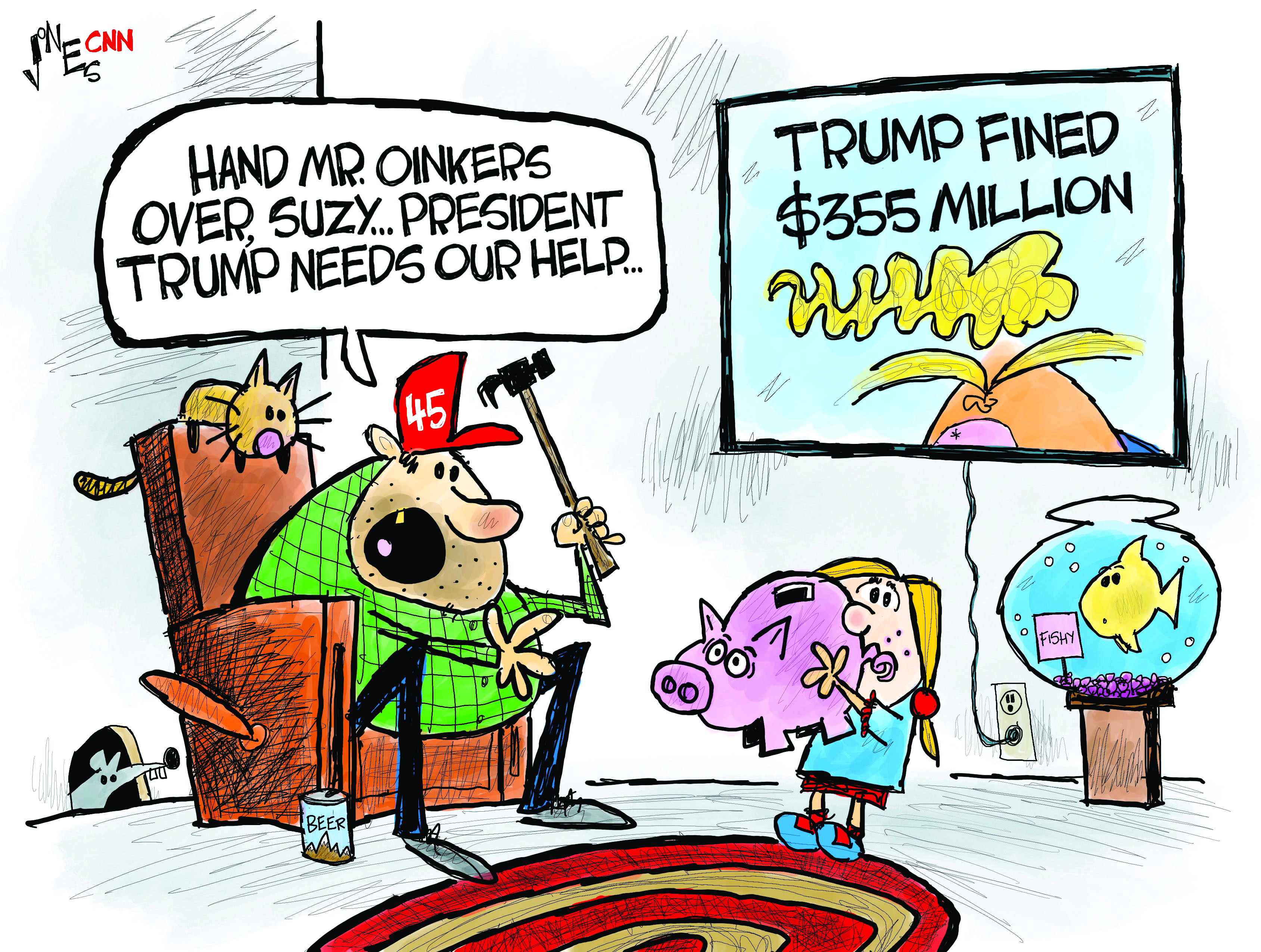
Why Trump keeps losing. Friday, New York Judge Arthur Engoron issued his decision in the New York civil fraud case against Donald Trump, his adult sons, several Trump Organization companies, and two major Trump Organization executives: a $355 million “disgorgement” penalty, plus interest.

This is a huge amount of money, and it is just the latest of a series of Trump losses in court: the two E. J. Carroll lawsuits for defamation and sexual assault, which resulted in $88 million in damages; the criminal tax-fraud case against the Trump Organization ($1.6 million from the company and jail time for ex-CFO Allen Weisselberg); the Trump University civil fraud suit (settled out of court for $25 million), the Trump Foundation lawsuit ($2 million and dissolution of the foundation), and 61 of the 62 suits Trump filed in his attempt to overturn his loss in the 2020 election. (The one he won affected a tiny number of votes and had no effect on the election’s outcome.)

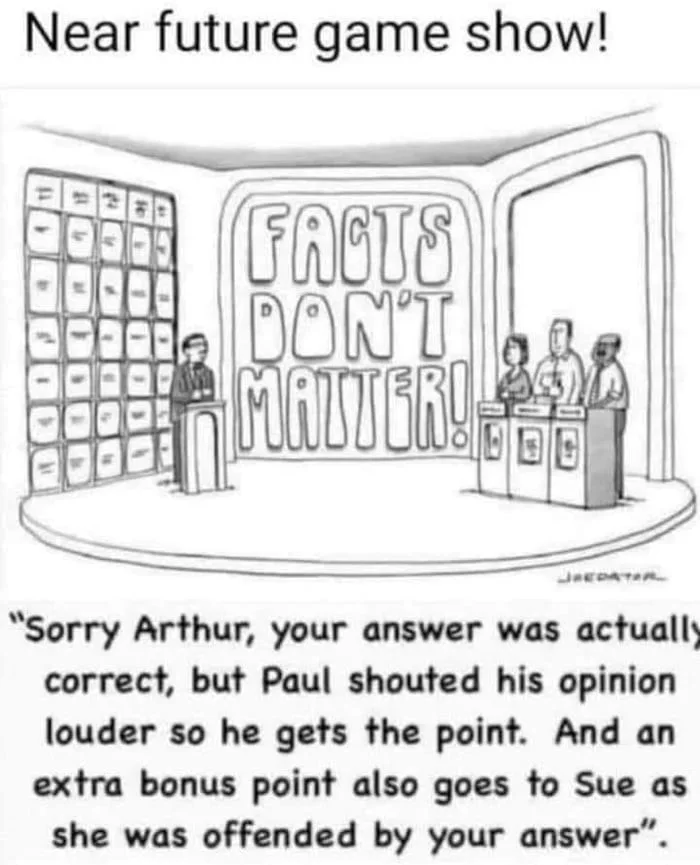
Trump, of course, paints this as years of harassment by a corrupt legal system, but I learn a much simpler lesson: Bullshitters don’t do well in court. A talented bullshitter can succeed in politics and/or business, but judges don’t have to put up with bullshit, and most of them won’t.

When he’s been caught doing something wrong, Trump’s usual damage-control technique is to spin out several mutually inconsistent stories until he sees which one is catching on. (January 6 is a great example: At first, the rioters were antifa rather than his supporters. Then they were his supporters, but they were conducting a mostly peaceful protest. Or maybe it was a riot, but he didn’t incite it. And now we’ve reached the point where it was a riot and they were his supporters, but they are patriots being railroaded by the same corrupt legal system that is railroading him.) His supporters latch on to whichever explanation rings true to them, ignoring the fact the Trump himself may have moved on to a different story.

He tried something similar in the NY civil-fraud trial: He claimed his financial statements weren’t false. Or maybe they were false, but they had a disclaimer. Besides, accuracy was the accountants’ responsibility, not Trump’s. In real estate, everybody’s financial statements are false. And the bankers are sophisticated people who should have known not to believe Trump’s claims. Pick whichever answer appeals you.

Trump’s string of losses demonstrates that his tactic doesn’t work in court, where the legal process is designed to reach a single narrative of events. Shifting back and forth from one excuse to another will just annoy a judge, who will communicate that annoyance to a jury, if there is one.

Another thing that doesn’t work in court is restarting arguments you’ve already lost. Trump’s lawyers keep repeating defenses that Engoron had already ruled against. (Like: The loans were repaid, so there was no fraud. More about this below.) That kind of doggedness can pay off in politics, because the public easily forgets how some point was debunked. But in court it just pisses a judge off.

The $355 million civil fraud decision. Here’s Judge Engoron’s 92-page decision. Or you can read the NYT-annotated version.

The judge also added interest to the penalty, bringing the total to around $450 million. He denied the state’s request to ban Trump permanently from doing business in New York, and instead banned him for only three years, with sons Eric and Don Jr. banned for two. Engoron also decided not to revoke the Trump Organization’s certification to do business in New York (part of his earlier summary judgment that an appeals court had put a stay on), which would have effectively dissolved the company, since it is incorporated in New York.

The decision is dull reading, because Engoron goes through the witnesses one-by-one, summarizing what each one said and why it was believable, unbelievable, or irrelevant. Then he goes through Trump’s fraudulently valued properties one-by-one and lays out the evidence of fraud. This is important material to record for Trump’s inevitable appeal (since the appellate court won’t hold its own trial), but it can be tiresome to plow through.

Here are a few simple things I gleaned from the decision:

First, the shape of the fraud: When The Trump Organization was looking for loans during the 2010s, Deutsche Bank’s Private Wealth Management Division was the only bank that wanted to do business with them. In a series of deals, it offered two loan possibilities: a loan secured only by the real estate collateral, or a loan secured by the collateral plus Trump’s personal guarantee. The second loan had a significantly lower interest rate, and it was based on assertions about Trump’s net worth and available cash. Trump was then obligated to give Deutsche Bank annual statements of financial condition (SFCs) verifying that his net worth and available cash were still above certain thresholds.

Those SFCs are the fraudulent business records, and they were off by a lot. One type of fraud was to value Trump’s properties “as if” rather than “as is”. So for example, Mar-a-Lago is worth a lot more if it can be sold as a private residence, but its deed restricts it to being a social club. (Trump got a lower real-estate tax rate by agreeing to that restriction.) The SFCs list the value as if that restriction could be made to go away. Similar things happen all over the Trump empire: One property is valued as if Trump had permission to build 2500 residences, when in fact he only had permission to build 500. And so on.

Second, where did the $355 million figure come from? Engoron didn’t just pull it out of a hat, and punitive damages play no role. It is a disgorgement of ill-gotten gains. Basically, it’s the interest Trump saved by making the fraudulent guarantees, plus the capital gain from the sale of the Old Post Office hotel near the White House (which Trump would not have been able to buy without the fraudulently obtained loan). Eric and Don Jr. each give up $4 million, because that was their share of the Old Post Office gain.

Third, the fact that the penalty is a disgorgement is why Trump’s there-is-no-victim rhetoric is off-base. The point here isn’t to compensate a victim, it’s to protect “the integrity of the marketplace” by punishing fraud. Engoron quotes a precedent:

Disgorgement is distinct from the remedy of restitution because it focuses on the gain to the wrongdoer as opposed to the loss to the victim . Thus, disgorgement aims to deter wrongdoing by preventing the wrongdoer from retaining ill-gotten gains from fraudulent conduct.

By asking for the personal guarantee and demanding evidence of the wealth to back it up, Deutsche Bank was trying to protect itself against a possible downturn in real estate in general and in Trump’s fortunes in particular. As it happens, those risks didn’t manifest and the loans were repaid. But Engoron observes: “The next group of lenders to receive bogus statements might not be so lucky.”

This kind of disgorgement happens all the time in insider-trading cases: The SEC makes the traders give up their gains, even if it’s impossible to figure out exactly who they cheated. And the purpose is the same: to protect the integrity of the market by preventing cheaters from prospering.

Finally, I want to turn around one standard conservative criticism, which you’ll hear whenever Biden tries to forgive college loan debt: “But what about the people who follow the rules, the ones who took their debts seriously and paid them off? What do you say to them?”

In this case, what about the people who have been denied loans (or had to pay a higher sub-prime interest rate) because they filled out their applications honestly? Or people who can’t afford to pay an accountant to lie for them, the way Trump can? What do Trump’s defenders say to them?

The hush-money criminal case will go to trial March 25. This is the red-headed stepchild of the Trump indictments, but it looks like it will be the first one to go to trial. Slate’s Robert Katzberg expresses what I think everybody is thinking:

While the conduct charged is, no doubt, criminal, it feels a bit like prosecuting John Gotti for shoplifting. The Bragg prosecution is also clearly the weakest of the four outstanding indictments from an evidentiary perspective, especially when compared to the D.C. slam-dunk. … In an ideal world the D.C. prosecution would be first, allowing the world to see just how close we came to having the 2020 election overturned and the frightening degree to which the former president is a threat to our democracy. However necessary and appropriate that would have been, it is not where we are now. The Bragg case, while hardly the most desirable opening act, at least gets the show on the road.

This case stems from Trump paying off porn star Stormy Daniels to keep their affair secret during the 2016 presidential campaign. But the sex itself isn’t a crime and the fact of the payoff isn’t what’s being prosecuted: It’s the lengths Trump went to in order to hide the payoff from voters in 2016. He had Michael Cohen pay Daniels. Then the Trump Organization created a false paper trail to reimburse Cohen, and recorded the reimbursement as a business expense when it was actually a campaign expense. So the charge is falsification of business records.

The Georgia case. The RICO case against Trump and his election-stealing co-conspirators is currently on hold while the judge decides whether DA Fani Willis should be disqualified.

The issue is her romantic entanglement with another prosecutor on the case, who she hired, and the claim that he kicked back some of the money she is paying him by spending it on her during their affair, which they both claim is now over. (They both claim she paid her own way by reimbursing him in cash, leaving no records — which is a sensible thing to do if you hope to keep the affair secret.)

The stakes in this are huge, because if Willis is disqualified, quite possibly nobody else picks the case up and Trump walks. Certainly the case won’t be tried before the election.

On the other hand, that outcome seems unlikely to a number of observers, for this reason: Willis’ affair is certainly salacious and embarrassing, and it may even be unethical enough to result in some kind of discipline against Willis outside this case. But disqualifying her from this case requires showing prejudice against these defendants. And nothing they’ve put forward so far proves that.

As a matter of both common sense and Georgia law, a prosecutor is disqualified from a case due to a “conflict of interest” only when the prosecutor’s conflicting loyalties could prejudice the defendant leading, for example, to an improper conviction. None of the factual allegations made in the Roman motion have a basis in law for the idea that such prejudice could exist here – as it might where a law enforcement agent is involved with a witness, or a defense lawyer with a judge. We might question Willis’s judgment in hiring Wade and the pair’s other alleged conduct, but under Georgia law that relationship and their alleged behavior do not impact her or his ability to continue on the case.

My social media is full of a point that may not be legally relevant, but packs a political punch:

So Clarence Thomas can accept hundreds of thousands in gifts but Fani Willis can’t go dutch on dinner?

Jack Smith and presidential immunity. The question of whether former presidents are immune from prosecution for anything they did in office is now with the Supreme Court. Both Judge Chutkan and the DC Court of Appeals have rejected Trump’s immunity claim, which appears to be far-fetched and intended as a delaying tactic.

So far the delaying strategy is working: The trial in this case was originally supposed to start March 4.

Other than Trump and his lawyers, I haven’t heard anyone predict that the Supreme Court will reverse the lower courts’ rulings and stop Jack Smith’s January 6 case in its tracks. However, it remains to be seen to what extent Trump allies on the Court will cooperate with his strategy to delay the case past Election Day.

(As I’ve commented before, Trump’s delay strategy is essentially an admission of guilt. An innocent man who believed he was being prosecuted purely for political reasons would want the case to be tried as soon as possible, so that he could get the vindication of a jury’s not-guilty verdict. But Trump knows that a jury that sees the evidence will convict him, so his best hope is to get reelected and then instruct his attorney general to drop the case.)

The key documents have already been filed with the Court: Trump’s application for a stay that will continue delaying the trial, Jack Smith’s response, and Trump’s reply to Smith. The arguments Trump’s lawyers are making are the same ones the lower courts rejected, and amount to “No, they’re wrong.” (BTW: I love that this case is Trump v the United States.)

The Court has a number of options, which Joyce Vance outlines, ranging from refusing to hear the appeal and letting the case continue as soon as possible, to scheduling lengthy briefings and not ruling on the case soon enough for the trial to be heard before the election.

Disqualification. We’re still waiting for the Supreme Court to rule on whether the 14th Amendment’s disqualification clause applies to Trump (because of his role in the January 6 insurrection), and whether states (like Colorado) can enforce that disqualification from public office by refusing to list him on presidential ballots.

The judges sounded skeptical during the oral arguments, so it would be a shock if they ruled Trump ineligible. But it will be a challenge to square a Trump-is-eligible ruling with the conservative justices’ originalist philosophies. The Court works on its own clock, so a ruling could come tomorrow, at the end of the term in June, or any time in between.

About Biden’s Age and Memory

Don’t be stampeded into freaking out.


The Hur Report. Thursday, Special Counsel Robert Hur released a 388-page document reporting on his investigation into classified documents President Biden returned to the government after they were found among his papers at the University of Delaware and in his home. The conclusion of that report is in its first line:

We conclude that no criminal charges are warranted in this matter. We would reach the same conclusion even if Department of Justice policy did not foreclose criminal charges against a sitting president.

In a report that followed Department of Justice traditions and guidelines, that would be the headline: We looked for evidence of prosecutable crimes and didn’t find any. For comparison, the special prosecutor tasked with investigating classified documents found in former Vice President Pence’s home also decided (last June) that no charges were warranted. The NBC News headline was “DOJ closes Pence classified documents investigation with no charges“.

The second paragraph of such an article would have quoted Hur outlining the difference between this case and former President Trump’s classified documents case:

It is not our role to assess the criminal charges pending against Mr. Trump, but several material distinctions between Mr. Trump’s case and Mr. Biden’s are clear. Unlike the evidence involving Mr. Biden, the allegations set forth in the indictment of Mr. Trump, if proven, would present serious aggravating facts.

Most notably, after being given multiple chances to return classified documents and avoid prosecution, Mr. Trump allegedly did the opposite. According to the indictment, he not only refused to return the documents for many months, but he also obstructed justice by enlisting others to destroy evidence and then to lie about it. In contrast, Mr. Biden turned in classified documents to the National Archives and the Department of Justice, consented to the search of multiple locations including his homes, sat for a voluntary interview. and in other ways cooperated with the investigation.

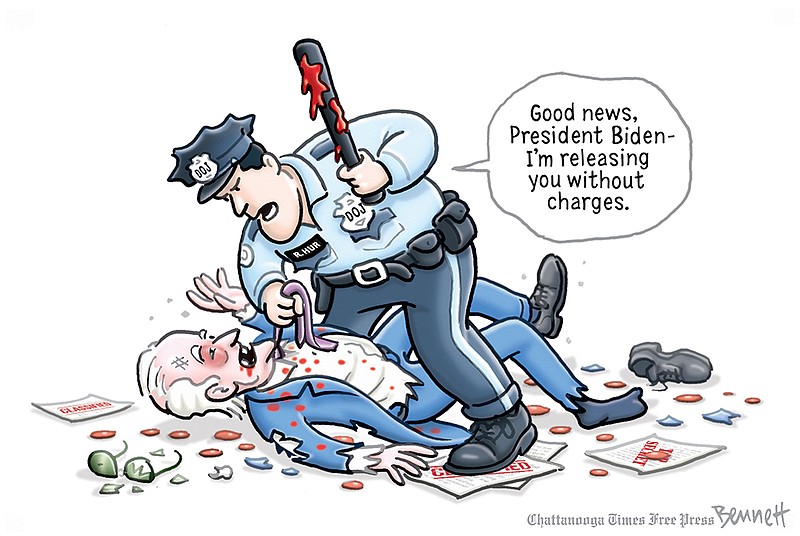
But the Hur report was covered very differently, because in addition to summarizing his investigation, Hur also gratuitously speculated on how Biden would defend himself at a trial.

In addition to this shortage of evidence, there are other innocent explanations for the documents that we cannot refute. When Mr. Biden told his ghostwriter he “just found all the classified stuff downstairs,” he could have been referring to something other than the Afghanistan documents, and our report discusses these possibilities in detail.

We have also considered that, at trial, Mr. Biden would likely present himself to a jury, as he did during our interview of him, as a sympathetic, well-meaning, elderly man with a poor memory.

Throughout, the document casts inappropriate and unnecessary aspersions on Biden’s memory and mental processes.

Mr. Biden’s memory also appeared to have significant limitations-both at the time he spoke to [ghostwriter Mark] Zwonitzer in 2017, as evidenced by their recorded conversations, and today, as evidenced by his recorded interview with our office. Mr. Biden’s recorded conversations with Zwonitzer from 2017 are often painfully slow, with Mr. Biden struggling to remember events and straining at times to read and relay his own notebook entries.

Thursday night, MSNBC’s Chris Hayes commented on how needlessly editorialized this was: Painfully? Who was supposed to be in pain? Ordinary human difficulties — struggling to interpret handwritten notes from years ago, or speaking slowly when you are trying to get something exactly right — are cast in the light of disability. The report then continues:

In his interview with our office, Mr. Biden’s memory was worse. He did not remember when he was vice president, forgetting on the first day of the interview when his term ended (“if it was 2013 – when did I stop being Vice President?”), and forgetting on the second day of the interview when his term began (“in 2009, am I still Vice President?”). He did not remember, even within several years, when his son Beau died.

This, again, paints something perfectly ordinary in a negative light: There’s no indication that Biden has really forgotten “when he was vice president” or “when his son Beau died”, just that he sometimes attaches the wrong year-numbers to these memories. This happens to me (and to Paul Krugman) all the time. A frequent exchange with my wife is “When did we move here? 2018? 2019?” And then we work it out because she was turning 65 and wanted to start Medicare in Massachusetts. Same thing with my father’s death: I know his birth year and that he lived to be 90; that’s the only way I remember what year he died. But I have not at all forgotten “when my father died”; I can tell you precisely where I was and what I was doing.

In general, I remember the years personal events happened only if I’ve had to list them on a resume. (Krugman gives the example of recalling the year his mother died: He figures it out by remembering when he left Princeton for CUNY.) Otherwise, I have to think about it. That’s been true all my life and has nothing to do with aging.

If you can’t identify with those examples because your memory works differently, let me try an analogy: It’s like the difference between forgetting the dates of the Civil War (1861-1865) and forgetting the Civil War. (“Like, didn’t a bunch of states secede once or something?”)

It’s hard to argue with Krugman’s conclusion that the report was written by somebody who knows that Republicans want to make a political issue out of Biden’s mental acuity and wants to help them do it. Hur’s legitimate conclusions as an investigator are of no use in this regard, so he contributes in other ways.

Contrast Hur’s behavior with Jack Smith’s. Smith has played it by the book: He has investigated alleged crimes, and when he has found sufficient evidence, he has presented that evidence in indictments. Does he know other embarrassing details about Donald Trump’s life? Quite possibly. But if they’re irrelevant to the crimes he’s indicting, he doesn’t talk about them.

For example, back in December there were reports in the press that Trump literally stinks “of armpits, ketchup, and butt”. Has Smith’s investigation turned up anything related to that? He hasn’t seen fit to tell us, because reeking is not an indictable crime.

There’s a reason the Justice Department has standards about this kind of thing. Criminal investigation is one of the most invasive things our Constitution allows the government to do. So unless the investigation turns up something actually criminal, investigators should remain circumspect about what they think, and certainly should not use the authority of their investigation to defame or denigrate people they are not prosecuting.

The Egypt/Mexico mistake. Biden was understandably angry with Hur’s report, and held a press conference to say so. Unfortunately, as he was walking out of the room, he took one more question about an unrelated subject: his efforts to negotiate a release of the hostages Hamas is holding. Responding off-the-cuff, he said this:

I’m of the view, as you know, that the conduct of the response in Gaza — in the Gaza Strip has been over the top.  I think that — as you know, initially, the President of Mexico [Egypt], El-Sisi, did not want to open up the gate to allow humanitarian material to get in.  I talked to him.  I convinced him to open the gate.

I talked to Bibi to open the gate on the Israeli side.  I’ve been pushing really hard — really hard to get humanitarian assistance into Gaza.  There are a lot of innocent people who are starving, a lot of innocent people who are in trouble and dying, and it’s got to stop.

OK, I’m biased to like this statement, because Biden’s views on the Gaza War have shifted in the same direction as mine. (See what I wrote last week.) But there is that mistake: He said “Mexico” when he meant “Egypt”. (Notice: He got the name of Egypt’s president right. So he clearly knew what country he was talking about.)

People have tried to draw a lot of conclusions from this mistake, but again, I do stuff like that all the time. So does Trump. In this clip, for example, he says, “We’re going to defund our freedoms.” (Presumably he meant “defend”.) In this one, he recalls (falsely) what he did after the World Trade Center was attacked on seven-eleven. More recently, he said “Nikki Haley” when he meant “Nancy Pelosi”.

I think most people do stuff like this from time to time: You reach into your mental bag of words in a category, and you come out with the wrong one. (In Biden’s case, the category is “countries on the other side of some significant border”. In Trump’s it’s “women who get in my way.”) Speaker Mike Johnson made a comparable mistake on Meet the Press a week ago yesterday. “We passed the support for Iran many months ago.” (He meant Israel, another Middle Eastern country beginning with I.) Johnson is 52.

Aphasia vs. dementia. Obviously, this kind of mistake happens more often as people get older. I have a lot of experience with this phenomenon, because in his later years, my Dad developed a far worse case of aphasia than anything Biden or Trump have demonstrated. Eventually, it reached the point where he called every meal “lunch”.

But it’s important not to confuse aphasia (problems recalling words) with dementia (problems grasping the situation). For example, Dad saying “lunch” did not reflect any confusion about what time of day it was or when he had eaten last. “Lunch” was just the easiest meal-word to find. (On a road trip, we went to “lunch” first thing in the morning, before getting on the highway. Dad ordered breakfast.)

You might worry that dementia is a natural progression from aphasia, but that’s not how it works. There’s a relationship, but the causality runs in the other direction: Problems in your thinking will lead you to use inappropriate words. But in general, pulling the wrong word out of memory (or no word at all) doesn’t screw up your thinking. So Dad’s aphasia kept getting worse, but he knew who he was, where he was, what he was doing, and who I was all the way up to his last days. (I remember one extreme example: Dad wanted a tool for some home maintenance project he was doing. He couldn’t come up with the name of the tool, the store he wanted to go to, or the street it was on. So he told me to get in the car, and then gave instructions — turn left, turn right — taking us directly to the paint store. He got the tool, we drove home, and he continued his project.)

So I cringed when I heard Biden say “Mexico”, but only because I knew how people would react. His misstatement did not at all cause me to worry that he did not grasp the world situation, or that he would start using the powers of the presidency in some delusional way.

Trump, on the other hand, has lived in a delusional world for decades. In his world, he has always been right, people oppose him because of some inexplicable hatred unrelated to his behavior, he has a mystical “strength” that causes the world to warp around him, his personal charm changes the behavior of dictators, and his wealth comes from mastering “the art of the deal” rather than via a vast inheritance and a lifetime of fraud.

I do not worry that Biden will begin basing his presidential decisions on the kinds of crazy things Trump says all the time: He won’t start pushing quack cures like ivermectin and hydroxychloroquine, or suggest that doctors look into injecting bleach. He won’t “fall in love” with a psychopathic killer like Kim Jong Un, or decide that Vladimir Putin is more trustworthy than the FBI. He won’t try to change the direction of a hurricane with his sharpie. He won’t claim that windmills kill whales. And he won’t encourage Russia to attack our NATO allies.

Biden will undoubtedly continue to say the wrong words now and then. But I can live with that, because I trust him (and not Trump) to stay rooted in the real world.

If things were worse than that, how would we know? There would be defectors from inside the Biden administration. Unlike Trump, Biden isn’t the focus of a personality cult. People who work with him may like Joe Biden, and they may feel a certain loyalty to him, but they are primarily Americans and Democrats rather than Biden-worshippers. If something were wrong with him that endangered the country and threatened the goals of the Democratic Party, at least a few insiders would come out and say so. Cabinet secretaries, speech writers, White House aides … they’d hate doing it, but at least a few of them would: “It’s worse than it looks,” they’d say. “We have to do something.”

But look around. That’s not happening. The people disparaging Biden’s competence are precisely the people who don’t work with him, the people who wouldn’t know. Even Republicans, like Kevin McCarthy, come out of their dealings with Biden saying that he’s sharper than you think.

What should Biden and the Democrats do? Immediately: nothing.

These last few days, pundits of all sorts have been trying to stampede Biden into resigning or Democrats into abandoning him. This is crazy: Biden has been a very good president and there’s no reason to think he won’t have an equally good second term, despite the unforgivable sin of saying “Mexico” when he meant “Egypt”.

On the flip side of that panic, it’s tempting to want to make some dramatic gesture to prove how sharp Biden is. But that’s likely to be counterproductive in the same way that Richard Nixon saying “I am not a crook” was counterproductive. “I don’t have dementia” is exactly the kind of thing somebody with dementia would say.

Immediately, Biden should let the wave of hysteria pass. Get on with governing. Give a good State of the Union address. Keep working on a truce in Gaza. An oval office message about something else entirely — the importance of not letting Ukraine fall to Russia, for example — would help.

After the dust settles a little, Biden should sit for more one-on-one interviews, like this one he did with John Harwood ten days before his interview the special counsel. When you watch this kind of exchange, you quickly realize that Biden has a mental dexterity Trump lacks: He can listen to a question, process it, and produce a thoughtful answer germane to what was asked. Asking Biden a question is like playing catch: You throw him a question, he fields it, and throws an answer back. But asking Trump a question is like bouncing a rubber ball off an irregular stone wall: It will ricochet quickly, but in a direction that doesn’t seem to have much to do with your throw.

And finally, Biden needs to laugh. This is tricky, but Ronald Reagan pulled it off. When a questioner raised the age issue during a debate with Walter Mondale in 1984, Reagan made a solemn pledge:

I will not make age an issue in this campaign. I am not going to exploit for political purposes my opponent’s youth and inexperience.

Gazan Lives Matter

I don’t have a peace plan. I just want the destruction to stop.


One of the more intriguing stories in Genesis happens in chapter 18: God visits Abraham in human form, along with two companions. As he is about to leave, God lets Abraham in on a divine secret: He is about to destroy Sodom and Gomorrah. He tells his companions why he thinks Abraham needs to know about this:

Abraham will surely become a great and powerful nation, and all nations on earth will be blessed through him. For I have chosen him, so that he will direct his children and his household after him to keep the way of the Lord by doing what is right and just

Like many passages in the Bible, there are at least two ways to read this: Maybe Abraham needs to know how evil nations are punished, and to teach his children, so that the nation of his descendants will know better than to be like Sodom. [1] But the conversation develops in such a way as to allow a second interpretation. Abraham knows his nephew Lot lives in Sodom, and he worries that God will kill evil and good people indiscriminately. So he pushes back against God’s judgment.

Will you sweep away the righteous with the wicked? What if there are fifty righteous people in the city? Will you really sweep it away and not spare the place for the sake of the fifty righteous people in it? Far be it from you to do such a thing—to kill the righteous with the wicked, treating the righteous and the wicked alike. Far be it from you! Will not the Judge of all the earth do right?

Gods agrees that he should save Sodom for the sake of fifty. And then Abraham begins to bargain. What about 45 good people? Forty? Thirty? Twenty? Ten? Each time, God agrees. And then the text says only “When the Lord had finished speaking with Abraham, he left”, not telling us whether Abraham pushed no further or God cut the discussion short.

Again, there are at least two ways to read this: Maybe God already knows that there aren’t ten righteous people in Sodom, and he indulges Abraham because the concessions he grants are moot; he’s going to destroy Sodom one way or the other. Or maybe something else is happening. Maybe this conversation establishes the idea of acceptable and unacceptable levels of collateral damage. Maybe that’s the lesson that God is drawing out of Abraham, so that he can pass it down to the great and powerful nation of his descendants. [2]

I’ve been thinking about this a lot lately, as the world watches the city of Gaza be destroyed. [3]

Immediately after October 7, my sympathies were entirely with the Israelis. The coordinated attacks of that day, targeted at places of no military value, apparently aimed at killing and carrying off as many civilians as possible, could not be tolerated. The people who planned and carried out those attacks could not be allowed to sit in safety and plot another one. And Hamas is famous for using civilians as shields, so I accepted that an Israeli counterattack would kill some number of innocent Gazans.

But not any number of innocent Gazans.

As of January 20, this was the British Red Cross‘ assessment of the situation in Gaza:

  • Winter temperatures are putting the lives of 1.9 million displaced people at risk
  • 80% of the population faces severe food insecurity
  • The death toll in Gaza currently stands at more than 23,210, and 330 in the West Bank
  • 59,167 people have been injured in Gaza and 4,042 in the West Bank
  • Food and safe and adequate shelter are extremely scarce, with many families unable to eat a single meal a day and people setting up makeshift camps in the street.
  • Sanitation and public health conditions have seriously deteriorated, posing a high risk of disease outbreaks that could cause significant casualties. Heavy rain and flooding is affecting Gaza which adds to the risk of waterborne diseases.
  • The situation facing Gaza’s hospitals and those relying on their care is also dire. Hundreds of thousands of people in Gaza no longer have access to healthcare.
  • Nearly 85% of the total population of Gaza have been forced to leave their homes in precarious and unsafe conditions. Many of these people have been forced to move and seek new shelter several times.

The BBC adds details about property damage.

[S]atellite data analysis obtained by the BBC shows the true extent of the destruction. The analysis suggests between 144,000 and 175,000 buildings across the whole Gaza Strip have been damaged or destroyed. That’s between 50% and 61% of Gaza’s buildings.

I don’t want to make claims beyond my knowledge and expertise, so let me admit my limitations: I don’t know what alternative responses to October 7 were considered or were even possible. I don’t know what negotiations have happened behind the scenes, or what possibilities for peace have been offered. I don’t know how much influence the Biden administration has, or how it has tried to use that influence.

I also don’t know precisely what the Israeli government intended or how well that matches what the Israeli public wants. I do know that some elements of the Netanyahu government have genocidal intent. Some others, I suspect, simply don’t care: They (understandably) want Hamas gone and want Israeli lives to be secure; the number of Gazans who must die or have their lives shattered to achieve that goal does not matter to them.

I just want to say this: What we have seen is already too much. Gazan lives do matter.

I contrast what’s going on in Gaza with smaller-scale hostage situations, thinking not just of the Israeli hostages, but of the Gazan civilians who are simply in the wrong place. Police typically do not charge into such situations as if the survival of the hostages were not their responsibility.

I still have no sympathy with Hamas, and I continue to condemn what they did in October. But are there fifty righteous people in Gaza? It seems like there must be.


[1] What exactly made Sodom so intolerable to God is widely misunderstood. When God’s two angels (presumably the two companions Abraham met) arrive in the city, the men of Sodom want to rape them. So it’s often thought that Sodom’s sin had something to do with homosexuality, i.e., sodomy. But Genesis doesn’t explicitly say that, and Ezekiel says something else entirely:

Now this was the sin of your sister Sodom: She and her daughters were arrogant, overfed and unconcerned; they did not help the poor and needy.

So if your political plan involves cracking down on LGBTQ folks while kicking children off food stamps, you might want to reconsider.

[2] Apparently there is some history to this interpretation. I first ran across it in Adam Levin’s novel The Instructions, about a boy from Chicago who may or may not become the Messiah. The boy’s training is full of such rabbinical discussions.

Of course, you can contest this interpretation by pointing to the conquest of Canaan described in the book of Joshua, in which God orders genocide.

So Joshua subdued the whole region, including the hill country, the Negev, the western foothills and the mountain slopes, together with all their kings. He left no survivors. He totally destroyed all who breathed, just as the Lord, the God of Israel, had commanded.

Conflicts like this are a major reason most modern scholars read the Bible as an amalgamation of separate sources rather than as a narrative from a single point of view.

[3] Gaza’s history also goes back to Biblical times, and perhaps further. It was the Philistine capital where Samson was taken, blinded, and held prisoner. Gaza is where he killed himself and numerous Philistines by pulling down the Temple of Dagon. The Aldous Huxley title Eyeless in Gaza is an allusion to Samson.

Monkeywrenching the Regulations that Protect Our Lives

The Supreme Court’s attempt to scuttle the Chevron Doctrine is part of a much larger program.


Over the last few weeks, Court-watchers have been trying to sound the alarm about the prospect of scuttling what had (until recently) been a fairly arcane bit of legal interpretation: the Chevron Doctrine. Lawyers understand how important it is (the Court has applied it in over 100 cases in the last 40 years), but it’s tough to get the general public to pay attention, much less to be up in arms about its possible demise. But there actually are good reasons to be up in arms.

A fairly standard thing to do at this point would be to tell you what the Chevron Doctrine is and where it comes from. I’ll eventually get around to doing that — click the link if you really can’t wait — but I’d rather have you keep reading for a few more paragraphs before you bookmark this page with the idea of getting back to it when you have more time.

Blood money. So instead I’ll back up a few levels and start with the underlying problem: In a complex modern economy, there are countless ways for corporations to make money by killing people. They can kill their customers by selling products that will crash them into trucks or suck them out of airliners or cause heart attacks or give customers cancer or salmonella or some other disease. They can kill their employees with unsafe workplaces. They can kill their neighbors by pumping poisons into the air or water. As AI catches on, products may start killing people and we won’t even know why.

Sometimes corporations very consciously make the money-for-lives tradeoff, as the tobacco companies did for decades, and as the gun manufacturers are still doing. But sometimes they just don’t know, at least at first. They have a product, they make money off of it, customers seem happy with it, so why look any deeper than that? Diacetyl makes microwave popcorn taste more buttery — what’s not to like?

As individuals, we’re more or less helpless to protect ourselves. No one has the time or the expertise to analyze every single thing they use or come into contact with. That’s why we rely on government regulation, agencies like the FDA, EPA, FSIS, and others, to protect our lives. (Other agencies, like the SEC and the FDIC, protect our money from the kinds of scams that were endemic prior to the New Deal.)

Government regulators get their power from two sources: Congress and the President. Congress creates the agencies, defines their missions, and funds them each year. Meanwhile, the President appoints the people who set the policies to accomplish those missions. Ultimately, Congress and the President get their power from the voters.

But here’s the problem: The marketplace moves much faster than our political system. New products, new drugs, new food additives, new pollutants, and so forth appear every week. Imagine the dystopia we’d be living in if Congress, which strains to pass basic legislation to keep the government’s doors open, had to pass a new law to regulate each one.

Well, you may not have to imagine much longer, because the Supreme Court’s conservative majority seems hellbent on taking us there.

Delegated power. The way the regulatory system currently works is that Congress passes a few foundational laws that give the agencies abstract goals, and then lets the agencies hire experts who figure out how to pursue those goals.

A typical example is the Clean Air Act. The CAA was first passed in 1963 and then overhauled in 1970. It established air quality standards (NAAQS) for a few well-known pollutants like carbon monoxide, sulfur dioxide, and lead, but then it defined a general category of “hazardous air pollutants” (HAPs) made up of other gases and particulates that “threaten human health and welfare”. It tasked the EPA with making and maintaining a list of HAPs and creating emission regulations for controlling them.

Hold that in your mind for a minute: In passing the CAA, Congress banned or controlled substances that the members of Congress had never even heard of. That’s how the regulatory system works.

That’s a lot of delegated power, particularly power over corporations that don’t like being controlled. And yes, their wealth does give the companies opportunities to influence the system — say by bribing or otherwise inducing congresspeople to give them various exemptions, or by letting regulators know they can have cushy jobs after they leave government if they behave themselves — but it’s never enough.

What corporations would really like to do is monkey-wrench the regulatory system in general. And the best way to do that is to interrupt the flow of delegated power from Congress to the agencies: Make Congress pass a new law every time there’s some new thing to regulate. In a Congress where even saving lives can be a partisan issue, and where a bunch of small-state senators can lock things up with a filibuster, even the most obvious new regulations can be stalled indefinitely or watered down to nothing.

So the basic strategy for restoring corporations’ ability to profit by killing people has two pieces

  • Logjam Congress.
  • Prevent Congress from delegating its regulatory power to anybody else.

A three-pronged attack. With the second part of that plan in mind, corporate money begat the Federalist Society, and the Federalist Society (with the assistance of presidents who lost the popular vote and Senate “majorities” that don’t represent a majority of voters) begat the six conservative justices on the Supreme Court. Since gaining control of the Court, those justices have been working hard to fulfill the mission their corporate masters assigned them.

The most direct idea for keeping Congress from empowering regulatory agencies is known as the Nondelegation Principle: basically, that Congress can’t, as a matter of constitutional principle, delegate power that is inherently legislative. Some version of this idea is necessary, because otherwise Congress could authorize the president to be a dictator and then go home. But since 1928 delegation has been considered OK if Congress provided an “intelligible principle” for the agency to follow (like protecting human health and welfare from air pollutants).

But in a dissent in the Gundy case in 2019, Justice Gorsuch proposed a much stricter limit: Agencies can only “fill in the details” of laws, and can’t do something sweeping like, say, compile a list of dangerous pollutants to regulate. Fortunately, he didn’t get the majority to go along with him on that. But he’s still working on it, and the composition of the Court has changed since then. Expect to hear more about nondelegation sometime soon.

A second idea for reining in regulatory agencies is the Major Questions Doctrine, which the Court has created out of whole cloth over the last 25 years. Major Questions is a response to something that happens fairly often: Circumstances change in such a way that a provision in a law that seemed relatively minor at the time it was passed ends up granting an agency significant power. Major Questions allows the Court to say, “No, no, no. The law may say that, but Congress didn’t really mean it. If they’d intended to delegate such a large power, they’d have said so explicitly.”

So, for example, the Obama administration EPA decided that (due to the previously unforeseen problems of climate change), the Clean Air Act gave it the power to regulate carbon dioxide emissions from power plants. The Court nixed that in West Virginia v EPA. Carbon emissions, it said, are so central to the workings of our economy that (regardless of the text of the CAA) Congress would never have delegated that power without an explicit statement.

Now, there are four major objections to the Major Questions Doctrine:

  • The Constitution never mentions it.
  • The Court has never clearly defined what a “major question” is, so it has given itself permission to interfere (or not) whenever it feels like it.
  • The law says what it says, even if Congress didn’t foresee all the possible applications.
  • If Congress really didn’t intend to delegate that much power, it could pass a law to take power back. (But of course, that puts the logjam-Congress shoe on the other foot.)

One recent use of Major Questions was to torpedo OSHA’s rules about large employers vaccinating their workers against Covid. Yes, OSHA’s mission is to protect workers from unsafe working conditions, and yes, working next to an unvaccinated person during an epidemic is unsafe, but … Congress couldn’t really have intended that, could it?

One thing you’ll notice about Major Questions: It allows the Court to substitute its own judgment for both the plain reading of the law and for an agency’s interpretation of that law. And that brings us (finally) to the Chevron Doctrine.

Chevron. Back in the Reagan administration, all the ideological arrows pointed in the other direction: Reagan’s appointees were conservative, while judges tended to be liberal. In particular, the EPA was run by Justice Gorsuch’s mom, Anne Gorsuch.

Anne’s EPA had drastically limited its interpretation of what a “source” of pollution meant under the CAA. Previously, just about any change that introduced new pollution was considered a new source, and required EPA approval. But the new interpretation said that, say, an entire factory or power plant was the source of pollution, and could be substantially reconstructed without triggering EPA supervision.

The Natural Resources Defense Council sued to try to block something Chevron was building, but the Court ruled in Chevron’s favor by creating the Chevron Doctrine: When some part of a law is ambiguous, a court should defer to the interpretation of a regulating agency rather than impose its own interpretation of what Congress really meant. An agency couldn’t make up a ridiculous interpretation, but as long as its reading was plausible, the courts should yield to it. (An eye-glazingly detailed history of the Chevron case is in this interview between David Roberts and Dvid Doniger.)

But remember: the ideological arrows were pointing in the opposite direction from today, so Chevron was a conservative principle that was championed by conservative justices like Anton Scalia. The arguments he made were the same ones liberals are making today: Agencies have technical expertise that courts can’t compete with, and (because they ultimately get their power from Congress and the President), they’re closer to the voters than judges are. So Chevron is not just prudent, it’s democratic.

This kind of humility is sometimes called judicial restraint. For many many years, it was the hallmark of conservative jurisprudence: Activist liberal judges should restrain themselves, because they’re not as smart as they think they are, and because it’s undemocratic to remove issues from the political process.

But now conservatives have control of the courts, so humility is out the window. Apparently, judicial restraint was never actually a conservative principle, it was just a rhetorical device to keep liberal judges in check. Activist conservative judges, on the other hand, should have free rein to do whatever they want.

So Chevron has to go. The Court is using two fairly obscure cases (involving fees paid by the fishing industry to the National Marine Fisheries Service) to tee up an attack on Chevron. No one knows exactly what the ruling will say yet, but the questions the justices were posing during oral arguments point at a complete revision of Chevron that could make the Supreme Court also the Supreme Regulator; whether any given agency was interpreting its authorizing legislation properly would be for the Court to determine.

The practical implications of sinking Chevron could be enormous: Literally thousands of cases have been decided on that basis in the last 40 years, and any of them could come up for a rehearing. Plus, literally every regulation on the books will become a legal battleground, with the Supreme Court’s six conservative justices being the ultimate deciders.

In short, a committee made up of six foxes is about to take over the regulation of every chicken coop in the country.

The Corruption of the Evangelical Movement

Tim Alberta indicts the religion he grew up in, but ends on a hopeful note. How convincing is that?


In the news sources I follow, Tim Alberta and his new book The Kingdom, the Power, and the Glory: American Evangelicals in an age of extremism have been everywhere lately. As of yesterday, it was the #1 best seller in Amazon’s “Christian Church history” category. The book’s web page boosts it as a “New York Times Bestseller, one of Barack Obama’s Favorite Books of the Year, and an Air Mail best book of the year.” An excerpt — the book’s prologue, in which Alberta reminisces about his Evangelical-preacher father and describes how his father’s flock assailed Alberta for his politics when he returned to the megachurch his father founded for his father’s funeral — has appeared in The Atlantic. He’s been interviewed on numerous MSNBC shows, including The 11th Hour. Michelle Goldberg wrote a column about his book, though I can’t find any clue that she read all the way to the end.

So chances are you’ve heard about Alberta, and maybe you know the thesis of his book: He surveys how right-wing politics has taken over the Evangelical movement, which today is often more about Trump than about Jesus, and whose Promised Land is not Heaven, but an America re-dominated by Christian leaders (who are probably White, male, and Republican, and definitely straight). Christianity, whose “kingdom is not of this world“, has been corrupted by a very worldly American nationalism.

What is special about Alberta’s perspective is that he critiques Evangelicalism from the inside. The fundamental problem he sees in Christian Nationalism isn’t that it violates the Constitution or opposes democracy or goes down the rabbit holes of absurd conspiracy theories, but that it is a heresy. Worshiping America (or Trump) is a form of idolatry. Jesus, in Alberta’s view, would have us change the world by channeling God’s love, not by promoting an angry, fearful, hateful brand of politics. God is eternal, and He cares little about nations, which come and go. (Galatians 3:28 says “There is neither Jew nor Greek, there is neither bond nor free, there is neither male nor female: for ye are all one in Christ Jesus.”)

Access. Alberta’s book demonstrates a level of access that I find hard to imagine. Some of the most famous — and most outrageous — characters in American Christianity sit down with him and share their unguarded (or barely guarded) thoughts.

  • Robert Jeffress (the Dallas megachurch pastor who was key in bringing Evangelicals to Trump in 2016 and in defending his worst excesses) discussed his post-1/6 doubts about how far he went to promote Trump. “I had that internal conversation with myself — and with God, too — about, you know, when do you cross the line? When does the mission get compromised?” Alberta pushed on that a little and Jeffress confessed, “I think it can be [compromised]. I think it even was, these last few years.” (Jeffress is back in the Trump fold now.)
  • Greg Locke, the Tennessee preacher whose church mushroomed when he defied public-health restrictions to stay open during the pandemic, and instead turned his church into a center of anti-vax, anti-liberal, and anti-government conspiracy theories, tells Alberta, “I’ve grown. … Are there times that it’s been perceived that I cared more about the kingdom of earth than the kingdom of heaven? Probably. And that was probably my fault. I probably shot myself in the foot and got a little too animated about things.” (Maybe he meant it.)
  • On election day 2022, Alberta had breakfast with the Christian Coalition founder Ralph Reed, who predicted a big night for Senate candidate Herschel Walker.
  • He reports numerous conversations with Russell Moore, a central character in the right/left struggles of the Southern Baptist Convention. And with Jerry Falwell Jr., who was pushed out as president of Liberty University under a cloud of scandal.

It goes on like that. List everybody you wish you could talk to about these issues, and Alberta talked to them. They appear to have taken his questions seriously rather than stiff-arming him as part of the liberal media. People who usually take a double-down, show-no-weakness attitude towards probing questions seem to have wanted Alberta to understand them and their points of view.

What point of view? Because we so seldom get our questions answered, people like me have a hard time piecing together how Evangelicals look at themselves and come to their (to me) bizarre-looking political positions. As best I can piece it together now, the logical order goes like this: Over the last 50 years or so, American culture has either de-emphasized or outright rejected many conservative Christian ideas about morality. So now abortion, homosexuality, interracial marriage, same-sex marriage, pre- and extra-marital sex, and even (in some communities) transsexuality are all OK. Evangelicals see this creep of standards as moving primarily against them, rather than in favor of previously oppressed groups like, say, gays. So they extrapolate forward to a society where they will be persecuted the way the early Christians were by Rome. When churches were closed during the pandemic — along with theaters, sporting events, and any other place where crowds typically assemble — they took it personally, as the first act of a liberal Deep State that is eager to shut them down.

This interpretation and this fear looks paranoid to me. (After all, I’m pretty liberal and I never run into anybody who is eager to shut down churches permanently and persecute their members. The suggestion just never comes up.) So I have no idea who in particular they should be afraid of. But it’s very real to them, which is why many of them have a we-are-facing-the-apocalypse mindset. Preachers and politicians have promoted this fear, preyed on it, and taken advantage of it. The result is a sense of desperation, a willingness to believe ridiculous conspiracy theories, and an eagerness approve some very un-Christ-like tactics.

That result looks to Alberta like a profound loss of faith in the message of Jesus, who said “Love your enemies and pray for those who persecute you, that you may be children of your Father in heaven.” Instead, Evangelicals find themselves looking for someone more badass than Jesus, which is what they like about Trump.

Structure. Alberta’s book is made up of three parts: The Kingdom is his tour of Evangelical churches, where he talks to the Trumpiest pastors he can find, as well as to pastors who are struggling not to lose their churches to this Christian Nationalist movement. One such church is Cornerstone Evangelical Presbyterian Church in Brighton, Michigan, which was founded by Alberta’s father and is where Tim grew up. In Chapter 1 we meet his father’s hand-picked successor, Chris Winans, who isn’t willing to endorse right-wing politics from the pulpit, and so is watching his membership plummet. But in Chapter 7 we meet Bill Bolin, whose Floodgate church in the same town is riding the right-wing wave — stolen election, vaccine horror stories, looming Christian persecution — to grow and prosper.

Part II, The Power, focuses on politicians and political operatives who are harnessing Christian Nationalism, people like the fake historian David Barton, Ralph Reed, and Charlie Kirk of Turning Point USA. Alberta attends a session of Michael Flynn’s ReAwaken America tour, which is like a tent revival for QAnon types. But he also talks to an apostate of the religion-meets-rightwing-politics movement: Cal Thomas, who anticipated much of what ultimately went wrong in his 1999 book Blinded By Might.

Part III, The Glory, is the hopeful part of the book, which I found unconvincing. He focuses on people who have survived the right-wing wave, including a return to Winans at Cornerstone, who over a period of years has rebuilt the church’s membership while keeping his message Christian rather than nationalist. Activists who want the Southern Baptist Convention to address its sex-abuse issue win a vote, and then beat back a right-wing counterrevolution. Jerry Falwell Jr. gets ousted at Liberty University, and is replaced by people who maybe maybe will start to take LU’s stated mission seriously. Stuff like that.

In the final chapter, one of the book’s sympathetic characters, LU Professor Nick Olson, delivers this optimistic vision of a revitalized Christian church:

I think the first step is reimagining the Christian worldview. And that means replacing our dominant metaphor — culture war — with something different. That’s been the running theme for evangelicals: we’re always embattled, always fighting back. But what if we laid down our defense mechanisms? What if we reframed our relationship to creation, to our neighbors, to our enemies, in ways that are more closely aligned to the Sermon on the Mount? What if we were willing to lay down our power and our status to love others, even if that comes at cost to ourselves?

Good luck with that, Nick. It’s a beautiful thought, but the currents still seem to me to be running in the other direction.

My response. In his hopeful Part III, I think Alberta underestimates how deep the structural problems in Christianity run, a case I made in a 2022 post “How did Christianity become so toxic?“.

In my experience, the style of motivated reasoning we see in the Trumpist movement (where, for example, Bill Clinton’s sexual excesses were disqualifying, but Donald Trump’s as-bad-or-worse actions are just part of his charm) began a long time ago. The willingness of Christians to deny facts, to seize on any useful misrepresentation, and to apply more favorable standards to people on their own side — I was running into this back in the 70s when fundamentalists argued against evolution, and probably it had been going on for decades before that.

Over time, anti-evolution became a template for denying anything conservative Christians didn’t want to believe: global warming, the effectiveness of vaccines, anything. The nonsense put out by the anti-abortion movement — that six-week-old fetuses have a heartbeat, 15-week fetuses feel pain, abortion can cause breast cancer, and so on — is unkillable, because conservative Christians live in a world where facts and science don’t matter. If some argument advances your position, then it must be true. Standing against this kind of nonsense means that you have turned against your faith.

Any serious attempt to clean this all up and teach sound reasoning will cost Evangelicals things they value far more than the truth. They’ll have to admit that the Earth has been around far longer than a few thousand years, that the diversity of human languages must have started much earlier than the Tower of Babel, that there never was a worldwide flood, and so on. They’ll have to account for obvious contradictions in the Bible. (The clearest, I think, is between the two genealogies of Jesus in Matthew and Luke. It’s not just a matter of the names being different; they don’t have the same number of generations between David and Jesus.)

They won’t have to give up on the teachings of Jesus, but they’ll be left with a faith far more complicated than “that old time religion” they want to believe in.

Above all else, Evangelicals believe the things they want to believe. So it’s not going to happen — which means that even if the Trumpist heresy ultimately fails, there will soon be another one, because the tools to build one are so widely distributed and easy to use.

And then there’s the propensity to invent paranoid conspiracy theories. This is baked into the theology at a very deep level: There is a Devil, who represents ultimate evil and has human minions to work his will.

When rational people confront a conspiracy theory, the unraveling usually begins with one question: Who would do all this and why? But Evangelical theology provides a ready-made answer: The Devil and his minions would do this because they’re evil. The diverse pieces of the conspiracy may have no apparent contact with each other, but they share inspiration from a being not of this world. If in addition you allow them occasional acts of supernatural power, then there’s no conspiracy you can’t rationalize.

The paranoid part comes from the fact that Devil’s primary goal is to destroy the One True Church and persecute its followers. You may belong to the biggest, richest, most powerful religion on the planet, and your pastor may meet regularly with the President of the United States, but it doesn’t matter. Some powerful entity is trying to persecute you, and you will never be safe from him.

This is not to say that all Evangelicals are necessarily paranoid and captured by false narratives that they cannot examine rationally. But the DNA of their faith makes them vulnerable to paranoia and false narratives. If they understood that fact, they could guard against those traps and call each other back when they fall down those rabbit holes. But the vulnerability that their faith builds into their thinking processes is the very first thing they are driven to deny.


POSTSCRIPT

After reading the comments, I feel like I should post some general remarks about my attitude toward religion.

I am not, in general, against religion. I belong to a church myself, albeit a Unitarian Universalist church, which some people would say is not really a religion. (I disagree.)

There are obvious social advantages in belonging to a church: In our atomized society, we usually only meet people in specific roles, and it’s hard to form the kind of relationships where the whole of my life is involved in the whole of somebody else’s life. In a church, you not only meet a person, you may also meet the person’s spouse, kids, possibly parents, and some of their friends. Deeper conversations about what we’re each trying to do with our lives and what’s stopping us from doing it — they don’t violate our roles, the way they might in another setting.

But beyond the social, a weekly church service is a way to regularly remind myself, and for a community of people to remind each other, that we want to be better than this. Overall American culture places such importance on money, status, fame, career success, and so on. It can be hard to remember that life should be about more than that.

At its best, religion can posit what a better world looks like: a place where everyone is treated with respect, where people care about each other too much to let them fall through society’s cracks, where we aspire to find truth and beauty, and where everyone has a chance to become their best self. It’s valuable to know that this vision is not just some crazy idea I dreamed up, but that a community of people shares it.

So far I haven’t said anything about God, because traditional notions of God don’t play a big role in my thinking. I sometimes describe myself as a “functional atheist”. If you have a vision of God that is meaningful for you and helps you be a better person, I won’t try to talk you out of it. I may even use your God-language in our conversations, if it helps get an idea across. But “this is what God wants me to do” usually doesn’t come up when I’m trying to make decisions in my own life.

That said, I have an appreciation of even theistic religion. If a religious community has its vision of a better world right (or even close to right), the idea that God wants this for us can be powerful. If a religion motivates its believers to do the hard work of improving the world, I’m not eager to change their minds.

Now, obviously, a lot of religion isn’t like that. Communities of people can get together each week to justify being their worst selves, or to share a vision of a world where large parts of humanity are made to suffer. I’m not defending that. I just don’t think that religion necessarily has to turn out that way.

Catching Up on the Gaza War

Back in 2004, before The Weekly Sift existed, I wrote a piece on DailyKos called “Terrorist Strategy 101: a quiz“. Laid out in a Q&A format, the purpose of that piece was to get people thinking differently about terrorism and anti-terrorist strategy. Its main point was that if you are a pro-X violent extremist, your primary obstacle is not the popularity of the radical anti-X position.

Quite the opposite, in fact. If you’re a violent extremist, the main obstacle to your success is the apathetic middle. Most people just want to get on with their lives, and if you give them half a chance, they’ll work out some compromise that makes you irrelevant. Your first priority, then, is to radicalize the center. “Invert the bell curve” was the way I put it. Rather than most people being the middle, you need most people to be at the extremes.

Strangely enough, your supposed enemies, the anti-X violent extremists, are in exactly the same position. So the best way things could work out for both of you is a series of tit-for-tat atrocities that produce too much collateral damage for the public to ignore. If the attacks and counter-attacks go on long enough, the center becomes untenable and the bell curve inverts. “The anti-X extremists are monsters who only understand force,” you say. “We won’t be safe until we kill them all, regardless of the innocent people who get in the way.”

And of course, after you end up killing a bunch of those innocent people, the anti-X extremists get to say the same thing about you.

History is full of examples. In Weimar Germany, you had to be a Communist because only they were tough enough to stop the Nazis. Or you had to be a Nazi, because only they were tough enough to stop the Communists. (Social Democrats? Give me a break. What are those wimps going to do?) Around the time TS101 was written, President Bush was justifying torture because he had to prevent another 9-11, and Al Qaeda was recruiting based on what Bush’s people were doing in Abu Ghraib and Guantanamo.

Israel/Palestine wasn’t the main focus of that article, but it did come up.

That’s why extremists come in pairs: Caesar and Pompey, the Nazis and the Communists, Sharon and Arafat, Bush and Bin Laden. Each side needs a demonic opposite in order to galvanize its supporters.

Naive observers frequently decry the apparent counter-productivity of extremist attacks. Don’t the leaders of Hamas understand that every suicide bombing makes the Israelis that much more determined not to give the Palestinians a state? Don’t they realize that the Israeli government will strike back even harder, and inflict even more suffering on the Palestinian people? Of course they do; they’re not idiots. The Israeli response is exactly what they’re counting on. More airstrikes, more repression, more poverty — fewer opportunities for normal life to get in the way of the Great Struggle.

And that brings us to the October 7 attacks. Even a casual observer had to realize that the attacks didn’t make a lot of military sense. The Israeli army was barely touched, but Hamas went after a music festival, a few kibbutzes, and some other convenient villages. They didn’t capture key generals or government officials, but instead they killed a bunch of random Israelis and took a number of ordinary folks as hostages. The Israeli military had overwhelming superiority before the attacks, and it had overwhelming superiority after.

The attack was on another level entirely, and corresponds to terrorism in its most literal sense. The point was to evoke many Israelis’ worst nightmare: the fear that they can never be safe, and that they can’t protect their loved ones. Taking Prime Minister Netanyahu’s daughter wouldn’t have served that purpose nearly so well as grabbing the children of people no one had ever heard of. You may not be special, but they aren’t either. What makes your children different?

Everyone knew that Israel could and probably would retaliate with overwhelming force. And that was the point. Over the last few years, the Arab world had been starting to forget about the Palestinians. Leaders like Saudi Arabia’s MBS were beginning to see Israel less as the Great Boogeyman and more as a potential trade partner and/or ally against Iran. More and more Arab leaders were starting to see the Palestinian problem as a nuisance, something to be contained rather than solved. So Palestinians needed the Great Jewish Boogeyman to reappear on the world stage.

Now, I’m not the only person who understands this strategy. The Israeli government has some pretty smart people in it, so they must have grasped what was happening. NYT columnist Thomas Friedman (whom I seldom agree with) raised the perfect question on October 10:

What do my worst enemies want me to do — and how can I do just the opposite?

Pretty clearly, Hamas wanted Israel to do more or less what it has done: charge into Gaza and kill a bunch of innocent people (in addition to a bunch of really horrible Hamas terrorists). AP reports:

Israel’s campaign in Gaza has killed more than 22,400 people, more than two-thirds of them women and children, according to the Health Ministry in the Hamas-run territory. The ministry’s count does not differentiate between civilians and combatants. … Much of northern Gaza, which troops invaded two months ago, has been flattened beyond recognition. … Some 85% of Gaza’s 2.3 million people have been driven from their homes and squeezed into smaller slivers of the territory. Israel’s siege of the territory has caused a humanitarian crisis, with a quarter of the population starving because not enough supplies are entering, according to the U.N. At the same time, airstrikes and shelling across Gaza continue to destroy houses, burying families taking shelter inside.

Take that, MBS! How are your negotiations with Israel going now? And you Palestinian or Israeli moderates, who still hope for peace and a two-state solution — have you persuaded anybody lately?

Now, it’s easy to be judgmental about this, and to a certain extent we should be. But we also need to appreciate just how hard Friedman’s advice is to follow. If gunmen had invaded your home, killed your spouse and carried off your children, and if you had the power to destroy everything in your path as you tried to get the children back, how restrained would you be? How open would you be to “reasonable” advice?

What needed to happen after 10-7 was some delicate combination of sticks and carrots whose restraint probably would have infuriated a big chunk of the Israeli public. Yes, Hamas can no longer be allowed to govern Gaza, and those holding Israeli hostages need to be tracked down. But Palestinians also have to be offered some kind of hope for a revitalized peace process. Otherwise, their choice is between being slowly strangled by ever-expanding Israeli settlements, and going out in a blaze of glory. The choice to become a terrorist is usually made in late adolescence, when a blaze of glory can be very appealing.

The New Yorker’s Isaac Chotiner interviewed Palestinian political analyst Ibrahim Dalalsha, who analyzed things this way:

Hamas in Gaza is three things: You have Hamas, the government, that was basically governing Gaza until October 7th. You have Hamas, the military wing, which is roughly thirty or forty thousand gunmen. And then you have Hamas as a political organization, which some politicians refer to as ideology. I think getting rid of the first—and saying, “Hamas will never govern Gaza again”—would have been a measurable and achievable goal. But the Israeli government instead went about it holistically, saying, “We will eliminate anything that has to do with Hamas or stands for Hamas.” It forgot that a political organization like Hamas has public support because Hamas stands up when Israelis apply collective punishment and discriminate against an entire population. By going against the entire Palestinian population, both in the West Bank and Gaza, they pushed all Palestinians to one side.

Now, why would Israel’s government do that? For a mixture of reasons, I imagine: Some leaders are probably as possessed by rage as anybody else; they’ve been hurt and they want to hurt somebody back. Some cynically recognize public anger as a force they can channel to raise their political power (and in Netanyahu’s case, stay out of jail). And some constitute the Israeli mirror-image of Hamas. (Remember, violent extremists come in pairs.) Just as Hamas wants to banish Jews “from the river to the sea”, they want to ethnically cleanse Palestinians from the same region.

They’re not going to do that by making peace. They need to keep the pot stirring until the bell curve completely collapses and a majority of Israelis see ethnic cleansing as the only answer. Two of them, Israel’s finance minister Bezalel Smotrich and national defense minister Itamar Ben Gvir, more-or-less said that recently.

each suggested the war in Gaza could result in the resettlement of the Palestinian people.

Smotrich told reporters Monday that the solution to the war was “to encourage the voluntary migration of Gaza’s residents to countries that will agree to take in the refugees,” The Times of Israel reported.

Ben Gvir echoed similar sentiments, telling reporters Monday that the war offers an “opportunity to concentrate on encouraging the migration of the residents of Gaza,” according to the outlet.

“We cannot withdraw from any territory we are in in the Gaza Strip. Not only do I not rule out Jewish settlement there, I believe it is also an important thing,” Ben Gvir said.

A US State Department spokesman commented:

We have been told repeatedly and consistently by the Government of Israel, including by the Prime Minister, that such statements do not reflect the policy of the Israeli government.

Maybe so. But nonetheless members of the cabinet are making such statements in public. So we know those ideas are being discussed within the government. Palestinians know it too. And that makes the job of Hamas recruiters so, so much easier.

Catching up on Donald Trump

As always, a lot of news during the last three weeks centered on Donald Trump. The main themes were

  • whether the 14th Amendment bans him from holding office again,
  • the partial report on the millions he received from foreign governments while he was president
  • mainstream media still hasn’t figured out how to cover Trump
  • campaign odds and ends

Let’s take those in order.

The disqualification argument. So far, Trump has been ruled off the primary ballot in two states: Colorado and Maine. The Colorado Supreme Court ruled him ineligible, as did the Maine Secretary of State. Trump is appealing those rulings and the Supreme Court will ultimately have to decide whether he is qualified to be president again. They plan to hear arguments in February.

The basis of his disqualification is Section 3 of the 14th Amendment, which reads:

No person shall be a Senator or Representative in Congress, or elector of President and Vice President, or hold any office, civil or military, under the United States, or under any state, who, having previously taken an oath, as a member of Congress, or as an officer of the United States, or as a member of any state legislature, or as an executive or judicial officer of any state, to support the Constitution of the United States, shall have engaged in insurrection or rebellion against the same, or given aid or comfort to the enemies thereof. But Congress may by a vote of two-thirds of each House, remove such disability.

The key legal questions to answer are:

  • Does the attack on the Capitol on January 6, 2021 qualify as an “insurrection”?
  • Did then-President Trump “engage” in this insurrection or “give aid and comfort” to the people who did?
  • Since the presidential oath does not include the word “support”, but does give the president the (arguably stronger) obligation to “preserve, protect, and defend the Constitution”, is an insurrectionist president disqualified?
  • Since the 14th Amendment does not specifically name the president, is the presidency covered by “any office … under the United States”?
  • What kind of legal process is needed to enforce disqualification? Both Colorado and Maine held evidentiary hearings where Trump was allowed to produce evidence that he is qualified. Is that good enough?

When I first heard the disqualification theory raised by retired Judge Michael Luttig and Harvard Law Professor Lawrence Tribe in an Atlantic article in August, I was ambivalent about it, largely because I wasn’t sure what the people who wrote, passed, and ratified the 14th Amendment intended insurrection to mean. All I would say then was:

disqualification is a serious question, and our legal system owes the country a serious answer.

Since then, both the Colorado Supreme Court’s decision and the Maine Secretary of State’s statement have addressed the legal questions with some fairly convincing arguments. The historical context of the term insurrection — remember, conservatives on the Supreme Court claim to be originalists — has been well covered by Ilya Somin, and covered in eye-glazing detail by Mark Graber. So my current opinion is that January 6 was an insurrection, so Trump is not legally qualified to be president again.

I am still open to hearing convincing arguments in the other direction. But what I don’t want to hear are political arguments about whether disqualifying Trump or attempting to disqualify him is a wise course for the nation or for Democrats to take.

Trump frames all the legal proceedings against him — the indictments, the defamation suits, the challenges to his qualifications for office — as political. When we calculate the political advantages and disadvantages of those actions, we validate that frame.

But whether or not the Constitution bans him from holding office again is a question of law, not politics. The whole point of including things in the Constitution is to take them out of politics. If constitutional provisions are subject to politics, then all the rights the Constitution supposedly gives us are up for grabs. Your right to do any particular thing will depend not on the Constitution, but on whether your action is politically popular.

Those who argue that “the people should decide” whether Trump should return to power are advocating that we ignore the Constitution. We didn’t let the people decide whether Barack Obama should be elected to a third term in 2016, when he would probably have beaten Trump. But instead, Obama and the Democratic Party accepted that the 22nd Amendment disqualified him, independent of how much support he had.

Another bad argument is that disqualifying Trump will lead to Republicans trying to disqualify Democratic candidates. This is something we hear constantly: Democrats shouldn’t use a process in good faith because it will inspire Republicans to use the same process in bad faith. (That’s what we’re seeing now with the attempt to impeach Biden as a tit-for-tat response to the Trump impeachments. They can’t even formulate a charge, much less support one with evidence comparable to the evidence against Trump.) If Republicans have legitimate constitutional grounds to disqualify current or future Democratic candidates, they should go for it and let the courts sort it out. But courts are not going to be impressed by “they did it to us” as grounds for disqualification.

The worst argument of all is that disqualifying Trump will anger his supporters, who might respond with an even larger insurrection than January 6. Timothy Snyder, who has written books about how fascist movements take power, calls this a “pitchfork ruling

How does the rule of law become something else? First comes the acceptance that one person is not subject to the rule of law, for whatever bad reason — that he was in office; that he has violent supporters; that he is charismatic; that we are cowards. Once that move is made, once that hole is opened, the person so sanctified as a Leader has been empowered to change the regime itself, and will predictably try to do so.

In short, I think disqualification is a legal question that deserves a legal answer. Personally, I don’t believe the Supreme Court will disqualify Trump. But I’m eager to find out how they will come to that conclusion: Will they find a plausible argument qualifying him, or will they simply make up an excuse to avoid doing something they don’t want to do? I have often accused the conservative justices of invoking originalism in bad faith, as sophistry that justifies whatever their prior opinions were. They have a chance to prove me wrong here.

Jay Kuo covers the current state of other Trump legal cases, including the second E. Jean Carroll defamation case, which starts a week from tomorrow. Final arguments in the New York civil fraud case, where the state has upped its ask to $370 million, start on Thursday.

Foreign emoluments. From the beginning of his administration — and maybe throughout his entire life — Donald Trump’s attitude towards his legal obligations has been: “Make me.” If a law has no effective enforcement mechanism, he sees no reason to follow it.

During his administration, that attitude showed up in many areas, such as the Hatch Act, which “prohibit[s] federal employees from using their official authority or influence for the purpose of interfering with or affecting elections”. A report issued in November, 2021 by the Office of the Special Counsel found repeated violations of the Hatch Act by 13 Trump administration officials.

[W]ith respect to an administration’s senior-most officials—whom only the president can discipline for violating the Hatch Act—the Hatch Act is only as effective in ensuring a depoliticized federal workforce as the president decides it will be. Where, as happened in the Trump administration, the White House chooses to ignore the Hatch Act’s requirements, there is currently no mechanism for holding senior administration officials accountable for violating the law.

Thursday, we found out about another example of Trump administration lawlessness: violations of the Foreign Emoluments Clause of the Constitution, which prohibits US public officials from accepting “any present, Emolument, Office, or Title, of any kind whatever, from any King, Prince, or foreign State” … “without the Consent of Congress”.

With respect to the President, the Foreign Emoluments Clause is enforced only the impeachment. So a lawless president who can count on the unflinching support of 34 senators can violate it to his heart’s content, which apparently Trump did.

A partial account of the money Trump took from foreign governments while president — at least $7.8 million from China, Saudi Arabia, and others — is the subject of a new report “White House for Sale: How Princes, Prime Ministers, and Premiers paid off President Trump“, written by the Democrats on the House Oversight Committee. The story of how this report came to exist, and why it isn’t the complete accounting we might hope for, is as interesting as the report itself.

At the very beginning of his administration, ethics experts recommended that Trump divest his business interests, particularly the ones that had foreign customers and clients. He refused to do so, and instead made an arrangement for his two adult sons, Don Jr. and Eric, to manage the Trump Organization in his absence, while he retained ownership and ultimate control. So foreign governments could do business that benefited the President (like owning a floor of Trump Tower or running up a big bill at a Trump hotel), the President could know about that business, and the President might subsequently take actions that furthered the interests of those foreign governments (like shielding MBS from the consequences of murdering Jamal Khashoggi).

When the House Oversight Committee (controlled by the House’s Democratic majority from 2019-2023) began investigating his foreign emoluments, Trump fought them at every turn, refusing to turn over documents and fighting subpoenas served to his accounting firm (Mazars) all the way to the Supreme Court. The Court ruled in the Committee’s favor in 2020, and Trump continued to try to limit the scope of the subpoenas in lower courts until an agreement was reached in September, 2022.

This agreement remained in effect only until March 2023, by which time Republicans had regained control of the House. New Oversight Chair James Comer then released Mazars from the agreement and ended the full committee’s investigation. So ultimately, only a fraction of the subpoenaed documents were turned over, only a fraction of Trump’s foreign emoluments were revealed, and the report was issued by the committee’s Democrats alone.

All this raises a question Comer and the Republicans have never answered: Why shouldn’t the public know about the profits Trump made from foreign governments?

This question is particularly appropriate given Comer’s focus on Hunter Biden’s foreign dealings, which he hopes someday to tie to President Biden, but so far has not. Why is it important to determine whether Biden has profited from foreign governments like China, when we already know for a fact that Trump did, and Comer does not care?

Media coverage. Thursday, AP wrote a headline outrageous in its false equivalence: “One attack, two interpretations: Biden and Trump both make the Jan. 6 riot a political rallying cry“. James Fallows commented with this parody:

Abraham Lincoln, Jefferson Davis: Two leaders, two traditions; both making the South’s “peculiar institution” a rallying cry.

Josh Marshall added:

Some headlines, you should look at yourself as a journalist and think I should stop being a journalist.

CNN’s Phil Mattingly responds as a journalist should:

There aren’t in fact two interpretations here. There is what happened, and then there are lies.

AP isn’t alone here. A big chunk of the mainstream media is still covering Trump the way it did in 2016: He says something false, Biden says something true, and the headline is “Two interpretations”. Journalists hate to “take a side”, but a higher priority should be to follow the truth. If the truth has taken a side, you have to follow it.


Promoting this kind of false equivalence is going to be a main thrust of the Trump campaign, and I was disappointed to see George Will — not normally a Trump puppet — echo it. “A Constitution-flouting ‘authoritarian’ is already in the White House” he wrote on Wednesday, citing Biden’s naming as acting head of the National Highway Traffic Safety Administration a woman whom he had been unable to get confirmed by the Senate, as if this were somehow comparable to Trump’s attempt to overturn the 2020 election or his plan to invoke the Insurrection Act on Day 1.

Other odds and ends. On the campaign trail, Trump has adjusted the famous “Are you better off than you were four years ago?” line that Ronald Reagan used against Jimmy Carter in 1980. Instead, he’s asking if you’re better off than you were five years ago. Apparently, his disastrous 2020 doesn’t count. (If you include 2020, Trump’s four-year job-creation total is negative. The economy lost 2.9 million jobs while he was in office.)

Now, I see the logic in giving Trump a mulligan for Covid-related job losses. (Up to a point. One reason the pandemic hit us as hard as it did was that Trump tried to happy-talk the virus away in the early months, and pushed disinformation about “cures” the whole time. Estimates vary wildly, but it’s easy to justify the claim that the cost of his mismanagement in lives-lost runs into the hundreds of thousands.) But if you give Trump a pandemic jobs mulligan, you also have to give Biden a post-pandemic inflation mulligan. Both the unemployment and the inflation were worldwide phenomena that were driven by external forces. As a Biden supporter, I don’t claim Biden would have created jobs during 2020. But Trump supporters almost universally assert — based on nothing — that Trump would have controlled inflation in 2022-23.

In general, dropping Trump’s fourth year down the memory hole allows him to ignore what crappy shape the country was in when the failure of his coup forced him to hand it over to Biden. And once you’ve ignored that fact, Biden’s performance in office doesn’t look nearly as impressive as it has actually been.


Who could have guessed that the Civil War would turn out to be an issue in the Republican primary campaign? It started a few weeks ago with Nikki Haley’s strange inability to say the word “slavery” when some New Hampshire voter at a post-Christmas town hall meeting asked her about the cause of the war. After suffering a day of ridicule, she backtracked and said, “Of course the Civil War was about slavery.” But the damage was done.

Republicans used to ridicule Democrats about “political correctness” when they’d use some strange circumlocution to avoid saying something that would offend part of their base, or appeared not to know what the currently acceptable terminology was. But now the shoe is on the other foot. White supremacists and Confederate apologists are a key part of the Republican base, and candidates have to speak carefully to avoid offending them by hinting, say, that the Confederates were the bad guys in the Civil War. It’s a weird turn of events for the Party of Lincoln, but here we are.

Anyway, Trump got into the act Saturday, saying that he could have avoided the Civil War through “negotiation”. Now this is laughable in one way and downright hilarious in another. The suggestion of negotiation is itself laughable, because Americans as skilled as Henry Clay and Daniel Webster tried to negotiate the slavery issue, continuing efforts that had been going on since the Continental Congress assembled the Declaration of Independence. But slavery was at the center of Southern identity and was “a positive good” according to John Calhoun. All along, the South was clear that it would go to war rather than give up its slaves. Lincoln came into office offering to let Southern states keep their slaves, but to ban slavery only in the western territories. But that wasn’t good enough for the South. So what offer does Trump imagine they would have accepted?

CNN’s Dean Obeidallah looks at Trump’s record of praising Confederates and pandering to White supremacists, and asks a more interesting question:

The question for me is not whether Lincoln could have made a deal that would have made the slave-owning states happy enough to remain in the Union. What I wonder about is which side would’ve Trump sided with in the Civil War: The Confederacy or the United States of America? The track record of a president facing accusations of attempting his own insurrection, which he of course denies, would seem to readily answer that question.

What’s hilarious is the idea that Trump could have negotiated this. If we learned anything during his four years in office, it’s that Trump can’t negotiate anything. North Korea still has nukes, China is still running a huge trade surplus, ObamaCare hasn’t been replaced, he never got out of Afghanistan, he never got the “better deal” he claimed his rejection of the Iran nuclear agreement and the Paris climate accords would lead to, and the Dreamers still have no legal status, just to name a few issues that his mythical deal-making skill was supposed to take care of.

Trump played a great deal-maker on TV. But he’s a terrible deal-maker in reality.


Thursday, a shooter killed one student and wounded several other people, including the principal, at Perry HIgh School in Perry, Iowa. Friday night at a campaign rally in Sioux City Donald Trump said, “It’s just horrible – so surprising to see it here. But we have to get over it. We have to move forward.”

In the immediate aftermath of a shooting, pro-gun people usually claim that it’s “too soon” to discuss doing something about America’s gun problem, or that using public sorrow and anger to promote solutions is “politicizing tragedy”. But in Trump’s new rhetoric, the very idea that something could be done is taken away. Somebody’s kid died needlessly? Get over it.

I did some googling to see how Fox News covered this quote, but I came up empty. Imagine the channel’s 24/7 focus if Biden had said something half this clueless.

Those University Presidents

William Faulkner’s classic story about a lynching, “Dry September“, starts with this paragraph:

Through the bloody September twilight, aftermath of sixty-two rainless days, it had gone like a fire in dry grass: the rumor, the story, whatever it was. Something about Miss Minnie Cooper and a Negro. Attacked, insulted, frightened: none of them, gathered in the barber shop on that Saturday evening where the ceiling fan stirred, without freshening it, the vitiated air, sending back upon them, in recurrent surges of stale pomade and lotion, their own stale breath and odors, knew exactly what had happened.

The beauty of that description is that by the time you get to “knew exactly what had happened”, you’ve forgotten that the subject is “none of them”. That’s how viral public outrage works sometimes: The more the story goes around, the simpler it becomes, until you start to forget how little you actually know.

We’ve had an example of viral public outrage these last two weeks: Something about Jews and genocide, and university presidents being OK with it, or not willing to condemn it, or something. It was horrible, whatever it was. And heads have rolled. Penn’s Liz Magill has already been forced out, while Harvard’s Claudine Gay and MIT’s Sally Kornbluth have managed to hang on. The House has passed a resolution citing statistics about antisemitic incidents on college campuses, “strongly condemning” the three presidents’ testimony as “evasive and dismissive”, and demanding that they all resign. The MIT Israel Alliance went a step further, calling for the resignations not just of the university’s president, but of board members “who support tacitly, or otherwise, the calls for genocide of Jews.”

The heart of the issue is a widely circulated video of a three-and-a-half-minute chunk of a five-and-a-half-hour hearing. [The video and transcript of the full hearing is available online. I’ve scanned the transcript, but I confess I have neither watched nor read the whole session. Unless otherwise sourced, the quotes below are from the transcript.] In that clip, Rep. Elise Stefanik (R-NY) badgers all three presidents to answer yes or no about whether “calling for the genocide of Jews” violates their institutions’ harassment policy. All three give similar answers to President Gay:

The rules around bullying and harassment are quite specific. And if the context in which that language is used, amounts to bullying and harassment, then we take — we take action against it.

Again and again, Stefanik rejects the suggestion that the context matters:

Yes or no, calling for the genocide of Jews does not constitute bullying and harassment?

None of the presidents is willing to give that clear yes-or-no, resulting in national outrage at their “lack of moral clarity” (to use Stefanik’s words), and costing at least one of them her job.

So why couldn’t they give that yes-or-no answer? If we’re going to understand what this exchange was really about, we’re going to have to examine — dare I use the word? — context.

Framing the hearing: not antisemitism, wokeness. The hearing was held before the House Committee on Education and the Work Force (which I honestly had never heard of before), chaired by Rep. Virginia Foxx (R-NC).

The first thing to understand about this hearing is that it was only superficially intended to discuss antisemitism. Antisemitism was just a convenient tool to use in the House Republican majority’s larger battle against “wokeness”, particularly as it appears in elite universities, which Republicans see as enemy outposts.

That purpose was announced in the opening statement given by Chair Foxx:

[A]fter the events of the past two months, it is clear that rabid anti-Semitism and the university are two ideas that cannot be cleaved from one another. We must be clear on the ideological dimension of this problem. For years, universities have stoked the flames of an ideology which goes by many names—anti-racism, anti-colonialism, critical race theory, DEI, intersectionality, the list goes on.

This value system taught in universities is absolutely foreign to 99 percent of Americans. It centers the identity on immutable racial and sexual characteristics. It presents a delusion that the color of one’s skin and expression of one’s chromosomes sort society into classes of oppressed and oppressors. And now it is clear that Jews are at the bottom of the totem pole and without protection under this critical theory framework. … Institutional anti-Semitism and hate are among the poison fruits of your institution’s cultures.

The buck for what has happened must stop on the President’s desk, along with the responsibility for making never again true on campus. Do you have the courage to truly confront and condemn the ideology driving anti-Semitism, or will you offer weak, blame shifting excuses and yet another responsibility dodging task force?

So the topic here isn’t really antisemitism, it’s “the ideology driving anti-Semitism”, which is “anti-racism, anti-colonialism, critical race theory, DEI, intersectionality.” As an example of this ideology, Foxx names courses like Harvard’s “Race and Racism in the Making of the United States as a Global Power”, whose title alone is so sinister that its wrongness needs no explanation.

Even the Harvard Divinity School has a page devoted to “Social and Racial Justice.” [1]

This larger focus is why much of the questioning by Republican members is about Blacks, not Jews. Rep Bob Good (R-VA), for example, uses Harvard’s history of affirmative action against it:

We know, of course, that Harvard has a history of dividing people based on race, based on the Supreme Court’s decision and students for Fair Admission versus Harvard.

Ranking Democrat Donald Norcross (NJ) pointed out in his opening statement that Republican interest in antisemitism or any other form of discrimination on campus has been quite selective:

Today we’ll hear from representatives of universities on their efforts to protect students and address discrimination on campus. Of note, this is an opportunity that my Republican colleagues denied us in 2017, when committee Democrats called for a hearing six years ago on campus discrimination, when white supremacists marched through the University of Virginia grounds shouting “Jews will not replace us.” We didn’t — couldn’t get a hearing back then.

And while my colleagues claim to be committed to combating discrimination on campus, they’re also contradictorily and simultaneously stoking culture wars that can be divisive and discriminatory. Moreover, House Republicans are proposing significant cuts to the Department of Education’s offices — Office of Civil Rights, the very office responsible for upholding student civil rights and investigating discrimination claims.

You can’t have it both ways. You can’t call for action then hamstring the agency charged with taking that action to protect students’ civil rights. In stark contrast, the Biden administration has taken an active role in helping institutions protect students as part of the White House’s national strategy to combat anti-Semitism. [2]

So no. They’re not talking about antisemitism because they see antisemitism as a problem. They’re using it as a bludgeon against Academia in general.

Why were the presidents called to testify? So that the committee could beat up on them. The title the committee gave the hearing was “Holding Campus Leaders Accountable and Confronting Antisemitism“. Antisemitism got second billing; humiliating university presidents was the main goal. Foxx’ opening statement was also clear about that:

Today, each of you will have a chance to answer to and atone for the many specific instances of vitriolic, hate-filled antisemitism on your respective campuses that have denied students the safe learning environment they are due. [italics added]

You might imagine calling three distinguished university presidents together in a spirit of real perplexity: How is this happening? What needs to change? But no: They’re not there to give insight; they’re there to atone.

What does it mean to “call for the genocide of Jews”? It’s important to recognize the mismatch between the questioners and the witnesses. The questioners — particularly Stefanik — were there to make particular political points to the nation. The administrators were there to protect their institutions, and so they mostly did not engage when the politicians framed larger political issues. This turned out to be a mistake on their part, and it cost them.

So what exactly counts as “genocide” or a “call for genocide”? In her questioning of President Gay, Stefanik identifies “intifada” with killing Jews in Israel, and “global intifada” with killing Jews everywhere in the world.

And you understand that the use of the term intifada in the context of the Israeli Arab conflict is indeed a call for violent armed resistance against the state of Israel, including violence against civilians and the genocide of Jews. … And there have been multiple marches at Harvard with students chanting quote, “there is only one solution intifada revolution.” and quote, “globalize the intifada.” Is that correct? … So, based upon your testimony, you understand that this call for intifada is to commit genocide against the Jewish people in Israel and globally, correct?

Gay isn’t there to fight the Palestinian/Israeli political battle, and doesn’t want to get pushed into that corner, so she doesn’t dispute Stefanik’s framing (and may not have the background to do so). No one in the room is there to argue the Palestinian case, so the intifada=genocide framing goes unquestioned. But it shouldn’t have. On the liberal Jewish website Forward, Mira Fox does the analysis that no one at the committee hearing felt called to do:

Arabic contains many words for revolts or uprisings, each with a different valence — and often understood differently in the West, and when used in English in ways that don’t capture the words’ full meaning. … Intifada connotes an uprising against an oppressor. But that’s a relatively new meaning for the word, which comes from a verb root meaning “to shake off” or “dust off.” It only acquired its revolutionary implications during the Iraqi Intifada in 1952, a series of strikes and riots protesting the monarchy at the time. In Arabic, [University of Virginia Professor Mohammed] Sawaie said, it is also used to talk about the Arab Spring, and other revolts against oppressive regimes.

… Daniel Lefkowitz, a professor of language and culture in the Middle East at the University of Virginia who lived in Israel for several years in the early 2000s, hypothesized that, for most Palestinians, the word brings up memories of the First Intifada, a largely non-violent Palestinian protest largely involving work stoppages, boycotts and demonstrations.

… But for Israelis, and many Jews, the word brings up memories, instead, of the Second Intifada, a far bloodier Palestinian uprising characterized by suicide bombings on buses and at cafés that killed about 1,000 Israeli civilians.

So it’s important to understand that when American college students call for “intifada”, they might be calling for the indiscriminate killing of Jews, but they might also be calling for resistance (which they might intend to be either violent or non-violent) to Israel’s oppression of Palestinians. Similarly “global intifada” might mean attacks on Jews or Israelis wherever, but it might also mean showing non-violent international support for Palestinian resistance to the Israeli occupation.

It depends on the context.

Similarly, the slogan “From the river to the sea, Palestine will be free.” clearly refers to the whole region between the Mediterranean Sea and the Jordan River, which includes both Israel proper as well as the areas commonly envisioned as a Palestinian state. Wanting that whole region to be “Palestine” might mean ethnically cleansing it of Jews. Or it might refer to what is known as the one-state solution: a multi-ethnic democracy where Palestinians and Jews have equal rights. Rep. Rashida Tlaib (D-MI) sees it as

“an aspirational call for freedom, human rights, and peaceful coexistence, not death, destruction, or hate.” Tlaib supports the establishment of a single, binational Palestinian-Jewish state in place of what is now Israel, the West Bank and Gaza.

Naturally, bigots can adopt ambiguous rhetoric in order to give themselves cover, so you can’t always take seriously people’s own explanations of what their slogans mean. (“All lives matter” is a good example. Taken literally, it is uncontroversial, but it is also commonly used by white supremacists to dispute the idea that Black lives matter.) But conversely, contending that you know what other people’s words mean — and they don’t — is a claim of supremacy: your interpretation is the only one that matters.

So what was Stefanik asking? The presidents also made opening statements, and all were clear about several points:

  • The Hamas attacks on October 7 were wrong and horrible. President Magill: “Let me begin by saying that I, and the University of Pennsylvania, are horrified by and condemn Hamas’s abhorrent terrorist attack on Israel on October 7th. There is no justification—none—for those heinous attacks.”
  • Antisemitism exists on campus and is unacceptable. President Kornbluth: “Let me repeat what I said in my very first message to campus. In that video, I said, ‘The brutality perpetrated on innocent civilians in Israel by terrorists from Hamas is horrifying. In my opinion, such a deliberate attack on civilians can never be justified.’ I also made clear that students were feeling unsafe ‘because of their Jewish faith, or their ties to Israel’ and said, ‘That should trouble every one of us deeply.’ I have reinforced this message, including in a November 14th campus video. As I said then, ‘Antisemitism is real, and it is rising in the world. We cannot let it poison our community’.”
  • No student (whether Jew, Muslim, or anything else), should feel unsafe, unwelcome, or intimidated on their own campus. President Gay: “I am deeply troubled by instances of inflammatory rhetoric and division on campus. Individuals are reporting feeling threatened by others in our community. The chilling effect created by these tactics threatens to turn our community of learning and trust into an environment of alienation and fear. Reckless and thoughtless rhetoric—in person and online, on campus and off—is undermining feelings of belonging among members of the Harvard community. Efforts to threaten or intimidate members of our community betray Harvard’s core values.”

The question Stefanik badgered the presidents with, though, was far more specific than whether the Hamas attacks were evil or antisemitism is wrong. She asked specifically about the harassment policies at the universities.

Does calling for the genocide of Jews violate Harvard’s rules on bullying and harassment?

That’s a legal question, and it should surprise no one that the presidents gave legalistic answers, all of which amounted to: It depends.

Their caution was undoubtedly raised by the framing Stefanik had already done: In her view, anyone who chanted or otherwise promoted common pro-Palestinian slogans was calling for genocide against Jews. Once that’s understood, and calling for genocide is defined as harassment, then any student who demonstrated in favor of Palestinian rights is subject to official punishment from their university.

It’s no wonder that the presidents didn’t want to go there.

How should context matter? You might think that a hearing lasting more than five hours would have ample time for everyone to explain themselves. But when a hearing is directed by people who don’t want to hear explanations, time can get away from you.

So if you want to know what “context” has to do with anything, I suggest looking at another Forward article “The university presidents were right and American Jews’ moral panic is wrong” by Jay Michaelson.

If someone says “Gaza should be turned into a parking lot” in the Knesset, or at some right-wing political rally, that is indeed a call for genocide. But is it harassment? No. And yet, if the same phrase is shouted in the faces of Palestinians who are marching in their own rally, or if it’s spray-painted on a mosque, then it is.

Now switch out “Gaza” for “Israel.” The same logic holds. If someone says “Israel must be pushed into the sea” in a college political science seminar, that may be a genocidal statement, even an antisemitic one, but it isn’t harassment. But if someone spray-paints it on a synagogue, or shouts it at a group of Jews, that’s harassment.

Michaelson concludes that the pain Jews feel in the aftermath of October 7 is being “exploited by people who do not have our best interests at heart.”

Just look around you. Is it not odd that, if you’re a relatively moderate or liberal American Jew, your current villain is a distinguished university president and your hero is a hard-right rabble-rouser who campaigned for a guy who praised Adolf Hitler? (Carl Paladino, if you want to look it up.) Don’t you see that you’re being played? Our pain is being weaponized as part of a longstanding hard-right attack on institutions of higher education. Do you really think that will be good for the Jews?

Blacks, not Jews. Much of Stefanik’s questioning was not about how Jews are protected by universities, but how Blacks are protected. She began one segment with

Dr. Gay, a Harvard student calling for the mass murder of African Americans is not protected free speech at Harvard, correct?

When Gay didn’t immediately say yes or no, Stefanik cut her off.

That’s a yes-or-no question. Is that correct? Is that OK for students to call for the mass murder of African Americans at Harvard? Is that protected free speech? … And isn’t it true that Harvard previously rescinded multiple offers of admissions for applicants and accepted freshmen for sharing offensive memes, racist statements, sometimes as young as 16 years old? Did Harvard not rescind those offers of admission?

This leads up to questions about what actions Harvard has taken against students who support intifada. (Stefanik knows Gay can’t answer about recent demonstrations because all those cases would be ongoing.) At times it seems like antisemitism is actually a stalking horse for another topic entirely: Not “Why are Palestinians treated so leniently when they intimidate Jews?” but “Why are white supremacists treated so harshly when they intimidate Blacks?”

Divide and conquer. Throughout history, one of the ways ruling minorities have stayed in power has been to turn disadvantaged groups against one another. Today, we can see that most clearly in the way that rural working-class Whites have been turned against Hispanic immigrants and urban Blacks. In this hearing, we see an attempt to drive a wedge between Blacks and Jews, and in particular to turn Jews against Black-led anti-racism programs.

Perhaps the primary distinction that critical theory makes is between privileged groups and underprivileged groups, but American Jews have a foot in both camps. In terms of median income, American Jews are a comparatively wealthy group. On average they have high educational achievement. Blacks and Hispanics can only envy the number of Jews (like President Kornbluth) who have risen to positions of institutional power and influence.

But on the other hand, Jews historically have always been one pogrom away from disaster. [3] Their very success makes them easy to scapegoat and subject to conspiracy theories. The recent increase in antisemitic hate crimes — not just on campus, but throughout America and the world — is very real. [4]

Like Blacks and other underprivileged groups, Jews are vulnerable to collective blame. For example, if you are against Israel’s policy towards Palestinians, it makes perfect sense to demonstrate in front of the Israeli embassy, or some other outpost of the Israeli government. But it makes no sense to demonstrate in front of a Jewish-owned restaurant. Jewishness is an ethnic and religious identity, not membership in a faction.

Victims of antisemitism and other victims of bigotry — like, say, the three young Palestinian men shot in Vermont — could look at each other and gloat: “Now maybe they’ll know what it feels like.” But for the sake of the world, we have to hope that they’ll decide instead to grasp what they have in common.

What can be done? Rep. Foxx has a clear remedy in mind: Jews, and anyone who opposes antisemitism whether they are Jewish or not, need to reject wokeness in all its forms. In particular, universities should have to worry about their government funding until they abandon any attempt to teach about structural racism, white male privilege, LGBTQ rights, or any other woke concept. In short, the US needs to follow the example of Ron DeSantis’ Florida.

In my opinion, though, the resurgence of antisemitism both on campus and in the larger world, together with the simultaneous increase in Islamophobia, anti-Asian hate, and many other forms of bigotry, deserve a better discussion than they got in this manipulative and exploitive hearing.

As so often happens when the Right stokes a controversy, we find ourselves talking about something other than the real problem. [5] As we debate about the attitudes of university presidents, the lived experience of students — Jews and Palestinians alike — who feel unsafe on campus or intimidated out of expressing their political views has faded into the background.

Of course you would expect that university presidents would see education as a key component of a solution here. President Gay in particular promises

a robust program of education and training for students, faculty, and staff on antisemitism and Islamophobia broadly and at Harvard specifically. These educational programs will provide history and
context about the roots of certain rhetoric that has been heard on our campus in recent weeks, and its impact on Jewish and Muslim members of our community. The goal is to identify antisemitism and Islamophobia in daily life and interrupt its harmful influence.

But I also think that in this hearing the Right has exploited a hole in much anti-racist literature, which (at least in what I have read, which is a non-trivial but far from comprehensive sample) says little about antisemitism. This isn’t just a failure of inclusion, it overlooks a valuable resource. Antisemitism is perhaps the longest-standing and best-documented manifestation of bigotry. Its history should be a storehouse of examples of key anti-racist concepts, such as structural bigotry and how privilege can be embedded in rules that seem to apply equally to everyone. (Requiring employees of all religions to work on Saturdays but not Sundays, for example. Jews who want to observe their religion’s day of rest can seem to be asking for “special rights”.)

The relationship between Judaism and anti-racism goes way back. Many Jews were important activists in the Civil Rights movement, and Black leaders have often used the symbolism of the Exodus (as when Martin Luther King identified himself with Moses and said he had “been to the mountaintop”). Much of our modern thinking about social justice traces its roots back to the Hebrew prophets.

That history and that commonality is too important to let the Right drive a wedge between the two communities today.


[1] I once sat in on an HDS class and thought about applying, so this hits home: Good heavens! Ministers-in-training are learning about social and racial justice? Maybe liberal professors will assign them to read radical pro-justice texts like the Book of Amos or the Sermon on the Mount. Wake up, America!

[2] Rep. Jamie Raskin (D-MD) isn’t on that committee and so wasn’t at the hearing, but fleshed out similar points in a subsequent tweetstorm, asking Stefanik five yes-or-no questions. He noted Great Replacement Theory’s role in the Pittsburgh synagogue shooting and asked if Stefanik rejected that theory. He also called attention to the antisemitic tropes employed by the Trump campaign and asked if she endorsed his candidacy.

Unsurprisingly, Stefanik dodged Raskin’s questions, and instead answered with a recitation of Trump pro-Israel policies, as if supporting the Netanyahu government were incompatible with antisemitism. In fact, the two positions can go hand-in-hand for ethno-nationalists, who support Jewish supremacy in Israel and White-Christian supremacy in the US. Many in the KKK would argue that Jews should have a homeland in Israel and they should all go there.

[3] For example, many Jews were doing quite well in Weimar Germany, but that didn’t save them when the Nazis came to power.

[4] Similar observations apply Chinese Americans, the so-called “model minority”. Many Chinese are quite successful in America, but during the recent pandemic we saw how easy it was to blame them for spreading “the Kung Flu“.

[5] For example, rather than discuss changing gender roles and how to treat people who don’t identify with either traditional gender, too often we end up discussing largely imaginary problems, like predatory men claiming to be trans so that they can enter women’s bathrooms, or the possibility that the comparatively small number of trans athletes might somehow come to dominate women’s sports.

More Questions Than Answers

A lot of the posts on this blog are motivated, in one way or another, by questions people ask me, or by worries I hear my friends express. They have concerns that they don’t have the time to research in detail, so I do that and report back.

My typical post is an expression of confidence: You may be wondering about this topic, but I think I’ve got it figured out, at least up to a point.

Lately, though, I’ve been hearing questions either from friends or via social media and thinking, “Those are good questions.” I usually have a few worthwhile thoughts on the topic, but nothing I can tie up with a bright red bow.

So this week I’m trying out a Q&A format as a way of lowering the bar a little. I don’t necessarily have the answers, but this is what I think.

Will Donald Trump ever be held accountable for the things he’s done?

I believe he will, but I can understand the frustration of all the people who ask this question. The justice system takes far too long under ordinary circumstances, and when a powerful man’s entire strategy is based on delay, the time lapse between crime and punishment can become enormous. Plus, I think the government lost about a year because Merrick Garland really didn’t want to start his term by pursuing charges against the former president. Trump keeps saying the charges are politically motivated, but I think what’s really political is that one-year delay. (This, I will add, is a theme in my thinking about the Trump trials: He believes — or says, it’s always hard to know if Trump believes what he’s saying — that he’s being persecuted for political reasons. But in fact he’s benefiting from favoritism.)

However, the mills of justice continue to grind. Trump is facing four separate indictments: federal indictments in D. C. and Florida, plus state indictments in New York and Georgia.

I can imagine the New York case failing for technical reasons. This is the case the comes out of the Stormy Daniels payoff, which Michael Cohen has already done jail time for. The charge against him is falsifying business records, and the 34 counts are 34 false documents. No one is even claiming the documents aren’t false, so he’s clearly guilty of the thing he’s been charged with. But it’s possible to argue that he should have been charged under the misdemeanor version of the law rather than the felony version, and if that’s true then the statute of limitations has run out.

The other three prosecutions look very solid to me, though, and if they get to a jury he’ll be found guilty. In his public comments, Trump doesn’t even address the evidence against him, because he can’t: He’s guilty and the government has the goods on him. (He talks about the prosecutions all the time, but mainly makes false ad hominem arguments: Jack Smith is a deranged thug, Fani Willis had an affair with a gang member, and so on.)

The big question is whether he can be tried before the election. His only hope of escape is to delay past the election, retake the presidency, and use the powers of his office to obstruct justice.

Unfortunately, the most open-and-shut case is the one that drew a judge biased in Trump’s favor: the classified documents case. After leaving office, he had no right to keep those documents, he said he had given them all back, he had them moved to avoid detection, and then a search found them in his possession. There’s really no defending that set of facts. (His only attempt to do so is a flight of fantasy: Trump’s claim that the Presidential Records Act gives him a right to keep classified documents at all, much less store them in cardboard boxes in his bathroom or show them to people he wants to impress, is legally absurd.)

The judge can’t change the facts, and probably would be reversed on appeal if she threw the case out for some bogus reason, but she can collaborate with Trump to delay past the election. The other judges won’t do that, so I’m pretty sure we’ll see a guilty verdict before the election in at least the federal election-interference trial. That’s the most important case anyway.

Undoubtedly Trump will find some excuse to appeal, so he won’t actually be in jail on election day. But to see him squirming out of accountability requires that the public witness a trial proving his guilt, that his guilt on a very serious charge be validated by a jury, and that he win the election anyway. That scenario seems unlikely to me.

Meanwhile, there are the civil cases. He’s already lost a multi-million-dollar settlement to E. Jean Carroll, and has been judged guilty of fraud in a New York case that could take down the whole Trump Organization. He hasn’t had to pay the money yet, though.

The New York civil case should end in a week or so, and the judge’s decision about damages should follow (in the NYT’s estimate) within a few weeks.

One final consideration: Can Trump count on higher courts (like maybe the Supremes) to save him? Probably not. We saw an example this week when an appeals court upheld nearly all of Judge Chutkan’s gag order on what Trump can say about the D. C. case. The Supreme Court had no appetite for getting involved in Trump’s lawsuits to overturn the 2020 election, and I doubt they feel much different now.

What’s going on with Ukraine aid?

In theory, nearly all Democrats and about half of the Republicans in Congress support continuing aid to Ukraine as it resists the Russian invasion. But somehow the aid doesn’t pass.

Currently, the aid package Biden proposed is tied to a border-security bill, which Republicans want to use to restore Trump border policies.

This is a tactic that I can’t remember Democrats using: claiming to support X, but refusing to vote for it unless they can also get Y. (Suggest an example in the comments if you have one.) But it’s a standard tactic for Republicans, and gets trotted out whenever there’s a budget impasse: We don’t want to shut down the government, but you have to give us something to keep us from doing it. Trump used to claim to want to give the Dreamers legal status, but no bargain the Democrats offered ever contained a big enough payoff to get him to agree to it.

Democratic Senator Chris Murphy suggests (but doesn’t get behind) a stronger spin: “If I were a cynic, I would say that Republicans have decided to tie support for Ukraine to immigration reform, because they want Ukraine aid to fail. But I’m not a cynic.”

Maybe I am that cynical: It’s credible to me that MAGA Republicans are doing the bidding of Vladimir Putin, who helped put Donald Trump in the White House and is a hero of the global white-Christian-supremacist authoritarian movement. According to The Guardian, unnamed Republicans in Congress are meeting with representatives of Hungarian authoritarian leader Viktor Orbán “to push for an end to US military support for Ukraine”. The Hungarians are in town for a two-day conference sponsored by the Heritage Foundation.

Are liberal media outlets giving Liz Cheney too much good publicity? Didn’t she used to be evil?

Politically and philosophically, Liz is a clone of her father, who was the dark heart of the Bush II administration. So it’s not hard to imagine a Princess-of-Darkness role somewhere in her future.

However …

During Bush II, just before the public began turning against the Cheney-inspired Iraq War, I heard Michael Moore speak to a crowd in Manchester. He predicted that people would soon start turning against the war, but told us that we needed to make it easy for them to do that. When people joined us, he said, we needed to welcome them.

Well, Liz Cheney has joined the effort to stop Donald Trump from bringing an end to the American experiment in democracy. And she hasn’t joined in an I’ll-give-one-interview way, like John Kelly, or in a now-that-I’m-out-the-door-I’ll-reveal-what-I-think way or in a making-excuses-not-to-help way like Mitt Romney. Liz is out there touring the country, talking to anybody who will listen to her, and telling them “our focus has got to be on defeating Donald Trump“.

At the moment I’m about half-way through her recent book. While making serious claims about Trump and his Republican allies, it’s impressively down-to-Earth: I saw this. I did that. I talked to this person. She’s managed to sound the alarm without sounding alarmist.

Is she convincing anybody who wasn’t already convinced? I have no idea. But I don’t see how we save the Republic without more people like her.

If everything works out, maybe I’ll have the luxury of demonizing Liz Cheney again someday. That would be nice.

What should we make of the whole Hunter Biden thing?

Hunter received a new batch of indictments this week, all having to do with tax charges. For Hunter himself, this is a big deal. If found guilty, he could serve years in prison.

This is also a big deal for Joe Biden the person, a father who loves his only surviving son despite all the ways Hunter has screwed up his own life and made trouble for his family.

Republicans love to claim that Hunter’s troubles implicate Joe Biden, the president. But so far they’ve shown no connection. We know that Hunter took advantage of his name to do business with foreign companies, a practice which is unethical but not necessarily illegal, and which implicates the Trumps far more than the Bidens. Hunter may have told people that he had pull with his Dad and could get them special favors, or maybe he just didn’t correct them when they assumed he could. That, again, is unsavory.

But here’s what I would need to see to say that President Joe has been implicated: evidence that he knew Hunter was making promises in his name, together with instances where Hunter’s associates arguably got some kind of special treatment from the Biden or Obama-Biden administrations. I’d also be impressed by evidence that some of the money Hunter was making found it’s way back to his Dad. (If you read the tax indictment, it looks like Hunter blew all the money on himself.)

If that kind of evidence exists, then by all means impeach President Biden. (Feel free to bookmark this page and quote that line back to me sometime in the future.) But while Republicans keep making wild claims that they will produce such evidence any day now, they still haven’t.

Should President Biden be running for reelection?

I hate to even raise this question, because in some sense the controversy is self-sustaining: People are talking about it because people are talking about it.

Here’s what I think: President Biden has done an amazing job and deserves to be reelected, but so far the public is not hearing that story.

He has dealt with the post-pandemic economic upheaval extremely well: We have full employment again, and inflation is returning to pre-pandemic levels. (I’m currently in South Carolina, where gas is back under $3 a gallon.) He pulled NATO back together after Trump tore it apart, and engineered a Ukraine aid pipeline that has kept Putin from conquering the country. He got us out of Afghanistan. He kept the promise Trump repeatedly broke, and got a bipartisan infrastructure bill passed to rebuild America. Working with tiny majorities in both houses of Congress, he got the first serious anti-climate-change bill passed.

It’s a fine body of work, making him one of the best presidents of my lifetime. He absolutely deserves another term, and ought to be leading Trump in the polls by a wide margin.

But he isn’t. Why is something of a mystery. “Generic Democrat” is leading Trump in the polls, though no specific Democrat is doing much better than Biden.

You can read that two ways: Nate Silver claims that other Democrats suffer from lack of name recognition, and that if they were nominated, they’d run closer to Generic Democrat. The alternate view is that the full force of right-wing propaganda is aimed at Biden, and would train itself on any alternative candidate as soon as Biden stepped aside.

I tend to lean the second way, but I’m not sure about it. Again and again, we’ve seen people claim that they’d like to vote for a Democrat, but there’s something wrong with this Democrat: Biden’s age, Hillary’s emails, Obama’s birth certificate, and so on.

When you have the kind of resources conservatives command, and the willingness to use those resources without any scruples or standards, you can create an issue about anybody. So if you can find me a Democrat mud won’t stick to, I’ll support that candidate in a heartbeat. Otherwise, I think I’ll stay with the old guy.