Author Archives: weeklysift

Doug Muder is a former mathematician who now writes about politics and religion. He is a frequent contributor to UU World.

What’s Up With the Stock Market?

Unemployment has hit levels not seen since the Great Depression. More than 10,000 Americans are dying every week with no end in sight. And the Dow is up 33% since March 23.


Friday morning, the April jobs report came out, and it was horrific: The economy lost 20.5 million jobs in April, and the unemployment rate soared to 14.5% — territory not seen since the Great Depression. And there’s no reason to think it won’t go higher. (If you can’t read the graph below, click on it to go to the CNN article where I found it.)

So naturally, the Dow Jones average proceeded to go up 455 points. That jump was weirdly typical of how the market has been behaving lately. In March, when the economy was being shut down, the Dow plunged in a way that seemed appropriate to the unfolding disaster: from its all-time high of 29,568 on February 12 down to 18,213 on March 23. But since then the market has had a nice rally, making up more than half its losses and getting back to 24,331.

Another way to look at it is in time rather than dollars: Friday the Dow closed 1,000 points higher than it was at the start of 2019. Can you remember back 16 months or so? Unemployment was 3.7% then, not 14.5%. Did that strike you as a less promising time than right now? Did you have more confidence in the economy? Less uncertainty and fear?

Among people who don’t study investing, facts like these are usually taken as signs of collective insanity, or maybe evidence of a vast market-manipulating conspiracy of the super-wealthy. And while collective insanity has been known to strike the market from time to time, and I’ve never regarded the super-wealthy as entirely trustworthy, there are some reasons why the market is where it is. Several recent articles (Emily Stewart’s in Vox is my current favorite) review those reasons, which I will try to summarize in my own way.

Forward-looking? I need to start by debunking a bad explanation. One old saw you will hear repeated at moments like this is: “The market is forward-looking.” In other words, things may look bad right now, but the market is looking ahead to conditions six months or a year down the road, when the situation will be much better.

Really? If that’s what investors are thinking as they bid prices up to this level, then I’m thrust back into the collective-insanity explanation. It’s definitely possible that some of our current uncertainty will resolve in a positive way over the coming months: Maybe phase-two vaccine trials will look promising. Maybe remdesivir or some other anti-viral drug will turn out to be an effective treatment, or just limit the lethality of the disease. Maybe curve-flattening will keep working even as we start to open more businesses, so that we hit some sweet spot of a better economy without a worse public-health situation.

None of that is unreasonable to hope for. But it’s also not assured. So far, the death numbers have stayed stubbornly high, and a lot of states’ opening-up plans have lacked the care and thoughtfulness many of us expected. (The Trump administration decided not to publish the CDC’s guidelines for opening various kinds of businesses safely. My guess is that Trump’s people thought they would be too discouraging. If that’s what it takes to open safely, lots of businesses might just stay closed. Much better, the Trumpists think, just to go ahead and encourage them to open unsafely.) The virus appears to be making the transition from urban areas to rural areas. If there is a weather effect, and infection numbers go down in the summer, they might snap back in the fall. There’s still no good plan for re-opening the schools, and how are you going to get parents back to work until their kids have somewhere to go?

In short, pessimism has its case too. And in addition to the epidemiological pessimism, you might also have economic pessimism: There could be a vaccine tomorrow, and the economy still might not recover right away. As we saw in years after the 2008 collapse, economies are like that. If something causes a depression, the depression doesn’t automatically go away once the cause is removed.

So no, the market is not predicting that something wonderful will happen between now and the fall or winter. Maybe it will, but maybe it won’t.

So what are the real reasons the market is so high?

Publicly traded businesses are not typical of the economy. It’s not hard to think of publicly traded companies that are doing badly right now. The big retailers are almost all close to bankruptcy. The real-estate trusts that own the malls are in bad shape. So are the cruise lines, and the hotel chains, and the movie theaters. Even as its new streaming-subscription service is booming, Disney suffers under the twin blows of closed parks and movies it can’t release. And whenever other businesses do badly, banks suffer, because a lot of loans may never be repaid.

But it’s an ill wind that blows no one to good. Lots of businesses are doing OK during the plague, maybe better than ever. Zoom is benefiting from the boom in online meetings. Gilead could have a blockbuster drug in remdesivir. Quest and LabCorp have developed home Covid-19 tests. What’s bad for the gyms is great for Peloton, which pulls isolated stationary-bike riders together into classes or even communities. The money people aren’t spending on restaurants is going to grocery chains like Kroger. What’s killing Macy’s is boosting Amazon. The business models of Google and Facebook are unaffected by the virus. Netflix is well positioned. Stocks like that are up for good reasons.

More ominously, in the long run the big chains stand to benefit if their smaller competitors get wiped out. The family that runs your local diner might go bankrupt, but Denny’s will probably survive. Your barber might lose his shop, but Supercuts will make it. Who knows what will happen to your friendly neighborhood coffee shop, but Starbucks isn’t going anywhere.

The local coffee shop is not on the New York Stock Exchange, but Starbucks is. A lot of the economic pain in the country is happening outside the view of the NYSE. And the demise of businesses off the stock exchange is raising the prospects of the businesses on it.

The Fed Put. For several years, the United States’ single biggest exporter has been Boeing. The aircraft manufacturer employs 161,000 people. The company was already under stress before the pandemic, due to the safety problems of its 737 MAX airliners, which have been grounded for more than a year. And now its main customers, the airlines, can’t fill the planes they have. The maps below — again, click to find a more legible version — show the decline in air traffic between March and April.

But there’s more to that story: “We’re not letting Boeing go out of business,” Trump told Fox News on March 24. The CARES Act included $17 billion that could have been loaned to Boeing.  As it turned out, the company didn’t take the money, choosing instead to float a $25 billion bond issue. But that also might turn out to be government money in a more roundabout way. The bond market is so cooperative because the Federal Reserve, fearing a liquidity crunch, has announced its intention to buy huge quantities of corporate bonds.

And even if Boeing’s money doesn’t come directly from the Fed, wouldn’t you feel more confident owning its bonds, now that you know Trump won’t let the business fail?

I pick out Boeing just for clarity, but it illustrates a wider phenomenon. The Fed has been creating money at a fierce rate, both to cover the federal budget deficit and to prevent a credit crunch or a collapse in demand. Inevitably, some large chunk of that money eventually flows into the investment markets, driving up prices, or at least keeping them from collapsing. Among traders, this is known as “the Fed put” — the belief that the downside risk in the stock market is limited because the Federal Reserve will intervene if things start to collapse.

Interest rates and stock prices (1). But the biggest reason stock prices are as high as they are is interest rates, which are historically low right now. (Again, due to the intervention of the Fed.) It’s practically axiomatic that low interest rates lead to high stock prices.

There are two ways to see that. The first is just simple comparison shopping. Imagine that you’re a big investor. Say you manage the investments of a big pension fund. The model under which your pot of money funds the pensions it’s supposed to cover says that you have to make a certain average return year after year. Let’s make up a number and say it’s 4%. If you average 4% over the next 20 years, the teachers (or whoever) get their pensions and everybody’s happy.

Now imagine interest rates are such that you can buy well-rated 20-year bonds that pay 6%. You’re done. Just buy them and you’ll exceed your goal.

But if you’re in an environment like we see today, a 20-year bond won’t pay much over 1% unless it’s pretty risky. So if you’re going to make your goal, you’re probably going to have to invest in stocks and hope for growth.

When a lot of investors come to that conclusion at the same time, they bid up the price of stocks.

Interest rates and stock prices (2). The second way to see how interest rates affect stocks is more theoretical. In theory, what a stock is worth is the present value of the sum total of all the future earnings per share. The “present value” of $1 of earnings in 2050 — what somebody should be willing to pay today to get $1 in 2050 — is usually quite a bit less than $1. But how much less is determined by the long-term interest rate. What an interest rate is, in essence, is a measure of how the value of money changes through time.  If the long-term interest rate were 0%, that would mean that $1 in 2050 is worth $1 today. At higher rates, that future dollar might only be worth fifty cents today or twenty-five cents or ten cents.

So when interest rates go down, the fundamental value of a stock goes up — even if the economic prospects of the company have not improved.

What investors are thinking. It sometimes comes up on this blog that I buy and sell stocks. I’m far from a tycoon, but my wife and I do have a retirement nest egg that needs to be invested somewhere. So while I don’t operate on the scale of someone who manages a big pension fund or hedge fund, I do go through some of the same thought processes.

And yes, that thinking has to start with the recognition that the economy is historically terrible right now. People disagree about what kind of recovery we can expect over the next year or two, but I expect it to be slow. If the states roll back their lockdown restrictions in a sensible way, we should eventually get to an economy that is just very, very bad rather than apocalyptic. (I think it was Matt Yglesias who imagined a recovery where 80% of the population does 80% of what they used to do. That would still constitute a huge drop in GDP.) If they do it badly (and I think some are), the virus could spike again and start a new lockdown.

At the same time, there will be winners in that world, and we’re all competing to figure out who they will be. For example, I’m betting that most people will continue to pay their phone bills, and that many of them will want to up their data plans. So I own stock in Verizon.

Assuming that you’ve picked a company that will weather the storm, you then have to decide what you think their stock is worth. Is the current price a bargain? Or is it so overvalued that you should sell the stock you own?

And that’s where the question of competing investments comes in. If I sell, what do I do with the money I get? If I leave it in a money market account, it will earn near zero interest. Lots of stocks pay dividends that don’t sound like much by our previous standards, but that look pretty good compared to zero. (Apple currently pays about 1%. Coca-Cola pays 3.5%.) Maybe I wouldn’t buy them if I could get 4% from a CD at my credit union. But I can’t.

On the other hand, maybe the economy’s prospects are even worse than my fellow investors think. (There’s a good chance of that. Investors tend to be professional-class folks or higher up the pyramid. They’re likely to know a lot of people who can work from home and think of the lockdown as an inconvenience. They likely don’t know many people who can’t work and are defaulting on their rent or mortgage. They probably underestimate how many such people there are.) Maybe as we get into summer, the real state of things will filter into the statistics they pay attention to, and we’ll see another crash. In that scenario, I would be happy that I had kept money sitting in a fund paying .01%. Then I could swoop in and buy Apple and Coke at much lower prices (and higher dividend rates).

But back on the first hand, the Fed has created a lot of money, and so have the central banks in other countries. Wherever that money starts out — like the federal government borrowing a bunch of it to send people those $1,200 payments — eventually it’s going to pool up somewhere. And whoever owns that pool is going to want to invest it somewhere. Wouldn’t it make sense to be in the market now, before all that extra money arrives and bids prices up higher?

It’s a conundrum. But on the whole, the lack of competing investments and the fear of missing out pushes me into the market, the same way it pushes a lot of other people. I hold back a little, and I try to be careful about what I buy, but I’m not sitting out.

And that’s why the market is so high.

The Monday Morning Teaser

Week after week, the pandemic has dominated the news. That’s what happens when you kill 80K Americans in two months.

But this week, the pandemic has competition: new highs in the corruption of the Trump administration. Bill Barr once again made a mockery of the Justice Department’s independence by serving Trump’s political interests; the Department moved to drop the indictment of Michael Flynn, who had already pleaded guilty to lying to the FBI. As in the Roger Stone case, a prosecutor resigned rather than have his name tainted by this dirty deed.

Also, the recently removed director of BARDA, a biological research organization inside HHS, filed a whistleblower complaint. In that complaint, he describes a history of political “cronyism” overruling the judgment of BARDA’s scientists, culminating in a corrupt move to push hydroxychloroquine, the drug Trump was promoting as a miracle cure for Covid-19, but which had not been proven to be either effective or safe.

And tomorrow, the Supreme Court considers Trump’s claim to have “absolute immunity” against any form of investigation, either federal or state. If the Court signs off on that, there’s really no limit.

So one of this week’s featured posts will be “This Week in Corruption”. I still have some work to do on that, so it probably won’t be out until around 11 EDT. Before that, I want to examine something I know a lot of people are wondering about: how the stock market can be so high when the economy is so awful. “What’s Up With the Stock Market?” should be out before 9.

The weekly summary still has a lot to cover after that, most notably that Covid-19 deaths seem to have leveled out, even as states start relaxing their shelter-in-place restrictions. Deaths are dropping in the New York City area, but rising elsewhere. Meanwhile, the virus has reached the White House. Baseball is back, but in South Korea, not here. The Tara Reade conversation continues. And I’ll close with a quarantine version of Billy Joel’s “For the Longest Time” performed by the Phoenix Chamber Choir. Let’s say that gets out before 1.

The Least You Can Do

If you expect elementary school children to endure the trauma of active shooter drills for your freedoms, you can wear a mask to Costco.

– Heidi Freymiller (5-1-2020)

This week’s featured post is “Things We’re Finding Out About the Pandemic“.

This week everybody was talking about states reopening

On Tuesday, NBC News made the same claim I’ve been making here:

no state that has opted to reopen has come close to the federally recommended decline in cases over a 14-day period.

This Fox News clip where Chris Wallace interviews Mississippi Governor Tate Reeves is illuminating. Wallace posts the last week of new-case numbers from Mississippi, noting that Friday was a new high of 397 (compared to 281 the previous Friday, and higher than anything in between) and asks “Why are you reopening Mississippi at all when you haven’t met the White House guideline of a steady downward trajectory for two straight weeks?” Governor Reeves replies:

You have to understand that Mississippi is different than New York and Mississippi is different than New Jersey. … They had a huge spike of cases in a very short period of time. But Mississippi is not like that. What we have seen is for the last 35 or 40 days, we’ve been between 200 and 300 cases without a spike. Our hospital system is not stressed. We have less than 100 people in our state on ventilators. … Sometimes the models are different for different states. … We believe that particular gating criteria just doesn’t work in states like ours, who have never had more than 300 cases in any one day, with the exception of Friday.

If you look at their daily death totals, Mississippi has been losing about 10-12 people a day since mid-April, with extremes of 2 (April 27) and 20 (May 1). Reeves is saying, essentially, “We’re OK with more deaths than that.” He’s also ignoring how infectious disease work: New York had 2 deaths on March 18 and 4 on March 19. Mississippians have no special immunity.

This is an example of the peculiar myopia that makes conservatives such poor guardians of public health. Public health is necessarily social, and conservatives see only individuals. (As Maggie Thatcher put it: “There’s no such thing as society. There are individual men and women and there are families.”) It may be true that an individual Mississippian going to a bar or restaurant right now faces a much different risk than a New Yorker. But that doesn’t mean Mississippi isn’t at risk.

and the meat-packing order

It’s easy to get overcome by righteous anger at workers being ordered to risk their lives. But at the same time it’s hard to figure out what is actually real in this story.

Start with this: Meat-packing plants have been the sources of several of the worst Covid-19 outbreaks in the country, especially among those in rural areas or small towns. Several of them have had to close down, at least temporarily. Management has promised that workers will all be tested, but a lot of them actually haven’t been. Mother Jones reports about a JBS plant in Greeley, Colorado:

Those who have returned talk about improved conditions, including temperature monitoring before each shift and staggered lunch breaks, but there’s a looming fear that the virus is still spreading silently among the workforce. The company still hasn’t implemented all-employee testing and contact tracing or provided sequestration housing for sick workers, two strategies that the health department deemed necessary before the plant should reopen. Yet the Republican-controlled board of Weld County Commissioners is not only allowing JBS to remain open but encouraging all businesses in Greeley to reopen this week.

Into the middle of this, the White House says that Trump is ordering all meat-packing plants to stay open. Except, that’s not quite what the executive order says. The order isn’t addressed to the meat-packers, or anybody other than the Secretary of Agriculture. The order delegates to the Ag-Sec the president’s power to invoke the Defense Production Act “to ensure the continued supply of meat and poultry, consistent with the guidance for the operations of meat and poultry processing facilities jointly issued by the CDC and OSHA.” Whatever that means.

The meat-packing plants have not all reopened yet, though Secretary Perdue (no relation to Perdue Chicken) expects them to in “days, not weeks“. Whether he has actually invoked the DPA is unclear. Exactly what has been done to make the workers safer is iffy. Whether the workers will show up when the plants reopen is also unclear.

“I don’t see it having much effect,” said Stephen Meyer, an economist at Kerns & Associates working with the pork industry. “You can tell anybody to open up a plant, but if the workers don’t show up, it doesn’t work.”

“It’s nice of the President to think we’re important and everything, but I don’t think it’s going to cause very many plants to open,” he added.

So, Trump got his on-camera moment looking all decisive and presidential, but it’s not clear what he actually accomplished for good or ill.


BTW: As I revealed last week, I owned Tyson stock for a few weeks, but sold it when I noticed the infection stories.

and Joe Biden

This week Biden released a statement and took questions about the Tara Reade accusation that he sexually assaulted her when she was a staffer in his Senate office in 1993. He made a full denial: “This never happened.”

Democrats and other liberals have been having a fairly calm and sensitive discussion of the issue, especially compared to the foaming at the mouth we saw from conservatives during the Kavanaugh hearings. There’s a general consensus that Reade’s story needs to be heard and examined, but also that we shouldn’t automatically assume it’s true.

Reade was one of several women who came forward last year to talk about how Biden touched them in ways they found inappropriate, or stood too close to them, or otherwise made them feel uncomfortable. She told The Union, a California newspaper:

“He used to put his hand on my shoulder and run his finger up my neck,” Reade said. “I would just kind of freeze and wait for him to stop doing that.”

None of the accusations against Biden at that time were overtly sexual; Biden sounded like a lot of guys of his generation who hadn’t gotten the memo about how to treat women in the workplace in this era. If you wanted to be generous to him, you could assume no bad intent on his part.

But in March, after Biden had all but clinched the Democratic nomination for president, Reade began to tell a more damaging story: Biden pushed her against a wall, put his hand up her skirt and pushed a finger into her vagina.

Like most stories of this type, there are no uninvolved witnesses to the act itself. Reade’s brother and a neighbor say she told them about the assault soon afterward. Reade claims she complained to her supervisors at the time, but they say she didn’t.

Reade now says she made claims of sexual harassment, but not assault, to her supervisors in Biden’s office; they vehemently deny hearing any such complaint. She says she was told to find a new job by a supervisor, but she has also changed her recollection of which supervisor it was when speaking to reporters in recent weeks (all of the people she named deny it). The AP contacted 21 former Biden staffers, none of whom remember any Reade complaint against their boss. Reade also claims she complained to the Senate personnel office; there is no record of it.

Biden has asked the National Archives to look for Reade’s complaint.


My point of view on this is skewed by a prior prediction. (I’m not sure whether I made it on this blog or just in social media.) Early in the primary campaign I argued that the Democrats should nominate a woman (I ultimately endorsed Elizabeth Warren), and one of my reasons was that after the Kavanaugh battle, Republicans would find an accuser for any man the Democrats nominated. (BTW: I still believe that is true, and that abandoning Biden won’t fix it. If he’s replaced by Cuomo or any of the other men whose names have been floated, an accusation against the new candidate will surface as well.)

I’m not saying Reade was put up to this by the Republicans. But if Reade didn’t exist, she would have to be invented. I have no special reason not to believe her account, but I was anticipating somebody’s accusation and prepared not to believe it.


Several Obama staffers have made the same point: We investigated Biden pretty thoroughly back in 2008, and we didn’t find any trace of this.


Biden’s request to the National Archives has gotten subsumed by the idea that he should open the collection of his Senate papers that he gave to the University of Delaware, on the condition that they not be available to scholars until after he had left public life. Biden has refused this, claiming that (1) records about Reade or her complaint wouldn’t be in there anyway; and (2) the collection contains a lot internal office memos and things that would be embarrassing to numerous people, not just him.

The what-should-Biden-reveal issue is a separate thing from the Reade accusation itself. Heather Cox Richardson wrote about it at length on Saturday, and I think she nailed it: This is Hillary’s emails all over again.

Trump and his GOP enablers are controlling today’s political narrative, just as they did before the 2016 election.

… The files will contain the sausage making of various political issues that can be cherrypicked to destroy careers (not just Biden’s). Of course Trump people want to expose everything Biden did as a senator. Media outlets are salivating to get into the papers for their own reasons: can you imagine the stories detailing rivalries from the thirty years Biden was in the Senate? It would rival the hay made off the stolen emails from the Democratic National Committee in 2016 which, after all, revealed nothing illegal, but embarrassed Hillary Clinton and the DNC.

The pressure on Biden to release his papers strikes me as the bad faith use of an important political conversation to score political points. It is vital to uncover the truth of what happened between Biden and Reade, but that’s not what’s going on here. Observers are demanding the release of material that has been donated in good faith for future researchers, to uncover information that we know full well would not be stored there. But it would certainly weaken Biden as a candidate.

At the same time, Trump simply refuses to show anyone anything. Once again, the media is dancing to his tune, making Biden’s reluctance to open his Senate records look nefarious while giving Trump a pass

Whatever Biden reveals, it will not be enough. And meanwhile, Trump will have revealed nothing. Still no tax returns. Nothing about his Russian investors. All conversations related to his obstruction of justice or his Ukraine extortion remain privileged.

and Trump’s brownshirts

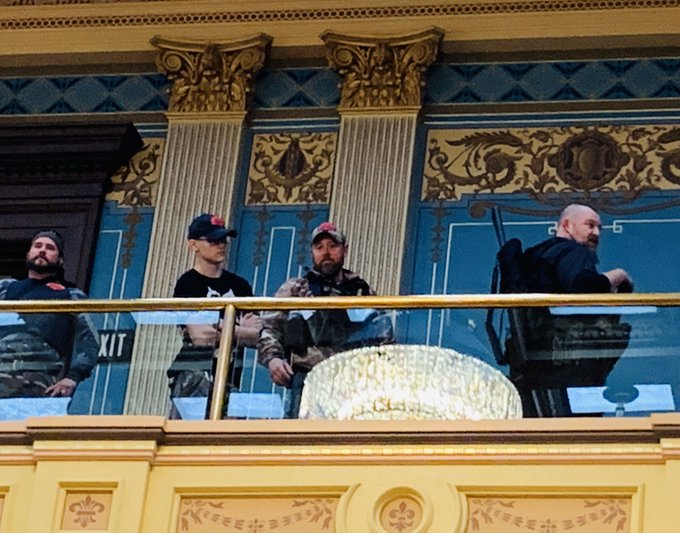
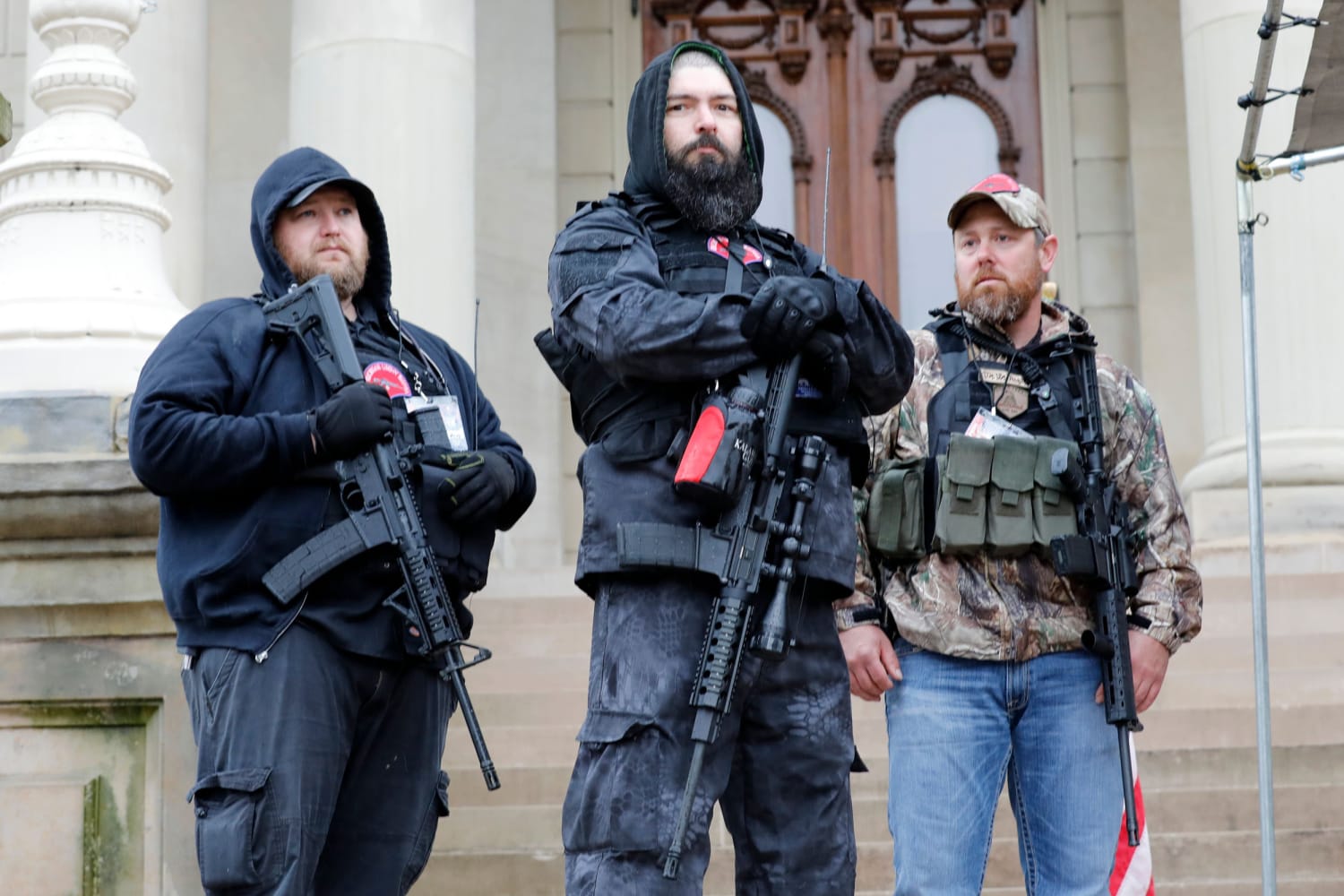
I know they’re not calling themselves brownshirts — and Trump is calling them “very good people“, similar to his characterization of the neo-Nazis at Charlottesville as “very fine people” — but when you “protest” with an AR-15, you’re not protesting, you’re trying to intimidate and terrorize.

A person carrying a gun to go hunting or target shooting is transporting the weapon to use for its lawful and intended purpose. Whether armed protesters admit it or not, gun-carrying to a political rally serves a different, disturbing and unnecessary purpose: intimidation. It is inherent in the act, putting it squarely at odds with vigorous, open and lawful political dissent.

This woman at an Illinois rally gives the game away with her “Arbeit Macht Frei” message to Illinois Governor J. B. Pritzker. The slogan “Work Makes Free” comes from the Nazi concentration camps. Pritzker is Jewish.

It’s important not to tar everyone with the same brush. I’m sure a lot of people who protest the lockdowns just want to go to the beach. But white supremacist or neo-fascist groups like the Proud Boys are at the core of these protests, and are using them to recruit.

Rule of thumb: If you’re at a protest and the people around you have AR-15s or are quoting Nazis, go home.


So many people have made this point already that I won’t belabor it, but only white men could do this. Black or brown people who tried to enter a state capitol with military-style weapons would be ordered to the ground, and if they didn’t comply fast enough they’d be killed. It’s that simple.

When the Black Panthers took guns to the California state capitol in 1967, they were disarmed, despite the fact that they were breaking no laws. California subsequently passed a gun control law, with the support of the NRA. The Second Amendment isn’t an issue when black people are being disarmed.

and you also might be interested in …

It looks like North Korea’s dictator Kim Jong Un is fine. There’s no official explanation of why he didn’t appear in public for about three weeks, but maybe it had something to do with coronavirus.


George W. Bush released a three-minute video to encourage the nation in this time of crisis. In it, he strikingly demonstrates the human qualities that Trump lacks.

Let us remember how small our differences are in the face of this shared threat. In the final analysis, we are not partisan combatants. We are human beings, equally vulnerable and equally wonderful in the sight of God. We rise or fall together, and we are determined to rise.

Bush was never known as Mr. Empathy, but nothing about being a Republican forces a person to be callous and self-centered. Trump is doing that on his own.

Naturally, Trump viewed this example of leadership as an attack, and struck back.

@PeteHegseth “Oh bye the way, I appreciate the message from former President Bush, but where was he during Impeachment calling for putting partisanship aside.” @foxandfriends He was nowhere to be found in speaking up against the greatest Hoax in American history!

Actually, Trump should be thanking Bush for staying silent during impeachment. The ex-president could have been pointing out the obvious fact that Trump was guilty. If partisanship had been put aside, and if Congress had responded only to the facts, Trump would have been removed from office.


Last Monday I wrote about “Why the Country isn’t Rallying Around Trump’s Flag“. Thursday, Vox’ Roge Karma took on the exact same topic, but added an international angle: “Many world leaders have seen double-digit polling surges amid coronavirus. Trump isn’t one of them.

Like me, Karma observes that Americans are rallying around their governors, many of whom have seen large increases in their approval ratings. But his data about other world leaders is also illuminating.

But ultimately he came to the same conclusion I did: Unity is just not what Trump does.

There’s been a lot of focus on how the Trump administration was technically and strategically unprepared for this crisis — and that’s true. But there’s also a way in which Trump himself was not temperamentally or ideologically prepared for it either. Trump built his political career atop fracture, conflict, and polarization. But he’s just collided with a crisis that demands solidarity, unity, and mutuality.


James Hamblin wonders:

I’m curious how psychiatrists diagnose people with depression now. Usually if people come in saying they’ve stopped leaving home, feel like every day is the same, are constantly overwhelmed by the plight of humanity, stopped getting dressed, stopped showering … typically a yes.

Now that’s all normal behavior.


I try to minimize the these-people-are-assholes anecdotes, because I could fill the whole Sift with them every week. I’m not sure who would benefit from reading them.

But the Mike-Pence-face-mask thing stands out, though, because it’s got all the elements: (1) the original assholery: Pence toured Mayo Clinic and ignored their regulations about wearing a face mask. He even let himself be photographed barefaced. (2) the lie: After a bunch of bogus excuses didn’t impress anybody, his people lied: They said Pence didn’t know about the rule. Also, Pence is apparently too dense to look around, see that everyone else is wearing a mask, and ask a question. (3) claiming victimhood: When a reporter caught them in the lie — pointing out that Pence’s staff had told reporters planning to go on the trip that they’d need to bring masks — Pence’s people called a foul on the reporter: That pre-trip notification was off the record, so the reporter owed Pence an apology.

and let’s close with nine good minutes

Just because school is out and they’re scattered to the winds, that doesn’t mean that over 100 Julliard musicians and dancers couldn’t work together on this amazing performance of Bolero. Be sure to check out the making-of article.

Things We’re Finding Out about the Pandemic

So far, Covid-19 has been characterized more by what we don’t know than what we do. That has allowed reporters to write either scary or reassuring articles, depending on what they assume about the unknown. This week I went looking for articles that give the unknown its due respect, and explain a lot of the artifacts in the data that might look like trends, but aren’t.

A good place to start is Ed Yong’s “Why the Coronavirus is So Confusing” in The Atlantic.

Terminology: “SARS-CoV-2 is the virus. COVID-19 is the disease that it causes.” It’s like HIV and AIDS. The epidemic — how the disease develops in a community — is yet a third thing.

The fatality rate isn’t a property of the virus. The reason the death rate (or case-fatality rate or CFR) is so hard to pin down is that it only becomes an objective quantity — number of deaths divided by number of cases — in retrospect. The CFR describes how the epidemic unfolded in a particular place; it’s not some inherent property of the virus.

The CFR’s denominator—total cases—depends on how thoroughly a country tests its population. Its numerator—total deaths—depends on the spread of ages within that population, the prevalence of preexisting illnesses, how far people live from hospitals, and how well staffed or well equipped those hospitals are. These factors vary among countries, states, and cities, and the CFR will, too.

We’re not really sure how the virus causes the symptoms of the disease. We know what a human body looks like after Covid-19 has attacked it. We’re not sure how to separate that into (1) damage the virus does, (2) collateral damage the immune system’s response causes, and (3) side effects of treatment.

The disease seems to wreak havoc not only on lungs and airways, but also on hearts, blood vessels, kidneys, guts, and nervous systems. It’s not clear if the virus is directly attacking these organs, if the damage stems from a bodywide overreaction of the immune system, if other organs are suffering from the side effects of treatments, or if they are failing due to prolonged stays on ventilators.

Others viruses might also have more wide-ranging effects than we know, but we just haven’t seen enough cases to notice them.

“Is COVID-19 fundamentally different to other diseases, or is it just that you have a lot of cases at once?” asks Vinay Prasad, a hematologist and an oncologist at Oregon Health and Science University.

Science doesn’t go straight to the right answer. The back-and-forth nature of the early scientific debate (asymptomatic people can’t spread the disease; yes they can) throws a lot of people, but it’s not that unusual.

This is how science actually works. It’s less the parade of decisive blockbuster discoveries that the press often portrays, and more a slow, erratic stumble toward ever less uncertainty. “Our understanding oscillates at first, but converges on an answer,” says Natalie Dean, a statistician at the University of Florida. “That’s the normal scientific process, but it looks jarring to people who aren’t used to it.”

The upshot is that if your whole view of the virus depends on one study by one lab, you should maybe take a wider look.

Uncertainty is a strength, not a weakness. In politics, the guy who is loudest and most sure of himself tends to win the argument. But expertise doesn’t work that way; real experts understand just how far their expertise goes, and recognize past some point, other kinds of expertise become more important.

The idea that there are no experts is overly glib. The issue is that modern expertise tends to be deep, but narrow. Even within epidemiology, someone who studies infectious diseases knows more about epidemics than, say, someone who studies nutrition. But pandemics demand both depth and breadth of expertise. To work out if widespread testing is crucial for controlling the pandemic, listen to public-health experts; to work out if widespread testing is possible, listen to supply-chain experts. To determine if antibody tests can tell people if they’re immune to the coronavirus, listen to immunologists; to determine if such testing is actually a good idea, listen to ethicists, anthropologists, and historians of science. No one knows it all, and those who claim to should not be trusted.

In a pandemic, the strongest attractor of trust shouldn’t be confidence, but the recognition of one’s limits, the tendency to point at expertise beyond one’s own, and the willingness to work as part of a whole.

The flu comparison is even less appropriate than the numbers make it sound. In Scientific American, Dr. Jeremy Samuel Faust concludes that the comparisons we hear about flu deaths vs. Covid-19 deaths are misguided.

When reports about the novel coronavirus SARS-CoV-2 began circulating earlier this year and questions were being raised about how the illness it causes, COVID-19, compared to the flu, it occurred to me that, in four years of emergency medicine residency and over three and a half years as an attending physician, I had almost never seen anyone die of the flu. I could only remember one tragic pediatric case.

He began asking other emergency-medicine doctors, and found that their memories match his. They remember lots of opioid deaths, gun deaths, and traffic-accident deaths — which are supposed to happen in similar numbers — but not flu deaths. Flu death totals, he came to understand, are not counted deaths — deaths of particular people whose doctors write “influenza” on their death certificates — they’re extrapolations based on models. The models assume that many people die of the flu outside of hospitals, and aren’t officially counted.

In the last six flu seasons, the CDC’s reported number of actual confirmed flu deaths—that is, counting flu deaths the way we are currently counting deaths from the coronavirus—has ranged from 3,448 to 15,620, which [is] far lower than the numbers commonly repeated by public officials and even public health experts.

In other words, (and I’m commenting here, not quoting or summarizing Dr. Faust) the flu death totals we usually hear are more comparable to the Covid-19 death totals we’re starting to get from excess-death demographic models — which show much higher numbers than the 65,000+ you commonly see reported. But if we compare counted Covid-19 deaths during the second week of April to counted flu deaths during the worst week of an outbreak “we find that the novel coronavirus killed between 9.5 and 44 times more people than seasonal flu”.

What happened in Belgium? If you study those country-by-country death totals, the one that always stands out is Belgium, which has 677 deaths per million compared the US’s 204 or Italy’s 475. What horrible lesson, you might wonder, should we learn from Belgium’s disastrous handling of the epidemic?

Maybe none.

Belgium’s high numbers have less to do with the spread of the disease and more to do with the way it counts fatalities. Its figures include all the deaths in the country’s more than 1,500 nursing homes, even those untested for the virus. These numbers add up to more than half of the overall figure.

The curve has flattened, but hasn’t turned downward much yet. Check out the Washington Post’s graphs of deaths and new cases per day. The peak in deaths was 2,874 on April 21 (assuming we ignore April 14, when New York City created a blip by reclassifying 3,700  previous deaths). But deaths have been in the neighborhood of 2,000 a day for the last two weeks. Trends are harder to detect due to a Sunday/Monday effect, when deaths are lower for some reason I don’t understand. (Sunday April 26 had “only” 1,087 deaths, but yesterday had 1,558.)

The numbers also depend to a certain extent on how they’re being collected. The WaPo numbers come from Johns Hopkins, and list 2,461 on Wednesday, 2,097 on Thursday, and 1,723 on Friday. But the WHO has a different way of collecting deaths and assigning them to days. They announced that 2,909 people died in the US on Thursday, a new high.

If you look at things Monday-to-Monday, as I do, there is a downward trend. 68K today, 55K last week, 40K and 22K the weeks before. So new deaths per week have gone from 18K to 15K to 13K.

As for where the numbers might be going next, 538 collects the projections of a variety of models about how many deaths we’ll see in the next three weeks. From the 65K deaths already recorded by May 1, some models predict as few as 72K deaths by May 23, others as many as 103K deaths. But if social distancing is abandoned too quickly and a second wave starts, all those projections go out the window.

When (and even whether) a vaccine shows up is anybody’s guess. A good summary here is Stuart Thompson’s article in Thursday’s NYT. If the normal vaccine-development timetable holds, a vaccine is years away, or maybe even decades. (There’s still no HIV vaccine, for example, after more than 30 years of looking for one.) But lots of things are being done to speed up the normal timetable, and maybe they’ll work.

There is a process to finding and producing a vaccine, but not one that can be easily predicted.

Clinical trials almost never succeed. We’ve never released a coronavirus vaccine for humans before. Our record for developing an entirely new vaccine is at least four years — more time than the public or the economy can tolerate social-distancing orders.

But if there was any time to fast-track a vaccine, it is now.

The main way you speed things up is that you do everything at once. Rather than take the most likely vaccine candidate, test it, and then test the next one after the first one fails, 95 different vaccines are being worked on at the same time. Some of them are probably very bad ideas.

What if a promising vaccine actually makes it easier to catch the virus, or makes the disease worse after someone’s infected? That’s been the case for a few H.I.V. drugs and vaccines for dengue fever, because of a process called vaccine-induced enhancement, in which the body reacts unexpectedly and makes the disease more dangerous.

That’s why you don’t just dream up a formula and start injecting it into the general public. Normally, there are three phases of testing, with time in between for analysis. But for Covid-19, you might start one phase before the previous one finishes. You also might start prepping a factory for production before you’re sure a vaccine works.

If you do all that and you get lucky, you might have a vaccine in mass production by August 2021.

The most aggressive timetable has been put forward by a group at Oxford, which is talking about availability in September, 2020. That would be a million doses, not the billions ultimately needed. But a lot has to go right before that happens. Human trials started this week. Right now all we know is that it works in rhesus macaques.

Whatever we’re returning to, it’s not “normal”. Another Atlantic article, Uri Friedman’s “I Have Seen the Future—And It’s Not the Life We Knew“, looks at the early signs of post-lockdown life in countries that are ahead of the US: China, South Korea, Denmark, and a few others. The very resemblance to normal enhances the strangeness of it.

In China, Friedman reports, reactions bifurcate as everyone anticipates the possibility of a second wave or a new plague. Some remain constantly on their guard, while others take a live-now approach: You’d better do whatever you can while you can, because it might all be taken away tomorrow. In general, the Chinese are saving more and spending less, frustrating planners who hope for a quick economic recovery.

Denmark seems to have the opposite problem: When the government reopened daycare centers and schools, many Danes took it as an all-clear signal. “[Just] because the schools open, doesn’t mean you should stop washing your hands,” says a University of Copenhagen professor.

Temperature screening at City Hall in Seoul

The NYT has a similar article:

In Hong Kong, tables at restaurants must be spaced at least five feet apart and customers are given bags to store their face masks during dining.

In China, students face temperature checks before they can enter schools, while cafeteria tables are outfitted with plastic dividers.

In South Korea, baseball games are devoid of fans and players can’t spit on the field.

… Libraries in Hong Kong are reopening, but visitors are allowed to be inside for only an hour at a time.

Hair salons in Sydney, some of which had closed because of the virus or financial pressures, are back in business with abundant supplies of masks and hand sanitizer. At some, magazines are no longer handed out to customers.

… In Sydney, schools are reopening in phases, holding classes one day a week for a quarter of the students from each grade and gradually expanding until the end of June.

We can hope that our opportunities increase over the coming months. But normal? Well, not exactly.

The Monday Morning Teaser

This week I want to focus more on what we do and don’t know about the virus and the pandemic, and less on the politics of it (though of course the politics can’t be ignored). So the featured post does not have “Trump” in the title, and may not mention him at all. He’ll turn up in the weekly summary, but there’s no need to dwell on him.

A lot of the articles that my social media universe brings to my attention express knowledge of one sort or another: The virus is like this; this tactic works and this one doesn’t; there will or won’t be a vaccine by such-and-such a time; this treatment is or isn’t a breakthrough; and so on. But I went looking for articles that give due respect to our ignorance, or that point to something we think we know, but really don’t. (Those stats people toss around about annual flu deaths aren’t nearly as solid as they look, for example.) And looking at countries that are ahead of us in dealing with the pandemic shows that whatever they are getting back to, it isn’t “normal” by any means. “Normal” is still quite a ways off, if we ever get there at all.

The point is not to cheer you up or get you down, it’s to build a stock of knowledge carefully, so that we don’t whipsaw back and forth between “It’s going to be OK” and “Millions of people will die.” Anyway, that should be out sometime this morning. (I’m being vague because I’m still making decisions about what’s in or out.)

The weekly summary will, of course, get into the politics of the lockdown, those armed yahoos trying to intimidate legislators, the accusation against Joe Biden and his response, the Republican president who did look like a statesman this week, and so on, before closing with a great piece of lockdown art: over 100 Julliard students, faculty, and alumni coming together virtually to play and dance their way through “Bolero”. When it came to my attention, I thought, “No way I’m watching the whole nine and a half minutes.” But I did.

I’ll try to get the summary out between noon and 1 EDT.

Speculation and Circumstances

Due to recent speculation and social media activity, RB (the makers of Lysol and Dettol) has been asked whether internal administration of disinfectants may be appropriate for investigation or use as a treatment for coronavirus (SARS-CoV-2). As a global leader in health and hygiene products, we must be clear that under no circumstance should our disinfectant products be administered into the human body (through injection, ingestion or any other route).

The Reckitt Benckiser Group

This week’s featured posts are “Why the Country Isn’t Rallying Around Trump’s Flag” and “Trump is Still Eating Souls“.

This week everybody was talking about states reopening

As I pointed out last week, no state truly fulfilled the criteria that the federal guidelines set out for beginning to roll back stay-at-home orders or other lockdown provisions. But Georgia allowed a variety of non-essential businesses, like barbers and nail salons, to open on Friday. Some of them did, but others decided not to. Restaurants and movie theaters will be allowed to open today.

A few other states are reopening a few types of businesses, and most states have announced a planning process that will lead to reopening at some undetermined future date.

Even if government allows it, reopening is a complex decision for a business to make. Of course you want to get your revenue stream started again. But are you telling your workers and your customers that you don’t care about their health? And if social distancing requires a restaurant to reduce its number of tables or a theater to reduce its seating, does its business model still work?

Everybody wants life to go back to normal, when you could go out to the mall without worrying about dying on a ventilator. But “back to normal” requires more than just unlocking the mall.


Also last week: I predicted that Trump would throw Republican governors under the bus. Thursday, a headline in the WaPo read: “Donald Trump Just Threw Georgia’s Governor Directly Under the Bus on Coronavirus“.


A reopen-the-economy protest in Arizona backfired when ICU nurse Lauren Leander showed up and silently observed. She was one of four healthcare workers at the rally. Healthcare workers have shown up at similar rallies around the country.

That poor guy with the flag, unable to intimidate one skinny little female. He’ll have to go home and order a big new gun to restore his manhood.


Congress passed another half-trillion in money for small businesses and hospitals. The one saving grace of Trump’s presidency is that deficits only matter when a Democrat is in office.

and the death totals rising

Friday, the United States recorded its 50,000th coronavirus death. This morning, we’re up to 990K cases and 55,506 deaths. That’s up from 40K deaths last Monday and 22K the week before. So the new deaths this week were slightly down, from 18K to 15K. Unless the trends slow down a lot faster, we’ll pass 60,000 deaths before the next Weekly Sift comes out on May 4.

If you remember, 60K has been tossed around as the likely total number of American deaths from this entire pandemic. That we’re sailing past it with considerable momentum should make everyone stop and think.

The IHME, [IHME Director Christopher Murray] said, will update its estimates next week to reflect a gloomier future amid indications that states like Georgia will begin to reopen — and boost the odds of a prolonged pandemic.

“We had presumed, perhaps naively, that given the magnitude of the epidemic, most states would stick to their social distancing until the end of May,” Murray said. “That is not happening.”

Another milestone likely to be passed in the next few days: 58,209, the number of Americans who died in the Vietnam War. We passed the Korean War total of 36,516 a week or so ago without much fanfare.


Confession time: I have been an economic pessimist for at least a year, so I happened to be in a relatively good position when the stock market collapsed. I lost money, of course, but I also had some cash to reinvest at the new low prices. I went looking for companies that would still be able to sell their products, and one I picked was Tyson Foods, the meat company. I was still buying chicken, so I figured everybody else must be also.

A couple weeks ago, when stories of the virus outbreaks at meat-packing plants started to surface, I realized that I had inadvertently joined the ranks of the villains: People were dying to make me money. Meat-packing plants are set up to crowd workers together, so if one of them gets sick, it spreads quickly.

So I sold the stock (at a profit, which feels weird). Anyway, yesterday Tyson took out full-page ads in major newspapers to emphasize how important it is to keep their plants open. They’re vital to the nation’s food supply and so on (which is true, but is only part of the picture). The letter from their chairman is very precisely worded, so he at least appears to care about the health and safety of his workers. But it’s hard not to be skeptical of lines like: “The government bodies at the national, state, and city levels must unite in a comprehensive, thoughtful, and productive way to allow our team members to work in safety without fear, panic, or worry.”

It kind of sounds like, “If we only kill a few workers, regulators should let us get away with it.”


From an editorial in National Catholic Reporter:

The question for the church in the United States is whether we will come out of this austere moment able to admit the role Catholics and their leaders played in electing and enabling a man who, far from being pro-life, has proven himself a distinct danger to life on several levels. …

This awful moment has laid bare the high cost to the U.S. church of 30 years or more of accommodation to a culture of political expediency and an attempt to diminish the community of faith’s responsibility to the common good. Single-issue voting relieved too many of us of the responsibility to engage deeper political and historical realities. The questions we’re left with are urgent.

The reckoning is upon us.


Dr. Fauci gets his wish: Brad Pitt plays him on SNL.


and injecting disinfectant

which you SHOULDN’T DO, under any circumstances. (Not that you ever would.)

In “Trump is Still Eating Souls“, I talked about the Thursday briefing where Trump suggested this, focusing not on why he said such a stupid thing (I think we all know the answer to that) but why none of the medical people corrected him before any damage was done.


If Republicans want to do some whataboutism here, they can point to stupid things Joe Biden has said, of which there are many (though I don’t remember any quite this bad). Words tend to pile up in Biden’s head, and sometimes they come out in an order that doesn’t make sense. Even Barack Obama, who generally thinks clearly on his feet and speaks off-the-cuff in well constructed paragraphs, once flubbed by saying he had visited “57 states“.

The difference is that Biden and Obama have enough strength of character to own up to their mistakes and laugh at themselves. (So could both Presidents Bush. It’s a character thing, not a red/blue thing.) So no Obama apologist had to argue that there really are 57 states, or deny what the tape clearly recorded, or insist that the President had intentionally exaggerated for effect. Instead, Obama confessed, “I understand I said there were 57 states today. It’s a sign that my numeracy is getting a little …” at which point an aide interrupted and ushered journalists out of the room.

But Thursday-into-Friday the White House and the entire Trump propaganda machine had to turn itself inside-out denying the obvious fact that the President had said something asinine and harmful. At first, Fox News just didn’t comment on it. White House press secretary Kayleigh McEnany insisted that the media was to blame for taking Trump’s comments “out of context“. (They hadn’t.) Then Friday, Trump gaslighted the country: His suggestion was “sarcastic”, a sarcasm so subtle that no one — not Birx, not Bryan, not McEnany, not Sean Hannity or Laura Ingraham — had recognized it up to that very moment.

But now that’s the official explanation, so all those whose souls Trump has eaten have to parrot it. If anybody says anything else, they are the ones who are being absurd. “How can any adult believe, seriously believe, that he was saying, ‘Hey, people should inject Clorox into their body’?” Fox News host Greg Gutfeld asked incredulously.

That’s how gaslighting works: How can any loyal subject truly believe that the Emperor is walking down the street naked? That’s just crazy.


If Trump’s “sarcasm” didn’t appeal to your sense of humor, try Randy Rainbow’s “A Spoonful of Clorox“. What have you got to lose?

And while we’re singing, here’s The Liar Tweets Tonight by Roy Zimmerman and The ReZisters, featuring Sandy Riccardi, in collaboration with the Raging Grannies of Mendocino.


and the immigration ban

A new executive order shuts down the green-card process for 60 days. Ostensibly this has something to do with the pandemic, but that explanation isn’t credible. Really it’s Trump using the virus as cover for something he wanted to do anyway.

and this just in: Russia helped Trump win

One casualty of the Trump-era news cycle is that by the time evidence comes in and reasonable people have a chance to weigh it, the whole subject feels like ancient history.

Case in point: The Senate Intelligence Committee has concluded that all Trump’s talk about a “hoax” or “coup” or whatever is baseless. The intelligence community’s assessment of the Trump/Russia thing was right. Russia did intervene in the 2016 election, and did it for the purpose of making Trump president.

For years, President Trump has derided the assessment by American intelligence officials that Russia interfered in the 2016 presidential election to assist his candidacy, dismissing it without evidence as the work of a “deep state” out to undermine his victory.

But on Tuesday, a long-awaited Senate review led by members of Mr. Trump’s own party effectively undercut those allegations. A three-year review by the Republican-led Senate Intelligence Committee unanimously found that the intelligence community assessment, pinning blame on Russia and outlining its goals to undercut American democracy, was fundamentally sound and untainted by politics.

and you also might be interested in …

This week I learned: The word quarantine comes from the Italian word for forty. During the Black Death in the 1300s, thirty days was the accepted standard period to isolate a ship from a plague-infested area. If that had held up, we’d be having trentines. But sometime during the 1400s, another ten days got tacked on for reasons no one remembers.


Nobody really knows what’s going on in North Korea. Maybe there’s some problem with Kim Jong Un’s health, or maybe he’s dead. But maybe he’s fine.


Crisis has a way of hastening along trends that were happening anyway. Wednesday, the NYT raised the possible end of the big department store. The decline has been going on for a while; Sears, K-Mart, and Penney’s had already closed large numbers of stores before the virus hit. For years, the growth in retail has been online, and even the top-line department stores were struggling to remake themselves. Now their time may be up.

The NYT article says:

The entire executive team at Lord & Taylor was let go this month. Nordstrom has canceled orders and put off paying its vendors. The Neiman Marcus Group, the most glittering of the American department store chains, is expected to declare bankruptcy in the coming days, the first major retailer felled during the current crisis.

The whole industry is eating its seed corn.

At a time when retailers should be putting in orders for the all-important holiday shopping season, stores are furloughing tens of thousands of corporate and store employees, hoarding cash and desperately planning how to survive this crisis…. The resort season has been canceled entirely, and fall orders have been put on hold, raising questions about what inventory will be left if and when shops reopen and consumers return to stores.

Department stores are typically the anchors of big malls; you want to look for something in Macy’s, and since you’re there you window-shop at Yankee Candle and get lunch at the Panda Express in the food court — neither of which would have been worth the trip otherwise.

“The nature of the mall is if you lose a big anchor like a Macy’s, you have co-tenancy issues and you have more pressure on the mall traffic, which was already a big issue,” said Oliver Chen, an analyst at Cowen. Co-tenancy clauses typically allow other tenants to demand rent reductions if certain key chains depart. Mr. Chen said that could accelerate the ongoing divide between top-tier malls and the second- or third-choice malls in certain areas.

Shares in the biggest mall-owner, Simon, have fallen from a high of $180 to $53. The shares currently yield 15%, a number indicating that the market believes a large dividend cut is coming.

In related news, private equity firm Sycamore Partners is trying to wriggle out of its poorly timed acquisition of Victoria’s Secret.

and let’s close with something inspiring

Voices Rock Canada offers a choir of women physicians singing “Rise Again“.

Trump Is Still Eating Souls

I really don’t want to talk about injecting Clorox, but I kind of have to.


To start with: Don’t do it. Disinfectants work by killing living things. You are a living thing. Complete the syllogism.

With that out of the way, the thing to focus on here isn’t that Trump said something monumentally stupid Thursday. He does that; it’s usually not quite this bad, but he says stupid things fairly regularly. On the whole, I think I’d rather have him saying incredibly, ridiculously stupid things rather than run-of-the-stupid-mill things — like that you should take dangerous drugs that haven’t been tested yet — because fewer people are likely to believe him and do harmful things to themselves or others. (Though apparently some did believe him this time too.)

No, the really scary thing about the inject-disinfectant story is what happened next. DHS Undersecretary William Bryan (who had just talked about the effectiveness of sunlight and bleach in killing coronavirus on surfaces — not inside the body) was still standing near the podium, and Dr. Deborah Birx was sitting a few feet away, and neither jumped in to protect public health by telling people not to do what the President just suggested.

Within a minute or two, Bryan was asked a question by a reporter, and he didn’t backtrack to tell people not to inject themselves with bleach. Even later, when a reporter specifically asked “But I — just, can I ask about — the President mentioned the idea of cleaners, like bleach and isopropyl alcohol you mentioned. There’s no scenario that that could be injected into a person, is there? I mean —”, Bryan said “no” in a deflecting way, not calling it out.

No, I’m here to talk about the findings that we had in the study. We won’t do that within that lab and our lab.

In other words: “No, that’s not my department”, not “No, that’s a really bad idea.” Later, on Fox News, Birx did this bit of spin.

When [President Trump] gets new information, he likes to talk that through out loud and really have that dialogue and so that’s what dialogue he was having. I think he just saw the information at the time immediately just before the press conference and he was still digesting that information

Assume that’s true for a second: It’s still political malpractice. Imagine any previous president “digesting information” about a crisis on national TV in real time. Picture George W. Bush — not my favorite president — digesting what his generals are saying about Iraq and spitballing whatever crosses his mind. “Couldn’t we just nuke them? We’re going to wargame that, right?”

I can only assume that both Bryan and Birx have made the same calculation: Protecting public health is less important than protecting the President’s fragile ego. Admitting that Trump said something stupid is a good way to get fired — and then maybe no one in the administration would care about public health.

And so Bryan and Birx have been corrupted by the soul-eating process James Comey described a year ago: First you don’t interrupt when Trump lies about trivial things like his inauguration crowd. Then you give in to peer pressure and flatter him in public.

Next comes Mr. Trump attacking institutions and values you hold dear — things you have always said must be protected and which you criticized past leaders for not supporting strongly enough. …

It bothers you, at least to some extent. But his outrageous conduct convinces you that you simply must stay, to preserve and protect the people and institutions and values you hold dear. Along with Republican members of Congress, you tell yourself you are too important for this nation to lose, especially now. … Of course, to stay, you must be seen as on his team, so you make further compromises. You use his language, praise his leadership, tout his commitment to values.

And then you are lost. He has eaten your soul.

Why the Country Isn’t Rallying Around Trump’s Flag

There is a substantial national consensus and someone needs to speak for it.
Unfortunately, our current President can’t.


The bullhorn speech. The highest presidential approval Gallup ever reported was published on September 24, 2001. Just ten months before, George W. Bush had lost the popular vote to Al Gore, resulting in a bitter dispute over Florida, and a widespread belief among Democrats that his presidency was illegitimate. In the poll published on September 10, Bush’s approval rating had been a lackluster 51%, barely higher than the 48% who had voted for him in November. But now, suddenly, 90% of Americans approved of his job performance.

Bush was the same man he had been two weeks before, but something historic had happened in the meantime: On September 11, the United States suffered a humiliating and horrifying attack. In New York, the twin towers of the World Trade Center fell, killing almost 3,000. In Washington, the Pentagon had been damaged. A fourth hijacked airliner, rumored to have been targeted at the Capitol, had been brought down by a self-sacrificing passenger uprising.

Three days later, Bush stood in the WTC rubble.

The president, who had been in office less than eight months, grabbed a bullhorn and started thanking the fire fighters and other first responders at the scene, telling them that they were in the country’s prayers. Someone in the crowd shouted that he couldn’t hear the president, and Bush replied with the words that made history.

“I can hear you!” he declared. “The rest of the world hears you! And the people – and the people who knocked these buildings down will hear all of us soon.” The crowd reacted with loud, prolonged chants of “USA! USA!”

In this electric moment, Bush captured the mood of the country, delivering just what the American people wanted a combination of gratitude for the rescue workers’ bravery and diligence, defiance toward the terrorists, and resolve to bring the evil doers to justice.

Rally round the flag. Other peaks of presidential approval reflect similar moments of national unity. In 1991 and 1945, the common emotion was pride and relief at the successful conclusion of a war. The first President Bush garnered 89% approval after the surprisingly one-sided victory over Saddam Hussein in the First Gulf War. President Truman reached 87% approval after the surrender of Nazi Germany. Perhaps the moment that most resembled 9/11 was Pearl Harbor, when a similar sense of national determination pushed FDR’s approval up to 84%.

Crisis has a way of uniting Americans around their president. Past mistakes and doubts are put aside. Had W ignored the terrorist threat before 9/11? Had his father’s uncertain policy led Saddam to believe he could get away with invading Kuwait? December 7, 1941 was not just a “date that will live in infamy”, it was also a shocking defeat for the Navy that Roosevelt commanded, and was soon followed by the defeat of American ground forces in the Philippines.

So if you had wanted to disapprove of any of those presidents, you could justify it. But somehow none of that mattered. The nation yearned to be united, and there was only one president to unite around. Lingering disagreements and disappointments would have to be transcended until the current challenge had been met and overcome.

Over time, this pattern has baked itself into the American psyche so deeply that it has a name: the rally-round-the-flag effect.

What about now? Right now, we’re in another national crisis of historic proportions. More than 50,000 Americans have died of Covid-19, almost all of them in the last month. Hundreds of thousands are sick, and nearly every American has felt the impact of stay-at-home orders intended to “flatten the curve” and blunt the upward trajectory of death.

We’re mourning, we’re hurting, we’re frightened, and we’re angry. So why isn’t the rally-round-the-flag effect working for President Trump?

One theory is that the country’s partisan divide has gotten so wide that it’s impossible to cross over and support a leader of the opposite party. But that doesn’t explain why the effect is still working at the state level, for governors of both parties: Democrat Andrew Cuomo of New York, whose televised briefings have made him a national figure, scored an 87% approval rating in late March. And Larry Hogan of Maryland and Ohio’s Mike DeWine are Republican governors with similarly stratospheric ratings: 84% and 83%, respectively.

All those states (especially New York) have been hard-hit by the virus, and you could easily imagine people deciding to blame the governor rather than support him. But that’s not what’s happening. Past disputes are being forgotten. Past oversights are being forgiven. New Yorkers, Marylanders, and Ohioans want to be united, and they only have one governor to unite around. So that’s what they’re doing.

Trump’s problem isn’t us, it’s him. We’re still capable of uniting; he’s just not capable of leading us.

The country tried to unite around Trump. In early April, when he had finally stopped trying to happy-talk the virus into vanishing “like a miracle”, and proclaimed himself a “wartime president”, his disapproval fell below 50% for the first time since early 2017, and his approval rose near 46%, an all-time high.

Democrats were beginning to get seriously depressed about the fall election. In a true rally-round-the-flag moment, it wouldn’t matter that he had been consistently wrong about the seriousness of the virus, or that he had failed to prepare either the government or the public for the battle we are now in. It wouldn’t matter that the economy, which Trump had counted on to be his ticket to a second term, had collapsed. We’d all be in this struggle together, and he’d be leading us.

But that trend fell apart pretty quickly. By this week, Trump’s 538 polling average was back in familiar territory: 52.4% disapproval, 43.4% approval — with the trend line decidedly negative.

Why?

How it works. Sometimes we talk about the RRtF effect as if it were a knee-jerk reflex: There’s a crisis, so I’ll support the president. But it’s actually a more complex process than that.

The first thing to notice is that ordinary politics is divisive, while crisis politics is unifying. Ordinarily, our national political conversation is about issues we disagree on: Should abortions be easier or harder to get? Should government do more to help people, or just get out of their way? Do refugees and immigrants continually revitalize our nation, or do they steal opportunities from the native born? Do whites and men have unfair privileges they need to relinquish, or have they yielded too much already?

We’re a two-party system, so we tend to divide into relatively equal sides.

But when a crisis hits, most of us suddenly find ourselves on the same side. When the planes hit the World Trade Center, everybody became a New Yorker. When Nazi Germany surrendered, parties broke out all over America.

Being on the same side, a lot of us find ourselves thinking the same things. After 9/11, a huge majority of Americans were all thinking: “We can’t just let something like this happen to us. We have to find who did it and stop them. We have to make sure nothing like this happens again.”

But at the same time, a crisis makes us feel small in our individuality. It was paralyzing to imagine being in the WTC when the planes hit. What could you have done? And if people on the other side of the world were plotting similar attacks right now, what could you do about it?

That combination of factors creates an opportunity for a leader: When Bush picked up that bullhorn, he spoke for us, and spoke with the strength that we had together rather than the weakness we felt as individuals. (There’s a long conversation to be had about how he misused that strength, but that’s a different topic.) He didn’t say, “Listen to me!” He said “I hear you!” and he promised to channel our unified will into powerful action.

That’s what 90% of America approved of.

The consensus today. If you listen to cable news shows or watch the President’s coronavirus briefings, you might imagine that the virus is an ordinary-politics divisive topic. But it really isn’t. Pretty much everybody is thinking and feeling and wanting the same things.

  • We’re afraid of getting sick and dying, or of passing the virus on to our more vulnerable loved ones and watching them die.
  • We wish we could do something.
  • We’re bored and frustrated with staying at home, but we’re willing to keep doing it if it actually helps.
  • We sympathize with people who have lost relatives or friends without being able to visit them in the hospital or hold their hands.
  • We’re worried about our financial future.
  • We’re rooting for our doctors and scientists to figure out how to beat this thing.
  • We concerned about the long-term effects on our communities. (Will our local shops and bars and restaurants and theaters and stadiums ever reopen? Will they be recognizable when they do?)
  • We miss the lives we used to have.
  • We worry that people will do stupid things to make it all worse.
  • We admire the people who are risking their lives to take care of others, and we feel responsible for the people (grocery workers, meat-plant processors, delivery people) whose jobs require them to take risks on our behalf.

I could go on, but you can probably extend that list yourself.

The arguments we’re having on social media (or that other people are having for us on TV) are mostly artificial. When we talk about reopening businesses, my worry that stupid people will make it all worse may conflict with your desire to get out of the house and your worry that we’ve been wrecking our financial future, but we share all those concerns. Literally everybody wants to restore normal life safely, but none of us know exactly how to do that. We all wish we did.

That consensus creates the opportunity that many governors are using to raise their popularity: They hear us. They’re speaking for us. And they speak with the power we have together rather than the weakness and fragility we feel as individuals.

Why not Trump? The singular virtue that made Trump’s political career is that he has the best-defined personal brand of anyone who has ever run for president. People sometimes say, “You know what he thinks” or “You know where he stands”, but neither of those is actually true. (In reality, he likes nothing better than to get on both sides of an issue and then claim victory no matter how it comes out. Last week I pointed out how he was doing that in regard to reopening the economy, but you can see the same pattern many places. Like China, for example: He’s an anti-China trade warrior, but he also brags about his great relationship with President Xi.)

The real underlying truth is “You know who he is, and he never changes.”

“Who he is” is a divider, not a uniter. The heart of his 2016 campaign was to channel the resentment and anger of rural whites who feel like America has slipped away from them. His whole public persona (and I suspect his personality) is based on resentment. Wherever he goes, he has to define enemies: the Deep State, the fake-news media, Crooked Hillary, Shifty Schiff … it never ends. He recognizes no loyal opposition; those who are against him (or just not for him ardently enough, like Jeff Sessions) are “horrible people”. He couldn’t forgive John McCain, even in death.

Unifying politicians have a way of co-opting their enemies — the way W co-opted the so-called liberal media in the run-up to the Iraq War — but Trump must defeat his. They must visibly surrender and pay tribute to his victory. President Obama found diplomatic roles for George W. Bush to play, as Bush in turn had made use of Bill Clinton. But it’s impossible to imagine Trump asking Obama’s help — despite (or perhaps because of) all the countries where Obama continues to be popular. Obama would have to bend the knee and beg first, and even then Trump would probably refuse (as during the transition, he accepted Mitt Romney’s submission, but refused to offer him a post).

So even trying to speak for the country’s consensus would break Trump’s brand. Who would the enemy be? How could he hold a press conference without demonizing the reporters? How could he be smarter than everyone if he agreed with everyone?

On a deeper level, it would also run counter to his psychology. Look again at Bush’s bullhorn speech. “I hear you,” requires a fluidity of ego that Trump does not have. He is himself, and he is right, and he is better than everybody else. Speaking for the consensus requires putting yourself to the side. Trump will never, ever be able to do that.

Instead, we have the spectacle of his daily briefings, where the reporters are enemies and the doctors are rivals whose loyalty he must constantly assess. The dead are not individuals to mourn and the bereaved are not objects of sympathy or empathy. They are possible sources of blame, and so they must be removed from the spotlight as quickly as possible. There is only one spotlight, and only one person it should illuminate. The opinions that are validated must be his opinions, which he came to first, before anyone else. They can’t be yours or mine or anybody’s but his.

The Monday Morning Teaser

Being basically a hermit by nature, I’m enduring lockdown fairly well. (It also helps that I’m doing OK financially, I don’t have small children to keep occupied, and my major activity — this blog — can proceed more-or-less undisturbed.) Even my week in solitary, when I thought I might be infected, passed fairly pleasantly.

But I’m starting to notice more and more signs of depression in my social-media universe. Occasionally I hear someone try to say something uplifting, but even that comes out depressing. It’s sort of like when a soldier tries to raise his companions’ courage, but really just reminds everybody how scary the situation is. (“We may not have anything that penetrates their tanks’ armor, and poison gas is indeed a terrible way to die, but are we afraid? No, we are not! We may be running out of food and bullets, but we have as much spirit as we ever did!”)

So I’m wondering if I’ve been underestimating the toll this experience is taking on people in general. If you have observations on this that you’re willing to put out on the internet, please leave a comment.

As I’ve pointed out before, news keeps going into reruns: more people are dead, Trump said something stupid, yada yada yada. It would be easy to put out the same weekly summary week after week, just updating the links to the current instances of the continuing narratives. (Although Trump really outdid himself this week with the injecting-disinfectants comment. Try as I might to let that go, I ended up writing about it.) So it’s a challenge to approach the news with a what-did-we-learn-this-week attitude.

This week, the featured post looks at the question: Why isn’t the rally-round-the-flag effect working for Trump? During a crisis, presidents generally see their popularity rise — even if the bad news could just as easily be blamed on them. For example, FDR’s navy suffered a crushing defeat at Pearl Harbor, but the next month he had an 84% approval rating. The current crisis gave Trump’s approval a bit of a blip — from the low 40s to the high 40s — but it dissipated in a couple of weeks. Meanwhile, governors of both parties are seeing a more typical rise: Democrats like Andrew Cuomo and Republicans like Mike DeWine have scored numbers in the 80s. What’s up with that?

That post still needs some work, but it should be out by 10 or 11 EDT.

The weekly summary looks at a few states starting to reopen, and a lot of states starting to announce reopening plans. As always, I’ll update the numbers on cases and deaths. (The models that predicted 60,000 total deaths are looking way too optimistic now. We should blow through that number in a few days.) As I said, I can’t ignore the disinfectants controversy, but I’ll approach it from the why-didn’t-anybody-jump-up-and-correct-him angle rather than rage for the Nth time at how ignorant Trump is. Stupidity at the top is old news, but the corruption of the supposedly apolitical parts of the government is the ongoing story.

Some really funny song parodies are going around, and come out amazingly quickly.

And then there are stories that either have nothing to do with the virus, or are tangential to it: The Senate Intelligence Committee validated the intelligence community’s assessment of Russian interference to help Trump in 2016; Stephen Miller finally got his immigration ban; nobody knows what’s going on with Kim Jong Un; the big department store chains might not reopen; and a few other things. And I’ll close with a virtual choir of Canadian women doctors singing an inspiring song. Let’s say that appears by 1.

Off the Table

You don’t want to think, “If I go to the movies, I might die.”
We’ve got to take dying off the table.

– Jim Cramer, CNBC analyst (4-16-2020),
commenting on reopening the economy

This week’s featured post is “Trump’s Guidelines Aren’t What He Says They Are“.

This week everybody was talking about the lockdown protests

I say a little more about this is the featured post, which includes that photo from Columbus that looks like something out of The Walking Dead. But here’s a meme that makes a more explicit connection with the zombie mythos.


One thing to remember about these demonstrators: They may not represent anyone but themselves.

Americans overwhelmingly support continued social distancing measures to fight the coronavirus pandemic despite the impact on the U.S. economy, a new poll finds.

In the Politico/Morning Consult poll released Wednesday, 81 percent of respondents say Americans should “continue to social distance for as long as is needed to curb the spread of coronavirus, even if it means continued damage to the economy.”


The virus is highlighting the difference between symbolism and reality, which ripples through America in so many places.

One thing no end-the-lockdown protest can do without is the American flag. These Tea Partiers see themselves as patriots, because they identify with the symbols of patriotism. They wave their flags, put flag decals on their bumpers, and tell anybody who will listen how proud they are to be Americans.

But they aren’t patriots at all in any real sense. If you ask them to do anything for the common good — stay home, do without a haircut, wear a mask in public, pay taxes — it’s too much. Their vision of America is that the government builds us roads, delivers our mail, protects us from criminals, educates our children, and sends helicopters to pluck us off the roof when the flood comes, but in return we wave flags and otherwise don’t have to do anything we don’t want to do. JFK’s idea that we should ask what we can do for our country — that’s tyranny. All that “pay any price, bear any burden, meet any hardship” crap — we don’t do that any more.

I can barely imagine how World War II would have played out if my parents’ generation had felt that way about the government rationing food and gas, or forcing Ford to build tanks and planes rather than new cars. There would have been riots, and probably America would have lost the war. History played out differently because the men and women of the GI generation were patriots in their actions, not just in their symbols and self-identifications.

Something similar is happening within Christianity. If Christianity is fundamentally an identity to you, then absolutely you had to symbolize your identity by going to church on Easter, and any government order trying to stop you was tyranny. The more obstacles public health officials put in the way of gathering together with hundreds or thousands of your fellow Christians, the more determined you are to do it.

On the other hand, if your Christianity is about following the teachings of Jesus, then the thought that you would make a big show of your Christian identity even if it costs your neighbor his or her life — that’s absolutely abhorrent.

and whether the virus is peaking

As of this morning, the US has reported 40,620 deaths from Covid-19. The number of deaths per day seems to leveling off at about 2,000. So if we’re going to achieve those “optimistic” predictions of “only” 60,000 deaths, the per-day totals have to start dropping significantly and soon.

The good news from New York is that the number cases in the state definitely looks to be past its peak. However, the peak of the graph looks rounded rather than spiky. If that’s the case nationwide, there’s a lot of death yet to come.

Something we have to bear in mind is that the virus is on a different track in different parts of the country, and that the models assume continued social distancing. If states start allowing people to congregate again, the graphs could go to a new peak.


One thing that’s driving me nuts about the discussion from the states that don’t have a large number of cases yet: If a state like New York or New Jersey had it to do over again, they’d lock down sooner, before the caseload took off. States like Wyoming and Idaho still have the chance to do that, but are acting like biology works differently for them.


CNN points to four good examples: Taiwan, Iceland, South Korea, and Germany.


But we’re also seeing examples that the virus can rise again if social-distancing restrictions are relaxed.

In Singapore, which is battling a resurgence of cases, the country reported 728 new cases today, a record daily high, according to the health ministry. None of the country’s cases since Apr 9 have been imported

China is also seeing a new wave of infections — not anywhere near its old peak, but the worst in five weeks.


The question of immunity remains open. It stands to reason that a person who beat the virus once, and who retains at least a few antibodies tuned to it, has a good shot at beating it again. But whether that person has a genuine immunity, such that the virus can’t even get a foothold that allows it to infect someone else, that’s still unknown. And if there is immunity, is it for life or just for some period of time? Since no one had this virus before December or so, the sell-by date of whatever immunity anyone has is a mystery.

Keep that in mind when open-the-economy folks start talking about antibody tests that “certify” someone’s immunity to the disease and make it “safe” for them to go back to whatever work they were doing. That might be true, or it might not.

and electoral politics

Hard to believe that a week ago, we still didn’t know who had won in Wisconsin: Biden won the presidential primary, but the big news was that the Republican voter-suppression effort failed. Wisconsinites turned out to vote in record numbers, and the incumbent conservative supreme court justice lost. Hats off to all the voters who either got their absentee ballots in on time or braved the virus threat to go out and vote in person.


Last week we knew that Bernie Sanders was withdrawing, leaving the nomination to Joe Biden. This week the Democratic Party began to close ranks around Biden. He was endorsed by Sanders, by Elizabeth Warren, and by Barack Obama.

All three endorsements demonstrated how different politics is during the lockdown. In a typical year, each would have been the occasion for a major rally: Biden and the endorser standing together with hands raised in front of a cheering crowd. This year, each happened via video messages.

and you also might be interested in …


Karleigh Frisbie Brogan is a grocery worker writing in The Atlantic. She appreciates all the attention she and her colleagues are getting during the coronavirus crisis, but the “hero” talk doesn’t sit well with her.

Unlike medical personnel and emergency responders, we didn’t sign up for potentially life-threatening work. We can’t check the temperature of people entering our store or maintain a safe distance from one another.

… Cashiers and shelf-stockers and delivery-truck drivers aren’t heroes. They’re victims. To call them heroes is to justify their exploitation. By praising the blue-collar worker’s public service, the progressive consumer is assuaged of her cognitive dissonance. When the world isn’t falling apart, we know the view of us is usually as faceless, throwaway citizens. The wealthy CEO telling his thousands of employees that they are vital, brave, and noble is a manipulative strategy to keep them churning out profits.

I have immense gratitude for my job. I love my co-workers like family. I respect the company that has employed me and given me excellent health-insurance benefits for more than 16 years. The anger I have is not toward my boss, or my boss’s boss, or even that guy’s boss. It’s toward an unfair system that will never change if we workers don’t question the motivations behind such mythmaking.

In spite of the we’re-all-in-this-together rhetoric, we’re actually not. Some of us can work at home, or are securely retired and can continue our normal activities (like writing this blog) with a few restrictions. For us, a trip the grocery store is like a mission behind enemy lines. We gear up and make plans for as efficient a strike as possible.

But people in other parts of the economy, typically working class and less well paid, enter that danger zone (or one like it) every day because they have little choice. If they’re heroes, it’s in the same way that drafted soldiers can be heroes, even the ones who wouldn’t have volunteered and would go home if they could. They’re carrying on, and doing what they have to do. The other workers we now recognize as “essential” — all the people who make Amazon packages magically appear on your doorstep, for example — are doing the same.

The one useful interpretation of the hero rhetoric is that it’s a promissory note we need to honor when this is all over. I don’t want to hear protests that workers don’t deserve a $15 minimum wage or health insurance or a chance to go to college. The drafted heroes of World War II got a GI Bill of Rights when the war ended. These heroes deserve something similar.


If you think Trump’s afternoon briefings are bizarre to watch, imagine what it’s like to participate in one. Brian Karem reports on Tuesday’s, where Trump responded to his question by threatening to walk out of his own briefing.

It was probably the most surreal thing I’ve seen in close to 35 years of attending White House news conferences. … The president of the United States was playing victim to a reporter he knows from past exchanges is going to ask him a tough question and not back down even if the president tries to bully him. Suddenly I had the power to make him leave? Please. It’s part of the Trump plan. He has turned the daily briefings into mini Trump rallies, complete with a propaganda video in Monday’s episode. Demeaning the media is a recurring theme, as is blaming everyone else for his problems. Trump may claim to have total authority, but in truth he loves to play the total victim.

Some have suggested that reporters should modify their behavior to keep Donald Trump from getting angry. I firmly disagree. As Helen Thomas told me when I was younger, “Just ask the question.” We are not responsible for the reaction our question elicits; we are merely responsible for the questions we ask. Trump’s behavior is on him and no one else. He is petulant, angry and dismissive because that is who he is, not because he’s the victim of some rude reporter asking him pointed questions.


Whether the Post Office is forced into bankruptcy or privatization by the current crisis is still up in the air. Bizarrely, it has turned into a partisan issue, with Democrats wanting to save the Post Office and Republicans willing to let it collapse. Trump reportedly threatened to veto the first stimulus bill if it included a post office bailout.

With local businesses shut down, the Post Office has lost some of its most lucrative business — delivering fliers for local stores and restaurants. It’s estimated to be losing $2 billion a month, and is projected to be insolvent by the end of September.

What’s weirdest about how the politics play out is that the parts of the country that will be most damaged by a collapse of the Post Office are the conservative rural areas.

Businesses like FedEx and UPS don’t build offices in remote rural areas, like deep in Wyoming or in the mountains of Colorado, because it’s simply not profitable. They often rely on the Post Office for last-mile delivery; the agency delivers mail for them from major transportation hubs to the final delivery destination, often in secluded areas.

This ultimately means that without the USPS, FedEx and UPS won’t have the resources to deliver to remote rural areas, nor will they likely make investments to do so since they’ll lose money in the process. Instead, people will have to bear the burden of traveling to the companies’ offices in larger towns to meet their mailing needs. For Mary Meyer, who lives in Bucyrus, Ohio — a town with a population of about 11,000 — the closest UPS customer center is 16 miles away in Marion.

and let’s close with an expression of values

This “Emptying Sacred Spaces” video was made in a variety of houses of worship in Maryland, and includes statements from leaders of many different sects. The mood is sad and somber, while at the same time hopeful and meaningful. A religious community may make its home in a particular place, but it is so much more than that place.