Author Archives: weeklysift

Doug Muder is a former mathematician who now writes about politics and religion. He is a frequent contributor to UU World.

Racism in the NFL

https://theweek.com/political-satire/1009806/dont-look-behind-the-shield

The lack of coaching opportunities for Blacks in the NFL is more than just the usual it’s-hard-to-break-into-management problem, and a new lawsuit explores why.


As far back as 1908, when Jack Johnson won the heavyweight boxing championship, sports have been a prime setting for America to work out its racial issues. Blacks might have been barred from most opportunities to excel, and what they managed to accomplish in spite of racial barriers could usually be minimized. But sporting events have objective outcomes. In the 1930s, for example, Whites who wanted to downplay Black achievements could claim that jazz wasn’t really music. But they couldn’t claim that Jesse Owens wasn’t really fast.

In sports, the 20th century was a long story of racial barriers falling and Black athletes succeeding. In 1947, Jackie Robinson was the only Black player in the major leagues. But he became the rookie of the year that season, and by 1949 he was the National League’s most valuable player. Willie Mays entered the league in 1951, and Hank Aaron in 1954. By 1981, the major leagues were 18.7% Black, but then percentages began to fall, possibly because Black athletes drifted into other sports. In 2016, major league baseball players were 63.7% White, 27.4% Hispanic, 6.7% Black, and 2.1% Asian.

Basketball is the sport most dominated by Black players: In 2020, about 3/4 of NBA players were Black, a number that has been relatively stable for some while. The change from majority White to majority Black happened fairly quickly: The first three Black players entered the league in 1950. By 1957, Bill Russell was the most important player in a Celtic dynasty that would win 11 championships in the next 13 years. Whether White owners and executives continued to have racist beliefs or not, there was no arguing with that kind of success.

The story of race in the National Football League has always been more complicated. The NFL had a handful of Black players when it was getting started in the 1920s, but instituted an informal color barrier from 1933 to 1946. That barrier was broken not through the efforts a crusading White general manager like baseball’s Branch Rickey, but out of legal necessity: When the Cleveland Rams moved to Los Angeles in 1946, they played in the publicly-owned Los Angeles Coliseum. Public accommodations couldn’t be segregated even in that era, so the Rams needed at least one Black player. The Washington Redskins became the last team to integrate in 1962, when the Kennedy administration similarly threatened not to let them play in a stadium on federally-controlled land.

The quarterback mystique. But even as Black athletes in many sports succeeded in blowing up the myth of White superiority, racism established a fallback position: Some Blacks might possess a raw animal physicality, but only Whites had the intellectual and moral virtues that made athletes truly admirable.

And so an article about base-stealing baseball players might emphasize a Black player’s blazing speed, but a White player’s painstaking analysis of pitchers and their moves. Black basketball players might be imposing Goliaths like Wilt Chamberlain, but (as the sports magazines of my youth told the story) White players compensated through smarts, hard work, and an indomitable will to succeed. That racial distinction was rarely spelled in so many words, but whenever I heard an athlete described as “crafty” or “scrappy”, I could be pretty sure he was White.

Baseball and basketball are inherently egalitarian sports — everybody bats, anybody can shoot — so this pro-White image-making had limited effects. But football is more corporate and specialized. In particular, a racial mystique developed around the quarterback position: Of course arm strength and other physical gifts mattered, but intangible (White) qualities like leadership and courage were more important, and quarterbacks needed the (White) mental capacity to analyze defenses and make sound decisions under pressure.

As a result, it took decades for football’s conventional wisdom to recognize that Black athletes could be good quarterbacks. The prophecy was self-fulfilling: High school and college coaches didn’t want to “waste their time” training unsuitable Black players to be quarterbacks, so by the time the quarterback pipeline reached the NFL, it contained mostly White players. As that pipeline combined with NFL coaches’ own racial preconceptions, Black NFL quarterbacks remained exceptional and usually had short careers until Warren Moon and Randall Cunningham became stars in the 1980s.

Naturally, if Black athletes lacked the cerebral and moral virtues needed to be good quarterbacks, it followed that they couldn’t be good coaches either. All sports have had racial barriers to management positions, as the larger society still does in many fields. (Bill Russell once explained the dominance of Black players in the NBA by semi-seriously observing that young Black men weren’t distracted by their opportunities in banking.) But no other sport has such a wide gap between its majority of Black players and its tiny number of Black coaches: 69% of players are Black, but only one of the 32 head coaches (Mike Tomlin of the Pittsburgh Steelers). With only a slightly higher percentage of Black players, the NBA has seven Black head coaches.

Until a few weeks ago, Brian Flores of the Miami Dolphins had been a second Black head coach. But he was fired at the end of the season, a move that seemed mysterious: In 2019, Flores had joined a team mired in mediocrity. The Dolphins had managed only one winning season out of the previous ten. His first season had been even worse: 5-11. But then he turned the team around, going 10-6 in 2020 and 9-8 in 2021. 2021 had seemed like two different seasons: The team had started 1-7 (and if Flores had been fired then, it would made some sense), but then finished 8-1. Teams that finish with that kind of spurt usually have high hopes for the next season. They don’t usually fire the head coach. So Miami’s Channel 4 seemed a bit puzzled:

During a Monday morning news conference, the primary issues [team owner Stephen] Ross cited for the decision to fire Flores seemed to have little to do with the on-field product and more with communication within the team’s braintrust — though there were no specific examples offered of how the team determined Flores wasn’t the right fit in those regards.

Anyway, life in the NFL. Flores moved on to apply for other coaching vacancies. And then, for a minute, it seemed like he had found something. The Patriots’ Bill Belichick — Flores had been his defensive coordinator during the Super Bowl winning 2018 season — sent Flores a text congratulating him on landing the New York Giants head coaching job.

The weird thing was, Flores hadn’t heard anything and hadn’t even interviewed for the job yet. That was supposed to happen in a few days. After a quick back-and-forth it turned out that Belichick had gotten the wrong Brian: The Giants had decided to hire Brian Daboll, a White coach who had also been a Belichick assistant at one point.

But even though they were telling people like Belichick that the decision was made, the Giants didn’t inform Flores. They went ahead with his interview, then announced that Daboll was their new coach.

Why they would do that has a simple answer: the Rooney Rule.

Rooney Rule. Named after former Pittsburgh Steeler owner Dan Rooney, the Rooney Rule says that NFL teams have to interview non-White candidates for coaching and management jobs. It puts no quota on hiring, but Black candidates at least have to get in the door.

It was established in 2003 after a similar controversy: Tampa Bay had just fired coach Tony Dungy (who would later win a Super Bowl in Indianapolis), and Minnesota had sacked Dennis Green (after his first losing season in ten years). A study showed that Black NFL coaches had, on average, better records than White coaches, but were less likely to be hired and more likely to be fired.

Clearly, the rule didn’t solve the problem. Nearly 20 years later, the NFL is down to one Black coach again. Instead, the rule has become a box-checking exercise, in which Black coaching candidates are put through charade interviews without being seriously considered.

They have long suspected this, but the Belichick text was the first time it could be established in a particular case.

The Flores lawsuit. Tuesday, Flores filed a lawsuit in federal court in New York (where the NFL is headquartered). It’s a class-action suit on behalf of

All Black Head Coach, Offensive and Defensive Coordinators and Quarterbacks Coaches, as well as General Managers, and Black candidates for those positions during the applicable statute of limitations period

The suit asks the court to declare the league in violation of several non-discrimination laws, to award monetary damages (both compensatory and punitive), and for

injunctive relief necessary to cure Defendants’ discriminatory policies and practices

And that’s where it gets interesting. What would a court have to do to “cure” the NFL of racism?

The problem is that each team hires only one head coach at a time, and those decision depend on subjective judgements: How well does this coach’s management style fit the team’s vision and the talent on the field?

So far this year, five of the nine coaching vacancies have been filled (all by White coaches), but it’s hard to pick out any one of them as a racist decision. The Jaguars, for example, just hired Doug Pederson, who in his last job won the Super Bowl with a back-up quarterback.

The fact that a coin comes up heads once doesn’t prove it’s rigged. But if it keeps coming up heads again and again, it probably is.

What Flores claims. Several of the specific charges in Flores’ lawsuit have gotten attention from the media, but not enough attention has been paid to the suit’s larger narrative.

For example, the accusation that Dolphins’ owner Ross offered Flores a bonus for losing games so that the team could get a better draft pick (an officially denied practice known as “tanking”), has been widely reported. But the larger implication is that hiring Flores in the first place was a sham: He wasn’t hired to succeed; he was hired to be the fall guy for losing seasons that would build a team that some other coach (presumably White) could lead to victory in the future.

Another former Black coach (Hue Jackson of the Cleveland Browns) has told a confusing story that supports Flores up to a point: At first he seemed to imply that he also was offered money to tank, but later backed off to claim only that the management above him was trying to lose.

I told [the Browns’ owner] that what he was doing was very destructive, to not do this because it’s going to hurt my career and every other coach that worked with me and every player on the team. And I told him that it would hurt every Black coach that would follow me. And I have the documents to prove this.

The Miami tanking scheme (which Flores obviously did not implement), also throws a different light on the official explanation of poor “communication within the team’s braintrust” as a reason to get rid of him.

In other words, the NFL’s problem is even bigger than the numbers suggest: Of the few Black coaches hired, how many were hired to take the blame for an intentional failure?

Prospects. The Federalist Society, which wouldn’t be able to find racism in a Confederate plantation, outlines the difficulties Flores’ suit will run into in the hardball world of anti-discrimination law.

What the lawsuit doesn’t contain, however, is actual proof that the NFL is a systemically racist organization and needs to be punished for discriminatory behavior.

Most of Flores’ allegations don’t come close to proving legally actionable systemic discrimination, which must involve finding racist intent or internal statistical “patterns” of inequity. He points out that the NFL currently employs only one black head coach (and three minority head coaches, counting Ron Rivera and Robert Saleh) in Mike Tomlin of the Pittsburgh Steelers. But judging an organization by one year of results is not actionable.

I agree with their analysis this far: Flores can’t win purely on the evidence that he cites in his complaint. But the class-action lawsuit is an open invitation for other Black coaches and coaching candidate to join his class. Hue Jackson is telling his story. How many others will chime in?

Informally, there’s a lot of sympathy with Flores. I’ve heard ESPN analysts quote unnamed Black coaches saying “I’ve been on that interview” where Rooney-rule boxes are checked without any real chance at a job. But does that mean they’ll come forward?

https://claytoonz.com/2022/02/02/nfl-racism/

At some point, it’s not just about the law. The NFL needs public support. The racist blackballing of Colin Kaepernick is already a stain on the league, and so is the race-norming in the original concussion settlement. (Until a new settlement in June, Black players had a harder time claiming cognitive impairment, because the assumed baseline for cognitive function was lower for Blacks. In laymen’s terms: The league assumed Black players had less brainpower to lose.) Independent of what a judge might say, the NFL just can’t have a parade of Black players and coaches testifying about its racism.

And finally, there’s the discovery process. If Flores can get a look at NFL teams’ internal communications, who knows what he’ll find? The NFL is run by billionaires, and billionaires often assume the rules don’t apply to them.

The Monday Morning Teaser

Probably there was more important news than football this week, but to me the Brian Flores lawsuit against the NFL was a shiny object I couldn’t put down. It’s been common knowledge for years that Black coaching candidates face an uphill struggle in the NFL, a league where 69% of the players are Black. But an “oops” text message from Bill Belichick provided Flores with a smoking gun, and now he has a viable discrimination case.

I decided to give the story what I think of as “the Rachel Maddow treatment”. (It might also be called “the Heather Cox Richardson treatment”.) In other words, I’m going to take a long historical perspective and talk about the role of sports in America’s racial debate, going back to Jack Johnson’s heavyweight boxing championship in 1908.

Short version: NFL coaching isn’t just the usual hard-to-break-into-management problem. When Black athletes like Jesse Owens and Joe Louis started proving that Whites aren’t a superior race, racism retreated into a fallback position: Some Blacks might be gifted with awesome animal physicality, but Whites compensate with superior intellect and character.

In the NFL, this created the Blacks-can’t-be-quarterbacks myth that persisted into the 1980s. The continuing prejudice against Black coaches is the current battle line.

Anyway, I’ll try to get that article out by 10 EST.

That leaves a lot for the weekly summary: censorship, more 1-6 revelations (and pushback from Trump and the GOP), the retreat of the Omicron surge, more good economic news, Ukraine, and so forth. That should appear a little after noon.

Such Stories

It would take many books, my life. And no one wants anyway to hear such stories.

– Holocaust survivor Vladek Spiegelman,
quoted by his son Art in Maus

This week’s featured post is “McMinn County’s Maus Problem“.

This week everybody was talking about Ukraine

https://www.washingtonpost.com/opinions/2022/01/25/revisionist-history/

Often in this blog, I encourage people to trust the experts. Unless you have some really solid reason not to, listen to the CDC about Covid, and to the climate scientists about global warming. If a bipartisan election commission certifies your state’s results, believe them. And so on.

Defense and foreign policy, though, is one place where I get skeptical. I don’t usually characterize national-security-state insiders as villains, but I also don’t always believe what they say. I remember how they misled us into the Iraq invasion, and how victory in our 20-year Afghan War was always just a few months away. I also remember how easily respected news platforms like The New York Times and The Washington Post let themselves be used to spread Iraq-invasion propaganda.

So now the experts are warning us that Russia might invade Ukraine at any moment, and they could be right. I certainly have no reason to think Putin is on the side of the angels, or that he was satisfied by the chunks of Ukraine he stole away in 2014.

But still. This is one of the hidden costs of the Iraq deception: The Pentagon and the State Department have lost a lot of credibility with Americans like me. It’s going to take a long time to win it back, if in fact they deserve to win it back — which they might not.

So who do we believe in all this?

The most convincing thing I read this week was written by Ukrainians. The gist is that Putin does threaten Ukraine, but not as immediately as Western sources make it sound.

According to our estimates, supported by many of the indicators below, a large-scale general military operation can’t take place for at least the next two or three weeks. As of Jan. 23, we do not observe the required formation of several hundred thousand troops, not only on the border with Ukraine, but also on Russian territory behind the front line.

They’re not seeing behind-the-lines mobilizations necessary for a major invasion, like medical infrastructure for handling mass casualties. Overall troop deployments, they say, haven’t changed since April.

Russia could mobilize for an invasion — that’s where the “two or three weeks” comes from — but the Ukrainian writers don’t think it’s likely.

Overall, a large-scale offensive operation with an attempt to hold large occupied territories is a gamble that has no chance of a positive outcome for Russia. It is impossible to calculate the course of such an operation, and when implemented, it will quickly move to an uncontrollable point. 

When we add non-military components to this formula, such as international isolation and sanctions, then the result of an invasion will be politically suicidal for the Kremlin. We believe that, if Putin and his team have not lost their ability to think rationally, they will not go for such a scenario. 

More likely, they say, is a multi-faceted pressure campaign aimed at “destabilization and demoralization of the population”. The troops on the border are part of that, but so are

cyberattacks, which are already taking place, … psychological operations, such as active disinformation, mass bomb threats at schools, subway systems, administrative offices, and other facilities, along with the spread of disinformation and other methods.


A Putin talking point that I’ve seen repeated on both the Left and the Right is that NATO promised Russia in 1991 that it would stop expanding. This seems not to be true.


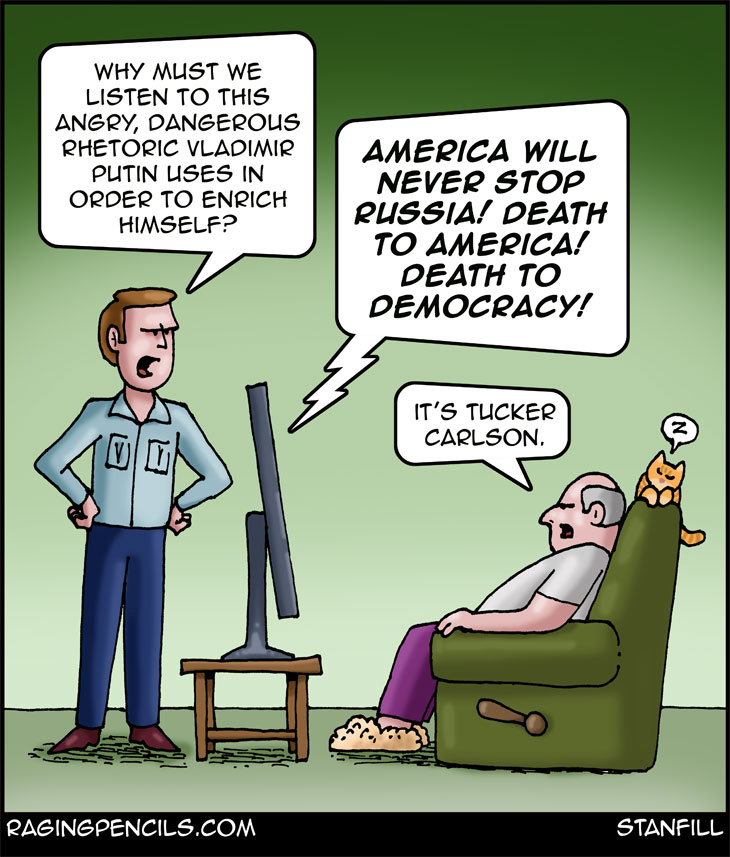
One striking thing about the media debate in America is how quickly the MAGA-right repeats Putin’s propaganda. Peter Navarro parrots Putin’s line that “Ukraine is not really a country.” Tucker Carlson on multiple occasions has wondered why the US would side with Ukraine rather than Russia. The distinctions between aggressor and target, or between democracy and authoritarianism, seem to elude him.

Meanwhile, Tucker’s identification with the authoritarian nationalist government of Hungary gets ever more explicit. The new “documentary” Hungary vs. Soros: The Fight for Civilization that Carlson has made for the subscriber channel Fox Nation supports Hungarian strongman Viktor Orban’s Nazi-themed tropes: Jewish money is behind Hungary’s troubles.

https://ragingpencils.com/2022/1-28-22-death-to-democracy.html

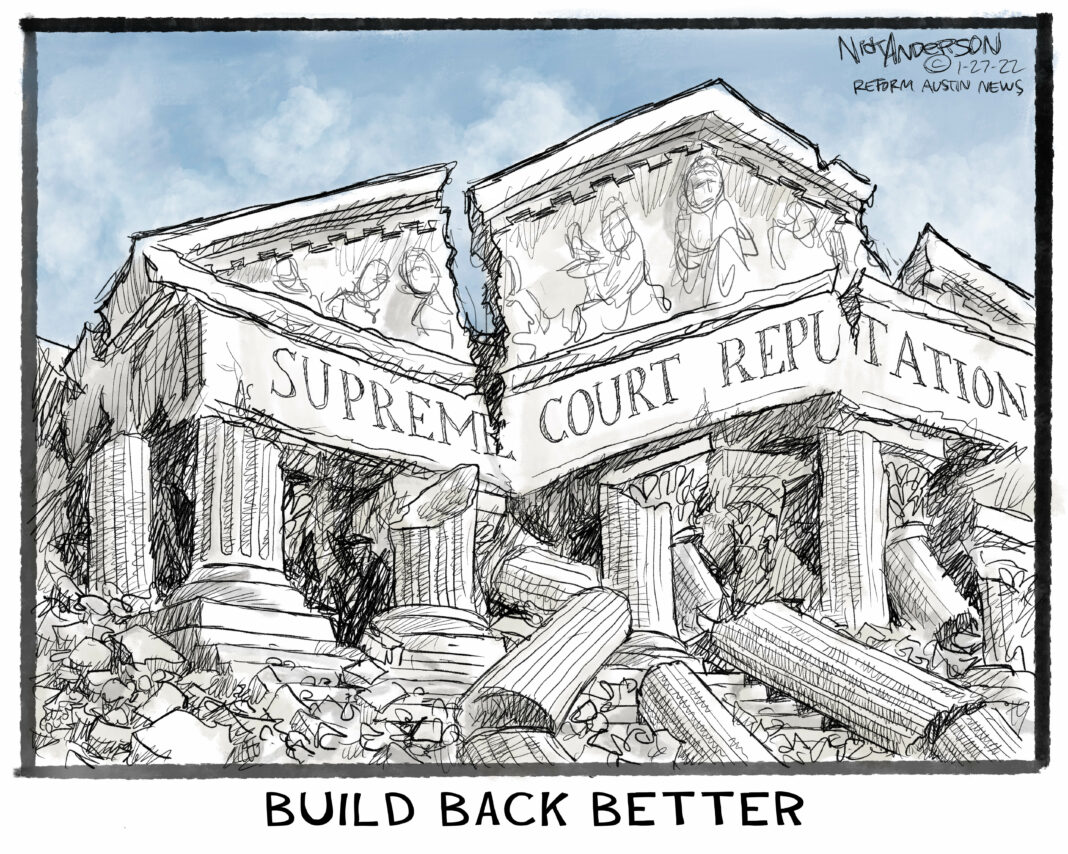
and the Supreme Court

https://www.reformaustin.org/political-cartoons/supremely-partisan/

Supreme Court Justice Stephen Breyer, one of the three liberals remaining, announced his retirement Thursday, kicking off what is sure to be an epic battle over his replacement.

President Biden had promised during the campaign that he would nominate the first Black woman to the Court, and he appears ready to make good on that promise. There are many worthy candidates, as you would suspect from the fact that previous presidents haven’t used up any of the good choices.

Senator Roger Wicker of Mississippi characterized Biden’s unnamed nominee as “a beneficiary of affirmative action”, and without knowing any more about her than her race and gender, predicted that “this new justice will probably not get a single Republican vote”.

I will point out that Jackie Robinson was an “affirmative action” pick in exactly the same sense: Branch Rickey went looking for a Black player to sign, because he saw the Negro Leagues as an untapped source of talent for the Dodgers.

and the pandemic

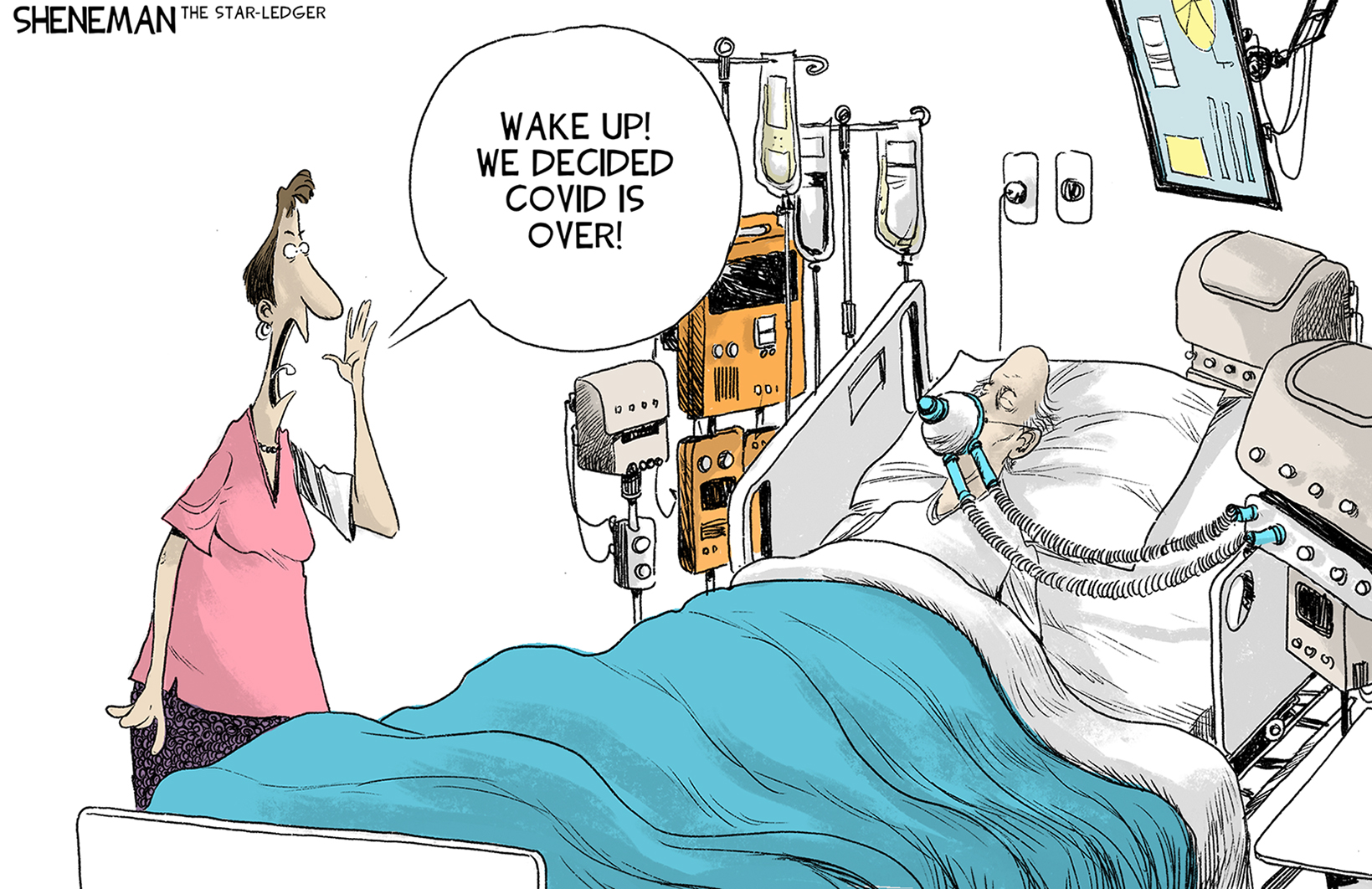
The Omicron wave is now clearly receding in most the country, particularly in the Northeast. But case-numbers are still high: 519K new cases per day in the US, down 35% in two weeks. Hospitalizations seem to have peaked also — 144K, down 8% in two weeks — but have not yet begun to fall sharply. Deaths still haven’t peaked: 2524 per day, up 28%.

Weirdly, at this moment when deaths are higher than they’ve been in about a year, we’re seeing a lot of calls to end special Covid precautions entirely and go “back to normal”. You know how when you get an infection, the doctor tells you to finish the antibiotic prescription even if you start feeling better? It’s like that. Historian John Barry, author of The Great Influenza, explains what we can learn from that pandemic.

Nearly all cities in the United States imposed restrictions during the pandemic’s virulent second wave, which peaked in the fall of 1918. That winter, some cities reimposed controls when a third, though less deadly wave struck. But virtually no city responded in 1920. People were weary of influenza, and so were public officials. Newspapers were filled with frightening news about the virus, but no one cared. People at the time ignored this fourth wave; so did historians. The virus mutated into ordinary seasonal influenza in 1921, but the world had moved on well before.

We should not repeat that mistake. …

As in 1920, people are tired of taking precautions.

This is ceding control to the virus. The result has been that even though Omicron appears to be less virulent, the seven-day average for daily Covid-19 deaths in the United States has now surpassed the Delta peak in late September.

Worse, the virus may not be finished with us.

https://theweek.com/political-satire/1009480/covid-is-over

The FDA is withdrawing monoclonal antibody treatments that were based on antibodies to previous versions of the virus and that provably don’t work on Omicron. But Ron DeSantis and other anti-public-health conservatives have embraced monoclonal antibodies as the one Covid-fighting method they can support, and they’re having trouble backing away from it.

Rand Paul has gone so far as to put forward a conspiracy theory: The FDA is taking away an effective treatment in order to “punish” conservative states like Florida.


A new low in Fox News’ deadly Covid-disinformation project: Tucker Carlson listens attentively while his invited guest Alex Berenson says:

The mRNA COVID vaccines need to be withdrawn from the market. No one should get them. No one should get boosted. No one should get double boosted. They are a dangerous and ineffective product at this point.


I don’t usually link to those gloating look-who-died-of-Covid stories, but I’m going to make an exception for Robert LaMay, a former Washington state trooper who in October made a viral video out of his decision to lose his job rather than comply with Governor Inslee’s vaccine mandate for state employees. “Jay Inslee can kiss my ass,” he broadcast from his patrol car. The video was clearly a planned stunt, because the dispatcher was prepared to respond with a list of LaMay’s accomplishments.

LaMay went on talk shows “non-stop” for a day or two afterward, including Laura Ingraham’s show on Fox News. “What’s next for you?” Ingraham asked. “Other than being a celebrity.”

I’ll bet that Ingraham won’t do a follow-up, now that her question has an answer: LaMay died of Covid on Friday, about three months after he made his video and appeared on her show. At least he wasn’t able to use his status as a state patrolman to infect members of the general public, who aren’t allowed to socially distance themselves from the police. Thank you, Jay Inslee.

BTW: Fox News itself has a vaccine mandate, which it doesn’t like to talk about. Tucker Carlson, in spite of spreading misinformation about vaccines night after night, always refuses to say whether he has been vaccinated. If he himself were the kind of anti-vax hero he frequently praises, don’t you think he’d say so?

and censorship

The featured post delves into a Tennessee school board’s decision to cancel an 8th-grade reading module based on the Holocaust-survivor graphic novel Maus.


Newly inaugurated Virginia Governor Glenn Youngkin has set up an email address for concerned parents to report teachers who engage in “divisive practices” like teaching critical race theory. Because that’s what freedom-loving people do: They snitch on each other to the government.

He appears not to have thought this out very well, though, because a very predictable thing happened: The account has been deluged with prank reports like “Albus Dumbeldore was teaching that full blooded wizards discriminated against mudbloods!”

For shame, people! You should definitely NOT send prank emails to

helpeducation@governor.virginia.gov

https://thenib.com/sensitive-snowflakes/

and you also might be interested in …

The most nerve-wracking part of the James Webb telescope mission has passed. The million-and-one things that had to go right for the Webb telescope to wind up fully unfolded and positioned at L2 have gone right. Now comes a few months of aligning and calibrating.


Meanwhile, Fox News has uncovered a major new Biden administration scandal: ice cream. It’s even worse than Obama’s tan suit. Criticizing Biden for doing something frivolous lines up with the effort to gaslight us about how hard Trump worked. “My father sat there 24 hours a day,” Eric lied.


I don’t pretend to know whether Bitcoin and its relatives will rebound from the latest slump. But the recent 50% drop reinforces the reasons I’ve stayed away from it. First, when the market started worrying about inflation, crypto-currencies behaved like speculative investments, not like the inflation hedges they’re supposed to be. And second, because I don’t see what you tell yourself to avoid panicking when it starts to crash. Any investment can fall, but when the value of your house crashes, you can just keep living in it. If the dollar falls, the US government will still let you pay your taxes with dollars. When a blue-chip stock slumps, you keep collecting the dividend. When the market turns against your stock in some speculative company, you can reassure yourself that the long-term trends are in place. (Businesses are still buying robots and moving their IT to the cloud.) But cryptocurrencies have no underlying fundamentals. When they fall, they just fall.


Despite devoting an indefensible amount of my time to watching sports, I usually don’t discuss sports on this blog. I’ll make an exception for this week’s vote on the Baseball Hall of Fame, in which Barry Bonds and Roger Clemens failed to get in on their final year of eligibility.

Fans have strong opinions both ways about this, and here’s mine: It’s not a Hall of Virtue, it’s a Hall of Fame. The point of going to Cooperstown isn’t to worship role models, but to revisit your memories of being a fan, and to imagine what it was like to be a fan in the distant past.

If you were a baseball fan in the 1990s and early 2000s, most of your memories are of Bonds, Clemens, Sammy Sosa, Mark McGwire, and a bunch of other guys who are not in Cooperstown because of suspicion of steroid use. Maybe you loved those players and maybe you hated them, but you can’t remember the era without them. The story of baseball in those years was their story, but the Hall has decided to pretend none of that happened.

I’d extend amnesty to to other eras as well. Joe Jackson should be in the Hall, and Pete Rose. Gaylord Perry threw an illegal spitball most of his career, but he got in, and I’m fine with that. These guys aren’t supposed to be heroes, just baseball players.


Apropos of nothing in particular:

https://jensorensen.com/2022/01/26/acceleration-change-disruption-cartoon/

and let’s close with some white-on-white crime

In a move that looks oddly romantic, a white rabbit nibbles a snowman’s carrot nose.

McMinn County’s Maus Problem

https://www.timesfreepress.com/cartoons/2022/jan/28/maus/5265/

The decision was made January 10, but it didn’t go viral until Thursday, which also happened to be Holocaust Remembrance Day: The Board of Education of McMinn County, Tennessee had voted 10-0 to ban Art Spiegelman’s Pulitzer-winning graphic novel Maus, which tells the story of his father’s experiences during the Holocaust.

If you clicked the links and read the longer versions of the story, though, “banned” wasn’t exactly the right word. The county’s 8th-grade reading program for the year had been split into four modules, each with a theme and an “anchor text”. The theme of the third module was the Holocaust, and the anchor text was supposed to be Maus. The kids would spend a quarter of the year discussing Maus while they also read supporting texts that gave them the context to understand what was going on in Maus.

The motion that passed 10-0 was to “remove this book from the reading series and challenge our instructional staff to come with an alternative method of teaching The Holocaust.” The motion doesn’t, say, take Maus out of the school libraries or do anything to stop kids who want to read the book on their own. But it won’t be assigned to 8th-graders.

Why not? The module was ready to go. The teachers were ready to teach it. Why did the school board feel that it needed to step in?

What they said. We don’t need to speculate about this as much as you might think, because the minutes of the meeting are publicly available. This was not some decision made thoughtlessly at the end of a long evening spent hashing out other issues. The meeting appears to have been called for this single purpose, and the discussion goes on for 20 pages.

County Director of Schools Lee Parkinson begins by saying that “two or three” school board members had come to his office to discuss “rough, objectionable language” in the book. He recommends redacting it “to get rid of the eight curse words and the picture of the woman that was objected to”.

But the Board immediately turns the conversation in a different direction: “Is there a substitute for this book?” One of the teachers the director had invited to the meeting says no and offers to explain why:

If you would like, I have some stuff I can run through with you that explains what our curriculum is and how it works and walk you through how this book fits into the bigger picture of what our kids are studying.

It quickly becomes clear, though, that the eight words and the picture are not really what the Board members are worried about:

we don’t need to enable or somewhat promote this stuff. It shows people hanging, it shows them killing kids, why does the educational system promote this kind of stuff, it is not wise or healthy.

Another teacher explains why a text about the Holocaust might get ugly:

I can talk of the history, I was a history teacher and there is nothing pretty about the Holocaust and for me this was a great way to depict a horrific time in history.

The Board goes on to table the discussion for a later date, then reverses itself, considers the motion to remove Maus from the curriculum, and unanimously approves it.

But why?

What is McMinn County’s Maus problem? The official explanation of an action isn’t always true, but it’s usually a good place to start. The Board of Education says on the county schools web site:

The McMinn County Board of Education voted to remove the graphic novel Maus from McMinn County Schools because of its unnecessary use of profanity and nudity and its depiction of violence and suicide. Taken as a whole, the Board felt this work was simply too adult-oriented for use in our schools.

If you’ve never read Maus — and I hadn’t until this weekend [1] — that explanation sounds sensible. I mean: nudity — some parents have a real problem with that. One of the Board members mentioned in the meeting that Spiegelman “used to do the graphics for Playboy” while another says:

My problem is, all the way through this literature we expose these kids to nakedness, we expose them to vulgarity. You go all the way back to first grade, second grade and they are reading books that have a picture of a naked man riding a bull. It’s not vulgar, it’s something you would see in an art gallery, but it’s unnecessary. So, teachers have gone back and put tape over the guys butts so the kids aren’t exposed to it. So, my problem is, it looks like the entire curriculum is developed to normalize sexuality, normalize nudity and normalize vulgar language. If I was trying to indoctrinate somebody’s kids, this is how I would do it. You put this stuff just enough on the edges, so the parents don’t catch it but the kids, they soak it in. I think we need to relook at the entire curriculum.

If you’ve never paged through Maus, you might imagine at this point that it’s downright pornographic, with the kind of drawings you might look for in Playboy. But if you have, this whole discussion seems ridiculous. The “nude” scene is a corner of one panel on page 100 of the first volume. The author’s mother has committed suicide and her body is in the bathtub. You see the back of her head, a single curved line representing not-particularly-large breasts, and a dot indicating a nipple.

So the “Playboy” artist has given us a single nude image in a setting that is not at all sexual. The drawing lacks detail and is not the least bit arousing. Any 8th-grader looking for a sexy picture could probably draw a better one for himself. [2] The “profanity” is similarly unimpressive. Remember: Director Parkinson wanted to white out eight words in a book of 295 pages. And that solution was not deemed acceptable.

The idea that Maus is not appropriate for 8th-graders might be believable if people making that claim had gone on to suggest moving the Holocaust module to the 9th or 10th grade curriculum. But no one did. The people who wanted to take Maus out of the 8th-grade curriculum didn’t suggest any age group that should read it.

So the Board’s official explanation doesn’t pass the laugh test. Clearly, they decided they didn’t like the book, and then went looking for explanations they could defend, at least to people who haven’t seen the book.

So what’s the real reason? During the Obama years, a lot of people didn’t like the president. If they had reality-based reasons for not liking him — they were conservative and he was liberal; he moved too fast or slow to end the wars or the economic disaster he inherited; Obamacare led to too much or too little government involvement in healthcare — I usually took those reasons seriously. No president gets 100% approval; there are always reasons.

But when people explained their dislike of Obama by spouting nonsense — he wasn’t born in America; he was secretly Muslim or Communist; he did objectionable things (that previous presidents had done without controversy) like putting his feet up on the Resolute desk in the Oval Office — then I had to wonder if the real reason was something they didn’t want to admit, like racism. Often, I think, anti-Obama racism was unconscious. People didn’t like him because they genuinely believed wild things him on flimsy evidence. But they wouldn’t have believed those things about a White president.

Something similar could be happening here. Because the Board’s explanation doesn’t make sense, we have to consider motives they’d be ashamed to admit, like Holocaust denial or antisemitism. Lots of people went there. Author Neil Gaiman, for example, tweeted:

There’s only one kind of people who would vote to ban Maus, whatever they are calling themselves these days.

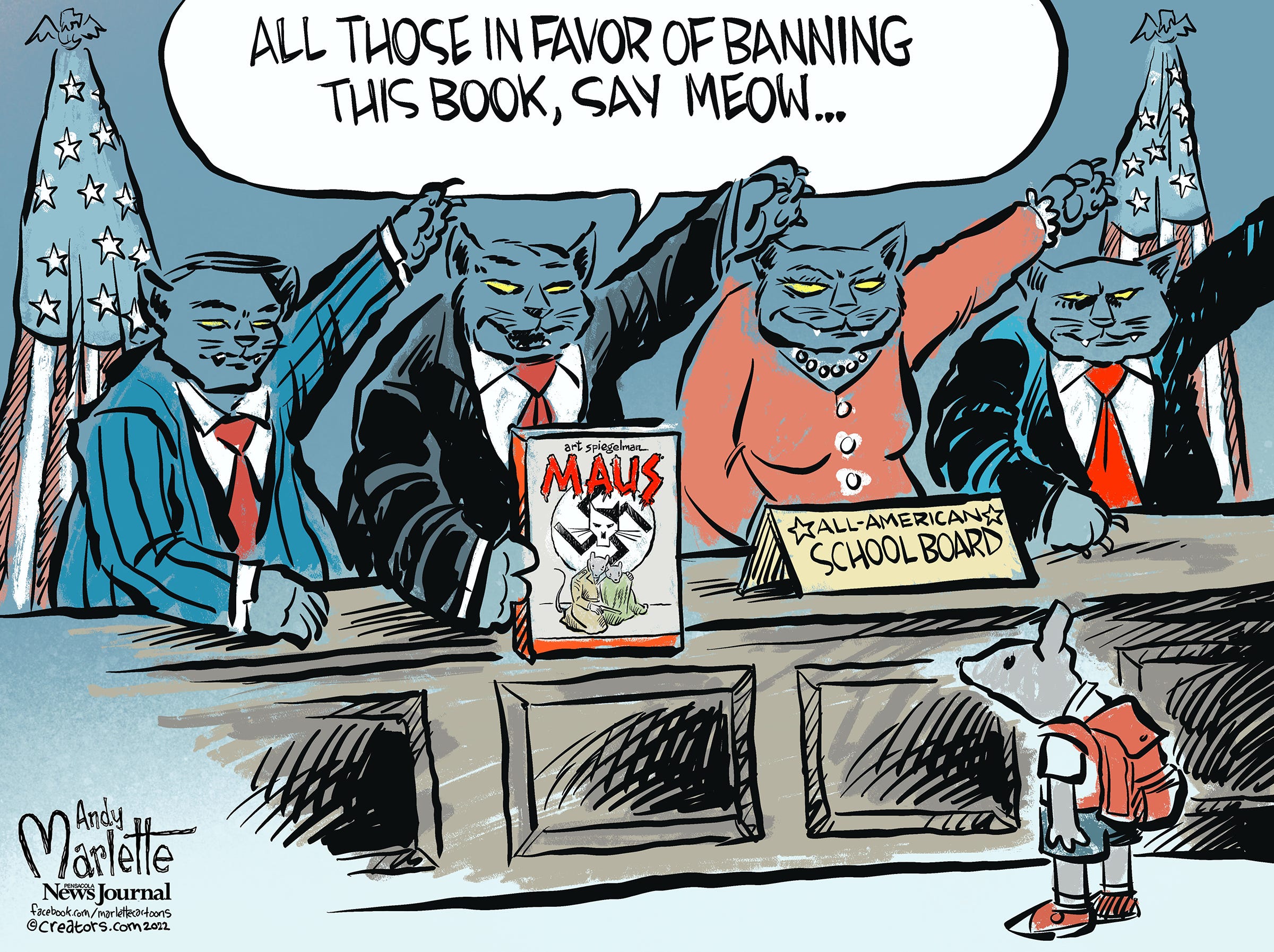
The following cartoon makes the same point by casting Board members as cats (which is how Nazis are portrayed in Maus).

https://www.pnj.com/story/opinion/2022/01/29/marlette-cartoon-all-american-book-banmarlette-cartoon-all-american-book-ban/9255940002/

It’s possible that McMinn County has a Nazi problem, but I don’t think we need to go that far. I’m speculating here (which is all you can do once you reject people’s stated motives), but I lean towards less conscious explanations: Something about Maus bothered the Board members (or the constituents who complained to them), and they went casting about for some way to justify their visceral reaction. They bought the absurd “vulgarity and profanity” explanation the way so many Obama-haters latched on to doubts about his birth certificate: Finding the real reason required too much uncomfortable introspection, so they grabbed the first justification they could find.

So what might the real cause of their discomfort be?

Matthew Parker (crediting the insights of the @JustSayXtian) approaches the question by listing the less “adult oriented” Holocaust books that Board members might have had in mind when they suggested replacing Maus: The Diary of Anne Frank, Number the Stars, The Book Thief, or The Boy in the Striped Pajamas. There’s nothing actually wrong with any of those books, Parker says, but they do something different.

Maus is a story centered on Jews, told in a Jewish way, in which there is horrible violence and no [Good Gentiles Doing Good Things] to save the day. There is no redemption, there is no salvation, there is only a story so terrible it has to be told and a need to remember.

People like this school board are perfectly comfortable teaching the Holocaust as long as it isn’t too violent, too sad, or too Jew-y. Because to them it isn’t a lesson about (largely if by no means exclusively) Jewish trauma, it’s a lesson about Good Gentiles Doing Good Things. The rest–our story, our tragedy, our people and families–are just set dressings for the moral and often explicitly religious lessons they want to take from the Shoah. [3]

Is it really about the children? Children, particularly in their aspect as “innocent” or “naive” children, are often used as screens for adult projection. If someone tells you a book is too disturbing for 8th-graders, they might well be saying that it is too disturbing for them.

The Holocaust, after all, is one of the most disturbing episodes in human history. If you can think about the Holocaust and not be disturbed, you probably don’t get it.

Maus captures that. Horrible things happen to Spiegelman’s father, and even more horrible things to people he knows and cares about. A few people help him, up to a point, but most don’t, and the few who do are mostly looking for payment or some other kind of advantage. Fellow Jews sometimes collaborate with the Nazis, and even family members can’t always be trusted. Vladek Spiegelman himself is a survivor, not a hero, and the scenes in the present illustrate the ways he was scarred by his experiences. Art Spiegelman can try to understand why his father is the way he is, but that doesn’t make him any easier to deal with.

So: People did and suffered horrible things; God didn’t rescue the victims; and if any good at all came out of all that suffering and death, it wasn’t worth it.

That irredeemable truth, in my opinion, is what the Board of Education doesn’t want to face. They’re not trying to protect teens from those ideas. They’re trying to protect themselves.

The Holocaust module. A part of my background that rarely comes up in this blog is all the education theory I read years ago. I went to an experimental public high school. We hosted an education conference every year, and I used to cover it for the student newspaper I edited. I did my homework before listening to the speakers.

One of the stories I remember reading (God knows where, after all these years) was about parents being told by their son’s grade-school teachers that his poor performance in reading was due to a learning disability; he belonged in a special class. What the parents knew that the teachers didn’t was that the boy was doing quite well in the Hebrew-reading class at their synagogue.

The difference, the author claimed, was that the Hebrew class was learning to read the Torah, which the teachers themselves thought was important. But the boy’s grade school was teaching him to read trivial stories that adults would never waste their time on. Reading Hebrew was worth his effort; reading English seemed not to be.

There is a widespread belief among children that school consists of meaningless hoops that adults expect them to jump through for reasons of their own. Even a lot of kids who do well in school believe this: If they’re forced to play this game, they might as well win. But that doesn’t mean they think education matters in any real sense.

The thing every true educator hopes for is to see the lights go on inside a student’s mind. There are magic moments in education, when a kid realizes that school isn’t just a waste of time, or even a way to compete with other kids for adult approval or success in some distant future. Instead, they surprise even themselves by thinking “I want to know this stuff.” Knowledge, they suddenly realize, is power. And all along, their good teachers have been hoping to empower them.

Often it’s one single book that sparks the change. “To Kill a Mockingbird made me a lawyer,” wrote Shami Chakrabarti. I remember reading Plato’s “Apology” as a 9th-grader (not in school; I found it randomly on a shelf), and realizing that a deeper kind of thought was possible. In a later generation, lots of kids didn’t see the point of reading until Harry Potter came out.

When the educators tell the McMinn Board what the English Language Arts curriculum is trying to do, it’s obvious those lights-on moments are what they’re shooting for.

When we were in school, we would hop from one book to the next. We would study one book a few days, do a test then move on to the next book. I want to tell you why curriculum is important and how the pieces of it are designed and how we have an opportunity to teach more than standards.

… The curriculum that we use is called EL, what does that stand for? I see some teachers here, what does that stand for? Expeditionary Learning. So, the whole idea is that students go on these expeditions, and they will spend two months or so on these different expeditions, and that’s their modules. In eighth grade that is four things. We do Latin America, we learn about food, The Holocaust and Japanese Internment.

… There are many lessons that can be learned through this book about how we treat others, how we speak, things that we say, how we act and how to persevere. I just wanted you to get an idea of why these lessons are structured like they are and how this text is just surrounded by excerpts and articles and the things we do to build that background knowledge and the opportunity we have to make a difference in our students lives.

This is the module that a Board member suspects was “developed to normalize sexuality, normalize nudity and normalize vulgar language.”

I listen to the descriptions of what the teachers are trying to accomplish and think, “Wow. I wish I’d had the opportunity to take a class like that.” This is the point that I think is getting lost in the news coverage: Simply defending Maus against charges of vulgarity and profanity makes it sound like the book clears a low bar. In fact, studying Maus, particularly in the in-depth way the module plans, could have been an amazing educational experience.

In the end, though, I’ve got no reason to be jealous of McMinn County 8th-graders, because they won’t get to take such a class either. The Board of Education has made sure of that. Maybe the students will get to study the Holocaust, sort of. But not in a way that might disturb them, or disturb their parents or their classmates’ parents. And not in a way that is too violent, too sad, or too Jew-y.

The Board wants another appropriate hoop for their kids to jump through. Study the Holocaust? Yeah, we checked that box.

Who is the victim here? Most of the coverage I’ve seen has made Art Spiegelman the victim, but I don’t think that’s quite right. Spiegelman’s name is in the headlines, his book is back on the best-seller lists, and Amazon seems to be sold out. People are reading Maus who would never had heard of it otherwise.

Another way of telling the story makes Jews-in-general the victims, and I can kind of see that. Especially in the current climate, when actual fascism is raising its head in America, and Nazi propaganda tropes about manipulative Jewish moneymen are showing up again in mainstream media, this incident is one more reminder that the lessons of the Holocaust have not really been learned. If I were Jewish, I think my anxiety level would have gone up a little this week.

The people I have the most sympathy for, though, are the 8th-graders of McMinn County. They had a chance to do something really amazing in school. Maybe that module, that chance to study something that really matters in some degree of depth, would have lit a fire under a few of them. Maybe they would have realized that school can be more than just busywork.

But that won’t happen, because powerful grown-ups (who have no idea what education is) have screwed that chance up for them. As grown-ups so often do.


[1] PDFs of both volume 1 and volume 2 are available online. I’m not sure how legal these reproductions are, so I intend to buy a copy when local bookstores have it in stock again.

[2] I truly feel sorry for kids who are picking up Maus now because they’ve heard it has nudity.

[3] Saturday’s NYT had an article about Poland’s attempt to shift the emphasis in Holocaust memorials to heroic Poles who attempted to help the Jews. The article does not mention Maus, but corroborates Spiegelman’s account of Poles profiteering off Jews rather than helping out of sympathy or kindness.

It’s also worth mentioning that slavery and the Civil Rights movement are often similarly reduced to stories of Good Whites Doing Good Things. We have a hard time facing up to the unrelenting grimness of American racism, so we tell these uplifting stories as if they were typical.

Is there any town in America that doesn’t have some connection to the Underground Railroad? With all those good folks working on the problem, it seems like the slaves should have been drained out of the South long before the Civil War.

The Monday Morning Teaser

A week ago, I did not anticipate that I would spend so much of this week thinking about the Holocaust. Sure, Thursday was Holocaust Remembrance Day, but that usually comes and goes without me paying much attention. This year, though, a Tennessee school board’s decision to take the Pulizer-winning Holocaust-themed graphic novel Maus out of their curriculum went viral, and for a couple days that was all anybody on my social media feeds wanted to talk about.

A lot of people jumped to one conclusion or another, but it turned out that you didn’t need to speculate that much about what was going on: The minutes of the board’s meeting were available online, and so were PDFs of Maus. I do my best to sort it all out in “McMinn County’s Maus Problem”, which should be out by 10 EST.

Not that the week lacked for other news: Justice Breyer announced his retirement from the Supreme Court, so the partisan wrangling over his replacement has already begun. Every day brings new speculations about whether the Russians are about to invade Ukraine. The Omicron wave of Covid began to recede. A blizzard hit the Northeast. GDP and inflation numbers came out.

So the weekly summary has a lot of ground to cover. I’ll try to have that out by noon.

Capricious Processes

No Sift next week. New articles will appear on January 31.

As these decisions show, the Court’s future hinges less on the text of federal law and the Constitution than on the capricious process by which conservatives define what it means to be one of them.

– Adam Serwer
The Culture War Has Warped the Supreme Court’s Judgment

This week’s featured posts are “Merrick Garland Starts Getting Serious” and “The Court and the Vaccine Mandates“.

This week everybody was talking about voting rights

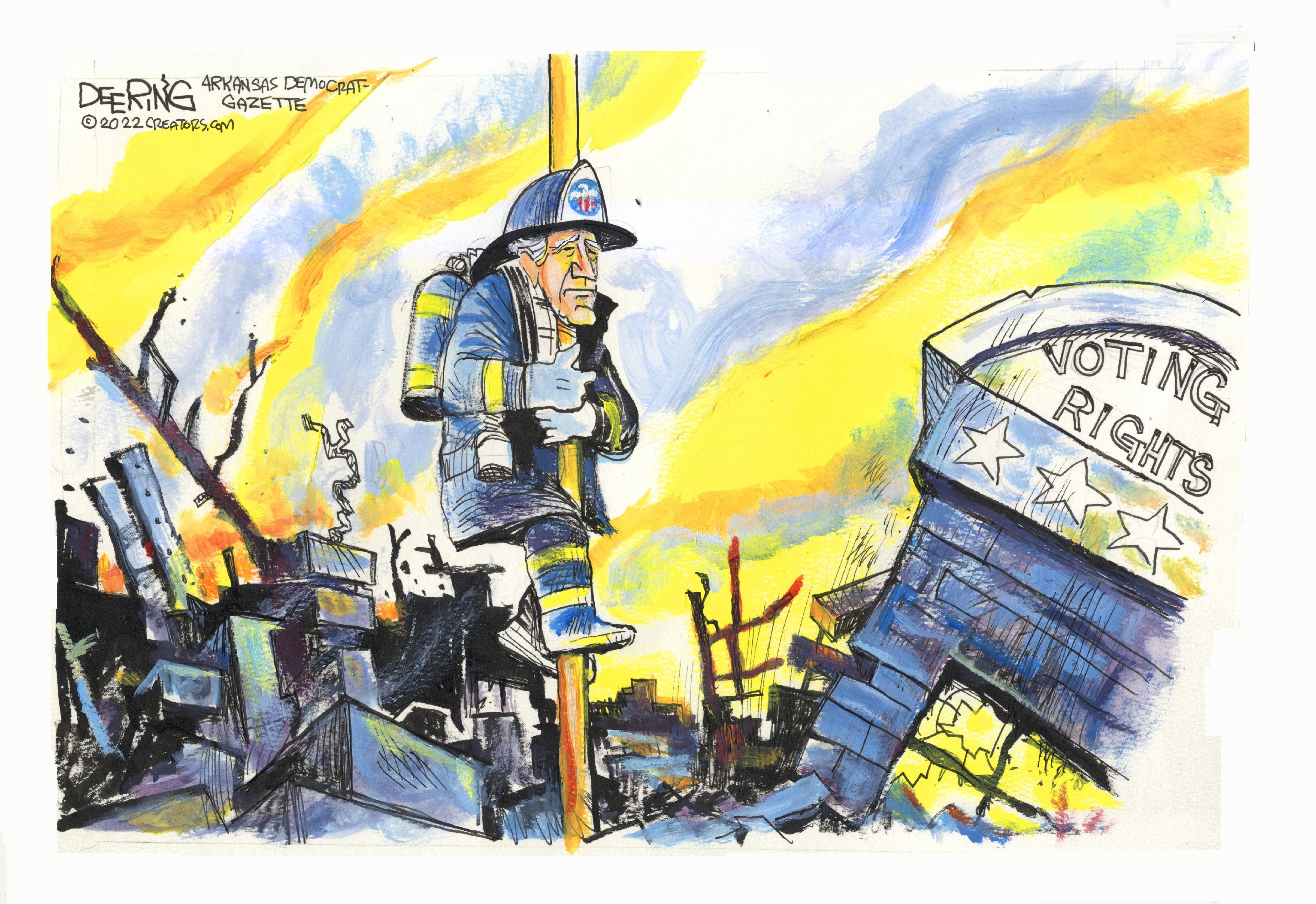
https://theweek.com/political-satire/1009018/the-fireman

Ever since Georgia passed its new voter-suppression law last March, Democrats at the federal level have been talking about protecting voting rights. But with a zero-vote margin in the Senate, and voting rights not fitting into any of the existing holes in the filibuster, talking is about all they’ve managed to do.

The conversation started with the For the People Act, which Senator Manchin said he couldn’t support. But then he seemed to do the responsible thing: He spelled out what he could support, and what he claimed enough Republicans would support to overcome a filibuster. A compromise Freedom to Vote Act was worked out, which Stacey Abrams — the avatar of voting rights — endorsed.

Unfortunately, Manchin was wrong; Republicans unanimously reject his bill too, and none of them came forward with a plausible counterproposal. They also successfully filibustered the John Lewis Voting Rights Act, with Lisa Murkowski the only Republican voting yes. So the question boiled down to the filibuster: If the filibuster lives, federal protection of voting rights dies.

Manchin and fellow right-leaning Democrat (I’m refusing to use the much-abused media label “moderate“) Kyrsten Sinema have been saying all year that they didn’t want to change the filibuster. But as with Biden’s Build Back Better bill, many Democrats continued to insist their minds could be changed.

They couldn’t. Sinema in particular has laid out her thinking on the topic, in an argument that doesn’t make a whole lot of sense: Democrats will need the filibuster when Republicans get back into power. Jonathan Chait responds:

But how many times did the filibuster stop [Trump] from carrying out an abuse of power? Not one. You can go through a long list of Trump’s norm-shattering behavior without finding a successful filibuster. Sometimes he appointed unqualified or pliant cronies to executive-branch positions, but those votes already have a 50-vote threshold. Other times, he ignored norms or laws, but he didn’t need Senate approval to do that. In theory, Trump needed Senate approval to build a border wall in the South, but in practice, he just did it anyway through executive action.

The Senate plans to debate both the Freedom to Vote and the John Lewis bills tomorrow, but both seem doomed.

https://www.reformaustin.org/political-cartoons/save-the-filibuster/

and the Capitol Insurrection

New developments in the case this week are discussed in one of the featured posts: 11 OathKeepers were indicted for seditious conspiracy, and the multi-state plot to produce fraudulent Electoral College votes started coming to light.

Asha Rangappa explains the current vision of how Trump’s coup was supposed to work.

Just so we don’t lose our sense of humor completely, Randy Rainbow already had a song ready a year ago.

and the Supreme Court

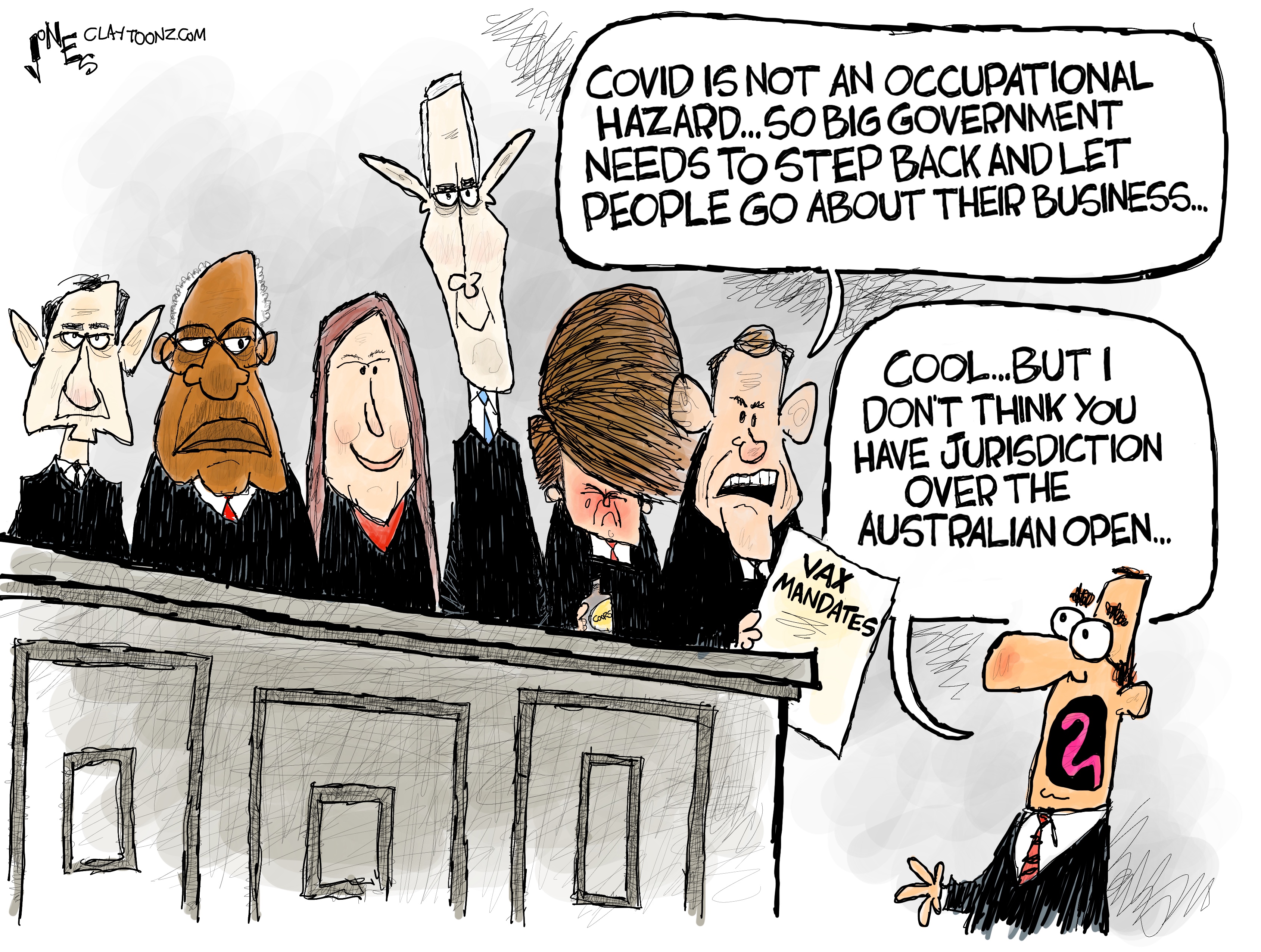
The other featured post covers the Court’s contradictory opinions on vaccine mandates. It’s hard to find any coherent legal reasoning here, but John Roberts’ political patterns explain everything.

In other legal news: The Ohio Supreme Court struck down a pro-GOP redistricting map. The Court believes Ohio voters actually meant what they said when they passed an anti-gerrymandering ballot proposition in 2018.

We reject the notion that Ohio voters rallied so strongly behind an anti-gerrymandering amendment to the Ohio Constitution yet believed at the time that the amendment was toothless

And Ted Cruz’ effort to take down an anti-corruption law is going to the Supreme Court.

and the pandemic

The Omicron wave seems to be peaking. Or rather, the peak has passed in the Northeast, while the rest of the country is still on the up-slope. Currently, the US is averaging 802K new cases per day, up 98% in two weeks, but down fractionally from 807K on Friday. Hospitalizations are at 156K, up 61%, and deaths are at 1964, up 57%. The West has now passed the Northeast as the region with the most per capita new cases.

Bob Wachter provides a useful tweetstorm explaining what will and won’t change over the next month, and why he believes we’ll face less Covid risk then.

and you also might be interested in …

MLK Day should be our annual reminder not to turn Martin Luther King into a moderate. Conservatives would reduce him to that one “content of their character” quote and claim he supported the superficial kind of color-blindness where people pretend not to notice what race anybody is. There was much more to King than that, and most of it was pretty radical in its day. A lot of it still is.


I haven’t said much about the Russia/NATO/Ukraine thing because I don’t understand it. It’s hard for me to tell what is a bluff, what is overreaction, and what is real.


A Brooklyn junior is one of the few American high school students who has taken an actual class in Critical Race Theory.

When we discussed CRT in our short workshop, we were taught the basic premise of critical race theory — that the underlying cause of racism within our country is institutional oppression built into American government and law. This structural racism shows up in systems such as the electoral college, which allowed slaveholding states disproportionate representation, and the prison-industrial complex, which upholds forced labor to this day.

But he wasn’t taught to hate White people, to hate the United States, or any of the other things CRT opponents denounce.


Talking Points Memo reader JS is a lawyer-turned-teacher who explains why the pandemic experience is going to hurt teacher morale and retention for years to come.

Maybe we should just say, well, if waitstaff at restaurants and everyone else can be forced to show up, then so can we, and I think there’s something to that. But if you want to destroy the morale of an entire class of people, point out that [their] biggest anxiety is well founded: in other words, you are basically like a fast food employee despite what we say about your education and training and your job requirements. 

A lot of the trends in education of late are to deprofessionalize the job and make teaching into commodity work. The low pay tickles that anxiety. We have as many units as an MBA or an MFT just to get credentialed. We have the student loan debt to match, but it can seem like it’s all a lie. We’re really just babysitters.


Novak Djokovic left Australia Sunday, concluding the long back-and-forth about whether the unvaccinated tennis star could play in the Australian Open, which starts today.


I’ve never cared about the British royal family, to the extent that I had to look up which prince Andrew is. (He’s the Queen’s second son.) But the Jeffrey Epstein scandal is taking him down too. He hasn’t been convicted of anything, but he has lost his royal titles and faces a lawsuit from a woman who claims Epstein forced her to have sex with Andrew when she was 17.

and let’s close with something musical

Have you ever listened to a new popular song and felt like you’d heard it before? Sir Mashalot went further than that: He proved it by remixing six popular country songs into one seamless whole.

Merrick Garland Starts Getting Serious

https://billypenn.com/2021/01/08/malcolm-nance-capitol-insurrection-trump-paramilitary-insurgency-philadelphia/

The misdemeanor part of his January 6 investigation seems to be over.
But will he get all the way to the top?


In a speech on January 5, Merrick Garland described his strategy for investigating the insurrection. Lawfare summarized it:

Seemingly in response to criticism that mostly smaller fry defendants have been charged to date while those behind the planning of the insurrection have not, Garland described the department’s approach as consistent with “well-worn prosecutorial practices.” Large investigations, he explained, start with the more junior people and the more easily proved cases. The public at first sees short sentences (or no jail time at all) handed out, and an absence of the more notorious figures being charged. Garland strongly implied that more significant actions are coming down the pike. Junior people flip on more senior people. And perpetrators who were not directly involved in violence but played planning or other behind-the-scenes roles must be reached with more time-consuming and complex investigations.

This week, we began to see what he was talking about.

On Thursday, federal prosecutors charged Oath Keepers leader Stewart Rhodes and 10 others with seditious conspiracy for their role in the January 6 attacks on the US Capitol. That charge — the most serious yet to come out of the investigation — is one of several in the indictment unsealed Thursday, which alleges Rhodes and his co-defendants brought small arms to the Washington, DC, area; engaged in combat training to prepare for the attacks; and made plans to stage quick-reaction forces to support insurrectionists.

… The new indictments are a significant step up from previous charges in the case, which range in seriousness from disorderly conduct to obstructing an official proceeding before Congress, and have so far resulted in sentences up to 41 months in prison. In comparison, seditious conspiracy carries a potential sentence of 20 years in prison.

The new indictment lays out a plan that goes far beyond the mob.

While certain Oath Keepers members and affiliates inside of Washington, D.C., breached the Capitol grounds and building, others remained stationed just outside the city in [quick-reaction force] teams. The QRF teams were prepared to rapidly transport arms into Washington, D.C., in support of operations aimed at using force to stop the lawful transfer of presidential power.

So the plan was to overwhelm the Capitol with numbers, then bring in the guns to hold it.

The obvious question is whether the people plotting Trump’s January 6 strategy (the so-called “Green Bay sweep“) knew about this or were complicit in its planning. GB Sweep plotter Peter Navarro claims not, but his plan seems to have had a big hole in it, which an armed militia occupying the Capitol might have filled: A Capitol occupation might have pushed the election certification past Inauguration Day, opening up a huge can of worms could justify authoritarian action.

And Roger Stone is connected to both groups. Maybe that’s why he pleaded the Fifth rather than tell the January 6 committee what he knows.

https://www.nytimes.com/2021/11/09/us/politics/jan-6-subpoena.html

All of which leads to this week’s second development: Electoral College fraud.

When I first ran across the Eastman memo, the game plan for Trump’s attempt to steal the election he lost by seven million votes, this part made me scratch my head:

When [Vice President Pence] gets to Arizona [in the state-by-state electoral vote count], he announces that he has multiple slates of electors, and so is going to defer decision on that until finishing the other States. … At the end, he announces that because of the ongoing disputes in the 7 States, there are no electors that can be deemed validly appointed in those States.

Multiple slates of electors? Where did that come from? There have been rare cases in American history where rival slates of electors were named by rival sources of certifying authority. In 1876, for example, Florida’s Republican-dominated Board of Canvassers declared Rutherford B. Hayes the winner and certified his electors. And then the newly elected Democratic governor appointed a new Board of Canvassers that certified Tilden’s electors. So both sets submitted their credentials to Congress.

But the Electoral Count Act of 1887 was supposed to straighten all that out. Each state prepares a certificate of ascertainment signed by the governor (an example is to the right), listing the state’s electors. I could imagine a state legislature deciding that the ECA was unconstitutional and submitting a rival slate, or a state’s supreme court declaring that the governor’s signature was illegal in some way, but I hadn’t heard of anything like that happening. So: what “multiple slates of electors”?

Now we know. In seven states that Trump lost, his defeated candidates for the Electoral College signed fraudulent documents declaring themselves to be “duly elected and qualified Electors”. The fake certificates are all similar, suggesting that somebody — Mark Meadows? — distributed a template. And they didn’t do this just for personal satisfaction. They sent the fake certificates to the National Archives and to Congress as if they were real.

Given how much trouble ordinary Americans would be in if we, say, printed our own drivers licenses, I have to wonder if this forgery is illegal. George Conway, Kellyanne’s lawyer husband, tweeted:

Anyone who prepared or submitted, or aided, abetted or conspired in the preparation or submission of, false electoral-vote certificates, would presumably be guilty of a host of federal and state criminal offenses. False electoral certificates ought to be easy pickings for prosecutors.

Michigan Attorney General Dana Nessel agrees:

Under state law, I think clearly you have forgery of a public record, which is a 14-year offense, and election law forgery, which is a five-year offense.

Since this is a multi-state election fraud case, she thinks the federal Department of Justice should take the lead, and has referred the matter to them. (To their credit, Fox News reported this story. It’s enlightening to read the comments as Fox viewers try hard not to understand what Fox has just explained to them. I’m reminded of what Oliver Wendell Holmes said about a closed mind: It’s “like the pupil of the eye. The more light you shine on it, the more it will contract.”)

So that ball is in Merrick Garland’s court too. He hasn’t said what he intends to do with it.

The fake electors themselves clearly know they’re in trouble. (They should ask Michael Cohen what happens to people who go along with Trump’s schemes.) Arizona State Representative Jake Hoffman was asked by a local reporter what authority he was acting under, and (after Hoffman dodged that question) how he knew to show up for the fake ceremony where Trump’s fraudulent electors cast their ballots. Hoffman said the reporter should ask the state party chair. The follow-up questions “Do you not know how you arrived at the place? Do you really not know how you got a call?” led Hoffman to walk away.

So this where we are: We finally know that Garland intends to move beyond the pawns in Trump’s mob. Now he’s at the knight-and-bishop level. But will he get all the way to the King? Does he plan to? So far there’s no sign of that.

The Court and the Vaccine Mandates

https://theweek.com/political-satire/1009010/sorry-novak

The law gives way to power and politics.


As expected, the Court nuked the Biden administration’s workplace vaccine-or-test mandate, while upholding a mandate for health care workers. The heart of the 6-3 majority’s negative opinion was this argument:

The question, then, is whether the [Occupational Safety and Health] Act plainly authorizes the Secretary’s mandate. It does not. The Act empowers the Secretary to set workplace safety standards, not broad public health measures. …

Although COVID–19 is a risk that occurs in many workplaces, it is not an occupational hazard in most. COVID–19 can and does spread at home, in schools, during sporting events, and everywhere else that people gather. That kind of universal risk is no different from the day-to-day dangers that all face from crime, air pollution, or any number of communicable diseases. Permitting OSHA to regulate the hazards of daily life—simply because most Americans have jobs and face those same risks while on the clock—would significantly expand OSHA’s regulatory authority without clear congressional authorization.

Got that? The majority doesn’t claim that Covid isn’t a hazard at work, but that you might catch Covid lots of other places too. So if you could pick up black lung disease at the supermarket, OSHA wouldn’t be able to regulate that either. The Atlantic’s Adam Serwer labels this logic “laughable”.

OSHA regulates many, many hazards that are also present outside the workplace. The fact that you can die in a fire in your apartment is not an argument against regulating fire hazards in factories or offices.

Fires, falling down stairs, handling sharp objects, etc. are all “hazards of daily life”. But while Americans can mitigate the risks we face at home, we’re mostly at the mercy of our employers at work. That’s why we need OSHA. The Breyer/Kagan/Sotomayor dissent explains:

OSHA has issued, and applied to nearly all workplaces, rules combating risks of fire, faulty electrical installations, and inadequate emergency exits — even though the dangers prevented by those rules arise not only in workplaces but in many physical facilities (e.g., stadiums, schools, hotels, even homes). Similarly, OSHA has regulated to reduce risks from excessive noise and unsafe drinking water—again, risks hardly confined to the workplace.

People like me. Let me bring this down to a personal level: My wife and I, being over 65 and having a few other complicating factors, have been very careful about minimizing our Covid risk. We haven’t caught Covid “at home” because we don’t let a lot of people into our home. We haven’t caught it “during sporting events” because we have been staying away from sporting events. And we haven’t caught it at work because we’re retired.

Until the current Omicron surge, our friends and family had almost entirely escaped infection too. How? Partly by being sensible people who take science seriously, but also because those who weren’t retired were almost all in white-collar jobs that allowed them to work from home. (I’d love to see some statistics breaking down Covid risk by education or job category.) The ones I worry most about are the few who have in-person jobs that require interacting with the public.

In short, the workplace isn’t the only place Americans can catch Covid, but it’s the primary source of unavoidable risk.

Now, if you are somebody who thinks Covid is a scam, or if you’re just “done” with trying to avoid it, the Court’s ruling makes perfect sense: You’re interacting with unmasked untested unvaccinated people all the time, so what’s the problem if you meet a few more at work? But for those of us still trying not to get sick — and especially for service-industry people who have been considering when it will be safe to re-enter the job market — this ruling is a major blow. The Court has said that our government is powerless to help us.

What the laws say. The majority’s logic is tenuous on its face, but the best argument against the Court’s opinion is to read the bleeping law, which the dissent reproduces:

OSHA ’s rule perfectly fits the language of the applicable statutory provision. Once again, that provision commands — not just enables, but commands — OSHA to issue an emergency temporary standard whenever it determines “(A) that employees are exposed to grave danger from exposure to substances or agents determined to be toxic or physically harmful or from new hazards, and (B) that such emergency standard is necessary to protect employees from such danger.”

Strangely, though, Chief Justice Roberts and Justice Kavanaugh flipped to the other side of the argument in a similar case decided the same day: In a 5-4 decision, the Court let stand a different Biden administration vaccine mandate — affecting 10 million people rather than 84 million — on health care workers.

Reading that opinion (which is unsigned, but probably written by either Roberts or Kavanaugh), it’s hard to see the difference between this and the more general mandate. The regulating agency has changed (HHS rather than OSHA), and the agency is implementing a different set of laws, but the main difference is that in this case Roberts and Kavanaugh decided to take those laws seriously.

Both Medicare and Medicaid are administered by the Secretary of Health and Human Services, who has general statutory authority to promulgate regulations “as may be necessary to the efficient administration of the functions with which [he] is charged.”

One such function—perhaps the most basic, given the Department’s core mission—is to ensure that the healthcare providers who care for Medicare and Medicaid patients protect their patients’ health and safety. Such providers include hospitals, nursing homes, ambulatory surgical centers, hospices, rehabilitation facilities, and more. To that end, Congress authorized the Secretary to promulgate, as a condition of a facility’s participation in the programs, such “requirements as [he] finds necessary in the interest of the health and safety of individuals who are furnished services in the institution.”

It wouldn’t be hard to use these paragraphs as a template and fill in “OSHA” and “workers” in place of “HHS” and “Medicare and Medicaid patients”. (If anything, the law is clearer in the OSHA case.) But Roberts and Kavanaugh couldn’t support such a revision. For some reason, the “core mission” of HHS matters in a way that the core mission of OSHA doesn’t.

Vox’s Ian Millhiser observes that the two opinions are “at war with each other”, and the “The Court is barely even pretending to be engaged in legal reasoning.”

Politics. Probably the Chief Justice’s thinking has more to do with protecting the Court’s image than upholding the law.

Roberts hates to make sweeping decisions whose judicial activism would be obvious to the public. Instead, he prefers to chip away at the federal power or individual rights that he wants to destroy, in decisions that are supposed to seem moderate individually, even as they stack up to create radical change. So he invented with a novel way to uphold ObamaCare while simultaneously undercutting precedents about the Commerce Clause and allowing states to opt out of Medicaid expansion. He left the Voting Rights Act in place while tossing its main enforcement mechanism. He’s been uprooting campaign finance laws bit by bit rather than declaring outright that Money is sovereign (which is clearly what he believes).

And so in these two cases, Roberts cuts the vaccine-mandate baby into a small piece and a large piece. He does what he wants with the larger piece, while letting the law govern the smaller piece to show how moderate he is.

Expect something similar in June when the Court rules on abortion: The other five conservative justices will want to reverse Roe v Wade outright. But Roberts will want to put loopholes in Roe to allow most (but probably not all) of the Roe-violating state laws to stand, while claiming that he technically “upheld” Roe rather than reversed it.

The question then will be whether he can persuade Kavanaugh, as he did this time.

Biden’s next steps. If the Court’s complaint about a broad mandate is that it’s not occupationally specific or tied to specific risks, OSHA could respond by breaking its mandate into occupation-specific chunks or detailing a more complex set of standards that would apply to all businesses, not just those with more than 100 employees. Apparently, it already drafted such a rule, but hasn’t issued it.

OSHA’s path forward to protecting workers from Covid-19 is clear. First, the agency should take the previous OSHA standard out of the desk drawer, dust it off, update the data, make any tweaks to ensure it fits the court’s new suggestion that it be risk-based and send it over to the White House. The standard should cover all workers in higher risk jobs, not only those employed by large employers.

That might or might not work, depending on whether the Court decides to play Calvinball and make up new rules as it goes.

The radicals. One related issue I speculated about last week was whether the Court would base its vaccine-mandate rulings on a “nondelegation” argument that would hamstring not just OSHA, but federal regulating agencies generally. The six-justice majority in the OSHA case (the usual conservative bloc) hints at such sentiments, but never actually invokes them.

But Justice Gorsuch’s concurrence with that ruling, joined by Thomas and Alito, does. The OSH Act can’t authorize the vaccine requirement, Gorsuch writes, because it is a general delegation of power from Congress, not a specific response by Congress to the pandemic. The power-granting subsection the dissent quoted can’t be applied because it

was not adopted in response to the pandemic, but some 50 years ago at the time of OSHA’s creation

It’s not hard to see where this line of thinking goes: Antitrust law can’t apply to markets that were inconceivable when the Sherman and Clayton Acts were passed more the 100 years ago. The Clean Air Act is more than 50 years old; clearly the EPA can’t invoke it to ban pollutants nobody knew about then. How can the SEC regulate complex financial derivatives that the laws don’t specifically mention, and that change faster than new laws can address? (Of course, this logic will never be applied to the Second Amendment, whose authors could not possibly have foreseen AR-15s.)

In this current age of obstruction and filibuster, the ultimate result of nondelegation would be the end of federal regulations across the board. Not because anti-regulation politicians took their case to the voters, won elections, and repealed OSH, the Clean Air Act, and the rest of our regulating laws, but because unelected judges (many chosen by presidents who lost the popular vote) made the entire system of regulation unworkable, independent of whatever the American people might have wanted.

A majority of the Court isn’t there yet. But three justices are.

The Monday Morning Teaser

I should have waited a week to sum up what we know about the Trump coup plot. Last week was the one-year anniversary of his mob invading the Capitol, but two significant new chunks of the story came out this week: An indictment describing the Oath Keepers’ plans to hold the Capitol after the mob seized control, and the fraudulent documents by which Trump’s defeated electors attempted to certify themselves to Congress.

Michigan’s attorney general has referred the Electoral-College-fraud case to the Justice Department, and we don’t know what they’ll do with it. But the Oath Keeper plan came out in the first DoJ indictment that puts January 6 in its political context: The charge is seditious conspiracy, not trespassing, assaulting an officer, or some other offense that could have been committed by an impulsive mob.

I’ll describe all that in “Merrick Garland Starts Getting Serious”, which I’m hoping to post by 11 EST.

Before that, though, I’ll cover the Supreme Court’s pair of vaccine-mandate decisions, which are no less bizarre because they were expected. Roberts and Kavanaugh switched sides between the two cases, and so were in the majority both times as Biden’s OSHA mandate was struck down, but his HHS mandate upheld. The issues were virtually the same in the two cases, and only minor editing could have turned the majority opinion in the HHS case into a dissent in the OSHA case.

That will be the subject of “The Court and the Vaccine Mandates”, which should be out around 9.

The weekly summary still has the Senate’s failure to protect voting rights to cover, as well as the apparent top of the Omicron surge, Matt Gaetz’ legal woes, Novak Djokovic, Prince Andrew, and a few other things, before closing with a mash-up showing that six country-and-western hits are really the same song. That should appear between noon and 1.

Lies and Violence

Violence can only be concealed by a lie, and the lie can only be maintained by violence.

– Aleksandr Solzhenitsyn

This week’s featured post is my review of what we now know about January 6, “One Year Later“.

This week everybody was talking about the January 6 insurrection

The featured post is my look back at January 6, but everyone else was doing it too. Here’s the Late Show’s musical tribute.

President Biden also spoke out more forcefully than usual.

For the first time in our history, a president had not just lost an election, he tried to prevent the peaceful transfer of power as a violent mob breached the Capitol. But they failed. They failed. And on this day of remembrance, we must make sure that such attack never, never happens again.

… We must be absolutely clear about what is true and what is a lie. And here’s the truth: the former president of the United States of America has created and spread a web of lies about the 2020 election. He’s done so because he values power over principle. Because he sees his own interest as more important than his country’s interest and America’s interest. And because his bruised ego matters more to him than our democracy or our constitution.

But my favorite line was “You can’t love your country only when you win.”

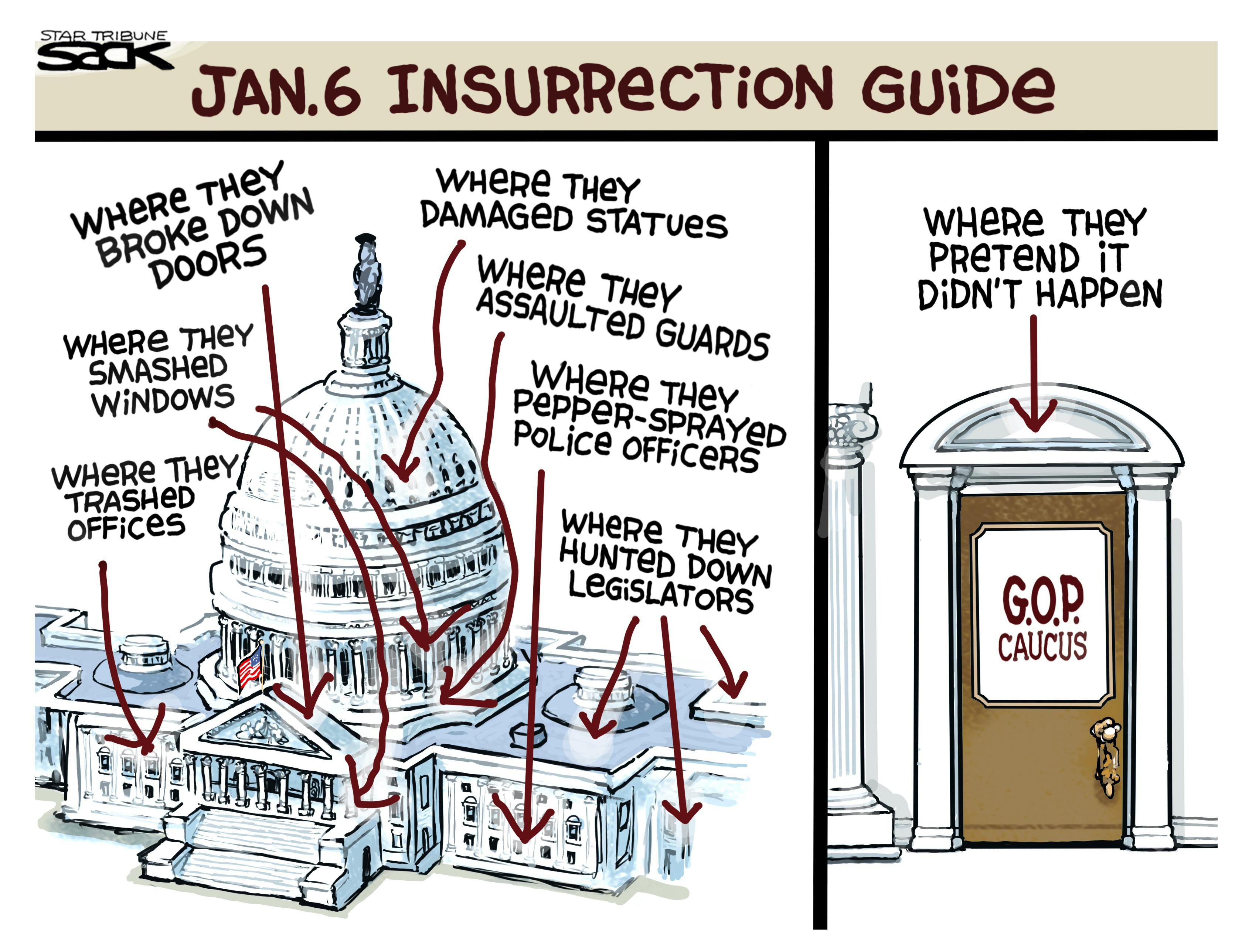
https://www.startribune.com/sack-cartoon-a-guide-to-the-jan-6-insurrection/600132658/

Meanwhile, the Maricopa County Elections Department put out a report that systematically went through all the conspiracy theories about the 2020 election in Arizona’s largest county, concluding

The November 2020 general election was administered with with integrity and the results were accurate and reliable. … The Elections Department followed all state and federal laws.

The report responds to the questions raised by the pro-Trump-biased Cyber Ninja election audit, typically concluding that the Ninjas were confused by their own ignorance of election law and the county’s voting systems, and that they then interpreted their confusion as evidence of nefarious activity.

We determined that nearly every finding included faulty analysis, inaccurate claims, misleading conclusions and a lack of understanding of federal and state election laws.

The Elections Department operates under the supervision of the Maricopa County Board of Supervisors, which has a Republican majority.

In other Arizona election news, the Cyber Ninjas are insolvent and are shutting down. I’ve gotta wonder what happened to the millions of dollars MAGA fans contributed to them.

and the pandemic

The vertical ascent in the new-cases graph continued this week. New cases are averaging 678K per day, more than tripling in the last two weeks. Hospitalizations have also turned upwards, but not as steeply: up 82% in two weeks, to roughly the same level as last January’s peak. Deaths have turned upward as well, but are nowhere near previous peaks: The seven-day average is 1674 now, compared to 1160 two weeks ago, but 2555 on September 22 and 3344 last January 16.

Those numbers remain hard to interpret: Many of the new cases will undoubtedly progress to hospitalizations or deaths in the coming weeks. But it also increasingly looks like the Omicron variant is somewhat milder than Delta. (Though possibly worse here than in Europe.) Unfortunately, the case-numbers are so huge that even smaller percentages turning serious will still produce a lot of serious cases. And 1674 deaths each day from a single disease is a toll that would have shocked us two years ago.

So it’s hard to answer the questions we all really want to ask: How risky is it to go to the grocery or eat in a restaurant or have people over for dinner? You’re more likely than ever to catch Covid, but maybe you’ll throw it off, especially if you’ve had three shots. Personally, I’m erring on the side of caution.


The really difficult question right now is when/whether to open the schools. I think there’s a broad consensus that distance learning didn’t work very well for a lot of kids, and that we should have had more in-person school last year. But now? With 600K+ new cases per day?

I can hear the debate inside my own head: “Wouldn’t it make sense to stay closed for a week or two until the surge passes?” “But everybody was saying ‘two weeks’ when we first closed the schools in March, 2020. How do we know that two weeks won’t turn into six months?”


NPR provides guidance on when and how to test.


On January 1, at least 800K unused Covid tests expired in a Florida warehouse. A state official explained: “We tried to give them out prior to that, but there wasn’t a demand for it.”

and the Supreme Court

which heard arguments about President Biden’s vaccine mandates, one applying to health care workers (including those at nursing homes), and the other to businesses with more than 100 employees.

You might think this should be just another note under the pandemic headline, but that’s not really what this case is about. The Court’s conservative justices have been looking for a chance to make a sweeping “nondelegation” ruling that cripples federal regulating agencies in general. Vaccine mandates are just an opportunity for six unelected judges — half appointed by a president who lost the popular vote — to remake American government.

In other words, the vaccine cases reach a Supreme Court that appears to be on the verge of reining in the ability of federal agencies to regulate any and all private conduct — a trend that has nothing at all to do with the Covid pandemic or the Biden administration’s responses to it.

In both situations, the law passed by Congress is clear:

Congress enacted the Occupational Safety and Health Act (OSH Act), which gives a similarly named agency — the Occupational Safety and Health Administration (OSHA) — sweeping authority to protect workers from health hazards. Among other things, Congress gave OSHA the power to issue binding rules that provide “medical criteria which will assure insofar as practicable that no employee will suffer diminished health, functional capacity, or life expectancy as a result of his work experience.”

Ordinarily, OSHA must complete a lumbering process that requires years of study and consulting with employers before it can hand down a new rule, but a provision of the OSH Act permits OSHA to issue an “emergency temporary standard” if the agency determines that “employees are exposed to grave danger from exposure to substances or agents determined to be toxic or physically harmful,” and that such a standard is “necessary to protect employees from such danger.”

If anything qualifies as an emergency, you would think that a plague killing over a thousand people a day would, especially given that several of the early outbreaks were in workplaces. So this is exactly the kind of situation Congress had in mind when it passed OSH in 1970 (and sent it to be signed by that flaming socialist Richard Nixon).

But not so fast. The OSH Act, like the founding legislation of most of the federal regulatory agencies, violates a principle that conservative jurists invented precisely for the purpose of wrecking federal regulatory agencies: nondelegation. According to the nondelegation doctrine, Congress violates the Constitution if it delegates too much of its power to agencies of the executive branch. So it doesn’t matter what OSH says, because it’s unconstitutional. Congress should have to pass a new law every time the country needs a new regulation — or at least a regulation that the Court’s conservative majority doesn’t like.

Have you seen what we have to go through to pass a law these days? Imagine needing to overcome a filibuster every time there’s a new carcinogenic food additive.

Ominously, Chief Justice Roberts drew attention to OSH being more than 50 years old. Recall that his main rationale for gutting the Voting Rights Act in 2013 was that “things have changed”, a legal principle I am unable to find in the Constitution. No wonder Vox’s Ian Millhiser believes

NFIB is likely to be a turning point in the right-wing Roberts Court’s relationship with the elected branches — and it could permanently disable the federal government’s ability to address crises like the Covid-19 pandemic in the future.

and electric vehicles

The day-long traffic jam on I-95 in Virginia drew my attention because I had driven that very stretch of road just a week before. But I was still surprised by where WaPo columnist Charles Lane took the story: into scare-mongering about electric vehicles.

If everyone had been driving electric vehicles, this mess could well have been worse. … It is a scientific fact that batteries of all kinds lose capacity more rapidly in cold weather, and that includes the sophisticated lithium-ion ones used by Teslas and other EVs. … Absent some breakthrough in mobile charging technology, out-of-juice EVs in out-of-the-way places will need a tow. If Monday’s nightmare had been an all-electric affair, they might have littered the highway for miles.

A few quick observations:

  • Dissing EVs is a hobby horse for Lane. He’s also done it here and here, where he described EV-skepticism as his 10-year “fixation”.
  • An electric-vehicle driver running the heater and wondering when his battery will die is in basically the same situation as a gas-powered-vehicle driver watching his fuel gauge go down.
  • Mobile charging doesn’t require a “breakthrough”. Systems “designed to be carried by a standard roadside-service truck” already exist, it’s just a matter of deploying them — which service stations should be eager to do as the number of EVs on the road increases. In the same way that a gas-powered car can be rescued with a single can of gas, and doesn’t require a complete fill-up, a stranded EV would just need enough juice to get to the next charging station rather than a time-consuming full charge. So in an I-95-type situation, one truck should be able to get many EVs moving again.
  • In the meantime, you can put your Tesla in neutral and push it into the breakdown lane, right next to all the cars that have run out of gas.
  • Lane waves off the popularity of EVs in frigid Norway, but his reasons for doing so are sketchy. For example, the link supposedly supporting his claim that Norwegian EVs are almost all second cars goes to a 2014 survey. Could anything possibly have changed since then?
  • As I know from driving my hybrid Accord, cold weather does have an effect on batteries, but it’s nothing to panic about. The cold also lowers the mileage of my gas-only second car.

I’m reminded of last February, when Texas Governor Greg Abbott blamed the collapse of his state’s electrical grid on green energy’s supposed inability to cope with cold weather, rather than his own free-market dogmatism. But somehow Wisconsin and Germany hadn’t noticed the same limitations.

The lesson I draw: Change is scary, so light-on-facts horror stories about the New often sound more convincing than they should. Remember when same-sex marriage was “presaging the fall of Western Civilization itself“?


Fascinating look at how Tesla was able to double its car production in 2021, while larger automakers often had to shut down plants for lack of key components:

When Tesla couldn’t get the chips it had counted on, it took the ones that were available and rewrote the software that operated them to suit its needs. Larger auto companies couldn’t do that because they relied on outside suppliers for much of their software and computing expertise.

and you also might be interested in …

The Webb Space Telescope has successfully deployed its mirror, which had been folded up to fit inside the launch vehicle. The unfolding in space required 178 separate release mechanisms to work, and they did.


The three men who lynched Ahmaud Arbery while he was out jogging were sentenced to life in prison. Only one of the three will be eligible for parole.


Notable deaths seem to come in clusters. This week: Sidney Poitier. There was a time in my childhood when Poitier was the only bankable Black actor. And of course, he only played characters that were specifically written as Black. The idea of a general-purpose Black movie star like Denzel Washington or Morgan Freeman, who might compete for any role not specifically written as some other race, was far in the future.

[W]ithout him, many filmgoers of previous generations might never have imagined an educated, Black authority figure.

Follow-up question: Who’s the female version of Poitier, or of Washington and Freeman?


What if you didn’t have to fund Fox News through your cable subscription? The goal of this campaign is to not to get cable systems to drop Fox, but to offer a Tucker-Carlson-free cable package that people can choose if they want.

Personally, I’d probably get the with-Fox package, because I think I need to keep an eye on the Right in order to do this blog properly. (Just this week, I wanted to check whether Sean Hannity was leading his show with the Sean-Hannity-tweet story that MSNBC was focusing on. He wasn’t. I didn’t watch the whole show, but Uproxx claims he never got around to mentioning it.) But I sympathize with the desire to know that your subscription money is not being used to promote White supremacy and knowingly spread disinformation.


Novak Djokovic appears to have won his battle with the Australian government. Today a judge ruled that he can enter the country without vaccination and play in the Australian Open.


As the son of a small farmer — I mean, he was 6’1″, but the farm was just 160 acres — I have mixed feelings about John Deere’s prototype “fully autonomous tractor“. Driving a tractor up and down the rows is repetitive and boring — exactly the kind of thing that an AI should be able to handle — but it’s also kind of peaceful and meditative. The idea that in a decade or two no one will do that job brings out the Luddite in me. Or maybe the John Henry.

Perversely, I think capitalism is about to achieve the Soviet vision of massive farms under unified management. It will happen not via worker collectives, but by eliminating the workers altogether.

and let’s close with a photo finish

I couldn’t pick which closing I liked better this week, so I’ll give you two of them. First, it must be great to be a panda cub rolling in snow for the first time.

But I can’t leave out an actual photo finish: the second annual Christmas Covid horse race.