Author Archives: weeklysift

Doug Muder is a former mathematician who now writes about politics and religion. He is a frequent contributor to UU World.

Imaginary problems, real laws, real victims

In red states, a barrage of new laws are diminishing freedom, violating parents’ rights, and mandating that schools teach conservative dogma. It’s not clear what real problems these laws are attempting to solve, but it is clear who’s being hurt.


This week, Tennessee passed a law banning drag shows in public spaces, or anywhere else they might be seen by children, and NBC reports that 15 states are considering similar laws. The state also passed a law banning gender-affirming medical care for minors, and permitting minors to sue their parents if the parents authorized such treatment. The Williams Institute at the UCLA School of Law says 15 states have either already passed similar laws or are considering them.

One proposed Florida bill goes even further: It legalizes a parent kidnapping a child from another state and bringing the child to Florida in order to “protect” the child from gender-affirming care, and orders Florida courts to ignore any other state’s child-custody rulings in such cases. [1]

A court may not treat a parent′s removal of a child from another parent or from another state as unjustifiable conduct or child abuse if the removal was for the purpose of protecting the child from one or more of the prescriptions or procedures referenced in paragraph (a) and if there is reason to believe that the child was at risk of or was being subjected to the provision of such prescriptions or procedures. … A court of this state has jurisdiction to vacate, stay, or modify a child custody determination of a court of another state to protect the child from the risk of being subjected to the provision of sex-reassignment prescriptions or procedures as defined in s. 456.001. The court must vacate, stay, or modify the child custody determination to the extent necessary to protect the child from the provision of such prescriptions or procedures.

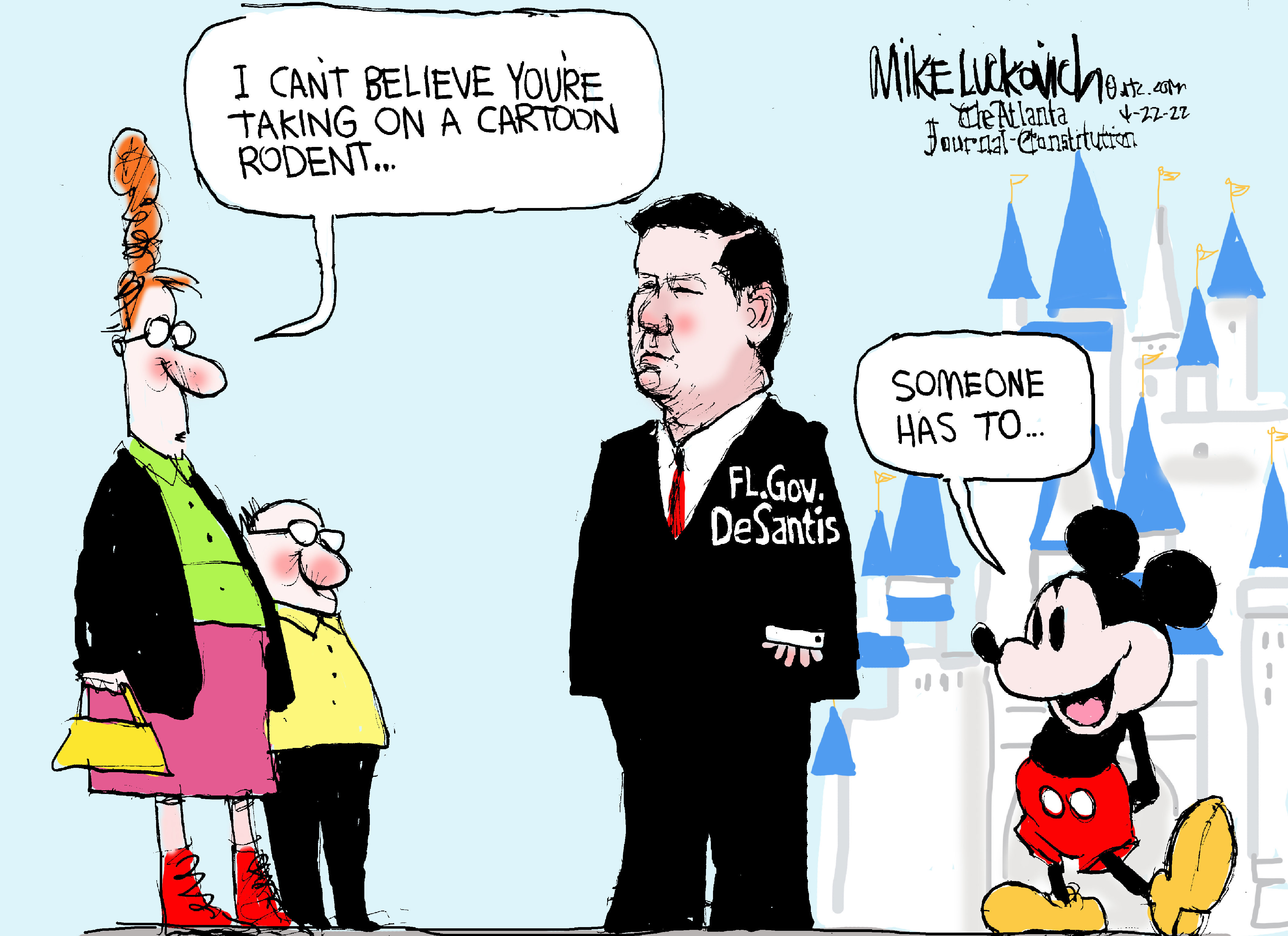
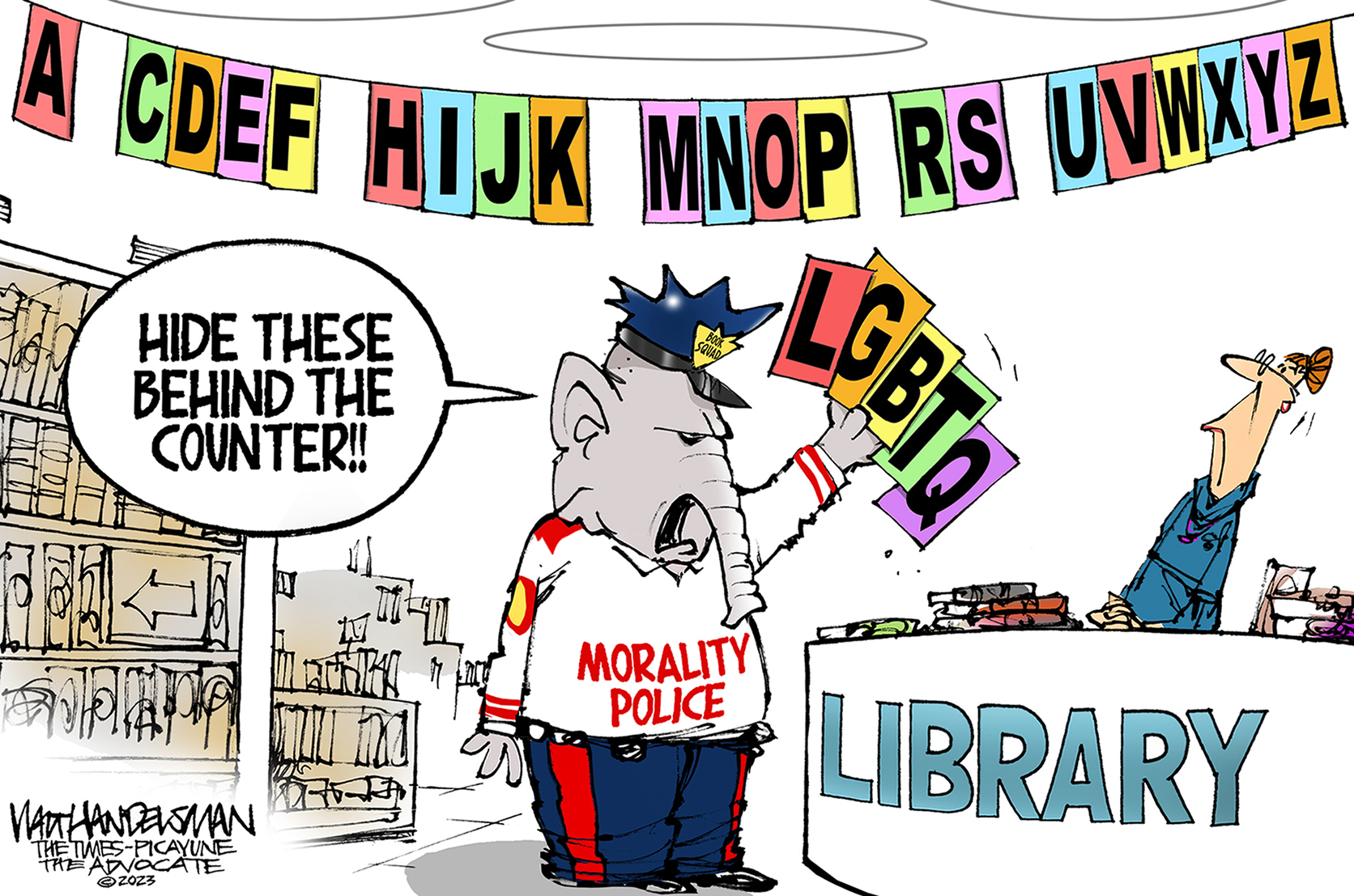
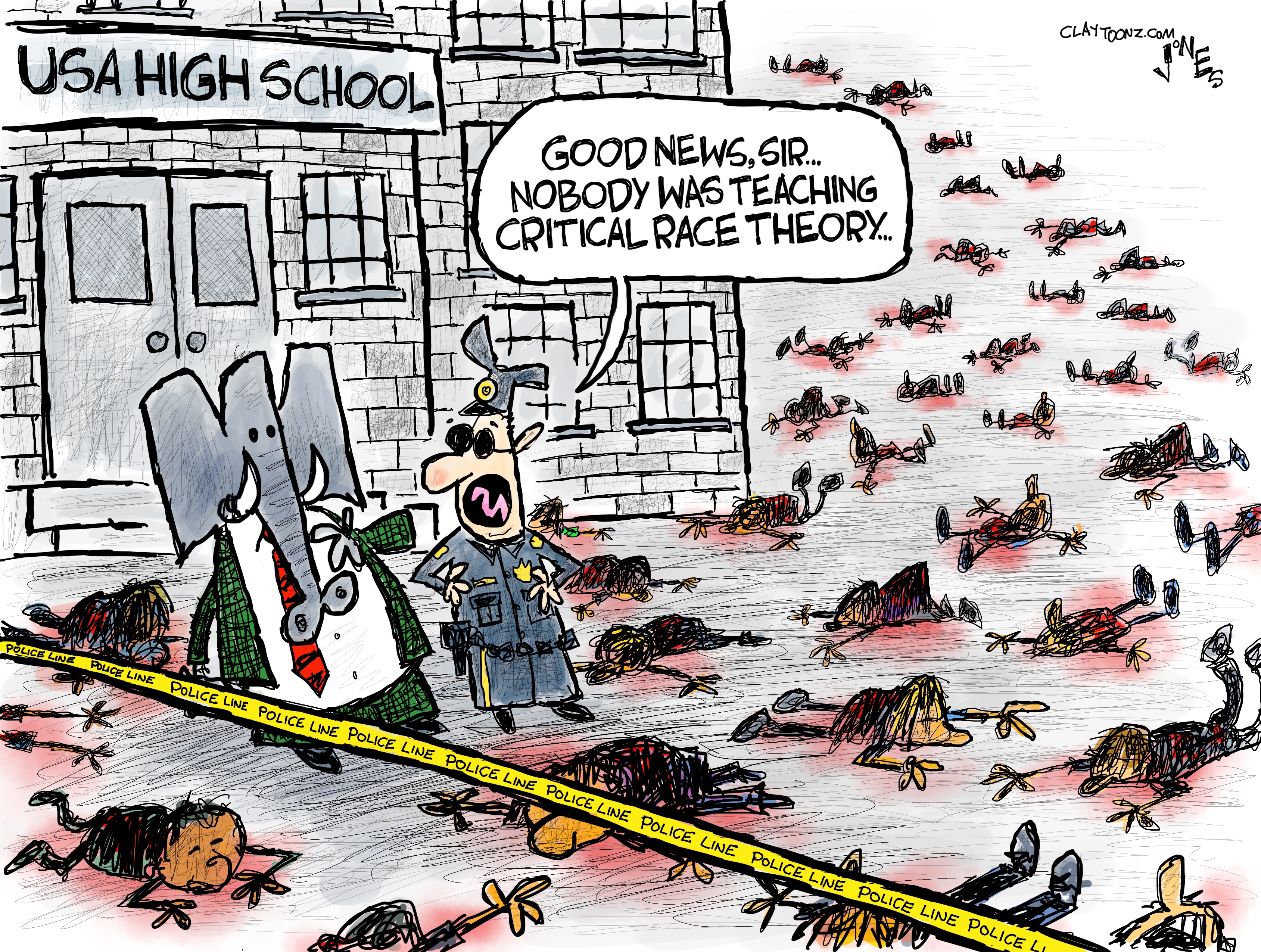
Last year, Florida’s legislature began an effort to turn its schools into indoctrination centers with the Parental Rights in Educationt Act (a.k.a. Don’t Say Gay) and STOP WOKE Act that banned the teaching of specific lists of ideas and caused entire counties to remove books from their classrooms. [2] Several states have passed similar laws, and a national Don’t Say Gay bill (the Stop the Sexualization of Children Act) has been introduced in the House. A new bill in Florida would expand the restrictions of Don’t Say Gay from third grade to eighth grade. [3] Another new bill would expand Governor DeSantis’ power to give ideological marching orders to the state universities.

In an administrative move, Alaska’s State Commission for Human Rights has downgraded “sexual identity and gender orientation” from the list of always-illegal bases for discrimination to the list of discrimination that is illegal “in some instances”. According to Pro Publica and The Anchorage Daily News

it began refusing to investigate complaints. Only employment-related complaints would now be accepted, and investigators dropped any non-employment LGBTQ civil rights cases they had been working on.

The onslaught of such legislation is so intense that I’m sure I’ve missed something important. But let’s take a closer look at a couple of these bills.

Controlling Florida’s universities. This year the top-down effort to control what is discussed in Florida’s K-12 classrooms is being extended into the state universities. (To a certain extent it was already there in STOP WOKE.) Governor DeSantis has used his administrative power to appoint a new board to govern New College in Sarasota, with the expressed goal of turning it into an academic center of right-wing ideology similar to Hillsdale College in Michigan, which is privately funded and explicitly Christian. [4]

A bill currently in the legislature would impose similar controls on the state university system as a whole: It adds a new mission to the university system “the education for citizenship of the constitutional republic”. [5] It instructs each “constituent university to examine its programs for the inclusion of any specified major or minor in critical race theory, gender studies, or intersectionality or any derivative major of these belief systems, that is, any major that engenders beliefs in those concepts defined in [STOP WOKE]” and to submit documentation of “the university’s process to remove from its course catalogues any specified major or minor” in the same subjects.

Each university’s board is empowered to review the tenure of any faculty member at any time, and power to appoint new faculty members is centered in the board, which is explicitly “not bound by recommendations or opinions of faculty or other individuals or groups”. No money — not even private donations — can be used for any programs that “that espouse diversity, equity, and inclusion or critical race theory rhetoric”.

Previously established programs at University of Florida and Florida State are now expanded into “colleges” that can hire faculty and enroll students. These colleges appear to have a Hillsdale-like purpose resembling the ideological mission DeSantis has given New College.

This bill so far has just been filed and the legislature has taken no action, but it looks serious. Similar bills are filed in both the House and Senate, and it seems like a fulfillment of DeSantis’ previous statements. Inside Higher Education says:

The bill mirrors much of the governor’s recent rhetoric and revisits draft legislation from DeSantis that never made it into the 2022 legislative session.

Tennessee’s anti-drag law. This one leaves me (and, I suspect, a lot of other people) shaking my head. Men dressing as women is a comic trope that goes back more-or-less forever. Shakespeare is full of gender-switching roles, and if you go back far enough, every female role was played in drag, as putting women on the stage was considered inappropriate.

Governor Bill Lee himself (who signed the bill) dressed in drag for his high school yearbook, something he has dismissed as a “lighthearted school tradition” that bears no resemblance to the “obscene, sexualized entertainment” the law restricts.

But if that’s true, his critics argue, then why is a new law necessary? Tennessee already has laws against obscenity and public indecency. So what is it about cross-dressing that should bring additional rules into play? If an act is too pornographic for male or female impersonators to perform in front of children, does it become OK if the performers wear gender-appropriate costumes instead? Conversely, if a dance routine is acceptable for, say, the Tennessee Titan cheerleaders (who I assume are women) would it suddenly become obscene if it were performed by a man wearing the same outfit?

Like the Florida education laws, the anti-drag law takes advantage of vagueness. In the key phrase “male or female impersonators who provide entertainment that appeals to a prurient interest”, the term “prurient interest” is never defined, and is largely in the eye of the beholder. (Do the Titan cheerleaders “appeal to a prurient interest”? Sometimes, I guess, maybe. I’m not sure.) The upshot of that vagueness is that promoters will be afraid to schedule drag shows, no matter how benign their content might be. Similarly, Florida teachers and professors are afraid to say anything about race or gender. Nobody wants to be sued, even if they believe they would ultimately win.

Conversely, vagueness gives conservatives cover: Ron DeSantis can deny that he told any teacher or librarian to ban any particular book. All he did was sign a law that might get them fired or sued if they leave the wrong books on the shelf.

The issue of “obscene, sexualized” drag shows also demonstrates a common propaganda technique: Something widely considered unsavory or disreputable becomes a special problem requiring special action when an out-of-favor group does it. The classic example is how the Nazi newspaper Völkischer Beobachter focused on the issue of “Jewish crime”. Jews are people and people commit crimes, so the VB didn’t have to invent Jewish crimes (though it probably exaggerated a few). The propaganda element was the implication that “Jewish crime” was a special problem that needed a special solution, as opposed to just better law enforcement generally.

In the 1980s, there was a national panic about gay high-school teachers seducing their students, as if this problem had nothing to do with straight high-school teachers seducing their students. More recently, the Trump administration ran the Nazi play almost move-for-move when it established the Victims Of Immigration Crime Engagement Office (VOICE), as if the victims of crimes by undocumented immigrants were somehow different from other crime victims.

This shouldn’t need to be said, but clearly it does: It is not a crime for a man to cross-dress. And an otherwise legal action should not become a crime if a cross-dressing man does it. So there is no need for a special law.

Why now? To my knowledge, there has been no drag-queen crime wave. So why do legislators in 15 states find it necessary to pass anti-drag laws their states never needed before? The answer has more to do with changes in Republican politics than changes in American society.

The elections that have followed Donald Trump’s yuge 2020 defeat [6] have given Republicans a lot to think about, both positive and negative.

Negatively, they have learned that a pure backward-looking Trumpism weighs down their candidates; it only works in places where a more traditional Republican would win easily. In New Hampshire, for example, a Reagan/Bush Republican like Chris Sununu won the governor’s race by over 15%, while MAGA Republican Don Bolduc lost the Senate race by over 9%. Arizona’s 2022 Republican candidates were all-in on election denial, and got swept by the Democrats. Candidates closely identified with Trump lost winnable Senate races in Pennsylvania (Dr. Oz) and Georgia (Herschel Walker). And while J. D. Vance did win in Ohio, he ran well behind the far less Trumpy Republican Governor Mike DeWine, who cruised with a 25% victory margin.

More positively, in 2022 crime and inflation were issues Republicans could win congressional races on. But that’s a lesson with a limited shelf life, given that Republicans have no policies to address either one, and inflation is likely to fade on its own by 2024.

But Republican wins in two governors’ elections stand out as possibly repeatable examples: Glenn Youngkin’s 2021 victory in Virginia and Ron DeSantis’ 2022 Florida landslide. Both largely ignored typical kitchen-table issues like jobs or health care to focus on a much vaguer anxiety about our changing society. Both talked a lot about education, but not in the usual sense of raising test scores or creating opportunity. The next generation needs protection, they claim, but not against observable threats like mass shootings or scientifically predictable threats like the looming catastrophes of climate change. Instead, the villains of this narrative are undefinable boogeymen like “critical race theory” and “wokeism”.

In essence, CRT and Wokeism, like “cancel culture” and “political correctness” before them, are Rorschach tests: If you are afraid of some societal trend, you see it those shapeless blobs.

And if you poke at any of that too hard, you have to invent conspiracy theories with improbable villains: Teachers are conspiring to turn your kids gay or make them hate America. Parents are pushing gender changes onto their children, who go along because everybody else is doing it. Rich Jews are convincing Guatemalans to leave perfectly fine lives so that they can steal jobs from all the good Americans who want to clean our toilets and pick our tomatoes.

Why drag queens? Back in 2015, when famous Olympic champion Bruce Jenner came out as trans and announced a new name, Caitlyn, I introspected and got philosophical about my own discomfort. (In hindsight, that article is clumsy in a lot of ways, because I still had a lot to learn. But I stand by the flow of ideas.) In essence, I decided, I was responding to my own insecurity and denial. The human mind can’t handle the task of conceiving the Universe as it is, so we collect real objects into categories and treat similarly categorized objects as if they had a unity they don’t actually have. Hence man/woman, Christian/Muslim/Jew, gay/straight, rich/poor, Black/White/Asian/Hispanic and so on. But all those categories are just arbitrary markings on a continuum. Deep down we know we’re telling ourselves a story, and that knowledge makes us anxious.

If you think seriously about how flawed the fundamental building blocks of our thinking are, it’s scary. At any moment, some part of the Universe you’ve been assuming away could come back to bite you. That’s the human condition.

That’s why we get such an oogy feeling whenever we see an example of something we were raised to think didn’t exist: an effeminate man, two women kissing, a child with dark brown skin and frizzy red hair. It’s a reminder that we don’t really grasp the Universe; we just apply kludgy notions that more-or-less work most of the time.

… At its root, social conservatism is a way to deny that fear and transmute it into anger. Conservatism reassures us that the categories in our heads are real. We didn’t make them up; God created them. They’re natural.

Drag is specifically designed to get into the boundarylands where our usual categories fail. The illusion is designed to be imperfect. A man who managed to be indistinguishable from Liza Minnelli might as well be Liza Minnelli; he wouldn’t be doing drag any more.

That lingering in the boundrylands is precisely what many people find scary about drag: It points out that while your sexual organs are real, your gender is a performance that could fall anywhere on a continuum from he-man to girly-girl. The people you meet are not necessarily one thing or the other. The world is more complicated than you usually allow yourself to realize.

But that boundaryland experience is also why some parents want to take their children to drag shows. (And why it’s a violation of freedom for Tennessee to tell them they can’t.) Some children may want to be told what their roles in society are, so that they can get on with learning to play them. But others experience the most common roles as oppressive. Seeing someone smash through those roles demonstrates that life holds more possibilities than just the obvious ones. It’s liberating.


[1] I often warn people not to get upset about bills that have no chance to become law. This bill might be in that category, but I can’t tell yet: It has only one sponsor, who introduced it this week. No committee has heard it or voted on it. Even if the bill passes, I suspect there are constitutional issues here having to do with the Full Faith and Credit Clause.

[2] DeSantis insists this is a “fake narrative”. Of course he does.

[3] Think about what that means. By eighth grade, students often know (or at least strongly suspect) who in their class is gay or trans or contemplating a gender transition, and bullying is already well underway. Under the proposed bill, it would be illegal for teachers or administrators to recognize potential problems or take steps to deal with them through classroom instruction. Any effort to teach 14-year-olds to accept or tolerate one another’s gender identities or sexual preferences would be illegal.

The same bill would also declare — as a matter of state law — that “it is false to ascribe to a person a pronoun that does not correspond to such person’s sex” which is “an immutable biological trait”.

[4] DeSantis-appointed trustee Chris Rufo (arguably the architect of the crusade against “critical race theory”) is very explicit about his goals:

We will be shutting down low-performing, ideologically-captured academic departments and hiring new faculty. The student body will be recomposed over time: some current students will self-select out, others will graduate; we’ll recruit new students who are mission-aligned.

I went to a state university (Michigan State) in the 1970s. Michigan had a Republican governor at that time, but I don’t recall ever having to worry that I might not be “aligned” with his “mission” for the university, or that any member of the university’s governing board was hoping I might “self-select out” because of my political views. This kind of ideological repression is new in America.

Today’s NYT notes a similar ideological battle over North Idaho College, which may lose accreditation as a result.

[5] That mission may sound benign until you realize how it’s going to be defined and interpreted. “Performance metrics and standards” for achieving such goals are to be part of a strategic plan the law instructs the DeSantis-appointed Board of Governors to write. Previously, the missions of the university system were apolitical ones, like “the academic success of its students”.

[6] Even reality-respecting Republicans who don’t claim massive fraud in 2020 often falsely portray the 2020 election as close. But it wasn’t. In terms of raw vote totals, Trump came within 500 votes of breaking Herbert Hoover’s record for the biggest loss ever by an incumbent president. Trump was 7,059,526 votes behind Joe Biden, while Hoover lost to Franklin Roosevelt in 1932 by 7,060,023 votes.

The Monday Morning Teaser

The state laws are coming at us so fast I’m having trouble keeping up. Banning drag shows and gender-affirming medical care, taking over state universities, creating official state ideologies, making bloggers register and report to the state, and even (in one case) proposing to de-certify the Florida Democratic Party. It’s hard to know what to protest, what to pay attention to, and what to write off as a distraction.

In this week’s featured post, I’ll try to sort things out and give some explanation of why it’s all happening now. (After all, drag shows weren’t invented yesterday.) That needs a lot of work yet, so I don’t expect to post it before 11 EST.

The weekly summary will cover the revelations that continue to spill out of the Dominion Voting Systems lawsuit against Fox News, other recent examples of right-wing propaganda, the continuing farce that Jim Jordan’s committee has become, and a few other things. That might not show up until around 1.

Speech and Understanding

It’s almost gotten to be boring, the degree to which people believe that what they refer to as “free speech” should not only allow them to say whatever they want (which it does), but should also prevent other people from understanding them to be the sort of person who says those things.

– A. R. Moxon “The Case for Shunning

This week’s featured post is “MTG’s dream deserves a serious response“.

This week everybody was talking about the first anniversary of the Ukraine War

One year in, a few conclusions are obvious:

  • It’s amazing that Ukraine, with material help from the NATO countries, is still standing. The Ukrainian military has performed better than anyone expected and the Russian military worse.
  • Sanctions have not been as crippling to the Russian economy as many expected.
  • NATO has been far more united and resolute than most expected. President Biden deserves a lot of credit for this.
  • So far, military failure has not loosened Vladimir Putin’s hold on power in Russia.

In general, I’ve been surprised by the optimism many observers expressed this week about Ukraine’s position. A long war usually turns into a war of attrition, which favors the larger country. (I keep thinking about the American Civil War. Early in the war, Lincoln’s generals maneuvered to preserve their army. But Grant understood that he had reserves to draw on and Lee didn’t, so battles that decimated both armies were actually victories. It was a horrible vision, but ultimately a successful one.)

The countervailing view is that Ukraine has now seen what Putin intends: to utterly destroy Ukrainian society. So they are motivated in a way that Russian troops aren’t. One apocryphal Sun Tzu quote says that you should “build your opponent a golden bridge to retreat across”. But Putin has left Ukrainians nowhere to retreat to, and so they will keep fighting as long as it takes.

The optimists say that Russia has sustained enormous casualties during its recent offensive and has gained little. So they’re expecting a successful Ukrainian counter-attack to begin sometime during the spring months.


All across Europe, people helped Russian diplomats mark the anniversary: In The Hague, a portable barrel organ sat on the sidewalk outside the Russian embassy and played the Ukrainian national anthem. In Berlin, somebody plunked a disabled Russian tank in front of the embassy.

and the East Palestine derailment

On February 3, a Norfolk Southern train that included 20 cars of hazardous chemicals derailed near East Palestine, Ohio. Wikipedia has the basic facts, and I’m way late in covering this. (I missed it two weeks ago, and then took a week off.) So I’m going to focus on interpretation and reaction.

Basically, the only three things worth paying attention to are

  1. The Past. Could either the railroad or its government regulators have prevented this?
  2. The Present. Are the people affected by the derailment getting the kind of help they need?
  3. The Future. What practices or regulations need to change to keep more stuff like this from happening?

Anybody who talks about the derailment without addressing one of those three questions is just playing political games. For example, Ukraine has nothing to do with any of those questions, so if somebody tries to link Ukraine and East Palestine together, they’re wasting your time and trying to bamboozle you. (I’m looking at you, Josh Hawley.) And the attempt to use suffering of working-class White people to increase racial resentment is just despicable.

About the present, I don’t know what to say. Obviously, after a disaster like this, the people affected have conflicting urges: They want to go home, get back to normal, and be safe. So when to let them restart their normal lives involves a lot of technical questions about testing and balancing long-term risks that I can’t answer. We may not know for years whether those judgments were made well. It’s also too soon to tell what kind of remediation the area will need and where the funding will come from. (I want to see Norfolk Southern pay the brunt of it, though I doubt it will.)

If someone believes the people of East Palestine (and downstream communities) won’t get the help they need, they should make a proposal for help and see if anyone actually opposes it. Any vague they’re-all-against-you talk, though, is just demagoguery.

Long-term, I think the main lesson to be learned from this disaster is that government needs to regulate business. Every year or two I see another study totaling up some awesome quantity of money that government regulations “cost” the economy. ($1.9 trillion a year, according to the Competitive Enterprise Institute.) Typically, these studies list every dollar companies spend to avoid killing people and poisoning the land — and they completely ignore the benefits of companies not killing people and poisoning the land. (If it really does cost us $1.9 trillion each year to avoid living in a post-apocalyptic hellscape, that sounds to me like money well spent.)

The Obama administration tried to require railroads to improve their braking systems. (A better technology has existed for decades.) It also wanted to strengthen cars that carry hazardous materials, so that they’d be less likely to rupture in an accident. But the industry claimed that installing the new systems would be too expensive, so the regulation was never implemented. The Trump administration then reversed course and slashed railroad regulations — because, you know, regulations just get in the way of corporations who otherwise would always do the right thing.

There’s still debate over whether the Obama regulations might have prevented the East Palestine disaster. (Ironically, the claim that they wouldn’t have rests mainly on the idea that Obama’s regulations weren’t sweeping enough, and so might not have applied to a train that was only partly a hazardous-chemical train.)

Another issue is whether trains like this need more crew to spot problems sooner and take action. This was a major issue in last year’s union dispute, where Congress and the Biden administration averted a national strike by imposing a settlement. The East Palestine train had only two crew members and a trainee to handle 141 freight cars. Is that enough?

What shouldn’t be under debate is that trains could be made much safer, if we only had the will to do so. The people of East Palestine didn’t lose political battle with Ukraine or Black people, they lost a political battle with railroad lobbyists. So Josh Hawley’s statement is easy to fix:

I would say to Republicans: You can either be the party of Ukraine corporate lobbyists and the globalists deregulation, or you can be the party of East Palestine and the working people of this country.

and Fox News

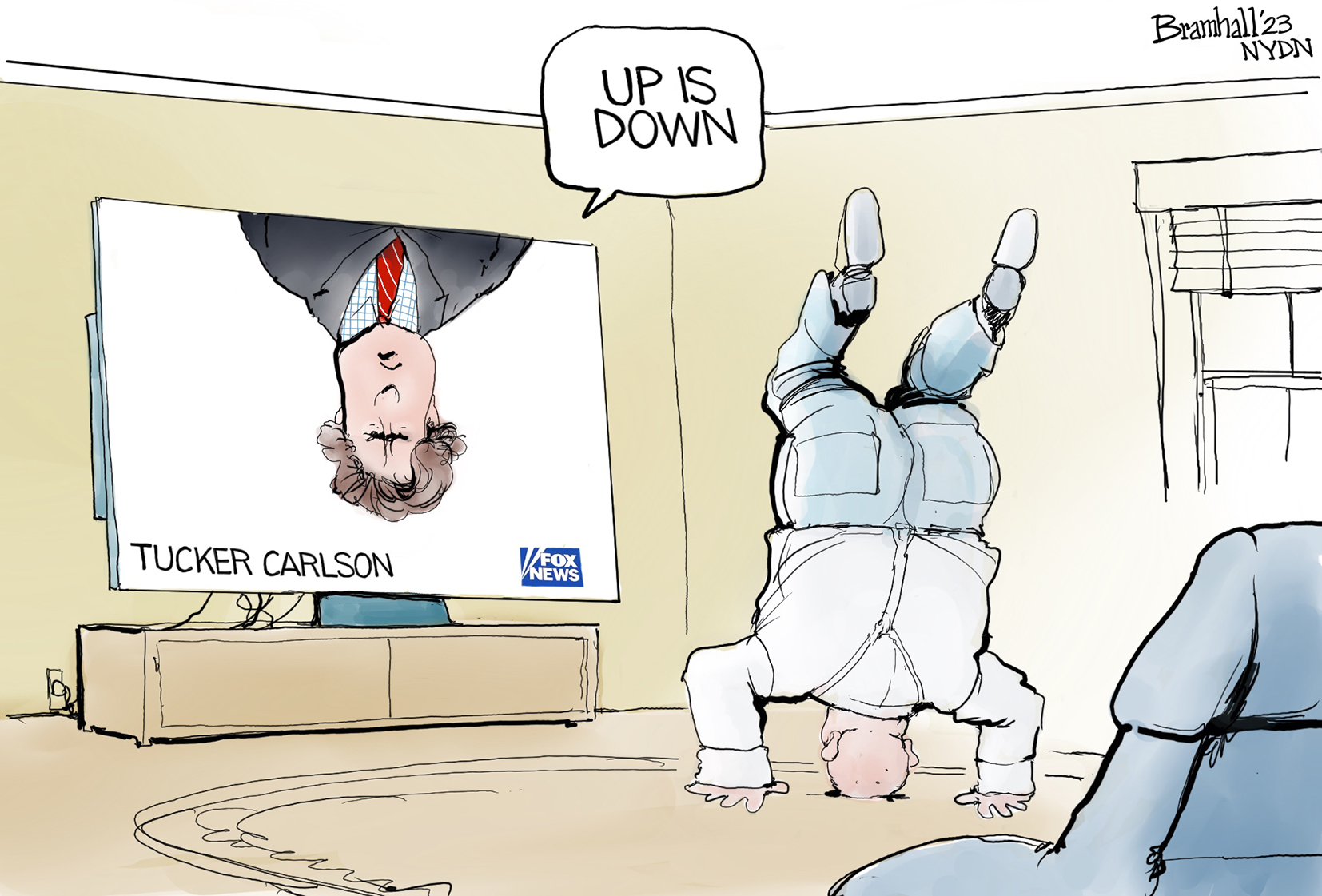
The text of the Dominion Voting Systems lawsuit against Fox News came out, and it is devastating. The claim, which is supported in detail by internal Fox communications, is that Fox knew Trump’s claims about Dominion voting machines stealing the election for Biden were false; but it promoted them anyway because it was afraid of losing viewers to Newsmax. All the major Fox hosts — Tucker Carlson, Laura Ingraham, Sean Hannity — were telling each other how ridiculous the claims were, even as their shows pushed them out to viewers.

It’s been clear for decades that much of Fox’ coverage is ridiculous and/or false. But there’s always been a debate about its authenticity: Do the hosts actually believe the crazy theories they peddle, or are they consciously duping their viewers? Now we know the answer: They don’t believe what they’re saying, and are just taking advantage of their viewers’ ignorance and gullibility.

For years, one constant Fox drumbeat has been to tell its viewers “The elites are laughing at you.” That is the root grievance that animates just about every segment of every show. But now we know that it is really Carlson, Ingraham, and Hannity who are laughing at their viewers.


Speaker McCarthy has turned all the January 6 security-camera footage over to Tucker Carlson. We already know that Carlson is dishonest (see above), so what he will do with the video is predictable: He will selectively edit it to spin some conspiracy theory that vindicates the pro-Trump mob. When he does this, no one in the legitimate news media will have any way to check the choices he made: What if you look at the scene from a different angle, or watch a longer clip of the same video?

Jamie Raskin has it exactly right: “If you want to make tens of thousands of hours publicly available, then it should be available for all media, not for just one propaganda mouthpiece.”

Of course, the better decision is not to release it at all. Anyone with access to this video will know where all the Capitol’s security cameras are, and can observe in detail where the weak spots in Capitol security were on January 6.

and The New York Times

Fox isn’t the only news site that’s been under fire recently. A week ago Thursday, 200 NYT contributors signed an open letter protesting the paper’s treatment of transgender issues. Several examples are given of the basic charge, which is that the Times has repeatedly laundered the talking points of anti-trans hate groups, turning them into front-page articles, which are then quoted by legislators pushing trans-oppressing bills.

A supporting letter endorsed by numerous LGBTQ-supporting organizations was written by GLAAD.

It is appalling that the Times would dedicate so many resources and pages to platforming the voices of extremist anti-LGBTQ activists who have built their careers on denigrating and dehumanizing LGBTQ people, especially transgender people. While there have been a few fair stories, mostly human interest stories, those articles are not getting front-page placement or sent to app users via push notification like the irresponsible pieces are.


Those letters point to a broader problem: Because national news sources like the NYT, Washington Post, and CNN hate to be characterized as “the liberal media”, conservatives can work the refs to get undeserved attention and credibility for right-wing talking points.

A case in point, this one about race rather than gender: Wednesday the WaPo published an opinion piece: “I’m a Black physician, and I’m appalled by mandated implicit bias training” by Marilyn Singleton.

If you just stumbled onto this article cold (as I did), you might imagine that a female Black doctor with no particular political ax to grind found herself in implicit-bias training and was appalled by what the trainers tried to teach her. That would certainly be an opinion worth hearing.

But if you read the article thoroughly and google up some relevant context, a completely different picture emerges. Singleton is not just a doctor, she’s a politician who ran for Congress in 2012 on a platform opposing the Affordable Care Act. (Her argument, expanded at length in Med City News, was that people’s poor health is primarily due to their own bad habits, which government can do nothing about.) She’s also a contributor for the right-wing Heartland Institute, which is part of the Koch network, and whose top issue is climate change denial. Singleton’s contribution to Heartland was an article protesting the “big government” response to Covid-19, promoting hydroxychloroquine as a “potentially lifesaving drug”, and describing barriers preventing its use against Covid (barriers that turned out to be entirely justified) as “appalling and unforgivable”.

And then (in paragraph 9 of her WaPo article) it turns out that Singleton has not in fact taken implicit-bias training.

I am so disturbed by the state’s mandate that, so far, I have balked at the training.

That admission comes after multiple paragraphs in which she has explained — entirely on her own authority, without reference to any training documents, trainer statements, or trainee accounts — the training’s “malignant false assumption” and “basic message”, as well as characterizing it as a “racially regressive practice”. But how does she know these things about a training she’s never taken?

In short: a right-wing activist who has no actual experience of implicit-bias training repeats right-wing talking points about it. And for some mysterious reason, this entirely predictable set of opinions deserves prominent placement in The Washington Post.

Worse, the only warning WaPo offers its readers that they are about to be propagandized is: “Marilyn Singleton is a board-certified anesthesiologist and a visiting fellow at the medical advocacy organization Do No Harm.” Again, you have to do your own googling to figure out what this means: Do No Harm is a right-wing organization focused on opposing “critical race theory” as it applies to medicine. Its FAQ defines CRT as “a divisive ideology that attributes all societal problems to racism”, an opinion I have never heard expressed by an actual anti-racism advocate.

and culture war battles

You know those conservative white guys who get seriously offended when someone implies they might be racists? Well, here’s a great example: Scott Adams, creator of Dilbert. In this clip (starting at about the 16 minute mark), he explains his new strategy for dealing with Black people:

I would say, based on the current way things are going, the best advice I would give to White people is to get the hell away from Black people. Just get the fuck away. Wherever you have to go, just get away, cause there’s no fixing this. … So that’s what I did. I went to a place with a very low Black population. … I’m going to back off from being helpful to Black America, because it doesn’t seem like it pays off. Like, I’ve been doing it all my life, and the only outcome is I get called a racist.

Really, Scott? That’s so unfair, that anybody would call you a racist. Clearly there’s not a racist bone in your body, and I’m sure Black America is really going to miss all your sincere helpfulness.

Sarcasm aside, that’s probably the last you’ll see of Dilbert for a while. Just about every newspaper in the country is dropping it. Adams’ statements are part of an hour-long post to his own YouTube channel — not an open-mic moment or somebody recording a drunken ramble on their iPhone — so clearly he planned his transformation into an anti-woke martyr. We’ll see where he takes it from here.

If you’re wondering what inspired Adams’ rant — other than maybe a desire to headline at CPAC or get Trump to say nice things about him on Truth Social — the Reframe blog explains:

There’s a saying that is very popular among white supremacists and neo Nazis and other far right bigots, and that saying is this: “It’s OK to be white.” It’s a catchphrase of theirs, which tries to position people deemed “white” as an oppressed minority, which they are not, instead of an artificially created privileged class, which is what they are.

And there’s a right-wing polling company called Rasmussen, who decided, for some reason they’d probably like us all to pretend is unknowable, to ask people whether or not they agree with the statement “it’s OK to be white”—which is, again, a well-known catchphrase among white supremacists.

Apparently only about half of Black Americans polled agreed with the phrase, which is a pretty high level of acceptance for a well-known white supremacist catchphrase, and which probably only shows the degree to which Black Americans are aware that this is a catchphrase among white supremacists.

Dilbert creator Scott Adams got into the crosstabs and found this little tidbit, and proceeded to have a decidedly non-skeptical meltdown about it. He decided to not know that “it’s OK to be white” is a white supremacist catchphrase (or at least not to mention it), and proclaimed that this result meant that Black people are a hate group, and advocated that white people stay the hell away from Black people, and he said some other racist things, too, which is the sort of thing he does from time to time.


Governor Bill Lee’s signature is all that Tennessee needs to be the first state to ban drag performances “on public property” or “in a location where [it] could be viewed by a person who is not an adult.” SB 3, which has passed both houses of the legislature, lumps drag shows in with other “adult cabaret” performances.

“Adult cabaret performance” means a performance in a location other than an adult cabaret that features topless dancers, go-go dancers, exotic dancers, strippers, male or female impersonators who provide entertainment that appeals to a prurient interest, or similar entertainers, regardless of whether or not performed for consideration;

The law follows the pattern of other recent repressive laws in red states, in that its vaguely defined terms seem intended have a chilling effect on a wide variety of activities. For example, what exactly does an impersonator have to do to “appeal to a prurient interest”? The law does not say. Is simply standing around in a showgirl costume enough? And is any trans person a “male or female impersonator” under Tennessee law? Suppose a trans woman headed for a night out wears something slinky (but no different from what another woman might wear). If she walks down a public sidewalk, she could be breaking the law.

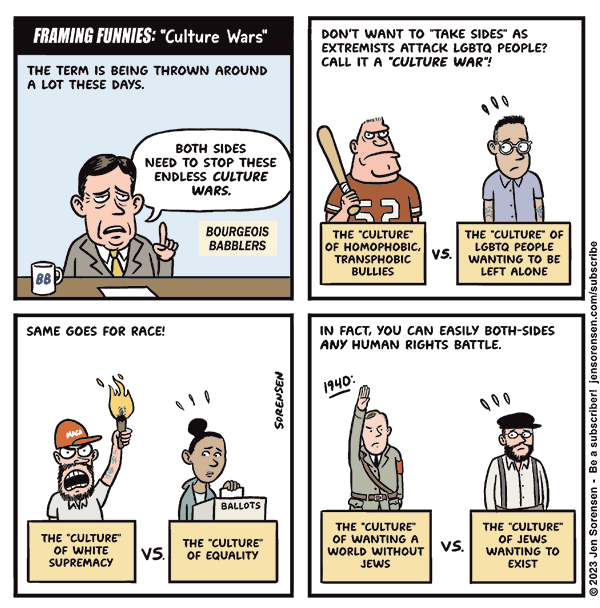
Conservatives are supposedly for local rights, but cities and towns are forbidden to have their own standards. They’re supposedly for parental rights, but parents who want their child to see a drag show can’t. They’re all for the First Amendment when it protects Nazis on Twitter, but not here.

Rep. Justin Jones from Nashville knew he couldn’t win the vote, but he could call out the hypocrisy:

If we want to talk about what is seriously harmful to children, let’s have a bill to ban children from going to these Bible camps where they’re being sexually assaulted with the Southern Baptist Convention. Let’s go after real threats to our youth. Let’s go after the predatory behavior in your own districts, clergy in your own congregations, harming youth. Weekly we read about this in the news, my colleagues.

That’s a statistic somebody needs to tabulate: How does the number of kids sexually assaulted by drag queens compare to the number sexually assaulted by ministers?


Another recent culture-war hoo-hah has to do with the publisher editing children’s books by the late Roald Dahl to eliminate a few words and phrases that present-day readers might find offensive, like saying that Augustus Gloop (in Charlie and the Chocolate Factory) is “enormous” instead of “fat”.

The changes have drawn objections from a wide range of critics, left and right. (The objection that most resonates with me is that the people making these changes are exactly the kinds of adults Dahl liked to make fun of.)

But whether you like or don’t like the changes, let’s attribute them to the right source: As with the great Dr. Seuss uproar of 2021, this isn’t primarily a political-correctness thing; it’s just capitalism. Helen Lewis nails it:

The Dahl controversy will inevitably be presented as a debate about culture—a principled stand in favor of free speech versus a righteous attempt to combat prejudice and bigotry. But it’s really about money. I’ve written before about how some of the most inflammatory debates, over “cancel culture” and “wokeness,” are best seen as capital defending itself. The Dahl rewrites were surely designed to preserve the value of the [intellectual property] as much as advance the cause of social justice.

Some government agency demanding these changes would be a completely different issue. It would even be different if some left-wing group were threatening a boycott. But this is just brand protection, and apparently it’s going to lead to a New Coke/Classic Coke outcome.

In general, I stand by what I said two years ago:

What should be done about [dated phrases and illustrations] depends on what you want Dr. Seuss to be in 2021. If he’s to be a historical figure — a leading children’s-book author of the mid-to-late 20th century — then his work should speak for itself. Leave it alone, and organize a conversation around it, as HBO Max did when it briefly withdrew and then re-launched Gone With the Wind. …

But if Theodore Geisel’s legacy is supposed to be timeless — [his widow’s] vision — if his work is supposed to live through our era and beyond, then it needs to be curated. Parents and grandparents should be able to trust the Dr. Seuss brand. When you sit down to read to your four-year-old, you should be able to pick up a Dr. Seuss book without worrying that you might put something bad into a developing mind.

People can reasonably disagree about how to curate beloved children’s literature of the past. But if you argue that the texts should be left alone, you’re turning them into museum pieces. Over time, more and more parents will do the curation themselves by not introducing their children to authors they see as problematic.

Becoming seldom-read historical figures may or may not be what authors would prefer, if that’s what it takes to preserve their original texts. But turning popular works into historical artifacts is definitely bad for business.

and you also might be interested in …

A week ago Friday, newly elected Senator John Fetterman checked into a hospital to get treatment for his clinical depression. His office is talking in terms of weeks, not days.

Fetterman had a serious stroke not long after winning the Democratic senatorial primary, and has lingering effects related to understanding spoken words. He stayed in the race in spite of the stroke and won his seat last fall. According to stroke.org

Depression is a common experience for stroke survivors. It’s often caused by biochemical changes in the brain.


Experts keep going back and forth about whether the Covid-19 pandemic started through natural transmission from animals or leaked out of a laboratory. The Department of Energy now believes (with “low confidence”) that it was a lab leak, though several other government agencies still disagree.

Whichever way you go on this question, it’s important not to jump to the conclusion that the virus was constructed rather than naturally-occurring. Among scientists, even lab-leak proponents overwhelmingly believe the lab was collecting viruses for study rather than building them.


The Southern Baptist Convention is kicking out Saddleback Church, the megachurch founded by best-selling author Rick Warren. Saddleback’s crime? It named a woman to its pastoral team. When Warren retired as lead pastor last fall, he named Andy Wood as his successor. Andy’s wife, Stacie Wood, became a “teaching pastor” at the same time. That breaks the SBC’s rules.

Keeping women out of the ministry is one of those rules that can only be enforced strictly. Because once your people see their first woman minister, it will be obvious to most of them that excluding women was always senseless bigotry. Amazingly quickly, the men-only pulpit starts to look like the Jim-Crow-era whites-only drinking fountain. You think: “Really? We used to do that?”


Mike Pence is trying to dodge a subpoena from Jack Smith with a bizarre constitutional argument that I won’t even go into. If you get lost in details like that, you’ll miss the fact that if Trump did nothing wrong Pence should want to testify, so that the truth will come out. Why does there even need to be a subpoena? What does Pence want to cover up? Why won’t he say things under oath that he has already written in a book?

If you do care about the legalities here, iconic conservative Judge J. Michael Luttig, the very guy Pence consulted when he wanted know exactly what his constitutional powers would be on January 6, has written an op-ed explaining why Pence’s argument against the subpoena doesn’t hold water.

It is Mr. Pence who has chosen to politicize the subpoena, not the D.O.J.

and let’s close with something moving

Much as I try to empathize with people everywhere, events hit me harder when I have a personal connection. For example, last summer’s 4th of July shooting in Highland Park stuck with me more than most shootings, both because I used to live in the Chicago area and because Highland Park has been the backdrop for so many movies and TV shows I’ve seen (Ferris Bueller’s Day Off, Risky Business, The Good Wife). Highland Park has become Hollywood’s archetype of an insulated suburban enclave.

Well, I’m a Michigan State graduate, so the mass shooting of students on campus on February 13 had a bigger impact on me than the general run of mass shootings. (Think about that phrase for a moment: the general run of mass shootings. The United States is the only country where someone would say those words.)

One emotion that surfaces after a lot of disasters is collective pride in the human spirit, which keeps going in the face of tragedy. One way the MSU community expressed that pride after the shooting was by circulating this YouTube from 2012: the MSU Men’s Glee singing “We Rise Again“.

MTG’s dream deserves a serious response

If we don’t want a “national divorce”, we need to start discussing ideas rather than trolling each other.


During my week off from writing the Sift, I preached a sermon about democracy to the Unitarian Universalist church I attend, First Parish in Bedford Massachusetts. My theme was that ultimately democracy rests not so much on processes and laws as on a shared spirit among the People: a desire to be united as equals, and to work together to govern ourselves. If a People has that spirit, it will come up with sound democratic processes for choosing leaders and making laws. But if it doesn’t, the best processes in the world will ultimately turn into empty rituals.

In the course of that talk, several ideas came up that aren’t relevant to what I want to say in this post. But I closed with a plea to try to overcome polarization: Democracy rests on an assumption that your fellow citizens are (not totally, but to a considerable extent) rational beings, capable of listening to each other and changing their minds. If you come to the conclusion that they’re not, then democracy stops making sense: Why go through all this public discussion if nobody’s listening? Why protect your opponents’ freedom of speech if nothing they might say could possibly make a difference?

In that part of the talk, I was echoing themes from Anand Giridharadas’ recent book The Persuaders. In the long run, democracy can’t survive just by each side rabble-rousing its base to get a big turnout, while rejecting as heretics anybody who isn’t in 100% agreement. That’s a path towards civil war, not democracy. Real democracy is a messy process of coalition-building: I may not agree with you on everything (or even like you much), but I can work with you on this and compromise up to here. “Politics makes strange bedfellows,” says the proverb.

Since I was talking to UUs, I could invoke the Universalist side of our heritage. Universalism centers on the doctrine of universal salvation: God is not going to give up on any of God’s creatures by condemning them to eternal damnation. [1] Today, Universalism typically gets a more secular interpretation: No one is ever beyond hope; even the most unlikely people can turn their lives around. The final line of my talk expresses a Universalist faith applied to politics:

No matter how stubborn they are or how many times they have been hoodwinked, no one is completely incapable of seeing Truth.

MTG’s divorce. As luck would have it, my faith was tested almost immediately: The next day, Marjorie Taylor Greene started tweeting about a “national divorce“.

We need a national divorce. We need to separate by red states and blue states and shrink the federal government. Everyone I talk to says this. From the sick and disgusting woke culture issues shoved down our throats to the Democrat’s traitorous America Last policies, we are done.

For obvious reasons, most people interpreted this tweet as a call for secession — more or less what the confederate states did in 1861. Mitt Romney, for example, responded like this:

I think Abraham Lincoln dealt with that kind of insanity. We’re not going to divide the country. It’s united we stand and divided we fall.

Fox News host Laura Ingraham also protested: Ronald Reagan came from California and Donald Trump from New York, so conservatives should be careful about exiling those states to a different union.

But taking people seriously as potential partners in democracy means letting them clarify their views. If your goal is to turn people against each other, you jump on any poorly worded statements your opponents make and go off to the races, spinning them into something monstrous (as Fox News often does with unfortunate liberal slogans like “defund the police” [2]). But if your goal is to move forward as a self-governing people, you welcome the possibility that your opponents’ statements are actually not as horrible as they may sound at first. [3]

So on Tuesday, MTG posted a 13-tweet storm that elaborated on her “national divorce” idea. In this version, it’s clearly not a Confederate-style secession, but more like a return to the Articles of Confederation that the Constitution replaced: It’s a federalism where the role of the national government is drastically reduced and the sovereignty of the states correspondingly increased. She emphasizes the rhetorical differences between red and blue states, but nothing in her plan makes a formal division of the union into two camps. Rather, every state is divorced from every other state, forming a loose confederation rather than a nation. “Red” and “blue” would be tendencies rather than separate countries.

The main part of the “divorce” model that stays in the restatement is the justification:

irreconcilable differences: inability to agree on most things or on important things

Liberals and conservatives look at the world so differently, she claims, that they can’t come to any mutually acceptable compromises at the national level. So let’s remove those issues from the federal government and push them down to the states.

I have no idea how serious she is about this, but I imagine this vision appeals to a significant minority of the country. (As I said in my sermon: “Leaders may act in bad faith, but many follow them in good faith, believing what they have been told.”) So I think it calls for a reasoned response [4], which I’ll make in a series of small points that lead up to my main reason for opposing the idea.

This is not going to happen anytime soon, so everybody should calm down. This kind of reorganization would require a sweeping constitutional amendment, which would need to be ratified by 38 states. So any bloc of 13 could prevent such a thing from happening. According to one measure, the 13th most liberal state in the country is New Jersey. So here’s a rule of thumb: If you can’t picture some conservative amendment being ratified in New Jersey, it’s not going to happen.

With that in mind, MTG’s proposal should not be treated as an imminent threat. As Jamelle Bouie puts it, she “has a dream”. For comparison, Bernie Sanders dreams of an America that looks more like Denmark. We should be able to talk about such visions without losing our minds.

Most states aren’t any more monolithic than the US as a whole. As Bouie points out, Americans don’t split neatly into red states and blue states, so it’s far from obvious that you can dodge partisan discord by pushing decisions down to the states. [5]

And if it makes sense to push decisions down to the states, why not further — to the cities or towns or counties? If it’s wrong for the United States to shove liberal ideas “down our throats” in red Georgia, isn’t it also wrong for red Georgia to shove conservative ideas down the throats of blue Atlantans? The same question would apply to Texas/Houston, Tennessee/Nashville, Missouri/St. Louis, and so on.

In addition, one of MTG’s other proposals — that Democrats who migrate from blue states to red states should have to wait five years to vote — indicates that she lacks confidence Georgia will stay red for much longer, if everybody who lives there gets to vote.

A national divorce would be an economic disaster for the red states. Most conservatives understand (and disapprove of the fact) that the government taxes high-income individuals to pay benefits to low-income individuals. But they seldom connect the dots and realize that in the aggregate, government taxes people in high-income states to pay benefits to people in low-income states.

In general, red states are low-income states, and are being subsidized by higher-income blue states. If you list states by per capita income, the richest red state, Alaska, doesn’t show up until #14. If you look at the list in the other order, blue New Mexico is #47. Then you find some Biden-supporting purple states near the middle: Georgia (#32), Nevada (#29), and Michigan (#26). Otherwise, the bottom half of the list is entirely red. [6]

According to SmartAsset.com, the states most dependent on the federal government economically are West Virginia, New Mexico, Mississippi, Alabama, and Alaska. The least dependent is Connecticut.

The federal government is big because that’s what the American people want. A decades-old paradox in American polling is that Americans will tell you they want the federal government to spend less, but when you ask specifically about the programs the government spends almost all its money on — Social Security, Medicare, Medicaid, defense — they’re all popular. People like to imagine that trillions of dollars can be slashed from the budget without taking away anyone’s healthcare or job or pension, but it’s just not true.

One way Greene shrinks the federal government is by sharply reducing America’s role in the world:

The federal government would have to maintain the Department of Defense but it would need to return to it’s original purpose. The United States border and our national security would be the border the DoD would defend.

Periodically, isolationism becomes popular, but it always eventually gets outweighed by a stronger national trait: Americans hate bullies. Support for Ukrainians is high right now because Russia is trying to bully them. But suppose that support fades and we pull back from all our foreign entanglements, as MTG wants. I’ll make a prediction: As soon as refugees start arriving from Chinese-occupied Taiwan and Russian-occupied Poland, Americans be asking why our leaders let that happen.

Nobody likes this divorce proposal better than America’s enemies do. Splitting the United States into fifty pieces with an isolationist foreign policy would be a dream come true for China, Russia, Iran, and a bunch of other bad actors around the world.

Her glowing vision of red states’ post-divorce future is not based in reality.

Think about the inherent contradictions in this sentence:

Red states would likely ban all gender lies and confusing theories, Drag Queen story times, and LGBTQ indoctrinating teachers, and China’s money and influence in our education while blue states could have government controlled gender transition schools.

Red states will ban all sorts of things. There will be an official state ideology about gender, and speaking out against it will be branded as “lies” or “indoctrination”. [7] If parents have other ideas and try to raise their children accordingly, they may be cited for “child abuse” and risk having their children taken away by the state. Banned theories don’t even have to be false, just “confusing”. (If that’s the criterion, I propose banning quantum mechanics from state universities.) Free performances freely attended will be outlawed if state bureaucrats disapprove.

And yet, it’s the blue states that will have “government control”.

But MTG’s vision of crime and safety is where she goes furthest into fantasy.

Crime rates would be very low. Red state citizens would be safe. Criminals would be locked away swiftly when they broke the law. Justice would be served.

Policing is mostly under state and local control now, so we can look at actual results rather than into our imaginations. The states with the highest murder rates are all red states: Mississippi, Louisiana, Alabama, Missouri, Arkansas, South Carolina, Tennessee. When USA Today ranked states by violent crime, red Alaska was the most dangerous state. Six of the seven red states listed above — not Mississippi, interestingly enough — were also in the top 10, which was filled out by blue New Mexico and purple Nevada and Arizona.

The least dangerous states were in the Northeast: Maine, Vermont, and New Hampshire. New York was 25th, right in the middle, and less dangerous than Florida (21st).

And if you’re worried about you or your children getting killed with a gun, you’ll want to seek out states with sensible gun laws: Massachusetts, New York, New Jersey, Hawaii, Rhode Island. Stay away from Alaska, Alabama, Louisiana, Mississippi, and Oklahoma.

Police officers would be well trained, paid, equipped, and seen as heroes once again, not portrayed as racists thugs.

Remember that economic disaster I warned about? Under the divorce settlement, red states would almost all have severe budget problems, which would probably lead to cuts in police pay and equipment. As for police being “portrayed as racist thugs”, that’s not being pushed down from Washington, it’s bubbling up from the outraged Black citizens of cities like Memphis and Louisville. (If you remember, the George Floyd protests happened while Trump was president, so the national government was not pushing them.)

Maybe red states will be able to quell that outrage with the kind of top-down thought control they’re already starting to practice: If nobody is allowed to learn about racism or discuss anything in racial terms, maybe nobody will notice that cops keep killing Black people for flimsy reasons. But achieving that kind of result will require a lot of repression. Banning a few textbooks won’t get it done.

Her vision is a response to the Right’s failure to convince the majority of Americans. If you want to drastically shrink the federal government and shift responsibilities to the states, the easiest way to do it is to rewrite to the federal budget and change the laws. Greene is in Congress, so she can propose such a thing any time she wants.

But it wouldn’t pass, because that’s not what the American people want. That’s why Republican fantasies of a much-smaller federal government revolve around terrorist tactics like threatening to push the United States into default. (As a gangster might put it, “Do what we want or the world economy gets it.”)

If their ideas were popular, they could have run on another “Contract With America” last fall. They could have publicized a detailed and drastically reduced budget proposal, swept into office with large majorities in both houses, and dared President Biden to veto a plan the American people had just endorsed.

But in fact Republicans still have not specified the cuts they want, even vaguely, because they know that the more specific they get, the less popular their proposal will be.

MTG knows the electorate is against her, so she wants to change the electorate. Her ideas can’t win on the national level, so she wants to shift the playing field to the states — but not to the cities, where (again) she would lose. She’s not expressing a principled position, she’s venue shopping.

The real reason I don’t like this? I’m an American. So far, I have the feeling that I’ve just been nibbling around the edges of the divorce proposal. Practicalities aside, what really engages my emotions here is the symbolism: What Greene is arguing, at its most basic level, is that we should all go back to identifying with our separate states rather than with the United States.

This was a popular view before the Civil War, when people started seeing “the United States” as singular rather than plural. (Before the War, an American was likely to say, “The United States are …”. After, popular usage changed to “The United States is …”.)

According to the American Battlefield Trust:

Because of his reputation as one of the finest officers in the United States Army, Abraham Lincoln offered Lee the command of the Federal forces in April 1861. Lee declined and tendered his resignation from the army when the state of Virginia seceded on April 17, arguing that he could not fight against his own people. 

Lee’s “people” were Virginians, not Americans. That’s what Greene wants to go back to: fifty sovereign entities loosely amalgamated for defense and a handful of other purposes. Ex uno, plures.

That’s not how I feel. In my lifetime, I’ve lived in four states: Illinois, Michigan (for college), back to Illinois (grad school), Massachusetts, New Hampshire, and then back to Massachusetts. But none of those moves felt like a change of identity, because all along I’ve been an American.

I still carry with me a hodge-podge of local loyalties: I root for Michigan State’s sports teams, and still have a soft spot for Chicago’s Bears and Cubs, even though the Patriots and Red Sox long ago captured my primary affections. (Inexplicably, I was always a Celtic fan, back to the days of Bill Russell and John Havlicek. Michael Jordan arrived in Chicago just as I was leaving.) I have friends all over the country, and can’t imagine thinking of them as foreigners. When I go to the national parks, I don’t feel like a tourist: The Grand Canyon, Yellowstone — they’re mine, because I’m an American.

Boston has a great old state house, but it will never spark the feelings I get from the US Capitol. Ask me who my governor was on some date in the past, and I’ll probably have to look it up. But I know all the presidents. (When I was Eurailing across the continent in the 1980s with a friend and my future wife, we tried to list them and came up one short. A few cars down, we found a tour group of American teachers, who remembered Rutherford B. Hayes.) What states do the US Olympic athletes come from? I have no idea and little interest in finding out. They’re Americans, like me.

Maybe Marjorie Taylor Greene is tired of being an American and wants to identify as a Georgian instead (at least until Georgia finishes turning blue). But I don’t even know what you call somebody from Massachusetts. (Moving.com suggests “Massachusettsans”, which is a mouthful. When I lived in New Hampshire, we called them “Massholes”.)

In short, it’s important to me to keep being an American. No matter how annoyed I sometimes get with Greene and her MAGA allies, or how mystified, embarrassed, and occasionally horrified I am by what’s been going on lately in red-state legislatures, I’m not interested in a divorce.

Maybe we should try counseling. I’ll bet a counselor would recommend that we stop trolling each other.


[1] Back in the 3rd century, the Christian theologian Origen taught that even the devils in Hell would eventually see the light and be brought back into unity with God. Personally, I don’t believe in literal devils or a literal Hell, but I see an awe-inspiring beauty in Origen’s vision.

[2] Rolling Stone explains defunding the police like this:

When cities start investing in community services, they reduce the need to call police in instances when police officers’ specific skill set isn’t required. “If someone is dealing with a mental health crisis, or someone has a substance abuse disorder, we are calling other entities that are better equipped to help these folks,”[Lynda] Garcia [from the Leadership Conference on Civil and Human Rights] says.

Virtually no one who says “defund the police” means that they want to let violent criminals run wild. So if that’s the position you’re arguing against, you’re avoiding the real issues.

[3] President Biden was practicing this attitude during the State of the Union, when he accepted Republicans’ outcry that they didn’t intend to cut Social Security. “So folks,” he said, “as we all apparently agree, Social Security, Medicare is off the books now, right? All right, we got unanimity.”

Similarly, Transportation Secretary Pete Buttigieg allowed former President Trump to claim that he had nothing to do with rolling back safety regulations on trains, which may have contributed to the rail disaster at East Palestine. Rather than accuse Trump of lying, Buttigieg graciously invited bipartisan unity: “So if he had nothing to do with it, and they did it in his administration against his will, maybe he could come out and say that he supports us moving in a different direction.”

Of course, you can interpret this kind of talk as some sort of political judo, using your opponents’ own momentum to wrong-foot them. But whatever the motive, if both sides practiced such judo, they would stumble towards agreement rather than dig in for trench warfare.

[4] A lot of the tweetstorm looks like trolling to me, and in the spirit of democracy I refuse to troll back, though I will use this note to parry unfair attacks. Her expectations of what blue states will do are almost all based on some demonic fantasy about what liberals want. For example:

In a National Divorce, the left could achieve their dreams of total and complete lawlessness.

Really? Somehow liberals are both tyrannical and lawless. We plan to institute a police state as soon as we get done abolishing the police.

And blue states would be free to allow illegal aliens from all over the world to vote freely and frequently in their elections like the DC city council wants. Dead people could still vote. Criminals in jail could vote that is if blue states even have jails or prisons anymore. Maybe blue states would let kids vote too. I mean why not, if the left says children can chop off their genitals or breasts, surely the left would let them make permanent important adult decisions like voting.

Again, I’m not sure who says “children can chop off their genitals or breasts”, and I suspect she’s just making that up. (A vanishingly small number of minors — under 18 but definitely not “children” any more — are having gender-related surgeries after their parents have had extensive consultations with psychologists and medical professionals. I suspect this is like the vanishingly small number of third-term abortions: Each individual case has unique circumstances that might evoke your empathy if you knew them.)

Non-citizens are not voting in our elections. As I first noted in 2013, dead people voting is a zombie myth that never dies no matter how often it gets debunked. And there’s probably somebody somewhere who would substantially lower the voting age, but I’m not sure who they are.

blue states would likely eliminate the anthem and pledge all together and replace them with anthems and pledges to identity ideologies like the Trans flag and BLM. Perhaps some blue states would even likely have government funded Antifa communists training schools. I mean elected Democrats already support Antifa, so why not.

Most Democrats I know doubt that Antifa really exists, at least in the form conservatives imagine. I have not heard a single elected Democrat say “I support Antifa”, and I doubt MTG has either. If there’s a flag specific to trans people (rather than a rainbow flag that represents everyone) or a pledge of allegiance to BLM, I don’t know about them.

[A commenter has pointed out that there is a trans flag, which (as I said) I didn’t know about. It looks like this:

But nobody has ever suggested that I pledge allegiance to it.]

I will confess that she has me pegged in one way: I think “The Star Spangled Banner” sucks as a national anthem. I’d happily replace it with “America the Beautiful”, which is not only singable but is also about our country rather than about a piece of cloth. But that’s a personal gripe, and I don’t know how many other liberals agree with me.

Anyway, I interpret this kind of trolling as an effort to turn Americans against each other rather than solve problems. I have parried a few unfair attacks, but I refuse to strike back with, say, a Handmaid’s Tale vision of the dystopia MTG might prefer. Both sides should try to deal with what their opponents actually say before launching hyperbolic attacks.

[5] Kansas, for example, is about as red as any state. But last summer a referendum to give the legislature power to ban abortion failed by a wide margin.

[6] People who believe that conservative government promotes economic growth need to account for Mississippi: A Democrat has been governor of Mississippi for exactly 4 of the last 31 years, and yet that state has been near the bottom of just about all economic rankings that whole time.

[7] This is already happening in Florida, and is being widely imitated in other red states. Florida’s Don’t-Say-Gay and Anti-WOKE laws contain lists of banned ideas that teachers can be fined or even imprisoned for telling their students about. No blue state has laws anything like this. Liberals also have been known to object to certain books, but only conservatives want to imprison librarians.

The Monday Morning Teaser

The big topics to cover from the last two weeks are: the one-year anniversary of the Ukraine war, what lessons to learn from the East Palestine derailment, and what the Dominion Voting Systems lawsuit has revealed about Fox News, plus a bunch of culture-war issues like Scott Adams arranging his own cancellation, the Right’s ability to manipulate the allegedly liberal media, Tennessee’s ban on drag performances, and the publisher’s editing of Roald Dahl books.

But I spent my week off preparing and delivering a sermon about democracy, which closed with the idea that those of us who want to save democracy need to keep reaching out to folks on the other side of the partisan divide. (Sadly, the other side doesn’t need to reach out. Polarization serves the authoritarian cause well.)

That was Sunday, a week ago yesterday. The next day, Marjorie Taylor Greene tweeted her now-famous call for a “national divorce”, and then followed that up with a more detailed walk-back that calls for an Articles-of-Confederation-style government with a weak and tiny national government and fifty sovereign states.

Now, I don’t usually respond to MTG, because I think she’s another Trump-style grifter. When she says something, I have no idea whether she’s serious, she’s conning her marks, or she’s just trying to troll people like me. But whether she’s making her proposal in good faith or not — and I suspect not — I think a lot of Americans read her tweetstorm and honestly thought that her vision sounded pretty good.

So if I’m going to practice what I’ve (quite literally) been preaching, I need to offer those people a response. That’s this week’s featured post. It should be out between 9 and 10 EST. The other stuff will be in the weekly summary, which should appear noonish.

Contrasting Temperaments

NO SIFT NEXT WEEK. THE NEXT NEW POSTS WILL APPEAR ON FEBRUARY 27.

If your opponent is of choleric temper, seek to irritate him. Pretend to be weak, that he may grow arrogant.

Sun Tzu, The Art of War

This week’s featured post is “Choose your enemies well“.

This week everybody was talking about the State of the Union

In the featured post, I describe why Biden’s speech was strategically brilliant. Joe Biden will never have Barack Obama’s skillful delivery, but Tuesday he pulled off a maneuver Sun Tzu would have appreciated: He occupied an easily defended position and then baited his opponents into attacking him there.


One thing I forgot to mention about Arkansas Governor Sarah Huckabee Sanders and the Republican SOTU response: She painted Biden’s America as a dystopia and blamed Democratic policies. I was struck by this quote:

After years of democratic attacks on law enforcement and calls to defund the police, violent criminals roam free while law-abiding families live in fear.

It’s worthwhile to look up the states with the highest homicide rates in the country, as of 2020 (the most recent year I could find statistics for): Mississippi, Louisiana, Alabama, Missouri, and Arkansas. All have Republican legislatures, and only one (Louisiana) has a Democratic governor. So whatever might be causing violent crime, I doubt it’s Democratic proposals for police reform.

and the earthquake

I don’t have anything to add to the mainstream media reports. The death toll continues to rise as would-be rescuers dig bodies out of the rubble. It’s currently up to 36,000.

and House Republicans’ hearings

When Republicans took control of the House, the big thing they promised (other than the debt-ceiling hostage crisis currently scheduled for June) was investigation. A few of their planned topics are legitimately things Congress should look into, like how people defrauded Covid relief programs and whether there was a better way to withdraw from Afghanistan. Good hearings on these topics could generate lessons for future Congresses.

But most of what McCarthy & Company have planned is political theater, meant to popularize and legitimize right-wing conspiracy theories: Anthony Fauci’s role in creating the Covid virus, the Twitter/FBI conspiracy against Trump, some previously unenumerated set of crimes that Hunter Biden’s laptop supposedly proves, and so on.

Kevin McCarthy’s problems securing the speakership delayed opening night, but now the hearings are underway. Sadly for him, though, they’re not going according to plan. You see, unlike the auditions that Fox News has been airing for two years now, the actual hearings include Democrats, some of whom are quite smart and do their homework. (My favorite source for clips from these hearings is to follow Acyn on Twitter.)

For example, House Weaponization Committee Chair Jim Jordan called “expert” witness Jonathan Turley to testify that

The Twitter Files raise serious questions of whether the United States government is now a partner in what may be the largest censorship system in our history. The involvement cuts across the Executive Branch, with confirmed coordination with agencies ranging from the CDC to the CIA. Even based on our limited knowledge, the size of this censorship system is breathtaking, and we only know of a fraction of its operations through the Twitter Files.

But then Rep. Debbie Wasserman Schultz made him admit that he doesn’t actually know anything beyond the cherry-picked claims the rest of us have seen.

DWS: Mr. Turley turning to you. Have you ever worked for Twitter?
Turley: No.
DWS: Do you have any formal relationship with the company?
Turley: No.
DWS: Do you have any specific or special or unique knowledge about the inner workings of Twitter?
Turley: Nothing beyond the Twitter Files and what I read in the media.

In this clip from the House Oversight Committee, AOC interviews Anika Collier Navaroli, a former member of Twitter’s content moderation team. She reviews then-President Trump tweeting that AOC and three other women of color in Congress should “go back where they came from”, and gets Navaroli to verify that:

  • At that time, Twitter’s content moderation guide specifically mentioned telling immigrants to “go back where you came from” as an example of banned abuse.
  • A higher official at Twitter overrode the content-moderation team’s assessment that Trump was in violation of the site’s policy.
  • Within days, that example was removed from the content moderation guide.

AOC: So Twitter changed their own policy after the President violated it, in order to essentially accommodate his tweet?
Navaroli: Yes.
AOC: Thank you. So much for bias against the right wing on Twitter.

That hearing was supposed to focus on a nefarious conspiracy between Twitter and Democrats in government to suppress free speech. But in fact the most striking case was of Trump trying to get a tweet by model Chrissy Tiegen removed because she called him a “pussy ass bitch”. (Trump can dish it out, but he can’t take it. Maybe that’s because he’s a … no, I won’t repeat it.)

And then there’s this epic rant by Rep. Jared Moskowitz. No single quote stands out; it’s just an end-to-end takedown. Along the way, he mentions this recent article from the WaPo, describing the direct financial benefits that Donald Trump and Jared Kushner have gotten from their relationship with Saudi Crown Prince MBS. The corruption described is much less speculative than what Hunter Biden is accused of.

The House Oversight Committee’s hearings about the border are also revealing more than Republicans expected. This full hearing is three hours, but if you skip to 1:40, you can hear Scott Perry (of 1-6 conspiracy fame) question John Modlin, chief of the Border Patrol’s Tucson sector. Perry quotes statistics showing that more migrants were apprehended at the border after Biden took office, and then badgers Modlin to tell him “what changed?”, clearly fishing for a condemnation of the Biden administration. Instead, Modlin explains that during post-arrest interviews, migrants said that they thought the border was open now.

Perry: The migrants said that they thought the border was open, right?
Modlin: Yes.
Perry: Why did they think that?
Modlin: They thought that, sir. … well, I don’t know. What they told us was that they had heard it was open. Sir, in my experience, it only takes a few people to say the right words, and it travels.

Why did they think the border was open? I don’t know, Scott. Maybe it’s because lying about Biden’s “open border” policy has been a major Republican talking point. (In the last Congress, for example, a number of Republicans introduced the “Close Biden’s Open Border Act“.) Maybe migrants think the border is open because they listen to people like you.


George Santos is not unique. There also appear to be problems with the story Anna Paulina Luna (R-FL) tells about herself.

but I want to give you an example of what “sifting” means

Every week, I see upsetting headlines that I decide are not worth your attention. This week, I ran across one so perfect that I thought I would highlight it as an example of the kinds of links you should ignore when they appear on your news feed: “Bill would ban the teaching of scientific theories in Montana schools“.

I have to confess that my first reaction was “Bill Who?”. But then I clicked through and read the article and the proposed legislation it’s based on.

Here’s what it’s about: A newly elected member of the Montana Senate introduced a truly stupid two-page piece of legislation that would limit K-12 science classes to teaching “scientific fact”, which it defines as “an indisputable and repeatable observation of a natural phenomenon”. Anything else is a “theory”, which is “speculation and is for higher education to explore, debate, and test to ultimately reach a scientific conclusion of fact or fiction”.

The bill looks like an attempt to get theories like evolution or climate change out of the K-12 curriculum. But the author clearly has no idea what “fact” and “theory” mean in a scientific context. A fact is something immediately observable, like where Jupiter is in the sky at a particular moment. A theory is a model that explains facts; the solar system, for example. (You can never “observe” the solar system. You can just observe where the planets are.) And no matter how many facts go into forming a theory, or how often a theory is confirmed by observation, it never becomes “indisputable”. (Think how many times Newton’s laws were confirmed by experiment before scientists started testing them near the speed of light, where they don’t work.)

So the whole idea that science chews on theories until they become “fact or fiction” is misguided. Theories and facts are two different kinds of things; one never becomes the other. (The missing word here is hypothesis, which is an insufficiently tested theory. Science tests hypotheses against observations until they are either disproved or become increasingly trustworthy.)

OK then, it’s a dumb bill that would, among other things, ban Montana schools from teaching kids about the solar system. But why do I say you shouldn’t concern yourself with it? Wouldn’t this be a terrible law?

Yes, of course it would. But so far it’s just one ignorant man spouting off. If you live in Great Falls and he happens to be your senator, you should care. But nothing about the bill indicates that it’s on its way to becoming law. It has one sponsor. It has been heard by the relevant committee, which took no action on it. And the bill’s official record already includes a “legal review note“; two lawyers working for the legislature point out that it would violate the Montana constitution, which doesn’t give the legislature this kind of power over curricula.

Conclusion: Don’t waste your energy getting upset about this bill.

Every week, I see stuff like this and decide not to call it to your attention. Thought you should know.

and you also might be interested in …

Every day or two now, we hear about another atmospheric object that the Pentagon is shooting down. There’s still no good explanation of what they are, who put them there, and what they were intended to do. The Atlantic Juliet Kayyem offers a simple if still speculative explanation: Maybe we’re seeing more of these objects because we’ve started looking harder.


Mike Pence has been subpoenaed by Special Counsel Jack Smith. This move opens up all kinds of speculation: about how close Smith is to charging Trump for his role in instigating the January 6 riot, whether Trump will claim executive privilege to prevent Pence’s testimony, and so on.

When it comes to Trump’s legal jeopardy, I’m just about done with speculation. Wake me up when somebody — whether it’s Smith or prosecutors in Georgia, in New York, or somewhere else — either file charges or announce that they’re not filing charges.

Meanwhile, more classified documents have turned up at Mar-a-Lago, including some that were scanned onto an aide’s laptop.


I’m growing increasingly suspicious of all the Kamala-Harris-has-a-problem columns I’ve been seeing in the NYT and elsewhere, almost from the moment she was sworn in. I didn’t support Harris when she ran for president in the 2020 primaries, and she wouldn’t be my first choice in 2024 if Biden decides not to run. But I’m not sure what standard she is failing to meet as vice president. I mean, was Mike Pence such a dynamic presence in the Trump administration?

The typical vice president stays in the background. George H. W. Bush’s main duty in the Reagan administration was to attend funerals of foreign leaders. Biden and Obama seemed to have a good relationship, but it was never particularly clear what Biden did in the administration. (Biden was often the comic relief, as in this cartoon about the trillion-dollar coin.) Al Gore was overshadowed by Hillary Clinton. Dick Cheney was a power-behind-the-throne in the George W. Bush administration, but that never seemed like a good thing. And the less said about Dan Quayle the better.

So what’s wrong with Kamala Harris? In my view, the most important duty of a VP is to avoid any appearance of conflict with the president. Otherwise, people with guns might get the idea that they can change the course of the nation by killing the president, as Leon Czolgosz did when he shot President McKinley and put Teddy Roosevelt into office. Done right, the vice presidency is not a job that lends itself to carving out a charismatic public persona.

I admit, Harris is not making a great case for why she should be president after Biden. But no VP does; if a current VP runs for president, the race almost always hinges on the popularity of the current president. So the more criticism of Harris I see, the more I suspect she is being judged by some special woman-of-color standard that hasn’t applied to any previous VP.


Twitter sounds like a terrible place to work these days. Recently, Elon Musk called a meeting to get an explanation of why his account’s engagement numbers are tanking. One of the engineers provided such an explanation: Musk is becoming less popular. Internal Twitter statistics say so, and so does his Google Trends score, which peaked at 100 in April and is now down to 9.

Musk had been looking for some way that Twitter’s algorithms are biased against him, which turns out not to be true. He fired the engineer.


It sounds like Jim Crow is coming back in Mississippi:

A white supermajority of the Mississippi House voted after an intense, four-plus hour debate to create a separate court system and an expanded police force within the city of Jackson — the Blackest city in America — that would be appointed completely by white state officials. … The appointments by state officials would occur in lieu of judges and prosecutors being elected by the local residents of Jackson and Hinds County — as is the case in every other municipality and county in the state.

The bill isn’t law yet, though. It still has to be passed by the state senate and signed by the governor.

The alleged purpose of the new system is to deal with Jackson’s crime problem. Why new funding has to go through a new state-appointed system rather than the existing Jackson system has not been adequately explained.

“This is just like the 1890 Constitution all over again,” [Black Democrat Rep. Ed] Blackmon said from the floor. “We are doing exactly what they said they were doing back then: ‘Helping those people because they can’t govern themselves.’”


The greenhouse effect that causes global warming is more complicated than I thought.


The price of electric vehicles is coming down and should continue to fall, according to the NYT. Three factors are coming together:

  • Production costs are falling, due to new mines opening and supply chains sorting themselves out.
  • Competition between manufacturers is increasing, as legacy car manufacturers like Ford and GM expand their offerings.
  • The Inflation Reduction Act included EV rebates.

A bit of right-wing rhetoric I haven’t decoded yet: Instead of talking about China, right-wingers talk about “the Chinese Communist Party”. One typical example comes from Marc Thiessen‘s column the WaPo:

Instead of using his speech this week to report to the American people on the recent incursion of a Chinese spy balloon and lay out a strategy to confront the danger posed by the Chinese Communist Party, Biden made only an elliptical reference

I see this again and again — and the Right doesn’t do this kind of thing by accident — but I don’t have an explanation: Why isn’t it “the danger posed by China” or even “posed by President Xi”? Anybody out there know?

and let’s close with something tiny

Every year, Nikon runs a variety of photo contests, including one devoted to microphotography. Winners are collected on Nikon’s Small World web site. Winning photos are unfailingly beautiful, even if you can’t begin to figure out what you’re seeing until you read the caption. This one, for example, is “blood vessel networks in the intestine of an adult mouse”.

Choose your enemies well

Biden’s State of the Union wasn’t pretty.
But it probably accomplished more than any SOTU in my lifetime.


This year’s State of the Union was a lesson in the difference between strategy and tactics. President Obama’s SOTUs, like all his speeches, were tactically outstanding. Watching him deliver them was like watching a gifted athlete in his prime. His voice perfectly pitched, his phrases perfectly timed, Obama raised emotion, evoked idealism, and occasionally managed to communicate an idea that was supposed to be too nuanced for this medium. If you had supported him, or even just identified with him as your president after he was elected, you felt pride: This is the man who leads my country.

Joe Biden will never be able to do that. Having struggled his whole life to overcome a childhood stutter, he will always look on a major speech as something to get through rather than an opportunity to shine. After more than half a century in politics, he still sometimes stumbles over his written text, puts emphasis on the wrong words, and races through sentences he ought to drive home.

But that cloud’s silver lining is an aura of authenticity: Biden must be telling it like it is, because he doesn’t have the artistry to lead us astray. Trump is glib and audacious enough to pitch any kind of snake oil, but Biden would never be able to get those words out. It’s already hard enough for him to tell you something he thinks is true.

Tuesday’s speech was vintage Biden. It was too long. His voice was not engaging. And I could easily picture his speechwriter grimacing as the President ruined well-crafted lines that must have looked so good on the computer screen.

And yet, Biden knew his audience, knew his opponents in the room, and delivered a speech that was strategically brilliant. He occupied a strong defensive position and invited his opponents to attack him there, knowing that they would be unable to resist. As Sun Tzu put it:

If your opponent is of choleric temper, seek to irritate him. Pretend to be weak, that he may grow arrogant.

The sound base of Biden’s speech is that he had a good story to tell: record low unemployment, lower drug prices, bipartisan support to rebuild America in ways Trump had promised but never delivered, bringing manufacturing jobs back, the first new gun regulations in decades, NATO reunited against Russian aggression, bipartisan support for research that helps our technology companies compete with China, and a minimum tax to prevent trillion-dollar corporations from paying nothing. He even had good news to tell about the negative parts of the picture: Inflation, the deficit, and Covid are all trending in the right direction.

But rather than unleash a Trump-style brag about his “yuge” accomplishments, Biden was more than willing to share the credit with Republicans.

Folks, as you all know, we used to be number one in the world in infrastructure. We’ve sunk to 13th in the world. The United States of America — 13th in the world in infrastructure, modern infrastructure.

But now we’re coming back because we came together and passed the Bipartisan Infrastructure Law — the largest investment in infrastructure since President Eisenhower’s Interstate Highway System. …

And I mean this sincerely: I want to thank my Republican friends who voted for the law. And my Republican friends who voted against it as well — but I’m still — I still get asked to fund the projects in those districts as well, but don’t worry. I promised I’d be a President for all Americans. We’ll fund these projects. And I’ll see you at the groundbreaking.

He then looked forward, with plans to address everyday problems large numbers of Americans face: protect Social Security and Medicare, end junk fees and surprise medical bills, restore the child tax credit, help seniors stay in their homes, reduce student debt, and move forward in ways that unite us rather than divide us. Here’s how he presented the often-divisive issue of police reform:

We all want the same thing: neighborhoods free of violence, law enforcement who earns the community’s trust. Just as every cop, when they pin on that badge in the morning, has a right to be able to go home at night, so does everybody else out there. Our children have a right to come home safely.

But getting back to Sun Tzu: It’s one thing to occupy a position you can easily defend. The real trick, though, is to get your opponent to attack you there. Biden managed that by pointing to a true fact most Republicans would like American people to ignore: Rick Scott’s proposal to sunset all government programs every five years, which he presented in a glossy brochure last year when he was chair of the National Republican Senatorial Committee. Biden pointed out an obvious consequence of Scott’s plan:

Instead of making the wealthy pay their fair share, some Republicans — some Republicans want Medicare and Social Security to sunset.

That set off a storm of protest from the Republican side, which Biden accepted at face value and made sure the American people took note of: In spite of what they’ve said many times in the past, Republicans don’t want to cut Social Security and Medicare.

Folks — so, folks, as we all apparently agree, Social Security and Medicare is off the — off the books now, right? They’re not to be touched?

All right. All right. We got unanimity! Social Security and Medicare are a lifeline for millions of seniors. Americans have to pay into them from the very first paycheck they’ve started.

So, tonight, let’s all agree — and we apparently are — let’s stand up for seniors. Stand up and show them we will not cut Social Security. We will not cut Medicare.

Popular as that position might be, though, it’s still impossible to square with a goal most Republicans are unwilling to give up on: They can’t achieve a balanced budget without tax increases if entitlement programs are off the table. [1]

But no matter how they protested on national TV Tuesday night, apparently some of them still do want to make cuts. Here’s Senator Mike Round (R-SD) on CNN yesterday. (I’m quoting at length to be as fair to him as possible.)

I kind of look at Social Security the way I would at the Department of Defense and our defense spending. We’re never going to not fund defense. But at the same time, every single year we look at how we can make it better. And think it’s about time that we start talking about Social Security and making it better. We’ve got 11 years before we actually see cuts start to happen to people that are on Social Security. It can be very responsible for us to do everything we can to make those funding programs now and the plans right now so that we don’t run out of money in Social Security, and that it continues to provide all the benefits that it does today. Simply looking away from it and pretending like there’s no problem with Social Security is not an appropriate or responsible thing to do. So I guess my preference would be: Let’s start managing it.

That is the line I expect to hear more often as the budget/debt-ceiling battle heats up: It’s completely impossible to make even the richest Americans pay more tax (as Biden proposes), so the trust funds will have to run out of money. [See note 1 again.] When that happens, benefit cuts are coming whether anyone wants them or not. Let’s accept, then, that cuts are inevitable and make it better by managing those cuts — so that billionaires can go on paying lower tax rates than truck drivers and nurses. (They won’t say that last part out loud.)

So that’s the significant policy achievement of Biden’s speech: He got Republicans to paint themselves into a corner on an issue the voters care about.

But there was also a significant political achievement: Biden stage-managed a bit of theater that framed his administration and his Republican opposition in the terms he wants.

Throughout the speech, Biden himself was calm and even generous. He thanked Republicans for their contribution to the bipartisan bills passed these last two years. [2] And he invited further cooperation

To my Republican friends, if we could work together in the last Congress, there’s no reason we can’t work together and find consensus on important things in this Congress as well.

I think — folks, you all are just as informed as I am, but I think the people sent us a clear message: Fighting for the sake of fighting, power for the sake of power, conflict for the sake of conflict gets us nowhere.

That’s always been my vision of our country, and I know it’s many of yours: to restore the soul of this nation; to rebuild the backbone of America, America’s middle class; and to unite the country.

When Republicans responded to parts of his speech with catcalls and angry yells of “Liar!”, Biden took it in stride: They were enraged, he was not. And if they no longer held the views he had just (correctly, and with documentation) attributed to some of them, then he was happy to accept their agreement: “I enjoy conversion,” he said. [3]

The theatrical aspect of the SOTU made something clear to the American people: If there’s a problem with incivility and extremism in Washington, it’s a one-sided problem. Marjorie Taylor Greene and the rest of the shouters made a mockery of the Republican SOTU response, in which new Arkansas governor and former Trump press secretary Sarah Huckabee Sanders said:

The choice is between normal or crazy.

Anybody who had been watching what happened in the House chamber had no doubt that this is true. But Sanders has clearly chosen Team Crazy, not Team Normal. And while Biden hoped for unity with “my Republican friends”, Sanders fanned division and doubled down on Trump-style trolling.

President Biden and I don’t have a lot in common. I’m for freedom. He’s for government control. At 40, I’m the youngest governor in the country. At 80, he’s the oldest president in American history.  I’m the first woman to lead my state. He’s the first man to surrender his presidency to a woke mob that can’t even tell you what a woman is.

And she painted conservatives as the innocent victims of that “woke mob”.

We are under attack in a left-wing culture war we didn’t start and never wanted to fight. Every day, we are told that we must partake in their rituals, salute their flags, and worship their false idols…all while big government colludes with Big Tech to strip away the most American thing there is—your freedom of speech.

Definitely, if I’m ever offered 15 minutes of national TV time, I’m going to use it to complain that I don’t have freedom of speech.

What has happened here is that President Biden has stolen a trick from Trump, but implemented it in a cleverer way. Whenever the news cycle is going against Trump, he picks a fight with someone his base is inclined to hate: the Squad, or Colin Kaepernick, or LeBron James. The content of the fight doesn’t matter, and it doesn’t matter that Trump’s attack is usually unprovoked. Trump just knows that a fight between him and AOC plays well to his base. (Ron DeSantis is doing the same thing now: It doesn’t matter that he’s totally in the wrong about Black history or banning LGBTQ books. DeSantis vs. Black or gay or trans activists is a good look for him as he gets ready for the 2024 Republican primaries.)

So Biden comes out of the SOTU with Marjorie Taylor Greene yelling “Liar!” at him for saying something true and reasonable that she didn’t like. It’s a good look for him — not just in front of the progressive base, but in front of the American people.


[1] A point sometimes made by this blog’s commenters is that Social Security and Medicare have their own taxes and trust funds, and so are not technically part of the deficit. However, current estimates say that the Social Security trust fund runs out of money in 2035, and Medicare runs dry in 2028. If there are no tax increases by then — something Republicans always assume — either benefits are cut at that point or money to pay for them has to come out of the general fund.

Budget bills are only binding on the current year, but they typically project ten years ahead. A perennial Republican goal is to pass a budget bill that sees the annual deficit go away in the final year the 10-year window. So while the problem with Social Security is still over Congress’ horizon, the projected Medicare shortfall is relevant.

[2] There’s actually quite a list.

You know, we’re often told that Democrats and Republicans can’t work together. But over the past two years, we proved the cynics and naysayers wrong.

Yes, we disagreed plenty. And yes, there were times when Democrats went alone.

But time and again, Democrats and Republicans came together. Came together to defend a stronger and safer Europe. You came together to pass one in a once-in-a-generation infrastructure law building bridges connecting our nation and our people. We came together to pass one the most significant laws ever helping victims exposed to toxic burn pits.

And in fact, I signed over 300 bipartisan pieces of legislation since becoming President, from reauthorizing the Violence Against Women Act to the Electoral Count Reform Act, the Respect for Marriage Act that protects the right to marry the person you love.

[3] An aside: This back-and-forth, where Biden interacted with his opponents off-the-cuff — and ate their lunch in the process — should permanently put to rest all the nonsensical claims that Biden has dementia and is just reading words off a screen.

The Monday Morning Teaser

Politically, the big event that happened this week was the State of the Union address. It was a uniquely Biden performance. Obama’s speeches were nearly always works of art: soaring oratory, full of idealism and inspiration, delivered with perfect timing and phrasing. Trump’s speeches were snake-oil pitches, designed to exhaust the fact-checkers to the point that many falsehoods went unanswered. And he always spoke only to his half of the country while doing his best to troll the other half.

Biden doesn’t have the skill to take either approach. His lifelong struggle not to stutter means that a long speech is something to get through rather than an opportunity to shine. His brand is bipartisan unity, not demonization of the Other, so he can’t rabble-rouse. And yet, Tuesday’s speech arguably accomplished more than any SOTU in my lifetime. It was not brilliantly delivered, but it was brilliantly conceived. Biden pulled off a masterful bit of strategy (which is why this week’s quote is from Sun Tzu).

The featured post examines the speech in detail. It should post maybe around 10 EST.

The weekly summary also covers the first hearings of Kevin McCarthy’s House, which did not go as planned. It turns out that (unlike when Republicans appear on Fox News) House hearings also include Democrats, some of whom are quite clever — and do enough homework to notice when the facts are on their side. In contrast to my usual summaries, this one will include a detailed example of the kind of headline you should not pay attention to. Then there are the UFOs the Air Force keeps shooting down, Mike Pence getting a subpoena from the special counsel, and a few other things. That should be out a little after noon

Gains and complaints

Our merchants frequently complain of the high wages of British labor as the cause of their manufactures being undersold in foreign markets; but they are silent about the high profits of stock. They complain about the extravagant gain of other people; but they say nothing of their own.

– Adam Smith, The Wealth of Nations

This week’s featured post is “How did we get $32 trillion in debt?“. It’s a somewhat nerdy look at the history of the national debt, preparing the way for posts later this spring about what (if anything) can or should be done about it.

This week everybody was talking about police reform

Some issues in America wear me down. Mass shootings are one. They’re almost a constant feature of American life; if you forget to pay attention to one, don’t sweat it, because there will be another one soon.

Once in a while one is so much more horrific than the usual run of mass shootings — Columbine, Sandy Hook, that Las Vegas music festival, Uvalde — that national attention lingers for more than a day or two. And for a little while, in spite of all experience, I think, “This can’t go on. Now something will have to change.”

Then nothing changes, and I feel foolish for imagining that something would. And it gets a little harder to raise my interest the next time.

Police killing innocent people of color (or even an occasional innocent white person) is another issue that wears me down. Last week I mentioned Tyre Nichols’ death, but didn’t give it the attention it deserved. I had been worn down. I mean, I’ve already lived through the deaths of George Floyd and Breonna Taylor and Eric Garner and Tamir Rice. And I got focused on each of them for a while and thought something would have to change.

And I can’t even say that nothing has changed. Derek Chauvin is in jail for killing Floyd, and his anticipated release date isn’t until 2035. So in this age of cellphone cameras, a cop can’t get away with killing a guy slowly in front of witnesses any more. That’s something. Tyre Nichols’ killers were fired and charged pretty quickly, and that’s something too. It rises above the very low bar set in the past.

But NYT columnist Jamelle Bouie put his finger on what I think is the core issue: “the institution of American policing lies outside any meaningful democratic control.”

What little accountability exists for American police is easily subverted. Internal-affairs departments are often more interested in exonerating colleagues than investigating misconduct, and police unions do everything they can to shield bad actors, attack critics and secure more due process for cops accused of abuse than their victims ever get. … Without a strategy to curb or break the cartel power of police departments — meaning their ability to undermine, neuter and subvert all attempts to regulate and control their actions and personnel — there is no practical way to achieve meaningful and lasting reform, if that is your goal.

In our current media and political culture, it’s way too easy for opponents of reform to frame the discussion as a dichotomy of bad choices: Either you are pro-police (which means you defend their right to kill people with little accountability) or you are anti-police (which means you want to abolish police and leave Americans at the mercy of violent criminals). What gets lost in that framing is any distinction between good policing and bad policing. Surely there must be some way to support police trying their best to do a difficult and dangerous job without giving bullies-with-badges carte blanche to beat or shoot anyone who looks cross-eyed at them. There has to be a way to empower a police department to protect the community without licensing it to prey on the community.

The Atlantic’s David Graham:

Since the rise of Black Lives Matter, activists had been pressing for reform of the troubled police department, yet starting in 2020, Memphis also saw a sharp rise in violent crime, including murder. The result was a city that was both underpoliced and overpoliced. Memphians, especially Black ones, complained of rampant crime and unchecked gang violence, and they didn’t want to defund the police. But they also reported that officers were focused on rinky-dink arrests and pretextual stops instead of violent crime, and feared that they or their family members would be brutalized by police—a fear that Nichols’s death chillingly validates.


Last week I linked to a clip of Tucker Carlson telling his audience that Antifa was using the newly released Tyre Nichols video as a pretext to start riots across the country. (The riots didn’t happen.) Apparently, that segment and many others on Fox News were based on a poster of dubious provenance that was said to be “circulating in the underground of New York City”.

Where that poster actually seems to have circulated was on right-wing sites trying to frighten their audiences. Disinformation researcher Caroline Orr has been able to trace the image through right-wing media back to NYPD sources, but hasn’t been able to find any earlier references. She describes it as a “likely disinformation narrative”.

One fact about the current era that conservatives are desperate to ignore, deny, or explain away is that right-wing political violence is a much bigger problem than left-wing political violence. (“Right-wing extremists perpetrated two thirds of the attacks and plots in the United States in 2019 and over 90 percent between January 1 and May 8, 2020.”) So any potential for left-wing violence is going to spread widely on the right, whether there’s any basis for it or not.

and Kevin McCarthy’s revenge

Thursday, the House voted on party lines to remove Rep. Ilhan Omar from from the Foreign Affairs Committee. Ostensibly, the removal was a punishment for past anti-Semitic remarks, but it was a fairly transparent reprisal for the Democratic House majority removing Marjorie Taylor Greene and Paul Gosar from committees in the previous Congress.

Previously, McCarthy had removed Adam Schiff and Eric Swalwell from the House Intelligence Committee, which is a select committee that the Speaker has arbitrary power over. Again, reasons other than revenge were given, but the WaPo awarded McCarthy four Pinocchios for them. Schiff was the lead House manager in Donald Trump’s first impeachment trial, and Swalwell was on the Judiciary Committee for both impeachments. That’s what this is about.

Nancy Pelosi had used her power over select committees to refuse to seat possible Trump conspirators Jim Jordan and Jim Banks on the January 6 Committee. MAGA Republican Rep. Chip Roy compared McCarthy’s reprisal to pitchers throwing at batters in baseball: “My view is, you hit my guy. You come to the plate, we’re gonna pop your guy.”

By making this a tit-for-tat situation, House Republicans are denying that any standards apply to their behavior. Jim Jordan was refused a seat on the January 6 Committee because, as a likely witness, he had a conflict of interest. (Jordan later defied a subpoena from the committee.) Gosar and Greene were cited for promoting violence against other members of Congress: Gosar posted a video in which he killed Democratic colleague AOC. Greene told a crowd that Nancy Pelosi deserved the death penalty for treason. None of the sanctioned Democrats did anything remotely similar.

If the tit-for-tat logic continues to motivate Republicans, soon we can expect them to impeach Joe Biden for something-or-other.


Ilhan Omar represents Minneapolis and part of its suburban ring. She was first elected to Congress in 2018, and in November was elected to her third term with 74% of the vote. She is a Muslim who was born in Somalia. Her family fled the Somali civil war, and she spent four years in a refugee camp. Her family came to the United States in 1995, when she was 12. She became an American citizen at age 17.

Omar has played a unique role on the Foreign Affairs Committee, as Peter Beinart explained in the NYT, describing her as “the only person who consistently describes American foreign policy as it is experienced by much of the rest of the world.” She does not immediately assume that American actions are motivated by the commitment to freedom and democracy our officials claim, but reminds her colleagues of uncomfortable facts about the repressive governments we have sometimes supported.

Across the world, many people encounter American foreign policy when they see a drone flying overhead, a hospital that U.S. sanctions have deprived of medicine or a dictator’s troops carrying American-made guns. Ms. Omar asks the kinds of questions that these non-Americans — whether they reside in Pakistan, Cuba or Cameroon — might ask were they seated across from the officials who direct America’s awesome power. She translates between Washington and the outside world.

Whether you always agree with her or not, she has a point of view that Congress needs to hear.

and a balloon

This week’s dumbest story was the Chinese spy/weather balloon that floated from Alaska to the Carolinas before being shot down by an F-22 on Saturday. Currently, the Pentagon is trying to recover the equipment, which fell into 47-foot-deep water.

What makes it a dumb story is that none of us have the information we need to evaluate the situation, and possibly we never will. What were the Chinese looking for? Were they in control of the balloon or was it a runaway, as they claimed? What could a balloon tell them that their spy satellites can’t? Did it pose any actual threat?

I know of no way to answer those questions, short of getting myself hired by the NSA or some other agency with the appropriate clearances. Since that’s not going to happen, I can compare the US government’s official version to the Chinese government’s official version and decide who I want to believe, if anybody. Or I could just make something up.

Hardly anybody who has been commenting on TV knows any more than I do, so the balloon turned into a pure Rorschach test on whether or not you trust the Biden administration. I more-or-less do, so I’m willing to believe that watching the balloon for a few days and then shooting it down before it returned to international waters was a sensible response. If you don’t trust the Biden administration, on the other hand, you might disagree with me and imagine all kinds of dire scenarios.

But neither of us know anything.

and you also might be interested in …


There’s been a major earthquake centered in Turkey with effects extending into Syria. I don’t do breaking news on this blog, so you might want to check a source that does.


The January jobs report came out: The economy added 517K jobs in January, far more than analysts had expected. That pushed the unemployment rate down to 3.4%, which is lower than at any time during the Trump administration. The last time unemployment was this low was May, 1969.

It’s weird that Biden gets so little credit for this. Vox discusses how hard it is to find economic optimism, in spite of numbers that look pretty good.


Mike Pence wants credit for being “part of it when George W. Bush proposed Social Security reform in 2005”, and still wants to “give younger Americans the ability to take a portion of their Social Security withholdings and put that into a private savings account”.

That was an extremely unpopular idea back in 2005, and I can’t quite imagine why Pence thinks it will be more popular now. Elder care is a problem in the real economy, not the financial economy, and nothing magic happens when you move financial responsibility for it from the public to the private sector. Such a move can only “take us off this trajectory of massive debt” if it means that some people will be left without care.

It’s also a bad idea on the individual level. Fundamentally, Social Security is an insurance program, not a pension program. The risk it’s supposed to insure you against is having no money after you’re too old to earn more. Putting that money in the stock market, which might collapse at precisely the moment you need it, increases your risk.

Over decades, investing in the stock market can make the difference between a passable retirement and an enviable one. But the stock market is for money you can afford to lose. Your old-age-cat-food money, on the other hand, should be guaranteed by the government.

and let’s close with some ingenuity

I don’t want to get into a discussion of the practicality of this. (I mean, what do you do with all that plastic wrap after you’re ready to break camp?) But I have to admire the inventiveness involved in turning 10 rolls of plastic wrap into a wilderness shelter.

How did we get $32 trillion in debt?

Your high school teachers probably didn’t tell you how big a role the national debt has played in American history.


President Biden and Speaker McCarthy met Wednesday to begin talking about next year’s budget, future policies on taxing and spending, and raising the ceiling on the national debt — which Treasury Secretary Janet Yellen says has already been reached and will become a crisis in a few months, probably by June.

Biden and McCarthy each framed their meeting differently. McCarthy presented it as the beginning of a negotiation over raising the debt ceiling, while Biden insists that (while he is eager to discuss the other issues), he will not pay ransom to House Republicans to avoid sending the United States into default.

President Biden made clear that, as every other leader in both parties in Congress has affirmed, it is their shared duty not to allow an unprecedented and economically catastrophic default. The United States Constitution is explicit about this obligation, and the American people expect Congress to meet it in the same way all of his predecessors have. It is not negotiable or conditional.

We probably haven’t heard the last of this issue, so I think it’s worth spending some time to get past the slogans and talking points. Four weeks ago I explained what the debt ceiling is, and came to the conclusion that it shouldn’t exist at all. The US and Denmark are the only countries that have a formal debt ceiling, and Denmark doesn’t play politics with its ceiling the way we do. In essence, the debt ceiling is a self-destruct button built into our government. Pushing the button would benefit no one, except possibly our enemies (though I doubt even China wants to see us default on the bonds it holds). But politicians can threaten to push the button (as McCarthy and his caucus are threatening now) to try to extract concessions. In essence, McCarthy is like the terrorist who hijacks an airliner and threatens to blow up the plane he is on unless his demands are met.

There is also good reason to believe that the Republicans are not acting in good faith, as I have regularly suggested in weekly summaries. They painted the national debt as an existential threat to America’s future during the Obama administration, and then conveniently forgot about it for four years under Trump. Now that Democrats have the White House again, debt is back to the top of their agenda.

But even after we recognize the bad faith and illegitimate tactics, we shouldn’t just ignore the issues Republicans are raising. (Once in a while, the airline terrorist might have a legitimate point, and his demands might be worth considering after the plane and its passengers are safe.) The strength of the Republican position politically is the American people’s intuition that this can’t go on forever. We can’t keep piling up trillions of new debt every few years. Or can we? What would go wrong if we did? And what warning signs should we be looking for, to know if or when we’ve pushed the debt too high?

I don’t want to obsess over this topic, but if Janet Yellen is right we have a few months to think about it before the crisis hits in June. So I have a series of articles planned, which will come out sporadically between now and then. The first was the debt-ceiling post I already mentioned. In this second post, I’ll look at the history of the national debt, which plays a bigger role in America’s story than your high school teachers probably led you to believe. (In general, high school history is bad at weaving economic history into its larger narrative.)

In later posts, I’ll talk about the various impacts people expect the national debt to have, and whether any of their predictions have manifested or show signs of manifesting anytime soon. And finally I’ll discuss what we might do if we were actually serious about getting the debt under control.

So let’s look at history:

English debt and colonial taxes. Prior to the Great Depression, just about all economists believed that government debt should be temporary. Once in a while, it was inevitable that some extraordinary event (like a war) would require more spending than a government could reasonably collect in taxes, and then it made sense to borrow. But once peacetime came, that debt should be repaid to quickly as possible. Big powers did not always do this, but that was a bad practice symptomatic of a failing state.

As we’ll see, it’s almost impossible to separate ideas about government debt from ideas about what money is. In the era of the American colonies, and for some while afterwards, money was gold or other precious metals. So when England took on debt to pay for the Seven Years War (1756-63, a conflict which included the French and Indian War in North America), the King was borrowing physical gold from people who owned it. (Today, we often forget the consequences of gold’s physicality. For example, rebuilding San Francisco after the earthquake of 1906 involved American and British insurance companies paying enormous claims. Gold had to physically move from London and New York to the West Coast, creating monetary shortages that led to the financial panic of 1907. The US created the Federal Reserve in 1913 largely to avoid similar monetary problems in the future.) (I’ll bet your high school American History class never connected the Fed to the San Francisco Earthquake.)

England’s attempt to repay its war debt led to the Stamp Act of 1765 and other taxes on the American colonies. This was part of the “taxation without representation” that brought on another war, the American Revolution.

As the American Revolution was happening, Adam Smith was revolutionizing economic thought, particularly the idea that national wealth meant the accumulation of gold. If gold were truly wealth, then the richest country in the world would be Spain, which had extracted huge amounts of precious metals from its American colonies. But instead, it had been England that prospered. A large chapter of The Wealth of Nations was devoted to urging England to rethink its colonial policy, particularly with regard to India. What if, rather than trying to extract goods, England managed India with the goal of creating a vibrant economy?

The ten-dollar founding father. One of the United States’ first political battles was over how to handle the debts of the Revolutionary War. Alexander Hamilton, the first secretary of the Treasury, had a fairly modern vision of the role government bonds could play in a banking system, as well as an expectation of the role foreign investment would play in developing the resources of the American continent. So he wanted the state war debts consolidated into a national debt, which he would be in no hurry to pay off, beyond keeping up interest payments.

Thomas Jefferson, whose battle with personal debt lasted his entire life (and was one of his excuses for why he couldn’t free his slaves), took a more traditional view:

Hamilton’s plan was highly criticized, most notably by Thomas Jefferson, who wrote to Washington in 1792 complaining about Hamilton’s ideology, “I would wish the debt paid tomorrow; he wishes it never to be paid, but always to be a thing where with to corrupt & manage the legislature.”

War debts. Jefferson’s successor James Madison pulled the plug on Hamilton’s Bank of the United States in 1811. But then the War of 1812 drove the national debt to the previously unimaginable sum of more than $100 million. Managing that debt led to the creation the Second Bank of the United States in 1816. Andrew Jackson liquidated the second bank in 1836, and used the proceeds to pay down the national debt (the last time the US has been virtually debt-free). That move created a sudden contraction in the money supply, leading to the Panic of 1837 and a subsequent depression. (The panic, in turn boosted American emigration to the new Republic of Texas. Southerners who had borrowed to buy land and slaves, and now could not repay those debts, could let the banks reclaim their land, but take their slaves to Texas where creditors could not follow them.)

Repaying debt as soon as feasible was still the conventional wisdom during and after the American Civil War. The war cost the United States about $5.2 billion, an awesome sum in those days. That cost was financed partly by borrowing; the national debt rose from $65 million to $2.6 billion. In addition, the government issued about $400 million in paper money not backed by gold or other precious metals, known as “greenbacks”.

This was widely seen at the time as a bad practice that only an emergency could justify, so after the war the government began gradually paying down the debt (to $2.4 billion by 1870 and $2.1 billion by 1900) and (more quickly) withdrawing the greenbacks from circulation. Once again, the result was a deflationary contraction that centered on the Panic of 1873, but continued for several years after — basically, a preview of the Great Depression. (Lots of events that show up in high school US History textbooks stem from this national trauma. One reason Reconstruction ended in the 1870s was that economic problems closer to home caused Northern Whites to lose interest in Southern Blacks. Subsequent fights over currency and coinage led to the Free Silver movement and William Jennings Bryan’s famous “Cross of Gold” speech in 1896.)

The debt leapt again during World War I, reaching $27 billion, but decreasing to $17 billion by the start of the Great Depression. (The numbers from my various references don’t match exactly, but do agree on general trends. I’m not sure why.)

Keynes and the Fed. After the Depression and World War II, when the debt exploded to $270 billion, John Maynard Keynes formulated a new theory of how governments should handle debt, focusing his attention on the business cycle rather than the war/peace cycle. Keynes saw capitalist economies as plagued by boom-and-bust cycles caused more by human behavior than by external forces like flood or famine. Government spending, in Keynes’ view, should be a counterweight to those cycles: In bust times, when everyone is hoarding their resources against an uncertain future, the government should borrow and spend to keep the economy moving. In boom times, when people are spending freely and borrowing against anticipated income that may never appear, the government should slow things down by running surpluses and paying off debt.

The Federal Reserve plays a similar role by managing the money supply through the banking system. It expands the money supply and lowers interest rates during busts and does the opposite during booms. (One fed chair said his job was to “order the punch bowl removed just as the party was really warming up”.)

The Fed era, and the abandonment of the gold standard in 1971, led to a new understanding of what money is. Today, dollars are no longer based on anything in particular. You can exchange a dollar for some other currency, but if you want gold or silver (or bitcoin), you’ll have to pay the market price, which varies wildly. Nixon is widely believed to have said “We are Keynesians now.” He could just have accurately have observed that all dollars are now greenbacks.

Today, dollars are little more than the way the international monetary system keeps score, and the Fed can create dollars simply by changing the numbers in its spreadsheet. This is why it is nonsense to talk about the US “going bankrupt” in any other way but Congress refusing to allow the Treasury to pay its bills (i.e., what McCarthy is now threatening). The US owes dollars, and dollars are whatever the Fed says they are. Worrying about the Fed running out of dollars to buy bonds from the Treasury is like worrying about the scoreboard at the Super Bowl running out of points.

The ultimate threat of fiscal irresponsibility (which we’ll get into in the next post in this series) is not national bankruptcy, but inflation combined with the much vaguer threat of people and countries and corporations choosing to drop out of the dollar-denominated economic system.

Similarly, Japan is not going bankrupt, because it owes yen that are defined by the Bank of Japan. Things are a bit more complicated for members of the European Union, because the individual members owe euros, which are defined by the European Central Bank, controlled by EU as a whole. (That’s how Greece got into trouble during the Great Recession. The ECB could have loaned Greece any number of euros, but chose not to.)

It has always been politically easier to increase spending and cut taxes than to cut spending and increase taxes, so in practice Keynesianism resulted in a slow-but-steady increase in the national debt, from $255 billion in 1951 to $475 billion in 1974. The Ford/Carter “stagflation” years pushed the debt up to $900 billion by 1980. Then came the Reagan-Bush years, when supply-side economists like Arthur Laffer promoted the (false) theory that tax cuts would pay for themselves by stimulating economic growth. (Laffer is still around and still preaching nonsense. There is a theoretical level at which high taxes so totally stifle an economy that cutting them would produce more revenue in the long run. But there’s no evidence American taxes are anywhere near that level, which is why tax cuts keep leading to deficits.)

The Clinton surplus. Because cutting taxes actually decreases revenue (duh), by the time Clinton took office in 1993, the debt was over $4 trillion and increasing rapidly. (Bush’s last budget, FY 1993, showed a $255 billion deficit, down from a then-record of $290 the previous year.) Bill Clinton and Republican House Speaker Newt Gingrich both saw the deficit as a problem, so a combination of restrained spending and increased taxes lowered the deficit every year, until FY 2000 showed a $236 million surplus. Clinton’s last budget, FY 2001, had a $128 billion surplus, and no annual federal budget has been in surplus since. (The Clinton/Gingrich plan refutes the Republican mantra that raising taxes can’t be part of deficit reduction, because Congress will just spend the new revenue. A combination of higher taxes and spending restraint is the only method that has ever successfully brought the budget into balance.)

Partly the Clinton surplus disappeared for Keynesian reasons, in response to the dot-com-bust recession of 2001. But also supply-side economics was back, and Bush II viewed tax cuts as a universal remedy for any economic ill. So the deficits did not disappear as the economy recovered, setting a new record of $413 billion in FY 2004, and still at $161 billion in FY 2007.

Trillion-dollar deficits. So a large structural deficit was already built in to the federal budget when the Great Recession started late in 2007. The FY 2009 budget deficit was already projected at over $1 trillion when Barack Obama took office in January of 2009, and his Keynesian stimulus package pushed it up to $1.4 trillion. Obama’s trillion-plus deficits of FY 2010 and 2011 were similarly justifiable in Keynesian terms, and they began to decline after the recession ended, getting down to $442 billion by 2015. The increases of the final Obama years were less justifiable, but Obama handed President Trump a growing economy and a $665 billion deficit in FY 2017.

Once again, though, tax cuts were supposed to pay for themselves and didn’t, so Trump proposed (and his Republican allies in Congress voted for) large and growing deficits in boom times, reaching $984 billion by FY 2019, the budget year that ended in September 2019, four months before the Covid pandemic hit the US.

When Covid shut down much of the economy, massive government spending prevented the cascading bankruptcies that characterized the “panics” of the pre-Keynes era. So Trump should be cut some slack for the $3.1 trillion deficit of FY 2020 and Trump/Biden should similarly catch a break for the $2.8 trillion deficit of FY 2021. Biden then cut the deficit to $1.4 trillion in FY 2022, and the current year, FY 2023 (ending September 30), is projected to have a $1.2 trillion deficit.

And that’s how the national debt arrived at the current debt ceiling of $31.4 trillion in January.

What harm does the national debt do? Intuitively, it seems like owing money can’t be good, and the bigger the debt, the worse it should be. But most people’s intuition is based on their experience of household finance, which differs from the US government’s situation in important ways (like that the government controls the currency it owes). So over the decades, repeated predictions of debt-induced apocalypse have not been fulfilled, to the point that it becomes hard to take them seriously.

I’m sure that if we could go back to, say, 1990, and tell economists then that the national debt would be $31.4 trillion in 2023, (rather than the $4 trillion they owed then), many would refuse to believe us. Surely the sky would fall long before the debt reached that level. And if it hasn’t fallen yet, what makes us think it ever will?

At the same time, though, people who model things have learned to be wary of infinity. The universe is full of patterns that work up to some point, but then stop. In aerodynamics, things change as you get close to the sound barrier. Air friction doesn’t seem like a big deal when you run, but if you fall from space it might burn you up. In physics, laws that seem perfectly sound in everyday life start failing near the speed of light. Maybe there’s something like that in economics, so that debt does no harm until some point X, and then things start to go wrong.

But where would X be? Measured in what units? And can we get any more specific about the “things” that might start to go wrong?

Those questions are where the next post in this series will begin.