Why aren’t rural people even crazier than they are?
Over the last month, I’ve driven nearly six thousand miles. My wife and I started in Massachusetts, where we live, and went first to central Illinois, where I grew up. From there we struck out towards Sedona, where the red rocks are, and towards the Georgia O’Keefe landscape of Santa Fe, home of one of my favorite cuisines. On the way home, we saw family in Nashville.
Between those highlights, we strung together a series of roadside attractions, like the otherwise undistinguished corner in Winslow that the Eagles sang about, or the figuratively (but not literally) tasteless Uranus Fudge Factory in Missouri. We considered stopping for many other diversions, like the Superman statue in Metropolis, Illinois, but kept driving. We passed maybe dozens of Route 66 museums, and countless Native American trading posts that seemed far too small to contain all the wonders promised by miles and miles of billboards. My best eating days being behind me, I did not try to win the free 72-ounce steak in Amarillo.
In other words, I have been seeing America, the “real America” that gets lauded at Republican rallies and NRA conventions.
A lot of it struck me as depressing. Through much of the drive, I was plagued by the thought “Why does anybody live here?” Or, more accurately, “Why will anybody live here?”
Of course I knew why people had settled the farm country where I grew up: The soil was rich, the Native Americans had vanished through some process we preferred not to think about, and the Homestead Act had divided the newly empty land into 160-acre plots that an ordinary White man could afford. Thomas Jefferson’s vision of a nation of yeoman farmers — who might never get rich, but would have the independence that comes from owning the land they tilled — was becoming real.
That agricultural land produced surplus, which needed to get to the cities somehow. So there were river ports like Cincinnati and Louisville and (eventually) St. Louis. In return, the farmers needed whatever tools and luxuries they couldn’t produce themselves, so trading posts developed into small towns, where doctors, dentists, lawyers, and accountants could hang a shingle. Eventually you had a real economy.
When industrialization happened, those small towns turned out to be ideal places to site factories. They had transportation, and surplus labor coming off the mechanizing farms. So you had John Deere in Moline, Caterpillar in Peoria, and countless lesser enterprises dotted across the landscape.
In the mid-20th century, it all made a lot of sense. But it doesn’t any more.
For decades I’ve been making the 300-mile drive from Chicago to my hometown, Quincy, Illinois. Quincy itself has been holding steady at around 40,000 people. It’s the biggest thing for 100 miles in any direction, so it has become the regional retail center. It has lost most of the factories I remember from my youth, and the ones that remain employ far fewer people, but there appear to be jobs (of a sort) at the Home Depot and the Walmart. The small hospital where I had pneumonia when I was three is now a sprawling campus that gets bigger every time I visit. Upper-middle-class people from St. Louis or Chicago can retire to Quincy and build mansions, so a number of them do.
Population-wise, it more or less balances out.
But the drive from Chicago goes through a lot of dying towns, ones that are too small or too close to something else to become regional centers. Homestead Act farms have been amalgamated into agribusinesses that support far fewer families. As the countryside depopulates, the towns lose their supermarkets and general stores, and then eventually even their gas stations. Where two or three restaurants used to compete, now there’s maybe enough traffic to support a bar. If you live there and want a gallon of milk, you need to drive a few dozen miles to a regional center like Quincy.
While the voices coming through my satellite radio debated the future impact of artificial intelligence, I was picturing electric robot combines roaming across the endless prairie, powered by automated windmills.
Why will anybody need to live here at all? And if some people want to live here, maybe because their families have lived here for generations, what will they do?
On the way from the fudge factory to Nashville, I resisted the macabre urge to see Cairo (pronounced KAY-ro). Cairo sits at the confluence of the Ohio and the Mississippi, which sounds like it ought to be the site of a great city. St. Louis, Pittsburgh — lots of cities have been founded at the confluence of rivers. The rich, fertile land surrounding Cairo is said to be the source of the region’s nickname “Little Egypt”. As Jacob’s sons made their way to Egypt to escape a Biblical famine, so did the surplus of Little Egypt feed the areas around it.
So Cairo’s original settlers must have had visions of empire. It never quite worked out that way, but the town did prosper as a minor transportation hub, growing to about 15,000 people by the 1920s. Mansions were built there in the late 1800s.
But transportation routes changed. Symbolically, Cairo used to be a stop on the City of New Orleans train made famous by Steve Goodman’s song. But although that train has still not disappeared (as Goodman mournfully envisioned) it doesn’t stop in Cairo any more. Hardly anybody does.
In addition to its economic challenges, Cairo had a history of lynching, and did a bad job managing the racial conflicts of the 1960s. And now the town is down to about 1700 people, barely a tenth of its previous size. The downtown is mostly boarded up.
I grew up picturing ghost towns as artifacts of the western deserts. Mines created boom towns, but then the mines played out and there was no reason to live there any more. As a child, I could not have imagined ghost towns in the farm country, but now I can.
The outlook gets even worse as you go west. Much of the agriculture of the Great Plains is based on pumping water out of the ground, which has gradually depleted aquifers like the Ogallala. Long term, that land won’t even support the robot combines. As far back as 1987, Deborah Epstein Popper and Frank J. Popper were envisioning letting the whole region go back to nature, restoring the “buffalo commons” that existed before the White man came.
Driving through this empty land gives you a lot of time to think, and one of the questions I considered was “What does living in a place with no future do to your outlook on life?”
Of course, the individuals who grow up in these places do have viable paths into the future. They can, for example, do what I did: Get a scholarship to a state university and earn a marketable credential they can cash in somewhere else. In this era of diminishing state education budgets and correspondingly higher student debt, that path is not as smooth as it used to be. But it is still there.
But what if you love your home in more than just a sentimental way? What if the people and the landscape and the way of life has burrowed deep into your soul? What if catching a lifeboat out seems less like an exciting adventure and more like exile?
And what if you’re older? What if you have children and grandchildren you’d dearly love to keep around you, but you know you can’t? For their own sakes, they need to go. And they need to leave you behind.
What does that do to your outlook on the world? Maybe in that situation, you wouldn’t like thinking of yourself as the victim of History’s impersonal forces. Maybe you’d prefer to imagine conspiracies that have stolen your future from you. Maybe those conspiracies would center on your children, on pulling them away from you or turning them against you or making them unrecognizable. Somebody — let’s call them “liberals” (or maybe “Jews”) — wants to make them “woke”, or turn them gay or trans, or replace them with dark-skinned immigrants.
Imagining such things may not give you hope, but at least it gives you someone to blame. Maybe that helps.
Last week I was writing (yet again) about fascism. I observed that the Trumpist brand of fascism isn’t even pretending to offer solutions to its rural supporters. Rather than a new deal, Trump promises vengeance. “I am your retribution,” he has been telling his rallies.
Maybe that’s what passes for “telling it like it is” in certain circles. Once you see that the future is hopeless, then it’s the people making plans and promises who sound like grifters. The “straight talkers” just promise to make other people suffer, which you are confident they can do.
How do we deal with this? I keep coming back to that Obama “Hope” poster. Somehow, we have to address the widespread sense of hopelessness in America without sounding like bigger grifters than Trump is. In a contest of solutions, liberals have it all over conservatives. But if there are no solutions, why not just lash out against the people you hate?
So anyway, I have been to the wilderness and seen a vision. Now I’m trying to get it out of my head so I can get on with life. If I’ve transferred that vision into your head, I apologize.
After about a month on the road, I’m back home and producing the Sift on its usual schedule.
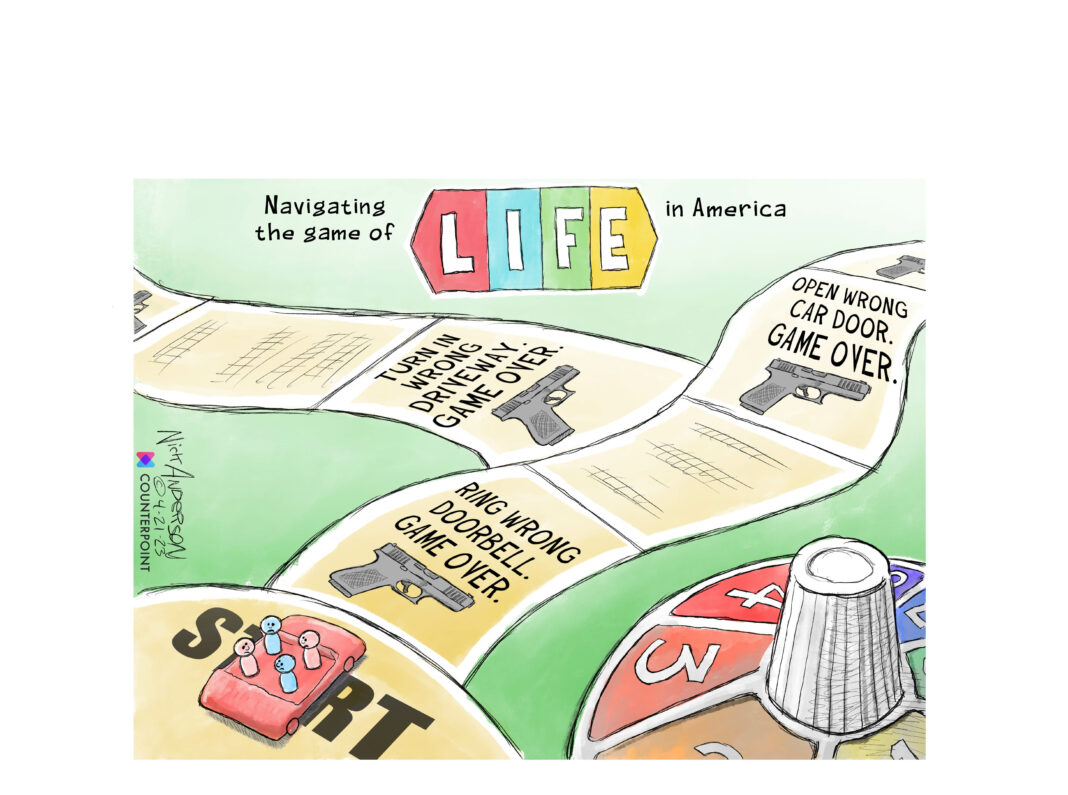
None of the major news stories this week — the Fox/Dominion settlement, the bizarre series of people getting shot for making common mistakes, the Supreme Court’s decision to stay the lower-court ruling banning mifepristone — seemed to me to need an in-depth analysis beyond what’s available in your usual news sources, so this week’s featured post is a more general reflection on driving through the empty places of America.
I grew up in the rural Midwest, so I understand the economic story of why the area was settled in the first place: The Homestead Act, then an economy grew up around the small family farms, and then industry came.
But then industry moved to Mexico or China, and farms don’t require that many people any more. So what’s the future of this place? Why won’t it all turn into endless fields where robot combines are powered by windmill electricity?
Living in a place that you love, but which has no obvious path into the future, might make you paranoid or depressed or resentful. And it more or less has. Maybe there’s a reason the Trump base in rural America seems so insane to the rest of the country.
Anyway, those reflections should appear by 10 EDT or so. The weekly summary will cover the stories I listed above, before closing with the most charming podcast I listened to on the drive. That should post around noon.
This week everybody was talking about a security leak
Thursday, the FBI arrested a 21-year-old man suspected to be the source of the recent leak of hundreds of classified documents, whose publication has damaged the US relationship with its allies and possibly exposed intelligence sources to America’s enemies. He worked as a “cyber transport systems specialist” for the Massachusetts Air National Guard, which appears to have given him access to highly classified systems.
The FBI’s explanation for the leak is frightening in its ordinariness: Jack Teixeira wanted to impress his friends. He appears not to have been motivated by money, blackmail, loyalty to another country, hatred of America, or any of the other motives typically found in spy movies. I am reminded of two characters in a minor John Le Carre novel struggling to explain why someone had defected. “I knew a man once who sold his birthright because he couldn’t get a seat on the Underground.”
I was investigated for a top-secret clearance (which I got) back in the 1980s, though I probably never saw more than half a dozen classified documents. The questions the investigators asked me and my references focused on things like whether my lifestyle matched my income, did I have blackmail-worthy secrets, had I expressed bizarre political beliefs, did I have friends or relatives in hostile countries, and so on. None of it would have picked up a motive like wanting to show off for an online discussion group. I don’t know how investigators could look for that kind of risk. That’s what’s most scary about this case.
The depth and variety of the leaked documents raises another question: Why did anybody in the Massachusetts Air National Guard need to know all this stuff? Why did our systems allow access to it?
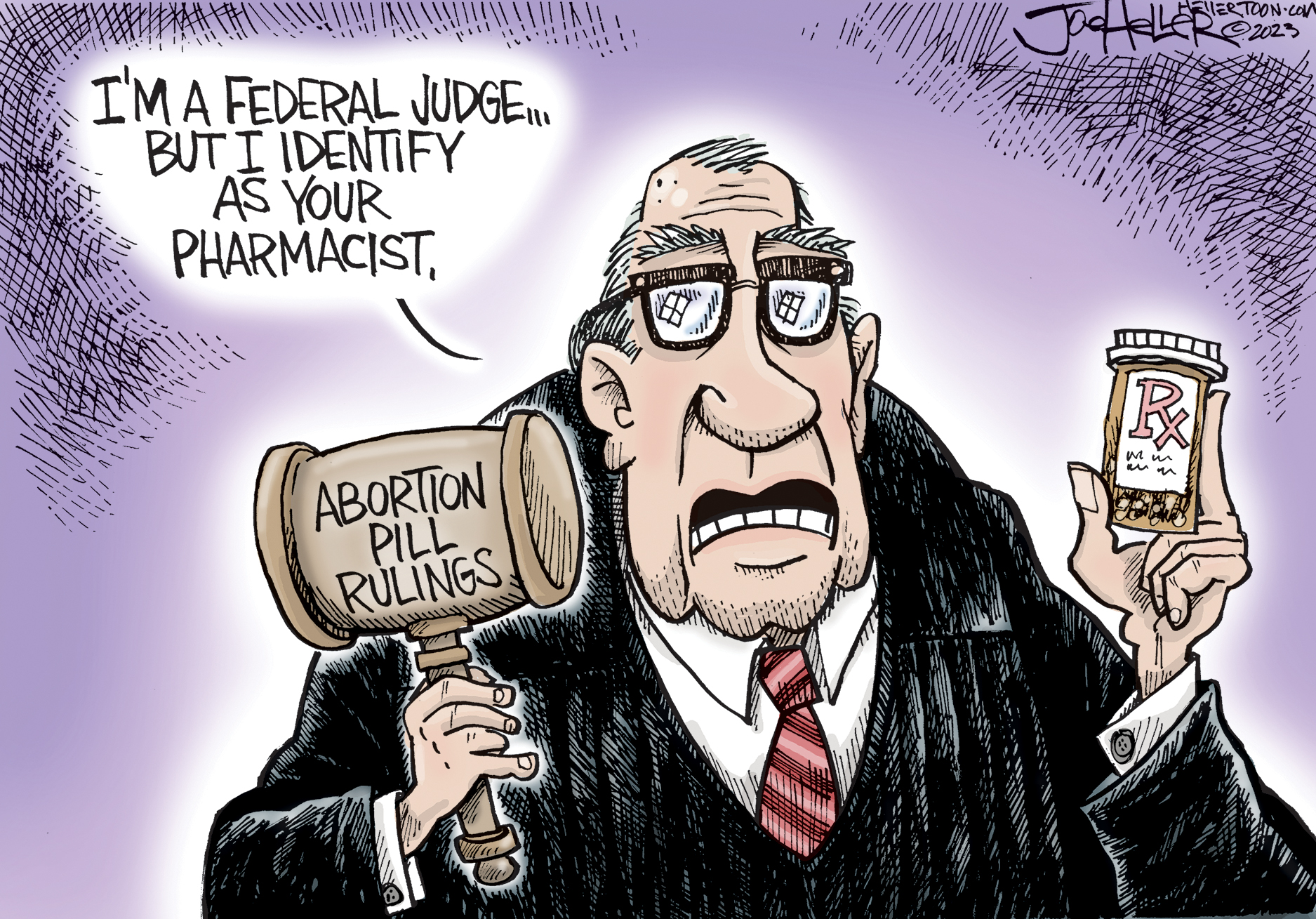
The abortion-pill injunction is still working its way through the system. The initial injunction banning mifepristone was supposed to take effect Friday. The appeals court rolled back the worst of it, but still left a terrible ruling. (That’s how bad the original was.) The Justice Department appealed to the Supreme Court, which froze everything until Wednesday. Stay tuned.
The Supreme Court has an easy way out if it wants one: Under existing precedents, the plaintiffs don’t have standing to sue. The appeals court upheld their standing, which is just really bad law in general, independent of how you feel about abortion. If an organization can sue any time one of its members is statistically likely to suffer some theoretical injury sometime in the future, the courts will be swamped with frivolous suits.
and the Fox News trial
The Dominion Voting Systems defamation lawsuit against Fox News was supposed to hear opening statements today, but (in a surprise last-minute move) that was delayed until tomorrow. Maybe that means a settlement is in the works.
and even more evidence of Clarence Thomas’ corruption
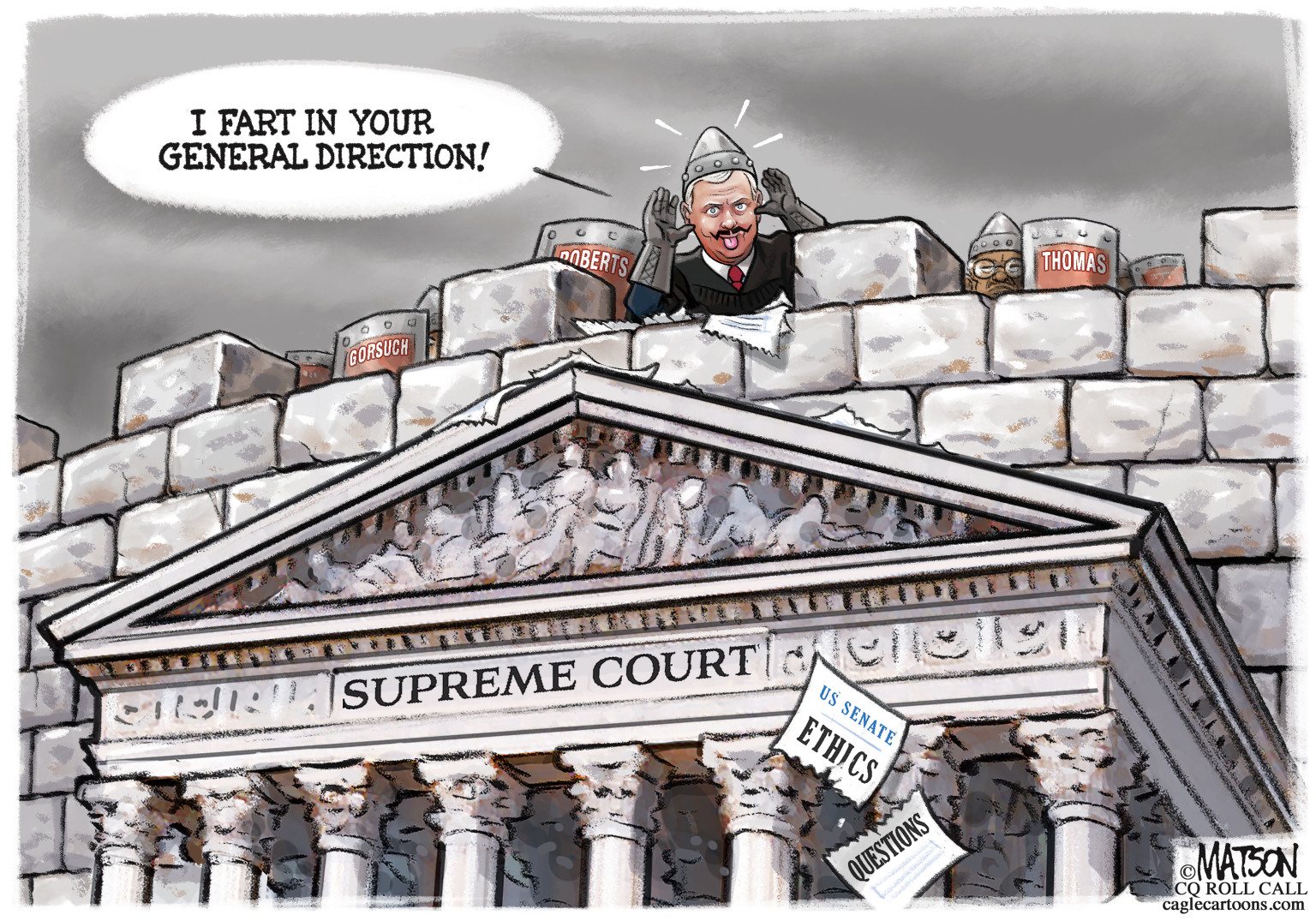
Last week, we found out that for two decades Thomas has been taking expensive vacations paid for by a major Republican donor who also gives a lot of money to organizations trying to influence Supreme Court decisions. We had to find out about these trips from Pro Publica rather than Thomas himself because, you know, the gift-reporting rules are just way too complicated for a mere Supreme Court justice to understand, and it’s not like Thomas should be expected to have some kind of moral intuition that would tell him this whole arrangement smells bad.
This week Pro Publica let another shoe drop: In 2014 the same donor, Harlan Crow, bought real estate from Thomas, including the house where Thomas’ mother lives, for over $100K, which might or might not be market price for properties a previous Thomas disclosure form had valued at less than $15K each. Again, Thomas did not report the transaction, in spite of laws that seem to say he has to.
Crow has since been paying the property taxes on Thomas’ mom’s house, and has funded a number of improvements that I’m sure Mrs. Thomas appreciates.
Soon after the sale was completed, contractors began work on tens of thousands of dollars of improvements on the two-bedroom, one-bathroom home, which looks out onto a patch of orange trees. The renovations included a carport, a repaired roof and a new fence and gates, according to city permit records and blueprints.
Crow’s statement on the Pro Publica scoop doesn’t say whether Mrs. Thomas pays rent. Clarence himself has said nothing.
Even Fox News has more-or-less gone silent, mentioning Thomas less than 50 times (and Bud Light 183 times) since the first Pro Publica article. The substance of its reporting has been that Democrats are attacking Thomas, and that AOC wants him impeached. But that’s Democrats for you. And you know AOC, she’s like that. It’s not like there’s an actual issue here. I mean, it’s not like George Soros has been buying off a liberal justice. That would be a national scandal deserving 24/7 coverage.
Yesterday, the WaPo reported another Thomas disclosure anomaly — that he reports income from a defunct real estate firm rather than the entity that replaced it. But unless there’s more to this story, I’m willing to write this one off as sloppiness rather than corruption.
and Tennessee
Both of the Justins — Justin Jones and Justin Pearson — have returned to the Tennessee House. After they were removed by the Republican supermajority last week, both were unanimously reappointed by councils of their constituents.
Both appointments are temporary until a special election can be held. But if the Justins were popular at home before, they are rock stars now. I don’t think getting elected will be a problem.
I’ll make a prediction: One or both of them will speak at the 2024 Democratic Convention.
Republican criticism of the demonstration the Justins led has included intentional misuse of the word insurrection. It started with Speaker Sexton, and then became a more general Republican talking point.
For almost a decade, I’ve been pointing out the right-wing practice of breaking words through intentional misuse. In 2014, I recalled the effort that had gone into breaking fascism, terrorism, and religious freedom, while pointing to a then-current effort to break torture.
The American Thinker blog reports on the “real torture scandal in America“, which is abortion. General Boykin says “Torture is what we’ve done by having the IRS go after conservative groups.” The Koch-funded American Energy Alliance is calling EPA fossil-fuel regulations “torture”.
Fortunately, they failed to break torture, and we have since been able to reclaim fascism, a word that has a lot of work to do these days. In 2021, I updated my 2014 analysis to include fake news, socialism, and even, ironically, Orwellian. (The breaking of fake news was so effective that hardly anyone remembers the original meaning: imitation “news” articles from entirely fictitious “publications” like the Denver Guardian or WTOE 5 News, created to be shared online and promote a false reality. The 2016 Trump campaign was the primary beneficiary of fake news, as many people took seriously fake articles that went viral, like “Pope Francis shocks world, endorses Donald Trump for president” or “FBI agent suspected in Hillary email leaks found dead in apartment murder-suicide“. Trump hated this meaning, so he misused fake news until it broke, and instead came to mean any news report — no matter how accurate — that he doesn’t like.)
And that leads us to insurrection. It annoys Republicans that January 6 is quite accurately described as an insurrection, so they want to make that idea inexpressible. That’s what’s behind their widespread use of insurrection to describe the protest on the floor of the Tennessee House that led to the Justins’ expulsion.
That usage is literally absurd. The Tennessee House was inconvenienced for about an hour. No one was injured and no one was threatened. The state house was not damaged. At no time did anyone propose establishing a new government in Nashville outside the usual electoral process. January 6, by contrast, was the culmination of a months-long plot to install the loser of the 2020 election as president. Had it succeeded, the United States’ centuries-old tradition of constitutional government would be over. Along the way, 114 Capitol police officers were injured, and numerous member of Congress (and their staff) feared for their lives. So did Mike Pence’s Secret Service detail.
But the absurdity is the point. Expect more misuse of insurrection, until the word ceases to mean anything at all. As Orwell put it in “The Principles of Newspeak“:
The purpose of Newspeak was not only to provide a medium of expression for the world-view and mental habits proper to the devotees of Ingsoc, but to make all other modes of thought impossible. … This was done partly by the invention of new words, but chiefly by eliminating undesirable words and by stripping such words as remained of unorthodox meanings, and so far as possible of all secondary meanings whatever.
and crazy new laws
Red-state legislatures just keep upping the ante on crazy.
The new “ abortion trafficking ” law signed on Wednesday, is the first of its kind in the U.S. It makes it illegal to either obtain abortion pills for a minor or to help them leave the state for an abortion without their parents’ knowledge and consent. Anyone convicted will face two to five years in prison and could also be sued by the minor’s parent or guardian. Parents who raped their child will not be able to sue, though the criminal penalties for anyone who helped the minor obtain an abortion will remain in effect.
So if an Idaho man gets his 13-year-old daughter pregnant, her grandmother can get 2-to-5 in the big house for driving her across the border to get an abortion in Washington. But at least the rapist can’t sue the grandmother, because that would push a good idea too far.
The banned books, which include themes of LGBTQ+ identity and race, were removed last year without public input after Llano County officials declared them pornographic and sexually explicit.
Somebody’s going to have to explain to me how Isabel Wilkerson’s Caste is pornographic. (I somehow missed the dirty parts when I read it.) Among a long list of awards and honors, Time magazine named Caste as its #1 nonfiction book of 2020. And remember: This is the public library, not a school library. It would be bad enough to keep children from reading Caste, but Llano is claiming no one should be allowed to read it, at least not on the public dime.
Another too-sexy-for-Llano book is Larry the Farting Leprechaun, which I have not read. If I do, I’ll have to stay alert so I don’t miss the pornographic sections.
Amanda Marcotte sees the defund-the-library trend as a skirmish in a more general war against public education.
Libraries are the latest battlefield, but the real white whale for the GOP is the destruction of public education.
She cites Texas Governor Greg Abbott’s “school choice” proposal, which would move money from public to private (i.e. religious) schools through a voucher program linked to “education savings accounts”.
In the Texas Observer, David Brockman goes a step further: The motive behind ESAs is Christian nationalism.
Having spent nearly a decade researching and writing about Christian nationalism—the movement to make the United States an explicitly “Christian nation” governed by Bible-based laws—I see this year’s push to fund private and religious schools as just the latest front in that movement’s decades-long battle to undermine what Thomas Jefferson called the wall of separation between church and state, and thereby establish conservative Christian dominance over government. … Though not all “school choice” supporters are Christian nationalists, it’s hard not to notice the strong Christian nationalist presence among them.
But Texans who believe in separation of church and state have an unexpected ally against Abbott’s proposal: rural Texas communities who find a civic identity in their public schools.
Many in New Home worried that political shifts in Austin threatened to leave out the voices of rural Texans, for whom the local schools — the Friday night football games and principals whose cellphone numbers you know — are essential parts of what makes a community.
While we’re talking about publicly supported religious schools, Oklahoma is deciding whether to approve its first explicitly religious charter school, which would be Catholic. If it does, the inevitable lawsuit will undoubtedly go to the Supreme Court. I think this Court will find a way to approve it on originalist grounds, despite so many of the Founders being anti-Catholic bigots. As we saw in Alito’s Dobbs opinion and Thomas’ Bruen opinion, history says whatever the six-judge majority needs it to say.
It’s not true, but you can be forgiven if you got the impression this week that 12-year-olds can marry in Missouri. (The actual minimum age is 16, with anybody under 18 requiring parental consent.) Tuesday, a debate in the legislature over an anti-trans law produced this viral clip: Missouri state Senator Mike Moon defended the idea that 12-year-olds should be allowed to marry. He claimed to know a couple that got married at 12 when the girl became pregnant. And “their marriage is thriving“.
Somehow, I don’t find that story as heartwarming as he apparently does.
Ordinarily, I’m a fan of electoral systems where a jungle primary is followed by a runoff between the top two candidates. The system should allow moderate candidates to win by marshaling support from independents and the other party, even if they couldn’t win a one-party primary.
But there’s something decidedly shady about the way Montana’s Republican legislature is planning to implement such a system: They’ve written the election-law change so that it applies once — to Jon Tester’s Senate race in 2024 — and then sunsets immediately. The point here is to keep a Libertarian candidate from siphoning votes away from Tester’s Republican challenger.
So: The jungle-primary system, I like. Changing the rules election-by-election to get the result you want, I don’t like.
and you also might be interested in …
There was another mass shooting, this one in Alabama at a teen-ager’s birthday party. Four dead, 28 injured. The birthday girl’s brother was one of the four.
For decades, the most vocal voices on the issue of guns were on the side of the gun lobby. If you held a town hall and someone stood up and said “I want to talk about guns”, you knew they were going to be advocates for the Second Amendment. That’s totally flipped. Today, in red and blue states, if somebody says “I want to talk to you about guns”, they want you to pass the assault weapons ban and universal background checks.
DA Alvin Bragg is asking a federal court to get Jim Jordan off his back. Jordan’s attempt to interfere in Bragg’s prosecution of Trump is completely out of line. Heads would explode on the right if a congressional committee tried to protect a Democratic politician against a local indictment, or to intimidate the local prosecutor.
I could have mentioned the right-wing outrage at Bud Light last week, but it was just too crazy to wrap my mind around. So I’ll let Vox explain it. The gist seems to be that the parent corporation wants to sell their beer to trans people, so if you hate trans people you should boycott it.
But hey, maybe there’s money to be made off folks who drink beer to express their bigotry rather than because they like the taste.
Apparently, this is real. But if I told you it was a parody video, would you know the difference?
Anyway, there’s a long history of such performative outrage, and zero examples of it accomplishing anything beyond providing opportunities for grifters. MAGA types love to lash out, but they don’t organize and persist, as successful boycotts must. So corporations just wait for them to get over it.
Most right-wingers probably don’t remember either.
I continue to believe that the best way to bridge the culture-war gap is for all of us to listen to each other’s stories. HuffPost Personal published one mother’s story of discovering that her child was trans.
I’m occasionally asked whether we should “trust” the mainstream media. My answer is usually some form of “Trust them to do what?”
A good case in point is Thomas Friedman’s recent NYT column “America, China, and a crisis of trust“. Nobody who lived through the Iraq War will ever again trust Friedman as a prognosticator. His rolling assurances that the war would turn a corner (for the better) in the next six months led to six months being referred to as a “Friedman Unit“.
Friedman is well-spoken and has access to the top experts — his problem in Iraq was that he too easily believed Bush administration sources who wouldn’t have talked so openly to the rest of us — so he can do a very convincing Voice of Authority. But he’s not as smart as he thinks he is, and his sources aren’t as smart as he thinks they are, so his authoritative predictions often go astray.
However, Friedman is also an honest reporter. In the current column, he goes to a conference in Beijing and talks to a lot of well connected Chinese who undoubtedly would not return my calls, even if I knew their numbers. Do I believe his account of what they’re saying? Yes, I do. I also believe his observation that the Chinese are investing in infrastructure that puts ours to shame.
And then there’s this:
a story making the rounds in Beijing is that many Chinese have begun using ChatGPT to do their ideology homework for the local Communist Party cell, so they don’t have to waste time on it.
and let’s close with someone who deserves my gratitude
Like Stephen Colbert, I grew up reading Mad Magazine and enjoying the cartoons of Al Jaffee, who died last Monday at the age of 102. I picture him reaching the Afterlife and giving the gatekeeper a snappy answer to a stupid question.
Examples of rising fascist tendencies easily draw attention and produce fear for the future. But much less attention gets focused on the deeper question: Why is this happening now? Fascism has never been completely stamped out, but for decades it was a fringe phenomenon. By and large, losing parties admitted their defeats, tacked back to the center, and tried to regain majority support rather than disenfranchise the voters who rejected them. Elected officials distanced themselves from violence, treason, and blatantly corrupt allies.
What changed? It can’t just be the fault of one bad leader. How, for example, could Donald Trump or Vladimir Putin be causing a drift towards fascism in Europe or South America or India or Israel?
The post-war “miracle”. For both Haque and Brin, the key question isn’t why fascism is rising now, but how it got pushed to the fringe for decades after World War II. Haque explains it like this:
Consider the founding of modern Europe. Its entire idea was to prevent the far right ever rising again. Modern Europe, rebuilt in the ashes of the war, did something remarkable, that led to what later observers like me would call the European Miracle. It took the relatively small amount of investment that America gave it — which was all it had — and used that in a way that was fundamentally new in human history. Instead of spending it on arms, or giving it to elites, it used it rewrite constitutions which guaranteed everything from healthcare to education to transport as basic, fundamental, universal rights.
This was the point of Keynes’ magisterial insight into why the War had happened.Germans, declining into sudden poverty, destabilized by debt, had undergone a political implosion. Economic ruin had had political consequences. The consequences of “the peace” as Keynes said — the peace of World War I, which had been designed to keep Germany impoverished. Fascism erupted as a result. And so after the Second World War, Europe did something bold, unprecedented, and remarkable in all of human history — it offered its citizens these cutting edge social contracts, rich in rights for all, built institutions to enact them, from pension systems to high speed trains, and then formed a political union on top of that, to make sure that peace, this time, remained.
Fascism, in Haque’s view, is a political technique for gathering up the misery of the masses and focusing it on scapegoats rather than solutions. The primary promise of the fascist leader is revenge, which will solve the problems of his followers through some magical process of subtraction rather than addition. Throwing rocks through the windows of Jewish businesses or preventing trans kids from getting gender-affirming care will somehow make your own life better. Break up the families of migrants seeking asylum, and somehow your own inability to care for your sick wife or send your children to college will not hurt so much.
America and England both had fascist movements in the 1930s, but they didn’t catch on like Germany’s. Maybe that was because — even in the depths of the Depression — neither country had Germany-level misery. Neither country experienced quite the sense of failure and loss of hope that made Hitler seem like a compelling way forward.
But Brin points to something else that happened in 1930s America: the New Deal, which confounded Karl Marx’ prediction of ever-increasing dominance by wealthy capitalists, inevitably leading to a revolutionary explosion.
Karl Marx never imagined that scions of wealth – Franklin Delano Roosevelt and his circle – would be persuaded to buy off the workers, by leveling the field and inviting them to share in a strong Middle Class, whose children would then (as recommended by Adam Smith) be able to compete fairly with scions of the rich.
It was a stunning (if way-incomplete) act of intelligence and resilience that changed America’s path and thus the world’s.
Brin, recalling the lessons of Isaac Asimov’s Foundation series, invokes the Seldon Paradox: “Accurate psychohistorical predictions, once made known, set into effect psychohistorical forces that falsify the prediction.”In this case, American plutocrats like “that smart crook, Joseph Kennedy” took Marx’ predictions seriously and tried to head them off. Brin quotes Kennedy: “I’d rather be taxed half my wealth so the poor and workers are calm and happy than lose it all to revolution.”
Kennedy’s view was far from universal among the American rich, but it did split the forces of plutocracy, enabling the creation of an American safety net.
Post-war Europe took the lesson further, as Haque describes:
What do Europeans enjoy, still, even though it’s teetering now, that Americans don’t? All those rich, sophisticated social contracts, one supposes, which guarantee them everything from high speed transport to cutting edge healthcare.
But there’s more than that. All that creates — or did for a very long time — a feeling that doesn’t exist in America. A sense of community. A kind of peace, which you can readily see in the absence of gun massacres in Europe, even though, yes, there are guns, if not quite so many. Stronger social bonds and ties — Europeans still have friends, and in America, friendship itself has become a luxury. All that matters.
The short description of what Europe achieved is public happiness.
Fascism is born of rage, fear, despair, which drives people into the arms of demagogues, who blame all those woes on hated subhumans, “others” — and so the truest antidote we know of to all that is human happiness itself.
Revenge, not hope. That observation explains one of the great mysteries of current American politics: why the GOP has no governing program. The party has a clear constituency: the non-college White working class, particularly in rural areas. So why are there no plans to do anything for them?
Think about it: expanding Medicaid to save not just the families of the working poor, but rural hospital systems as well; bringing broadband internet to rural areas; raising the minimum wage; shoring up community colleges — those are all Democratic goals that Republicans do their best to block.
It’s not that Republicans have no proposals. The red-state legislatures they control are buzzing with activity: loosening gun laws, taking away women’s bodily autonomy, banning accurate accounts of racism from schools, defunding libraries, and making trans youth invisible, just to name a few.
But how exactly does that help anybody?
Or take that frequent Trump claim that “They’re not after me, they’re after you. I’m just in the way.” Who is after you? How did Trump ever stand in their way? Even a sympathetic NY Post columnist has no answer for that. He spins conspiracy theories of how the Deep State has been out to get Trump from the beginning, but what does any of that have to do with the “you” in Trump’s statement?
What Trump offered “you” was revenge. Those people you hate: the Muslims, the queers, the immigrants, the Blacks, the educated “elite”, and so on. He demeaned them, insulted them, made them suffer. He “owned the libs” and made them hopping mad in ways that you never could have managed on your own..
But he never did anything to improve your life, because that was never the point. It would, in fact, have been counterproductive, because MAGAism needs your misery. If you felt more secure, more hopeful, more capable of dealing with a changing world, then you wouldn’t need revenge any more. And you wouldn’t need Trump.
Beyond the Seldon Paradox. So what happened to public happiness? Now we bounce back to Brin, who quotes a corollary to the Seldon Paradox: After people adjust to dire predictions and cause them to fail, the next generation stops taking the predictions seriously. And then they come true.
In other words, what we are seeing now… a massive, worldwide oligarchic putsch to discredit the very same Rooseveltean social compact that saved their caste and allowed them to become rich… but that led to them surrounding themselves with sycophants who murmur flattering notions of inherent superiority and dreams of harems. Would-be lords, never allowing themselves to realize that yacht has sailed.
In other words: Marx? Who listens to Marx any more? All his nonsense predictions turned out to be laughably false.
So sometime in the 1970s, the plutocratic counter-revolution began. One turning point was the infamous Powell Memo, written in 1971 by future Supreme Court Justice Lewis Powell for the U.S. Chamber of Commerce. The American system of free enterprise, he wrote, was under broad attack from socialist thinkers, and business leaders had been responding with “appeasement, ineptitude and ignoring the problem”. Powell outlined a multi-faceted program to create a new intellectual climate in America, one more favorable to corporate power and the influence of big money.
Within ten years, Ronald Reagan was president, and the United States had embarked on an era of ever-lower taxes on the rich, restrictions on corporate regulation, and union-busting.
And that was the end of the great American middle class. From 1940 through 1980, income growth among the rich had lagged behind the larger public, but after the Reagan Revolution it rapidly made up the difference.
Then and now. A decline in human happiness and hope can lead to a Marxist revolution. (That was one possibility in Weimar Germany as well.) But it also creates opportunities for fascist scapegoating.
So if you don’t feel as successful as your parents were at the same age, and you see even worse prospects waiting for your children, whose fault is that? Maybe it’s the Jews. Maybe it’s the November criminals who stabbed your valiant German soldiers in the back at Versailles. Maybe it’s the decadent culture of big cities like Berlin: the gays, the transvestites, the young people dancing to that African “monkey music” from America.
If only we had a leader strong enough to make them pay.
See the resemblance?
Lessons. So where does that leave us? What lessons can we draw? One lesson is to keep our own resentment tightly focused on the people who deserve it. Working class Americans who see little hope for their children are not our enemies, even if they vote for our enemies. We shouldn’t want revenge on them, we should want them to have better prospects, so that they lose their own need for revenge.
Us against Them is the fascist conversation. We can’t let ourselves be drawn into it.
Our salvation will not come through their misery. Quite the reverse. If we are to be saved, it will have to be through happiness — everyone’s happiness.
And if we’re lucky, maybe some rebel faction of smart plutocrats will come to see the same thing.
[1] Some want to argue about whether to call this worldwide movement “fascism”. I’ve explained why I do, but if you’d rather reserve the word for Hitler, Mussolini, et al, that’s fine. Trump, Orban, and Bolsonaro are certainly not identical to Hitler, Mussolini, and Franco, but I would say that 20th-century fascism differs in some particulars from 21st-century fascism, not that they are completely different animals.
The important thing is that the lack of a word doesn’t lead to an inability to discuss the phenomenon, in the fashion of Orwell’s Newspeak. Simply referring to Trump, Orban, Bolsonaro, Modi, et al as “authoritarians” (as Tom Nichols does) is not nearly specific enough. Any general who stages a successful coup is an authoritarian. But an anti-democratic movement that anoints one segment of the citizenry as the “real” or “true” citizens, and scapegoats the “unreal” or “false” citizens as the cause of all the nation’s problems, justifying discrimination and even violence against them — that’s something more than just “authoritarianism”.
In short, I’d be content to use some other word to carry on a discussion with someone who wants Hitler to be unique. But that word has to capture the full evil of the phenomenon, without diluting it by including anyone who finds democratic governance inefficient.
Not much happened this week: The FBI caught the guy who leaked all those documents (and Trump supporters rallied around him). The abortion-pill injunction rose through the judicial system, but is still unresolved. The Fox News trial is about to start. Clarence Thomas is even more corrupt than we realized last week. The Justins made a triumphant return to the Tennessee legislature. Idaho outlawed “abortion trafficking”, while the Missouri House tried to defund all the state’s libraries. Alan Bragg sued Jim Jordan in an attempt to stop his interference in the Trump prosecution. Something something something Bud Light. Oh, and we had another mass shooting of teen-agers.
Hardly anything, in other words.
But I decided to take a step back and look at something longer term: Why is all this happening? Yes, it almost all revolves around the Republican Party’s continuing descent into fascism. But why is that happening? Why now? What global trend opened up opportunities for the likes of Trump, Modi, Orban, Netanyahu, et al?
I found two recent essays that look at this question from different directions, but coalesce around this framing: Fascism is an eternal temptation of modern politics. The mystery isn’t why we have to deal with it now, but why we didn’t have to deal with it for so many years after World War II. How did those lessons get lost?
That post still needs work, so it probably won’t show up until 10 or 11 EDT. (I’ve made it back as far as the central time zone, but I’m trying to run on my usual east-coast schedule today.) The weekly summary will cover the other stuff, and appear by about 1 or so.
The Republican Party in Tennessee succeeded in creating tens of thousands of lifelong Democrats when they did this. … The Tennessee state legislature showed its hand. They’re not representatives, they’re rulers. You don’t get a voice. What you think doesn’t matter. You’re going to do what you’re told. Whether you accept that or not is up to you.
– Beau of the Fifth Column, speaking to young Tennessee voters after the legislature’s expulsion of elected representatives Justin Jones and Justin Pearson
This week everybody was talking about the Trump indictment
Believe it or not, he was arraigned and the indictment was unsealed last Tuesday, not even a week ago. Details of the indictment and what happens next are discussed in the featured post.
and the Tennessee Three
If you’re the kind of Sift follower who reads and remembers every word, you’ve heard of Nashville legislator Justin Jones before: Back in February, I linked to this clip of Jones calling out the Tennessee General Assembly’s Republican majority for its hypocrisy in outlawing drag shows “to protect the children”, but ignoring far more serious dangers to the state’s children. Several more Jones speeches have popped up on my social media feeds in the last few months and very nearly made it into the Sift. You could say I’m a fan.
Well, Thursday the majority took its revenge and expelled Jones from the Assembly, along with another eloquent young Black representative, Justin Pearson of Memphis. A White woman, Gloria Johnson from Knoxville, missed expulsion by one vote. (If the votes had been taken in a different order, Johnson might have been expelled too. Pearson was expelled last, and so was able to vote for Johnson. But the margin against Jones and Pearson was more than one vote.)
The trigger for the expulsions was an incident on March 30. A few days before, a shooter had killed three children and three adults at the Covenant School in Nashville. Young people from all over the state came to Nashville on the 30th to protest the legislature’s unwillingness to do anything about Tennessee’s gun violence problem. As demonstrators filled the Capitol gallery, Jones, Pearson, and Johnson occupied the floor without recognition from the Republican chair, and led the protesters in chants. The business of the Assembly was disrupted for about an hour.
Tennessee, you should remember, was the birthplace of the KKK. A bust of KKK founder Nathan Bedford Forrest was prominently displayed in the Capitol — I saw it myself in 2013 — until 2021, when Jones was leading a protest movement against it. So it should not be surprising that White Republican Speaker Cameron Sexton would not take lightly such disrespect from uppity young Black representatives. Expulsion is vanishingly rare in Tennessee history — only two representatives have been expelled since 1866, and those were for bribery and sexual misconduct. Expulsion for a violation of “decorum” has no precedent.
But never mind that. Gerrymandering has given Republicans a supermajority, so they could muster the required 2/3rds vote purely on party lines. So the Justins are out. (A clever protest line I’ve been seeing: “No Justins, no peace.“)
That’s why you’re standing there, because of that temper tantrum that day. That yearning to have attention. That’s what you wanted. Well, you’re getting it now.
To which Pearson responded:
You all heard that. How many of you would want to be spoken to that way?
The expulsions of Jones and Pearson left vacancies in House Districts 52 and 86. Article 2, Section 15 of the Tennessee State Constitution allows the local legislative body—in this case, the Metropolitan Council of Nashville and Davidson County and the Shelby County Board of Commissioners, respectively—to appoint an interim successor until a special election can be held. At least 29 members of the 40-member Davidson County Metropolitan Council have vowed to reappoint Jones; the measure requires a majority of members to approve it. Shelby county commissioner Erika Sugarmon claimed that commissioners were threatened with cuts in state funding for certain local projects during budget negotiations if Pearson were reseated, which was disputed by a spokesperson for the House Speaker.
So local officials are going to send Jones and Pearson right back to the General Assembly. White Speaker Sexton will probably not take that uppity-ness well either, so stay tuned.
Grumbach’s State Democracy Index (SDI) grades each state on a series of metrics — like the extent to which a state is gerrymandered at the federal level, whether felons can vote, and the like — and then combines the assessments to give each state an overall score from -3 (worst) to 2 (best).
Tennessee got the lowest score in the nation. Wisconsin (see below) also did badly.
White Speaker Sexton’s draconian response to protest has led some journalists to take a closer look at his own situation. Jud Legum claims to have found a problem much more serious that a breach of “decorum”: Sexton appears not to live in the district he represents.
Just last week, I remarked on the strangeness of the GOP making absolutely no policy moves to change its disastrous performance with young voters, nothing that would say to them “We’re not your enemies”.
Well, in Tennessee, young people showed up in the thousands to tell the legislature what they want — action against gun violence — and the legislature’s response was to expel two young representatives who demonstrated with them. In short: “We are your enemies.” I think a lot of young voters have heard that message loud and clear.
(See below for similar cluelessness in Wisconsin.)
Two of my favorite podcasters have roots in Tennessee, and commented on this week’s events: “liberal redneck” Trae Crowder and Beau of the Fifth Column. Trae’s reaction is funnier, Beau’s more serious.
and abortion pills
As I predicted three weeks ago, the lone federal judge hearing cases in Amarillo did the job Trump appointed him to do: He issued an injunction taking mifepristone, part of the two-drug combination used in almost all medication abortions (which now constitute more than half of abortions nationwide), off the market.
Judge Matthew J. Kacsmaryk’s ruling makes precisely the arguments that Adam Unikowsky had debunked over a month ago: An organization of doctors (incorporated in Amarillo precisely to bring this case to his court) has standing to sue, based on a mythic rush of patients they may have to treat after medication abortions go wrong. The FDA was wrong to rely on 20 years of safety data out of Europe, and is wrong now to rely on mifepristone’s 23-year safety record in the United States. The plaintiffs do not have to exhaust the FDA’s own process before suing.
All of this flies in the face of numerous Supreme Court precedents, which Unikowsky cited. But nonetheless, Kacsmaryk found that the plaintiffs were likely to prevail in their claims, justifying an injunction upending the majority of abortions in America.
Kacsmaryk’s ruling is couched in the terms of pro-life propaganda, without even a pretense of objectivity. In footnote 1, for example, he explains why he will use the terms “unborn human” and “unborn child” rather than “fetus”. Throughout his ruling, doctors who prescribe mifepristone are “abortionists”, while the doctors suing are “physicians”.
Unlike abortionists suing on behalf of women seeking abortions, here there are no potential conflicts of interest between the Plaintiff physicians and their patients.
In other words, the plaintiffs’ (and the judge’s) prior commitment to a religious ideology that their patients may not share is not a relevant conflict.
Anyway, this predictable judicial activism won’t stand unless higher courts validate it. The FDA and the Justice Department appealed to the Fifth Circuit Court of Appeals on Friday. This is one of the most conservative appeals courts in the country (another reason for the plaintiffs to choose Amarillo), so we’ll see what happens.
Almost simultaneous with the Amarillo injunction, a federal judge in Washington state issued a contradictory injunction ordering the FDA not to remove mifepristone from the market. That injunction applies to the 17 (blue) states whose attorneys general were suing.
The two rulings will be appealed to different appellate courts. So unless those courts miraculously come to the same conclusion, the fate of mifepristone will ultimately have to be decided by the Supreme Court. When that might happen, and whether the drug will remain available in the meantime, remains to be seen.
and Clarence Thomas
Speaking of the Supreme Court, there’s a new Clarence Thomas scandal.
Back in 2011, he had to amend 20 years of financial disclosure forms after Common Cause pointed out that he hadn’t listed the sources of his wife Ginni’s income — largely conservative think tanks like the Heritage Foundation (who have opinions and desires about Supreme Court decisions). He blamed that on “a misunderstanding of the filing instructions”. Common Cause found that explanation “implausible”.
Justice Thomas sits on the highest court of the land, is called upon daily to understand and interpret the most complicated legal issues of our day and makes decisions that affect millions. It is hard to see how he could have misunderstood the simple directions of a federal disclosure form.
Thomas regularly has had conflicts of interests through his wife. In 2011, he didn’t recuse himself from Supreme Court rulings on the Affordable Care Act, despite Ginni’s active lobbying for repeal of the act.
More recently, Thomas didn’t recuse himself from ruling on ex-President Trump’s request that the Court block release of White House records related to January 6. (He was the only justice to vote in Trump’s favor.) When Mark Meadows turned over his text messages, we found out that Ginni had been urging Meadows to urge Trump to challenge the 2020 election, which she called “the greatest Heist of our History”.
The latest scandal is that the Thomases have been accepting massive gifts from billionaire GOP donor Harlan Crow for over 20 years, and Justice Thomas hasn’t been reporting them as the law requires. Clarence and Ginni regularly cruise on Crow’s yacht, fly on his private jet, and vacation at his private resort.
In late June 2019, right after the U.S. Supreme Court released its final opinion of the term, Justice Clarence Thomas boarded a large private jet headed to Indonesia. He and his wife were going on vacation: nine days of island-hopping in a volcanic archipelago on a superyacht staffed by a coterie of attendants and a private chef.
If Thomas had chartered the plane and the 162-foot yacht himself, the total cost of the trip could have exceeded $500,000. Fortunately for him, that wasn’t necessary: He was on vacation with real estate magnate and Republican megadonor Harlan Crow, who owned the jet — and the yacht, too.
… These trips appeared nowhere on Thomas’ financial disclosures. His failure to report the flights appears to violate a law passed after Watergate that requires justices, judges, members of Congress and federal officials to disclose most gifts, two ethics law experts said. He also should have disclosed his trips on the yacht, these experts said.
Crow himself has not had cases before the Supreme Court during this time, but he is associated with organizations that often do, like the Club for Growth and the American Enterprise Institute.
He has also donated hundreds of thousands of dollars to a Tea Party organization founded by Ginni Thomas — one that paid her $120,000, ProPublica notes.
Early in my tenure at the Court, I sought guidance from my colleagues and others in the judiciary, and was advised that this sort of personal hospitality from close personal friends, who did not have business before the Court, was not reportable.
In other words, Thomas has once again misunderstood the legal requirements. I have three comments on this:
As in the Common Cause scandal, Thomas’ defense is that he isn’t very good at law.
Even if his false impression were true, Supreme Court justices shouldn’t be trying to squeak through loopholes in the rules. Any idiot should know that accepting these kinds of favors looks really, really bad and would undermine the legitimacy of the Court.
Thomas’ “close friend” is someone he didn’t know when he joined the Court.
Meanwhile, elected Republicans and conservative media has been lining up to defend Thomas. The Wall Street Journal editorial page characterized this scandal as a “smear” and “another phony ethics assault to tarnish the Supreme Court”. The “smear” charge is repeated in a tweet from Senator Cornyn.
Last week, many of the same voices were trying to make some sinister connection between Trump-indicting DA Alvin Bragg and billionaire George Soros, because Soros contributed to an organization that contributed to Bragg’s political campaign. But here we have an actual corrupt arrangement, where millions of dollars in benefits accrue to Thomas personally, and it’s no big deal.
I don’t want to make too much of Crow’s collection of Nazi memorabilia. Lots of people collect weird things, after all. But it does seem like a red flag.
Wisconsin’s Supreme Court has been one of the most blatantly partisan in the country, giving Republicans a huge advantage statewide.
Wisconsin elections are typically close, and this one wasn’t. The liberal won by 11%.
Let’s start with partisanship. Wisconsin has long been one of the most gerrymandered states in the country, locking in large Republican majorities in spite of a relatively even split among the voters.
Wisconsin is an evenly divided purple state and [Governor] Tony Evers won re-election with 51.2% of the vote, but on the very same 2022 midterm ballots, Republicans won more than 60% of seats in the state legislature.
Many states are gerrymandered because the state’s supreme court tolerates biased maps. But in Wisconsin, the state supreme court chose the map itself, resulting in a map that was even more biased than the previous one. If the new liberal majority tears those maps up, the state could return to a semblance of democracy.
Now let’s talk about that “evenly divided” electorate. In 2016, Trump won the state by 43,000 votes, or less than 1%. In 2020, Biden won by 20,000 votes, a little more than half a percent. But on Tuesday, Janet Protasiewicz beat Daniel Kelly by over 200,000 votes, more than 11%.
We don’t have detailed exit polls that break that victory up according to demographics, but educated opinion attributes the landslide to two groups: women and young people. The court is expected to rule on whether the state’s ancient ban on abortion is back in effect after Dobbs, and Republicans nationwide have a serious problem with young voters.
It’s fascinating watching Republicans try to deal with this reality without changing any of the positions that have alienated women and young voters. National GOP chair Ronna McDaniel said, “When you’re losing by ten points there is a messaging issue” on abortion. But of course there isn’t a “messaging issue”; voters understand very well where the two parties stand on abortion, and they agree with the Democrats.
Former Wisconsin Governor Scott Walker sounded a similar alarm about young voters. He noted the big margins Democrats ran up among younger voters in the 2022 midterms, and then called attention to the 82% of the vote “the radical” (Protasiewicz) got in Dane County, home of the University of Wisconsin.
But like McDaniel, Walker doesn’t see the need for any policy changes. In his mind, the problem isn’t that the GOP is dominated by climate-change denial, or that it promotes (or at best winks at) racism and homophobia, or that it wants the state to take control of women’s bodies.
This is years of liberal indoctrination come home to roost.
I suppose the obvious answer, then, would be to ban more books, as DeSantis is doing in Florida. But in the real world, the GOP’s problem with young voters isn’t that they’re deluded, it’s that they see all too well what Republicans stand for.
Perry murdered a demonstrator who was protesting the murder of George Floyd. Both Perry and his victim were armed, so Perry claims self-defense. But he raised that claim in his trial, and a jury of his peers unanimously rejected it. What does Abbott know that they didn’t?
This is yet another example of creeping fascism in red states: brownshirt violence going unpunished. Apparently, in Texas you can get away with murdering people the regime considers undesirable.
A. R. Moxon makes an apt analogy I wish I had thought of first: Elon Musk and his Twitter followers resemble Butthead with an army of Beavises.
Along the way he raises a dangerous idea that I haven’t analyzed: Maybe the profit in technological disruption comes from the associated destruction, not the creation.
If he eventually wins, his GOP presidential primary opponents (and Democrats) will rightfully portray him as being anti-business. If he loses, his opponents will ridicule him for having been beaten by a mouse. Either way, the American people are already seeing DeSantis for what he is — thin-skinned, vindictive, stubborn, mean, shortsighted, and not very bright.
Meanwhile, Democrats are using the vagueness of DeSantis’ own laws to try to get his book “The Courage to Be Fascist Free” taken out of school libraries. After all, it contains several “divisive concepts”.
and let’s close with a blast from the past
Yesterday my wife and I were drinking tea at the one table in Cafe Vinyl in Santa Fe (“coffee, records, books, t-shirts”) when the not-quite-30 guy behind the counter cued up a Tom Waits album we used to listen to in the 1970s.
Aside from the sheer nostalgia of it, listening to Waits while the 20-somethings flipped through used vinyl records raised an issue I’ve been thinking about since I read a Slate retrospective on Rod McKuen last fall: What gets remembered and what doesn’t?
One of the weird contradictions of living in the future is that every artist is at the tip of your fingers, but you can only find who your fingers know to search for. In the not-so-distant past, artists could avoid slipping away thanks to only the physical evidence: a record in a thrift store, a used book with a man in a white turtleneck on its cover, murmuring to the bewildered shopper, “Who am I? To whom did I matter? To whom did I stop mattering?”
The Spotify algorithm, Amazon’s recommendations, they’ll never, ever show you Rod McKuen. Those are designed to direct you towards things that other people like right now. But thrift stores, used bookshops, and Goodwills are, accidentally, perfectly designed to show you things that people liked decades ago, then stopped liking.
Unlike McKuen, Waits deserves to be remembered. So here’s one of my favorites from 1976, Waits’ lampoon of salesmanship and advertising, “Step Right Up“.
“You got it, buddy. The large print giveth and the small print taketh away.”
If you were hoping for more detail about the DA’s case, you were disappointed. But that doesn’t imply the case against Trump is weak. Now the wheels of justice will grind slowly.
For weeks I’ve been trying not to waste my time (or yours) on speculation, but at last there’s finally something real to talk about.
Donald Trump, a private citizen who no longer has any connection with the presidency, showed up for his arraignment in New York on Tuesday, and his indictment was unsealed. The indictment itself isn’t that interesting: It’s 34 counts of falsifying business records, and each count just lists a record that the DA alleges is false. Like this:
The defendant, in the County of New York and elsewhere, on or about February 14, 2017, with intent to defraud and intent to commit another crime and aid and conceal the commission thereof, made and caused a false entry in the business records of an enterprise, to wit, an entry in the Detail General Ledger for the Donald J. Trump Revocable Trust, bearing voucher number 842457, and kept and maintained by the Trump Organization
The DA also filed a statement of facts, which lays out some of the narrative he’s going to try to prove in court. The high-level description goes like this:
From August 2015 to December 2017, the Defendant orchestrated a scheme with others to influence the 2016 presidential election by identifying and purchasing negative information about him to suppress its publication and benefit the Defendant’s electoral prospects. In order to execute the unlawful scheme, the participants violated election laws and made and caused false entries in the business records of various entities in New York. The participants also took steps that mischaracterized, for tax purposes, the true nature of the payments made in furtherance of the scheme.
That expands into 13 pages of details, with reference to testimony and documents that presumably the prosecution is ready to present in court.
But the DA didn’t go into detail about how the legal logic fits together: What exactly is the “other crime” the indictment keeps referring to? Maybe it’s the violation of federal election law Michael Cohen went to jail for. Maybe it’s some related state election crime. Maybe it’s filing a false tax return. DA Bragg doesn’t need to specify at this point, and he doesn’t.
But the “other crime” is a load-bearing component of the case: Without it, the falsified records are just misdemeanors rather than felonies, and it’s possible that the statute of limitations has already run out on them. (One detail various TV commentators have pointed out: The other crime doesn’t have to have been committed; it only had to be intended. So if the other crime is some kind of tax fraud, it doesn’t matter whether the fraudulent tax forms were actually filed.)
Several commentators interpreted this lack of detail as a flaw in the case, and expressed disappointment at the “weak” indictment. I (and several writers more qualified than I am) interpreted it differently: Bragg isn’t trying to win in public opinion, he’s trying to win in court. So (in contrast to the “speaking indictments” we often got from the Mueller investigation), he’ll reveal his strategy to the defense as he has to, and not before. Undoubtedly, the defense will file a motion challenging the indictment’s legal logic, and then Bragg will have to make an argument. We’ll see then how well his structure holds.
A few other things are clear from the indictment and supporting statement: Trump’s claim that he “did absolutely nothing wrong” is just gaslighting. One claim his lawyers have made in the media is that the $130K payment to Stormy Daniels was personal and not campaign related. But then we run into this:
The Defendant directed Lawyer A [Cohen] to delay making a payment to Woman 2 [Daniels] as long as possible. He instructed Lawyer A that if they could delay the payment until after the election, they could avoid paying altogether, because at that point it would not matter if the story became public. As reflected in emails and text messages between and among Lawyer A, Lawyer B, and the AMI Editor-in-Chief [David Pecker], Lawyer A attempted to delay making payment as long as possible.
If Bragg really has those emails and text messages, the “personal” interpretation goes away: Melania would have been just as upset the day after the election, so the payments are about fooling the voters, not protecting Trump’s marriage.
Also, the steps Trump, Cohen, and Pecker took to hide their actions make it obvious they knew they were up to no good. When Trump reimburses Cohen for the payoffs he’s made, he doubles the amount so that Cohen can declare the payment as income rather than a reimbursement, which might leave a trail back to Trump. After paying taxes on the false “income”, Cohen would have his original payment back. That bit of subterfuge was worth nearly $200K to Trump, so he must have believed he had something to hide.
Another red herring is the idea that the case will come down to whether the jury believes Cohen or Trump. (Since both are habitual liars, such a case couldn’t be “beyond reasonable doubt”.) Cohen (backed up by Pecker) is likely to be the narrator for the evidence presented in documents; his testimony won’t be the substance of the evidence. The jury will have to decide between Trump and the documents, not between Trump and Cohen.
In summary, the case will fall into two parts: The judge will decide the law, and then the jury will decide the facts. The two parts will be practically separate. The judge will decide if the factual claims made by the prosecution would be sufficient to convict Trump of the offenses he’s charged with. If not, the case will be thrown out before it ever reaches the jury. If it does reach the jury, the judge’s instructions will probably tie the facts to the verdict: “If you believe beyond a reasonable doubt that X happened, then you must convict. But if you have reasonable doubt that X is true, then you must acquit.” The jury may not even know about the legal issues the judge has decided.
If DA Bragg has the documents he alludes to in the indictment, then the facts are clear. So if the case reaches the jury, Trump should be convicted.
Criminal justice is a slow process. The prosecution must turn over its evidence to the defense, which then has a chance to review it and possibly ask the judge not to allow some of it. Defense motions about the case (for example, a motion to dismiss the charges for lack of the “other crime”) have to be filed by August 8. The prosecution has until September 19 to respond to those motions, and the judge will announce his decisions on December 4, the next official court date. At that point, the judge would lay out a schedule for the trial, assuming the case is going to trial.
All those dates might be delayed if the motions get appealed up the Supreme Court, as they might.
This means that the trial could be happening during the primary season, with a verdict possible around the time of the conventions. Politically, the process would be smoother if the trial could wrap up before the primaries, so voters could process the verdict rather than media speculation about Trump’s guilt or innocence. But (despite what Trump keeps saying) this isn’t about politics. It’s about the rule of law. So it will happen on its own schedule.
Meanwhile, Trump will try to spin this to his benefit politically, but I have my doubts about how well that’s going to work. This week’s SNL Trump parody was way too on-the-nose.
Some weeks history seems to be moving faster than usual. A week ago, all anyone could talk about was the Trump indictment, which existed but was still under seal. The drama of his arraignment was still in the future, and it was all the news networks could talk about. In the Sift, I reiterated my usual warning against speculation: We’ll know soon enough what the indictment says; wait for it.
Well, the arraignment and the unsealing of the indictment happened on Tuesday, which seems like a very long time ago. In the meantime,
An injunction banning one of the two drugs used in medication abortions is set to take effect Friday, unless appellate courts intervene, or a contradictory injunction from a different judge holds in most of the blue states.
The Tennessee legislature responded to popular protests against its inaction on gun violence by ejecting two young Black legislators who took that protest to the floor of the General Assembly — essentially telling the Black voters of Nashville and Memphis that they don’t get their choice of representative. They need to pick again until they settle on someone acceptable to the White Republican supermajority.
Supreme Court Justice Clarence Thomas, it turns out, has been taking high-luxury gift vacations from a major Republican donor for decades, and not reporting them as the law demands.
And (I almost forgot; it was Tuesday), Wisconsin voters tipped its Supreme Court liberal in a stunning landslide for the usually-closely divided state.
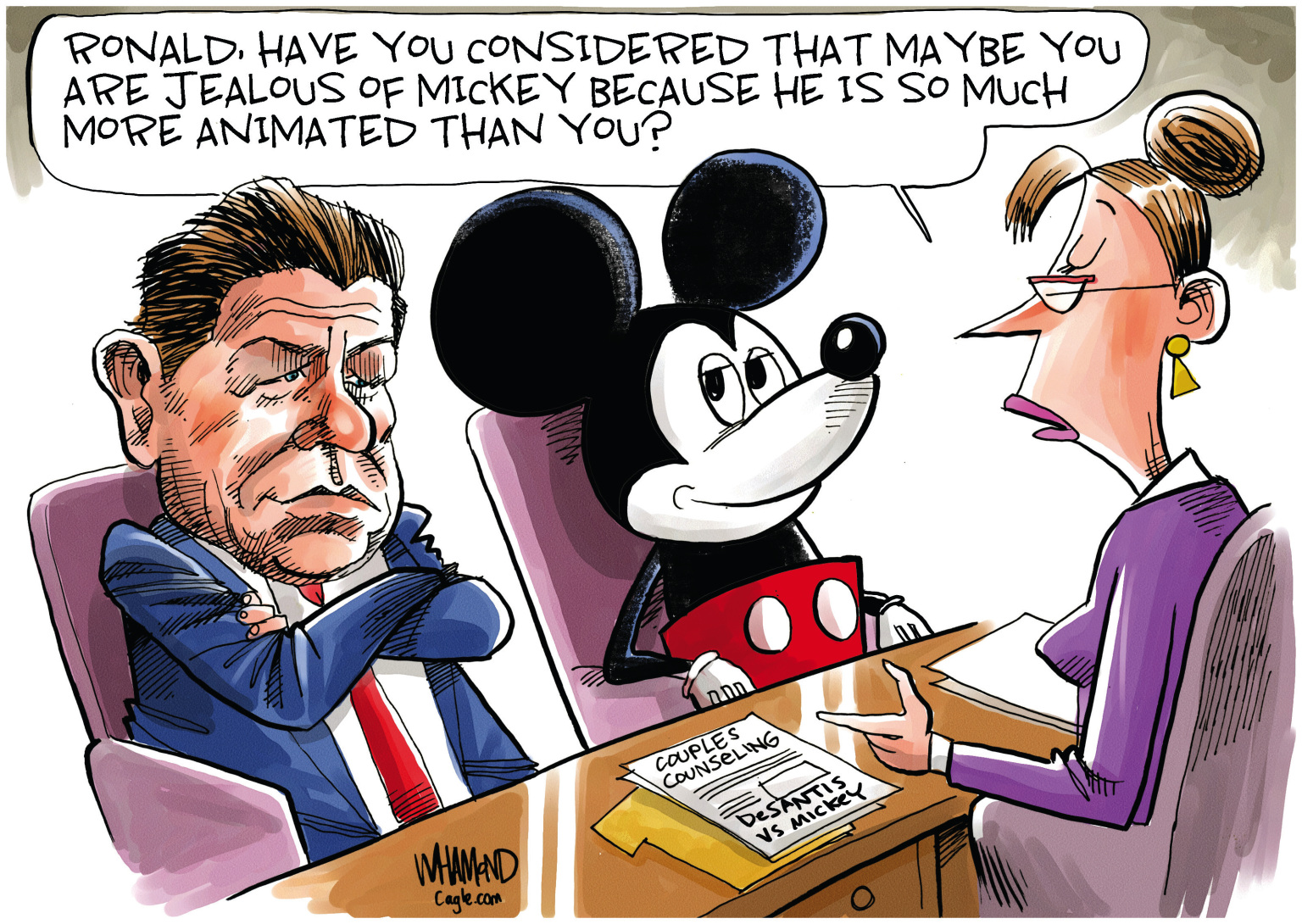
Plus, there’s been some kind of intelligence breach I haven’t even thought about yet, DeSantis is escalating his war against Disney, and Texas Governor Abbott is offering to pardon a guy just convicted of murdering a protester during the George Floyd demonstrations. (I mean, murdering somebody Abbott doesn’t like can’t really be a crime, can it?)
Wait, wasn’t I supposed to talk about Trump? It was just Tuesday.
Anyway, the Trump indictment does get a featured post, which should come out by 9 or 10 EDT (which is 7 or 8 to me, on vacation in Santa Fe). The weekly summary (with lengthy sections on Tennessee and abortion that maybe should have been split off into their own posts) should have everything else, and come out around noon EDT, 10 MDT.
Chuck & I are heartbroken to hear about the shooting at Covenant School in Nashville. My office is in contact with federal, state, & local officials, & we stand ready to assist. Thank you to the first responders working on site. Please join us in prayer for those affected.
Therefore thus says the Lord: “I hate, I despise your feasts, and I take no delight in your solemn assemblies. Even though you offer me your burnt offerings and grain offerings, I will not accept them; and the peace offerings of your fattened animals, I will not look upon them. Take away from me the noise of your songs; to the melody of your harps I will not listen. But let justice roll down like waters, and righteousness like an ever-flowing stream.”
This week’s featured post is “I am radicalizing against guns“. A lot of people seem to be, and I suspect the prayers of pro-gun politicians like Blackburn are being received in an Amos-like fashion.
As I mentioned in the teaser, today’s posts are running late because I’m in Arizona, three hours behind my usual schedule.
This week everybody was talking about the Trump indictment
Thursday, after the Manhattan grand jury announced a month-long hiatus, we discovered that it had voted to indict Trump.
You’re probably wondering why I’m not writing a featured post about this, but at the moment there’s not much to know. The indictment is sealed until the arraignment, which is scheduled for tomorrow. At the moment, I don’t even know for sure what the charges are, much less what evidence the grand jury may have assembled to support them.
So any reaction is still premature. I have been hoping for the justice system to hold Trump accountable for what seem to me to be crimes, but it’s still possible that when I have a chance to read the actual charges and the evidence they’re based on, I’ll be disappointed and think this isn’t a good case. Similarly, an open-minded person inclined to support Trump might be surprised to see how clear the evidence against him is.
In other words, none of us know enough yet to announce a definite judgment.
Florida will not assist in an extradition request given the questionable circumstances at issue with this Soros-backed Manhattan prosecutor and his political agenda.
Recall that Article IV of the Constitution says this:
A Person charged in any State with Treason, Felony, or other Crime, who shall flee from Justice, and be found in another State, shall on Demand of the executive Authority of the State from which he fled, be delivered up, to be removed to the State having Jurisdiction of the Crime.
So without knowing the exact charges or what evidence supports them, DeSantis has announced his willingness to violate the Constitution on Trump’s behalf. In case it should come to that, the Supreme Court unanimously ruled in 1987 that federal courts have the power to enforce extraditions, so even DeSantis’ lawlessness couldn’t shield Trump forever.
At the moment, Trump’s lawyers are saying he will come to his arraignment voluntarily. We’ll see. Trump’s lawyers often do not speak for him, and he often does not follow their advice. I have trouble picturing him meekly walking in for fingerprints and a mug shot; it looks too much like a defeat. He’s got to be planning a way to spin this in his favor, at least in his own mind.
About all the references to George Soros being made not just by Trump, but by DeSantis, Rick Scott, Matt Gaetz, and countless other Republicans taking their talking points from Trump: Soros is this generation’s version of the Rothschilds, the rich puppetmaster imagined to be behind some world-spanning Jewish conspiracy. He’s the #1 Elder of Zion.
Soros did indeed contribute to Color of Change, a national organization trying to get the racism out of our justice system. Color of Change in turn has supported reform candidates in local district attorney races across the country, Alvin Bragg being one. But a Democrat getting contributions from Soros (directly or indirectly) is no more sinister than a Republican getting contributions from the Koch network. How often do you hear Ron DeSantis identified as “the Koch-backed governor of Florida”?
I’ll give one piece of advice to people who discuss this case in person or on social media: Trump wants this conversation to be about anything other than whether he broke the law. He wants us talking about whether this helps or hurts his campaign, about Hillary Clinton or Hunter Biden, about whether one of his other crimes should have been indicted first, about George Soros, about Alvin Bragg or Fani Willis or Jack Smith, or about anything other than whether Trump broke the law.
Here are the questions worth discussing: Did he break the law? Is he entitled to do that because of who he is? Refuse to be distracted.
Another red herring is to talk about how “unprecedented” this all is. Rachel Maddow has been all over this question, pointing out that American politicians get indicted all the time. We’ve indicted a sitting vice president, at least one presidential candidate, governors, congressmen, and countless lesser officials.
So yes, Trump is the first former president to face indictment. But his indictment fits into the well-established American pattern of crooked politicians being held accountable for their actions. It’s like when a college basketball team gets its first 7-footer. Sure, they had a 6-11 guy two years ago, but seven feet! It’s unprecedented!
Chris Hayes made another good point Friday night: Long before he went into politics, Trump was known in New York as a businessman who lived on the edge of the law. He’s constantly been in and out of court, going back to when he and his father were accused of refusing to rent apartments to Black people in the 1970s. His corrupt foundation had to be shut down. He paid a $25 million settlement to Trump University students to avoid a fraud trial. If New Yorkers in the 1990s had looked into the future and seen a headline saying “Trump indicted for falsifying business records”, no one would have been shocked.
Of course, the people who think indicting a presidential candidate makes us a “third world country” are the same ones who wanted to lock up Hillary Clinton for some crime they could never quite specify.
Trump is being indicted because a grand jury of American citizens has become convinced that he probably violated laws that existed long before he allegedly broke them, laws that countless others have been convicted under. He’ll have every opportunity to challenge the basis of his indictment in higher courts. If he goes to trial, he’ll he have the same opportunity to stimulate a trial jury’s reasonable doubts that every other defendant gets.
A federal judge ruled against Mike Pence: He’ll have to testify to Jack Smith’s grand jury unless a higher court intervenes. The judge allowed none of Trump’s executive privilege claims and just a fraction of Pence’s appeal to the speech-and-debate clause of the Constitution: Pence won’t have to testify about his actions on January 6 itself, when he was acting as president of the Senate. All other questions he’ll have to answer.
I continue to be amazed that Pence thinks he can thread the needle between the Trump base and Americans who believe in the rule of law. He should testify to Smith as a matter of duty, even if some legal loophole might allow him not to. And it’s ludicrous that he might refuse to testify about events he has already described in his book.
To Trump and his base, Pence’s struggles to avoid testifying will count for nothing if his testimony does eventually hurt Trump. Trump expects loyal underlings to lie for him or go to jail for him, not to tell the truth reluctantly.
If you’re doing well because all the things I’ve done have brought you wealth and prosperity .. it would be really great if you can contribute.
and the Nashville school shooting
That’s the topic of the featured post. Past school shootings sometimes led to a moment of hopefulness: Maybe now everyone will see that we have to do something.
I’ve lost that hopefulness and seen it replaced by anger and determination: Some people will never see, and we have to defeat them.
and the budget
We’re still steaming toward a national crisis in June or July.
McCarthy is clearly playing to the Republican base rather than trying to reach a solution. Witness what he said Thursday:
I would bring lunch to the White House, I would make it soft food if that’s what he wants. It doesn’t matter. Whatever it takes to meet.
Yeah, that’s how you talk to somebody you want to make a deal with.
I’ve already said what I think about the debt ceiling: It shouldn’t exist at all. No other countries have these kinds of self-induced crises. If Congress passes a budget with a deficit, that in itself should authorize the government to borrow.
If Republicans are serious about cutting spending, the place to do that is in the budget resolution that authorizes next year’s spending. Whether we’re going to pay the bills incurred in the current year’s budget shouldn’t be up for debate.
A new poll verifies a longstanding fact: Americans generally think the federal government spends too much, but specific budget cuts are almost all unpopular. Lots of people seem to imagine there are piles of money being spent on nothing in particular, so cuts could be made without compromising any worthwhile policy goal. In reality, though, once you get past health care, defense, pensions, and paying interest on the existing debt, there’s really not much left to cut.
and you also might be interested in …
The other thing happening tomorrow is Wisconsin’s election of a supreme court judge. The winner is expected to be the deciding vote on a lot of hot-button issues, like whether one of the most gerrymandered legislatures in the country will have to return to democracy.
The Dominion Voting Systems lawsuit against Fox News will be going to trial this month. Jury selection starts April 13. Both sides made pretrial motions to have the case decided in their favor. Both motions were denied, but Dominion did win one important ruling: The jury won’t be deciding whether the charges that Dominion tried to rig the 2020 election are true. The judge has already ruled that they are false. The jury will only be deciding whether Fox’ false statements fit the legal definition of defamation. The judge also dismissed several possible Fox defenses, which it will not be allowed to argue to the jury.
A federal judge — Trump-appointed no less — has blocked the Tennessee law banning drag performances in public venues where children might be present. This is a temporary restraining order pending a trial, and not a final judgment. But it does indicate which way the judge is leaning.
It’s hard to say how much bias is in these accounts, but Ukrainian soldiers seem confident that they have stopped the Russian offensive with little gain, and their own counter-offensive is about to begin.
There’s still legal wrangling to do, but it sure looks like Disney has outmaneuvered Governor DeSantis. In order to punish the corporation for opposing his Don’t-Say-Gay law, DeSantis appointed a new board to oversee the special governing district around Disney World in Orlando, which for decades has made Disney more-or-less its own local government. The governor has done a lot of crowing about how he is bringing the “woke corporation” to heel.
But one of the old board’s last acts was to give almost all of its power back to Disney. So DeSantis’ new appointees are essentially powerless.
I’m no great fan of Disney, or of corporations wielding governmental power in general. But what DeSantis tried to do should make any real conservative squirm. Using the power of the state to punish corporations who speak out against the governor’s policies is Putinesque. It’s what dictators do.
Fortunately, though, it looks like DeSantis might not be smart enough to achieve dictatorial power. “Authoritarianism is hard” comments MSNBC’s Ja’han Jones.
Speaking of unsuccessful attempts to achieve dictatorial power, Israeli Prime Minister Benjamin Netanyahu appears to have yielded to massive public protests and a general strike: His attempt to seize control of the judicial branch of Israel’s government is on hold.
It seems unlikely that he’s given up the goal of unchecked power, though, so Israelis will have to remain watchful.
Gessen is my go-to source on Vladimir Putin and contemporary Russia. Gessen also has a lot of insight into authoritarianism in general, and the signs of it in various countries.
What I didn’t know about them is that they identify as trans. Gessen was raised as a girl and has even given birth. But their inner experience has always been different.
I remember, at the age of five, going to sleep in my dyetski sad, my Russian preschool, and hoping that I would wake up a boy. A real boy. I had people address me by a boy’s name. My parents, fortunately, were incredibly game. They were totally fine with it.
Gessen now lives as trans in New York.
I believe the road to tolerance and understanding goes through listening to people’s stories. It’s one thing to hear a theoretical explanation, and another to imagine the lives of specific individuals. If the person you’re hearing about is someone you already know and admire for some other reason — as Gessen is to me — the impact is even greater.
Ordinarily, when an important bloc of voters trends against a party, leadership thinks about how to appeal to them, or at least to send the message that we’re not your enemies. Think, for example, about all the discussions Democrats have had about their problem with rural voters or the white working class.
But Republicans don’t roll that way. Young people have been voting against them, and it’s obvious why: Young voters worry about climate change and student debt. They grew up fearing school shootings, so they want gun control. They’re more open to gender diversity and favor LGBTQ rights. They’re the most racially diverse generation in US history, so they’re revolted when politicians wink and nod at white supremacists. There are all kinds of issues where the GOP could make a policy gesture, something that would tell young voters, “We’re not as bad as you think.”
Anger is replacing sadness and hope. Gun worship is American society’s greatest sickness. Guns don’t preserve freedom, they threaten it. And if the Second Amendment won’t allow action, it has to go.
Last Monday, three students and three staff members of the Covenant School in Nashville were killed by a shooter. As you all know, this is not a new phenomenon in America. The Gun Violence Archive says it was the 130th mass shooting in the US in 2023. Gun violence has now replaced auto accidents as the #1 cause of death for children and teens.
But all the same, something about it felt different. At least to me.
Covenant School shooting victims
Earlier school shootings, like Columbine or Sandy Hook or Parkland, left the nation with a sense of horror and sadness. But there was also a tinge of hopefulness: Maybe this would be as far as it goes. Maybe now, at long last, everyone would see that we had to do something about our gun problem.
That hopefulness is gone now. We’ve been through this so many times that the truth has become very clear: Some people will never see. They don’t want to see.
So last Monday, I didn’t feel any hopefulness in myself or see it in others. Instead, what I felt and saw was anger.
Post-Covenant rage. It started right away. Last Monday, Ashbey Beasley jumped in front of the cameras after Nashville police finished briefing the news media on the shooting, and ranted against our national inaction. Beasley and her son had been at the 4th of July parade in Highland Park last summer where a sniper killed seven people, and now she was on vacation in Nashville for another mass shooting.
How is this still happening? Why are our children still dying and why are we failing them? … These mass shootings will continue to happen until our lawmakers step up and pass gun safety legislation.
They’re all cowards! They won’t do anything to save the lives of our children at all! Question them! Force them to respond to the question: “Why the hell won’t you do anything to save America’s children?” And let them explain that all the way up to election day in 2024.
When Kentucky’s gun-worshiping Congressman Thomas Massie stopped to argue with him, saying that schools that arm teachers haven’t had shootings, Bowman didn’t back down.
More guns lead to more deaths. Look at the data. You’re not looking at any data. … Have you ever worked in a school?
Both of these clips went viral as people responded to the justified outrage. Meanwhile, a Republican congressman was also going viral: Tim Burchett from Knoxville, who was fatalistic about gun violence. He acknowledged that the Nashville shooting was a “horrible, horrible situation”, but then said:
We’re not going to fix it. Criminals are going to be criminals. And my daddy fought in the Second World War, fought in the Pacific, fought the Japanese, and he told me, he said, “Buddy,” he said, “if somebody wants to take you out and doesn’t mind losing their life, there’s not a whole heck of a lot you can do about it.”
That’s the best you have to offer? You’re a congressman. If you don’t have any ideas for how to keep our kids safe, get the fuck out of the way and go work at a Pinkberry or some shit.
Meanwhile, in the House, two Democratic lawmakers caused a temporary shutdown when they began yelling, “Power to the people” through a megaphone.
For so long, gun-control advocates have tried to be the soft voice of reason, and to project empathy for the strong feelings of gun advocates. Democratic politicians have treated the issue as a loser. The conventional wisdom said that pro-gun people would vote their convictions, while gun-control advocates wouldn’t. And so politicians who aren’t in the NRA’s pocket have offered only small measures: “Can we at least have background checks on gun sales? Can we at least keep guns away from the mentally ill or people with restraining orders for domestic violence?”
Tennessee lawmakers have instead moved to make firearms even more accessible, proposing bills this year to arm more teachers and allow college students to carry weapons on campus, among other measures. … In Kentucky, Ohio, Nebraska, Texas and Virginia, Republicans have pushed this year to limit gun-free zones, remove background checks and roll back red-flag laws that seek to remove firearms from those who are a danger to themselves or others.
Even before the recent steps backward, Tennessee was already one of the worst states in the country when it comes to addressing gun violence, ranking 9th in gun deaths per capita. [1] Back in 2017, the minority leader of the Tennessee House, Rep. Mike Stewart, demonstrated just how ridiculous the state’s gun laws were by offering an AK-47 for sale at a downtown lemonade stand. Private gun sales required no background checks then and still don’t. He had bought the assault rifle in a parking lot with no background check and was proposing to sell it the same way.
The sickness of gun worship. But laws are not the whole problem. Arguably, our gun culture is worse. Guns in America are not just tools for self-defense or sport. They are symbols of identity and objects of cult veneration. They are, quite literally, worshiped.
Look at Andy Ogles, the congressman who represents the Covenant School neighborhood. He is not just pro-gun-rights. Here is his family Christmas card. Something well beyond simple second-amendment advocacy is going on here.
When asked whether he regretted that card after the Covenant School shooting, Ogles said: “Why would I regret a photograph with my family exercising my rights to bear arms?”
Let me answer that question for Rep. Ogles: You and your family are endorsing and propagating a deep sickness in our society.
The Ogles family doesn’t just own guns, it chooses them to represent its identity and values. And the guns it highlights are not target pistols or duck-hunting shotguns, they are weapons of war, weapons that are often used to kill people in large numbers.
Apparently, those who hear from the Ogles once a year (on the birthday of the Prince of Peace, who told Peter “all who take the sword shall perish by the sword”) need to know that the Ogles are a gun-toting family. The Ogles could send out a picture of the family volunteering at a soup kitchen, or touring the Grand Canyon, or sitting around the table for a Norman Rockwell Thanksgiving. But no: They are a family of guns. [2]
Ogles is not alone. Rep. Thomas Massie and Rep. Lauren Boebert also display the family arsenal on their Christmas cards. Several Republican members of Congress have been spotted wearing AR-15 pins. I mean, why wear a flag or a cross when you can show your fealty to an instrument of violence that regularly slaughters American children?
Yes, guns are everywhere in America. But our problem goes far beyond that. For a considerable segment of our society, guns have taken on totemic value. They have become idols. [3] Guns symbolize strength, they symbolize freedom. The bigger your gun, the more manly you are.
So it shouldn’t surprise anyone that so many Americans who feel weak and helpless think they need to shoot somebody.
More guns, more death. When Rep. Bowmann told Rep. Massie “More guns lead to more deaths. Look at the data.”, he had the facts on his side. Looking at all the world’s richest countries, the number of guns correlates with the number of gun deaths — and the US is an outlier in both.
#History has shown us that the first thing a government does when it wants total control over its people is to disarm them. President Reagan once stated, “if we lose #freedom here, there is nowhere else to escape to. This is the last stand on Earth.” #2A#GOP
When challenged on “trivializing the memory of millions murdered by the Nazis”, the party leadership doubled down.
Considering the history of governments abusing their citizens, the only thing vile is that the Michigan Democratic party is incrementally seeking to disarm citizens. Our #2A rights shall not be infringed! Disarmed Citizens = Government Tyranny[.] #Defend2A.
Again, I’m thinking that the sane part of American society has been way too tolerant of this kind of nonsense. Posting something like this is like wearing a t-shirt that says: “I am stupid. I know nothing about history.” This ought to be pointed out to them whenever they do it.
They don’t seem to realize that the US is not the only country in the world with freedom and democracy. We’re not even the most free or the most democratic. And the other free countries do not have anything like the number of guns we have.
Now let’s look at the number of guns in civilian hands in those countries. Of the free and democratic countries listed above, Finland has the most guns: 32 per 100 civilians, compared to 120 in the US. Denmark, the only country that is top-five on both lists, has 10 guns per 100 civilians, and its gun laws are much stricter than US laws.
Denmark has one of the strictest – possibly the strictest – gun ownership laws in Europe. The only type of weapon that civilians may own without a licence are air rifles of a calibre of 4.5 mm or less. All other firearms, including gas pistols, alarm weapons and deactivated weapons, require a licence. In Denmark, self-defence is not a legitimate reason for acquiring a weapon, and civilians are never granted a firearm licence for self-defence reasons. The only two reasons for being granted a firearms licence are for sports shooting and hunting purposes. To gain an individual licence, sports shooters are required to have been active members of a sports shooting club for at least two years. Members without a firearms licence may practise their shooting at the firing range of the club to which they belong using the club’s own licensed weapons, but they may not take any of these weapons home. Sport shooting clubs in Denmark currently have approximately 75,000 members; of these, about 20,000 members hold firearms licences. Dynamic sports shooting with semiautomatic rifles, as defined by the International Practical Shooting Confederation, is not allowed in Denmark. To have the right to hold a licence for hunting, individuals must pass an advanced hunting exam, which includes skills on how to handle weapons properly. Although Danish law accepts that hunters use semi-automatic rifles with a magazine capacity of more than two cartridges, hunters may never carry more than two cartridges in their semi-automatic rifles at one time.
So here’s what I say to the Michigan GOP: When the Danish government starts herding its unarmed citizens into concentration camps, let me know. Until then just shut up about guns and tyranny, because you don’t know anything. [4]
Guns threaten freedom. The most popular post in Weekly Sift history is “Not a Tea Party, a Confederate Party“, which posted in 2014 and has over half a million page views. One of the observations I made in that post was that while the Tea Party attributed its ideology to the Founders, most of it actually came from the Confederacy. The true ancestor of the Tea Party wasn’t Samuel Adams or Thomas Jefferson, it was John Calhoun.
Something similar is going on with guns. Today’s gun worshipers fantasize about an armed populace overthrowing a tyrannical government, and they imagine themselves to be descendants of the colonial Minutemen. But that is all fantasy. The Minutemen and other colonial militias were organized openly by local governments, and they were not the primary force that defeated the British. The main force was the army authorized and funded by the Continental Congress and led by General Washington.
The revolution, in short, was a war fought between the army of a local government versus the army of a foreign government. Anti-government partisans played only a minor role.
However, there is an example in America history of armed partisans overthrowing an established government: The white supremacist Redeemer movement that overthrew the interracial democracy established in the South during Reconstruction and replaced it with the Whites-only government of Jim Crow.
Jim Crow didn’t just happen. White Southerners used a campaign of organized terrorism to disrupt elections, kill politicians loyal to the United States, and prevent Black Americans from voting.
The roots of the current militia movement go back to that history, not to the Revolutionary War. Their true ancestor is Nathan Bedford Forrest, not George Washington.
Many gun-owning Americans have a Red Dawn fantasy, in which they take their guns into the hills when Communism overruns the US. The much more likely outcome is that they will be the instruments of tyranny, not its opponents. They will be the Brownshirts of American fascism, as the Oath Keepers and Proud Boys tried to be on January 6.
The Second Amendment. I think the Supreme Court has completely misinterpreted the Second Amendment in recent years, starting with Justice Scalia’s Heller opinion in 2008 and continuing through Justice Thomas’ last year in Bruen. I don’t believe the amendment confers an individual right to bear arms, and I think the words “militia” and “well-regulated” appear in the amendment for a reason. That was the prevailing opinion on the US Supreme Court before 2008.
In short, the prevailing constitutional interpretation of gun rights is exactly what conservatives used to rail against: law created out of nothing by unelected judges.
And things are only getting worse. What Justice Thomas did in Bruen wasn’t just to invalidate a century-old New York state law sharply limiting the concealed carry of handguns. Thomas initiated a whole new standard for evaluating restrictions on guns, and we still don’t know what that standard will lead to. Recently a lower court used it to strike down a law taking guns away from domestic abusers.
One solution would be to reverse what the NRA did: elect sympathetic presidents who will appoint judges to undo the current court’s ideological overreach. That means waiting for the Court’s current majority to retire or die, which could take decades. A quicker option would be to expand the Court, allowing Biden or the next Democratic president to change the majority immediately. That’s radical and sets a dangerous precedent, but the current court is so far out of line that it may be necessary. (As I’ve pointed out many times, the current Court majority has never been based on a popular majority. Trump’s three appointees in particular were nominated by a president who lost the popular vote and were approved by a Republican Senate majority whose members represented far less than half the citizenry.)
But if we’re going for a radical solution, I think there’s a third option to consider: If the Second Amendment really does mean that the individual right to own and carry weapons is unlimited, and is not constrained by situations where it appears to conflict with other basic rights, then the Second Amendment needs to be repealed. I’ve already discussed how I would rewrite the amendment (a post that via Google caught the attention of pro-gun people and got me the most negative comments I’ve ever received). But I think it’s time to stop tip-toeing around the irrational gun nuts in our midst: If the Second Amendment really is a suicide pact, and if the only way it can be interpreted forces us to keep watching children being slaughtered, then it has to go.
That may seem impossible today, but things can change quickly when the American people make up their minds about something. The majority will not stay in the box the radical minority has built for us.
Those who have a more reasonable interpretation of gun rights need to be put on notice. In the long run, if they can’t constrain their lunatic fringe, they’re going to lose all their gun rights. Because Americans will not put up with this forever.
[1] Except for New Mexico, the eight states with more gun deaths per capita also have Republican legislatures. The idea that blue states like New York or Illinois are more violent is just false.
[2] Except for the youngest, who seems to be holding a book rather than a gun. I saw one commenter on Twitter express sympathy for him. He looks like he belongs in a different family, one with sane values.
[3] If any Christian pastors are looking for a sermon topic, let me suggest that one.