Author Archives: weeklysift

Doug Muder is a former mathematician who now writes about politics and religion. He is a frequent contributor to UU World.

Are Trump’s Tariffs Legal?

Can Trump decide for himself the extent of his own power?


Many of the Trump administration’s most controversial actions are based on novel (and perhaps far-fetched) interpretations of existing laws. The most objectionable deportations are based on a bizarre reading of the 1798 Alien Enemies Act, and soon the Supreme Court will have to rule on whether it really does give Trump he power he claims. Similarly, many of the tariffs he has declared are based on the International Emergency Economic Powers Act of 1977.

But the same question arises: In the IEEPA, Congress delegated certain powers to the President. But did it delegate these powers, to be used in this situation.

Wednesday, the United States Court of International Trade said no.

The argument. Simplifying somewhat, the Trump administration argues that the IEEPA gives Trump essentially unlimited powers over tariffs. He can invoke the IEEPA by declaring a national emergency of his choosing, and once he does, the emergency powers Congress has delegated to the President allow him to do just about whatever he wants. Courts have no power to intervene, because the existence of an emergency and the measures necessary to deal with it are “political questions” that unelected judges have no business resolving.

The counter-argument is that emergency laws like the IEEPA delegate specific powers with limitations, not dictatorial powers for the President to use however he likes. Even if you could interpret the language of the law to grant unlimited power, that would itself be unconstitutional: Congress can only delegate its power up to a point.

Moreover, the courts have a necessary role in interpreting whether a President’s use of an emergency power is within the limitations of the statute. Otherwise we’re back in the dictatorial situation: The President has as much power as he says he has, and no one can say otherwise.

Ordinary tariffs. Some background: Presidents don’t ordinarily make tariffs. Tariffs are taxes, and the Constitution assigns Congress “Power To lay and collect Taxes, Duties, Imposts and Excises”. Congress is also empowered to “regulate Commerce with foreign Nations”. So that’s typically how tariffs get done: Congress passes a law establishing them, like the ill-fated Smoot-Hawley Tariff Act of 1930.

This Congress has not passed a tariff bill, and Trump has not asked it to. Instead he has invoked the IEEPA, which Wikipedia describes like this:

The IEEPA authorizes the president to declare the existence of an “unusual and extraordinary threat … to the national security, foreign policy, or economy of the United States” that originates “in whole or substantial part outside the United States.” It further authorizes the president, after such a declaration, to block transactions and freeze assets to deal with the threat and requires the president to report to Congress every 6 months on the circumstances, threats and actions taken. In the event of an actual attack on the United States, the president can also confiscate property connected with a country, group, or person that aided in the attack.

IEEPA falls under the provisions of the National Emergencies Act (NEA), which means that an emergency declared under the act must be renewed annually to remain in effect.

A textbook example of the IEEPA in action was what President Bush II did after 9-11: He declared an emergency and blocked the assets of organizations identified as terrorist.

Emergency tariffs. Tariffs come into the picture because President Nixon used a predecessor of IEEPA (the Trading With the Enemy Act of 1917, or TWEA) to raise tariffs across the board. That action was contested in court, and an appeals court reversed a lower-court finding that the tariffs exceeded the power Nixon was delegated under TWEA. In reversing that decision, the higher court emphasized that the President’s power was not unlimited. Nixon had

imposed a limited surcharge, as a temporary measure calculated to help meet a particular national emergency, which is quite different from imposing whatever tariff rates he deems desirable

After that ruling, Congress passed IEEPA to pull back some of the power it had delegated to the President. The TWEA powers were now reserved for wartime, while IEEPA covered “national emergencies” short of war. These powers

may only be exercised to deal with an unusual and extraordinary threat with respect to which a national emergency has been declared for purposes of this chapter and may not be exercised for any other purpose.

Questions related to the balance of trade are dealt with in a separate piece of legislation: Section 122 of the Trade Act, where the President’s powers are still more restricted: Tariff surcharges are limited to 15% and 150 days.

But the Trump administration’s position in court is that the IEEPA’s delegation of power is essentially unlimited: It’s up to the President to decide what a national emergency is and what measures are necessary to “deal with” it. Courts can’t second-guess him, because that’s a “political question” off limits to the unelected judiciary. (So if the President declares that vaping constitutes a national emergency and banning pogo sticks is necessary to deal with it, courts have no power to intervene.)

The court didn’t buy any of that. The language of the statute is not the President’s to interpret.

This language, importantly, does not commit the question of whether IEEPA authority “deal[s] with an unusual and extraordinary threat” to the President’s judgment. It does not grant IEEPA authority to the
President simply when he “finds” or “determines” that an unusual and extraordinary threat exists. … Indeed, “[t]he question here is not whether something should be done; it is who has the authority to do it.” [Biden v. Nebraska, 600 U.S. at 501]. The court simply asks whether the President’s action “deal[s] with an unusual and extraordinary threat.” Congress provided the necessary standards for resolving this inquiry when it enacted IEEPA, and the court’s task is to apply them.

Which tariffs are at issue? Trump used IEEPA authority to impose tariffs of three types

  • worldwide tariffs. The 10% tariff on all imports.
  • retaliatory tariffs. The country-by-country tariffs Trump announced on “liberation day”.
  • trafficking tariffs. Tariffs against Canada, Mexico, and China to pressure them to prevent fentanyl smuggling into the US.

The court rejects all of them. There are other tariffs, including tariffs on metals and car parts, that Trump invoked on other authorities. Those were not questioned.

Nondelegation and Major Questions. During the Biden administration, the Supreme Court created new legal principles to restrain executive power. Nondelegation is essentially the idea that certain powers are so central to Congress’ role that they can’t be delegated. So legislation that delegates those powers broadly, rather than in very specifically defined circumstances, is unconstitutional.

The major questions doctrine says that large-scale grants of power to the executive branch must be made explicitly in the authorizing legislation. For example, the Court used this doctrine to knock down President Biden’s cancellation of student debt. The authorizing legislation allowed the executive branch to tinker with student loan repayments. But if Congress had intended to allow the President to cancel over a trillion dollars of debt, it would have said so explicitly.

Findings. The Court of International Trade found that Trump’s worldwide and retaliatory tariffs were balance-of-trade remedies that belonged under the restrictions of Section 122, not the IEEPA. A trade deficit by itself is not an “unusual and extraordinary threat” that invokes IEEPA emergency powers.

The President’s assertion of tariff-making authority in the instant case, unbounded as it is by any limitation in duration or scope, exceeds any tariff authority delegated to the President under IEEPA. The Worldwide and Retaliatory tariffs are thus ultra vires and contrary to law

The trafficking tariffs fail because they do not “deal with” the emergency that the President has declared. Fentanyl smuggling may well be a national emergency, but the connection to tariffs on Mexico, Canada, and China is too indirect and tenuous.

“Deal with” connotes a direct link between an act and the problem it purports to address. A tax deals with a budget deficit by raising revenue. A dam deals with flooding by holding back a river. But there is no such association between the act of imposing a tariff and the “unusual and extraordinary threat[s]” that the Trafficking Orders purport to combat.

Trump argues that the tariffs are necessary to put pressure on the targeted nations, so that they will crack down on fentanyl smuggling.

The Government’s “pressure” argument effectively concedes that the direct effect of the country-specific tariffs is simply to burden the countries they target. It is the prospect of mitigating this burden, the Government explains, that will induce the target countries to crack down on trafficking within their jurisdictions. See Gov’t Resp. to Oregon Mots. at 39. But however sound this might be as a diplomatic strategy, it does not comfortably meet the statutory definition of “deal[ing] with” the cited emergency. It is hard to conceive of any IEEPA power that could not be justified on the same ground of “pressure.”

The Government’s reading would cause the meaning of “deal with an unusual and extraordinary threat” to permit any infliction of a burden on a counterparty to exact concessions, regardless of the relationship between the burden inflicted and the concessions exacted. If “deal with” can mean “impose a burden until someone else deals with,” then everything is permitted. It means a President may use IEEPA to take whatever actions he chooses simply by declaring them “pressure” or “leverage” tactics that will elicit a third party’s response to an unconnected “threat.” Surely this is not what Congress meant when it clarified that IEEPA powers “may not be exercised for any other purpose” than to “deal with” a threat.

The ruling concludes:

In so holding, the court does not pass upon the wisdom or likely effectiveness of the President’s use of tariffs as leverage. That use is impermissible not because it is unwise or ineffective, but because [the law] does not allow it.

What happens now. The International Trade Court is not the final authority, and the administration has already appealed to the appellate court for the Federal Circuit. That court has put a stay on the ITC’s ruling until it has time to consider the case. Ultimately, this is probably headed to the Supreme Court.

That will be an interesting test for this Supreme Court, which expanded its own power to overrule presidential orders during the Biden administration. But do the same limitations apply to Democratic and Republican presidents? Or has the law become partisan, so that what was done matters less than who did it?

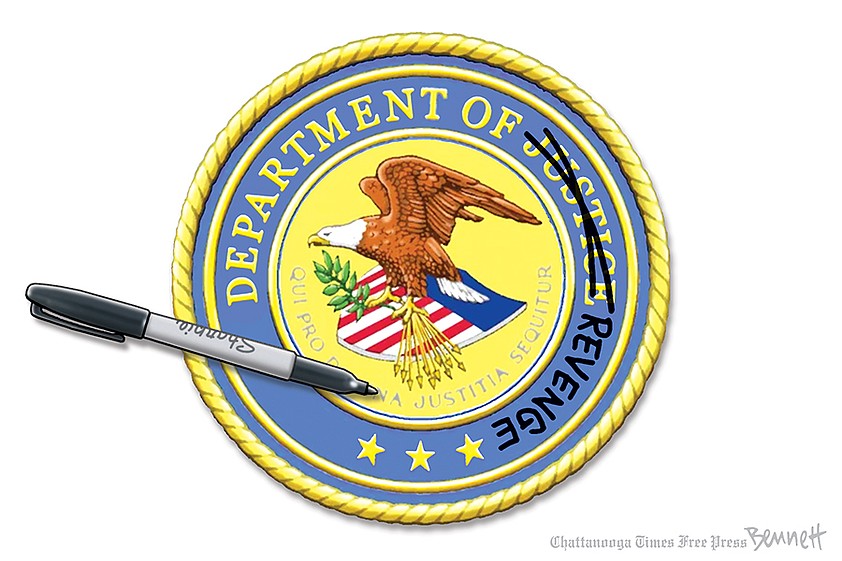
The politics. The Trump administration interprets all its losses in court as judges making their own policy decisions and trying to impose them on the executive branch. Stephen Miller, for example, decried how “15 Communist judges” spread through the courts can “block and freeze each executive action”.

That framing allows Trump’s people to describe the issues the way they want, and then say that judges are against what the administration is for. Trump wants to deport dangerous criminals, while judges want to stop him. Trump wants to defend our economy from predatory foreign countries, but judges want to stop him, and so on.

But that framing sidesteps whether the United States will continue to be a country of laws, or whether it will become a Trump dictatorship. The Constitution defines the powers of our government, and assigns them to different branches. When Trump gathers all those powers to himself — and more powers that the Constitution does not assign to anyone — our way of life is endangered.

Whatever legitimate goals Trump may have — deporting criminals or protecting American jobs or whatever — can be accomplished in legal ways. (For example, Trump could ask Congress for a new tariff law. He could deport criminals through the immigration courts.) When he ignores legal pathways in favor of illegal ones, he needs to be stopped.

The Monday Morning Teaser

Three big things happened this week:

  • The US Court of International Trade struck down most of the new tariffs Trump has imposed, while putting major restrictions on the tariffs he can impose in the future.
  • Ukraine launched an incredible drone strike thousands of miles from its border, destroying bombers on three Russian air bases.
  • Elon Musk had his last day as a “special government employee”, prompting reflections on what the whole DOGE thing has accomplished.

The featured post will delve into the court ruling on tariffs, leaving Ukraine and Musk for the weekly summary. Expect to see the featured post around 10 EDT, and the summary around noon.

Deep Motives

Trump isn’t trying to make our communities safer from migrant crime, which is not a widespread thing. He is trying to divide us, to make us fear and despise other human beings who live in our communities, and to gain power from that division and fear.

– “The Cruelty Is The Point, But What’s The Goal?
The Big Picture

This week’s featured post is “The Greatness Paradox“.

This week everybody was talking about the GOP’s budget bill

Last week I wrote about what the “Big Beautiful Bill” contains: tax cuts for rich people, cuts to programs like Medicaid and Food Stamps that help the working poor, and a huge deficit.

Trump’s supporters will undoubtedly see hypocrisy my complaints about this bill’s deficits when I was fine with Biden’s deficits. But there’s a big difference: Biden was investing in the future, in infrastructure, and in mitigating the damaging effects of climate change. Trump is just transferring wealth from the bottom of society to the top.

The “Freedom” caucus in the House briefly slowed down the bill’s passage, but enough of them fell into line to pass the bill by one vote. The holdouts got a variety of concessions, but the big one is a further cut in Medicaid: the “work requirement” (that adds bureaucratic hurdles to the program and will cause millions of qualified working people to lose their medical coverage) starts in 2027 rather than 2029.


A handful of Republican senators are still pretending to care about the national debt. They will make lots of favorable headlines for themselves and their serious good intentions — and then quietly cave.


An obscure point about this bill deserves more attention: PAYGO legislation from years ago forces an across-the-board sequestration if deficits go too high. The nonpartisan Congressional Budget Office is projecting that the Big Beautiful Bill might cross that limit and lead to $500 billion in Medicare cuts.

and the ongoing wars

The Ukraine War continues, long after Trump’s promise to end it “in 24 hours” expired. As Putin responds to Trump’s attempts at peace talks with ever-more-deadly attacks, Trump appears to finally be recognizing that Putin is an enemy to peace. But he frames the situation as Putin-has-changed, not Putin-fooled-me.

“I’ve always had a very good relationship with Vladimir Putin of Russia, but something has happened to him. He has gone absolutely CRAZY!” Trump wrote in a social media post, adding, “I’ve always said that he wants ALL of Ukraine, not just a piece of it, and maybe that’s proving to be right, but if he does, it will lead to the downfall of Russia!

”Earlier on Sunday the US president told reporters that was he was “very surprised” that his Russian counterpart had intensified the bombardment of Ukrainian cities despite the US president’s efforts to broker a ceasefire.

Pressed by a reporter to say if he was now seriously considering “putting more sanctions on Russia”, Trump replied: “Absolutely. He’s killing a lot of people. What the hell happened to him?”

The sanctions will never happen, because Putin is the alpha in the Putin-Trump relationship.


Israel’s genocide in Gaza continues and even escalates. I used to hesitate to use that word, but I don’t see how else to characterize the situation. This week, Israel’s former prime minister Ehud Olmert wrote an op-ed in a leading Israeli newspaper:

“What we are doing in Gaza is a war of extermination: indiscriminate, unrestrained, brutal, and criminal killing of civilians,” he said.

“We are doing this not because of an accidental loss of control in a particular sector, not because of a disproportionate outburst of fighters in some unit — but as a result of a policy dictated by the government, knowingly, intentionally, viciously, maliciously, recklessly,” Olmert’s op-ed continued. “Yes, we are committing war crimes.”


I continue to denounce any attempt by Americans of any opinion to bring the Gaza War here. The murder of two Israeli embassy staffers in Washington, D.C. Wednesday helps no one. And there is even less justification for harassing American Jews for the actions of the Netanyahu government.

Similarly, demonstrating or writing in favor of Palestine is no reason to deport foreign students.

In America, we can and should argue about issues of all kinds. We have the right to speak out and peacefully demonstrate to make our opinions known. But leave the violence over there. Our goal should be to stop the violence there, not bring it here.

and Joe Biden

Last week we heard that Joe Biden has an advanced form of prostate cancer. I cannot remember bad news about a former president being met with less compassion. Don Jr. tweeted:

What I want to know is how did Dr. Jill Biden miss stage five metastatic cancer or is this yet another cover-up???

When he took flack for that stone-hearted comment, he struck back:

I sometimes forget that part of the mental disorder of leftism is an inability to understand sarcasm.

No, we get the sarcasm. What we can’t understand is posting a sarcastic response to another human being’s death sentence.

Laura Loomer skipped any attempt at humor and went straight for venom.

To all of you praying for Joe Biden, can you pray for the people he killed with his open border policies instead? “Ohhhh boo hoo he’s such a good guy booo hooo he’s such a fighter.” No he’s not. And no, he’s not. He is going down in history as the worst US President EVER.

No, Laura, I think your guy has that title pretty well wrapped up.

For the mainstream media, this was another opportunity to raise the dementia-cover-up theory. I find it striking how much of this story revolves around Biden’s trouble walking, and has nothing to do with an inability to think.

In a statement to Axios, an anonymous Biden aide said: “Yes, there were physical changes as he got older, but evidence of aging is not evidence of mental incapacity.”

The spokesperson added: “We are still waiting for someone, anyone, to point out where Joe Biden had to make a presidential decision or make a presidential address where he was unable to do his job because of mental decline.

“In fact, the evidence points to the opposite – he was a very effective president.”

I don’t know how much he did himself and how much he delegated, but everything that happened during the Biden administration was consistent with the man he has always been. The US was well-governed during his four years, and he did an excellent job of cleaning up the mess Trump left behind after his first term.

And whether you liked his politics or not, his career is done now and he’s likely to die soon. It costs you nothing to treat him like a human being.

and you also might be interested in …

Bruce Springsteen tells it like it is:


The measles outbreak in Texas seems to be waning, but the disease is still spreading in New Mexico and Kansas. Officials worry about the outbreak spreading further as more people travel in the summer. Already, 2025 has the second-most cases of any year in this century.


Just in case you thought it couldn’t get worse: The EPA wants to completely eliminate greenhouse gas limits on power plants.


MSNBC host Jen Psaki used to answer questions as Biden’s press secretary. One of the more charming features of her current show is to take questions from current White House press conferences and answer them honestly, something current press secretary Karoline Leavitt will never do.


I always thought Kristi Noem was an opportunist. But now we find out she’s also an idiot.


It’s been five years since a Minneapolis policeman murdered George Floyd, igniting protests around the country. NPR’s Michel Martin spoke to Minnesota Attorney General Keith Ellison, Minneapolis Mayor Jacob Frey and civil rights attorney Benjamin Crump. Activists M Adams and Miski Noor argue that the resulting movement to defund the police accomplished more than you might think. On the other hand, the NYT reports that police killings have risen every year since Floyd’s murder.


David Roberts:

If you’re talking about jobs that could relatively easily be replaced with AI, I would suggest, at the top of the list: [mainstream media] political reporter. How trivially easy would it be to program an AI to crank out “Dems in disarray” pieces from now to eternity?


Ruben Bolling does his best Dr. Seuss imitation:

and let’s close with something challenging

The Sony World Photography Awards open a new competition on Sunday. Just for reference, here’s last year’s winner.

The Greatness Paradox

Trump’s notion of national greatness is stuck in the Napoleonic Era.
That’s causing him to destroy everything that makes America great today.


Nothing is more central to the positive version of Trump’s image or to the aspirations of his followers than the idea of greatness. Throughout his political career, policies come and go, allies are cast out as enemies and then welcomed back into his good graces, and whether he wants more or less of something may change from the beginning of a speech to the end. But the slogan never changes: Make America Great Again. It’s been so steady that everyone knows it just by its initials, MAGA. You talk about MAGA followers or the MAGA Party, and everyone knows what you mean.

And who can argue with that goal? Don’t all loyal Americans want their country to be greater rather than lesser? The “again” may be controversial — when exactly are we talking about? — but “greatness”, who doesn’t aspire to greatness?

And yet, every day we see Trump tear down the things that have made America great: scientific excellence, the rule of law, trade, alliances, our open society, and the soft power that comes from the attractiveness of our vision. How does that make any sense? Is it just hypocrisy? Is “greatness” just a buzzword to exploit? A false banner for the gullible to flock behind?

I want to propose a different explanation. When we asked what era “again” referred to, we were on the right track, but we didn’t take it far enough. What era does “greatness” refer to?

Look at some of the things Trump thinks will make America “great again” and ask yourself what era they belong to. Invariably, they fit a Napoleonic view of greatness, not a 21st-century view.

  • Territorial expansion. Great nations gain territory while lesser nations lose territory. Taking over Greenland, regaining the Panama Canal, and annexing Canada, would be a sure sign of our renewed greatness.
  • Mercantile dominance. A great nation exports more goods than it imports, drawing in gold and silver. This was the dominant theory of economics at least until Adam Smith’s Wealth of Nations came out in 1776 and for some while thereafter. Such mercantilism is the primary motive behind Trump’s tariff policy.
  • Manliness. In the Napoleonic years, Frenchmen were confident of their ultimate victory over England, because the English were “a nation of shopkeepers” that did not properly center martial valor in their national identity. This attitude resonates with Defense Secretary Pete Hegseth’s prioritization of “restoring the warrior ethos” in our military, and getting rid of efforts to promote diversity and inclusion. “We are leaving wokeness and weakness behind. And refocusing on lethality”. As if armies still relied on glorious cavalry charges rather than drone pilots who might have any sex, sexual preference, or gender identity.
  • A Great Leader. A primary knock on democracy centuries ago was that it could not produce great leaders like Louis XIV or Peter the Great. Democratic leaders were barely larger than their voters and changed every few years. How could a comparative nonentity like Prime Minister William Pitt compete with a world-bestriding figure like the Emperor Napoleon? Similarly, how could a Kamala Harris or Tim Walz stand up to a contemporary czar like Vladimir Putin? Centuries ago, the pettiness and towering rages of absolute rulers were signs of greatness, while the self-control of a democratic leader seemed weak.

But think for a minute about what has made America great these last hundred years:

  • Science. Yes, the United States fielded valiant soldiers during World War II. But so did our enemies. Our margin of victory came from developments like radar, code-breaking, and the atomic bomb. As we enter into an era of war-fighting AI, global pandemics, and drones, scientific leadership is more important than ever.
  • Trustworthy institutions. The primacy of the US in the postwar era has less to do with being a military hegemon than with being at the heart of a global order. The dollar is the global currency. The US banking system is the nerve center of the world economy. US Treasury bills have been the default investment of all other nations’ central banks. Wall Street is the world’s stock market. Other countries tolerate this because (until recently) they have trusted US institutions to be reliable partners.
  • The rule of law. Why have so many entrepreneurs come to America to found their businesses? Because a fortune made in America was protected by law and safe from predatory rulers like Putin or Viktor Orban. Contracts were enforceable in America, rather than subject to reinterpretation every time an autocrat changed his mind.
  • Education. Around the world, families aspire to send their most promising children to top American universities like Harvard or Columbia. Much of that talent has stayed in America, and even the graduates who returned home brought with them American ideals and an appreciation of American culture.
  • Alliances and treaties. US power has been multiplied by the NATO alliance America leads. American support for international law and international standards has enabled global trade that produced much wealth.
  • Immigration. Immigrants have never been welcomed in America with open arms. But throughout our history, oppressed people around the world have seen America as a refuge, and have hoped their descendants could be fully integrated into our “melting pot”. This influx of energy and talent has kept our society young and vibrant. The freshness and openness of American culture has made the US a place of aspiration.
  • Moral leadership. No great power has ever been mistaken for a saint, and the US won’t be the first. But when disaster strikes anywhere in the world, the US has been among the first nations to help. This generosity has paid dividends for us, both in terms of influence and in our ability to fight epidemics overseas before they can arrive here.
  • Freedom. Much of the mystique of America has revolved around freedom: If you come here, you are free. You can say what you want and believe what you want without fear of government retribution.

Now look at what the Trump administration has been doing.

So is Trump pursuing national greatness? Yes, but according to a notion of greatness that passed its sell-by date centuries ago. He aspires to a Napoleonic greatness and is oblivious to everything that makes a 21st-century nation great. That’s why his policies have America on its way to the dustbin of history, not to a new “golden age“.

The Monday Morning Teaser

The featured post today is another take-a-step-back post, where I try to make sense out of something that looks mysterious at first glance. The subject this week is greatness, as in “Make America Great Again”. There’s been a lot of debate about what era “again” refers to: the Confederacy? the Gilded Age? Jim Crow? Pre-feminism? When?

But hardly anybody asks what era “great” refers to. Because the meaning of national greatness has changed over the centuries. You can drive yourself nuts trying to figure out how “national greatness” can lead a movement to slash funding for science, destroy higher education, weaken our alliances, or undermine the rule of law. From a 21st-century perspective, everything Trump is doing tears down America’s greatness. So how can his followers be so gullible as to imagine he’s making us “great again”?

I think I know the answer to that one: Trump and his most ardent followers don’t have a 21st-century concept of greatness. They’re stuck in the Napoleonic Era, when “greatness” meant something completely different, like territorial expansion and mercantile dominance.

That’s the topic of the featured post, “The Greatness Paradox”, which should be out before 9 EST.

That leaves a lot for the weekly summary: passage of the “big beautiful” budget bill through the House, the ongoing wars in Ukraine and Gaza, Joe Biden’s cancer diagnosis, and so on. I’ll try to get that out by noon.

Still Sanewashing

It’s hard to avoid the sense that what we’re seeing on tariffs is another version of the sanewashing that Trump has benefited from ever since he entered politics. People just keep wanting to believe that he’s making sense, that he isn’t as ignorant and irresponsible as he seems. But he is.

– Paul Krugman “The Trade War Isn’t Over

This week’s featured posts are “What’s up with the Supreme Court?” and “The Big Beautiful Bill“.

This week everybody was talking about the FY 2026 budget

Trump’s “big beautiful bill” squeaked through the House Budget Committee yesterday. Details about what the bill is intended to accomplish are in one featured post.

and Trump’s retreat on tariffs

It’s been about six weeks since Trump announced “Liberation Day”, when drastically increased tariffs freed Americans from the tyranny of full shelves and cheap products made overseas. Stephen Miller called it “the most significant action on global trade policy that has taken place in our lifetimes”.

Then it all started to unravel. (Timeline from The Guardian.) The bizarrely determined individual “reciprocal tariffs” imposed on imports from each country came and went in less than a day, even though deals had been announced only with the UK — and that one was still tentative. A week ago, Trump announced that the 145% tariffs on Chinese goods would go down to 30% for 90 days.

So here we are. The Treasury secretary is still threatening that the “reciprocal” tariff levels will be back if countries don’t negotiate “in good faith”, as if the US has been acting in good faith. But the markets have returned to their pre-liberation levels, as investors seem to be pretending the last six weeks were just a bad dream. Maybe Trump has learned his lesson now, as Senator Collins claimed after voting to acquit in his first impeachment.

Paul Krugman would like to differ.

If you get your picture of what’s happening from “news analyses” rather than experts who actually do the math, you might well think that the Trump trade war is basically over, that we’re back to more or less normal policy.

The reality is that we’ve gone from a completely insane tariff rate on imports from China to a rate that’s merely crazy. And China accounts for only a fraction of our imports. Tariffs on everyone else are still at 10 percent, a level we haven’t seen in generations. And there are still other shoes to drop: Trump has, for example, been promising tariffs on pharmaceuticals.

The trade war is still very much on. … In other words, not much has changed since last week. We may not be looking at the complete economic meltdown that seemed quite possible (and is still a possibility), but we’re still looking at much higher inflation and an economic slowdown at best — i.e., stagflation.

and bribery

Other than going to Vatican City to sleep at Pope Francis’ funeral, the first overseas trip of Trump’s second administration was the tour of the oil-rich kingdoms of the Persian Gulf he completed this week. He took with him friendly tech-company CEOs “including Nvidia’s Jensen Huang, OpenAI’s Sam Altman, Elon Musk, Amazon’s Andy Jassy, Palantir’s Alex Karp and two dozen others”.

While it’s not unusual for presidents to promote US business interests overseas, the trip’s biggest headlines concerned the benefits to Trump himself, including Qatar’s gift of a $400 million “palace in the sky” intended to replace Air Force One, which Trump has long considered shabby and whose replacement is behind schedule. (Technically, the plane is a gift to the US government, but Trump’s plan is for it to go to his presidential library foundation — which he will control — after he leaves office.)

A much more direct enrichment of Trump came from an Abu Dhabi firm that invested $2 billion in his crypto-coin scheme. Some of the investments in US corporations involved changes in government policy, like allowing the United Arab Emirates to buy quantities of top Nvidia chips that would have been forbidden under Biden administration policies, trusting the UAE not to pass such advanced tech on to a rival superpower like China.

Richard Painter, previously a government ethics lawyer under George W. Bush, commented:

[T]he impression is given that the position of the United States can be swayed and even bought.

and the Guardian reported:

Past administrations would have run from the perceived conflicts of interest being welcomed by Trump. … “The status quo has been saying no, because it’s an actual and apparent conflict of interest, and it could jeopardize our domestic and foreign policies,” said [Scott] Amey [of the non-profit Project On Government Oversight]. ”It certainly doesn’t pass the sniff test for a lot of Americans.”

The lavish gifts and other investments come as Trump is reshaping America’s policy in the Middle East, skipping Israel and turning toward the Gulf states in a flurry of deal-making that could benefit both sides handsomely.

and the Palm Springs bombing

An IVF clinic in California was bombed Saturday morning, in an apparent terrorist attack. My first thought was that this was the work of people who believe in ensoulment at conception, upset that IVF clinics destroy fertilized embryos after they are no longer needed.

But no, it looks like the perpetrator, who also appears to have been the sole fatality, is an antinatalist. I had no idea what that was until NPR explained it: An antinatalist believes it is wrong to have children.

and you also might be interested in …

We can expect a robust tourist trade this summer.


It’s got to be hard for satirical sites like The Onion to compete with real headlines like this one: “Trump’s DHS considers reality show where immigrants compete for citizenship, producer says“.


DOGE is still around, and still exceeding any possible authority it might have. It’s been trying to take over agencies that serve Congress, like the Library of Congress and the General Accounting Office.


Oklahoma’s new social studies curriculum will encourage students to believe Trump’s conspiracy theories about the 2020 election.


Some good news on climate change from the UK-based Carbon Brief website, which looks like a good source for in-depth information about the climate.


and let’s close with something commercial

I’m not sure how Facebook figured out my sense of humor, but lately I’ve been deluged with ads for history-related t-shirts.

The Big Beautiful Bill

Since the Republicans took it over in January, one of our three branches of government has been AWOL: Congress. The Executive branch has been all too active, as President Trump has sought to exercise powers the Constitution does not grant him. That has kept the judicial branch busy as well, processing lawsuits that try to block Trump’s illegal actions.

But where has Congress been? Not only has it passed almost no laws, but it has watched mutely as the Trump administration refuses to spend money it appropriated and closes down agencies it established. The Senate shrugged as Trump nominated one absurdly unfit and unqualified character after another to the most important positions in our government. And as one scandal after another unfolded, Congress has not even held any noteworthy investigative hearings.

However, there is one congressional power that neither the President nor the Supreme Court has yet figured out how to usurp in any major way: authorizing the government to collect taxes and spend money.

So we saw Congress act back in March, when the government was about to run out of money. It did just about the minimum possible: passed a continuing resolution that kept fiscal 2025 spending at more-or-less the same level as fiscal 2024. But the money runs out again when FY2026 starts on October 1.

From the beginning, there’s been pressure on Congress’ Republican leadership to put its mark on the new budget. After all, if the government keeps spending the same amounts of money on the same things, what was the point of giving the GOP control? The Party needs a budget it can take back to its voters and say, “See? This is what you sent us to Washington to do.”

Or, to put it another way: Republicans own the FY 2026 budget. They can’t blame Biden or Nancy Pelosi or any of their usual scapegoats. So what are they going to do?

If you’ve ever managed anything — a household, a church, a business, or whatever — you know that budgets are where the rubber meets the road. You can say lofty things about your values, your principles, or who you care about, but it’s all just words until you have to put numbers on paper. When real dollars start coming in and going out, your rhetoric doesn’t matter any more.

That’s a particular problem for MAGA Republicans this year, because much of what they’ve been telling their voters isn’t true. In particular, they’ve been claiming for years that government spending is full of waste and fraud that serves no legitimate public purpose. So spending can be drastically cut without hurting anybody other than the bureaucrats and the fraudsters. They can spend even more on Trump priorities like border security and missile defense, and still find enough waste and fraud to give big tax cuts to the Dear Leader’s wealthy friends — all without increasing the national debt that they claim is destroying the nation.

But then there are those pesky numbers, and disciplines like arithmetic that they still haven’t managed to write out of the national curriculum. So as of yesterday, when the budget bill squeaked through the House Budget Committee on its second try, it can be summed up in three points:

In theory, this combination — transferring wealth from the working poor to the very rich, while worsening the debt problem Republicans claim is an existential threat to the Republic — should repel the White working-class voters who provided Trump’s margin of victory. But we’ll see. Whatever comes out of this process, Trump will claim that it’s wonderful. Perhaps his MAGA base will be loyal enough and gullible enough to believe him, as they so often do.

What Democrats need to do during this process is keep the discussion focused on things that are real, and cut through Republican attempts to cloud the real issues.

Work requirements. The biggest attempt to cloud the reality of the Medicaid and food stamp cuts is the imposition of work requirements on recipients. This sounds great to the typical MAGA voter, who has been fed story after story of able-bodied young men taking advantage of the system. These moochers, Speaker Mike Johnson says, “need to be out working instead of playing videogames all day.”

Johnson hopes you don’t know that numerous states have imposed work requirements, and it has never worked the way he wants you to believe it will.

When Arkansas applied this policy in 2018, it failed disastrously. Even though nearly all enrollees should have met the work requirement or qualified for an exemption, a large share tripped over the red tape and lost their health care coverage anyway. About 1 in 4 people in Arkansas subject to the requirements—about 18,000 people—lost coverage in just the first seven months of the new policy, before a federal judge determined that the policy violated the purpose of the Medicaid program and put a stop to it.

New Hampshire followed Arkansas’ lead in 2019, and similarly found that about 2 out of 3 enrollees subject to the new policy would have lost their health care coverage in the first two months—so the state suspended the program. Shortly after, it was halted permanently by a federal court.

And in Georgia, the only state allowed to continue a work requirement policy, which applied to a narrow eligibility expansion, the administrative costs to run the program were astronomical—nearly $60 million in the first year to cover just 4,200 people.

Think it through: If you’re going to require recipients to work (or engage in some other worthwhile behavior like school), they’re going to have to provide proof that they’re working, and do it on a regular basis. And you’ll have to hire more bureaucrats to check up on that paperwork.

Now picture the life of typical Medicaid or SNAP recipients, who are not playing video games all day. They’re working 30 hours or more a week at something close to minimum wage, dealing with inefficient public transportation or unreliable car pools because they don’t have a car, and probably juggling child care at the same time. Many of them are not well educated, so they have trouble navigating complex systems. Completing a new set of forms (with supporting documentation) every 90 days or so has a way of slipping through the cracks.

Now think about health insurance. If you’re healthy, nothing happens when you lose health insurance, at least not right away. Your kids will complain if you don’t get dinner on the table, and your boss may fire you if you’re late for work, but if your Medicaid paperwork slides a day or two, that doesn’t seem like an emergency. How are you going to allocate your time?

So yes, the government can save money by imposing work requirements. But those savings come from denying care to people who are actually eligible. (The people who are working the most hours are the ones who will have the hardest time keeping their paperwork up to date.) And much of the savings is eaten up by the increased bureaucracy.

Similar “savings”. The Contrarian reports:

The bill includes a range of other cruel Medicaid policies that should also come out. In yet another play to harass people off of their Medicaid coverage, it would roll back a rule finalized by the Biden administration to modernize and simplify how people enroll and stay enrolled in coverage. Repealing this rule will save the government $162 billion over the next 10 years— largely because rolling back the rule reinstates a lot of unnecessary red tape, which reduces the total number of people enrolled.

ObamaCare. For years Republicans tried to repeal ObamaCare, but now they’re taking refuge in it. Specifically, they argue that people who get kicked out of Medicaid can still get subsidized policies on the ObamaCare marketplaces.

Subsidized, but not free. And that brings up a public-policy aspect of healthcare: We don’t want people to gamble with their health insurance.

I know how this works because decades ago I did it myself: In the two or three months between the end of my final school year and the beginning of my first job-with-benefits, I went without health coverage. It would have cost me hundreds of dollars a month to fill the gap, which seemed like a lot of money to me at the time. I was healthy, so why not risk it?

I got away with it. Lots of people do. But the ones who don’t end up costing our healthcare system a lot of money, because emergency rooms are the least efficient way to take care of people.

Again, if you’re healthy, nothing immediately goes wrong when your health insurance lapses. The kids will suffer if you stop buying groceries, and they’ll complain if they have to keep wearing clothes they’ve outgrown. The landlord may throw you out if you stop paying rent. But if you don’t have health insurance for a month or two, maybe you get away with it. Doing without can look like the easiest way to fill the hole in your budget. And then months stretch into years, until something happens.

We don’t want to tempt people to make that trade-off.

Values. Finally, think about what we’re giving away here: health care and food. We’re not giving poor people sports cars and Super Bowl tickets. If someone “takes advantage” of you to get the medicine and treatment they need, or food for themselves or their families, are you really that upset? How many needy people are you willing to cut off to make sure that some handful of young men aren’t playing video games all day?

If your answer to that question isn’t tiny, you might want to take another look at your moral values.

What’s up with the Supreme Court?

Consider this a follow-up to last week’s post of qualified optimism about the prospects for American democracy to outlive the Trump administration. We continue to be steaming towards a direct clash between Trump and the Supreme Court. How that plays out will be a big factor in whether our way of government survives.

A lot of the pessimists I talk with say this clash has already happened and the bad guys won. Specifically, the Court told the Trump administration to bring Kilmar Abrego Garcia back from the concentration camp Trump has established in El Salvador. Trump has ignored that order and gotten away with it. So: courts and laws are powerless and Trump will do as he pleases. For all practical purposes, American democracy is already dead.

I read the situation somewhat differently. To me, the Supreme Court and the Trump administration look like two fighters circling each other warily, each waiting to see if the other really wants to do this.

It already seems clear that the Court will not endorse Trump’s most obviously illegal acts. It will not deny that the 14th Amendment guarantees birthright citizenship, no matter how badly Trump wants that denial. It won’t agree that he can invoke wartime powers (like the Alien Enemies Act) when there is no war. It won’t endorse him unilaterally unmaking agencies made and funded by Congress. The administration seems to understand this, which is why it hasn’t pushed for the Court to resolve those issues quickly.

Instead, Trump’s lawyers keep offering the Court ways to surrender quietly, by writing itself out of the picture. For example, the portion of the birthright citizenship case that the administration argued in front of the Court this week did not seek an answer to the central question. Instead, it focused on whether lower court injunctions could cover the entire country. The acting Solicitor General argued for a system in which each loss in a lower court only affected the specific plaintiffs involved, leaving the administration free to ignore the birthright citizenship of any other Americans until they sued too. Only a Supreme Court ruling could shut the administration down completely.

This leaves an enormous loophole: If the administration simply refused to appeal a series of lower-court losses, none of the cases would make it to the Supreme Court, so there could be no national ruling against them.

In other words: You don’t have to endorse our position, Supremes, just write yourself out of the picture and let us proceed.

For its part, the Court has so far treated the Trump administration as if it were a good-faith actor, which it clearly is not. In the Garcia case, the Supremes supported a lower-court order to “facilitate” Garcia’s release, leaving the details to the executive branch. (That’s appropriate if the executive branch is acting in good faith, because the executive is presumed to be better equipped to deal with foreign governments.) In essence, it was offering Trump the opportunity to stop all this nonsense and start behaving like the kind of American president the Constitution envisions.

But of course he did not. The Trump administration interpreted “facilitate” in a ridiculously narrow way, and — surprise! — the details of Garcia’s release haven’t worked out. The government continues to give the lower-court judge a run-around as to what it is or is not doing to get Garcia back.

Sooner or later, Judge Xinis is going to tire of this and order the administration to present Garcia in his court on a particular date. That order will also get appealed up to the Supreme Court, which will then have to decide whether it is ready to confront Trump or surrender to him. If it isn’t ready to surrender, then Trump will have to decide whether he recognizes the authority of the Court. If he doesn’t, that’s the crisis point.

I don’t think anyone knows whether we’ll get there, or what will happen then. Trump himself may not know, and the answer may turn on how popular Trump is at the time, how the economy is going, how vigorously Republicans in Congress are standing up for him, how well organized anti-Trump protesters are, and a lot of other factors that have nothing to do with the case at hand.

It’s worth noting that so far the Trump administration is not acting as if it had thrown off the burden of judicial oversight. For example, on Friday the Supreme Court extended its previous ban on deporting any more people under the authority of the Alien Enemies Act until the administration’s invocation of the AEA’s wartime powers can be fully adjudicated. As best we can tell, the administration is obeying the order.

At least for now.

The Monday Morning Teaser

From my point of view, two things that happened this week are worth paying attention to: Trump and the Supreme Court continued steaming towards a democracy-rattling confrontation, and Republicans in Congress made a few more steps in the direction of passing a disastrous budget for the fiscal year that starts in October. Each one of those developments gets a (fairly short) featured post.

The first, “What’s up with the Supreme Court?” is done and should post soon. The second “The Big Beautiful Bill” should appear by 10 EST.

That leaves a few major things for the weekly summary: Trump’s turnaround on tariffs, his corruption-filled trip to the Persian Gulf, the Palm Springs bombing, and a few other things. That should be out by noon or so.

True Greatness

America is the greatest democracy in the world.

Rümeysa Öztürk,
arriving back in Massachusetts after her court-ordered release

This week’s featured post is “As we approach our crisis of democracy, we’re in better shape than I expected“.

This week everybody was talking about the new Pope

Thursday, the College of Cardinals elected the next pope: Leo XIV.

In my previous weekly summary (April 21) I said:

Undoubtedly there will now be a battle for the soul of Catholicism. Will the church continue on the path Francis started down, or will it return to its traditional role as an ally of authoritarians and the privileged classes?

Leo XIV may surprise me, but at first glance it looks like the Francis faction won. The new pope seems more interested in the Sermon on the Mount than in fighting the culture wars.

I think the name he chose is significant: in 1891, Leo XIII wrote the ground-breaking encyclical Rerum Novarum (Of New Things), which has been the foundation of Catholic social justice thinking ever since. The main idea of Rerum Novarum is for the church to take seriously the plight of working people under capitalism. It represented a realization that without a clearly worker-sympathetic position, the church might lose out to some form of Marxism.

By choosing to be another Leo, this pope gestures towards both a sympathy with the lower classes and a willingness to modernize Catholic doctrine.

Much is being made of Leo’s American roots He grew up in Chicago, and his time the Catholic Theological Union in Chicago overlapped my years at the University of Chicago a few blocks away. We probably walked past each other on the sidewalk. Chicago is extremely proud to claim Leo, as the following cartoon illustrates.

To me, the greatest significance of an American pope is that he’ll be much harder for conservative American Catholics to ignore. (I’m looking at you, J. D. Vance and Sam Alito.)

and Trump’s legal losses

Yesterday, a federal judge in Vermont ordered Rümeysa Öztürk released on bail without travel restrictions. She’s the Tufts student who was kidnapped off the street in Somerville, Massachusetts by masked DHS agents and taken to a detention center in Louisiana. The administration obeyed the order, and Özturk is back in Massachusetts walking around free.

Chris Geidner of the Law Dork blog:

[Judge William Sessions concluded] that she has raised “a very substantial First Amendment claim” in her underlying habeas challenge, in addition to a “substantial claim” that the Trump administration violated her due process rights regarding her detention as well.

Prior to being arrested, Öztürk had been a Tufts Ph.D. student legally in the country on a student visa. What appears to have drawn the administration’s ire was an op-ed Öztürk wrote (with co-authors) in Tufts Daily urging the Tufts administration to “acknowledge the Palestinian genocide”. The judge wrote:

“There is absolutely no evidence that she has engaged in violence or advocated violence.” Additionally, he noted, “I do not find that any of the contacts that she has in the community create any danger or risk of flight.”

If you read the First Amendment, you will notice that it says nothing about citizenship. Freedom of speech is a human right, not a privilege of citizenship.

In a similar case, a federal appeals court denied the administration’s motion to stay the release of Columbia student Mohsen Mahdawi. Mahdawi was a green-card holder who was arrested in Vermont when he appeared for an interview related to his application for citizenship. He similarly has no record of violence or criminality, and has only advocated for Gaza.


Several federal judges have ruled against the administration on its invocation of the Alien Enemies Act; this is the basis for Trump to send people to prison in El Salvador. (See the same Law Dork link.) The Act allows the president to deport foreign nationals during time of war, predatory incursion, or invasion. Judges in a variety of jurisdictions have been finding that the current situation does not fit into any of those categories. Trump can call mass migration of individuals an “invasion”, but that does not match the way such a term was used in 1798 when the AEA was passed.


Yet another judge issued a restraining order against Trump’s mass firings of federal workers. (Same Law Dork link.)

“It is the prerogative of presidents to pursue new policy priorities and to imprint their stamp on the federal government. But to make large-scale overhauls of federal agencies, any president must enlist the help of his co-equal branch and partner, the Congress,” U.S. District Judge Susan Illston wrote in the decision. “Federal courts should not micromanage the vast federal workforce, but courts must sometimes act to preserve the proper checks and balances between the three branches of government.“

… “Plaintiffs are likely to succeed on their claim that the President’s Executive Order 14210 is ultra vires” — or beyond the president’s legal authority, in other words illegal — “as the President has neither constitutional nor, at this time, statutory authority to reorganize the executive branch,” [Judge Susan] Illston wrote.


One Trump victory: the purge of transfolk from the armed services can continue.


In general, I think the media is doing a bad job of explaining why the Trump administration is snatching people off the street, deporting American children, and so on: Trump was elected because he sold voters a dark fantasy about Biden’s America: The nation had been overrun by millions of immigrant criminals whose gangs had taken over our cities. The local police knew who they were, but couldn’t do anything because Biden protected the criminals. But Trump would be able to deport them all quickly. Millions of them.

So now he’s elected and has a real world to deal with: There aren’t millions of immigrant criminals and there is no migrant crime wave. If he just deports people for legitimate reasons, he can’t achieve the numbers his supporters expect.

That’s why he has to deport not just the relatively small number of immigrant criminals, but also men with tattoos, students who expressed anti-Israel opinions, and so on. And he’s still not making the numbers his followers expect.

and the FY 2026 budget

Nothing sums up the problems Republicans face in putting together a budget than this: Senator Josh Hawley isn’t down with cutting Medicaid.

As for Missouri, it is one of 40 Medicaid expansion states — because our voters wanted it that way. In 2020, the same year Mr. Trump carried the Missouri popular vote by a decisive margin, voters mandated that the state expand Medicaid coverage to working-class individuals unable to afford health care elsewhere. Voters went so far as to inscribe that expansion in our state constitution. Now some 21 percent of Missourians benefit from Medicaid or CHIP, the companion insurance program for lower-income children. And many of our rural hospitals and health providers depend on the funding from these programs to keep their doors open.

All of which means this: If Congress cuts funding for Medicaid benefits, Missouri workers and their children will lose their health care. And hospitals will close. It’s that simple. And that pattern will replicate in states across the country.

Meanwhile, the House leadership’s budget calls for more than $800 billion in Medicaid cuts.

A preliminary estimate from the nonpartisan Congressional Budget Office said the proposals would reduce the number of people with health care by 8.6 million over the decade.

They’re clever about it: They aren’t cutting “benefits”, they’re just slashing the federal reimbursement to states. Then most red states will scrap the Medicaid expansion associated with Obama’s Affordable Care Act, providing Congress with deniability: We didn’t do it, the states did it.

The end result, though, is exactly what Hawley says: People (particularly people working for barely more than minimum wage) will lose their health insurance, and rural hospitals will close.

Cuts like this (and to food stamps, which also affects the working poor) are necessary so that billionaires can pay lower taxes. And even then, a huge deficit will remain. I don’t know how Republicans will be able to sell this to their base. And if they can’t, their slim majorities in Congress won’t hold together well enough to push it through.

This is another example of the MAGA fantasy world running into reality. In the fantasy world, government is full of waste and fraud that a smart guy like Elon can point out and eliminate. That way, spending can be slashed without affecting ordinary Americans.

but I want to talk about optimism

That’s the subject of this week’s featured post. My view wouldn’t be optimistic in any other context: I still think we’re facing a crisis of democracy. But we’re facing it in better shape than I thought we’d be in.

and you also might be interested in …

Brought to you by the party that supports family values:


Vox’ Zack Beauchamp warns:

Israel’s war in Gaza, which has long been a moral atrocity, is on the brink of becoming unimaginably worse.

He quotes Israeli Finance Minister Bezalel Smotrich;

“Within a few months, we will be able to declare that we have won. Gaza will be totally destroyed,” Smotrich said. “In another six months, Hamas won’t exist as a functioning entity.”

He told the listening audience that the population of Gaza, some 2.3 million Palestinians, would be “concentrated” in a narrow strip of land between the Egyptian border and the so-called Morag Corridor, which runs the width of Gaza between Khan Younis and the border city of Rafah.

“They will be totally despairing, understanding that there is no hope and nothing to look for in Gaza, and will be looking for relocation to begin a new life in other places.”

Beauchamp notes that this is “a textbook example of ethnic cleansing”.


Mass shootings are down. No idea why.


Trump has stopped just about all refugee resettlement in the US. But he has finally found a group of refugees he likes: White South Africans.

The Trump administration is bringing a small number of white South Africans to the United States as refugees next week in what it says is the start of a larger relocation effort for a minority group who are being persecuted by their Black-led government because of their race.

But are they persecuted? Not in any way that makes them stand out, and maybe not at all. But they’re White, so they go to the front of the line.


This week in corruption:

In what may be the most valuable gift ever extended to the United States from a foreign government, the Trump administration is preparing to accept a super luxury Boeing 747-8 jumbo jet from the royal family of Qatar — a gift that is to be available for use by President Donald Trump as the new Air Force One until shortly before he leaves office, at which time ownership of the plane will be transferred to the Trump presidential library foundation, sources familiar with the proposed arrangement told ABC News.

Nothing to see here, just a foreign government giving an extremely valuable gift not to the United States, but for the benefit of one person, who happens to make many decisions the government of Qatar might want to influence.

The Guardian reviews the rules on presidential gifts, which are legally regarded as gifts to the American people. Previous presidents have transferred gifts — none of them nearly this large — to their presidential libraries for public display. But in Trump’s case this appears to be a dodge, as the plane will remain available for Trump’s personal use after ownership transfers. Judd Legum:

Can we please stop staying that, after Trump leaves office, the $400 million plane from Qatar will be given to the “Trump Presidential Library” Libraries do not fly on planes. The plane will be given to Trump.

The jet is not the only Qatari bribe. There’s also his partnership with Qatar’s sovereign wealth fund in developing a new Trump International Golf Club in Qatar.


The measles outbreak continues to spread, and even though it started before RFK Jr. took over as HHS Secretary, he’s coming to own it. The costs of his anti-vaccine crusade are becoming obvious.


A Republican attempt to steal a state supreme court seat in North Carolina was finally thwarted this week, a mere six months after an election that the Democratic candidate won.

[Incumbent Justice Allison] Riggs won the election in November by just 734 votes, but [Republican challenger Jefferson] Griffin mounted a massive legal challenge to overturn the election results and disenfranchise tens of thousands of voters. At the heart of Griffin’s lawsuit was a challenge to 65,000 lawfully cast ballots that he believed should be tossed out, because of errors made by the North Carolina elections board. The board counted some 60,000 ballots cast by voters with allegedly incomplete registration. … In fact, the litigation raised no significant evidence whatsoever that any illegitimate votes were cast.

A federal judge ruled in Riggs favor last Monday.

“This case concerns whether the federal constitution permits a state to alter the rules of an election after the fact and apply those changes retroactively to only a select group of voters, and in so doing treat those voters differently than other similarly situated individuals. This case is also about whether a state may redefine its class of eligible voters but offer no process to those who may have been misclassified as ineligible,” Myers wrote in his opinion. “To this court, the answer to each of those questions is ‘no.’”

Griffin decided not to appeal, so the case is finally over.


The US and China have agreed to reduce the massive tariffs each have imposed on the other, from 145% and 125% to 30% and 10%. The reduction is temporary: 90 days. We’ll see if that’s enough to cause trade to start flowing again. 30% is still a pretty hefty price increase.

and let’s close with something distracting

If you’re on BlueSky and looking for something to brighten up your otherwise depressing news feed, I recommend following Daily Bunnies. You’ll get a reliable stream of cute rabbit pictures. I guarantee that this sleepy bunny is not worrying about whatever is bothering you.