It’s not that Trump is saying things he believes to be false. It’s that he doesn’t seem to have beliefs at all, not in the way people typically talk about beliefs — as mental constructs stable across time and context. Rather, his opinions dissolve and coalesce fluidly, as he’s talking, like oil on shallow water. That’s why he gives every indication of conviction, even when, say, denying that he has said something that is still posted on his Twitter feed, or denying that he said something that he in fact said on live television, in front of millions of people, just minutes earlier.
– David Roberts “The question of what Donald Trump ‘really believes’ has no answer“
This week’s featured post is “Investigative Reporters and Donald Trump: The 9 Best Articles“.
This week everybody was talking about the Clinton/Trump debate (and Miss Universe 1996)

A week ago, the polls looked like a dead heat, and the momentum was still with Trump. Last Monday’s debate seems to have changed that dynamic. But not because we learned anything new about the candidates’ philosophies or programs.
I’m not even sure it was the debate itself that moved the polls. Sure, Clinton did look sharper and Trump made mistakes. But the more serious problem for Trump came afterwards. He spent the rest of the week off-message, overcome by his inability to let go of any argument that he’s not winning. All week he’s been proving the truth of what Clinton said in her convention speech:
A man you can bait with a tweet is not a man we can trust with nuclear weapons.
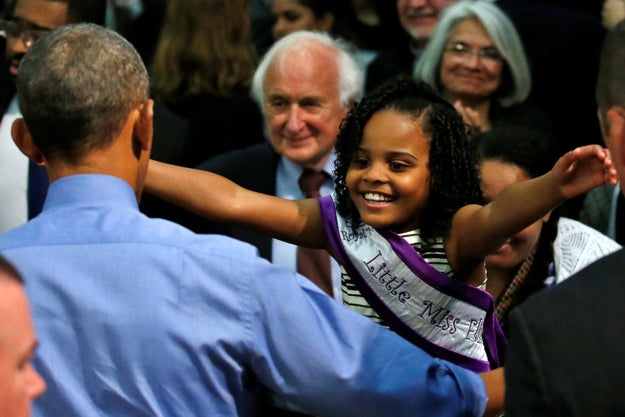
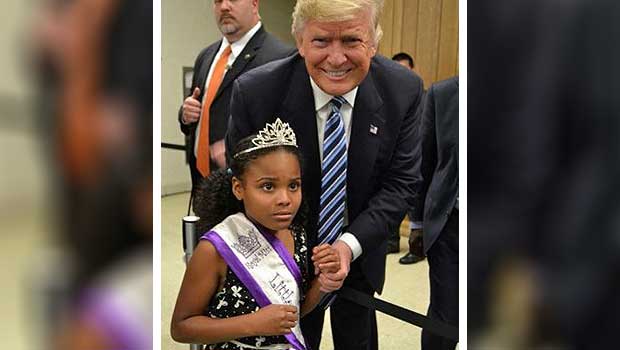
First, there was the Miss Universe flap. Josh Marshall pointed out how easily Trump could have stepped around the whole issue.
Anyone with the most basic communications experience or simply a conscience knows there’s a simple and solitary way to deal with something like this: “We quarreled years ago. I’m sorry we did. That’s a long time ago. I wish her the best.” Done and done.
But no. As with the Khan family, Trump took the attack personally and couldn’t let it go. Someone had implied he did something wrong, and he never does anything wrong.
He was still fuming in the wee hours of Friday morning. Clinton described this as “unhinged, even for him. Really, who gets up at 3 o’clock in the morning to engage in a Twitter attack against a former Miss Universe?” And Elizabeth Warren chimed in, tweeting at Trump: “You never tweet at 3am with ways to create new jobs for workers or hold Wall Street accountable.”
So does insulting a young woman 20 years ago mean Trump should never be president? No. It may not cast him in a positive light, but it’s a minor event far in the past. Does his reaction this week prove Clinton’s point that he is “temperamentally unfit” for the presidency? Yes it does. Ezra Klein did the best job of explaining why: Hillary set a trap for him and he has spent a week flailing in it. If he were president, ISIS and Russia and China could do the same thing.
The problem is that Trump is predictable and controllable. … As unpredictable and uncontrollable as he is to his allies, he is exactly that predictable and controllable to his enemies, and to America’s enemies.
Trump made two other unforced errors: He said “That makes me smart” when Clinton suggested he hadn’t paid any income tax. Ross Rosenfeld responded in The Hill:
I guess the rest of us are just stupid because we have to pay taxes. If only my daddy had left me a real estate empire, a host of political and financial connections, and no morals whatsoever — then I, too, could be “smart” like Donald Trump.
And on his own, Trump brought up his insults directed at Rosie O’Donnell, saying:
Somebody who’s been very vicious to me, Rosie O’Donnell, I said very tough things to her, and I think everybody would agree that she deserves it, and nobody feels sorry for her.
Lawrence O’Donnell said what I was thinking: “She deserves it. That is what every man guilty of spousal abuse always thinks.” So what exactly did Rosie do to deserve being called “disgusting” and “a fat pig”? She made fun of Trump on TV ten years ago. He can’t let it go.
The claim that Trump pays no taxes might be true, at least for a long stretch of years. The New York Times got hold of a few pages of Trump’s state and local income tax returns from 1995. They show Trump declared a huge loss, presumably on the collapse of his Atlantic City casinos.
Tax experts hired by The Times to analyze Mr. Trump’s 1995 records said that tax rules especially advantageous to wealthy filers would have allowed Mr. Trump to use his $916 million loss to cancel out an equivalent amount of taxable income over an 18-year period.
I feel like this is half a story, and I hope we see the other half before we vote. Unanswered questions: Is that loss real, or the product of creative tax accounting? Did he in fact use it to pay no taxes in subsequent years?
Trump once again used that I-could-talk-about-your-mama-but-I-won’t tactic that we all remember from fourth-grade recess. (Build your vocabulary: The technical name for this is apophasis.) Even more immature is that both he and his son Eric expect credit for not bringing up what they just brought up by talking about how they weren’t going to bring it up.
If Trump starts the conversation about Bill Clinton’s infidelity, here’s how it ends: Chelsea Clinton explains on TV how grateful she is that her parents held their marriage together, so she didn’t have to go through a divorce at age 7 like poor Eric Trump did.
and there were some unusual newspaper endorsements
The New York Times‘ endorsement of Clinton and denunciation of Trump really shouldn’t have surprised anyone. That The Washington Post also dislikes Trump wasn’t that big a shock either.
But The Arizona Republic had never endorsed a Democrat in its 126-year history, until Tuesday.
Clinton has the temperament and experience to be president. Donald Trump does not.
USA Today also has never endorsed a presidential candidate, and it still hasn’t, exactly. But it did take a side. Its Editorial Board “does not have a consensus for a Clinton endorsement.” But the Board could agree on this:
This year, the choice isn’t between two capable major party nominees who happen to have significant ideological differences. This year, one of the candidates — Republican nominee Donald Trump — is, by unanimous consensus of the Editorial Board, unfit for the presidency.
The Cincinnati Enquirer has “supported Republicans for president for almost a century”, but this time it says
Clinton is a known commodity with a proven track record of governing. … Trump is a clear and present danger to our country.
The Dallas Morning News last endorsed a Democrat for president “before World War II”, but this time it says
There is only one serious candidate on the presidential ballot in November. We recommend Hillary Clinton.
Trump has not managed to get a single major newspaper endorsement (though the conservative Washington Times and Wall Street Journal have yet to commit themselves, and it’s not hard to tell who The National Enquirer is rooting for). Even New Hampshire’s conservative voice, The Union Leader, has defected to Libertarian Gary Johnson. So have The Chicago Tribune and The Detroit News (breaking a 143-year-old Republican tradition).
Along the same lines, the NYT’s Ross Douthat also makes the conservative case against Trump:
Set aside for a moment Trump’s low character, his penchant for inflaming racial tensions, his personal corruptions. Assume for the sake of argument that all that can be folded into a “lesser of two evils” case.
What remains is this question: Can Donald Trump actually execute the basic duties of the presidency? Is there any way that his administration won’t be a flaming train wreck from the start? Is there any possibility that he’ll be levelheaded in a crisis — be it another 9/11 or financial meltdown, or any of the lesser-but-still-severe challenges that presidents reliably face?
I think we have seen enough from his campaign — up to and including his wretchedly stupid conduct since the first debate — to answer confidently, “No.” Trump’s zest for self-sabotage, his wild swings, his inability to delegate or take advice, are not mere flaws; they are defining characteristics. The burdens of the presidency will leave him permanently maddened, perpetually undone.
and Congress avoided another government shutdown
The new federal fiscal year began Saturday. Wednesday, Congress avoided a shutdown by passing a bill to fund operations through December 9. Republicans gave in to Democratic spending requests on issues that really shouldn’t be controversial or partisan: Flint’s water crisis, the Zika virus, and opiod addiction. Money related to the Louisiana floods was also in the bill. Democrats didn’t get everything they wanted though: the SEC still can’t take “action to increase transparency in public companies’ political spending”.
Not so long ago, we all took for granted that Congress would figure out some way to keep the lights on. Now it’s considered an accomplishment.
but Obama suffered his first veto override
This is kind of an odd story. Some families of 9-11 victims would like to sue Saudi Arabia for its alleged role in the attack. The problem is a legal principle known as sovereign immunity, which prevents people from suing foreign governments. Recently, Congress passed the Justice Against Sponsors of Terrorism bill to allow these suits. President Obama vetoed it, and Congress just overrode his veto, making the bill a law.
Overriding a veto takes a 2/3 votes in each house, so Republicans couldn’t do this by themselves. Apparently, congressional Democrats decided that opposing 9-11 victims right before an election was too politically dangerous, so most of them supported the override.
The problem is that when you take some action against a foreign government, it can respond. So Saudi Arabia, or maybe other countries, might start allowing their citizens to sue the U.S. for the damages we cause. This could result in the kind of huge mess that sovereign immunity is supposed to avoid.
So now congressional leaders are having second thoughts about what they’ve done, and Republicans are blaming President Obama for reasons that really defy analysis. Mitch McConnell said:
Because everyone was aware who the potential beneficiaries were, but nobody focused on the potential downside in terms of our international relationships. And I just think it was a ball dropped. I wish the President — and I hate to blame everything on him and I don’t — but it would have been helpful had … we had a discussion about this much earlier than the last week.
Because expecting Congress to do its own research into the consequences of its actions is setting the bar way too high. And McConnell listens so well when Obama tries to tell him something.
and you also might be interested in
Shimon Peres died. At 93, Peres was described as the “last link to Israel’s founding generation“. Because of that symbolic role, the articles this week about his death and career often say as much about the author’s attitude towards Israel and its current politics as about Peres.
David Roberts’ article in Vox, “The question of what Donald Trump ‘really believes’ has no answer” doesn’t meet the criteria for my “Investigative Reporters and Donald Trump: The 9 Best Articles” post, because it’s analysis rather than reporting. But it’s insightful and seems dead-on to me.
Roberts’ claim is that people use language in two sometimes-conflicting ways: to communicate ideas and to position themselves in the social hierarchy. But Trump is almost always focused on the second purpose. The reason it is so frustrating to discuss the content of Trump’s statements is that most of them were not intended to have content: They are pure maneuvers for dominance.
This point helps explain why Trump cannot ever admit a mistake or an error. He can only process accusations — of dishonesty, of cruelty — as social gambits, not as factual claims. To him, the demand that he apologize or admit error is nothing more than a dominance play. Apologizing is losing. …
It helps explain why Trump has such a long and rich history of defrauding investors, refusing to pay contractors, using his charitable foundation as a piggybank, and declaring bankruptcy to escape debt. Contracts and promises are just plays in the game, not words that carry meanings or create obligations. You sign them or say them when you need to, to win whatever negotiation you are in, and then they are gone like smoke.
Rush Limbaugh warns: “Don’t be fooled by fact-checkers.”
Usually we only talk about needlessly aggressive police tactics when someone winds up dead, but here are two videos of the kinds of interactions that might be happening every day without making headlines.
Calling attention to stuff like this is sometimes labeled as “anti-police”. But that’s not it. There is good policing and bad policing. You can be against bad policing without being anti-police.
and believe it or not, I decided to cut Gary Johnson some slack
This week Libertarian candidate Gary Johnson had what he described as another “Aleppo moment“: asked by Chris Matthews to name a foreign leader he admired, he couldn’t come up with a name without the help of his VP, Bill Weld. It looked like he had no idea who else belongs to the world-leader club he wants to join.
I was ready to ridicule him over this, when I noticed that I can’t list a lot of world leaders either. What’s the name of the British woman who came into office after Brexit? Who’s leading France? Spain? Italy? India? China? Iran? Iraq? Anywhere in Africa? Who’s heads the junta that took over Egypt a few years ago? I’d have to look all that up.
If you’re under 30, or maybe 40, you’ve lived your adult life in an era when the news media doesn’t bother much with other countries, so you may take this kind of ignorance for granted. Maintaining a far-flung network of foreign correspondents is expensive, and the economics of the news business has gotten harsher, so for decades we’ve gradually gotten less and less international news. Most of the coverage we do get is shallower, the kind you can do by pulling video of some disaster off the internet and narrating it from New York or London.
It’s all happened so gradually that the result is hard to notice, until something like the Johnson incident happens. But I’m about to turn 60, so I remember an era when the leaders of major countries were household names: Maggie Thatcher, Francois Mitterrand, Indira Gandhi, Willy Brandt, King (not Saddam) Hussein, Franco, Begin, Sadat, and so on. When I was a kid, Mad Magazine sometimes made fun of French President Charles de Gaulle, because of course their core audience of teens and tweens would know enough about him to get the joke.
As a society, we never talked it over and decided to become this ignorant of foreign affairs. It’s just one of those self-reinforcing cycles market economies are prone to: The less you know, the less you wonder. It never occurs to us to ask why we don’t know what we don’t know.
and let’s close with an ordinary person’s act of kindness and courage
Would you pull a Coke can off the head of a skunk?


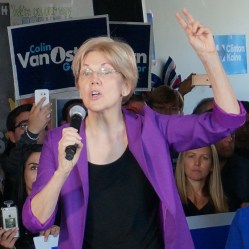 Elizabeth Warren crossed the border to Nashua Saturday morning to give a pep talk to the door-knockers and phone-bankers gathered at the local Democratic headquarters. I had a chance to snap this picture.