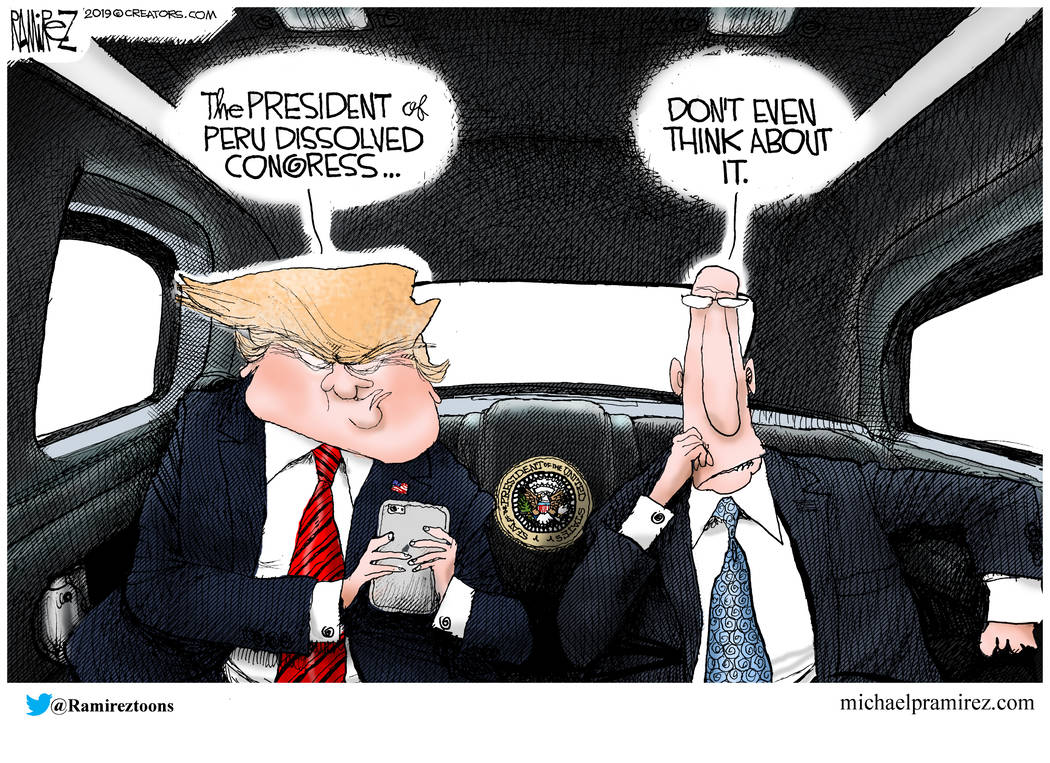
Unless Democrats are able to break through the Trump blockade on key witnesses, the Ukraine part of the impeachment hearings ended this week. The Intelligence Committee is preparing its report for the Judiciary Committee, which is responsible for writing articles of impeachment.
Judiciary will almost certainly offer an impeachment resolution with an article on Ukraine. Whether that resolution will be narrowly focused or include additional articles like obstruction of justice (based on Part II of the Mueller Report) or obstruction of Congress (based on the administration’s withholding of evidence and refusal to let officials testify) is still up in the air.
As many people have noted, this investigation has reversed the usual detective story: We knew whodunnit from the beginning. As soon as the White House released the call notes from President Trump’s July 25th phone conversation with Ukrainian President Zelensky, it was obvious that Trump had used the threat of withholding American military aid to pressure Zelensky to announce investigations of “Crowdstrike” (the wacky conspiracy theory that Ukraine and the Democrats framed Russia for interfering in the 2016 election on Trump’s behalf) and “Biden’s son” .
The testimony we’ve heard the last two weeks has mainly done three things:
Educated the public on how important US military aid and the public appearance of US support was to Ukraine, which is fighting a war with Russia. Trump really did have Zelensky over a barrel.
Detailed just how wide and deep the effort to pressure Ukraine was, and how extremely it differed from the US policy towards Ukraine supported by a large bipartisan majority in Congress. Trump’s lawyer Rudy Giuliani had no official government position, but for months ran a “shadow foreign policy” directly at odds with official US policy. (Fiona Hill put it like this: “[Gordon Sondland] was being involved in a domestic political errand. And we were being involved in national security foreign policy. And those two things had just diverged.”) Official policy wholeheartedly supported Ukraine in its war with Russia; the shadow policy threatened that support in order to create pressure on Ukraine to help Trump’s re-election campaign.
Shot down the wide range of unlikely claims by which Trump defenders urged us to ignore what we could see with our own eyes in the call notes. Trump may have spoken in a Mafia-don manner that only hinted at what he wanted, but the Ukrainians and the US personnel involved in the process understood the corrupt bargain Trump was offering. Ambassador Gordon Sondland’s testimony was the most explicit: “Members of this Committee have frequently framed these complicated issues in the form of a simple question: Was there a quid pro quo? As I testified previously, with regard to the requested White House call and White House meeting, the answer is yes. … Everyone was in the loop. It was no secret.”
The fourth key point is what the hearings have not done: challenged the basic narrative of Trump shaking down Zelensky. Republicans weren’t allowed to turn the hearings into a circus by calling witnesses against the Bidens or Crowdstrike, but none of the witnesses they were denied had anything to offer relevant to the shakedown narrative. Similarly, Republican questioning of the witnesses offered distractions from the narrative and denigrated either the witnesses themselves or their knowledge, but offered no exculpatory facts.
It’s really kind of amazing just how crazy the “Crowdstrike” conspiracy theory is.
Most conspiracy theories are built on some real coincidence that the theory baselessly casts in a sinister light, but the most basic element of the Crowdstrike theory is just false: Crowdstrike is a California company that has no Ukrainian connection at all. The “suspicious” founder (Dmitri Alperovitch) is an American citizen who was born in Russia, not Ukraine, and has lived in the US since he was a teen-ager. The other founders are George Kurtz (born in New Jersey) and Gregg Marston (whose biography I haven’t been able to google up, but who is never mentioned as an immigrant in articles about the company’s founding).
In his recent Fox & Friends phone call, Trump referred to Crowdstrike as “a company owned by a very wealthy Ukrainian.” Wikipedia lists Crowdstrike’s major non-founder investors: Google, Telstra, March Capital Partners, Rackspace, Accel Partners, and Warburg Pincus. So Trump’s claim appears to be a pure invention. When challenged by F&F co-host Steve Doocy whether he was “sure” that the mythical DNC email server was in Ukraine, Trump said only “That’s what the word is.”
The weakness of the hearings has been the lack of star witnesses that the public already knows. Unlike the Clinton and Nixon impeachment hearings, Trump has successfully blocked his top officials from testifying. Republicans involved in the hearings have repeatedly denigrated witness testimony as “hearsay”, while supporting Trump in blocking the testimony of witnesses who had more direct contact with the President.
The public deserves to hear from administration officials like acting Chief of Staff Mick Mulvaney, Secretary of State Mike Pompeo, Energy Secretary Rick Perry, former National Security Adviser John Bolton, and Trump lawyer Rudy Giuliani, just to name a few. But they have defied subpoenas under Trump’s instructions.
TPM floats an interesting theory about why Democrats are not pushing the courts to enforce these subpoenas. Everyone agrees that if the cases go to the Supreme Court, they might not be resolved until the Court’s term ends in June, when the 2020 conventions will be looming. But an impeachment trial in the Senate might offer a quicker path to the desired testimony.
Under the Senate’s impeachment rules, the House managers will be able to issue subpoenas whose validity will be adjudicated directly by Chief Justice Roberts, who will preside over the trial. Roberts is the swing vote on the Supreme Court anyway, so going straight to a Senate trial will force him to decide in January rather than June.
There are two major objections to this plan, but both seem answerable. First, by majority vote, the Senate could overrule Roberts’ decisions to issue subpoenas. But that would be a very public vote to suppress evidence, and only a few Republican senators would need to defect to uphold Roberts’ decision. Second, Democrats will have no chance to interview the witnesses before they testify. That may produce some false starts and dead ends, but it will also increase the drama of the televised hearings: No one knows what these witnesses will say.
Yesterday, Adam Schiff was asked about this theory by NBC’s Chuck Todd:
I do think that when it comes to documents and witnesses, that if it comes to a trial, and again we’re getting far down the road here, that the Chief Justice will have to make a decision on requests for witnesses and documents.
Gordon Sondland corroborated David Holmes’ account of a phone call Sondland had with Trump while Sondland and Holmes were in a restaurant in Kyiv, but Trump told Fox & Friends “I guarantee you that never took place.” Holmes and Sondland were under oath. Maybe Trump should go under oath before he contradicts them.
Another tantalizing Sondland revelation: Zelensky “had to announce the investigations. He didn’t actually have to do them, as I understood it.”
This blows up the already far-fetched idea that Trump had a legitimate concern for corruption in Ukraine. (Holmes reports Sondland agreeing with the statement that Trump “doesn’t give a shit about Ukraine“. I know no example anywhere of Trump opposing corruption, unless it involved his political opponents.) Trump wanted Ukrainian investigations as a touchstone for lock-him-up chants against Biden, and was not counting on them finding any actual malfeasance.
According to 538’s polling analysis, support for impeachment has been slowly eroding during the hearings. A small plurality 46%-45% currently supports impeachment. Polls that specify removing the president from office are a virtual tie.
At least the hearings changed one person’s mind: Bret Stephens, the conservative columnist of the NYT, who now thinks Trump should be removed from office even though “This isn’t what I thought two months ago, when the impeachment inquiry began.”
What persuaded him isn’t what Trump did to Ukraine, but to politics in the United States.
we’ve been living in a country undergoing its own dismal process of Ukrainianization: of treating fictions as facts; and propaganda as journalism; and political opponents as criminals; and political offices as business ventures; and personal relatives as diplomatic representatives; and legal fixers as shadow cabinet members; and extortion as foreign policy; and toadyism as patriotism; and fellow citizens as “human scum”; and mortal enemies as long-lost friends — and then acting as if all this is perfectly normal. This is more than a high crime. It’s a clear and present danger to our security, institutions, and moral hygiene.
If people aren’t changing their minds about Trump during these hearings, I hope they are changing their minds about Republicans in general. Because it’s been really clear that the Republicans in the room are acting in bad faith. All the patriotism in the room is coming from the witnesses, because the Republicans, one and all, have chosen Trump over America. Again and again, they make ridiculous arguments that they can’t possibly believe themselves.
While complaining about the lack of witnesses who spoke to Trump directly, not one of them has asked Trump to let more witnesses testify. Thursday, Fiona Hill called them out for repeating talking points that originate in the Russian security services, and have been refuted by all American intelligence agencies.
Based on questions and statements I have heard, some of you on this committee appear to believe that Russia and its security services did not conduct a campaign against our country — and that perhaps, somehow, for some reason, Ukraine did. This is a fictional narrative that has been perpetuated and propagated by the Russian security services themselves. … Right now, Russia’s security services and their proxies have geared up to repeat their interference in the 2020 election. We are running out of time to stop them. In the course of this investigation, I would ask that you please not promote politically driven falsehoods that so clearly advance Russian interests.
CHRIS WALLACE: Senator Kennedy, who do you believe was responsible for hacking the DNC & Clinton campaign? Russia or Ukraine?
KENNEDY: I don’t know. Nor do you.
W: The entire intel community says it was Russia.
K: Right. But it could be Ukraine. Fiona Hill is entitled to her opinion
The goal of the Republican leadership is to make impeachment a party-line vote, with no Republicans crossing over. But I wonder if that might not rebound against them in 2020. That willingness to ignore all the evidence will underline that there are no “reasonable” Republicans. Whatever the candidate in your district might sound like, when push comes to shove, all Republicans are Trump.
Unless new witnesses become available, the House Intelligence Committee’s hearings on the Trump/Ukraine extortion plot wrapped up this week. The featured post will pull together where things stand. It should be out shortly.
The weekly summary will include a few impeachment-related tidbits that aren’t directly related to the hearings, like reports that Devin Nunes was in Europe seeking dirt on Biden, and leaks about the Justice Department Inspector General’s report on the origins of the Mueller investigation. But mainly it will be about the rest of the world: Israel, Hong Kong, the Democratic president debate, Colin Kaepernick, and a few other things. It should be out by noon EST.
You can’t promote principled anti-corruption action without pissing off corrupt people.
– Deputy Assistant Secretary of State George Kent (11-13-2019)
This week’s featured post is “Why Can’t I Watch This?“, where I meditate on my inability to make myself watch more than short snatches of the impeachment hearings. (A humorous aside: Ever since I titled that article, I’ve been humming Weird Al’s Hammer parody “I Can’t Watch This“.)
This week everybody was talking about the impeachment hearings
Tuesday morning: Lt. Col. Alexander Vindman of the NSC and Jennifer Williams, an aide to VP Pence.
Tuesday afternoon: former Special Envoy to Ukraine Kurt Volker and Timothy Morrison of the NSC.
Wednesday morning: Ambassador to the EU Gordon Sondland
Wednesday afternoon: Deputy Assistant Secretary of Defense Laura Cooper and Undersecretary of State David Hale
Thursday: Fiona Hill of the NSC
This week we heard from three witnesses: Bill Taylor, George Kent, and Marie Yovanovitch. All of them had testified previously behind closed doors, and their opening statements became public then, so the main import of the public hearing was to see them in person, where we could judge their manner and see how they handled questioning.
In general, all three impressed me with the precision of their statements. Questioners from both sides often tried to lead them into stating an unsupported opinion, and they repeatedly refused to. Typical is the way Yovanovitch talked about Trump’s Twitter attack on her during the hearing.
ADAM SCHIFF: Ambassador, you’re shown the courage to come forward today and testify, notwithstanding the fact you urged by the White House or State Department not to, notwithstanding the fact that, as you testified earlier, the president implicitly threatened you in that call record. And now the president in real time is attacking you. What effect do you think that has on other witnesses’ willingness to come forward and expose wrongdoing?
MARIE YOVANOVITCH: Well, it’s very intimidating.
SCHIFF: It’s a designed to intimidate, is it not?
YOVANOVITCH: I mean, I can’t speak to what the president is trying to do. But I think the effect is to be intimidating.
There was also a closed-door session for State Department aide David Holmes. Holmes told an amazing story about being in a Kyiv restaurant with Gordon Sondland and two other people, when Sondland decides to call Trump. Trump talked at such volume that Sondland held the phone away from his ear, allowing Holmes (and maybe random other people) to hear both sides of the conversation. (As someone who once had a security clearance, I’m appalled by this whole situation.) Trump asked whether Zelensky was going to do the investigations, and Sondland assured him that Zelensky would do “anything you ask him to”.
Afterwards, Sondland explained that Trump “doesn’t give a shit about Ukraine”, but only cares about “big stuff” like investigating Biden.
One common refrain among Republicans in the hearings is that nothing really happened: Zelensky didn’t announce any investigations, and Ukraine got its military aid eventually anyway, so what’s the big deal?
Eric Swalwell took this point apart. First he got Ambassador Yovanovitch’s agreement that the Ukrainians only got the money after the whistleblower complaint became public, and then he summed up:
So you don’t really get points when you get your hand caught in the cookie jar, and someone says, “Hey, he’s got his hand in the cookie jar”, and then you take your hand out — which is essentially what my Republican colleagues and the President are trying to take credit for.
Republicans repeatedly tried to derail the hearings onto a discussion of the whistleblower. The fake outrage at the anonymity of the whistleblower was answered conclusively by Kellyanne’s husband over a month ago.
Someone calls 911 because they hear shots down the street at the bank. The cops show up at the bank, and, sure enough, it’s been robbed, and there are numerous witnesses there who saw the crime. The suspects confess. Normally, at this point, no one cares about who called 911.
Both Nunes and Stefanik knew what the impeachment resolution said about the rules of the hearing. The entire committee knows what they are. I heard them complain about this particular rule—that the ranking member would only be able to yield time to counsel during these 45-minute periods, ahead of the usual five-minute rounds for each member that would come immediately afterward—when the resolution was released, and I watched them debate it in the Rules Committee. Wednesday’s hearing had already proceeded under precisely the same rules, with Nunes obediently sharing his time with his committee counsel, Steve Castor, and no one else. But, hey, they produced their content: Cult leaderAdam Schiff shuts up a Republican woman. Coming soon to five hours of prime-time Fox News coverage.
Bloomberg columnist Noah Feldman explains why he thinks the Supreme Court will rule that Trump’s accountant has to turn over his tax returns. His argument relies on John Roberts staying true to the principle of judicial restraint. I think it’s a stretch to see any principles in Roberts. (His handling of the Citizens United case was the exact opposite of restraint.) So we’ll see.
and Roger Stone
Guilty on all seven counts: five counts of lying to Congress, one of witness tampering and one of obstructing a congressional committee proceeding. Stone joins Michael Flynn, Paul Manafort, Michael Cohen, Rick Gates, and George Papadopoulos as Trump associates convicted of crimes.
His sentencing hearing is set for February 6, so he may actually spend a few months in prison before Trump pardons him (and Manafort and maybe Flynn) the day after the 2020 election.
So they now convict Roger Stone of lying and want to jail him for many years to come. Well, what about Crooked Hillary, Comey, Strzok, Page, McCabe, Brennan, Clapper, Shifty Schiff, Ohr & Nellie, Steele & all of the others, including even Mueller himself? Didn’t they lie?
Did they? I’m not in a position to vouch for the 100% honesty of all those people, but anybody who wants to claim their equivalency with Stone’s lies ought to be a little more specific.
One thing that came out during Stone’s trial was that Trump’s written answers to Robert Mueller’s questions were misleading. They only reason they weren’t perjury was that Trump phrased them in terms of what he remembered rather than what happened. (The gist of Trump’s testimony is that he remembers virtually nothing. If I were VP Pence and I believed these statements, I’d invoke the 25th Amendment, because the President clearly has dementia.)
I have no recollection of the specifics of any conversations I had with Mr. Stone between June 1.2016 and November 8, 2016. I do not recall discussing WikiLeaks with him, nor do I recall being aware of Mr. Stone having discussed WikiLeaks with individuals associated with my campaign
Trump’s deputy campaign manager Rick Gates testified that he was in an SUV with Trump while Trump talked to Stone on the phone. After the conversation ended, Trump said that more information was coming from WikiLeaks.
but we should also pay attention to stuff happening overseas
The response to the protests in Hong Kong appears to be escalating. Police stormed a university campus this morning, and last week police shot an unarmed demonstrator. A good overall article on the protests (which have been going on for months now) is “The Hong Kong Protesters Aren’t Driven By Hope” in the Atlantic.
Interesting Engineering claims that Chilean protesters brought down a police drone by focusing lasers on it. People are trading theories about how that might have happened.
Turkish President Recep Tayyip Erdoğan visited the White House Wednesday. He returned the letter Trump sent him in October, the barely literate one where Trump urged him “Don’t be a tough guy. Don’t be a fool.” He showed an anti-Kurdish propaganda video to five Republican senators critical of his Syrian invasion. Turkish government media portrayed the event as Erdogan’s triumph over Trump.
In additional to killing many of our former Kurdish allies, Turkey has recently bought an air defense system from Russia. The new system is not compatible with NATO’s air defenses. How this got him the White House visit that Ukraine’s president can’t get is something of a mystery.
Remember Trump’s boast that Saudi Arabia would “pay cash” for the new US troops posted there? Turns out that his “100%” claim is not strictly true, but you had already guessed that, right?
But letting the details slide a little, we can all see the Trumpian vision: The US military becomes a mercenary force. You want our protection, you pay us.
South Korea is the latest country to get the Trump shakedown. It currently pays about $1 billion annually to defray the cost of maintaining US troops there. Trump is proposing raising that to $5 billion.
Meanwhile, there has been exactly zero progress towards denuclearizing North Korea.
and Stephen Miller
The Southern Poverty Law Center’s Hatewatch blog has published excerpts of emails that White House advisor Stephen Miller wrote to editors of the right-wing website Breitbart in 2015 and 2016, when he was working for then-Senator Jeff Sessions. In these emails, Miller was pushing Breitbart to pick up stories and talking points from openly white-supremacist sites like VDARE and American Renaissance.
Hatewatch reviewed more than 900 previously private emails Miller sent to Breitbart editors from March 4, 2015, to June 27, 2016. Miller does not converse along a wide range of topics in the emails. His focus is strikingly narrow – more than 80 percent of the emails Hatewatch reviewed relate to or appear on threads relating to the subjects of race or immigration.
There’s a lot more at the link, but I’ll just add my interpretation of what was going on: There’s a pipeline that flows from neo-Nazi and KKKer sites to the far right end of the widely-read news sources (like Breitbart), then to Fox News, and finally to the mainstream news outlets. In this way, ideas that start in the white supremacist fever swamps (like the “Great Replacement” theory) make their way into mainstream conversation. Miller’s job was to help that pipeline flow.
His administration has granted fewer visas, approved fewer refugees, ordered the removal of hundreds of thousands of legal residents whose home countries have been hit by war and natural disasters and pushed Congress to pass laws to dramatically cut the entire legal immigration system.
This is why calling for Stephen Miller’s resignation wouldn’t change much. Neither Miller nor Bannon “made” Trump the white-supremacist-in-chief. And Trump is not the only problem either, as Joe Biden seems to believe. He won the Republican primaries, and presidential elections, not despite white supremacy but because of it. In short, it is time for Democrats to face and name the ugly truth: the Grand Old Party is a party steeped in white supremacy.
The White House is attacking the messenger, calling SPLC “an utterly-discredited, long-debunked far-left smear organization” that is “beneath discussion”. But the leaked emails are what they are, and Miller has not denied writing them.
and the Democrats
I keep hearing people make sweeping pronouncements about the Democrats in the presidential race: Biden is doomed; Warren is too liberal to beat Trump; we need new candidates. And so on. Well, I think a lot of things can happen that we haven’t foreseen yet, so I’m keeping my powder dry prediction-wise. I continue to believe that at this stage in the campaign, the important thing is to pick somebody you like and think would be a good president. After we get down to three or four candidates who have real support from people who like them and think they would be good presidents, then we can worry about which one we want to see challenge Trump.
Support for my you-never-know position comes from the recent Buttigieg surge in Iowa. Did you see that coming? I didn’t. I mean, I love listening to Mayor Pete and admire the crispness of a lot of his answers. But has anything about him really changed in the last two months? On September 15, the RCP polling average had him running fifth in Iowa at 7.5%. Now he’s first with 21%, followed by Warren (19%), Biden (16.5%), and Sanders (16%).
Nationally, Biden (26%) is still the front-runner (after a brief blip in early October when Warren was ahead), followed by Warren (20.8%), Sanders (17.8%), and then Buttigieg (8%).
I’ve previously compared this race to the Republican 2012 contest, where a series of boomlets briefly pushed Romney out of the lead, only to see him go ahead again in a week or two. Again and again, Republicans would get excited about Candidate X, and then look at X more skeptically once X became the frontrunner. (Michele Bachmann? Herman Cain? Rick Perry? Newt Gingrich? Maybe Romney isn’t so bad.)
I’m not predicting that Biden definitely weathers all the past and future storms until he gets the nomination, as Romney did. But it’s foolish to discount that possibility, or to write other candidates off because they haven’t caught fire yet. A lot can still happen, and it’s easy to imagine that we know a lot more than we do.
One reason waves crest is that other candidates start attacking any new threat. Amy Klobuchar (who is probably competing for a lot of the same Iowa voters Buttigieg targets) pointed out the role sexism plays in the rise (or failure to rise) of inexperienced candidates:
Of the women on the stage — I’m focusing here on my fellow women senators, Sen. (Kamala) Harris, Sen. (Elizabeth) Warren and myself — do I think that we would be standing on that stage if we had the experience that he had? No, I don’t. Maybe we’re held to a different standard
That’s probably true, though it deserves two caveats: First, it’s not exactly an argument against Buttigieg; more precisely, it says that we might be overlooking good female candidates who have similar experience levels. Second, being gay has given Buttigieg his own hurdles to jump.
Atlantic has a good article about sexism in the coverage of Elizabeth Warren. Both rival candidates and the media are repeating a theme of Warren as an “angry” candidate. Anger is one of those emotions that men are allowed (see Brett Kavanaugh) but women are not.
New candidates: Mike Bloomberg is definitely in. And now former Massachusetts Governor Deval Patrick is too.
Next debate: day after tomorrow. Ten candidates will be on stage: Biden, Booker, Buttigieg, Gabbard, Harris, Klobuchar, Sanders, Steyer, Warren, and Yang.
I feel vindicated in my assessment last week, that the Kentucky legislature’s Republican majority wasn’t willing to steal the election for Bevin.
Saturday, Democrats also won another close governor’s race in a red state: Louisiana re-elected John Bel Edwards. Edwards’ message was a mixture of liberal and conservative issues: He favors expanding healthcare access and paying teachers more, but is against abortion and gun control.
Retired General Marty Dempsey tweeted in May (when the possible pardons were first floated)
Absent evidence of innocence or injustice the wholesale pardon of US servicemembers accused of war crimes signals our troops and allies that we don’t take the Law of Armed Conflict seriously. Bad message. Bad precedent. Abdication of moral responsibility. Risk to us.
Take a look at the situation right now. United States Supreme Court justices are selected based on a Federalist Society operative, on his recommendations, while the Federalist Society is taking large amounts of dark money from big donor interests. So there’s dark money behind the selection of justices. Then when the selection is made, the confirmation battles for those nominees are fought with dark money. The Judicial Crisis Network took two $17 million–plus contributions, one to push Garland out and Gorsuch in, and one to push Kavanaugh through and onto the court.
There’s every likelihood that the donor in those two $17 million contributions was the same donor, which, if that were true, means that somebody paid $35 million–plus to influence the composition of the United States Supreme Court. And we have no idea who that person is and what their interests are before the court.
… Most Americans have no idea that under Chief Justice Roberts, there are 73 of these 5–4 partisan decisions in which there was a big Republican donor interest implicated. And in 73 out of 73, the big Republican donor interest won.
And why can’t we trace all that dark money? Well, because of Supreme Court decisions that equate money with speech.
Understanding that any legislature will have a few crazies, I try not to get excited about every ridiculous bill that gets introduced somewhere. (Most will vanish in committee and aren’t worth your outrage.) But Ohio’s “Student Religious Liberties Act” (full text) has passed the House and now moves to the Senate, so it’s worth paying attention to.
The bill states that no school authority (there’s a long list of them, starting with the local board of education)
shall prohibit a student from engaging in religious expression in the completion of homework, artwork, or other written or oral assignments. Assignment grades and scores shall be calculated using ordinary academic standards of substance and relevance, including any legitimate pedagogical concerns, and shall not penalize or reward a student based on the religious content of a student’s work.
So six-day creation, Noah’s flood, light speeding up so that distant stars can be visible despite the universe only being 10,000 years old — if that’s what your religion says, you can express it on a test and still get an A. Heck, nothing in the bill restricts its scope to specific classes, so if your religion says 2 + 2 = 5, that’s an OK answer too.
The bill passed 61-31, with Republicans voting for it 59-0 and Democrats against it 2-31. Maybe the two parties really aren’t the same.
Planned Parenthood was awarded a $2.2 million settlement in their lawsuit against the Center for Medical Progress, which filmed PP workers secretly and produced a video claiming that PP was illegally selling fetal tissue from abortions.
Some parts of the economy are doing better than others. Farmers are suffering from Trump’s trade war, and that problem has spread to farm-equipment makers like Deere and Caterpillar, which are cutting production and laying off workers.
Yesterday’s NYT examined how the Trump tax cut played out for one big corporation: Federal Express. Its tax bill went from $1.5 billion in 2017 to zero in 2018. And did the company pay workers better, increase capital investment, or let that money trickle down in any other way? Not really.
As for capital investments, the company spent less in the 2018 fiscal year than it had projected in December 2017, before the tax law passed. It spent even less in 2019. … This year, the company cut back employee bonuses and has offered buyouts in an effort to reduce labor costs in the face of slowing global growth.
What did happen to the money? It went to stockholders.
FedEx spent more than $2 billion on stock buybacks and dividend increases in the 2019 fiscal year, up from $1.6 billion in 2018, and more than double the amount the company spent on buybacks and dividends in fiscal year 2017.
The closing is going to be a fun-fact chart from Our World in Data, but here’s an important thing to know from the same source. A lot of times we hear about which countries have the highest carbon emissions. By that measure, China is the worst offender, followed by the US and India. A related question is which countries have the highest per capita carbon emissions, and that list is topped by oil-rich nations that need a lot of air conditioning, like Qatar and Kuwait.
But OWiD has thought this out a little deeper. If a car gets manufactured in, say, Mexico, but is sold to somebody in the US, who is really responsible for that carbon? America, not Mexico. If you track carbon emissions to the ultimate consumer, then the map looks like this:
Again, the hot oil-producers — Saudi Arabia and smaller surrounding countries — are most responsible, but they are closely followed by the US, Canada, and Australia. China is much less of a factor and India barely figures at all.
and let’s close with something that’s been getting better for a long time
We could all stand to contemplate some good news this week. The Our World in Data website tracks the price of artificial light in the UK since 1300, when you probably would have lighted your book or gameboard or after-sundown project with a candle made from animal fat. A few centuries ago, whether or not an activity was “worth the candle” was a real consideration.
I’ve been waiting for Congress to start the process of impeaching Trump. So why is it so hard to watch?
Fundamentally, the whole point of the Weekly Sift is that I dive deeply into the news so that people with busier lives don’t have to. So I read things like the Mueller Report or Supreme Court’s marriage-equality decisions or the transcripts of presidential debates. I check out neo-Nazi websites to see what they’re up to. I review polls, and examine enough of them to warn everybody not to get too excited about some surprising result that no other pollster can replicate. I keep track of books about the death patterns of democracies or the structure of the American news media.
And then once a week I report back. That schedule is a small revolt against the 24-hour news cycle. If an active shooter is still at large somewhere, you should probably get your updates somewhere else. But an awful lot of the news makes more sense if you take it in week-long chunks rather than five-minute blips. And it often turns out that something seems terribly important for an hour or two, but is not really worth your time at all.
So the impeachment hearings should be right up my alley. I’ve been keeping track of the story ever since the whistleblower report came out, so I know the characters, the basic outline of events, the range of arguments available to both sides, and a bunch of the legal and procedural nuances. The length of the hearings (ten hours Wednesday and eight Friday) makes it unreasonable for most of my readers to watch, so I should watch it for them.
More than that, it’s history. In the two-centuries-and-counting history of the United States, this is only the fourth serious attempt to impeach a president. And rather than some tawdry sex story like the last impeachment, this one is about war and intrigue and world leaders trying to bully each other. It’s about the rule of law, the separation of powers, and whether or not we’ll have a fair election in 2020 (or ever again). This impeachment matters in a way that the Clinton impeachment never really did.
So why can’t I watch this?
I try. I tune in for opening statements and maybe a little of the questioning by counsel. Maybe later in the day I try again and watch five or ten minutes. And then maybe again once more. But I’m making myself do it. I want to turn it off.
To be more specific, I can’t watch these Republicans. This is a problem I have never had before. I disagreed with President Reagan and his followers, but I could watch them. I was pretty sure George W. Bush’s people were lying to me a lot of the time, but I mostly understood where they were coming from, and why they thought they were the good guys. Some of them, I’m pretty sure, were trying to do the best they could with a bad situation (though some weren’t). There was something human in there, something I could empathize with.
I’m not seeing that now.
It seems perfectly clear at this point that Trump did what he is accused of: He withheld aid that Congress had appropriated for Ukraine, for the purpose of pressuring President Zelensky to launch a pretty clearly bogus investigation into Joe Biden, which would do nothing at all to help either Ukraine or the United States, but would work to Trump’s personal political benefit. Withholding the aid would have sabotaged Ukraine in its war against Russia, and even hinting at withholding the aid has harmed Ukraine’s negotiating position with Russia. So Trump has done public harm in an attempt to get private benefit.
It almost worked. Zelensky was within days of announcing the investigations in a CNN interview, but the whistleblower report and Congress’ resulting curiosity about what was going on caused Trump to release the aid, after which Zelensky cancelled the interview.
That’s bad enough, but it looks like there’s even shadier stuff going on in the background. With the President’s blessing, Rudy Giuliani has been running some scam of his own in Ukraine, one we don’t even begin to understand yet. But even without that, we’re looking at a corrupt style of governing, the kind that’s typical in kleptocratic regimes. If all this is OK, then the president should be able to skim personal favors off of all of our foreign aid.
Sad as all that is for America, so far it’s just the story of a simple mistake: The Electoral College elevated a scam artist to the presidency (against the will of the voters, I should point out) and he’s scamming us. It’s an unfortunate state of affairs, but by itself it doesn’t implicate our society or our system of government. In fact, the Founders anticipated stuff like this would happen from time to time. (That’s the nation-sized version of “Momma told me there would be days like this.”) That’s why they built impeachment into the Constitution.
But then the Republicans involved in the current impeachment hearings start to talk, and it’s crystal clear that they have no interest at all in finding out whether Trump has committed crimes, or how bad they are. They just want to make sure that he gets away with them.
That’s what I can’t stand listening to.
I’m old enough to remember the Nixon impeachment, and it wasn’t like this. The iconic Watergate question “What did the President know and when did he know it?” was asked by a Republican, Senator Howard Baker. He wanted to know. By and large, Republicans in Congress wanted to believe the best about Nixon and tried to frame the evidence against him in the best possible light. But they were not accomplices. If the President was guilty, they wanted to know.
These Republicans don’t want to know.
Once you acknowledge the facts of the case, there’s still a debate to be had about how bad this is, and whether it justifies removal from office. There is room to acknowledge that the president did something wrong, something that should never be repeated, without supporting removal. This is the position nearly all Democrats came to in the Clinton impeachment. (The liberal group Move On originated in an online petition saying: “Congress must Immediately Censure President Clinton and Move On to pressing issues facing the country.”) No one argued then that presidents have an absolute right to blow jobs from interns, or that DNA testing is not really a science, or that presidential ejaculations are covered by executive privilege. No one did a Lindsey Graham and just refused to pay attention. (“I’ve written the whole process off. I think this is a bunch of BS.”)
There is a thoughtful way to receive bad news about the leader of your party, and to consider what should be done about it. These Republicans are not doing that.
Instead, they’re ginning up fake controversies to keep their base outraged. They’re asking to call witnesses like Hunter Biden, who has no knowledge of Trump’s Ukraine extortion scheme, and no connection to it at all other than as an intended victim. (The point here is purely to claim some kind of our-scandal/your-scandal equivalence. It’s as if Democrats called Newt Gingrich as a witness in the Clinton impeachment, so that he could be questioned about his own infidelities.) They threaten to violate the laws protecting whistleblowers, and paint Democrats as Stalinists for not allowing them to do so.
In lockstep, these Republicans accept and promote the circular logic of the Trump defense: Testimony from people who didn’t deal with the President directly can’t be taken seriously, but anyone who did deal with the President directly can’t testify. Whether to remove the President for his crimes should be left to the voters, but the voters should not be allowed to learn what those crimes are. Any witnesses who testify against the President (or simply testify to facts the President finds inconvenient) must be opposed to him politically, and so their testimony can be written off as biased.
These Republicans charge that the impeachment process is a sham, but it is they who are making it a sham. By showing no interest in the facts of the case, they are sending a blunt message to the American people: “Nothing the President did matters. We have power and we’re keeping it.”
That’s what I find so hard to watch. I had thought I had prepared myself for this. I had thought I had lost all my illusions about the state of American democracy. But to see so immediately just how far one of America’s two great political parties has fallen, to bear witness to this degradation for hours at a time … it’s sad beyond my ability to process.
So this week, I have failed to adequately sift the news for you. I’ll try again next week, but I don’t know what I can promise.
I have to confess failure this week: I should have watched the impeachment hearings for you, and I couldn’t make myself do it. My full confession is in this week’s featured post “Why Can’t I Watch This?”. It should be out shortly.
The weekly summary has a lot to cover. The impeachment hearings, of course, but also the Roger Stone conviction. The regime’s response to the Hong Kong protesters escalated. We got more explicit information about Stephen Miller’s role in promoting white supremacy. Pete Buttigieg grabbed the lead in the Iowa polls, while new candidates entered the race. Kentucky’s defeated governor Matt Bevin finally conceded, and Democrats held on to the governorship in another red state, Louisiana. Turkish President Erdogan came to the White House to make Trump’s Syria surrender official. There’s more, and then we close with a fascinating graph about the drastic decline in the cost of artificial lighting since 1300.
As we drove past the rows of white grave markers, in the gravity of the moment, I had a deep sense of the importance of the presidency and a love of our country. In that moment, I also thought of all the attacks we’d already suffered as a family, and about all the sacrifices we’d have to make to help my father succeed – voluntarily giving up a huge chunk of our business and all international deals to avoid the appearance that we were ‘profiting off of the office.’ … Frankly, it was a big sacrifice, costing us millions and millions of dollars annually. Of course, we didn’t get any credit whatsoever from the mainstream media, which now does not surprise me at all.
There is no featured post this week, but plenty of news to process.
This week everybody was talking about the off-year elections
Going into Tuesday night, every pundit had two narratives ready.
The anti-Trump blue wave of 2018 is still rolling.
Impeachment has rallied the Trump base and turned moderates away from Democrats.
The results picked out the first story: Democrat Andy Beshear won the Kentucky governorship over the incumbent Matt Bevin. Democrats took control of both houses of the Virginia legislature. And while Republicans held on to the governorship in Mississippi, the margin (52%-47%) was hardly encouraging for Republicans, given that Trump won the state in 2016 58%-40%.
The deeper story was that both sides were energized. 1.4 million votes were cast in the Kentucky race, compared to less than a million in 2015. Bevin got nearly 200K more votes than in 2015, when he won by a comfortable margin; it just wasn’t enough.
Also, the two parties’ geographical bases of support are shifting. 538 summarizes:
Rural areas got redder, and urban and suburban ones got bluer — and not only in Virginia. Even for centrist Democrats like Mississippi gubernatorial candidate Jim Hood, the old, pre-Trump Democratic coalition has been replaced by one that increasingly relies on suburban voters to make up for losses among rural whites.
The Kentucky race didn’t settle the Democrats’ progressive/moderate argument about how to win elections. Progressives argue that you win by energizing the base to get a big turnout, while moderates say you shouldn’t turn off the changing suburban voters, who could easily go back to voting Republican or just stay home.
Beshear’s performance Tuesday, like Doug Jones’ win in Alabama in 2017, showed that Democrats can win in red states if they do both. Beshear got a huge turnout in urban Democratic strongholds, but he also won the suburbs.
It also helps if your opponent is toxic, as Bevin and Roy Moore both were. Even as Beshear was beating Bevin, Republicans were winning the other statewide offices. It’s not clear what that says about Amy McGrath’s chances of beating Mitch McConnell next year.
Think what a huge step towards might-makes-right that would be. Republicans have moved in this direction before: North Carolina’s and Wisconsin’s gerrymandered Republican legislatures both tried to diminish the power of the governorship after a Democrat won the office. But no state has simply refused to let the voters elect a Democrat.
Fortunately, it appears that Kentucky’s Republican legislators aren’t interested in that kind of power grab — particularly for Bevin, whom many of them didn’t like anyway. The Week reports:
“The best thing to do, the right thing to do, is for Gov. Bevin to concede the election today so we can move on,” Rep. Jason Nemes (R) told the Herald Leader. “There’s nothing wrong with checking the math,” added Rep. Adam Koenig (R), but “unless there is a mountain of clear, unambiguous evidence, then he should let it go.”
Kentucky could be a preview of the national situation a year from now: If Trump loses, he almost certainly will blame his loss on fraud, whether any evidence supports that conclusion or not. (That’s how he has explained Clinton’s 2.8 million vote margin in the 2016 popular vote.) Then the question will be what levers he can push to hold onto office, and whether other elected Republicans or Trump-appointed judges will support him if he does.
and impeachment
If you’re not watching Chris Hayes on Friday nights, you’re missing out. Hayes has been doing his show in front of a live audience on Fridays, and the format works really well. This Friday’s opening piece was Hayes’ response to Trump’s “read the transcript” mantra, which Hayes and I both believe he is putting forward cynically. Trump knows that his voters will not in fact read the transcript, but will conclude that he wouldn’t invite them to read it if his claim that it is “perfect” weren’t true. (One way to tell Trump’s supporters are not reading the transcript is that only 40% of Republicans say that Trump mentioned the Bidens in the call, when anyone who has read the transcript would know that he did.)
Hayes says “Yes, read the transcript”, and walks the audience through what the transcript says.
Public impeachment hearings will start Wednesday, when the House Intelligence Committee will hear testimony from Bill Taylor and George Kent. Ambassador Marie Yovanovich, whose dismissal is a key part of the story, will testify Friday.
This week the committee also released transcripts of several of the closed-door depositions: Colonel Vindman, Fiona Hill, George Kent, Bill Taylor, Gordon Sondland, Kurt Volker. The depositions were each hours long and altogether the transcripts run over 2500 pages. I haven’t attempted to read them, and will wait for public hearings to pick out the highlights.
In the meantime, it’s important to remember the sequence of events:
Friday night on CNN, David Gergen said the exact words I’d been thinking: Trump’s defense is basically a “Catch-22” that plays hearsay off against executive privilege: If a witness in the impeachment probe didn’t talk to Trump face-to-face, then his or her knowledge of the Ukraine extortion plot can be written off as hearsay. But people who did talk with Trump face-to-face can’t testify because of executive privilege.
In particular, all the testimony released so far points to three people: Mick Mulvaney, Mike Pompeo, and Rudy Giuliani. Each claimed to speak for Trump and was very explicit in detailing (in front of witnesses who have testified under oath) the plot’s quid-pro-quo: releasing the money Congress had appropriated to defend Ukraine from Russian aggression in exchange for investigations into Biden and into the Ukraine-framed-Russia conspiracy theory of 2016 election interference.
It is hard to imagine any or all of these men cooking up the extortion plot without Trump’s approval, but they are the ones who had the most direct contact with the President. So the obvious thing to do is ask them: Were you free-lancing or were you following the President’s orders? But Trump won’t let them testify because of executive privilege.
In my mind, the whole notion of reasonable doubt goes out the window when the defendant creates the doubt by withholding evidence and blocking testimony.
Lindsey Graham is trying out the next line of Trump defense, which is to simply refuse to think about the evidence of his crimes: “I’ve written the whole process off,” he said. “I think this is a bunch of B.S.”
The Republican strategy for the public hearings seems to be to turn them into a circus. Among the witnesses they want are Hunter Biden and the whistleblower, as well as a DNC staffer who is supposedly involved in the 2016 Ukrainian interference conspiracy theory, and Nellie Ohr, who had something to do with the Steele dossier.
Other than the whistleblower, none of these people have any light to shine on the question before the committee: whether or not President Trump abused the power of his office to extort partisan political help out of the Ukrainian government. It’s totally crazy that Hunter Biden and Nellie Ohr should have to testify, but not Mulvaney or Pompeo.
The focus on the whistleblower is also misguided and wrong. Exposing his identity strikes at the heart of the whistleblower protection laws. The main purpose of exposing him would be to intimidate other government officials who might blow the whistle on Trump’s crimes. At this point, the claims in the whistleblower complaint have been substantiated by testimony under oath from other officials, so it’s not clear what the whistleblower could add.
Here’s an analogy: Somebody pulls the fire alarm in a big office building. The building is evacuated, the fire department comes, and a real fire is discovered and put out. Afterward, investigators look at how the fire started, how it spread, and what can be done to prevent similar fires in the future. But a second set of investigators cares nothing about those questions. Instead, their efforts are focused on figuring out who pulled the alarm.
This inquiry is not, and will not serve … as a vehicle to undertake the same sham investigations into the Bidens or 2016 that the President pressed Ukraine to conduct for his personal political benefit, or to facilitate the President’s effort to threaten, intimidate, and retaliate against the whistleblower who courageously raised the initial alarm
Schiff’s refusal will lead to a new round of process complaints from Republicans. The Devin Nunes letter listing witnesses already complains “You directed witnesses called by Democrats not to answer Republican questions.” I believe he is referring to questions intended to identify the whistleblower.
Steve Benen makes essentially the same argument I made a few weeks ago: Removing Trump can’t wait for the next election, because the whole issue here is that Trump will abuse his power in order to cheat in that election.
When this is all over, there needs to be legislation codifying a bunch of stuff that was taken for granted in all previous administrations: about Congress’ oversight powers, the responsibility of members of the executive branch to testify, and so forth. In addition, there needs to be a streamlined process for courts to adjudicate disputes over these issues, so that a president can’t simply use the courts to delay, as Trump is doing.
but what about censure?
The WaPo’s conservative columnist Marc Thiessen proposes that Democrats try to censure Trump instead of impeach him. (A censure resolution would be a moral condemnation, but would not result in removal from office or any other substantive penalties. Moreover, a House censure resolution could be ignored by the Senate.)
Thiessen argues that since the Senate is not going to remove Trump from office anyway, impeachment is really just a fancy kind of censure, and he offers the possibility that a censure resolution might gain Republican support:
A bipartisan censure vote would ultimately be more damaging to Trump than impeachment along party lines. The impeachment inquiry is energizing Trump voters, who believe Democrats are trying to invalidate their votes by removing Trump from office. Censure would take away that argument. It would be dispiriting to Trump’s base, especially if some Republicans joined Democrats in voting to rebuke the president. Trump would be furious at a bipartisan vote of censure.
That may sound reasonable, but we’ve seen this game before. When the Affordable Care Act was being debated, “moderate” Republicans would often hint that they might support it if it were watered down: if the public option were removed (it eventually was), or if it also included conservative features like tort reform (it never did). However, those Republican moderates never made a genuine counter-proposal, i.e., “Here’s an amended version of the ACA that I would vote for.” In the end, none of them did vote for the ACA, but we were left with the myth that somehow Democrats had been unreasonable and had passed up genuine compromise opportunities.
I fear the same thing here: Democrats retreat to censure in an effort to get Republican votes, and Republicans still don’t vote for it.
Here’s how I think the process should work: Democrats believe that Trump’s crimes are impeachable and that removal from office is the appropriate response, so that’s what they should propose. If Republicans believe the proper response is censure, they should propose that. In other words, if Republicans want to compose a censure resolution, introduce it (with a list of sponsors) in either the House or Senate, and try to persuade Democrats to vote for it instead of impeachment, they should go right ahead. But absent some legitimate counter-proposal from Republicans — one they would advocate in public and not just hint at — Democrats should continue doing what they believe is right.
If a Republican censure resolution existed, then its pluses and minuses could be discussed: Is the wording strong enough? Could it pass overwhelmingly? Would the Senate pass it too? Would such a public condemnation deter Trump and future presidents from committing similar crimes in the future? And so on. But until some number of Republicans in Congress are willing to clearly say, “Here is how we want to condemn the President’s actions”, there’s nothing to talk about.
and other Trump-related news
A New York state judge ruled that Trump must pay $2 million to a consortium of non-profits to resolve a lawsuit charging him with misusing the Trump Foundation for personal gain. The judge’s ruling sharply criticized the January, 2016 event Trump scheduled to conflict with the Republican debate he was boycotting. The event was billed as a Trump Foundation fund-raiser for veterans’ groups, but the Foundation allowed the Trump campaign to distribute the money in campaign events.
Mr. Trump’s fiduciary duty breaches included allowing his campaign to orchestrate the Fundraiser, allowing his campaign, instead of the Foundation, to direct distribution of the Funds, and using the Fundraiser and distribution of the Funds to further Mr. Trump’s political campaign.
It marked an extraordinary moment: The president of the United States acknowledged in a court filing that he had failed to follow basic laws about how charities should be governed. Previously, Trump had insisted the charity was run properly and the suit was a partisan sham.
This scandal points to the same character flaw we see in the Ukraine scandal and throughout the Trump administration: He is incapable of distinguishing between himself and the roles he has taken on. He sees whatever power he has as his own, to do with as he likes, rather than as part of a role that includes responsibilities and restrictions.
The Roger Stone trial started, which means that we might finally find out what all those redactions in the Mueller Report were about. Mother Jones summarizes the government’s case against Stone, and Rolling Stone discusses Steve Bannon’s testimony. And there’s this Dylan-parody meme.
Beppe Severgnini gives a European perspective on Trump’s decision to abandon America’s Kurdish allies. Another wave of Syrian refugees will result, he fears, and Europe (not America) will have to deal with them. “[W]e felt betrayed. No warning, no consultation. Trust has been shattered.”
The anonymous Trump official who wrote a controversial op-ed a year ago has a book coming out a week from tomorrow. It’s called A Warning, and to a large extent it contradicts the message of last year’s op-ed. That article assured the public that the administration was full of people who would control Trump’s venal or insane impulses, and thwart his ability to do illegal or destructive things.
This book — if the excerpts we’ve seen so far are typical — argues that those people (the “Steady State”, the author calls them) are failing, and that things will get much worse if the voters give Trump a second term.
Nikki Haley’s book With All Due Respect is coming out tomorrow. In it, she tells of Rex Tillerson and John Kelly confiding in her that they were intentionally undermining the president in order to “save the country”. Maybe one of them is Anonymous.
You may have heard that the Trump campaign is so desperate for black supporters that it has begun photoshopping its hats onto black people. Snopes tones that accusation down a little: The fake photo doesn’t come from the official Trump campaign, but does appear in an advertisement for the hat on the Conservative News Daily web site. The hat is not an official piece of Trump-campaign merchandise and is being marketed by someone else.
So the photo is an attempt to scam conservatives, who are often targeted for scams (and have been for years) because of their well-known gullibility. But it’s not an official Trump scam.
Imitation is the sincerest form of flattery: The founder of Students for Trump just pleaded guilty to a $46K fraud scheme. The 23-year-old posed as a lawyer with 15 years experience, and charged for online legal advice.
and Mike Bloomberg (and the Democratic presidential race)
I have two contradictory opinions about the number of candidates in the race for the Democratic nomination. On one hand, I want everybody who thinks they have the right message or ability or experience to run. I don’t want any Democratic voters looking at somebody on the sidelines and thinking “If only …”. A lot of Democrats did that with Hillary Clinton in 2004 and Elizabeth Warren in 2016. Let’s not do it again.
On the other hand, I’m tired of seeing ten or more candidates on the debate stage, or still running even though they can’t meet the debate-stage requirements. John Delaney, Steve Bullock, Tulsi Gabbard, and a bunch of other people whose names I can’t even think of right now — aren’t you just wasting everybody’s time, including your own?
So anyway, it looks like we might be getting a new entry: Mike Bloomberg. And part of me says: Why not? He served three terms as mayor of New York City, which has a bigger population than most states (way more than Steve Bullock’s Montana). He’s at least ten times richer than Trump, and got there by starting new businesses rather than being a scam artist. He’s got a national profile for gun control and some other issues. Why not?
But I’m very skeptical that he’s going to shake up the race. The beltway narrative is that he’ll compete with Joe Biden for the moderate vote, but I think that’s a misperception of Biden’s support, which is not fundamentally ideological. Biden represents a return to normalcy. The elect-Biden fantasy is that then the adults will be back in charge, the Twitter circus will be over, and we can pretend this whole Trump thing never happened. Bloomberg doesn’t offer that same comfort.
Also, the Biden moderate-lane narrative, the one that has him challenged not just by Bloomberg, but also by Mayor Pete and maybe Amy Klobuchar, ignores the racial component of Biden’s appeal. At the moment, here’s the most likely scenario: Warren, Sanders, or Buttigieg wins in Iowa, Warren or Sanders wins in New Hampshire, and then the black voters of South Carolina save Biden’s bacon by coming through for him. Then we head into the big-state primaries with two or three viable candidates: Biden, the Iowa winner, and the New Hampshire winner.
The black vote is what saved Hillary Clinton’s candidacy after Sanders’ New Hampshire wipe-out in 2016, and so far it’s lining up the same way for Biden. An Economist/YouGov poll that is otherwise quite favorable to Warren — she trails Biden 26%-25% — shows Biden getting 47% of the black vote, with Warren at 17% and Sanders at 14%. Kamala Harris is at 7%, Julian Castro 5%, and Cory Booker 3%. Buttigieg and Klobuchar clock in at zero.
Bloomberg is Mayor Stop-and-Frisk. He’s going nowhere with blacks. If there were a sudden boomlet for Harris or Booker, that would threaten Biden’s path to victory way more than Bloomberg does. But so far I see no sign of it.
After I wrote the previous note, the first Bloomberg-inclusive polls came out, showing him with single-digits of support.
Exactly why Biden has so much black support is an interesting question in its own right. Generalizations about large demographic groups should never be taken too seriously, since there will usually be gobs and gobs of exceptions. But let me toss out this theory: In general, the black electorate is wary and pragmatic. Falling in love with a candidate is seen as a luxury privileged people have. Blacks (especially older blacks) are used to the idea that the candidate they would fall in love with probably has no chance. They also distrust bright new faces and big promises, because they’ve seen their people get conned again and again. So they look for a candidate who can win and has a longstanding relationship with them. Right now, that’s Biden.
That can change. In the 2008 cycle, blacks were wary of supporting Barrack Obama against their longstanding ally Hillary Clinton. Eventually they did support him in a big way, but only after Obama’s performance in Iowa proved that white people would vote for him too. They loved Obama, but they weren’t going to do a charge-of-the-light-brigade for him, just like they’re not doing one now for Harris or Booker.
Elizabeth Warren has made an interesting tactical decision: She’s not going tit-for-tat against all the other candidates who are attacking her and her healthcare plan.
Warren aides said they’re not adopting a pacifist posture; they expect that some attacks will require a response. Rather, they say they’re adapting to the modern media environment where responding to everything can distract from more important tasks and muddle their message.
It’s too soon to tell whether this works, but I understand the impulse behind it: Next fall, Trump wants the national debate to be a food fight rather than a discussion of where the country is going or should go. The Democratic nominee will have to figure out how to deal with his constant name-calling and lies without just getting into a shouting match. The approach that worked against gentlemanly candidates like George Bush the First or Mitt Romney may play into Trump’s hands.
meanwhile, it’s Veterans’ Day
It used to be Armistice Day, marking the 11/11/1918 end of the shooting in World War I, then known only as “the Great War”.
Veterans’ Day, like Memorial Day on the other side of the calendar, can be a tricky holiday for liberals to celebrate. We have opposed many of our country’s recent wars. (And not-so-recent wars. Twain’s “Battle Hymn” protested the war in the Philippines. The Christmas carol “It Came Upon a Midnight Clear” lamented the Mexican-American War of 1848.) We would like to see a less militarized country and culture. We think our government overspends on weapons and puts too many of our soldiers in danger overseas. Too often, national security is used as an excuse for restricting citizens’ rights and increasing government surveillance.
None of that, though, should turn us against the individual men and women who have stepped up to accept the risks of defending our country and its allies, and who have fulfilled their commitments honorably, often at dire cost to themselves and their families. If you’re not a pacifist (and I’m not) you’re consciously or unconsciously counting on someone to train for war and be ready to meet violence with violence. Particularly if we don’t take on that job ourselves (and I haven’t), we owe some gratitude to the people who do.
The soldier is the most visible symbol of militarism, but we must be careful not to let symbolism blind us to soldiers’ humanity. Soldiers didn’t send themselves to Vietnam or Iraq; our leaders sent them there. Soldiers don’t steal their pay or their equipment from schools and poor families who need help; it is politicians who set those priorities and distribute the nation’s resources. (Many soldiers come from those poor families, and see military service as the only viable ticket out of poverty for themselves and their children.) Again and again, voters have endorsed those choices.
The members of our armed forces have put their lives in the hands of our nation’s leaders, and ultimately in our hands. Veterans’ Day is a time to remember the costs of military service, and to rededicate ourselves to making sure that the nation does not abuse the trust that these men and women have placed in it.
and you also might be interested in …
Deciding which streaming TV services you want has gotten complicated over the past few years, and is about to get significantly more complicated. The Washington Post breaks it down.
SkyPixel has a contest for the best aerial photographs. The Verge has picked its favorites, including this image of Hong Kong that has been warped to make the sky a small circle of light surrounded by skyscrapers.
Today is going to be all brief notes without a featured post. The weekly summary should be out around 11 EST. It will review Tuesday’s elections, look forward to this week’s public impeachment hearings, discuss Mike Bloomberg’s (lack of) impact on the Democratic presidential race, reflect on Veterans’ Day, and link to a few other interesting articles.
You also might be interested in the talk I gave to the Unitarian Church of Quincy last week. It’s called “The Spirit of Democracy” and is more Sift-like than my typical sermon. I’m looking at the question of what is making our democracy vulnerable to the attack of authoritarian populism.
This week everybody was talking about impeachment
As I mention in the featured post, the most damning evidence against Trump is still his own words: “I would like you to do us a favor, though”, in response to President Zelensky’s request for Javelin missiles. The corruption here is clear: Trump wants Zelensky to boost his re-election campaign in exchange for Trump releasing money that Congress had already appropriated. In short, Trump was exchanging public money for private benefit, which is virtually the definition of corruption.
The parade of witnesses we’ve seen the last two weeks mainly provides context for those words: Trump had instructed his people to hold up the money, Zelensky already knew Trump was holding up the money, and he already knew what Trump wanted. So it wasn’t necessary to spell out the quid pro quo in explicit detail on the phone. It’s like in Mafia trials: The boss saying “It’s time for you to do the thing we talked about” qualifies as ordering a murder, if other evidence establishes that murder is “the thing we talked about”.
All that testimony happened behind closed doors, as is entirely appropriate for this phase of the investigation. Early phases of an investigation shouldn’t be public, so that witnesses don’t influence each other. Republicans tried to make a big deal out of this perfectly ordinary process by comparing it to the Nixon and Clinton impeachment hearings, which started out in public. However, both of those investigations were preceded by a special counsel investigation of the same events, in which testimony was taken behind closed doors. The right comparison here would be if one of the impeachment counts comes from the obstruction-of-justice evidence collected by the Mueller investigation; the House can go right into open hearings about that, because the preliminary investigation has already happened.
Thursday, the House approved a resolution outlining how the process will go from here. (Lawfare has a detailed explanation.) Transcripts of the closed-door testimony will become public, probably starting this week, with possible redactions to protect classified or otherwise sensitive information. Public hearings will begin soon; Nancy Pelosi has said “this month“.
The White House had claimed that the lack of a formal resolution made the previous hearings illegitimate, and used that as an excuse to refuse to cooperate. Now that there has been a formal resolution, they’re still not cooperating. Who could have guessed?
John Bolton may or may not testify Thursday.
An appeals court has agreed with the lower court that Trump’s accountants have to turn his tax returns over to prosecutors in New York. The court dodged Trump’s claims of “absolute immunity” from all legal process — which the lower court characterized as “repugnant to the nation’s governmental structure and constitutional values” — by noting that the subpoena applied to an accounting firm, not to the White House or Trump himself.
Inevitably, this is going to wind up in the Supreme Court, where we will find out whether Trump has managed to corrupt that court or not.
Who moved the transcript of Trump’s Ukraine call to the ultra-secret computer system? Apparently, John Eisenberg of the White House Counsel’s office. That action undermines Trump’s claim that the call was “perfect”, because it seems his own staff knew it needed to be hidden. Eisenberg was supposed to testify today, but didn’t show up.
Republicans have been struggling to find ways to defend Trump. The only viable path of defense — other than just he’s-my-guy-I-don’t-care-what-he-did — is something Trump himself would fight: an admission that what he did was wrong, but that it wasn’t that bad and he has learned his lesson and won’t do anything like that again. The American people can be forgiving, but it’s hard to forgive somebody who insists he’s never done anything wrong.
Sondland stands out here as neither ethical or moral enough to see that this plot was wrong and limit his involvement accordingly nor experienced enough at being evil to lie about it effectively.
Meanwhile, Trump appeared twice before unscreened crowds — something he almost never does — and was soundly booed both times. The first was at Game 5 of the World Series, and the second at a UFC fight at Madison Square Garden.
Various Trumpist commentators have criticized the rudeness and disrespect the crowds showed. “They should hold those fans accountable,” Frank Luntz said on Fox News. I will repeat what I’ve said before: What standard of conduct does Trump uphold that would justify such a condemnation? When Trump accepts some kind of behavioral standard, I am willing to treat him according to that standard. But the idea that there are rules for how I should treat him, but none for how he treats everybody else — that’s not acceptable.
Joe Keohane’s review of Aaron James’ book Assholes: A Theory, summarized James’ definition like this:
James’s asshole has a sense of ironclad entitlement. He’s superior, immune to your complaints, though he insists you listen to his. He’s reflective, but only to the extent that it allows him to morally justify his behavior.
The October jobs report told a similar story: It came in with more jobs than expected, but the rate of job growth has slowed.
and the Democratic presidential candidates
Elizabeth Warren answered the challenge to explain how she’d pay for Medicare for All without raising middle-class taxes. Like all such plans, it relies on assumptions that you may or may not believe, and no president is going to get exactly the plan she or he proposes. Ezra Klein goes into detail.
What is clear is that she took the challenge seriously, as Paul Krugman explains. This isn’t like Paul Ryan’s “magic asterisk” of unspecified spending cuts that somehow would lead to balanced budgets in the distant future.
Joe Biden changed his mind, and will now have a super-PAC that donors can give unlimited amounts of money to. I really can’t see how this is a good idea.
Bernie Sanders, Elizabeth Warren, and Pete Buttigieg are the leaders in contributions and number of contributors. Biden still has a substantial lead in the polls. All the other candidates seem to be struggling.
Tim Ryan and Beto O’Rourke have withdrawn from the race.
Vox explains what net neutrality has to do with the streaming-service wars: Streaming plans (like HBO Max) that are owned by distribution giants (like AT&T) may be more affordable than plans (like NetFlix or Disney+) that have to work out deals with the ISPs.
Car companies are picking sides: Ford, Honda, BMW, Mercedes, and Volkswagen are voluntarily agreeing to meet California’s mileage and emission standards, which are a bit lower than the standards the Obama administration had laid out, but are considerably higher than the standards the Trump administration has replaced them with. GM, Toyota, Hyundai, Nissan, and Fiat Chrysler are going with the Trump standards.
Toyota’s decision is particularly disappointing, as Prius owners are among the most ecologically-minded car buyers. I have a Honda hybrid, which has been a good car. When I look for a new car next summer, I was planning to compare Toyotas, but now I don’t think I will.
Katie Hill’s situation demonstrates that male privilege is still a thing in politics. OK, the California congresswoman had a messy divorce and an affair with a staffer who doesn’t seem to be complaining about it. (Congressmen who fit that description or worse, line up over there.) But she had to resign because intimate texts and photos wound up on RedState and the Daily Mail. She claims the material came from her ex-husband’s “cyber exploitation”.
As attorneys who work day-in and day-out for individuals suffering the hell of intimate partner and sexual violence — online and offline — we have something important to say: Hill’s allegations cannot be reduced to “revenge porn.” It was far more insidious than that. We attribute it to a perfect storm of three things: 1) an alleged abusive ex, 2) a far-right media apparatus that enabled and amplified misogyny, and 3) a society gleefully receptive to the sexual humiliation of a young woman who dared be powerful.
Hill’s farewell speech to the House is worth reading. She mentions that she resigned not because of what has already come out but because of “hundreds more photos and text messages that they would release bit by bit until they broke me down to nothing”.
The forces of revenge by a bitter jealous man, cyber exploitation and sexual shaming that target our gender and a large segment of society that fears and hates powerful women have combined to push a young woman out of power and say that she doesn’t belong here. Yet a man who brags about his sexual predation, who has had dozens of women come forward to accuse him of sexual assault, who pushes policies that are uniquely harmful to women and who has filled the courts with judges who proudly rule to deprive women of the most fundamental right to control their own bodies, sits in the highest office of the land.
So today, as my last vote, I voted on impeachment proceedings. Not just because of corruption, obstruction of justice or gross misconduct, but because of the deepest abuse of power, including the abuse of power over women.
Slate’s legal reporter Dahlia Lithwick, whose opinion on key court cases I have often quoted, has written a powerful essay explaining why she can’t bring herself to cover the Supreme Court now that Brett Kavanaugh is on it. It’s a meditation on how “getting over it” so often means making peace with the fact that an injustice is beyond correction now. The powerful get forgiven in hope that maybe they won’t be quite so vindictive against those who tried to hold them accountable. And the powerless just have to suck it up one more time.
I haven’t been inside the Supreme Court since Brett Kavanaugh was confirmed. I’ve been waiting, chiefly in the hope that at some point I would get over it, as I am meant to do for the good of the courts, and the team, and the ineffable someday fifth vote which may occasionally come in exchange for enough bonhomie and good grace. There isn’t a lot of power in my failing to show up to do my job, but there is a teaspoon of power in refusing to normalize that which was simply wrong, and which continues to be wrong. I don’t judge other reporters for continuing to go, and I understand the ways in which justices, judges, law professors, and clerks must operate in a world where this case is closed. Sometimes I tell myself that my new beat is justice, as opposed to the Supreme Court. And my new beat now seems to make it impossible to cover the old one.
As you might have guessed, Trump’s wall isn’t all that he makes it out to be. Smugglers have been sawing through sections of it with a $100 saw. It’s the age-old problem: When you invest your resources in a fixed defense, your opponents know what they have to work around. Eventually they figure out how.
and let’s close with something calming
I don’t think I’ve seen quite enough puppy pictures yet. Here’s a gallery of them.
It’s hard for conservative Christians to imagine how their notions of “religious freedom” could ever come back to bite them. So I constructed a thought experiment.
This week, the Trump administration announced a rule change that will allow private adoption and foster-care agencies to receive federal grants while discriminating against LGBTQ families. This is part of a years-long campaign to exempt conservative Christians from discrimination laws, if their desire to discriminate arises from their “sincere religious beliefs”. Making them treat fairly people that they disapprove of, according to this point of view, is a violation of their “religious freedom”.
Regular readers of this blog already know my opinion about this issue: “Religious freedom” used to mean that religious minorities — Jews, Buddhists, atheists — got the same rights as the followers of more popular religions. In recent decades, though, the term has been hijacked and its meaning has flipped: Now it means that conservative Christians have special rights that apply to no one else. (As a humanistic member of a religious tradition with its roots in liberal Christianity, what laws do I get to ignore?)
It’s hard to get the beneficiaries of these special rights to see the problems they cause, though, because they usually can’t imagine being on the other side. If you’re a white, straight, native-born, male Baptist or Catholic (like several conservative members of the Supreme Court) whose religious freedom is going to victimize you?
in the real world, no one’s. So making this point requires constructing thought experiments, and even that gets tricky. I think I finally have one that I like.
Psalm 90:10 says “The days of our years are three score and ten.” Imagine a sect that decides to take that as prescriptive: People aren’t supposed to live past 70. Let’s call these people Loganists. (Critics hung that name on them because of the age discrimination in the movie Logan’s Run. The Loganists themselves hate being called that, because killing people at thirty is just nuts. But the name has stuck.)
Before continuing, let me head off some objections: I understand that the Loganist interpretation depends on taking the scriptural quote out of context, but Christian sects do that all the time. You can’t seriously claim that this is a worse misreading of scripture than many other popular misreadings. Plus, if the issues I’m about to raise would ever go to court, do you want secular judges deciding whose readings of scripture are or aren’t reasonable? Are you certain that your own interpretations would pass muster in such a setting?
Also, I know that the patriarchs of Genesis lived well past 70, and God seemed to approve of that. (Noah, for example, was 600 when God saved him from the Flood.) But dispensationalist Christians hold that God changes the rules from time to time. This is not considered a fringe belief. (For example, God used to approve of polygamy, but most non-Mormon sects believe that he no longer does. Slavery is another issue on which God seems to have changed his mind.)
In every other way, Loganists are totally indistinguishable from other Christians. Absolutely nothing points to them being unserious, and there are many examples of Loganists dying because they refused medical care after they turned 70. It’s clearly their sincere religious belief that people over 70 should not have their lives saved.
Of course, Loganists don’t go out and kill septuagenarians — that would be like murdering gays based on Leviticus 20:13. (Lots of preachers say that should happen, but they don’t go out and do it.) But Loganist healthcare professionals claim that it violates their religious freedom to force them to give lifesaving care to people over 70.
So if you believe that the religious freedom of conservative Christians means that they don’t have to obey anti-discrimination laws — they don’t have to sell cakes to gay couples or provide contraceptives to unmarried women or help gay couples adopt children or even perform an abortion on a woman who will die without it — what about Loganists and age discrimination? Would it be religious persecution to fire a Loganist EMT because he let a elderly patient die? What if he just treated younger people first, because they still have some of their Biblical three-score-and-ten coming, and a 73-year-old happened to die in line?
If receiving government money means you owe the President a personal favor, we’ve become a different kind of country.
As the House formalized its impeachment inquiry this week, many voices raised a legitimate question: Why put the country through this? Impeachments are divisive, and given Republican control of the Senate (and the proven willingness of Republicans to choose party over country) removing Trump from office seems unlikely, no matter what he may have done.
That question has an answer: If the direct evidence of corruption we’ve seen in the Ukraine case doesn’t produce any response, then as a country we’re saying that we view this kind of presidential behavior as normal and acceptable. Going forward, that collective shrug will make the United States a very different kind of country than it has been before.
Conservatives often raged about Barack Obama’s pledge to “fundamentally transform the United States of America”. (And just as often, liberals have expressed their disappointment at his inability to fulfill that pledge.) But if there are no consequences for his abuses of power, Trump will have succeeded in fundamentally transforming America — into something much more like a banana republic than the nation the Founders envisioned.
“Do us a favor”. With all the damaging witnesses who have testified to the House Intelligence Committee these past two weeks, it’s important not to lose sight of the fact that the most incriminating words so far came from President Trump himself and were released by the White House. In the rough transcript of his call with President Zelensky of Ukraine, Zelensky asks about buying more anti-tank Javelin missiles, and Trump responds, “I would like you to do us a favor, though.”
The favor is to launch investigations into two matters: “Crowdstrike”, which started “that whole nonsense [that] ended with a very poor performance by Robert Mueller” the previous day, and “The other thing, there’s a lot talk about Biden’s son, that Biden stopped the prosecution and a lot of people want to find out about that so whatever you can do with the Attorney General would be great.”
In other words, in order for Trump to stop blocking the military aid that Congress had already appropriated, Ukraine had to do two things to benefit not the United States, but Trump’s re-election campaign: undermine the basis of the Mueller investigation and tear down the Democrat that the polls have been saying is most likely to defeat Trump in 2020. [1]
Even baseless investigations can be effective. Presuming that these Ukrainian investigations were performed honestly, they would turn up nothing, because their subject matter consists of two conspiracy theories that can’t even be told coherently in any detail. The Wikipedia article on the Crowdstrike theory characterizes it as “multiple disjointed threads of unfounded allegations”. And the reporter who wrote the first Biden-Ukraine story in 2015 describes the Trump version as “upside-down“.
But the ultimate result of these probes doesn’t matter: The investigations into Hillary Clinton’s emails ultimately turned up nothing (beyond the kind of corner-cutting that happened under previous administrations and is also common among Trump’s top advisors, including Jared and Ivanka). But just the fact that Clinton was being investigated lent credibility to Trump’s smears against her and justified the chants of “Lock her up!”
Trump could get similar value out of an investigation of Biden, even if we later discovered it had found nothing. [2]
Beyond Ukraine. So Trump, by his own words, has been caught red-handed in an abuse of power — using his official powers for personal gain. The way we found out — a whistleblower inside the administration had the courage and the patriotism to write up a complaint — seems so fortuitous that it’s easy to imagine that many similar abuses of power have gone unnoticed. [3] Think how easy it would have been to miss this one: Ukraine announces a corruption investigation into the Bidens, and crowds chant “Lock him up!” without realizing that Trump himself started that investigation.
Lots of circumstantial evidence points to the conclusion that this isn’t a unique situation: Trump continues to insist that his side of the Zelensky call is “perfect” and “I did nothing wrong”. So why wouldn’t he do the same thing somewhere else? Plus, his zeal to unmask (and presumably punish) the whistleblower only makes sense as a tactic to intimidate officials who might blow the whistle on other abuses of power. We fortuitously caught him once, demanding a personal favor for a public action. How many other examples are there?
And what if, now that Congress and the public know about this, there is no consequence? No removal from office, no impeachment, no censure, no need for a humiliating public apology? Trump insists that “I did nothing wrong”, and Congress validates that opinion. [4]
Well, then we’ve established that this kind of behavior is OK. There’s no need even to hide it any more, or to limit the occasions for it: If you want Trump to perform his public duty, you need to do him a favor.
So if the State of New York wants the highway funds Congress has appropriated, maybe it should drop its investigation of the Trump Foundation. If Jeff Bezos wants Amazon to compete for a big Pentagon contract, maybe he should rein in The Washington Post, which he also owns. It’s no big deal; Trump just wants a favor. [5]
Lots of countries work this way: Russia under Trump’s role model Vladimir Putin, for example. One thing we can learn from looking at those countries is that corruption tends to trickle down. If Trump can ask for favors before doing his duty, so can officials of lesser power. In a few years, the clerk at your local DMV may expect a tip before processing your driver’s license renewal. That also happens in lots of countries.
Do we want to be one of those countries or not? Underneath all the arguments about process and quid pro quo and so on, that’s the issue Congress will be debating these next few months.
We do that all the time with foreign policy. We were holding money at the same time for — what was it? The Northern Triangle countries. We were holding up aid at the Northern Triangle countries so that they would change their policies on immigration.
Unlike Ukraine, the Northern Triangle example was about trying to mitigate a problem for the country; it wasn’t a favor for Trump himself.
[2] Bill Barr’s investigation — recently upgraded to a “criminal” investigation — into the origins of the Mueller investigation serves a similar purpose. All Barr has to do is keep the investigation going through the 2020 campaign. That will allow Trump to make outrageous claims about what the investigation is finding, which Barr will be duty-bound not to comment on.
Remember the detectives Trump claimed he sent to Hawaii to investigate Barack Obama’s birth certificate? “They cannot believe what they’re finding,” he told NBC. But for some reason he never told us what those unbelievable findings were. I have to wonder if there ever were any detectives.
In the Ukraine scheme, though, numerous people realize something is going on that is at best unethical and at worst illegal. And yet the scheme perks along until one guy — one of many, remember — reports it to Congress. Marshall wonders what has been happening in parts of the world where corruption is taken for granted, like Saudi Arabia or the Arab Emirates.
Trump’s willingness has always been a given. That of crooked oligarchies looking for advantage is equally so. The question has been the acquiescence, if not necessarily the connivance, of high level advisors. That is clear now too.
In other words, there is every reason to think, the very strong likelihood that Donald Trump’s corruption and lawlessness has already infected relationships with numerous countries abroad. It’s now just a matter of finding out the details.
[4] That’s why even an impeachment that fails to remove Trump from office will be worth doing, especially if a few Republican senators vote against him. Such a process would show that there is a line somewhere, even if this case didn’t result in punishment.
Behind the scenes, some Republican senators are rumored to be looking for a middle position: coming out against what Trump did, but holding that it’s not an impeachable offense. That’s not an impossible position to defend, but this question needs to be put to them: If not impeachment, what is the proper way to hold Trump accountable? Because doing nothing just says it’s OK.
If Trump were a different kind of person, I could imagine an outcome similar to the Clinton impeachment: He admits to doing wrong, apologizes to the country, and pledges never to do anything like that again. But Trump doesn’t even ask God for forgiveness; he’s not going to ask the country.
[5] You can see this kind of thinking in Trump’s war on California. The state has been a thorn in Trump’s side, participating in as many as 60 lawsuits against his administration’s actions. Trump, in turn, has used the federal government’s regulatory power to target California in numerous ways. The particular issues are often ones that Trump has otherwise shown no interest in, like the environment or homelessness. But he can make California pay a price for opposing him, so he does.
For now, all of this is done in a deniable way. But if the Ukraine scheme is acceptable, then there’s no reason not to be open about the quid pro quos Trump is demanding.







 The Roger Stone trial started, which means that we might finally find out what all those redactions in the Mueller Report were about.
  The anonymous Trump official who wrote a controversial op-ed a year ago
:format(webp):no_upscale()/cdn.vox-cdn.com/uploads/chorus_asset/file/15994811/1ee34cbd_634f_41e7_8654_fccbf479c940.jpg)