
Why this lost war is different from the others.
In the current Atlantic, Phillips O’Brien announces the end of the “American age”. (The link is a gift from O’Brien and should work even if you don’t subscribe to Atlantic.) By the American age, I think he means an era when the financial and technological dominance of the United States has allowed it to project power all over the world, and has allowed allies as far afield as Saudi Arabia and South Korea to rely on that power.
Our failure in the Iran War heralds the end of that age, not just because we are losing to a regional power, but because we are losing in a way that undermines our whole theory of power projection. We are losing because we cannot defend our own bases in the region from Iran’s missile attacks, and cannot defend our regional allies.
That makes this defeat different from, say, our loss in Vietnam. There, we were unable to achieve a result we wanted at a cost the American public was willing to pay. But North Vietnam wasn’t able to strike at our bases in Thailand, the Philippines, and Guam. The Japanese and Australians did not have to worry about our ability to protect them. Walking away from Vietnam wounded our pride, but left the rest of our world power structure largely unaffected.
Not so this time. The much-publicized travails of the USS Abraham Lincoln, for example, arose because the Iranians destroyed our logistics base in Bahrain, and so the Lincoln had to be supplied from Diego Garcia thousands of miles away. And the Bahrain base is not just temporarily out of commission. O’Brien notes:
At a recent town-hall meeting, Navy Times has reported, a service member asked Admiral Daryl Caudle about retrieving personal items from the Bahrain base. “We’re not getting back in there anytime soon,” Caudle responded. “I just want to be completely honest with that.”
Our era of dominance was bound to end eventually, O’Brien says, but Trump has made it come about sooner by starting a foolish shooting war against Iran and foolish trade wars with our former allies. Around the world, countries are concluding that neither our power nor our word can be trusted, and are beginning to make post-American arrangements.
Pakistan, Turkey, and Saudi Arabia—all long-term U.S. partners—recently signed their own defense pact. Now that Iran is exercising control over the Strait of Hormuz, Oman, on the waterway’s opposite shore, is inching toward closer cooperation with Tehran. Other Gulf States are reaching out to Iran as well. Even Saudi Arabia, which for decades based its security on massive purchases of U.S. weapons and the hosting of U.S. forces, must reassess its choices after Trump told its de facto ruler that the U.S. will not assist the country in its war with the Houthis. Meanwhile, South Korea is improving relations with China, and European states are thinking more and more of a European-wide defense association.
It is quite ironic that this end of American greatness happens under a regime that promised to “Make America Great Again”. What makes O’Brien’s article important — I suspect it will be referenced decades from now, the way George Kennan’s anonymous 1947 “X article“, the one that promoted a policy of “containment” against the Soviet Union, has been — is that the American public has not gotten this message yet. The Trump regime still trumpets its “victory” in Iran, and hubristically compares an ally like Canada to “a little yippy dog“.
The bulk of Trump voters, the ones who live in the MAGA echo chamber, are beginning to become uneasy about the war dragging on, and are tired of paying higher war-induced gas and diesel prices. But they do not yet understand that we have lost, much less what we have lost.
The rest of the public is not far ahead of the MAGA base. Most Americans are coming to understand that Trump has no plans that will lead to victory, so we will at some point have to simply drop the war — probably ending up in a situation far worse than Obama achieved by negotiating with Iran. But even they are imagining a loss like Vietnam or Afghanistan, where we feel embarrassed, but turn the page and go on as before.
What the end of the Pax Americana will mean is still a mystery, even to foreign-policy experts. The last time a world power passed from the scene was over a hundred years ago, with the decline of the British Empire. As Kipling wrote in 1897:
Far-called, our navies melt away;
On dune and headland sinks the fire:
Lo, all our pomp of yesterday
Is one with Nineveh and Tyre!
But even then, Britain could pass the torch to a like-minded ally in the United States. In some sense, what is ending now is an Anglo-American period of dominance that goes back at least to the Napoleonic wars. Today, China is the only power comparable to the United States, and it is neither like-minded nor ready to define a world order.
We are likely to be entering a period of instability around the world. Probably the worst thing we can do is to refuse to recognize it, and to escape into nostalgia for our past greatness. We could go ever-deeper into debt by increasing our military budget, maybe rebuilding bases we still cannot defend, and buying nostalgia-inducing weapons like the Trump-class battleships.
Or we could rethink America’s role in the world. We are a strong nation with outstanding technology and world leadership in many areas. Much can be still be done with that, if we come to a new understanding of both our strengths and our limitations.


Comments
The vgreatest sin will be to keep harking back to the “American Century”
In the UK we’ve been held back from developing a better society and economy by the retelling of “dreams of old”… Our nation is divided by those who feel guilt for past deeds and those who refuse to accept the the Past is gone.
Our reality must be to acknowledge the sins and glories of our forefathers but to neither take on that guilt nor yearn for their glory…
We must create our own history…
The Saudi/Pakistan/Turkey alliance apparently doesn’t mean much, either, as neither Pakistan nor Turkey seem interested in helping Saudi with the Houthi incursion.
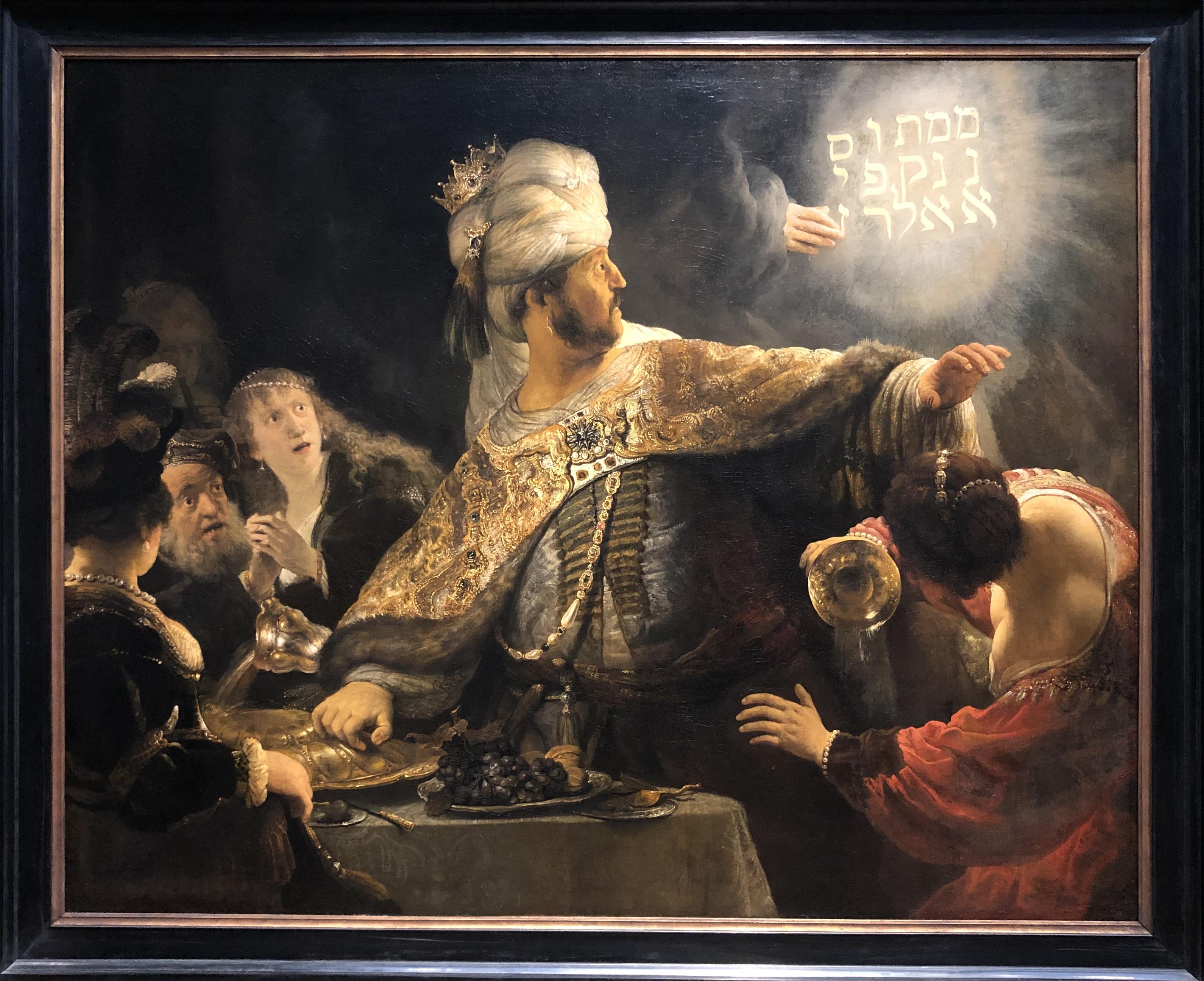
Your choice of Rembrandt’s “Belshazzar’s Feast” is appropriate, as the writing on the wall signified that his empire was about to end by an invasion of…the Persians.
Not wanting to be Pollyanna here, but I want to remind people of Adam Smith’s observation that there is a great deal of ruin in a nation.
I won’t try to claim that the status quo ante Trump is ever coming back. MAGA have permanently altered some terms of American engagement with the rest of the world. But an energetic, activist successor Presidency aimed at restoring confidence in the US’s reliability will be able to recover a lot of lost ground. Assuming the can opener.
American hegemony has likely been permanently degraded, and that’s been a long time coming. The places where the failures have happened are not particularly surprising, to people who’ve been watching military affairs for long enough.
It’s not just the problems associated with turning strategic preparedness and magazine depth over to bean-counters, who looked at 155mm artillery round consumption over a two-year interval and decided that there was no need to maintain the capability to manufacture the things. And it’s not just the focus on gold-plated lethality-nerds-wet-dream weapons like the Patriot, which are so hard to build that resupplying them in wartime is a contradiction in terms.
A fundamental problem is what kind of military force America has built since the end of the draft. It is still, even after MAGA has tried for 2+ years to drag it back into the 19th century, a force that can (with 6 months lead time) go anyplace in the world and put an army on the ground there. And assuming that it would face another army, not too much bigger than itself, that army would win whatever fight it was there for.
But it’s not an army that can hold conquered territory, as was shown in such detail by the Afghanistan and Iraq adventures. It’s not a garrison or occupation force. It has no capacity to win the peace anywhere. And when there’s no enemy army for it to fight, just a hostile population, it’s an atrocity machine. But that’s a separate problem.
The current loss to Iran is being overblown somewhat by people ignoring the fact that no effort was made to manufacture any consensus about that fight. And the fight itself has been pursued in the most idiotic, amateurish fashion imaginable. A competent Administration that made a good-faith case for fighting a regime-change war against a regional power like Iran, and did not make every possible kind of beginner mistake in prosecuting the conflict, would arrive at very different results.
A competent Administration that made a good-faith case for fighting a regime-change war against a regional power like Iran, and did not make every possible kind of beginner mistake in prosecuting the conflict, would arrive at very different results.
I keep hearing people claim that the only reason Iran beat American is because of Trump’s stupidity, but I don’t buy it. Trump and Hegseth are incompetent morons, yes, but at the end of the day America lost to Iran because its military suffers from disorganization, crippling casualty aversion, and a total inability to replace the spent standoff munitions and interceptors that it relies on because of that casualty aversion. These are not Trump and Hegseth problems, they are US military problems. We know this because they were all on display during the Red Sea campaign under the “smart” liberals of the Biden administration.
Operation Prosperity Guardian was basically the tutorial mission for the current war with Iran, because achieving victory against Yemen in the Red sea required the American military to do the same things it would need to do to defeat Iran in the Persian Gulf. Winning the battle of the Red Sea meant running convoys through the Bab al-Mandeb until whatever ground forces America landed could push deep enough into Yemeni territory to force Ansarallah’s missile and drone launchers out of range of shipping. It’s the same mission they would have to carry out in the Persian Gulf, against a weaker enemy and with lower stakes. However, all the US Navy could do was aimlessly sail around while shooting irreplaceable multimillion dollar interceptors at $5000 drones. The only ground forces that could be deployed were the hypertrophied JSOC special forces (since their casualties wouldn’t cause political problems) which achieved nothing strategically. The result was that the full might of a carrier group completely failed to stop Ansarallah and reopen the Red Sea to shipping.
With these weaknesses in mind, what could a “competent administration” have done to defeat Iran that hasn’t already been done? Everything I can think of would require an America that could concentrate all its effort against Iran, produce munitions, aircraft, and ships on a scale that hasn’t been seen since WW2, and rally its people to accept tens of thousands of casualties in a grinding, years-long conventional ground war. To do that, America would have to be a completely different society with a completely different diplomatic posture, political economy, and relationship between the state and its citizens.
One more example of the observation: “Everything Trump touches, dies.”
thank-you and congratulations on your upcoming nuptuals! I have enjoyed your socioeconomic analysis of American affairs for a couple of years now.
brilliantly thought out and brilliantly written and so sad to read the truth in this tragic series of observations. Thank you, Doug for writing with such clarity and with a brevity that can entice people to read and hopefully understand. Please enjoy your time off
The idea that the US will no longer be so important in the world is interesting. Maybe we can stop trying to be the world’s policeman, which sounds good to me. But the negative effects could be really big, especially economically. If ours is no longer the standard currency of the world, if China calls our debt, if no one trusts our economic stability — we could be in for a lot of difficulty. Add that to the problems from AI and the world will be upside down. Will we be able to spply sanctions on countries we want to control/punish? What else will we no longer be able to do?
I happen to think that Trump is destroying the US on purpose. Possibly as revenge for not re-electing him in 2020, possibly for Putin. But why would he be destroying the planet too?
Doug — Congratulations and enjoy your honeymoon!
–Kim
Trackbacks
[…] week’s featured posts are “At the end of an age” and “The Nerd […]
[…] At the End of an Age […]