
Bullies seem to have a finely tuned awareness of where the margins of permission lie as regards abuses, and choose their targets based on whose suffering will be most broadly acceptable to others.
– A. R. Moxon “Soon You Too Will Be a Commie“
This week’s featured post is “Hazards and pitfalls of moving to the center“.
Ongoing stories
- Trump’s assault on American democracy. A couple of court decisions went against the regime this week. Links are below.
- Climate change. It’s not just land temperatures that are setting records this year. So are sea temperatures.
- Iran. The war is mostly on hold, with occasional air attacks in each direction.
- Ukraine. Russia is now only producing about 70% of the gasoline it uses.
This week’s developments
This week everybody was talking about Canada
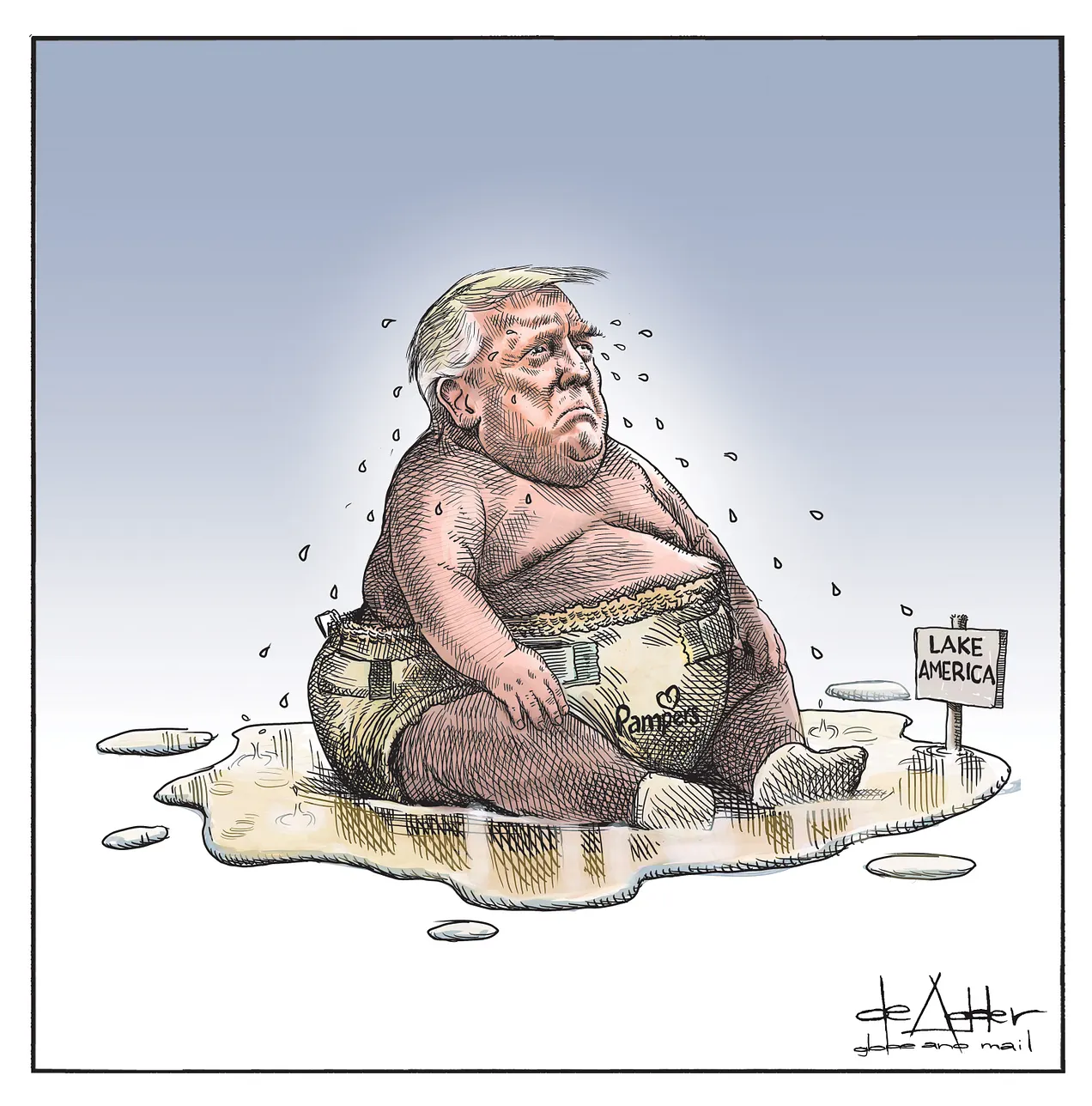
Here we see a combination of a substantive issue with one of those blood-boiling but essentially meaningless things we see over and over: We find ourselves in an all-out trade war with our nearest neighbor and closest ally. That’s important. And Trump has ordered the name of Lake Ontario changed to Lake America, which is annoying but of no real consequence. (As soon as Trump is out of office, no one will say “Lake America” or “Gulf of America” ever again.)
The Toronto Star reports:
As [Prime Minister Carney] described it, he was faced with a trade agreement that was suddenly transformed into an attack on Canadian sovereignty, an attempted psychological annexation that could have turned Canada into an American client state, a sort of North American Belarus.
Paul Krugman explains why the US will lose this war. The US may be the much larger economy, but
an all-out trade war would create a lot of pain in the U.S. in addition to inflicting severe damage to the Canadian economy. And all indications are that the Canadians will be much more willing to bear the pain of a trade war than Americans will – especially given that the great majority of Americans are already dissatisfied with Trump’s economic management.
Former Trump official Miles Taylor sees Canada’s resistance as a harbinger of nations getting fed up with trying to appease Trump. “nothing on earth scares Donald Trump like an opponent who fights back.”
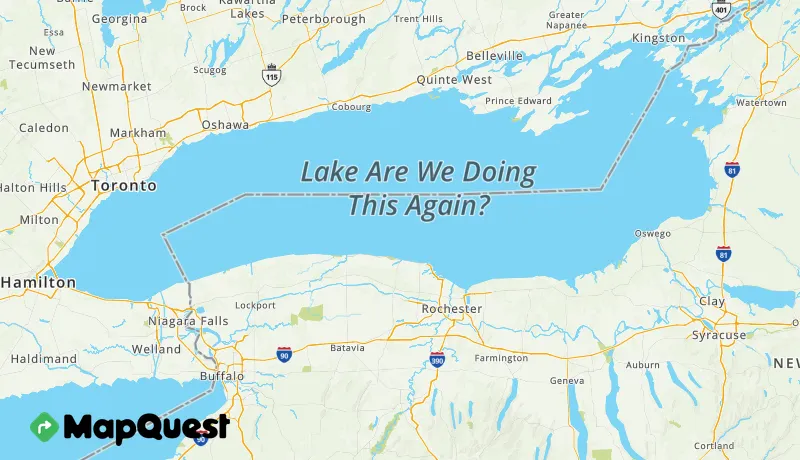
Unlike Google, MapQuest is just not having this Lake America thing.
and the fall elections
Trump’s bid to control who can cast a mail-in ballot had another set-back Thursday, when his executive order was blocked by a federal judge. A previous block had been lifted by the Supreme Court just a few days before, but on technical grounds that didn’t reach the merits of the case.
Things continue to look good for Democrats. A series of polls in Michigan have El-Sayed up slightly. Josh Marshall concludes:
I’m not saying El-Sayed has this wrapped up. I’m saying that the idea that he can’t win or that the results of the primary were some kind of decisive setback for Democrats’ chances just can’t be squared with the available evidence. At least not so far. This is very much a race and it’s one in which El-Sayed kind of has to be viewed as a favorite to at least some degree.
So-called “centrist” pundits like Jonathan Chait really need to calm down. His column is about how El-Sayed needs to denounce this guy and separate himself from that guy more strongly than just saying he disagrees with what they’re saying. Chait says virtually nothing about what El-Sayed himself says or believes or hopes to do in the Senate.
Last week, I described the Democrats’ chance of winning a Senate majority this fall. I went through the states commonly viewed as having competitive Senate races and came out with a winning scenario — far from a sure thing, but more than wishful thinking. I didn’t consider any of the true long-shot races Jay Kuo covered Thursday: Mississippi, Kansas, South Carolina, Nebraska, and Arkansas. I’d be surprised if any of these red states seats flipped, but Kuo makes a good case that it’s not impossible.
and Venezuela
Friday, Trump announced on social media “THE BIGGEST OIL DEAL IN WORLD HISTORY!” The deal, which AFAIK still hasn’t been confirmed by any on-the-record American government office, supposedly involves 17 oil fields with 65 billion barrels of proven reserves.
The agreement allows for the United States to partner with an unnamed private operator in Venezuela to create a new private company to take hold of the reserves, according to a U.S. official familiar with the contours of the deal. The official, who was not authorized to comment publicly and spoke on the condition of anonymity, added that [Venezuelan President Delcy] Rodríguez granted the company 100-year rights to develop the oil fields. The deal gives the United States 55% effective output of the new private company — including an ownership stake and rights to buy oil at cost. The company would be the second largest corporate holder of proven reserves after Saudi Aramco, according to the official.
Phillips O’Brien points out that there all kinds of problems with this arrangement. For one thing,
it is not clear what element of the US government (if any) either can or will hold the equity stake in any new company
The American stake would have to be controlled and overseen by some particular department or agency, and without any congressional action it’s not clear who could do that. And without Senate ratification, this isn’t an official treaty. Like Obama’s nuclear deal with Iran, it could be cancelled by any future president.
There are also problems on the Venezuelan side, because their constitution does not allow the government to sign away the country’s natural resources. If a future Venezuelan government thought it could get away with taking the oil fields back, it would face no legal barriers.
And finally, who are we making this agreement with? When we deposed Maduro, we were supposedly bringing freedom to the Venezuelan people. But since then we’ve ignored the democratic opposition and recognized Maduro’s henchmen as the government. O’Brien sums up:
I am providing this information so that there is no mistake about what the Trump administration is, and has been doing. It got rid of Maduro to entrench even more ruthless alleged criminals, the exact kind of people with which it can and, indeed, likes to do business.
Add to the mix that the country’s oil industry is a mess and requires huge amounts of capital investment (which so far the major oil companies haven’t been willing to fund). It will take years to substantially increase production. Also, Venezuelan crude oil is heavier than most American refineries can process, so there won’t be any big increase in gasoline production any time soon. Clean Technica has a fairly technical analysis that comes to the conclusion:
Raising output materially would require something closer to $100 billion over a decade. That scale of capital must be patient, politically insulated, and confident in long term demand. Even if someone was willing to pay for it, significant increases are a decade away in a world clearly pivoting away from oil and toward renewables and electrification.
and you also might be interested in …
I hope to review Gil Duran’s “The Nerd Reich” before long. In the meantime, check out this five-minute video about J. D. Vance and his puppet-master Peter Thiel.
David Frum looks at how other countries have recovered money from their past despots, and speculates about using civil suits to claw back Trump’s “ill-gotten gains”.
For about a year Christopher Armitage was a corrections officer in a prison. It taught him something about politics and the psychology behind MAGA.
I began to see a pattern that my psychology training wouldn’t let me ignore. The same personality traits that concentrated behind bars, what psychologists call the “dark triad” of psychopathy, narcissism, and Machiavellianism, were appearing throughout our political system. The empathy deficits that defined prison life weren’t confined to cellblocks. They were running for office, hosting talk shows, and writing legislation. … American conservatism has become an ideology that systematically suppresses empathy. It rewards the prison mentality: dominate or be dominated, trust only your tribe, see kindness as weakness. It’s created a political movement that mirrors the psychological dynamics of incarceration, complete with gang colors in the form of red hats and protection rackets in the form of vote-for-us-or-the-criminals-will-get-you rhetoric. …
The prison mirror reflects perfectly here: just as inmates must perform toughness to maintain status, conservative politicians must perform cruelty. Expressing empathy for the wrong group, immigrants, trans kids, the poor, marks you as weak, a “RINO” who’ll get primaried
A Stanford student newspaper won its suit against the Trump administration. It claimed that international students were afraid to write articles for fear they would be deported if Trump disagreed with what they said. The judge ruled that foreign citizens on student visas have the same free-speech rights Americans do, and that they cannot be deported based on what they have written or said.
and let’s close with a look back

I’m sure you’ve had no trouble finding coverage of Dolly Parton, who died Tuesday. She was one of the few public figures — it’s hard to find a comparable one — whose appeal spanned the political divide. She was an authentic up-from-poverty success story who never forgot about the kind of people she grew up around. Late in life, her philanthropy was as famous as her music.
If you wonder what the fuss is all about, The Guardian provides a curated list of 10 of her best songs. As someone lost a spouse less than two years ago, I resonate with her final hit “If You Hadn’t Been There” about her husband Carl Dean who died in 2025 a few weeks before their 59th anniversary. “I wouldn’t be here if you hadn’t been there.”


Comments
The comments on “empathy” reminded me of a recent book I read named “suicidal Empathy” by Gad Saad. I was completely disgusted by his views. Conservative to the core.
Saad cherry-picks the most extreme examples of performative empathy (“gays for Palestine”) and presents them as representative of the left wing as a whole. These people may be ridiculous but they’re not setting policy.
They probably aren’t setting policy directly, but they are influencing the discussion. Setting the boundaries of the Overton Window. Which is a big factor in how US policies and governance are determined.
SOUTH DAKOTA!!! Sorry to shout, but why isn’t anyone paying attention to the independent candidate Brian Bengs in South Dakota who is in a tie with the Republican incumbent. He is just the guy we need and a Senate vote from South Dakota is just as important as Senate vote from anywhere else!
Best, Kathy Campbell
Trackbacks
[…] Margins of Permission […]
[…] Margins of Permission […]
[…] Doug Mouder at The Weekly Sift: “Margins of Permission“ […]