
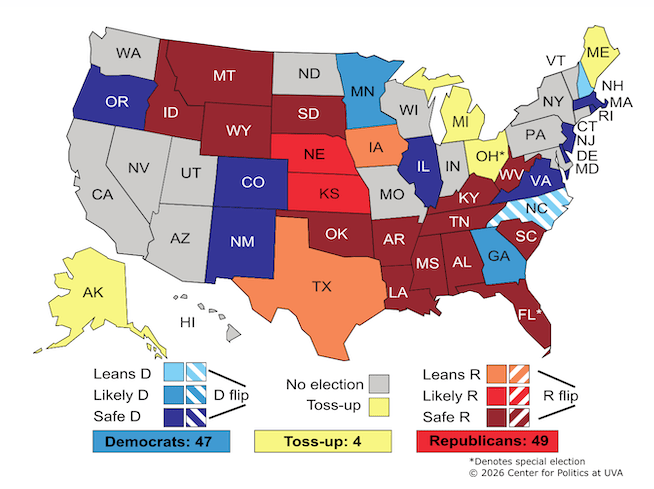
A few months ago it looked like a pipe dream. But maybe …
For some while, conventional wisdom has said that the Democrats were likely to retake control of the House in 2026, but that the Senate was too much to hope for. The GOP’s current margin is 53-47, assuming independents Bernie Sanders and Angus King continue to caucus with the Democrats. A 50-50 Senate is still Republican, because VP Vance would cast the deciding vote. So Democrats need to net four additional seats to get a 51-49 majority. Given the states a Democrat would have to carry — places like Ohio and Alaska — it seemed impossible.
It seems a lot more possible now.
Let’s not underestimate the challenge. To start with, Democrats need to hang on to seats in Michigan and Georgia, neither of which are a sure thing. The most likely flip is North Carolina, and from there it gets tricky. That map above is from the University of Virginia’s Center for Politics. In order to prevail, Democrats would need to sweep the map’s four toss-up seats: Alaska, Michigan, Ohio, and Maine. Also, the Iowa and Texas seats may not be as secure for Republicans as the map claims.
But the polls look promising. The current RCP polling averages have Democratic Senate candidates substantially ahead in North Carolina and Georgia, and narrowly ahead in Alaska, Michigan, Ohio, Maine, and Texas. In Iowa the Democrat is narrowly behind.
Nate Silver notes that Democrats often poll well in August, only to see the race turn against them in the fall. In red states, marginal Republicans have a way of returning to their established party loyalties as the election approaches, even if they initially found the Democrat attractive. And Republican candidates will have plenty of money to hammer at Democrats, labeling them “communists”, attacking their manhood (Talerico, Ossoff), or raising bigotry against their name and religion (El-Sayed).
What makes predicting the final results tricky is that the various races probably aren’t independent. The electorate will likely focus on a few key points that all the races will hinge on. So if Democrats lose Maine, they probably can’t make up for it by taking Texas. If Maine is gone, Texas will be gone too.
But this is where I get optimistic, because I don’t see the state of the country and the world cooperating with a Republican bounce-back. Trump won’t magically pull out a win in Iran. The price of gas will still be high. And Trump shows no signs of learning election discipline, so he’ll probably keep talking about ballrooms and revenge indictments, and keep being obvious about his corruption. I doubt he’ll focus on making the economy work for the working-class voters Republicans need. So if a wave breaks on Election Day, it should break in Democrats’ favor, with frustrated working-class Whites finally giving up on Trump and his enablers.
Let’s take the key states one by one.
Alaska. The Data For Progress site finds Alaskans focused on affordability, and their Republican governor is deeply unpopular (-23 favorable-unfavorable). Trump carried the state by 13% in 2024, but his favorability has collapsed too. (He’s at -1.)
Alaska has an unusual system. Four candidates come out of its jungle primary, and the general election has ranked-choice voting. (I like this system.) A lot has been made of there being two Dan Sullivans in the race (the Republican candidate and an independent), but probably it will have no effect. If you’re confused about which Dan Sullivan is which, you’ll rank them next to each other and it will all work out. (That’s one reason I like this system. It handles various kinds of election trickery well.)
The Democrat in the race is Mary Peltola. She has won two elections to be Alaska’s only representative in the House, and lost in 2024 by only 2-3%, running well ahead of Kamala Harris in the state. So Alaskans know who she is and she’ll be hard to smear. The RCP polling average has her up 2%, and the betting markets make her the favorite.
Georgia. This is the surprise, at least to me. Jon Ossoff is running a very strong race and is ahead in the RCP average by a comfortable 7.5%. He’s emerging as a possible 2028 presidential candidate. Ossoff is one of the Democrats’ best messengers at framing Trump’s corruption.
Iowa. Seriously? Democrats are competitive in Iowa? This year, yes. This is the seat currently held by Joni Ernst. Rep. Ashley Hinson (R) is running against State Rep. Josh Turek. Turek is running on his centrist record in the legislature — which is probably the only way an Iowa Democrat breaks through — so don’t expect any progressive fireworks.
Anyway, Hinson is running slightly ahead (.7%) in the polls. And that close race is not a fluke, because the Democratic candidate for governor, Rob Sand, currently has a 5% lead. Apparently, the nation’s second-highest cancer rate and contaminated water are big local issues. Also, cheap land and Republican government have made Iowa a target for corporations building data centers.
Maine. A lot of national pundits thought Democrats blew their chance to oust Susan Collins in the Graham Platner fiasco. That doesn’t seem to be the case. Democrats united quickly around Platner’s replacement, Troy Jackson, and Collins is still dogged by the same issues: her deciding vote to confirm Brett Kavanaugh (who was the deciding vote to overturn Roe v Wade), her wishywashy position on ICE’s Portland surge, and her general position as someone who expresses “concern” about the Trump regime’s outrages, but will get in line when Trump needs her vote. Maine went for Harris over Trump by 7% in 2024, and you have to wonder how Collins will win over those Harris voters when the national winds are blowing the other way.
The closer we get to November, the further in the rear-view mirror Platner is. Currently Jackson is ahead by 2.3% in the RCP average. Collins has a lot of billionaire money behind her, but that might work against her as much as for her.
Michigan. Abdul El-Sayed beat the Democratic establishment’s chosen candidate in the primary. The party establishment has since gotten behind El-Sayed, but I have to wonder how much hard feeling remains in the electorate. Republicans will spend a lot of money demonizing him as a “terrorist” and raising bigotry against his name and Muslim religion.
In his favor, El-Sayed is a strong candidate. He interviews well, in that he gives quotable answers to hostile questions without sounding abrasive. He keeps his eye on the ball. For example, in response to a question about Islamophobia, he replied:
That’s the best you’ve got? You can’t actually talk about what you want to do? My name is not raising your gas prices. My name is not taking us to war. My name is not the reason you can’t afford your groceries.
Polls currently are close, with El-Sayed narrowly ahead (.7%). Two factors point in opposite directions: Polls overestimated El-Sayed’s support in the primary (which often happens in cases where bigotry is an issue; people get into the voting booth and express prejudices they wouldn’t admit otherwise). But also, time helps Democrats unite, and Republican Mike Rogers won’t know what to do with debates: A smear works better when the target remains at a distance, and El-Sayed is the far more articulate candidate. But not debating looks cowardly.
El-Sayed’s challenge is to get voters to listen to him rather than react to him as a string of labels from attack ads: a far-left Muslim terrorist. I think he’s up to the job.
North Carolina. Here’s a case where the Chuck Schumer model of candidate recruitment worked well. Schumer looks for experienced candidates with name recognition who know how to raise money. In North Carolina, that describes Roy Cooper, a two-term governor who was succeeded by another Democrat when term limits wouldn’t let him run in 2025.
Trump won North Carolina by about 3% in 2024, but his recent approval-disapproval number is -18%.
RCP has Cooper up by 8%, which isn’t a lock but looks pretty good.
Ohio. Sherrod Brown is another familiar face. He won election to the Senate in 2006, 2012, and 2018 before losing to Bernie Moreno by less than 4% in 2024. Trump won Ohio by 11% in 2024. I can’t find recent Trump favorability polls from Ohio, but I think it’s safe to say he’s in negative territory.
Polls are scattered on this race. The only poll since June has Brown up 8%, but the RCP average includes polls since March, and only gives Brown a .6% edge. I might like to claim that Brown has momentum, but nobody has polled Ohio twice, so it’s hard to make apples-to-apples comparisons.
Texas. This is the long shot Democrats would most like to see come in. Just by his existence, James Talerico is demonstrating the hypocrisy of the Christian Nationalist movement and Evangelical Christianity’s right-wing sellout in general. Talerico is a seminary student who takes the teachings of Jesus seriously, rather than making Jesus the mascot of the home team.
Ken Paxton, on the other hand, is blatantly corrupt. In 2023, he was impeached as attorney general by a legislature heavily controlled by his own party, but escaped removal from office. He has been repeatedly investigated and/or indicted. His wife sued for divorce, accusing him of adultery. I don’t quite see how voters can square all that with Christianity, other than “He’s on our team.”
Talerico is one of the few Democrats with a fund-raising advantage. RCP has him up by 1.2%, but I will be pleasantly surprised if that holds up. I have great faith in the hypocrisy of Texas “Christians”. They’ll find a way to come home to Paxton.
Pull it together. For what it’s worth, my best guess is that Democrats hold their seats in Georgia and Michigan. They flip North Carolina, Maine, and probably Alaska. Meanwhile, Iowa and Texas seem like too much to hope for. That leaves Democrats ahead 50-49, and Ohio decides the majority. If you make me choose, I think Brown puts Democrats over the top, but its very iffy.
Friday J. D. Vance was in Ohio campaigning for a Republican ticket that includes John Husted, whose Senate race against Sherrod Brown is one of the toss-ups that may decide control. I really wonder if J. D. reads his speeches ahead of time:
I believe this November, we will face a choice: Do we demand that our government serves us rather than the fraudsters and the criminals? Do we demand that the American president fight for the American people first?
I couldn’t have said it better myself. The only comment I needed to make was to add the links.
If James Talerico’s approach to Christianity is making you rethink your rejection of that faith, you should check out the blog “Backyard Church” by Dan Foster. Like me, Foster was raised in a denomination where the most important thing was to hold “correct” beliefs. In the post “There Are Two Ways to be a Christian“, he describes that approach as simply one way.
One begins with the question: What do I need to believe? The other begins somewhere else entirely: What kind of person am I becoming? … Suddenly, spiritual growth isn’t measured primarily by how much theology I know or how certain I am about it. It’s measured by what is happening to me. Am I becoming more loving? Am I more patient than I used to be? More generous? More forgiving?

The cartoon refers to a “Christian crusader march” in Dearborn, Michigan to protest the “Islamification of America”. Police had to break it up.


Comments
What do you think of the concern that if Democrats take both houses of Congress this year, they won’t be able to override a Trump veto, so they won’t be able to pass any laws, and then voters in 2028 will blame them for a do-nothing Congress and we’ll be less likely to win the Presidency? If we just take the House, that still gives us a veto over any bad new legislation and leaves Republicans looking more accountable for whatever happens.
First, Senators serve six-year terms. That’s forever in today’s politics, and the incumbent advantage it gives them is extraordinary. The reactionary cretins currently filling our judiciary with authoritarian sympathizers need to be picked off any time the opportunity presents itself.
Second, what could be a better environment than to run a candidate for POTUS where the Democratic Party is able to point to a variety of legislation for everyday Americans Congress passed, but was stymied because of the party controlling the WH?
If nothing’s going to get done, at least provide the clearest story as to why.
One case for being skeptical of polls…
https://www.electoral-vote.com/evp2026/Items/Aug24-9.html
Please start paying attention to Brian Bengs in South Dakota. He is running as an independent against a do nothing Democrat and a Trump to. And he has a darn good chance.
It’s spelled Talarico
Trackbacks
[…] Can Democrats take the Senate? […]
[…] This week’s featured post is “Can Democrats take the Senate?“ […]
[…] Can Democrats take the Senate? […]
[…] Last week, I described the Democrats’ chance of winning a Senate majority this fall. I went through the states commonly viewed as having competitive Senate races and came out with a winning scenario — far from a sure thing, but more than wishful thinking. I didn’t consider any of the true long-shot races Jay Kuo covered Thursday: Mississippi, Kansas, South Carolina, Nebraska, and Arkansas. I’d be surprised if any of these red states seats flipped, but Kuo makes a good case that it’s not impossible. […]
[…] reason I’m optimistic about Democrats taking not just the House but the Senate: Trump doesn’t seem to understand the problem. He lives in Natalie’s fantasy world […]