
People [are] calling us the “far left” and we are literally just out here talking about funding public schools and keeping hospitals open and paving roads.
There is no featured post this week.
Ongoing stories
- Trump’s assault on American democracy. This week’s primary target was the free press. Fortunately, federal judges still believe in the First Amendment.
- Climate change. This summer continues to set heat records. Next summer should be worse.
- Iran. Are we entering a new round of escalation or a new round of peace talks? Signals are mixed. But nothing we’re seeing indicates that the conflict will be resolved soon.
- Ukraine. Ukraine has begun attacking Wildberries warehouses in Russia. Wildberries is said to be “Russia’s Amazon”, a big online shopping site. There may be military equipment passing through its warehouses, but mainly this looks like a way to bring the war home to Russian consumers.
This week’s developments
This week everybody was talking about the war with no end in sight
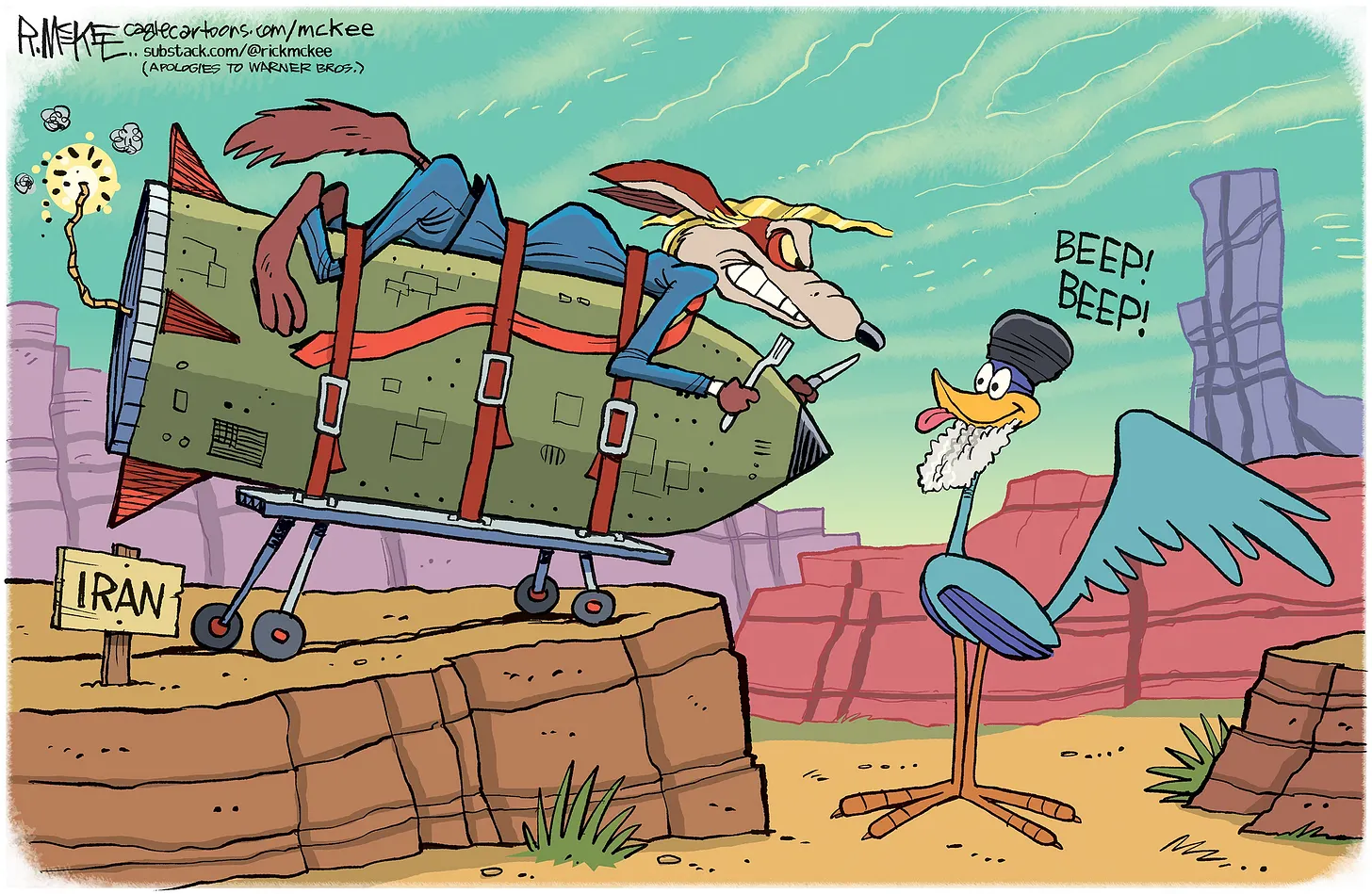
We’ve been getting signals in both directions recently. On the one hand, there are anonymous-source reports that Trump is getting increasingly frustrated with Iranian leadership and going into “revenge mode”.
he has told people that he thinks he can break the Iranians’ will through an aggressive bombing campaign, according to a person familiar with his views.
On the other hand, we’ve had a few days of both sides pausing their attacks while they see if new talks can be started.
I find Josh Marshall’s take insightful. Trump’s frustration, according to the WSJ link above, is that he “keeps making deals with them that they simply break”.
But this whole set of claims is a fantasy. Trump has never had any agreements or deals with the Iranians. What he’s had is a series of notional ceasefires in which nothing of substance or consequence is actually agreed to … But since these ceasefires are only “deals” to begin negotiations the actual war aims and demands of each side eventually seep through. Then they go back to fighting.
The underlying problem is that
Trump lost this conflict in its first days. Everything since then has been his struggle to deny that reality, either with bogus “deals,” more bombing or various threats. … Effective war diplomacy can get you the best and most creative agreement that the circumstances warrant. But that last part is key. Kickass diplomacy is never going to get the side that won the conflict to agree to a deal in which they lost.
Of course it is hard for Trump or his cult followers to fathom how anyone can say he “lost this conflict”, because the US can destroy things and kill people at much higher rates than the Iranians can. (That’s been true since the first days of the war, and it’s still true.) But the victory conditions here are asymmetric. The US wants concessions from Iran: that they stop supporting regional terrorism, developing nuclear weapons, and threatening shipping in the Persian Gulf. But all the destruction we’ve been able to rain down on them has not forced them to give in, and there is little prospect that it ever will. If the war ends without those concessions, the US has lost — even if we’ve knocked down every structure in Iran and killed 10,000 Iranians for every American death.
An analogy might help: Imagine you’re a parent who is trying to force a child to eat the vegetables you’ve put on his plate. You have it in your power to yell at him, send him to bed hungry, take away his favorite toy, or even beat him in ways that would put you in jail if anybody found out. The child can do none of this to you. But as long as he’s not eating the vegetables, you’re losing.
The worse the Iranian conflict is going, the less the Trump regime wants the American people to know. CNN lays out Pete Hegseth’s efforts to “control information, limit access and avoid difficult questions about the war”.
The Pentagon hasn’t held a press briefing in two and a half months. Defense Secretary Pete Hegseth hasn’t explained the military strategy behind the renewed air strikes. His department hasn’t revealed the circumstances that led to the recent deaths of US service members. … In response to CNN’s request for comment about the press briefing drought, the Pentagon’s chief spokesman Sean Parnell said the U.S. government “has consistently provided comprehensive, real-time updates” on the strikes in Iran.
But “updates” are simply releases stating what the Pentagon wants the public to know. They avoid any interaction where the official accounts might be questioned. Without any official comments on key issues, reporters have been seeking out anonymous sources, which Hegseth is also trying to shut down.
So far, though, Hegseth has not figured out a way to avoid facing questions in Congress, as he did Tuesday before the Senate Appropriations Committee. (At least for now, Congress still controls the money he needs to fight his war. The regime is asking for $87 billion in supplemental spending over and above this year’s budget. $67 billion is related to the war.) But while he can’t avoid facing questions, he doesn’t have to answer them. In this interaction with Senator Jon Ossoff of Georgia, he just shouts over Ossoff and keeps repeating the same unresponsive talking points.
Somehow, the “historic military victory” Hegseth described four months ago, which will leave the Iranian military “combat-ineffective for years to come”, hasn’t stopped the Iranians from continuing to kill American soldiers, intimidate ships from using the Strait of Hormuz, and terrorize our allies in the region. Hegseth refused to acknowledge the cognitive dissonance there.
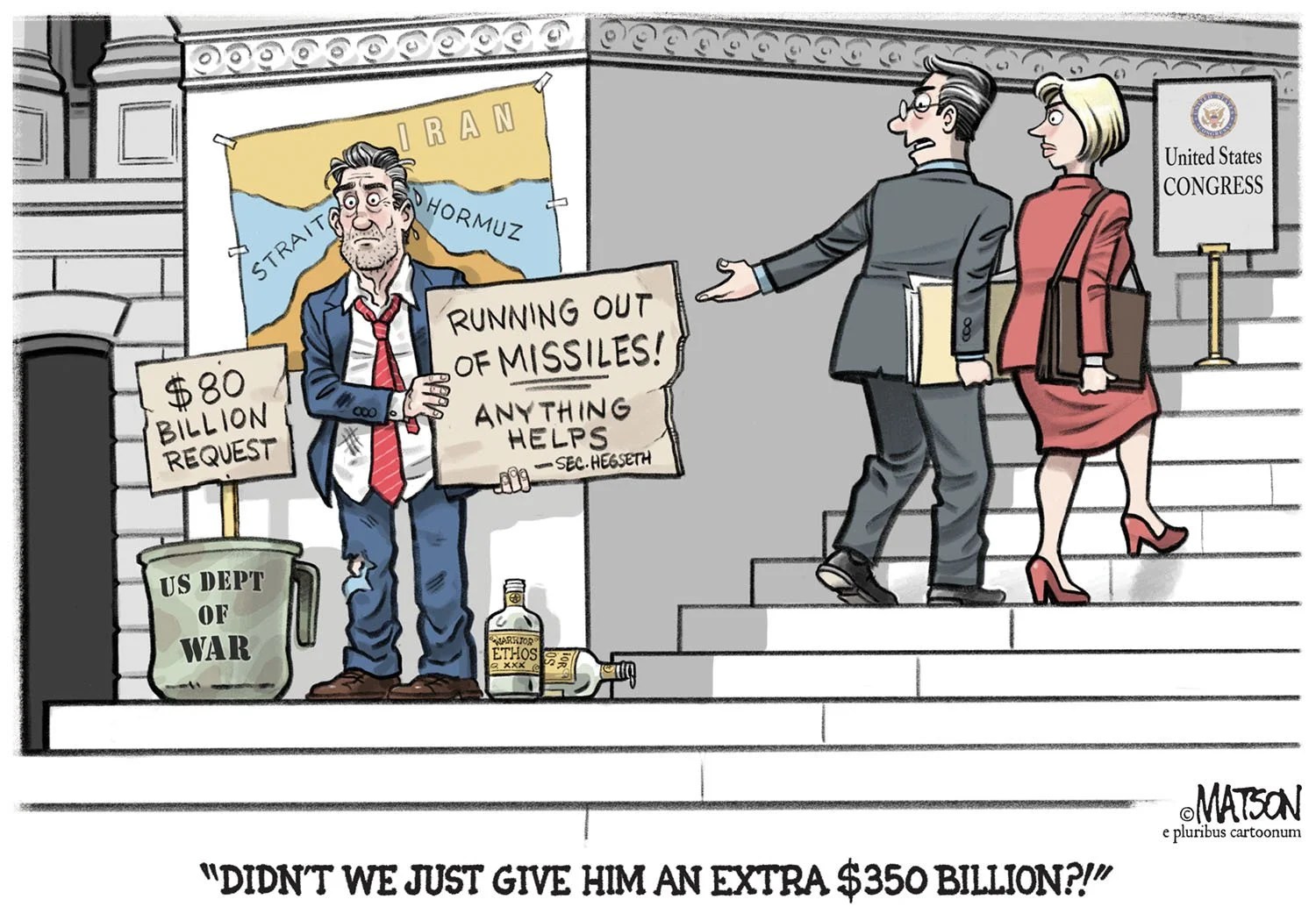
I’m not sure who said it first, but numerous people have responded to Hegseth pushing a “Spartan mindset” in the Pentagon with: Maybe that’s why we’re losing to the Persians.
When the war started, many economists predicted oil prices would soar much higher than they did. Paul Krugman explains one reason they didn’t: Ukraine’s missile campaign against Russia’s refineries has noticeably lowered the world’s oil-refining capacity. Why buy oil, Krugman asks, when you can’t refine it?
But the shortage appears on the other side of the refineries: the market for gasoline, diesel and so on. The “crack spread” is the difference between the price of a barrel of oil and the price of the various products refined from that barrel. That spread has risen from $25 to $65.
From the point of view of end users, this is the same as if crude prices had risen an extra $40 per barrel. In effect, the world is coping with the equivalent of $140 oil even though the headline price is “only” around $100.
Meanwhile, who knows what’s going on with Saudi Arabia? Wednesday, the Trump regime announced a deal that would give the Saudis the kind of pre-nuclear-weapon capabilities we’re trying to destroy in Iran. It’s the kind of historically dumb idea that only a man deeply in the pocket of the kingdom could love.
Then after the deal was signed, Trump added a condition: The Saudis have to join the Abraham Accords that normalize relationships between Israel and other Arabian countries. That’s probably a deal-breaker for the Saudis. Stay tuned.
and the environment
The science journal Nature reports:
The El Niño climate pattern that is strengthening in the Pacific Ocean is on track to be the largest one in at least 150 years, researchers said today during a press briefing. If the monster forecasts they presented pan out, the surge of heat that the El Niño will unleash from the ocean, combined with warming from human-caused climate change, will probably make next year the hottest on record — and cue up extreme weather in many parts of the world.
Another distinguished journal, Science, has stopped pulling its punches.
When I talk to people about [science funding] (and that includes some journalists as well) and say what I’m about to at the end of this paragraph I am sometimes met with disbelief. But I mean what I say and I am trying my best to say what I mean: The Trump administration hates academic science funding, full stop. They hate where that money goes, and they hate who it goes to. They want to keep all that money for themselves, to hand out to favored cronies who can help them get elected and to steer yet more money and more power back into their hands.
That’s it. That’s the story. They are naturally not putting it in those words, but instead talking about “gold standard science” and the “reproducibility crisis” and funding “bold inquiry” for “transformational breakthroughs”. This is all bullshit, and it’s important to realize that. Shameless hand-waving bullshit, delivered in a how-dare-you-think-otherwise manner is the defining style of the entire Trump administration. You can see it in every appointee, in every part of the executive branch, and in the pronouncements of all of Trump’s supporters. I realize that this is a simple heuristic to apply, and a very unambiguous and unflattering one, but I find it to be all too useful and all too accurate. Give it a try.
Wildfires in France and Spain have forced 300K people to evacuate. AFP:
According to the Gironde fire service, the blaze generated a rare “pyrocumulonimbus” cloud, creating its own winds and whirlwinds and making it “erratic and unmanageable”, firefighter Captain Nicolas Braz told AFP.
Trump is back to his absurd fantasy that forests can or should be “managed” by clearing away leaves and other debris. Canada’s wildfires are in inaccessible boreal forests that cover nearly half the country’s land. They’re burning because of the global warming that Trump denies, and not because Canadians should be out there with rakes and leaf blowers.
Laws against tampering with your vehicles emission-monitoring sensors? Ignore them, the government is.
and ICE
More than 300K Haitian refugees are losing their legal status today. ICE is gearing up for major round-ups, particularly in cities like Springfield, Ohio — site of the infamous dog-and-cat-eating hoax that J. D. Vance pushed during 2024 campaign.
After an ICE agent killed Johan Sebastián Durán Guerrero in Biddeford, Maine earlier this month, it came out that the agent had a history of violent behavior, including domestic violence. It turns out that’s not unusual. If you’re looking for a gun-carrying job in immigration enforcement, violent thuggery doesn’t seem to be a deal-breaker. Mother Jones reports:
On July 22, the advocacy group Ohio Immigrant Alliance released a list of 59 active and former ICE and CBP agents charged with sexual and violent crimes between 2007 and 2026.
Around the time Trump sent the National Guard to DC, he also sent it to Memphis. That hasn’t attracted as much attention because (unlike California Governor Newsom or Illinois Governor Pritzker) Tennessee’s Republican Governor Bill Lee welcomed the troops — despite the fact that crime in Memphis was already at 25-year low.
Now it turns out that crime was a pretext and the National Guard served as a Trojan horse. They were accompanied by an influx of agents from federal agencies, who are mainly engaging in an immigration crackdown. The immigrant community in Memphis is just as terrorized as the ones in Minneapolis or Los Angeles were, but they are getting little attention.
and tariffs
Trump loves tariffs, so he keeps imposing them. The rationale for why he has the power to do so keeps changing. As one source of authority is denied by the courts, he moves on to another.
Here’s the latest power grab:
Levied under a statute called Section 301, the administration has said these new tariffs are designed to target countries that have not effectively banned forced labor from their supply chains.
OK, what countries would that be? 80 of them, it turns out, including such famous slave nations as Canada and the UK. They all get tariffs between 10% and 12%.
And then there are special tariffs against Canada — up to 50% “covering products ranging from wine to hockey sticks to cement”. Neither liberal Paul Krugman nor conservative National Review can find a point.
For decades, people have criticized tariffs by comparing them to the disastrous Smoot-Hawley tariff of 1930, which is widely blamed for helping turn the 1929 stock market crash into a global Great Depression. Well, the legal authorization Trump is pointing to for his authority is precisely Smoot-Hawley, which was never formally repealed.
Krugman says the new tariffs will have little immediate economic impact
But the auto industry, like business in general, has been put on notice that the huge flows of goods and services that cross those borders every day may be cut off whenever Trump has a temper tantrum. And this really is a temper tantrum, in the sense that there’s no strategy here. The new tariffs will hurt American consumers, and nobody expects them to extract any concessions from Canadians who are only getting more outraged at the United States.
National Review asks Congress to take its power back.
More broadly, this episode only reinforces our conviction that, despite the best efforts of the Supreme Court, the current state of the law still gives the president too much latitude to turn tariffs into his playthings. That has to stop. A tariff is a tax. Taxation is, under the Constitution, a matter for Congress. When it comes to tariffs, Congress must do its constitutional duty, reverse the excessive delegation of its powers to the executive, and take back control.
This is precisely what Trump loves about tariffs: He gets to impose them like a dictator, without consulting Congress. Whenever he’s feeling impotent in the world — as he must be now, given his low poll numbers and how ineffectual his bombardment of Iran has been — decreeing some new tariff makes him feel powerful again.
But there’s a bigger issue here: For more than a century, Canada has been America’s best friend in the world. Countries have got to wonder why they should want to be America’s friend these days. And why should they negotiate agreements with Trump, when he’ll break them the next time he’s jonesing for a power rush?
and Elon’s crashing companies
It’s possible that recent weeks have marked the beginning of the Musk crash I’ve been anticipating for a very long time. SpaceX stock has lost about half its value in the last few weeks, going from $225 on June 15 and $129 on Tuesday to $111 this morning. Meanwhile Tesla is down to $308 a share from a peak of nearly $500 in December and $380 on Tuesday.
But the mystery isn’t why those stocks have gone down, but why they’re still this high. Elon Musk has a history of announcing grand plans that don’t come to fruition, or at least don’t come to fruition in anything like the time scale he predicted — robotaxis by 2020, humans landing on Mars by 2024, fully autonomous Teslas by “next year” every year since 2018. And yet somehow, the stock market keeps pricing his companies as if the things he predicts might actually happen reasonably soon.
Brad DeLong looks at Tesla, which he describes as “a $50 billion company wearing a $1.2 Trillion magical rainbow unicorn costume”. He provides this chart showing Tesla’s flat revenue stream and declining earnings.
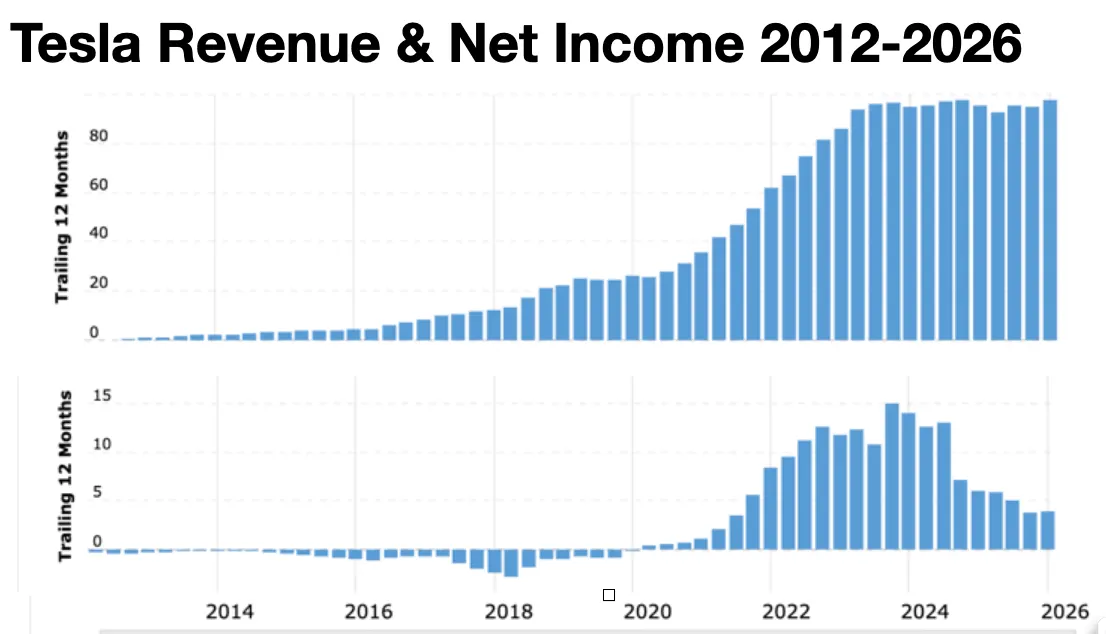
And yet Tesla’s stock is priced like like a company growing by leaps and bounds, at 280 times earnings. (Another car company, Toyota, is at 10 times earnings. A company that actually is growing rapidly, Nvidia, is at 30 times earnings.) Why? Well, the Morningstar rating service explains in a behind-a-paywall report:
- Tesla has the potential to disrupt multiple industries with its technology for [electric vehicles], [autonomous vehicles], batteries, and humanoid robots.
- Tesla’s full self-driving software should generate growing profits in the coming years as the technology continues to improve, leading to a robotaxi service and increased adoption by Tesla drivers.
- Tesla’s humanoid robot will create shareholder value as its ability to perform multiple functions will transform manufacturing and be useful to consumers.
The word “potential” does a lot of work in that analysis. It embodies the assumption that all the promises Musk has made are worth hard cash.
Even more than Tesla, SpaceX is a “magical rainbow unicorn” company. Even Morningstar sounds skeptical:
Loyal holders of companies run by Elon Musk have a very long time horizon and are often willing to look past interim milestones toward the prospects of big bets on moonshot projects and the grander vision on the horizon.
But somebody has to keep putting up money to cover those “big bets”.
SpaceX faces an average annual cash burn of $84 billion through 2034, according to Morgan Stanley, which does not expect positive free cash flow until 2035.
That means SpaceX requires a constant stream of new investors (or old investors willing to double down on their bets) for nearly the next decade. If those investors fail to appear, the magical unicorn will never arrive.
Tempting as it may be in this case, I’ve never sold a stock short, and I’m not recommending you do either, because there’s no predicting how long it will take investors to wise up. As John Maynard Keynes said:
You need to keep in mind that the stock market can remain irrational a lot longer than you can remain solvent.
Bloomberg’s Bethany Benjamin observes that when you measure sales expectations against actual sales, Tesla’s Cybertruck was a bigger marketing disaster than Ford’s Edsel.
and you also might be interested in …
NPR reviews the current state of the midterm race to control the Senate.
In Maine, Troy Jackson has replaced Graham Platner as Susan Collins’ opponent. There seems to have been little rancor in the convention that chose him, which is impressive given the circumstances. After it became clear Jackson would be nominated, all his rivals stepped aside. The final vote was 566-5.
Here’s a chunk of his acceptance speech:
For nearly 30 years, Collins has told Maine that she is “concerned”. She was concerned while she rubber-stamped Trump’s Medicaid cuts and gutted our healthcare. She was concerned when she cut taxes for corporations and the wealthy, concerned when she confirmed justices who overturned Roe v. Wade. And really tragically, she was concerned when she gave ICE billions to terrorize our neighbors and murder people in the streets with no accountability.
But concern does not lower the costs of groceries or gas. Concern does not keep our maternity wards of rural hospitals like down in Lincoln County open. Concern does not restore all the rights that she’s taken away. Maine does not need another six years of concern. We need someone with courage. We need a fighter, and we need a senator who remembers exactly who sent them to Washington, which is you.
South Carolina will be the first Democratic primary in the 2028 cycle, followed by Nevada, New Hampshire, New Mexico, Michigan and Virginia

Trump’s war against the “woke” Smithsonian continues. On July 4, the White House released a report on the Smithsonian’s “ideological capture” by social-justice activists. The Organization of American Historians wasn’t impressed.
“Saving America’s Story” is part of a broad attempt to return the nation to a vision of America that never actually existed and that serves the ends of superficial patriotism. The White House seeks to impose a narrow, singular, and celebratory narrative of American greatness populated by a mythologized set of heroes. Crucially, the proposed narrative would erase the conflict, struggle, and diversity—the complexity—that have always defined the American experience. The report insists that history itself is essentially, for Americans, a special and providential story of triumph.
Friday, Trump followed up with an executive order.
The Secretary of the Interior, acting through the Director of the National Park Service (NPS) and in coordination with the Assistant to the President for Domestic Policy, shall install temporary signage along the NPS-maintained sidewalks and walkways used by the public to access the Museum, informing visitors of the findings of the Report and of the policy set forth in section 1 of this order. Such signage shall notify visitors that the Museum exhibits should be renovated consistent with the findings in the Report and direct visitors to locations and resources for accurate information regarding America’s history.
This is supposed to “restore trust” in the Smithsonian.
That’s typical Trumpian NewSpeak. He “restores trust” in an institution — the Smithsonian, our elections — by making up lies about how hopelessly corrupted they are. Surely no one has done more to erode trust in America than Trump himself.
I hope visitors to the National Mall find appropriate ways to deface these propaganda signs and/or ridicule them on social media.
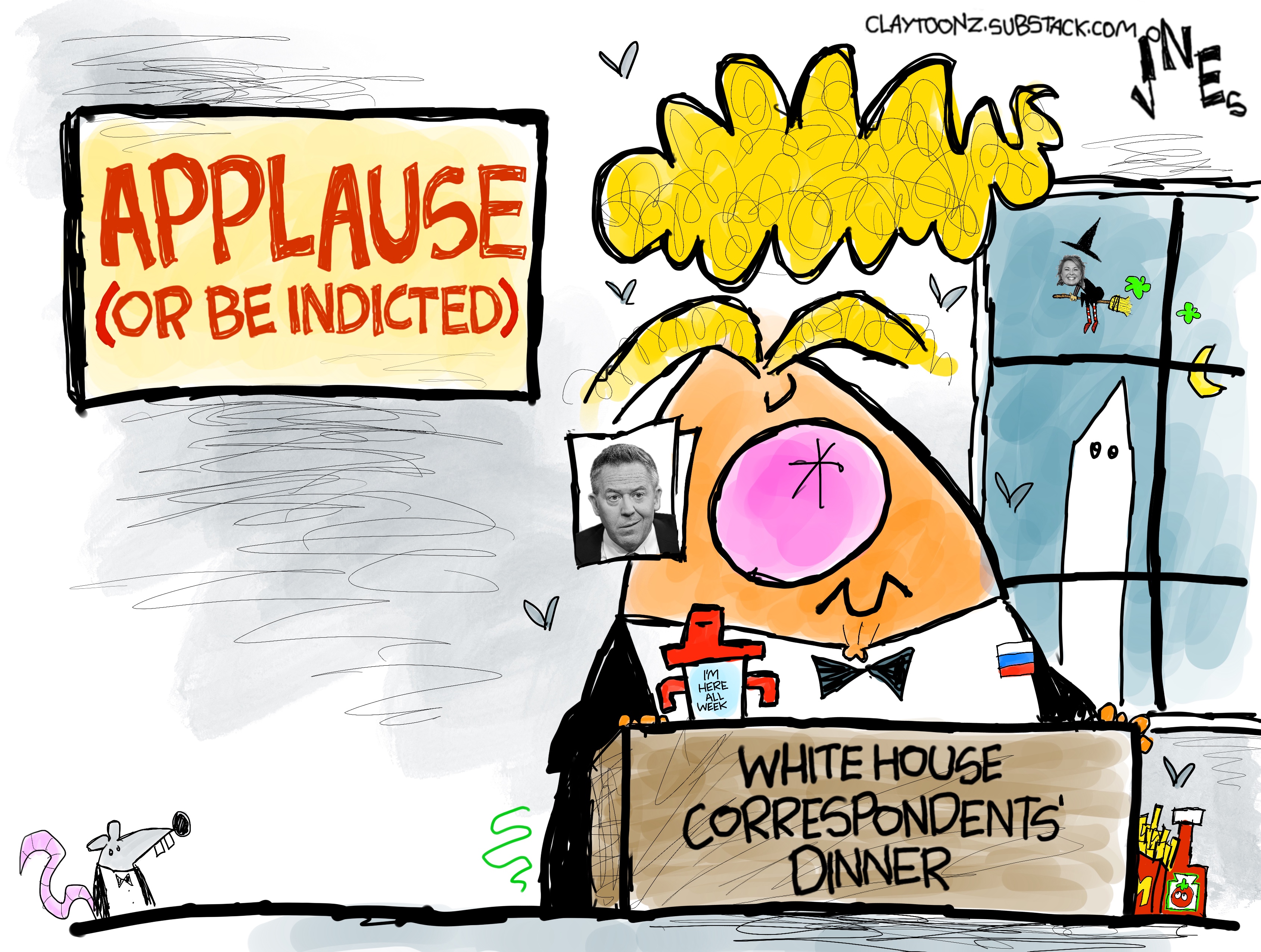
Megan McArdle (my WaPo subscription hasn’t quite run out yet) isn’t someone I usually agree with. But in this column, she segues from the new Odyssey movie to the widespread tendency to become pointlessly enraged by cultural incidents that don’t really affect the lives of anyone you may care about. She arrives at this wise point:
However soothing it feels in the moment, all this manufactured fury is stealing our real lives, bit by bit. The high wears off, the internet mob dissipates and there we are, exactly as lonely or frustrated or sad as we were before. Meanwhile, we have not fixed any of the underlying problems, so we feel even worse.
That’s addiction in a nutshell: Something seems like it will make you feel better, but you end up feeling worse — and more in need of something to make you feel better. People who have been lost at sea talk about the temptation to drink ocean water. Their compatriots who gave in to that urge didn’t make it back, because the salt just made them thirstier and thirstier.
Another WaPo columnist, Jason Willick, reviews what happened to the Constitution’s stipulation that only Congress can declare war.
The Iran conflict makes plain that Congress has lost the war power the Founders assigned it. On matters of war and peace, the Constitution has, in effect, been amended without a vote. … America’s foreign policy is post-constitutional, with Senate-ratified treaties largely replaced by “executive agreements” and the legislature’s war power now vested primarily in the executive.
His retelling of how this happened is mostly correct, but leaves out something I think is important: The Founders (particularly the Virginians like Jefferson and Madison) didn’t picture the new Republic fielding a large standing army, which they saw as a threat to liberty. (That’s why a well-regulated militia of citizen volunteers is “necessary to the security of a free state“.) Immediate attacks would be met by state and local militias, who could be federalized under the President’s command if the conflict grew. But (as Madison found out when he tried to conquer Canada during the War of 1812) militias hate to invade foreign countries. A foreign war, or a war against a European power like Britain or Spain, would require creating a large federal army, (or, more accurately, building a large army around the skeleton of a small peacetime army) which Congress would have to fund. So of course a foreign war could only be fought with congressional support.
The modern situation, where the President always has the wherewithal to wage a major conflict for months before needing Congress, was unforeseen (and is part of the reason the Second Amendment is obsolete).
The US military has blown up 67 boats that it claims were smuggling drugs, killing 221 people — basically executing people without trials. The result? No effect on fentanyl, which the regime claimed was the target. But that was predictable, because fentanyl mostly comes into the country via land routes. But there was a temporary effect on cocaine, which is the drug the boats were actually trying to smuggle. However, the cartels adjusted, and things are back to normal now.
Preliminary findings two months after the strikes began last September showed that they had disrupted smuggling routes, the DEA analysts reported, causing increases in cocaine prices and drug-related violence. But prices have since reverted to previous levels.“Smugglers have adapted to the intensified pressure,” they wrote. “Price and availability have not been noticeably affected.” … Pentagon officials told members of the Senate Armed Services Committee last month that DEA analysis of confiscated cocaine showed high levels of purity, according to a congressional aide familiar with the briefing. High purity suggests supply remains consistent, the DEA official said; dealers do not need to dilute the drug to stretch inventory.
As in our attacks on Iran, blowing things up and killing people seems to be an end in itself. It doesn’t need to be justified by results.
and let’s close with big Finnish
I got my solar panels working this week, so renewable power is on my mind. The well-publicized problem with wind and solar power is intermittency: Sometimes the sun shines and the wind blows, and sometimes it doesn’t. The obvious answer is as old as Genesis (i.e., Joseph’s interpretation of Pharaoah’s dreams): Store the power when it’s plentiful and draw that supply back down when it’s not. But how?
Batteries tend to be techy things that use a lot of materials that may be in short supply or require some environmentally-destructive mining. But Pornainen, a town of about 5000 people in southern Finland, has a much lower-tech strategy: a sand battery, which is basically a giant thermos bottle filled with crushed soapstone. The idea is to heat up the rock at times when electricity is plentiful and cheap, and then use the hot rocks to produce steam at times when electricity is scarcer and more expensive.
I think I’m unlikely to ever put a sand battery in my back yard. But here’s a thought that I think needs wider circulation: The climate crisis isn’t going to resolve through one magic-bullet solution. It’s going to take a lot of smaller ideas that creatively adapt to the circumstances of particular places and purposes. (If you want to flesh that idea out, read the sci-fi novel The Ministry for the Future by Kim Stanley Robinson.)


Comments
The climate crisis is going to abate when and only when there are fewer people. There’s hope on that front. Population growth is leveling off. As women become more empowered, they find other ways to be creative other than babies. I hope this trend continues. I don’t see us solving Global Warming any other way.
Dear Doug,
I look forward each week to your posts and I very much appreciate all the effort you take to summarize current events and point out what’s actually relevant. Thank you!
Perhaps I am am partial to your reports because I mostly agree with your perspectives. Occasionally. but not often, I don’t share your view. And very rarely, I take exception to something you write. This is such an occasion.
I find your analogy of the positions of Iran and the U.S. — “Imagine you’re a parent who is trying to force a child to eat the vegetables you’ve put on his plate” — very uncomfortable. It seems condescending to another sovereign nation and even chauvinistic (and out of character for you, I might add) to characterize an ancient culture whose recent (the last 70 years or so) approach to foreign relationships has largely been shaped by American interference and antagonism. What’s more, what national leadership in the whole wide world can best be described as childish?
Thanks again for you good work and for reading my own opinion.
In peace,
Kim Carlyle
Happiness is the absence of striving for happiness. ―Zhuang Zhou
Sent with Proton Mail secure email.
Thank you for a great Weekly Sift, as usual, although I have one small issue with McArdle’s point in that it seems like a watered-down “both sides” conclusion. Wouldn’t it be more accurate to say that politics has become entertainment? That would explain the constant “culture war” framing and tie it back to the point about the conservative political, legal, intellectual and media infrastructure that subverts discussion and debate; preventing the people and their representatives from working together or arriving at a consensus to address our most pressing issues.
Trackbacks
[…] Left of what? […]