
Cory Doctorow’s recent book not only outlines how “enshittification” works, but lays out solutions.
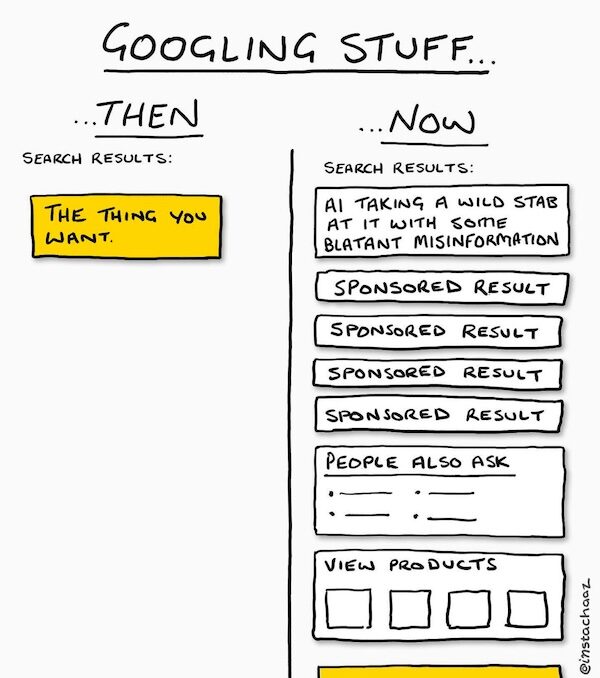
The problem with Google. Recently I was trying to plan an upcoming trip to Paris. Having heard warnings that the Louvre can book up, I set out to buy advance tickets online. Googling “Louvre tickets” took me to louvre-museum-tickets.org, where I was unable to find the 22-euro tickets the guidebook assured me existed. Instead, I was offered significantly more expensive options that combined a Louvre ticket with something else, like an audio guide or a Seine cruise.
Eventually I realized that (in spite of the .org suffix) I wasn’t really on a Louvre web site, but had found an independent ticketing agency. So I googled “Louvre official site”, which took me to another overpriced ticketing agency (paristickets.com) that wasn’t the Louvre. Only after I clicked “Hide sponsored results” did I find the Louvre’s actual site louvre.fr and its English-language page at louvre.fr/en. That’s where the 22-euro tickets were.
In other words, Google knew what I wanted, but just chose to show me something else because it could make more money that way.
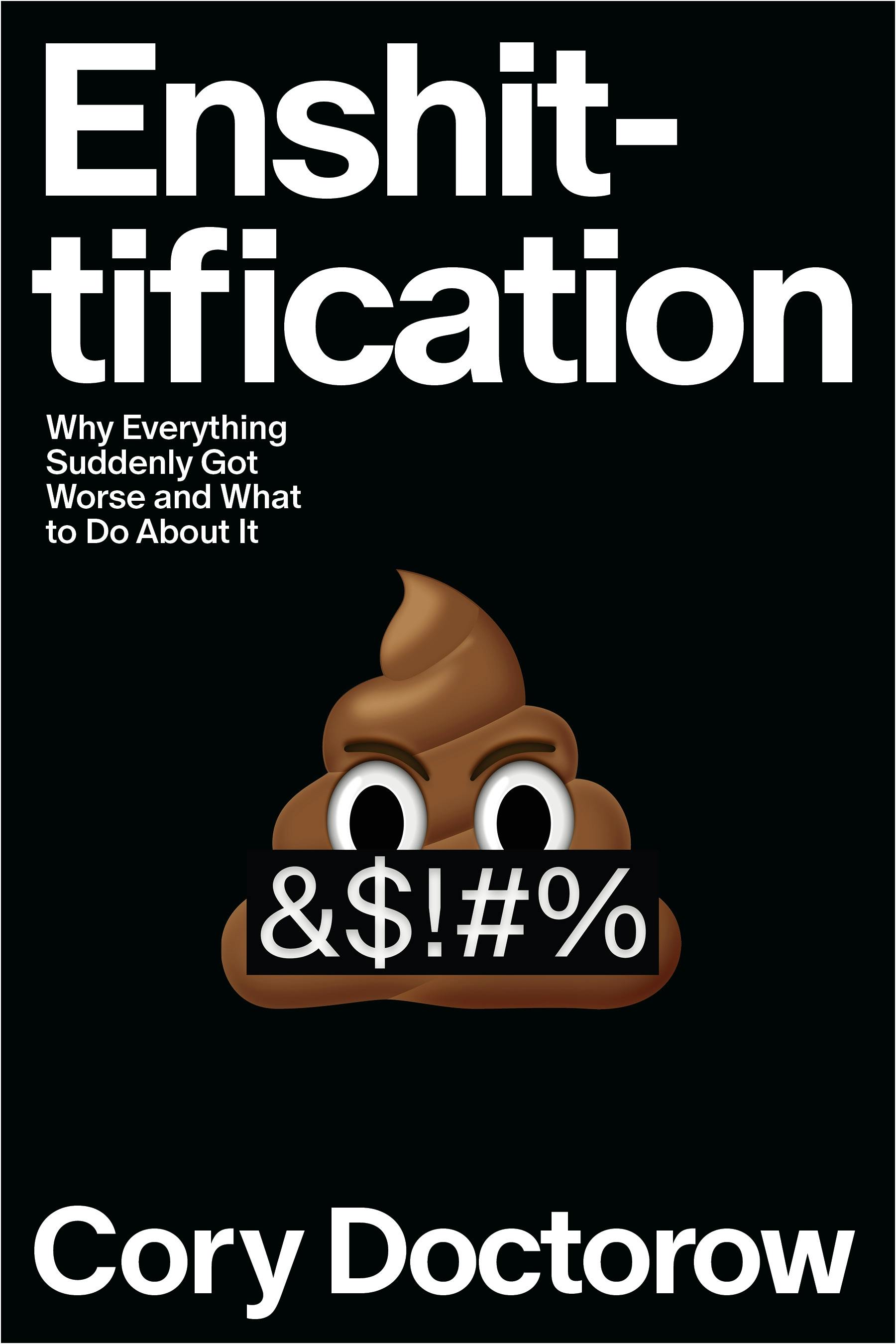
I was experiencing Step 2 of a process Cory Doctorow calls “enshittification”.
- First, platforms are good to their users. They become popular for good reasons. Either through network effects or because monopolistic business practices eliminate competition, they become hard to leave.
- Because users don’t want to leave, the platform can degrade their experience to make things better for its business customers. It becomes an essential business tool.
- But now businesses can’t leave either, so the platform can degrade their experience as well, capturing all the value for itself.
The result, Doctorow claims, is “a giant pile of shit” that makes lots of money while serving no one.
Not so many years ago, the Google algorithm was a revelation. Previous search engines like Altavista might have produced a many-thousand-entry list of every site that mentioned “Louvre”, leaving me to come up with more search terms to narrow it down. Finding what you actually wanted on such lists was a bit of an arcane art. But Google went right to it. At the time, it seemed miraculous.
That was Step 1 Google. But little did we all realize that providing a valuable service was just a means to an end. Eventually, Google became rich enough to buy the default-browser slot in nearly every app you might use. (Google pays Apple about $20 billion a year to be the default in Siri and Safari.) Since then, Google has no need to give users anything like the value it used to. It has enshittified itself.
Uber, Amazon, Facebook. Doctorow gives plenty of other examples. Uber, for one, used to simply match people who were willing to pay for rides with drivers who were willing to drive them. There was enough slack in the middle for Uber to take a cut while making a good deal for both riders and drivers.
Since then, though, Uber has been gathering data about both riders and drivers, so it has an informational advantage over both. So its algorithm can drive hard bargains in both directions: It simultaneously makes good guesses about both the highest rate you might be willing to pay and the lowest rate a driver might be willing to take. So enshittified Uber captures nearly all of the surplus value its app creates.
Similarly, Amazon’s search engine isn’t trying to find you the best product at the best price. Instead, it’s using everything it knows about you to pitch you the highest-margin product you might buy. Simultaneously, it’s charging manufacturers the most they might be willing to pay to get their products moved up the list Amazon shows you.
But the enshittified platform I feel the most nostalgia for is Facebook. In the early 2010s, Facebook showed you what your friends posted, including the links they thought you should look at. That wasn’t just good for you and your friends, it also created an engine for launching viral blog posts. If you posted a link to something, all your friends saw it. Enough of them might repost it to reach a new layer of readers, and a chain reaction might ensue.
That made Facebook an ally of any aspiring blogger. Every now and then, a Weekly Sift post would hit escape velocity and take off. Two posts in particular went viral, The Distress of the Privileged in 2012 and Not a Tea Party, a Confederate Party in 2014, accounting for more than a million page views between them. When I delved into the details of those page views, a large majority of them came via Facebook.
A few years later, I was noticing that it had been a long time since I’d had a 100K post. And then I connected that fact with the option Facebook had been giving me to “boost” my posts for a fee. In other words, if I paid them money, they would do what they used to do automatically — show my posts to all my friends. I refused to pay, and the numbers kept dropping. Today, a Sift post that gets a thousand views at weeklysift.com is a big deal. (This doesn’t count the six thousand or so people who subscribe and get posts by email. I have no idea how many of them read those emails.)
The viral path is still there — I still have friends and friends-of-friends and so on. But (without a monetary “boost”) the Facebook algorithm snuffs out would-be viral posts the way a control rod stops chain reactions in nuclear reactors: Some percentage of my friends never see my posts, some percentage of friends-of-friends don’t see my friends’ attempts to share my work, and so on. So the chain reaction dies out.
Bloggers of all types noticed this phenomenon in the mid-to-late 2010s. And simultaneously, Facebook users noticed that their feeds were filling up with crap: advertisements, links from major-media outlets, posts from famous people kinda/sorta in their echo chamber, and some stuff that defied explanation.
I just did a quick count: Of the first 20 items on my Facebook feed, only 3 are from my friends.
It isn’t just capitalism. You might think that this is just capitalism. Of course middlemen try to charge their customers more and pay their providers less. “Buy low, sell high” and all that; it goes back to the beginning of markets. But that doesn’t explain why enshittification has taken over everything at precisely this moment. Doctorow argues that we’re in a new economic age: the Enshittocene, or the Great Enshittening.
And yes, this is a sort of capitalism. But technology has created new avenues to enshittify products at precisely the same time that the forces containing enshittification have eroded. Corporations are enshittening their products because they can. But why can they? And why particularly now?
When a whole population starts to change in the same way at the same time, it’s a sign that something external and systemic is underway. Rather than looking for the origins of enshittification inside the companies, we should look at the world the companies operate in.
Doctorow identifies four forces that could punish or control an enshittifying company, and finds that they have all weakened in recent years.
- competition. If a company is taking too much advantage of its users or clients, they’ll go somewhere else, if they can. But anti-trust enforcement has weakened considerably, allowing monopolies, near-monopolies, and collusive agreements like the one through which Facebook and Google set rages for online advertising.
- regulation. Governments can establish enforceable rules on a company’s behavior. But de-regulation has been in vogue since the Reagan administration.
- self-help. Users or other companies can create work-arounds to avoid the most onerous features of an enshittified platform, like the third-party ink cartridges for HP printers. But many work-arounds are now treated as illegal hacking or copyright infringement by laws that the software industry lobbied to pass. For example: What if a new e-book reader gave you the option to leave Kindle or iBooks and take your books with you. That would be illegal; it violates Amazon’s or Apple’s intellectual property.
- worker power. Many tech workers have a dedication to visions of an idealistic mission. Enshittification is not part of that vision, so workers have often resisted it. But the job market in tech has worsened considerably in recent years. If you don’t want to go along, they can easily find somebody to replace you. “Axing twelve thousand Googlers in 2023 and thousands more in 2024 was a small price for Google to pay to allow managers total discretion about when they’d cheat and how. It was a price Google paid gladly, and we’re all living in its aftermath.”
Solutions. All the policies that created the opening for enshittification are reversible. Antitrust enforcement can be strengthened to break monopolies. Regulation can police anti-competitive behavior. The laws that prevent interoperability and competitive hacking can be weakened or repealed. Privacy laws can prevent companies from accumulating data about their users and transparency laws can force them to reveal information that current apps make invisible (like what other Uber drivers are getting for driving similar routes).
Doctorow has a lot to say about each of those paths, and how they can be done in ways that work in the real world. That’s all a little too detailed for me to cover here, and why you might want to read the book.
Enshittification destroys the capitalist myth. If you read the Wall Street Journal or listen to speakers from Heritage Foundation and other pro-capitalist institutions, you’ll often hear arguments based in the Cold War struggle against the Soviet Union: Communist governments claimed to be all about the worker and the common person, but long-term they strangled economic growth and made their whole society poorer. By contrast, the capitalist West out-produced Soviet-bloc countries and created a widely shared prosperity. You may not like the economic inequality that goes along with capitalism, but in the end even the people near the bottom are better off than they would be in a society that didn’t let anyone get rich.
If you delve into why that should be, you’ll get an answer something like this: When inventors and entrepreneurs create better ways of doing things, they can’t capture all the benefits for themselves. Invariably, the gains spill over into the rest of society.
So: Thomas Edison got rich from his light bulb, but consumers got reliable cheap lighting, cities became safer, and Edison used his wealth to fund research into more inventions that produced more social benefits.
But here’s the problem: Those days are over.
Inventors and entrepreneurs don’t produce widespread benefits out of generosity. They do it only when they have no other choice. From their point of view, every benefit of their innovations that they don’t capture for themselves is an inefficiency.
As we get deeper into the Enshittocene Era, the big tech companies and their billionaire/trillionaire owners get more and more efficient at capturing the benefits of technological progress. As the era goes on, the benefits of capitalist innovation get less and less widespread. Wealth inequality stops being a side-effect of the system and becomes the central feature.
Technology used to promise us products that would get better and better every year: Faster and cheaper computers with more memory running programs that seemed like magic.
But that’s not our primary experience of tech any more. Now we deal with Google and Facebook and Uber and Amazon and a host of other enshittifying corporations. Every day their products get worse, require us to look at more and more things we’d rather not see, and cost more.
The AI-driven future. Now we’re supposed to be dazzled by the promise of AI. AI tools like ChatGPT and Claude are free to play with and sometimes produce amazing results. Yes, it must cost something (maybe a lot) to provide that free service, but companies are burning through investor capital to make it happen.
We all know that can’t last. Eventually, AI tools will lead to more complex systems that can only be navigated by AI agent. Then the free service will end, and you’ll need to pay a subscription fee in order to participate in the economy. And then the AI agents themselves will begin to turn on you. They won’t find the best deals or the best arrangements for you, but they’ll channel you into paths that the AI producers want you to walk.
Don’t start depending on AI until you’ve fully imagined enshittified AI.
An answer for the economists. One of the mysteries economists are confronting right now is why people think the economy is bad. GDP keeps rising. Wages are more-or-less keeping pace with inflation. Unemployment is low. So what’s the problem?
According to a report from Yahoo Finance, consumer sentiment is near historic lows even as objective measures of well-being have reached all-time highs.
Maybe enshittification is the answer. All around you, the world is less and less responsive to your wants and needs. More and more, you have to jump through somebody else’s hoops just to do things you used to take for granted. Maybe it doesn’t show up in your paycheck and isn’t fully reflected in the prices you pay. But every day you are confronted with a world that is not as good as it used to be.


Comments
always love your ideas! I think you might want to fix the typo in the bulleted item “competition“: in the last line it says “rages“ instead of “rates“
I am one of the 6000 who reads your emails! You hit the nail on the head with this one. I rarely even look at Facebook anymore, and yesterday Google could not tell me why my choux pastry was falling apart when I tried to roll out some strips! Yes, everything is harder and more inconvenient, isn’t it? Thank you for your posts; I really enjoy them.
i switched from Google to Kagi and tried the Louvre query that you mentioned and the correct link was listed as the first reponse.
Kagi is not free, however.
Points on target and well made. I served the capitalist world, quite happily I confess, for a lifelong career and it treated me well. Twenty-five years ago. This is now. Customer service by a live, knowledgeable and articulate person is very, very hard to get. To a cost-slashing mega-automaton with many lines of business and computer bays full of e-Beancounters, attentive personal service seems unworthily expensive to train, provide and keep. It’s OK if such irritating and demanding customers go elsewhere, better to beleaguer their competition.
As for Paris tourism, for great, well-automated service for tickets and info, go to Paris’s government website. Whilst physically in that great city, deal with its official tourist offices. They get busy and there may be a wait, but the service is — or at least was, a couple of years ago — quite good.
I’m grateful to receive the weekly sift free. Once in awhile it’s not the case and I find it in Spam or junk mail. Thanks for your generosity and work
Putting questions of regulation aside for a moment, software technology gives firms a lot more tools to extract additional value from the market. Corporate interest in greater profits isn’t new, but the ability to morph a product or service on a daily basis and operate with huge amounts of customer data gives firms enormous leverage. You can run a “value extraction” experiment every week, and the big companies all do. The corporate world would have been doing this in the 1950’s if they could have. Modern software systems make it possible.
In addition to this, the whole software space moves so quickly that the ecosystem is playing out in fast-forward. New players can reach a near-monopoly very quickly, often by simply being first, and this can put immature firms in positions of power.
Economists, and I have traded comments with a few, resist the notion that people are unhappy because life has gotten so onerous due to shitty corporate behavior. The fact that monopolies are created both legally and by affiliation (Thiel’s Tech Overlords clubs come to mind) makes life much worse. And it costs us time and money.
The Takers are those corporations, the Makers are their consumers and employees, and those Takers are taking us for a really bad ride.
So what’s the answer? As Facebook, Quora, and other sites have deteriorated, I stopped using them. Companies that rely on either membership fees or advertising will have to revamp their products if they want to stay in business. Yes, it’s a problem if all of the companies with a similar offering are doing the same thing, but that’s also a problem in every other sector. The oil industry is a good example of this. The free market isn’t sufficient; you need government regulation.
Another one of the 6000 checking in! I read every week. I started with Not a Tea Party, a Confederate Party from a Facebook link back in the day. I agree that the consumer sentiment statistics are linked to enshittification. I tried to call my local pharmacy and I couldn’t get through the AI web to a real person, at all. The system just hung up on me. These are people physically down the street from me. The system is deeply broken.
I actually receive The Weekly Sift in two ways: from email, and via RSS feed. And you probably have no way of knowing how many RSS views you get….
I get your Weekly Sift in my email inbox, and look forward to it every week. It helps me keep informed and helps me know where to look for items when I have questions about what I see and hear in the news. Thank you!
Had not realized the extent to which I have been shat upon.
Email getter here! Thank you for your thoughts each week.
Duck Duck Go returned the louvre.fr/en website as the top result. And it is free. There are adjustments to be made though if you switch from Google search.
Thumbs up for duckduckgo.com !
I had picked up Enshiitification and it’s a hella book. Alternatively enlightening and infuriating. A brutal testimony of the accelerating awfulness of dealing with the tech and corporate worlds. As a Creative pro, I have seen my costs relentlessly rising for increasingly crappier services and evaporating support while my income steadily erodes. And here comes AI, sniping away at what’s left.
At sixty-seven, retirement no longer seems as grim a fate as the enjoyment gets sucked out of my profession.
I’m another weekly reader. Thanks so much for all your insights – invaluable to this Australian reader who wants to understand what’s going on in the US.
Re the Google experience – ugh! I switched my default search engine to Ecosia, another (free) search engine which does pretty well and which donates all its profits to climate action (mostly tree planting) as well as running on 100% clean energy.
Trackbacks
[…] This week’s featured post is “Why everything seems to be getting worse“. […]
[…] Why everything seems to be getting worse […]
[…] few weeks ago I reviewed Cory Doctorow’s book Enshittification, which focuses on the software platforms that are increasingly making life […]
[…] this tendency in the existing internet systems. (Read Cory Doctorow’s Enshittification, which I reviewed in July. Or read The Nerd Reich, which I have now finished and plan to review […]