
How narrative turns into destiny.
I’ve mentioned before the writer A. R. Moxon and his blog The Reframe. [See endnote 1.] He doesn’t do the weekly news processing I do here, but instead writes the kind of long-form think-pieces that I only get around to occasionally. This week he posted “Winning the Story Game“, where he looks at the way the people at the top of our systems — Elon Musk and Donald Trump particularly — go from lie to lie, crime to crime, and failure to failure without ever being held to account.
So Elon Musk is about to become the planet’s first trillionaire, I’ve learned. Or he already is one? It’s hard to tell once you’ve reached such levels of cartoon villainy and pretend money. I say “cartoon villainy” because you don’t get a trillion dollars by providing value to humanity, and I hope we’re all savvy enough by now to know that. You get a trillion dollars first by capturing the mechanisms of power and influence that decide what value is and how it is counted, and then by pointing those mechanisms right toward yourself while cutting off as many avenues that don’t point toward you as you can. Corruption and exploitation, in other words.
He describes how Musk became a trillionaire:
by telling lies to the market about what his technology will do and when it will do it, then reaping the rewards of the market’s credulity on his grandiose claims, deploying all the reputation he fraudulently gained in order to hoover up government contracts, using the wealth he gained to acquire genuinely valuable things that other people have actually created [2], and finally corrupting those things to his own benefit and enrichment, all the while never paying any penalty for his mendacity as he simply keeps moving out the delivery dates on the technologic miracles he was obviously never able to deliver, and indeed rarely seems interested in even looking like he is bothering to try. Musk got his final boost into trillionairism on the strength of what sure seems like a fraudulent or at least bogus valuation for the recent IPO of his SpaceX company, propped up on typically grandiose and specious claims, unaccountable market credulity, captured government contracts, and rules changes favoring specious-to-fraudulent valuations, including loosened regulation and mandatory purchases by index funds. Index funds are where most of our retirement accounts are, by the way, so if Musk and his shareholders want to dip out with all their gains, it will be everyone else left holding the bag.
None of this is a secret. Nor is it a secret that Trump lies constantly, nor that his presidency has enriched himself and his family by several billion dollars. And yet …
[T]his disrepute doesn’t impact the way our systems of government and finance and influence deal with them. Trump and Musk’s next grandiose claims—about the end of the conflict in Iran, say, or about putting a colony on Mars—will be reported as if it actually news, without the context of their long history of lies, without the assumption that these are just the latest lies. The markets will respond to the claims as if they are based in reality. The justice system will go on ignoring their crimes. The money will keep flowing to them, and to other billionaires, too. And billionaires as a class are increasingly in disrepute, yet the money keeps flowing to them, even as more and more people struggle to survive, even as billionaires get more and more open about their intention to control our bodies and lives, to enslave most of us and devour the rest.
Fewer and fewer people want this, it seems, and yet more and more of us are getting it. There seems to be a fundamental disconnection between the will of the people and the will of our systems of government and finance and influence. This tells me that whatever changes we need to make, they need to be systematic and fundamental—radical, in other words.
Moxon is not the only person to notice this, but he goes on to ask why. And he connects this corruption with the stories we tell ourselves through our popular media: Once our superheroes were selfless beings who felt an inner pressure to use their power responsibly, in service of the people they had the power to rule. [3] But then came the Marvel cinematic universe.
Iron Man aka Tony Stark was the central hero of these dominant stories we told ourselves. He was a capitalist genius billionaire arms dealer who saves the world by single-handedly developing increasingly autonomous mechanized weapons over which he has an ever-increasingly level of personal control, which he deploys throughout the world however he sees fit. I remember when this would describe the villain of most stories, but over the last two decades of our dominant mode of storytelling, Tony Stark was our central hero. His wealth was proof of his goodness; his development of technology was proof of his right to use it; his genius enabled him to make, all by himself, the marvels that brought salvation to the universe, and the creation of those marvels bestowed upon him license to decide how those marvels should be best used. It shouldn’t perhaps surprise us that after a decade or so of this we wound up with Donald Trump and Elon Musk.
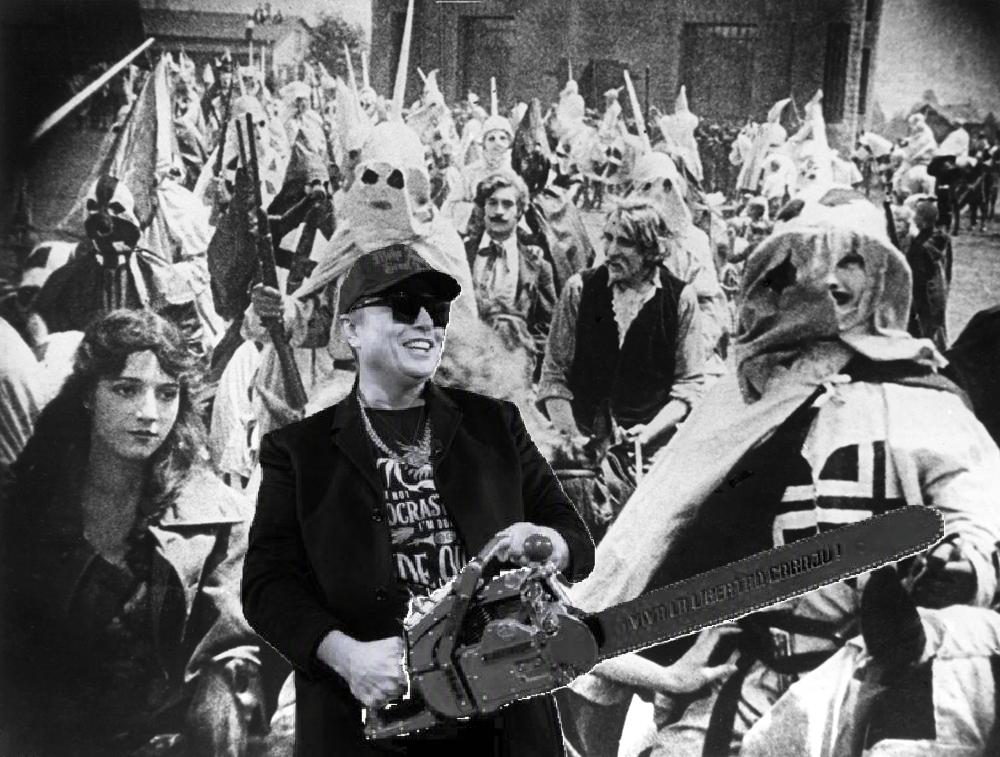
But supremacist story cycles have a way of falling apart eventually, because people start connecting them to the harms they cause. In the first half of the 20th century, a popular story cycle — from The Birth of a Nation to Gone With the Wind — idealized the Confederacy and the Ku Klux Klan that was fighting to restore the South’s former glory. [4] That story falls flat today. [5]
Confederates seceded with an open defense of their right to slavery, but their modern defenders have discovered they can’t tell the story they defend on its own terms. Southern scions of human slavers don’t like being thought of as scions of slavers, these days, and those who serve as Confederate apologists don’t like being thought of as apologists for slavery. These days most racists don’t like being called racists and most supremacists don’t like being understood as supremacists, and most fascists don’t like being called fascists. Instead, they try to cast their critics as the real racists, and those who try to resist their oppression and suppression as the real supremacists, and antifascists are the real fascists. There seems to be a reputational cost that attends their actual beliefs, one they’d rather make others pay, and they seem to know it.
So supremacists have to keep coming up with new stories to justify their dominance. Moxon says we need to get quicker at noticing and undermining these new stories, and get better at coming up with counter-stories of our own. Intriguingly, he claims to be drafting future essays about how to do that.

[1] A book collecting some of his essays, Fighting in the Dark, is coming out in August.
[2] Many people believe that Musk founded Tesla, or maybe even invented its technology. He didn’t.
[3] The idea that changes in superhero myths mark changes in society is something I worked with in my 2010 UU World article “Reclaiming Krypton“. I followed up in 2021 with a blog post “Return to Krypton“.
While I’m mentioning it, let me say that “Return to Krypton” deserves a look. The superhero stories since 2010 focus on an ambivalence about legacy, and point us towards a process of discernment, where we separate the legacies we are grateful for from the legacies we must reject. There are good and bad sides to being, say, Batman’s protege. And that invites us into a discernment process about our American legacy: “I revere this Thomas Jefferson. I revile that one.” Once you enter the debate over whether we should admire Jefferson or be ashamed of him, you’ve oversimplified American history.
In contrast to Musk and Trump, the superhero myths of the 1940s and 1950s gave us “the wise men“, six incredibly influential people who shaped postwar and Cold War American foreign policy. Most were from well-to-do families who gave them elite educations, and Averell Harriman inherited considerable wealth, but none of the six used their public-policy influence to capture billions for themselves. Today, only history buffs can tell you who they were.
[4] Here I’m reminded of my 2014 post “Not a Tea Party, a Confederate Party“. It was the most viral Sift post ever.
[5] Something similar has happened to the old-fashioned cowboys-and-Indians western. Portraying Native Americans as mindless savages just doesn’t work any more. How the West was “won” has become a much more ambiguous tale.


Comments
It feels weird to say this by painting the Marvel movies with a broad brush without. Actually reckoning, in any way, with the stories being told. Isn’t “wait, this sucks actually” literally the point of the Ultron thing? Isn’t “holy crap, what am I doing, I need to figure out how to be responsible” what results in the famous Civil War? You don’t really have to look very deeply to see that that hasn’t been the superhero story being told any time in the last decade.
I was going to say something similar, but with this added point. Of course it doesn’t really matter to his argument whether he gets the example of Iron Man/Tony Stark correct or not, but it does matter in establishing credibility.
We’ve all seen news stories about something we know a lot about and noticed how much they get wrong. Making incorrect statements about something so broad and well-known as Marvel movies really makes me question the rest of his examples and analysis. Are the other examples he uses equally distorted? If all of his examples are undermined, why should I place any weight in his analysis?
Trackbacks
[…] This week’s featured post is “Story Games“. […]
[…] Story Games […]