
I hate to even ask this question, because it’s been discussed so often over the years, and the hopes raised have (up until now) always been dashed. But maybe? Maybe?
Way back in 2015, when Trump came down the escalator characterizing Mexican immigrants as rapists, and then a few weeks later denigrated John McCain’s war record, the conventional wisdom was certain that he had gone too far. Outrageousness had always been his shtick, but this was too much. Surely even his supporters would start backing away from him now.
Needless to say, it didn’t happen. It also didn’t happen after he bragged to Billy Bush that he could “grab ’em by the pussy” and get away with it. Or when two dozen women verified that he really did behave that way. Or when a jury unanimously concluded that he had sexually assaulted E. Jean Carroll.
It didn’t happen when he said he trusted Vladimir Putin more than American intelligence services. Or when his mismanagement of the Covid pandemic expanded the death toll by hundreds of thousands of American souls.
It didn’t happen when he withheld aid approved by Congress in an attempt to extort Ukrainian President Volodymyr Zelenskyy into launching a bogus investigation of Joe and Hunter Biden. Or when he was impeached for that. Or when he incited rioters to attack the Capitol to reverse the result of the election he lost to Biden. Or when he was impeached for that. Or when he pardoned the rioters of all the crimes they had committed in his name, including hospitalizing over a hundred Capitol police.
Every time, very smart people told us this was it, he had finally gone too far. But it was never true.

So why might it be true now?
The downward slide. Hemingway once said that bankruptcies happen two ways: gradually, and then suddenly. The undermining of Trump’s popularity has been following a similar pattern.
For months, Trump supporters have been getting less and less sure of themselves. Maybe it began with the Epstein Files, which Trump had campaigned on releasing, and then did his best to hide once he got into office. (His Justice Department is still dragging its feet, and Trump keeps flirting with the idea of pardoning Epstein’s primary accomplice — the only one currently in jail for Epstein’s crimes.) Or when the prices he said when come down “on Day One” kept climbing — often due to Trump’s own policies like illegal tariffs and the effect of his war with Iran. Or when he attacked Iran for no discernible reason after running on not starting foreign wars.
That all resulted in a steadily declining approval rating from the general public, to levels unlike anything he had seen before.
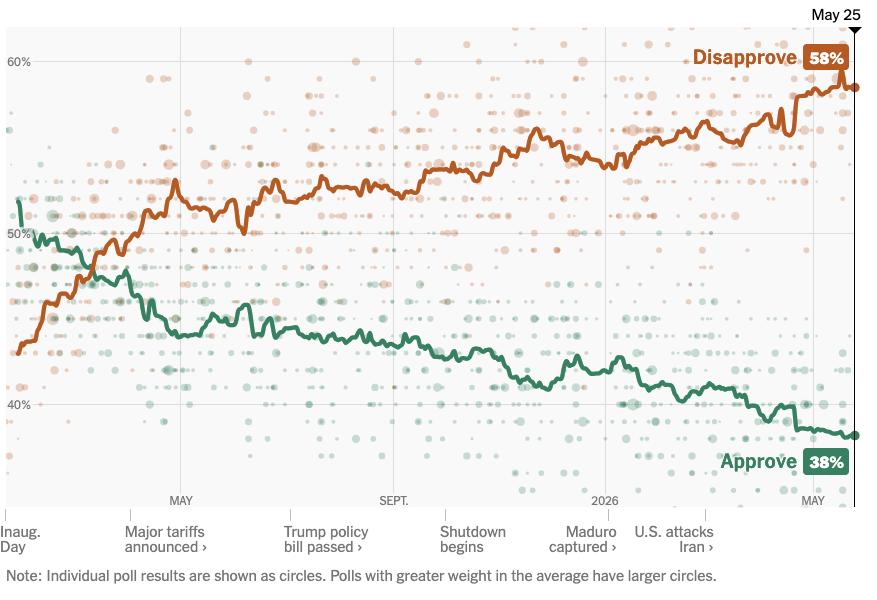
That set the stage. But more recently three events have brought it into focus: the White House ballroom, his insider stock trades, and (most of all) the $1.776 billion fund he has illegally created to reward the same violent criminals he pardoned for the January 6 riot.
Primary voters. Probably the last people to leave Trump will be the MAGA faithful who show up to vote in Republican primaries where he has made an endorsement. Recent results have shown him to still be strong there — strong enough to punish Republicans in Congress who step out of line.
So Rep. Thomas Massie (R-KY) lost his primary on Tuesday after being targeted by Trump for (among other things) pushing to release the Epstein Files. Last week Republican Senator Bill Cassidy also lost his primary five years after voting to convict Trump in his second impeachment trial. Neither Massie nor Cassidy, though, had defined himself as anti-Trump. Both pitched themselves as loyal Trump Republicans who maintained just a smidgen of independence.
But that’s not good enough for Trump, and he clearly retains enough sway with Republican voters to punish elected officials who cross him in any way at all. Tomorrow we’ll get another test: Trump has endorsed Texas’ corrupt attorney general, Ken Paxton, over Senator John Cornyn, who not long ago was in contention to be Majority Leader. Cornyn’s sins are even less tangible than Massie’s or Cassidy’s — he hasn’t been enthusiastic enough about Trump’s agenda to want to scrap the Senate filibuster. Trump also ousted Indiana legislators who refused to redraw their state’s congressional map.
Republicans in Congress. But Republicans in Congress don’t just have primaries to worry about. In spite of gerrymandering, some have to win in competitive districts, where they need votes from independents and maybe even a few Democrats. Senators, meanwhile, have to run statewide. So unless they’re from clearly red states, they also need support from more than just Trump and his most fervent followers.
That’s where you would expect to see the cracks form first — and we’re seeing them in two places: the reconciliation bill trying to move through the Senate, and the war powers resolution attempting to limit the Iran War. In both cases, Republican leaders in Congress adjourned for the Memorial Day recess rather than hold a vote that they would lose.
The reconciliation bill. Remember how this started. After Trump’s masked police (some combination of ICE and the border patrol) terrorized Minneapolis, murdering Alex Pretti and Renee Good, Democrats refused ICE and CBP any further funding without putting some common-sense restrictions on these rogue agencies.
first, federal immigration agents need to remove masks, turn on their body cameras, and wear visible, clear identification. Second, Democrats want to end the roving patrols. This is a nation of laws guided by the Constitution that everyone—including ICE—must abide by. This means that federal immigration officials must stop racial profiling and end random arrests; and agents must obtain a judicial warrant signed by a neutral judge—not an administrative warrant—to enter private property. They also cannot detain Americans for hours or use excessive force against them just for peacefully protesting in support of their neighbors and friends. Third, Democrats are demanding accountability. ICE and Border Patrol squads cannot indiscriminately smash in car windows, use tear gas on protestors, and shoot at people without any accountability.
Republicans refused any meaningful limits on ICE, and resolved to fund the mass-deportation agenda without Democratic votes (the same way they passed Trump’s “Big Beautiful Bill” last year). That was the origin of the current reconciliation bill.
Since then, the bill has become a Christmas tree with all kinds of baubles on it. Trump wanted it to include $1 billion for his White House ballroom — which originally wasn’t supposed to cost the taxpayers anything (beyond the cost of whatever favors Trump offered donors). Senators balked at this, but then were bailed out by the Senate parliamentarian, who ruled that the ballroom funding violated the arcane rules that govern reconciliation bills. Trump then demanded that Majority Leader Thune fire the parliamentarian, which he has not done.

The reconciliation bill doesn’t fund Trump’s corrupt “anti-weaponization” fund, which the Justice Department claims it can create with money from a fund previously established to pay settlements of lawsuits against the government. But there is no settlement in this case. Settlements are overseen by courts, and probably no judge would sign off on what Trump wants.
On May 20—the same day the parties’ jurisdictional briefs had been due—[the judge] issued an order formally closing the case. In her order, she noted that the Justice Department, which has an “independent obligation to uphold the ‘public’s strong interest in knowing about the conduct of its Government and expenditure of its resources,’” had “neither submitted any settlement documents nor filed any documents ensuring that settlement was appropriate where there was an outstanding question as to whether an actual case or controversy existed.”

So if it’s not in the bill, why is the fund a problem for Senate Republicans? The reconciliation process allows the opposing party a chance to offer amendments. Democrats are almost certain to propose an amendment saying that no federal money can be spent on the anti-weaponization fund, or perhaps just that no money be awarded to people who have been convicted of assaulting police officers or committing sedition against the United States. Since those are precisely the people Trump wants to reward, he will demand Republican senators vote against such an amendment. And how will they explain such a vote to their constituents?
That prospect set up a tumultuous private meeting between Republican senators and Acting Attorney General Todd Blanche, who is spearheading the anti-weaponization fund effort. Mitch McConnell came out saying this:
So the nation’s top law enforcement official is asking for a slush fund to pay people who assault cops? Utterly stupid, morally wrong — Take your pick.
The upshot was that the reconciliation vote wasn’t held before senators left for the Memorial Day recess. Whether any of this can be resolved after they come back in June is still up in the air.

Iran war. We’re now three months into a war that Trump insisted was won on the first day. He has never explained the goals of the war to the American people, and has never gone to Congress for authorization. He just wanted to attack Iran, so he did. Why does anybody need to know any more than that? The reasons he gives may shift from tweet to tweet, but why does that matter?
Democrats have been proposing resolutions to limit the war since it began, but Republicans have been holding them at bay. But defections on the Republican side have been building up, and a resolution asking Trump to withdraw American forces by the end of June looked ready to pass the House Thursday, forcing Speaker Johnson to delay the vote until after the Memorial Day recess.
Of course, Trump could veto that resolution even if it passes, and there aren’t nearly enough votes to override such a veto. So the legal effect of passing the resolution would have been nil. But putting the House on record opposing Trump’s war would be a big deal.
And eventually, Congress will need to appropriate some money to pay for all the bombs and missiles and military deployments. What will happen then?
Where are we? Opposed to the now-he’s-gone-too-far conventional wisdom is the Trump-has-a-floor view that his base of support is unshakeable. What seems to be true is something in between. The process of Trump’s fall should go something like this: He’ll lose the support of independents who voted for him in 2024 (which has pretty much already happened). Then Republican senators and congresspeople will peel off one-by-one, which has been happening slowly for several months. Then the drip-drip of leaking support will become a flood. Eventually, even previously fervent supporters will go silent, or forget that they were ever MAGA.
It won’t happen all at once. There’s even a chance that a deal-on-paper with Iran will reduce the pressure on the GOP congressional majorities to assert themselves, or that some fig-leaf concessions on the ballroom or the weaponization fund will allow the reconciliation bill to pass.
But the erosion is still happening. Long-term, I don’t think it can be stopped.


Comments
Trump’s immoral and law-less conduct must be called out to an increasingly edgy Republican Congressional majority and to voters in the primaries that are left and the generals coming up.
Perhaps the most important things we citizens have are our voices to neighbors, our communities and the media … and our active support of voter protection in registration, early voting and the ballot process, all the way through to the resulting count in November.
Trackbacks
[…] This week’s featured post is “Has Trump finally pushed Republicans too far?“ […]
[…] Has Trump finally pushed Republicans too far? […]
[…] Doug Mouder at The Weekly Sift: “Has Trump finally pushed Republicans too far?“ […]