
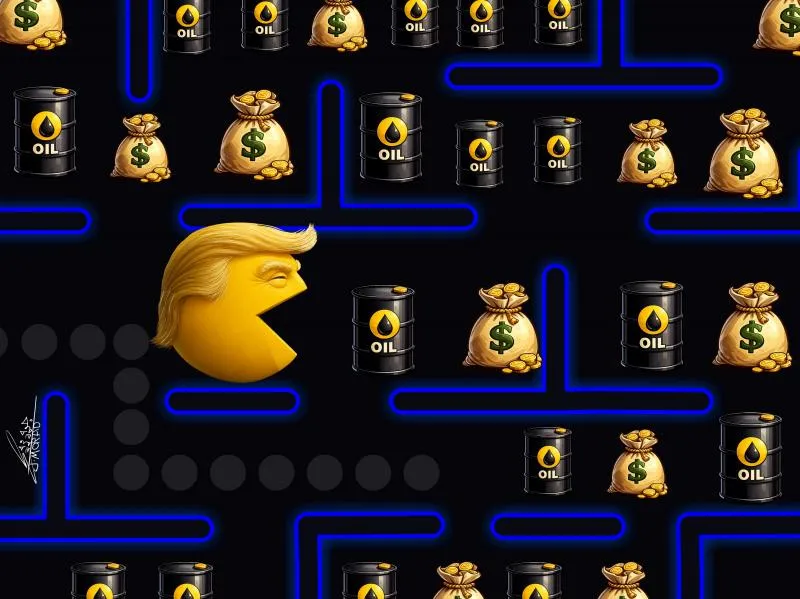
Maybe the reason the government is working so badly for you is that it works so well for him.
Ever since he came down the escalator in 2015, Donald Trump has posed a unique problem for his opponents: There’s so much to run against, how do you focus?
- Maybe his ongoing attack on democratic governance and the rule of law is the most serious problem. But that can sound legalistic and abstract to a low-information voter. Harris tried to make democracy a major issue in 2024, and it didn’t get traction.
- Maybe in the long run his gutting of the already-inadequate Obama/Biden response to climate change is the most serious thing. But there you run into a fossil-fuel-company disinformation campaign that has been going on for decades. Lots of Americans just don’t believe in climate change and don’t see why they should make sacrifices to head it off.
- Maybe we need to turn around his “Promises Made; Promises Kept” slogan and point to all the reasons his supporters should be disappointed: Inflation is worse, not better. The deficit has gone up, not down. Tariffs and deportations haven’t opened up manufacturing jobs for Americans. Quite the opposite of exposing Epstein’s co-conspirators, his Justice Department has been helping hide them. Rather than curb wasteful government spending, he has pushed for expensive vanity projects like a billion-dollar ballroom and the Arc de Trump. After claiming that Harris would get us into another expensive war, he has gotten us into another expensive war.
- Maybe we should push a class theme: Trump’s “Big Beautiful Bill” cut billionaire’s taxes and paid for it by cutting food and healthcare benefits for the working poor.
- Maybe Trump’s personality is the problem: the constant lying, the childish insults, his mistreatment of women, and the way he demands a North-Korea-like level of praise from everyone in his administration. But Trump has a unique teflon-coating in this area. His over-the-top rhetoric channels the free-floating anger many voters feel.
I could go on. But if you don’t focus, if you catalog everything, you sound obsessive. Trump’s counter-narrative is that his critics have Trump Derangement Syndrome, an irrational urge to denounce anything Trump does. (The real TDS, in my opinion, is suffered by the Republicans who abandoned their previous principles to follow Trump: the libertarians who are now pro-autocracy, the deficit hawks who support both cutting taxes and fighting unnecessary wars, the religious leaders for whom Trump’s personal immorality doesn’t matter, and so on.)
The underlying problem is that everything is a distraction from everything else. Picking out one thing seems to imply that the others are acceptable. And that gets us squabbling among ourselves rather than uniting in opposition.
If only there were a theme that was unifying rather than divisive. Is there any aspect of the Trump regime that could serve as a trunk, with all the other objections as branches?
The Hungarian example. Péter Magyar faced a similar problem when he ran against Viktor Orbán, the neo-fascist autocrat of Hungary. Like Trump, Orbán had been an across-the-board negative influence on Hungarian society for many years. But as a result, the people who ought to oppose him did not form any coherent whole. So how could they be united behind a single party or candidate?
Magyar chose to focus on one central issue: corruption. And it worked.
Could it work for us?
Trump’s corruption. There’s a lot to work with here. To start with, there’s the bottom-line result: Trump’s net worth has skyrocketed since he got re-elected. Somehow, being president again has tripled his wealth in less than two years.
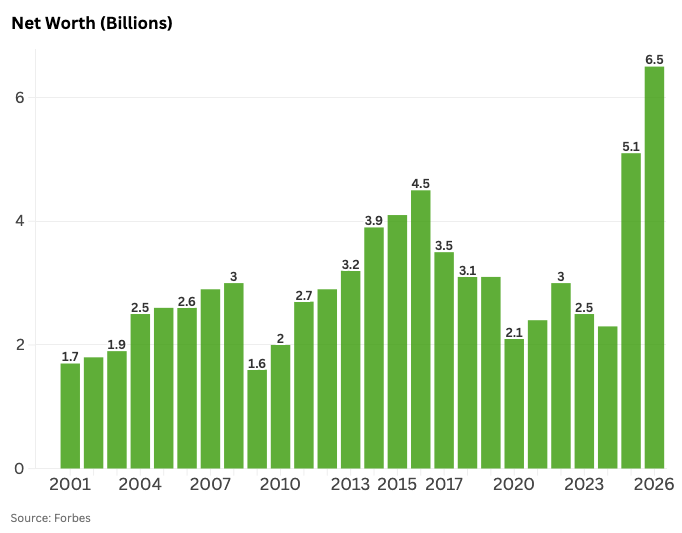
How? According to Forbes:
His cryptocurrency ventures, stalled out before the election, exploded after his victory, adding an estimated $1.8 billion to his fortune overall. Another $500 million came in court, where Trump’s legal team succeeded in eliminating a half-billion judgement against him. His once-dormant licensing business surged $400 million, as foreign developers clamored to do business with an American president.
Then there are the bribes channeled through lawsuits. For example, Trump filed a legally baseless lawsuit against CBS, but the parent company Paramount paid $16 million to the Trump Library to settle it — and got approval for its merger with Skydance. ABC had previously settled a similarly frivolous lawsuit for $15 million.
Then there are the indirect bribes, like Qatar giving a $400-million airplane to the Trump Library rather than directly to him, or the government contracts his sons are getting, or son-in-law Jared Kushner doing billions of dollars in private business ventures with the same governments he’s negotiating with for the United States.
This level of corruption has filtered down to his appointees, like border czar Tom Homan, who reportedly was taped taking $50,000 in a bag. (The investigation into Homan was quashed and Pam Bondi refused to answer questions about it in a congressional hearing.) Former DHS Secretary Kristi Noem reportedly commissioned her own “palace in the sky” for $70 million.

This week’s self-dealing. But it’s hard to find a more blatant example of corruption than Trump’s $10 billion lawsuit against the IRS. Supposedly, this is about the damage he suffered from having his tax returns leaked to the New York Times.
Bear in mind that all presidents since Nixon have released their tax returns voluntarily, for free, because the American people have a right to know how their presidents have been making money. Trump repeatedly had said he would release his returns, but always claimed there was some reason it couldn’t happen immediately.
Who knew that information was worth $10 billion?
Trump also has filed claims against the government for $230 million, concerning fantasized abuses of the investigations into his dealings with Russia and the successful FBI search of his Mar-a-Lago home. (Both were entirely justified. Most obviously the Mar-a-Lago search: Trump illegally kept classified documents after he left the White House and became a private citizen. He told the government he had turned everything in. But the FBI searched for additional classified documents and found them.)
So anyway, these are claims in which Trump as an individual is suing the government he heads. He is effectively controlling both sides of the process — literal self-dealing. In April, a federal judge objected, requiring both “sides” to write memos explaining how this suit belongs in an adversarial process, when the two sides are not adversaries.
Rather than do that, according to both ABC News and the New York Times, Trump planned to “settle” with himself, by using $1.7 billion of taxpayer funds to create a slush fund controlled by Trump that could be used to pay off anyone who claimed to have been damaged by the Biden administration’s “weaponization” of the Justice Department: For example, the violent criminals who assaulted police officers on January 6.
All weekend, the obviousness of this scheme created bad publicity for the Trump regime. But that didn’t stop him. This morning, Trump dropped the lawsuit and the slush fund got created.

How is corruption a unifying theme? Trump’s corruption deserves to be an issue in its own right. It’s unparalleled in American history. (Even past corrupt presidencies typically didn’t enrich the president directly. Grant, for example, wrote his memoirs as he was dying so that his widow could have some money to live on after he was gone.) Any of a dozen or so similar scandals would have sunk any previous administration. (Think about how the Republicans tried to spin Hunter Biden, and what small potatoes all that is compared to Jared, Eric, and Don Jr.)
But Magyar made corruption unifying like this: The government isn’t working for you because it’s not trying to. It’s trying to work for him.
Do you not see what you’re getting from the Iran War? You’re not supposed to. It’s not for you. Tariffs? That was about bullying foreign governments into cooperating with Trump; it was never about you. Inflation? Trump was too busy designing his ballroom (and making sweetheart deals with contractors) to worry about it. Climate change? The big money is with the oil companies, so who cares about your children’s future?
And finally there’s the democracy issue, which is famously difficult to package in a way that reaches the voters we need. To many, it all sounds like politicians fighting turf battles: Who cares about Trump defying court orders or usurping Congress’ power-of-the-purse? How does any of that affect me?
It affects you like this: What Trump has consistently done is bulldoze any power center in government that could stop him from stealing. That’s why there are no independent inspectors general in government departments any more. That’s why cabinet secretaries won’t answer questions in congressional hearings. That’s why he wants to pre-determine elections through gerrymandering and voter suppression. He’s taking power away from anybody who could call him to account for his corruption.


Comments
I wish I had any faith at all in the party’s ability to choose, focus on, and disseminate a universal campaign issue this simple. It’s just not the Democrat way.
For the Democrats to win on corruption as an issue, they would have to be squeaky clean. “What he did was worse” isn’t going to cut it.
An underlying “universal theme” would target and focus, Yes. And having a few simply stated, self-explaining themes is excellent — an aimless Iraq war and foreign ventures, rampant profiteering in accepting money and other gifts, statements like I-don’t- think-about-people. But this November …
… we the people vote for Senate, House and an abundance of down ballot offices. That means, above all, candidates must localize the issues. Intersperse them with anti-Trump themes and his limited (but very potent) popularity, sure. But Trump pushes many things, some of which “independents” and disillusioned Republicans favor. So we should put our emphasis on voter issues in the area, not on our justified liberal revilement of Donald Trump.
I don’t like the framing of the Big Beautiful Bill as taking away benefits for people “in order to pay for tax cuts for the wealthy.” It doesn’t do that. As horrendous as the cuts to crucial programs are, they fall far short of paying for the tax cuts. The BBB uses brutal cuts to programs to justify tax cuts for the rich while still increasing the debt by trillions of dollars.
You’re on the right track with this — connecting his corruption with the benefits you’re not seeing and with his destruction of our democracy — but top that off with what Mamdani is doing. That is, a few real benefits that we will make happen. But they have to be stuff we can and will really do. And the kindof real stuff Mamdani is doing — child care, rent control, taxing the rich in ways that make sense, cheaper groceries, etc. Oh, and paying off debt. I know the Dems usually pay down the debt when we get into office, but we don’t brag about it enough.
–Kim Cooper
Why can’t Dems use either/or questions such as Which would you rather have
An Arch de Trump or help with health care?
A guided ballroom or your parents (or yourself) having social security?
Love your articles.
The correct line of attack is much dumber than this: Donald Trump cannot read.
Can he? Yes but he is very dumb so he will mess it up.
No adult wants to align themselves with someone who’s both erratic and illiterate, it shatters the illusion of his success
A universal theme – people love and care about their children and want a good life/future for them. Trump and his administration are stealing that future by ballooning the deficit, attacking support systems like Social Security, Medicare, and increasing pollution.
Trackbacks
[…] This week’s featured post is “Is Corruption the Democrats’ Unifying Theme?“ […]
[…] Is Corruption the Democrats’ Unifying Theme? […]