
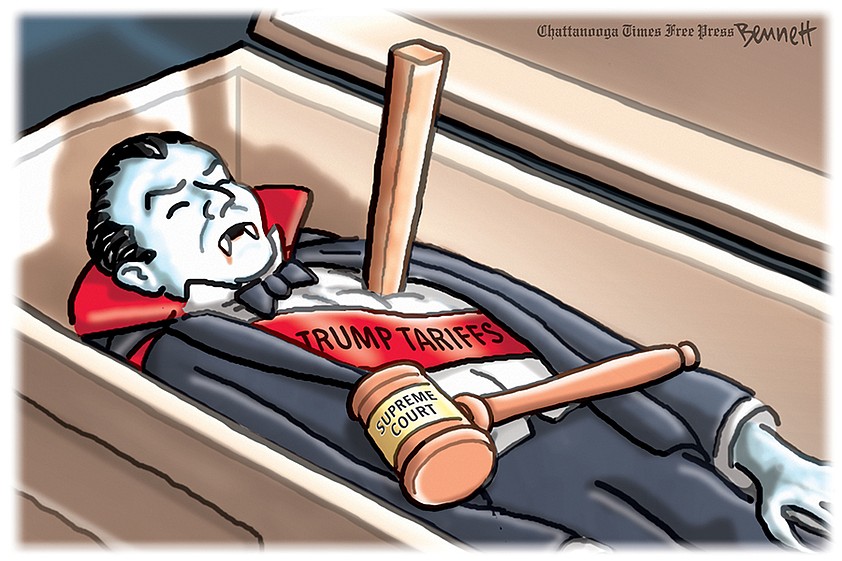
At least for now, the power to tax still belongs to Congress.
I had been starting to wonder if we still had a Supreme Court.
Again and again, starting with two cases before the election (the ballot-access case in March, 2024, where the Court more-or-less took Section 3 of the 14th Amendment out of the Constitution; and the immunity case, where they placed Trump above the law) and proceeding through a series of shadow-docket cases in 2025, the high court has seemed to be just another agency in the Trump regime, and not at all an independent branch of government. After spending four years trying to limit executive power when it was wielded by Joe Biden, the Court has been expanding the reach of the Trump presidency well past legal limits that seemed clear to judges in lower courts.
But the Court’s creeping abandonment of the rule of law at least paused on Friday, when it ruled that the emergency law Trump had been using to justify his tariffs, the International Emergency Economic Powers Act (IEEPA), doesn’t actually give him that power. So the approximately $130 billion of IEEPA tariffs to date have been collected illegally.
I thought the law in this case was clear, so I can’t say that I was surprised by the outcome. But I was (at the very least) grateful that the six conservative justices didn’t make up some completely new legal principle to let Trump continue to do whatever he wants. (Only three of them did — not enough to form a majority.)
Several pundits are trying to read some great meaning into this decision, like that the Court is drawing a line on Trump’s power grabs. In other words, John Roberts has finally seen where all this is going and decided to take a stand. But I don’t think so. In order to understand what happened, you need to break the nine Supreme Court justices into three camps:
- The partisan hacks: Alito, Thomas, and Kavanaugh. Whatever Republican presidents do is fine. Whatever Democratic presidents do is unconstitutional.
- The liberals: Kagan, Sotomayor, and Jackson. They look at the statute Trump says authorizes his tariffs and can’t find an authorization there. They don’t think any novel constitutional doctrine is needed to see this.
- The long-gamers. Roberts, Gorsuch, and Barrett. They’ve worked to establish new constitutional doctrines (Major Questions, Non-delegation) that limit regulation and unleash corporations to do whatever they want. Denying that those doctrines apply here would undermine their long-term program to hogtie the administrative state.
The votes of the hacks and the liberals were both predictable before any arguments were presented. The question was what the long-gamers would do: They are also partisan Republicans, as the immunity decision showed. (Barrett less so than Roberts and Gorsuch.) So they must have wanted to let the tariffs stand. But Trump’s justification for his tariffs flies in the face of Major Questions decisions the Court made during the Biden administration. Finding for Trump here would give the game away: Major Questions is just a rhetorical trick for constraining Democratic presidents; it doesn’t apply to Republican presidents.
Delegated powers. OK, let’s explain what these doctrines are. When Congress passes a law, sometimes small turns of phrase turn out to have big consequences. (I’ll give you a simple example from the Constitution: When the Founders gave the federal government the power to regulate interstate commerce, they never imagined that eventually nearly all commerce would have some interstate component. What they imagined to be a specialized power has turned into a sweeping power.) Both Major Questions and Non-delegation are supposed to limit this possibility.
- Major Questions says that an executive action with huge consequences can’t be based on a subtle reading of an apparently minor phrase. So Biden couldn’t cancel all student debt, even though a law allowed him to change the terms of any particular student loan. Congress couldn’t have imagined that this simple provision could be the basis for a trillion-dollar action.
- Non-delegation says that there are powers Congress can’t delegate, even if it wants to. It couldn’t, for example, delegate the power of the purse, essentially telling the president: “Tax and spend however you want.” Even if a law said that, the courts should disallow it.
Both of these ideas make sense in extreme cases, if the courts apply them fairly. But they both allow the Supreme Court to grab power away from the executive branch, and they’re both open to ideological bias. There’s no clear definition of the powers that can’t be delegated, or exactly when an executive action becomes “major”. So the Court has essentially given itself as much veto power as it chooses to claim.
Up until now, the Court’s conservative majority has been using that power in a partisan way, but they usually don’t even need to: Both provisions inherently favor de-regulation, because corporations tend to move much faster than Congress. For example, corporations can create new compounds faster than Congress can pass laws to regulate them. So the Clean Air Act specifically empowers the EPA to identify new pollutants and make rules about them. (The Obama administration used that power to find that climate change makes CO2 is a pollutant, allowing the EPA to regulate things like coal-burning power plants. The Trump regime has recently unmade that scientific finding, which the Court was probably going to undo anyway.) Disallowing delegations like that favors corporate malefactors over government regulators.
On the surface, both doctrines seem to be pro-democracy: If the government is going to do something significant, Congress should debate it and vote. That sounds lovely in the abstract, but it ignores the dysfunctionality of our Congress. Senate filibuster rules require a supermajority to pass new laws, and a presidential veto requires an even bigger supermajority to overcome. In practice, this means that very few new laws will get passed. So either major problems will go unaddressed, or other branches of government will have to use the powers Congress has abdicated.
This case. (The text of all the justices’ opinions is here.) The problem for the long-game faction is that the Trump tariffs are clearly a bigger intervention in the economy than Biden’s student-loan cancellation was. Biden wanted to take a one-time charge against the national balance sheet. But Trump wants to take hundreds of billions out of the private sector every year, and do it in a way that re-arranges the global trading system. So if student loan cancellation is a major question, massive tariffs must be too.
In 2021, Barrett famously declared that the Court “is not a bunch of partisan hacks”. Taking Trump’s side in this case would have exposed that as a lie.
So, here’s the issue this case presents: The Constitution gives Congress (and not the president) the power to tax. Tariffs are taxes. So a president can only impose a tariff if Congress has somehow delegated that particular taxing power to him or her. In his majority opinion, Roberts writes:
the President must “point to clear congressional authorization” to justify his extraordinary assertion of the power to impose tariffs. He cannot.
Trump takes the IEEPA as the congressional delegation he needs. But IEEPA doesn’t specifically mention tariffs, or any equivalent term. Kagan’s concurring opinion summarizes:
That text authorizes the President, upon finding a foreign threat and declaring an emergency, to “regulate” the “importation” of foreign goods.
Trump’s lawyers interpret “regulating” imported goods as including the power to tax them. But it can’t point to any other law where “regulate” carries that meaning. Roberts writes:
The Government concedes, for example, that the Securities and Exchange Commission cannot tax the trading of securities, even though it is expressly authorized to “regulate the trading of . . . securities.”
(Wouldn’t that be a bombshell, if the next Democratic president could impose a sales tax on NYSE transactions, and change the tax rate according to whatever whim possessed him that day?)
To the liberals, that’s the end of the story; it doesn’t matter whether the tariffs are major or minor, they’re just unauthorized by Congress. (To the charge of hypocrisy, in supporting Biden’s loan cancellation while opposing Trump’s tariffs, the liberals might point to this: Biden stretched a provision that is really in the law. But Trump is making up an authorization that doesn’t exist at all.)
But the long-gamers feel obligated to have an argument about why and how this falls under the Major Questions doctrine, which the liberals don’t recognize at all, and Barrett appears to regard as minor. That argument takes up about half of the 170 pages of opinions, and is well worth skipping.
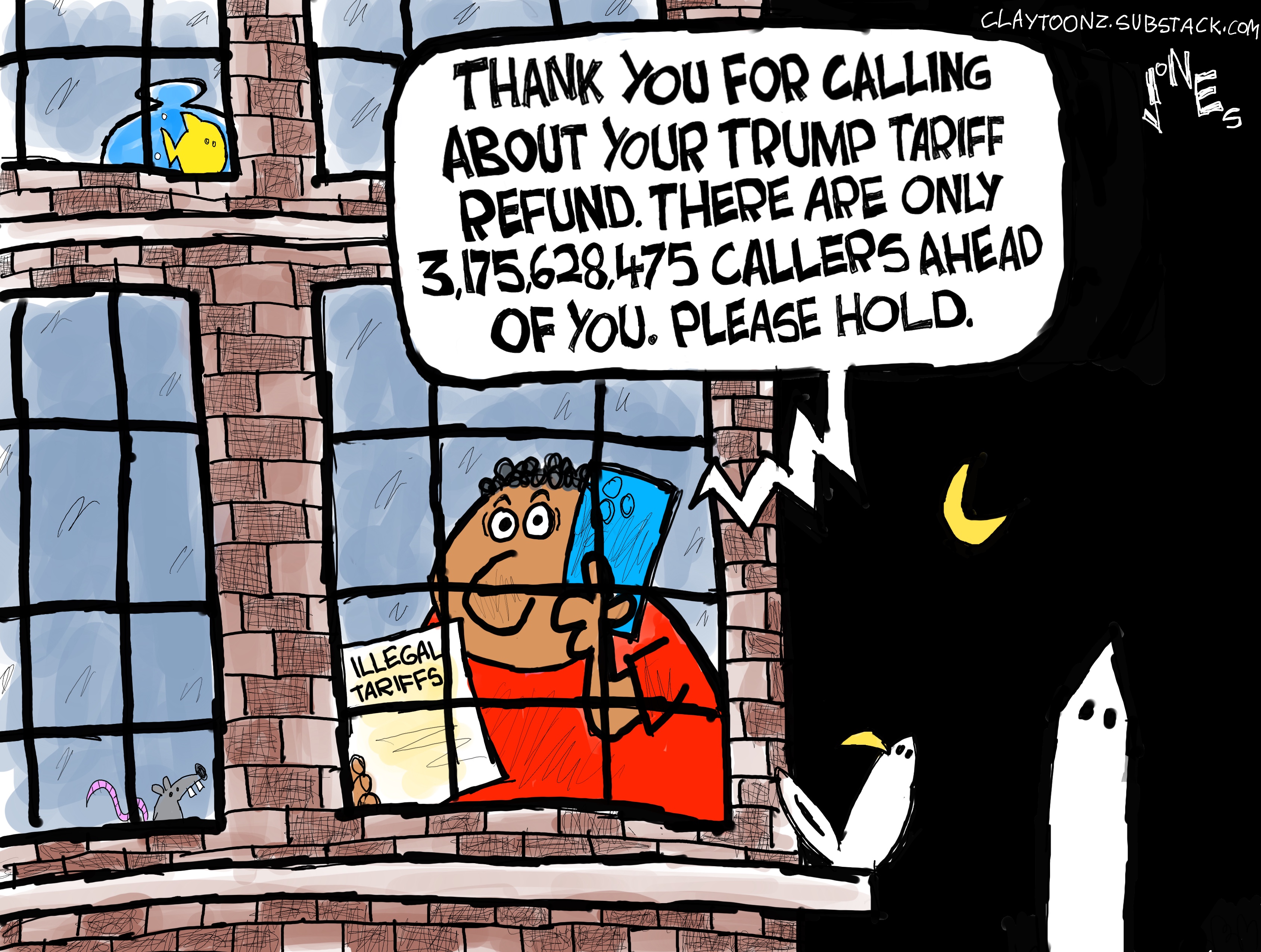
The consequences. So according to the BBC, the regime has so far collected about $130 billion in illegal tariffs. Legally, that money ought to be returned. It’s a mess, made worse by the length of time the Court took to decide the case.
But who should it get returned to, and how? Directly, tariffs are paid by importers, so they presumably can sue to get their money back. (Or there’s an administrative procedure to claim tariff refunds, a process that undoubtedly will get swamped soon.) Importers like, say, WalMart or General Motors have plenty of lawyers, so they’ll eventually get their money back.
Indirectly, the tariffs have been paid by ordinary American consumers. A recent report from the New York branch of the Federal Reserve estimates that about 90% of the tariff costs were passed on to consumers in the form of higher prices. But absent some unlikely legislation to pay us back out of the Treasury, we’re just out of luck. You didn’t directly write a check to the government, so you can’t get a refund.
Next steps. Trump responded to his legal defeat in two ways: First, he lashed out at individual members of the Court, accusing them of being “swayed by foreign interests” and “fools and lapdogs for the Rhinos and the radical left Democrats”. His own appointees — Gorsuch and Barrett — weren’t exempted. He called their opinions “an embarrassment to their families, to one another”.
Second, he announced new illegal tariffs: First 10% across the board, which he then raised to 15%. (Since the IEEPA lawsuit was first decided in a lower court last June, and was filed months before that, you’d think Trump would have had a clear plan of what to do if he lost. Apparently he didn’t, and just started making stuff up on the fly.)
The new tariffs are based on a different law, Section 122 of the 1974 Trade Act. That law allows tariffs up to 15% that last for 150 days. However, there are conditions, which Trump has ignored:
the actual language of the Trade Act lists requirements that don’t exist today, including a “large and serious” balance-of-payments deficit. While the U.S. has run a trade deficit for decades, it’s been offset by capital inflows as foreign investors pour billions into financial markets, resulting in a net balance of zero.
Bryan Riley, director of the National Taxpayers Union’s Free Trade Initiative, wrote in a blog post last month that Section 122 only makes sense under a fixed exchange rate, which hasn’t existed in the U.S. in more than 50 years.
Expect lawsuits to be filed as soon as the new tariffs take effect. Trump will lose that case too.
However, winning may not actually be the point. The Supreme Court decision made Trump look weak, and responding with a new power grab makes him look strong again, at least for now. To the MAGA faithful, he remains a valiant warrior against the Deep State, which now includes two people he appointed to the Supreme Court himself.
One last point. Maybe at this point you are asking an obvious question: The Court didn’t say that tariffs are illegal, just tariffs unauthorized by Congress. Republicans control Congress, so why doesn’t Trump ask for authorization?
Two reasons: First, Trump’s authoritarian takeover relies on establishing that he doesn’t need Congress. A tariff he imposes on his own authority is better, in that view, from a tariff Congress gives him permission to impose. And second, Congress wouldn’t do it. The tariffs are unpopular, economists of all stripes say they’re a bad idea, and the Republican majorities in each house are small. Asking for permission and not getting it would make Trump look weak (because he is weak). From an authoritarian-takeover point of view, it’s the worst possible outcome.
 The Weekly Sift
Comments
Perhaps the Senate/House Judiciary Committees should be concerned that President Trump, apparently, has evidence unavailable to them that there is corruption on the Supreme Court and call for hearings to investigate this corruption. President Trump is an honest man, after all. I’m sure he would not accuse Gorsuch and Roberts of corruption without evidence that this is the case. Administration officials should be deposed until they get to the bottom of this, finding any and all known evidence of any and all corruption that might exist on the Supreme Court. It may well require some deep digging into financial statements and travel records. But if President Trump says there is corruption on the Supreme Court, I say we pull out the all the stops to find it.
I love the sentiment! I’m not holding my breath.
Trackbacks
[…] This week’s featured post is “The Tariff Decision“. […]
[…] The Tariff Decision […]