
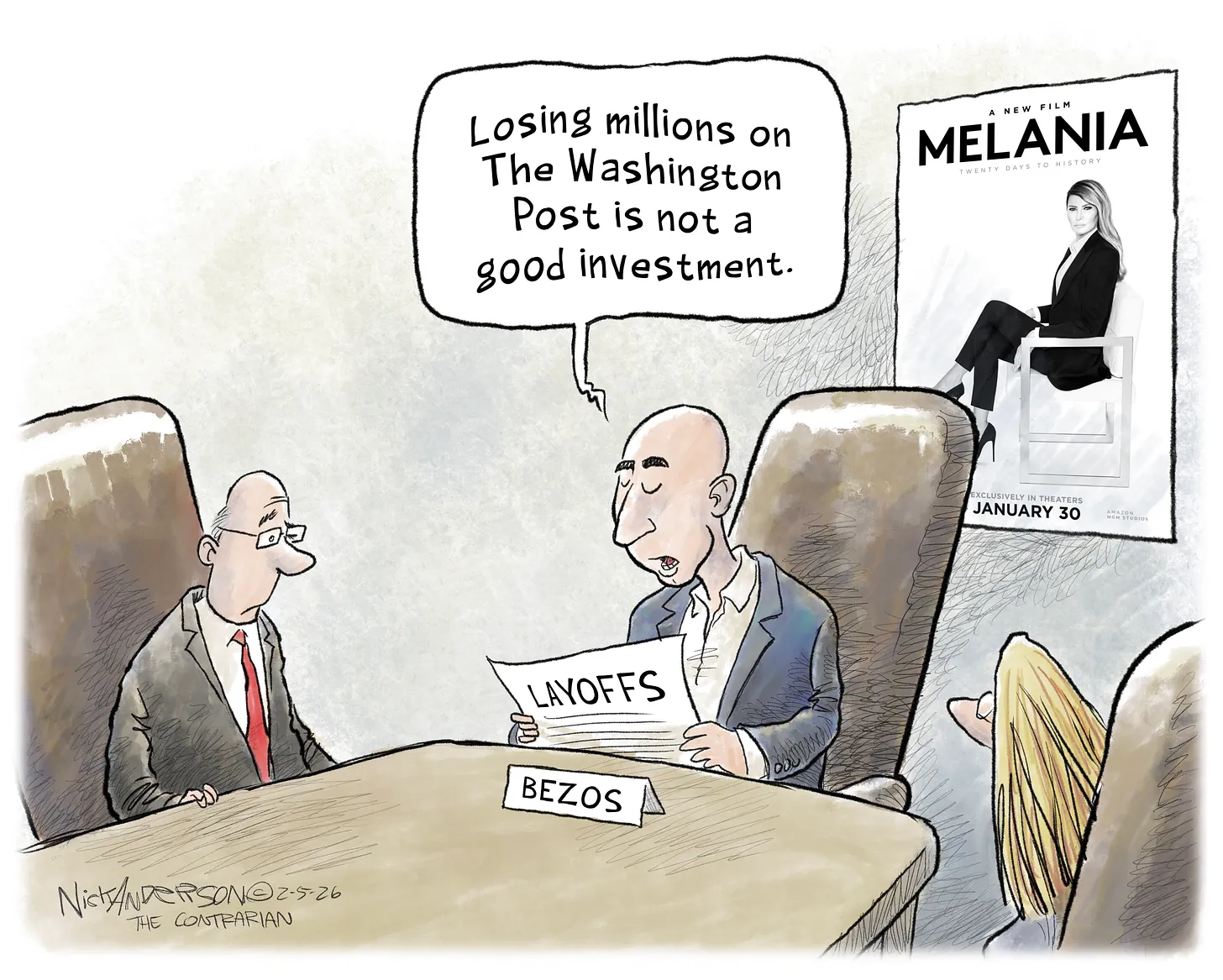
We’ve seen newspapers go into a death-spiral before. But who thought it could happen to The Washington Post?
Maybe you’ve seen this pattern with your own local newspaper: It has financial problems, so it lays off staff. Then the paper shrinks and has less to offer, so its readership declines, creating new financial problems. So the cycle repeats: more layoffs, less coverage, fewer readers, less revenue.
When that happens to a small-town paper (as it has, many, many times in the last 20 years or so), it’s tragic for the community the paper serves, but the rest of us barely notice. Now, however, it’s happening to one of the most storied, most influential newspapers in the United States: The Washington Post.
It wasn’t supposed to be this way. When the Graham family sold The Post, it looked for someone who had both the will and the resources to do right by one of the crown jewels of American journalism. And at the time, Amazon founder Jeff Bezos looked like the right choice. In The New Yorker, Post veteran Ruth Marcus described the moment like this:
On September 4, 2013, the Amazon founder Jeff Bezos held his first meeting with the staff of the Washington Post, the newspaper he had agreed to purchase a month earlier from the Graham family, for two hundred and fifty million dollars. It had been a long and unsettling stretch for the paper’s staff. We—I was a deputy editor of the editorial page at the time—had suffered through years of retrenchment. We trusted that Don Graham would place us in capable hands, but we did not know this new owner, and he did not know or love our business in the way that the Graham family had. Bezos’s words at that meeting, about “a new golden era for the Washington Post,” were reassuring. Bob Woodward asked why he had purchased the paper, and Bezos was clear about the commitment he was prepared to make. “I finally concluded that I could provide runway—financial runway—because I don’t think you can keep shrinking the business,” he said. “You can be profitable and shrinking. And that’s a survival strategy, but it ultimately leads to irrelevance, at best. And, at worst, it leads to extinction.”
For a while, Bezos and The Post had favorable winds. The controversies of the first Trump administration drove the public’s interest in political coverage, and The Post rode that wave to build its online readership. Then the Biden administration set out to be boring (as good government often is) and largely succeeded. The Post began losing money, and even Trump’s return hasn’t turned that around.
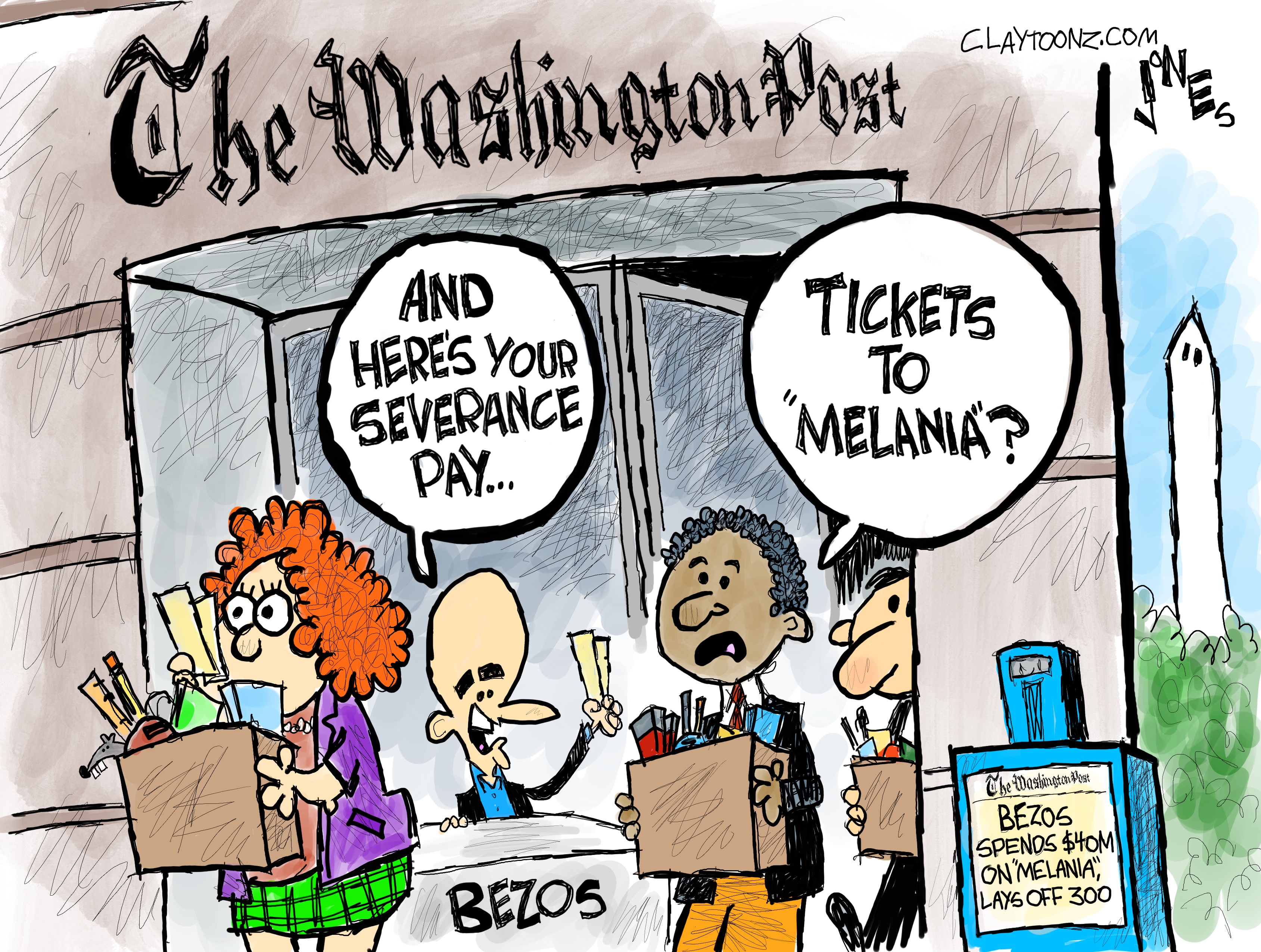
Then Bezos stepped away from his white knight role and began interfering in the newsroom. He cancelled the Post’s endorsement of Kamala Harris at the last minute, shifted The Post’s stable of columnists sharply to the Right, and began currying favor with Donald Trump, who has the power to give or take billions from Amazon’s bottom line. Bezos’ most blatant and most corrupt move is playing out right now: He gave First Lady Melania Trump $40 million for the rights to make the Melania propaganda vehicle, and spent another $35 million promoting it. Yahoo reports that the film’s $7 million opening weekend was larger than expected [1] and high for a documentary, but
It’s hard to imagine a scenario where the film ends up making the $75 million back.
From the beginning, it was obvious that giving Melania $40 million could not be justified economically. It was a bribe.
Bezos appeared to miss one of the key factors about The Post’s potential audience: It appeals to people who want sound, fact-based coverage. But in the Trump era, those people are mostly liberals. Like Elon Musk before him, by bowing to Trump he was alienating most of his market base.
On the flip side, The Post hasn’t been able to bow sufficiently low to attract many MAGA readers.
So Wednesday, Bezos ordered a massive layoff, about 1/3 of The Post’s workforce. The sports department is gone, and the Books section, along with big chunks of its international coverage. (For example, the Ukraine bureau and the Middle East bureau.) The Metro section shrinks from around 40 staff members (already well below its peak) to maybe 12.
NPR analyzes:
Now the Post appears poised to appeal primarily to readers interested in issues about the U.S. government, with an emphasis on national security and American politics. … Several former editors said it appeared the paper was seeking to compete more with such specialized publications as Politico and Punchbowl rather than The New York Times.
Here’s how I think about it: Historically, the Post has been the local newspaper of a company town: the town is D. C. and the company is the US government. That made the Post interesting to a national audience, in addition to the people who wanted to keep up with the Redskins or know what was happening on the National Mall. The recent layoffs look like a decision to stop being a local newspaper in any but the most superficial sense. But simultaneously, Bezos’ decision to position the Post as a MAGA-friendly billionaire-favoring news outlet is alienating its mostly non-MAGA national base. Besides, Fox News and The Wall Street Journal already own that market.
The rest of the mainstream press has been mourning for what the Washington Post used to be, and blaming Bezos for failing to come up with a solution other than entering the doom-loop of diminishing quality and diminishing returns. Many have referenced the scene in Citizen Kane where Kane says he doesn’t care how much money his newspaper loses, because he can go on losing at this rate for sixty years.
Bezos is far richer than Kane (or William Randolph Hearst, the model for Kane). The Post’s losses are just a rounding error on Bezos’ net worth. He could go on losing at this rate forever.
However, it’s a bit unfair to blame him for refusing the Charles Foster Kane role. We, the news-consuming public, have no real claim on the Bezos fortune. [2]
For that reason, one of the most interesting takes on the Post’s situation is from Josh Marshall, who has shepherded Talking Points Memo from a one-man blog to a profitable news site. The necessities of business leave him little room for being sentimental about journalism. “Making payroll,” he says, “is a brutal taskmaster.”
He sees the Bezos/Post saga as one more example of the “billionaire white knight press baron doom cycle” (previously observed when Chris Hughes bought The New Republic in 2012). The billionaire comes in as a hero, ready to spend what it takes to turn around the flagging fortunes of some iconic news source. Why doesn’t that work? In a prophetic post last July, Marshall observed:
The super rich don’t like losing money, even if it’s at scales that are essentially meaningless to them. … Why did things go wrong when Bezos got involved and started making big changes [at the Post]? A big part of the answer is the consultants, the particular ones a guy like Bezos would gravitate toward. In short, he gravitated toward the ones who speak billionaire. Which is to say, the language of leverage, commercial paper, efficiencies, disruption, innovation, the big idea, etc. Why would he go to those people? Because that’s his social world. To the extent Bezos has peers they live in that world, work with those consultants, think in that way. … They have these ideas because, like Bezos, they are heavily plugged into the tech business, its assumptions, its business models. Critically, they are hyper-focused on scale and efficiencies — two things which can be positives but are mostly neither here nor there in terms of the challenges facing most news publications.
Marshall takes a both-sides-are-wrong attitude towards the Post. The business model of the 20th-century metro newspaper is dead, but Bezos is
defaulting to what was probably the biggest error of the first two decades of the 21st century on the business side of the journalism business: the idea that the dynamics, business concepts and mores of the tech world were applicable to the news business. They’re mostly not.
Bezos will probably bring in a new batch of non-journalist consultants when The Post’s decline continues, and so the doom loop will continue, until Bezos either closes the doors or sells to someone who understands what The Post can be in the current era.
[1] Possibly because military commanders pressured their subordinates to see the movie. Viewership dropped considerably in its second week.
[2] I will leave aside whether multi-billionaires like Bezos should face higher taxes, or whether the antitrust laws should apply to online monopolies like Amazon. I strongly support both propositions, but that’s a different conversation.
 The Weekly Sift
Comments
I wish everyone could stop buying from Amazon, where Bezos makes his money. It’s so hard because the convience is so good. I hate Amazon but still continue to buy from them. I am such a hypocrite!
Me too. The current economic system is hateful.
Yes and me too. Many times it seems to be the only source. Additionally, he makes most of his money from government contracts and his web hosting services.
Amazon sells things, but doesn’t make things. If you don’t want to use Amazon, buy from whatever company made the thing. Every company has a website.
Or buy from any other retailer that can get the product to you. Every company has a website.
Bezos should continue funding it without interference or sell it or give it to someone who cares about it. How about giving it to the staff who can run it as a non-profit (altho I am told that’s an unworkable model).
Relevant to this post, a recent podcast series about the challenges facing local news in the current era:
https://www.npr.org/podcasts/fis-1269164065/out-of-print-the-unmaking-of-american-n
You say that “The Post’s losses are just a rounding error on Bezos’ net worth. He could go on losing at this rate forever.”
Does “losing at this rate” include the damage a hostile Trump administration can do to Bezos’ businesses?
if you can’t stand the heat, don’t open a kitchen.
Bezos — whose Amazon books I taught as a business/ communications case 26 years ago — is as adept an analyzer of the consuming environment as there is. I think he saw a chance to be more publicly influential in a new environment for him … and he could afford a hobby farm.
That it would impact his other ventures, financially and politically, might possibly not have occurred to him in the pre-Trump era when he made his “investment”. However, I much doubt that. I’ll wager that as a business asset, it was a part of his calculated evolving strategy.
Nowadays, he and his cohorts need governance to smile upon them. They can’t abide friendly fire.
Bezos’ problems stem from his mistake in not running the Post as a business. He should be keeping a closer rein on his politics. Otherwise he is bound to fail in his other enterprises, e.g. Amazon.
First, WaPo is not only a company-town paper, but a voice of America to the world. So Bezos cutting back sends messages domestic and internationally.
Second. Perhaps he can run the thing into the ground faster and we can (1) interest one of our lib moguls who Trump decries to make an investment and (2) crowd source among the rest of us for broadened public/private investment.
I think you’re giving Bezos more benefit of the doubt than he deserves. My meddled in a way that actively drove readers away. Sympathy for losing money as a reason for cuts assumes one of the most successful businessmen alive didn’t know he was making a money-losing choice.
The first thought that occurred to me is Bezos’ ex would be the ideal person to own WaPo, and the projected losses are well within her ability to absorb.
Apparently Bezos is not interested in selling. Hubris? Some other agenda?
https://www.status.news/p/washington-post-jeff-bezos-ownership-sell
Trackbacks
[…] This week’s featured posts are “Non-Cooperation” and “Dying in Broad Daylight: The Washington Post“. […]
[…] Dying in Broad Daylight: The Washington Post […]