
What happens to democracy when directing and misdirecting public attention becomes more important than convincing voters to agree with you?
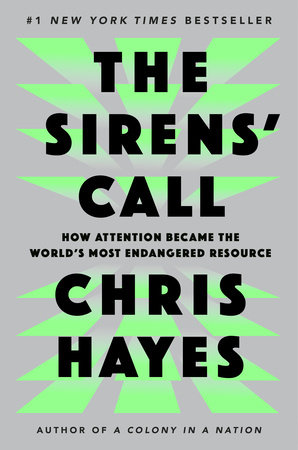
Chris Hayes’ recent book The Sirens’ Call is worth reading in its entirety, but there is one particular aspect of it that I want to highlight. Once you’ve had this thought, it’s perfectly obvious, but I’ve never seen it spelled out so clearly before: Getting attention and holding attention are two very different problems. Getting attention is easy; holding attention is hard.
If you’re in a roomful of people and you want to get their attention, you have a lot of options: Drop something breakable, start yelling obscenities, run through the room naked or covered in blood, fire a gun in the air. The possibilities are endless.
But now imagine that you want to hold people’s attention long enough to explain something to them or convince them of something. That’s much harder. If the waiter who just dropped a tray of glasses starts trying to tell you about the dangers of climate change or rising government debt, you’re probably going to tune him out pretty quickly.
Traditionally, politics has been all about holding people’s attention long enough to change their minds about something or motivate them to do something. Politically active people might want to convince you that abortion is wrong or gays are people too or the rich have too much money or government regulations stifle economic growth, just to name a few possibilities. Yes, they need to get your attention. But more than that, they need to hold your attention long enough to present their case, maybe even long enough to overcome your initial resistance.
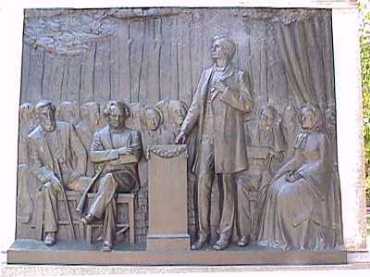
Hayes flashes back to something that seems unimaginable now: the Lincoln-Douglas debates. Back in 1858, people in Illinois more or less agreed that the biggest issue the nation faced was slavery and what to do about it. So that year’s two Senate candidates, Abraham Lincoln and Stephen Douglas, toured the state together, debating the slavery issue for three hours at a time. (My home town, Quincy, hosted one of the debates.) That format gave each man a chance to explain some fairly complex and subtle ideas.
Admittedly, that’s unusual. For well over a century, most American politics has revolved around slogans: “Equal pay for equal work”, “No third term”, “Remember the Maine”, and many others. A slogan boils a political message down to its absolute minimum. You still have to hold attention, but you don’t have to hold it very long. Sometime a slogan is just a placeholder that your supporters will flesh out later; it makes people curious to find out what the slogan means. In 2024, “Make America great again” and “Democracy is on the ballot” were both like that. If you didn’t have at least a little background, both were so vague as to be meaningless.
But Hayes describes a way of managing attention that skips the difficult hold-attention step completely. It has been pioneered by the social-media platforms and has now been adapted to politics: If you want to keep somebody on your platform for hours at a time, you don’t need to produce an epic like Lord of the Rings or Lawrence of Arabia — content capable of holding a person’s attention that long. Instead, you just grab somebody’s attention, then grab it again, and grab it again. Keep doing that for hours. That’s the secret of the infinite scroll. Hardly anybody sits down thinking they’re going to devote the next two hours to TikTok or Facebook. They just look up and realize they’re late for something.
Now apply that idea to politics. What if I’m not trying to explain anything at all, even at the slogan level? What if I’m just trying to grab your attention in a particular way and prevent my opponent from grabbing it some other way?
This is something the Trump campaign seemed to understand much better than the Harris campaign. If a voter went into the voting booth thinking about inflation, immigration, or trans athletes, probably that vote would go to Trump. But a voter thinking about democracy, climate change, racism, or healthcare probably would probably choose Harris. It almost didn’t matter what a voter thought about any of those issues. Just direct their attention and you command their vote.
That was the method behind the madness of the Trump campaign. As far back as 2015, Trump has been saying things that were supposed to be political suicide. When he said that immigrants were “animals” or spouted “facts” about them that were obviously false, it didn’t matter if he looked like an ignorant asshole, because he made you think about immigration. If he grossly overstated the price of bacon and was proven wrong the next day, so what? He made you think about inflation — and the debunking article the next morning made you think about it again.
Harris could never catch up. I kept reading columns by pundits frustrated that Harris didn’t just say X — and those columns frustrated me, because I knew that Harris DID say X, but nobody paid attention.
The big thing I got wrong about the election was that I expected voters to get serious at the end of the campaign; low-interest and low-information voters who had been checked out all summer would check back in long enough to decide who to vote for. It never happened. Right up to the last day, Trump dominated the news cycle with his look-here, look-there, look-at-this-other-thing tactics. He had no message to speak of, just the idea that things were bad and he would somehow make them better.
What we’ve been seeing these last two months is the new attention-politics as a governing strategy. In traditional politics, an incoming administration tried to focus on a few simple themes, with the idea of raising enough public support to push one or two big ideas through Congress. So George W. Bush came in promoting his tax cut. Barack Obama was focused on his stimulus plan and then healthcare. (I remember the frustration many environmentalists felt when a carbon tax and other items from a climate-change agenda were sidelined so as not to interfere with the healthcare push.)
Trump hasn’t been doing anything like that. Instead, he’s doing a million things at once, including many that circumvent Congress in a way that is flatly illegal. By ignoring Congress and relying on executive actions, he avoids the need to marshal public opinion. Quite the reverse: It’s the opposition that needs to marshal public opinion to stop him. And that’s difficult, because what opposition leader or opposition agenda can get attention when Trump grabs all the attention in the room with a new outrage every day? (Invade Greenland! Annex Canada! Brief Musk about China war plans! Defy court orders! Fire the people who keep track of nuclear weapons! Turn Gaza into a seaside resort!)
I’m frankly unsure what I ought to be rooting for. Eventually, assuming Trump doesn’t establish his own version of the Thousand-Year Reich, some Democrat will figure out how to master the new attention politics and become president. But how good is that outcome really? The new politics lends itself to autocracy. Probably a Democratic autocrat would do more things I like than Trump is doing. But I’m not sure what would take us back in the direction of democracy.
 The Weekly Sift
Comments
[heart] Schwer, Lauren reacted to your message:
Excellent post. My own mantra:however insane, we, the people, elected the current regime at every level. Where were the 90,000,000, most of whom could have voted, who didn’t even bother to cast that one single ballot? Where were the sensibilities of the 2 1/2 million who voted for candidates who they knew had zero chance of being elected? 75 million of us did vote for the alternative, and I guess we’re the one who have to go to work on the approximately 170 million who prevailed. There is hope, but only if we, the already engaged, get even more engaged.
It is said in Tibet that until you control where your attention goes (and stays) you do not have a mind. Your mind has you.
I’ve been reading your blog longer than any other. I confess to not reading it daily (time is fleeting) but I do always scan the subject line from the blog email. I’ve not yet read Chris Hayes’ new book, but I do now have a bit of its flavor. Like you, when it was said that Kamala Harris should have said thus and such, I would yell at the article or my TV that indeed she had. I heard her say it! Without reading Hayes’ book, I have said (and posted on various sites) that the problem is “trump this… trump that… trump thus and such… When I hear the name, I am revolted. I grew up in NYC and remember Page 6 in the NY Post. I knew he was not a great businessman. I knew what he thought of women (and young girls). I knew he didn’t know what to do with the millions he inherited from his father. It is the repetition of his name on every newscast that keeps him front and center no matter the words that come out of his mouth.
There isn’t anything to take us back in the direction of democracy. You yourself understood this thirteen years ago when you wrote “Countdown to Augustus”. Look to those “Masters of Rome” novels you recommended. Look to the Gracchi brothers, Marius, and Sulla.
If Trump has done one single thing in the last two months, it is to prove, well beyond a reasonable doubt, that the republic of institutions doesn’t have the juice to stand up to autocracy. When Trump is gone, we won’t rebuild the agencies he destroyed. Not as they were so constituted. They’ve lost the unassailable aura that came from age and stability. If the next Democrat restarts DOEd, the next Republican will just kill it again.
So the thing you knew and loved c. 1930-2010 is dead, and the way forward is to let that thing go, and make long term plans to build something better, from scratch, that serves the same desired functions.
Trackbacks
[…] This week’s featured post is “Politics in the Attention Economy“. […]
[…] Politics in the Attention Economy […]
[…] Friends at a local retirement home asked me to speak at their forum, which I did Tuesday, on the topic “Nurturing a Healthier Relationship to the News”. Here’s the video. If you watch it, you may recognize a bunch of the ideas from last week’s featured post. […]