
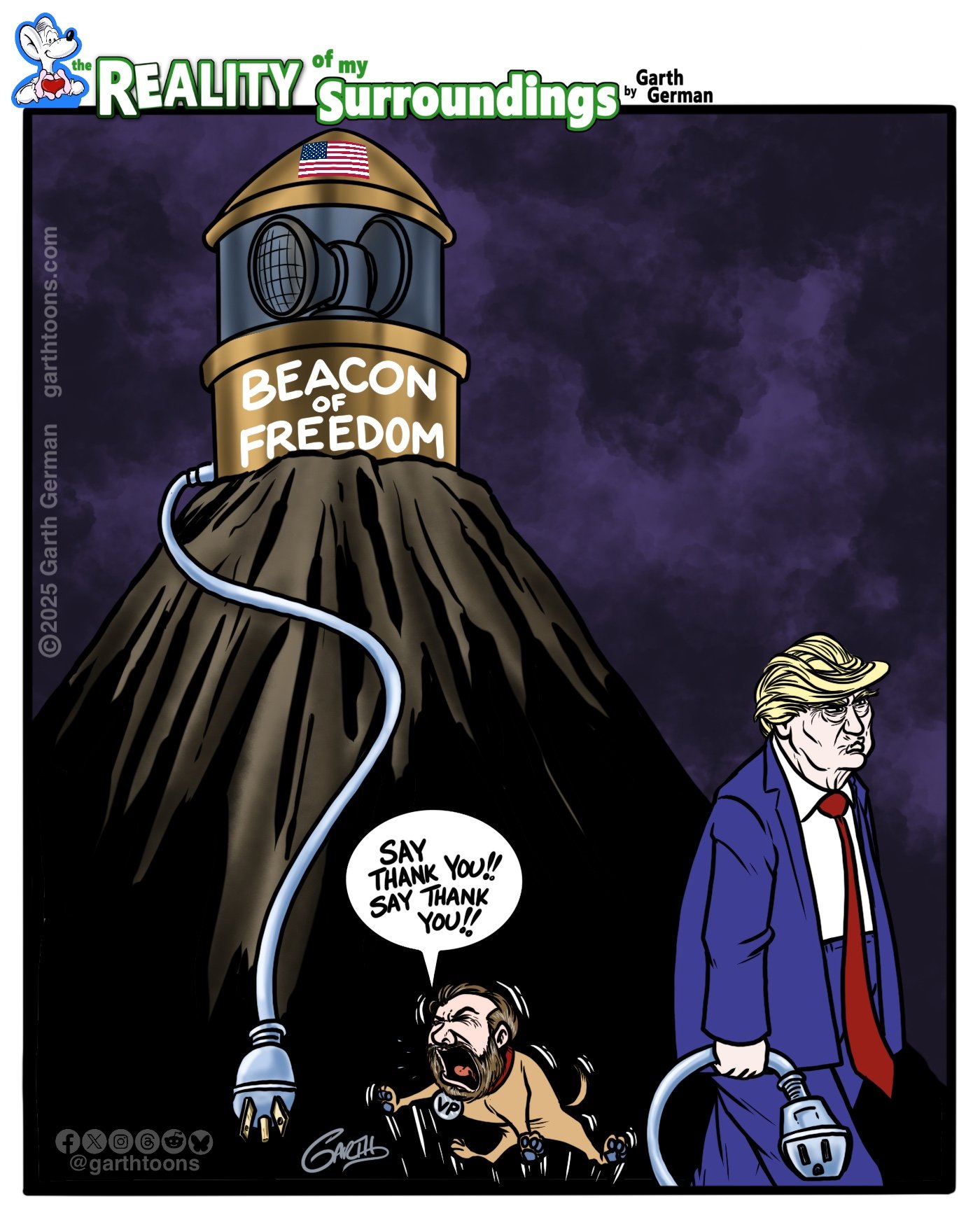
Can a legal permanent resident be deported for expressing views the President disagrees with?
A long-standing debate runs through American history: Does the Bill of Rights enumerate human rights, i.e., something that anyone can claim by virtue of being human, or privileges of citizenship that our government can ignore when it deals with non-citizens?
The Declaration of Independence uses theistic language to promote a human-rights view: Human beings (or at least “all men”) have been “endowed” with rights “by their Creator”. To say that a man lacks rights is tantamount to claiming that he was not created by God. But in the Dred Scott decision of 1857, the Supreme Court took the opposite view: Rights derive from the social contract embodied in the Constitution. Africans residing in the United States, the Court held, were not party to that contract, and thus they “had no rights which the white man was bound to respect”.
Dred Scott has long been in the dustbin of history, and is widely viewed as one of the Court’s worst decisions. Currently binding Supreme Court precedents take an in-between view that leans towards human rights. Basically, the Court interprets the Constitution and the laws to mean exactly what they say: If lawmakers had intended a provision to apply only to citizens, they would have used the word “citizen” rather than some more general term like “person”. For example, the 14th Amendment uses both words:
No State shall make or enforce any law which shall abridge the privileges or immunities of citizens of the United States; nor shall any State deprive any person of life, liberty, or property, without due process of law; nor deny to any person within its jurisdiction the equal protection of the laws.
So there are privileges that apply only to citizens (the right to vote, for example), but due process and equal protection are not among them.
The Trump administration shows every sign of wanting to move that line. Just how far it wants to go is not clear. But the first case in point is Mahmoud Khalil.
Who is Mahmoud Khalil? Two weeks ago, Khalil (an Algerian citizen born in a Palestinian refugee camp in Syria) had the next layer of privileges short of American citizenship: He came here originally on a student visa, but became a legal permanent resident, a “green card holder”. He is married to an American citizen, who is eight months pregnant. If nothing goes wrong, in another month he’ll be the father of an American citizen.
He is also a pro-Palestine activist. Last spring, he participated in demonstrations at Columbia University, where he was a student at the time. (He has since finished his degree.) Wikipedia describes his views like this:
Following the start of the Gaza war in 2023, Khalil became involved in pro-Palestinian activism. He served as a negotiator for students associated with Columbia University Apartheid Divest (CUAD) when they were bargaining with Columbia University officials. In a 2024 interview, Khalil said, “As a Palestinian student, I believe that the liberation of the Palestinian people and the Jewish people are intertwined and go hand by hand, and you cannot achieve one without the other.” He characterized the movement as one “for social justice and freedom and equality for everyone”. Of concerns about antisemitism, Khalil said, “There is, of course, no place for antisemitism. What we are witnessing is anti-Palestinian sentiment that’s taking different forms, and antisemitism, Islamophobia, racism [are] some of these forms.”
The Trump administration describes him differently, claiming that he “led activities aligned to Hamas” and “engaged in pro-terrorist, anti-Semitic, anti-American activity“. But it has produced no specifics to back those claims up, and the language itself is slippery. What does it mean that an activity is “aligned with Hamas”? Aligned in whose view? Similarly, unless Khalil himself endorsed terrorism or attacked Jews or America in so many words — and if he had, I’d expect his critics to have produced specific quotes — “pro-terrorist, anti-Semitic, anti-American” is an opinion, not a fact.
Khalil’s arrest. A week ago yesterday, agents from the Homeland Security department arrested Khalil at his home in New York. Khalil’s wife Noor Abdalla recorded the event on her phone while simultaneously talking to Khalil’s lawyer on his phone. It isn’t exactly a classic police-state arrest — Khalil is not roughed up, for example — but it still has a lot of disturbing aspects. When Khalil’s wife asks for the names of the arresting agents, she is told “We don’t give our names.” They also refuse to say which agency they represent. All they’re willing to tell her is where Khalil is being taken: Immigration Custody at 26 Federal Plaza. They refuse to talk to Khalil’s lawyer, who is on the phone. “They’re literally running away from me,” Noor reports to the lawyer.
When Noor tried to visit Khalil at a detention center in New Jersey, she was told he was no longer there. It took some time for his lawyer to determine that Khalil had been moved to a facility in Louisiana, where at first he was not allowed to consult privately with lawyers. An immigration hearing to have him deported was scheduled for March 27.
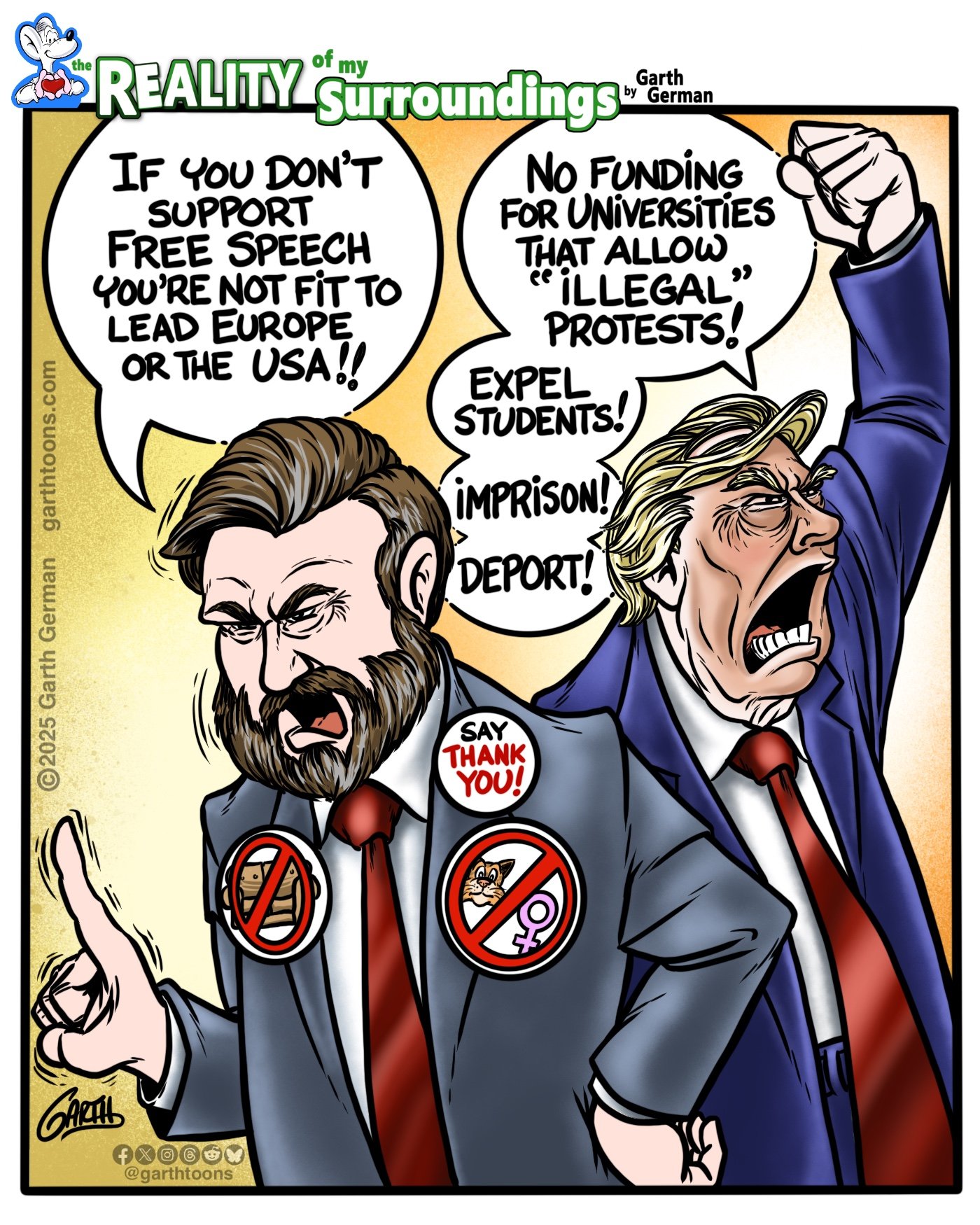
Last Monday, a federal judge in New York ordered that Khalil not be removed from the US until a hearing in his court can determine whether deporting him violates constitutional rights.
The Just Security blog analyzes the legalities: No one in the executive branch can unilaterally revoke a green card.
To obtain authority to deport a green card holder, the government must charge (or accuse, as this is not a criminal matter) them with a condition under the immigration laws that in some way makes them “deportable.” “Deportable” is a term of art under the immigration laws. It refers to conduct defined in a set of provisions—most though not all involving criminal activity—codified at 8 U.S.C. 1227(a).
To prove that an [legal permanent resident] is deportable, the government must convene a “removal hearing” before an immigration judge. At that hearing, government attorneys must prove deportability by “clear and convincing” evidence.
Notably, the Trump administration has not accused Khalil of committing crimes, or of committing fraud in his green-card application (another deportability condition). Instead, it points to a condition that has never been used in this way before:
the government has invoked a rarely used “foreign policy” ground of deportation. That provision, located in section 237(a)(4)(C) of the Immigration and Nationality Act, makes deportable any “alien whose presence or activities in the United States the Secretary of State has reasonable ground to believe would have potentially serious adverse foreign policy consequences for the United States” (emphasis added).
The statute contains a (freedom of speech and association) safe harbor, incorporated by reference to the inadmissibility provisions, prohibiting deportation “because of the alien’s past, current, or expected beliefs, statements, or associations, if such beliefs, statements, or associations would be lawful within the United States,” but then contains an exception for the safe harbor: “unless the Secretary of State personally determines that the alien’s [presence] would compromise a compelling United States foreign policy interest” (emphasis added).
It’s worth pointing out that much of what the administration claims about Khalil (even if true) consists of “beliefs, statements, or associations would be lawful within the United States”. The First Amendment would protect an American saying “I support what Hamas did on October 7”, even if most other Americans would find that statement reprehensible. (Again, Khalil seems not to have said anything like that.)
The foreign-policy justification is pretty obviously absurd: Khalil is up for deportation because Trump promised to deport pro-Palestinian campus demonstrators. There is no “compelling US foreign policy interest” involved. What the administration will probably argue, though, is that identifying US foreign policy interests is a judgment call that belongs to the executive branch, not the judiciary.
The case, then, will turn on whether an immigration judge feels empowered to use common sense, which says that the foreign policy interest here is a pretext, not a reason.

Protests. The administration has pledged that a Khalil deportation will be “the first of many“, and has already arrested a second Columbia protester. A third has returned to India after having her student visa revoked.
Protests calling for Khalil’s release were held in several cities this weekend. The most striking was organized by Jewish Voice for Peace. Thursday, over 100 demonstrators were arrested for occupying Trump Tower in New York.
It would be a mistake to conclude from this that American Jews in general support Khalil. (A pro-Israel group is apparently fingering pro-Palestinian protesters for deportation.) But the administration’s usurpation of the fight against “antisemitism” as an excuse for curtailing freedom of speech is making a number of American Jews uneasy. Whatever pretext they claim for curtailing human rights, authoritarian governments have a way of using their powers against Jews eventually. Elon Musk’s antisemitism, as well as Trump’s and Vance’s embrace of the antisemitic Alliance for Germany party, undermines the administration’s claims to be fighting antisemitism.
In truth, the administration seems to be fighting freedom of speech, not antisemitism. The Khalil case shows the lengths it will go in order to find legal pretexts to punish people it disagrees with. That should worry all of us, no matter what we think about Palestine or Israel.
 The Weekly Sift
Comments
Hey Doug, really appreciate all your work and have been a reader for a long time. Just wanted to offer a slight correction, AfD actually stands for Alternative for Germany.
Trackbacks
[…] This week’s featured post is “Rights, Privileges, and Mahmoud Khalil“ […]
[…] Doug Muder at The Weekly Sift: “Rights, Privileges, and Mahmoud Khalil“ […]