

What the Washington Post and Los Angeles Times aren’t saying speaks volumes.
Newspaper endorsements seldom garner much attention. (The New York Times endorsed Harris almost a month ago. Did you notice?) It’s debatable whether such endorsements move many votes, though I think they used to. As a 12-year-old in 1968, one of my first political actions was to stand near my hometown’s central square, where Lincoln once debated Douglas, and hand out copies of the Times’ editorial endorsing Hubert Humphrey. Clearly the Humphrey campaign thought the newspaper’s voice might have some influence, even a thousand miles from Manhattan.
But this week, the decisions of the Washington Post and LA Times not to endorse any presidential candidate did get attention, and for good reasons. In each case, the editorial department of the paper had a Harris endorsement drafted, but the higher-ups squelched it. At the LA Times, owner Patrick Soon-Shiong intervened, and also nixed a week-long Case Against Trump series that would have led up to the Harris endorsement. At WaPo, the decision was announced by publisher and CEO William Lewis, but the Post’s own news division reported that the decision came from owner Jeff Bezos.
The problem here isn’t that newspapers are obligated to make endorsements. Whether news organizations should endorse candidates or show a public face of neutrality is a question journalists can debate in good faith. Earlier in their history, both the WaPo and the LAT had periods where they didn’t endorse presidential candidates. Rival news organizations CNN and NPR still don’t. I’m on the editorial committee of the hyperlocal Bedford Citizen, which serves the 14 thousand people of Bedford, Massachusetts. We don’t endorse candidates, or even take positions on controversial local issues (despite the fact that members of the editorial committee are often fairly unified in our opinions).
Changing policies is also not the problem. Individual news organizations should be free to change their endorsement policies (whatever they are) whenever they want, or to decide in some election cycle that neither candidate deserves their support. But both the process and the timing of these particular decisions augur badly for the future of American democracy.
WaPo’s Publisher Lewis put a principled spin on the paper’s non-endorsement, framing it
as a statement in support of our readers’ ability to make up their own minds on this, the most consequential of American decisions — whom to vote for as the next president.
However, both the LAT and the WaPo have endorsed senate candidates this year, so the principle here escapes me. And if readers can make up their own minds, why have an editorial page at all? If you have an editorial department and a decision process for making endorsements, why not trust it? And after your editorial department comes to a decision, what valuable new insight does an owner bring to the table?
That last question is what makes these non-endorsements so disturbing: The owner brings a business point of view. An owner can see how a new administration, particularly a corrupt and vengeful new administration, might use the power of government to attack either the paper itself or the owner’s unrelated businesses. Conversely, such an administration might also rain benefits on a supportive media-company-owner’s businesses, like Bezos’ Blue Origin or Elon Musk’s Starlink. (LAT owner Patrick Soon-Shiong has a variety of business interests in pharmaceuticals, energy, and biotech. I could not easily guess which carrots or sticks a second Trump administration might use to influence him. Compared to Bezos or Musk he is a mere pauper, with a net worth just over $7 billion.)
During the first Trump administration, Bezos (whose much larger business is Amazon) saw what can happen when his newspaper becomes too annoying.
In 2019, Trump found his lever. Amazon was due to receive a $10 billion cloud-computing contract from the Pentagon. The Pentagon suddenly shifted course and denied Amazon the contract. A former speechwriter for Defense Secretary James Mattis reported that Trump had directed Mattis to “screw Amazon.”
This is the context in which the Post’s decision to spike its planned endorsement of Kamala Harris should be considered.
In other words, the owners of one (or maybe two) major American newspapers appear to be giving in to intimidation/bribery. Their actions (or non-actions) are teaching Donald Trump that intimidation/bribery works. So if he is elected next week, they will see more.
The WaPo’s and LAT’s silence illustrates what fascism expert Jason Stanley calls “anticipatory obedience“, a primary pattern in democracies that surrender to autocrats: Don’t wait for the lash to fall. Anticipate what the autocrat will require of you and obey in advance. (Stanley himself makes the connection with the newspaper non-endorsements here.)
For all the good it will do, journalists have protested. The LA Times editorials editor resigned, along with a couple of editorial writers. Twenty WaPo columnists have cosigned a column calling Bezos’ decision a mistake, and at least two contributors have resigned. But it was WaPo’s satirist, Alexandra Petri, who had the best response:
Roots are important, of course. As recently as the 1970s, The Post did not endorse a candidate for president. As recently as centuries ago, there was no Post and the country had a king! Go even further back, and the entire continent of North America was totally uninhabitable, and we were all spineless creatures who lived in the ocean, and certainly there were no Post subscribers.
But if I were the paper, I would be a little embarrassed that it has fallen to me, the humor columnist, to make our presidential endorsement. I will spare you the suspense: I am endorsing Kamala Harris for president, because I like elections and want to keep having them.
Readers are also protesting. A person I don’t know on X/Twitter (I realize how unimpressive that sourcing is) writes:
A friend who works for #WaPo marketing dept says there’s a #WaPoMeltDown in their business unit following the news as digital subscriptions cancellations have hit 60k barely 8 hrs after decision not to endorse. Cancellation rate is unprecedented and we’re barely 24 hours into it.
But as damaging as this might be to the WaPo business model, it’s hard to imagine it having a noticeable impact on Bezos-scale wealth.
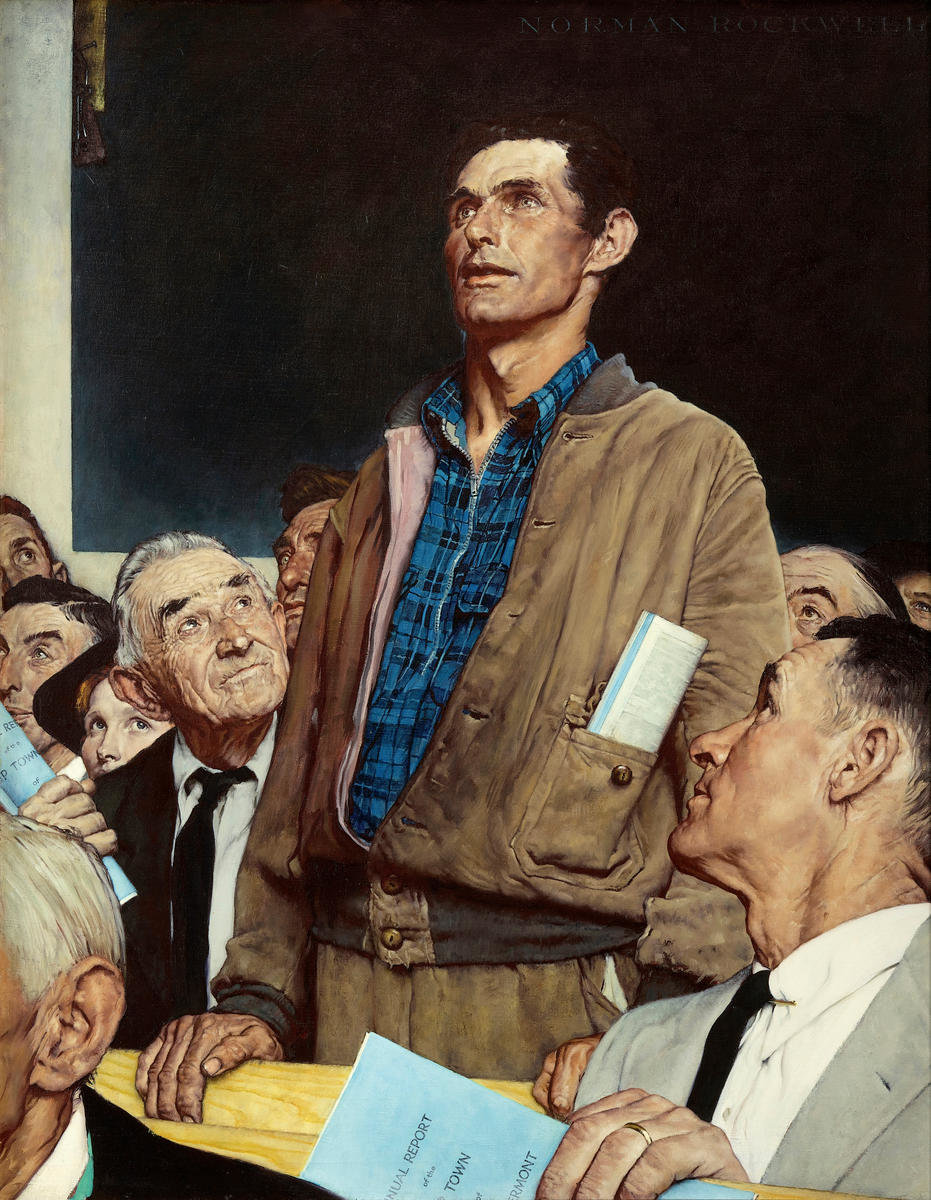
The impact Bezos’ decision is having on American democracy is easier to see. Norman Rockwell famously illustrated Freedom of Speech by painting a man wearing working-class clothes standing up at a public meeting. All eyes are on him, and he seems to be about to speak his mind. His own eyes tilt upward, as if he were being inspired by a high ideal. Maybe he what he says will change minds and convince his fellow citizens to take some worthy action.
But picture, for a moment, a different way that scene might play out: Some rich employer or local political boss might shoot him a dirty look, causing the man to think better of speaking and sit back down. His refusal to speak also would have an influence on fellow citizens, but a less positive one.
That’s what has happened here.
The Post’s slogan is “Democracy Dies in Darkness”. But democracy also dies in silence, particularly if those moments of silence happen when everyone is looking at you and waiting for you to speak.
 The Weekly Sift
Comments
WaPo Haiku
.Democracy dies:
In Darkness, In Silence too-:(
Capitulation.
I should have commented on this sooner: That’s really good.
American liberals are angrier about newspapers not doing endorsements than they are about the Biden-Harris administration backing Israel’s invasion of Lebanon.
Military attacks are launched from Lebanon into Israel, routinely. Israel’s tactics can be debated, but not their moral right to fight back. Of course we’re more concerned about our free press volunteering to be less free.
Why are those attacks coming from Lebanon?
Ok you two, let’s call this round a draw for now and get back to it in 10 days or so. We’ve other fish to fry this week.
The Biden-Harris administration supporting a regional war in the Middle East instead of cutting off Israel’s bombs (which literally all come from America) seems like a “bigger fish to fry” than newspaper endorsements!
Tell you what. We can stop backing Israel’s attack on Lebanon when your friends in Iran stop backing Hezbollah’s attacks on Israel. At least Hamas can maintain the plausible fiction that they’re fighting for what they view as their own country. Hezbollah doesn’t even have that. They’re only attacking Israel because they hate Jews.
Watching Trump happily play-act working at McDonalds reminds me that his real dream job if he can’t act as President would be to be a contemporary “Tokyo Rose” — call him “Donbas Don” — beaming Putin’s views of the world, highlighting the degradation of the U.S. around the world daily from a dacha on the Black Sea, near a golf course built for him.
It occurs to me that the political consequences of the failure of the Washington Post and LA Times to endorse Harris have been much more significant, and immediately positive, than their endorsements would have been. This is almost certainly unintentional, but let’s run with it.
If the papers had published their endorsements, it would have had almost no impact. It would have been predictable, unremarkable, and instantly forgettable. (I doubt it would have been mentioned in the Weekly Sift… 🤔) Instead, we have a dramatic and effective demonstration of the reality of the central message of the Harris campaign: that Trump is a fascist whose disrespect for the rule of law causes even oligarchs to bend the knee, and this event is reverberating widely. Actions speak louder than words: Bezos signaling that he is scared of Trump is much more potent than yet another politician using the “F” word.
From NYmag:
Elon Musk’s recent conversion to the MAGA cult may be explained by nothing more complicated than his expectation that the Trump administration will do business with his companies.
Doug: my comments here seem to get stuck in moderation. If it’s due to excessive quoted material, let me know.
The quoted material moves the post into my queue for approval, and I often forget to look. (Most weeks there aren’t any comments for me to moderate.) So the delay is definitely my fault, and I keep promising myself (and affected commenters) that I’ll do better. I regret that it looks like people are being punished for making an effort to back up what they’re saying.
The algorithm that flags posts with links (and quotes, apparently; I hadn’t realized that) is well intentioned and saves the blog from a lot of spam comments that are trying to advertise some web site. So I haven’t been motivated to figure out how to turn it off.
It occurs to me that the political consequences of the failure of the Washington Post and LA Times to endorse Harris have been much more significant, and immediately positive, than their endorsements would have been. This is almost certainly unintentional, but let’s run with it.
If the papers had published their endorsements, it would have had almost no impact. It would have been predictable, unremarkable, and instantly forgettable. (I doubt it would have been mentioned in the Weekly Sift… 🤔) Instead, we have a dramatic and effective demonstration of the reality of the central message of the Harris campaign: that Trump is a fascist whose disrespect for the rule of law causes even oligarchs to bend the knee, and this event is reverberating widely. Actions speak louder than words: Bezos signaling that he is scared of Trump is much more potent than yet another politician using the “F” word.
(Please delete the earlier version of this comment.)
If Bezos wanted no endorsement, he should have stated so in early September. Doing it AFTER the endorsement has been drafted is clearly the move of a chicken.,.. squawk squawk..
While it’s not surprising that people are cancelling their WaPo and LaTi subscriptions, but a more direct vote of no confidence is ditching your Amazon Prime Memberships.
Bezos’ decision to keep the WaPo from issuing its planned Harris endorsement was yet another in a long line of examples of how Trump openly uses government resources at his disposal to either reward or punish those who appease or oppose him. He’s purely transactional.
Only hours after the announcement, the CEO of Bezos’ Blue Origin space company met with Trump. And Bezos is still smarting from losing that government AWS contract.
Trump has promised that if returned to office he will use the power of the federal government to smite his enemies, of which there are many. Jeff Bezos believes he will. We all should, too.
So, it sounds like the ultimate effect of the two newspapers not publishing endorsements is to call attention to both the fact that they had intended to endorse Harris, and that they are afraid of Trump, and that Trump is definitely showing obvious signs of being a fascist. It seems to me like getting the country’s attention on those things might end up having more significance and impact than endorsing would have been. So, does that make it good?
— Kim
Trackbacks
[…] This week’s featured posts are “MAGA’s Closing Argument: Dad’s Coming Home” and “Democracy Succumbs in Silence“. […]