Monthly Archives: November 2023

Advantages and Disadvantages

The great tactical disadvantage for all those of us who will fight for democracy is that you have one tool to do it: democracy. You must use democratic means to defeat anti-democratic forces. And that can feel like fighting with one hand tied behind your back. But you’re either a democrat or you’re not.

Rachel Maddow

This week’s featured post is “The Remarkable Biden Economy“.

This week everybody was talking about the hostage release in Gaza
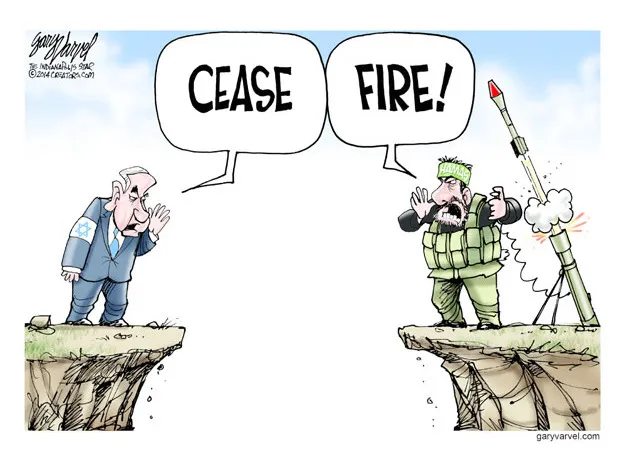
The long-rumored ceasefire-with-prisoner-exchange deal between Israel and Hamas took effect Friday. The ceasefire started then and was supposed to last four days. Talks are underway to extend that period and perhaps free more hostages. Otherwise, fighting will resume tomorrow.

Any agreement that results in real actions is a good sign: The two sides have ways to talk to each other, and are building trust that agreements made can be carried out. But there’s still a long, long way to go. (Late-breaking reports say the truce will last another two days.)

and the Dutch election

Anti-Islam and anti-EU politician Geert Wilders led his Party for Freedom to a surprisingly good showing in the parliamentary elections Wednesday. Still far from a majority, his 35 seats is the most by any individual party in the 150-seat parliament. He will get the first chance to put together a majority coalition.

I’m not sure the WaPo is correct in interpreting this result as showing a rising right-wing momentum in Europe, especially given the Polish election results in October. But it bears watching.

but we should talk more about how Trump gets covered
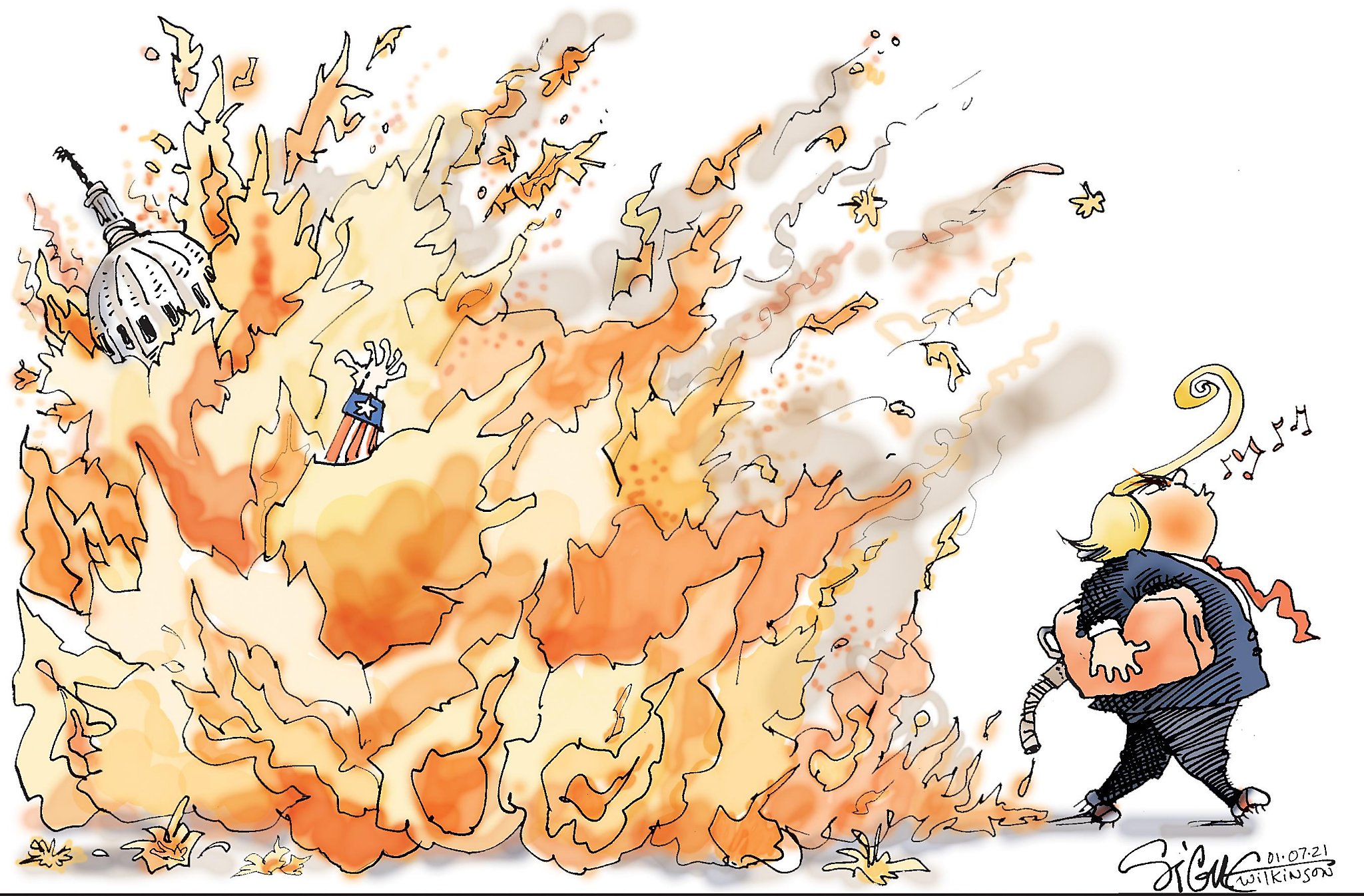
Major media still seems to be having a hard time figuring out how to cover Trump. In 2015, he was a man-bites-dog story who clearly was never going to be president anyway, so he got millions and millions of dollars worth of free media coverage. Entire Trump speeches were broadcast live on CNN, and quotes the media determined to be “gaffes” got repeated again and again.

Eventually, outlets noticed that they had become vehicles for disinformation. Unlike the typical presidential candidate, Trump was not embarrassed to be caught in a lie, and would keep repeating the lie long after fact-checkers had debunked it. In fact, he had more persistence than the fact-checkers, so he would keep lying, while fact-checkers found it pointless to keep repeating the same debunking columns. This led WaPo’s Glenn Kessler to invent the “bottomless Pinocchio”:

The bar for the Bottomless Pinocchio is high: The claims must have received three or four Pinocchios from The Fact Checker, and they must have been repeated at least 20 times. Twenty is a sufficiently robust number that there can be no question the politician is aware that his or her facts are wrong.

Similarly, Trump’s “gaffes” were not the usual sort of political misstatements: slips of the tongue or half-truths that got stretched to the point of hyperbole, like Hillary Clinton’s harrowing tale of landing in Bosnia under sniper fire. Trump wasn’t misspeaking, he was intentionally trolling; he said outrageous things strategically, to get attention and change the direction of the national conversation. (You can see that happening now with his trials. Are the news headlines about the damning and unanswerable evidence of his criminality? Of course not. They’re about some attack on a court official or witness or prosecutor that is likely to get somebody killed eventually.)

What many outlets came down to was a non-amplification policy: Let Trump say whatever he wants, and if it’s too outrageous we just won’t pay attention. At a surface level that made sense: If he is saying these things to manipulate our attention, ignore him.

Now, though, we’re seeing the downside of that policy as well: For years, right-wing politicians have used “dog whistles”, turns of phrase that may sound innocuous to the average voter, but communicate a more sinister message to the politician’s extremist base. So, for example, you didn’t need to say openly racist things about Black people; if you simply talked about “the inner city”, your racist supporters would get your message.

Non-amplification, though, lets Trump get all the benefits of a dog whistle while opening saying what he means. For example, when he called his political enemies “vermin” a couple weeks ago, the major news outlets didn’t cover it right away. So his followers on Truth Social got the message, but the people he was implicitly threatening to exterminate didn’t. Likewise, his sharing of a fan’s fantasy of performing a “citizen’s arrest” on NY AG Letitia James and Judge Arthur Engoron escaped immediate national attention.

I don’t know why this is so hard: You don’t give Trump a live microphone to pass on disinformation. You never quote him without an immediate fact-check. But you do cover the fact of him making racist, violent, or authoritarian remarks.


Five co-authors at Columbia Journalism Review researched similar issues, and found that almost none of the major-outlet coverage of politics informed readers/viewers about the policy issues at stake.

Instead, articles speculated about candidates and discussed where voter bases were leaning.

The authors also found a major difference between the choices made on the front pages of The New York Times as opposed to The Washington Post: In the lead-up to the 2022 elections, The Times consistently emphasized issues that favored Republican narratives, while the Post was more balanced.

Exit polls indicated that Democrats cared most about abortion and gun policy; crime, inflation, and immigration were top of mind for Republicans. In the Times, Republican-favored topics accounted for thirty-seven articles, while Democratic topics accounted for just seven. In the Post, Republican topics were the focus of twenty articles and Democratic topics accounted for fifteen—a much more balanced showing. In the final days before the election, we noticed that the Times, in particular, hit a drumbeat of fear about the economy—the worries of voters, exploitation by companies, and anxieties related to the Federal Reserve—as well as crime. Data buried within articles occasionally refuted the fear-based premise of a piece. Still, by discussing how much people were concerned about inflation and crime—and reporting in those stories that Republicans benefited from a sense of alarm—the Times suggested that inflation and crime were historically bad (they were not) and that Republicans had solutions to offer (they did not).

and you also might be interested in …

Heather Cox Richardson reminds us of the true origin of Thanksgiving: The mythic “first Thanksgiving” of Native Americans and Pilgrims had been long forgotten when it resurfaced in 1841, and inspired a nation torn by the slavery question to imagine reconciliation. A Thanksgiving holiday did not become official until President Lincoln began proclaiming days of thanksgiving during the Civil War.


Cory Doctorow is one of the most interesting voices to listen to about technology and its influence on society. In this article, he talks about why the internet keeps getting less useful and more annoying, which he labels “the Great Enshittening”. X/Twitter is an obvious case in point, but it’s far from the only example.

The problem, he says, is structural change, not that tech people suddenly became villains.

Tech has also always included people who wanted to enshittify the internet – to transfer value from the internet’s users to themselves. The wide-open internet, defined by open standards and open protocols, confounded those people. Any gains they stood to make from making a service you loved worse had to be offset against the losses they’d suffer when users went elsewhere.

It follows, then, that as it got harder for users to leave these services, it got easier to abuse users.

In other words, inside tech companies there have always been arguments between people who want to extract more value from their users and people who want to give their users better service. But the argument against exploiting users was “if we do that, they’ll leave”.

In today’s internet, though, it gets harder and harder to leave an abusive platform for a less abusive one. (I’m still using X, for example, even as I experiment with alternatives.) So “if we do that, users will leave” isn’t as persuasive an argument as it used to be.


HuffPost has an article about the work Speaker Mike Johnson used to do as an attorney for the Alliance Defense Fund, a group trying to get the courts to recognize special rights for Christians. The article quotes Johnson making a point he still makes, claiming that “separation of church and state” is not only a “misunderstood” concept, but that when Thomas Jefferson originally used the phrase, he didn’t really mean what we think.

What he was explaining is they did not want the government to encroach upon the church, not that they didn’t want principles of faith to have influence on our public life.

Johnson is counting on people not looking up the letter where Jefferson coined the phrase. Here’s the key paragraph.

Believing with you that religion is a matter which lies solely between Man & his God, that he owes account to none other for his faith or his worship, that the legitimate powers of government reach actions only, & not opinions, I contemplate with sovereign reverence that act of the whole American people which declared that their legislature should “make no law respecting an establishment of religion, or prohibiting the free exercise thereof,” thus building a wall of separation between Church & State. Adhering to this expression of the supreme will of the nation in behalf of the rights of conscience, I shall see with sincere satisfaction the progress of those sentiments which tend to restore to man all his natural rights, convinced he has no natural right in opposition to his social duties. [italics added]

The obvious corollary to Jefferson’s letter is that government can restrict actions, even if you justify your actions with some religious belief. So it’s fine if you want to believe that gays or transfolk are immoral, but if you want to turn same-sex couples away from your wedding-cake shop, that’s an action, not an opinion.


This week in When Bad Things Happen to Bad People: Derek Chauvin, the police officer convicted of murdering George Floyd, got stabbed in prison. And Kyle Rittenhouse, who became a right-wing hero after killing two people and shooting a third during the unrest following a police shooting in Kenosha, Wisconsin, is now broke, according to his lawyer.

He is working, he is trying to support himself. Everybody thinks that Kyle got so much money from this. Whatever money he did get is gone.

Not to worry, though, Rittenhouse has a book coming out. Crime may pay yet.

and let’s close with some holiday self-defense

Perhaps you’ve been lucky so far, and a few of your local retailers didn’t start playing “Jingle Bell Rock” until Black Friday. But for the next month or so all restraint is off, so you won’t be able to leave the house without hearing “Santa Baby” coming from somewhere.

I mean, some Christmas music is fine, and I’d probably miss it if I went a full season without any. But December is a whole month, and the Christmas playlist just isn’t that long. Even “O Holy Night” gets old if you hear it night after night after night.

So what you’ll need by December 25 is some off-beat Christmas music no one else is going to play, or maybe even some anti-Christmas music to channel your building resentment before it blows. Here are some of my favorites.

If you dread getting together with your dysfunctional extended family, the Dropkick Murphys have it worse than you do, and sing about it (with a very catchy tune) in “The Season’s Upon Us“.

You know that face you make when you were hoping for one kind of present and get something else entirely? Garfunkel and Oates have a song about it: “Present Face“.

It seems like every kind of place has a song explaining why Christmas so wonderful there. It’s become a formula and you can do it for anywhere, as Weird Al proved by collecting Cold War nostalgia in “Christmas at Ground Zero“. Similarly, the makers of South Park cranked out “Christmastime in Hell“.

South Park, it turns out, has an entire page of Christmas songs. Or if you want offbeat or unusual Christmas songs no one else knows about, there are entire playlists available on the web. You’re welcome.

Feel free to share your own rebellious seasonal music in the comments.
The Remarkable Biden Economy

Under Biden, the US has faced the post-Covid challenges better than just about any other country in the world.


The polls. Most readers of this blog, I imagine, are worried about the polls. A string of polls have shown Trump with a lead over President Biden, and the current RCP poll average has Trump up by 2.3%.

Now, 2.3% isn’t much, and polls a year ahead of the election are not that meaningful, particularly when the media focus is on the opposing party’s primary campaign. A number of Republican candidates are touring the country and putting their commercials on television, and those ads start from the premise that the Democratic president is doing a terrible job and deserves to lose. President Obama had a small lead (less than 1%) over Mitt Romney at this point 12 years ago, and the RCP had Romney ahead at several points in October of 2012. Obama wound up winning by 3.9%.

The betting markets — whose predictive record is probably even worse than the early polls — are mixed. One has Trump-to-win at 40 cents on the dollar and Biden-to-win at 37 cents. But Democrat-to-win-the-presidency is at 55 cents.

I have explained in a past post why I think Biden will still win. But what the polls do tell us is that three important parts of the Biden message have not gotten through yet to most voters:

  • A second Trump term will mean the end of American constitutional democracy. In his response to losing the 2020 election, Trump showed us just how little he respects the will of the voters and how much he is willing to do to hang onto power. His recent rhetoric and his announced plans for a second term are openly authoritarian, and can be fairly described as fascist.
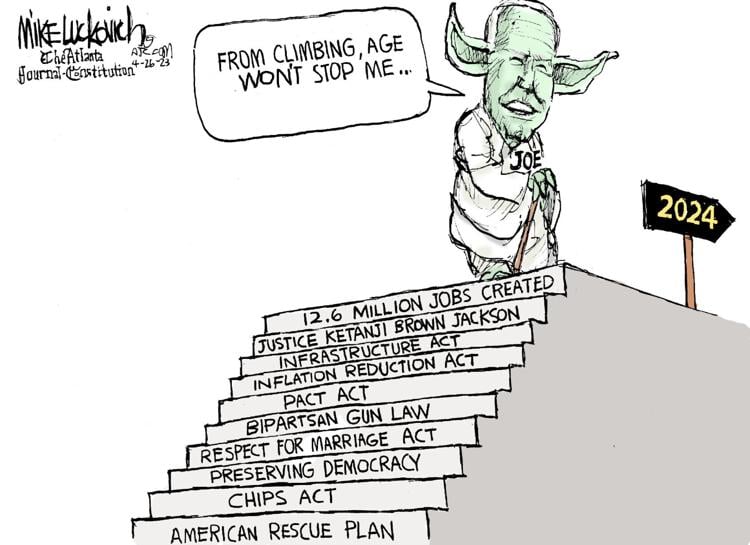
  • Biden has been an excellent president, particularly in his stewardship of the economy. The issue on which the polls give Trump his biggest advantage over Biden is the economy. But this is a complete misperception. The Covid pandemic disrupted the economy of every nation on the globe, and recovery has been difficult everywhere. But under Biden, the US economy is doing as well or better than just about any country in the world: GDP is rising, jobs are plentiful, and wages-after-inflation are rising. Post-pandemic inflation was a worldwide phenomenon, but the US has handled it better than most.
  • Biden will continue fighting climate change. Trump will reverse the progress Biden has made. Getting from a fossil-fuel-based economy to a sustainable-energy economy will require a lot of government investment, because the advantages of a more temperate planet are hard for private-sector corporations to capture. Biden began making those investments in the American Rescue Plan, and more emphatically in the Inflation Reduction Act. The Republican Party is still in the pocket of the oil companies, though, so any Republican victory will not just stop that progress, but actively undo it.

I covered the first point last week. In this post I want to look at the second. I hope to get to the third before long.

The state of the country on Inauguration Day. One similarity between the Biden and Obama administrations is that both presidents were handed an economy in terrible shape, a fact that the opposing party was very good at getting the public to forget. The month Obama took office, the economy lost nearly 600,000 jobs, the unemployment rate was 7.6%, and many worried that we were headed into a second Great Depression. The bad trends continued for several months, but by January, 2017, Obama was able to hand off to Trump an economy in very good shape: 4.8% unemployment, consistent job growth that would lower it further, and low inflation.

Four years later, the economy Trump handed off to Biden was doing very badly indeed: unemployment at 6.3%, GDP at virtually the same level it had been at the start of the pandemic, and a federal budget deficit of around $150 billion per month.

Trump tends to get a mulligan for that poor overall performance, because we usually think of the pandemic like a hurricane or other natural disaster: It’s an unfortunate thing that (mostly) wasn’t his fault, and that screwed up his plans as much as it did ours.

For some reason, though, Biden doesn’t get the same mulligan: Not only didn’t Covid magically end on Inauguration Day, but the disruptive policies that world leaders (including Trump) implemented to fight Covid have had longer-term effects. So Biden has had to sail through choppy economic waters since Day One, and has done so remarkably well.

The inevitability of post-pandemic inflation. Compounding the economic problems of the Covid shutdown was an overhang of savings: Like most other countries, the US (under Trump, remember) had shut down much of its economy intentionally, in order to save lives. To a large extent, this had meant paying people not to work: The government subsidized shut-down businesses that kept people on their payrolls, and even sent money to people directly.

For many people, these payments were life-savers. Otherwise, they would have been homeless during a deadly pandemic. (Recall, even with these mitigation efforts, Covid deaths peaked in January, 2021, with over 100K deaths in the US that month.) Those personal bankruptcies could easily have cascaded into business bankruptcies, Great-Depression style.

For others, though, the government checks went straight into the bank, because most of what they had been spending money on was shut down. No one was driving, for example, both because travel seemed unsafe and because there was nowhere to go. (The collapse of demand sent average gas prices down to $1.82 per gallon. This number is sometimes used today as a things-were-better-under-Trump argument, but in fact it is a measure of just how bad things got. If we have another pandemic that kills thousands of people every day, gas prices will sink again.) No one bought new cars, because their current car was rusting in the garage. Cruise ships and airliners looked like death traps.

At a macro level, the effect of this policy was to preserve purchasing power even as production dropped. Basic supply-and-demand thinking makes the outcome obvious: As soon as people started buying again, inflation was going to cut loose.

That’s what happened around the world.

Biden’s dilemma. By January, 2021, the US economy had begun to reopen, but it was still 9.9 million jobs short of where it had been when the nation first felt the effects of the pandemic in February, 2020. So the twin threats of inflation and recession were both looming. Too much government stimulus would exacerbate inflation, but too little might repeat the mistake both the US and Europe made in response to the Great Recession of 2008, when a focus on austerity slowed growth so much that it took years for the economy to fully recover.

Biden opted for a full recovery and got it.

Economic performance. Under Biden, the unemployment rate fell from 6.3% to under 4% by February, 2022, and has stayed below 4% ever since. During the period Trump describes as “the greatest economy ever”, unemployment got as low as 3.5%. But it was 3.4% in both January and March of this year.

The price of that impressive jobs performance has been inflation, which peaked in the summer and has declined considerably since: 3.2% year-over-year rather than 9% in the summer.

But US inflation is not purely Biden’s responsibility. Our inflation performance parallels (and in fact is somewhat better than) inflation rates around the world, which (according to Statista) peaked at 8.7% in 2022 and fell to 6.9% this year.

That inflation is unfortunate, but American wages have largely kept up. Average real hourly earnings (i.e., adjusted for inflation) were at $11.03 (in constant dollars from 1982) in February, 2020, rose considerably early in the pandemic (to $11.72 in April, 2020, probably because workers able to keep working from home made more money to begin with), fell to a low of $10.92 in June, and have risen back to $11.05 by October.

So average real wages are back at pre-pandemic, best-economy-ever levels, and are rising.

What’s more, Biden actually got some important things done with that money the government needed to spend to stimulate the economy back to full employment: He financed a vaccine program that has saved countless American lives, began making good on Trump’s failed promises to rebuild our infrastructure, and started the US transition to a sustainable-energy economy.

What’s the Trump anti-inflation plan? It is an article of faith on the right that inflation would not have happened under Trump — the post-pandemic overhang of savings would have dissipated with no effect, and jobs would have bounced back without additional stimulus. Going forward, we’d be back to the full-employment low-inflation days of February, 2020.

What policies would bring this about? That’s where things get murky. Republicans in Congress talk about cutting spending, but that didn’t work so well, either here or in Europe, in the aftermath of the Great Recession. What’s more, Trump has never cut spending. Federal spending increased every year under Trump (even before the pandemic). And who’s going to pay for the ten futuristic cities he has promised to build?

Other policies Trump is famous for — tariffs, for example, which he promises to increase sharply, or expelling immigrants who work for low wages — would make inflation worse, not better.

In short, if you’re counting on Trump to beat inflation, you’re betting on the magic of the Trump name, because he hasn’t offered us anything else.

Why doesn’t Biden get credit for his good economic record? Trump has one talent that Biden lacks: He is very good at claiming credit when things go right and at blaming others when things go wrong. So, for example, his administration’s pre-Covid economic record mainly consisted of keeping going the trends that Obama had established. (Look at that job-creation graph above. The slope in Trump pre-pandemic performance is exactly the same as the trend in Obama’s second term.) But in retrospect it’s the Trump economy, not the Obama economy.

Ditto for the Covid mulligans: Trump gets one, but Biden doesn’t. Matt Yglesias summarizes:

It’s like how we don’t hold the disastrous state of the economy in 2020 against Trump because the pandemic interceded, but somehow Joe Biden is personally culpable for the fact that restoring full employment and real output couldn’t be achieved at zero cost.

But a discussion between NYT business writers Binyamin Applebaum and Peter Coy pinpoints a second reason: People aren’t reacting to the current state of the economy at all, but to their long-term pessimism about the future.

In an NBC News poll released last weekend, only 19 percent of respondents said that they were confident the next generation would have better lives than their own generation. NBC said it was the smallest share of optimists dating back to the question’s introduction in 1990. …

I think what we’re experiencing is a crisis of faith in the narrative of capitalism — at least as practiced in the United States in 2023 — as an engine of shared prosperity. Americans are dying sooner. They can’t afford to own a home. The cost of college is crushing. Global warming looms. And the world seems a lot less safe and stable than it did a few years ago.

As for what we do about that …

In 2024, Biden and Trump will represent two options for dealing with that pessimism: With Biden, we can continue taking small steps in the right direction that may or may not be adequate to the scale of the problems. With Trump, we can distract ourselves chasing “enemies within”, punishing scapegoats, and imagining that our leader has some messianic power to make us all great again.

I hope America chooses wisely.

The Monday Morning Teaser

I’m blaming the holidays for how little advance preparation I got done on this week’s Sift. So everything will probably run a little late today.

Everyone’s fretting about the polls showing Trump slightly ahead of Biden, but to me the important information from those polls is where Democrats are losing messaging battles they ought to win: in particular on the economy. That’s the subject of this week’s featured post, “The Remarkable Biden Economy”, which should be out around 10 EST or so.

The weekly summary will link to articles about the Israel/Hamas prisoner exchange and the possibilities for a longer ceasefire, which seem to change hourly. Also, a right-wing party had a surprising victory in Holland, sparking discussion about the momentum of right-wing politics in Europe. I’ll discuss a few other things, like the mainstream media’s failure to cover Trump accurately, the origin of the wall between church and state, and a few other things, before closing with some music to play if the onslaught of Christmas songs starts getting to you. I’ll try to get that out before one.

Echoes and Resemblances

The initial, personal cause of his grievance against the universe can only be guessed at; but at any rate the grievance is here. He is the martyr, the victim, Prometheus chained to the rock, the self-sacrificing hero who fights single-handed against impossible odds. If he were killing a mouse he would know how to make it seem like a dragon.

George Orwell’s 1940 review of Mein Kampf

This week’s featured post is “Revisiting the fascism question“. I didn’t notice this cartoon until after that article posted.

If you wondered what I was doing with my week off last week, I was in a church speculating about death.

This week everybody was talking about Gaza

A frequently rumored deal where Hamas would release some number of hostages in exchange for a ceasefire of a certain number of days keeps not quite happening.

The war news this week centered on the Al Shifa Hospital in Gaza, which Israel has claimed sits over a Hamas command-and-control center. Meanwhile, though, it was a hospital, and conditions there became horrific while Israel searched it for Hamas fighters and their hostages. Saturday, a deal was reached to evacuate the patients that could be moved and leave the hospital with a skeleton crew to take care of the rest.

Israel turned up a collection of weapons from the hospital and a shaft that presumably goes down into deeper tunnels. But so far this evidence has fallen short of a command-and-control center, so not everyone was impressed.


It’s hard to feel good about any news coming out of Gaza. My interpretation of the October 7 attacks is that Hamas designed them to offend Israel as deeply as possible, giving Israelis the maximum motivation to come to Gaza and root them out. Simultaneously, Hamas had embedded itself in Gaza so tightly that Israel would have to do ugly, horrible things to succeed in rooting them out. For its part, Israel is now doing those ugly, horrible things, and Palestinian civilians are dying in large numbers.

Watching from the outside, I have a hard time coming up with some alternative path Israel ought to be taking, and yet I also have a hard time rooting for them to succeed in their current path. I find myself agreeing with this Nicholas Kristof column, especially this line:

Unless you believe in human rights for Jews and for Palestinians, you don’t actually believe in human rights.


There’s been a lot written — maybe appropriately so — about antisemitism on college campuses, and from the left in general. But this week we got a reminder that antisemitism on the right is far more pervasive and virulent.

Matt Yglesias wrote a fairly long column about left and right antisemitism, which I’ll oversimplify down to this: Leftists sympathize with Palestinians, and sometimes end up overshooting into hating Jews. Rightists hate Jews, and so invent conspiracy theories to justify that hatred. Neither position is good, but they’re not exactly mirror images of each other.

Cases in point are these statements by Tucker Carlson and Charlie Kirk, which blame Jews for financing “white genocide” and “anti-white causes”. Elon Musk responded to a tweet expressing a similar view with “You have said the actual truth.”


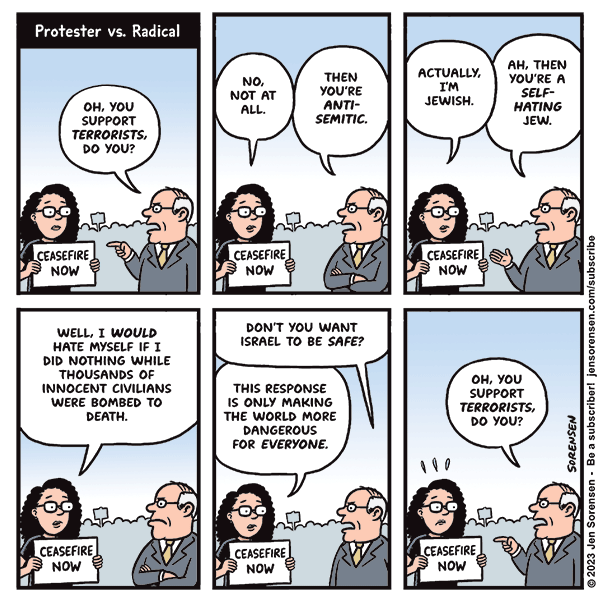
In case you thought Hamas was the only group of unreasonable radicals, The New Yorker interviews Daniella Weiss of the Israeli settler movement.

The borders of the homeland of the Jews are the Euphrates in the east and the Nile in the southwest.

That’s the land promised to Abraham’s descendants in Genesis 15. It includes big chunks of Egypt, Syria, Lebanon, and Iraq.

If someone decides to invent a new religion today, who will decide the rules? The first nation that got the word from God, the promise from God—the first nation is the one who has the right to it. The others that follow—Christianity and Islam, with their demands, with their perceptions—they’re imitating what existed already. So, why in Israel? They could be anywhere in the world. They came after us, in the double sense of the world.

She’s fine with non-Jews continuing to live in these lands, as long as they accept that

We the Jews are the sovereigns in the state of Israel and in the Land of Israel.

That means accepting that “they are not going to have the right to vote for the Knesset. No, no, no.”

and averting a government shutdown

I give Speaker Johnson credit for not waiting until the absolute last minute to recognize reality: Any plan to keep the government funded has to rely on Democratic votes, so loading a continuing resolution up with right-wing culture-war riders can’t work. The House got a relatively clean CR done Tuesday (supported by 209 Democrats and only 127 Republicans), the Senate passed it Wednesday, and President Biden signed it Thursday, with a day to spare. The ordinary business of government shouldn’t be dramatic. Things that need to get done should get done without watching some clock tick down to zero.

Johnson accomplished this by pulling the same trick Kevin McCarthy did just before the House sacked him: He avoided putting the bill through the Rules Committee (where all bills usually go, so that rules can be established for amendments, debate limits, etc., and which McCarthy had stacked with “Freedom” Caucus members as part of the deal that made him speaker). That meant it needed a 2/3rds supermajority to pass, which it only got via overwhelming Democratic support.

Predictably, passing a realistic CR with mostly Democratic votes angered the “Freedom” Caucus, which has no interest in the kind of compromise democracy always entails. So far no one is proposing another vacate-the-chair resolution. But it’s hard to see how Johnson gets past the next set of funding deadlines without a revolt.


About those deadlines: The one weird thing about the Johnson-designed CR is that it has two. The bill would extend funding until January 19 for military construction, veterans’ affairs, transportation, housing and the Energy Department. The rest of the government – anything not covered by the first step – would be funded until February 2.

It’s not clear what kind of game Johnson has in mind. Maybe he wants to get full-year appropriation bills approved for the January 19 departments approved first, then have a showdown over big cuts to the February 2 departments. Or maybe he wants to be able to have a shutdown over the January 19 departments while the others are still funded. We’ll see how Democrats maneuver in response.

In general, it’s hard to disagree with one part of Johnson’s rhetoric: Congress ought to debate individual programs on their merits, rather than vote the whole government up or down. However, such a plan requires repeated compromises with Democrats, and recognizing that the small and fractious Republican House majority can’t get its way on everything. As long as the House loads every bill with things Democrats will never support, nothing will pass and we’ll keep coming down to deadlines with the government unfunded.


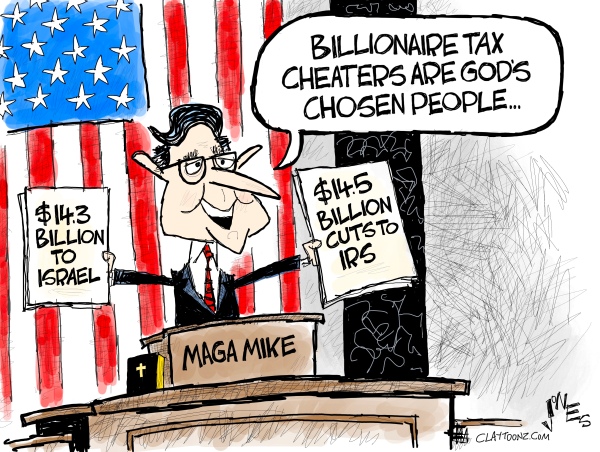
The CR does not include additional aid for Israel or Ukraine. Meanwhile, Johnson’s previous bill that coupled aid to Israel with a deficit-increasing IRS cut is dead in the Senate. If Israel (not to mention Ukraine) is going to get more aid, the House is going to have to try again.

The fact that the IRS cut increases the deficit (by making it easier for rich taxpayers to cheat; I’ve heard the cut described as “defund the tax police”) is routinely left out of conservative-media articles. Conservative media frames the situation as Democrats wanting to protect IRS bureaucrats, not Democrats wanting rich people to pay the taxes they legally owe.

Basically, there are two kinds of legislators. When something needs to get done, one kind thinks “What am I willing to give up to make this happen?” and the other thinks “What can I get people to give me to stop blocking this?”

and the China summit

President Biden met President Xi on Wednesday, and accomplished a small number of important but not flashy things: They restored communications between Chinese and American military leaders, which is how minor incidents are settled without escalating into war. And China agreed to reduce precursor chemicals for making fentanyl, which is a key point in the China-to-Mexico-to-America drug trade. The two leaders disagreed about a number of other issues, like Taiwan.


Yeah, yeah, Taiwan and trade and climate agreements and all that are important, but here’s what you were really concerned about: China will resume sending pandas to US zoos.


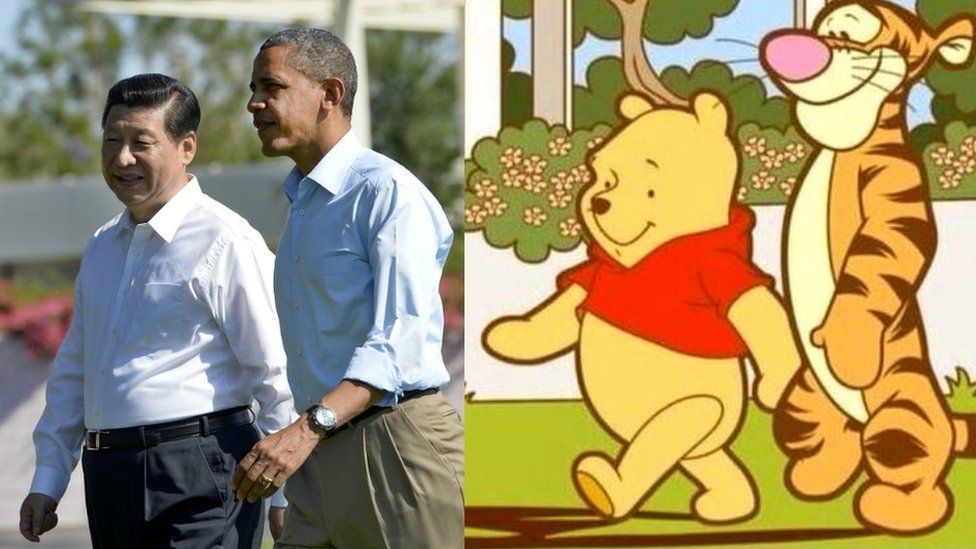
Back in 2018, John Oliver publicized the banned-in-China anti-Xi memes styling him as Winnie the Pooh, and now I can’t see him without noting the resemblance.

and the Tuberville drama

Senator Tuberville’s blockade on military promotions continued this week, and we found out that he has at least one ally: Mike Lee of Utah.

Several Republicans have publicly expressed frustration with Tuberville on the floor of the Senate, to no avail. Democrats are going to propose a temporary rule change to circumvent the blockade, but it needs 60 votes to pass. If all 51 Democrats show up to support the change, nine Republicans will be needed. No one knows whether the anti-Tuberville faction has that many Republicans.

and Trump’s “insurrection”

A Colorado judge weighed in Friday on whether the 14th Amendment’s insurrection clause makes Donald Trump ineligible to be president again. The ruling is a mixed bag: She finds that Trump did engage in insurrection, in the sense intended by the Amendment, but denies that the phrase “officer of the United States” was intended to include presidents. As a result, Trump’s name should appear on Colorado primary ballots.

That sounds like a victory for Trump, but Harry Litman isn’t so sure. The engaged-in-insurrection part is a finding of fact (based on extensive examination of evidence) which the appellate courts would be inclined to defer to, while the not-an-officer part is a matter of law that the higher courts will want to decide for themselves. So this Trump “victory” may set up a less victorious outcome on appeal.

The judge’s opinion is a good summary of what happened on January 6. A key point is that Trump’s words can’t be taken at face value because

Trump developed and employed a coded language based in doublespeak that was understood between himself and far-right extremists, while maintaining a claim to ambiguity among a wider audience.

and you also might be interested in …

Former first lady Rosalynn Carter died Sunday. Her husband, former president Jimmy Carter, has been in hospice since February.


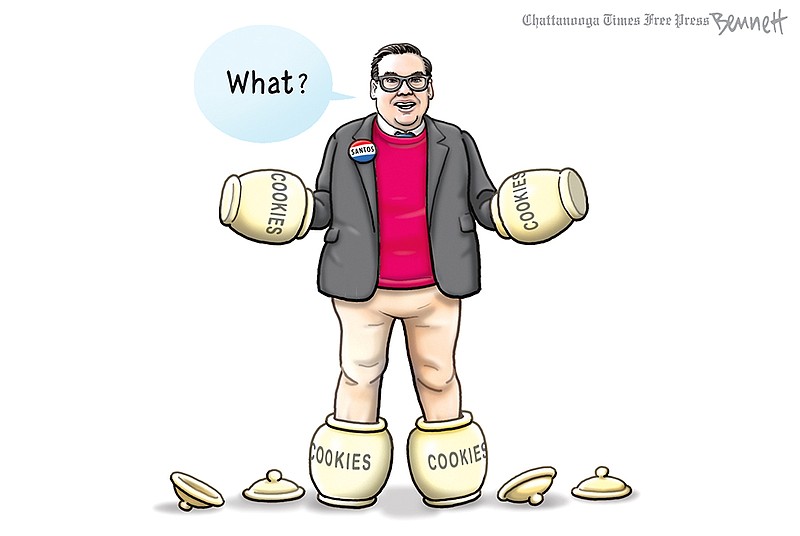
When Republicans and a few Democrats voted against a resolution to expel George Santos from the House of Representatives a few weeks ago, they claimed it was because he had not yet gotten the due process that an Ethics Committee investigation would provide.

Well, the Ethics report came in Thursday, saying that

Mr Santos exploited “every aspect of his House candidacy for his own personal financial profit.”

A new expulsion resolution is expected after Thanksgiving, and it will probably pass.


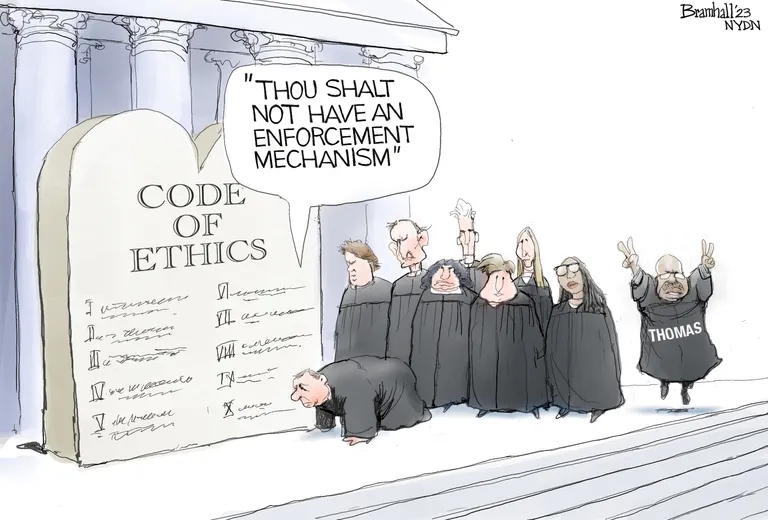
The Supreme Court finally adopted an ethics code. Critics are not impressed.

The most glaring defect of the new code is its complete lack of any enforcement power. Its 15 pages are littered with weak verbs like “should,” “should not” and “endeavor to,” which, as any college student on a pre-exam bender will tell you, is a reliable way to sound serious without actually doing the work. … Whatever the justices do, they must know there will be no professional repercussions. Appointed for life and removable only by impeachment, they are effectively untouchable.


Baseball’s A’s will move from Oakland to Las Vegas by 2028, leaving Oakland without any sports franchises. The A’s are baseball’s most traveled franchise, beginning as the Philadelphia Athletics, then moving to Kansas City, Oakland, and now Las Vegas.


My annual exercise in humility — reading various publications’ best-books-of-the-year lists and admitting how few of them I’ve even noticed — begins with the Washington Post. And Vox reviews the 25 nominees for a National Book Award.

and let’s close with an interesting question

WaPo columnist Michael Dirda raises the idea of books you come back to again and again, and refines it a little: Books you may have read only once, but you want to come back to. What’s interesting in his column isn’t his list of 22 books, but the question itself.

I’ll offer All the King’s Men as a novel I re-read every five years or so, and Gravity’s Rainbow as one I don’t re-read cover to cover, but keep coming back to for specific scenes and descriptions. (If you write, you need to keep exposing yourself to authors whose grasp of language is deeper than your own.) As for a set of books I want to come back to someday: Neal Stephenson’s Baroque Cycle and Nick Harkaway’s Gnommon, which I almost understood the second time through.

Your turn.

Revisiting the fascism question

People who used to deny that Trump is a fascist have been changing their minds.


From the beginning of his first presidential campaign, it was clear Donald Trump was not like other candidates. The difference was not in political philosophy, because he barely seemed to have one. On any given day, he might be for or against a national healthcare program. He might want to raise or cut taxes on the rich. If “conservative” had been defined by Ronald Reagan and carried into the present by Republicans like Paul Ryan, then Trump was not a conservative.

Meanwhile, he celebrated his supporters’ violent tendencies, called Mexican immigrants rapists, and promised to ban Muslims from entering the country. Maybe we needed a different word for this. Maybe the word was fascist.

For years, the word fascist had mainly just served as an insult in American politics. Yes, there were people on the right-wing fringe who waved swastikas and celebrated Hitler’s birthday, but they had no power and nobody took them seriously. If you heard some congressman or cabinet secretary described as a fascist, it was hyperbole. No significant player in American government was literally a fascist. [1]

But maybe it was time to dust that word off as a serious descriptor. If you were going to do that in a responsible way, though, you had to be clear about what you were using the word to mean. It couldn’t just be “somebody more conservative than me” or “somebody I don’t like”. It needed a real definition that could be applied objectively.

And that was actually kind of tricky, because historical fascism has not displayed a defining set of policy positions, like communism’s public ownership of the means of production. Once in power, fascists become chameleons, championing whatever ideas their leaders find useful. Fascism often resembles a charismatic religion more than a political philosophy; the important thing is the spirit, not adherence to some 10-point plan.

But by November of 2015, I was ready to start using the word again, so I wrote “The Political F-Word” to say what I would mean by it. I said fascism was more about social psychology than politics, and described it as:

“a dysfunctional attempt of people who feel humiliated and powerless to restore their pride by:

  • styling themselves as the only true and faithful heirs of their nation’s glorious (and possibly mythical) past, [2]
  • identifying with a charismatic leader whose success will become their success,
  • helping that leader achieve power by whatever means necessary, including violence,
  • under his leadership, purifying the nation by restoring its traditional and characteristic virtues (again, through violence if necessary),
  • reawakening and reclaiming the nation’s past glory (by war, if necessary),
  • all of which leads to the main point: humiliating the internal and external enemies they blame for their own humiliation.”

I could easily see Hitler’s and Mussolini’s fascism in that description, and believed that it fit Trumpism as well, with its vague allusions to making America great “again” (without specifying when exactly that greatness was present or how it was lost), its persistent claims of persecution and victimhood, its emphasis on “owning the libs”, its hatred of immigrants, the violence of its rhetoric (which is frequently echoed in the manifestos of mass murderers), its focus on “real Americans”, and (most of all) the cult of personality around Donald Trump himself. [3]

The subsequent eight years, I believe, have borne out what I saw in 2015. The January 6 insurrection, for example, was a direct manifestation of “helping that leader achieve power by whatever means necessary, including violence”, and so are the current threats of violence against the prosecutors and judges who attempt to make Trump submit to the rule of law.

Still, not everyone agreed, and calling Trump a fascist was controversial. To many, fascist meant Hitler, and (whatever you might think of him) Trump was not Hitler. This week, Tom Nichols summarized his thinking like this: He was against using fascist through the 2016 campaign because

Trump, as a person and as a public figure, is just so obviously ridiculous; fascists, by contrast, are dangerously serious people, and in many circumstances, their leaders have been unnervingly tough and courageous. Trump—whiny, childish, unmanly—hardly fits that bill.

At the time, I thought this view was unhistorical, because Hitler also had seemed ridiculous to many Germans, even after he had become chancellor. But Nichols continued:

After Trump was elected, I still warned against the indiscriminate use of fascism, because I suspected that the day might come when it would be an accurate term to describe him, and I wanted to preserve its power to shock and to alarm us. I acknowledged in August 2022 that Trump’s cult “stinks of fascism,” but I counseled “against rushing toward the F-word: Things are poised to get worse, and we need to know what to watch for.”

Well, Nichols is now shocked and alarmed. What changed his mind? The same things that have swayed a lot of pundits lately: the escalating rhetoric that now routinely dehumanizes his opponents as “vermin” and immigrants as “poisoning the blood of our country“, coupled with a series of ominous proposals for his second administration:

Add the language in these speeches to all of the programmatic changes Trump and his allies have threatened to enact once he’s back in office—establishing massive detention camps for undocumented people, using the Justice Department against anyone who dares to run against him, purging government institutions, singling out Christianity as the state’s preferred religion, and many other actions—and it’s hard to describe it all as generic “authoritarianism.” Trump no longer aims to be some garden-variety supremo; he is now promising to be a threat to every American he identifies as an enemy—and that’s a lot of Americans.

Nichols is not alone. [4] Though The Economist does not use the F-word, it says that Trump “poses the biggest danger to the world in 2024”. WaPo’s Dan Balz also avoids fascist, but says his rhetoric is “associated with authoritarian leaders of the past”, whoever they might be. His colleague Aaron Blake puts recent Trump quotes side-by-side with Hitler’s use of the same language. The New Yorker’s John Cassidy warns that the 2024 election is

a struggle to prevent the election of a President whose embrace of fascistic imagery and authoritarian governance goes well beyond what comes out of his mouth.

In short, it’s not just the crazy things Trump says or how he says them. It’s what he’s done and plans to do.

The 2020 election plot. It’s important to realize that we’ve gone well beyond the point of Trump-says-a-lot-of-crazy-things. Openly fascist ideas and proposals are percolating in TrumpWorld right now, and are still not being taken seriously by many American voters. But before we go into those, we need to lay out what Trump has already done: launched a plot to stay in power after losing the 2020 election.

People who think we can put January 6 behind us tell the story like this: After it became clear that Trump had lost the 2020 election, he latched on to every rumor of fraud because he didn’t want to admit defeat. His stolen-election rhetoric resonated with his most radical supporters, and the result was a January 6 rally that got out of hand. Eventually, though, Trump told the rioters to go home and left office peacefully. He still may be claiming he won in 2020, but so what?

Both the evidence gathered by the House January 6 Committee [5] and the Georgia and D.C. indictments against Trump, though, tell a different story:

  • As soon as it became clear that Trump was likely to lose the 2020 election, he began preparing to claim fraud and stay in office.
  • Within a few days of the November 3 election, his campaign officials and other top advisors told him that he had lost.
  • Within a few weeks, all his administration’s top investigators — Bill Barr in Justice, Chris Krebs at the Cybersecurity and Infrastructure Security Agency, and others — told him that his claims of election fraud had no basis in fact. No one in a position to know supported those claims.
  • Republican officials in key states — Georgia, Michigan, Arizona — told him that the votes had been counted accurately. Again, no one in a position to know said otherwise.
  • In order to find support for the view that he had won the election, Trump had to turn to amateur conspiracy theorists like Sidney Powell and Mike Lindell.
  • Barr’s successors at Justice refused to send state legislators a letter falsely claiming that evidence of significant election fraud had been found and recommending that they reconsider their states’ electoral votes.
  • Republican-controlled state legislatures all refused Trump’s urging to ignore the election results and appoint Trump electors instead of Biden electors.
  • Officials close to Trump coordinated attempts in multiple states for Trump supporters to falsely claim to be electors, and to fraudulently cast Electoral College votes for Trump.
  • His own vice president, Mike Pence, resisted his urging to count the votes of the fake electors, or to refuse to count electoral votes from states Biden had won.
  • The January 6 assault on the Capitol was planned in advance by groups like the Proud Boys, and their leaders have been convicted of seditious conspiracy. A direct connection from the White House to the Proud Boys has not been nailed down in evidence publicly available, but may have gone through Roger Stone.

The more details come out, the clearer it becomes that this plot could have worked if only Trump had more yes-men in key positions. If the Justice Department had backed rumors of election fraud, Republican legislatures would have had cover to submit alternate slates of electors, and Mike Pence might have been convinced to count those votes, creating a constitutional crisis that the Supreme Court (with three Trump appointees) might have been unwilling to resolve in Biden’s favor. A military leader unlike Mark Milley might have provided troops to put down any subsequent disorder, and Trump would be President for Life. [6]

From the preparations for his second administration, we can conclude that Trump has learned a lesson from his first failed attempt to overthrow the constitutional order, and will not make the same mistakes again. He’ll appoint a compliant attorney general, a compliant vice president, and military leaders willing to do what they’re told. Former Trump Chief of Staff John Kelly put it like this:

The lesson the former president learned from his first term is don’t put guys like me … in those jobs. The lesson he learned was to find sycophants.

Plans for Trump’s second term. According to many reports, Trump did not expect to win in 2016, so he paid little attention to the transition plan drafted by Chris Christie. Top jobs were filled in a haphazard way, often with conservatives who had little previous connection to Trump, like General John Kelly, or with people like Senator Jeff Sessions, who backed Trump but retained independent views of how government was supposed to function. The Trump legislative agenda was largely left to Speaker Paul Ryan, who engineered a Reagan-style tax cut for corporations and the rich, but failed to “repeal and replace” ObamaCare.

As a result, Trump was frequently told that he couldn’t do what he wanted to do; it was illegal or unethical or against the norms of the federal government. By the end of his term, he had gotten rid of most of those people, but there were still enough establishment conservatives around to thwart his attempt to steal a second term.

He doesn’t want that to happen again, so plans are already in place to hit the ground running with sweeping proposals and a list of Trump loyalists ready to implement them.

Weaponize the Justice Department against his enemies. Trump claims that the indictments against him are purely political. [7] But rather than promise to restore the Justice Department to its proper function, Trump promises to do to his enemies what he (falsely) claims has been done to him. In an interview with Univision, he said:

What they’ve done is they’ve released the genie out of the box. … They’ve done indictments in order to win an election. They call it weaponization, and the people aren’t going to stand for it. But yeah, they have done something that allows the next party. I mean, if somebody if I happen to be president and I see somebody who’s doing well and beating me very badly, I say go down and indict them. Mostly what that would be, you know, they would be out of business. They’d be out they’d be out of the election.

At a New Hampshire rally in October, Trump said:

This is third-world-country stuff, “arrest your opponent”. And that means I can do that, too.

In general, I’m trying to source Trump’s second-term plans to his own words and quotes from allied organizations and named advisors, rather than anonymous sources (though the Mueller Report often attached names and testimony under oath to anonymously-sourced reports Trump had labeled “fake news” at the time). But I’ll make an exception for this quote from the WaPo:

In private, Trump has told advisers and friends in recent months that he wants the Justice Department to investigate onetime officials and allies who have become critical of his time in office, including his former chief of staff, John F. Kelly, and former attorney general William P. Barr, as well as his ex-attorney Ty Cobb and former Joint Chiefs of Staff chairman Gen. Mark A. Milley, according to people who have talked to him, who, like others, spoke on the condition of anonymity to describe private conversations. Trump has also talked of prosecuting officials at the FBI and Justice Department, a person familiar with the matter said.

One person who believes this account is John Kelly:

There is no question in my mind he is going to go after people that have turned on him.

Use the military against Americans. During his administration, Trump threatened to invoke the Insurrection Act, which allows deploying the active-duty military to enforce law and order within the United States itself. (During riots and natural disasters, governors may call out their state’s chapter of the National Guard, which consists of ordinary citizens and is the successor to the “militia” mentioned in the Constitution.) According to the NYT, he was talked out of doing so by Attorney General Bill Barr, Defense Secretary Mark Esper, and Joint Chiefs Chair Mark Milley — exactly the kind of appointees he will avoid in a second administration.

Instead, Trump reportedly plans to invoke the Insurrection Act on Day One of a second term. This would put the military on call to respond wherever he found it necessary.

Turn the federal government into a patronage machine. In the early days of the United States, the government worked according to the “spoils system”, in which federal jobs were plums a new president could award to his political allies. This led to a lot of corruption and inefficiency, so a series of reforms were passed that made most federal jobs nonpartisan civil service jobs.

Trump began trying to undo the civil service in his first term. A month before the 2020 election, he ordered the creation of “Schedule F” jobs — tens of thousands of positions formerly protected by civil service rules that would become fireable by the president.

Rather than take advantage of this power grab, President Biden reversed Trump’s executive order. But Trump has pledged to restore it if he regains office. Presidents already need to make about 4000 appointments when they take office, but Trump’s plan could cover ten times as many jobs. The Heritage Foundation’s Project 2025 is assembling a database of Trump loyalists who could fill those jobs. According to Axios:

intense attention will be given to the social-media histories of anyone being considered for top jobs. Those queasy about testing the limits of Trump’s power will get flagged and rejected.

Create massive detention camps for immigrants and the homeless. Trump has pledged to conduct “the largest domestic deportation operation in American history”, a statement fleshed out by Trump advisor and speech-writer Stephen Miller, who told the NYT:

Any activists who doubt President Trump’s resolve in the slightest are making a drastic error: Trump will unleash the vast arsenal of federal powers to implement the most spectacular migration crackdown. The immigration legal activists won’t know what’s happening.

Miller is talking about rounding up not just “illegal” immigrants, deporting “millions per year”, but also revoking the legal status of many others: foreign students who participate in demonstrations Trump disagrees with, immigrants granted temporary protected status because they escaped from countries the US deems unsafe, Afghans evacuated after the Taliban takeover, and others.

To help speed mass deportations, Mr. Trump is preparing an enormous expansion of a form of removal that does not require due process hearings. To help Immigration and Customs Enforcement carry out sweeping raids, he plans to reassign other federal agents and deputize local police officers and National Guard soldiers voluntarily contributed by Republican-run states.

To ease the strain on ICE detention facilities, Mr. Trump wants to build huge camps to detain people while their cases are processed and they await deportation flights. And to get around any refusal by Congress to appropriate the necessary funds, Mr. Trump would redirect money in the military budget, as he did in his first term to spend more on a border wall than Congress had authorized.

Trump has also proposed tent cities for the homeless, who would be arrested and relocated. [8]

The threat of non-action. In addition to the things Trump is planning to do in a second administration, we have to consider the things he might choose not to do: enforce the law against groups who do violence against his opponents. From the beginning, Trump has defended his supporters when they get violent, from describing two Trumpists who beat a homeless man in 2015 as “passionate” to saying “We love you. You’re very special.” to the January 6 rioters, whom he says he will pardon.

In the early Hitler years, the more serious threat was not that the official Gestapo would whisk you away to a concentration camp, but that the unofficial Brownshirts would beat or murder you with no interference from the police. Kristallnact was not police enforcing draconian laws, but hooligans running free. If you think the Proud Boys or Oath Keepers wouldn’t like to play a similar role today, you haven’t been paying attention.


[1] On the Right, the word communist is still used this way, as when Trump promised to “root out the communists, Marxists, fascists and the radical-left thugs that live like vermin within the confines of our country”. I doubt he could define communist, Marxist, or fascist. The words are simply barbs that he throws at people.

[2] Four years after my F-word post, Trump made this point clearly in his January 6 speech:

Just remember this: You’re stronger, you’re smarter, you’ve got more going than anybody. And they try and demean everybody having to do with us. And you’re the real people, you’re the people that built this nation. You’re not the people that tore down our nation.

[3] The 2020 Republican Convention, for example, refused to write a platform that would endorse any specific policies, but declared instead that it “enthusiastically supports President Trump” and would “enthusiastically support the President’s America-first agenda” — whatever turns that might take.

any motion to amend the 2016 Platform or to adopt a new platform, including any motion to suspend the procedures that will allow doing so, will be ruled out of order

Going forward, the Republican Party would be Donald Trump, and its policies would be whatever Trump said they were.

[4] You might think Nichols’ article would have an apologetic tone, something like: “You guys were right, he is a fascist.” But no. Those of us who saw further ahead than Nichols are to blame for “the overuse of fascist” that “wore out the part of the public’s eardrums that could process such words”.

I see it the other way: Maybe if people like Nichols had taken Trump’s fascism more seriously in 2015, more of the public could have processed the threat then, and we could have avoided this whole mess.

[5] Trump supporters discount the January 6 Committee’s findings because (after Kevin McCarthy pulled all of his appointees and Nancy Pelosi named Republicans Liz Cheney and Adam Kinzinger to replace them) no members of the committee defended Trump.

What this point ignores is that nearly all the testimony heard by the committee came from Trump appointees, Republicans at the state level who supported Trump’s 2020 campaign, and even members of the Trump family. There would have been more even testimony from Trump supporters if so many (including Trump himself) had not refused to testify. Steve Bannon, Mark Meadows, Jim Jordan, and Peter Navarro went so far as to defy subpoenas.

I can’t help believing that if any of those people could have testified to Trump’s innocence without committing perjury, they would have.

The possible bias of the Committee’s report was an issue in the recent hearing in a Colorado court about whether Trump is disqualified from being on the ballot in 2024 by the 14th Amendment’s insurrection clause. The judge’s ruling noted:

while Trump spent much time contesting potential biases of the Committee members and their staff, he spent almost no time attacking the credibility of the Committee’s findings themselves. The Hearing [in Colorado] provided Trump with an opportunity to subject these findings to the adversarial process, and he chose not to do so, despite frequent complaints that the Committee investigation was not subject to such a process. Because Trump was unable to provide the Court with any credible evidence which would discredit the factual findings of the January 6th Report, the Court has difficulty understanding the argument that it should not consider its findings

[6] You might think, “A second Trump administration would just be four years, because of the 22nd Amendment.” But already during the 2020 campaign, Trump floated plans to serve more than two terms.

We are going to win four more years. And then after that, we’ll go for another four years because they spied on my campaign. We should get a redo of four years.

Doubting his intent would be repeating another mistake Germans made with Hitler: believing that he didn’t really mean what he said. Hitler’s 1925 book Mein Kampf laid out much of what he wanted to do and later did, but many Germans refused to take his writings seriously.

[7] That position is hard to square with the evidence those indictments lay out. Trump has been indicted because he committed crimes.

In practice, Trump simply does not address the evidence against him. See the quote from the judge’s ruling in note [5].

[8] In this context, it’s worth pointing out that the Nazi death camps did not start out as death camps, and did not specifically target Jews. In the beginning, the camps housed “undesirables” like Communists. Over time, the definition of “undesirable” expanded, and the limits of what could be done to them loosened.

The Monday Morning Teaser

Back in 2015, many of us struggled to find a label that captured how Donald Trump was different from other “conservative” candidates. With some trepidation, we dusted off the word fascist, which in recent years had mainly been used as a hyperbolic insult. Before re-introducing and applying the word, it seemed necessary to lay out exactly what you intended it to mean. I did that in November, 2015 in a post “The Political F-Word“, which I think stands up well in hindsight.

At the time, this use was widely disputed, and it remained controversial throughout Trump’s administration. As he campaigns to be restored to office, though, Trump has increasingly been imitating Hitler’s rhetoric. (Immigrants “poison the blood of our country”. His enemies are “vermin” he wants to “root out”.) Alarming plans continue to leak out of his campaign and its allied think-tanks: vast detention camps for immigrants and the homeless, invoking the Insurrection Act on Day One, replacing the civil service with loyalists, pushing executive power to its limits, and so on.

Consequently, many who had been reluctant to use fascist are changing their minds. That’s the subject of this week’s featured post “Revisiting the fascism question”. That should appear by 10 EST.

The weekly summary has a lot to cover: developments in the Israel/Gaza War, averting a government shutdown, Biden’s summit meeting with China’s President Xi, the ethics report on George Santos, a Colorado judge’s ruling on whether Trump is eligible to run for president, and more. That should appear a little after noon.

Doubt and Indecision

No Sift next week. The next new articles will post on November 20.

One of the painful things about our time is that those who feel certainty are stupid, and those with any imagination and understanding are filled with doubt and indecision. I do not think this is necessary.

– Bertrand Russell
Present Perplexities” (1953)

This week’s featured post is “Can we talk about Israel and Palestine?

This week everybody was avoiding talking about the war in Gaza

That reluctance is the subject of the featured post.

This week Israeli troops moved into Gaza in force, and have encircled Gaza City, cutting the region in two. The Gaza health ministry now reports over 10,000 Palestinian deaths, though this number can’t be independently verified.


Here are a couple of links that didn’t make it into the featured post: Ta-Nahisi Coates goes to the West Bank and interprets what he sees through the lens of Jim Crow: Some people can vote and others can’t. Some people can go wherever they want and others can’t. The history of how things got to be this way may be complicated, Coates says, but the morality of it is simple.

And Nicholas Kristof visits two Palestinian men he met 41 years ago on a bus.

I pushed back and noted how brutal the Hamas terrorism had been and how many Israeli civilians had been killed or kidnapped. Saleh and Mahmoud said that they mourned the Israeli deaths, but wondered why the world wasn’t equally outraged that Palestinians have been killed in cumulatively greater numbers. They were disappointed by my focus on the Hamas barbarism, and I was disappointed by their reluctance to unequivocally condemn those attacks.

… We parted, all of us less spry than we had been the first time. They were fairly ordinary Palestinian men who had mostly kept their heads down; they had avoided politics and had not lost family members to the conflict. But they had lost freedom and dignity. There are untold numbers just like them who never make the headlines but are stewing inside.

I remembered two young men full of promise and warmth, animated by hope and inhabiting a world in which Israelis and Palestinians interacted regularly and didn’t much fear each other. It is wrenching to see such change. As Saleh and Mahmoud became dads and grandfathers, they were shorn of a future, of vitality, of hope.

And that, I think, is the core of the Palestinian problem.

and talking about the new Speaker’s first bill

OK, the House has a speaker again so it’s open for business and ready to govern. Sort of.

The first order of business is a $105 billion emergency spending bill Biden proposed that included money for Israel, Ukraine, Taiwan, and the southern border. It seems likely to pass the Senate with a substantial bipartisan majority.

But “No, no, no,” the House Republican majority says. “That’s not how we want to do business any more. We’ll unbundle the pieces and look at them separately, then combine them with cuts so that spending doesn’t increase.”

One problem with that approach is that bundling proposals together is how you assemble coalitions big enough to pass things. But never mind, Israel is popular, so let’s start there: a $14.3 billion aid-to-Israel bill that is offset by a $14.3 billion cut in funding the IRS, undoing a piece of Biden’s Inflation Reduction Act that passed last year before Republicans got control of the House.

But there’s a snag in the House’s logic: The IRS funding was supposed to crack down on rich tax cheats, and is expected to raise more revenue than it costs. The Congressional Budget Office estimates that cutting $14.3 billion out of the IRS budget will decrease revenue by $26.8 billion over ten years, for a net deficit increase of $12.5 billion. (The Fox News story on the bill leaves this detail out.)

So in order to “balance” deficit-increasing aid for Israel, the House adds a deficit-increasing cut to the IRS.

A few things we can conclude from this:

  • House Republicans aren’t serious about the deficit. If they were, they’d pair the $14 billion of Israel aid with $14 billion of deficit reduction, not an additional deficit increase.
  • They aren’t serious about helping Israel. Otherwise they wouldn’t try to score political points that will slow down coming to an agreement with the Senate.
  • Getting aid to Ukraine is going to be difficult. (That should make Putin happy.)
  • Helping rich people cheat on their taxes is a high priority for them.
  • If this is how Speaker Johnson approaches legislation, avoiding a government shutdown is going to be difficult. New funding has to pass both houses of Congress by a week from Friday.

Cutting spending: Great idea! Here’s a Labor Party video from Britain a few years ago that explains how austerity (doesn’t) work.

and prejudice rising in America

There were always a number of things wrong with the “melting pot” imagery America once used to describe itself. (Chiefly: the assumption that you had to give up your prior ethnic identity to become truly American, and the fact that we never allowed Black people to fully melt in.) But there’s one thing it got right: Whatever ethnic squabbles you had in the old country should be left in the old country. Germany/France, Greece/Turkey, Serb/Croat — whatever it was, we didn’t want it here. Of course we developed our own ethnic rivalries, but at least they were based on things that happened in America, not feuds brought across the ocean. Mr. Dubois and Mr. Schwartz could be good neighbors here, whatever the Der Kaiser and la République were bickering about.

We seem to have lost that. One of the many depressing aspects of the current conflict in Israel and Gaza is antisemitic and Islamophobic violence in the United States. This much should be obvious: Your Palestinian-American neighbor is not a Hamas terrorist and your Jewish-American neighbor is not trying to steal anybody’s ancestral land. I understand that Israelis and Palestinians in the Middle East face difficult issues that I don’t know how to resolve. But the echoing violence here in America is something we can and should just stop. There’s no reason for it.

and the Trump trials

Donald Trump is testifying today in the New York civil fraud trial against the Trump Organization. Last week, Trump sons Don Jr. and Eric testified, and Ivanka is due up on Wednesday.

Last Friday on MSNBC’s “Deadline White House”, former DoJ official Andrew Weissman outlined the standard Trump family strategy on testifying. (Sorry I can’t find video on this or quote him exactly.)

The first ploy, Weissman said, is to claim to be the smartest person in the room. You see this, for example, in things Trump has said about valuing Mar-a-Lago: He knows what it is worth, and nobody else’s opinion matters. Appraisers don’t know, assessors don’t know, accountants don’t know — but he knows. When that fails, the back-up ploy is to claim to be the dumbest person in the room: It’s not my job to know these things; I have people for that. I just do what the accountants and lawyers tell me.

It will be interesting to see which way Trump himself goes today.

Don Jr. and Eric were using the second ploy in their testimony. Junior’s Wharton MBA, he testified, doesn’t mean that he knows anything about accounting. (I have it on good authority that other Wharton MBAs were mortified by this.) The accountants, the Trump sons both claimed, did the financial statements and they just signed off on them.

Both of them were tripped up by Assistant Attorneys General Colleen Faherty and Andrew Amer, who produced emails and other documents the sons couldn’t explain.

If you’ve ever had somebody else do your taxes, you should understand that accountants don’t work the way the Trumps claimed. Accountants are not auditors; they apply laws and rules to the numbers you give them. If you lie to your accountant about, say, what you spent to keep your home business operating or how much you paid for the house you just sold, it’s not up to the accountant to do an independent investigation and correct you.

Same thing here: When Trump claimed his Trump Tower apartment was three times its actual size, it wasn’t the accountants’ responsibility to get out a tape measure and check.

and tomorrow’s elections

Ohio votes on whether to guarantee a right to abortion. Kentucky and Mississippi have surprisingly competitive governor’s races. And Virginia’s legislative elections will tell us whether the issues Glenn Youngkin won on two years ago still resonate.

this week’s best schadenfreude moments

Now that Mark Meadows appears to be offering testimony that contradicts what he said in his book, his publisher is suing him.


Crypto-currency fraudster Sam Bankman-Fried was convicted on all counts. Wikipedia sums up his spectacular fall:

Prior to FTX’s collapse, Bankman-Fried was ranked the 41st richest American in the Forbes 400, and the 60th richest person in world by The World’s Billionaires. His net worth peaked at $26 billion. By November 11, 2022, amid the bankruptcy of FTX, the Bloomberg Billionaires Index considered his net worth to have been reduced to zero.

The satirical NYT Pitchbot‘s take:

If the federal prosecutors can put Sam Bankman-Fried in jail for stealing billions of dollars, imagine what they can do to you.

but hardly anybody has been talking about the World Series

If you’re younger than, say, 50, you probably have no notion of what the World Series meant when I was growing up in the 1960s. For a little over a week, the world all but stopped. If somebody was playing football on Saturday or Sunday, nobody noticed.

And it wasn’t just the sports world that ground to a halt: The games were all played in the daytime until 1971, and radio broadcasts echoed through factories and other workplaces. Young fans like me applied considerable ingenuity to sneaking radios into our classrooms. (If you could stuff one of the cheap new transistor radios into a shirt pocket and cover the bulge with a sweater, you could thread the earphone cord under a sleeve as far as your left wrist — or right wrist if you were left-handed. Then you could prop your head up palm-to-ear while pretending to do schoolwork with your dominant hand.)

There were no “playoffs” until 1969, and no “wild card” teams until 1995. The regular-season champion of the National and American Leagues played each other, and since there was no interleague play during the season (until 1997), the two leagues were impossible to compare. So the Series held a considerable mystique: These match-ups — Mickey Mantle facing Sandy Koufax or Bob Gibson — could only happen in an All-Star game or a World Series. No one knew what to expect.

That mystique cloaked a difficult truth about baseball: Unlike football or basketball, baseball is so inherently random and streaky that you can’t tell how good a team is by watching it for only a week or two. (For example, countless no-name pitchers have thrown no-hitters during their one magical day in the sun, only to immediately fade back into obscurity.) So while it was undoubtedly true that occasionally the lesser team won the World Series (like the Pirates beating the Yankees in 1960 despite being outscored 55-27 over the course of seven games), it was easy to suspend disbelief and convince yourself that the winner was indeed the best team.

That’s much harder to do now. Twelve teams — nearly half of the 30-team league — get into the playoffs, so one or two of them are bound to get hot and play way over their heads for a few weeks. Whichever two teams are most favored by luck and circumstance will meet in the World Series, and one of them will win. Is that “champion” the best team in baseball? Don’t be silly.

Under the pre-1969 system, this year’s World Series would have featured the Orioles (101-61 in the regular season) against the Braves (104-58), instead of the Rangers (90-72) against the Diamondbacks (84-78). An Orioles/Braves series would have been the culmination of the drama fans had been watching all summer. (Within the National League, the Braves/Dodgers pennant race would have been epic.) Instead, those of us living outside of Texas and Arizona were scratching our heads saying, “Wait. Who are these guys again?”

Or we just ignored it. Because “World Series winner” — the Rangers this year, in case you hadn’t heard — has just become a line in a record book. It doesn’t actually mean anything any more.

and you also might be interested in …

The latest set of polls from NYT/Siena aren’t good, and aren’t good in mysterious ways: Trump has a surprising amount of support among young voters and voters of color.

I finally broke down and subscribed the The Status Kuo blog by Jay Kuo. His latest post is “One Year Out from Election 2024“, and it roughly parallels the argument I made in “About the Polls” in September. He is concerned about the polls, but still thinks Biden is in a far better position than the polls make it appear.

David Roberts:

Every single Dem presidential candidate of my lifetime, the tag-team of RW media & shitty MSM has honed in on some (often silly) weakness & beaten it to death. Gore is insincere; Kerry’s a flip-flopper; Clinton had her emails; Biden’s age. Only Obama has escaped this. …

Any realistic alternative to Biden would also be tagged with some flaw, some Thing, some narrative that the media beat to death until the public started repeating it back to them. It’s structural, just how the game works.

And then we’d get calls to shove that person aside in favor of some other even-more-unicorn unicorn that would not be subject to the same shit. There is no unicorn. Solve the structural information problem or things keep getting worse.

It reminds me of a refrain I’ve heard so often in climate/energy over the years: “they’ve polarized X, let’s talk about Y instead.” Dudes. They can polarize anything! They’ve spent decades building a giant polarization machine! There is no non-polarizeable term/tech/policy!


The vote to expel George Santos from Congress failed. But the interesting voice here is Jeff Jackson, a Democrat who voted not to expel him. Jackson points out that an Ethics Committee report on Santos is due in two weeks. The Ethics Committee process that gives investigated members certain rights, and expelling Santos without the report would set a bad precedent. Jackson fully expects to vote to expel Santos after the report comes out, but not until then.

He anticipates an objection:

“But Jeff, the other side doesn’t care about precedent or due process!” Perhaps, but I do. And I think we all should. So that’s the standard I’ll defend.

MSNBC’s Hayes Brown argues the other side:

The bigger threat, as I see it, is not that members are kicked out too easily for partisan reasons. It’s that members who are clearly unfit to serve are permitted to remain because of the letters next to their names.

and let’s close with something anachronistic

I’ve closed with this 2Cellos video before, but not for nine years. This 17th-century performance of AC/DC’s “Thunderstruck” is worth a second look.

Just for reference, here’s AC/DC’s original.

Can we talk about Israel and Palestine?

The endless spiral of tragedy seems too depressing to contemplate. But beyond the repetitive segments of the 24-hour news cycle, a few articles are worth paying attention to.


Nobody I know, including me, wants to talk about the war in Gaza and Israel. Sometimes we feel compelled to: It is the news, after all. It is consequential, and informed citizens in the world’s most powerful democracy should form opinions about it.

And yet …

I’ve been witnessing, experiencing, and occasionally complaining about this phenomenon for nearly a month now (since the October 7 Hamas attacks on southern Israel). But it really came home to me Friday evening. I was at a church potluck dinner. My church is full of opinionated people, many of whom have a fairly high assessment of their grasp of world affairs. Then someone brought up the war, and there was an awkward silence. Eventually we segued onto some other topic.

I did not break the silence, because anything it occurred to me to say sounded either pompous or stupid. I have no simple paradigm that lays everything out clearly, and no five-point plan for peace. The people who can fit everything into a simple frame — whether that frame is the Global Zionist Conspiracy or God’s promise to Abraham’s descendants in Genesis 15 — are more likely to be part of the problem than part of the solution. The situation seems to illustrate a famous Bertrand Russell quote:

One of the painful things about our time is that those who feel certainty are stupid, and those with any imagination and understanding are filled with doubt and indecision.

And yet, a simple Google search for a source shows that this quote is out of context: Russell’s next line was “I do not believe this is necessary”, and from there he laid out a hopeful message of how he believed human happiness might be achieved.

I have no comparable vision. But if I have no grand explanation to present, Russell at least inspires me to start collecting articles and ideas that seem useful if we want to think seriously about the situation.

Colonialism plays a role, but maybe not the one you think. In the critique of Israel that is popular in some left-wing circles, Zionism is just one more example of White colonists stealing land from indigenous peoples. Previous examples include the United States, where Native Americans were steadily pushed onto smaller and smaller reservations, and the apartheid regime of 20th-century South Africa. In this narrative, the foundation of Israel is an unjust act of Jewish aggression from the beginning, and all the subsequent unhappiness — from the Nakba of 1948 to last month’s Hamas attacks and the Israeli reprisals — can be laid at the door of the early Zionists and their contemporary successors.

Simon Sebag Montefiore does a good debunking of this view in “The Decolonization Narrative Is Dangerous and False” in The Atlantic: Most of the Jews who moved to Israel in the last century or two were not “settlers” so much as refugees — from Czarist pogroms, Nazi death camps, Soviet oppression, Ethiopia, or long-vanished Jewish quarters of Muslim cities like Baghdad. Many of these refugees (especially the Ethiopians) do not fit any reasonable definition of White. Josh Marshall echoes this point:

You cannot look at the range of inhabitants of Israel and all the Palestinian territories together and think the conflict is fundamentally or consistently about skin color. Many Ashkenazi Jews [i.e. from European backgrounds], in American terms, look white. But more than half of Israel’s Jewish population is descended from Jews from the Arab and Islamic worlds. There are many Palestinians and Israeli Jews who could not be readily identified as one or the other by physical appearance or skin color alone.

There is a role for colonialism in this narrative, but it is more subtle. (I’m leaving Montefiore’s article at this point and going off on my own interpretation of history.) In the aftermath of the Holocaust (and the Western world’s relative indifference to it as it was happening), the Zionist vision of a sanctuary for Jews — a place that would always accept them and never throw them out — became compelling for many non-Jews. Once, Western liberals might have imagined that civilization and education would eventually overcome the ancient prejudices, but what society had been more civilized or better educated than Germany? And among those ancient prejudices, antisemitism seemed virtually unique. Jews, of course, are not the only group that has ever been persecuted, and the Holocaust was not history’s only genocide. But antisemitism’s ability to subside for decades and then spring up with renewed virulence made virtually any nation’s guarantees suspect.

In addition to that theoretical justification, there was a practical problem that needed a solution: Postwar Europe was full of displaced persons, including many survivors of the death camps. They couldn’t be sent back to their families, who were either dead or similarly displaced. Often their entire villages no longer existed, or were now occupied by the people who had collaborated with the Nazis to send them away. But they had to go somewhere.

Palestine was of course where the Zionists envisioned their homeland, but the great powers were not bound by their preferences. (Michael Chabon’s novel The Yiddish Policemen’s Union takes place in an alternate history where part of Alaska became a sanctuary for Jews fleeing the Holocaust.) There was even a certain logic to making the nations that caused the problem pay the price: What if, say, Bavaria, where Hitler’s movement got its start, had been set aside as a Jewish homeland?

But even suggesting such a thing sounds laughable, because Bavaria already had citizens (some of whom share my last name, though I’ve never met them) and cities like Munich. But so did everyplace else, including Palestine. The world had no desirable empty spaces. The challenge was to find a place whose current inhabitants volunteered, or could be induced to cooperate.

Or whose desires could be ignored.

What separated Palestine from everyplace else wasn’t just the Zionist vision, it was that the Arab world had no power. World War I had brought down the Ottoman Empire, and the subsequent treaty of 1922 divided the region into a British mandate and a French mandate. These colonial powers then drew the outlines of the subsequent states: Syria and Lebanon by the French, and Iraq, Jordan, and the Hejaz (a forerunner of Saudi Arabia) by the British. The strife-torn histories of several of these states comes in part from their unnatural founding. (As we saw during the Iraq War, there is little reason for Iraqi Kurdistan — largely the Ottoman province of Mosul — to belong to the same country as the former Ottoman provinces of Baghdad and Basra.)

When Britain and the United Nations (with American support) split the Palestine mandate into a Jewish state and an Arab state, the great powers were doing what great powers often do: paying their moral debts with someone else’s assets.

Today, Americans often shake our heads at the two sides: Why can’t they get along? We are dismayed when every dispute seems to have no beginning: The Israelis have no choice but to do Z, because the Palestinians did Y. And the Palestinians had no choice but to do Y, because the Israelis had already done X … back and back and back to A and beyond. “Why not leave them to fight it out?” we sometimes think, because it has nothing to do with us.

But it has everything to do with us. We played a large role in the great-power coalition that redrew the world after World War II. That arrangement set the Israeli Jews and the Palestinians up to fight with each other. What has happened since was not fate; both sides have made mistakes and have blown opportunities to seek peace. But it’s not all their fault either.

Jews deserve a state. The Western powers should not have made Palestine provide one. That is history now and there’s no undoing it. Generations have been born and died in Israel; moving either the Israelis or the Palestinians somewhere else would be no more just than moving you or me from our homes. But we also can’t wash our hands of the current situation. If there is some way to resolve it that demands sacrifice, the US, Britain, the EU, and perhaps other countries should be ready to make some of those sacrifices.

The situations in Gaza and the West Bank may be linked, but we can’t lose sight of the differences. Here I would point you to Matt Yglesias’ “Israel’s Two Wars“. He believes that Israel has little choice but to root Hamas out of Gaza (with all the costs that entails), but opposes what has been happening slowly for decades on the West Bank.

while Israel is waging a just war in Gaza, they are in parallel waging an unjust war in the West Bank. This second war is much less spectacular, much more of a slow burn, and at the moment, is causing much less death and destruction to innocent civilians. That these two wars — one just but spectacularly deadly, one unjust but lower-key — are playing out in tandem is contributing to a confused and polarized debate over a set of issues that were already quite fraught.

Yglesias believes that the closest the two sides came to peace was at the 2008 summit in Annapolis. The framework of that near-agreement was that Israel got to keep its most populous West Bank settlements, in exchange for giving the new Palestinian state land elsewhere. Obviously that compromise gets harder for Palestinians to accept the more settlements there are. Yglesias believes that sabotaging such a two-state solution has been a deliberate Netanyahu policy.

Josh Marshall interprets Netanyahu slightly differently:

Benjamin Netanyahu’s return to power in 2009 was based on a very different premise [than an Annapolis-style agreement]: that the Palestinian issue could be managed indefinitely rather than resolved and with no major repercussions. …

For those of us who never believed this could be true, it did slowly become a matter of reason over experience. That couldn’t go on forever. And yet, year after year somehow it did. Israel’s economy grew stronger. It normalized relations with more Arab countries. It even managed a de facto normalization and something close to a de facto, though sub rosa, alliance with Saudi Arabia. It couldn’t work and yet it kept working. Until it didn’t.

What exploded Netanyahu’s legitimacy and reputation on October 7th wasn’t just an abject national security failure. It exploded the whole idea that the occupation could be effectively managed and that Benjamin Netanyahu could manage it.

He sees a return to the Netanyahu status quo as a failure of imagination: a simultaneous inability to imagine peace and an inability to imagine the nightmares that will continue to happen until both sides are willing to take risks for peace.

What might happen in Gaza. One of the most dismal aspects of thinking about this war is that all roads seem to lead nowhere. Simply punishing Hamas, but leaving it in control of Gaza, just starts the clock ticking down to the next attack. But occupying Gaza would be an endless quagmire.

In Iraq, the US demonstrated the limits of military power: A superior military can go wherever it wants and destroy whatever it chooses. Any goal that can be achieved by going places and destroying things can be achieved by military might alone. However, neither winning over a population that hates you nor establishing a government they will cooperate with fits that description.

Israel wants to wind up living next to a Gaza that is stable rather than a launching pad for future attacks like the ones we just saw. But what kind of government could achieve such a goal?

Francis Foer takes on this challenge in “Tell Me How This Ends“.

Thus far, the Israelis have answered the question only in the negative. Although some of the ultranationalists in the Netanyahu government openly fantasize about reoccupying Gaza, Defense Minister Yoav Gallant has said that his government won’t pursue that path, which would come at a financial, military, and moral cost that Israel apparently doesn’t want to bear. But the alternative to a postwar occupation of some sort is lawlessness, which would permit Hamas’s return, thus undermining the very purpose of the war.

Foer asked “a former prime minister, a former national security adviser, and a former head of Mossad, as well as longtime diplomats and analysts in Washington” to imagine “a plausible endgame for Gaza”.

What I found was both a surprising degree of consensus on a plan for life after Hamas, and a lack of faith in the current Israeli government’s ability to execute it.

That plan has a number of moving parts, and requires a number of countries, including the Gazans themselves, to make sensible decisions. The basic steps are

  • Israel goes into Gaza and destroys Hamas as a viable government. But it does not stay as an occupying power.
  • During a transition period that is framed from the beginning as temporary, a collection of Arab countries not aligned with Iran — the article suggests Egypt, Jordan, the Emirates, and Morocco — manage a reconstruction. Presumably, this reconstruction is funded by some combination of the oil-rich Arab states, the US, and the EU.
  • What makes the transition temporary is turning Gaza over to the Palestinian Authority that currently oversees the West Bank.

Each participant buy-in might be difficult to achieve, but Foer tries to answer those objections: Egypt will want its companies to get reconstruction contracts. The PA will want to “substantially [bolster] its position in the West Bank.”

It would almost certainly demand stringent constraints on settlement expansion and promises of greater autonomy, measures that Netanhyahu and coalition partners abhor.

Now we’re back to the “sacrifices for peace” from the last section. So why would the Israeli government (whatever it looks like when the war ends) make such concessions?

In the midst of such gloom, I also thought I detected muffled hints of hope. Israelis almost universally invoked the unexpected aftermath of the 1973 Yom Kippur War, the other cataclysmic lapse in the history of the nation’s defense, so searing that it scrambled the politics of both Israel and its neighbors. Some of the Jewish state’s old enemies finally accepted its existence. Fervent hawks in Israel became ambitious peacemakers. No Israeli was willing to stake their reputation on the rise of a new alignment, but they all wanted to believe in its imminence, beyond the carnage.

A million things can go wrong with the plan Foer describes, and with the resolution of Gaza as a stepping stone to a broader peace. Certainly, plans that seemed more promising have failed in the past. Peace is definitely a long shot. But we have to hope that at some point all involved will realize that there is no alternative. At that point, an admonition of the original Zionist, Theodore Herzl, can be repurposed: “If you will it, it is no dream.

The Monday Morning Teaser

For about a month I’ve been watching a tendency both in myself and in just about everyone I know: We’d rather not think about the war in Gaza. Yes, it’s news. Yes, we see ourselves as citizens of a democracy who have a duty to stay well informed. But this is just too depressing. Maybe there’s something amusing we can stream on Netflix.

The 24-hour news cycle doesn’t help. Every time I look at CNN, it seems like they’re interviewing either a relative of a Hamas hostage, someone who managed to hide or run from the October 7 attack, or a Gaza nurse who has no supplies — as if the tenth such interview will communicate something the first nine failed to capture.

In some sense, though, this kind of situation is the Weekly Sift’s whole purpose: Beyond the endless repetition, somebody out there must be saying things we need to think about. I’ve tried to pick a few out in this week’s featured post, “Can we talk about Israel and Palestine?” That should be out around 9 or so EST.

The weekly summary will cover the new Speaker’s attempt to play politics with Israel/Palestine aid, the ongoing Trump trials, the polls a year out from the election, the actual elections happening tomorrow, and an old man’s rant about the World Series, before doing something I try to never do: repeat a closing. I used this 2Cellos video as a closing nine years ago, but it’s still great. That should appear before noon.