Monthly Archives: May 2022

Who’s to blame for overturning Roe?

https://www.timesfreepress.com/cartoons/2022/may/07/overturned/5402/

There’s plenty of blame to go around.


The two featured posts today look at the leaked Alito opinion overturning Roe v Wade through two very different lenses. The other post goes through the text of the opinion and examines its claims and arguments. This one considers the question: How did we get here?

In particular, whose fault is it that women in about half the states are going to lose their right to bodily autonomy, and their ability to plan their lives?

Let’s start with those most directly responsible.

Justices Alito, Barrett, Gorsuch, Kavanaugh, and Thomas. Or, as Stephen Colbert described them: “four old dudes and a woman who thinks The Handmaid’s Tale is a rom-com”.

Sometimes when we start assessing secondary blame, we lose sight of the primary blame. (Yeah, you shouldn’t have left your keys in the ignition, but the main reason your car got stolen was that some thief stole it.) Let’s not do that here: Roe is being overturned because five Supreme Court justices are putting their personal religious opinions above their duty to respect established precedents.

Now, as Justice Kavanaugh rationalized during the oral arguments, it’s not unheard of to reverse a precedent, and reversals have been some of the Court’s best decisions.

But a reversal is typically done after the Court has tried and failed to make the precedent work. That’s what happened, for example, when Brown v Board of Education (1954) reversed the “separate but equal” doctrine of Plessy v Ferguson (1893). In a series of cases from 1938 to 1950, the Court ordered students admitted to previously segregated white schools because the separate educational path provided for Black students was not really equal. In Brown, the Court drew a conclusion from that experience: Separate-but-equal schools were unworkable, because states with segregated schools would never provide a truly equal education to Black students.

But (in spite of what Alito claims, which I discussed in the other post) nothing about Roe and Casey has proven to be unworkable. The only major thing that has changed since Roe was decided in 1973 and upheld in 1992 is the composition of the Court. Alito, Barrett, Gorsuch, Kavanaugh, and Thomas are overturning Roe because they want to.

What’s more, they were all deceptive about this in their confirmation hearings. It’s arguable that they did not “lie”, depending on how tightly you define that word. (Thomas, I would argue, clearly did lie, though his lie may not be provable. It is simply unbelievable that, even though he was in law school when Roe was decided, he never participated in a discussion about it.) When asked about their approach to the Roe precedent, all five gave lawyerly answers that, in retrospect, were designed to deceive. If they could be cross-examined somewhere about their statements (which they can’t be, short of an impeachment hearing), all would have to say something similar to Bill Clinton’s “It depends on what the definition of ‘is’ is.”

And we already knew that Brett Kavanaugh lied repeatedly during his confirmation.

It is ironic, in my opinion, that these five deceivers are now trying to claim the moral high ground. They do not deserve it.
Donald Trump. It isn’t just that Trump appointed Gorsuch, Kavanaugh, and Barrett. It’s that he turned the Court over to the anti-abortion Federalist Society. Judges up and down the court system were selected by Leonard Leo, and rubber-stamped by Trump

Mitch McConnell. The reason Trump got to appoint three justices in four years is that McConnell played shenanigans in the Senate.

When Antonin Scalia died 11 months before the end of President Obama’s term, Obama nominated Merrick Garland to the Court. This was in no way a radical choice: Garland was already the chief judge on the most powerful appeals court in the country; he had been confirmed for that job by 73 senators; he was widely regarded as a moderate; and at the age of 63, he would probably only hold the seat for about 20 years, rather than 30 or 40.

In short: Obama was bending over backwards to be reasonable.

McConnell knew he could not present a valid reason not to confirm Garland, so he simply refused to hold hearings or bring the nomination to a vote, which is the process the Constitution calls for. The reason he gave was that an election was coming up, and the American people should have a chance to weigh in on this decision. (They did: Hillary Clinton got millions more votes than Donald Trump, but Trump got to make the appointment, who turned out to be Neil Gorsuch.)

McConnell also pushed Brett Kavanaugh’s nomination, and rubber-stamped the sham investigation of the sexual assault charge against him. When Ruth Bader Ginsburg died two months before the 2020 election, McConnell completely reversed his 2016 rhetoric about giving the American people a voice, and rammed Amy Coney Barrett’s nomination through in record time to give Trump his third justice.
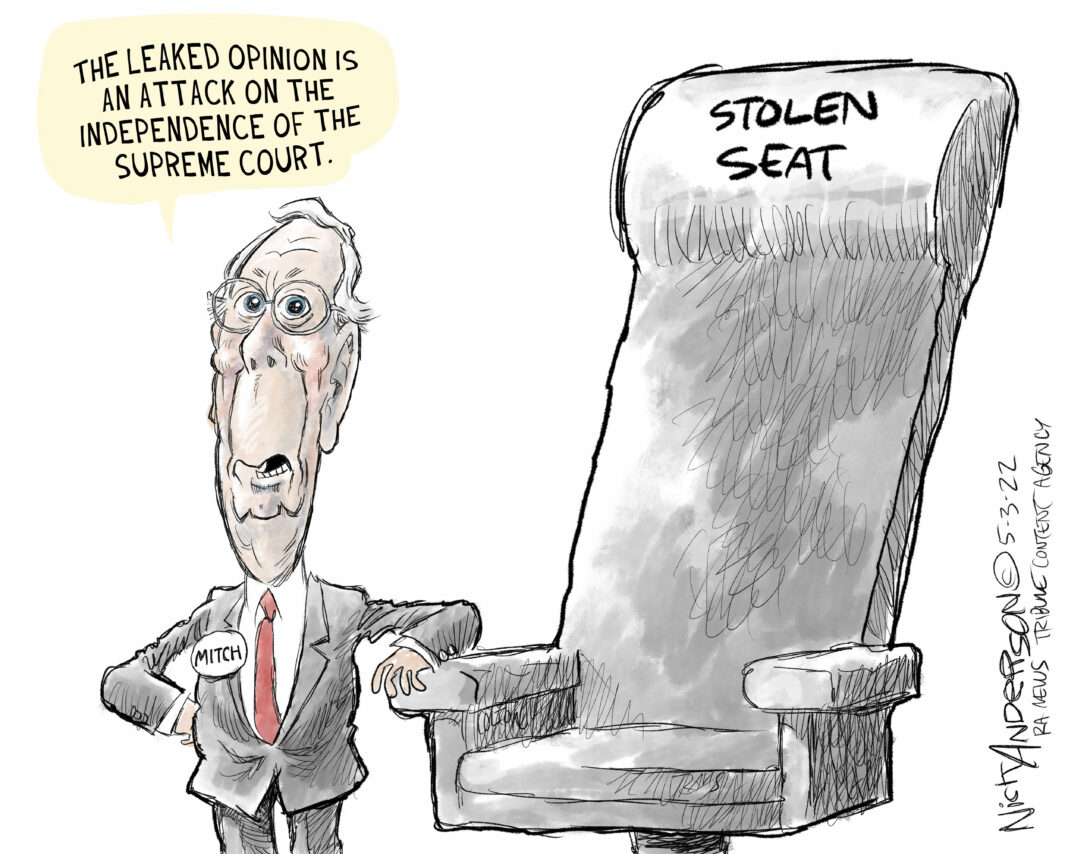
https://www.reformaustin.org/political-cartoons/mitch-mcconnell/

The anti-democratic structure of the Senate. If the Senate were a democratic institution, Mitch would never have been majority leader to begin with, because the GOP would not have achieved a Senate majority any time in the last 24 years.

Here’s how that works: Every state gets two senators, no matter how many people it has. So Wyoming gets one senator for every 140,000 registered voters, while California gets one for every 11 million registered voters. In other words, it takes about 70 California voters have as much influence on the Senate as one Wyoming voter.

Sounds fair, right?

But you might be thinking: “Sure, blue California is under-represented compared to red Wyoming, but red Texas is also under-represented compared to blue Vermont. So maybe it all washes out.”

It doesn’t wash out. If you run the numbers, the last time Republican senators got more votes (over a complete 6-year Senate election cycle) than Democratic senators was 1994-1998. But in the 24 years since 1998, Republicans have held a Senate majority for 12 years: half the time.

In 2016, for example, when Mitch McConnell was using his Republican “majority” to keep President Obama from appointing Merrick Garland, sitting Democratic senators had gotten 50.7% of the total six-year Senate vote, compared to the Republicans’ 44.1%.

In a democratic country, Mitch wouldn’t have been majority leader at all, and Merrick Garland would be on the Court instead of Neil Gorsuch.

Similarly, during the Trump and Bush years, a democratic Senate would have had a Democratic majority. Bush probably could have gotten Alito and Roberts through anyway, because in those rose-colored days senators were not as partisan about the Court. (Alito was approved 58-42, and Roberts 78-22.) But Gorsuch, Kavanaugh, and Barrett would not have been confirmed.

Next, you might be wondering how we got such a skewed Senate. Historical accident, right?

No. Republicans in the late 1800s intentionally packed the Senate by admitting new states with tiny populations. As historian Heather Cox Richardson explained to Bill Moyers:

After 1888, when we get the installment of Benjamin Harrison in the White House, he loses the popular vote by about 100,000 votes. But he’s installed thanks to the Electoral College. The Republicans under Harrison between 1889 and 1890, they let in six new states in 12 months. That was the largest acquisition of new states in American history since the original 13 and it’s never been matched again. They let in North Dakota, South Dakota, Montana, Washington, and then Idaho and Wyoming to go ahead and make sure that they would continue to control the Senate, and the Electoral College. And they’re not hiding this. They actually go onto their media which is their equivalent of the Fox News channel at the time and say, by letting in these states, we’re going to hold onto the Senate for all time and we’re going to make sure we hold onto the White House for all time.

So if you’ve ever wondered why one Dakota wasn’t enough, that’s the reason: Republicans were packing the Senate. The Senate remains skewed in their favor to this day.

It’s almost impossible to unmake states, and hard to imagine passing a constitutional amendment to give larger states more senators, so the easiest way to change the Senate to better reflect the voting public would be to grant statehood to Puerto Rico and D.C., which presumably would elect four Democrats to the Senate. (If Democrats wanted to imitate Republicans, they could give statehood to East and West Puerto Rico, each of which could have a population roughly equal to the two Dakotas put together.) That won’t happen, McConnell says, because eliminating the Senate’s Republican bias would be “full-bore socialism“.

Also, admitting Puerto Rico and D.C. would let a lot of Hispanics and Blacks cast meaningful votes, so that’s a non-starter.

https://claytoonz.com/2022/05/03/goodbye-to-womens-rights/

The Electoral College. Like Benjamin Harrison, Donald Trump was never elected by the American people; he was installed by the Electoral College. In 2016, he got 46% of the vote, almost 3 million votes less than Hillary Clinton’s 48%. But his 46% produced 304 electoral votes to Clinton’s 227.

A less extreme miscarriage of democracy happened in 2000. That election has often been described as “close”, but it really wasn’t that close: Al Gore got half a million more votes than George W. Bush, so there was no doubt who the People chose. But after Florida was adjudicated in his favor (the vote in Florida really was close), Bush’s fewer votes turned into a 271-266 Electoral College win. (Sixteen of those electoral votes come from the aforementioned Montana, Idaho, Wyoming, and the two Dakotas. If they were all one state, it would have 5 million people, or 9 electoral votes; Bush loses.) Bush went on to appoint Justice Alito and Chief Justice Roberts.

Minority-vote presidents aren’t an accident; that’s what the Electoral College was designed to do: make some Americans’ votes count more than others. So in 2016, a few thousand voters in Wisconsin, Michigan, and Pennsylvania overruled much larger majorities in states like California, New York, and Illinois. If you’re a Californian, your vote just doesn’t matter as much as a purple-state vote. Sucks to be you.

Why did the Founders curse us with this unjust system? In a word: slavery. Votes in slave states were supposed to count more than votes in free states.

In 1787, the slave states wanted federal power comparable to their full populations (including slaves), but for obvious reasons they didn’t want to give the vote to slaves (or women, or men who didn’t own enough property). In school, most of us learned about one result of this desire to wield power in the name of people whose rights you totally deny: the 3/5ths Compromise. In setting the number of representatives a slave state got in Congress, its slave population would be included, but at a 40% discount.

That settled the House. The Senate was already undemocratic, so no problem there. But that left the presidency: If presidents were elected by the People, states that let more people vote would have more influence on the outcome.

Can’t have that, so the Electoral College was born. Each state got one electoral vote for each senator or congressman. So no matter how few people a state let vote, its influence on the presidency was guaranteed.

As Shakespeare had Marc Antony say: “The evil that men do lives after them.” Slavery ended with the 13th Amendment in 1865, but the blatant injustice of the Electoral College lives on. Women can thank it for the loss of their bodily autonomy.

https://ifunny.co/picture/evangelical-christians-actual-aclump-of-children-cells-gedxH7mc8

Theocrats. There are people who honestly believe that an ovum acquires a complete human soul the instant it bonds with a sperm. That sounds nutty to me (and it’s completely non-Biblical, so don’t tell me it’s the “Christian” position). But your religion is your own; it doesn’t have to make sense to me.

Where I lose patience is the point where people decide that their theological speculations give them the right to interfere in other people’s lives. You can believe whatever you want about fetuses and souls and abortion. But if you’re not the pregnant woman, what happens to the pregnancy is not your decision. And if no pregnant woman is asking for your advice, your opinion doesn’t matter.

The gullibility of purportedly pro-choice senators. Susan Collins isn’t the only one, but she is definitely on the poster.

My favorite Susan Collins joke describes how she gets lunch in the Senate cafeteria: She studies the menu for half an hour, and then orders the same thing as Mitch McConnell.

That’s pretty literally what happened during the Kavanaugh confirmation. Collins was one of the last senators to commit to Kavanaugh, who was confirmed 50-48. (Collins and Democrat Joe Manchin were the deciding votes.) For weeks, her agonizing decision process had us all speculating about what she would do. In the end, though, after all that dithering, she voted with Mitch McConnell, just as she had on the deficit-busting billionaire-boosting Trump tax cut, and as she did on Trump’s first impeachment. (She said Trump had learned “a pretty big lesson” from being impeached, and predicted that “he will be much more cautious in the future”. She voted to convict on his second impeachment, and says she’s “very unlikely” to support him in the 2024 Republican primaries. But in the general election? She leaves it open. Maybe failing to overthrow democracy on 1-6 taught him something.)

During her speech advocating Kavanaugh’s confirmation, Collins recounted her conversations with the nominee.

Our discussion then turned to the right of privacy, on which the Supreme Court relied in Griswold v. Connecticut, a case that struck down a law banning the use and sale of contraceptives. Griswold established the legal foundation that led to Roe eight years later. In describing Griswold as “settled law,” Judge Kavanaugh observed that it was the correct application of two famous cases from the 1920s, Meyer and Pierce, that are not seriously challenged by anyone today. Finally, in his testimony, he noted repeatedly that Roe had been upheld by Planned Parenthood v. Casey, describing it as “precedent on precedent.” When I asked him would it be sufficient to overturn a long-established precedent if five current justices believed it was wrongly decided, he emphatically said “no.”

Kavanaugh had obviously lied numerous times during is confirmation hearings, but Collins took his affirmations of Roe’s status at face value. Now she describes Kavanaugh’s apparent vote to overturn Roe as “completely inconsistent” with what he told her, but she accepts no responsibility for being such a stooge.

https://www.reddit.com/r/PoliticalHumor/comments/68x91p/but_her_emails/

Pro-choice voters who refused to vote for Hillary Clinton. Who could have foreseen that electing Donald Trump might risk ending abortion rights? Well, everyone, actually. This is from an AP article written in May, 2016:

Scalia’s death was a shock, but the next few years are almost certain to produce more vacancies. Justice Ruth Bader Ginsburg is 83, Justice Anthony Kennedy turns 80 in July and Justice Stephen Breyer will be 78 before the end of the summer. A Trump nominee in any of those seats would cement conservative domination of the court for years, if not decades. By contrast, a victory by the Democrats in November probably would lead to the most liberal Supreme Court in a half-century. …

Advocates on both sides of the abortion debate were quick to react in ways that pointed to the importance of the presidential election. “Donald Trump’s list of potential Supreme Court nominees are a woman’s worst nightmare. Their records reveal a lineup of individuals who would likely overturn Roe v. Wade if given the chance, gutting what’s left of abortion access in this country and heaping punishment on women,” said Ilyse Hogue, president of NARAL Pro-Choice America. On the other side of the issue, Susan B. Anthony List President Marjorie Dannenfelser said Trump’s list was especially strong and stood in contrast to judges Democratic front-runner Hillary Clinton would choose. “There is no question Clinton would only nominate judges who stand in lock-step with the abortion lobby and would strike down even the most modest abortion limits,” Dannenfelser said.

But here’s what Bernie-supporter H. A. Goodman was writing in November, 2015 in a Salon article “Hillary Clinton is on wrong side of everything: Stop telling me I have to vote for her because of the Supreme Court“:

Ruth Bader Ginsburg is fine and the New York Times writes that she has “no interest in retiring.” Justice Scalia isn’t stepping down from the U.S. Supreme Court soon and will only contemplate retirement when he “can’t do the job well.” Anthony Kennedy is in “no rush” to leave the Supreme Court. Justice Breyer has no plans to step down but will “eventually” retire one day.

The paranoid legions, frightful of voting their conscience and actually upholding our democracy, can rest assured that all four Supreme Court justices mentioned are still capable of lasting four more years.

It turned out that Scalia didn’t last six months. But even after his death reminded everyone that you never know, here’s an article advocating that gay progressives vote for Jill Stein, because even if those votes did happen to cost Hillary the election, “Trump would be an acceptable setback for the ultimate greater good.”

Many are quick to point out that this election is actually about who gets to nominate Supreme Court judges and I agree that it is better to elect a candidate who would nominate liberals to these positions.

But anyone who knows politics knows that all of the potentially vacant seats are currently occupied by conservatives, so in the worst case scenario, after Obama nominates, liberals will still have a 5-4 advantage.

That worked out great, didn’t it? Obama would choose Scalia’s replacement, Ginsburg would live forever, and Kennedy was already a “conservative”, so nobody needed to worry about a Federalist Society extremist replacing him. Supreme Court? Not a problem.

Every pro-choice American who has treated abortion as a secondary issue. For nearly fifty years, pro-choice politicians have hidden behind the Supreme Court, and pro-choice voters have let them do it.

Now that Roe is being overturned, Democrats are beginning to work on protecting abortion rights through federal legislation. But given their narrow majority in the Senate and a few Democratic senators’ unwillingness to end the filibuster, they will be unable to pass that legislation.

But Democrats have had Senate majorities about half the time in recent decades, and for about six months during the Obama administration, they had a filibuster-proof majority. Roe could have been codified then. Or the filibuster could have been eliminated long ago, when the party had a few votes to spare, and then Roe could have been codified.

Even if they could not pass legislation, they could have made Republicans vote it down again and again. They could have challenged those legislators to explain that vote to their constituents.

But it was easier to rely on the Court. As a result, after the Supreme Court’s protection of abortion rights ends, there is no second line of defense. Abortion rights are already gone in Texas, and will vanish in many other states in June.

It didn’t have to be this way.
What Alito wrote

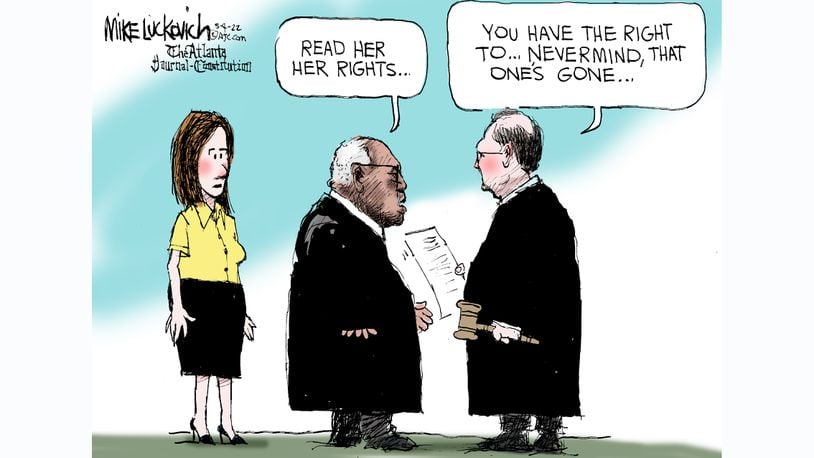
https://www.ajc.com/opinion/mike-luckovich-blog/54-mike-luckovich-going-going-gone/PW5FT437ZJENHNII5YQRL2STFM/

A summary of his arguments, and how they might be used to take away other constitutional rights.


A week ago, Politico released a leaked draft of Supreme Court Justice Samuel Alito’s opinion overturning Roe v Wade. Politico claimed this was to be the majority opinion, representing not just Alito, but supported by Justices Thomas, Gorsuch, Kavanaugh, and Barrett as well. The draft dates from February, and we do not know what revisions may have been made since. The decision on the case (Dobbs v Jackson Women’s Health) is expected to be released before the Court’s current term ends in June.

The case concerns a Mississippi law that bans abortions after 15 weeks, in violation of the existing Supreme Court precedents. The Court has three basic options:

  • Respect the Roe and Casey precedents by invalidating the Mississippi law.
  • Create a loophole that allows the law to take effect, and chips away at abortion rights in general, but does not overturn Roe in its entirety.
  • Overturn Roe, allowing states to regulate or ban abortions as they see fit.

This is how I summarized the situation in March:

So it’s clear which approach Roberts will favor: Don’t make headlines by reversing Roe, but chew away at it by creating a loophole for Mississippi, maybe by changing the definition of “viability”. The language of such a decision could subtly invite states to push the boundary further, until a woman’s right to control her own pregnancy would have little practical meaning. Roe would continue to stand, but like a bombed-out building without walls or a roof, would protect no one.

That probably won’t happen, though, for a simple reason: When Barrett replaced Ruth Bader Ginsburg, Roberts lost control of the Court. He is no longer the swing vote, so he loses 5-4 decisions when he sides with the Court’s three surviving liberals.

And I warned that reversing Roe would not be the final chapter of this saga.

Roe doesn’t stand alone. It is part of a web of substantive due process decisions on a variety of issues. Reversing Roe will send ripples through the whole web, putting all those rights up for grabs.

So here we are. Unless something inside the Court has drastically changed since February, the constitutional right to abortion, which has existed for 49 years, will vanish sometime in June, and a number of other rights will be in doubt, including the right to use birth control, for consenting adults to choose their own sexual practices, and for two people of any race or gender to marry.

What does Alito’s ruling do? Alito has written an unambiguous reversal of Roe.

We hold that Roe and Casey must be overruled. The Constitution makes no reference to abortion, and no such right is implicitly protected by any constitutional provision. … Roe was egregiously wrong from the start. Its reasoning was exceptionally weak, and the decision has had damaging consequences.

Unenumerated rights. No one claims that the word “abortion” appears in the Constitution. But there are several places where a judge might find implicit protection for rights not specifically listed:

  • The Ninth Amendment, which says “The enumeration in the Constitution, of certain rights, shall not be construed to deny or disparage others retained by the people.” This recognizes the existence of rights beyond those the Constitution mentions, but provides little basis for identifying them.
  • The Equal Protection Clause of the 14th Amendment, which guarantees “any person” within the jurisdiction of the states “the equal protection of the laws”. Judges at many levels have, for example, rooted same-sex marriage here — same-sex couples are guaranteed the equal protection of the marriage laws — but Justice Kennedy’s majority opinion in Obergefell gave equal protection a secondary role.
  • The Due Process Clause of the 14th Amendment, which says that no one can be deprived of “liberty” without due process of law. Abortion and the related privacy rights have been rooted here, in a doctrine called “substantive due process”, which I described in March.

Another place to look for an unenumerated right is in Supreme Court precedents themselves. Under the doctrine of stare decisis, the Court will usually stand by a previous decision, even if the current justices believe the case was wrongly decided. For example, corporate personhood arises from a bad decision the Court made in 1886. It continues to be upheld despite the fact that the word “corporation” does not appear in the Constitution.

His arguments. Alito dismisses the equal-protection option like this:

[I]t is squarely foreclosed by our precedents, which establish that a State’s regulation of abortion is not a sex-based classification and is thus not subject to the “heightened scrutiny” that applies to such classifications. The regulation of a medical procedure that only one sex can undergo does not trigger heightened constitutional scrutiny unless the regulation is a “mere pretext designed to effect an invidious discrimination against one sex or the other.”

Due-process rights not otherwise mentioned in the Constitution, Alito writes, have to pass what is called the Glucksberg Test:

[T]he Court has long asked whether the right is “deeply rooted in [our] history and tradition” and whether it is essential to our Nation’s “scheme of ordered Liberty.”

He concludes that the right to abortion does not pass this test.

Until the latter part of the 20th century, there was no support in American law for a constitutional right to obtain an abortion. Zero. None. No state constitutional provision had recognized such a right. Until a few years before Roe was handed down, no federal or state court had recognized such a right. Nor had any scholarly treatise of which we are aware. …

Not only was there no support for such a constitutional right until shortly before Roe, but abortion had long been a crime in every single State.

Much of the opinion’s 98 pages consists of a long history lesson about state laws and common law cases.

Alito also addresses the possibility that a right to abortion is part of a broader right to privacy, which does pass Glucksberg.

Casey described it as the freedom to make “intimate and personal choices” that are “central to personal dignity and autonomy”. Casey elaborated: “At the heart of liberty is the right to define one’s own concept of existence, of meaning, of the universe, and of the mystery of human life.”

Alito also dismisses this justification in what is by far the weakest part of his argument, consisting mostly (in my opinion) of question-begging and because-I-said-so.

Our nation’s historical understanding of ordered liberty does not prevent the people’s elected representatives from deciding how abortion should be regulated. … This attempts to justify abortion through appeals to a broader right to autonomy and to define one’s “concept of existence” prove too much. Those criteria, at a high level of generality, could license fundamental rights to illicit drug use, prostitution, and the like.

What sharply distinguishes the abortion right from the rights recognized in the cases on which Roe and Casey rely is something that both those decisions acknowledged: Abortion destroys what those decisions call “potential life” and what the law at issue in this case regards as the life of an “unborn human being.” None of the other decisions cited by Roe and Casey involved the critical moral question posed by abortion. They are therefore inapposite. They do not support the right to obtain an abortion

And finally he dismisses stare decisis.

In this case, five factors weigh strongly in favor of overruling Roe and Casey: the nature of their error, the quality of their reasoning, the “workability” of the rules they imposed on the country, their disruptive effect on other areas of the law, and the absence of concrete reliance.

I found this part bizarre. Alito’s first two factors just reiterate that he disagrees with the original decision, which is a precondition for stare decisis being relevant at all. (If you agree with a precedent, you don’t need a doctrine to tell you to follow it.) His examples of the “unworkability” and “disruptive effect” of the Roe framework (as adjusted by Casey) are mostly examples of state legislatures persistently attempting to find loopholes that allow them to harass women seeking abortions, and engaging in bad-faith efforts to sneak harassment in as health regulations, building codes, and other Trojan horses.

Would Alito find gun-right decisions (like Heller) “unworkable” if blue states persistently harassed gun owners and forced courts to keep striking down bad-faith laws by the dozens year after year? I doubt it.

And as for “reliance”, I look at my own reliance on Roe (which I explained ten years ago): My wife and I planned our life together around the assumption that we would not have children. We took precautions to prevent pregnancy, but ultimately we could not have fully trusted our plans if abortion had not been an option.

This is not something special about us. Around the nation, women are planning their lives and careers based on the belief that they will not have to carry a fetus, give birth, or raise a child until they decide to do so. In a very real sense, women are not equal to men in a world without abortion.

More critically, since any form of birth control can fail, women whose lives will be in danger if they get pregnant will have to give up sex if abortion is not available.

So Alito’s assertion that there are no “reliance interests” in Roe is just absurd. He doesn’t rely on Roe, so he thinks no one does.

The problem with “deeply rooted in this Nation’s history and tradition”. You know what definitely is “deeply rooted in this Nation’s history and tradition”? Sexism, racism, and bigotry of all sorts. If “liberty” is going to be defined by what that word meant when the 14th Amendment passed in 1868, then only straight White Christian men will ever have unenumerated rights protected by substantive due process. Justice Kennedy acknowledged as much in his Obergefell opinion:

If rights were defined by who exercised them in the past, then received practices could serve as their own continued justification and new groups could not invoke rights once denied.

Jill Lepore went further in The New Yorker:

There is nothing in [the Constitution] about women at all. Most consequentially, there is nothing in that document—or in the circumstances under which it was written—that suggests its authors imagined women as part of the political community embraced by the phrase “We the People.” There were no women among the delegates to the Constitutional Convention. There were no women among the hundreds of people who participated in ratifying conventions in the states. There were no women judges. There were no women legislators. At the time, women could neither hold office nor run for office, and, except in New Jersey, and then only fleetingly, women could not vote. Legally, most women did not exist as persons.

… Women are indeed missing from the Constitution. That’s a problem to remedy, not a precedent to honor.

Think about the common-law authorities Alito cites, and some of their other opinions. In addition to opinions about abortion, for example, Sir William Blackstone’s Commentaries on the Laws of England also includes this assessment of a wife’s personhood:

By marriage, the husband and wife are one person in law: that is, the very being or legal existence of the woman is suspended during the marriage, or at least is incorporated and consolidated into that of the husband: under whose wing, protection, and cover, she performs every thing; and is therefore called in our law-french a feme-covert; is said to be covert-baron, or under the protection and influence of her husband, her baron, or lord; and her condition during her marriage is called her coverture.

And Thomas Hale, who, in addition to sentencing two women to death for witchcraft, also had a lasting impact on the law unrelated to abortion, which became known Hale’s Principle:

but the husband cannot be guilty of a rape committed by himself upon his lawful wife, for by their mutual matrimonial consent and contract the wife hath given up herself in this kind unto her husband, which she cannot retract.

Lepore notes the opinions that Alito does not cite:

Alito cites a number of eighteenth-century texts; he does not cite anything written by a woman, and not because there’s nothing available. “The laws respecting woman,” Mary Wollstonecraft wrote in “A Vindication of the Rights of Woman,” in 1791, “make an absurd unit of a man and his wife, and then, by the easy transition of only considering him as responsible, she is reduced to a mere cypher.” She is but a part of him. She herself does not exist but is instead, as Wollstonecraft wrote, a “non-entity.”

So Alito’s litany that prior to the 20th century abortion rights can be found in

no state constitutional provision, no statute, no judicial decision, no learned treatise

is much less impressive when you realize that no woman had any input into these documents. I find it hard to argue with Lepore’s conclusion:

To use a history of discrimination to deny people their constitutional rights is a perversion of logic and a betrayal of justice.

How should we justify unenumerated rights? History is a fine tool to use when judging what unenumerated rights the Constitution implicitly guarantees to individuals and groups who were enfranchised and empowered at the time (such as straight White Christian men). But in order to keep those rights from further enlarging the unfair advantages those individuals and groups already have, we need to combine those historical findings with a generous respect for the equal protection of the laws.

Justice Kennedy recognized just such a conjunction of prinicples in Obergefell:

The Due Process Clause and the Equal Protection Clause are connected in a profound way, though they set forth independent principles. Rights implicit in liberty and rights secured by equal protection may rest on different precepts and are not always co-extensive, yet in some instances each may be instructive as to the meaning and reach of the other. In any particular case one Clause may be thought to capture the essence of the right in a more accurate and comprehensive way, even as the two Clauses may converge in the identification and definition of the right.

For example: Do men have a traditional right to bodily autonomy, even when someone else’s life is at stake? Of course they do. American law has never forced a man to, say, donate a kidney to someone who will die without it. That would be absurd. But if a woman can be forced to risk her own lives to save the life of a fetus, does she enjoy the equal protection of the laws? I don’t think so.

Many of the same men who would force a woman to give up months of her life or even risk death for a fetus also believe that the Constitution protects them against the comparatively trivial inconvenience of a vaccine shot that might save not just their own lives, but the lives of the fellow citizens that they might otherwise infect. This is not equality under the law.

And about that history … A number of authors suggest that Alito’s reading of the history of abortion is biased. One of the more amusing examples of the historical acceptance of abortion in America is Ben Franklin’s abortion recipe, which he published in 1748 as part of a textbook.

And a brief prepared for this case by the American Historical Association contradicts Alito:

The common law did not regulate abortion in early pregnancy. Indeed, the common law did not even recognize abortion as occurring at that stage. That is because the common law did not legally acknowledge a fetus as existing separately from a pregnant woman until the woman felt fetal movement, called “quickening,” which could occur as late as the 25th week of pregnancy. This was a subjective standard decided by the pregnant woman alone and was not considered accurately ascertainable by other means.

Are other rights at risk? Alito explicitly denies that his reasoning leads to the end of other rights associated with substantive due process:

As even the Casey plurality recognized, “abortion is a unique act” because it terminates “life or potential life”. … And to ensure that our decision is not misunderstood or mischaracterized, we emphasize that our decision concerns the constitutional right to abortion and no other right. Nothing in this opinion should be understood to cast doubt on precedents that do not concern abortion.

While it is true that lower courts cannot directly quote Alito’s ruling to support eliminating other privacy rights, anti-abortion extremists also describe the pill, Plan B, and IUDs — and basically all birth control other than barrier methods — as “abortificants”. If states can ban abortion, they can ban these as well.

A bill currently advancing through the Louisiana legislature would define personhood as beginning “at fertilization”, which would make the use of an IUD attempted murder. This law would probably pass muster with Alito, who says that abortion laws going forward need only pass a rational basis test, the loosest possible legal standard.

And nothing stops these same five justices from walking the same path for a different issue on a different case. Consider what Alito writes about a right to abortion:

Not only are respondents and their amici unable to show that a constitutional right to abortion was established when the Fourteenth Amendment was adopted, but they have found no support for the existence of an abortion right that predates the latter part of the 20th century — no state constitutional provision, no statute, no judicial decision, no learned treatise.

This statement is equally true if you replace “abortion” with “same-sex marriage” or “interracial marriage” or “sodomy”. Why would the radical conservative justices not make that substitution in some future case?

Vox’ Ian Millhiser points out that Alito has already made a similar argument against same-sex marriage.

Though Alito’s Dobbs opinion largely focuses on why he believes that the right to abortion fails the Glucksberg test, there is no doubt that he also believes that other important rights, such as same-sex couples’ right to marry, also fail Glucksberg and are thus unprotected by the Constitution. Alito said as much in his Obergefell dissent, which said that “it is beyond dispute that the right to same-sex marriage is not among those rights” that are sufficiently rooted in American history and tradition.

Every issue, when you come down to it, is “unique” in some way. If criminalization in 1868 shows that a right does not exist, then clearly the right of consenting adults to choose their own sexual practices, for example, is not “deeply rooted in this Nation’s history and tradition” or “implicit in the concept of ordered liberty”. Neither is the right to marry the person of your choice.

This is where it matters that Alito and his fellow conservative justices made so many misleading and deceptive statements during their confirmation hearings. Could Alito’s statement that he does not “cast doubt on precedents that do not concern abortion” be one more deceptive reassurance that will only last until the five radical justices find a more convenient opportunity to take away other rights that contradict their conservative interpretations of Christianity?

Harvard Law Professor Mary Ziegler thinks it probably is:

The Court can draw whatever distinctions it likes and dodge the cases it doesn’t. But the draft of Dobbs v. Jackson Women’s Health Organization stresses that states were criminalizing abortion. True enough. But in the late 19th century, Congress passed the Comstock Amendment, which criminalized contraception. States criminalized same-sex intimacy.

The draft suggests that abortion is different because of the state’s impact on fetal life. This language — and the draft’s historically questionable narrative about the doctors who originally pushed to ban abortion — will encourage antiabortion leaders to ask the conservative justices to declare that a fetus is a rights-holding person under the Fourteenth Amendment — and that abortion is unconstitutional in blue as well as red states.

If this is where a final opinion ends up, the Court has painted itself into a corner — and maybe by design. Whether abortion is different or not, the Court will not likely send this back to the states for good. It will simply invite conservatives back for the next round.

In short, anyone who trusts Alito’s statement, and so believes that birth control (Griswold), same sex marriage (Obergefell), interracial marriage (Loving), and homosexuality (Lawrence) are secure, is a fool.

We know who Samuel Alito is, and he is not trustworthy.

The Monday Morning Teaser

This week’s Sift is going to center on the Supreme Court and abortion.

If you haven’t been on Mars or under a rock, you know that a draft of a Supreme Court decision overturning Roe v Wade and eliminating constitutional protection for abortion rights came out Monday night. This is a big deal, both in itself and in what it presages about future decisions. We can expect red states to pass not only laws banning abortion (which are already on the books in many of them), but also challenges to birth control, same-sex marriage, and other previously accepted constitutional rights. This decision may not immediately validate such laws, but the logic it uses could be repurposed to overturn other Supreme Court precedents.

I’ve written two featured posts that consider this issue from different angles. The first, which should be out shortly, is a legal analysis of what Justice Alito’s draft says, assuming that it becomes the opinion of the Court next month. The second asks how we got here, and more specifically “Who’s to blame for overturning Roe?” That should appear around 10 EDT.

Even that doesn’t finish covering the issue, though, so the weekly summary will take up the political implications going forward.

Also in the summary: Today is Victory Day in Russia, and yet the new offensive in Ukraine continues to go badly. Trump Defense Secretary Mark Esper has a book giving new reasons to believe Trump is/was unfit to be president, and that we dodged a bullet by getting him out of office without even greater damage to the Republic. The pandemic continues to heat up again. The debate about what to do about student loans continues. And a few other things are going on.

I’ll try to get that out by noon.

WWRJD?

Ask yourself this question: If Russian journalists, who are losing their livelihoods and their freedom for daring to report on what their own government is doing, if they had the freedom to write any words, to show any stories, or to ask any questions, if they had, basically, what you have, would they be using it in the same way that you do? Ask yourself that question every day, because you have one of the most important roles in the world.

Trevor Noah, at the White House Correspondents Dinner

This week’s featured post is MAGA 2.0.

During my week off, I spoke at the Unitarian Church of Quincy, Illinois (my hometown). I converted the Sift post “How did Christianity become so toxic?” into a sermon “Where Christianity Went Wrong”. The text is here and the audio there.

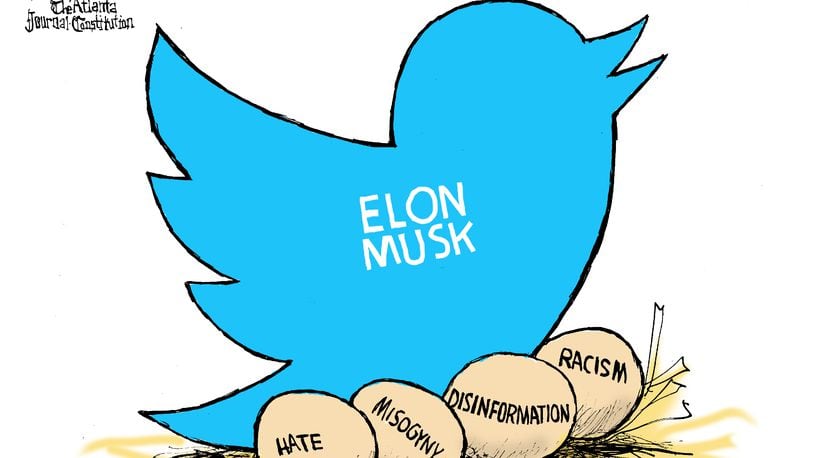
This week everybody was still talking about Musk and Twitter

https://www.ajc.com/opinion/mike-luckovich-blog/427-mike-luckovich-soon-to-hatch/Z54QNZBSNBCVFDEMUYX2SVAAME/

So far it looks like Musk’s takeover is really happening, though it still could fall through.

Like Adam Serwer, I am skeptical of Musk’s “free speech” rhetoric.

The fight over Twitter’s future is not really about free speech, but the political agenda the platform may end up serving. As Americans are more and more reliant on a shrinking number of wealthy individuals and companies for services, conservatives believe having a sympathetic billionaire acquire Twitter means one less large or influential corporation the Republican Party needs to strongarm into serving its purposes. Whatever Musk ends up doing, this possibility is what the right is actually celebrating. “Free speech” is a disingenuous attempt to frame what is ultimately a political conflict over Twitter’s usage as a neutral question about civil liberties, but the outcome conservatives are hoping for is one in which conservative speech on the platform is favored and liberal speech disfavored. …

The fact that conservative concerns about Big Tech vanish the second a sympathetic billionaire buys a social-media platform, however, illustrates the shallowness of their complaints about the power of Silicon Valley. Conservatives are not registering their concern over the consolidation of corporate power so much as they are trying to ensure that consolidation serves their interests. Put simply, conservatives hope that Twitter will now become a more willing vehicle for right-wing propaganda.

An issue that hasn’t gotten nearly enough attention is that Musk-ownership links Twitter’s interests to Tesla’s. And Tesla builds and sells a lot of cars in China. What happens when the Chinese government demands favorable treatment on Twitter (or deplatforming of its critics), and threatens to shut Tesla down? If Musk thinks he’s too rich to push around, he should have a talk with Alibaba’s Jack Ma.

and more January 6 revelations

Few stories illustrate the corruption of the Republican Party like the recent Kevin McCarthy tapes. It started with a report in the new book “This Shall Not Pass” by NYT reporters Alexander Burns and Jonathan Martin, that shortly after the 1-6 insurrection, House GOP Leader McCarthy told other members of the leadership team that he was going to tell President Trump it was time to resign. McCarthy branded the report “totally false and wrong”, and his spokesman said “McCarthy never said he’d call Trump to say he should resign.”

Except that he did, and it’s on tape.

McCarthy has long since come crawling back to Trump, of course, and now he hopes for Trump’s support in becoming Speaker, should the GOP take the House majority this fall. You might think that Trump would be angry to find out that McCarthy was saying such things in private, but in fact he’s not.

Trump doesn’t need Republican leaders to believe in him. He just needs them to be spineless, and McCarthy is.


Texts exchanged before the election between Sean Hannity and Mark Meadows came out. Meadows, who was then White House chief of staff, gave Hannity instructions about what to stress on his radio show, to which Hannity replied “Yes sir.”

The texts show the kind of political subservience that CNN fired Chris Cuomo for. But Fox News’ standards are much lower, and Hannity has not been disciplined in any way.


The Manhattan grand jury investigating Donald Trump for possible fraudulent bank and tax fraud is expiring without issuing an indictment, making such charges unlikely, though the DA says investigations will continue. The Washington Post has published a summary of the various Trump investigations and where they stand.

and the line between church and state

The Supreme Court heard arguments in the case of a football coach who led players in prayer on the 50-yard-line after games. His claim is that his prayers are private religious acts protected by the First Amendment’s free-exercise clause. I’m not sure why this private act needs to happen on the 50-yard-line, but the Court’s conservative majority didn’t seem bothered by this.

I will be more interested in the Court’s reasoning than in the decision itself. Whatever standard the justices use to find in the coach’s favor, does it apply to non-Christians, or is this yet another special right that Christians have and no one else does? It seems entirely implausible to me that we would be having this discussion if the coach were performing a Muslim or Hindu ritual.

The best thing I read about this case appeared in Baptist News Global, where the coach’s case was related to another recent story about Christians who turned a commercial air flight into a hymn-sing.

The common thread is performative Christianity that operates out of a place of assumed privilege. That is a privilege so taken for granted that the average American Christian has no clue they are swimming in it.

… The parallel to this, of course, is the thousands of evangelicals who have been trained — literally trained — to use places like airplanes to evangelize their seatmates. What Christians may see as a God-ordained witnessing opportunity, the poor seatmate may see as religious assault.

Such attitudes and actions from Christians are not evil, but they are misguided. And they originate from a place of assumed privilege. As I’ve written before, there’s an easy test to understand this: What if the roles were reversed and you, dear Christian, were seated next to an evangelizing Muslim or Hindu or Mormon or atheist? Would you afford them the same assumed privilege you claim for yourself? I don’t think so.

Modern Christians must understand that we live in an increasingly pluralistic society and that assuming Christian privilege actually does more harm than good. If you want to be a good witness for Jesus, this is not the way to do it. It is tone deaf and arrogant and rude — pretty much the opposite of every virtue of love described in 1 Corinthians 13.


Chaz Stevens, whose Twitter handle describes him as “stunt activist“, is responding to a new Florida law giving parents more input into school decisions by asking school districts across the state to ban the Bible.

On the one hand, he’s pushing precisely the point I was making above: The law needs to apply to Christians the same way it applies to everyone else. And he’s absolutely correct that the Bible describes murder, adultery, sexual immorality, and infanticide — stuff that would absolutely get any other book banned from Florida schools.

But at the same time, this tactic points out a strategic weakness in the secular position: We want to defend public schools, while Christian nationalists are looking for excuses to privatize them. Any tit-for-tat that drives public support away from the schools hurts us in the long run. If we ban their books after they ban ours, we’re still losing.


Meanwhile, Marjorie Taylor Greene says of Catholic Relief, an organization that assists immigrants: “Satan’s controlling the church.


In previous weeks, I’ve talked about the right-wing takeover of the public library system in Llano County, Texas, which resulted in firing a librarian who wouldn’t cooperate. Last week, residents sued in federal court, charging that books are being removed without public hearings or any other due process.


The Texas school district in Southlake got bad publicity last fall when an administrator was taped advising teachers to “balance” books about the Holocaust with opposing perspectives.

The school district has come up with a way to make sure that doesn’t happen again: A “non-disparagement clause” has been added to teachers’ contracts. The problem isn’t what the administrator said, it’s that somebody snitched to the press.

and the war in Ukraine

It’s too soon to draw a firm conclusion about how Russia’s Plan B — advance in the Donbas rather than try to take Kyiv — is going, but the early reports look familiar: slow progress and heavy losses.


The Economist has a fascinating article about the Russian army’s radio problems. They know how to make secure hard-to-jam radios, but they didn’t procure enough of them, so only elite units have them. When those units try to coordinate with less-elite units, they end up reverting to more primitive equipment, including off-the-shelf walkie-talkies. The Ukrainians intercept their communications, and sometimes jam them by broadcasting heavy metal music on the same frequencies.

This is one example of a larger logistical problem: Apparently the Russian procurement system is even less efficient and more corrupt than ours.

“They put a lot of money into modernisation,” says [retired Czech] General [Petr] Pavel. “But a lot of this money was lost in the process.”

and the pandemic

Reported cases per day in the US have doubled since they bottomed out at 26K on April 3. They’re now up to 56K. Hospitalizations turned up about two weeks later, as they usually do. They bottomed at 14.8K on April 18, and are now at 17.1K. The number of Covid patients in ICUs bottomed at 1886 on April 22, and is now 1985.

Deaths are still dropping, about four weeks after case numbers turned up, and more than a week after ICU patients bottomed. An average of 321 Americans are dying of Covid each day, down considerably from 2652 on February 1. I thought that might be unusual, but it appears not. The last time deaths turned upward was on November 30, 20 days after hospitalizations bottomed, and 18 days after ICU patients bottomed. That would suggest that we’re about 10 days from deaths beginning to increase.

and you also might be interested in …

The White House Correspondents’ Dinner was held Saturday. Trevor Noah’s monologue is worth the time.


Solar energy is booming in both Texas and California, but in different ways that reflect different styles of government.

Texas solar projects often come with a “batteries not included” designation. In the Lone Star State, among Interconnection Agreement-signed projects expected to reach COD through 2024, only 28% of the 120 solar projects with completed are solar + battery projects. Again, this compares to nearly 99% of solar projects in California.

California is aiming towards a future where renewable energy replaces fossil fuels, and that requires batteries. Otherwise, you still need fossil-fuel or nuclear plants to generate electricity when the sun isn’t shining and the wind isn’t blowing.

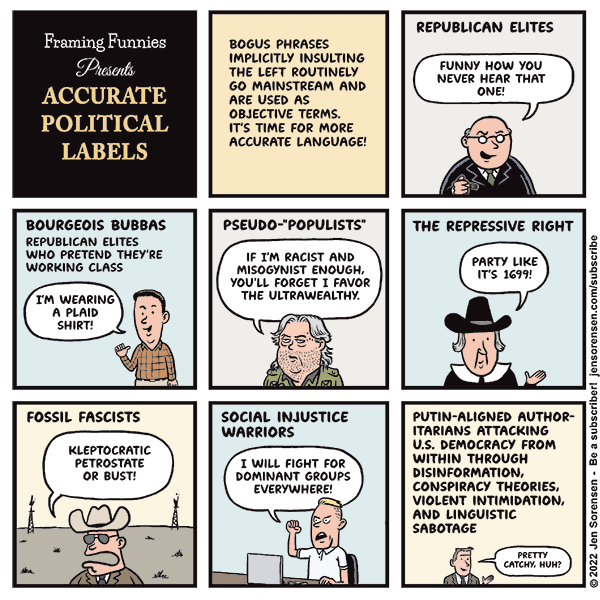
https://jensorensen.com/2022/04/20/accurate-political-labels/

and let’s close with something bookish

Back in the old days, the stereotypic librarian was a dowdy woman shushing anybody who spoke above a whisper. These days, though, a big part of a librarian’s job is doing silly things to encourage reading. Electric Lit has collected librarian music parodies, like “Unread Book” to the tune of “Uptown Funk”.

MAGA 2.0

https://www.ajc.com/opinion/mike-luckovich-blog/422-mike-luckovich-mickey-and-ronald/472WF6YUX5AHJLNSUV2HPYQ5CU/

What if Trump isn’t the worst of our problems?


To many Americans, what’s been going on in Florida lately must seem so bizarre as to be almost comic. It’s gotten increasingly difficult to tell real headlines from stories in The Onion.

The witchhunt against critical race theory has gotten so out of hand that math textbooks are being banned. Public-school teachers who tell their students about the mere existence of same-sex marriages or people who transition from one gender to another (facts that may be necessary to understand other students in the classroom or their families) are not just breaking the law, they are said to be grooming the students for abuse by pedophiles. And if you object to that law, you too are probably grooming kids for pedophiles.

When the Disney Corporation came out (too late) against the law, the DeSantis administration punished it by getting the legislature to reverse the company’s completely unrelated tax advantage — a move which might be illegal, but otherwise will put two Florida counties on the hook for a billion dollars of debt.

When was the last time a Republican governor declared war on a corporation that employs 75,000 of his constituents?

If you think DeSantis’ actions don’t fit any American model of political behavior, you’re right. But that doesn’t mean they’re completely unprecedented. As Zack Beauchamp observed in Vox, the model is Viktor Orbán’s “illiberal democracy” in Hungary. And it may be the next step in the evolution of Trumpism.

The difference between Orbánism and traditional conservatism. The central message of traditional American conservatism is that government needs to get out of the way so that the private sector can create prosperity. So: low taxes, limited regulation, limited government services for the people. What working people miss in public goods (like parks, public education, healthcare, and economic security) supposedly will be more than balanced by all the good-paying jobs that will trickle down from unfettered capitalism.

That rhetoric was never fully embodied in conservative policy, which was fine with government intervention that subsidized oil exploration, the defense industry, and other big-corporate interests. But in spite of occasional inconsistencies, it was a reliable first guess at how conservatives would view an issue.

Traditional conservatives nodded in the direction of the culture war, but their hearts were never in it. Instead, they made cynical use of social/cultural issues to win elections, so that they could assemble enough power to push their small-government economic agenda, as Thomas Frank described in What’s the Matter With Kansas? in 2004.

The trick never ages; the illusion never wears off. Vote to stop abortion; receive a rollback in capital gains taxes. Vote to make our country strong again; receive deindustrialization. Vote to screw those politically correct college professors; receive electricity deregulation. Vote to get government off our backs; receive conglomeration and monopoly everywhere from media to meatpacking. Vote to stand tall against terrorists; receive Social Security privatization. Vote to strike a blow against elitism; receive a social order in which wealth is more concentrated than ever before in our lifetimes, in which workers have been stripped of power and CEOs are rewarded in a manner beyond imagining.

Orbánism, by contrast, uses social/cultural issues as a way to increase government power and entrench the Orbán regime’s hold on that power. Beauchamp explains:

Orbán’s political model has frequently employed a demagogic two-step: Stand up a feared or marginalized group as an enemy then use the supposed need to combat this group’s influence to justify punitive policies that also happen to expand his regime’s power. Targets have included Muslim immigrants, Jewish financier George Soros, and most recently LGBTQ Hungarians.

Whoever the current scapegoat is, the ultimate enemy is always the same: the “cultural elite”.

Broadly speaking, both Orbán and DeSantis characterize themselves as standing for ordinary citizens against a corrupt and immoral left-wing cosmopolitan elite. These factions are so powerful, in their telling, that aggressive steps must be taken to defeat their influence and defend traditional values. University professors, the LGBTQ community, “woke” corporations, undocumented immigrants, opposition political parties — these are not merely rivals or constituents in a democratic political system, but threats to a traditional way of life.

In such an existential struggle, the old norms of tolerance and limited government need to be adjusted, tailored to a world where the left controls the commanding heights of culture. Since the left can’t be beaten in that realm, government must be seized and wielded in service of a right-wing cultural agenda.

The difference between Orbánism and Trumpism. At its root, Trumpism has always been a personality cult. If that wasn’t already obvious in 2016, it certainly had became so by 2020, when the Republican Convention refused to update its platform, replacing it instead with a resolution whose only substantive point was

RESOLVED, That the Republican Party has and will continue to enthusiastically support the President’s America-first agenda

In other words: The Republican Party stands for whatever President Trump chooses to announce. The party’s position on healthcare, education, foreign policy, immigration, and everything else is whatever Trump says it is.

Since Trump lost the 2020 election and tried (unsuccessfully) to stay in power anyway, Trumpworld has gotten even more culty: Where you stand in MAGA-land depends not on your support or opposition to any political philosophy or policy proposal, but what you say about Trump. Liz Cheney has been tossed out of the Wyoming Republican Party because she denies that Biden stole the election and holds Trump responsible for the 1-6 coup attempt. Marjorie Taylor Greene is at the center of the movement, because she has never breathed a word against the Orange One. If Brad Raffensperger had “found” the 11,780 votes Trump needed to win Georgia, he’d have Mar-a-Lago’s full support. But he didn’t, so Trump is campaigning against him.

Trump has become associated with both social conservatism and traditional conservatism, but the relationship is almost entirely opportunistic: Trump says things to his crowds, and if they respond he uses the line again. In the course of the 2016 campaign, these applause lines evolved into slogans, like “Build a Wall”. After he took office, underlings were tasked with turning those slogans into policies. The policies often seemed half-baked because they were: Candidate Trump never had any idea how he would implement his applause lines.

But in hindsight we often overlook all the times when candidate Trump floated liberal ideas, like when he told 60 Minutes that his healthcare plan would cover everybody and “the government’s gonna pay for it”. Or when he said his tax plan would raise taxes on the rich. If his stadium crowds had responded to those proposals the way they responded to building a wall or banning Muslims, he would happily have stolen Bernie’s agenda, and underlings would have been tasked with turning those slogans into programs.

The point was never policy. It was big, beautiful crowds cheering for Trump.

He got elected as a Republican, so he staffed his administration with Republicans and leaned on Republicans in Congress to create legislative victories for him. That was as far as his governing vision went. Paul Ryan already had a tax plan — one that handed trillions of dollars to corporations and the very rich — so that got passed. No two Republicans in Congress had the same vision of how to replace ObamaCare, so nothing happened.

Trump ended up appealing to the same kind of voters Orbán targeted — the racists, sexists, homophobes, xenophobes, and Islamaphobes Hillary Clinton labeled a “basket of deplorables” — so Trumpism started converging towards Orbánism. But it never completely got there, because ultimately Trumpism could only be about Trump. Beauchamp explains:

During his presidency, many observers on both sides of the aisle compared Trump to the Hungarian autocrat — and not without some justification. But after a 2018 visit to Hungary, I concluded that Trump was not competent or disciplined enough to implement Orbán-style authoritarianism in America on his own. The real worry, I argued, was a GOP that took on features of Orbán’s Fidesz party.

In the end, Trump is Trumpism’s biggest weakness: It’s the personality cult of a man with an unappealing personality. No wonder over 80 million Americans turned out to vote against him in 2020.

The law as a weapon. One point of convergence between Trump and Orbán is the use of boogeymen: Trump’s invading migrant caravans, for example. But it’s never been in Trump’s character to go full apocalyptic: There are villains in the world, but none of them are a match for Trump. His worldview is ultimately too episodic to support a death-struggle against the Apocalypse. Every day is a new story in which he defeats his enemies. He wins today, he won yesterday, he’ll win tomorrow. Anybody who tells you he’s not winning is peddling fake news.

Orbánism is much darker. Satanic forces threaten our entire way of life, and only a government much stronger than the current one can stand against it. Norms of civility and fair play can’t be allowed to stop us from defending society from the existential threat.

What’s hardest to grasp from a traditional American point of view is that the law, whatever it says, is just a weapon to use in the apocalyptic struggle. It does not embody ideals or principles of any kind. It’s nothing more than a stick you can use to club your enemies.

Trump sometimes used laws this way, but denied he was doing it — illustrating the adage that hypocrisy is the homage vice pays to virtue. Title 42 is a good example: A 1944 public health law allows the government to keep asylum-seeking immigrants from entering the country during a public-health emergency.

We know, of course, what Trump thought about the Covid pandemic: He repeatedly and consistently played down the idea that it was an emergency requiring drastic action, and encouraged his followers to behave as if nothing unusual were happening. When state governors took emergency anti-Covid actions, Trump tweeted things like “Liberate Michigan” while armed protesters surrounded the state capitol and conspirators plotted to kidnap Governor Whitmer.

But he wanted to shut down immigration, and Title 42 was a law that allowed him to do it. So for that purpose, and that purpose only, the Covid pandemic was an emergency.

In the Orbán model, by contrast, there is no need for hypocrisy or denial. Society is in a death struggle, so you pick up whatever weapon happens to be lying around and use it without apology.

That’s what DeSantis is doing against Disney. There is no cover story that lays out a connection between the Reedy Creek Improvement District and the Don’t Say Gay law. Nor does DeSantis claim that his sudden interest in Disney’s tax status is coincidental. Disney has sided with the pedophiles threatening to destroy American society, so it must be punished. (And other corporations must be warned what can happen if they step out of line.)

It’s not about ideology or the spirit of the laws; it’s about clubbing your enemies.

It’s worth pointing out that a government powerful enough to keep corporations in line by threatening reprisals is precisely the nightmare scenario of traditional conservatives. It is almost certainly illegal to use state power this way. But will courts packed with conservative judges say so? And if they do now, what if a President DeSantis gets to appoint even more judges?

That’s how events played out in Hungary. Here’s Beauchamp again:

This use of regulatory power to punish political opponents is right out of Orbán’s playbook. In 2015, Lajos Simicska — an extremely wealthy Hungarian businessman and longtime Orbán ally — turned on his patron, using a vulgar term to describe the prime minister.

In retaliation, the government cut its advertising in Simicska’s media outlets and shifted contracts away from his construction companies. After Fidesz’s 2018 election, Simicska sold his corporate holdings (mostly to pro-government figures). He moved to an isolated village in western Hungary; his last remaining business interest was an agricultural firm owned by his wife.

Technically, that was all probably illegal under Hungarian law too. But by then, the judiciary was under control.

The broader movement. DeSantis’ move to Orbánism did not come from nowhere. The Hungarian model has been widely praised and publicized in conservative circles for some time now. Tucker Carlson has broadcast his show from Hungary. Later this month, CPAC will hold a meeting in Budapest, with Viktor Orbán as its featured speaker.

This week, the New York Times has been running a series on Tucker Carlson and his message. Part 3 focuses on just how dark and apocalyptic that message has become.

Night after night, the host of the most-watched show in prime-time cable news uses a simple narrative to instill fear in his viewers: “They” want to control and then destroy “you”.

A key part of the Carlson worldview is “replacement theory”, that Democrats want to import a new electorate that can be counted on to outvote the previous White majority. He also uses the “grooming” smear to legitimize violence:

I don’t understand where then men are. Like, where are the dads? Some teacher’s pushing sex values on your third grader. Why don’t you go in there and thrash the teacher? This is an agent of the government pushing someone else’s values on your kid about sex. Where’s the pushback?

Moving on? Already, we are seeing stories about how the Republican Party is “moving on” from Trump. That buzz might gain momentum if Trump-endorsed candidates underperform in the upcoming GOP primaries, or if the January 6 Committee’s public hearings in June capture public attention. As the 2024 presidential cycle begins, Democrats, moderates, and traditional conservatives alike may be tempted to sigh with relief if some alternative to Trump emerges.

But we need to be careful not to relax too quickly. Most likely, the Trump alternative will not be some Liz Cheney or Mitt Romney-like traditional conservative, or represent a Lisa Murkowski or John Kasich-ish move back towards the political center. The alternative could be DeSantis himself, or some other MAGA 2.0 figure. We’ll need to pay attention to the darkness of the rhetoric and the commitment to the rule of law. If people believe what this candidate is saying about the threats to our way of life, what will they be willing to do to win? Or do to their enemies after they win?

The Monday Morning Teaser

The most important thing I read this week was an article in Vox: “How Ron DeSantis is following a trail blazed by a Hungarian authoritarian“. The reason it’s so hard to make sense out of what DeSantis is doing is that he’s not imitating Trump or following any other American model; he’s translating a Hungarian model of fascism into an American context. This article fits well with a series that the New York Times is doing on another American Orbánist, Tucker Carlson. This week’s featured post ties the two together in “MAGA 2.0”. It should be out between 10 and 11 EDT.

The weekly summary has a lot to cover: the Russian offensive in Eastern Ukraine continues, the pandemic is now clearly on the upswing, Elon Musk’s bid for Twitter appears to be succeeding, the Supreme Court appears ready to knock a few more bricks out of the wall separating Church and State, and GDP shrank in the first quarter. Plus, a lot of insightful things were written about the future of American democracy, and I’ll link to the talk I gave during my week off.

The summary should appear by 1.