Monthly Archives: September 2018

Voiceless

NO SIFT NEXT WEEK. THE NEXT NEW ARTICLES WILL APPEAR OCTOBER 8.

Remember, all men would be tyrants if they could. If particular care and attention is not paid to the ladies, we are determined to foment a rebellion, and will not hold ourselves bound by any laws in which we have no voice or representation.

– Abigail Adams
Letter to John Adams, 3-31-1776

This week’s featured post is “Two Ways Brett Kavanaugh Could Be a Hero“. That sounds crazy, but here’s the basic idea: In a difficult situation, the hero is somebody who steps up to take the risk or pay the price. Heroes don’t shove burdens off on other people.

If you happen to be in west central Illinois next weekend, you can hear me discuss “Men and #MeToo” at the Unitarian Church of Quincy, Illinois on Sunday morning at 10:45.

This week everybody was talking about Brett Kavanaugh

The dust is still swirling from the second accusation that came out in The New Yorker yesterday. The second accuser is a Yale classmate, and apparently was picked out for victimization because she was drunker than the other women at the party. So her account is correspondingly muddled. She would have made a terrible first accuser, but her story does bolster Christine Blasey Ford’s.

This morning, other news outlets are still trying to figure out what to do with the second accusation. As of 9:30, the New York Times still wasn’t headlining it, but referred to it in an article about Diane Feinstein’s call for a delay. Otherwise, the committee will interview Dr. Blasey Ford on Thursday. (I predict Kavanaugh will withdraw before then.)


One constant in Republican defenses of Kavanaugh is that he is a “man of integrity” and “one of the finest human beings you will have the privilege of knowing“. But what exactly are they talking about?

I’m not aware of him working with Mother Theresa, making a major career sacrifice for a principle, rescuing people from burning buildings, winning a Medal of Honor, or doing anything else that rises above the kinds of things that ordinary decent people do. He drives other people’s kids in a carpool; he coaches girls basketball; a lot of women say he has treated them well. Good for him, but don’t we all know people we could say similar things about? I don’t think any of that should qualify him for sainthood.

To me, this sterling reputation looks like a benefit of privilege: He’s a straight white male Christian conservative from an upscale family, so he is presumed to be a man with a high sense of honor. No actual supporting evidence is needed.


When Kavanaugh was nominated, here’s the first thing he said:

Mr. President, thank you. Throughout this process, I have witnessed firsthand your appreciation for the vital role of the American judiciary. No president has ever consulted more widely or talked with more people from more backgrounds to seek input about a Supreme Court nomination.

It may not have seemed like a big deal at the time, but that was a brazen, obvious lie. Trump picked Kavanaugh off a list of 25 names that was given to him by the Federalist Society’s Leonard Leo, a straight white male Catholic conservative from an Ivy League school. So Trump conspicuously didn’t consult widely or seek input from large numbers of people from diverse backgrounds. On the contrary, together with the Neil Gorsuch search process, the Kavanaugh process was probably the least rigorous search in recent American history. That was public knowledge, and Kavanaugh surely knew it too.

In other words, whatever Kavanaugh’s version of “integrity” entails, he’s not above telling a big public lie to flatter someone important. He’s not above introducing himself to the American people by telling a big, obvious lie.

So now he needs us to believe him rather than the women who accuse him of misconduct. Why exactly should we do that?


This picture of the Senate Judiciary Committee’s Republican majority (posted by Democratic Senator Mazie Hirono of Hawaii) is worth contemplating. How small a slice of America do they really represent? If you were accusing an over-50 well-to-do Christian white man of something, is the group you’d want to judge your credibility?
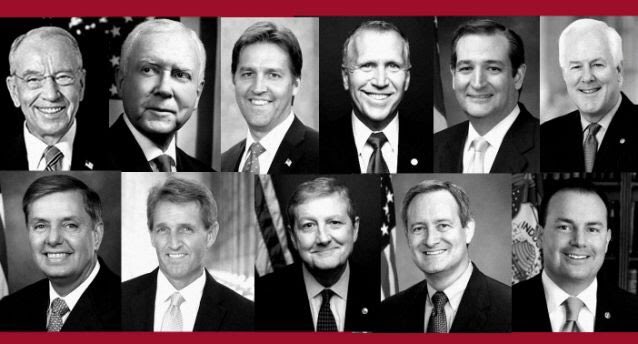

TPM has the backstory on how Democrats on the Judiciary Committee handled the Blasey Ford accusation.


Some very unconvincing arguments are being made in Kavanaugh’s defense. The NYT’s Bret Stephens offers:

I believe human memory is imperfect. I believe it deteriorates over time. I believe most of us have had the experience of thinking we remember something clearly, only to discover we got important details wrong.

I know there are studies showing that spouses often remember very different facts about important moments, like their wedding or honeymoon or how they met. I myself sometimes notice that I remember an event happening in a room that didn’t exist at the time. But I very much doubt that ordinary human memory drift extends as far as “Wait, maybe it was the other guy who tried to rape me.”


A number of defenders have put forward some version of the he-was-just-17 argument. You know who’s not convinced by this? 17-year-olds.

“They just keep saying ‘He was in high school—boys will be boys,’” says Maurielle, a 17-year-old from Houston. “But I’m in high school—I don’t want that to happen to me.”


Making up stuff about Blasey Ford shows lack of faith that the truth is on your side. No, she isn’t poorly reviewed as a professor, she doesn’t carry a grudge against Kavanaugh’s mother, she didn’t accuse Neil Gorsuch of anything, she’s not a big Democratic donor, and her brother has no connection to the Trump/Russia investigation.


Flatly misstating Blasey Ford’s account is not convincing either. Here’s Franklin Graham (whose Dad apparently forgot to warn him about bearing false witness):

Asked by the CBN interviewer what kind of message his remarks send to sexual abuse victims, Graham replied: “Well, there wasn’t a crime that was committed. These are two teenagers and it’s obvious that she said no and he respected it and walked away.”

Kavanaugh “respected” her refusal, according Blasey Ford, after groping her, trying to pull off her swimsuit, and holding his hand over her mouth to keep her from screaming. And he didn’t “walk away”; she escaped after Kavanaugh drunkenly fell off her.


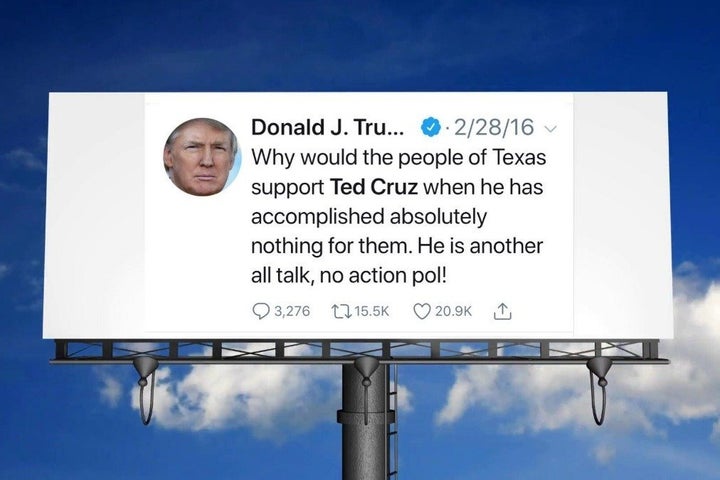
Two related items of interest: Following the lead of actress Alyssa Milano, many women have responded to Trump’s tweet

I have no doubt that, if the attack on Dr. Ford was as bad as she says, charges would have been immediately filed with local Law Enforcement Authorities by either her or her loving parents.

by telling their own stories under the #WhyIDidntReport hashtag.

Or if you want to sum it all up with one story, look at “What Do We Owe Her Now?” in The Washington Post. When Elizabeth Bruenig was a sophomore in high school, a junior cheerleader reported a rape and became an outcast. The physical evidence supported her claims, but the authorities never filed charges, leading to the local rumor that she had made the whole thing up. When Bruenig grew up and became a journalist, she decided to investigate.


Nate Silver tweets that Kavanaugh is polling worse than any previous nominee who got confirmed. And that was before the latest charges.

and Rod Rosenstein

The New York Times is reporting that Rosenstein will lose his job today, either by resigning or being fired.

If Mr. Rosenstein exits, Noel Francisco, the solicitor general, would assume oversight of the Russia investigation, according to a Justice Department official. The acting deputy attorney general would be Matthew G. Whitaker, the chief of staff to Attorney General Jeff Sessions, an unusual move.

This follow an NYT story earlier in the week, which claimed that Rosenstein felt misused after his memo gave Trump cover to fire Jim Comey. Reportedly, he discussed the 25th Amendment (through which Trump could be removed without impeachment) and suggested taping Trump secretly. Rosenstein denies those reports.

Vox sees problems ahead for Bob Mueller:

Rosenstein’s departure strikes at the heart of the Trump-Russia investigation because Mueller had to run major investigative decisions past the deputy attorney general. Rosenstein’s temporary replacement, Solicitor General Noel Francisco, could simply refuse to approve Mueller’s requests, effectively slowing the whole investigation to a crawl — or even fire Mueller outright if he felt there was a reason to do so.

So the long-anticipated constitutional crisis could be upon us.

and the midterm elections

We’re about six weeks out from the election, and everything the Republicans expect to turn the tide in their favor keeps backfiring. Kavanaugh was supposed to work for them, and several candidates have been running attack ads against Democratic senators for not supporting Kavanaugh. That now looks like wasted money.

Nate Silver’s model now gives the Democrats a 4 out of 5 chance of gaining control of the House and a 3 in 10 chance of winning the Senate.

and the consequences of Hurricane Florence

A lot of North Carolina wasn’t built with this kind of flooding in mind. (In fact, in 2012 the legislature banned state agencies from basing plans on a study that predicted rising sea level from climate change.) So toxic coal ash is entering the Cape Fear River and the waste pools from hog farms are also a problem.

Grist explores the side issue of why massive hog farms are in North Carolina to begin with. Hog farms should be in places that raise massive amounts of hog feed, like Iowa. Then the manure can fertilize the fields rather than build up in toxic pools.

If North Carolina wants to end the pattern of water pollution, it has to find a way to spread out the livestock or treat their waste. And the state needs to face the fact that once-in-a-lifetime floods are now hitting more than once a decade.


In this week’s episode of “What’s Wrong With That Man?”, President Trump toured hurricane-ravaged North Carolina. Talking to someone whose house was damaged by a storm-driven boat (and was having trouble getting his insurance company to cover it), Trump commented, “At least you got a nice boat out of the deal.” On the same trip, he also handed a box lunch to another victim, telling him to “Have a good time.

It’s hard to know what to do with comments reflecting such a basic lack of human empathy. Stephen Colbert decided to turn them into a children’s book.

but you have to see this political ad

It’s not often you can get six of your opponent’s siblings to make an ad for you.

BuzzFeed tells how this ad came about. Six of Rep. Paul Gosar’s nine siblings appear in the ad and two others support it. But their 85-year-old mother is still on Paul’s side. This should make for a lovely Thanksgiving.

and you also might be interested in …

Congress is currently working on appropriation bills for the fiscal year that starts next Monday. Current bills don’t include the funding Trump wants for the Mexican wall, so he is talking about a veto, possibly shutting down the government or some large part of it.

This is a time when major proposals can get swept into a bill without much fanfare. One such is in the House’s version of the appropriation bill for Departments of Labor, Health and Human Services, and Education: It would “cut 15% of federal adoption funding to states and localities that penalize adoption agencies that refuse to place children in families that conflict with the agency’s ‘sincerely held religious beliefs or convictions'” and also bar “the federal government from refusing to work with adoption agencies that discriminate.”

Once again, Christians would get the special right to ignore discrimination laws, and gays and lesbians would lose the “equal protection of the laws” promised in the Constitution’s 14th Amendment.


If you’re going to give huge tax cuts to rich people and big corporations, you have to crack down somewhere. How about on young people who have trouble repaying their student loans?

The proposal unveiled Monday would sharply curtail income-based loan repayment plans, scratch the Public Service Loan Forgiveness Program, embolden the government to go after students who don’t pay their loans and cut funding for federal work study in half.

… The Public Service Loan Forgiveness Program is eliminated in the proposed budget. This program allows former students who fulfill certain public service positions — such as public school teachers or health researchers — to have their loans erased after 10 years of on-time payments. Nearly two-thirds of student loan borrowers who’ve shown interest in the Public Service Loan Forgiveness earn less than $50,000 a year.

… People whose loans fall into delinquency would be subject to more stringent enforcement as the proposal also calls to “streamline the Department of Education’s ability to verify applicants’ income data held by the Internal Revenue Service.”


A new round of tariffs on Chinese goods went into effect today. These tariffs are 10%, and will automatically rise to 25% in 2019 if no new deal is negotiated. China is retaliating, and there’s no end in sight.

I’m slowly making my way through Bob Woodward’s Fear. I recently hit the point where Trump is reviewing a proposed speech on the economy and writes in the margin “Trade is bad.”


Apple has warned that tariffs on Chinese imports will raise the cost of its products to American consumers. Trump has responded that Apple should just make its iPhones in the US. Vox takes a look at how practical that is. Not very, as it turns out.

The issue is not so much cost of putting an iPhone together, or even the cost per part on paper. The issue is skill, scale, expertise, and infrastructure — all of which require money, time and long-term investment. Unlike other manufacturing jobs that have migrated from the United States, Apple wouldn’t be bringing them “back” so much as starting from scratch. The cost would come in attempting to build a system that’s never been in the US, but has been built over decades abroad.

China has these jobs because it has put together the right combination of “craftsman-like skill, sophisticated robotics, and computer science”.

“There’s a confusion about China,” [Apple CEO Tim] Cook said. “The popular conception is that companies come to China because of low labor cost. I’m not sure what part of China they go to, but the truth is China stopped being the low labor-cost country many years ago. And that is not the reason to come to China from a supply point of view. The reason is because of the skill, and the quantity of skill in one location and the type of skill it is.”

If Apple could do it, making iPhones in America would raise the price anywhere from $16 to $100, depending on what “Made in America” means to you: If the US plant would just assemble parts made elsewhere, you get the lower number. If you want all the parts made here too, you get the higher number.

For similar reasons, the official statistics exaggerate how big a dent iPhones make in our trade balance with China: China is reaping about $8 from each iPhone, but a tariff would fall on the full import price of around $240.


Florida GOP gubernatorial candidate DeSantis has run into another racial controversy (his fifth since winning the primary a month ago).

A Republican activist who donated more than $20,000 to Ron DeSantis and lined up a speech for him at President Donald Trump’s Mar-a-Lago club recently called President Barack Obama a “F—- MUSLIM N—-” on Twitter, in addition to making other inflammatory remarks.

Steven M. Alembik told POLITICO on Wednesday he wrote the Obama tweet in anger, that he’s “absolutely not” a racist and that he understood that DeSantis’ campaign for governor would need to distance itself from the comments — which the campaign promptly did.

Of course Alembik isn’t a racist. I’m sure lots of non-racists tweet about F—- MUSLIM N—-s every day. Nonetheless, Paul Waldman raises the question: “Why do all these racists keep joining the GOP?

DeSantis may have been embroiled in an unusual number of these controversies, but it’s what every Republican candidate worries about these days. What if some supporter of mine says something shockingly racist? What if that guy who introduced me at that rally turns out to be a klansman? What if I get endorsed by some neo-Nazi group?

But you know who doesn’t have to worry about getting endorsed by neo-Nazis, white nationalists and racists? People who don’t give neo-Nazis, white nationals and racists any reason to believe that they share their views.

and let’s close with something awesome

A bridge through Vietnam’s Ba Na Hills, held up by stone hands.

Two Ways Brett Kavanaugh Could Be a Hero

What might Brett Kavanaugh do
if he really were the man his supporters claim he is?


[The bulk of this article was written before a second accuser came forward. At this moment, it’s still not clear how her account will affect the process.]

The most insightful piece on the Kavanaugh nomination I have seen so far was written by Benjamin Wittes and appeared at The Atlantic. Wittes claims to know something about Kavanaugh.

I have known Brett Kavanaugh for a long time—in many different contexts. I am fond of him personally. I think the world of him intellectually. I don’t believe he lied in his Senate testimony. I don’t believe he’s itching to get on the Supreme Court to protect Donald Trump from Robert Mueller. I’m much less afraid of conservative judges than are many of my liberal friends. As recently as a few days ago, I was cheerfully vouching for Kavanaugh’s character.

But then Christine Blasey Ford accused Kavanaugh of attempting to rape her when she was 15 and he was 17. That allegation, Wittes says, is “credible” and “deserves to be taken seriously”. Kavanaugh’s supporters claim that there’s no good way to respond to an accusation like this and complain that the unanswerability of the charge makes it unfair. But Wittes takes that claim and goes somewhere else with it:

The circumstances in which he should fight this out are, in my view, extremely limited. I would advise him against letting Senate Republicans ram his nomination through in a fashion that will forever attach an asterisk to his service on the Supreme Court. Assuming she is not impugning him maliciously, Kavanaugh’s accuser, Christine Blasey Ford, deserves better than that. The Court deserves better than that. And Kavanaugh himself, if he is telling the truth about his conduct in high school, deserves better than to be confirmed under circumstances which tens of millions of people will regard, with good reason, as tainted.

The real burden of proof. Given how long ago the attempted rape is supposed to have happened and the haziness of the details, it shouldn’t be hard for Kavanaugh and his defenders to create reasonable doubt. But that’s not enough in this situation: It’s Kavanaugh who should bear the burden of proof.

The question before us, after all, is not whether to punish Kavanaugh or whether to assign liability to him. It’s whether to bestow on him an immense honor that comes with great power. Kavanaugh is applying for a much-coveted job. And the burden of convincing in such situations always lies with the applicant. The standard for elevation to the nation’s highest court is not that the nominee established a “reasonable doubt” that the serious allegations against him were true.

In other words: It makes sense to let ten guilty people go free rather than send one innocent person to prison. But if we’re talking about positions of high power, I would rather turn down ten innocent people than elevate one guilty one.

Of course, there’s a very real possibility that Kavanaugh might prevail simply because the Republicans have the political power to confirm him. That would get him onto the Court, but would be

a disaster for anyone who believes in apolitical courts. And it is not what Kavanaugh should want. Clearing one’s name sufficiently to convince only senators who are already ideologically aligned is not, in fact, clearing one’s name. It’s winning. And while winning may be the highest value for Trump, it isn’t actually the highest value—particularly for a justice.

A scorched-earth campaign to impugn Blasey Ford’s credibility would leave a similar taint on the Court and on Kavanaugh’s reputation.

I would never say that no attack on Ford’s credibility could be appropriate; if Kavanaugh can produce some hypothetical emails in which she hatched the plot to bring him down, he certainly gets to use those. But an attack on Ford’s credibility that is not devastating and complete will only worsen Kavanaugh’s problem—and such an attack should worsen it.

Who pays the price? And so Wittes reaches the same point many of Kavanaugh’s defenders do: There’s no good way for him to respond to the accusation against him. But rather than rage at the injustice of that and focus their ire on Blasey Ford or Diane Feinstein or Democrats in general, Wittes calls on Kavanaugh to do what’s best for the country: withdraw.

Getting out does not mean admitting that Ford’s account of his behavior is accurate, something Kavanaugh should certainly not do if her account is not accurate. It means only acknowledging that there is no way to defend against it in a fashion that is both persuasive and honorable in the context of seeking elevation to a job that requires a certain moral viability. It means acknowledging that whatever the truth may be, Kavanaugh cannot carry his burden of proof given the constraints upon him.

It means accepting that it is better to continue serving as a D.C. Circuit judge than to play the sort of undignified games that Republicans are playing on his behalf.

There would be heroism in that path. I am reminded of the ending of Lev Grossman’s The Magician King, when Quentin gets banished from the magical kingdom he has just saved. “I am the hero,” he protests, “and the hero gets the reward.”

But Ember, the god who is banishing him, disagrees: “No, Quentin. The hero pays the price.”

If his Republican support in the Senate holds firm, Kavanaugh can get the reward of a seat on the Supreme Court. But there is a price to be paid in this situation, and if Kavanaugh doesn’t pay it the nation does, in the form of a diminished Supreme Court whose moral authority will always be questionable when it rules on issues of women’s and victims’ rights. There’s nothing heroic about that.

The second heroic path. Wittes argues that Kavanaugh should withdraw even if he is innocent. But there is a second heroic path available if he is guilty, or if he honestly doesn’t remember Blasey Ford or anything about the night in question: Tell the truth.

Many of Kavanaugh’s supporters have been skipping past his denials and arguing for forgiveness: He’s not the same man today that he was at 17. What he did then shouldn’t disqualify him.

That, I think, is a discussion the nation needs to have: What is forgivable? How long should a youthful mistake hang over someone who has lived an admirable life since? How admirable does that life need to be? Does some other kind of restitution need to be made?

But if we were to have that discussion, it shouldn’t just apply to Kavanaugh, or to people on one side or the other of the partisan divide. It should apply, for example, to immigrants who are deportable for something they did decades ago, but have done good work, lived good lives, and been a credit to their communities in the years since. It should apply to people serving long prison sentences for non-violent drug crimes, some of which were committed when they were not much older than Kavanaugh was. You can’t expect forgiveness for the people on your side while you apply eye-for-eye justice to those you disagree with or disapprove of.

Even if we want to have that discussion, though, we can’t as long as Kavanaugh insists on his complete innocence. It’s unreasonable to expect to reap the benefits of forgiveness while simultaneously painting your accusers as liars. (That principle would also apply to President Trump.)

Imagine if Kavanaugh went before the Senate Judiciary Committee and told the nation, “Here’s how I remember that night.” What if he told his story without lawyerly caveats, but just as a human being trying to get a difficult memory off his chest? Or maybe he could say, “I don’t remember the event Dr. Blasey Ford describes. But I went to a hard-drinking school, and things may have happened that I don’t remember. I feel terrible that she has had to carry such a memory all these years, and I am ashamed to think that I could have been the cause of it.”

After all the Bill Cosbys and Harvey Weinsteins we have seen, what a breath of fresh air that would be.

Who shoulders the risk? If Kavanaugh did throw himself on the nation’s mercy, what would happen then? I don’t think anyone knows. And that’s what makes the path heroic: Heroes take risks; they don’t push risks off on others. Blasey Ford took a risk by coming forward, and she has been paying for that decision. Kavanaugh could take much of that burden off of her. It wouldn’t make sense to threaten or abuse her any more, if Kavanaugh himself were taking her account seriously.

Instead, he would shoulder the risk of public judgment. Blasey Ford, the Senate, and the country as a whole would have to face squarely the issues of forgiveness and the passage of time, rather than consider them only as a Plan B for those who doubt Kavanaugh’s denials. That honest public debate would be a step in the direction of healing the wounds that the #MeToo movement has revealed. However it came out — whether Kavanaugh ascended to the Supreme Court, remained where he is, or left public life entirely — it would be a service to the nation.

We keep hearing from Republicans, Evangelicals, and Kavanaugh’s other defenders what a fine man he is. He has a chance to prove them right. But you don’t get to be a hero just by claiming the reward. You have to pay the price.

The Monday Morning Teaser

Once again, Monday morning finds us in the middle of breaking news: Brett Kavanaugh has a second accuser. This incident is supposed to have happened during his freshman year at Yale, and also involves drinking. The woman seems to have been targeted because she was drunk, and her memories are correspondingly hazy. The story was broken yesterday by The New Yorker, and this morning other major news outlets (The New York Times and The Washington Post, for example) seem uncertain about how much to say.

This leaves me with a decision about what to do with this week’s featured article, which was written under the assumption of a single accuser. I plan to go ahead with it, but I’m still not sure what kind of adjustments are appropriate.

I wrote the piece yesterday with the idea of raising the discussion to a higher level: The country has gotten focused on whether the Republicans can or should “plow through” the accusations against Kavanaugh and confirm him. I asked a different question: How would Kavanaugh handle this situation if he really were the man of high virtue his supporters claim he is? The result is “Two Ways Brett Kavanaugh Could Be a Hero”. I suspect it’s the first time an article on the Kavanaugh nomination has quoted one of the gods of Fillory.

Anyway, I’ll figure out the final edits and get the piece posted, probably before 9 EDT.

Kavanaugh, Dr. Blasey Ford, and the Senate Judiciary Committee dominated the news this week to the extent that the weekly summary will also have a lot to say about them. (A picture of the 11 aging white men who form the committee’s Republican majority is itself worth a little meditation.) But there was also news about Rod Rosenstein, Trump’s callous interactions with hurricane victims, the political ad six members of the Gosar family made against their brother, the trade war with China, how the fall elections are shaping up, and a few other things. That post should appear between 11 and 12.

To Speak or Stay Silent?

It is upsetting to discuss sexual assault and its repercussions, yet I felt guilty and compelled as a citizen about the idea of not saying anything.

Christine Blasey Ford

This week’s featured post is “10 Years After: the Post-Recovery Economy“.

This week everybody was talking about hurricanes

Early in the week, it was thought that Hurricane Florence might make landfall as Category 4 or even 5. But it spread out, slowed, and weakened, hitting North Carolina as Category 1. It’s now down to a tropical depression, but its cloud-field still covers a huge chunk of the Southeastern seaboard. Swansboro, NC has gotten over 30 inches of rain.


Meanwhile, Super Typhoon Mangkhut hit China’s Guangdong province (south of Hong Kong) yesterday.

The decision to evacuate towns and cities in southern China came as Hong Kong was left reeling by ferocious winds of up to 173 kilometers per hour (107 miles per hour) and gusts of up to 223 kph (138 mph).

Before getting to China, Mangkhut ravaged the Philippines, killing 54 people.


The series of huge storms we’ve seen in recent years is either an enormously improbable coincidence, or it’s evidence of global warming. But it’s not just that the administration doesn’t want to do anything about climate change, it’s actively been undoing what little Obama managed to get done.

In its latest retreat from federal action on climate change, the Trump administration on Tuesday proposed to lift rules on the leaking and uncontrolled release of the potent greenhouse gas methane from oil and natural gas operations.

Methane is such a potent greenhouse gas that (depending on your estimate of how much methane gets leaked between the well and the consumer), it might make natural gas less climate-friendly than coal. Environmental Defense Fund writes:

Whether natural gas has lower life cycle greenhouse gas emissions than coal and oil depends on the assumed leakage rate, the global warming potential of methane over different time frames, the energy conversion efficiency, and other factors. … Technologies are available to reduce much of the leaking methane, but deploying such technology would require new policies and investments.

In particular, government regulation is needed to make energy companies care about the methane they leak. Trump’s EPA is making sure they have no reason to care.


Florence is drawing attention back to the complete botch of the response to Hurricane Maria in Puerto Rico last year. The NY Post reports:

Hundreds of thousands of water bottles meant for victims of Hurricane Maria are still sitting at a Puerto Rico airport — nearly a year after the deadly storm


Trump, of course, denies everything. The federal response to Maria was “one of the best jobs that’s ever been done with respect to what this is all about“. And the 3,000 excess deaths? Fake news, made up “by the Democrats in order to make me look as bad as possible“.

It’s important to realize just how not-normal this is. George W. Bush was known to spin and dissemble (that’s how he got the Iraq War started), but it’s impossible to imagine him claiming that Katrina only killed a few dozen people, and that stories about more than a thousand deaths were just Democratic inventions meant to make him look bad. Literally NO previous president has ever been this dishonest, or willing to insult the public intelligence to this degree.

Jennifer Rubin draws the inescapable conclusion:

Trump’s outburst should remind us of several troubling facts. First, whether he is lying (or is simply a victim of his own self-delusion that he is incapable of error) is beside the point. He’s not functioning as a president or any other officeholder should. He cannot comprehend facts, process them and take appropriate action. He is, in a word, non-functional.

… Republicans’ inability to check or challenge the president and their insistence on rubber-stamping his decisions while ignoring his outbursts pose more than a constitutional and moral challenge. They, too, are responsible for confirmed Cabinet officials who are incompetent or corrupt, for lack of serious governance, for failure to hold officials accountable, and for the suffering and deaths (e.g. separated families, dead Puerto Ricans) that come about by virtue of a president who is never forced to confront reality.

and Paul Manafort

On Friday, Trump’s former campaign manager pleaded guilty and accepted a plea deal that involves him cooperating with the Justice Department. He also will forfeit ill-gotten assets that might be worth as much as $46 million. That means that the Mueller investigation could making money for the government. I have been unable to track down where I heard this line, but it’s not mine: “Trump will be impeached, and Russia will pay for it.”

There’s a big guessing game going on concerning what Manafort might be able to testify about, but nobody outside the investigation really knows. Noah Bookbinder, Barry Berke and Norman Eisen  wrote in the NYT:

According to prosecutors, Mr. Manafort has already participated in a so-called proffer session, in which he described information that investigators deemed valuable. Mr. Manafort’s agreement will also require him to give further interviews without the presence of his own counsel, turn over documents and testify in other proceedings. His surrender is complete.

Even if you’re a die-hard MAGA-hatter, you have to be wondering where this stops. With Flynn, Cohen, and Manafort all cooperating, the only bigger fish to go after are in the Trump family.

and Brett Kavanaugh

Last week, my comment about the hearings on Kavanaugh’s nomination to the Supreme Court was “nothing matters”. Was Kavanaugh’s paper trail being covered up? Did he lie under oath in previous confirmation hearings? Would he gut abortion rights and grant conservative Christians the special right to ignore discrimination laws? Was he so pro-business that he was anti-consumer and anti-worker? It didn’t matter. Even an anonymous accusation of sexual assault (which became publicly known on Wednesday and which Kavanaugh denied) wasn’t worth taking the time to investigate. The Republicans have the majority in the Senate and were determined to push Kavanaugh through as fast as possible.

But now, finally, a few Republican senators are asking to slow this train down. The difference is that the anonymous accuser came forward yesterday. She’s Christine Blasey Ford,

a professor at Palo Alto University who teaches in a consortium with Stanford University, training graduate students in clinical psychology. Her work has been widely published in academic journals.

At WaPo’s “The Fix”, Amber Phillips assesses:

As far as tracing decades-old sexual harassment allegations go, Ford’s story is remarkably credible. Ford is speaking on the record about her experience. She passed a polygraph test, the results of which The Post reviewed. She told other people about the alleged attack years before Kavanaugh was a Supreme Court nominee. She allowed her records from a therapy session about it to be reviewed by The Post. She says she didn’t want to come forward and decided to do so only after her story was leaked to news outlets.

Will the presence of an actual accuser, a woman willing to stand up and watch her life be shredded by right-wing media outlets (as it inevitably will be), make a difference? Maybe. Republican Senators Jeff Flake and Bob Corker have both called for Thursday’s vote in the Senate Judiciary Committee to be delayed. Flake’s view is particularly important here, since he is on the Judiciary Committee, and could be a swing vote against Kavanaugh if his doubts are not addressed. “We can’t vote until we hear more,” he said.

So what happens after Republican senators “hear more”, assuming they do? I can’t guess.


Jeet Heer:

I want a venn diagram of people willing to argue “Give Kavanaugh a break, he was only 17” and “Trayvon Martin got what he deserved.”


The accusations are about events that happened a long time ago, but Kavanaugh’s response to those accusations is happening now. We’ll see how that unfolds, and what it tells us about his character. Matt Yglesias:

There’s a good case for forgiving teenage misconduct but to receive forgiveness you have to seek it, not call the victim a liar and participate in a smear campaign against her.


Here’s the text of the letter Ford wrote to Senator Feinstein in July.


Other Kavanaugh issues: Kavanaugh’s previous Senate testimony under oath appears to not entirely correspond to the truth. But the legal scholars Vox consulted say the case falls short of criminal perjury.

Senator Kamala Harris showed a clip in which Kavanaugh appears to characterize contraceptives as “abortion-inducing drugs”, an extreme claim by religious-right groups that the science doesn’t support. If true, that would be disturbing, because a lot of court cases hang on whether or not a judge takes seriously some fantastic unscientific claim. But a longer version of the clip makes it clear that Kavanaugh was summarizing the position of one side of the case, not stating his own opinion. Politifact rated Harris’ charge false.

and you also might be interested in …

Thursday evening, dozens of fires broke out in the Boston suburbs of Lawrence, Andover, and North Andover. The cause hasn’t been officially identified, but the most likely speculation is that Columbia Gas overpressurized a gas main, resulting in multiple gas leaks.


The Trump administration is taking in many fewer refugees than the U.S. has in recent years. But one group’s numbers are up: white Evangelicals from the former Soviet Union.


Jonathan Chait’s take on Elizabeth Warren  is pretty similar to the one I gave a few weeks ago.

The Massachusetts senator has made a series of unusually early moves that, taken together, suggest a well-designed strategy to compete across the spectrum of the Democratic Party without risking her viability in a general election. … She is building a national profile to position herself to win a primary and a general election, without sacrificing one for the sake of the other.

Earlier this year, I often told people I had no idea at all who would win the Democratic nomination. In a potentially huge field, it is still impossible to predict the outcome with much confidence. But at this point, Warren’s early moves position her as a clear front-runner.


NRATV hit a new low last week: The September 7 edition of “Relentless”, hosted by Dana Loesch, closed by ridiculing the Thomas the Tank Engine TV show, which has made the trainyard more diverse by bringing in girl trains, including one from Kenya. Loesch rejected the idea that the trains had ever had races before, and showed this parody image, which presumably is how liberals saw the show before the new characters were introduced.


The Atlantic’s Adam Serwer explores the NRA’s perverse attitude towards police violence against blacks.

When armed black men are shot by the police, the NRA says nothing about the rights of gun owners; when unarmed black men are shot, its spokesperson says they should have been armed. … If innocent unarmed black men like [Botham] Jean are shot, it’s because they lack firearms; if innocent black men who are armed like [Fernando] Castile or [Alton] Sterling are shot, it’s because they had a gun. Heads, you’re dead, tails, you’re also dead.

He also notes that in recent years the NRA has become much more of an across-the-board right-wing organization, as the Thomas example above illustrates.

In recent years, the NRA has made frequent forays into culture-war disputes that have little to do with gun rights per se.

His explanation is that the NRA is primarily about selling guns, not defending gun-owners’ rights. (It’s funding comes primarily from gun manufacturers.) And its current why-you-should-be-armed message is a right-wing dystopian fantasy.

NRATV tells its viewers that they are under assault from liberals, black people, undocumented immigrants, and Muslims and that they might one day need to kill them—in self defense, of course. Like the president, the NRA has correctly divined that fomenting and exploiting white people’s fears and hatreds is an effective sales strategy. If marketing murder fantasies is what it takes to move the product, then so be it.


A Kansas woman who was born at home, rather than at a clinic or hospital, was denied a passport.

[S]he received a letter from the federal division of the U.S. Passport Agency out of Houston, TX, telling her the application was denied and required further documentation. … The letter stated, because her birth certificate was not issued at a institution or hospital, it was not considered proof enough of her citizenship.

She received a letter asking her to submit any number of the listed additional documents. “Border crossing card or green card for your parents issued prior to your birth? My parents were born in the United States….Early religious records? We don’t have any. Family Bible? They won’t accept a birth certificate but they will accept a family Bible?” Barbara said.

Eventually her senator intervened, and the passport came through.


If you live in Arizona (or are thinking of moving there), you should be aware that a young-Earth creationist was on the special committee that reviewed the state’s science curriculum standards on evolution. The outgoing Arizona Secretary of Education appointed Joseph Kezele, who teaches at Arizona Christian University and is president of the Arizona Origin Science Association.

He advocates for a literal interpretation of the history presented in the Bible, and claimed that all land animals, including humans and dinosaurs, were created on the sixth day when God created the universe. Adolescent dinosaurs were present on Noah’s Ark because adult dinosaurs would have been too big, Kezele said. “Plenty of space on the Ark for dinosaurs – no problem,” Kezele said.

and let’s close with something to make people look twice

Imagine flying this radio-controlled version of Snoopy’s dog house around your neighborhood.

10 Years After: The Post-Recovery Economy

The recovery from the Great Recession didn’t bring back some previous state of prosperity and resume growth from there. It created a new economy that, in some ways, may never again be what it was.


In addition to 9-11, which was a Tuesday this year, this week included one other important anniversary: Saturday marked ten years since the collapse of the Lehman Brothers investment bank, the spark that ignited the financial crisis that started the Great Recession.

Like most major world events, the Great Recession didn’t begin in an instant and didn’t have a single cause. Just as Europe had started sliding towards World War I long before Archduke Ferdinand’s assassination, the world financial system had been showing signs of strain long before Lehman declared bankruptcy. But Lehman had been one of the biggest players in the international financial markets, so its insolvency was a huge shock: If their debts weren’t good, whose were? Who knew what other financial institutions were insolvent, now that Lehman wouldn’t be repaying its loans? Suddenly, banks were afraid to loan money even to other banks, and the dominoes began to fall.

The worst financial panics are marked by cascading waves of bankruptcies. Alice can’t pay Bob, and Bob had been counting on Alice’s money to pay Charlie and Darlene, who now won’t be able to meet their payrolls. Charlie and Darlene’s employees, in turn, won’t be able to pay their rent, and so their landlords won’t be able to make their mortgage payments to the bank, which may also become insolvent. Where does it stop?

Wikipedia sums up the effects:

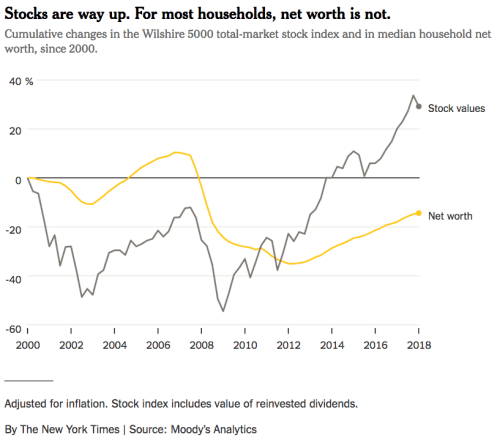
While the recession technically lasted from December 2007-June 2009 (the nominal GDP trough), many important economic variables did not regain pre-recession (November or Q4 2007) levels until 2011-2016. For example, real GDP fell $650 billion (4.3%) and did not recover its $15 trillion pre-recession level until Q3 2011. Household net worth, which reflects the value of both stock markets and housing prices, fell $11.5 trillion (17.3%) and did not regain its pre-recession level of $66.4 trillion until Q3 2012. The number of persons with jobs (total non-farm payrolls) fell 8.6 million (6.2%) and did not regain the pre-recession level of 138.3 million until May 2014. The unemployment rate peaked at 10.0% in October 2009 and did not return to its pre-recession level of 4.7% until May 2016.

This week, the New York Times ran a series of articles pointing out all the ways in which the economy has still not recovered. Or, putting it another way, how the economy has changed. We haven’t simply returned to some previous state of prosperity and continued growing from there. We have entered a new economy, parts of which may never return to previous levels of prosperity.

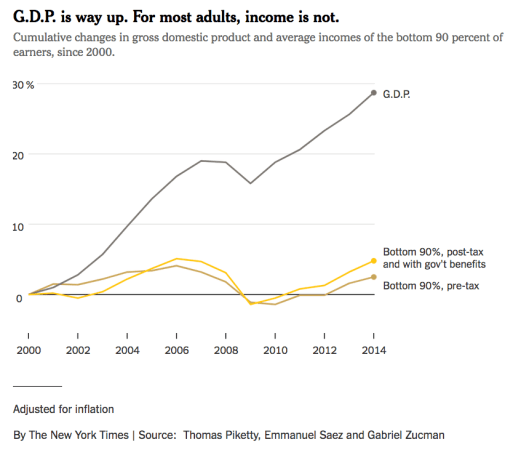
The most significant change is an increase in inequality. The lower your pre-Lehman income and net worth, the longer it has taken the recovery to reach you. People at the top of the economy are far better off than they have ever been. But people at the bottom are still waiting to get back to where they were, and some never will. In fact, if you take the top 10% of earners out of your statistics, the 90% who are left are only just now getting back to their 2006 incomes, and that’s only because of tax cuts and government programs like unemployment insurance, Food Stamps, and ObamaCare. If you just look at pre-tax income, it’s still underwater.

Wikipedia noted that household net worth was back to its pre-Lehman levels by 2012. But that number has been pulled up by the huge gains of the richest households. Median household net worth, the net worth of the households in the middle of the economy, has still not recovered. In fact, it is still below its level at the beginning of the previous recession, the one that started when the dot-com bubble burst in 2000 and 2001.

GDP recovered by 2011, but Wednesday the Census Bureau announced that median household income had only just recovered by 2017.

[T]he details of the report raised questions about whether middle-class households — which have experienced an economic “lost decade” — are now likely to see actual income gains or if they will simply tread water. One reason for concern is that income growth slowed in 2017, to 1.8 percent. Median income had grown more rapidly in previous years, by 5.2 percent in 2015 and 3.2 percent in 2016.

Another NYT article (by Nelson Schwartz) digs a little deeper:

Data from the Federal Reserve show that over the last decade and a half, the proportion of family income from wages has dropped from nearly 70 percent to just under 61 percent. It’s an extraordinary shift, driven largely by the investment profits of the very wealthy. In short, the people who possess tradable assets, especially stocks, have enjoyed a recovery that Americans dependent on savings or income from their weekly paycheck have yet to see. Ten years after the financial crisis, getting ahead by going to work every day seems quaint, akin to using the phone book to find a number or renting a video at Blockbuster.

Basically, there are two dividing lines: About a fifth the households in America either own nothing to speak of, or have debts that are greater than their assets. They live paycheck-to-paycheck, and miss out entirely on that 39% of national household income that now comes from something other than wages.

A large chunk of households in the middle of the economy have a positive net worth, but that wealth is almost entirely in the form of home equity. (Their IRAs or 401(k)s may own a few shares of stock, but those shares are not a significant percentage of their assets.) After paying the mortgage, they also live paycheck-to-paycheck. In most of the country, house prices collapsed in the Great Recession, and (except in a few hot markets) they haven’t grown much (if at all) in the last ten years, so these families’ net worth has remained relatively stagnant.

But at the top of the economy, people own stocks. They get dividends and capital gains that are taxed at a lower rate. And the government’s economic-recovery policies worked much better for them than for homeowners.

Like the bankers, shareholders and investors were also bailed out. By cutting interest rates to near zero and pumping trillions — yes, you read that right — into the economy, the Federal Reserve essentially put a trampoline under the stock market. The subsequent bounce produced a windfall, but only for a limited group of beneficiaries. Only about half of American households have any exposure to the stock market, including 401(k)’s and retirement plans, and ownership of the shares of individual companies is clustered among upper-income families.

For homeowners, there wasn’t much of a rescue package from Washington, and eight million succumbed to foreclosure. Sometimes, eviction came in the form of marshals with court orders; in other cases, families quietly handed over the keys to the bank and just walked away. Although home prices in hot markets have fully recovered, many homeowners are still underwater in the worst-hit states like Florida, Arizona and Nevada. Meanwhile, more Americans are renting and have little prospect of ever owning a home.

The housing crash hit middle-class black and Hispanic families harder than middle-class white families, worsening the racial wealth gap.

[F]amilies in the latter two groups were more dependent on housing as their principal form of investment. Not only were both minority groups harder hit by foreclosures, but Hispanics were also twice as likely as other Americans to be living in Sun Belt states where the housing crash was most severe.

In 2016, net worth among white middle-income families was 19 percent below 2007 levels, adjusted for inflation. But among blacks, it was down 40 percent, and Hispanics saw a drop of 46 percent.

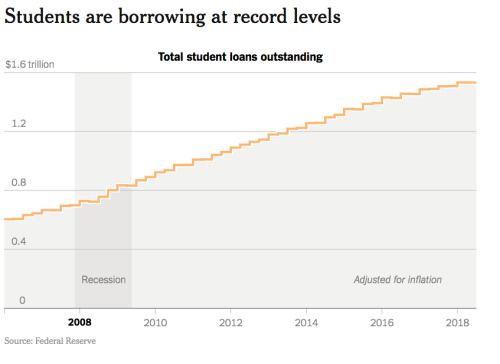
Young people have also been set back. With their parents’ home equity all but gone, they face a choice between entering the economy without marketable skills and borrowing heavily to go to college or get other training. Student debt, says the NYT, “is now the second-largest category of consumer debt outstanding, after mortgages.”

A personal view comes from NYT editor M. H. Miller, who tells of his parents attending his 2009 graduation while facing foreclosure. At an age when previous generations of Americans were taking on mortgages and building for the future, Miller still owes $100K of student debt. “The financial crisis remains the defining trauma of my generation,” he says.

Finally, we come to what has happened at the bottom levels of the job market, covered by Matthew Desmond. He follows Vanessa Solivan, a home health aide raising three children in Trenton, New Jersey.

In May, Vanessa finally secured a spot in public housing. But for almost three years, she had belonged to the “working homeless,” a now-necessary phrase in today’s low-wage/high-rent society. … After juggling the kids and managing her diabetes, Vanessa is able to work 20 to 30 hours a week, which earns her around $1,200 a month. And that’s when things go well.

These days, we’re told that the American economy is strong. Unemployment is down, the Dow Jones industrial average is north of 25,000 and millions of jobs are going unfilled. But for people like Vanessa, the question is not, Can I land a job? (The answer is almost certainly, Yes, you can.) Instead the question is, What kinds of jobs are available to people without much education? By and large, the answer is: jobs that do not pay enough to live on.

It’s not that safety-net programs don’t help; on the contrary, they lift millions of families above the poverty line each year. But one of the most effective antipoverty solutions is a decent-paying job, and those have become scarce for people like Vanessa. Today, 41.7 million laborers — nearly a third of the American work force — earn less than $12 an hour, and almost none of their employers offer health insurance.

Desmond did well to focus on Vanessa. I suspect that the majority of NYT readers (whom I picture as better off than most Americans) have little contact with low-wage workers. Janitors, dishwashers, and busboys are almost invisible. Farm workers are out there in the country somewhere doing God-knows-what. You can imagine that waitresses make a lot in tips, and a few of them actually do. When your personal experiences don’t connect you to people, it’s easy to accept stereotyped accounts of their lives and problems: It’s their own fault. They just need to work harder and stay off drugs. If they learned to practice middle-class virtues, they’d be middle class themselves soon enough.

But lots and lots of professional-class folks have had needed home health aides at one time or another, either while recovering from something themselves or when they were trying to keep aging parents out of a nursing home. I dealt with several in my parents’ final years, and I know the agency didn’t charge us enough to pay them very well. The aides are not nurses, but they do hard, necessary work. The ones I met did it cheerfully, without complaining. None of the negative stereotypes of low-wage workers — that they’re lazy, stupid, resentful, unreliable, irresponsible, and have to be watched every minute — applied to the aides who took care of Mom and Dad.

In short, when I picture a home health aide, I picture someone who deserves to have a decent life. (Whether anyone deserves not to have a decent life is another question. But surely home health aides shouldn’t fall into that abyss.) The thought of Vanessa doing all the work she can get and still living in her car — that’s jarring to me in a way that stories of other low-wage workers might not be. I can’t easily make up some excuse to explain it, or make it seem just. I suspect that a lot of NYT readers had a similar reaction.

Similarly, many professional-class people recall the low-paying jobs they held as teen-agers, or during the summers of their college years, and may regard the experience as a harmless hazing that welcomes young people into the workforce. But Vanessa is 33, and is not on the road to some future prosperity. This is her life, and it’s the life of a lot of adult Americans.

The Bureau of Labor Statistics defines a “working poor” person as someone below the poverty line who spent at least half the year either working or looking for employment. In 2016, there were roughly 7.6 million Americans who fell into this category. Most working poor people are over 35, while fewer than five in 100 are between the ages of 16 and 19. In other words, the working poor are not primarily teenagers bagging groceries or scooping ice cream in paper hats. They are adults — and often parents — wiping down hotel showers and toilets, taking food orders and bussing tables, eviscerating chickens at meat-processing plants, minding children at 24-hour day care centers, picking berries, emptying trash cans, stacking grocery shelves at midnight, driving taxis and Ubers, answering customer-service hotlines, smoothing hot asphalt on freeways, teaching community-college students as adjunct professors and, yes, bagging groceries and scooping ice cream in paper hats.

There was never a golden age when the American Dream (whatever it may have been in that era) was available to all on equal terms. Inequality has always been with us, and has been increasing since the late 1970s. It is not some new development of the last ten years, but class lines have increasingly hardened since the Great Recession.

If you are a child of wealth, your path to success is comparatively smooth: As a child, you will get whatever help you need to maximize your talents and your attractiveness to elite colleges. With appropriate effort on your part, you will graduate not just with a punched ticket to the professional class, but without debt. If at some point your further development requires either more training or the capital to start a business, that won’t be a problem. Quite likely, you will reach 40 in good shape, ready to give your own children similar advantages, but with no awareness of ever having taken a “handout”. You got the grades, you did the work, you started the business — by what right can these socialists tax “your” money away and spend it on the people who lost the games you won?

But if your parents are not rich, you face difficult hurdles and choices. Depending on where you live, public schools may or may not give you the grounding you need to move on and get an advanced education. If that path is available to you, will it be worth all the money you will have to borrow? Or should you take your chances in the unskilled workforce, knowing that jobs and wages can evaporate in an instant, and that the best you can hope for is to scrape by from one week to the next?

That is our “recovered” economy. It’s “booming”, we are told. And for many people, it is. But not for everybody.

The Monday Morning Teaser

The late-breaking news is all about the Kavanaugh nomination: The woman who accused him of sexual assault (when he was 17 and she was 15) has come forward, so it’s not an anonymous accusation any more. Two Republican senators, including one on the Judiciary Committee, say the committee shouldn’t vote on the nomination until they investigate this charge.

As I’ve often said, the Weekly Sift doesn’t do breaking news; I’m not going to try to compete with CNN. Sometime in the next day or two we should find out whether or not the Judiciary Committee is going to try to ram a vote through on Thursday, as originally planned. Watch your usual breaking-news sources.

Instead, my featured article this week summarizes a few of the more insightful ten-years-after articles about the collapse of the Lehman Brothers investment bank, which sparked the financial crisis that led to the Great Recession. If you just look at the nationwide statistics, that financial crisis seems to be comfortably in the rear-view mirror: It was bad, but it’s over, and things are better than ever now.

But the reality is more complicated. The pre-collapse economy didn’t recover, exactly. It changed, and in many ways became even more unequal than it was before. The soaring stock market and low unemployment form one part of the story, but soaring student debt and the increasingly untenable situation of the working poor are another part. “10 Years After: the Post-Recovery Economy” should be out between 10 and 11 EDT.

The weekly summary has the Kavanaugh nomination to cover, plus Hurricane Florence (and the echoes of last year’s Maria), Paul Manafort flipping, and a few other things. It should be out between noon and 1.

Complicity

The thing about autocracies, or budding autocracies, is that they present citizens with only bad choices. At a certain point, one has to stop trying to find the right solution and has to look, instead, for a course of action that avoids complicity.

– Masha Gessen, “The Anonymous New York Times Op-Ed
and the Trumpian Corruption of Language and the Media”

The New Yorker, 9-6-2018

The officials who enable the Trump administration to maintain some veneer of normalcy, rather than resigning and loudly proclaiming that the president is unfit, are not “resisters.” They are enablers.

– Adam Serwer,
There’s No Coup Against Trump
The Atlantic, 9-6-2018

This week’s featured post is “What should we make of Anonymous?

This week everybody was talking about “resistance” inside the Trump administration

See the featured post. Short version: Yes, Trump is unfit to be president. But setting up a government-within-the-government to thwart him is not the right solution.

and Brett Kavanaugh

I’ve had a hard time making myself pay attention to the Kavanaugh hearings, because as best I can tell nothing matters. This is a power play, and Republicans have the power to force it through.

Various Republican senators are posturing in various ways. Susan Collins and Lisa Murkowski pretend not to know that Kavanaugh will be the deciding vote to reverse Roe v Wade. (Nothing Collins takes as reassuring is interpreted as disturbing by the religious right; they know what Kavanaugh will do.) Mitch McConnell pretends not to know that Trump nominated Kavanaugh precisely so he would be a pro-executive-power vote when the Court has to decide whether Trump can be subpoenaed or indicted. Chuck Grassley pretends nothing is hidden in all those Kavanaugh papers we aren’t allowed to see. And all the Republicans avert their eyes so as not to see that Kavanaugh lied in his previous confirmation hearings.

All the Republicans will vote for him because they just will. Nothing matters. Collins continues to describe herself as undecided, but nothing she has said is laying the groundwork for a No vote.


I agree whole-heartedly with Katherine Stewart’s article “Whose Religious Liberty Is It Anyway?“. She notes Kavanaugh’s endorsement of “religious liberty”, and explores what that really means: Christian supremacy (as I’ve been claiming since 2013). Stewart writes:

Let’s call it by its true name: religious privilege, not religious liberty. Today’s Christian nationalists want the ability to override the law where it conflicts with their religious beliefs, and thus to withdraw from the social contract that binds the rest of us together as a nation.

… Religious privilege of this sort was never intended for all belief systems, but rather for one type of religion. Sure, its advocates will on occasion rope in representatives of non-Christian faiths to lend the illusion of principle to their cause. But the real aim and effect of the religious liberty movement is to advance their idea of religion at the expense of everyone else.

If your religion or deeply held moral beliefs include the view that all people should be treated with equal dignity, then this religious liberty won’t do anything for you. If you’re a taxpayer who helps to fund your local hospital, a patient who keeps it in business, or a professional who works there, then your sincerely held religious and moral conviction that all people are entitled to equal access to the best medicine that science can provide and the law permits won’t stand a chance against a Catholic bishop’s conviction that some procedures are forbidden by a higher authority.

Today’s Christian nationalists will insist they are the only victims here. But that is as false as it is lacking in compassion. The terribly real effect of the kind of religious supremacy they seek is to target specific groups of people as legitimate objects of contempt.

and Nike

Nike unveiled the full version of its ad narrated by Colin Kaepernick yesterday. (It also includes footage of Serena Williams, LeBron James, and a lot of other amazing athletes.) Nike is intentionally thumbing its nose at Trump here, and taking the side of players like the Miami Dolphins’ Kenny Stills, who is carrying forward the protest Kaepernick started.

Vice News explains the business reality pretty well:

Conservative old white guys may love Trump, hate Colin Kaepernick, and now hate Nike as well. But how many top-of-the-line athletic shoes are they going to buy this year? And how many younger people want to be like them? Nike showed how much it worries about the shoe-burning protesters with this ad:

The shoe-burnings practically parody themselves. But Brent Terhune pushed it a little farther.

and Barack Obama

President Obama went to the University of Illinois to receive an award Friday, and gave the students there the kind of speech ex-presidents rarely give: a serious one that went right at the problems of the current moment. If you have the time, it’s worth watching or reading in its entirety.

The overarching theme of the speech is that, in the long run, America makes progress towards the dreams it was founded on: equal rights for everyone, government of the people, and so on. But that progress isn’t steady; it doesn’t advance like clockwork, year in, year out. Instead, whenever we make progress, the forces of inequality and special privilege regroup and counterattack.

The status quo pushes back. Sometimes the backlash comes from people who are genuinely, if wrongly, fearful of change. More often it’s manufactured by the powerful and the privileged who want to keep us divided and keep us angry and keep us cynical because it helps them maintain the status quo and keep their power and keep their privilege. And you happen to be coming of age during one of those moments.

… Appealing to tribe, appealing to fear, pitting one group against another, telling people that order and security will be restored if it weren’t for those who don’t look like us or don’t sound like us or don’t pray like we do, that’s an old playbook. It’s as old as time.

And in a healthy democracy, it doesn’t work. Our antibodies kick in, and people of goodwill from across the political spectrum call out the bigots and the fear mongers and work to compromise and get things done and promote the better angels of our nature.

But when there’s a vacuum in our democracy, when we don’t vote, when we take our basic rights and freedoms for granted, when we turn away and stop paying attention and stop engaging and stop believing and look for the newest diversion, the electronic versions of bread and circuses, then other voices fill the void.

He goes on to summarize what Republicans are doing and what Democrats want to do instead. And then he tells the students to vote.

and you also might be interested in …

The Atlantic has an article about “zombie small business“: small businesses that are entirely under the thumb of the large businesses who control their pipeline to the consumer. The prime example is chicken growing: A handful of companies control just about the entire chicken market, and each works with “tied-and-bound contractors—so controlled by their agreements with giant food corporations that they no longer act like independent entities.”

The big company provides the chicks. The contract farmer raises them into chickens. The big company slaughters them for meat. It packages and brands that meat under one of dozens of labels. And it sells it cheap to the American consumer. … These big operations do not act like department stores, choosing goods from a broad variety of vendors and fostering competition and innovation. They instead act like a lord with serfs, or a landowner with sharecroppers.

The article quotes the head of a poultry-growers association:

I’ll list what they tell you: what time to pick up the chickens, what time to run the feed, what time to turn the lights off and on, every move that you make. Then, they say we’re not an employee—we are employees, but they won’t let us have any kind of benefits or insurance.

But it’s not just chickens:

The top four beef producers account for more than 80 percent of the market. The top four hog processors account for more than half. Much the same is true across the economy. The top four players account for more than 90 percent of overall revenue in a wide variety of market sectors and for a wide variety of consumer goods: web search, toilet paper, wireless services, arcade operations, soda, light bulbs, tires.

We’re used to thinking about the danger of monopolies, companies that can charge what they want for their product, because they are the only ones selling it. We need to think more about monopsonies, companies that can dictate to their suppliers, because they are the only buyers.

A monopsony-dominated economy is not a good place to achieve economic equality. Starting your own small business has traditionally been a way to get ahead in America. But if being a small businessman just means that you take orders in a different way, and your sole customer dictates how much money you get to make, then that avenue is shut off.

and let’s close with something awesome

Brightside collects the “100 best photographs taken without Photoshop“. It’s hard to chose just one, but I think I like the first one best: what it looks like to toss hot tea into the air in the Arctic.

What should we make of “Anonymous”?

As I’m pretty sure you already know, Wednesday the New York Times published “I Am Part of the Resistance Inside the Trump Administration” by an anonymous “senior official”. [1] The author claims to be one of many similarly placed people who are “working diligently from within to frustrate parts of [Trump’s] agenda and his worst inclinations”. They do this because “we believe our first duty is to this country, and the president continues to act in a manner that is detrimental to the health of our republic.”

Anonymous diagnoses problems that run deep in Trump’s character and competence: He is “amoral” and has “no discernible first principles”. His “impulses are generally anti-trade [2] and anti-democratic”.  And his leadership style is “impetuous, adversarial, petty and ineffective”, resulting in “half-baked, ill-informed and occasionally reckless decisions that have to be walked back”.

In response, the internal resistance works to “preserve our democratic institutions” by keeping “bad decisions contained to the West Wing”. This results in a “two-track presidency”, where Trump may say one thing, but the government actually pursues a different policy entirely. Anonymous gives the example of how we deal with other countries:

In public and in private, President Trump shows a preference for autocrats and dictators, such as President Vladimir Putin of Russia and North Korea’s leader, Kim Jong-un, and displays little genuine appreciation for the ties that bind us to allied, like-minded nations.

Astute observers have noted, though, that the rest of the administration is operating on another track, one where countries like Russia are called out for meddling and punished accordingly, and where allies around the world are engaged as peers rather than ridiculed as rivals.

So don’t worry, America, “there are adults in the room … [who are] are trying to do what’s right even when Donald Trump won’t”.

The questions this raises. Since Wednesday, debate has sprung up in a number of areas.

  • Is this for real? If it isn’t, then the NYT (which claims to know who Anonymous is and to have verified that he really wrote this) has made the whole thing up. To me, that kind of fraud would be way more incredible than anything in the essay, but I imagine some Trump supporters will believe that “the fake news media” and “the failing New York Times” do stuff like this all the time. Trump himself, as usual, wants it both ways: He both suggests that the article is fake and demands that the Justice Department find out who wrote it (even though there is no crime to investigate, so this shouldn’t be a DoJ matter).
  • Who is Anonymous, and who else is part of this “we” he describes? (Like most commenters, I’m going to use a male pronoun, which is a good bet for a “senior official in the Trump administration”.) This is the kind of guessing game that Washington insiders love, because getting it right proves you’re more savvy than everybody else. But what difference does it make? Suppose I tell you it’s Mike Pompeo or Dan Coates; does that change anything? [For what it’s worth, here’s my guess: Somebody who just barely qualifies as “senior” wrote it, but he did it with the blessing of his boss, who can now say “Not me!” to Trump and to the public. I’ll illustrate with analogies from previous administrations: What if Lawrence Wilkerson had written such an essay with the blessing of Colin Powell, or Huma Abedin under the direction of Hillary Clinton?]
  • Should the NYT have published this? I hadn’t thought this was a particularly interesting question, but The New Yorker’s Masha Gessen convinced me otherwise. More about that below.
  • Are the internal resisters heroes or villains? This is complicated. Obviously, if Trump throws a fit and wants to nuke Belgium, any staffer who loses that order before it reaches the missile silos is a hero. But when unknown people consistently decide that they’re smarter than both the elected officials and the voters who elected them, that’s a problem for democracy. (It reminds me of countries like pre-Erdogan Turkey, where the military was always checking to make sure the voters got it right.) More below.
  • How will this article affect events going forward? As many people have pointed out, publishing this essay is just going to make Trump more erratic and more paranoid, so it’s hard to see how it furthers the author’s apparent goals. On the other hand, it’s got to have an effect on the mid-term voters. Stories about Trump’s unfit behavior have been around for a while now, but they’ve been filtered through reporters who could be exaggerating or distorting. (Bob Woodward is harder to dismiss on that count than Michael Wolff or Omarosa, though the MAGA-hatters will manage somehow.) But the Anonymous essay is on a different level. Unless you’re willing to believe that the NYT conjured Anonymous out of pure smoke, you have to admit that even some Republicans who work with Trump and his administration every day think that he’s dangerous. Suddenly it makes a lot of sense to elect a Democratic Congress to fill the constitutional check-and-balance roles that Paul Ryan and Mitch McConnell have abdicated.

Gessen’s take on the NYT’s decision. Masha Gessen argues that the Anonymous essay is not newsworthy enough to offer the author an anonymous platform. The anonymous Trump “resister” is just repeating a point of view that we’ve heard many times before: Trump is unfit. He doesn’t understand the presidency, the American system of government, or the details of any particular issue. He doesn’t respect democracy or the rule of law. He doesn’t think rationally, or even hold an idea in his head from one minute to the next. The people around him try to manipulate him (and often succeed) because they believe (correctly) that he’s a dangerous fool.

That’s not news. We’ve been hearing it from anonymous White House sources for a long time now, and just heard it again in Bob Woodward’s new book (out tomorrow, but already widely quoted). The Atlantic’s Adam Serwer sums up:

The biggest open secret in Washington is that Donald Trump is unfit to be president. His staff knows it. Senate Majority Leader Mitch McConnell knows it. House Speaker Paul Ryan knows it. Everyone who works for the president, including his attorneys, knows it.

If you know about Trump’s unfitness, are in a position to do something about it, and choose to do nothing, then you are complicit in his presidency. It’s really that simple, no matter what story you tell yourself. Gessen expands the circle of complicity further:

The thing about autocracies, or budding autocracies, is that they present citizens with only bad choices. At a certain point, one has to stop trying to find the right solution and has to look, instead, for a course of action that avoids complicity. By publishing the anonymous Op-Ed, the Times became complicit in its own corruption.

The way in which the news media are being corrupted—even an outlet like the Times, which continues to publish remarkable investigative work throughout this era—is one of the most insidious, pronounced, and likely long-lasting effects of the Trump Administration. The media are being corrupted every time they engage with a nonsensical, false, or hateful Trump tweet (although not engaging with these tweets is not an option). They are being corrupted every time journalists act polite while the President, his press secretary, or other Administration officials lie to them. They are being corrupted every time a Trumpian lie is referred to as a “falsehood,” a “factually incorrect statement,” or as anything other than a lie. They are being corrupted every time journalists allow the Administration to frame an issue, like when they engage in a discussion about whether the separation of children from their parents at the border is an effective deterrent against illegal immigration. They are being corrupted every time they use the phrase “illegal immigration.”

The corrupt exchange here is that (in return for an article that everyone wants to read), the Times allows Anonymous to paint a virtuous self-portrait: By keeping the American people from knowing what its government is actually doing or why, people like him become “unsung heroes”. I’m sure they tell themselves that, but few things could be farther from the truth. Rather than actually resist, they cover for Trump’s incompetence. Rather than stand up to him, they flatter him.

But since the NYT has bestowed anonymity, we can’t effectively contest that self-portrait, or hold Anonymous responsible for the Trumpian policies he actually did carry out. Why, you might wonder, didn’t some internal resister get in the way of Trump taking children away from asylum-seeking parents? Officials who participated in that evil policy, or helped justify it after the fact — what kind of “resisters” are they really? Or why couldn’t the “adults in the room” manage to get Puerto Rico some help before thousands of American citizens died there?

The Devil’s bargain. If Trump really is unfit, and if this is widely known in the administration and Congress, then why don’t they remove him, either through impeachment or the 25th Amendment? Even if the resisters are only a minority of the cabinet, why don’t they stage a mass resignation and bring their case to the public? Why do the never-Trumpers continue to be such a lonely and pathetic segment of the Republican party?

Serwer explains:

But they all want something, whether it’s upper-income tax cuts, starving the social safety net, or solidifying a right-wing federal judiciary. The Constitution provides for the removal of a president who is dangerously unfit, but those who have the power to remove him will not do so, not out of respect for democracy but because Trump is a means to get what they want. The officials who enable the Trump administration to maintain some veneer of normalcy, rather than resigning and loudly proclaiming that the president is unfit, are not “resisters.” They are enablers.

We’re seeing this process right now with the Brett Kavanaugh nomination. It makes literally zero sense to allow a president like Trump (who may only hold his office because he committed a crime to get it) to appoint judges who will probably have to rule on important points of his case, like whether he can be subpoenaed or whether he can pardon himself. But Kavanaugh will cement a far-right majority on the Supreme Court, something the conservative movement has been trying to achieve for decades. Why let that questing beast get away, just because the President is unstable and may have to use undemocratic methods to stay in power?

This is how tragedies happen: because everyone in a position to prevent them has some special reason not to. And usually they all have some way of telling the story that makes them sound like heroes.

They’re not. An official who refuses to carry out an illegal or unconstitutional order is a hero. When a staffer conveniently ignores orders given when the president is not in his right mind, ones that the president himself will soon be glad weren’t implemented — that staffer may be a better friend than the president deserves. There is virtue in openly refusing to implement policies you believe to be immoral or catastrophic, in telling the president directly that you will resign first, and then carrying out that threat and warning the public about what is happening.

But there’s nothing virtuous about setting yourself up as a permanent unelected government-within-the-government, and tasking yourself to implement a policy agenda the voters rejected. Elections ought to be consequential, and if those consequences are too much for the country to bear, then the president should be removed by legal means.


[1] Don’t miss the parodies: Slate’s “I Am Part of the Police Department Inside This Bank Robbery” and McSweeney’s “I Am Part of the Resistance Inside Nyarlathotep’s Death Cult“.

[2] Of all the Trump policies that officials can justifiably monkey-wrench in the name of democracy, I would think trade is about last, because protectionism and getting tough with our trade partners was a big part of Trump’s message from the beginning. If Americans really wanted free trade, somebody like Ted Cruz or Jeb Bush should have been able to make that case against Trump in the Republican primaries. So I have to agree with Ross Douthat:

One might say that insofar as the officials resisting Trump are trying to prevent his temperamental unfitness from leading to some mass-casualty disaster or moral infamy, they are doing the country a great service. But insofar as they are just trying to prevent him implementing possibly-misguided populist ideas, they are being presumptuously antidemocratic and should resign instead.

The Monday Morning Teaser

I moved to Massachusetts this week. (Sorry, Annie Kuster. I really wanted to vote for you.) So I spent a lot more time carrying boxes up stairs than scanning news sites and blogs. But there were two stories it was impossible to miss: the Anonymous article in the New York Times and the Brett Kavanaugh hearings.

In the long run, the prospect of Kavanaugh pushing the Supreme Court much further to the right in the coming decades, threatening not just abortion rights, but worker rights, consumer rights, and the rights of anybody conservative Christians disapprove of, is the much bigger deal. But at the same time, the Kavanaugh hearings are themselves of little consequence, because the fix is in: Democrats get a chance to explain to the country why he shouldn’t be on the Court, but Republicans are going to approve him no matter what. You can hope the hearings convince a lot of voters that we need a Democratic Congress, but that’s about it.

With that in mind, this week’s featured article is about Anonymous, the so-called “resistance” within the Trump administration, and what its official announcement in the NYT might mean for the future. The Kavanaugh nomination takes up a big chunk of the weekly summary, along with the reaction to Nike’s Colin Kaepernick ad, Obama’s pro-democracy (and consequently anti-Trump) speech, and a few other things.

The featured post should be out by 9 EDT, and the summary by noon.

America Is Better Than This

So much of our politics, our public life, our public discourse can seem small and mean and petty, trafficking in bombast and insult and phony controversies and manufactured outrage. It’s a politics that pretends to be brave and tough, but in fact is born of fear. John called on us to be bigger than that. He called on us to be better than that.

– President Barack Obama, eulogy for John McCain
9-1-2018

To the face of those in authority, John McCain would insist: We are better than this. America is better than this.

President George W. Bush, eulogy for John McCain
9-1-2018

This week’s featured post is “John McCain Shot Liberty Valance“.

This week everybody was talking about John McCain

Last week, pundits were announcing the worst week of the Trump presidency, as the legal dominoes started to fall more swiftly. But I wonder if Trump actually disliked this week more, because so much of it wasn’t about him. Instead, it was about one of the few elected Republicans who didn’t kowtow to him, Senator John McCain.

From his funeral in Arizona on Thursday to his burial at the Annapolis Naval Cemetery on Sunday, the national focus was on the memory of McCain. And what most people seemed to remember was that he was nothing like Donald Trump.

The featured post uses the classic Western The Man Who Shot Liberty Valance to discuss the phenomenon of a man whose life gets mixed up (and partially lost) in the myth we need to tell about him.


Many of the eulogies of McCain were seen as indirect attacks on Trump, because they praised McCain virtues that contrast so strongly with Trump vices. Humorist Andy Borowitz took the indirect-attack angle one step further: “Obama’s Barrage of Complete Sentences Seen as Brutal Attack on Trump“.

and revoking Hispanics’ US citizenship

Over the last year or so, a lot of different stories have revolved around a central theme: The Trump administration wants to use any excuse it can muster to get non-whites out of the country.

  • The most visible of those efforts has been the zero-tolerance policy on migrants crossing the southern border, which has had the effect of voiding the US’s commitments under treaties and international law to give reasonable consideration to pleas for asylum.
  • In May, the administration revoked the temporary protected status granted to 57,000 Hondurans in 1998 after Hurricane Mitch. (The hurricane, of course, is long gone. But the question remains: Is it safe for those people to go home?) All in all, about 400,000 people from a variety of countries have lost their permission to live in this country.
  • A program that offered citizenship to immigrants who had skills needed by the military hasn’t been eliminated, but it has become much harder to complete the process. According to Military Times: “The bottom line is that far more than 40 may soon be weeded out – and it’s possible that the majority of the remaining 1,000 or so participants in the Military Accessions Vital to National Interest, or MAVNI, program will be let go before they can be cleared for duty.”
  • Spouses of H-1B visa holders are being denied work permits.
  • A “denaturalization task force” has been formed to re-examine immigrants who have already been granted citizenship. “The creation of the task force itself is undoing the naturalization of the more than twenty million naturalized citizens in the American population by taking away their assumption of permanence,” wrote author Masha Gessen in a widely circulated New Yorker column. “All of them — all of us — are second-class citizens now.”

This week produced a new entry in this series: Because there have been cases in which midwives working in Texas near the Mexican border have provided fake Texas birth certificates for babies actually born in Mexico, the administration is regarding everyone delivered by a midwife in that area as suspect.

In some cases, passport applicants with official U.S. birth certificates are being jailed in immigration detention centers and entered into deportation proceedings. In others, they are stuck in Mexico, their passports suddenly revoked when they tried to reenter the United States. As the Trump administration attempts to reduce both legal and illegal immigration, the government’s treatment of passport applicants in South Texas shows how U.S. citizens are increasingly being swept up by immigration enforcement agencies.

Given the demographics of the area and who uses midwives, just about everybody affected is Hispanic.

Eugene Robinson:

If the government had specific evidence that an individual’s birth certificate was falsified, then we could have a debate about the right thing to do. But this administration is assuming that a person of a certain ethnicity, recorded as being born in a certain part of the country and meeting other unspecified criteria, is de facto not a citizen — and has the burden of proving otherwise.


Oh, and those kids the Trump administration took away from their parents at the border? 500 of them are still in government custody. We can’t forget about them just because no new events keep them in the headlines.

and the Catholic Church

The clergy sexual abuse story has now turned into a political football within the Catholic hierarchy. Last week, Archbishop Carlo Maria Viganò published a letter calling on Pope Francis to resign. It would be one thing if this looked like an honest call for a house-cleaning. But it seems to be a power move by conservatives in the hierarchy to get rid of a liberal pope and (simultaneously) blame the issue on homosexuality rather than abuse of power.

and the midterm elections in November

Both Florida and Georgia will have fascinating governor’s races that pit black progressives against right-wing whites with a history of dog-whistling about race.

We’ve known since July about Stacey Abrams against Brian Kemp in Georgia. Abrams is a black woman testing the theory that Democrats can do better with a clear progressive message that motivates its core voters than by shifting to the center to compete for moderates. Kemp was endorsed by Trump and has ads featuring guns, chain saws, and a get-tough attitude towards undocumented immigrants.

Now in Florida we’ve got black Tallahassee mayor Andrew Gillum against another Trumpist, Congressman Ron DeSantis. Things might get kind of dicey there.

Speaking to Fox News on Wednesday morning, the representative said Florida voters should not “monkey it up” and vote for what he called Gillum’s “socialist agenda.” DeSantis’ campaign denied the comment had any racial intent.

Again we’ve got the Trump base against an effort to give Democrats — especially poor and minority voters who often stay home — something exciting to vote for.

Whether or not DeSantis himself keeps dog-whistling, race is going to be an issue. A neo-Nazi group is already robo-calling against Gillum.


538 adds the right amount of skepticism to the poll showing Beto O’Rourke within one point of Ted Cruz in Texas. Specifically: Stranger things have happened, but they usually don’t. Lots of polls have the race within single digits, but none show Beto with a lead. So he has a real shot, especially this far out from election day, but it’s still an uphill struggle.

Trump is promising to campaign for Cruz. But when he gets to Texas he may see a few billboards like this:

and NAFTA

A sad symptom of the times: Monday, when Trump announced a major new trade deal with Mexico (“an incredible deal for both parties” and “maybe the largest trade deal ever made”), my first thought was: “I wonder if anything actually happened.”

I mean, Trump announced the denuclearization of North Korea, too, and that meant nothing at all. It’s weird. I’ve often disliked, disapproved of, or disagreed with American presidents. But I’ve never been so inclined to discount presidential announcements as meaningless. If Trump announced that we were bombing Pyongyang, I’d think: “I wonder if the Pentagon knows about this.” And I wouldn’t believe it until somebody there had confirmed it.

Vox shares my skepticism:

The countries involved are closer to achieving Trump’s dream of a changed NAFTA that mostly helps America, but still not that close — which means the president may be celebrating too early. “There is still a long road ahead,” says [Christopher Wilson, a NAFTA expert at the Wilson Center].

Trump also announced a deadline of Friday for Canada to join the so-called agreement. But Friday passed and the negotiations continue.

Many people speculate that Trump is looking for an excuse to pull the plug on NAFTA. Republicans in Congress are mostly against that idea, but it’s not clear what can be done. Under NAFTA rules, the president can give Mexico and Canada six months notice.


A sidebar to this story is the off-the-record comment Trump made to reporters from Bloomberg, that somehow found its way into the Toronto Star:

Trump made his controversial statements in an Oval Office interview with Bloomberg News on Thursday. He said, “off the record,” that he is not making any compromises at all with Canada — and that he could not say this publicly because “it’s going to be so insulting they’re not going to be able to make a deal.”

Trump immediately blamed the Bloomberg reporters for breaking his confidence, but the reporter who broke the story says that’s not true.

I’d said I wasn’t going to say anything about my source for the quotes Trump made off the record to Bloomberg. However, I don’t want to be party to the president’s smearing of excellent, ethical journalists. So I can say this: none of the Bloomberg interviewers was my source.

The NYT’s Maggie Haberman raises the possibility that Trump had it leaked himself.

but let’s not forget about Puerto Rico

The latest estimates are that nearly 3,000 people died in Puerto Rico from the effects of Hurricane Maria last year. The federal government’s disaster-relief effort was its own kind of disaster, and the Trump administration has really paid no price for that. (This is one of the many events that you might think would call for congressional hearings. But Republicans’ attitude towards the Russian investigation has expanded to cover all areas of government: If Trump did something wrong, they don’t want to know.)

Vox makes the connection between this mistreatment and Puerto Rico’s lack of statehood, which it is seeking.

That a sitting US president would expect no political consequences from showing zero empathy toward the deaths of so many American citizens crystallizes the fact that Puerto Rico’s status as a US territory is more than a civil rights issue — it’s a human rights issue.

More than 3 million US citizens live in Puerto Rico with fewer constitutional rights than anyone living in one of the 50 states. Americans on the island can’t vote for president in the general election or elect a voting member of Congress. But the federal government’s response to Hurricane Maria has shown that the problem is even uglier than that: Puerto Rico’s status as a US territory, which is rooted in racist legal rulings, has created a class of citizens whose lives are valued less, and whose deaths can be ignored by America’s most powerful leaders.

and you also might be interested in …

Tom Tomorrow:


With all the talk of a “blue wave” in November, it’s worth remembering that it won’t happen by itself. If anyone you know hasn’t registered to vote, or is thinking about not voting, remind them of this scenario (from Matt Ygelsias):

Really worth emphasizing that there’s a good (~25%) chance Republicans hold the House, gain a senate seat or two, replace McCain/Flake/Corker with Trump loyalists, Mueller gets fired, Manafort gets pardoned, and then that’s game over — the coverup worked.

Nate Silver’s 538 quotes similar odds: a 28% chance that Republicans hold the House. If that happens, the People will not have held Congress responsible for not holding Trump responsible for anything he’s done. The door will be wide open to anything he wants to do in the future.


If you’re thinking far ahead, here’s the betting on who the Democrats will nominate in 2020. Kamala Harris is the front-runner, but not by a convincing margin. A ticket that pays $1 if she’s nominated is going for 22 cents. Other notables: Elizabeth Warren at 16 cents, Bernie Sanders and Joe Biden at 15 cents. I still think Somebody You’ve Never Heard Of has a good shot.

Compare this to January, 2015 (the closest to a 4-years-ago parallel I could find), when Hillary Clinton’s nomination shares were at 75 cents.


Having not been invited to speak at McCain’s funeral, Trump held a rally in Indiana Thursday instead. It included this howler:

They want to raid Medicare to pay for socialism.

Medicare, of course, is socialism. (If you don’t believe me, believe Ronald Reagan, who predicted Medicare would lead to a socialist dictatorship.) The centerpiece of the Democratic Socialist agenda is to extend Medicare to everyone.


I guess Chuck Grassley has given up on Ivanka or John Kelly or anybody else keeping Trump in line. He’s handing the job to God.


Trump blocked a 1.9% pay raise for federal workers, citing the budget deficit that his recent corporate tax cut made much worse:

We must maintain efforts to put our nation on a fiscally sustainable course, and federal agency budgets cannot sustain such increases.

A few observations:

  • 1.9% isn’t a huge raise.
  • During the Great Recession, federal workers’ pay was frozen. They haven’t made up that ground yet.
  • Conservatives like to paint federal workers as “bureaucrats” and “paper-pushers”, but they do a lot of useful and necessary stuff. For example: the doctors and nurses at the VA, the disaster-relief folks at FEMA, air-traffic controllers at the FAA, and the Secret Service agents Trump is relying on to protect his life. Think about NASA, the CDC, the FBI, and all the people working to keep mercury out of your water and E coli out of your vegetables. They’re federal employees.

This is a “first they came for …” situation. “Bureaucrats” are not popular, so they’re the first ones to be sacrificed on the altar of Tax Cuts. After the election, though, Republicans are going to be trying to fill the tax-cut budget hole by cutting more popular stuff like Social Security and Medicare. (That’s what “entitlement reform” means.) That’s not a partisan charge against them, it’s what they’ve been saying for months.

and let’s close with something bigger

I know it doesn’t make any sense to close with an opening, but it’s hard to find anything bigger than Neil Patrick Harris’ opening to the 2013 Tony Awards.