Monthly Archives: June 2014

How the Fall Elections are Shaping Up for Democrats

Up until now, I’ve been ignoring the speculation about who’s going to win in the fall elections for two reasons:

  • The mainstream media already does way too much speculating. Who’s-going-to-win speculation is easier and cheaper than covering government, or figuring out whether what the candidates are saying is true, or analyzing how well their proposals mightwork. Instead, you can fill air time with wild guesses that no one takes responsibility for*. (Remember the people who on election eve in 2012 confidently predicted a Romney win? Peggy Noonan, George Will, Karl Rove, Charles Krauthammer — did the networks take any of those people out of their rolodexes, or do you still see them on TV making new baseless predictions?)
  • I expect the narrative of the race to change in ways that will make current speculation obsolete. We’ve already seen that to a certain extent. Six months ago, Republicans were expecting to win a 2010-like wave election because of what a disaster ObamaCare was turning out to be. Then the web site got fixed, people signed up, and good things started to happen. ObamaCare still isn’t getting all the credit it deserves — and may not even by fall — but unless you’re in a very red state I don’t think you can win campaign just on the awfulness of ObamaCare.

Recently, though, a friend asked a very practical question: She’s a Democrat planning to contribute some money to candidates (hardly anything on the Sheldon Adelson scale, but not nothing either), and would like it to go to the best possible place; in other words, to good candidates in tight races where a little money might make a difference. (She asked the same question in 2012; I gave her Elizabeth Warren and Tammy Baldwin. Warren’s race turned out not to be as close as I expected, but in general I’m pleased with those suggestions.)

Three elections. The first thing to realize is that the rhythm of American elections is producing three very different situations in the Senate, the House, and the governorships.

  • Senators have six-year terms, so Democrats are defending the Senate seats they won in the Obama landslide of 2008. Consequently, they have more seats at stake, and in particular they have seats to lose in red states like Arkansas and Alaska.
  • Most governors have four-year terms, so in the statehouses, the story is the exact opposite: Republicans are defending what they won in the Tea Party wave of 2010. Not only are they defending governorships in blue states like Pennsylvania and Michigan, many of their incumbents are extremists in moderate states like Wisconsin and Florida.
  • In the House, Republicans are still benefiting from the gerrymandering after the 2010 census. Democratic candidates totaled 1.3 million more votes than Republicans in 2012, but still lost the House by a wide margin. Estimates are that it would take a 4-7% national margin in the popular vote for Democrats to win the House.

In general, I would pay most attention to the Senate. Winning the House is a bridge too far, while losing the Senate is a real possibility. (At the moment, the Senate looks like a toss-up; I think the overall winds will shift a little in the Democrats favor by November.) Obviously, the governor of your own state is going to have a big effect on your life, but holding the majority of governorships is more about bragging rights than real consequences.

Sizing up the Senate. The 64 senators not up for re-election this year split into 34 Democrats** and 30 Republicans. Of the 36 seats up for grabs, currently Democrats hold 21 and Republicans 15. Nate Silver’s analysis from March is a little out of date, but Larry Sabato’s up-to-date model tells the same basic story: Each side has 48 seats it can feel some confidence in winning, so control of the Senate*** comes down to four states: Alaska, Arkansas, Louisiana, and North Carolina. In each of them, a Democratic incumbent is trying to hang on in a state that Obama lost in 2012.

Those four races are:

  • Alaska: Senator Mark Begich against a Republican still to be chosen, probably former attorney general Daniel Sullivan. (Though Joe Miller — the Tea Party candidate who beat Lisa Murkowski in the 2010 primary, but lost to her in the general — is making it interesting by claiming that he’s the only real climate-change denier in the race. In fact, all the Republican candidates are deniers, but Miller is the most extreme and most consistent.) A recent poll has Begich ahead of Sullivan 42-37%, but that could change if Republicans pull together after the primary.
  • Arkansas. Senator Mark Pryor against Congressman Tom Cotton. Pryor was behind, but has pulled into a slight lead by attacking Cotton’s vote in the House for the Republican Study Committee’s budget that would raise the Social Security and Medicare eligibility age to 70. That’s a big deal in the working class, where jobs aren’t easy to do after your knees start to give out, and life expectancy isn’t nearly as high as that of richer folks.
  • Louisiana. Senator Mary Landrieu against multiple Republicans, in a system where there’s a run-off if no one gets a majority. Her main opponent seems to be Congressman Bill Cassidy. Landrieu is running ahead in most polls, but below 50%.
  • North Carolina. Senator Kay Hagan against NC Speaker of the House Thom Tillis. The RCP polling average has Tillis slightly ahead, though it seems unduly influenced by an outlying result from a conservative polling group.

Of those four, the Democrat I would miss least is Landrieu, while Hagan is the one I’d miss most. Hagan’s opponent Thom Tillis is the ringleader of the North Carolina legislature’s sharp lurch to the right, which provoked the Moral Monday protests. Pretty much whatever Tea Party proposal you can think of has passed in North Carolina — voter ID, non-expansion of Medicaid, ending extended unemployment benefits, shifting money from public schools to vouchers, expanding the public places where you can carry guns … the whole deal.

Northern Democrats tend to think of southern states as lost causes, but Obama carried NC in 2008 and lost it closely in 2012. So if I had to pick one race to focus on, it would be Hagan’s.

If you want an underdog. One of the 48 seats Republicans are supposed to feel comfortable about is Mitch McConnell’s in Kentucky, though RCP rates it a toss-up and the polls are close.

But McConnell seems beatable, Alison Lundergan Grimes is a good candidate to beat him with, and if she does, that’s all anybody is going to be talking about on election night. McConnell is fumbling what was supposed to be his main issue, ObamaCare, because he doesn’t know how to handle the popularity of ObamaCare’s local manifestation, Kynect.

The one reason to avoid the Kentucky race is that the money totals are getting so high that your contribution may seem irrelevant. I’m not sure what you do with $100 million in a small market like Kentucky. Chris Cillizza reports:

As one veteran Democratic strategist noted to us, it’s possible that Kentucky radio and television stations will simply run out of inventory; there, literally, won’t be anything left to buy with all the money pouring into the state.

If that turns you away, underdog-supporters may want to look a little further south, to Michelle Nunn’s race in Georgia.

If you want a governor’s race. Maine. It’s hard to find a more extreme right-wing governor than Maine’s Paul LePage, who won in a three-way race in 2010 and may do it again.

If you want a House race.  I have a bias: My representative Ann Kuster is a top target of the Koch brothers’ Americans For Prosperity. But she’s ahead in the polls anyway. The other NH seat belongs to Carol Shea-Porter, another good candidate whose race is rated a toss-up.


* That raises the question of my own record. In April, 2012 I did my first serious look at the Obama/Romney race. I had Obama leading in electoral votes 242-206, with eight swing states worth 90. In the fall, Obama won all eight and had a 332-206 victory.

But my 2010 record wasn’t so good. I don’t think I made definite predictions, but I was late coming around to the realization that Democrats were in serious trouble.

** Bernie Sanders of Vermont and Angus King of Maine are technically independents, but they’ve been caucusing with the Democrats.

*** In a 50-50 Senate, Joe Biden casts the deciding vote as vice president, so Democrats retain control.
 

#YesAllWomen and the Continuum of Aggression

Men look at Elliot Rodger and say, “I would never do something like that.” Women look at his victims and say, “That could totally happen to me.”


Last week the Isla Vista murders — and Elliot Rodger’s bizarre rants justifying his revenge on the female gender because women wouldn’t have sex with him — were recent enough that I hadn’t processed them. I described my snap reaction as feeling “slimed”. Letting Rodger’s thoughts into my head just made me feel dirty, polluted, unclean. And I wrote, “I can’t imagine how women feel about it.”

This week women told the world how they feel about it. (They were already starting to tell the world last Monday, but I hadn’t discovered it yet.) I have read only a tiny fraction of what has been tweeted with the #YesAllWomen hashtag, but it has been eye-opening.

The struggle for meaning. Every striking news event starts a debate about what it means, or if it even means anything. For a lot of men, Isla Vista didn’t mean much: Crazy people do crazy things. Shit happens.

For others, it restarted the eternal gun-control debate, which always ends in the same place: Yes, a large majority of Americans want at least minor restrictions on guns, and no, it’s not going to happen, because America really isn’t a democracy any more. A victim’s father channeled the majority’s frustration in an interview with Anderson Cooper: “I don’t want to hear that you’re sorry about my son’s death,” he said to any politicians who might be planning to make a condolence call. “I don’t care if you’re sorry about my son’s death. You go back to Congress and you do something, and you come back to me and tell me you’ve done something. Then I’ll be interested in talking to you.”

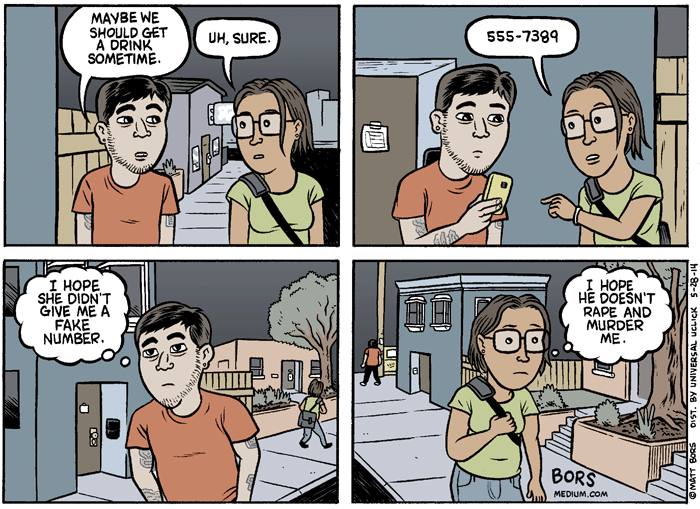
Bizarre exception, or part of a pattern? To a lot of women, though, Isla Vista looked very different. Rather than a bizarre random event, it seemed like the extreme edge of the male aggression they experience constantly: They get grabbed or groped; men yell obscenities at them or make unwanted “flattering” comments about their bodies; they are harassed online; men demand their attention and refuse to go away; when women try to walk away, men grab their wrists or stand in the doorway or follow them as stalkers; men get angry and abusive when their uninvited advances are rejected; and on and on and on.

And while the exact statistics on rape are hotly debated — the difference depends in large part on how forcefully a woman has to say “no” before you count it — I have a lot of confidence in this qualitative statement: Just about every woman knows somebody who has been raped. (If you don’t believe me, ask some.) Whatever the definition is and whatever percentage that leads to, rape is not a monsters-in-the-closet phobia; it’s the well-founded fear that what happened to her (and maybe also to her and her and her) could happen to me.

So while men look at Elliot Rodger and say, “I would never do something like that”, women look at his victims and say, “That could totally happen to me.” Men divide the world into murderers and non-murderers, observing that the murderer pool is very small. Women look at murder as the extreme edge of a continuum of aggression, disrespect, and threat that affects them every day.

#YesAllWomen. And that is what I see as the point of #YesAllWomen: encouraging women to express and men to feel the oppressive weight of that continuum. #YesAllWomen is at its best when women simply tell their stories, one after another. Read enough stories and the bigger reality starts to break through: The meaning of Isla Vista isn’t that shit happens, it’s that the same kinds of shit keep happening day after day all over the country. And when there’s an widespread pattern like that, sooner or later it’s going to break out into something really horrific.*

The brilliance of #YesAllWomen is in its framing: It sidesteps the objection “Not all men are like that.” True or not, that objection misses the point. Whether or not feminist terms like misogyny or rape culture unfairly tar some good men is a minor issue compared to the environment of danger all women have to live in. Let’s not drop the larger issue to discuss the smaller one.**

And let’s not fall into the trap of interpreting every problem in the forest as the fault of individual trees. Laurie Penny explains:

of course not all men hate women. But culture hates women, so men who grow up in a sexist culture have a tendency to do and say sexist things, often without meaning to. … You can be the gentlest, sweetest man in the world yet still benefit from sexism. That’s how oppression works. Thousands of otherwise decent people are persuaded to go along with an unfair system because it’s less hassle that way. … I do not believe the majority of men are too stupid to understand this distinction

[And before we leave the gun-control issue entirely, can we discuss how the two issues interact? Think about the open-carry demonstrations in Texas or Georgia’s new guns-everywhere law. Now picture a woman you care about having a drink after work with some friends, and being accosted by a strange man who won’t go away. Now picture him armed. And no, NRA spokesmen, picturing a second gun in your sister/daughter/friend’s purse doesn’t fix the situation.]

The game. Men, by and large, have not handled our side of this discussion well, attempting either to disown the problem or to mansplain what women should do to fix it.*** But a few men have had intelligent things to say. I thought the Daily Beast piece by self-described nerd Arthur Chu was particularly on point:

[T]he overall problem is one of a culture where instead of seeing women as, you know, people, protagonists of their own stories just like we are of ours, men are taught that women are things to “earn,” to “win.” That if we try hard enough and persist long enough, we’ll get the girl in the end. Like life is a video game and women, like money and status, are just part of the reward we get for doing well.

The game metaphor explains a lot about what was wrong with Rodger’s point of view, and how it relates to a problem in the larger culture. Elliot Rodger’s complaint wasn’t that he couldn’t find his soulmate or that his genes might fail in the Darwinian struggle for immortality. It wasn’t even about pleasure, really, because you don’t need a partner for that. The essence of Rodger’s complaint was that he couldn’t level up — no matter how long he played or how hard he tried — in the multi-player game of sex.

To grasp the full dysfunction of that game, you need to understand who the players are: men. Rodger wasn’t playing with or even against women when he went out looking for sex. He was playing against other men to gain status. Women are just NPCs — non-player characters. Figuring out what to say or do to get their attention or their phone numbers or to get them into bed is like solving the gatekeeper’s riddle or finding the catch that opens the door to the secret passage.

Rodger’s virginity wasn’t just a lack of experience, comparable to someone who has never seen the ocean or been to Paris or tasted champagne. It was his state of being. He was a newby, a beginner, a loser. And it wasn’t fair. He had put so much of his time and effort and passion into the game; he deserved to get something out.

Chu explains the error:

other people’s bodies and other people’s love are not something that can be taken nor even something that can be earned—they can be given freely, by choice, or not.

We need to get that. Really, really grok that, if our half of the species ever going to be worth a damn. Not getting that means that there will always be some percent of us who will be rapists, and abusers, and killers.

What will we pass on? Phrasing the game metaphor in computer terms makes it sound like a new problem of the internet generation, but it’s not.**** Computer games are just a good way of describing an attitude that has been around since Achilles and Agamemnon argued over a slave girl: that women are just tokens in a competition among men. In junior high in the 70s, my friends and I talked about “getting to second base”, and today commercials sell Viagra and Grecian Formula to older men by telling us we can “get back in the game”. We all know what game they’re talking about.

As long as that attitude gets passed down from one generation of men to the next, there’s going to be an aggression-against-women problem. Because that’s how men play: You sneak some vaseline onto the ball, hide an ace up your sleeve, take that performance-enhancing drug, or push away a defender when the refs aren’t looking. If you can get away with it, it’s part of the game. So if it raises your score to grab some body part otherwise denied you, or to intimidate women into submission, take advantage of their unconsciousness, drug them, or even kidnap and imprison them, someone’s going to do it.

No one ever asks a boy whether he wants to play this game. At some point in your adolescence, you just find yourself in the middle of it, being told that you are losing and advised on how to win. There are competing visions that (for most men, I believe) eventually win out as they mature: the search for companionship, or looking for an ally to help you face life’s challenges. In those visions, women can be “protagonists of their own stories” rather than NPCs. But no one ever tells you there is a choice of visions and lays out the consequences.

If we did discuss these competing visions openly with boys, I don’t think the game metaphor would stand up to conscious scrutiny. Few men would openly defend the idea that women exist to be tokens of our competition, and even most teens already have enough empathy and experience for it to ring false. But the game attitude survives because we don’t bring it out into the light and discuss it.

Changing that dynamic would be a fine response to #YesAllWomen.


* I shake my head at the people who want to make an either/or out of whether the blame for Isla Vista belongs to a misogynistic culture or to Rodger’s personal insanity. Growing up, I had the chance to observe a paranoid relative. She went crazy during the McCarthy red scare, so the Communists were after her. If she’d broken with reality a few years earlier it might have been the Nazis; a few years later, the Mafia. Maybe people go crazy because their brains malfunction, but how they go crazy is shaped by their culture.


** One of the prerogatives of any form of privilege is that your concerns move to the top of the agenda, even if they are comparatively minor. Privileged classes of all sorts take this prerogative for granted and have a hard time seeing it as an injustice. So it is here: Men who feel smeared by a term like rape culture tend to think the conversation should immediately shift to their hurt feelings. It shouldn’t. To the extent that this objection is justified, it can wait. Let’s talk about it later. (Privileged classes aren’t used to hearing that response, but under-privileged classes hear it all the time.)

An important reason it should wait, in addition to its comparative insignificance, is that when a man fully grasps the continuum of aggression, it’s hard to claim that he’s never played any role in perpetuating it. (I know I can’t make that claim.) But by changing the subject to their own victimization, men avoid that realization.


*** Most advice about how to avoid rape — how to dress, places to avoid, not leaving your drink unattended — is really about making sure the rapist picks someone else. It’s like, “You don’t have to swim faster than the shark, you just have to swim faster than your sister.” It’s got zero impact on the overall rape problem.


**** And the attitude behind it is not even unique to men. In the pre-war chapters of Gone With the Wind, Scarlett is playing her own version of the game. While she wants to wind up with Ashley eventually, in the meantime she wants every eligible man in Georgia to be her suitor, and she “wins” whenever a bride realizes that she has married one of Scarlett’s cast-offs.

But there’s one important difference between the male and female versions of the game: Men who tire of Scarlett’s game can get on their horses and ride away, and in the end, it’s up to Rhett to decide whether or not he gives a damn. Women would like to have those options in the male version of the game.

The Monday Morning Teaser

It’s another week where my word-limit target is laughing at me.

Last week I had only a couple sentences about the Isla Vista murders. This week the #YesAllWomen hashtag exploded on Twitter, and blogging world seems divided between those who comment on it and those who don’t dare. For the last few days I’ve been pulling together the best ideas I’ve seen on the topic and trying to add a little of my own.

Simultaneously, I’ve been trying to answer a reader’s question: If you have only a limited amount of energy/money/attention to spend on the 2014 elections, would races should you focus on? That’s not a quickly covered topic either.

So both articles will post today, and the idea of keeping the Sift down to 3500 words a week will have to just stand aside. “#YesAllWomen and the Continuum of Aggression” will come out first, probably before too long, and “How the Fall Elections Are Shaping Up for Democrats” will follow later this morning. In general, I try to get the weekly summary out by noon (NH time). We’ll see if that happens this week.