Monthly Archives: April 2014

History Lesson

The newspapers shout a new style is growing,
but it don’t know if it’s coming or going,
there is fashion, there is fad
some is good, some is bad
and the joke is rather sad,
that it’s all just a little bit of history repeating

— the Propellerheads “History Repeating

This week’s featured articles are “More Than Just Affirmative Action” and “Cliven Bundy and the Klan Komplex“. Both topics sent me back to study the 19th century.

This week everybody was talking about affirmative action

The Court upheld an amendment to the Michigan Constitution that banned all forms of affirmative action. What I find more disturbing than the outcome is the basis on which it was decided: The Court has made the Political Process doctrine virtually unusable, which consigns the rights of minorities to the tender mercies of the majority.

and a 700-page economics book

Who knew that a tome like Thomas Piketty’s Capital in the 21st Century could become such a popular phenomenon. (Amazon is said to have temporarily run out of copies.) That doesn’t necessarily translate into people reading it — I haven’t finished my copy yet — but it does point to a popular hunger for a liberal economics that can make sense out of the growing inequality we’re seeing.

Conservatives are freaking and saying the words “Marxist” and “Soviet” a lot. But you have to wonder whether Red Scare techniques are still effective at a time when 20-somethings have no memories of the Soviet Union and China is more worrisome as a capitalist competitor than it was during the Cultural Revolution.

Paul Krugman sees “The Piketty Panic” as evidence that the Right is out of ideas. They could try to point out what Piketty has gotten wrong about the increasing significance of inherited capital, but “so far, I’ve seen no sign of that happening. Instead, as I said, it has been all about name-calling.”

and net neutrality

The FCC seems to be ready to surrender the net neutrality principle to Comcast, Verizon, and the other big internet providers. The ISPs will be able to leverage more revenue out of their networks by charging some content providers more to get their content delivered faster and more reliably. Reportedly, the new rules won’t allow an ISP to block a site completely or use its new power in an “anti-competitive” way (say, by giving Comcast’s own movie-download service preferred access). But even if the most obvious forms of hostage-taking aren’t allowed, the internet-as-we-know-it will be drastically changed. The Electronic Frontier Foundation commented:

This kind of “pay to play” model would be profoundly dangerous for competition.  New innovators often cannot afford to pay to reach consumers at the same speeds as well-established web companies. That means ISPs could effectively become gatekeepers to their subscribers.

Again, the new rules reportedly won’t allow an ISP to slow down the internet for a company that it doesn’t like. But in a technological environment where constant improvement is the norm, they don’t have to. They can put a content company at a relative disadvantage just by offering improved service to its competitors. In a competitive technological environment, constant improvement is just part of the competition. But the ISPs seek an environment in which someone will have to pay for every advance.

The overall problem here is the one I talked about in my review of Barry Lynn’s “Cornered”.

The purest form of market is what you can see at any big farmer’s market: Lots of consumers dealing directly with lots of producers. … But markets can also be structured to give middlemen as much freedom as possible. The most profitable way to use that freedom is to create choke-points where a toll can be extracted or one producer can be played off against another. In an opaque market, the way to get rich is not to produce things, but to build middleman power that allows you to dictate terms up and down the supply chain. (I don’t have space to go into it here, but keeping the internet transparent is what net neutrality is about, and why Comcast doesn’t like it.)

Comcast (even more so if its merger with Time Warner Cable goes through) has been creating an artificial choke point between consumers and content creators. Getting rid of net neutrality lets it set up a toll booth there. The plan is for the toll to be paid by producers rather than consumers, but in the bigger picture that doesn’t matter. Nothing is being produced at that toll booth; it’s just a parasite sucking blood out of the economy.

and old white guys behaving badly

So Cliven Bundy turns out to be a racist. I discuss why this should have surprised no one in “Cliven Bundy and the Klan Komplex“.

Matt Yglesias made a point about Bundy that extends what I said last week:

From day one, I’ve tried to imagine the reaction if a young black man living in my gentrifying neighborhood reacted to some adverse change in government policy — perhaps funding cuts led a bus line in the neighborhood to get shut down — by stealing a bus. Then when the cops come to take the bus back, he brings out fifty friends, some of them armed, and starts talking about putting the women out front so they’ll be shot first. My overwhelming presupposition is that he’d end up shot dead, along with his armed buddies, and that would about be the end of it. There would be no partisan political controversy about whether or not it is appropriate to react to changes in WMATA’s route planning with violence.

You may want the government to provide excellent bus service to where you live, but in life you can’t always get what you want.

Bundy’s supporters have tried to make the Bureau of Land Management the issue: They’re out of control, unresponsive; the political process has failed, etc. But as far as I can see, Bundy’s problem isn’t that the political process failed, it’s just that he lost (until his buddies with guns showed up).

One of the background assumptions of the militia movement that has come to Bundy’s aid is that there are “real Americans”, i.e. white Christian conservatives, who deserve to win the political process. When they lose, the process has failed and they are justified in resorting to violence.

Jonathan Korman explains that such a process has a name:

There is a name for a “populist” movement by an armed minority which attacks the legitimacy of liberal democratic institutions in the name of the nation’s “true spirit” which must be rescued from the corrupting influence of lesser races through acts of redemptive violence. It is not “civil disobedience”. It is something else.

Conservatives have tried to abuse the word fascism to the point that it stops meaning anything. But this is a meaning that Hitler, Mussolini, Franco, and their followers would all recognize.


In other white-guys-behaving-badly news, an argument L. A. Clippers owner Donald Sterling had with his mixed-race girl friend (he’s separated from his wife) was caught on tape and published by TMZ. He tells her not to bring Magic Johnson — or any other black people — to Clippers games or post pictures of them on Istagram.

This is a huge problem for Sterling and the NBA, where black players are the majority. It also raises the issues I covered a few weeks ago in “Who Should Be Beyond the Pale?” My rules of thumb are split. On the one hand, Sterling was ferreted out as a racist rather than promoting his views to the public. On the other, it’s hard to imagine a good person saying what he said.

It looks to me like he’s going to have to sell the team. I can’t imagine a black free agent choosing to come to the Clippers while he’s the owner, so he’s putting the team at a competitive disadvantage.

and you also might be interested in …

If you’ve ever used Verizon Wireless’ “My Verizon” web site, you should read this. They’re tracking not just what you do on their network, but everything you do on every computer or device that has visited “My Verizon”.


Remember how (when it was trying to restore its public image) BP was going to compensate the people hurt by the Deep Horizon oil spill and help restore the Gulf Coast to its former condition? Well, that was then.


I try not to give Sarah Palin the attention she begs for so desperately, but sometimes I just can’t help myself. Saturday at an NRA rally, Palin said “If I were in charge, [America’s enemies] would know that waterboarding is how we baptize terrorists.” Imagine how she’d react if a liberal blasphemed against a sacred Christian ritual like that.

and let’s end with something amazing

A Calgary guy lies on top of a beaver lodge and films the beavers repairing the lodge. The adults ignore him, but the baby gets scared.
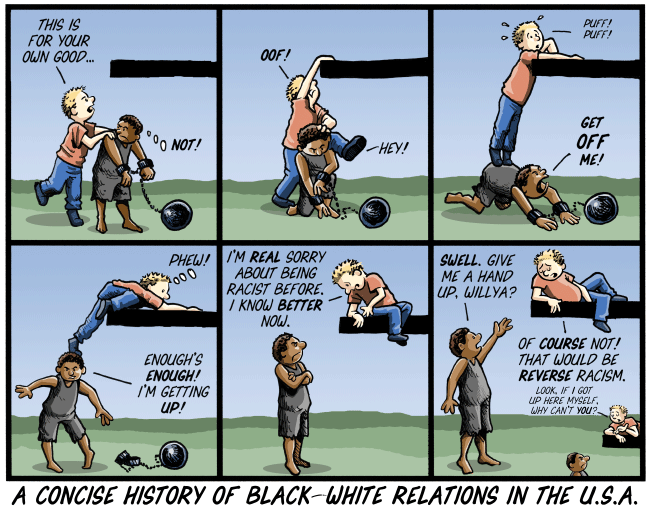
More Than Just Affirmative Action

The Court has decided to trust majority rule to defend minority rights. That didn’t work very well the last time.


It’s hard to appreciate this week’s Supreme Court decision on affirmative action without knowing about a case from the 19th century.

The Civil Rights Cases. In 1883, just a few years after Union troops stopped occupying the states of the former Confederacy, the Supreme Court ruled on five cases it combined into the Civil Rights Cases (Wikipedia, text of decision). Eight justices ruled unconstitutional the Civil Rights Act of 1875, which banned racial discrimination in “accommodations, advantages, facilities, and privileges of inns, public conveyances on land or water, theaters, and other places of public amusement”. The Court said that Congress had overstepped its power, because the 13th and 14th Amendments only gave it “corrective” power to reverse state laws that denied blacks their civil rights. Congress couldn’t legislate directly to guarantee those rights.

And then the Court went on to make a more sweeping statement:

When a man has emerged from slavery, and, by the aid of beneficent legislation, has shaken off the inseparable concomitants of that state, there must be some stage in the progress of his elevation when he takes the rank of a mere citizen and ceases to be the special favorite of the laws, and when his rights as a citizen or a man are to be protected in the ordinary modes by which other men’s rights are protected.

In other words, if the former slaves needed this kind of protection, they should seek it from their state governments, the way white people would. No doubt that sounded very reasonable to most whites, even most Northern white liberals: Slavery was over; the former slaves were citizens now; they should avail themselves of the protections the law had made for other citizens.

But Douglas Blackmon observed in Slavery By Another Name that things didn’t quite work out that way.

Civil rights was a local, not federal issue, the Court found. The effect was to open the floodgates for laws throughout the South specifically aimed at eliminating those new rights for former slaves and their descendents. … [A] declaration by the country’s highest courts that the federal government could not force states to comply with the constitutional requirement of the equal treatment of citizens, regardless of race, opened a torrent of repression.

As reasonable as it may have sounded at the time, from the perspective of history the Civil Rights Cases decision was the opening bell for the Jim Crow era. Due process and equal protection under the laws had become pro forma rights; if a state preserved certain outward appearances, it need not provide any real equality. Or, more accurately, the state continued to have a moral obligation to provide equality, but the federal government had no authority to enforce that obligation. The lone dissent of Justice John Harlan (not to be confused with his grandson, John Harlan II, a 20th-century Supreme Court justice whose opinions figure as precedents in this week’s ruling) was prophetic:

[I]f the recent amendments are so construed … we shall enter upon an era of constitutional law when the rights of freedom and American citizenship cannot receive from the nation that efficient protection which heretofore was unhesitatingly accorded to slavery and the rights of the master.

Harlan also was the lone dissent in the 1896 Plessy v Ferguson decision that enshrined separate-but-equal. He deserves to be more famous than he is.

Michigan. Now let’s talk about this week’s decision, Schuette v Coalition to Defend Affirmative Action. Like most race cases these days, there has been a back-and-forth that makes the underlying principles hard to sort out: Until 2003, the University of Michigan used race as a consideration for admission to both its undergraduate program and its law school. That year, the Supreme Court ruled on both: It threw out the undergraduate system in the Gratz decision but upheld the law school system in Grutter.

Both cases hung on the same issues, and Justices O’Connor and Breyer were the swing votes. Previous cases had identified only one interest that could justify affirmative action by a state university: the overall educational advantage provided by a diverse student body. In other words, the state couldn’t favor one race for the simple purpose of giving that race an advantage, but it could decide that a diverse student body provides a better education for everyone. (Imagine studying the Civil War in an all-white classroom versus a classroom where other races are represented. Probably the discussions would be very different, and a university might legitimately decide that the mixed-race classroom experience is better.) But the Court insisted that the particular plan to promote diversity had to be narrowly tailored for that purpose, rather than resembling a racial quota system. The law-school plan passed muster under the narrowly-tailored standard; the undergraduate plan didn’t.

But Michigan’s anti-affirmative-action groups weren’t satisfied with a split decision, so in 2006 (as a direct response to Grutter), a referendum added an amendment to the Michigan Constitution banning “preferential treatment to any individual or group on the basis of race, sex, color, ethnicity, or national origin” in education, hiring, or contracting by the state or any public institution under the authority of the state. Overall, the amendment passed with a clear 58%-42% majority, but the exit poll showed major demographic splits: White men voted for it 70%-30%, while non-white women opposed it 82%-18%. If you work out the numbers, the entire margin of victory came from white men (42% of the electorate), while everyone else split almost evenly.

So you wind up with two separate levels of dispute: affirmative action itself, but also the limits of democracy. In other words, if the majority doesn’t get its way for some reason, under what circumstances can it change the rules?

The Political Process doctrine. The history of the Civil Rights movement since 1883 has been a story of the white majority changing the rules whenever the black minority seemed about to rectify some disadvantage. If the 15th Amendment gave blacks the right to vote, poll taxes and literacy tests could take it away, while grandfather clauses protected poor or illiterate whites from disenfranchisement. If Arkansas couldn’t keep blacks out of Little Rock’s Central High, the governor could shut the school down. Slavery By Another Name is about how Southern whites circumvented the elimination of slavery itself by inventing bogus crimes that blacks could be convicted of and then sentenced to hard labor.

The Supreme Court cases on race — from the Civil Rights Cases to Brown and beyond into enforcing Brown‘s requirement of integrated schools — revolve around the Court’s increasing realization that it couldn’t deal with state and local governments under the assumption of good faith. The white majority simply did not want blacks to receive due process and equal protection under the laws, and any high principles announced by the Court would be examined for loopholes rather than implemented.

As a result, the Court evolved what came to be called the Political Process doctrine: If a minority achieves one of its goals through the ordinary decision-making process — courts, school boards, elections, etc. — and the majority responds by changing the rules to move the decision to a different body where the minority will lose, that rule-change deserves special scrutiny from the courts. If there was no compelling reason to change the process beyond frustrating the minority, the change is invalid.

Justices Sotomayor, Ginsberg, Scalia, and Thomas all agree that the Political Process doctrine applies to this case. Sotomayor and Ginsberg want to invoke it to invalidate the Michigan constitutional amendment, while Scalia and Thomas want to take this opportunity to reverse the doctrine entirely. The plurality opinion (written by Justice Kennedy, and joined by Roberts and Alito), is another example of something I complained about two weeks ago: covertly reversing decisions without appearing to do so. After Schuette, the Political Process doctrine is dead. While it remains as a precedent, it’s hard to imagine a situation where it could be invoked.

And that development has consequences beyond affirmative action.

The opinions. The plurality opinion (representing Kennedy, Roberts, and Alito) was written by Justice Kennedy. If you’ve been reading the Sift since last summer, you know I don’t think much of Justice Kennedy’s writing style and the muddled mind it seems to represent. (Lower court judges seem not to know how to apply Kennedy’s rulings, which tells you something.) I suspect that’s why the Chief Justice chose Kennedy to write this opinion rather than doing it himself. Any judge who tries to invoke the Political Process doctrine in the future will have to glean some principles of application from Kennedy’s opinion; probably they will just throw up their hands and decide the case on some other basis.

Kennedy reminds us that “It cannot be entertained as a serious proposition that all individuals of the same race think alike”, that there are no clear legal standards for determining the interests of a racial group, or even of defining who is in or out of the group, and so on. If the Court allows that there are racial interests that prevent rule changes, race might be dragged into any number of issues in order to freeze the process in place.

In short, if racial majorities decide to act in bad faith, judges are simply not clever enough to catch them. Kennedy concludes:

Democracy does not presume that some subjects are either too divisive or too profound for public debate.

as if anyone had ever made that claim.

Scalia’s dissent (joined by Thomas) is painful to read, because as he gets older, Scalia is less and less able to pretend that he respects anyone who disagrees with him. So his opinions increasingly contain more attitude than law. But at least he does go through the relevant precedents, explaining why they were all wrongly decided. I would love to hear Justice Scalia’s opinion on the Civil Rights Cases, or whether rule changes that disadvantage a minority should ever be thrown out by the Court. Most of all, I want to hear how he will square all this with what he rules in the upcoming Hobby Lobby case, where the minority seeking protection is abortion-opposing Christian employers.

Justice Breyer’s concurrence shows more honest inner conflict than any of the others. He wants to support both the democratic process and minority rights, but has to come down on the side of democratic process.

the principle that underlies [the Political Process doctrine precedents] runs up against a competing principle, discussed above. This competing principle favors decisionmaking through the democratic process. Just as this principle strongly supports the right of the people, or their elected representatives, to adopt race-conscious policies for reasons of inclusion, so must it give them the right to vote not to do so.

Justice Sotomayor’s dissent (joined by Ginsberg) is as long as all the rest put together, probably because she alone is arguing that the Court needs to pay attention to nuance. Like Scalia, she takes the precedents seriously, but she wants to apply those precedents rather than reverse them. She also thinks the Court needs to consider where the Michigan constitutional amendment fits in the long history of changing the rules to short-circuit minority victories.

As a result of [the amendment], there are now two very different processes through which a Michigan citizen is permitted to influence the admissions policies of the State’s universities: one for persons interested in race-sensitive admissions policies and one for everyone else. A citizen who is a University of Michigan alumnus, for instance, can advocate for an admissions policy that considers an applicant’s legacy status by meeting individually with members of the Board of Regents to convince them of her views, by joining with other legacy parents to lobby the Board, or by voting for and supporting Board candidates who share her position. The same options are available to a citizen who wants the Board to adopt admissions policies that consider athleticism, geography, area of study, and so on. The one and only policy a Michigan citizen may not seek through this long-established process is a race-sensitive admissions policy that considers race in an individualized manner when it is clear that race-neutral alternatives are not adequate to achieve diversity. For that policy alone, the citizens of Michigan must undertake the daunting task of amending the State Constitution.

But that point of view lost. As in last summer’s Voting Rights decision (in which Chief Justice Roberts announced the profound legal principle that “things have changed”) the history of racism and racial progress in America is not considered relevant by the Roberts Court. Going forward, the Court appears ready to assume good faith on the part of the white majority. Let’s hope it works out better this time.

Cliven Bundy and the Klan Komplex

Why the rancher’s racist rant shouldn’t have surprised anybody


If you’ve been paying attention to the Cliven Bundy situation at all (as I started doing last week) you no doubt heard that Wednesday night he went off script in front of a New York Times reporter:

“I want to tell you one more thing I know about the Negro,” he said. Mr. Bundy recalled driving past a public-housing project in North Las Vegas, “and in front of that government house the door was usually open and the older people and the kids — and there is always at least a half a dozen people sitting on the porch — they didn’t have nothing to do. They didn’t have nothing for their kids to do. They didn’t have nothing for their young girls to do.

“And because they were basically on government subsidy, so now what do they do?” he asked. “They abort their young children, they put their young men in jail, because they never learned how to pick cotton. And I’ve often wondered, are they better off as slaves, picking cotton and having a family life and doing things, or are they better off under government subsidy? They didn’t get no more freedom. They got less freedom.”

Reactions varied. Bundy’s own first reaction was to claim he had been misquoted — “I didn’t say nothing about picking cotton” — until Media Matters released the video of him saying it.

Mainstream Republicans who had made a hero of Bundy — Rand Paul and Sean Hannity in particular — claimed to be shocked, and dropped the rancher like a hot rock. But the true believers promoted a smeared-by-the-liberal-media theme. InfoWars posted a longer version of the video that it claims vindicates Bundy: “his argument is actually anti-racist in that it laments the plight of black families who have been caught in the trap of dependency on government.” (I invite you to click through and examine the larger context for yourself. I don’t think it vindicates much of anything, probably because I already see the “dependency on government” meme as a racist dog whistle. I mean, we all know who those dependent-on-government people are, don’t we? We’re not talking about my white mother depending on Medicare to pay her hospital bills.)

One of the best responses came from satirist Andy Borowitz, whose invented quotes nail the hidden meaning of the mainstream Republican reaction:

“We Republicans have worked long and hard to develop insidious racial code words like ‘entitlement society’ and ‘personal responsibility,’ ” said Sen. Rand Paul (R-Kentucky). “There is no excuse for offensive racist comments like the ones Cliven Bundy made when there are so many subtler ways of making the exact same point.”

Fox News also blasted the rancher, saying in a statement, “Cliven Bundy’s outrageous racist remarks undermine decades of progress in our effort to come up with cleverer ways of saying the same thing.”

If you hear someone saying that Bundy just wasn’t “politically correct” — or that the problem is “an old man rancher isn’t media trained to express himself perfectly” —
that’s what they really mean: It’s fine to imply that slavery wasn’t so bad and to characterize black people receiving government assistance (i.e., all of them) as lazy and promiscuous and criminal, but you have to use the right words, like Paul Ryan did in March:

We have got this tailspin of culture, in our inner cities in particular, of men not working and just generations of men not even thinking about working or learning the value and the culture of work. There is a real culture problem here that has to be dealt with.

Ryan presumably does have some media training, so he didn’t say Negro or mention slavery or picking cotton —  and it’s those words (and not the ideas behind them) that make Bundy’s quote racist, right? Ryan criticized the “culture” of the “inner city” rather than black people, so his comment couldn’t be racist — “I don’t have a racist bone in my body” he said afterward — even though everybody knew who he was talking about and what he meant.

By contrast to the apparent shock of Sean Hannity, liberals mainly expressed surprise that anybody would be surprised by the discovery that Bundy is a racist. Matt Yglesias found it “clarifying” that Bundy had gone off on race “because race has not been far from my mind since the story first hit the papers.”

On Bill Mahr’s Real Time, Daily Beast editor John Avlon explained:

The reason it’s predictable is that we’ve seen a pattern, especially at a time when the face of the federal government is an African-American. The association with racists is becoming the black lung disease of the conservative movement. It’s an occupational hazard. … You start seeing a pattern and at some point you’ve got to confront it: “How come we keep making common cause with racists?” Maybe it’s got something to do with some of the appeals they’re making.

Rachel Maddow did the best job of laying that pattern out: Much of what Bundy had been saying all along were the kinds of bizarre ideas that are not themselves racist, but are way more popular in white supremacist circles than anywhere else. (It’s like an accent; you don’t have to be Canadian to end a question with “eh”, but if you do you probably are.) Rachel drilled down into the history of one particular strange notion: that county sheriffs are the ultimate in legitimate legal authority. Bundy had been urging his own county sheriff to disarm the federal agents, as if the sheriff’s authority were paramount. (In 2012, a fringe candidate for sheriff in my own Hillsborough County, NH professed a similar view of the job he imagined himself to be running for. He lost.) Rachel chased that notion back through the 20th-century Posse Comitatus movement, and from there back to the Southern resistance to Reconstruction in the 19th century.

Something I’m just beginning to appreciate is how influential the Southern anti-Reconstruction movement that birthed the KKK has been in forming the ideas that are still running around on the extreme Right. If you want initiate yourself into this mindset, I recommend reading Thomas Dixon’s 1905 best-seller The Clansman: a Historical Romance of the Ku Klux Klan, which inspired the 1915 movie classic The Birth of a Nation, and whose themes were still echoing in 1936’s Gone With the Wind. Dixon drops you into a world where the Klan are the good guys. Evil Washington politicians have conspired with corrupt and rapacious local blacks to upend the natural order and create a black-dominated society. Unable to take any more, the noble Southern whites arm and organize themselves into a freedom-seeking secret society, the KKK. Once they do, the fundamentally cowardly black troops that Washington has tried to stand up against them scatter like nine-pins.

This “historical romance” has essentially nothing to do with the actual history of the KKK, which from the beginning was focused on terrorizing blacks out of claiming their rights.

But there’s a configuration of ideas we might call the Klan Komplex — a combination of Lost Cause mythology, John Calhoun’s* misinterpretation of the Constitution and miscasting of the Founders, love of guns, and hatred of the federal government — that survives to this day in radical right-wing fringe groups. Today many of these ideas sound like nonsense to outsiders, but the whole Komplex makes sense if you picture yourself as a defeated Southern aristocrat watching victorious Union troops side with your former slaves against you, and looking to the heroic knights of the KKK to restore you to your rightful dominance.

  • The federal government is illegitimate, having grossly exceeded the authority legitimately granted by the Constitution. Government officials have no claim to represent the American people.
  • The Founders were divinely inspired men whose vision has been betrayed.
  • The true federal government was an agreement among the states, and had no direct authority over the American people.
  • The Founders intended states’ rights to be paramount and the federal government to be weak.
  • Slavery in the old South was a benevolent institution. Through slavery, African savages were civilized and taught Christianity. They were treated well by their masters.
  • Slavery is the worst thing that can happen to a white man. Any time the federal government forces a white man to do something he doesn’t want to do, he is being enslaved.
  • Federal taxes are confiscation.
  • The federal government has corrupted blacks by removing them from the benevolent authority of whites and giving them goods that it has confiscated from whites. Blacks are addicted to these government handouts, and through that addiction the government dominates them more completely than their masters ever did.
  • The United States was founded to be a white Christian nation. Non-whites and non-Christians have been generously allowed to settle and prosper here, but now they are illegitimately taking over.
  • States can nullify federal laws.
  • States have the right to secede, and the South was right to do so.
  • The Second Amendment was put into the Bill of Rights so that citizens could overthrow the federal government if it exceeded its authority.
  • The vast armament of private citizens is the only thing that keeps the federal government from establishing tyranny. Armed citizens ready to revolt against the federal government are the true American patriots.

The three-percenters are fighting a new American Revolution.

Those ideas are not related to each other in any logical sense, so it would certainly be possible to believe a few of them without the others. But they originated together in the defeated South and have spread through the same channels ever since. As a result, although lots of people believe one or two of these ideas, if you hear more than a few of them from someone, probably you’ll eventually hear all the rest. When well-armed white men are rabidly opposed to the federal government and talk at length about their love of their own freedom, chances are excellent that they will eventually start waxing nostalgic about slavery, as Cliven Bundy did.

That shouldn’t surprise anyone.


* I keep meaning to write a longer article on the seminal influence of Calhoun on the Right. (Sam Tanenhaus has already done one, but I have a different take.) Whenever right-wingers talk about “the Founders” or “the Constitution” in ways that make no historical sense, they are probably invoking John Calhoun without realizing it. Calhoun re-interpreted (i.e., misinterpreted) the Founders in a way that allowed Jefferson Davis and the other Confederate secessionists to claim that they were the true heirs of the Revolution. In particular, Calhoun cast the Constitution as a confederation agreement among the states (similar to the Articles of Confederation it replaced), ignoring that it begins “We the People” rather than “We the States”.

Combining freedom-loving rhetoric with a positive attitude towards slavery goes back to Calhoun’s 1837 Senate speech “Slavery a Positive Good“. Slave-holding founders like Washington and Jefferson had been ambivalent about slavery, regarding it as an evil but not willing to support any of the schemes to end it. (Jefferson described slavery as holding “a wolf by the ear, and we can neither hold him, nor safely let him go.” Lincoln’s campaign platform that slavery should not be extended the territories — the cause of the South’s secession — was originally Jefferson’s idea.) But by the 1830s, abolitionism had progressed to such a point that Calhoun foresaw the slave system’s destruction unless the South full-throatedly defended it as good. Already in the first paragraph, though, he uses slavery as a vision of horror, if it should happen to white people.

[E]ncroachments must be met at the beginning, and those who act on the opposite principle are prepared to become slaves.

So Calhoun urges Southern whites to stand up to the abolitionists, lest they metaphorically become slaves of the North. But he holds literal slavery to be a good thing, when it happens to an inferior race like the Africans. That fundamental hypocrisy has been with us ever since.

The Monday Morning Teaser

Two events stood out for me this week: the Supreme Court’s decision on affirmative action that came out Tuesday, and then the surprising-to-some racist rant of Cliven Bundy on Wednesday. Trying to make sense of each took me back to the 19th century.

The conservative justices’ impatience with affirmative action reminded me of a paragraph from the Court’s Civil Rights Cases decision of 1883, which declared unconstitutional the Civil Rights Act of 1875:

When a man has emerged from slavery, and, by the aid of beneficent legislation, has shaken off the inseparable concomitants of that state, there must be some stage in the progress of his elevation when he takes the rank of a mere citizen and ceases to be the special favorite of the laws, and when his rights as a citizen or a man are to be protected in the ordinary modes by which other men’s rights are protected.

In the white mindset of 1883, that decision sounded so reasonable that only one justice dissented. But from a 21st-century perspective, the Court was naive to assume that the Southern states were going to act in good faith to protect the rights of their black citizens, and so the Civil Rights Cases became the opening bell for the Jim Crow era.

Similarly in this week’s decision, the 6-2 majority decided that there’s no need to make non-whites or women “the special favorite of the laws”, and that the ordinary political process can be trusted to defend their rights. We’ll see how it turns out this time.

With Cliven Bundy, conservative pundits were shocked by his racist outburst while liberals had been expecting it. The difference? Conservatives had been taking each individual Bundy pronouncement at face value, while liberals had noted all the points of congruence between Bundy’s views and those of the post-Civil-War defeated Southern aristocrats who founded the KKK. Having already seen so much of that package, we were expecting the rest of it to show up sooner or later.

Other stories worthy of note this week: The FCC seems ready to kill net neutrality. Now that the Deepwater Horizon public relations disaster has been dealt with, BP wants to welch on its deal to clean up the Gulf. The owner of the L. A. Clippers went on his own racist rant, alienating his coach, most of his players, and the rest of the NBA. And the surprising popularity of Thomas Piketty’s book of economic theory has conservatives panicking and yelling “Marxist!” As the Soviet Union recedes into history’s rear-view mirror, does the Red Scare technique still work?

The Bundy article “Cliven Bundy and the Klan Komplex” should be out within the hour. I haven’t titled the article on the affirmative action decision yet, but I’m picturing it coming out in the late morning, with the weekly summary “History Lesson” following around noon, Eastern time.

No Influence

Clearly, when one holds constant net interest group alignments and the preferences of affluent Americans, it makes very little difference what the general public thinks. … [A]dvocates of populistic democracy may not be enthusiastic about democracy by coincidence, in which ordinary citizens get what they want from government only when they happen to agree with elites or interest groups that are really calling the shots.

— Martin Gilens and Benjamin Page
Testing Theories of American Politics: Elites, Interest Groups, and Average Citizens” (2014)

This week’s featured articles are “Democracy By Coincidence” and “Rights Are For People Like Us“.

This week everybody was talking about the anniversaries

It’s Marathon Day in Boston, which brings back memories of last year’s marathon. I want to make a claim for having been right in my article “Maybe 9-11 Can Be Over Now“. Then I imagined that the Boston Marathon Bombing could be an anti-9/11, one where heroes saved people rather than dying in the attempt, one that we faced and dealt with as it happened, rather than having unresolved issues we had to take to Afghanistan and Iraq.

I think that happened. Something has gone out of the 9-11 mythology in the last year. It’s just not fresh any more. I think we exorcized those demons.

Yesterday was the 15th anniversary of the Columbine shooting. There, I wish I had such an upbeat story to tell. As Mother Jones put it:

Nothing changed after 13 people were killed at Columbine, or 33 at Virginia Tech, or 26 at Sandy Hook. Each of those tragedies came with the same breaking-news urgency as Columbine, but none generated the same sense of expected action because fewer and fewer people actually believed things could change.

and Ukraine

The Geneva agreement to corral the unrest in eastern Ukraine is faltering. The pro-Russian militants who have occupied several public buildings in various cities have ignored it, and yesterday a shoot-out near Slaviansk killed three people.

Somebody in the eastern Ukrainian city of Donetsk distributed leaflets saying that Jews had to register with the city’s self-appointed pro-Russian separatist government. No one is claiming responsibility for the leaflets or actually registering Jews. It may be a joke, a provocation, a trial balloon … who knows? I mention it just because you may have heard about it.

and right-wing extremists like Cliven Bundy and Frazier Glenn Miller

I discuss Cliven Bundy in “Rights Are For People Like Us“. Frazier Glenn Miller is the 73-year-old KKK grand dragon who shot at three Jewish centers in Kansas City, killing three people, none of whom were Jewish.

Miller’s case prompted a meta-discussion on the left. Rachel Maddow wondered why the media treats each act of right-wing terrorism as a unique event, rather than yet another instance of right-wing terrorism. CNN’s Peter Bergen wrote:

Now let’s do the thought experiment in which instead of shouting “Heil Hitler” after he was arrested, the suspect had shouted “Allahu Akbar.” Only two days before the first anniversary of the Boston Marathon bombings, this simple switch of words would surely have greatly increased the extent and type of coverage the incident received.

Bergen claims right-wing terrorists have killed 34 people in the United States since 9-11, compared to 21 by jihadists. Remember that report that Homeland Security had to withdraw in 2009 because conservatives found it upsetting?

and Easter

Not many people celebrate a really old-fashioned Easter any more.

and you also might be interested in …

Once again: What’s the matter with Kansas? You might think getting the First Lady to speak at your high school graduation would be cool, particularly since her husband can’t run again, so there’s no way this is a campaign speech. (I can’t remember who spoke at my high school graduation, which says it all. Four years later, some congressman talked about farm policy at my Michigan State graduation. I was jealous of the Harvard grads, who got Solzhenitsyn that year.) But no. In Kansas, parents think having Mrs. Obama speak will take “the glory and shine from the children.”

Meanwhile, Kansas Congressman Tim Huelskamp makes this amazing claim:

But the numbers we see today is that — as I understand them — we believe there are more people uninsured today in Kansas than there were before the president’s health care plan went into effect.

No idea where he got those numbers; his office won’t say. Gallup has Kansas’ uninsured rate dropping from 16.2% in 2010 to 12.9% this January. In general, the uninsured rate has dropped faster in states that have embraced ObamaCare by extending Medicare and setting up a state insurance exchange; Kansas has done neither.


If you’ve ever downloaded a Cheerios coupon or liked General Mills on Facebook, I’ll bet you didn’t know that General Mills thinks you’ve given up the right to sue the company. I’m considering posting a small-type notice outside my door notifying visitors that by entering my apartment they’ve given me the right to sell their first-born children into slavery. Not that I’d actually do it; I’m such a nice guy, after all. But it might a useful power to have, just in case.


Game of Thrones humor: An honest trailer (with spoilers). Tail wags dog: George R. R. Martin is “a rogue enthusiast … who has written five whole volumes consisting solely of spoilers for the popular television show.” A social-media-company version of the title sequence.


See if your city has a judgmental map.


Elizabeth Hand says she was “saved by ObamaCare“. When are stories like that going to get the kind of media traction that the debunked horror stories did?


Jonathan Chait says that the belief that objective data can lead to nonpartisan or bipartisan solutions is itself a liberal notion.

Evaluating health care, or other government programs, by objective criteria sounds perfectly neutral. But to do so is to disregard the deep moral belief held by most conservatives that big government is inherently wrong. The empirical evenhandedness of the new data journalists is a wonderful contribution to American public life. It is, however, anything but politically neutral.


The Daily Beast pulls together several recent sex scandals in the Christian patriarchy movement to make this point:

The “pitch” of Biblical patriarchy … is that women will be coddled and worshipped in exchange for giving up their ambitions and the autonomy to practice an extreme form of female submission. The unpleasant truth is that a culture that teaches that women are put on Earth for no other purpose but to serve men is not going to breed respect for women. Instead, these incidents show a world where men believe they can do whatever they want to women without repercussions. Is it any surprise that a subculture that promises absolute control over women will attract men who want to dominate and hurt women?

and let’s end with something cool

like maybe a solar-powered electric tricycle with a trunk big enough for groceries.

Or, if you only want 84 mpg:

Rights Are for People Like Us

Those high-flown principles put forward by the militiamen defending Cliven Bundy’s rights … do they apply to anybody else?


The best summaries I’ve seen of the conflict between Nevada rancher Cliven Bundy and the federal Bureau of Land Management are from the local St. George News and the Washington Post. Cutting it down somewhat: the BLM charges that Bundy has been grazing his cattle on public land without paying grazing and tresspass fees for 20 years. (They got their first court order telling him to stop in 1998; he ignored it.) The claimed fees now amount to over $1 million, and so April 5 the BLM started seizing some of Bundy’s illegally grazing cattle.

Self-appointed defender of Freedom.

Armed militiamen who support Bundy started gathering at a camp on April 10, and on April 12 the BLM backed down after what the Las Vegas Review-Journal described as “a 20-minute standoff … [w]ith rifles pointing toward each side”. The BLM released a statement:

Based on information about conditions on the ground, and in consultation with law enforcement, we have made a decision to conclude the cattle gather because of our serious concern about the safety of employees and members of the public.

The Bundy Ranch blog described the scene like this:

The result was a group of Bundy’s family members and supporters making a slow advance on a line of armed agents who kept ordering them to halt. At one point, the protesters were even told “one more step and you’re dead,” but the group kept coming, eventually walking easily through the line of federal agents and SWAT members who obviously didn’t have the courage of their convictions. According to InfoWars, the BLM had already announced it was leaving, but the county sheriff refused Bundy’s demand to disarm the federal agents and return his cattle. Within about a half hour, the cattle were released from the federal pen.

In other words, federal agents tried to enforce the law, were met with armed resistance from a mob, and decided to temporize rather than start killing people. On the extreme Right, this was celebrated as a victory for Freedom. Bundy’s son said, “The people have the power when they unite. The war has just begun.”

And the mainstream Right went along. The Powerline blog wrote “Why You Should Be Sympathetic Toward Cliven Bundy” while admitting “legally, Bundy doesn’t have a leg to stand on.” National Review‘s Kevin Williamson made “The Case for a Little Sedition“, saying

Of course the law is against Cliven Bundy. How could it be otherwise? The law was against Mohandas Gandhi, too

Fox News commentator Andrew Napolitano described the BLM (and not the miltiamen) as “a group of thugs dressed in military uniform with loaded M16s pointed at a rancher and his family.” Fox News produced this sympathetic segment, in which National Review editor Rich Lowry described the resistance as “in the finest American tradition of civil disobedience going back to Henry David Thoreau.”

To me, the Bundy incident has captured much of the basic sickness of conservatism in America: The rhetoric is full of high principle, but it’s hard to find any actual principle that would apply to anyone other than People Like Us — people like the people who belong to the conservative fringe.

It’s tempting to characterize this kind of thing as racism. Certainly that’s what the NYT’s Timothy Egan is suggesting with:

If you changed that picture to Black Panthers surrounding a lawful eviction in the inner city, do you think right-wing media would be there cheering the outlaws?

But it’s more subtle than that. Probably a black man who behaved like a far-fringe-rightist in all other ways could become People Like Us and come to have similar “rights” recognized. But the Black Panthers are clearly not People Like Us, so it would be an absolute horror if they were to arm themselves and resist the law. Likewise, it would be a horror if a Hispanic militia decided to liberate one of Sheriff Arpaio’s detention camps for immigrants. If some miltiamen got killed in such an attempt, I doubt Fox News would lament about “government overreach”. The Occupy protesters weren’t People Like Us, so they could be thrown off public land with impunity. Imagine the outrage if Occupy had militarized Zuccotti Park!

One of the reasons Bundy is supposed to deserve sympathy is that “his family has been ranching on the acres at issue since the late 19th century”. You can imagine how far similar sympathy would extend if armed Native Americans were threatening to kill whites over land their people had been hunting and fishing on for thousands of years. Hispanics have been wandering back and forth across the Rio Grande for centuries, but if they do it today, we have to enforce the Rule of Law. If people get killed, well, so be it.

But not People Like Us. When we feel wronged and take up arms, everyone should sympathize, the government should show restraint, and the media should re-litigate our case to the general public.

A number of Bundy’s sympathizers are rehashing the bizarre claims he has made in court: that the federal government can’t own land inside a state, or that the federal government is itself illegitimate. Bundy repeatedly refers to the federal government’s ownership as “unconstitutional”, probably because his reading of the Constitution never got as far as Article IV:

The Congress shall have Power to dispose of and make all needful Rules and Regulations respecting the Territory or other Property belonging to the United States

This is why we have courts, to adjudicate disputes like this. Bundy made his argument in court and lost. Most people don’t then get to appeal their case to the Court of Nuts With Guns. But People Like Us do.

Whenever Bundy supporters are given media time, I would like to see them challenged to state their position in such a way that they would support similar rights for people not at all like them and not already part of the conservative movement. And I’d like to see mainstream conservative pundits confronted with a different challenge: Are there any limits to what you will support if the people doing it are on your side?

Democracy By Coincidence

A new study concludes that We the People sometimes get what we want, but not because we have any real power.


For months after the Sandy Hook shootings, polls showed that large majorities of American voters wanted at least some strengthening of gun control laws, with support for universal background checks on gun buyers reaching the almost unheard-of level of 90%. A well organized and well funded interest group, the National Rifle Association, opposed this groundswell of popular opinion and won. A bipartisan bill that expanded background checks to sales at gun shows (and included a specific ban on the national gun registry the NRA said the proposal would lead to) failed in the Senate.

Recently, hopes for gun control rose again — not because of any further increase in its popularity, but because one rich man (billionaire and former NYC Mayor Mike Bloomberg) announced his intention to spend $50 million on the issue.

Forget for a moment the specific arguments for or against gun control: Does that resemble any process you studied in civics class? Do you think that’s what Lincoln had in mind when he talked about “government of the people, by the people, and for the people”?

There are plenty of other examples where the public has a definite opinion, but has been unable to get the result it wants: getting the NSA to stop tracking our phone calls, sending some bankers to jail after the known crimes of the housing bubble, or even things I disagree with, like prayer in public schools. One current issue is raising the minimum wage: It’s popular, but so far that hasn’t made much difference.

In addition to individual issues, consider our presidential primary process, an elimination race in which candidates compete until they run out of money. Until the 2012 cycle, you could argue that (while money was certainly influential) the voters were still driving the feedback process between money and elections: success at the polls led to contributions that keep the campaign going long enough to have another electoral success.

But the first presidential cycle after Citizens United worked a little differently: Casino billionaire Sheldon Adelson kept Newt Gingrich’s campaign going single-handedly, contributing $16.5 million. (Adelson went on to spend at least $98 million on the entire 2012 election cycle, a drop in the bucket for a man worth $37 billion. To get some perspective, imagine 37,000 millionaires each contributed $2650. Collectively, they would equal one Sheldon Adelson.) Rick Santorum, the other Romney challenger to survive deep into the process, had his own billionaire backer contributing millions of dollars: Foster Friess.

So if Romney (worth $250 million himself) had stumbled down the stretch, the only candidates in a position to benefit had been put there by individual rich men. Those without a billionaire backer were long gone. Does that resemble any process you studied in high school?

As persuasive as such stories may seem, they’re only anecdotes. People who think American democracy is working fine can find their own anecdotes in which popular opinion changes and something happens, apparently as a result. Majorities initially supported the Iraq invasion, especially in the early days when it appeared to be succeeding. But as the war dragged on, the public turned against it, and our combat troops are out now. Maybe the withdrawal took longer than it should have, but ultimately the voters got what they wanted.

In 2008, Barack Obama and the Democrats ran on a health plan very much like ObamaCare. They won huge majorities and implemented the program they ran on. In 2010, Republicans ran on deficit reduction, won, and the deficit has been considerably reduced. That’s democracy in action.

My anecdotes, somebody else’s anecdotes — who’s right? That’s the question political science professors Martin Gillens of Princeton and Benjamin Page of Northwestern set out to answer in their paper “Testing Theories of American Politics: Elites, Interest Groups, and Average Citizens” which will appear in the Fall issue of the refereed journal Perspectives in Politics published by the American Political Science Association.

Gillens and Page (or more likely their graduate students) examined “1,779 instances between 1981 and 2002 in which a national survey of the general public asked a favor/oppose question about a proposed policy change”. They stipulated that the questions had to be specific enough to determine four years later whether or not the public had gotten its way, and that the results had to be broken down by income. They also compiled lists of major interest-group organizations (trade groups, labor unions, groups focused on single issues like abortion, mass-membership groups like AARP, etc.) and their public positions on these issues, then constructed an index (“Net Interest Group Alignment”) to measure the overall interest-group pressure on each issue.

From there, what makes the analysis difficult is that the policies favored by average citizens, wealthy citizens, and interest groups often overlap, so some advanced statistical juggling has to be done to determine who’s driving the bus and who’s just riding on it. (For example, you and your neighbor may have disagreed about background checks at gun shows, and one of you got your way. But was the really significant argument between you and your neighbor, or between the NRA and Mike Bloomberg?) I haven’t examined the specific techniques Gillens and Page used, but the general idea is that the variables that predict the outcome most often are assumed to be more powerful, and the power of the remaining variables is assessed after the influence of the more powerful variables is factored out. (Or, simplifying a bit, when public opinion and wealthy opinion contradict each other, who wins?)

Here’s what they concluded:

These results suggest that reality is best captured by mixed theories in which both individual economic elites and organized interest groups (including corporations, largely owned and controlled by wealthy elites) play a substantial part in affecting public policy, but the general public has little or no independent influence. …

Since the preferences of ordinary citizens tend to be positively correlated with the preferences of economic elites, ordinary citizens often win the policies they want, even if they are more or less coincidental beneficiaries rather than causes of the victory. … In any case, normative advocates of populistic democracy may not be enthusiastic about democracy by coincidence, in which ordinary citizens get what they want from government only when they happen to agree with elites or interest groups that are really calling the shots.

The authors realize that this paper represents an incomplete theory. They don’t, for example, come up with a formula that reliably predicts policy outcomes from elite opinion and interest group alignment. The degree of correlation they find isn’t large enough to suggest that such a formula is possible; probably other variables are at work as well. For example, they aren’t modeling

  • the views of opinion-makers who are only incidentally wealthy (like Glenn Beck, Anderson Cooper, or Rachel Maddow);
  • the interests of entrenched government bureaucracies like the Pentagon or the Federal Reserve;
  • the option-shaping power of academic elites at universities and think tanks.

or any of the other factors bound up in the idea of “serious people”. (The influence of “serious people” shows most clearly in issues like NSA spying. I don’t think the wealthy are any happier about having their calls logged than the rest of us, and there’s no NRA-like group that defends domestic spying. But “serious people”, like the ones who are presented as experts on the weekend talk shows, don’t make the case for reining in the NSA, and people who do aren’t taken seriously.)

In addition, the authors recognize weaknesses in their data that they believe understate the influence of the very wealthy. After all, even a poll that breaks down results by income isn’t going to provide a significant sample of billionaires. (The authors estimate the opinions of the wealthy by using data about the richest 10% of responders, figuring that the differences between opinion at the 50th percentile and the 90th percentile are indicative of greater differences higher up the ladder.) A method that more directly measures the views of the 1% or the .01% might find an even greater correlation with policy outcomes.

We also don’t know why there’s an overlap between elite opinion and public opinion. Perhaps the wealthy are paternalistically trying to do what’s best for everybody. (Mayor Bloomberg appears to have no personal stake in limiting guns, and Bill Gates‘ kids aren’t likely to need the public schools.) Perhaps public opinion itself has already been shaped by the influence of the rich. (Think of all the working-class people who vehemently oppose “the death tax” — not realizing it’s not triggered until your estates exceeds $5 million.)

Finally, there’s a point of view that says elites should run things. Maybe, as a class, the rich are more educated, better informed, and more insightful than the rest of us. (Then again, maybe our public discussion of poverty has such an abstract, other-worldly quality because the rich people whose opinions really matter don’t know any poor people.) That’s certainly a discussion worth having, but we ought to have it honestly, recognizing that we’ve decided to abandon all our 1776-ish rhetoric about government being founded on the will of the People.

Worst of all, though, is the thought of how that discussion would be judged: The elite wouldn’t have to convince the general public that they deserve to lead, because the opinion of the general public really doesn’t matter. Instead, the public would have to convince the elite that we deserve to be listened to.

The Monday Morning Teaser

Last week I wrote about the Supreme Court’s ongoing destruction of campaign finance laws. This week’s most striking story concerned why such laws are necessary and should be expanded rather than struck down: A research paper by two political scientists examined 1,779 separate political disputes between 1981 and 2002 (before John Roberts began his defense of rich people’s right to buy influence), compared them to measures of public opinion broken down by income, and concluded that ordinary voters get their way only when they happen to agree with either the rich or with organized interest groups (especially business interest groups). “Clearly, when one holds constant net interest group alignments and the preferences of affluent Americans, it makes very little difference what the general public thinks.” The paper described the American political system with a particularly telling phrase that gives this week’s first featured article its title: “Democracy by Coincidence”.

The other story that struck me this week was the armed mob that successfully defended the cattle of freeloader and public-land-abuser Cliven Bundy from government seizure. Bundy and his defenders put forward many ideas that sound like high-minded principles, but it is hard to imagine a situation where those principles would apply to anyone other than People Like Us. (Didn’t Occupy Wall Street claim a right to use public land? Did the militia movement rush to their defense?) And mainstream conservative pundits are somehow unable to separate themselves from this radical, violent fringe of the conservative movement. I’ll have a second featured article about that, but I haven’t titled it yet.

The weekly summary will discuss the marathon-bombing anniversary, developments in Ukraine, Kansas parents trying to stop the First Lady from speaking at their kids’ graduation, and a few other short notes, before closing with video of two amazing new vehicles that don’t need a lot of fossil fuel.

As a wild guess, expect “Democracy By Coincidence” between 9 and 10 (Eastern), and the Bundy article before noon, with the weekly summary coming a little bit later.


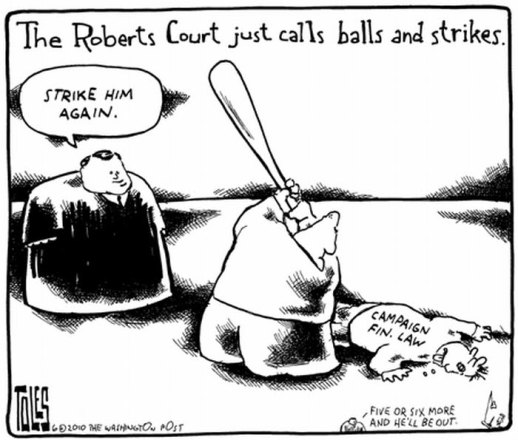
Roberts at the Bat

I will decide every case based on the record, according to the rule of law, without fear or favor, to the best of my ability. And I will remember that it’s my job to call balls and strikes and not to pitch or bat.

John Roberts (2005)

This week’s featured articles are “This is What Judicial Activism Looks Like” and “Who Should Be Beyond the Pale?

These last two weeks everybody has been talking about the Supreme Court

By now you’ve undoubtedly heard about the Court’s McCutcheon decision, which I discuss in “This is What Judicial Activism Looks Like“.

Chief Justice Roberts wrote the plurality’s opinion; his reasoning revolves around protecting the right of citizens to give the maximum $5200 per election cycle to as many candidates as they choose. But of course, the only citizens whose rights are actually affected are those who would like to give more than $123,200 to candidates, parties, and PACs during the 2013-2014 election cycle. According to the Federal Election Commission, only 646 people reached the limit during the 2011-2012 cycle. It goes without saying that these are 646 very wealthy people. So if you read Roberts’ opinion, I recommend doing a global-search-and-replace on the text to replace “citizens” with “very wealthy citizens”. For example:

The Government has a strong interest, no less critical to our democratic system, in combatting corruption and its appearance. We have, however, held that this interest must be limited to a specific kind of corruption — quid pro quo corruption — in order to ensure that the Government’s efforts do not have the effect of restricting the First Amendment right of very wealthy citizens to choose who shall govern them.

I think that makes the meaning much clearer.

and ObamaCare passed its sign-up goal

Yes, after all that angst about the web site, after the Koch brothers and their allies spent massive amounts of money on an unprecedented disinformation campaign, after the media fell for countless false ObamaCare horror stories, the number of sign-ups hit 7.5 million, somewhat more than the CBO’s original projection of 7 million. The reason is pretty simple: A lot of Americans need affordable health care, and the Affordable Care Act provides it.

That success allowed Kathleen Sebelius to resign with a rosy glow rather than slinking out of town defeated. Her replacement has already been named, but you can expect the confirmation hearings to be a circus, as Ted Cruz is looking on this as yet another chance to repeal ObamaCare. I think Democrats should sell popcorn for this circus, because it’s going to be a public orgy of mean-spiritedness that will not do the Republican Party any good. One of the reasons I haven’t been panicking about the projections for the fall elections is that the whole Republican strategy revolves around exploiting the failure of ObamaCare. What if we get to November it’s obviously not failing?

In fact, what if Democrats hit back hard? I suggest something like: “According to independent research, Republicans’ refusal to expand Medicaid has killed X Floridians this year.” They’ll squeal like stuck pigs, but I like the conversation where they’re saying “No, we’re not killing people.” (Yes, they are killing people.)

It’s not like Republicans are running away from this fight: Those in the Virginia legislature are threatening to shut down the state government rather than start saving the lives of the working poor.

Republicans are of course hanging on to the trainwreck narrative. But it’s worth pointing out that the point where the whole program explodes keeps receding into the future. Every prediction they’ve made that is checkable hasn’t panned out.

and equal pay

Last Tuesday was Equal Pay Day, the theoretical point where working women have finally made as much money as men did in 2013, given an average wage 77% of a man’s wage.

There’s been a lot of discussion of that number these last two weeks, with conservatives arguing that it’s meaningless, because women do different jobs, have different qualifications, choose a different career path, and so on.

I tried to understand the statistics myself a couple years ago, and my overall conclusion was that you can shrink the gap by normalizing for various factors, but you can’t make it go away. Discrimination continues to be a real, measurable thing. That’s more-or-less the conclusion ThinkProgress comes to also. It’s also not clear that you should normalize for everything you can possible normalize. Yes, women congregate in poorer-paying professions and interrupt their career paths to have children. But some of that is just discrimination of a different sort: “Women’s work” pays less (at least in part) because it has traditionally been women’s work, not because it’s inherently less valuable. And we could set up the economy in such a way that interrupted career paths wouldn’t be punished as much as they are, but we don’t.

The Republican position on this is that of course they are for equal pay for women, they’re just against any effort to help bring that about. Bill O’Reilly laid out the overall strategy

I strong believe in fighting for equality and I also believe that institutional bias should be against the law. What I oppose is government trying to impose equality.

To which Stephen Colbert responded:

I agree with every single word you’re saying, even if those words don’t agree with each other. You see, I also believe that institutional bias should be against the law. And, at the same time, that government shouldn’t do anything about it.

and taxes are due tomorrow

Ezra Klein explains how the IRS could just send you a bill (which you could ignore and send them a 1040 instead if you wanted). For most people, it would be easier and cheaper than keeping records and sending the IRS a bunch of information it already has. But tax-preparation companies would lose out, and they have lobbyists. So it’s not going to happen.

and you also might be interested in …

How I spent my week off: I talked about “Acceptance and Action” at the Unitarian Church of Quincy, Illinois.


The Heartbleed bug really does seem to be worth paying attention to. Change your online passwords; it doesn’t hurt anything.

Here’s my best advice for picking easy-to-remember hard-to-guess passwords: Think of some line or quote or song lyric that you’ll never forget, and turn it into an acronym. Example: “In the beginning God created the Heavens and the Earth” produces the password ItbGctH&tE. In your own mind, call it “the Genesis password” and if you put it on a list somewhere, just write down “Gen”. (Needless to say, I’m never using that one.)


If you don’t follow the conservative media, you miss all the exciting inside-the-bubble stories that the regular media doesn’t cover … because they’re not true. Example: Attorney General Eric Holder isn’t pushing for gun owners to wear tracking bracelets. Imagine that you hear four or five similarly outrageous stories each week, and that the oh-never-mind retractions don’t always reach you. Think what that would do to your worldview.


One of the reasons I’m not willing to give conservatives credit for being principled is that their principles have an odd way of evaporating whenever other conservative priorities are in the picture. Digby points out how conservative defenses of states rights somehow exclude a state’s right to legalize marijuana.

and let’s close with a visual pun

This is What Judicial Activism Looks Like

When John Roberts was being confirmed as Chief Justice in 2005, he likened his role to an umpire in a baseball game:

Judges are like umpires. Umpires don’t make the rules; they apply them. … I will remember that it’s my job to call balls and strikes and not to pitch or bat.

This was his way of invoking a common conservative trope: that “activist liberal judges” had “legislated from the bench” to create laws that were impervious to repeal through the political process. Roberts was pledging to be a different kind of judge, one who applied the law to the facts the way an umpire applies the rulebook’s definition of the strike zone to the pitch he just saw.

The umpire analogy was always suspect. As Justice David Souter pointed out in his 2010 Harvard commencement speech, cases that can be resolved just by reading the text and applying the facts usually don’t make it to the Supreme Court.

Even a moment’s thought is enough to show why it is so unrealistic. The Constitution has a good share of deliberately open-ended guarantees, like rights to due process of law, equal protection of the law, and freedom from unreasonable searches. These provisions cannot be applied like the requirement for 30-year-old senators; they call for more elaborate reasoning to show why very general language applies in some specific cases but not in others, and over time the various examples turn into rules that the Constitution does not mention.

Constitutional values, Souter recognized, often “exist in tension with each other, not in harmony.” Resolving those conflicts in a way that stays as true as possible to the spirit behind the Constitution as a whole … that requires a judge, not an umpire.

Souter was in many ways the model of what conservatives didn’t want to see in George W. Bush’s judicial appointments: Appointed by Bush’s father, Souter had drifted into the Court’s liberal wing, the wing that conservatives accused of making up laws. Roberts was promising not to do that. He would stay objective, rather than drifting into liberal activism.

When the Court’s McCutcheon v Federal Election Commission decision came out earlier this month, we saw just how ironically things have worked out. The decision, written by Roberts and building on the Roberts Court’s earlier decisions in Citizens United and McComish, is one more step in his completely original remaking (or rather, unmaking) of campaign finance law. John Roberts has become arguably the most activist Chief Justice in U.S. history.

When you read McCutcheon, the most striking thing is the way that Roberts is talking to himself. The precedents quoted are almost entirely those of the Roberts Court itself, many written by Chief Justice Roberts.

Moreover, the only type of corruption that Congress may target is quid pro quo corruption. Spending large sums of money in connection with elections, but not in connection with an effort to control the exercise of an officeholder’s official duties, does not give rise to quid pro quo corruption. Nor does the possibility that an individual who spends large sums may garner “influence over or access to” elected officials or political parties. Citizens United v. Federal Election Comm’n, 558 U. S. 310, 359. The line between quid pro quo corruption and general influence must be respected in order to safeguard basic First Amendment rights, and the Court must “err on the side of protecting political speech rather than suppressing it.” Federal Election Comm’n v. Wisconsin Right to Life, 551 U. S. 449, 457 (opinion of ROBERTS, C.J.). Pp. 18–21.

That bright line between quid pro quo corruption (direct bribery, where a campaign contribution is exchanged for a vote or other favor) and the more general buying of influence — and the idea that the Constitution limits Congress to legislate only on the quid pro quo side of that line — is a pure invention of John Roberts. It did not exist anywhere in law or legal tradition before he joined the Supreme Court.

Roberts also cites an older decision, Buckley v Valeo from 1976, but slides over the fact that he is reversing that decision. Buckley was the Court’s response to the post-Watergate rewriting of campaign finance laws. It upheld the part of the law that restricted campaign contributions, but threw out the law’s limits on campaign expenditures. The Court reached this conclusion via an interesting piece of reasoning that Roberts has completely written over: When a candidate spends money on his campaign, he is exercising his freedom of speech, and the government needs a very serious reason to stop him. But when a contributor gives money to a campaign, he is not himself speaking; contributors are exercising their right to free association, which is also a First Amendment right, but one that is not quite so sensitive as the freedom of speech.

In other words, in 1976 money was not speech.

The 1976 Court upheld the exact kind of restriction that McCutcheon throws out: an overall restriction on the amount of money an individual can give to federal campaigns during a two-year election cycle. So McCutcheon is a reversal, though you will struggle hard to find that fact acknowledged in the text. In Supreme Court tradition, reversals are not done lightly. A major reversal like Brown v Board of Education is a historical landmark, and typically happens only as a last resort. (See David Strauss’ book The Living Constitution for an account of all the ways the Court had tried for decades to make sense of “separate but equal” before recognizing in Brown that it just wasn’t going to work.)

If there is one cardinal symptom of judicial activism, reversal-on-a-whim is it. But Roberts does not struggle at all with reversing Buckley, he simply ignores that he’s doing it. And it’s not just Buckley. In Justice Breyer’s dissenting opinion, he quotes McConnell v FEC, the last major pre-Roberts campaign finance case, which upheld restrictions on soft money contributions:

Plaintiffs argue that without concrete evidence of an instance in which a federal officeholder has actually switched a vote [in exchange for soft money] . . . , Congress has not shown that there exists real or apparent corruption. . . . [P]laintiffs conceive of corruption too narrowly. Our cases have firmly estab­lished that Congress’ legitimate interest extends be­yond preventing simple cash-for-votes corruption to curbing ‘undue influence on an officeholder’s judg­ment, and the appearance of such influence.’

But as Breyer complains, Roberts now quotes Citizens United as if it had reversed McConnell.

Did the Court in Citizens United intend to overrule McConnell? I doubt it, for if it did, the Court or certainly the dissent would have said something about it.

Another major symptom of judicial activism is a judge valuing his own view of reality above that of the legislature. Judges are presumed to be experts in the law. But often a case hangs on not on the law alone, but on facts about the world. Congress can hold months of hearings and require reports from the full apparatus of government, and so is in general better situated to investigate the state of the world than a court is. Within the court system, a district court can spend weeks or months assembling a body of expert testimony, and so higher courts typically defer to a lower court’s findings of fact. In our entire system, no one is more poorly positioned to assess the state of the external world than the Supreme Court.

Non-activist judges realize that.

Lots of reality-based issues enter into campaign finance law: How does corruption really work? How corrupting are various kinds of contributions? How diligently will contributors and political parties look for loopholes in the law? What kinds of legal restrictions are practically enforceable, and which ones require the government to prove intentions that no one can really know? How does the appearance of corruption influence the behavior of voters and the overall health of democracy?

The Bipartisan Campaign Reform Act (BCRA) of 2002 was passed after Congress had assembled massive amounts of testimony and evidence. Moreover, congressmen themselves have direct experience with the temptations towards corruption, and significant interactions with the voters. When McCutcheon came before a district court, that court upheld the law in view of the Buckley precedent, before getting to the evidence-gathering part of the trial. Breyer summarizes:

The District Court in this case, holding that Buckley foreclosed McCutcheon’s constitutional challenge to the aggregate limits, granted the Government’s motion to dismiss the complaint prior to a full evidentiary hearing. … If the plu­rality now believes the District Court was wrong, then why does it not return the case for the further evidentiary development which has not yet taken place?

Why indeed? Is it that Chief Justice Roberts is afraid the facts would get in the way of what he wants to do? Or is he convinced that he already knows everything he needs to know?

Here’s the kind of thing I wish Justice Roberts knew: Last week I was in my home town, where I had dinner with my best friend from grade school. We have argued politics since we were seven, and he is quite conservative today. But we found one issue where we completely agree: No bank should be too big to fail. We agreed that Congress has done practically nothing to fix the financial system after the meltdown of 2008, and neither of us was optimistic that it would.

Why not? Not because the People want banks to be too big to fail. Between the two of us, I believe we represent a fairly broad public consensus on the issue. And not because bankers are delivering sacks of cash to congressmen in quid pro quo exchange for their votes. But the broader influence of big money in politics — the kind that Justice Roberts has placed beyond legal remedy — makes the too-big-to-fail issue unapproachable. Neither I nor my friend is actively pushing for Wall Street reform because … well, what’s the point?

That’s corruption of the political process undermining democracy. And Chief Justice Roberts has decreed that nothing can be done about it.