Monthly Archives: January 2014

Working for the People

Average people in America think government doesn’t work. Think again.
Government actually does work. It works for the people who pay it to work for them.

— Hedrick Smith, NH Rebellion rally
Nashua, NH, 1-24-2014

This week’s featured posts: “The Fall of Governor Ultrasound” and “One Week’s Worth of Crazy

This week Republicans started talking about another debt ceiling crisis

Because the last one worked out so well, I guess. But you can tell this is an organized effort because they’re using the same words. Both Mitch McConnell and Ted Cruz called a clean debt-ceiling increase “irresponsible”. John Boehner is also hinting at attaching ransom demands.

It’s important to keep in mind exactly what this all means: Congress just passed a two-year budget deal last month. That deal included a budget deficit that will push the national debt over the current debt ceiling. Now Republicans want to take a position against the debt that they just approved. You see, they’re for keeping taxes lower than spending; they’re just against borrowing the difference. Get it?

Treasury Secretary Jacob Lew estimates the disaster deadline is the end of February.

and the Bob McDonnell indictment

which I cover in “The Fall of Governor Ultrasound“. One of the issues that gets raised by this case is “the fine line between what is illegal versus what is unseemly”. Ditto for the latest out of Florida, where Governor Scott’s chief fund-raiser (who has donated over $1 million himself) got billions in Medicaid-management contracts for his companies. Illegal, or just unseemly?

And Bridgegate just keeps percolating along. Subpoenas are out, testimony is being taken. I’m sure the U.S. attorney will let us know when he has something.

and the Republican winter meetings

(Mike Huckabee’s winter-meetings speech is one of many incidents covered in “One Week’s Worth of Crazy“.)

The main news to come out the meetings was that Republicans are shortening their nomination process for 2016: Primaries will start later and end sooner. They want to hold the early primaries in February — in 2012 the Iowa caucuses were January 3, almost a week before the last bowl game — and  to have the convention in late June or early July, rather than late August.

It’s fascinating to compare the Democrats’ nomination process in 2008 to the Republicans’ in 2012. Both were national road shows that seemed to go on forever. But the eternal Obama/Clinton struggle worked in the Democrats’ favor: Each new primary state became the focus of a voter registration drive that helped Obama in the fall. When Republicans tried to raise the Jeremiah Wright/Bill Ayers issues, they seemed like old news because Obama had faced them already in the primaries. In general, Obama gained stature each time he debated the more famous Clinton head-to-head.

By contrast, Republicans came out of 2012 with a never-again attitude. Romney had to fend off a series of flawed boom-candidate-of-the-week challengers: Michele Bachmann, Rick Perry, Herman Cain, Newt Gingrich, and finally Rick Santorum. Each seemed like a joke to the non-Republican electorate, and the fact that each was succeeded by the next just emphasized how little the Republican base wanted to nominate Romney.

The 2004 Democratic nomination process demonstrated that the phrase “too far left” actually meant something: Dennis Kucinich was too far left, and the main debate in the early primaries was whether Howard Dean was too. But in 2012, “too far right” was meaningless to Republicans. In the debates, the candidates competed to be the most conservative, and the audiences seemed even more extreme: They booed a gay soldier in Iraq, cheered letting the uninsured die, cheered waterboarding, and applauded the fact that Rick Perry had executed 234 prisoners.

To be blunt, the Republican base is a freak show, and the longer they are on camera the worse it is for the eventual nominee. The RNC recognized that this week, and acted accordingly. As 2016 gets closer, expect them also to limit the number of debates and put them off as long as possible. If they could hold the primary campaign inside a bell jar, they would.

and you also might be interested in …

Doris Haddock, a.k.a. Granny D

Lawrence Lessig’s frigid 185-mile walk across New Hampshire concluded Friday at an NH Rebellion rally in Nashua, a few blocks from where I live. The rally doubled as a 114th birthday party for the late Granny D, whose 3200-mile walk across America deserves some amount of credit for the McCain-Feingold campaign finance reform of 2002.

At the rally, Lessig said:

Before we started this walk, we did a poll that found that 96% of Americans believe the influence of money in politics must be reduced. … But the reason why the pundits and the politicians don’t talk about it is that 91% of us believe it’s not going to happen. It can’t be done. We want it, but we won’t get it. Now I told those statistics to John Sarbanes, one of the congresspeople who has been most important in pushing the reform. And he said to me, “That’s wonderful. That means we’re the 5%.”

Lessig thinks the movement to reduce the corruption of our democratic system is in at least as good a position as the Civil Rights movement was when Rosa Parks sat down on the bus. He does a very good job of creating a sense of history, and raising the possibility that fighting for a worthy cause at a time when so few people believe it can succeed might be something you’ll tell your grandchildren about.

[BTW: I don’t have a link for either this quote or the one at the top of this post. But I heard it live and I have an audio recording.]


New Hampshire will try again to pass Medicaid expansion. Even the Business and Industry Association of New Hampshire supports it, but we haven’t been able to get it through our Republican-controlled Senate.


The No Taxpayer Funding for Abortion Act is coming up for a vote in the House. An earlier version was passed by the House in 2011, but failed in the Senate. At that time, Mother Jones reported that it could have some nasty results:

In testimony to a House taxation subcommittee on Wednesday, Thomas Barthold, the chief of staff of the nonpartisan Joint Tax Committee, confirmed that one consequence of the Republicans’ “No Taxpayer Funding for Abortion Act” would be to turn IRS agents into abortion cops—that is, during an audit, they’d have to determine, from evidence provided by the taxpayer, whether any tax benefit had been inappropriately used to pay for an abortion. … If an American who used such a benefit were to be audited, Barthold said, the burden of proof would lie with the taxpayer to provide documentation, for example, that her abortion fell under the rape/incest/life-of-the-mother exception, or that the health insurance she had purchased did not cover abortions.

… Under standard audit procedure, a woman would have to provide evidence to corroborate facts about abortions, rapes, and cases of incest, says Marcus Owens, an accountant and former longtime IRS official. If a taxpayer received a deduction or tax credit for abortion costs related to a case of rape or incest, or because her life was endangered, then “on audit [she] would have to demonstrate or prove, ideally by contemporaneous written documentation, that it was incest, or rape, or [her] life was in danger,” Owens says.

So if you get raped, save your receipts.

You really have to wonder what conservatives would come up with if they did want big government to intrude in people’s lives.


Eventually, I’m planning to do a full review of Ian Haney-Lopez’ new book Dog Whistle Politics: How Coded Racial Appeals Have Reinvented Racism and Wrecked the Middle Class. But for now, Salon has made an article out of the chapter on colorblindness.

Dog whistling cannot be resisted by refusing to talk about race, for this only leaves constant racial insinuations unchallenged, operating in the background to panic many whites. Indeed, dog whistle racism is not only protected by colorblindness, it rests fundamentally on colorblind myth-making.


Slate’s Zack Kopplin explains how Texas’ charter schools are a big loophole through which tax dollars are flowing to teach the most unscientific varieties of Creationism, as well as right-wing Christian views of history and society.


Another mall shooting. Is there a tipping point anywhere?

The Fall of Governor Ultrasound

The indictment, I now realize, is an under-exploited narrative form. Novels have been written in the form of diaries, case notes, and exchanges of letters, but I can’t remember seeing a novel written as an indictment.

It’s got to be an oversight, because the indictment of former Governor Bob McDonnell and his wife Maureen makes the potential clear: Within the constraints of the genre’s just-the-facts style, it still manages to build a sense of character and theme.

As the story begins, Bob and Maureen have risen to a new level, and can see yet another level beckoning, but don’t realize yet that they’re already in over their heads. Bob is the handsome, articulate new governor of what has recently become a swing state, Virginia. The Republican Party chooses him to respond to the 2010 State of the Union. He’s elected chair of the Republican Governor’s Association. He’s even being talked about as a likely running mate for Mitt Romney, who needs to reach out to the Christian Right without alienating the mainstream. And if Bob performs well on that national stage, who knows? He could be president himself someday. (If only he hadn’t backed that forced-transvaginal-ultrasound bill just as the war-on-women meme was starting to take off. Rick Perry did the same thing a year before, and nobody called him “Governor Ultrasound“. Bad timing!)

The big stage is full of important people to impress. But there’s a problem: money. The McDonnells were never rich, and then Bob bought property at the peak of the housing boom. (Bad timing again!) It’s so hard to cast the right image when your investments cost you more in mortgage interest than they generate in rent, and you can’t sell without revealing a huge loss. Where is Maureen going to get the designer gowns she needs for the Inaugural Ball and future formal events? How is Bob going to sport a Rolex or tool around in a Ferrari? How is the McDonnell daughter going to get the kind of wedding that an up-and-coming governor ought to be able to give her?

Enter the rich founder of a dietary-supplement company that (like Bob) seems right on the verge of bigger things. Bob and Maureen didn’t meet him until after Bob became governor, but he instantly becomes such a good friend to them — so nice, so generous; all they have to do is ask, and he provides whatever they need. And he asks so little: if the First Couple could only lend his company their names and images and the backdrop of the Governor’s Mansion, if they could lean on the state universities to do some legitimizing research.

Once the wrongdoing begins, the McDonnells are such clumsy criminals that you may end up feeling sorry for them. (Sometimes a lie can be so obvious that it’s almost honest.) They conspire in email and text messages. They know their stock holdings look suspicious, so they sell in December, fill out the year-end form, and then buy the shares back in January. Who could possibly see through such clever subterfuge?

But don’t worry, Bob and Maureen, a happy ending is on its way. The indictment ends with 14 reasons you should be admitted to a special federal academy, where experienced criminals can teach you how it’s really done.


Is he the right comparison?

Having looked at the indictment, you should also consider the McDonnell’s defense, which claims this is all politics. Some outside observers also say the case “is no slam dunk” because of “the fine line between what is illegal versus what is unseemly”. The point here is that McDonnell made no specific official action as governor to benefit his “friend”: McDonnell didn’t veto a law or appoint somebody to a state office in direct response to a gift. He sold the trappings and influence of the governorship rather than its constitutional powers.

In MSNBC reports on the case, you’re likely to see comparisons to a Democratic governor in jail: Rob Blagojevich, who famously tried to sell the Senate seat Barack Obama left to become president. But a comparison friendlier to McDonnell would be Don Siegelman, former Democratic governor of Alabama, also now in prison.

Or is he?

Like McDonnell’s defenders, Siegelman’s (including 60 Minutes) point out that some elements of the classic bribery story are missing: Siegelman did take an official action (re-appointing to a state board someone who had already served on that board under previous governors), but received no personal benefit (the appointee made a contribution to a fund campaigning to bring a state lottery to Alabama, a policy Siegelman favored).

In essence, both Siegelman and McDonnell claim that they didn’t cross the line between the man and the governor: Siegelman used his powers as governor to pursue his policies as governor, perhaps in an unseemly way. McDonnell used his prestige as a man (who happened to be governor) to reward someone who gave him personal gifts. In each case, the question is whether the law is being enforced in a politically biased way: How many other politicians could we send to jail under the same standards? And is there a partisan reason why we don’t?

One Week’s Worth of Crazy

You could get angry, or you could just laugh.


Every week as I put the Sift together, I face the same question: Do any of the outrageous, infuriating, and downright crazy quotes from conservative pundits or office-seeking Republicans or clueless rich people that I ran across this week deserve my readers’ attention?

If this were a pure partisan blog, the answer would always be yes: Outraging your fellow partisans is good. It raises energy. It keeps them focused. And from a blog-traffic point of view, something that gets a reader’s goat is likely to be shared or linked to or commented on.

But I view the Sift as more opinionated than partisan. That may sound like splitting hairs, but here’s what it means to me: I’m liberal but not manipulative. I see myself working for my readers (helping them stay sane while processing the news) not working on them, to keep them wound up. And besides, anyone who’s looking to get wound up — liberal or conservative — has plenty of other options. The Sift should strike a calmer, more contemplative tone.

Well, most of the time. Because there’s another factor at work: the 47% factor, you might say. Conservatives count on their ability to have two messages. They can go to a meeting of their partisans and say totally over-the-top stuff, and then put on their sane face and talk to the general public as if crazy-time never happened. Then I run into low-information voters who tell me, “He sounds pretty reasonable.”

So when the mask does drop and the ranting starts, it’s important that people hear about it.

At least sometimes. I still don’t want to walk around in a constant state of outrage, and I don’t want to do that to my readers either. So rather than pass on each and every crazy thing I see or hear, once in a while I think I’ll just bundle together the ones I ran into that week and try to present them a sense of humor.

So let’s start with a joke. Or rather, with the Iowa Republican Party’s idea of a joke:

Those Iowa Republicans, what a bunch of kidders!

Because, like, racism is so funny! And it doesn’t really exist, it’s just a word to throw at people you don’t like when they do humorous but totally understandable things like shoot innocent black teen-agers or concoct conspiracy theories about the president’s birth certificate.

At least this joke has a punch line: After the post started getting noticed, Iowa Republicans took it down, blamed a contractor, and fired him. I’d love to have heard that conversation. Did they say, “That’s just wrong” or something more like “I know we were laughing about that this afternoon, but those kind of jokes have to stay in-house”?

Most of all I’d like to know: Did the contractor get the flowchart from the guy who fired him?


Next are two examples of what I’ve started to call “guillotine bait”: very rich people displaying cluelessness on a let-them-eat-cake scale.

Tom Perkins is a wealthy venture capitalist who published a letter in The Wall Street Journal.

I would call attention to the parallels of fascist Nazi Germany to its war on its “one percent,” namely its Jews, to the progressive war on the American one percent, namely the “rich.” … Kristallnacht was unthinkable in 1930; is its descendent “progressive” radicalism unthinkable now?

I haven’t plugged The Distress of the Privileged yet this week, but what a great example of privileged distress. The rich — they’re just so persecuted these days! Sucks to be them, don’t you think?

And Kristallnacht? No, I have another historical parallel in mind. As Queen sang on the Highlander soundtrack: “Don’t lose your head.

More guillotine bait came from Kevin O’Leary, the Canadian businessman who appears on the reality-TV show Shark Tank. Asked for his reaction to the claim by Oxfam that “The bottom half of the world’s population owns the same as the richest 85 people in the world”, O’Leary responded:

It’s fantastic. And this is a great thing because because it inspires everybody, gives them motivation to look up to the 1% and say “I want to become one of those people. I’m going to fight hard to get up to the top.” This is fantastic news, and of course I applaud it.

If I were living on a dollar or two a day, I suspect everybody who’s safe, warm, and well-fed would look the same to me. But perhaps I underestimate the world’s poorest, and the sight of multi-billionaires inspires them in a way that mere millionaires can never manage. If so, though, O’Leary might show more concern about what exactly it inspires them to do.


Next we come to  Congressman Steve Pearce of New Mexico. He recently published a memoir in which he compares the family to the military chain of command: The husband is on top and the role of a wife “is to voluntarily submit”. But her submission isn’t “a matter of superior versus inferior”. Perish the thought.

This kind of stuff is much more convincing when it comes from the people who are submitting rather than the ones suggesting somebody else submit (voluntarily, of course). So Steve, how about this: In Congress, why don’t you voluntarily submit to Nancy Pelosi for a while? Then you can report back on whether it makes you feel inferior.


Virginia State Senator Dick Black (not to be confused with the similarly-named character in Hardcore) has dropped out of the race for Congress after his previous opposition to criminalizing spousal rape became an issue. (He wasn’t opposed per se, he just thought the point was moot because he couldn’t imagine how a husband raping his wife could leave any evidence.) He has also referred to emergency contraception as “baby pesticide“, and he segues smoothly from same-sex marriage to incest and polygamy. Polygamy, he says, “is just more natural” than homosexuality, because “at least it functions biologically.” (Especially if all your wives voluntarily submit, I suppose.)

Congress will be much less interesting without you, Dick.


Mug shot of an improving economy

Presenting the “faces of an improving economy” during his state-of-the-state address, Wisconsin Governor Scott Walker introduced an unemployed-until-recently welder. It turns out he may not have been entirely typical of Wisconsin’s unemployed: He’s a sex offender with two felonies and three drunk-driving convictions on his record.

The scary thought is that this might not be a mistake. Maybe Governor Walker really pictures the unemployed that way.


A candidate in the Republican congressional primary in Illinois’ 9th district has identified the source of our national problems:

“I am a conservative Republican and I believe in God first,” [Susanne] Atanus said. She said she believes God controls the weather and has put tornadoes and diseases such as autism and dementia on earth as punishment for gay rights and legalized abortions.

“God is angry. We are provoking him with abortions and same-sex marriage and civil unions,” she said.

I think it’s more likely God gets angry when complete idiots put their words into His mouth. But that’s just my opinion.


Another one of God’s ventriloquists, Family Research Council’s Tony Perkins, also knows the hidden cause of a social problem. Campus sexual assault (which President Obama announced a task force on Wednesday) is caused by “sexual liberalism” — free birth control, co-ed dorms, decriminalized marijuana, and Sandra Fluke. Because campus rapes never happened in the Happy Days before all that, I suppose.

The implication here is that there is some kind of slippery slope between voluntary sex (which could be enabled by, say, free birth control) and involuntary sex. Can’t say I’ve ever noticed it.


I cheated just a little: This week wasn’t entirely typical because the of the RNC Winter Meetings, where Mike Huckabee said Republicans aren’t fighting a War on Women, they’re fighting a “War for Women“.

Way to turn the spin around, Huck. You see, Republicans want to remove contraceptive coverage from ObamaCare “to empower [women] to be something other than victims of their gender.”

If the Democrats want to insult the women of America by making them believe that they are helpless without Uncle Sugar coming in and providing for them a prescription each month for birth control because they cannot control their libido or their reproductive system without the help of the government, then so be it. Let’s take that discussion all across America, because women are far more than the Democrats have played them to be.

Critics are making unflattering comparisons to Rick Santorum’s bankroller Foster Friess (whose recommended form of birth control was an aspirin held between a woman’s knees) or 2012 Missouri Senate candidate Todd Akin (who denied rape pregnancy is a problem because a woman’s reproductive system shuts down during rape).

The American Prospect‘s Paul Waldman explains “Why Republicans Keep Calling American Women Sluts“:

The morality clearly reflected in these statements is that sex is inherently sinful … and a virtuous woman doesn’t have sex except for those rare occasions when her husband wants to impregnate her. That’s why Huckabee can say—sincerely, I’m sure—that it’s an insult for Democrats to say women should have access to contraception, because that’s the same as saying women lack virtue.

But I think Huckabee is onto something more than just the evil of sex: Refusing to help people empowers them to help themselves. It’s like if Huckabee fell off a cruise ship: Throwing him a life preserver would just cast him as a victim of his mammalian need to breathe air. Better by far to empower him to swim to safety on his own — or, even better, to control his pulmonary system by spontaneously developing gills.

I hope Huckabee doesn’t just take his message across America; I hope he extends it to other situations: Cutting Food Stamps empowers the poor to feed themselves, and shows faith in their (and their children’s) ability to control their appetites. Cutting unemployment empowers people to find jobs, even when there are no jobs. Ending tax breaks for fossil-fuel companies empowers them to find oil without handouts from Uncle Sugar.

Wait, maybe that last one goes too far. Nobody likes an extremist.

Anyway, Huck’s speech made the NYT’s Gail Collins reminisce about 2008, when Huckabee “was a front-runner for a while, because he was the most likable candidate.” Then it was the usual tragic story: He got a talk show on Fox News and started running with a bad crowd.


That’s just what I happened across this week. Next week — nah, I’m not going to do it. Maybe one or two outlandish things will make it into the weekly summary, but an article-length round-up probably shouldn’t happen more than once a quarter.

The Monday Morning Teaser

For some reason I’ve felt unusually snarky this week, so both of this week’s featured articles will have a high snark quotient.

The first one is pretty much done, so it should appear in just a few minutes. All week, I kept running into over-the-top quotes: Mike Huckabee claiming he was fighting a “war for women” to protect them from the “insult” of insurance-covered contraception, that Shark Tank guy saying it was “fantastic news” that the world’s 85 richest individuals have as much money as the bottom 3.5 billion people do, the Family Research Council guy blaming the campus sexual assault problem on Sandra Fluke, and so on. I was despairing for my gender when I finally found evidence that women are crazy too: A Republican candidate for Congress blamed dementia and autism on same-sex marriage. (“God is angry.”)

Finally I decided you just have to laugh, so I collected it all in “One Week’s Worth of Crazy”. I use two phrases (Google says I didn’t coin them) that I hope catch on: God’s ventriloquists for people who keep putting their ridiculous words into God’s mouth, and guillotine bait for rich people displaying let-them-eat-cake cluelessness.

My second snarky piece is “The Fall of Governor Ultrasound”. I read the 14-count Bob McDonnell indictment, and now believe the federal indictment is a literary form of unappreciated potential.

As usual, I’m going to try to get the weekly summary out by noon.

Good Intentions

Our system of government is built on the premise that our liberty cannot depend on the good intentions of those in power; it depends on the law to constrain those in power.

— President Obama, Friday at the Department of Justice

This week everybody was still talking about Bridgegate

or at least MSNBC was. Rachel Maddow has been talking about little else. (It’s been working for her. Fox News usually outdraws MSNBC by a considerable margin, but in recent weeks the Rachel/Megyn Kelly match-up has been noticeably closer.)

In its general form, Bridgegate is a Watergate-type scandal: The story starts with an event that is clearly wrong (a bungled burglary, an engineered traffic jam), but not all that consequential for most people. The event is only interesting because it is so incongruous with a civics-textbook view of government: If this happened, and if officials reacted so automatically to cover it up, then the (Nixon, Christie) administration clearly views itself and its mission very differently from the vision of government the public believes in. And if that is the case, what else has been going on?

If the answer is “nothing”, then the story will largely die out, unless there’s clear proof Christie himself committed a crime. (So far there isn’t.) But we now enter the Chinese-water-torture part of the narrative, where thematically (but not directly) related charges drip-drip-drip down on Christie’s head.

The first drip came Saturday, when Mayor Dawn Zimmer of Hoboken charged that

Two senior members of Gov. Chris Christie’s administration warned [her] earlier this year that her town would be starved of hurricane relief money unless she approved a lucrative redevelopment plan favored by the governor.

Probably there will be more drips. And rather than defend, I expect Republicans to counter-attack. In the same way that Republican congressmen’s extra-marital affairs started coming out during the Clinton impeachment, the corruption of New Jersey Democrats is likely to make headlines soon. (I don’t know anything; I’m just reading the signs.)

If Bridgegate does follow the path of Watergate, MSNBC better pace itself. From the Watergate break-in to Nixon’s resignation was two years.


Bridgegate has also been a Rorschach test, in which a pundit’s reaction says as much about him as about the story. For example, the question of whether Governor Christie is a bully evoked this from Britt Hume.

In this sort of feminized atmosphere in which we exist today, guys who are masculine and muscular like that in their private conduct, kind of old-fashioned tough guys, run some risks. … Men today have learned the lesson the hard way that if you act like kind of an old-fashioned guy’s guy, you’re in constant danger of slipping out and saying something that’s going to get you in trouble and make you look like a sexist or make you look like you seem thuggish or whatever.

Let me translate this into 21st-century English: “If you talk the way men used to talk when women either weren’t in the room or had to keep quiet, some woman is bound to point out that you’re being a jerk.”


And you know who the conservative media thinks is the really bully here? Bruce Springsteen. When he went on Jimmy Fallon’s show and sang this song:

he was “mean, small, and petty“. He was “piling on“. Poor Chris Christie. He loves the Boss, but the Boss doesn’t love him back.

and poverty

The 50th anniversary of the War on Poverty (which I mentioned last week) has made a lot of people take a step back and look at the longer view.

Barbara Ehrenreich revisits some of the territory of her book Nickel and Dimed in an Atlantic article “It’s Expensive to be Poor“. The point she’s making is not new, but the wealthy and professional-class folks who monopolize the national political conversation have a way of forgetting it.

We hear again and again how anti-poverty programs just make the poor dependent on government and encourage laziness. But the biggest obstacles to getting out of poverty are the poverty traps: situations where the poor don’t have enough money to live cheaply or look for better jobs. If you can’t afford security-deposit-plus-first-month’s-rent for an apartment with a kitchen; if you don’t have access to a car; if you can’t make appointments in advance because your part-time minimum-wage job has unpredictable hours — then your chances of climbing out of poverty are not very good.


If you happened to see David Brooks’ enough-with-this-talk-about-inequality column, you should read Dean Baker’s answer. To Brooks’ point that the growing income of the rich is a different phenomenon than the shrinking opportunities of the poor and the destruction of the middle class, and that only a “primitive zero-sum mentality” connects them, Baker responded:

Fans of arithmetic everywhere know that if the rich get more, and the economy is not growing faster, then everyone else gets less. (It might be primitive, but it’s true.) And the economy has been growing very slowly for the last thirteen years and actually pretty slowly for the whole period in which inequality has been increasing.

and President Obama’s new tone on the NSA

Friday, President Obama gave a speech at the Justice Department “On Review of Signals Intelligence” (text, video, summary of new directive).

As I’ve admitted before, I’m having a hard time staying on top of this issue. New revelations, new policies, and new rhetoric appear faster than I have been able to process it all. So for now I’ll defer to The New Yorker‘s Ryan Lizza. Lizza is skeptical that the new rules will be more than “cosmetic changes”. But he does believe that a more subtle tipping point has been reached: Up until now, the administration has been dismissive of critics.

Indeed, in my conversations with intelligence officials this past year, their general attitude was that smart, well-meaning, Ivy League-educated lawyers were on the front lines at the intelligence agencies making sure that the privacy rights of Americans were protected, and, therefore, the concerns about abuse were not only unfounded but also bordered on paranoia. … Today, Obama reversed course, acknowledging that all of that wasn’t enough. He has now adopted the language of the reformers.

Lizza concludes that Obama has undercut status-quo supporters in Congress, while empowering those who are more skeptical of current arrangements:

Obama’s cautious, infuriating speech won’t reform the system in all the ways that N.S.A. critics want, but it just might help Congress do so.

but I wrote about court decisions

The Supreme Court has been relatively quiet lately, but lower courts have been busily ruling on same-sex marriage, the NSA’s domestic spying, net neutrality, and many other issues. This week I tried to catch up. I covered net neutrality and same-sex marriage, and I hope to get to the rest next week.

While we’re talking about voting rights (or putting off that talk until next week), it’s worth mentioning that two Democrats and a Republican have agreed on a formula for fixing the part of the Voting Rights Act that the Supreme Court torpedoed last summer.

Where the revised bill goes from here is an open question. Renewing the VRA has been a no-brainer in the past, passing by wide margins. So Congress could just pass it.

On the other hand, the VRA could follow the path of immigration reform: The Senate passes it with a bipartisan majority, and Republicans in the House claim to support it when they talk to minority audiences, but Speaker Boehner keeps it from coming to a vote so as not to offend the extreme right wing. Too soon to tell.

and you also might be interested in …

When my Dad was alive, he was always mystified when I omitted the “Dr.” title that my Ph.D. in mathematics gives me the right to use. My policy is that I’ll call myself “Dr. Muder” when I write about mathematics, because that’s where my credentials are relevant. But on subjects where I’m just another guy with an opinion, those opinions have to stand on their own. I won’t imply that I’m an expert by styling myself as a doctor.

I came to that policy as a graduate student in the 80s, an era when Milton Friedman was using his legitimate prestige as an economist to give heft to his oracular pronouncements about the morality of various political policies. On political and moral issues, Friedman was just a guy with an opinion, and his Nobel prize was as irrelevant as my eventual doctorate would be.

Climate scientists today have a more difficult line to walk, because their scientific prestige is relevant up to a point, but the more politically active they get, the more they’ll be tempted to exaggerate the extent of their expertise. Penn State’s Michael Mann (creator of the “hockey stick” graph and a main target of the Climategate smear) wrote a thoughtful article about this in the NYT’s Sunday Review.

It is not an uncommon view among scientists that we potentially compromise our objectivity if we choose to wade into policy matters or the societal implications of our work. And it would be problematic if our views on policy somehow influenced the way we went about doing our science. But there is nothing inappropriate at all about drawing on our scientific knowledge to speak out about the very real implications of our research.

He sums up the right balance by re-purposing the Homeland Security slogan: “If you see something, say something.”


For the first time, a player on Washington’s NFL team says that the franchise should change its name.

Ya think? Nobody would stand for a team named the Memphis Niggers or the Arizona Wetbacks. As Clem Ironwing of the Sioux put it:

The only way “redskin” was ever used towards my people and myself was in a derogatory manner. It was never, ever, used in a show of respect or kindness. It was only used to let you know that you were dirty and no good, and to this day still is.

Defenders of the NFL franchise have tried a few points. First, they want to lump “redskin” in with other Native-American-related team-names, making common cause with fans across the country. But while there’s also an argument for renaming some other teams, calling someone a “brave” or a “chief” is not inherently derogatory. (Degrading mascots and logos can be a separate issue.) And names that commemorate the pre-European inhabitants of a region — the Florida State Seminoles or the University of Illinois Illini, say — may or may not have been chosen respectfully, but they can honor the local history now, if the schools make a legitimate effort to do so. But what “redskin” mainly commemorates is the genocidal project directed from Washington. Picture the Berlin Jews (or maybe Kikes) wearing a yellow star on their jerseys. Could that ever be acceptable?

Another defense is that a few Native American communities have chosen to name their own high school teams the Redskins. Yeah, right. And it’s OK for whites to say “nigger” now, because black rappers say it. If members of a historically oppressed community want to reclaim the words that were used to put them down, that’s up to them. If they want our “help”, they’ll ask for it.

and let’s end with something fun

To the enlightened, all dances are one. You knew that, didn’t you?

Catching Up With the Judges

While the Supreme Court has been relatively quiet lately, a lot has been going on in lower courts. This week I’ll tackle the recent net neutrality and same-sex marriage cases. In future articles I plan to address cases related to the NSA, voting rights, and drug-testing welfare recipients.

Net neutrality. The headlines about this decision said things like “Verizon Wins, Net Neutrality Loses“. But the overall impact of the D. C. Court of Appeals ruling is a little more ambiguous and complicated. Reading it was like watching the tape of a football game where my team gets way ahead, but I’ve already heard that they lost. On its way to ruling in Verizon’s favor, the court trashes one Verizon argument after another. “We lose this?” I kept asking myself.

Net neutrality is one of those important-but-somewhat-technical issues that it’s hard to get the public excited about. The issue will go months at a time without making headlines, so when it comes up again even people who have read about it before are likely to say, “Wait, I know this. What is it again?” Wikipedia defines it pretty well:

Net neutrality (also network neutrality or Internet neutrality) is the principle that Internet service providers and governments should treat all data on the Internet equally, not discriminating or charging differentially by user, content, site, platform, application, type of attached equipment, and modes of communication.

The practical problem is that you don’t have a lot of choices if you want fast broadband internet access in your home. The local cable monopoly may be the only option if you aren’t near a major city. If you are, you might have a choice between Comcast and Verizon FIOS — a Coke/Pepsi choice where competition is tightly confined to battlefields that don’t rock the corporate boat too much.

In short, broadband providers have a lot of market power. And the technology has shaken out in such a way that they have the power not just to impose a bad deal on you, but also on “edge providers” of services like Netflix or Google. Comcast has its own video-on-demand service, for example, so what if it decided to block its users from accessing Netflix? Or maybe Netflix connections could be inexplicably glitchy, unless Netflix paid Comcast a big fee. (Nice service you got there. It’d be a shame if something happened to it.)

Verizon could decide to compete with Comcast by charging smaller fee (or no fee at all) so that its users got Netflix cheaper. But why not just charge the same fee, give your own on-demand service the same advantage, and make money hand-over-fist? If there were five or six broadband providers, one of the smaller ones would probably break ranks. But with two or three, probably not. (BTW: That’s the same logic why none of the larger wireless companies should be allowed to take over T-Mobile.)

Until Tuesday, FCC rules made that illegal. Those are the rules that got thrown out by the D. C. Appeals Court. But along the way, the Court rejected almost all the arguments Verizon made for why it should be allowed to do whatever it wants with its network and charge whatever the market will bear.

The relevant law is Telecommunications Act of 1996, which gave the FCC the mission to promote the spread of broadband internet access. The main argument is over how to do that: Verizon thinks that making things as profitable as possible for broadband providers (like itself) encourages the providers to build out the broadband infrastructure. Net neutrality advocates argue that letting a few big corporations essentially “own the internet” discourages the real creativity in the system, which comes from edge providers trying to create the next gotta-have-it service like Netflix or YouTube. A Verizon-owned internet will be less interesting than a net-neutrality internet, and hence will inspire less consumer demand.

In short, it’s yet another version of the eternal supply-side vs. demand-side argument.

Anyway, the TCA classifies internet companies into two bins: telecommunications carriers and information-services providers. Telecommunications carriers are regulated like the wired phone companies: They have to offer their services to everyone on a more-or-less equal basis. Information-services companies have more leeway.

The gist of the court ruling is that the FCC has classified cable companies as information-services providers, but that its net-neutrality rules regulate them like telecommunications carriers. So the FCC’s net-neutrality rules can’t stand. But — and this is the observation that snatches victory from the jaws of defeat — it’s totally within the FCC’s current powers and mandate to just reclassify the cable companies.

So net neutrality is dead. But if the FCC wants to revive it, all they have to do is issue new rules. Judge Laurence Silberman dissented from the majority opinion that the FCC has this power, but since Verizon technically “won”, they can’t appeal the ruling to the Supreme Court unless and until the FCC tries to use the power that the Court says it has.

In short, this is all a long way from over.

Same-sex marriage. A month ago, if I had to guess which two states would be the last ones to legalize same-sex marriage, I might have picked Utah and Oklahoma. Since then, though, federal judges have struck down the amendments to both state constitutions that restrict marriage to opposite-sex couples. Both judges build on the Supreme Court’s Windsor decision that struck down parts of the Defense of Marriage Act last summer, but they do it in somewhat different ways.

You may remember that while I liked the outcome of Windsor, I was no fan of Justice Kennedy’s majority opinion, which I labeled “mush” and lumped together with Chief Justice Roberts’ voting-rights-act decision in a subtle, soft-spoken article I called “This Court Sucks“.

Here’s why Kennedy’s Windsor opinion sucked. Same-sex marriage cases all revolve around these three questions:

  • Does the right to marry (which the Court has often affirmed as a fundamental right protected by the Constitution) apply to same-sex couples?
  • Are laws targeting gays and lesbians (like laws targeting blacks or women) inherently suspicious as vehicles for irrational prejudice, and so subject to some form of heightened scrutiny from the courts?
  • Whatever standard of scrutiny you choose, do the laws serve legitimate purposes that outweigh the limitations they put on the couples’ rights?

Kennedy dodged all that. He waxed eloquent for a while on the plight of same-sex couples and the unreasonable prejudices against them, and then announced that DOMA was struck down.

That’s exactly the result I want, Justice Kennedy, but how did you get there? The purposes Congress imagined DOMA serving — whatever they were; you don’t list them or examine them — don’t “overcome”, but are they failing to overcome a high standard or a low standard?

The victims of Kennedy’s judicial malpractice are lower court judges like Terence Kern and Robert Shelby, who have been left to rule on similar-but-not-identical cases without any clear guidance. In his Oklahoma ruling, Kern avoids technical legal terms like sucks and mush, but makes more-or-less the same point I did:

The Windsor Court did not apply the familiar equal protection framework, which inquires as to the applicable level of scrutiny and then analyzes the law’s justifications. … Thus, Windsor does not answer whether a state may prohibit same-sex marriage in the first instance. Nor does Windsor declare homosexuals a suspect class or discuss whether DOMA impacted a fundamental right, which would have provided this Court with a clear test .

So Kern does his best to puzzle out the WWJKD question:

This Court has gleaned and will apply two principles from Windsor.

Ordinarily, a lower-court judge just “applies” principles from a higher-court ruling, rather than having to “glean” them first.

Lacking clear guidance, Kern avoids declaring either a fundamental right to same-sex marriage or that gays and lesbians are a protected class. That means that Oklahoma’s same-sex marriage ban only needs to have “rational relation to some legitimate end”.

Shelby took a somewhat different path to the same destination in the Utah case. He made an insightful observation about what exactly has changed in recent years: not the Constitution, but our understanding of what it means to be gay or lesbian.

The State accepts without contest the Plaintiffs’ testimony that they cannot develop the type of intimate bond necessary to sustain a marriage with a person of the opposite sex. … Forty years ago, these assertions would not have been accepted by a court without dispute. In 1973, the American Psychiatric Association still defined homosexuality as a mental disorder in the Diagnostic and Statistical Manual of Mental Disorders (DSM-II), and leading experts believed that homosexuality was simply a lifestyle choice. … The State presents no argument or evidence to suggest that the Plaintiffs could change their identity if they desired to do so. Given these undisputed facts, it is clear that if the Plaintiffs are not allowed to marry a partner of the same sex, the Plaintiffs will be forced to remain unmarried. The effect of Amendment 3 is therefore that it denies gay and lesbian citizens of Utah the ability to exercise one of their constitutionally protected rights.

So Shelby is in a position to demand a higher standard of the state, that their ban on same-sex marriage is “narrowly tailored to serve a compelling state interest.” But ultimately, both Kern and Shelby end up arguing that the ban does not satisfy even the lowest standard, the rational-basis test.

In each case, the state trotted out the same justifications: that the state has an interest in promoting “responsible procreation” among “naturally procreative” couples, and that opposite-sex couples provide the ideal setting for raising childrent.

Both judges make basically the same counter-argument, but Shelby says it best:

[T]he State poses the wrong question. The court’s focus is not on whether extending marriage benefits to heterosexual couples serves a legitimate governmental interest.  No one disputes that marriage benefits serve not just legitimate, but compelling governmental interests, which is why the Constitution provides such protection to an individual’s fundamental right to marry. Instead, courts are required to determine whether there is a rational connection between the challenged statute and a legitimate state interest. … The State of Utah has provided no evidence that opposite-sex marriage will be affected in any way by same-sex marriage. In the absence of such evidence, the State’s unsupported fears and speculations are insufficient to justify the State’s refusal to dignify the family relationships of its gay and lesbian citizens. …

Applying the law as it is required to do, the court holds that Utah’s prohibition on same-sex marriage conflicts with the United States Constitution’s guarantees of equal protection and due process under the law. The State’s current laws deny its gay and lesbian citizens their fundamental right to marry and, in so doing, demean the dignity of these same-sex couples for no rational reason. Accordingly, the court finds that these laws are unconstitutional.

Both cases are being appealed and will undoubtedly end up before the Supreme Court. But what’s clear from the rulings is that the opponents of same-sex marriage will have to come up with a new set of arguments if they hope to prevail: It’s not enough to argue that opposite-sex marriage is good; they’ll need to argue that same-sex marriage is bad, which they have not done and may not be able to do, particularly when the person they need to convince is the Supreme Court’s swing vote, Justice Kennedy.

The Monday Morning Teaser

The Supreme Court has been relatively quiet lately. (Like freshmen, they finish most of their assignments at the end of the term in June.) But lower court judges have been issuing important rulings on net neutrality, same-sex marriage, the NSA, voting rights, drug-testing welfare recipients, and a variety of other subjects.

I’ve gotten way behind in covering them, so this week’s featured article will be: “Catching Up With the Judges: Net Neutrality and Marriage”. (I’ll try to catch up with the rest next week.)

The D. C. Circuit Court of Appeals struck down the FCC’s net neutrality rules, but the majority opinion suggests that the FCC could fix the problem without new legislation. So in a weird way, the winners (Verizon) were losers and vice versa.

A month ago, if you’d asked me to guess which two states would be the last to legalize same-sex marriage, I might have picked Utah and Oklahoma. Well, just before Christmas a federal judge struck down Utah’s constitutional amendment limiting marriage to one man and one woman, and this Tuesday Oklahoma’s bit the dust. The cases had nearly identical facts and the states made nearly identical arguments, which the judges destroyed in similar ways, as if the standard anti-marriage-equality arguments have become fat pitches easily hit out of the park.

Both cases will be appealed and undoubtedly the issue will wind up at the Supreme Court, maybe next year. I’m having a hard time imagining what the four conservative justices can possibly say to persuade Justice Kennedy.

The weekly summary will bring you up to date on the Bridgegate scandal and President Obama’s change of rhetoric on the NSA. Michael Mann also wrote an interesting article about how climate scientists should approach the politics of global warming. The 50th anniversary of the War on Poverty is continuing to generate good discussion about inequality. Pressure continues to build on the Washington NFL franchise to change its name. And I’ll end with a great dance video.

Expect the legal article around ten (New Hampshire time) and the weekly summary about noon.

Cold and Dark

Saying global warming isn’t real because it’s cold out is like saying the sun isn’t real because it’s dark out.

Ezra Klein

This week everybody was talking about a traffic jam near a bridge

Wednesday: Did something happen?

Well, almost everybody. Fox News barely covered the story the day it broke open, and now the strategy seems to be to use it as a segue to talk about Benghazi.

By now you may have heard too much about Bridgegate, or the same basic information repeated way too many times. So let me do a really quick sort:

  • What happened? Wikipedia has the essential facts. In September, Governor Christie’s appointees cut down access from Fort Lee, NJ to the George Washington Bridge into New York, causing massive traffic jams several days in a row.
  • Why are we talking about it now? Rachel Maddow has been covering this story for a month and the local media even longer, but it really broke open Wednesday, when a North Jersey newspaper released emails and texts that proved the jams were created intentionally for some punitive purpose. Thursday, Christie apologized to the state, claimed he knew nothing about it, and fired the deputy chief of staff who he claims misled him.
  • Who were Christie’s people trying to punish and why? That’s the mystery. The original claim was that they were taking revenge on Fort Lee’s mayor for not endorsing Christie’s re-election campaign. But that case seems really weak, given that many more important people didn’t endorse Christie and weren’t similarly punished. Maddow floated an alternate theory about judicial appointments and Fort Lee’s state senator, but Democrats in the NJ Senate have shot that down too. The latest theory has to do with Fort Lee’s billion-dollar development project whose value depends on its access to New York.

As always, the media is doing way too much speculating about whether Christie was really as disconnected from the wrongdoing as he claims. Basically, we’re all just predicting that the facts will eventually validate our prior opinions about Christie, whatever those happen to be. Better to just wait: Real investigations are happening, and they’ll probably produce solid information long before anybody has to vote on whether Christie should be president.

So far, the main beneficiaries of the scandal are the comedians. Jon Stewart, of course. And I enjoyed Andy Borowitz’s “All Lanes on George Washington Bridge Blocked by Chris Christie’s Ego“. (But enough with the fat jokes already; that should be out of bounds.)

After all the phony scandals they’ve tried to drum up about President Obama (IRS, Benghazi, his birth certificate, etc.), you’d think an authentic Republican scandal would be difficult for the conservative media to deal with. But they’re up to the job. Media Matters explains their game plan:

and the weather

The polar vortex came and went, and now the east coast is unseasonably warm.

Here’s the right point to make when deniers advance the global-warming-is-false-because-I’m-cold argument: Even when 2014 was just a few days old and wind chills were below zero for most of the country, there was a bet you could make that was almost a sure thing. No matter how it started, by its end 2014 will be yet another warm year. And by warm I mean: The global average temperature will wind up well above the 50-year average and the 20-year average. (When you get down to the five-year average, short-term randomness makes the bet iffy, as the graph below demonstrates.)

Deniers will tell you global warming is a religious belief that contrary evidence can’t touch. But in fact I can tell you exactly what would make me doubt: a genuinely cold year. If we had a year where the average global temperature fell below the 100-year average, with no obvious explanation like a massive volcano or a nuclear war, I’d have to rethink.

A decade cooler than the one before it would also impress me. Ezra Klein got this graph from the World Meteorological Association:

When Klein tweeted the quote at the top of this article, various conservatives tweeted back some version of:

no, it’s like saying “global warming is real because there’s a heat wave”

And that would be an excellent rejoinder if anyone ever made that argument.

In fact, if you look at environmentalists’ discussions of whether Hurricane Sandy or the Colorado brush fires or the Oklahoma tornadoes or any other weather event could be related to global warming, they are filled with nuance and explanations and acknowledgements that the connection between climate and specific weather events is probabilistic at best. And if you look at how the liberal portion of the mainstream media covers those discussions, as a rule they are likewise cautious and judicious. Unless you edit deceptively, you won’t find clips of top liberal pundits and spokesmen and political leaders saying anything remotely equivalent to this:

Which raises another interesting question: Who is the liberal equivalent of Donald Trump?

and Al Qaeda taking over Fallujah

The news that Sunni militants linked to Al Qaeda had taken control of Fallujah, the site of “the bloodiest battle of the entire Iraq War” — nearly 100 American troops died taking the city — re-opened a lot of the wounds of that struggle.

If you were against the war, it made you reflect on the pointlessness of it all. Thom Hartmann commented:

The freedom Bush promised the Iraqi people now looks like the freedom to die in a region-wide sectarian civil war that’s rapidly spiraling out of control.

War supporters, on the other hand, blamed President Obama for pulling our troops out and thereby squandering the gains they had made. Senators John McCain and Lindsey Graham released a statement:

When President Obama withdrew all U.S. forces from Iraq in 2011, over the objections of our military leaders and commanders on the ground, many of us predicted that the vacuum would be filled by America’s enemies and would emerge as a threat to U.S. national security interests. Sadly, that reality is now clearer than ever.

It’s given me an I-didn’t-want-to-be-right feeling.

Lots of folks were against starting the war. But after it got going, I kept hearing people say, “I want to get our troops out, but we can’t just cut and run.” So in 2005, when “only” 1800 or so American troops had died in the Iraq War and the price tag was still only in the hundreds of billions, I wrote a piece called “Cut and Run“, where I advocated exactly that: Don’t wait until something-or-other happens that will allow us to save face and make a graceful exit. Just get out of Iraq as fast as possible.

What are we fixing? What do we expect to get better if we stay for another year or five years or ten years? …

It is hard to let go of the fantasy that some good can salvaged from the thousands of lives and hundreds of billions of dollars that have already been sacrificed to this war. Americans like to believe in happy endings. We want to be told that one more push will make it all worthwhile.

But we need to face reality. The dead soldiers and spent dollars are gone and they have accomplished nothing. We are like the gambler who stays at the table because he cannot admit that he has already lost more than he can afford. One more game, we think, and we can win it all back. Or at least some of it.

We can’t. It is a hard truth, but it is a truth.

So we stayed for another six years and lost another 2600 or so American soldiers, killed tens of thousands of Iraqis, and added trillions to our national debt. And the result is … what? What did we fix?

We could have followed the McCain/Graham plan and kept troops there for many years more, and lost many more of them. And when we eventually left and things fell apart, they could still say, “We didn’t stay long enough.”

Anyway, here’s the lesson I want us to learn from Iraq. When we as a country make a mistake, the right time to stop making it is now, not “in six months” or “after we stabilize the situation” or whenever. Now. Cut-and-run was the right answer in 2005 in Iraq. It often is.

and the 50th anniversary of the War on Poverty

LBJ declared the war in his 1964 State of the Union address. Watching the movie newsreel coverage brings home just how long 50 years can be.

The anniversary evoked a longer-term look at poverty and the programs that are supposed to fight it. The best retrospective, I think, was Paul Krugman’s.

For a long time, everyone knew — or, more accurately, “knew” — that the war on poverty had been an abject failure. And they knew why: It was the fault of the poor themselves. But what everyone knew wasn’t true, and the public seems to have caught on.

The narrative went like this: Antipoverty programs hadn’t actually reduced poverty, because poverty in America was basically a social problem — a problem of broken families, crime and a culture of dependence that was only reinforced by government aid. And because this narrative was so widely accepted, bashing the poor was good politics, enthusiastically embraced by Republicans and some Democrats, too.

But in recent years something has changed: It’s become obvious that people are poor because wages don’t track productivity any more. People who have strong values and work hard can still be poor, and lots of lower-middle-class people now see their jobs as vulnerable and their economic security virtually non-existent without a government safety net.

On its 50th birthday, the war on poverty no longer looks like a failure. It looks, instead, like a template for a rising, increasingly confident progressive movement.

Over at The Atlantic, Peter Beinhart looks at the conservative approach to poverty.

the new Republican anti-poverty speeches have a depressingly theological quality. They usually begin with a catechism: Washington can’t effectively fight poverty. … Rarely is serious evidence offered for these assertions, because they are not statements of fact; they are declarations of faith. In truth, there’s ample evidence that some Washington programs significantly reduce poverty.

Starting with ideology leads to proposals that are “epistemologically backward”.

They don’t start with the assumption that since poverty is bad, any method of fighting that has proven effective has merit. They start with the assumption that since the federal government is bad, the only anti-poverty measures with merit are those that circumvent it. That doesn’t mean all the ideas Cantor and company propose are ineffective. But they’re disproportionately ineffective because proven effectiveness wasn’t the key criteria for their selection. Ideological comfort was. Until that changes, the GOP’s new focus on poverty won’t improve its own fortunes or those of America’s poor.

But more people should be paying attention to … lower healthcare inflation

Yeah, I know, it’s not as juicy as the bridge scandal. But Salon’s Brian Beutler makes a good case that

The furthest-reaching political news of the week … came in a seemingly boring actuarial report from a government agency most people probably have never of, showing that for the first time since the 1990s, total U.S. healthcare spending grew at a slower rate than the U.S. economy at the beginning of the current decade.

That’s important for two reasons: Specifically and in the medium term, ObamaCare. The fear was that getting more people covered would be too expensive, and the cost savings the law promised would never appear. But if the ACA is responsible for healthcare costs slowing, then it’s already a success. And even if it’s not, if the inflation slowdown is caused by something else entirely, ObamaCare still avoids its nightmare scenario.

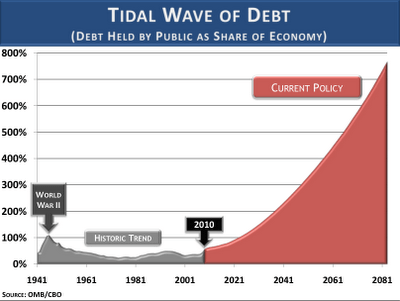
More generally and longer term, the entire conservative narrative is based on those exponential curves projecting “unsustainable” growth in government spending.

What if “current policy” doesn’t do this?

And that, in turn, is based on projections of runaway healthcare spending. As Kevin Drum puts it: “Washington doesn’t have a spending problem. It has a health care problem. Period.” Beutler elaborates:

the slowdown [in healthcare inflation] threatens the pretext for key elements of the conservative policy agenda. If it’s permanent, it destroys the pretext completely. In a perverse way, the right needs healthcare inflation to return to unsustainable levels because without it, the enormous challenges of privatizing Medicare and crushing Medicaid become impossible.

and I wrote about atheism.

I’ve written before about the myth of Christian persecution in America. One reason that myth is so easy to sell to Christian fundamentalists is that many of them have no clue what it’s like to belong to a religious group that actually does suffer discrimination — atheists, for example. Two recent stories bring home the routine disapproval that atheists face in America. (A Christian pastor is surprised how quickly things get serious when he starts “a year without God”, and an atheist trying to give money away is compared to the KKK.) I discuss them in “To Experience Real Religious Discrimination, Turn Atheist“.

While researching that article I scanned the Friendly Atheist blog and ran across this hilarious video by dancer-turned-biologist Dr. Carin Anne Bondar. I’m sure you were all wondering: What if Miley Cyrus’ “Wrecking Ball” hadn’t been a metaphor for the disruptive impact of breaking up with someone, and instead had symbolized the shock of discovering that evolution is true?


In other religious news, AlterNet’s Amanda Marcotte explains the logic of a Satanist group proposing a statue of Baphomet for the Oklahoma capitol grounds.

Christian fundamentalists in Oklahoma managed to get a Ten Commandments monument placed on capitol grounds in 2012. Though the supporters of the monument deny it, it’s an obvious attempt by fundamentalists to get the state government to endorse Christianity above all other religious beliefs, in a direct violation of the Constitution’s ban on state establishment of religion. … No doubt the Satanists expect Oklahoma to reject their petition, which is the point, of course. By rejecting the petition, the legislature will make it clear they really are elevating one religion over another, strengthening the ACLU’s case against the state.

Here’s the weird thing about this issue: It’s the conservatives, the people who claim to respect government the least, who want the government to endorse their religion. That’s the question we should keep asking the right-wing Christians: Why is it so important that the government endorse your religion?

You also might be interested in …

Coal is supposed to be the cheap form of energy. But that’s only if you ignore the cost of stuff like nine counties of West Virginia going without water since Thursday, due to a spill of 4-Methylcyclohexane Methanol (a chemical used in processing coal) by the Elk River “near the intake facilities for the West Virginia division of American Water Works.”

The chemical is so dangerous that “American Water customers are being advised not to drink, cook with, bathe in or boil their water … to stop using water for everything other than flushing toilets and fire suppression.”

In a twist that would be cheesy in a movie, the corporation behind the spill is called Freedom Industries. Freedom didn’t find the “leaking storage unit” itself, the West Virginia Department of Environmental Protection did after it received reports of a “strange odor” in the area. So this is a story of government regulators interfering with Freedom.


Add Iowa to the list of places where a comprehensive investigation of voter fraud turned up nothing worth turning up. And in Ohio, an investigation turned up 17 cases of non-citizens voting, out of 5.6 million voters. The 17 were not part of any organized effort, and all had driver’s licenses that would pass photo-ID muster.


If you’ve been worrying that maybe you practice (or suffer from) reverse racism, it’s good to know that comedian Aamer Rahman has been thinking it through.


Normally my book reviews don’t get a lot of page views, but last week’s review of Angry White Men is over 3000 hits, making it #7 on the Sift’s all-time list. And that brings up a curious thing about viral posts: In my experience, the region between 3000 hits and 8000 hits is virtually unpopulated. There are four posts between 3145 (where AWM was at last count) and 2662. The next post up is at 7957. No idea why.

and let’s end with a cartoon too good not to mention

(This one is pretty good too.) You want an apt metaphor for sexism and racism and all the other forms of institutionalized privilege? They’re like The Matrix.

To Experience Real Religious Discrimination, Turn Atheist

From the War on Christmas to the ObamaCare contraception mandate, the media gives a lot of respect to the idea that Christians might be persecuted in America, or at least that their religious freedom might be in danger. But two recent stories underline a contrasting point: If Christians really want to know what religious discrimination is like, they should try being atheists.

Christian pastor Ryan Bell is literally trying, and it’s not going well. In the spirit of A. J. Jacobs’ The Year of Living Biblically, Bell announced that he would live 2014 as an atheist and chronicle his experiences on his A Year Without God blog. In his announcement post, he portrayed his experiment partly as a religious identity crisis and partly as an attempt to answer a friend’s question: “What difference does God make?”

How could Bell explain the difference unless he had tried both? So:

For the next 12 months I will live as if there is no God. I will not pray, read the Bible for inspiration, refer to God as the cause of things or hope that God might intervene and change my own or someone else’s circumstances. (I trust that if there really is a God that God will not be too flummoxed by my foolish experiment and allow others to suffer as a result).

I will read atheist “sacred texts” — from Hobbes and Spinoza to Russell and Nietzsche to the trinity of New Atheists, Hitchens, Dawkins and Dennett. I will explore the various ways of being atheist, from naturalism (Voltaire, Dewey, et al) to the new ‘religious atheists’ (Alain de Botton and Ronald Dworkin). I will also attempt to speak to as many actual atheists as possible — scholars, writers and ordinary unbelievers — to learn how they have come to their non-faith and what it means to them. I will visit atheist gatherings and try it on.

No doubt Bell anticipated writing about challenges like: Could he really “live as if there is no God”, or would his sensibilities rebel at the vision of a godless universe? Would he get depressed without God to give him hope? Would his moral character weaken? Would he have to abandon his experiment if he faced a true life crisis? Near the end of the year, would he look forward to the day when he could return to religion? In 2015 would he, like King David, be “glad when they said unto me, let us go into the house of the Lord”?

What actually happened is that in the first week he lost all his sources of income.

I was an adjunct professor at Azusa Pacific University (APU) teaching Intercultural Communication to undergrads, and Fuller Theological Seminary, coaching doctoral candidates in the writing of their dissertation proposals. Both are Christian institutions of higher learning that have a requirement that their instructors and staff be committed followers of Jesus and, obviously, believers in God. They simply feel they cannot have me as a part of the faculty while I’m am in this year long process. … The other work I do is consulting with congregations … the fact that I was embarking on a year without god was just too much for them.

His friends have not ostracized him, but he hadn’t realized that was even a risk. Apparently it was.

We still love you!

So many of my closest friends and colleagues have said this to me in the past few days. My initial, unspoken reaction was, “Well, I certainly hope so.” Now I understand that this is not a forgone conclusion. I didn’t realize, even four days ago, how difficult it would be for some people to embrace me while I was embracing this journey of open inquiry into the question of God’s existence.

The lesson seems pretty clear: If you’re having doubts about God’s existence, don’t tell anybody.

The second story concerns Hemant Mehta, author of the Friendly Atheist blog. Mehta lives in Naperville, Illinois. In October, the local American Legion post in nearby Morton Grove stopped giving financial support to the Morton Grove Park District because one of the district’s board members was refusing to stand during the Pledge of Allegiance. Mehta asked his readers to make up the difference, and raised $3000 to more than replace the Legion’s $2600. There were no strings. Mehta says, “the only ‘ethical implication’ of accepting money from atheists is that you get money.”

The Park District turned it down. So did the library, after the library’s treasurer referred to Mehta and his readers as “a hate group” and backed up that accusation by reading “a couple of the religiously-inflammatory and expletive-ridden comments posted on Mehta’s Friendly Atheist Facebook Page.” (As if you couldn’t find offensive comments on any popular Facebook page, including Christian ones.) She asked the other trustees: “Would you take money from the Klan?”

The apparent reference is to Georgia’s refusal to let a local chapter of the Ku Klux Klan participate in its Adopt-a-Highway program. But there the Klan would get a benefit:

The program provides advertising for sponsors who agree to clean a stretch of road on a sign posted along the stretch.

Mehta, on the other hand, was asking for nothing: no plaque, no mention in the newsletter, nothing. Just take the money. He comments:

I firmly believe that if the money came from the “Friendly Christian,” none of this would be an issue. The “A” word is just freaking everybody out.

Finally, the Niles Township Food Pantry cashed the check. If any of the food it bought burst into flames when the needy said grace over it, I haven’t heard.

I know: As examples of religious persecution, neither of these stories holds a candle to the Holocaust or the Inquisition. Nobody is dying, languishing in prison, or getting tossed into a fiery furnace. But in the same way, they put into perspective fundamentalist Christian problems like not being able to display a Ten Commandments monument at the state supreme court, or your monument maybe being forced to share public space with other people’s monuments, or the law forcing you to treat gays and lesbians as if they were part of the general public, or being offended that someone wished you “Happy Holidays” rather than “Merry Christmas”.

But still, Christians can give no-strings-attached money to the local library without worrying that they might be likened to the KKK. Compared to the alternatives, being Christian in America is still a pretty cushy gig.

The Monday Morning Teaser

It’s been a busy week for news. The Chris Christie Bridgegate scandal broke open. The polar vortex came and went. An al-Qaeda-linked group claimed control of Fallujah, a town that was a memorable Iraq-War battlefield for American troops; in this country that news pulled the scab off arguments that had been quiet since the last American combat troops left Iraq: What did Bush’s whole Iraq excursion accomplish? Or did Obama screw up Bush’s accomplishments by pulling out too soon?

Wednesday was the 50th anniversary of another war: President Johnson’s War on Poverty. That touched off a similar debate: Was the War on Poverty an example of misguided liberal over-reach? Or was it working until conservatives managed to sabotage it? What about poverty today? And what about growing inequality, which is pushing the lower middle class towards poverty?

At least one pundit claimed that the most important news of the week was something boring that nobody was paying much attention to: Inflation in the healthcare market slipped below the overall inflation rate for the first time since … well, maybe ever. If healthcare inflation starts behaving itself, then those scary exponential-growth-in-government-spending graphs go away.

With all that to discuss, most of this week’s Sift is devoted to the weekly summary. I did split off one short article to connect two stories related to atheism: A Christian pastor announced his intention to live 2014 as if there were no God and blog about the results; he got results much faster than he expected. And an atheist blogger tried to raise funds for charity and discovered nobody wanted his money; his attempt to do a good deed got him and his readers compared to the KKK and denounced as a “hate group”. The lesson I draw is that prejudice against atheists is alive and well. Christians who imagine they’re being discriminated against really have no idea what atheists go through.

The atheist article should be out in the next hour or so, and the weekly summary before noon.