Monthly Archives: May 2013

Enough

Three things are never satisfied. Yea, four say not “It is enough”:
the grave, and the barren womb, and the earth that is not filled with water, and the fire.

— Proverbs 30: 15-16

This week everybody was talking about industrial accidents

The death toll from the factory collapse in Bangladesh keeps rising, now at 650.

All week, liberal web sites have been full of socially-conscious shopping tips about what brands may or may not be involved in corner-cutting third-world factories like the ones that ordered their workers back into a building whose walls were cracking. But that’s a band-aid at best.

The fundamental problem here is that workers have no power. Without their jobs they’d be so desperately poor that going back into a crumbling factory seems less risky than standing up to their bosses. As long as that is true, all the incentives in the capitalist system work to circumvent the consciences of shoppers. The most “efficient” way for the system to deal with the current situation is not to improve safety, but to fool socially conscious consumers into thinking something is being done. The system will keep working on that “efficient” solution until it figures out a way to do it, because that’s where the money is.

Just ask Walmart, whose greenwashing campaign is working great for the corporate image, even if it isn’t doing much for the environment.

So sure, change your buying patterns in whatever way seems appropriate. But if you’re doing that instead of pushing for worker rights, the corporate power structure thanks you.

Oh, and in case you think this is just a third-world problem, don’t forget about the fertilizer factory explosion in West, Texas. We hear so much about the costs of government regulation, but the costs of non-regulation are even higher.

and Jason Collins

Basketball player Jason Collins became the first active professional athlete in a major American sport to announce he is gay. His article in Sports Illustrated talks about the pressure of hiding a major area of your life not just from the public, but from teammates as well.

Collins is a 12-season NBA veteran who has never been a star and seldom starts, but consistently fills a role a lot of teams need: a 7-footer who can come off the bench and provide defense and rebounding when your starting big guys are in foul trouble or need a rest. He played for the Celtics and Wizards last season and is currently a free agent. He is in his declining years as an athlete, but Nate Silver’s comparisons to similar players in the past indicates there was a somewhat better than 50-50 chance he would have a job next season before his announcement. (So whether he gets signed next year is not necessarily proof of either prejudice or favoritism.)

Comparisons to Jackie Robinson are appropriate in some ways but not others. Robinson was a uniquely talented athlete whose statistics (compiled over only half a career, since he was kept out of the majors until age 28) could have put him in the Hall of Fame even without his off-the-field significance. Obviously, Collins is not in that class. And I’m sure Robinson would have had an easier time if he could have played 12 years in the majors and then announced he was black.

Still, Collins’ announcement required courage. (Anyone who thinks it didn’t needs to explain why no one has done it before.) He has made himself a symbol. Like Robinson, Collins will be cheered and booed for what he is, not who he is.

Some commenters clearly resent the fact that Collins is being cheered by many. There’s an intentional cluelessness in Ben Shapiro’s tweet: “So Jason Collins is a hero because he’s gay?” What’s striking, though, is the way such views are being rejected in neutral forums. Check out the comments on this anti-Collins editorial by a small-town Illinois sports editor.

Naturally, this popular rejection of bigotry is being spun as some kind of unfair discrimination against bigots. There’s a name for that: privileged distress.

But the biggest significance of Collins’ announcement (and the generally positive response) is on the many closeted gay athletes in high school and college, like the one profiled by Sunday by the Portland Press Herald.

But I wrote about sustainable economics

I reviewed the recent book Enough is Enough in Prosperity Without Growth?

and you also might be interested in …

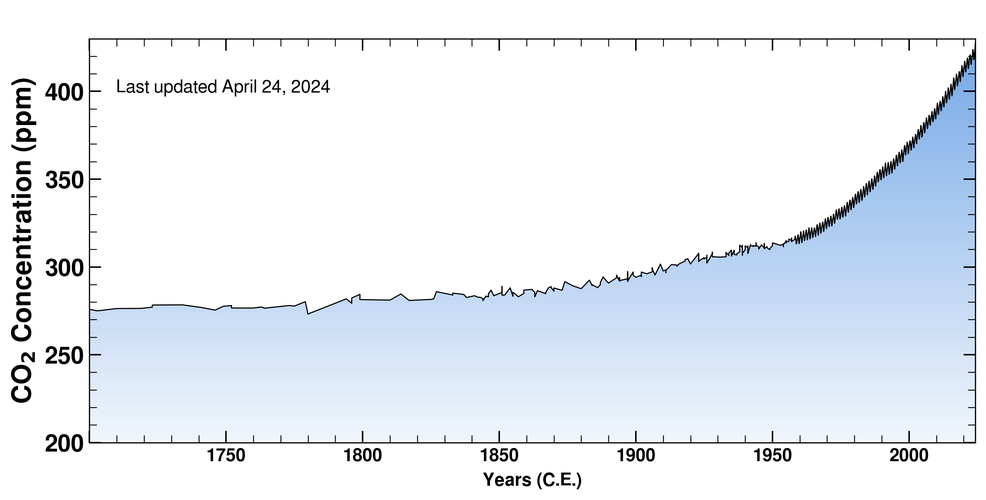
The observatory at the top of Mauna Loa in Hawaii is recording atmospheric carbon dioxide approaching 400 parts per million “for the first time in human history“. The graph tells the story.

This re-emphasizes a point I’ve made before: When someone says they don’t believe in global warming, or don’t believe humans cause it, ask them which part of the argument they doubt. Here are the steps:

  1. Burning fossil fuels releases carbon dioxide into the atmosphere. (Duh.)
  2. The concentration of carbon dioxide in the atmosphere has been going up more-or-less continuously since the Industrial Age got rolling. (That’s this graph.)
  3. Atmospheric carbon dioxide warms the Earth through a greenhouse effect. (Infra-red radiation that would ordinarily dissipate into outer space gets reflected back to the planet surface.)

Given these rising carbon levels, which we can measure directly, global warming is what a rational person would expect. The argument against it needs to be a little stronger than just “maybe something else will happen”.


The public got its first look at the George W. Bush Library this week. I had been hearing about the Decision Point Theater game, where visitors supposedly hear the kind of advice Bush got at some key point in his administration, then get to make a decision. Now we finally see what that looks like.

You know what it looks like? The whole Bush administration. The single thing most typical of Bush was his shameless spin — rhetoric that made you think of one thing, but then if you challenged it as a lie, his people would explain that it was true because of something else entirely. So Saddam “supported international terrorist organizations” — which was supposed to make you think he was helping Al Qaeda plan the next 9-11. But if you pushed back you’d hear about connections to Hamas or Abu Nidal, not Al Qaeda or Bin Laden. They’d talk about Al Qaeda affiliates “operating in Iraq”, but if you pushed you’d find they were talking about a Kurdish zone Saddam had lost control of. And so on.

Bush is still spinning in exactly the same ways. Rachel Maddow shows clips from the DPT section on invading Iraq, calls BS on it, and then comments:

The case to invade Iraq was not “mistaken”. The case to invade Iraq was cooked up. It was a hoax perpetrated on the American people. And they are still cooking it up, right now.


Here’s one of those polls that makes you wonder if people really believe what they say. By a 44%-31% margin, Republicans agree with the statement “In the next few years, an armed rebellion might be necessary to protect our liberties.” (Democrats disagree 61%-18%.)

If I actually believed that, I think I’d be doing more than just stockpiling assault rifles. (After all, the government has tanks and planes.) I’d for sure have my escape route out of the country planned and a stash of money at my planned destination. Are people really doing that kind of stuff? In large numbers? Or has answering polls become part of some big fantasy game?


If there’s anyplace in America that might need an armed rebellion to maintain democracy, it’s North Carolina. The Republican leadership in the legislature is so intent on getting rid of the state’s renewable energy program that they declared victory in a voice vote and refused requests to have votes actually counted.


Mitch McConnell is catching on to this social-media thing. If your campaign video is getting as many hits as you want, you can buy the extra hits.


I often find myself telling non-religious people that right-wing Christians really aren’t as bad as they think. Well, the science education at Blue Ridge Christian Academy in South Carolina is worse than you think.


It’s been a heavy week. Let’s end with some entertainment:

Prosperity Without Growth?

When you take a very-long-term view of the future of civilization, the one option that seems most unlikely is that we can continue the patterns of the last few centuries: an ever-increasing population consuming ever-more stuff, using ever-more natural resources to produce it, and leaving ever-more waste products for the planet to absorb.

Futurists embarrass themselves when they predict precisely when and how that pattern will break, but still, it defies my imagination to picture how this could all continue indefinitely down the millennia. Eventually — whether by wise planning, cataclysm, alien conquest, or the return of Jesus — the exponential growth is going to stop.*

What will that look like? If you stipulate those steady-state conditions — stable population, stable resource use, and each generation leaving the planet’s natural environment more-or-less the way they found it — what kind of society can you construct? Can you come up with one that has a place for people more-or-less like us? Or does the whole concept involve making over the human character completely? Could the people in such a no-growth society feel prosperous? Or is prosperity-without-growth a contradiction?

A number of fairly smart, reasonable people have been asking those questions for a while now, and they’re starting to come up with some visions — sketchy ones, to be sure, but sketched-out well enough that the rest of us should start paying attention. One such vision is in Enough is Enough by Rob Dietz and Dan O’Neill.

Disclaimers. Growth has gotten to be such a religion that no-growth smacks of heresy. Like most heresies, it has been caricatured by the faithful to such a degree that any discussion has to start with a few denials.

Two examples of non-growing economies leap to mind: growth-oriented economies that are failing to grow (as the American economy has failed since the housing bubble burst), and aboriginal hunter-gatherer economies. The first example is characterized by despair, lack of opportunity,  and increasing poverty; the second, by discomfort, lack of technology, and vulnerability to disease and famine. Aboriginal societies may live in harmony with Nature, but they also live at the mercy of Nature. One thing you can say for the global economy is that Iowa can have a drought without Iowans starving to death.

Neither example is what the no-growth visionaries are proposing. A society without growth could continue to have antibiotics and the internet — and could even continue innovating, as long as the innovations-as-a-whole didn’t increase the consumption of resources or the production of waste.

A growth-oriented economy that doesn’t grow is the worst of both worlds. It consumes resources unsustainably, and yet fails to provide opportunity and hope. If that were the goal, it could easily be achieved: Just instruct the Fed to keep interest rates high enough to choke off new investment.

The challenge, though, is quite different: To envision a steady-state relationship between Nature and a stable population of humans, while providing those humans the opportunity to lead satisfying lives.

Outline. The book is in three parts. The first discusses the overall idea of “enough”. The second breaks this down into specific areas: How could we achieve a stable population? How could a non-growing economy deal with poverty? What would banking and investment look like? And the third discusses strategies for changing the culture and the political system.

Problem-solving attitude. Because it covers so many topics and is intended to further an open-ended discussion, the book really can’t be condensed. Its strength is in its details, not in a sound bite that gets elaborated over 200 pages.

But the other important aspect of the book is the attitude it projects: It takes the problem of planetary depletion seriously and approaches it with a problem-solving attitude. So it is not a jeremiad, or a prophesy of doom, or a denial that anything really needs to change — three categories that take in most of the debate on these topics. It’s easy to find reasons why a stable economy can’t happen, but comparatively rare to find people who accept that it must happen eventually, and then bring a problem-solving attitude to the question of how.

A number of factors evolved with the idea of economic growth, and they will have to change or be replaced to achieve stability: a money-creating banking system, measuring the economy by GDP, and corporations devoted to constant growth are just a few of the ones discussed in more detail. An example of the kind of change a stable economy would need: Much of what is done today by profit-seeking corporations could be done by consumer-owned co-ops focused on providing service rather than producing an ever-increasing profit for investors.**

The poor held hostage. To me, the most significant argument against a stable economy says, “Morally, how can we rein in economic growth when so many people still don’t have enough?” My problem with that question: I have lost faith that the capitalist economy will ever provide enough for everybody, now matter how high global GDP gets. Over the last few decades, the top 1% has gotten better and better at capturing economic growth for themselves. From the point of view of a CEO seeking higher profits for his corporation, a better life for the poor is an inefficiency to be avoided. Across-the-board wage increases are a capitalist nightmare, not a fulfillment of the capitalist system.

In the Dietz/O’Neill view, we need to turn this kind of thinking around: Rather than continuing to grow the economy in hopes that some of the new consumables will filter down to the poor, we need to solve the problem of inequality so that we can achieve a stable economy. Poverty is a political problem, not an economic problem. Growing the economy without changing the politics won’t solve it.

Rather than putting the entire burden of proof on the no-growth vision, I think we also have to stop accepting a “someday” vision of ending poverty through growth. Anyone who makes the anti-poverty argument for growth needs to explain exactly how growth is going to help the poor, and offer a projection of how much more growth it will take to eradicate poverty before we can stabilize the economy’s toll on the planet.

Trustworthy governance. Again and again, I was struck by how the Dietz/O’Neill vision requires that we work together as a species. The easiest way to envision that unity is via some Hunger-Games-style tyranny, which no one (least of all Dietz and O’Neill) wants. But even the most free and democratic vision of a stable economy depends on establishing some trustworthy global institutions.

For example, a global cap-and-trade system to stabilize the CO2 in the atmosphere would work only if people can’t cheat anywhere in the world, if the tradable CO2 certificates can’t be counterfeited, and if you can’t “earn” them by creating bogus carbon-offset projects — trees that are never actually planted, etc.

Similarly, population could be stabilized through incentives and voluntary cooperation rather than one-child mandates and forced sterilizations. But someone would have to monitor all that and adjust the incentives accordingly, and the rest of us would have to trust the fairness of that monitoring agency.

This is the part I worry about most: If you have money and power and you want to derail the vision of a stable future, all you really have to do is create distrust. What could be easier?

Not a lone voice. Another striking thing about Enough is Enough is the extent to which it builds on the work of many others. For example, the view of money, debt, and banking will be familiar to Sift readers from David Graeber’s Debt: the first 5,000 years and Warren Mosler’s Seven Deadly Innocent Frauds of Economic Policy.

I’m sure many people will look on this as cranks quoting other cranks, but I don’t. I’m starting to see a unifying view develop.

Virtual consumption. Futurists have to be wary of a technology-will-save-us argument, which is always too easy and is often a mirage. But I think Dietz and O’Neill miss one important way that technology can contribute to a sustainable future: virtualization. We’re already seeing some of it: My book collection is gradually turning into patterns of electrical charges rather than shelves of paper.

Dietz and O’Neill point out (appropriately) that such changes are meaningless if they just make paper cheaper and allow somebody else to consume more of it. But recent sci-fi (starting with Snow Crash and continuing into more recent works like The Quantum Thief or Ready Player One) points to the greater possibilities.

You can think of consumption as serving four purposes: survival, comfort, entertainment, and competition for status. It is easy to imagine “enough” when we talk about survival and comfort, and maybe even entertainment. But the really open-ended consumption happens when we compete for status. I can imagine wanting a boat for entertainment, but the only reason to want a 400-foot yacht is to out-do the guys who can only afford 300-foot yachts. (As far back as the Roman sumptuary laws, the essence of the moral argument to limit consumption is that some people are starving so that others can raise their status.)

Survival and comfort require real-world resources. (You can’t eat pixels.) But if the culture evolved so that we got most of our entertainment inside virtual worlds and competed for status there, then a sustainable economy would be much easier to achieve.


* Space travel is sometimes presented as a far-future solution. While I can imagine a Noah’s-Ark-style spaceship seeding another planet with humans, I can’t imagine inter-stellar travel ever being so cheap that emigration has a significant impact on Earth’s population. (At least that’s not a future I’m willing to count on.) So Earth’s remaining citizens would still have to come to terms with the planet’s limitations.

Think about the colonization of the New World. Except for a few temporary situations (like the Irish Potato Famine), Europe’s population continued going up, even as it sent more and more people to America. Europe today is more crowded than ever.

** This got me thinking. Back when cable TV was being established, we all took for granted the model of a privately financed network made economically feasible by granting a monopoly. But the New-Deal-era model of the rural electric co-ops also would have worked: government-guaranteed loans to establish consumer-owned co-ops. If we’d done that, every year you’d get to vote on the leadership and policy of your cable system.

The Monday Morning Teaser

The featured article this week will look at the visionary economics of sustainability: How would our whole society have to change if we accepted that each generation had to leave the planet more-or-less as we found it? In other words, what if we aimed not for growth — more and more people consuming more and more stuff and leaving more and more waste behind — but for a steady-state economy whose output was consistently sufficient to support a stable population?

The text for that sermon is a new book by Rob Dietz and Dan O’Neill, Enough is Enough.

The weekly summary calls attention to: the massive industrial accident in Bangladesh, Jason Collins’ coming out, atmospheric CO2 nearing 400 ppm, and how the Bush Library continues the parade of BS that characterized the Bush administration.

I spent the weekend enjoying Portland, Maine (the best little city in the Northeast) rather than doing my background reading and prep work, so the Sift will come out a little slowly today.