Monthly Archives: April 2012

Poisoned Spring

The right ordering of economic life cannot be left to a free competition of forces. For from this source, as from a poisoned spring, have originated and spread all the errors of individualist economic teaching. … [F]ree competition, while justified and certainly useful provided it is kept within certain limits, clearly cannot direct economic life – a truth which the outcome of the application in practice of the tenets of this evil individualistic spirit has more than sufficiently demonstrated

– Pope Pius XI, Quadragesimo Anno (1931)

In this week’s sift:

  • Jesus Shrugged — why Christianity and Ayn Rand don’t mix. Rep. Paul Ryan can’t have it both ways: He can’t be a good Catholic as well as a good Randist. The Church is right not to let him wash his cruel budget in the blood of the lamb.
  • How Understanding Should Liberals Be?  Jonathan Haidt’s The Righteous Mind explains to liberals how conservatives can be good people too. But is there anything useful we can do with that information?
  • Bad Arguments and other short notesLogical fallacies, the pyramid of refutation, and excuses conservatives use when the facts prove them wrong. Plus:  Obama jams and does comedy. MTP regulars condescend to argue with Rachel Maddow. Maybe high-fructose corn syrup doesn’t cause autism. Where to hear me Wednesday. And more.
  • Last week’s most popular post. It’s rare for the short-notes post to be the most popular, but Working for the Man and other short notes was, with 161 views.

Jesus Shrugged — why Christianity and Ayn Rand don’t mix

To a sizable number of conservatives, Ayn Rand’s novel Atlas Shrugged is practically scripture. To another sizable number, Christian scripture is a law higher than the Constitution.

If you want to appreciate just how strange that is, consider the passage that gives Atlas Shrugged its title:

“Mr. Rearden,” said Francisco, his voice solemnly calm, “if you saw Atlas, the giant who holds the world on his shoulders, if you saw that he stood, blood running down his chest, his knees buckling, his arms trembling but still trying to hold the world aloft with the last of his strength, and the greater his effort the heavier the world bore down on his shoulders – what would you tell him to do?”

“I … don’t know. What … could he do? What would you tell him?”

“To shrug.”

Both Francisco d’Anconia and Hank Rearden are heroes of the novel. Ultimately, Francisco convinces Hank and many other right-thinking capitalists to vanish and let the success-punishing world economy fend for itself without their genius and productivity. Francisco’s exit is particularly dramatic: He destroys all the assets that he can’t take with him into hiding.

The capitalists are Atlas. They shrug and let the world economy collapse. (Well, Francisco does a bit more than shrug. He didn’t just let those copper mines collapse. But never mind.)

Now imagine entering the novel to ask this question: “Mr. d’Anconia, if you saw Jesus, whipped and with a crown of thorns on his head, his knees buckling, his arms trembling, but still trying to drag his cross down the streets of Jerusalem to Golgotha – what would you tell him to do?”

To shrug?

That impossible image – Jesus shrugging off the cross and returning to Heaven six weeks early – sums up the incompatibility of Randism and Christianity. Rand taught that the powerful bear no obligation to the helpless. Jesus had other ideas.

Rand held private property rights to be absolute. That’s how Francisco can guiltlessly blow up his mines. They’re his. Forget superstitious nonsense like Psalm 24’s “The Earth is the Lord’s and the fullness thereof.” Property is not something you hold in trust for a higher power. Owning property entails no moral responsibility at all. It’s yours. Do whatever you want with it.

Short of pure Orwellian doublethink, there’s no way to square that with Christianity. Rand herself didn’t even try. She found “the inviolate integrity of man’s soul” and “a code of altruism” to be “a great, basic contradiction in the teachings of Jesus”.

This is why men have never succeeded in applying Christianity in practice, while they have preached it in theory for two thousand years. The reason of their failure was not men’s natural depravity or hypocrisy, which is the superficial (and vicious) explanation usually given. The reason is that a contradiction cannot be made to work.

And that brings us to Rep. Paul Ryan’s recent go-round with the Catholic bishops and the Jesuits of Georgetown University.

Ryan is a Randist whose budget plan Francisco d’Anconia would love. As Paul Krugman sums up, “it slashes taxes for corporations and the rich while drastically cutting food and medical aid to the needy”. It deals with the resulting deficit increase by closing unspecified tax loopholes that lobbyists will undoubtedly manage to keep open once they get specified.

But Ryan also claims to be a good Catholic, so now he’s trying to make that work too. Like Peter denying Jesus, Ryan now calls his Randism “an urban legend“. But that trick is hard to pull off in the Age of Google, when everything you’ve been saying for years is easily retrievable. You know who started that urban legend? Paul Ryan.

Unfortunately for Ryan’s attempt to wash his budget in the blood of the lamb, popes have been handing down bleeding-sacred-heart encyclicals on economic policy since Rerum Novarum in 1891. (You can get the general flavor from this week’s Sift quote or  my article on John Paul II’s Laborem Exercens.) Worse, the Church has actual experts who keep track of these things, so you can’t just cherry-pick the Catholic tradition for out-of-context quotes and expect nobody to call you on it.

Ninety members of the Georgetown faculty called Paul Ryan on it:

we would be remiss in our duty to you and our students if we did not challenge your continuing misuse of Catholic teaching to defend a budget plan that decimates food programs for struggling families, radically weakens protections for the elderly and sick, and gives more tax breaks to the wealthiest few. … In short, your budget appears to reflect the values of your favorite philosopher, Ayn Rand, rather than the Gospel of Jesus Christ.

The particular doctrine Ryan misuses is called “subsidiarity” (first enunciated in Rerum Novarum). As theologian Meghan Clark explains it:

According to the principle of subsidiarity, decisions should be made at the lowest level possible and the highest level necessary.

And BeliefNet editor David Gibson elaborates:

[Subsidiarity] argues that lower levels of society (individuals, families, communities) should be allowed to carry out social functions that they can fulfill and larger society (state and federal governments), meanwhile, should provide help (“subsidium,” is the formal Latin term) to cover things the smaller units cannot. … If Washington has to do it, so be it; if Mayberry can do it, all the better. But if Mayberry can’t, then Washington has an obligation to step in.

Conservative policy genuinely based on subsidiarity would work upward from below: As local churches, charities and neighborhood organizations developed plans and raised resources to care for the poor and helpless, local governments could re-purpose their resources on services that the state now provides. States could similarly replace federal programs, and the federal government would shrink because there was less for it to do.

None of that is actually happening in any significant way. Instead, conservatives at all levels cut programs and taxes, using the excuse that problems would be better handled further down the chain. But down-the-chain conservatives are not reaching up to take the responsibilities that up-the-chain conservatives are dropping.

I could sympathize with, say, Ryan’s desire to cut federal services for the poor in his district if conservative Governor Scott Walker were eager to expand Wisconsin’s state programs to take up the slack (and raise state taxes to pay for them) as subsidiarity demands.

But is he? I don’t think so.

If elected at all levels, conservative officials from the president to the councilman would shrug and let responsibility for the poor drop like a stone. That’s not subsidiarity, and it’s not Catholic or any other kind of Christian.

Francisco d’Anconia, though, could probably give a great speech about it.

How Understanding Should Liberals Be?

In a polarized world, it’s tempting and satisfying to think: My side is right and the other side is wrong. We represent truth, justice, and all that is good; they represent lies, corruption, and all that is evil. So the most direct way to improve the world is for Us to kick the crap out of Them.

As a liberal, though, I sometimes find it just as tempting (and satisfying in a different way) to think: No one has a monopoly on Truth; there are wise and good people on all sides. Democracy doesn’t work without compromise, and for any conflict there’s usually a higher Truth that transcends both poles. So it’s important for the wise and good people on all sides to stay in dialog and work towards understanding and consensus. Only then can we achieve the kind of win/win solutions that move humanity forward.

On one path, anger and self-righteousness provide energy and direction. On the other, identification with the yet-to-be-discovered wisdom of the future yields a softer (but perhaps more lasting) determination.

Each attitude (if I’m being really honest) offers its own kind of ego boost. In one, I’m superior to those stupid and corrupt conservatives; in the other I’m superior to everyone who hasn’t been to the mountaintop and seen my vision – or at least the vision that I plan to see when I get to the mountaintop.

In the blogosphere, kick-the-crap-out-of-them liberals and find-the-higher-truth liberals have their own polarization, which often manifests in bitter fights between idealists and pragmatists. So in this post, I’m doing what any good meta-liberal would do: I’m searching for the higher truth that transcends the conflict between crap-kicking liberals and conflict-transcending liberals.

The text for my sermon is Jonathan Haidt’s recent book The Righteous Mind: Why Good People Are Divided by Politics and Religion. Obviously, Haidt hails from the conflict-transcending tribe. He describes himself as a life-long liberal from academia, but living among the common people in India opened his eyes to the worthiness of conservative values like in-group loyalty and respect for authority, and the data he has collected since convinces him that there is wisdom on both sides.

Now if only all the wise and good people could transcend polarization and get into dialog.

Not so fast. If Haidt had completely convinced me, I would write a polemic about how conflict-transcending liberals need to kick the crap out of the crap-kicking liberals who poison the dialog that we otherwise could be having with wise and good conservatives.

But I also read Charles Blow’s post in February, showing that compromise itself is a liberal value conservatives don’t share. In poll after poll, Democrats say their leaders should compromise to get something done, while Republicans say their leaders should stick to conservative principles.

Given that difference, the path of least resistance is for Democrats to compromise and Republicans to move ever further to the right. So the Heritage Foundation’s conservative alternative to HillaryCare begets ObamaCare, which Heritage now denounces as an unconstitutional Marxist plot to take over the economy.

I sometimes imagine inviting the Ricks (Santorum and Warren) to a dialog aimed at finding a truth that transcends both my secularism and their Christianity. It’s a non-starter. To the Ricks, the very idea of a truth transcending Christianity is Satanic. Even liberal Christianity might be Satanic.

Worse, you can’t negotiate with Wisdom and Goodness when Lies and Corruption are in the driver’s seat. Think about climate change: The “controversy” over global warming comes not from the laboratories of dissident scientists, but from the board rooms of Exxon-Mobil and Koch Energy.

Corporations are sociopaths; they aren’t influenced by arguments about truth and goodness. So whatever evidence emerges, fossil-fuel companies (and their PR firms, lobbyists, and senators) will challenge the scientific consensus on global warming until they’ve sold the last trainload of coal to the last power plant to run the last air conditioner.

How do you find common ground with that? Don’t we just have to win?

Haidt’s case. Armored with appropriate skepticism, then, let’s look at what Haidt has to say.

Haidt has very artfully organized his book to illustrate his own principles. He believes people first react to an idea intuitively, and only then engage their rational minds to justify their reaction. So Haidt knows that if he turns people off on page 1, none of the evidence he offers later will get a fair hearing. So instead he engagingly tells the story of how he got to his conclusions while saving the conclusions themselves until the end.

He offers (and supports with data) a model of how this all-powerful moral intuition works: Humans have evolved to ‘taste’ six different moral ‘flavors’. Four are easy to describe:

  • Care/harm. Don’t hurt the innocent, especially if they’re cute and helpless.
  • Loyalty/betrayal. Don’t break your agreements or sabotage the team.
  • Authority/subversion. Don’t get uppity and disrespect your betters.
  • Sanctity/degradation. Don’t break your community’s fundamental taboos.

Haidt spells out the emotions these flavors evoke – violations of sanctity evoke disgust, for example, while violations of loyalty evoke rage – and how these responses (even the ones that contradict others) might have evolved.

Originally fairness was a fifth flavor, but eventually he realized that this word is used ambiguously for two different flavors.

  • Liberty/oppression. Nobody is inherently better than anybody else. Example: Count each person’s vote equally.
  • Fairness/cheating. Rewards should be proportional to contributions. Example: People who worker harder should make more money.

The punch line is that liberal moral arguments focus on Care and Liberty, while conservatives season their arguments with all six flavors. (Again, there’s supporting data.)

Politically, Haidt’s book has two big takeaways for liberals: (1) We should learn how to appeal to a wider palate. (2) Conservatives aren’t evil, they just taste different flavors of morality.

Not so fast, part II. I can buy (1), but I’ve got problems with (2). First, I taste those other flavors, I’m just deeply ambivalent about them, because I understand how they can serve evil purposes as easily as good: Being a team player and respecting authority can be bad (say, when you’re in Nazi Germany). Sanctity provides the ugh-factor that justifies oppression of out-groups like homosexuals. Distributing rewards proportionately to contributions can hide an unequal distribution of the opportunities to contribute.

I love a good strong salty taste, but it makes me worry about the value of what I’m eating.

Second, go back to my Exxon-Mobil example: Corporations don’t taste any flavors of morality, they just know how to manipulate the people who do. Fry up some pink slime, add a bunch of salt, and it tastes great!

How understanding do I want to be? But now I’m leaning too far over in the crap-kicking direction. I promised some transcendence. So here’s how much of Haidt I take to heart:

First, liberals need to distinguish what we’re fighting for from who we’re fighting with.

That dittohead friend from high school or the cousin who forwards right-wing viral emails – you probably already realize that they’re not bad people. If you can stand to talk politics at all with them, Haidt has a lot to tell you: You’re never going to convince them by yelling your liberal values back at them. To be convincing, you need to understand what flavor of morality they find in the positions they’re taking, echo that value to the extent you honestly can, and then detach it from the case at hand while you add liberal flavors to the stew.

But lies are poison, no matter how they’re flavored. You can cut some slack for the woman in the next cubicle who tells you Obama is a Kenyan. But you can’t cut any slack for the lie itself. “Why do you believe that?” invites dialog, but “You might be right” just surrenders.

And that TV-talking-head that a Koch-Brothers astroturf group pays to lie for them? He’s evil. Don’t waste your compassion trying to understand anything deeper about him than his paycheck.

Compromise on proposals, not principles. There’s nothing wrong with supporting the best proposal you can pass, even if the other side also manages to get some of its agenda in as well. That’s how democracy works.

For example, the 15th Amendment guaranteed black men the right to vote. Some feminists opposed it, because it should have given women the right to vote as well.

In principle, they were right: It should have. But I’m glad the 15th Amendment passsed, especially since the 19th Amendment eventually followed.

But no post-Civil-War liberal should have said, “It’s good that the 15th Amendment doesn’t apply to women.” Pass as much as you can, but never surrender your intention to come back for more.

Liberal/conservative isn’t symmetric. Haidt is right that six-flavor conservatism has an inherent advantage over two-flavor liberalism. We just don’t have as many ways to provoke a knee-jerk response. That’s why conservatism corrolates with low-effort thought.

That’s also why we can’t just invert the knee-jerk arguments of the right. The correct response to “Black people are bad” isn’t “White people are bad.” “America is always right” shouldn’t lead to “America is always wrong.”

Our side needs nuance. We need to engage thought rather than shut it down.

In particular, we need nuance when we respond to books like The Righteous Mind. The proper response to “Conservatives are good people” isn’t “Conservatives are bad people.” It’s “In what cases and what ways are conservatives good, and how can we engage them there without betraying our own values?”


Bad Arguments and other short notes

This week’s articles are so wordy that I’m going to focus the short notes on images.

Don’t know your ad hominems from your slippery slopes? This poster can help.


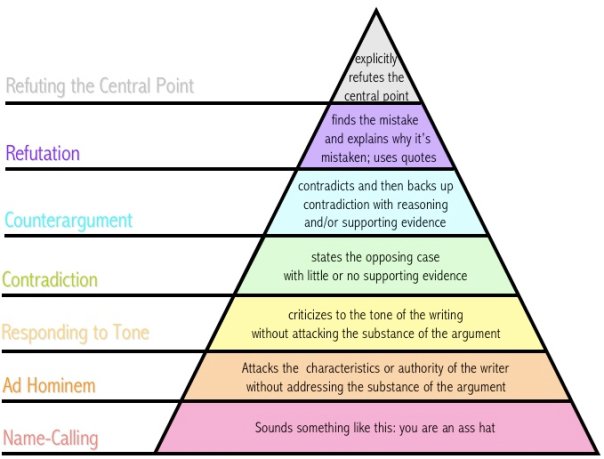
Or you can show your opponents where their response falls in the pyramid of refutation.


Here’s how democracy works:


Most editorial-cartoon flow charts are funny. This one is just accurate:


I keep hoping that Obama’s pop-culture appearances will tempt Mitt Romney to prove that he’s cool too.


Obama’s stand-up routine at the White House Correspondent’s Dinner was pretty good too.


Taking on the nuns at the same time they’re challenging Obama on contraception may not be the Catholic hierarchy’s greatest idea.


I don’t know what possesses people to go on TV shows where they are bound to be humiliated. Here, former Texas Board of Education Chair Don McLeroy gets interviewed by Stephen Colbert — in a segment that promotes a documentary critical of McLeroy.


The marketplace gives you great power to decide which corporate octopus will take over the world.


Rachel Maddow continues her reporting on Michigan’s loss of democracy. In this chapter, a petition to put Michigan’s controversial Emergency Manager Law up for referendum is rejected it used the wrong font size. Or did it?

And while it is a step forward for a liberal woman like Rachel to get an occasional seat at the Meet the Press table, how long will it take for male conservatives to treat her like an equal?

The tussle took a more personal turn when Castellanos told Maddow, “I love how passionate you are. I wish you are as right about what you’re saying as you are passionate about it. I really do.”

“That’s really condescending,” Maddow replied. “I mean this is a stylistic issue. My ‘passion’ on this issue is actually me making a factual argument.”


Department of Corrections: In last week’s short notes I balanced the report that high-fructose corn syrup causes autism with a link to an article by the Corn Refiners Association. Here’s a better counter-argument:


If you find yourself near Concord, MA Wednesday evening, come hear me talk to the Concord Area Humanists on “A Humanist Approach to Death”.

Story Logic

The human mind is a story processor, not a logic processor.

—  Jonathan Haidt, The Righteous Mind (2012)

In this week’s sift:

  • The Narratives of NovemberWhat matters at this point in the campaign isn’t the Electoral College, favorability ratings, or head-to-head polls. It’s whether either candidate can assemble believable stories explaining why he should be president and his opponent shouldn’t.
  • Jobs, Hobbies, and Reflections on a Viral PostThe most common complaint about last week’s Rich People Don’t Have Jobs is that I co-opted the perfectly good word job. Why that seemed necessary opens a whole other can of worms.
  • Working for the Man and other short notes. Private prison corporations, lobbyists, and industries that pay peanuts for prison labor have established an incestuous relationship with government. The Yes Men take on the Bank of America. The Vatican cracks down on American nuns. Environmental arguments against immigration are actually arguments against the poor. Plus links to a few other things I found worth reading this week.
  • Book recommendation of the week: The Righteous Mind: Why Good People Are Divided by Politics and Religion, where this week’s quote comes from. It’s an important book for anybody who wants to influence politics (so I may give it a longer review in some future week). One key insight: It’s now possible to prove rationally that people are not rational. Intuition reacts to any situation first, and the rational mind then turns that intuition into a post-hoc argument that might convince somebody else. That’s not a glitch; it’s what the rational mind evolved to do. The possibility of using to reason to find truth is a happy accident that came later. Rational truth-finding hardly ever works except in subcultures (like the scientific community) that go to great lengths to foster it.
  • Last week’s most popular post. Rich People Don’t Have Jobs was only the sixth 1000-view post since the Sift moved to weeklysift.com last summer. At last count it had 1156 views. It has a follow-up post (Jobs, Hobbies …) this week.

The Narratives of November

All across the Commentariat, I’m hearing the same message: “The pregame warm-up is over.” The Obama vs. Romney show-down has finally arrived, so it’s time to get serious about the November election.

It’s fascinating, though, to see what “getting serious” means to different people. For some, it means getting down to the nuts and bolts of the electoral college. We actually hold 51 presidential elections – don’t forget D.C. – or even 56, once you realize that Maine and Nebraska award one electoral vote for each congressional district plus two for the winner of the statewide election.

People who get electoral-college-serious are already drawing their swing-state maps, like CNN’s above, where they give Obama 196 EVs, Romney 159, and leave 183 up for grabs in 15 swing states. If you want to try your own scenarios, go to 270towin.com. (Here’s mine: Arizona, Indiana, Missouri, and North Carolina only go to Obama in another landslide. Ditto for Romney taking Wisconsin, Michigan, and Pennsylvania. So I start with Obama 242, Romney 206 and eight swing states worth 90. I think it will ultimately come down to Ohio and Virginia.)

Other people get demographic-serious. These folks focus on the Latino vote, the gender gap, and the turnout of Obama’s “new voters” (mainly blacks and young people) who showed up in 2008 but not in 2010.

You can also get characteristic-serious. People’s voting choices might still be in flux, but Obama is more “likeable” than Romney (56%–27% in a recent poll), and is also seen as “more honest and trustworthy” (44%–33%).

Here’s the way I’m looking at the race: April head-to-head polls are fun, but a lot can happen before November. Unless you’re a professional campaign strategist, it’s also too early to get electoral-college-serious. That’s a game to play in October, when it merges with demographic-seriousness and you start talking about the Hispanic vote in Colorado or how the urban/rural split is playing out in Virginia.

Characteristic-seriousness is only part of the story. Nobody liked or trusted Richard Nixon, but in 1972 Tricky Dick had one of the biggest landslides ever. Nate Silver says favorability predicts the outcome in October, but not so well in April. (Maybe we talk ourselves into liking a candidate after we decide to vote for him.)

So instead, I’m getting narrative-serious. To me, this phase of the campaign is about fleshing out four stories: Why you should vote

  • for Obama
  • against Obama
  • for Romney
  • against Romney.

Come November, one of those stories is going to sound a lot more believable than the other three. Whoever benefits from that story is going to win.

The candidates’ characteristics matter, but only as the building-blocks of their stories. So Mitt Romney’s message can’t be: “You should vote for me because I’m a regular guy like you.” That loses, because we’ve all already decided we don’t believe it.

Losing campaigns are characterized by images that crystalize the unbelievability of some part of the candidate’s story: Mike Dukakis in a tank. John Kerry hunting geese. Mitt Romney trying to look like a regular guy is a similar image waiting to happen.

This didn't help.

But Romney doesn’t have to be a regular guy to win. FDR wasn’t and neither was JFK. Neither, for that matter, is Obama. So Romney could have a winning message like this: “This country is going the wrong way and Romney is a smart executive who knows how to turn things around.” People who don’t like Mitt at all might believe that story and vote for him.

Who says aristocrats can't win?

Vote for Romney. The Romney smart-executive message depends on a couple of things. The more the economy appears to need saving, the better it works. Plus, Romney has to look and sound like that guy. He needs to win the debates, and he needs some economic proposals that seem new.

Obama’s allies can throw sand in Romney’s gears in two ways: (1) By pointing out that Romney wasn’t a turn-around executive, he was a vulture capitalist who profited from deals that destroyed jobs. (2) By identifying Romney’s don’t-tax-the-rich, don’t-regulate-BP policies with the Bush administration. If Romney’s so smart about the economy, why does he sound just like George W. Bush?

Vote for Obama. Obama needs to portray himself as a reasonable guy who did well under difficult conditions, and who has kept his eye on the country’s long-term goals. He needs to contrast how the economy is now (middling) with how it was on Inauguration Day (in free fall).

No matter what the Supreme Court does with it, he needs to defend Obamacare as the only progress recent presidents have made on reforming our broken healthcare system. Make Romney (or the Court) own all the problems of the pre-Obamacare system.

Obama can also point to foreign policy successes that have no parallel on Romney’s resume: We’re not fighting in Iraq any more. We’re winding down Afghanistan. And Osama bin Laden is dead.

Romney’s allies can counter this by exploiting any bad news and blaming it on Obama. They need voters to judge the economy on an absolute scale rather than a relative one. Who cares how things were under Bush? They’re bad now.

Vote Against Romney. You should vote against Romney because he’s not on your side. His policies favor the rich because he’s rich, he’s always been rich, and the rich are the only people he understands or cares about.

A simple “he’s rich” argument won’t work, because nobody cares. Every big name in politics, Obama included, is rich by most people’s standards. But if Romney’s wealth and general stiffness can be tied to his pro-1% policies, he loses.

In the primaries, Romney interpreted every such attack as envy of his success, not resentment of his being on the wrong side. That was sufficient for a Republican audience, for whom the rich are heroes. (But even there you have to wonder what would have happened in Michigan and Ohio if Santorum had hammered economic issues rather than wandering off into Jesusland.) But he’ll have to come up with a better answer in the general election.

The Obama campaign will make sure that specific groups are reminded of the extreme positions Romney took against them when he needed right-wing support. Women will hear a lot about what Romney-supported “personhood” laws would do to contraception, and Latinos won’t be allowed to forget his self-deportation policy. These attacks will be hard to counter without feeding the Romney-will-say-anything meme.

Vote Against Obama. There are two anti-Obama messages. The one for general consumption is that he hasn’t performed well enough to deserve a second term. The economy is still bad, the deficit is high, the wars have fizzled rather than ending in victory, and Iran is still on track to get the bomb.

That all works better if there is bad news to tie it to: a new downturn, a big bankruptcy, a terrorist attack, and so on. (Karl Rove thinks Obama can be beaten on foreign policy, but it’s hard to see how that happens without some striking event.)

The second anti-Obama message needs to be carefully targeted to the white Christian population:  In Obama’s vision of America’s future, you’re not on top any more. Working-class whites in particular feel insecure and long for an imagined past. Romney needs to (subtly) cast Obama as the reason that past can’t come back.

What Works? It’s possible one campaign will just be better than the other at telling its stories. The anti-Obama story will have a ton of corporate money behind it, and that might make a difference.

But if both campaigns are competent, it’s going to come to events. If the news between now and November is neutral or positive, Obama’s stories work. But if there’s major bad news, voters may decide that Romney deserves a first chance more than Obama deserves a second.

Jobs, Hobbies, and Reflections on a Viral Post

Last week I wrote Rich People Don’t Have Jobs to point out one of the most important distinctions in American life: the one that separates the people who work out of necessity from the people who either don’t work or work purely for personal satisfaction.

Usually, a distinction that basic corresponds to a pair of one-syllable words: young/old, boy/girl, rich/poor, black/white, smart/dumb, gay/straight, and so on. People like to talk about important categories, so they give them nice short names.

But what happens when there’s a distinction people don’t talk about? Then the words are longer and sound like scientific classifications. When I was young, nobody was supposed to talk about men who love men or women who love women, so they were homosexuals rather than heterosexuals. I first heard the word gay (in that sense) in the 70s, right about the time it became OK to talk about gays.

You know you’ve really hit a taboo subject when you can’t think of a word at all. Picture Freud laboriously searching his dictionary, looking for the word that describes a boy’s lust for his mother. Sorry, Sigmund, you’ll have to coin oedipal yourself.

That’s where I was. I’m not as creative with mythology as Freud, but I suppose I could have hyphenated something: necessity-workers and satisfaction-workers, say. It would have sounded sociological, an academic distinction rather than something people butt their heads against every day.

The other approach is to be outrageous. Gay was outrageous, back when it was coined. It made boys smirk at the idea of donning “gay apparel” at Christmas, or Fred and Barney having “a gay old time” down in Bedrock. A lot of people hated the homosexual community’s appropriation of a perfectly good one-syllable word – as if homosexuality were something people should want to talk about, as if English should reconfigure itself to make those conversations easier.

I decided to be outrageous. So I called work-you-do-out-of-necessity a job and work-you-do-for-satisfaction a hobby. “Rich people don’t have jobs,” I said, “they have hobbies.”

I heard from a lot of people who hated it. (And others who loved it.) Many wanted to talk about the words rather than what they represented. Some accused me of saying that rich people don’t work. (I didn’t.) Or of denigrating well-to-do “hobbyists”. (Why anyone would feel denigrated to be classed with Warren Buffett and Tiger Woods escapes me.) There were the usual write-offs of “class warfare”. Some of the wilder comments I saw were by Facebook friends of my article-sharing Facebook friends. (One thought the point of my post was to beatify my mother and demonize Ann Romney.)

Here’s what I think is going on: America is in denial about inequality and class. It’s fine to talk (occasionally) about rich and poor, but only as a difference of degree. The one has a new BMW and the other an old junker, but they both get where they’re going. The one eats at a four-star restaurant while the other has a bag lunch, but they both eat.

What’s taboo is to suggest that there’s something qualitatively different about living with money. We’re fine with the idea that a concierge doctor will come out to see a billionaire while a waitress goes to the emergency room — a little more convenience, that’s what money gives you a right to expect. But it’s taboo to suggest that the billionaire will live in situations where the waitress will die.

If we don’t talk about those qualitative differences, though, the conversation gets distorted. Inevitably it tilts towards justifying the privileges of the rich, because they appear to be so much better at life than the working poor.

Take the situation I focused on: the necessity-driven working-class housewife versus the wealthy stay-at-home mom. Picture how each might cook for her family. All day, the less affluent one has been juggling the laundry, the chauffeuring, and the baby-minding. Running out of time, she combines the left-over hamburger from last night’s tacos with a jar of Ragu and serves a spaghetti good enough to keep body and soul together for another day.

Meanwhile the wealthy woman sends her cook home early, shops for fresh organic ingredients, and then spends all afternoon in the kitchen trying out what she’s been learning in her Italian cuisine class. The meal she produces is better in every way: tastier, healthier, more artfully presented. Proud of her achievement, she is a more pleasant dinner companion than the harried working-class mom.

If you imagine that the two women are doing the same thing, then you’re forced to conclude that the rich woman is doing it better. Not only is her product of higher quality, it’s superior for virtuous reasons: She devoted more time, searched for better ingredients, and applied more expert knowledge.

It’s that way across the board. If you imagine that necessity-driven families and surplus-enjoying families are doing the same things, it’s obvious that (on the whole) the richer families do them better. Once you accept that frame, you’ll be driven to the conclusion that wealthier families are just superior at doing the stuff life is made of. From there it’s a short jump to the conclusion that each family gets the life it deserves.

But they’re not doing the same things. In America, class differences are qualitative, not just quantitative. Rich and poor lead different lives.

College students who spend the summer manning a cash register or an assembly line are not doing the same things as the middle-aged people they work next to. Living on ramen while you finish your MBA is not the same as living on ramen from now on. Scrimping to save for your Caribbean vacation is not the same as scrimping to pay off what you owe the dentist. The “jobs” of CEOs who choose not to retire to the Hamptons (yet) bear no resemblance to the jobs their secretaries and salesmen do.

The fundamental difference between the classes in America is not the difference between steak and hamburger. It’s the difference between choice and necessity, between striving for fulfillment and striving for survival.

We need qualitatively different words to express those differences. Jobs and hobbies — not perfect, maybe, but better than any alternatives I can think of.

Working for the Man and other short notes

Our 24/7 news media covers fires and hurricanes pretty well, but does a bad job on major stories that develop over decades. Thursday, Salon published an article that deserved major-media attention, but didn’t get it: 21st Century Chain Gangs by Steve Fraser and Joshua Freeman.

What they’re pointing to isn’t news because it isn’t new: NewsOne.com connected many of the same dots in October (Big Business or Slave Labor? What Prisoners Make in Jail). Vicky Palaez (The prison industry in the United States: big business or a new form of slavery?) was on the story in 2008. Nobody noticed then either.

Here are the dots:

  • Compared to other countries, the United States jails an incredible number of people: 2.3 million in 2010, about 25% of all the prisoners in the world. The prison population continues to increase, even as all forms of violent crime are going down.
  • Prisons are increasingly privatized. More people behind bars means more money for corporations like CCA.
  • Through organizations like the American Legislative Exchange Council (ALEC), the private prison industry lobbies for legislatures to jail more types of offenders and lengthen prison sentences. The New Yorker’s Adam Gopnik describes CCA as: “a capitalist enterprise that feeds on the misery of man trying as hard as it can to be sure that nothing is done to decrease that misery.”
  • Increasing numbers of prisoners (about a million, currently) are leased out to private industry. They work for wages that are sometimes less than $1 an hour, and the workers are in no position to complain if they aren’t treated well. The old trend was to move call centers to India; the new trend is moving them to prison.

Victor Hugo’s Jean Valjean was sentenced to row the galleys for stealing a loaf of bread to feed his family. (How else are you going to get people to row galleys?) We seem to be headed back in that direction. Why should companies pay real American wages when they can get real Americans to work for less? And as legitimate jobs dry up (or lose their purchasing power) due to competition from rightless workers at home and abroad, crime becomes more tempting.


An elaborate parody imagines what the Bank of America should say on its web site. The parody comes from Yes Lab, home of the Yes Men.


The Vatican is cracking down on American nuns, who worry too much about social justice and not enough about the culture wars. The solution? Put a man in charge: Seattle Archbishop Peter Sartain.

Nuns need to learn to take their political cues from male leaders like Peoria Bishop Daniel Jenky, who this week compared President Obama to Hitler and Stalin.


I didn’t expect the revolution to be started by Citigroup shareholders.


A USA Today reporter investigating illegal Pentagon propaganda activities mysteriously becomes the target of an info op.


Attack those who are attacking the status quo (as James McWilliams does in “The Myth of Sustainable Meat“) and the major media (like the NYT) will beat a path to your door.  Joel Salatin of Polyface Farms (who you may remember from The Omnivore’s Dilemma) answers.


Slate’s Dahlia Lithwick reports that conservative judges are feeling increasingly unfettered by standing precedents. Bush-appointed Circuit Court Judge Janice Brown recently wrote an opinion calling on the Supreme Court to return to pre-New-Deal interpretations of the law, an issue that ought to be way beyond her pay grade.


An ad by Californians for Populations Stabilization features an attractive and sensible-looking young man making this argument against immigration:

Immigrants produce four times more carbon emissions in the U.S. than in their home countries.

Sounds reasonable, doesn’t it? We don’t hate Mexicans, it’s just that letting them into California is killing the planet.

But where does that argument come from? ThinkProgress traces the 4-fold-increase calculation to a report by the anti-immigration think tank, the Center for Immigration Studies.

Here’s everything you need to know about the Center: They gave the 2004 award for “excellence in the coverage of immigration” to Lou Dobbs, for the same CNN program The Nation summed up as “nightly nativism“.

And here’s the logic of their report:

this study postulates a broad correlation between a person’s annual income and his or her annual CO2 emissions

In other words, immigrants have a bigger CO2 footprint in the U.S. because they make more money here. So this isn’t just an argument for keeping immigrants out of the U.S., it’s an argument for keeping poor people poor.

What if we applied the same logic to other groups? “Don’t create jobs, because the unemployed have a smaller carbon footprint.” or “Raising taxes on the rich will shrink their carbon footprint.”

Or why not go all the way? “We want to cut CO2 emissions by starting a worldwide recession.” But no. In any context but immigration, the message we get from the right is more like this:


Two groups that need help with their messaging. (1) a religious group:

(2) a university (click for bigger image)


I hesitate to link to this because (1) the study sounds very preliminary, and (2) the public got burned so badly by false reports of an autism/vaccination link. But a new study links autism to consumption of high fructose corn syrup.

A dissenting view comes, naturally, from the Corn Refiners Association.


Anders Behring Breivik is on trial for the murder of dozens of teen-agers at a camp run by the Workers’ Youth League of Norway’s Labor Party. A chilling article in the respected journal Foreign Policy sees him as “the tip of the iceberg in a rising sea of radical Islamophobia in Europe.”

The kids were mostly blond Norwegians unconnected to Islam, but Breivik blames the Labor Party for Norway’s increasing multiculturalism.


The Writing Center at St. Mary’s University gets schooled:

Not Laughing

Men are afraid women will laugh at them. Women are afraid men will kill them. 

— attributed to Margaret Atwood

In this week’s sift:

  • Rich People Don’t Have Jobs. I don’t care how hard you work or how productive you are; if you don’t need the money you’re making, you don’t have a job, you have a hobby.
  • The Sifted Bookshelf: “Delirium” by Nancy Cohen. A feminist historian reviews the last half century and determines that all the conventional wisdom about the culture wars is wrong.
  • Girls Heart Republicans and other short notes. Herman Cain is just the guy to explain the gender gap. Mitch McConnell puts words in the mouth of his female senators. How “low-effort thought” leads to conservative views. Free Republic revolts against Romney. Four crazy legislators. Orrin Hatch “despises” the Tea Party. Abstinence-only sex education still doesn’t work. And a grandmother recalls her abortion, while hoping that her granddaughters will have the same rights she did.
  • Last week’s most popular post. Seven Issues the Election Should Be About got 611 views. The most-clicked link went to Nicholas Kristof’s “Learning to Respect Religion“.
  • Follow-ups on past articles. Now that ALEC is drawing public attention, more and more corporations are dropping out. I love whoever noticed the resemblance between John Derbyshire’s racist rant and this clip from Twelve Angry Men. And Derbyshire causes Slate’s William Saletan to make the roughly the same observation about racial profiling that George Zimmerman evoked in me: “drawing inferences about anyone based on race, sex, religion, or any other crude category is a lousy substitute for inspecting or interacting with that individual.  If you tell people to protect themselves by avoiding interaction with the person they’re judging, you’re not just rationalizing racism. You’re perpetuating it.”
  • This week’s challenge. I know it seems pointless to contribute money to political campaigns when you read about Super-PACs raising hundreds of millions, but it’s important that ordinary people throw the stubborn ounces of their weight onto the scale. Decide how much you can contribute this year and start looking for candidates who deserve more than just your vote.

Rich People Don’t Have Jobs

The news hook for this post is the Hilary Rosen/Ann Romney flap, but in truth just about every week offers some hook for the following observation: Rich people don’t have jobs, they have hobbies.

If any multi-millionaire CEOs and investment bankers read the Sift (love to hear from you), they’re probably screaming at me: “What do you mean I don’t have a job? I have the toughest job in the world! I work 80 hours a week, and the stress follows me home. Waitresses and coal miners are slackers compared to me.”

Maybe so.

Whenever the national conversation turns to inequality, the corporate media gives us gobs of stories about and testimonies from the hard-working 1%. Probably some of it’s exaggerated – waitresses and coal miners don’t have publicists, after all – but maybe a lot of it is true.

By all accounts, Bill Gates was very focused during those years when he turned his first Microsoft billion into fifty more. Warren Buffett may spend every waking hour researching Berkshire Hathaway’s next big investment. For all I know, Kobe Byrant and Tiger Woods train like maniacs.

It doesn’t matter. Rich people have always devoted a lot of time and effort to their hobbies. That doesn’t mean they have jobs.

You know what a job is? It’s something you do because you need to eat, or because your family is counting on you. You don’t necessarily hate it, and maybe you’d even keep doing it if you didn’t have to. (I used to get my hair cut by an 80ish guy who just liked feeling useful and talking to people. He told great stories about barbering on luxury trains back in the day.) But that’s the whole point: If it’s really a job, you do have to.

That’s the only test that counts. It’s not how hard you work, it’s what happens if you stop. If quitting means real hardship for you or your family, you have a job. If you keep at it even though you could spend the rest of your life skipping rocks at your house by the lake, you have a hobby.

I’ve got nothing against hobbies. The Weekly Sift is a hobby. One way to describe the Marxist vision of Utopia is that we’d all be hobbyists, and the world’s work would get done by people who just wanted the satisfaction of doing it. (That vision even works sometimes: Wikipedia, open source software, and so on.)

People have hobbies for fulfillment, for identity, to get out of the house, to make the world a better place, to test themselves against worthy adversaries, and for a lot of other creditable reasons. People have jobs because their kids need braces.

It’s not a difficult concept.

And that brings me to the Romneys.

Like most Republican politicians, Mitt Romney has been having trouble figuring out how to respond to the fact that women don’t like him. Across the country, Republicans have been pushing policies that (at best) are insensitive to the needs and desires of the vast majority of American women. Democrats have packaged that as a “War on Women”, and polls show that their message is working. In particular, it’s working against Mitt, who had to endorse a lot of War-on-Women policies to compete with Rick Santorum for the votes of social conservatives.

What to do?

Romney still has problems on his right flank, so he can’t just shake the Etch-a-Sketch and draw a more feminist set of policies. Instead he’s been touting Ann as his connection to the women of America. (That’s patronizingly close to a some-of-my-best friends-are-women defense, but it’s all he’s got.) Women, Ann tells him, don’t care about so-called “women’s issues” like contraception or equal pay:

My wife has the occasion, as you know, to campaign on her own and also with me, and she reports to me regularly that the issue women care about most is the economy.

On CNN’s AC360, liberal talking-head Hilary Rosen objected that even if we shift away from social issues to economic issues, Ann Romney is not the best person to represent women’s interests.

Guess what? His wife has never actually worked a day in her life. She’s never really dealt with the kinds of economic issues that a majority of the women in this country are facing.

And that brought down a hailstorm of outrage, because it allowed Republicans to brand Democrats as anti-Mom. How dare Rosen say Ann Romney has never worked? Ann raised five boys – that’s work enough for anybody! And so on.

All of which is beside the point, because the job/hobby distinction applies as much to within-the-home work as to work-for-money.

Yes, a lot of effort goes into raising five boys to adulthood, and Ann may have done a fair piece of it herself. For all I know, she could have changed all the diapers, nursed all the colds, and packed all the lunch boxes. If so, she must have been reasonably good at it, because the kids seem to have turned out fine.

But here’s what makes all the difference: She didn’t have to. If Ann lifted a finger around the kitchen or nursery, it was because she wanted to. She found it satisfying, it was part of her identity, or she had some other motive unconnected to necessity. If her search for fulfillment ever turned her in a different direction, an upscale domestic-help agency could have dispatched an armada of well-qualified maids and cooks and nannies to Romney Manor in no time at all.

So whatever vomit-wiping, homework-correcting, and cheese-sandwich-grilling Ann did was part of her hobby, not her job. If it ever became too much for her – for one night, a weekend, or forever – she had the option to become Lady Ann and have the servants call her whenever the boys did something cute or fun.

It isn’t like that for most American moms, whether they work inside the home, outside the home, or in somebody else’s home. They have jobs.

It wasn’t like that for my Mom, a housewife who differed from Ann Romney in about a quarter of a billion ways. Mom took pride in providing a good home for her family, but it was a job, not a hobby. Dad worked two jobs of his own, so most of the time there was no back-up.

Cooking in particular was a job. Mom took pride in keeping us well fed, but she rarely bought cookbooks or experimented with recipes. She had an adequate repertoire and stuck to it. Early in their marriage, she nixed Dad’s suggestion of camping or rent-a-cabin vacations. “If I have to cook,” she said, “it’s not a vacation.”

It’s too late to ask her, but I doubt Mom would have picked Ann Romney to be her voice in the halls of power. I don’t think they had a lot in common. Hobbyists and job-workers rarely do, even if (by all outward appearances) they’re doing the same things.

Maybe someday everybody will live in Wikipedia World, where the work gets done by hobbyists and nobody is driven by economic necessity. Some of us get to spend a lot of time there now.

But most people don’t. They have jobs – in the home, in the factory, in the office, or out in cyberspace somewhere. Working a job is a central fact about their lives — which is precisely why you won’t figure out what they want or need by talking to hobbyists. Not even hobbyists who work very, very hard.