
In this week’s Sift:
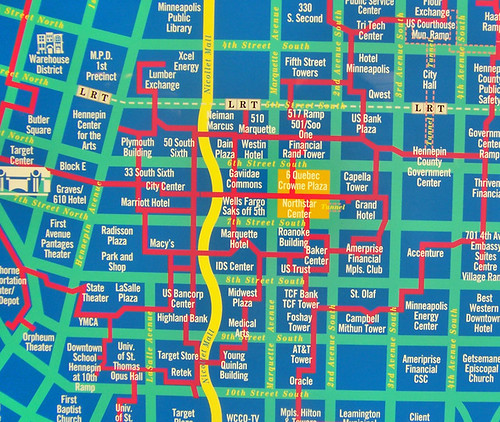
- Minneapolis. This week’s Sift comes to you from the best thought-out downtown in America.
- Road Gadget: Three weeks with my iPad. I can’t give you a nice simple justification for buying one, but I like it.
- Short Notes. The wisest thing Robert Byrd ever said. A local Fox station has an open-mic incident after a Palin speech. Republicans vs. demography. McChrystal is almost famous. Fantasies of Hezbollah in Mexico. A simple depolarization scheme. Glenn Beck claims Thomas Jefferson. And if money is speech, then speech isn’t free.
Downtown (see map) is really two shopping districts overlaid. The heart of ground-level downtown is the Nicollet Mall, an 11-block long stretch of Nicollet Avenue that has wide sidewalks and two traffic lanes reserved for buses — many of which are free for rides up and down the Mall. It’s anchored at one end by the beautiful Hennipin County LIbrary and the light rail station (which will take you to the Mall of America, if you really think that’s necessary), and at the other by the Convention Center. In between are a very un-mall-like variety of retailers, from unique local shops and restaurants to big chain stores like Macy’s and Barnes & Noble.
I can’t say how packed downtown is on a normal weekend, because this was the Pride Festival. While walking from a conference event to my hotel Saturday evening, I suddenly found myself in the staging area for Dyke March. A peppy young woman explained that I didn’t have to be a dyke to march with them, but I had somewhere else to be.
Friday’s NYT looked into the future of e-readers. Nicholas Negroponte is planning
a slate computer set to be released in 2012 that will cost less than $100. Plastic and, he said, unbreakable, the computer will resemble the iPad and will “use so little power you should be able to shake it or wind it up to give it power.”
If the United States leads the charge to war in the Persian Gulf, we may get lucky and achieve a rapid victory. But then we face a second war: a war to win the peace in Iraq. This war will last many years and will surely cost hundreds of billions of dollars. In light of this enormous task, it would be a great mistake to expect that this will be a replay of the 1991 war. The stakes are much higher in this conflict.
A Sarah Palin endorsement may help you win a Republican primary, but you’ll have to hope everybody forgets about it by November.
Lots of bloggers are discussing the “Demographic Change and the Future of Parties” report put out this week by demographer Ruy Teixeira. The gist is that by riding white-working-class anger and white-Christian social issues, Republicans are pursuing a very short-term strategy. The white, Christian, and working-class shares of the electorate are all shrinking, and younger voters lack the anti-gay animus so many candidates are relying on.
The growth action on the religious front is among unaffiliated or secular voters, who are the fastest-growing “religious” group in the United States. From 1944 to 2004 the percentage of adults reporting no religious affiliation almost tripled, rising from 5 percent to 14 percent. Projections indicate that by 2024 somewhere between 20-25 percent of adults will be unaffiliated.
This trend, combined with growth among non-Christian faiths and race-ethnic trends, will ensure that in very short order we will no longer be a white Christian nation. Even today, only about 55 percent of adults are white Christians. By 2024 that figure will be down to 45 percent.
In the big story of the week, a group of guys forgets a Rolling Stone reporter is around and makes fools of themselves. Didn’t I see this already in Almost Famous?
The North Carolina congresswoman who bravely exposed Muslims working as congressional interns and warned of the dangers posed by Arab-owned convenience stores is protecting the public from a new imaginary threat: the connection between Hezbollah and Mexican drug cartels.
Matt Yglesias notes that mainstream pundits love to complain about polarization, but you never hear them support any solutions. He proposes an obvious one: Elect representatives over larger districts and have proportional representation.
In any given election, Democrats and Republicans alike would have plausible pickup opportunities all across the country—even in New York City—meaning that it would make sense for the GOP to always at least think about trying to answer the concerns of American cities.
Then on the flipside, if Nebraska elected its three-member congressional delegation in a proportional manner you wouldn’t have the scenario where 41 percent of Nebraskans vote for Barack Obama but 100 percent of them are represented in the House by conservative Republicans.
Glenn Beck has devoted a bunch of time lately to “proving” that the Founders were all conservative Christians who never intended to separate church and state. These segments are typically nonsense — there’s a whole industry of fundamentalist “scholars” trying to make history more to their liking — but Beck outdid himself recently when he tried to claim Thomas Jefferson. Chris Rodda (author of Liars for Jesus) debunks.
The NYT’s Room for Debate blog discusses the recent Supreme Court decision upholding the law against giving material support to organizations that the government has labeled as “terrorist”, even if that “material support” is your public-relations advice or your speaking out on their behalf.
If you believe that multi-national corporations are exercising a right to free speech by spending unlimited funds to influence elections to their benefit, then you would naturally assume that exercising your right to free speech to influence organizations is equivalent to giving them money. The consistent concept for this court isn’t free speech at all, it’s their belief that money equals speech.
Get the Sift every Monday by email. Write to weeklysift at gmail dot com.

 The Weekly Sift
Comments
I was happy to meet you in person in Minneapolis, my home town.
James Leonard Park,
webmaster for FUUCI:
http://www.tc.umn.edu/~parkx032/Y-INDEX.html
PS: There is no “h” in “Nicollet”, our main street downtown.
You are correct. (you'd think I'd have noticed that when i put in the Wikipedia link)
It was good meeting you too, James. And this time I won't forget about posting something to your site.
Thanks for the link to Chris Rodda – I hadn't been following the inventions of the right regarding the founders, just fulminating about them. So it's always nice to find out that so often with these guys, if it sounds made up, it is. Kudos to Rodda for doing the leg-work, and to you for turning me on to him.
Ironically, I was sitting at an outdoor restaurant table reading the Sift on my netbook with my 3G card when I read about your experiences with the iPad. I find that Apple is one of those companies whose products I keep wanting to like, but just can't quite. I like my iMac well enough, but I hate the finder. Now that they've dropped the price on the data plan, I was thinking about getting a 2gb/mo iPhone 4, but can't guarantee that I'll hold it “just so”. And while the iPad sounds attractive, do I really want to patronize the folks who vetoed James Joyce and Oscar Wilde in the name of “freedom from porn”?
I do't bother taking the power brick from my netbook with me since the battery lasts 6 or more hours. It certainly isn't taking up much space on my cafe-table, and I can read it without holding it up, since the screen is conveniently tilted for my reading comfort (g).
Mail synchronization? Actually, that works perfectly between the netbook, my iMac, and my iPod touch. And the iPad is way more slick. So it's not like I don't understand why you like it, but the proposing isn't compelling enough for me. Yet.
Read today this essay on national economics and thought about your blog:
http://www.tinyrevolution.com/mt/archives/003326.html
Sorry, the link is:
http://www.tinyrevolution.com/mt/archives/003326.html#more
In case of problems:
Date: June 29, 2010
Name: Money Is Not Real
Generraly agree with your review of the iPad, though long term I wonder if the balance between consumption and creation will shift. The iPad is much more physical than what came before it. For some artistic forms, like “painting”, this gives iPad has a much higher potiental than a traditional computer. For other forms, like the textual arts it will get better over time as Apple, programers, and users understand the iPad/iPhone better over time.
btw, there is a Skype app for the iPhone that runs fine on the iPad, used it to call home from Taipei a few weeks ago.
Posted from my iPad (with some not trivial iPad/blogger.com interactions)