Two decades ago, George W. Bush and his cabinet spent months raising support for an invasion of Iraq. Two days ago, the Trump regime attacked Iran without giving us any coherent explanation.
Saturday, the US and Israel began an air war against Iran. The widespread attacks had a variety of goals, but decapitating the government was clearly one of them: One early death was that of Supreme Leader Ali Khamenei, an ayatollah who has been in power since the death of the founder of the current theocracy, Ayatollah Ruhollah Khomeini, in 1989.
The first American deaths were reported yesterday: three service members who had not yet been named. Five more have been seriously wounded.
It’s hard to know what to write about this, because we have been told so little. Comparisons to George W. Bush’s Iraq fiasco are everywhere, but this attack differs in one important respect: Bush spent months trying to raise public and congressional support for his invasion. Trump, on the other hand, has given no credible explanation. In retrospect, many Americans resented Bush’s deceptive propaganda, but at least he acted like our opinions mattered. Trump seems not to need either our approval or that of Congress. (The Constitution and the War Powers Act say he does need Congress’ approval, if things like that still matter.)
I remember where I was when Bush came on every TV network to announce we were going to war. Trump hasn’t bothered. He posted to social media an 8-minute video full of rhetoric and falsehoods, and never answered the questions “Why this? Why now?” Stylistically, he talked at us rather than to us — standing behind an official podium and hiding his eyes in the shadow of the visor of a USA cap.
No senior Trump administration officials or cabinet members appeared on the Sunday show television circuit a day after the US and Israel began a major military operation in Iran, killing Iran’s Supreme Leader Ayatollah Ali Khamenei. … The White House’s communications operation indicated that it would let allies on Capitol Hill do the talking, three people familiar with the discussions said.
Why would Trump want Lindsey Graham and Tom Cotton to make the case rather than Marco Rubio or Pete Hegseth or J. D. Vance? To me, the answer seems obvious: Republican senators aren’t official representatives of the Trump regime, so anything they say is deniable.
Trump has sent them out to lie to us, and doesn’t want to be answerable when those lies collapse.
Every hint of an explanation that we’ve been given so far is full of holes. We were told in June that the bombing raids then had “totally obliterated” Iran’s nuclear capability. But only months later we have to attack again because Iran “can never have a nuclear weapon.”
As they made their public case this week for another American military campaign against Iran, President Trump and his aides asserted that Iran has restarted its nuclear program, has enough available nuclear material to build a bomb within days, and is developing long-range missiles that will soon be capable of hitting the United States. All three of these claims are either false or unproven.
Lay down your arms. You will be treated fairly with total immunity. Or you will face certain death.
But there’s no way an air campaign can back that up. The Iranian forces would have to surrender to somebody on the ground, somebody with the institutional power to hold tribunals for some people but not others. Who is that?
Trump also claimed to be doing this for the Iranian people:
When we are done, take over your government. It will be yours to take. This will be probably your only chance for generations. … America is backing you with overwhelming strength and devastating force.
What we did in Venezuela, I think, is the perfect, the perfect scenario.
In Venezuela after Maduro was captured, his vice president took power and the entire regime remained intact. All they did was let Trump control their oil.
So much for the Iranian people.
In the absence of any plausible explanation from Trump, we’re left to imagine some other motive. Here’s the opinion of Phillips P. OBrien, professor of strategic studies at the University of St. Andrews in Scotland:
Boil it all down and what do we have? We have a military operation with no clear ends at all. Stop asking what the US government’s intentions are, they do not exist outside of the personal interests of Donald Trump. They can and will therefore change in a heartbeat as he searches desperately for whatever end gives him the best chance to declare victory. He has made the national interest entirely personal.
Trump attacked Iran to change the media narrative in the US. The testimony of the Clintons to the House Oversight Committee has raised the question of why Trump doesn’t testify. And polls show Trump’s party headed for a historic defeat in November, losing the House and possibly even the Senate.
This bombing campaign is what Iran’s regional rivals get in exchange for a series of bribes to Trump and his family: the UAE’s half-billion-dollar investment in Trump’s crypto company; a $400 million luxury jet from Qatar; Jared Kushner’s firm getting $2 billion in Saudi money to invest despite their high management fees and lack of experience; an Abu Dhabi firm using $2 billion in Trump meme coins to complete a business transaction; and perhaps countless others that are still hidden behind the veil of Trump’s real estate and crypto-currency operations. Rachel Maddow says: “And now for that low, low price, they appear to have rented the services of the United States military to start a war that they want, but that the American people do not, and that our American government hasn’t bothered to explain in terms that are even internally consistent, let alone rational and sound.”
A big, expensive distraction? A quid for the sheikhs’ quo? Trump may not like those theories. But if he doesn’t want them settling into the public mind, he needs to give us something better.
As I often point out: A one-person weekly blog is a bad place to cover breaking news. This morning, the attack on Venezuela is in that nebulous zone between breaking news and an ongoing story: US forces attacked Caracas early Saturday morning, seized President Nicolás Maduro, and apparently left. We can see the general outline of what happened, but what it all means and where it’s all going is still very cloudy.
At the same time, we can’t just wait for the dust to settle, because this is an emergency moment not just for Venezuela, but for America.
For almost a year now, Trump has been pushing Congress into irrelevancy, and the Republican majorities in both houses and in the Supreme Court have been letting him do it: Congress no longer controls government spending. Agencies set up by Congress to be independent of the President have been taken over. The deadlines laid out in the Epstein Files Transparency Act have been ignored. The Education Department established by Congress has been all but eliminated.
And now, Congress has been shoved out of any role in making decisions of war and peace.
Apologists for the administration will tell you that this is nothing new. Ever since World War II (the last war officially declared by Congress), Congress’ constitutional power to declare war has been in tension with the President’s constitutional power as commander in chief. [1] Exactly where the boundary lies — what the President can do on his own and what requires congressional authorization — has been a topic of legitimate debate. A rule of thumb has been that decisions that need to be made quickly belong to the President, while longer commitments require Congress.
Congress asserted its power in the War Powers Act of 1973, which set clear limits on presidential discretion. Subsequent presidents have refused to recognize the constitutionality of the WPA, but have generally respected its boundaries as a matter of good form and sound politics. [2] So, for example, President Bush II sought congressional approval before invading both Iraq and Afghanistan. Lesser military actions have sometimes been initiated without Congress.
But the Venezuela attack is completely outside the bounds of previous constitutional debates. Not only did Trump not seek authorization from Congress, but the congressional “Gang of 8” — leaders of both parties in both houses, who by law are required to be kept informed — did not know about the attack until it was underway. Worse, briefings by Marco Rubio and Pete Hegseth actively misinformed congresspeople about the administration’s intentions. [3] In short, Trump has given Congress no role whatsoever in this decision to go to war.
If Congress were taking seriously its constitutional obligation to preserve our system of checks and balances, it would immediately launch an impeachment. But unfortunately, Republicans in Congress are mostly taking an all’s-well-that-ends-well view: Maduro was bad and he is out now. The mission itself was a stunning display of tactical brilliance. So we should all just be happy with our military success.
The problem with that view is that nothing has ended yet. Immediately, power has not passed to the opposition leaders whose election victory Maduro stole. Instead, Maduro’s vice president Delcy Rodríguez has taken charge of a governing structure that is very much intact. So far, she has sent signals in both directions, denouncing the US attack as “an atrocity that violates international law”, but also saying she want the US government to “collaborate with us on an agenda of cooperation”.
Trump, meanwhile, has said several times that the US is going to “run” Venezuela now and “fix” it. No one in the administration seems to know exactly what that means, or whether American troops will have to occupy the country and take casualties. He seems to imagine that he can manage Rodriguez with threats. But even if he can, will Rodriguez’ people let her stay in power as an American puppet?
Rep. Jim Hines, the ranking Democrat on the House Intelligence Committee (which makes him one of the uninformed Gang of 8) summed up pretty well:
We’re in the euphoria period of acknowledging across the board that Maduro was a bad guy and that our military is absolutely incredible. This is exactly the euphoria we felt in 2002 when our military took down the Taliban in Afghanistan, in 2003 when our military took out Saddam Hussein, and in 2011 when we helped remove Muammar Gaddafi from power in Libya. … Let’s let my Republican colleagues enjoy their day of euphoria, but they’re going to wake up tomorrow morning, knowing, oh my God, there is no plan here any more than there was in Afghanistan, Iraq, or in Libya.
[1] This is one of many situations where the Founders lived in a different world than we do now. The early United States had only a minuscule standing army. So any president who wanted to go to war first had to convince Congress to raise and supply a larger force. But World War II made the US a global superpower, so recent presidents have always had large military forces to command.
[2] One of the lessons of Vietnam was that it’s hard to sustain a war without popular support. Getting Congress to buy in is usually part of a larger effort to sell a war to the general public.
[3] Senator Chris Murphy (D-CT) told CNN’s “State of the Union” yesterday:
I can certainly tell you that the message that [Rubio and Hegseth] sent was that this wasn’t about regime change. When they came to Congress — and they literally lied to our face — they said, “This is just a counternarcotics operation. This is about trying to interrupt the drug flow to the United States.” Right around that same time, the White House Chief of Staff [Susie Wiles] said publicly if we ever had boots on the ground in Venezuela, of course, we would have to come to Congress.
If you think about it, identifying America just with agreeing with the principles, let’s say, of the Declaration of Independence, that’s a definition that is way over-inclusive and under-inclusive at the same time.
I don’t think many people would argue with the over-inclusive part. As Vance observed, there are probably billions of people who agree with the founding principles of the United States. They may even identify with America the way JFK was identifying with Germany when he said “Ich bin ein Berliner.” But that doesn’t make them Americans in any real sense. Now, if they come here, work, pay taxes, and pledge their allegiance to the government defined in the Constitution, we can start to have a discussion. But until then, hardly anyone would claim they’re Americans.
Where Vance caused controversy, though, was with “underinclusive”. If your ancestors fought in the Civil War, then you “have a hell of a lot more claim over America than the people who say [you] don’t belong”, even if you don’t believe in the founding principles. Vance seemed to be saying that you could be, say, a Nazi. But if your ancestors fought for the fascist empire of its day, the Confederacy, maybe because they wanted to defend and preserve slavery, then you’re one of us.
In short, Vance’s America isn’t fundamentally about freedom or democracy or any other grand principle.
America is not just an idea. We’re a particular place, with a particular people, and a particular set of beliefs and way of life.
This is sometimes described as the “blood and soil” vision of a nation, and it quickly lends itself to what the far right calls “heritage Americans”, who are English-speaking and Christian and (predominantly) White and have a “way of life” that puts men (and not women) at the top of the pyramid. As one author explains:
Non-Christians can be tolerated, as long as they acquiesce to living in an unashamedly Christian America (i.e., submitting to Christian civil law, government support for Christianity, Christian moral, civil, and religious norms and customs, etc.). At the same time, both public and private citizens should be concerned to help the Christian Church flourish in our nation, since a collapse of Christian conversions, church plants, and influence will mark the end of America.
Like so much of Trumpism, this is deniable if you find it embarrassing (as I hope many Trumpists do). Vance didn’t actually spell all that out, and besides, it’s Vance, not Trump. Who takes what J. D. Vance says all that seriously anyway? And since Trump isn’t coherent enough to enunciate such a grand vision, MAGAts don’t have to own up to the full implications of redefining America in blood-and-soil terms.
NSS-USA. Last month, though, the regime put out a document that is harder to deny: National Security Strategy for the United States of America. The text part of it is only 29 pages, but I can’t recommend you read the whole thing, because (like nearly all regime publications) it’s full of praise for how Donald J. Trump rescued America from the pit of despair Joe Biden had left it in. Now is the winter of our discontent made glorious summer by this son of New York, and yadda, yadda, yadda.
But beyond the huckstering, the NSS-USA does have some real content. In particular, it declares an end to the era in which the US tried to be the linchpin of a rules-based global order, and tried (at least some of the time) to promote freedom and democracy. The NSS-USA characterizes this past policy both as “permanent American domination of the entire world” and as “lash[ing] American policy to a network of international institutions, some of which are driven by outright anti-Americanism and many by a transnationalism that explicitly seeks to dissolve individual state sovereignty”.
But we’re done with all that now. Instead, we’re going to control immigration, make money, and launch a “restoration and reinvigoration of American spiritual and cultural health”. And we’re not going to try to export American values like human rights that disrespect “other countries’ differing religions, cultures, and governing systems.” (So if MBS wants to lure an Washington Post journalist into a foreign embassy, kill him, and saw his body into little pieces, that’s just how they do things in Saudi Arabia, and we want to do profitable business with them. As the Emperor Vespasian supposedly said about raising funds by taxing public toilets, “Pecunia non olet“, meaning “Money doesn’t stink”, no matter where it comes from.)
Here’s what that “reinvigoration of American spiritual and cultural health” means:
We want an America that cherishes its past glories and its heroes, and that looks forward to a new golden age. We want a people who are proud, happy, and optimistic that they will leave their country to the next generation better than they found it. We want a gainfully employed citizenry—with no one sitting on the sidelines—who take satisfaction from knowing that their work is essential to the prosperity of our nation and to the well-being of individuals and families. This cannot be accomplished without growing numbers of strong, traditional families that raise healthy children.
That’s why we have to turn our schools into propaganda mills that expunge any real discussion of slavery, genocide against the Native Americans, or the ongoing effects of racism and sexism. The American past must have nothing but “glories”, and we must ignore discouraging trends like climate change, the increasing concentration of wealth, or anything else that might cause our people to expect something other than the Golden Age of Trump. The NSS-USA doesn’t define “strong traditional families” or “healthy children”, but I hear a lot of ominous subtext there.
The document then goes region by region. Some of its goals are the same as previous administrations. We don’t want a hostile power to control the oil of the Middle East, and we want to maintain our access to other critical resources. We want to avoid seeing some rival power dominate the world.
But then it starts to diverge. It defines what is basically an American sphere of influence in the Western hemisphere. We want countries that are “reasonably stable and well-governed enough to prevent and discourage mass migration to the United States”. Beyond that, we don’t care what they do to their people.
The one place where we do want to interfere in other countries’ business is with our allies.
We will oppose elite-driven, anti-democratic restrictions on core liberties in Europe, the Anglosphere, and the rest of the democratic world, especially among our allies.
However, it looks like the regime sees those “elite-driven, anti-democratic restrictions” mainly in our allies’ attempts to suppress right-wing radicalism. It promotes a view of Europe’s future that sounds a lot like proto-fascist parties such as Germany’s AfD (which Vance endorses). Due to immigration and falling native birth rates, Europe faces “civilizational erasure”. But the US wants Europe to “remain European” and to “regain its civilizational self-confidence”.
Europe’s support for Ukraine against Russia (i.e., its “unrealistic expectations for the war”) is due to its “anti-democratic” aspects.
A large European majority wants peace, yet that desire is not translated into policy, in large measure because of those governments’ subversion of democratic processes. This is strategically important to the United States precisely because European states cannot reform themselves if they are trapped in political crisis.
Again, what this “reform” consists of is not spelled out, but I suspect the model is fascist Hungary.
American diplomacy should continue to stand up for genuine democracy, freedom of expression, and unapologetic celebrations of European nations’ individual character and history. America encourages its political allies in Europe to promote this revival of spirit, and the growing influence of patriotic European parties indeed gives cause for great optimism. … We want to work with aligned countries that want to restore their former greatness.
But that’s not where NSS-USA sees Europe heading, so it wants to “cultivat[e] resistance to Europe’s current trajectory within European nations”, I suppose this means supporting blood-and-soil European parties like France’s National Rally.
If Europe refuses to defend its white cultural heritage, though, it sounds like the Trump regime wants to cut them loose.
Over the long term, it is more than plausible that within a few decades at the latest, certain NATO members will become majority non-European. As such, it is an open question whether they will view their place in the world, or their alliance with the United States, in the same way as those who signed the NATO charter
I mean, we signed a treaty with white countries. We can’t be expected to honor it if Whites become a minority.
Other than Europe, where we want political change to preserve a native-European racial mix, we care about other countries only as potential business partners. Nothing in the document suggests that Russia is an enemy, a rival, or a threat to anyone in particular. China is a frenemy, a rival we can do business with. I would really worry if I were Taiwan, because this is how NSS-USA views it:
There is, rightly, much focus on Taiwan, partly because of Taiwan’s dominance of semiconductor production, but mostly because Taiwan provides direct access to the Second Island Chain and splits Northeast and Southeast Asia into two distinct theaters
Taiwan is a fellow democracy and a long-standing ally, but who cares? It produces semiconductors and has a strategic location. China would have to cough up some serious bucks to induce us to turn our backs on that.
The Kagan interview. Robert Kagan is a historian of US foreign policy with whom I have often disagreed. Recently he was interviewed by Bill Kristol, who I also differ with on many things. But despite past differences, I’m fascinated by this interview [video, transcript], which takes a view-from-orbit perspective on American foreign policy. It happened before the NSS-USA came out, but anticipates much of it.
Kagan’s view, basically, is that the American-dominated post-World-War-II world order is a pleasant aberration in history, because for 3/4 of a century other potential great powers like Britain, France, Germany, and Japan have been content to live inside the American orbit. The unspoken contract was that America would take the lead in international affairs, the dollar would be the world’s reserve currency, and so on; and in return, the US would guarantee its allies’ security and wouldn’t use its preeminent position to take advantage of them.
Ordinarily, sovereign nations wouldn’t trust each other to keep a deal like that. (One cautionary historical example is the Delian League, an anti-Persia alliance that got coopted into an Athenian Empire.) But this one has held largely because of the faith all the nations had in shared liberal values like democracy and human rights.
Kagan sees that deal unraveling, largely because Trump doesn’t share liberal values and wants to take advantage.
[T]hat bargain has been exploded. And that’s why we are entering a new era, because if these countries, as is now the case, cannot rely on the American security guarantee, and I think the Trump administration has made it very clear that they can’t, that it’s sort of the intention of the Trump administration to make it clear that they can’t really rely on the United States, on the one hand.
While on the other hand, the United States now is using its superior power to demand, what is in effect, tribute from its allies in the form of these high tariffs. And so the United States is taking advantage of its overwhelming power and abusing it with its own allies. I don’t see how the alliance structure can continue under those circumstances. And now all these countries that have relied on the United States for their security are now going to have to go back to the world that existed before this unusual era in which they can only rely on themselves for security. And that has vast implications for regional geopolitics and global geopolitics that I think, again, Americans have not really begun to contemplate.
(Kagan doesn’t mention this, but from my point of view the contract has been slowly eroding for several years, as the US has used the dollar’s central role to finance enormous budget and trade deficits. In essence, the world sends us goods and we send them dollar-denominated bonds that we could devalue at any time. The Fed could, for example, create enough dollars out of nothing to redeem all the bonds.)
Needing to be able to go it alone, without the US, will probably change the nature of those countries and their governments. Kagan gives the example of Japan, which he says came out of World War I with a largely democratic pro-American government. But in the 1920s, America instituted high tariffs and strong barriers to immigration.
[P]olitics in Japan completely shifts, and then you get the Japan that invades Manchuria in 1931.
For now, our NATO allies may cut deals with Trump and pay his tariffs, while grasping that he no longer guarantees their security against, say, Russia. Short-term, they have little choice. But that’s not a stable situation.
Germany having to re-arm to the point where it can actually meet Soviet power means a completely new Germany again. Now, maybe a heavily armed Germany will still be a liberal Germany, that’s possible. But it’s clear that Germany’s neighbors are going to have the same reaction to that level of German power that they’ve always had in the past. If Japan can’t rely on the United States, it’s going to go become a nuclear weapon state. It’s going to build up its capabilities, and tensions between Japan and China are going to increase exponentially. And if there’s one thing Americans have learned over the past century is that when other great powers get into wars, the United States is immediately implicated in that. That’s the great lesson of World War II. And that’s why we created this liberal world order in the first place.
And again, that’s another thing that I think Americans just are not conscious of. A lot of Americans think we created this liberal order to fight the Soviet Union, which was not true. It was created without regard, even without anticipation that the Soviets were going to be the big problem. It was to prevent a return to effectively a multipolar world.
Trump may think the US can just collect its tribute and live happily ever after. But history has never worked that way before. Picture, for example, a re-militarized Germany led by a xenophobic far-right party like the AfD. What could possibly go wrong?
Saturday night, the United States joined Israel’s air war against Iran. The most significant piece of the US intervention was to do what Israel could not: drop giant bunker-buster bombs on the underground Iranian nuclear research facility at Fordow. The US dropped 14 GBU-57 bombs, the largest non-nuclear bomb in our arsenal. (They are also sometimes referred to as MOPs, massive ordinance penetrators.)
The attack came a week after Israel began bombing Iran, and ended several days of what had appeared to be indecision on Trump’s part. Wednesday, he said: “I may do it, I may not do it. I mean, nobody knows what I’m going to do.” He suggested a two-week window for negotiations, then attacked in two days. (As several people have pointed out, “two weeks” is Trumpspeak for “I have no idea”. He seems to believe that two weeks is long enough for the news cycle to forget about an issue.) Like so many of Trump’s actions, this has been justified after the fact as intentional misdirection rather than indecision.
In response, the Iranian Parliament has authorized closing the Strait of Hormuz, but has left the final decision up to Iran’s Supreme National Security Council. One-fifth of the world’s oil goes through that strait, which sits at the mouth of the Persian Gulf. Closing it would raise world oil prices substantially, at least in the short term. So far, markets seem not to be taking the threat seriously.
As I’ve often said, a one-person weekly blog can’t do a good job of covering breaking news, particularly if it breaks on the other side of the world. So you should look to other sources for minute-to-minute or day-to-day coverage.
I also frequently warn about the pointlessness of most news-channel speculation. The vast majority of pundits have no idea what’s going to happen next, so taking their scenarios seriously is at best a waste of time and at worst a way to make yourself crazy.
So if I can’t reliably tell you what’s happening or what’s going to happen, what can I do? At the moment, I think the most useful discussion to have on this blog is to ask the right questions.
What are we trying to accomplish in this war? Failure to get this right has been the major failing in America’s recent wars. Our government has frequently marshaled public support by invoking a wide variety of motives, with the result that we never quite know when we’re done. Our involvement in Afghanistan started out as a hunt for Osama bin Laden and the Al Qaeda leadership behind 9-11. But it quickly evolved into an attempt to establish a friendly regime in Kabul, combat Muslim extremism in general, test counter-insurgency theories, and prove that liberal democracy could work in the Muslim world. So our apparent early success turned into a two-decade failure.
Similarly in Iraq. Were we trying to depose Saddam Hussein? Chase down the (apparently false) rumors of his nuclear program? Control Iraq’s oil? Try yet again to build liberal democracy in the Muslim world? If all we had wanted to do was replace Saddam with a friendlier dictator, that’s not a very inspiring ambition, but we might have been in-and-out quickly. Instead, the failure to find Saddam’s mythical weapons of mass destruction left the Bush administration grasping after some other definition of victory, and getting stuck in another long-term war with dubious goals.
The early indications about this war are not encouraging. Maybe we’re just trying to make sure Iran doesn’t get nuclear weapons. Of course, Obama had a treaty in place that did just that, which Trump ditched, claiming he could get a “better deal”. This war, apparently, is that “better” deal.
But maybe we want to topple the Islamic Republic. Maybe we once again want to control the oil. Those kind of goals bring back Colin Powell’s “Pottery Barn rule“: If we break the country’s government, we own own the ensuing problems until we can fix them. That implies the same kind of long-term commitment we had in Iraq.
Of course, Trump might walk away from such a moral obligation, since he has little notion of morality in any sphere. Then we wind up with a failed state three times the size of Afghanistan, and who knows what kind of mischief might germinate there?
Did our attack work? The answer to this question depends on the answer to the previous question: What does “work” mean?
If the goal was simply to destroy Iran’s current nuclear program, maybe it did work, or can be made to work soon. Trump announced that the attacks were “a spectacular military success” which “completely and totally obliterated” the target sites. But then, he would say that no matter what happened, wouldn’t he? Without someone on the ground, it’s impossible to know.
And without regime change, or without some kind of verifiable agreement in which the current regime renounces nuclear weapons, any such damage is just temporary. Any nation with sufficient money and will can develop nuclear weapons. If Iran comes out of this war with money and will, it can start over.
If the goal is regime change or “unconditional surrender”, the attack hasn’t worked yet and may never. Air war is a poor tool for establishing a new government. I would hope we learned our lesson from Dick Cheney’s famous “we will, in fact, be greeted as liberators” comment, but maybe not. I’ve heard commentators cite internal political opposition to the Iranian theocracy as some kind of ally, but It’s hard for me to picture how that works.
Apply the same logic to the United States: I am deeply opposed to the Trump administration and regard it as a threat to the tradition of American constitutional government. But would I favor some Chinese operation to overthrow Trump? No. What if the internal opposition in Iran is like me? Might they have to unite behind their government to avoid foreign domination?
What could Iran do in response? It’s always tempting to imagine that I will take some extreme action and that will be the end of the matter. Probably you’ve seen this yourself in online discussions. Somebody says something stupid, and you come up with some devastating comment, figuring that the other person will slink off in disgrace.
It doesn’t usually work out that way, does it? The other person will strike back at least as hard as you did, and the exchange might go on for days. You never planned on a flame war eating up hours of your time, but there you are.
Same thing here. Iran might close the Strait of Hormuz to oil tankers, sending the price of gas shooting up and the world economy reeling. It might attack American troops stationed in various places around the Middle East. It might launch terrorist attacks in the US itself. (Do you trust this 22-year-old to protect you?)
Even worse is the possibility of the unexpected. We seem to be at a hinge point in the history of warfare, where drones and various other new technologies change the battlefield in ways that are hard to imagine. Ukraine’s attack on Russia’s Siberian bomber bases is a case in point, but there are others.
Traditional symbols of power may be vulnerable, the way that the American battleships at Pearl Harbor were vulnerable to the new technology of air power. Are we prepared for, say, a massive drone attack sinking an aircraft carrier? What about a cyberattack blacking out some major city? If we suffer such an unexpected blow to our prestige and power, will we be able to respond in a rational way?
What will this war do to the United States itself? The War on Terror undermined the consensus against torture, and authorized previously unprecedented levels of government spying on ordinary Americans.
So far, this war looks like another few steps down the road to autocracy. We attacked Iran because Trump decided to. Bush’s invasion of Iraq, by contrast, was authorized by a bipartisan vote in Congress (to the shame of opportunistic Democrats who should have stood against it). That vote was preceded by a spirited public debate and mass protests.
This time, Congress was not consulted in any formal way. And even informally, a few congressional Republicans were informed ahead of time, but played no part in the decision. Democrats were not consulted at all. No effort at all has been made to convince the American public that this war is in our interests.
So far we’ve been treating this war as if it were a reality show involving Trump, Netanyahu, and the Iranian leadership. We’re just spectators. Until, that is, our city blacks out or we can’t afford gas.
The choice I had to make, as your President, was either to follow through on [the Trump administration’s] agreement or be prepared to go back to fighting the Taliban in the middle of the spring fighting season.
There would have been no ceasefire after May 1. There was no agreement protecting our forces after May 1. There was no status quo of stability without American casualties after May 1.
There was only the cold reality of either following through on the agreement to withdraw our forces or escalating the conflict and sending thousands more American troops back into combat in Afghanistan, lurching into the third decade of conflict.
I stand squarely behind my decision. After 20 years, I’ve learned the hard way that there was never a good time to withdraw U.S. forces.
That speech led to what TPM’s Josh Marshall called “peak screech” from the DC media. In Tuesday’s morning newsletter from Politico, Marshall elaborates, “A sort of primal scream of ‘WTF, JOE BIDEN?!?!?!!?!’ virtually bleeds through the copy.”
Immediately after Biden’s speech, MSNBC’s Nicole Wallace offered this blunt assessment of a mainstream that her show itself was often swimming in:
Ninety-five percent of the American people will agree with everything [Biden] just said. Ninety-five percent of the press covering this White House will disagree.
Her numbers were exaggerated, but the overall point was dead-on: I can’t remember the last time the media was so unified and so intent on talking me out of my opinion.
This was not a question of facts that they knew and I didn’t. The mainstream media has been equally unified in combating misinformation about the Covid vaccines, say, or in batting aside Trump’s self-serving bullshit about election fraud. But in each of those cases, there is a fact of the matter: The vaccines work. Fraud did not decide the election.
But Afghanistan is different. The belief that our troops should have stayed in Afghanistan a little bit longer (or a lot longer or forever) is an opinion about what might happen in the unknowable future. It’s also a value judgment about the significance of Afghanistan to American security compared to the ongoing cost in lives and money. Reasonable people can disagree about such things.
But apparently not on TV. The Popular Information blog talked to “a veteran communications professional who has been trying to place prominent voices supportive of the withdrawal on television and in print”.
I’ve been in political media for over two decades, and I have never experienced something like this before. Not only can I not get people booked on shows, but I can’t even get TV bookers who frequently book my guests to give me a call back…
I’ve fed sources to reporters, who end up not quoting the sources, but do quote multiple voices who are critical of the president and/or put the withdrawal in a negative light.
I turn on TV and watch CNN and, frankly, a lot of MSNBC shows, and they’re presenting it as if there’s not a voice out there willing to defend the president and his decision to withdraw. But I offered those very shows those voices, and the shows purposely decided to shut them out.
In so many ways this feels like Iraq and 2003 all over again. The media has coalesced around a narrative, and any threat to that narrative needs to be shut out.
As we have watched the rapid dissolution of the Afghan government, the takeover of the country by the Taliban and the desperate effort of so many Afghans to flee, the U.S. media have asked themselves a question: What do the people who were wrong about Afghanistan all along have to say about all this?
That’s not literally what TV bookers and journalists have said, of course. But if you’ve been watching the debate, it almost seems that way.
A parade of retired generals, military contractors, and think-tank talking heads were given a platform to explain how Biden had made a “terrible mistake“, that was “worse than Saigon“, and that pushed his presidency past “the point of no return“. Afghanistan has ruined the Biden administration’s image of competence and empathy, and it will “never be the same“.
As we saw with the beginning of these wars in 2001-2003, these moments of unanimity allow a lot of dubious ideas to sneak in to the conversation. Let’s examine a few of them.
Yes, this was a “forever war”. One false idea I keep hearing is that Afghanistan had settled down to the point where a minimal US commitment could have held it steady: maybe 2-3 thousand troops that would rarely take any casualties. Jeff Jacoby was one of many pushing this point:
Yes, the United States has been involved in Afghanistan for almost 20 years, but the last time American forces suffered any combat casualties was Feb. 8, 2020, when Sgt. Javier Gutierrez and Sgt. Antonio Rodriguez were ambushed and killed. Their sacrifice was heroic and selfless. But it makes little sense to speak of a “forever war” in which there are no fatalities for a year and a half. Nor does it make sense to apply that label to a mission involving just 2,500 troops, which was the tiny size to which the US footprint in Afghanistan had shrunk by the time Biden took office.
And The Washington Post made space for Rory Stewart to claim:
When he became president, Biden took over a relatively low-cost, low-risk presence in Afghanistan that was nevertheless capable of protecting the achievements of the previous 20 years.
But you know what else happened in February of 2020? Trump’s peace agreement with the Taliban. Once Trump agreed to totally withdraw, the Taliban stopped targeting US troops. The “low-cost, low-risk” presence depended on the Taliban believing our promise to leave. If Biden had suddenly said, “Never mind, we’re keeping 2,500 troops in place from now on.”, we’d soon start seeing body bags again, and realizing that 2,500 troops weren’t enough. Biden was right: “There was no status quo of stability without American casualties after May 1.”
Popular Information points out the hidden cost to the Afghans of our “light footprint”:
With few troops on the ground, the military increasingly relied on air power to keep the Taliban at bay. This kept U.S. fatalities low but resulted in a massive increase in civilian casualties. A Brown University study found that between 2016 and 2019 the “number of civilians killed by international airstrikes increased about 330 percent.” In October 2020 “212 civilians were killed.”
Jacoby invokes the example of Germany, where we have kept far more than 2,500 troops for far longer than 20 years. “Should we call that a forever war, too?” No, because Germany has no war. If Nazi partisans were still hiding in the Bavarian mountains, which we regularly pounded with air power, and if we worried about them overthrowing the Bundesrepublik as soon as our troops left, that would be a forever war in Germany. Is that really so hard to grasp?
Actually, no one saw this coming. Much has been made of the few intelligence reports that warned of the Afghan government falling soon after we left. But if that had actually happened, we’d have been OK — or at least better off than we are.
What did happen, though, is that the Afghan army dissolved and the leaders fled Kabul before we were done leaving. That’s why we’re having the problems we’re having. And literally no one — certainly not the “experts” who are denouncing Biden on TV — predicted that.
Evacuating our people sooner wouldn’t have avoided the problem. Imagine you’ve spent the evening in the city, and as you go through the subway turnstile you see the last train home vanishing down the tunnel. Naturally, you think “I should have left the party sooner.”
Commentators are thinking like that now, but the metaphor doesn’t work. In the metaphor, you and the train are independent processes. If you’d arrived at the station five minutes earlier, the train would have been waiting and you’d have gotten home.
The fall of Saigon in 1975 was exactly like a train leaving: It took time for the North Vietnamese/Viet Cong forces to fight their way to Saigon. If you didn’t get out before they arrived, you should have started leaving sooner.
But the Taliban didn’t fight their way to Kabul; the Afghan army we had so lavishly equipped simply dissolved in front of them, in accordance with surrender deals previously worked out. And the signal that started the surrender was the Americans beginning to leave. Nobody wanted to be the last person to wave the white flag, so when they saw Americans evacuating, it was time.
In other words: Afghanistan is more like the train operator being in contact with someone at the party, so that he could start pushing off as soon as you were on your way.
So yes, Biden could have started pulling out a month or two sooner. And the collapse would have happened a month or two sooner. Again, Biden nailed it: There was never a good time to leave Afghanistan.
Imagine if Biden had foreseen everything and been transparent about it. So in June or July he goes on TV and says, “The Afghan Army isn’t going to fight, so the government going to fall very suddenly. If you want to be part of the evacuation, start off for the airport now.”
Not only would the collapse have begun immediately, but all the Liz Cheney and David Petraeus types would claim that Biden had stabbed the Afghans in the back. Biden’s lack of faith, they would claim, and not the Afghan government’s failings, would have been to blame.
And now picture what happens to the politics of welcoming the Afghan refugees. Tucker Carlson and the other nativist voices are already claiming the Afghan rescue is part of the massive Democratic plot to replace White Americans with immigrants. “First we invade, then we’re invaded.” Laura Ingraham echoed that concern:
All day, we’ve heard phrases like “We promised them.” Well, who did? Did you?
How much more weight would this immigration conspiracy theory have, if the first visible sign of collapse had been Biden expressing his lack of faith in the Afghan government? Clearly, replacement theorists would argue, Biden wanted Afghanistan to collapse so that he could bring in more immigrants — possibly “millions” of them, as Carlson has already warned.
The war, and not the end of the war, is what lowered America’s standing in the world. I can’t put this better than David Rothkopf already did when he listed “the top 30 things that have really harmed our standing”. His list is more Trump-centered than mine would be — I’d give a prominent place to the Bush administration’s torture policy — but we agree on this: Having things go badly for a few weeks while we’re trying to do the right thing is not on it.
Spending 20 years, thousands of lives, and trillions of dollars fighting a war that, in the end, accomplished little — that lowers our standing in the world. Ending that war doesn’t.
So what explains the “peak screech”? I’m sure someone in the comments will argue that the DC press corps is part of the corrupt military-industrial complex that has been profiting from the continuing war, but I’m not going there. (In general, I am leery of the assumption that the people who disagree with me are corrupt. That assumption gives up too easily on democracy, which requires good-faith exchanges of ideas between disagreeing parties. I’m not saying there is no corruption and bad-faith arguing, but I have to be driven to that conclusion. I’m not going there first.)
Josh Marshall offers a two-fold explanation, which rings true for me. First, the major foreign policy reporters have personal connections to a lot of the people who are at risk in Afghanistan, or to people just like them in other shaky countries. If you reported from Afghanistan, you had a driver, you had an interpreter. Maybe your cameraman was Afghan. You depended on those people, spent a lot of downtime with them, and maybe even met their families. Maybe their street smarts got you out of a few difficult situations. Will they now be killed because they helped you? You never committed to bring them to America, which was always beyond your power anyway. But you can’t be objective about their situation.
Second is a phenomenon sometimes described as “source capture”. A big part of being a reporter is cultivating well-placed sources. For war reporters, that means sources in the Pentagon or the State Department, or commanders in the field, or officials in the Afghan government or military. Even if you have no specific deal with these sources, you always understand the situation: If you make them look bad, they’ll stop talking to you.
Over time, as you go back to your sources again and again, you start to internalize that understanding, particularly with the ones who consistently give you reliable information. You identify with them. You stop thinking of them as your sources and start to think of yourself as their voice. If they are invested in a project like the Afghanistan war, you start to feel invested in it too.
Marshall sums up:
[W]hat I’m describing isn’t a flag-waving, America’s never wrong, “pro-war” mindset. It’s more varied and critical, capable of seeing the collateral damage of these engagements, the toll on American service members post combat, the corruption endemic in occupation-backed governments. And yet it is still very bought-in. You see this in a different way in some of the country’s most accomplished longform magazine writers, many of whom have spent ample time in these warzones. Again, not at all militarists or gungho armchair warriors but people capable of capturing the subtleties and discontents of these missions and the individuals caught up in their storms. And yet they are still very bought-in. And it is from these voices that we are hearing many of the most anguished accusations of betrayal and abandonment. It is harrowing to process years or decades of denial in hours or days.
What we see in so many reactions, claims of disgrace and betrayal are no more than people who have been deeply bought into these endeavors suddenly forced to confront how much of it was simply an illusion.
If the last two weeks have revealed anything, it’s exactly how much of an illusion our “nation-building” in Afghanistan always was. Real countries, with real governments and real armies, don’t evaporate overnight.
People who have been living in denial typically react with anger when their bubble pops. They ought to be angry at the people who duped them, or at themselves for being gullible. But that’s not usually where the anger goes, at least not at first. The first target is the person who popped the bubble.
So damn that Joe Biden. If he’d just kept a few thousand troops deployed and kept the money spigot open, we could all still be happy.
Biden’s announcement ends not just to our war in Afghanistan, but 20 years of fantasies about what “six more months” can accomplish there.
Wednesday, President Biden announced that our troops (and those of our NATO allies) will leave Afghanistan by September 11. Unlike previous dates for withdrawal, this one isn’t based on achieving some kind of stability or other goals first; we’re just getting out.
That announcement touched off a lot of comment, both pro and con. Pro: Leaving saves American lives and resources, and gives our military more flexibility to confront challenges more central to our well-being, as may come from Russia (in Ukraine) or China (in Taiwan). Con: Without us, the Afghan government will probably fall to the Taliban. That will definitely be bad for the Afghan people, and could also harm us if the Taliban starts sheltering terrorist groups like Al Qaeda again.
But one argument has been conspicuous by its absence: If we stay for six more months, or a year, or three years, Afghan democracy will stabilize, the Afghan Army will finally have enough training, and the government we leave behind in Kabul will be able to sustain itself.
The generals and their media allies have been making that argument for almost 20 years, and I was pleased to hear Biden blow it up:
So when will it be the right moment to leave? One more year, two more years, ten more years? Ten, twenty, thirty billion dollars more above the trillion we’ve already spent? …
“Not now” — that’s how we got here. And in this moment, there’s a significant downside risk to staying beyond May 1st without a clear timetable for departure.
If we instead pursue the approach where [the US] exit is tied to conditions on the ground, we have to have clear answers to the following questions: Just what conditions [will] be required to allow us to depart? By what means and how long would it take to achieve them, if they could be achieved at all? And at what additional cost in lives and treasure?
I’m not hearing any good answers to these questions. And if you can’t answer them, in my view, we should not stay.
Biden acknowledges the possibility of a terrorist resurgence in Afghanistan, but plans to deal with that if and when it happens.
We’ll not take our eye off the terrorist threat. We’ll reorganize our counterterrorism capabilities and the substantial assets in the region to prevent reemergence of terrorists — of the threat to our homeland from over the horizon. We’ll hold the Taliban accountable for its commitment not to allow any terrorists to threaten the United States or its allies from Afghan soil.
I think of The Washington Post as the hometown paper of the defense and foreign-policy establishment, and it has been playing that role this week. The Post’s editorial board responded to Biden’s plan by predicting that “the likely result will be disaster”. But even they acknowledged that their alternative path offers no exit.
A strategy of leaving troops in the country in an effort to force the Taliban to compromise could extend the U.S. commitment for years without achieving a durable peace.
And WaPo columnist Max Boot offered a much-scaled-down version of the usual rosy scenario:
To avert such a dire contingency, Biden would not have to wage a “forever war.” He would merely have to keep a relatively small number of U.S. forces to advise and assist the Afghans who already undertake almost all of the fighting.
So: a forever skirmish, not a forever war. We’ve recently gone a whole year without a combat death in Afghanistan. Maybe that happy circumstance will continue, and the price of freezing the status quo will be low enough to tolerate indefinitely.
Or maybe not. Maybe the Taliban will tire of trying to wait us out, and will go back to trying to drive us out. And if combat deaths go back up, that will be its own reason to stay, so that the troops we are losing will not have died in vain.
But notice: This disagreement is between two sides that each have at least one foot in reality. Maybe the cost of staying in Afghanistan forever will be tolerable, or maybe we’ll find some better way of dealing with the increased terrorism threat of a Taliban-ruled Afghanistan. But nobody is counting on the Freedom Fairy to sprinkle her dust over Kandahar.
So whether you agree with Biden on this or not, you should at least thank him for bringing some honesty into the conversation.
Having written more-or-less even-handedly up to this point, I’ll take a side: I’m with Biden on this.
Way back in 2005, I expressed very similar ideas (about Iraq) in a 2005 essay I provocatively titled “Cut and Run“. At the time, “serious” foreign-policy experts were finally admitting that the 2003 Iraq invasion had been a mistake and we needed to get our troops out. But they always paired that concession with some sort of “after we fix what we’ve broken” caveat. (This became known as the Pottery Barn rule.) Typically, the sages thought our troops needed six more months to “stabilize the country” or “establish democracy” or achieve some other worthy but nebulous goal. (NYT columnist Thomas Friedman rolled his six-more-months projections forward with such regularity that six months became known as a Friedman unit.)
In “Cut and Run” I demanded a measurable answer to the question “What are we fixing?” Because in my opinion our military presence wasn’t fixing anything. After six more months, Iraq would still need “stabilizing”, and our troops would have to stay longer.
We can leave Iraq now, or we can leave after our losses have grown. That is the only choice we have.
I feel the same about Afghanistan today, after nearly 20 years of war. Whatever our original intentions might have been, by now it’s clear that we’re not building a secular, democratic, pro-Western government that will someday be strong enough to stand on its own.
There’s a lesson here, and it’s the same lesson we should have learned from Vietnam: In order to install a new form of government in a country, people on the ground have to be buying what you’re selling. As The Boston Globe’s H. D. S. Greenway puts it: In both Vietnam and Afghanistan
our clients could never shake the impression that they were puppets fighting for foreigners, while the Viet Cong and the Taliban were able to present themselves as the true patriots fighting to rid their country of colonialism.
In South Vietnam, all we had to work with was the remnant of the old French colonial administration, which local people joined for the sake of power and profit, not because they believed in the French Empire or anti-Communism or some other idealistic notion. In Afghanistan, we have a corrupt government in Kabul supported (up to a point) by a patchwork of warlords in the countryside. The Afghan people don’t believe in it, because they shouldn’t believe in it.
Over the last two decades, hundreds of thousands of American troops have served in Afghanistan — most of them honorably and some heroically. It is a shame that their effort and sacrifice has not produced a lasting result that our nation can point to with pride. But more effort and sacrifice will not redeem what bad policy has already wasted. We need to leave.
Wednesday, Rachel Maddow brought up another good point about this war, illustrated by the experience of Taliban hostage David Rhode, the Pulitzer-winning NYT journalist who was held for seven months in 2008-2009. Rhode was actually only a prisoner in Afghanistan for a week; for the half-year beyond that, the Taliban kept him in parts of Pakistan where they had free rein.
Knocking the Taliban out of power in Afghanistan was one thing. Defeating them in some kind of larger war, preventing them from ever rising again in Afghanistan, that was something that a US military conflict in Afghanistan was never going to be able to do. Not when the Taliban wasn’t confined to Afghanistan and wasn’t really based there.
In August 2010, a former Pakistani intelligence officer approached the U.S. embassy station chief in Islamabad and offered to reveal bin Laden’s location, in return for the $25 million reward, according to a retired senior U.S. intelligence official.This story was corroborated by two U.S. intelligence officials speaking to NBC News, and had been previously reported by intelligence analyst Raelynn Hillhouse. The Pakistani official informed U.S. intelligence that bin Laden had been located by the Pakistani intelligence service ISI in 2006, and held under house arrest near Pakistani intelligence and military centers ever since.
According to the retired senior U.S. intelligence official speaking to [journalist Seymour] Hersh, bin Laden was ill at this point, financially supported by some within Saudi Arabia, and kept by the ISI to better manage their complex relationship with Pakistani and Afghan Islamist groups.
So a fully military solution to the Afghan problem would mean, at a minimum, expanding the war into Pakistan, and taking down factions within the Pakistani government. Pakistan, you may recall, is a nuclear power.
I don’t think anybody wants to open that can of worms.
Every previous president since Pearl Harbor would have handled the Soleimani announcement very differently.
It’s now been ten days since the United States assassinated top Iranian General Qasem Soleimani near the Baghdad airport, and we still have no coherent explanation of why it was done, why it was legal, and what strategy the assassination is a piece of. Apparently even Congress hasn’t been able to get these questions answered in a classified briefing.
One of the ways Trump gets normalized is that we often compare his actions to his own previous conduct, as in “This is even worse than the last ridiculous thing he did.” As a result, our expectations of presidential behavior drift continually downward. I mean, sure, the claims of an “imminent” threat to American lives, some deadly Iranian scheme that came apart because we killed Soleimani, are almost certainly false. (Once a plot is under way, i.e., truly “imminent”, you disrupt it by stopping the perpetrators, not blowing up the mastermind. Killing Bin Laden after the hijackers were on their way to the airport would have done nothing to prevent 9/11.) But Trump’s like that — what’s one more lie after the many thousands we’ve already heard from him?
Another way we normalize Trump is to cut his actions into tiny pieces and find horrifying precedents for each one. (As in: “So Trump lied about the imminent threat? W lied about WMDs.”) And so we allow the Trump administration to become a Frankenstein monster, stitched together from all the worst aspects of previous presidencies.
To correct these normalizing tendencies, I want to raise the question: What do we normally expect from an American president when there’s been a major military development?
Talk to us. The very least we expect from a normal president is that he address the American people, to acknowledge what has happened himself, as soon as possible.
This tradition is as old as mass media. The day after the Pearl Harbor attack, President Franklin Roosevelt addressed a joint session of Congress, calling December 7 “a date that will live in infamy” and asking the House and Senate to declare war on Japan. The speech was broadcast live over the radio, and “attracted the largest audience in US radio history, with over 81% of American homes tuning in”.
[The speech] was intended not merely as a personal response by the President, but as a statement on behalf of the entire American people in the face of a great collective trauma. In proclaiming the indelibility of the attack, and expressing outrage at its “dastardly” nature, the speech worked to crystallize and channel the response of the nation into a collective response and resolve.
Every subsequent president has carried on this tradition of using the mass media to reach out to the American people when issues of war and peace arose. This week I examined a number of such examples, including these:
In 1950, President Truman went on television to explain what was happening in Korea, and how the mobilization of American troops would (or would not) affect the American people. (“Hoarding food is especially foolish. There is plenty of food in this country.”)
Within an hour of the signing of the Korean armistice, President Eisenhower gave a televised address.
President Kennedy went on TV to announce the “quarantine” of Cuba during the Cuban Missile Crisis.
President Johnson interrupted normal TV programming to tell the American people about the Gulf of Tonkin incident and his response to it.
How a normal president sounds. I could have included many other examples, but the list above is a good sampling. Some the actions announced turned out well and some turned out badly. (It’s probably unfair to expect him to have foreseen this, but Nixon’s Cambodia campaign was a step down the road to the killing fields.) Some of the speeches were more honest than others. (The Gulf of Tonkin incident, for example, was not quite how LBJ described it.) But despite the differences in era and philosophy and personality, all these speeches share a number of features that made them “presidential”.
The most obvious thing they share is a tone: They are all calm but serious. The President, whoever he might have been at the time, projects an attitude of thoughtful determination, as if he were saying “I know there will be consequences to this act, but I have thought them out to the best of my ability. I am not acting rashly out of unreasoning fear or blind anger.”
They are also in some manner humble. This might seem like a strange trait for a leader to display when he is invoking the greatest power his office affords him, but American presidents do not hold their power as a personal possession, the way a divine-right king would. Presidential power is held in trust for the American people. No one is worthy of the power to start bombing some other country or to send troops into harm’s way, but our country has to place that power somewhere. So we have placed it in our president, under supervision from the Congress, who is just a human being like the rest of us. Any human who assumes that power is quite right to be awed by it.
The speeches are not self-aggrandizing, which is the opposite of humble. FDR, for example, could have used the opportunity to pat himself on the back: He had shown the foresight to begin a draft a little over a year before. His Lend-Lease program had armed countries that would now be our allies, and had developed a weapons industry we would now be relying on. But he mentioned none of that.
Unity. Every one of the speeches is an attempt to unify Americans behind the action being announced and the policy it represents. Consequently, they all strive to be non-partisan. Again, look at FDR: He could have reminded the country that Republican congressmen voted against Roosevelt’s Lend-Lease Act 24-135, a decision that now looked short-sighted. That might have scored points with the voters and helped Democrats unseat those Republicans. But he made no mention of parties: The nation had been attacked, and he called for the nation — not just his party — to respond.
That model has stood until the present administration. Frequently in the speeches above, the president quotes or refers to some past member of the other party to demonstrate the bipartisan nature of the policy he is carrying out. Ronald Reagan quoted former Democratic Speaker Sam Rayburn. Nixon referenced a bipartisan list of presidents:
In this room, Woodrow Wilson made the great decisions which led to victory in World War I. Franklin Roosevelt made the decisions which led to our victory in World War II. Dwight D. Eisenhower made decisions which ended the war in Korea and avoided war in the Middle East. John F. Kennedy, in his finest hour, made the great decision which removed Soviet nuclear missiles from Cuba and the western hemisphere.
Johnson’s speech is especially noteworthy in this regard, because it took place in August, 1964, just three months before the election. The idea that Barry Goldwater was a hothead not to be trusted with nuclear weapons would soon become a theme of Johnson’s reelection campaign, but nothing in the Gulf of Tonkin speech hints at that. Quite the opposite:
I have today met with the leaders of both parties in the Congress of the United States, and I have informed them that I shall immediately request the Congress to pass a resolution making it clear that our government is united in its determination to take all necessary measures in support of freedom and in defense of peace in Southeast Asia. I have been given encouraging assurance by these leaders of both parties that such a resolution will be promptly introduced, freely and expeditiously debated, and passed with overwhelming support. And just a few minutes ago, I was able to reach Senator Goldwater, and I am glad to say that he has expressed his support of the statement that I am making to you tonight.
In none of the speeches does the president snipe at his predecessors, blame them for the current predicament, or gloat over the way things have turned out. No president ever had a better opportunity to throw shade at the previous president than Barack Obama, who had succeeded at something George W. Bush had failed to do for seven years: kill Bin Laden. But Obama passed up that opportunity to boost himself by tearing down his predecessor. Instead, he acknowledged the “tireless and heroic work of our military and our counterterrorism professionals” over the previous ten years. He closed by asking Americans to
think back to the sense of unity that prevailed on 9/11. I know that it has, at times, frayed. Yet today’s achievement is a testament to the greatness of our country and the determination of the American people. … Let us remember that we can do these things not just because of wealth or power, but because of who we are: one nation, under God, indivisible, with liberty and justice for all.
What is presidential? The presidential speeches seek to evoke three kinds of unity: Unity as Americans facing an external challenge, unity of vision between the president and Congress, and unity of the United States with its allies. The speeches are not always entirely truthful — among his other roles, the president is the country’s chief propagandist — but the untruths are aimed at the enemy, not at other Americans. The president takes a generous, hopeful view of how Congress, our allies, and the nation as a whole will respond. The vision is consistently about what we can do together, not what the president as an individual is doing for us or against our opposition. He seeks to paper over any past differences, in hopes of moving forward as a united nation.
Now look at Trump. The day after the Soleimani assassination, Trump made a public statement, but not a particularly formal one. He addressed reporters at Mar-a-Lago, not the nation from the White House. (The text begins “Hello everybody”, not “My fellow Americans”.) The brief announcement does not mention Congress or our allies, but has an unusual number of first-person references: “at my direction … under my leadership … I am ready and prepared to take whatever action is necessary”, leading up to Trump’s list of accomplishments:
Under my leadership, we have destroyed the ISIS territorial caliphate, and recently, American Special Operations Forces killed the terrorist leader known as al-Baghdadi. The world is a safer place without these monsters.
Trump also took a slap at previous administrations:
What the United States did yesterday should have been done long ago. A lot of lives would have been saved.
The message asks for nothing — not from the public, not from Congress, not from our allies. Trump simply reports what he has done for reasons that are not entirely clear. (It can’t be that we have a right to know.) He does not warn us of hardships to come, or of possible Iranian reprisals. He warns Iran, though of what “I” will do.
The United States has the best military by far, anywhere in the world. We have best intelligence in the world. If Americans anywhere are threatened, we have all of those targets already fully identified, and I am ready and prepared to take whatever action is necessary. And that, in particular, refers to Iran.
After Iran’s response — a missile attack on the Iraqi base from which the Soleimani mission was launched — Trump finally gave a more formal speech from the White House. He begins, not with a salutation to the audience or even with a statement of the policy of the United States, but with a pledge from Trump the Individual:
As long as I am President of the United States, Iran will never be allowed to have a nuclear weapon.
He does not say how he will prevent that from happening, given that he tore up the agreement that had been blocking Iran’s nuclear program. He goes on to ramble fairly incoherently about the evils of Iran. Again he does not mention Congress, and while he does mention both NATO and the partner countries in the Iran nuclear deal, it is not at all clear what he wants them to do, other than “recognize reality”.
Again, he exaggerates his “accompliments”:
Over the last three years, under my leadership, our economy is stronger than ever before and America has achieved energy independence. These historic accompliments [accomplishments] changed our strategic priorities. These are accomplishments that nobody thought were possible. And options in the Middle East became available. We are now the number-one producer of oil and natural gas anywhere in the world. We are independent, and we do not need Middle East oil.
The American military has been completely rebuilt under my administration, at a cost of $2.5 trillion. … Three months ago, after destroying 100 percent of ISIS and its territorial caliphate, we killed the savage leader of ISIS, al-Baghdadi. … Tens of thousands of ISIS fighters have been killed or captured during my administration.
But the most unpresidential thing of all in this speech is the way that he goes after his predecessor, in some cases distorting the truth to do so, and in other cases just simply lying. Under Obama’s Iran deal, “they were given $150 billion”. [False. A much smaller sum of Iran’s own money was unfrozen. Iran was “given” nothing.] “The missiles fired last night at us and our allies were paid for with the funds made available by the last administration.” [Theoretically possible, but Trump provides no evidence. He appears to have just made this up.] “The very defective JCPOA expires shortly anyway, and gives Iran a clear and quick path to nuclear breakout.” I’ll let PolitiFact handle that one:
The Iran deal put a cap on enriched uranium that would have lasted until 2030, at which point other agreements would have continued to limit Iran’s nuclear development.
Some of the deal’s restrictions would have eased beginning in 2025, but the key elements that prevented Iran from enriching the levels of uranium needed to make a bomb would have remained in effect until 2030.
Other terms would have lasted forever, including the prohibition on manufacturing a nuclear weapon and a provision requiring compliance with oversight from international inspectors.
Think about what these statements do, relative to what we would expect from any previous president. They feed a cult of personality around Trump. He is not the current avatar of the President of the United States, he is himself, accomplishing things that his predecessors at best played no role in, and more often provided obstacles he had to overcome. He wields power as a personal possession, not in trust from the American people or overseen by Congress. America’s allies are not equals, they are vassal states that he need not consult, but can make demands on.
He makes no appeal for unity, and does not reach out to the opposition party. Instead, he uses the attention provided by the current crisis to claim his predecessor’s accomplishments (we became the top oil producer under Obama), and to spread lies about him. Democrats should feel slapped in the face by this, not invited into an American unity.
In addition to the televised addresses, Trump has access to media FDR never imagined. His Twitter feed has been non-stop partisan, in the most vicious way. Just this morning, for example, he retweeted an image of Chuck Schumer and Nancy Pelosi in Muslim dress, with an Iranian flag behind them. In his own words, he told this lie:
The Democrats and the Fake News are trying to make terrorist Soleimani into a wonderful guy
Nothing he says speaks to Democrats in Congress, or to the 54% of the American people who voted for someone else in 2016, or the 53.4% who voted for Democratic candidates for Congress in 2018. He is leading us down a path that may well end up in war, without seeking approval from Congress or even trying to make a case to anyone other than the minority of the country that supports him.
As conflict with Iran escalates, what a luxury a trustworthy president would be.
In the early morning hours Friday (local time), a US drone attack killed Maj. Gen. Qassim Soleimani, the head of Iran’s Quds Force. Soleimani was in a convoy leaving the Baghdad Airport in Iraq. Abu Mahdi al-Muhandis, the deputy leader of the body that oversees Iraq’s myriad militia factions, was also killed in the strike.
Escalating US/Iran conflict. Soleimani’s assassination takes place in the middle of a tangled mess: Iran/US relations have been in a state of increasing conflict since May, 2018, when President Trump pulled the US out of the agreement the Obama administration had negotiated to limit Iran’s nuclear program, replacing it with a campaign of “maximum pressure” to force more concessions from the Iranians. So far, those concessions have not materialized. Sunday, Iran announced that it would no longer be bound by the agreement’s restrictions on its nuclear programs. In the NYT’s words, the decision “re-creates conditions that led Israel and the United States to consider destroying Iran’s facilities a decade ago”.
More immediately, a rocket attack near Kirkuk by an Iran-backed Iraqi militia killed an American contractor a week ago; the US retaliated with an airstrike on a militia base that killed 25; and pro-Iranian protesters then mobbed the US embassy in Baghdad. So now we’ve killed a major figure in the Iranian military, together with an Iraqi militia leader.
Iraq. Iraq also has been in political turmoil: Massive protests that began in October have resulted in the resignation of Iraqi Prime Minister Adel Abdul-Mahdi, who nonetheless remains in office because Iraq’s political leaders haven’t been able to settle on a replacement. So while he retains the formal powers of his office, his ability to lead the country is questionable.
The protests against the Iraqi government (which are not related to the protests at the US embassy) had been seeking an end to corruption and foreign influence, including both Iranian and US influence. In response to Friday’s drone attack (which Prime Minister Adel Abdul Mahdi called “an outrageous breach to Iraqi sovereignty“), the Iraqi parliament passed a bill instructing the government to ask the United States to withdraw all military forces from Iraq. Time described this vote as “symbolic” because “it sets no timetable for withdrawal and is subject to Iraqi Prime Minister Adel Abdul Mahdi’s approval.”
The Washington Post points out that the legal basis for an American presence in Iraq is not that solid. Most deployments are defined by a formal Status of Forces agreement, but this one isn’t.
“The current U.S. military presence is based of an exchange of letters at the executive level,” said Ramzy Mardini, an Iraq scholar at the US Institute of Peace who previously served in the State Department’s Bureau of Near Eastern Affairs.
So the Prime Minister could revoke that agreement “with the stroke of a pen”.
President Trump sounded more like an occupier than an ally when he responded Sunday night.
“We have a very extraordinarily expensive air base that’s there. It cost billions of dollars to build. We’re not leaving unless they pay us back for it,” he told reporters. … Mr Trump said that if Iraq asked US forces to depart on an unfriendly basis, “we will charge them sanctions like they’ve never seen before, ever. It’ll make Iranian sanctions look somewhat tame.”
It’s like he thinks he holds the mortgage on Iraq and is threatening to repossess.
Dubious justifications. The administration claims that Soleimani was planning attacks on US forces (almost certainly true) and that his death short-circuited those plans (highly unlikely). Mike Pompeo told Fox News that Soleimani’s death “saved American lives”.
The problem I have with that statement is that Trump and Pompeo have spent the last three years lying to us about more-or-less everything. This is a moment when Americans need to be able to trust their leaders, and we just can’t; these leaders have shown themselves to be untrustworthy.
For example, Vice President Pence’s attempt to link Soleimani to 9/11 is just a lie. Some of the 9/11 perpetrators traveled through Iran on their way to Afghanistan, but there is no evidence Iran knew what they were up to, and nothing that connects their passage to Soleimani personally.
“There may well have been an ongoing plot as Pompeo claims, but Soleimani was a decision-maker, not an operational asset himself,” said Jon Bateman, who served as a senior intelligence analyst on Iran at the Defense Intelligence Agency. “Killing him would be neither necessary nor sufficient to disrupt the operational progression of an imminent plot. What it might do instead is shock Iran’s decision calculus” and deter future attack plans, Bateman said.
Narges Bajoghli, author of Iran Reframed, discounts claims that Soleimani’s death cripples Iran’s ability to strike US targets.
The idea that General Suleimani was all powerful and that the Quds Force will now retreat, or that Iran’s ties with Shiite armed groups in Iraq and Lebanon like Hezbollah will suffer, indicates a superficial, and frankly ideological, understanding of Iran and the Revolutionary Guard. …
In my 10 years in Iran researching the Revolutionary Guards and their depiction in Iranian media, one of my key observations was that wherever they operate, in Iran or on foreign battlefields, they function with that same ad hoc leadership [developed during the Iran/Iraq War]: Decisions and actions don’t just come from one man or even a small group of men; many within the organization have experience building relationships, creating strategies and making decisions.
Slighting Congress, insulting Democrats. And then there’s the US side of the mess: Unlike major military actions by previous administrations, this one happened without official notice to the Gang of Eight in Congress. (That’s the Speaker of the House, Majority Leader of the Senate, minority leaders of both houses, and the chair and ranking opposition member of the intelligence committees in both houses.) Apparently, some Republicans members of Congress knew about the attack in advance, but no Democrats.
Trump added insult to injury by retweeting Dinesh D’Souza: “Neither were the Iranians [given advance notice], and for pretty much the same reason.” Democrats in the Gang of Eight have done nothing to deserve such an accusation of disloyalty; there is no example of them leaking or otherwise misusing prior knowledge of an American strike.
The administration complied with the letter of the War Powers Act by officially notifying Congress on Saturday. Whatever justification the classified memo gave, Nancy Pelosi was not impressed:
This document prompts serious and urgent questions about the timing, manner and justification of the Administration’s decision to engage in hostilities against Iran. The highly unusual decision to classify this document in its entirety compounds our many concerns, and suggests that the Congress and the American people are being left in the dark about our national security.
Iranian reaction. Supreme Leader Ayatollah Ali Khamenei has called for “harsh retaliation“, and The Atlantic lists a number of options:
all-out conflict by Shiite militias in Iraq against American forces, diplomats, and personnel in Iraq; Hezbollah attacks against Americans in Lebanon and targets in Israel; rocket attacks on international oil assets or U.S. bases in Saudi Arabia and the United Arab Emirates; and potentially even terrorist attacks in the United States and around the world.
Whatever retaliation Iran chooses is likely to be very popular with the Iranians people. Huge and angry crowds showed up when Soleimani’s body was returned to Tehran.
Strategy? Members of the Trump administration and Republicans in Congress have supported the assassination by pointing out that Soleimani was undeniably a bad guy from the US point of view: He masterminded numerous operations that killed Americans.
So far I’ve mostly been summarizing facts, but now I’ll state an opinion: One thing we should have learned from the Bush administration’s War on Terror is that simply killing bad guys is not a viable strategy. Are we going to kill all the bad guys in the world? As Seth Moulton (coincidentally, my congressman) put it: “The question we’ve grappled with for years in Iraq was how to kill more terrorists than we create.”
I don’t want to claim more expertise than I have, so I’m not making any predictions. (Some pundits even see this assassination as a possible prelude to negotiations. But the Brookings’ Institution’s Suzanne Maloney says “Anyone who tells you they know where it’s going is probably overconfident about their own powers of prediction.”) What I want to emphasize, though, is the uncertainty: Trump has sharply escalated the simmering conflict with Iran. If Iran escalates further, what happens? How far is he prepared to go? [1]
I wish I believed that people who understand Iran far better than I do had thought all this through, and had a larger strategy. That strategy might eventually go to hell, as our plan for the Iraq invasion did, but at least it would have a chance. [2]
I don’t see how I can have even that amount of confidence, though. Trump himself is anything but a strategic thinker, and he seems to have stopped listening to anyone else. Chances are excellent that killing Soleimani just sounded good in the moment, and that he didn’t think more than a few hours ahead.
In the wars waged since the Sept. 11, 2001, attacks, Pentagon officials have often offered improbable options to presidents to make other possibilities appear more palatable. …
After initially rejecting the Suleimani option on Dec. 28 and authorizing airstrikes on an Iranian-backed Shia militia group instead, a few days later Mr. Trump watched, fuming, as television reports showed Iranian-backed attacks on the American Embassy in Baghdad, according to Defense Department and administration officials.
By late Thursday, the president had gone for the extreme option. Top Pentagon officials were stunned.
It’s entirely possible that no one but Trump thought this was a good idea.
American law. Then there are the legal issues. At what point does action against Iran bring the War Powers Act into play? Whatever you might think of the Gulf War in 1991 or the Iraq invasion of 2003, each was preceded by a thoughtful debate in Congress. So far there was been nothing of the sort regarding Iran. We seem headed towards a scenario where Congressional debate (if we have one at all) will take place while the war is ongoing.
Also: Assassinations of foreign leaders were banned by an executive order signed by President Ford in 1975 and revised by President Reagan in 1981. The 1981 order is unequivocal:
No person employed by or acting on behalf of the United States Government shall engage in, or conspire to engage in, assassination
When the Obama administration was going after Osama bin Laden, it tried to make a distinction between assassinations and “targeted killings”. That distinction looked suspect at the time, and looks even worse now that it’s being applied to top officials of foreign governments. If killing Soleimani wasn’t an assassination, it’s hard to imagine what the assassination ban would cover.
Partisan politics. Finally, there’s the wag-the-dog interpretation: Maybe the attack was never intended to be an effective response to Iran; perhaps it’s entirely about distracting the public from Trump’s pending impeachment trial, and kicking off his 2020 campaign. The “othering” of congressional Democrats (treating them as equivalent to or sympathetic with the Iranians) fits that interpretation.
“This your first reelection campaign, kid?”
It would be nice to believe that the wag-the-dog hypothesis just stems from Trump Derangement Syndrome: Liberals like me imagine the worst and then assign those motives to Trump, when in fact no American president would risk a major war just for domestic political advantage. But again, how can I have that confidence, given the behavior we’ve seen so far? Isn’t Trump’s willingness to sacrifice the public good for personal benefit exactly what he’s been impeached for? Can anyone give a countervailing example of Trump foregoing personal advantage to do the right thing for the nation?
Projection is a regular part of the Trump playbook. He’s taken the impulse and elevated it to an effective political tactic.
In other words, Trump regularly accuses his opponents of things that he does himself, or that he would do in their place. His most-repeated insults are ones that apply more accurately to himself than to his opponents:
The rest of the top five insults [after “fake”]? “Failed” (or “failing”), which he has applied on 205 occasions, mostly to the Times. “Dishonest” (or “dishonesty”), used 149 times. (Some observers will no doubt consider it ironic that Trump has referred to 35 other entities as dishonest.) Then “weak,” used 94 times, followed by “lying” or “liar,” which he has used 68 times.
So it’s not much of a stretch to reach this conclusion: If he thought wagging the dog in Iran made sense for Obama’s re-election in 2012, quite likely he has considered it for his own reelection in 2020. Maybe he sees it as a bonus for something he’d do anyway, or maybe it’s his prime motive.
[1] Saturday, Trump tweeted about a list of 52 Iranian targets “some at a very high level & important to Iran & the Iranian culture” that the US could strike if Iran retaliates for Friday’s assassination. Those sites have not be identified (and, given Trump’s history, I have to wonder if the list even exists), but intentionally attacking cultural sites is a violation of international law.
They’re allowed to kill our people. They’re allowed to torture and maim our people. They’re allowed to use roadside bombs and blow up our people. And we’re not allowed to touch their cultural site? It doesn’t work that way.
Contradicting the President, Secretary of State Pompeo said Sunday that “We’ll behave lawfully.” Who should we believe?
[2] The importance of strategy is illustrated by this quote from George Kennan’s 1951 classic American Diplomacy.
Both [world] wars were fought, really, with a view to changing Germany. … Yet, today, if one were offered the chance of having back again the Germany of 1913 — a Germany run by conservative but relatively moderate people, no Nazis and no Communists, a vigorous Germany, united and unoccupied, full of energy and confidence, able to play a part again in the balancing-off of Russian power in Europe … in many ways it wouldn’t sound so bad, in comparison with our problems of today. Now, think what this means. When you tally up the total score of the two wars, in terms of their ostensible objective, you find that if there has been any gain at all, it’s pretty hard to discern.
A similar point could be made about Saddam Hussein’s Iraq. After the overthrow of the Shah, America saw a powerful Sunni Iraq as a regional counterweight to Iran’s Shia theocracy. We have since fought two wars to remake Iraq, and ostensibly won them both. And now here we are, with no regional counterweight to Iran.
If we now fight a war with Iran, what objective will we be hoping to achieve? If we win, how will Americans of 2030 be better off?
So many of our debates about defense and foreign policy take place in a fantasy world.
Nations. Every time you look at a globe, you’re participating in an illusion: that the Earth’s land mass partitions neatly into nations. On the globe, ungovernable places like Afghanistan and Syria look every bit as solid and well-defined as Belgium or Japan.
In spite of ourselves, we fall for that illusion again and again. When American troops occupy a place like Iraq, we immediately start talking about “installing” a government, as if Iraq were a light socket that just needed a new bulb after we removed the old one. After all, there are lines on our globes, and little stars that denote their capitals. You just put somebody in charge, they send one of their people to the UN, and there you go: a nation.
In reality, the world is full of wild places where the word “government” doesn’t quite apply. Some of them, like Kashmir, are contested regions on the edges of larger entities. Some, like in Afghanistan, start right outside the capital and extend over the bulk of the alleged country. In places like Mexico, neighborhoods of major cities are controlled by crime families that the official government can’t overcome.
Some wild places are ruled by insurgencies that aspire to become governments themselves. Some are a field of play where rival warlords compete for dominance. Sometimes it’s hard to tell what’s going on: There are troops that claim to represent a government, insurgencies fighting against them, warlords picking a side one day at a time, criminal gangs just trying to do business, mercenaries paid by some interested party, official foreign troops allied with the government, or even covert foreign troops who wear no insignia and officially aren’t there at all.
Code that on a map.
War and peace. Another illusion is that war and peace are a binary pair of opposites. You’re at war, or you have peace. Peace is the natural order, but occasionally it is punctuated by relatively brief episodes of war, like the Civil War or World War II. Society has its normal rules for peacetime, but occasionally a switch gets flipped and the rules of war apply, giving more freedom to governments and armies, but less to citizens and foreign civilians caught in the wrong place.
Because peace is the natural state, within a few years any war is supposed to come to a conclusion: victory, defeat, or a negotiated settlement. Citizens submit to the restrictions of war on the implicit assumption that those restrictions are temporary. When events don’t play out that way — if say, the war goes on and on with no apparent end in sight — citizens get antsy and support for the war wanes.
Similarly to its localization in time, war is also supposed to be localized in space. There is a comparatively small and well-defined war zone where the shooting happens; everywhere else, life is normal but for a few restrictions necessary to support the war effort. Inside the war zone, people neatly divide into combatants and non-combatants. Combatants are soldiers of the afore-mentioned nations, which have agreed to rules that (up to a point) protect non-combatants.
The way a nation wins a war is through the quantity and quality of its combatants. Either you throw more troops at your enemy than it can handle (as Iran did against Iraq in the 1980s), or you equip your troops with expensive weapons that give them a decisive advantage (as the US has done wherever it fights).
Conventional war. One of the strangest bits of terminology we use is “conventional war”, which is supposed to distinguish a conflict from nuclear war on the one hand and “unconventional” war on the other.
The classic conventional war is World War II in Europe: There are two sides that each control well-defined territory. The line between those territories is the “front”, and each side tries to push the front one way or the other, using armies equipped with guns and tanks, and supported by air and naval power. Away from the front there might be spies, saboteurs, and assassins; covert partisan groups (like the French Resistance); or even enemy troops who have infiltrated past the front lines somehow (like our airborne troops on D-Day). But these behind-the-lines struggles are a sideshow compared to the big tank battles at the front.
What’s weird about calling this model “conventional” is that it rarely happens any more. Granted, it’s not totally gone. The Six Day War between Israel and its Arab neighbors in 1967 was a conventional war. The opening phase of the Iraq War, where the US and its allies attacked and destroyed Saddam Hussein’s organized armies, was conventional.
But the US war in Vietnam wasn’t conventional. The Afghanistan War isn’t conventional. After the initial invasion, the Iraq War wasn’t conventional.
Unconventional war. “Unconventional” war is like what happens behind the lines of a conventional war. It’s all sabotage and partisans and irregular troops, but there is no “line” for this activity to be behind.
By calling this kind of war “unconventional”, we ghettoize it. It’s like the irregular verbs in a foreign language. War is mainly conventional war, and we’ve got that covered. But there are a few exceptional situations that fall through the cracks.
And that’s the problem we’ve had these last 60 years or so: Everything falls through the cracks. If the Viet Cong or the Taliban would just line up some tanks and roll them at us, we’d totally nail those suckers. If Boko Haram would field an air force and dogfight our F-16s, they’d have no chance. If the Colombian drug cartels floated a navy and tried to land narcotics on our Gulf coast in a Normandy-invasion sort of way, they’d find out just how mighty we are.
But they don’t. Everybody who takes on the United States fights an unconventional war against us. And we keep losing.
We lose in a fairly predictable way: We see war as a temporary thing. We imagine applying our matchless power until we’ve captured the enemy flag, and then we’ll declare victory and go back to our normal peacetime lives. So all the enemy has to do is refuse to give us a flag to capture. Melt into the countryside, hide among the civilian population, and come out just often enough to remind everyone that they’re not defeated yet. Eventually these tactics will run out our clock and we’ll start looking for a way to leave.
Obama took a lot of criticism in Iraq for a having a timetable, because you’re not supposed to tell the enemy how long they have to wait. But even without a timetable, we don’t fool anybody. Everyone knows we can’t stay forever.
Dr. McFate
The new rules of war. That’s where Sean McFate starts in his recent book The New Rules of War. How can we be so powerful and yet keep losing wars?
I find it hard to believe that “McFate” is his real name, but it seems to be. He’s on the faculty at Georgetown and the National Defense University. (Dr. McFate is not to be confused with Dr. Fate, the most powerful sorcerer of the DC comic book universe, even though McFate sounds a bit like a comic book character himself: He was a paratrooper in the 82nd Airborne, served as a mercenary in various conflicts he can’t talk about, got a Ph.D. in international relations from the London School of Economics, and published two novels. He’s exactly the kind of guy you’d expect to stumble across the Crimson Gem of Cyttorak, or maybe an infinity stone.)
The central point of McFate’s “new rules” is less that he knows exactly what we need to do and more that we need to start thinking about reality again. The book’s subtitle, “victory in the age of durable disorder” introduces the book’s central idea: that disorder is a chronic condition to be managed, not a disease we should expect to cure and be done with.
Dr. Fate
Durable disorder is something that happens in the twilight region between war and peace. It can be found in the physical places that we call “failed states”, but it also happens in abstract areas where the rules of war and peace have never been nailed down, as in cyberwar between rival countries’ hackers, or information war.
“Conventional war is dead.” is the first of McFate’s new rules. He points out that not even other great powers practice it any more. Look at Putin’s Russia. In the last few years they have
invaded Crimea with “little green men” — masked soldiers without Russian insignia — that Putin for a long time denied existed or had anything to do with him.
manipulated the American political process to put his man in the White House and co-opt one of our two major political parties. Similar tactics have just about succeeded in breaking the United Kingdom away from the European Union.
bombed civilian areas in Syria to produce a wave of refugees that destabilized democratic governments across Europe.
None of that is peaceful, but neither does it fit into the usual categories of war. It is aggressive and sometimes violent, but far from the tanks-pouring-into-Europe scenario that NATO was designed to oppose.
Weapons. McFate disapproves of the urge to invest fabulous amounts of money in ever-more-complex technology. Rule 2 is “Technology will not save us.” There’s a reason for that: Gee-whiz weaponry may succeed in giving us greater dominance of the battlefield, but it doesn’t address the problem that most of our conflicts don’t happen on traditional battlefields.
Tech is useful, he says, but not decisive.
Gizmos can shape our everyday lives, but not victory. War is armed politics, and seeking a technical solution to a political problem is folly. Ultimately, brainpower is superior to firepower.
Instead, he recommends investing more in people, particularly special forces, diplomats, and people who know how to shape narratives. Rule 5 is “The best weapons do not fire bullets.”
Mercenaries. Having been a mercenary, McFate has a more nuanced view of them than you typically see. The stereotypic merc is a killing machine for hire. But in McFate’s account, they are like any other professionals whose skills may be used for good or evil. (Compare, for example, computer programmers, who could be developing algorithms to help Facebook manipulate us more completely, or who could be hacking Cayman Island banks to expose the sources of dark money.) Maybe they will take a gig with the bad guys to keep food on the table, but they’d rather work for people they believe are the good guys.
McFate tells an amazing story that I have no other source for: During the Darfur genocide, he claims, Mia Farrow floated the idea of human rights organizations hiring mercs to secure safe places for refugees to run away to. It was seen as a temporary measure while a parallel PR campaign would try to shame the world community into taking action. The scheme was never put into action, but it could have been.
He foresees a future in which mercenaries play an ever-larger role. Rather than pay a corrupt government for protection (like Rachel Maddow describes Exxon-Mobil doing in Equatorial Guinea) why shouldn’t a corporation just establish its own fiefdom with paid soldiers? When individual people have tens of billions of dollars and strong views, why shouldn’t they take direct action rather than work through the political system? What if, say, the Koch brothers decided to take down Venezuela, or Bill Gates finally had enough of corrupt African governments getting in the way of his foundation’s good projects?
Educating strategists. Strategy, especially grand strategy, is held in low regard these days. It’s supposedly a bunch of ivory tower ideas that have lost touch with the real world.
But the United States’ biggest failures in recent years have been failures of strategy. Bad strategy is how you win all the battles but lose the war. The mess in Iraq arose because we didn’t know what we were trying to accomplish: Replace Saddam with a friendlier tyrant? Control a larger chunk of the world’s oil supply? Create a showpiece democracy for the rest of the Muslim world? We didn’t know, so we couldn’t do it.
McFate locates this problem in how we educate our military leaders: We start out teaching them tactics and expect them to grow into strategic thinkers as they rise up the ranks. It seldom happens. He also has a radical diagnosis: Our officer corps attracts and promotes too many engineers. Engineers make good tacticians, but strategy is a liberal art.
My take. I think that McFate has sold conventional war a little short: It’s not so much that conventional war is obsolete, but that US dominance has largely taken it off the table. The same is true of nuclear war: It’s not that nuclear weapons can’t be used to win a war — they were key to our victory over Japan. But that example defines the situation where nukes are usable: You have them and your enemy doesn’t.
The fact that we haven’t exploded a nuclear bomb (other than as a test) since 1945 doesn’t mean that there was no point in building them. Our nukes took nuclear war off the table for our enemies.
The same thing could be said about the tanks, planes, ships, and missiles of our conventional arsenal. Wars against the United States have been unconventional not because conventional war is obsolete, but because potential adversaries know the US would win such wars.
We want to keep nuclear and conventional war off the table, so we should still invest in weapons that will make those options unattractive to our adversaries. (That probably doesn’t require as much money as we currently spend — maybe ten aircraft carriers is enough — but it does require something.)
I think some of his other rules are questionable, but in some sense that criticism misses the point. He’s raising questions that somebody needs to raise. Our defense debate is often just about a number: How much are we going to raise the budget this year? It needs to be about what we’re trying to do and how we imagine doing it.
Trump has taken liberals’ no-endless-war rhetoric and gone somewhere ugly with it. How do we take it back?
Like many liberals, I was wrong-footed by President Trump’s abrupt decision to wash his hands of Syria. On the one hand, it sure looks like a dishonorable move that has led to an embarrassing defeat and opened the door to a humanitarian catastrophe.
On the other hand, I also want to see America stop policing the world. I was against invading Iraq and Afghanistan in the first place, and I don’t see any achievable goal in Afghanistan that is worth our continued involvement. In general, I want to see American troops come home from war zones far from our borders. So what was my plan exactly for Syria?
I feel like Trump has stolen my own rhetoric about “endless war” and abused it. But what is the right use of it? And if I’m against Trump’s abandonment of the Kurds, is the only alternative to side with interventionists like Mitch McConnell?
I can’t promise a complete answer here, but let’s try to sort this out as best we can.
Betrayal and surrender. Let’s start with the Kurds , who are among the most persistently short-changed people on Earth. Something like 30-40 million of them live in a more-or-less definable area, but somehow the self-determination wave that swept the world after World War I passed them by. Bulgarians and Czechs got their own states, and by now even Croatia and Azerbaijan are countries, but the Kurds are still divided up among Turkey, Iran, Iraq, and Syria.
And now we’ve screwed them over again. We enlisted them into our fight against the Islamic State, and something like 11,000 of them died in that war. They had managed to carve out an autonomous zone in northeastern Syria, one in which women played an unusually active role, but the connections between that zone and a sometimes-violent Kurdish independence movement in Turkey threatened the authoritarian Erdogan government, which has wanted for years to cross into Syria and crush the Kurdish forces.
What had been stopping them was the presence of a small number of US troops in the area, and the threat of American air power. The Kurds may not be a military match for the second-largest army in NATO, but they are real soldiers, and with control of the skies they could make Turkey pay an unacceptable price. After all, this wasn’t some kind of asymmetric guerilla war, it was an invasion — exactly the kind of thing the American military was built to stop.
And then Trump decided to stand aside. We don’t know for sure what happened on that Trump/Erdogan phone call, but I picture it the way Mitt Romney does: “Turkey may have called America’s bluff.” I imagine Erdogan saying: “We’re coming whether you like it or not” and Trump being cowed into submission.
I’m happy to report tremendous success with respect to Turkey. This is an amazing outcome. This is an outcome, regardless of how the press would like to damp it down, this was something they were trying to get for 10 years.
But Trump’s “tremendous success” looks a lot like surrender. The agreement calls for Turkish forces to remain in the territory they have captured, and for our Kurdish allies to turn over their heavy weapons, dismantle their fortifications, and remove their forces from the 20-mile buffer zone Turkey has claimed. The United States will remove its forces from Syria entirely and impose no sanctions on Turkey. So Turkey gets what it wants and pays no price. Turkey may have been trying to get to this point for ten years, but that’s not what the Kurds wanted — or us for that matter.
I also doubt that any of the American troops waiting to be evacuated from Syrian feel victorious. Russians have already occupied one of the bases they left behind, and we destroyed another one with an air strike. Those are the kinds of things that happen when you flee in desperation, not when you win.
McConnell’s internationalist critique.Friday, Majority Leader Mitch McConnell took the unusual step of publishing an op-ed in the Washington Post to denounce Trump’s Syria policy. Before looking at the content of his article, it’s worth considering what its mere existence tells us: McConnell doesn’t think Trump is listening to him. An influential player like McConnell doesn’t make a public argument if the President is taking his calls and paying attention. For McConnell, going public like this is a last resort, and points to feelings of both frustration and helplessness.
He’s also taking out insurance. If bad things happen because of Trump’s surrender, he doesn’t want to share the blame. So his article is a public marker that says, “I warned everybody.”
Also worth noting: He’s doing his best not to attack the President personally. In fact, the name “Trump” doesn’t appear (though “Obama” does). He focuses on the decision, not the man who made it.
Now to the content. First he makes an abstract defense of America’s military role abroad: Recalling 9/11, he predicts that the threat of ISIS or similar terrorist groups will not stay in the Middle East, and lays out a strategy where America provides strategic leadership, but has allies and so does not have to do all the fighting itself.
Then he assesses the current situation:
The combination of a U.S. pullback and the escalating Turkish-Kurdish hostilities is creating a strategic nightmare for our country. Even if the five-day cease-fire announced Thursday holds, events of the past week have set back the United States’ campaign against the Islamic State and other terrorists. Unless halted, our retreat will invite the brutal Assad regime in Syria and its Iranian backers to expand their influence. And we are ignoring Russia’s efforts to leverage its increasingly dominant position in Syria to amass power and influence throughout the Middle East and beyond.
And his prescription:
We need to use both sticks and carrots to bring Turkey back in line while respecting its own legitimate security concerns. In addition to limiting Turkey’s incursion and encouraging an enduring cease-fire, we should create conditions for the reintroduction of U.S. troops and move Turkey away from Russia and back into the NATO fold.
Finally, he worries that Trump’s desire to pull the US out of “endless wars” will strike next in Afghanistan.
We saw humanitarian disaster and a terrorist free-for-all after we abandoned Afghanistan in the 1990s, laying the groundwork for 9/11. We saw the Islamic State flourish in Iraq after President Barack Obama’s retreat. We will see these things anew in Syria and Afghanistan if we abandon our partners and retreat from these conflicts before they are won.
He closes with “America’s wars will be ‘endless’ only if America refuses to win them.”
In essence, McConnell is restating what has been the conventional wisdom in American foreign policy since World War II. (It lapsed a bit after Vietnam but came back after 9/11.): The world will never leave us alone, so we can’t leave it alone. Threats can arise anywhere, and we need to be ready to oppose them while they’re small and tractable, rather than wait for them to get large enough to strike at our homeland.
My anti-war record. I’d like to stay in an objective-journalist role and quote other people making the case for bringing our troops home from overseas — maybe Elizabeth Warren and Joe Biden, as Atlantic’s Peter Beinart does — but that would be disingenuous: I’ve been making that case myself for years, and I can’t disown it now.
Back in 2005, when I was blogging on Daily Kos under the pseudonym Pericles, I wrote a piece called “Cut and Run” about pulling out of Iraq. At the time, even people who realized that invading Iraq had been a mistake were falling for Colin Powell’s “Pottery Barn Doctrine”: We broke Iraq, so now we had a responsibility to fix it before we left. They admitted that we needed to get out, but in six months or maybe a year or two, after we had stabilized the situation.
The case I made in “Cut and Run” was that we weren’t fixing anything by staying.
What are we fixing? What do we expect to get better if we stay for another year or five years or ten years? I do not intend that question to be rhetorical. If “we are making progress, “as President Bush claimed this week, we ought to be able to measure that progress somehow.
Elsewhere (the link has since died; I need to repost somewhere) I argued that the stay-a-little-longer caucus would never be satisfied: Whenever we left, disaster would ensue, and they would claim vindication. And that is what happened. We stayed another six years, but McConnell (and others) blame Obama’s withdrawal for the rise of ISIS. (If only we’d stayed seven or eight more years rather than six.)
That’s why I’m not satisfied by McConnell’s assurance that he doesn’t want to stay in Afghanistan forever, just until we “win”. I have the same fundamental objection I had many years ago: What does “winning” even mean? If someone would offer a compelling vision of a post-victory Afghanistan, and then describe a path for getting there, reasonable people could argue about whether the outcome is worth the cost.
Instead, we always get the same dystopian vision: If we leave now, something terrible will happen. So when can we leave? Sometime, maybe, but not now. So how many “not nows” make a “forever”?
Is it possible to thread this needle? On the one hand, I am disgusted by what I’m seeing in Syria. On the other, I still don’t want to join McConnell and most of the rest of the foreign-policy establishment in the post-World-War-II intervention consensus.
Looking back, I also find that I’m not against all interventions. I like what President Clinton did in Bosnia: We ended a genocide. And while we (but mostly our European allies) ended up with troops in the area for many years afterward, it was a peace-keeping mission rather than a war-fighting mission. Casualties were minimal.
I regret that we didn’t find some similar way to end the genocide in Rwanda. And I don’t know what to think about Libya. Things haven’t turned out well there, but I can’t feel bad about stopping Qaddafi from killing civilians by the tens of thousands.
So what kind of policy do I want exactly?
I warned you I wouldn’t have a complete answer. I don’t have a doctrine that spells out precisely when the US should or shouldn’t get involved in some distant conflict. (Senator Warren: If you have a plan for that, this would be a good time to reveal it.) All I can offer are some intuitions that I still trust, in spite of it all. Mostly they revolve around coming to a proper understanding of the scope of American power: Being the most powerful nation on Earth gives us some responsibilities. But at the same time we need to be realistic: There are things our military — or military power in general — can’t accomplish. If we try we’ll only make bad situations worse.
So here’s what I think:
We can’t end tyranny in the world, but we should try to prevent genocide. The world is full of bad governments, and sometimes overthrowing them just gets you a worse government, or a failed state that can’t fulfill the responsibilities of a government at all. You can’t create a good government at gunpoint.
What you can do at gunpoint, though, is stop one group of people from slaughtering another. Sometimes the mass murder is a mania that will pass if you can just interrupt it. Some groups will see that — as much as they still hate some other group — the world is not going to stand for a genocide, so they need to come up with some other plan. Other situations may require a longer occupation. But stopping genocide doesn’t require you to rule over people or teach them to govern themselves, just to put limits on them.
There’s hope for a peacekeeping mission, but nation-building hardly ever works. An amazing number of the world’s problem areas, particularly in the Middle East, are “nations” that were created by colonial powers drawing arbitrary lines on a map.
The people in those regions often feel no sense of national loyalty to each other, and the only way they have ever held together as “nations” is under the dominance of some strongman. You can’t turn such places into constitutional democracies just by writing a constitution and having elections.
Don’t misinterpret that: It’s not that some kinds of people aren’t ready for democracy as individuals. When they emigrate to the US or Western Europe, they often make fine citizens. The problem is that democracy requires a sense of mutual loyalty that the residents of places like Iraq and Afghanistan have never developed. And that’s something else you can’t instill at gunpoint.
What you can do at gunpoint, though, is stop them from killing each other.
We can’t kid ourselves about our good intentions. One mistake American interventionists often make is to whitewash our motives. We didn’t go into Iraq and Afghanistan because we wanted to bestow democracy on these oppressed peoples. We invaded Iraq for the oil and Afghanistan because we wanted to get Bin Laden. Building democracy was a story we told ourselves to salve our consciences.
Nothing is as doomed to failure as a mission you didn’t really believe in from the start.
If we examine our real motives before we start an intervention, usually we’ll either realize that we shouldn’t do this at all, or see that the scope of our mission should be much smaller than taking over the whole country.
So what about the Kurds? Our troops in Syria got there because they were fighting ISIS. Once the territory of ISIS had all been retaken, there were two reasons to keep them there: to keep ISIS from reforming, and to prevent either the Turks or the Syrians from attacking the Kurds.
Both of those were peace-keeping missions. We weren’t trying to teach the Kurds how to be a people; they knew that already. They were building their own nation.
One way you can tell the mission was peace-keeping is that war broke out as soon as Trump ordered our troops to stand down.
The Kurds believe that the Turks intend an ethnic cleansing of the area or even a genocide. Trump thinks not, but I guess we’ll see.
Planning. One final note: Even if you believe that our mission in Syria wasn’t worth the cost any more, there’s no excuse for the way Trump handled it.
When we do decide to pull out of a country, we need a withdrawal plan rather than just a tweet announcing our departure. First, we need a plan to get our own people out of the country safely. And second, we need to do right by the people who have helped us, and who will likely be targeted for death after we leave. If nothing else, that means doing something Trump hates to do: welcoming refugees to the United States.


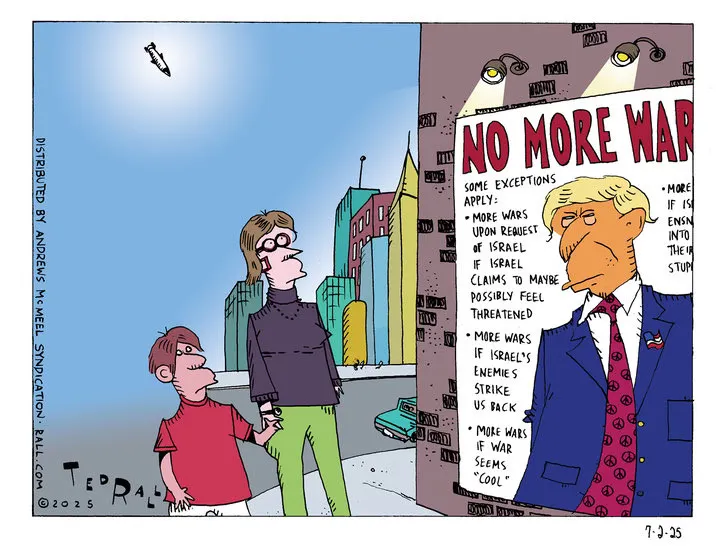
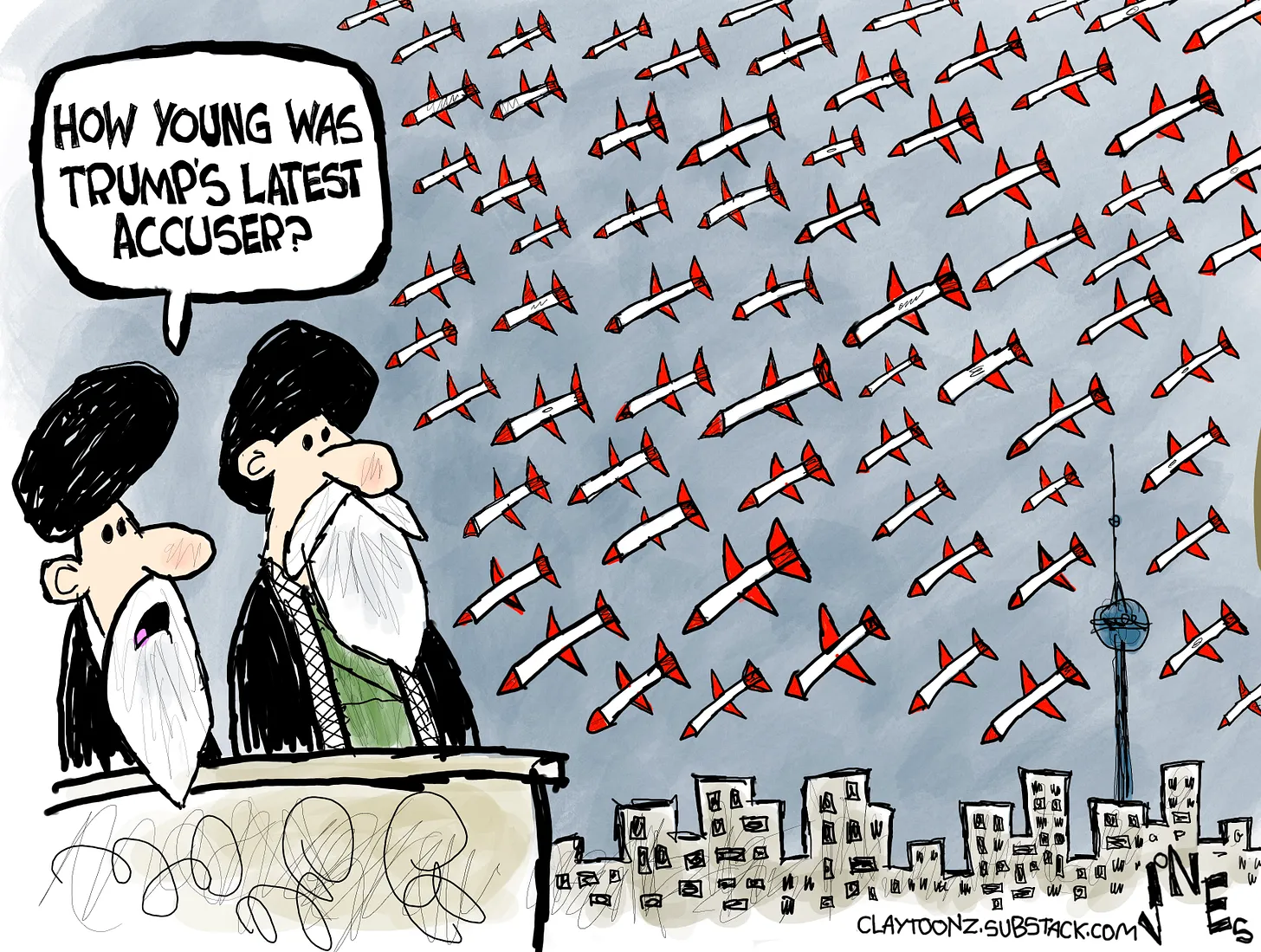
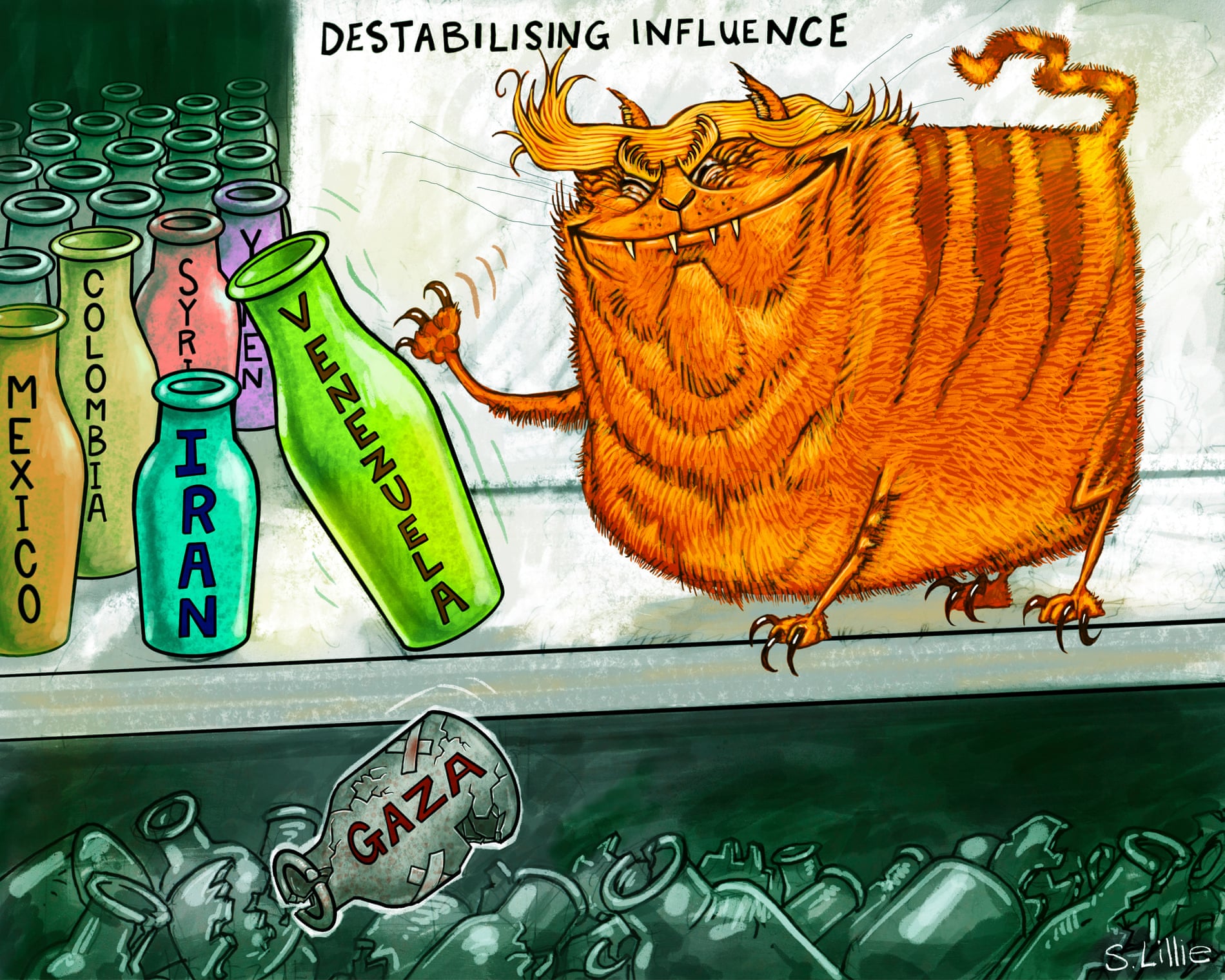
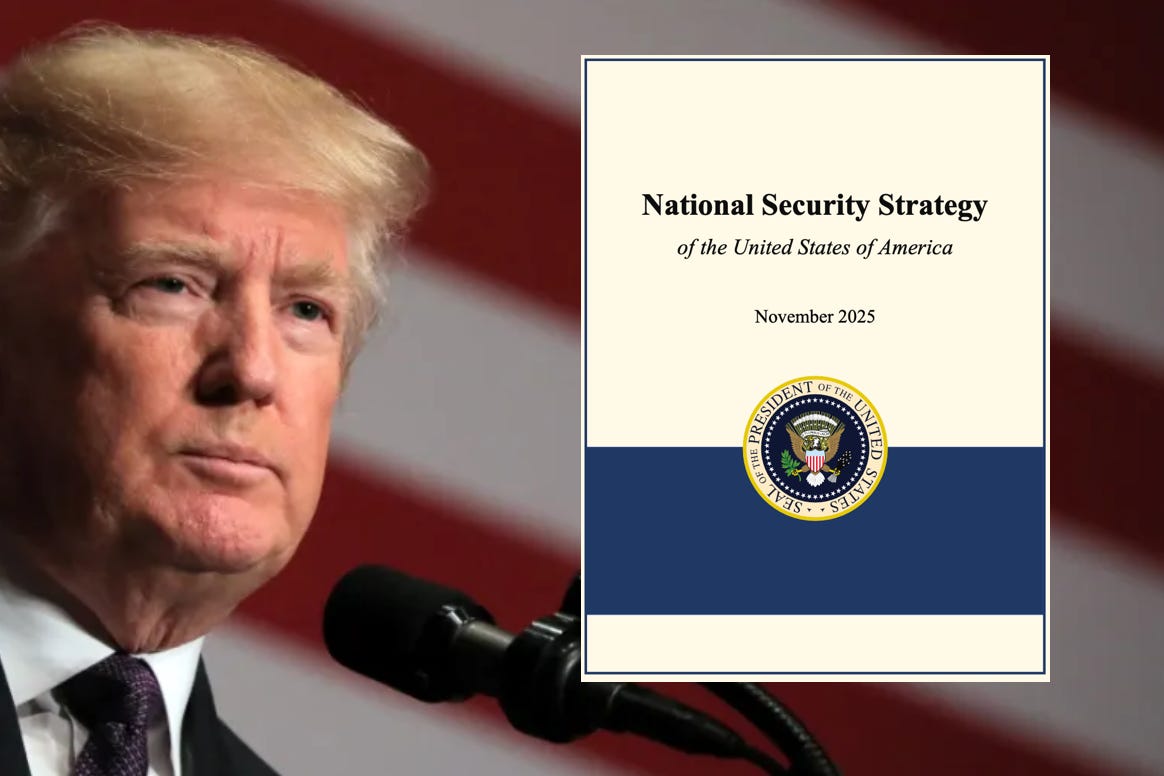
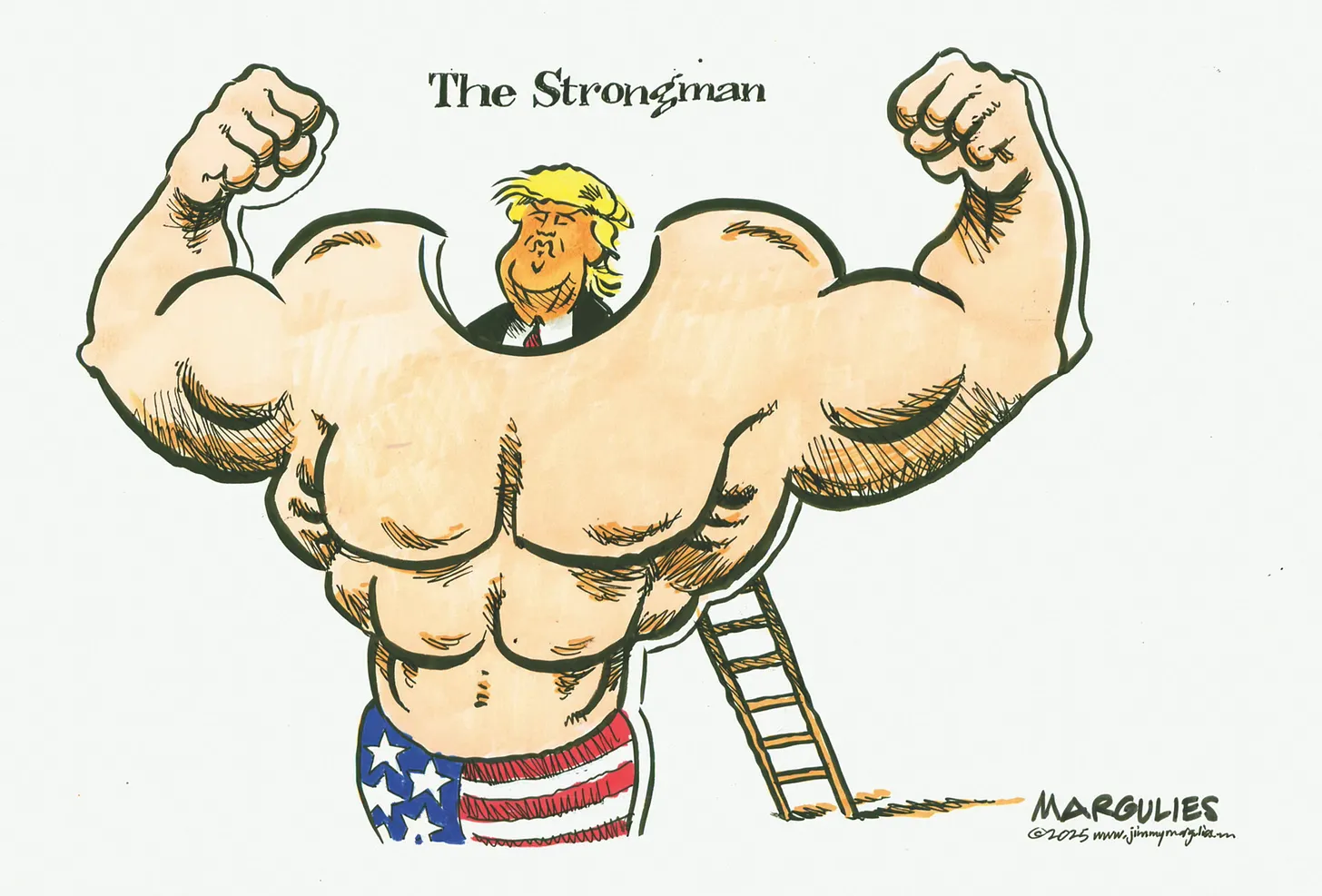
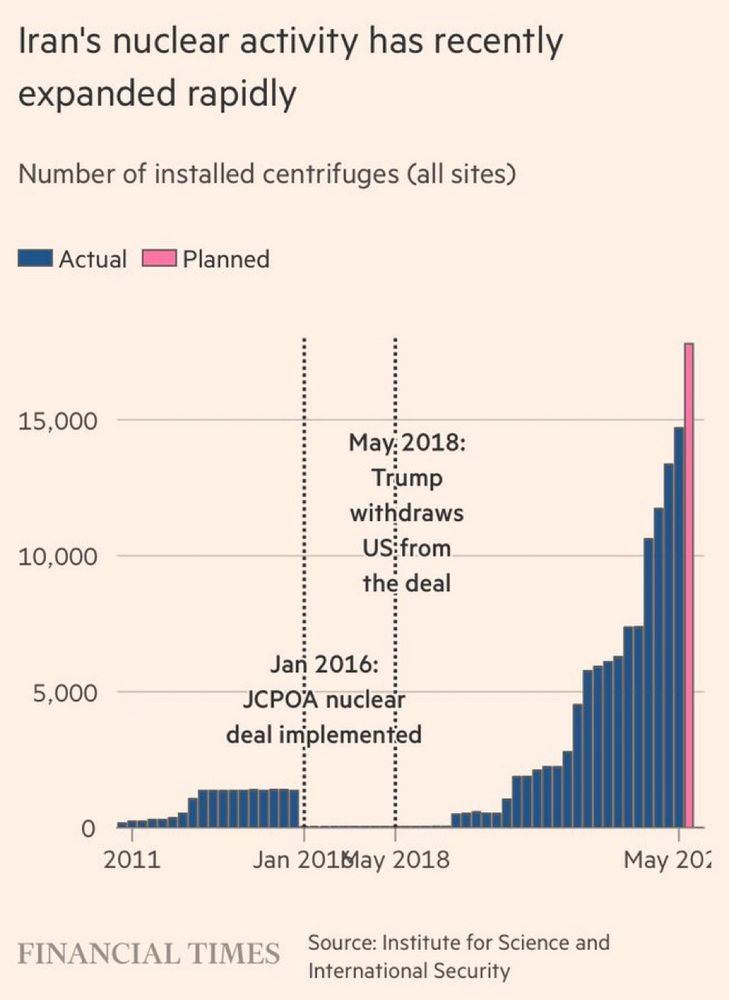
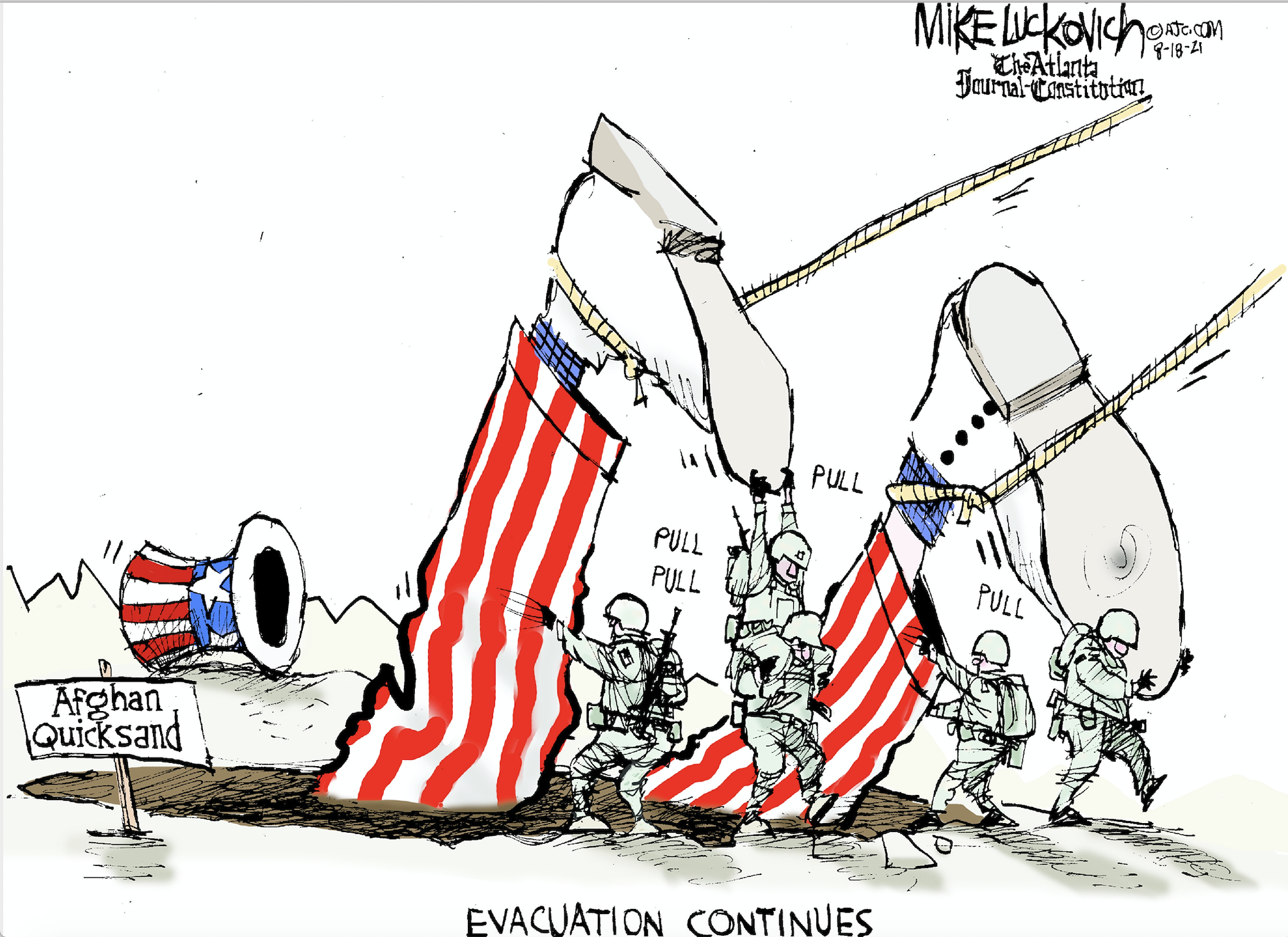

/https://www.thestar.com/content/dam/thestar/opinion/editorial_cartoon/2020/01/07/theo-moudakis-lies-to-date/theo_moudakis_lies_to_date.jpg)

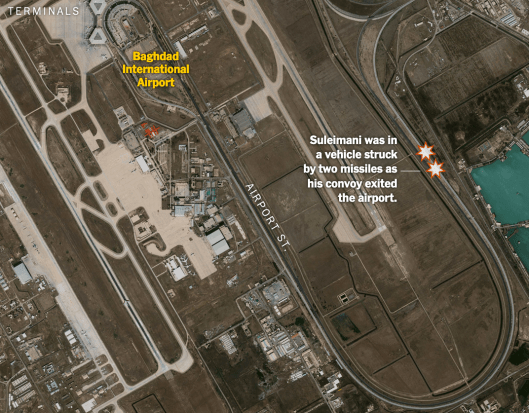

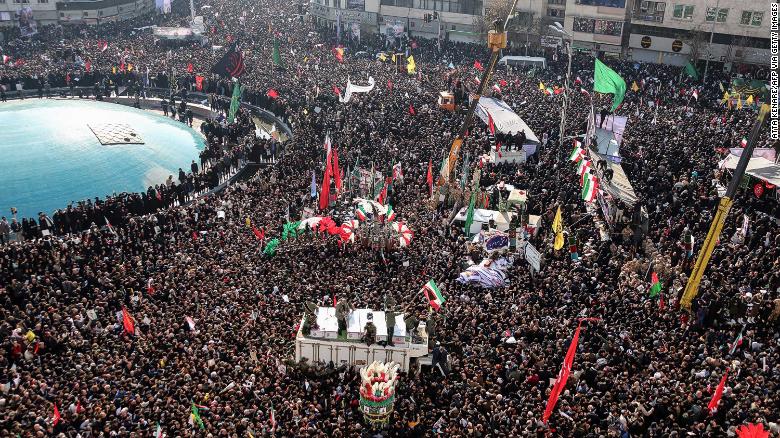


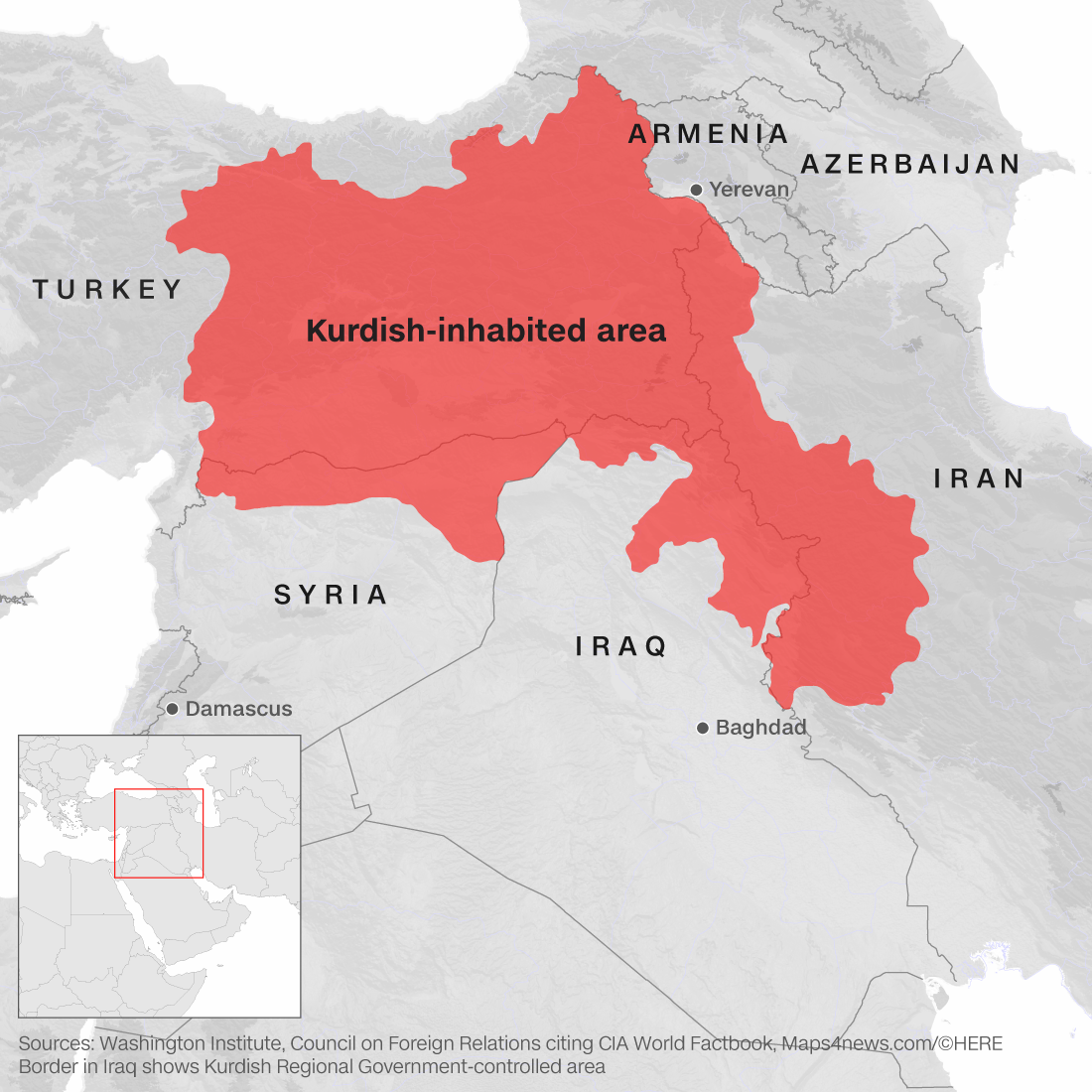
 The Weekly Sift