Tag Archives: Trump administration

The Year of “This Can’t Be Happening”

In the 2015 Yearly Sift, I wrote:

I started 2015 with clear expectations about how I’d cover the campaign. But by Fall, I had to back up and try to answer a more fundamental question than the ones I ‘d been addressing: WTF? … I think I’ll be working on that question for a considerable chunk of the year to come.

That was the best prediction I made all year. For me, the continuing mystery of 2016 was why anyone was voting for Donald Trump. I believed about him then more or less what I believe about him now: He has no qualifications to be president, and no insights about America that deserve a serious person’s attention. Truth means nothing to him. His life demonstrates no interest in anyone but himself and no discernible moral code. He brings out the worst in his followers, encouraging them to be more selfish, more hateful, and less thoughtful.

So why do so many people want him to be our president?

My first post of the new year flashed back to a post I wrote about the Tea Party in 2011: Working-class voters’ rage is like the famous wrong-way touchdown Jim Marshall scored in 1965. They have a right to be angry and to want to “take our country back”, but they’re trying to take it back from the wrong people. It’s not government and bureaucrats who have been stealing their opportunities, it’s corporations and billionaires. The Tea Party’s success had in fact given power to congressional Republicans who were doing their best to empower those oppressors and keep working people down. In short: They’re running the wrong way.

The only time working people have actually succeeded in taking the country back and bettering their lot was when they got behind a liberal: FDR.

You know who is offering a program to take our country back? Bernie Sanders. Like FDR, he wants to create jobs by rebuilding America’s infrastructure, investing money in things that produce economic growth, like roads and rail lines and airports and the electrical grid — not a wall across the middle of the desert. He has offered the only realistic plan to replace ObamaCare without cutting off millions of people’s health insurance. He’s behind a higher minimum wage. He wants everybody to be able to afford a college education. He advocates breaking up the big banks, so that they never again have the economy over a barrel like they did in 2008. He has proposed a constitutional amendment that gives Congress back the power the Supreme Court took away with the Citizens United decision: the power to keep billionaires from buying our political system.

Those plans would make a real difference in the lives of working people. But there is a downside, if you want to call it that: Rich people and corporations would have to pay more tax, and Wall Street would have to pay a tax that would discourage financial manipulations by introducing some friction into their transactions.

I didn’t really expect Trump voters to switch to Bernie, but I thought the case needed to be made.

As for what they were doing with Trump, my explanation (in February) was that Trump was an “opportunistic infection” Republicans had left themselves open to.

All the weapons another candidate might use to take Trump down have been systematically dismantled. Are his “facts” wrong? Mitt Romney already burned that bridge in 2012. Do experts say his proposals are nonsense? There are no experts any more; if you feel a need for expert support, go invent your own experts like the Koch brothers and right-wing Christians do. Are his speeches full of racist dog-whistles? Politically correct nonsense! Racism ended in the 60s, except reverse-racism against whites. And if Republicans had to expel anybody who dog-whistled about Obama, they’d have no party left. Are there echoes of fascism in his giant rallies and cult of personality? In his celebration of real and imaginary violence against hecklers? In his fear-mongering about unpopular ethnic or religious groups? In his implication that specific policies are unnecessary, because all will follow from installing a Leader with sufficient Will? More nonsense: There is no fascism any more, unless you mean liberal fascism or Islamofascism.

With all the legitimate arguments of political discourse unavailable, other candidates were left to fight each other and wait for Trump to go away. And when Marco Rubio recently decided he finally had to take Trump on, the only weapon at hand was to tease him like a third-grader, suggesting that he wet his pants during a debate.

But by early March, I thought I knew what the right anti-Trump argument was: He’s a con man. Tear down his image as a master businessman and replace it with the more accurate view that he’s a predatory parasite. The Trump supporters hadn’t been horrified by his attacks on Mexicans or Muslims or the disabled or Megan Kelly, because they didn’t identify with any of those people. But the victims of Trump U and Trump Tampa and all the other Trump business scams do look like them.

Up until now, arguing with Trump supporters has been like telling your 17-year-old daughter that her 29-year-old boyfriend is no good for her: It’s obvious to you, but everything you say just reinforces the me-and-him-against-the-world mystique that has been driving the relationship from the beginning.

… You know what finally gets through to the 17-year-old? Meeting her boyfriend’s previous three teen-age girlfriends, the ones he dumped when they got pregnant. They look just like her — or at least they used to, before the single-mom lifestyle started to drag them down. Realizing that he told them all the things he’s telling her … that starts to mean something.

And that’s the message that’s emerging: Not that Trump is crude (which he is) or racist (which he is) or a proto-fascist (which he is) or unprepared for the presidency (which he is) or any of that. But he’s a con-man, and he hasn’t been conning Mexicans or Muslims or Megyn Kelly (who is too smart to fall for his bullshit). No, his career is all about conning the kind of people who support him now.

By September, he had been nominated, and his core supporters seemed impervious to any argument, including the con-man one. So I assembled a bunch of articles about who they were and what they might be thinking (especially Arlie Russell Hochschild’s account of their “deep story”) in “Trump voters: Where they’re coming from, where they’re going“.

Trump capitalizes on that white hopelessness by offering scapegoats: Immigrants and foreigners and the other line-cutters have taken all the opportunities, and that’s why you (and your children) don’t have any. Liberals have our own story to tell here, and we need to tell it loudly, putting aside our fear of offending rich donors: You have so few opportunities because wealth has gotten over-concentrated at the top. America has had decent (if unspectacular) economic growth for seven years now, but it all flows up the pyramid, not down to people who get paid by the hour.

Ultimately, though, no matter how hard I tried to understand them, I just couldn’t respect anyone so misguided and misinformed as to want to turn the country over to an ignorant huckster like Trump. That frustration boiled over in my election-eve post “I don’t know why we’re having this conversation“.

When did avoiding political correctness become a blanket excuse for being an asshole?

When Trump waves his arms around to make fun of a disabled man, when he suggests that Natasha Stoynoff isn’t attractive enough to assault, when he critiques Hillary Clinton’s butt in front of thousands of cheering fans, when he says that an Indiana-born Hispanic judge can’t be fair to him because “he’s a Mexican“, when he taunts a bereaved mother of a decorated Muslim-American soldier — that’s not “politically incorrect”. He’s just an asshole.

One my many failures of foresight this year was that I did not at all foresee Trump winning. The week after the election, I was in the Midwestern town where I grew up, asking “How did my home town become Trumpland?

All those people who stayed here without a family business to inherit, how did the town look to them? The promising kids who move away and never come back. The good jobs going to foreigners and to corporate climbers who are spending a few years in the sticks in hopes of returning to headquarters at a higher level. The acres of mansions that you can’t figure out who lives in them. How do they feel about all that?

The word that popped into my mind was colonized. Like this wasn’t their town any more.

But as much as I might (at times) empathize or sympathize with those Trump voters who don’t fit into one of the deplorable categories (racist, sexist, homophobe, xenophobe, Islamophobe), I’m left with the belief that they’ve done something stupid for both the country and themselves. Because whether my con-man argument convinced any of them or not, it’s true. The people who voted for him are the marks, and when his presidency starts to have real effects on the country, even they will see it. As I wrote last week in “How will they change their minds?

Working class whites are going to see their safety net shredded and power further consolidate among the wealthy, with no turnaround in the collapse of the kind of good-paying manufacturing and mining jobs people could count on a generation ago. They will lose health insurance, their public schools will decline, their children will have a harder time paying for college, and many will be victims of preventable environmental or public-health disasters. … Eventually people catch on, even if they don’t begin each day with The New York Times and end it with PBS Newshour. You don’t have to believe the “liberal media” when the news is happening to you and the people you love.

… Trumpism will fail as a political movement because the people who voted for Trump will look at their own undeniable experiences and change their minds. It’s something they will do for themselves, not something we can do to them or for them.

That’s a story I intend to keep following in 2017: What effects are Trump’s actions having on the people who voted for him, and are any of them starting to notice?

How will they change their minds?

Trump voters made an enormous mistake, for their country and even for themselves. We can’t force them to see it, but maybe we can make it easier for them figure it out on their own.


In the summer of 2003, the Iraq War was popular. Sure, somewhere between a third and half of the public had been strongly against the invasion before it happened. But then it all seemed to go so well. Iraqi armies melted away in front of our brave troops. Our technology seemed invincible, and before long we were helping the liberated Baghdad residents pull down Saddam’s statue. All those pessimists who had predicted a quagmire and thousands of dead American soldiers had been proved wrong.

On May 1, President Bush had heroically landed a plane on the USS Abraham Lincoln and announced victory under a “Mission Accomplished” banner. “In the battle of Iraq,” he proclaimed, “the United States and our allies have prevailed.” There was still some minor mopping up to do — we still hadn’t captured Saddam or found his WMDs — but our forces had the run of the country, so that was bound to happen any day now.

A few people knew better. In early July I talked to my best friend from high school, a career Marine who was home already from participating in the invasion. “The real war is just starting now,” he told me. But that was a lonely point of view. Bush’s supporters were already styling him as one of the great presidents — maybe not quite in the Washington/Lincoln neighborhood, but certainly in the next tier. It was a shame there was no more space on Mount Rushmore.

Sometime around then — I can’t tell you when because I hadn’t started blogging yet and haven’t been able to google up a newspaper account of it — Michael Moore gave a talk in Manchester. At the time I knew Moore only by reputation, so I was expecting to hear some angry rabble-rousing. Instead, he spoke in a compassionate tone that has stuck with me ever since.

The country had made a huge mistake, he told us. (I’m paraphrasing because I took no notes.) And sooner or later events would make that obvious. The way forward was for large numbers of Americans to recognize that mistake and change their minds about the war. How would that happen? Changing your mind about something you felt strongly about was a gut-wrenching process, and we needed to make it as easy as possible for them, so that it could happen sooner rather than later.

More or less, things played out the way he envisioned: By April, 2004, the First Battle of Fallujah made it undeniable that the war was not over, and the Abu Ghraib revelations removed the invasion’s aura of moral crusade. From then on, support for the war waned. Dick Cheney’s claims that the insurgency was in its last throes, or Thomas Friedman’s repeated predictions that everything would be fine in another six months (which became known as a “Friedman unit“), became increasingly unbelievable. The Democrats retook Congress in 2006, and a Democrat who had opposed the invasion got the nomination in 2008 and beat a more hawkish Republican in a landslide. Some public figures who supported the war early on (Hillary Clinton and John Kerry come to mind) admitted they were wrong, but lots more people (Donald Trump, for example) just rewrote history so that they had always been against the war.

At no point in that national mind-changing process was there some stunning new argument that turned everybody around. Anti-war Democrats didn’t come up with great new slogans or ads in 2006 or 2008. Demonstrations didn’t change minds in the numbers needed. Books and movies didn’t do it. Events had to do it.

I think we’re in a similar situation now: Electing Donald Trump was a huge mistake. It’s not just a mistake for the country as a whole, it’s a mistake for most of the people who did it: Working class whites are going to see their safety net shredded and power further consolidate among the wealthy, with no turnaround in the collapse of the kind of good-paying manufacturing and mining jobs people could count on a generation ago. They will lose health insurance, their public schools will decline, their children will have a harder time paying for college, and many will be victims of preventable environmental or public-health disasters.

The limits of propaganda. Many of them have, up until now, been entirely taken in by Trump’s bluster and a regular diet of propaganda from Fox News, Breitbart, Alex Jones, and right-wing talk radio. They believe a lot of things that aren’t true, and are ignorant of many facts they ought to know. But propaganda can only go so far. You can’t, for example, convince a minimum-wage worker that he has a good job, or that we have the greatest healthcare system in the world when he faces a choice between bankruptcy and watching his wife die.

Reality is persistent, and propaganda that explains it away has to keep changing. Eventually people catch on, even if they don’t begin each day with The New York Times and end it with PBS Newshour. You don’t have to believe the “liberal media” when the news is happening to you and the people you love.

Moore’s speech impressed me for a couple of reasons. First, he really believed in his view of reality, so he didn’t have to be shrill about it. He didn’t need to wish misfortune on the people who disagreed with him, because misfortune was coming whether anybody wished for it or not. He was so certain that he could already feel compassion for misfortune’s victims. And second, in spite of recent events to the contrary, he retained his faith in the basic sense of the American people. They/we could be fooled for a while, but not forever.

That’s the point of view we need now. If President Trump really does “make America great again” — bring good jobs back to the middle class, fix our education system, produce opportunities for poor people in the inner cities, fix our healthcare system, avoid any further damage from the “hoax” of climate change, win the war against “radical Islam” — then liberalism is done for a generation. And it should be, because he would have proved us totally wrong.

But how likely is that?

And if he makes all those situations worse, as I think he will, how likely is it that the American people won’t notice? Or that they will support him anyway, just because?

Trumpism will fail as a political movement because the people who voted for Trump will look at their own undeniable experiences and change their minds. It’s something they will do for themselves, not something we can do to them or for them. The best we can do is to help that process along. So how?

We won’t overpower them with vehemence. Trump supporters already know that we don’t like him, that we think he’s a horrible person, and that we think everything he says is a lie. They knew that when they voted for him. Repeating all that in a louder voice is not going to turn them around.

Does that mean we should just shut up? Not at all, but it should influence the way we express ourselves. We need to think of ourselves as Avatars of Reality: persistent, implacable, but not boiling over. In terms of protests, for example, large groups of people holding a vigil are better than small groups having a riot. Publicly supporting somebody — American Muslims, the undocumented, black neighborhoods that feel terrorized by police, the working poor who depend on Medicaid or ObamaCare or Planned Parenthood, communities damaged by de-regulated pollution — is better than just being anti-Trump.

On social media, just trading insults plays into Trump’s hands, because his insults are as good as ours. His model of political discourse is two tribes of people yelling at each other; it doesn’t matter who’s right, just who is on your side. Our model is that reality exists and presents problems the public needs to deal with.

To remain true to our model, we need to keep drawing the discussion back to facts and plans and personal experiences. That doesn’t have to be complicated. (This week I saw somebody on Facebook claim that Trump had more integrity than Clinton, and I responded with a fact: Clinton has never had to pay $25 million to settle a fraud lawsuit.)

Trump, of course, will continue to assert his own facts. But fantasy lacks the stability of reality, so he will have to keep changing his story as events unfold. One by one, here and there, people will catch on.

The low-information voter. Trump himself almost never loses sight of the fact that he is speaking to the low-information voter. It’s rare for an interviewer to draw him deeper into an issue, and it never goes well for him. (Chris Matthews got him talking specifics about abortion, and his staff was walking that back for the next week.) That’s why Twitter is his primary form of public communication: It’s all about reaction, not explanation.

Feeling superior about that is too easy. I believe Trump won by beating Clinton decisively among low-information voters. (That’s hard to prove, because low-info voters aren’t as easily identifiable as racial or economic subgroups. You can use education as a proxy, but that involves some biased assumptions.) So people who only pay attention now and then are precisely the ones we need to turn around.

That was also true about Iraq. If your whole experience of the Iraq War was watching on TV as smart bombs went down smokestacks and joyful Iraqis pulled down Saddam’s statue, then nobody could convince you the invasion had been a bad idea. Eventually, though, even the most poorly informed voter started to wonder: “Why are we still losing soldiers if the war was over months ago?” and “If we’re winning, why do we have to take Fallujah again?” Thoughts like that didn’t have to be deep or complicated.

Two things to remember about low-info voters:

  • They respond to stories and experiences more than statistics. It’s important to keep bringing policy questions back to the people who are getting helped or hurt. It’s best if you can lay out a scenario where a policy will hurt the listener himself. Next best is to explain how you’re being affected. Next best is to relate things you’ve seen yourself rather than learned through the media. (So don’t just read about stuff, go places where you will see things, and then testify to what you’ve seen.)
  • They care about results more than processes. This is particularly maddening right now, when all the effects of Trump’s policies are still theoretical, but the process violations are everywhere. But while the high-info voter looks at a hole in the fence and immediately imagines the wolves getting in or the sheep getting out, the low-info voter doesn’t.

Amplifying that second point a little: People who watch politics closely are horrified that Trump hasn’t released his tax returns or put his assets into a blind trust. All other recent presidents have done that, so the sense of violation is immediate. But to a low-info voter, those sound like technicalities. So you always need to make the connection to results: His businesses are wide-open doors for pay-offs, and we know so little about his finances at the beginning of his term that at the end we won’t even know whether he has robbed us blind. Reagan said, “Trust, but verify.” We aren’t in a position to verify anything about Trump.

The importance of popularity. The darkest imagining of liberals right now is that Trump’s election heralds a descent towards fascism or some related form of non-democratic government. Trump has roused such nativist/racist passions and shows so little respect for the norms of democracy that the question “What wouldn’t he do if he could get away with it?” seems to have no answer.

Other Republican behavior — the unprecedented obstruction of President Obama, up to the point of ignoring his Supreme Court nominee; the moves to suppress minority voting in states where Republicans have power; and most recently the post-election rule-changing in North Carolina — point to a party that has lost all principles and stands only for its own power.

All that raises the questions: What if there are no more meaningful elections? Why would changing people’s minds even matter?

That fascist scenario requires President Trump to take audacious extra-constitutional action which Republicans in Congress, in the military, in the courts, and elsewhere in government either actively support or passively go along with. But Republicans at the moment are not unified behind Trump. They could become unified, if he becomes the kind of overwhelmingly popular president that it would be political suicide to oppose. But that’s not where they are now.

Trump begins his term having received only 46% of the vote, and with an unprecedented unfavorability rating, even after a post-election bump. This is before the fog around his policies resolves, as it must, into a budget proposal and a plan for healthcare.

In the next year or two, his popularity is key to avoiding the most negative scenarios. If he remains as unpopular as he is today, or gets more unpopular, then the darkest scenarios will never manifest.

No facts? What does that mean?

Since Wednesday, you have undoubtedly seen several headlines about some Trump surrogate denying the existence of facts. It’s from Scottie Nell Hughes talking to NPR host Diane Rehm, and the money quote is: “There’s no such thing, unfortunately, anymore, as facts,” Sometimes condensed to “There are no facts”, that quote exploded across the internet in the same way that many fake news headlines do. But it had the added virtue of being true (to the extent that there is such a thing as truth any more).

But what does it mean?

If you make Hughes’ sentence stand alone, the most obvious interpretation is some kind of New Age you-make-your-own-reality philosophy. But I’m pretty sure that isn’t what she meant. For example, there are 2.6 million more Hillary voters than Trump voters, but even if we all get together on January 20 and visualize really hard, we won’t be transported to a world where President Clinton is being sworn in. Reality just isn’t that flexible, and I don’t believe Hughes was claiming otherwise.

So what was she saying? Let’s expand the context a little.

One thing that has been interesting this entire campaign season to watch is that people that say “facts are facts”, they’re not really facts. Everybody has a way, it’s kind of like looking at ratings or looking at a glass of half-full water. Everybody has a way of interpreting them to be the truth or not true. There’s no such thing, unfortunately, anymore, as facts. And so Mr. Trump’s tweets, amongst a certain crowd, a large part of the population, are truth. When he says that millions of people illegally voted, he has some facts—amongst him and his supporters, and people believe they have facts to back that up. Those that do not like Mr. Trump, they say that those are lies, and there are no facts to back it up.

I’m hearing a less metaphysical claim, which I’ll restate like this: You can’t win a political argument any more by claiming to have the facts on your side, because the other side can generate its own apparent “facts”, and the public as a whole doesn’t trust anyone to decide between the two sets of “facts”. So in the end, all that matters politically is who you like: If you like Trump, you’ll believe his “facts” and if you don’t, you’ll believe the “facts” that contradict him. Worse, no one can set himself up as a neutral fact-checker, because as soon as he decides the case one way or the other, his presumption of neutrality goes away: All the public will hear is that he likes Trump or he doesn’t.

So when The Atlantic‘s James Fallows (who was on the same episode of NPR’s The Diane Rehm Show as Hughes) listed a series of Trump lies, Hughes responded that the sources Fallows was relying on were all biased against Trump. Fallows immediately zeroed in on a Trump claim that the NFL had written to him about something, to which the NFL had responded by denying writing any letter to him at all. “The NFL?” Fallows challenged. “The NFL is biased?” And Hughes responded: “That’s the question you have to ask right now.”

So that’s Hughes’ not-quite-a-syllogism: What Trump asserts is true. People biased against Trump will say otherwise. Therefore anyone who says otherwise is biased against Trump. (Compare Woody Allen’s reasoning in Love and Death: “A. Socrates is a man. B. All men are mortal. C. All men are Socrates.”)

The interesting thing, if you listen to the rest of the episode, is that the other guests — Fallows, Glenn Thrush from Politico, and Margaret Sullivan from The Washington Post — are pretty much saying the same thing in terms less quotable than “There’s no such thing as facts.” Fallows begins the show by describing the old state of affairs as

a sort of built in constraint of most public figures, that they would at least try to tell the truth most of the time and they would recognize it as a significant penalty if they’re shown not telling the truth.

And then pointing out how this has changed:

This does not apply in the same way to Donald Trump and therefore, we sort of need to recalibrate our gears to say, how do we treat assertions where the speaker himself doesn’t seem to care whether they can be proven false five minutes later, just goes on and doesn’t show any affect from that.

One perverse result of this is that Trump has gotten a reputation among his fans as “telling it like it is”. In other words, we are used to politicians spinning; they speak in elaborately constructed sentences so that they can give a misleading impression without saying anything provably false. But Trump doesn’t spin. He speaks in very direct sentences because he just doesn’t care whether he’s saying something provably false. If he wants to give you the impression that millions of people voted illegally (when they really didn’t), he’ll just say that.

I won the popular vote if you deduct the millions of people who voted illegally.

In the same way that “Hypocrisy is the homage vice pays to virtue“, spinning is the homage liars pay to truth. Bill Clinton’s famous “It depends on what the meaning of the word ‘is’ is” was his attempt to recognize established facts, but still carve out some tiny sliver of interpretation in which he hadn’t been lying when he claimed nothing was going on with Monica Lewinsky.

It sounded weaselly. How much bolder and telling-it-like-it-is Clinton would have sounded if he had just kept saying “I did not have sexual relations with that woman.” He could have claimed that the lab that analyzed Lewinsky’s semen-stained dress was biased against him, and DNA testing is junk science anyway. Surely some “experts” could have been manufactured to go on TV and make that argument.

He didn’t do that, because sounding weaselly was a “significant penalty” Clinton was willing to pay in order to live in a world of facts. But Trump has declared his independence from the world of facts, so he never has to sound weaselly. If more than a dozen women accuse him of groping and other sexual assaults similar to his bragging claims, they’re liars and he’s going to sue them. (He hasn’t sued any of them, and he won’t.) If Trump University students claim he defrauded them and the instructor’s manual backs them up, he looks forward to refuting their baseless case in court. (He settled right after the election, paying the students $25 million.)

No spin. Just bold, direct statements that aren’t true. He hasn’t paid a political penalty for those false statements, because his supporters have neither the inclination nor the attention span to check up on him, and they don’t trust anybody who does.

If that’s not disturbing enough for you, there’s a way things could turn worse from here. An Elliott Lusztig tweetstorm explained how:

Hannah Arendt in her book The Origin of Totalitarianism provides a helpful guide for interpreting the language of fascists. She noted how decent liberals of 1930s Germany would “fact check” the Nazis’ bizarre claims about Jews like they were meant to be factual. What they failed to understand, Arendt suggests, is that the Nazi Jew hating was not a statement of fact but a declaration of intent.

So when someone would blame the Jews for Germany’s defeat in [World War I], naive people would counter by saying there’s no evidence of that. What the Nazis were doing was not describing what was true, but what would have to be true to justify what they planned to do next.

Did 3 million “illegals” cast votes in this election? Clearly not. But fact checking is just a way of playing along with their game. What Trump is saying is not that 3m illegals voted. What he’s saying is: I’m going to steal the voting rights of millions of Americans.

It’s not hard to see how this might apply to other Trump lies. For example, his claim that the murder rate is the “highest it’s been in 45 years“, when in fact it’s close to a low for that period. Combine that with his characterization of Mexican immigrants as rapists and “Islam hates us“, and and you get a justification for a harsh police crackdown on those communities.

What Lusztig is pointing out here is how this kind of widespread lying can turn partisanship into horror: People accept claims as factual for partisan reasons, and then later can be moved to draw consequences from those false claims. Those consequences might include horrible actions that those same people would have rejected had they been proposed directly.

It’s hard to see what to do about this, but it has to start with identifying the advantages reality has over falsehood. Obviously, reality also has many disadvantages, but its advantages include that it is persistent, self-consistent, and infinitely detailed.

Fantastic lies depend on an ability to constantly change the subject, so that the thinness of the fantasy world can’t be compared to the richness of reality. When a topic becomes so important that it stays in the public mind for long periods of time — the Iraq War is a good example — it becomes harder to lie about. The closer a topic impinges on the everyday experiences of large numbers of people, the harder it is to lie about. And finally, anything a person cares deeply about can become a conduit to reality. For example, many otherwise conservative churches have made a project out of helping refugees resettle in America. Their commitment to those projects makes it harder to sell them horror stories about the refugee threat.

This is another example of a larger theme: The Trump administration is going to force us to think seriously about things we used to take for granted. (That’s why I wrote about white pride last week.)

For a long time, many of us have taken for granted that facts are facts, truth ultimately wins out, and lies eventually rebound against the liars. Those principles may still hold, but they’re not in the “of course” category any more. We’re going to have to study more closely exactly what strategic advantages reality offers, and figure out tactics that bring those advantages into play.

The Trump Administration: What I’m watching for

So far, I haven’t been tempted to protest against President-elect Donald Trump, at least not yet. If I am angry at all right now, it is at the swing-state voters who put him in office, not at him for taking advantage of our ridiculous Electoral College system, which allowed him to win when Hillary Clinton got more votes (about 1.7 million more, at last count). But demonstrating support for immigrants, Muslims, gays, and others who feel threatened by a Trump administration is a different matter.

Mostly for the sake of my own sanity, I have resolved not to react to things Trump hasn’t done yet. So, for example, in this week’s summary post I will comment on the appointments he has made, but not on the people he is rumored to be considering. During the next four years, I expect to see plenty of actions worth objecting to. But this will be a marathon, not a sprint, so I see no reason to jump the gun.

That said, I am also not naively hoping for the best. I am watching the Trump administration closely, and will be quick to object as soon as there are actions worth objecting to. Here is a list of the primary things I’m watching for, starting with the most mundane:

Taking credit for Obama’s accomplishments. President Obama has left his successor a country in much better shape than the one he inherited from President Bush. Republicans in general and Trump in particular have refused to give Obama credit for his accomplishments, or even to recognize good news when it appeared. Now Trump is in a position to acknowledge American success and take credit for it.

So, for example, ISIS has been losing territory for some while now. Mosul, its last stronghold in Iraq, is cut off and likely to fall in the next few months. Its de facto capital of Raqqa is under attack in Syria. If events continue on their current path, sometime in 2017 President Trump will be able to declare victory in the territorial struggle, though ISIS will continue to be a significant underground movement. That victory will be the result of Obama’s strategy, but I expect Trump to crow about how “America is winning again.”

Similarly, expect Republicans to suddenly notice that the number of undocumented immigrants is dropping, gas prices are down, unemployment is low, and that rates of murder and other major crimes are at their lowest levels in decades. Already, Gallup reports that Republicans have drastically changed their opinion about how well the economy is doing: “Just 16% of Republicans said the economy was getting better in the week before the election, while 81% said it was getting worse. Since the election, 49% say it is getting better and 44% worse.”

The beauty of this (from Trump’s point of view) is that no lying is necessary. On the contrary, all he has to do is stop lying about the state of country, and bask in the glow of instant success.

Taking credit for averting dangers that never existed. This has already started. Trump is taking credit for keeping a Kentucky Ford plant from moving to Mexico, when Ford never had a plan to move it. Who knows what he’ll prevent next? War with Belgium, maybe. By May, he will have decisively beaten winter.

In the conspiracy-theory swamps where many Trump supporters live, this will be incredibly easy: All they have to do is celebrate the end of things that never existed to begin with: You know those FEMA detention camps where anti-Obama dissidents were going to be sent? Trump closed them! They’re gone.

I’m reminded of a joke about a political leader answering charges of nepotism. Asked why his mother was on the public payroll, he explained that she oversaw the government’s anti-tiger policy. “But there are no tigers for a thousand miles,” the interviewer objected. “Don’t thank me,” the leader responded. “Thank Mom.”

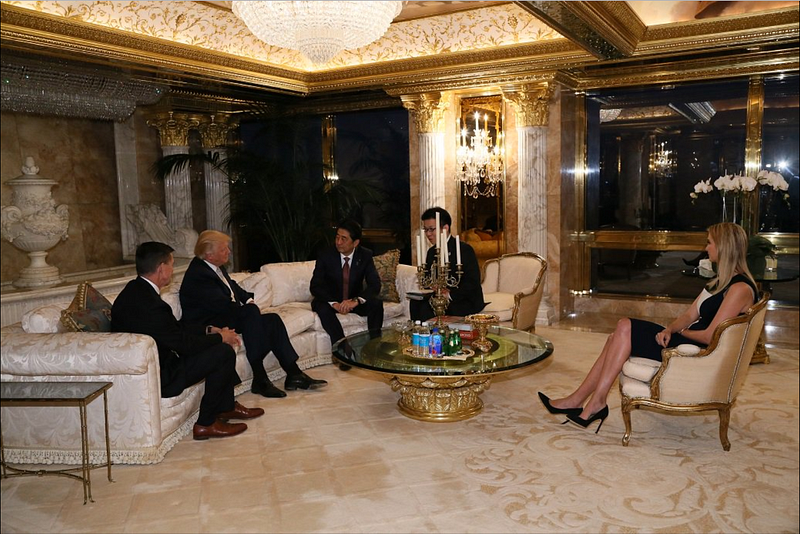
Profiteering. This picture is worth a thousand words:

It’s President-elect Trump’s first meeting with a foreign head of state: Japanese Prime Minister Shinzo Abe. And who is that in the chair on the right? Ivanka Trump, the daughter who is expected to take control of Trump’s business interests.

It’s a staged photo, and the message it sends is unmistakable: There will be no distance between Trump’s government and Trump’s profit-making enterprises. The Trump children have all played significant roles in the transition, so many officials in the new administration will be in their debt. And presumably they will continue to have their father’s ear after the inauguration, even as they negotiate deals in foreign countries.

This week, Trump also met with three businessmen who are building Trump-branded properties in India. Two are sons of a member of India’s Parliament.

What this means is that there is a wide-open door for foreign governments to bribe President Trump: Go to Ivanka (or maybe even directly to Donald) and cut a lucrative deal to build a new Trump Tower in your capital city. Or if you are afraid the President is going to do something you don’t like, threaten to cancel such a deal.

This kind of thinking is toxic:

In interviews with a dozen diplomats … some said spending money at Trump’s hotel is an easy, friendly gesture to the new president.

“Why wouldn’t I stay at his hotel blocks from the White House, so I can tell the new president, ‘I love your new hotel!’ Isn’t it rude to come to his city and say, ‘I am staying at your competitor?’ ” said one Asian diplomat.

So if you’re competing against a Trump business, you’re competing against the Trump administration. It’s one enterprise now.

All this runs afoul of the Emoluments Clause of the Constitution, which conservatives were inclined to interpret strictly when imagining President Hillary Clinton. Unless Trump has some amazing plan he hasn’t announced yet, his violation of the Clause looks likely to be far more blatant than anything Clinton did or was even accused of doing. So we’ll soon see which conservatives have actually been serious about that uphold-the-Constitution rhetoric.

Changing the electorate. All through the campaign, conservative voices like Laura Ingraham have been referring to the Trump campaign as “the last chance, last stand for America as we know it”. The racial dog whistle there is pretty obvious: “America as we know it” is White America, and the electorate becomes a little less white every year.

To a certain extent that process can be slowed down by preventing non-white immigrants from becoming citizens. But that won’t change the demographics, because the non-white population is younger and more inclined towards large families. So if you really want to preserve the United States as a white-majority nation, you have to prevent non-whites from voting.

That has been the Republican strategy for several years now. As soon as the Supreme Court opened the door, states governed by Republicans began changing election rules to make it harder to vote, especially for blacks, Hispanics, poor people, and college students. Fortunately, this year courts struck down the most outrageous attempts to rig the electorate, like North Carolina’s.

The court said that in crafting the law, the Republican-controlled general assembly requested and received data on voters’ use of various voting practices by race. It found that African American voters in North Carolina are more likely to vote early, use same-day voter registration and straight-ticket voting. They were also disproportionately less likely to have an ID, more likely to cast a provisional ballot and take advantage of pre-registration.

Then, the court, said, lawmakers restricted all of these voting options, and further narrowed the list of acceptable voter IDs. “… [W]ith race data in hand, the legislature amended the bill to exclude many of the alternative photo IDs used by African Americans. As amended, the bill retained only the kinds of IDs that white North Carolinians were more likely to possess.”

Unfortunately, the federal Justice Department plays a big role in bringing such cases to court, and under Attorney General Sessions it’s likely to get out of that business. (Sessions’ home state of Alabama has been one of the worst offenders, and he has not raised a word of protest.) Then there’s the question of how President Trump’s appointees will stack the courts.

Winking at right-wing paramilitary groups. To be honest, I’ll be relieved if we make it through the next four years with nothing worse than financial chicanery. Much darker stuff is possible.

When we think of fascist governments, we usually picture the police doing things like destroying the printing presses of critical newspapers and dragging their editors off to jail. But that kind of thing only happens at a much later stage. Early on, fascist violence is unofficial: Organized thugs destroy the printing press and send the editor to a hospital, not a jail. Police are not involved, but they show no interest in catching the people who are.

Right-wing violence in America was already a problem before Trump: There are groups that support firebombing abortion clinics and murdering doctors. Hate crimes against blacks, immigrants, or Muslims are usually portrayed as the work of isolated maniacs, but in fact killers like Dylann Roof and Wade Michael Page have had far stronger relationships with organized hate groups than, say, Omar Mateen had with ISIS. The Bundy gang in Nevada has openly challenged the federal government with armed resistance.

An Oathkeeper "protecting" Ferguson

An Oathkeeper “protecting” Ferguson

During the campaign, Trump frequently praised violence and valorized violent responses from his followers. My question is whether this will continue after inauguration and if violent Trump supporters will organize in a brownshirt fashion. Or perhaps already existing groups — Oathkeepers, for example — will shift into this role. Militia groups that organized to resist imaginary “tyranny” from Obama might welcome the opportunity to support an actual tyranny of their own.

And if this happens, how will Trump react? He could condemn such a development, or he could suggest targets to his paramilitary supporters by labeling people as “traitors” or using some similar language.

Richard Engel drew on his observations of other countries to describe the signs of creeping authoritarianism to Rachel Maddow.

If you start to hear the word “traitor” being used a lot about the opposition, that’s a red flag. If those criticisms escalate to “cancer”, that’s an even worse sign. So I think we should be listening for things like that. After that, the next stage would be mass rallies by his supporters that look potentially intimidating. And after that, to see if there’s any kind of call for a referendum to go right to the people to get around the constitutional system.

Subverting government agencies for political advantage. If Trump does intend to push America in an authoritarian direction, institutional forces within the government might resist — or not.

I don’t expect Trump to carry through on his promise to appoint a special prosecutor to go after the Clintons. The whole point of the accusations against Hillary was to defeat her politically and neutralize the Clintons as a political force — not to pursue justice or enforce the law. That political mission has been accomplished now, and attempting to prosecute her would only demonstrate how baseless the charges were.

But the mere fact that he would suggest such a thing is gravely troubling. In America, prosecutions bubble up from investigators, they don’t come down from the President. He has also threatened antitrust action against Amazon because its founder (Jeff Bezos) also owns The Washington Post, which Trump found too critical.

FBI Director Comey’s highly unusual commentary on the Clinton email server problem — ordinarily, an investigation that didn’t produce prosecutions would not be revealed to the public, and certainly not late in an election campaign — as well as the leaks from inside the FBI about some nebulous Clinton Foundation investigation, suggests that there has been considerable political corruption of the FBI already.

The FBI, CIA, NSA, SEC, IRS, and other agencies all have considerable power to make Trump’s critics miserable, as well as to provide valuable information to his business interests. Will they be asked to do so, and will they give in?

Paying Putin back. Trump and Vladimir Putin both know that Trump could not have won without Putin’s help. The Russian hack of DNC and Clinton campaign emails was a major factor in the campaign. We have since found out that the Trump campaign was in regular contact with Russian officials. This should come as no surprise, since former Trump campaign manager Paul Manafort had previously received millions of dollars from pro-Russian organizations in Ukraine.

Two questions immediately come to mind: Will the Russian government continue committing crimes for Trump’s benefit? And what do they want in return?

Obvious ways to pay Putin back include: supporting the Russian-allied Assad regime in Syria, turning a blind eye to further encroachments in Ukraine, or letting Putin dominate our NATO allies in Estonia, Latvia, and Lithuania.


Did I miss anything important? What else should we be on the lookout for?