Republicans have left an opening. Can Democrats like James Talarico take advantage?
Ever since Jerry Falwell launched the Moral Majority and got credit for electing Ronald Reagan in 1980, conservative Republicans have seemed to own Christianity.
Not really, of course. There was always a Christian Left, going back to Dorothy Day in the 1930s, and even further back to St. Francis or even that ultimate bleeding heart, Jesus. Both the civil rights movement and the anti-Vietnam War movement had strong liberal religious components.
But from the 1980s on, in the media and the public mind, Christianity in politics somehow came to mean conservative politics. “Moral” issues were defined as the issues religious conservatives cared about: abortion, gay rights, and so on. When Supreme Court decisions purport to defend “conscience”, or people’s right to act on their “sincerely held religious beliefs”, you can bet that those beliefs are conservative. Only rarely have treating women like people, fighting oligarchy, refusing to racially discriminate, opposing cruelty towards immigrants, preserving the environment, or allowing LGBTQ people to lead full lives been framed as “moral” issues.
Texas has gone as far as to legally prohibit its [mortality review] committee from reviewing deaths that are considered abortion-related. This could include some miscarriage care, health officials told ProPublica.
In times past, the choice between Democrat and Republican wasn’t always so clear, and Christians tended to split down the middle. A shared worldview across the aisle led to more options in the voting booth. As things stand now, no such options remain. The Democratic Party has so situated itself against the God of heaven and against His Word that no Christian can justly, nor obediently cast a vote for anyone who claims the Democratic platform. … For these reasons, Christians cannot vote for any member of the Democratic party while also saying “I believe and follow the teachings of King Jesus.” From Vice President Harris all the way down to local City Councils and school boards.
The “reasons” given are abortion [1], LGBTQI+ rights, and DEI (which doesn’t even rate an explanation).
Democrats, for the most part, have dodged this challenge. Conservative Catholics like J. D. Vance can claim to know better than the Pope, but liberal Catholics like Joe Biden or John Kerry have had to strike nuanced positions (like disapproving personally of abortion while defending a public right to choose it) while trying to change the subject. Barack Obama’s liberal Christian religion was seen as a political problem, not a strength.
Enter Trump. During the Trump era, Republicans have leaned even more heavily on the conservative Christian vote while putting their Christian supporters in an ever-more-difficult position. Trump, after all, represents the virtual antithesis of Christianity.
He has been accused of sexually assaulting a minor. And even if that turns out not to be true, he’s been suppressing the Epstein files to hide something.
He lies so constantly that he has worn out the fact-checkers. Anything short of an outrage-producing howler gets ignored now.
When you get down to cases, it’s actually harder to see how a Christian can support Trump rather than a typical Democrat.
Pastors who are committed to Trump politically have twisted themselves into all kinds of contorted positions. Bible verses get re-interpreted to circumvent what they obviously say. The importance of morality and character in public leaders (something we heard a lot about when Bill Clinton was president) is discounted, because “God uses flawed people“. When Republicans have scandals, we hear about God’s mercy and forgiveness — even if the offender denies the sin and refuses to make things right with the victim. But Democratic sin is unforgivable.
This can’t go on forever. At some point, the gulf between Trump and Christ grows so large as to be unbridgeable. And that raises the question: Can Democrats make an explicitly Christian play for the Christian vote?
Talarico. That’s going to be tested in Texas, where Presbyterian seminarian James Talarico won the Democratic senate primary Tuesday. Guthrie Graves-Fitzsimmons comments:
Talarico’s message is not about moderating progressive commitments to win over religious conservatives. It is about courage. It is about saying plainly that support for LGBTQ+ equality, reproductive freedom, public education and church-state separation can flow directly from Christian faith. He’s openly Christian and firmly pluralistic.
That does more than close a messaging gap: Talarico and those like him can change the terrain. When leaders speak about faith with confidence instead of defensiveness, they show that democracy and devotion are not in conflict.
His Republican opponent — whether it will be the incumbent John Cornyn or challenger Ken Paxton (who presents about as many moral issues as Donald Trump) — is bound to double down on the Christians-can’t-vote-for-Democrats message. Texans can expect to hear a lot about Talarico’s support for reproductive freedom and trans rights. We’ll see whether such attack ads can drown out the voice of an authentic liberal Christian whose worldview is rooted in what Jesus actually said rather than the conservative positions that have attached to him like barnacles.
But what about church-and-state? A second question Talarico raises is whether Democrats should compete explicitly for the Christian vote. One popular liberal viewpoint is an interpretation of church-and-state separation that extends to political argument rather than just government: Our government needs to remain secular and not favor any particular religion, so our candidates should campaign in a purely secular way.
I think this view misses an important point: People come to their political positions through their values, and many people’s values are grounded in their religion. If you can’t use religious language, you end up arguing against opinions already set; you can’t get into the mill where those opinions were forged and might be re-forged.
And finally, purely secular politics runs into a widespread American belief: that religious convictions are more serious and solid than secular ones. One reason Democrats are always under more pressure to compromise than Republicans is that the public sees conservative positions as religion-based and therefore immovable. Democratic positions seem more political than principled, because we so rarely seem to “speak from the heart”.
Many, many liberal positions rise out of deeply held moral values that are as serious as any religion, and many of those values are in fact religious. In the privacy of their own minds, many Democrats think in religious terms. If those terms have to be edited out before we speak in public, we will sound inauthentic.
[1] I’ve said it before, but it’s worth repeating that the anti-abortion position is entirely un-Biblical. Nothing in the Bible indicates that fetuses have souls, and Genesis 2:7 shows the soul entering the body not at conception, but with the first breath (which is a common Jewish belief).
Occasionally someone argues that Jesus or the prophets would have denounced abortion had they known about it, but this is nonsense. Surgical abortion may be a recent development, but from the beginning of time women who didn’t want to be pregnant have tried to induce miscarriages. If you see some spiritual difference between mifepristone and pennyroyal, you are more perceptive than I am.
Jesus and the prophets had to know about this practice, but for some reason they didn’t find it worth commenting on.
This lack of Biblical support is not so important for Catholics who oppose abortion, because the institution of the Catholic Church reserves the right to create new doctrine. But Protestant denominations — especially conservative ones — explicitly reject this view: Churches are not supposed to add or subtract from the message of the Bible.
Anti-abortion has been grafted onto the Bible. It wasn’t there originally.
Collections of quotes that paint Kirk as a hate-monger promoting bigotry of all sorts: racism, sexism, Islamophobia, anti-LGBTQ, and so on.
Neither struck me as the whole story, so I challenged myself to form an independent opinion about Kirk. I listened to his wife’s eulogy for him, I watched most of his conversation with Gavin Newsom, I read as much of his book The MAGA Doctrine as Amazon would show me for free, and I looked for anybody else who had a view of him deeper than a partisan knee-jerk.
This is where I’ve gotten to. Unsurprisingly, I wind up mostly on the cynical side.
In Erika Kirk’s speech, I mainly heard standard Christian evangelism not all that different from what Billy Graham was saying half a century ago: Americans are in a spiritual crisis that can only be solved by turning their lives over to Jesus and living according to traditional gender roles that I don’t recall Jesus ever advocating. Kirk’s brand of Christianity was mostly Christian Nationalism, which I (and many others) believe is a perversion of Jesus’ message.
(For those of you without a Christian education, Jesus had a lot to say about feeding the poor, healing the sick, and living your life according to compassion rather than rules. The gospels paint his opponents the Pharisees as the strict rule-followers. A few years ago, I wrote a post about where I think Christianity went wrong. Later I turned it into a sermon at a Unitarian Universalist church. The sermon is a little better, in my opinion.)
Kirk and Newsom talked amicably (to the point that I was getting angry with Newsom for not challenging some very questionable assertions). Here, the evangelism played a very small role: This was two political operators comparing notes. Still, I heard Kirk’s voice and heard him speak for himself; we should all do that before we pass judgment on people.
The MAGA Doctrine is Kirk’s 2020 take on Trumpism, though I’ve seen no sign that he ever revised his the worshipful view it presents. His political worldview, to me, feels based in resentment: Both political parties are presented as uncaring, and Trump is the revenge of the neglected voter. There is a whiff of traditional conservative rhetoric: small government, individual freedom, and so on. But it’s hard to take seriously given that Kirk stuck by Trump even as Trump was expanding government power and concentrating it in an autocratic presidency. As with so many conservatives, Kirk’s idea of “freedom” was freedom for people like himself, not freedom for everybody.
One thing Kirk was very good at — and this is where all those objectionable quotes come from — was trolling people like me. He played the game of making people angry, then painting himself as the victim of that anger. (And ultimately, he did become the victim of someone who felt trolled. “I had enough of his hatred,” the accused shooter texted to a friend.)
Another thing Kirk was good at was getting funding from the very rich. Erika made a point of how little he had when he started his crusade to win young Americans for Christ (and later Trump), but Turning Point has never lacked for funding. Charlie got his first $50K at age 20 from the multimillionaire Dunn family. He soon attracted the attention of billionaire Foster Friess, and he was on his way. The Dunns eventually contributed millions. The Bradley Impact Fund gave TPUSA $8 million in 2023, and millions more came from a fund connected to Home Depot founder Bernie Marcus.
The ValueWalk website recently estimated Kirk’s net worth at $12 million, including a $4.5 million mansion in Scottsdale.
People sometimes wonder why there’s no Charlie Kirk of the Left. Well, money is one big reason: It’s hard to picture an 20-year-old liberal or socialist running into somebody at a conference and walking away with the funding to start a national organization, much less get rich in the process.
The Voice of Reason blog had an even more cynical take on Kirk’s entrepreneurial nature, painting him as a front for older, richer men.
Here is what really happened. In 2012, a 72-year-old Tea Party activist named Bill Montgomery heard Kirk give a talk at a small local event. Montgomery took one look at this kid with ambition in his eyes and told him to skip college and start an organization. Within weeks, Turning Point USA was born. Montgomery wasn’t just a mentor. He was the co-founder, treasurer, and strategist. In plain English: Kirk didn’t invent Turning Point USA. He was recruited into it by an older political operative who saw in him a useful mouthpiece.
Then came the money. Kirk didn’t scrape together pennies from bake sales. He stalked the Republican National Convention in Tampa in 2012 memorizing donor faces. That’s how he buttonholed multimillionaire Foster Friess, pitched him, and walked away with a five-figure check. Add in Bruce Rauner, the future governor of Illinois, and the DeVos family, and suddenly this “teenage entrepreneur” had more capital than most actual start-ups. By 2016, Turning Point’s budget had ballooned from $50,000 to over $5 million. That doesn’t happen because of hustle. That happens because deep-pocketed billionaires decide you are worth buying.
Amanda Marcotte doubts that Erika can keep TPUSA rolling, because so much of Charlie’s following was based on misogyny.
Charlie Kirk was an aspirational figure for his male audience. They wished they could go on campuses and condescend to cute girls, but they knew — they continue to know — that wouldn’t go well for them. They’d get ignored, mocked or worse, have campus security called on them. Charlie Kirk, though, had the charisma, money and organization to tilt the field so that he “won” every encounter — even though the kids that approached him usually had better arguments. He offered a fantasy of male domination. His audience will never accept a woman in this fake “alpha male” role.
Just winning the next set of elections won’t fix the underlying problems.
Zohran Mamdani’s surprise victory in New York City’s mayoral primary, and his probable ascension to the office itself, sent shock waves through the Democratic Party and reopened many longstanding debates. Maybe the word “socialist” isn’t as toxic as many think it is. Maybe the party needs younger, newer faces. Maybe a positive vision is at least as important as standing against Trump. Maybe being Muslim or pro-Palestine does not alienate potential Democratic voters. And so on.
Those are all worthwhile points to discuss, but I worry that they all revolve around a goal — taking power back from Trump and the MAGA congressmen who hold it now — that is necessary but not sufficient to save American democracy. Too easily, we get lost in the search for a new face or a new slogan or even new policies, but lose sight of the deeper problems that allowed Trump to come to power in the first place.
Remember, we beat Trump soundly in 2020. His ego will never let him admit it, but Trump got his butt kicked by Joe Biden, to the tune of more than 7 million votes. Beating Trump is not an unsolvable problem, and we don’t have to convert the MAGA cultists to do it. All we have to do is win back the voters who already voted against Trump in 2020.
But beating Trump did not end the threat then, and it won’t do it now either. We need to understand why.
Donald Trump, in my opinion, is not some history-altering mutant, like the Mule in Asimov’s Foundation trilogy. I think of him as an opportunist who exploited rifts in American society and weak spots in American culture. He did not create those rifts and weak spots, and if all we do is get rid of Trump, they will still be there waiting for their next exploiter.
I do not have solutions for the problems I’m pointing to, but I think we need to keep them in our sights, even as we look for the next face and slogan and message.
The Rift Between Working and Professional Classes. All through Elon Musk’s political ascendancy, I kept wondering: How can working people possibly believe that the richest man in the world is on their side? Similarly, how can people who unload trucks or operate cash registers imagine that Donald Trump, who was born rich and probably never did a day of physical labor in his life, is their voice in government?
The answer to that question is simple: The people who shower after work have gotten so alienated from the people who shower before work that anyone who takes on “the educated elite” seems to be their ally. In the minds of many low-wage workers, the enemy is not the very rich, but rather the merely well-to-do — people with salaries and benefits and the ability to speak the language of bureaucracy and science.
Actual billionaires like Musk or Trump or Jeff Bezos or Mark Zuckerberg are so distant that it’s hard to feel personally threatened by them. But your brother-in-law the psychologist or your cousin who got an engineering degree — you know they look down on you. Whenever they deign to discuss national affairs with you at all, it’s in that parent-to-child you-don’t-really-understand tone of voice. And let’s not even mention your daughter who comes home from college with a social justice agenda. Everything you think is wrong, and she can’t even explain why without using long words you’ve never heard before. Somebody with a college degree is telling you what to do every minute of your day, and yet you’re supposed to be the one who has “privilege”.
The tension has been building for a long time, but it really boiled over for you during the pandemic. You couldn’t go to work, your kids couldn’t go to school, you couldn’t go to football games or even to church — and why exactly? Because “experts” like Anthony Fauci were “protecting” you from viruses too small to see. (They could see them, but you couldn’t. Nothing you could see interested anybody.) Then there were masks you had to wear and shots you had to get, but nobody could explain exactly what they did. Would they keep you from getting the disease or transmitting it to other people? Not exactly. If you questioned why you had to do all this, all they could do was trot out statistics and point to numbers. And if you’ve learned anything from your lifetime of experience dealing with educated people, it’s that they can make numbers say whatever they want. The “experts” speak Math and you don’t, so you just have to do what they say.
Here’s why this is such a big problem for democracy, and how it turns into a liberal/conservative issue: Ever since the progressive era and the New Deal, the liberal project has been for government to take on issues that are too big and too complex for individuals to handle on their own. When you buy a bag of lettuce at the grocery store, how do you know it isn’t full of E coli? Some corporation has a dump somewhere upstream from you, so how can you tell what dangerous chemicals might be leeching into your water supply? How do you know your workplace is won’t kill you or your money is safe in a bank? What interest rates and tax/spending policies will keep the economy humming without causing inflation? Stuff like that.
The conservative answer to those questions is to trust corporations to police themselves subject to the discipline of the market. (So if the lettuce producers keep selling E-coli-spreading produce, eventually people will catch on and stop buying from them and they’ll go out of business.) Historically, that solution has never worked very well. Corporations are too rich and too clever and too chameleon-like for market discipline to keep them in line. But we’ve had regulations for over a century now, so most of the bad-example history happened a long time ago. (We wouldn’t have OSHA today without the Triangle Shirtwaist Factory fire.) The only people who still remember it are themselves experts of some sort.
The liberal alternative is to have what has come to be called an “administrative state”. The government runs a bunch of three-letter agencies — FDA, EPA, SEC, CDC, FCC, and so on, with an occasional four-letter agency like OSHA or FDIC thrown in. These agencies keep track of things no individual has the resources to keep track of, and they hire experts who spend their lives studying things most of us only think about once in a while, like food safety or how much cash banks should keep on hand to avoid runs or what kind of resources need to be stockpiled to deal with hurricanes.
And the liberal administrative state works like a charm as long as two conditions hold:
The experts are trustworthy.
The public trusts them.
It’s not hard to see that there are problems with both of those propositions. In his 2012 book The Twilight of the Elites, Chris Hayes outlined the ways that the expert class has become self-serving. In theory, the expert class is comprised of winners in a competitive meritocracy. But in practice, educated professionals have found ways to tip the balance in their children’s favor. Also, the experts did not do a good job running the Iraq or Afghanistan wars, and they failed to foresee the economic crisis of 2008. When they did notice it, they responded badly: Bankers got bailed out while many ordinary people lost their homes.
And then there’s the challenge of globalism: It was supposed to benefit everybody, but in practice, working-class people lost good jobs while professional-class people got cheap products made overseas.
On the public-trust side, people have been too willing to believe conspiracy theories about perfectly legitimate things like the Covid vaccine. Trump’s slashing of funding for science and research is a long-term disaster for America, and his war against top universities like Harvard and Columbia destroys one of the major advantages the US has on the rest of the world. But many cheer when revenge is taken on the so-called experts they think look down on them.
In a series of books, most recently End Times, Peter Turchin describes two conditions that historically have led to social unrest, revolution, or civil war: popular immiseration and elite overproduction. In other words: Ordinary people see their fortunes declining, and the elite classes expand beyond the number of elite roles for them to fill. (Think about how hard it is for recent college graduates to find jobs.) So there are mobs to lead, and dissatisfied members of the would-be ruling class trained and ready to lead them.
“Remember objective truth?”
Truth Decay. Democracy is supposed to work through what is sometimes called “the marketplace of ideas”. Different interest groups have their own self-interested spin, but when people with a variety of viewpoints look at the facts, truth is supposed to win out.
If you are younger than, say, 40, you may be surprised to realize how recently that actually worked. There have always been fringe groups and conspiracy theorists, but there were also powerful institutions dedicated to sorting out what really happened and how things really happen. The two most important of those institutions were the press and the scientific community.
Those two institutions still exist, and (with some exceptions) still pursue capital-T Truth. But they have lost their reality-defining power. (Part of the problem is that journalists and scientists are part of the expert class that working people no longer trust.) No current news anchor would dare end a broadcast with “And that’s the way it is”, as Walter Cronkite did every day for decades. And no scientific study, no matter how large it is or where it was done, can settle the questions our society endlessly debates.
So: Is global warming really happening, and do we cause it by burning fossil fuels? The scientific community says yes, and the experts whose livelihoods depend on the answer (like the ones in the insurance industry) accept that judgment. But the general public? Not so much, or at least not enough to commit our country to the kind of changes that need to happen.
Was the Covid vaccine safe, and did it save millions of lives worldwide? Do other vaccines (like the ones that all but wiped out measles and smallpox) bring huge benefits to our society? Again, the scientific community says yes. But that answer is considered sufficiently untrustworthy that a crank like RFK Jr. can get control of our government’s health services and put millions of lives at risk.
Did Trump lose in 2020? By the standards of objective journalism, yes he did. He lost soundly, by a wide margin. The diverse institutions of vote-counting, spread through both blue states and red ones like Georgia and (then) Arizona, support that conclusion. Every court case that has hung on the question of voter fraud or computer tampering has come out the same way: There is no evidence to support those claims. Fox News paid Dominion Voting Systems $787 million rather than argue that it could have reasonably believed Dominion’s vote-counting machines were rigged. (Not that they were rigged, but that there was any reasonable doubt about their accuracy.)
But none of that matters. No institution — not even one Trump cultists establish themselves, like the audit of Arizona’s votes — can declare once and for all that Trump lost.
Loss of Depth. Along with the lost of trust in experts and the inability of American society to agree on a basic set of facts, we are plagued by a loss of depth in our public discussions. It’s not just that Americans don’t know or understand things, it’s that they’ve lost the sense that there are things to know or understand. College professors report that students don’t know how to read entire books any more. And we all have run into people who think they are experts on a complex subject (like climate change or MRNA vaccines) because they watched a YouTube video.
Levels of superficiality that once would have gotten someone drummed out of politics — Marjorie Taylor Greene confusing “gazpacho” with “Gestapo” comes to mind — are now everyday events.
Empathy is out. Assholery is in. Remember George W. Bush’s “compassionate conservatism“? The idea in a nutshell was that if conservative policies produced a more prosperous society, the rising tide might lift more people out of poverty than liberal attempts to help people through government programs. Things never actually worked out that way, but the intention behind the phrase was clear: Conservatives didn’t want to be seen as selfish or heartless bad guys. They also want a better world, they just have a different vision of how to get there.
Later Republican candidates like John McCain and Mitt Romney worked hard to build images as good, decent men, reasonable and courteous to a fault. If the policies they supported might lead to more poverty, more suffering, or even more death, that was lamentable and surely not what they intended.
But in 2018, The Atlantic’s Adam Serwer made a shocking observation about the first Trump administration: The Cruelty is the Point. MAGA means never having to say you’re sorry. If people you don’t like are made poorer, weaker, or sicker — well, good! Nothing tastes sweeter than liberal tears.
After California Senator Alex Padilla was wrestled to the ground and handcuffed for attempting to ask Homeland Security Secretary Kristi Noem a question, Vice President J. D. Vance referred to Padilla as “José”, a reference to José Padilla, who is a convicted terrorist.
After admitting in court that deporting Kilmar Abrego Garcia to a gulag in El Salvador was an “administrative error”, the Trump administration kept him there until they could gin up a criminal case against him. Now they are preventing his release from the criminal charge by threatening to re-deport him somewhere else. And they have assembled testimony against him by making deals with criminals who have done things far worse than Garcia is accused of.
I could go on. It’s hard to look at any list of recent Trump administration actions without concluding that these people are trying to be assholes. It’s not an accident. It’s not a side effect of something else. The assholery is the point.
You might think this intentional assholery would get Trump in trouble with his Evangelical Christian base, because — I can’t believe I have to write this — Jesus was not an asshole. Jesus preached compassion and empathy.
Where does a recognition of these issues leave us? Don’t get me wrong. I would like nothing better than for a Democratic wave to sweep the 2026 midterms and then give us a non-MAGA president in 2028. But that is the beginning of the change we need, not the end.
What America needs runs far deeper than a new set of political leaders. We need some sort of spiritual or cultural reformation, one that rededicates Americans to the pursuit of truth and the responsibility to be trustworthy. It would cause us to care about each other rather than rejoice in each other’s pain. It would start us looking for leaders who bring out the best in us rather than the worst.
How do we get that reformation started? I really have no idea. I just see the need.
Let’s not do to Harrison Butker what Trump did to Colin Kaepernick.
As you’ve no doubt already heard, last Saturday a football player (Kansas City Chief kicker Harrison Butker) gave the commencement address at Benedictine College in Atchison, Kansas. Much has been said and written about this speech, and there’s a petition asking the Chiefs to “dismiss Harrison Butker immediately for his inappropriate conduct”. Last I heard, more than 200K people had signed.
I try to know what I’m talking about before I write, so I watched the full speech on YouTube. (You can also read a transcript.) It’s a very traditional Catholic talk, including a lengthy endorsement of the Latin mass, so if you feel wounded by a Catholic upbringing (as many people I know do), you shouldn’t torture yourself with it.
That said, I would not sign the petition, because taking away someone’s livelihood is a big deal and should be reserved for more serious offenses.
Here’s what I think should happen: People who disagree with Butker and find themselves at a game where he takes the field should feel free to boo loudly. If you have access to any public platform, from your own TV show to a window-facing whiteboard, it would also be appropriate to make fun of him mercilessly. (Here’s an example to get you started.) I don’t know if he endorses any products, but if he does you can boycott them. All those actions just exercise the same freedoms he claims for himself.
Of course, this response is nothing like what happened to Colin Kaepernick, whose NFL career ended prematurely after he knelt during the national anthem to protest racism. (Kaepernick’s unofficial shunning by teams who needed quarterbacks accorded with then-President Trump’s demand to “get that son of a bitch off the field.“) That gross injustice should not be forgotten — and in fact this is a good time to remember it — but dealing out a similar injustice to Butker will not right that wrong.
Anyway, here’s why I think Butker should not be punished beyond verbal humiliation: Benedictine College is a Catholic college that in recent years has moved to embrace traditional Catholic teachings and values. Students presumably choose to go there at least partially for that reason (though not all the graduates approved of Butker’s speech, and neither did the Benedictine Sisters associated with the College who said: “We reject a narrow definition of what it means to be Catholic”). Butker told the graduates, in essence, that they should feel good about what their school stands for. Places like Benedictine, he said, “are showing the world how an ordered, Christ-centered existence is the recipe for success.”
I have a lot of tolerance for religious groups making their case positively, as in “This is what we’re doing and it works for us. You should try it.” For the most part, that’s what the Benedictine College leadership seemed to be looking for and what Butker provided. At the end, he got a standing ovation.
Of course, Butker’s speech also included a lot annoyed me, beginning with his fairly snide remarks about “bad policies and poor leadership” during “the Covid fiasco”, which he seemed (without naming names) to attribute to Anthony Fauci but not Donald Trump (whose negligence is implicated in the deaths of hundreds of thousands of Americans). He talked about the importance of Catholics “staying in their lane”, but did not seem to do so when he criticized unnamed bishops. He denounced the “tyranny of diversity, equity, and inclusion”, and referred to “the deadly sin sort of pride that has an entire month dedicated to it”, i.e. gay pride.
He also spoke for his wife, telling “the ladies” what she “would” say about her choice to embrace her vocation as a homemaker rather than pursue her dream of having a career. For all I know he may be totally right about her lack of regret, but couldn’t he have asked her directly and then quoted her exact words, rather than ask himself and imagine her response? I was left to wonder (perhaps unfairly) how many opinions Mrs. Butker is allowed to have.
Mainly, though, he did what defenders of tradition so often do: justify a system in which he himself is privileged. Billionaires extol the virtues of low taxes, white Supreme Court justices tell us why laws protecting non-Whites are no longer needed, and Butker explains that
As men, we set the tone of the culture, and when that is absent, disorder, dysfunction, and chaos set in.
Yes, we men are being totally selfless when we demand to set the tone of the culture. We only do it so that society will be spared the chaos that would inevitably ensue if our God-given authority were ever questioned.
Tim Alberta indicts the religion he grew up in, but ends on a hopeful note. How convincing is that?
In the news sources I follow, Tim Alberta and his new book The Kingdom, the Power, and the Glory: American Evangelicals in an age of extremism have been everywhere lately. As of yesterday, it was the #1 best seller in Amazon’s “Christian Church history” category. The book’s web page boosts it as a “New York Times Bestseller, one of Barack Obama’s Favorite Books of the Year, and an Air Mail best book of the year.” An excerpt — the book’s prologue, in which Alberta reminisces about his Evangelical-preacher father and describes how his father’s flock assailed Alberta for his politics when he returned to the megachurch his father founded for his father’s funeral — has appeared in The Atlantic. He’s been interviewed on numerous MSNBC shows, including The 11th Hour. Michelle Goldberg wrote a column about his book, though I can’t find any clue that she read all the way to the end.
So chances are you’ve heard about Alberta, and maybe you know the thesis of his book: He surveys how right-wing politics has taken over the Evangelical movement, which today is often more about Trump than about Jesus, and whose Promised Land is not Heaven, but an America re-dominated by Christian leaders (who are probably White, male, and Republican, and definitely straight). Christianity, whose “kingdom is not of this world“, has been corrupted by a very worldly American nationalism.
What is special about Alberta’s perspective is that he critiques Evangelicalism from the inside. The fundamental problem he sees in Christian Nationalism isn’t that it violates the Constitution or opposes democracy or goes down the rabbit holes of absurd conspiracy theories, but that it is a heresy. Worshiping America (or Trump) is a form of idolatry. Jesus, in Alberta’s view, would have us change the world by channeling God’s love, not by promoting an angry, fearful, hateful brand of politics. God is eternal, and He cares little about nations, which come and go. (Galatians 3:28 says “There is neither Jew nor Greek, there is neither bond nor free, there is neither male nor female: for ye are all one in Christ Jesus.”)
Access. Alberta’s book demonstrates a level of access that I find hard to imagine. Some of the most famous — and most outrageous — characters in American Christianity sit down with him and share their unguarded (or barely guarded) thoughts.
Robert Jeffress (the Dallas megachurch pastor who was key in bringing Evangelicals to Trump in 2016 and in defending his worst excesses) discussed his post-1/6 doubts about how far he went to promote Trump. “I had that internal conversation with myself — and with God, too — about, you know, when do you cross the line? When does the mission get compromised?” Alberta pushed on that a little and Jeffress confessed, “I think it can be [compromised]. I think it even was, these last few years.” (Jeffress is back in the Trump fold now.)
Greg Locke, the Tennessee preacher whose church mushroomed when he defied public-health restrictions to stay open during the pandemic, and instead turned his church into a center of anti-vax, anti-liberal, and anti-government conspiracy theories, tells Alberta, “I’ve grown. … Are there times that it’s been perceived that I cared more about the kingdom of earth than the kingdom of heaven? Probably. And that was probably my fault. I probably shot myself in the foot and got a little too animated about things.” (Maybe he meant it.)
On election day 2022, Alberta had breakfast with the Christian Coalition founder Ralph Reed, who predicted a big night for Senate candidate Herschel Walker.
He reports numerous conversations with Russell Moore, a central character in the right/left struggles of the Southern Baptist Convention. And with Jerry Falwell Jr., who was pushed out as president of Liberty University under a cloud of scandal.
It goes on like that. List everybody you wish you could talk to about these issues, and Alberta talked to them. They appear to have taken his questions seriously rather than stiff-arming him as part of the liberal media. People who usually take a double-down, show-no-weakness attitude towards probing questions seem to have wanted Alberta to understand them and their points of view.
What point of view? Because we so seldom get our questions answered, people like me have a hard time piecing together how Evangelicals look at themselves and come to their (to me) bizarre-looking political positions. As best I can piece it together now, the logical order goes like this: Over the last 50 years or so, American culture has either de-emphasized or outright rejected many conservative Christian ideas about morality. So now abortion, homosexuality, interracial marriage, same-sex marriage, pre- and extra-marital sex, and even (in some communities) transsexuality are all OK. Evangelicals see this creep of standards as moving primarily against them, rather than in favor of previously oppressed groups like, say, gays. So they extrapolate forward to a society where they will be persecuted the way the early Christians were by Rome. When churches were closed during the pandemic — along with theaters, sporting events, and any other place where crowds typically assemble — they took it personally, as the first act of a liberal Deep State that is eager to shut them down.
This interpretation and this fear looks paranoid to me. (After all, I’m pretty liberal and I never run into anybody who is eager to shut down churches permanently and persecute their members. The suggestion just never comes up.) So I have no idea who in particular they should be afraid of. But it’s very real to them, which is why many of them have a we-are-facing-the-apocalypse mindset. Preachers and politicians have promoted this fear, preyed on it, and taken advantage of it. The result is a sense of desperation, a willingness to believe ridiculous conspiracy theories, and an eagerness approve some very un-Christ-like tactics.
That result looks to Alberta like a profound loss of faith in the message of Jesus, who said “Love your enemies and pray for those who persecute you, that you may be children of your Father in heaven.” Instead, Evangelicals find themselves looking for someone more badass than Jesus, which is what they like about Trump.
Structure. Alberta’s book is made up of three parts: The Kingdom is his tour of Evangelical churches, where he talks to the Trumpiest pastors he can find, as well as to pastors who are struggling not to lose their churches to this Christian Nationalist movement. One such church is Cornerstone Evangelical Presbyterian Church in Brighton, Michigan, which was founded by Alberta’s father and is where Tim grew up. In Chapter 1 we meet his father’s hand-picked successor, Chris Winans, who isn’t willing to endorse right-wing politics from the pulpit, and so is watching his membership plummet. But in Chapter 7 we meet Bill Bolin, whose Floodgate church in the same town is riding the right-wing wave — stolen election, vaccine horror stories, looming Christian persecution — to grow and prosper.
Part II, The Power, focuses on politicians and political operatives who are harnessing Christian Nationalism, people like the fake historian David Barton, Ralph Reed, and Charlie Kirk of Turning Point USA. Alberta attends a session of Michael Flynn’s ReAwaken America tour, which is like a tent revival for QAnon types. But he also talks to an apostate of the religion-meets-rightwing-politics movement: Cal Thomas, who anticipated much of what ultimately went wrong in his 1999 book Blinded By Might.
Part III, The Glory, is the hopeful part of the book, which I found unconvincing. He focuses on people who have survived the right-wing wave, including a return to Winans at Cornerstone, who over a period of years has rebuilt the church’s membership while keeping his message Christian rather than nationalist. Activists who want the Southern Baptist Convention to address its sex-abuse issue win a vote, and then beat back a right-wing counterrevolution. Jerry Falwell Jr. gets ousted at Liberty University, and is replaced by people who maybe maybe will start to take LU’s stated mission seriously. Stuff like that.
In the final chapter, one of the book’s sympathetic characters, LU Professor Nick Olson, delivers this optimistic vision of a revitalized Christian church:
I think the first step is reimagining the Christian worldview. And that means replacing our dominant metaphor — culture war — with something different. That’s been the running theme for evangelicals: we’re always embattled, always fighting back. But what if we laid down our defense mechanisms? What if we reframed our relationship to creation, to our neighbors, to our enemies, in ways that are more closely aligned to the Sermon on the Mount? What if we were willing to lay down our power and our status to love others, even if that comes at cost to ourselves?
Good luck with that, Nick. It’s a beautiful thought, but the currents still seem to me to be running in the other direction.
My response. In his hopeful Part III, I think Alberta underestimates how deep the structural problems in Christianity run, a case I made in a 2022 post “How did Christianity become so toxic?“.
In my experience, the style of motivated reasoning we see in the Trumpist movement (where, for example, Bill Clinton’s sexual excesses were disqualifying, but Donald Trump’s as-bad-or-worse actions are just part of his charm) began a long time ago. The willingness of Christians to deny facts, to seize on any useful misrepresentation, and to apply more favorable standards to people on their own side — I was running into this back in the 70s when fundamentalists argued against evolution, and probably it had been going on for decades before that.
Over time, anti-evolution became a template for denying anything conservative Christians didn’t want to believe: global warming, the effectiveness of vaccines, anything. The nonsense put out by the anti-abortion movement — that six-week-old fetuses have a heartbeat, 15-week fetuses feel pain, abortion can cause breast cancer, and so on — is unkillable, because conservative Christians live in a world where facts and science don’t matter. If some argument advances your position, then it must be true. Standing against this kind of nonsense means that you have turned against your faith.
Any serious attempt to clean this all up and teach sound reasoning will cost Evangelicals things they value far more than the truth. They’ll have to admit that the Earth has been around far longer than a few thousand years, that the diversity of human languages must have started much earlier than the Tower of Babel, that there never was a worldwide flood, and so on. They’ll have to account for obvious contradictions in the Bible. (The clearest, I think, is between the two genealogies of Jesus in Matthew and Luke. It’s not just a matter of the names being different; they don’t have the same number of generations between David and Jesus.)
They won’t have to give up on the teachings of Jesus, but they’ll be left with a faith far more complicated than “that old time religion” they want to believe in.
Above all else, Evangelicals believe the things they want to believe. So it’s not going to happen — which means that even if the Trumpist heresy ultimately fails, there will soon be another one, because the tools to build one are so widely distributed and easy to use.
And then there’s the propensity to invent paranoid conspiracy theories. This is baked into the theology at a very deep level: There is a Devil, who represents ultimate evil and has human minions to work his will.
When rational people confront a conspiracy theory, the unraveling usually begins with one question: Who would do all this and why? But Evangelical theology provides a ready-made answer: The Devil and his minions would do this because they’re evil. The diverse pieces of the conspiracy may have no apparent contact with each other, but they share inspiration from a being not of this world. If in addition you allow them occasional acts of supernatural power, then there’s no conspiracy you can’t rationalize.
The paranoid part comes from the fact that Devil’s primary goal is to destroy the One True Church and persecute its followers. You may belong to the biggest, richest, most powerful religion on the planet, and your pastor may meet regularly with the President of the United States, but it doesn’t matter. Some powerful entity is trying to persecute you, and you will never be safe from him.
This is not to say that all Evangelicals are necessarily paranoid and captured by false narratives that they cannot examine rationally. But the DNA of their faith makes them vulnerable to paranoia and false narratives. If they understood that fact, they could guard against those traps and call each other back when they fall down those rabbit holes. But the vulnerability that their faith builds into their thinking processes is the very first thing they are driven to deny.
POSTSCRIPT
After reading the comments, I feel like I should post some general remarks about my attitude toward religion.
I am not, in general, against religion. I belong to a church myself, albeit a Unitarian Universalist church, which some people would say is not really a religion. (I disagree.)
There are obvious social advantages in belonging to a church: In our atomized society, we usually only meet people in specific roles, and it’s hard to form the kind of relationships where the whole of my life is involved in the whole of somebody else’s life. In a church, you not only meet a person, you may also meet the person’s spouse, kids, possibly parents, and some of their friends. Deeper conversations about what we’re each trying to do with our lives and what’s stopping us from doing it — they don’t violate our roles, the way they might in another setting.
But beyond the social, a weekly church service is a way to regularly remind myself, and for a community of people to remind each other, that we want to be better than this. Overall American culture places such importance on money, status, fame, career success, and so on. It can be hard to remember that life should be about more than that.
At its best, religion can posit what a better world looks like: a place where everyone is treated with respect, where people care about each other too much to let them fall through society’s cracks, where we aspire to find truth and beauty, and where everyone has a chance to become their best self. It’s valuable to know that this vision is not just some crazy idea I dreamed up, but that a community of people shares it.
So far I haven’t said anything about God, because traditional notions of God don’t play a big role in my thinking. I sometimes describe myself as a “functional atheist”. If you have a vision of God that is meaningful for you and helps you be a better person, I won’t try to talk you out of it. I may even use your God-language in our conversations, if it helps get an idea across. But “this is what God wants me to do” usually doesn’t come up when I’m trying to make decisions in my own life.
That said, I have an appreciation of even theistic religion. If a religious community has its vision of a better world right (or even close to right), the idea that God wants this for us can be powerful. If a religion motivates its believers to do the hard work of improving the world, I’m not eager to change their minds.
Now, obviously, a lot of religion isn’t like that. Communities of people can get together each week to justify being their worst selves, or to share a vision of a world where large parts of humanity are made to suffer. I’m not defending that. I just don’t think that religion necessarily has to turn out that way.
For the Republican base, individual candidates don’t matter. The only thing on the ballot is control of the Senate.
In living memory, all kinds of scandals could topple a candidacy, including some that today wouldn’t be scandals at all. Way back in 1972, Democratic presidential nominee George McGovern had to replace his running mate, Missouri Senator Tom Eagleton, when it came out that (years before) Eagleton had been hospitalized for depression. Newt Gingrich resigned as Speaker of the House for multiple hypocrisies: He profited from the same kind of shady book deal he had targeted previous Speaker Jim Wright for, and he was having an extramarital affair with a much younger woman at the same time he was impeaching Bill Clinton for doing precisely that. (None of that stopped him from being a serious presidential contender a few years later.)
Gingrich’s designated successor Bob Livingston soon resigned after his own affairs became public, giving way to Dennis Hastert, who (it later turned out) had sexually abused at least four male students when he was a high school teacher and wrestling coach.
But all that was in a different era. In 2016, Donald Trump toughed out the Access Hollywood scandal, along with numerous accusations from women who claimed that his “grab them by the pussy” quote was more than just the “locker room talk” he claimed it was. Later it was revealed that he paid two women (one a porn star) to keep quiet about sexual affairs while he was married to Melania. His political career not only survived, but he continues to be the hero of Evangelical Christians and other “family values” voters.
During the Clinton/Lewinsky scandal of 1998, Evangelical leader James Dobson wrote:
As it turns out, character DOES matter. You can’t run a family, let alone a country, without it. How foolish to believe that a person who lacks honesty and moral integrity is qualified to lead a nation and the world! Nevertheless, our people continue to say that the President is doing a good job even if they don’t respect him personally. Those two positions are fundamentally incompatible. In the Book of James the question is posed, “Can both fresh water and salt water flow from the same spring” (James 3:11 NIV). The answer is no.
But when Christianity Today supported Trump’s first impeachment, Dobson forgot James 3:11 and jumped to Trump’s defense with talk about policy, not character. (He also completely ignored the existence of Vice President Pence.)
The editors didn’t tell us who should take his place in the aftermath. Maybe the magazine would prefer a president who is passionately pro-abortion, anti-family, hostile to the military, dispassionate toward Israel, supports a socialist form of government, promotes confiscatory taxation, opposes school choice, favors men in women’s sports and boys in girl’s locker rooms, promotes the entire LGBTQ agenda, opposes parental rights, and distrusts evangelicals and anyone who is not politically correct.
Trump’s refusal to be shamed, and Evangelical leaders’ unwillingness to hold it against him, inaugurated the nothing-matters era, at least in the GOP. (Franken’s resignation was in 2018, and Cuomo’s in 2021. But they were Democrats.) As late as 2004, National Review’s Jonah Goldberg could title a Clinton-administration retrospective “Character Matters“, and conclude: “The man never had the character for the job.”
But character apparently doesn’t matter any more. All that matters is which side you’re on.
But never mind: The bad stuff, he claimed, was all in the past. He got help for his dissociative personality disorder and Jesus has forgiven him, so he’s a new man now. Nothing in his past should count except for the touchdowns and his friendship with Trump.
Walker claimed not to know who The Daily Beast might be talking to, but a follow-up report narrowed it down for him: She’s also the mother of one of the children Walker has acknowledged.
A woman who has said Herschel Walker, the Republican Senate nominee in Georgia, paid for her abortion in 2009 told The New York Times that he urged her to terminate a second pregnancy two years later. They ended their relationship after she refused.
In a series of interviews, the woman said Mr. Walker had barely been involved in their now 10-year-old son’s life, offering little more than court-ordered child support and occasional gifts.
Both pregnancies took place after the 2008 book in which Walker claimed to have turned his life around.
Parties, not individuals. One reason politicians used to respond to scandal by resigning or withdrawing was that other politicians treated them like lepers. The thing to do when someone had been tainted by scandal was to get far away from them, lest you be drawn into the scandal yourself. (As a song that turns 100 next year puts it: “Nobody knows you when you’re down and out.“) That fickleness was one reason why Harry Truman famously quipped “If you want a friend in Washington, get a dog.”
But something more than public morality and judgment has changed: All elections have been nationalized. The names on the ballot may be Walker and Warnock, but what Georgia voters are really deciding is whether Republicans or Democrats will control the Senate.
And that matters, in turn, because of the increasing partisanship within the Senate. Whether or not judges will be confirmed, for example, depends less on the character or qualifications of the nominees than on the party of the president who nominated them. Whether senators are trying to boost the economy or sabotage it depends on whether or not they belong to the president’s party. (If Republicans get control of either house this year, you can expect another debt ceiling crisis in 2023. And maybe this time they’ll force the US into default.)
The result is a more tribal party that sticks together in crisis, and circles the wagons around any embattled candidate, no matter how undeserving that individual may be. And while Republicans are much further down that road than Democrats, I feel the pull myself: What could I possibly find out about his opponent that would make me root for Walker to win?
That’s the tacit message in all the “X is on the ballot” slogans. Democracy is on the ballot. Abortion is on the ballot. The planet is on the ballot. Compared to those stakes, what do Herschel Walker and Raphael Warnock — or any competing pair of candidates — matter? You may not know or care who the candidates are in your district, but you should vote anyway.
Conservative radio host and NRA spokesperson Dana Loesch, for example, tweeted
IF true, Walker paid for one broad’s abortion compared to Warnock who wants your tax dollars to pay for EVERY broad’s abortion-as-birth control with no limitations. This isn’t a difficult choice and conservatives shouldn’t look to the left to validate their vote.
(But wait: Warnock isn’t pushing any woman to get an abortion, as Walker did. He’s just supporting women who make that decision for themselves.)
I want to control the senate and you should, too. The end.
The individual hypocrisy — for his own convenience, Walker pushed his girlfriend to exercise options he wants to take away from all the women he didn’t impregnate — doesn’t even figure. Nor does the “personhood” of a fetus matter. Republicans claim to believe fetuses are babies and that abortion is murdering a child. So if Walker had paid someone to murder one of his four breathing-and-walking-around children, would that not count either? Would conservative talking heads say “That’s just one murder. How many more murders will there be if Democrats control the Senate?”
So does anything matter? Watching Republicans circle their wagons around Walker, it’s tempting to conclude that all this, bad as it obviously is, will make no difference.
But if you think that, you’re looking in the wrong direction. OK, hardcore MAGA types are not going to change their minds. They have convinced themselves that Democrats are going to destroy America, so if the only way to prevent that is to elect grifters, hypocrites, or even outright criminals to high office, so be it.
But if the hardcore supporters of either party were the only people who voted, nobody would bother to campaign. And while it seems to be true that the number of persuadable swing voters is shrinking, there’s still a considerable pool of folks who (whatever they think) may or may not vote.
Every dribble of new stuff between now and the election I think increases the pool who say, ‘Screw this, let’s vote for Brian Kemp and let’s not do the other race at all.’ Those people exist in Georgia.
Those are the people who might be swayed. It’s not that some ultra-conservative Georgian is going to get pissed enough at Walker to vote for Warnock. But a sizeable number of the voters any Georgia Republican needs are racists who didn’t really want to vote for a Black guy anyway, even if he did win the Heisman. A lot are people who lean Republican, but sometimes don’t vote because they think politicians are all crooks. If they get disgusted enough with Walker, they might just forget to show up at the polls, decide at the last minute to skip the Walker/Warnock line on the ballot, or maybe write in the name of some YouTube influencer they really agree with.
Conversely, watching Christian Walker rail against his Dad on social media might convince a few young men to get off their butts and register to vote. Seeing yet another example of the hypocrisy of the religious Right might give some marginal female voters a push to go protect their bodily autonomy.
If you want to know what difference this scandal will make, you have to look there, not at the Dana Loeschs.
One final note on Christianity. Walker is responding to the scandal obliquely, with an ad his campaign calls “Grace“.
Raphael Warnock’s running a nasty, dishonest campaign. Perfect for Washington. The Reverend doesn’t even tell my full story. My true story. As everyone knows, I had a real battle with mental health. I even wrote a book about it. And by the grace of God, I’ve overcome it. Warnock’s a preacher, who doesn’t tell the truth. He doesn’t even believe in redemption. I’m Herschel Walker, saved by grace, and I approve this message.
This ad is an opportunistic mishmash of themes. On the one hand it hints at a denial: Warnock’s campaign is “dishonest”, so whatever they’re accusing me of, I didn’t do it. On the other hand, maybe I did do it, but God has forgiven me. So anyone who brings up the bad things I did or tries to hold me responsible for them “doesn’t believe in redemption”.
If there still are any Trump-era conservatives who have anything more than an opportunistic relationship with Christianity, I have a theological question: In what theory of grace does God forgive you for stuff that you still deny you did? What kind of repentance allows you to keep saying that your accusers are liars?
All the theologians I know refer to this kind of grace disdainfully as “cheap grace”, which Dietrich Bonhoeffer defined as “forgiveness without repentance”. Your sin goes away because taking responsibility for it is inconvenient. Or, as the mother of the child Walker wanted aborted put it: “He picks and chooses where it’s convenient for him to use that religious crutch.”
Amanda Marcotte points out the long-term cost Christianity is paying and will continue to pay for this kind of hypocrisy: The adults may not believe what they’re saying, but the kids do — until they realize it’s all a con.
The kids are watching. Young people raised in churches often DO believe the lies about chastity and “pro-life.” This hypocrisy exposes them to the truth before they’re too deep to extract themselves. And they turn their backs on their parents. I have met SO MANY people who became liberals because of the hypocrisy of the conservative environments they grew up in. It’s a major reason every generation is more liberal than the last. So this shit matters.
When Christians lament about the decline of their religion and the growing number of Americans with no religious affiliation, they shouldn’t vaguely blame “the culture” or “Hollywood liberals”, because they’re doing it to themselves. Christianity is losing its children because the kids see their elders saying one thing and doing something else.
Six ways conservative theology undercuts the teachings of Jesus.
If you devote much of your time to trying to make the world a better place, you’ve probably noticed a paradox.
On the one hand, some of your most dedicated co-workers are church people. You may not have realized it right away, because they’re not the kind of Christians who say “Praise the Lord” whenever something good happens. Rather than preach at you or try to lead the group in prayer, they just show up and share the work: ladle the soup, stuff the envelopes, hammer the nails, make the phone calls. Only after you spend some down time talking do you start to understand what motivates them: They think some guy named Jesus had some pretty good ideas about healing the sick, feeding the hungry, and welcoming the stranger.
But at the same time, when you look at the bigger picture, it’s hard to escape the idea that Christianity is your enemy. The loudest, best-funded, and best-organized groups working to make the world harsher, crueler, and less forgiving are the ones waving the cross. There’s nothing subtle about it. All their rhetoric is about what God wants, what God hates, and the “Christian values” that the law should impose on Christians and non-Christians alike.
And strangest of all, those “Christian values” seldom have anything to do with healing the sick, feeding the hungry, or welcoming the stranger. These followers of the Prince of Peace aspire to be “spiritual warriors“. They revere a man whose self-sacrifice brought forgiveness to the world, but their focus is on punishment.
The name of Jesus shows up in every paragraph of their rhetoric; his teachings, not so much.
The value of cruelty. Pretty much any time you want, you can pull examples out of the headlines. Recently, the people Christians want to punish have been kids who express the wrong gender identity or sexual orientation, as well as the adults who support them.
I know what the law says. And yet it is terrifying to have a [Child Protective Services] worker come into your home and threaten to take your children away for doing nothing more than loving them unconditionally.
Florida’s new Don’t Say Gay law will stop kids who are uncertain about their sexual orientation from confiding in teachers or school counselors: By law, school employees have to break their students’ trust and out them to their parents; otherwise, the school district could be sued. And if you’re a teacher or principal who sees elementary-school kids being bullied because of their gender expression, you can’t start a conversation about that without risking a lawsuit, because such topics are not “age appropriate”.
As soon as you picture either law in practice, the cruelty is obvious, and it’s hard to see who benefits. But if you ask the people behind these efforts what motivates them, one answer almost always comes up: their Christian values. The Tennessee version of Don’t Say Gay includes this in its list of justifications:
WHEREAS, the promotion of LGBT issues and lifestyles in public schools offends a significant portion of students, parents, and Tennessee residents with Christian values” …
Where on Earth did these “Christian values” come from? Not Jesus.
Did Jesus have “Christian values”? If you’ve never read the gospels, but you’ve listened to the people who invoke his name, you might think Jesus talked about sex and gender constantly. But in fact you’d be wrong. Homosexuality never comes up in his sermons and parables, and Jesus never rebukes his followers for getting their gender roles confused.
If you believe that Jesus defines Christianity, then persecuting gay and trans people isn’t a Christian value at all.
Other Christian values. Those are recent headlines, but these last few weeks have been nothing special. If I’d written this article in a different month, I might have talked about the Christians who were doing their damnedest to help a deadly virus spread freely and kill as many people as possible.
“Religious liberty” now includes churches’ right to host superspreader events, which many of them have been eager to do. Rather than thank God for the scientists who found and tested a vaccine so quickly, many Christians spread lies and conspiracy theories about the vaccines (“For those of you who say you are Christians, what will your life review look like at the end of your life? Will the Lord say to you: ‘You coerced people into being injected with this gene-modification technology that irreversibly disrupts your chromosomes?’”). Wearing a mask in church became evidence that you didn’t trust God’s protection. (But if you really trusted God, wouldn’t you jump off a tall building?)
Making women bear their rapist’s child is a Christian value. (“As plain as day, God spoke to me. … And I said yes Lord, I will. It’s coming back. It’s coming back. We are going to file that bill without any exceptions.”) But miscarriage-inducing herbs have been part of women’s folklore since the beginning of time. Isn’t it strange that Jesus never mentioned them?
The Bible warns us not to bear false witness. But Christian churches have become the prime breeding ground for the most vicious and baseless conspiracy theories.
You know who’s also a Christian hero these days? Vladimir Putin. A Republican candidate for the Senate praised Russia as a “Christian nationalist nation” and told CPAC
I identify more with Putin’s Christian values than I do with Joe Biden.
As far back as 2014, Franklin Graham was lauding Putin for the even harsher Russian version of Don’t Say Gay:
Isn’t it sad, though, that America’s own morality has fallen so far that on this issue — protecting children from any homosexual agenda or propaganda — Russia’s standard is higher than our own?
How did this happen? You might imagine that the teachings of Jesus would be a pole star for Christians, and that any time they started to drift away, the Sermon on the Mount would guide them back.
Clearly that’s not happening. But why not?
The reason is simple: Jesus told stories and gave advice, but he never laid out a systematic theology or worldview. He used imagery that was designed to upend the way his disciples were thinking, but he never told them step-by-step how they should think.
Jesus hinted that you’re not really supposed to understand right away. The Kingdom of God, he said, is like yeast; it works on you invisibly. His images and stories are supposed to sit in the back of your mind and ferment, not proceed logically from axioms to theorems.
And while that’s a fine guru-to-disciple teaching technique, it leaves an opening for people who do lay out systematic theologies and worldviews, and do tell people what to think. Over the centuries that’s what’s happened. A conservative worldview has built up around Jesus’ teachings and almost completely sealed them off.
Here’s a simple example: According to John, Jesus once made this enigmatic statement: “The Father and I are one.” But he never explained exactly how that worked. The result has been centuries and centuries of theological battles about the precise nature of the Trinity, arguments that have occasionally erupted into gruesome executions or even warfare.
In short: People got lost in the mystery of that one line, and wound up on the other side of the world from loving their neighbors.
How conservative theology leads people astray. Today, when you come to an Evangelical church, the main thing you are met with is a worldview that contains simple answers about what’s going on in the world and how you should respond to it. Sometimes those answers are proof-texted back to something Jesus said (though more often they point back to Paul or Leviticus or some verse in Revelation that could mean just about anything). But invariably the logic only works one way: After the idea is presented to you, you can squint at one of Jesus’ more puzzling statements and say “Oh, that’s what he meant.” But you can’t walk that path in the opposite direction; what Jesus said would never lead you to the idea if some community-endorsed authority hadn’t already put it in your head.
I’m not claiming this is a complete list, but here are six ways that a conservative theology and worldview tilts Evangelical thinking in directions that eventually put a wall around Jesus and his teachings.
Focusing on the Devil opens a person to conspiracy theories.
Believing that we’re in the End Times justifies suspending normal reasoning.
Traditional religion values tradition more than religion.
A focus on individual souls and individual salvation makes systemic or social reasoning heretical.
Fundamentalism promotes bad-faith reasoning.
Christian imagery and rhetoric tilts towards autocracy.
1. The Devil is the prime conspirator. The conventional wisdom isn’t always right, and occasionally powerful people do conspire for nefarious purposes. But the problem with conspiracy-theory thinking is that it’s too easy: You can always come up with some way to fit current events into whatever story you want to believe. No matter what actually happens, you can make it prove that whoever you like is the hero and whoever you hate is the villain.
So if you want to live in the real world rather than some dramatic fantasy of your own choosing, you need some standards that filter out the crazy conspiracies. The most important standard is to realize that conspiring is hard. People all have their own motives and purposes, so keeping a large number of them on the same page is difficult, especially if you have to do it secretly.
So the first questions a rational person asks about a conspiracy theory are: How many people would have to commit to this, and why would they? What keeps them all pulling in the same direction? Why don’t they rat each other out?
Those questions sink most conspiracy theories. Take the central Q-Anon theory for example: that the world is run by a ring of child-sex traffickers, and has been for a long time. Now picture yourself as a rising star in the world of money and politics. At what point would the conspirators reach out to you? And what if child sex wasn’t your particular kink? It just seems really hard to make this work.
But now imagine you believe in the Devil. (Satan does show up in Jesus’ stories, but those references are easy to misread. Our current picture of the Devil stitches together diverse Biblical characters with different names, and didn’t fully congeal until a century or so after Jesus. Neil Forsyth described the process in The Old Enemy.) The Devil doesn’t need a motive to launch some evil plot, because for the Devil, evil is its own reward. Minions of the Devil, likewise, do things just for the sake of being evil.
If you can imagine a core of people like that, who don’t need the conspiracy to bring them wealth or power or status or any other visible benefit beyond the simple opportunity to do evil, then just about any conspiracy becomes feasible. The door to believing whatever you want is wide open.
2. Strange things happen during the End Times. In the summer of 2013, 77% of Evangelicals told the Barna Group that they agreed with this statement: “The world is currently living in the ‘end times’ as described by prophecies in the Bible.” Evangelicals not only believe this, they seem to enjoy thinking about it: The Left Behind series of novels (based on a literalistic interpretation of the Book of Revelation) has sold more than 80 million books and inspired six movies.
Paradoxically, a belief that the world is ending soon has always been prominent in Christian circles. As far back as the first or second century AD, St. John could close his Book of Revelation with
He who testifies to these things says, “Yes, I am coming soon.” Amen. Come, Lord Jesus.
That’s Jesus’ second coming he’s talking about, the one Christians are still waiting for. Nearly two thousand years later, John’s “soon” has still not turned into “now”.
But in spite of this extended delay, the persistence of the end-times belief is not hard to understand. Basically, it’s a form of self-aggrandizement, because it makes our lifetimes special. Nobody, apparently, wants to believe that they live in a humdrum era.
Now think about the everyday significance of that belief: More than three-quarters of conservative Christians approach the evening news the way the rest of us approach the final chapters of a novel. They expect diverse plot threads to start coming together. Connections that would ordinarily be wild coincidences are almost required. (Of course the serving girl with amnesia is the Duke’s long-lost niece! I should have seen that a mile away.)
What’s more, as the final battle of Good versus Evil approaches, the participants should become easier to identify. So of course there’s an international conspiracy of blood-drinking child molesters. How could there not be?
3. Traditional religion is more traditional than religious. Religious teachings are one of the prime ways that a community maintains its institutions and passes down its folk wisdom. The practices in one part of the world may be completely different than those somewhere else, but you can be pretty sure that in both places, some local deity wants things to work that way.
New empires often bring new religions (which usually complete the circle by justifying the new imperial order). But community practices change much more slowly than military or political power structures. So old practices get woven into the new mythology and the new belief system, as if they had been part of the new religion all along. The annual fertility rite of a pagan deity continues, but instead is blessed by a Catholic saint. And no matter how many Islamic scholars say that the Quran does not endorse honor killings, many common people in Muslim countries keep on believing that it does.
In 21st century America, “traditional values” and “Christian values” are often used interchangeably, but they ought to be very different concepts. Countless varieties of bigotry are traditional in America: racism, sexism, antisemitism, anti-gay prejudice, and many others. Like any dominant religion, Christianity has often been co-opted to justify abusing “outsiders” (however that term has been defined at different times in different places). But custom shouldn’t turn prejudices into Christian values.
4. Bias towards individuality. One of Jesus’ most mysterious phrases is “the Kingdom of God”. He said it a lot, and anyone who claims to know exactly what he meant by it is kidding somebody, most likely himself. Sometimes it sounds like a vision of an ideal future. Other times it seems more like a metaphor for the state of consciousness Jesus had achieved and was trying to teach. Once in a while it resembled an afterlife.
Nobody really knows. It’s even possible that Jesus meant different things at different times, or that the gospels occasionally misquote him.
But in the conservative theology I was taught growing up, the Kingdom of Heaven was a literal place that I could hope to reach after death. I’d get there as an individual, because we all have individual souls, which will be judged at the end of time. There’s no such thing as a collective soul (except in Ralph Waldo Emerson and Walter Wink’s creative reimagining of angels).
My teachers never admitted that all this stuff about souls is speculative. It’s not really spelled out anywhere in scripture. (If the sheep and goats story is supposed to be a description of literal events, it’s just about the only parable that is.) Heaven is speculative also, and (like the Devil) has meant different things in different eras.
Once you’ve made that speculative leap, though, any kind of social thinking is going to give you problems. If good and evil are only accounted for in judgments about individuals, then good and evil must only exist in individuals.
Systemic racism, then, can only be a heresy. If racism is evil, then that evil has to be accountable to individuals, not to systems. If stealing is a sin, then the man who steals a loaf of bread is guilty, and not the society that left him no other way to feed his family. If enslaving people is evil, then George Washington, Robert E. Lee, and many other people we might want to admire were evil. Slavery can’t be blamed on society, because society will never stand before St. Peter and be sent to Heaven or Hell. So maybe slavery wasn’t really so bad.
Theologians created these problems by going too far out on a limb. They’ve constructed a semi-logical structure around some hints in scripture, and that structure leads them into absurdities and injustices.
5. From apologetics to bad-faith denial. Apologetics is the art of using rational argument to support positions that originate in faith. It often looks like philosophy, but it isn’t, because practitioners aren’t reasoning in order to find truth. Instead, they believe they’ve already found truth through their faith, and are now just trying to persuade others. So apologists start with their conclusions already established, and try to tie them to convincing first principles via logic.
Apologetics can be an honorable practice if the apologists are open about what they’re doing. (And philosophy can even benefit if the arguments are sharp enough. Aquinas’ Summa Theologicae proudly claims to be apologetic, but philosophers still read it.) The practice goes back at least as far as the Middle Ages, and is still taught in seminaries.
But for most of its history, apologetics was an esoteric field of study. Parishioners in the pews might believe what they were taught or doubt it, but they didn’t really care whether St. Anselm’s proof of the existence of God was sound.
That all changed in the 19th century, when geologists discovered a world far older than Genesis described, and biologists developed a theory of human origins very different from God shaping Adam out of dust. Science was now invading turf that had previously belonged to religion, and many religious people believed they had to fight back.
That was the origin of fundamentalism.
But a problem soon became apparent: If you restrict yourself facts and logic, Genesis is just wrong. If you’re going to argue that it’s right (without invoking faith), you have to cheat. You have to make bad-faith scientific arguments and hope you can sell them. So fundamentalists did that. They’re still doing it.
The result was that fundamentalist churches encouraged their members to reason badly, and to accept any kind of nonsense if it supported a literal interpretation of the Bible. In essence, they built a back door into their members’ reasoning processes. But in the long run, that kind of corner-cutting always has unforeseen consequences. In the subsequent decades, self-induced gullibility has made fundamentalists prey to intellectual hackers and conmen of all sorts.
Evolution denial established the notion that if enough people don’t want to believe some true thing, it’s OK for them to support each other in denying it. That genie is out of its bottle now, and it will work ever-greater mischief in conservative churches until they recognize the problem they have made for themselves.
The Divine Monarchy. When monotheism replaced polytheism, the Universe began to be viewed as a vast autocratic system. You can see the transition happening already in Aeschylus’ Prometheus Bound, written in the fifth century BC. There are still many gods at this point, but the sky god is sovereign to the point of tyranny. In the opening scene, the personification of Power explains to Hephaistos why he must complete the disagreeable job of chaining Prometheus to the mountain: “Zeus alone is free.”
Jesus often talked about the Kingdom of Heaven, but St. Paul supported worldly kings in Romans 13:
Let everyone be subject to the governing authorities, for there is no authority except that which God has established. The authorities that exist have been established by God. Consequently, whoever rebels against the authority is rebelling against what God has instituted, and those who do so will bring judgment on themselves.
If we know that Heaven is a kingdom, then maybe Earth should be a kingdom too. Maybe we should find the godliest man we can (of course it has to be a man), and do whatever he says. (And by the way, have I told you about the lying, womanizing, unrepentant, Bible-illiterate conman all the other Christians are voting for? Maybe he’s the guy.)
Today, Christians talk about “Christ the King” and say “Jesus is Lord!” with the enthusiasm of football fans saying “We’re #1!” But again, Jesus never laid out his political theory. If you think you know what kind of theocracy Jesus wants you to establish, or even who Jesus thinks you should vote for, you’re standing at the end of a long chain of speculation.
I can’t tell you what Jesus would think, but I can tell you what I think: If that long chain of speculation has you supporting cruelty, and if it gets in the way of healing the sick, feeding the hungry, and welcoming the stranger, then you probably did it wrong.
Trump is guilty as charged: “The president of the United States attempted to use his political power to coerce a foreign leader to harass and discredit one of the president’s political opponents. That is not only a violation of the Constitution; more importantly, it is profoundly immoral.”
Beyond the articles of impeachment, Trump has conducted himself in a grossly un-Christian way: “[T]his president has dumbed down the idea of morality in his administration. He has hired and fired a number of people who are now convicted criminals. He himself has admitted to immoral actions in business and his relationship with women, about which he remains proud. His Twitter feed alone—with its habitual string of mischaracterizations, lies, and slanders—is a near perfect example of a human being who is morally lost and confused.”
Religious leaders who defend Trump are distorting the Christian message and damaging the credibility the Evangelical movement: “To the many evangelicals who continue to support Mr. Trump in spite of his blackened moral record, we might say this: Remember who you are and whom you serve. Consider how your justification of Mr. Trump influences your witness to your Lord and Savior. Consider what an unbelieving world will say if you continue to brush off Mr. Trump’s immoral words and behavior in the cause of political expediency. If we don’t reverse course now, will anyone take anything we say about justice and righteousness with any seriousness for decades to come?”
Protestant Christianity has a long history of “remonstrances“, where some religious leader attempts to tell his colleagues that they’ve taken a wrong turn. (Arguably, Protestantism began with a remonstrance: Luther’s 95 theses.) So we know exactly how honest and sincere Protestant leaders respond to such challenges: They answer the points in the context of their faith.
In this case, a thoughtful counter-remonstrance would argue that Trump is not guilty, or that his overall behavior is not immoral, or that defending him is an appropriate example of Christian witness, not a distortion of it. You might expect a response full of Biblical texts and comparisons to proud moments from the history of the Evangelical movement.
The letter from the 200 does none of that. Not a single point from the editorial is confronted directly. Neither Trump’s impeachable actions nor his general morality is mentioned. The loss of credibility that comes from identifying Christianity with Trumpism is not addressed. Instead, the 200 responders make two points:
They feel insulted. The particular statements that they believe insult them are not actually in the CT editorial, but were made by the author in interviews. As so often is the case when conservative Christians claim offense, they are the ones who decided that the shoe fit them. The CT editor talked about “evangelicals on the far right”, but did not name any.
The author of the CT editorial is an elitist who looks down on less educated believers, so the majority of Evangelicals shouldn’t identify with him or pay attention to what he says.
Like so much of Trump’s defense in the larger culture, this argument is entirely tribal, and not at all based on facts or principles: Trump is one of us, and if you oppose him, you’re not one of us.
The one time the letter alludes to the Bible is an up-is-down distortion.
We are proud to be numbered among those in history who, like Jesus, have been pretentiously accused of having too much grace for tax collectors and sinners, and we take deeply our personal responsibility to render unto Caesar what is Caesar’s — our public service.
But Trump does not at all fit the model of a tax collector (like Matthew) or a “sinner” (like Mary Magdalene). He is a head of government, like Herod, who does not repent his immoral actions or seek to change. The Bible contains no example of Jesus (or any prophet) pandering to power in the way these Evangelical leaders have.
Quite the opposite, the prophets repeatedly confronted immoral rulers, as I have observed at length before. The Christianity Today editorial fits well into this prophetic tradition of speaking truth to power. The letter responding to it does not.
It’s hard for conservative Christians to imagine how their notions of “religious freedom” could ever come back to bite them. So I constructed a thought experiment.
This week, the Trump administration announced a rule change that will allow private adoption and foster-care agencies to receive federal grants while discriminating against LGBTQ families. This is part of a years-long campaign to exempt conservative Christians from discrimination laws, if their desire to discriminate arises from their “sincere religious beliefs”. Making them treat fairly people that they disapprove of, according to this point of view, is a violation of their “religious freedom”.
Regular readers of this blog already know my opinion about this issue: “Religious freedom” used to mean that religious minorities — Jews, Buddhists, atheists — got the same rights as the followers of more popular religions. In recent decades, though, the term has been hijacked and its meaning has flipped: Now it means that conservative Christians have special rights that apply to no one else. (As a humanistic member of a religious tradition with its roots in liberal Christianity, what laws do I get to ignore?)
It’s hard to get the beneficiaries of these special rights to see the problems they cause, though, because they usually can’t imagine being on the other side. If you’re a white, straight, native-born, male Baptist or Catholic (like several conservative members of the Supreme Court) whose religious freedom is going to victimize you?
in the real world, no one’s. So making this point requires constructing thought experiments, and even that gets tricky. I think I finally have one that I like.
Psalm 90:10 says “The days of our years are three score and ten.” Imagine a sect that decides to take that as prescriptive: People aren’t supposed to live past 70. Let’s call these people Loganists. (Critics hung that name on them because of the age discrimination in the movie Logan’s Run. The Loganists themselves hate being called that, because killing people at thirty is just nuts. But the name has stuck.)
Before continuing, let me head off some objections: I understand that the Loganist interpretation depends on taking the scriptural quote out of context, but Christian sects do that all the time. You can’t seriously claim that this is a worse misreading of scripture than many other popular misreadings. Plus, if the issues I’m about to raise would ever go to court, do you want secular judges deciding whose readings of scripture are or aren’t reasonable? Are you certain that your own interpretations would pass muster in such a setting?
Also, I know that the patriarchs of Genesis lived well past 70, and God seemed to approve of that. (Noah, for example, was 600 when God saved him from the Flood.) But dispensationalist Christians hold that God changes the rules from time to time. This is not considered a fringe belief. (For example, God used to approve of polygamy, but most non-Mormon sects believe that he no longer does. Slavery is another issue on which God seems to have changed his mind.)
In every other way, Loganists are totally indistinguishable from other Christians. Absolutely nothing points to them being unserious, and there are many examples of Loganists dying because they refused medical care after they turned 70. It’s clearly their sincere religious belief that people over 70 should not have their lives saved.
Of course, Loganists don’t go out and kill septuagenarians — that would be like murdering gays based on Leviticus 20:13. (Lots of preachers say that should happen, but they don’t go out and do it.) But Loganist healthcare professionals claim that it violates their religious freedom to force them to give lifesaving care to people over 70.
So if you believe that the religious freedom of conservative Christians means that they don’t have to obey anti-discrimination laws — they don’t have to sell cakes to gay couples or provide contraceptives to unmarried women or help gay couples adopt children or even perform an abortion on a woman who will die without it — what about Loganists and age discrimination? Would it be religious persecution to fire a Loganist EMT because he let a elderly patient die? What if he just treated younger people first, because they still have some of their Biblical three-score-and-ten coming, and a 73-year-old happened to die in line?
Liberals have been yielding the high ground on religion for far too long. Maybe that’s going to stop.
There are two ways to seek people’s political support: You can lay out policy proposals to address the problems that concern them — like Medicare for All or a plan to cancel student debt — or you can show them that you’re on their side by taking on the people that threaten or intimidate them.
It’s not an either/or, of course. Elizabeth Warren, for example, has no trouble taking on the bankers who illegally foreclosed on your house while at the same time laying out policies that would stop them from foreclosing on someone else. Ultimately, a politician’s willingness to fight for you in the public square will come to nothing if he or she doesn’t also enact substantive changes after taking office.
But if you doubt the power of a pure I’ll-stand-up-to-your-enemies message, you need look no farther back than 2016. Candidate Trump’s policy proposals were often an incoherent mess. He said he’d replace ObamaCare something “fantastic” and “wonderful” that would take care of everybody. The government would pay for it, but it would neither raise your taxes or impinge on your freedom. (That’s not a synopsis of his program; that’s the whole program.) His foreign policy was both bellicose and promised an end to the endless wars. He was in favor of both LGBT rights and the religious right. He would simultaneously cut taxes, increase defense spending, and repay the national debt. He promised to build a wall, while his supporters argued among themselves about whether the wall would be literal or metaphorical.
But whatever he might propose, and however he might contradict that proposal the next time he opened his mouth, one part of Trump’s message was clear, and remains clear today: If you feel threatened by immigrants of color, by people who don’t speak English, by scientists who think they’re smarter than you, or by advocates of “political correctness” who tell you that you can’t say this or do that any more, then Trump has your back. If you’re sick of liberals calling you “racist” or “sexist”, well, Trump glories in being called those names, and strikes back at the accusers twice as hard.
A week ago yesterday, in his own soft-spoken way, Pete Buttigieg did something similar: At the annual champagne brunch of the LGBTQ Victory Fund, he took on Vice President Mike Pence by name, and challenged the religious right not just politically, but morally and religiously. When his words got national attention and Pence answered (dishonestly), Buttigieg did not back down.
The message was clear: He’s not intimidated by Mike Pence, so you don’t need to be either. And if the “Mike Pences of this world” think that they own religion or Christianity or words like morality and freedom, then Pete Buttigieg has news for them.
The speech. His 19-minute speech is worth listening to in its entirety, if you have the time. He is talking to a friendly audience of those who fight for LGBTQ rights, so it may not be as immediately courageous as, say, Catholic JFK’s speech to the protestant ministers of Houston. But in an era when everything is recorded, everything gets out, and your words live on forever in hard drives all over the world, it is quite striking.
We often hear the term “gay pride”. Buttigieg’s speech is a clear and simple assertion of gay pride. He’s not claiming to be better than straight people, but he’s also not apologizing for his sexuality or hoping that critics will ignore it. He is proud of his life, proud of his marriage, and proud of the spouse he married. He will not keep Chasten hidden and hope that his opponents will be gracious enough not to bring him up. Instead, Buttigieg talks about meeting Chasten, and adds:
One of the best things about these last couple months has been watching America meet him too, and start to fall for Chasten just like I did.
But he then goes on to talk about his struggle to accept his sexual orientation.
When I was younger, I would have done anything to not be gay. When I began to halfway realize what it meant that I felt the way I did about people I saw in the hallways in school or the dining halls in college, it launched in me something I can only describe as a kind of war. And if that war would have been settled on the terms that I would have wished for when I was 15, or 20, or frankly even 25, I would not be standing here. If you had offered me a pill to make me straight, I would have swallowed it before you had time to give me a sip of water.
It is a hard thing to think about. It’s hard to face the truth that there were times in my life when if you had shown me exactly what it was inside me that made me gay, I would have cut it out with a knife.
The room is completely silent at this point. What he is presenting is the religious right’s fantasy: that homosexuality is curable, and that 15-year-olds like Buttigieg could be offered the chance to sign up for some kind of conversion therapy (which is now illegal in 16 states, partly because it doesn’t work, and partly because forcing a child into such therapy is believed to increase the risk of suicide). The fantasy says that these men will be grateful later, when they look back on a life that includes wives and naturally-conceived children. But Buttigieg represents the polar opposite of that fantasy: Looking back on his life, he is grateful that he didn’t get that choice.
The real reason it’s so hard to think about is that if I had had the chance to do that, I would never have found my way to Chasten. The best thing in my life, my marriage, might not have happened at all. … How dark the thought, that the man that I admire and care about, and love sharing with the rest of the country, and even more importantly, can’t wait to share one day with raising children, might not have been part of my life at all. Thank God there was no pill. Thank God there was no knife.
And “thank God” is not just figure of speech. It segues Buttigieg into religion, and into the moral issue of marriage equality.
It’s a moral issue because being married to Chasten has made me a better human being, because it has made me more compassionate, more understanding, more self-aware, and more decent. My marriage to Chasten has made me a better man. And yes, Mr. Vice President, it has moved me closer to God.
He explains exactly what “closer to God” means to him.
You may be religious and you may not. But if you are, and you are also queer, and you have come through the other side of a period of wishing that you weren’t, then you know that that message, this idea that there’s something wrong with you, is a message that puts you at war not only with yourself, but with your Maker.
And speaking only for myself, I can tell you that if me being gay was a choice, it was a choice that was made far, far above my pay grade. And that’s the thing I wish the Mike Pences of the world would understand: that if you’ve got a problem with who I am, your problem is not with me. Your quarrel, sir, is with my Creator.
The response. This is a story and an argument that many straight Americans have never heard: Accepting your sexual orientation or gender identity or some other aspect of yourself (that you didn’t choose and can’t un-choose) can be part of a journey of coming to terms with God.
The religious right will tell you that accepting homosexuality means rejecting God. (In a Fox News piece responding to Buttigieg, Log Cabin Republican Rob Smith says precisely that: “those on the left … have been very successful at convincing a generation of young gays and lesbians to reject God in favor of their cult of intersectionality and identity politics.”) It will tell you that gays want to tear down Christianity, and that the point of same-sex marriage is to undermine marriage in general. But Buttigieg is saying the exact opposite: Accepting how you were made is part of accepting God’s creation.
Buttigieg is challenging not the politics of the religious right, but its morality and its theology. This isn’t just about the Constitution or the law, it’s about what it means to be in right relation with God.
You can tell how threatening Buttigieg’s message is to the Mike Pences of the world by how hard they try not to hear it, and to pretend that Buttigieg said something else. Pence himself responded with this non sequitur:
I hope that Pete will offer more to the American people than attacks on my Christian faith or attacks on the President as he seeks the highest office in the land. He’d do well to reflect on the importance of respecting the freedom of religion of every American.
But Buttigieg didn’t “attack” anybody’s Christian faith. He challenged Pence’s interpretation of it. In particular, there was no attack on Pence’s “religious freedom”. No one, least of all Buttigieg, is preventing Pence from believing whatever he wants, from trying to convince others to agree with him, or from living his faith. [1]
I don’t have a problem with religion. I’m religious too. I have a problem with religion being used as a justification to harm people. … I’m not interested in feuding with the Vice President. But if he wanted to clear this up, he could come out today and say that he’s changed his mind, that it shouldn’t be legal to discriminate against anybody in this country for who they are.
Some very old arguments. Buttigieg’s challenge brings up several longstanding theological issues that conservative Christians would prefer to sweep under the rug. Though different, they all revolve around the notion that (in spite of the purported changelessness of Christian doctrine) the image of God that was taught centuries ago is something most people just can’t believe in today. [2]
One of those issues is predestination, the idea that God’s omniscience included knowledge of the destiny of the souls He was creating. [3] From the beginning of time, a few souls were predestined for Heaven and the vast majority for Hell. This belief turns God into a monster, because He created most of humanity for no other purpose than to torture them for all eternity.
Current religious-right teachings about gender and sexuality contain echoes of this monstrosity. If LGBTQ people in their many varieties are not choosing a lifestyle, but in fact are discovering an inner nature that has been theirs from birth, and if that nature either damns them to eternal torment or permanently cuts them off from sex, children, and the kind of deep relationship that Buttigieg describes making with Chasten, then something very similar to predestination is happening. [4]
An even larger and older issue goes back to the reformulations of the Axial Age, which never quite completed its mission: Is religion fundamentally about a list of rules and the rewards and punishments that enforce those rules? Or is it about becoming (in Buttigieg’s words) “more compassionate, more understanding, more self-aware, and more decent”. If it is about rules, do those rules have to make sense, or is their very arbitrariness a measure of God’s majesty? [5] In the Christian tradition, this issue is the heart of the New Testament arguments between Jesus and the Pharisees. But the modern religious right has forgotten Jesus and taken the Pharisee side: The rules are the rules, and if we have to be cruel to enforce them, that’s just how it is.
And finally, there is the issue that religion itself can become a kind of idol: Rather than worshiping God, you can find yourself worshiping a scripture or a church or a set or rituals.
It’s not surprising that the religious right doesn’t want to talk about any of this.
We’re not supposed to challenge them. Conservative Christians have gotten used to being able to define the playing field. When they involve themselves in political discussions, we are all supposed to accept as given that they are good, decent people who are just trying to live according to their faith. We are supposed to accept the moral and theological premises they offer, and yield to them all the powerful vocabulary and imagery of Christianity.
But they don’t deserve that kind of consideration. They are offering us a God who is monstrous, and a religion that justifies discrimination and bigotry. They need to be called on that, not just because it’s bad law and bad politics, but because it’s bad religion.
I’m still waiting for a detailed set of policies from Buttigieg, and who knows whether I’ll like it when I see it. But this part of the message he’s gotten right.
[1] I won’t go into this in detail today, because I already have here and here. What masquerades as “religious freedom” for conservative Christians is actually a demand for special rights. They want a special exemption from discrimination laws, because they’re Christians. As the cartoon below demonstrates, it’s laughable to imagine the rights that conservative Christians claim being applied generally, to issues other than their hobby horses of homosexuality, abortion, or birth control.
[2] I mean can’t in a literal sense. If you can picture such a being at all, you will feel revulsion, not awe or wonder. If this is God, then maybe Lucifer was right to rebel.
[3] I’m describing God as “He” here, because in the theologies I’m describing, God is male. That’s not something I do when I describe my own beliefs.
[4] In contrast to Buttigieg’s coming closer to God, Chris Steadman describes (in the book Faitheist) going through a period of rage at a God who created him gay and then condemned gays to Hell.
In Evolving in Monkey Town Rachel Held Evans, whose path of spiritual growth has taken her out of Evangelicalism and into the Episcopal religion that Erickson finds so objectionable, recounts one of the first cracks in her childhood faith: Going on a mission trip to China, looking out a bus window, and realizing that a billion people out there were going to Hell. What kind of God would set the world up like that?
[5] Occasionally you’ll hear the conundrum expressed like this: Do we worship God because He is good, or because He is God? In an earlier era, this question made sense, but today we are more inclined to ask: Why would we worship a God who is not good?


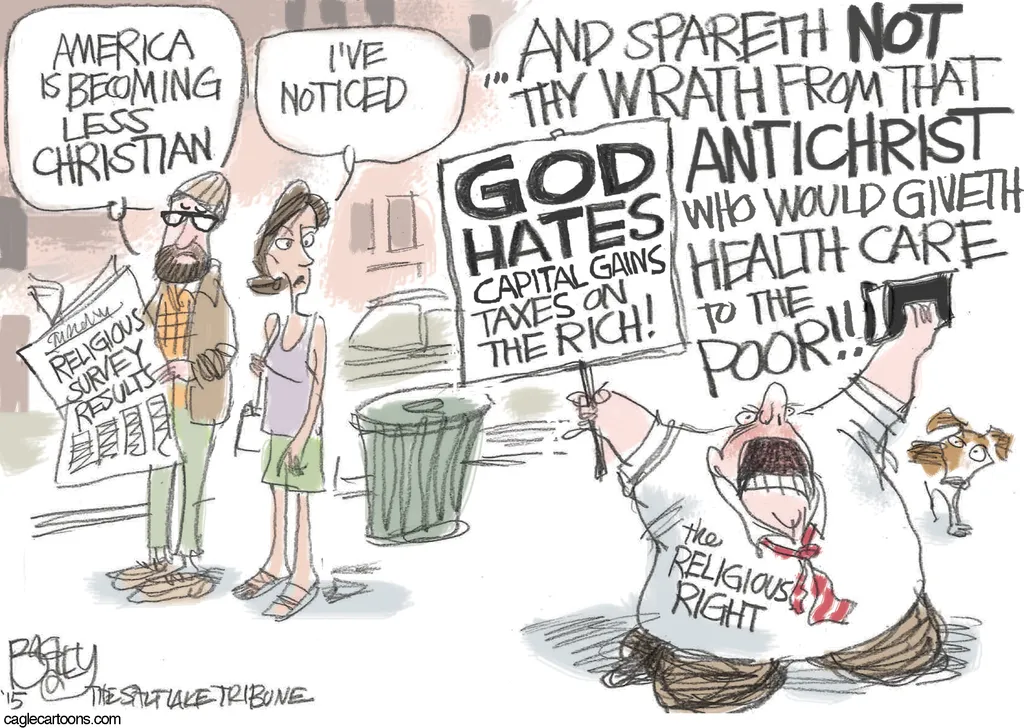




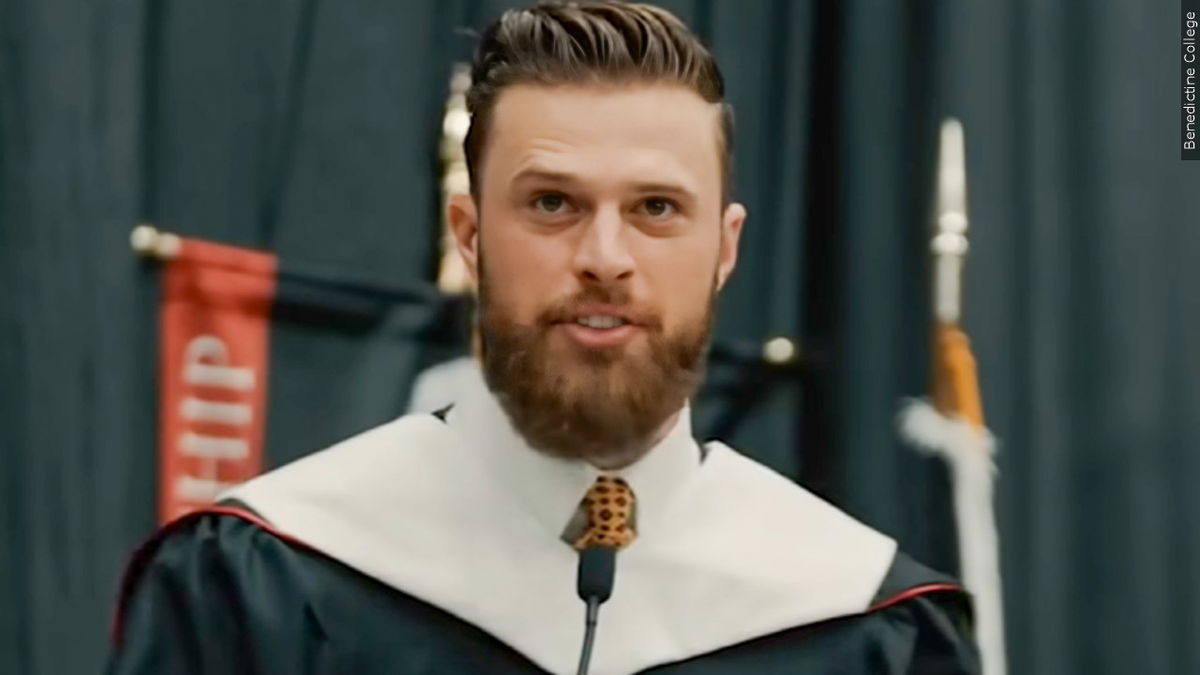


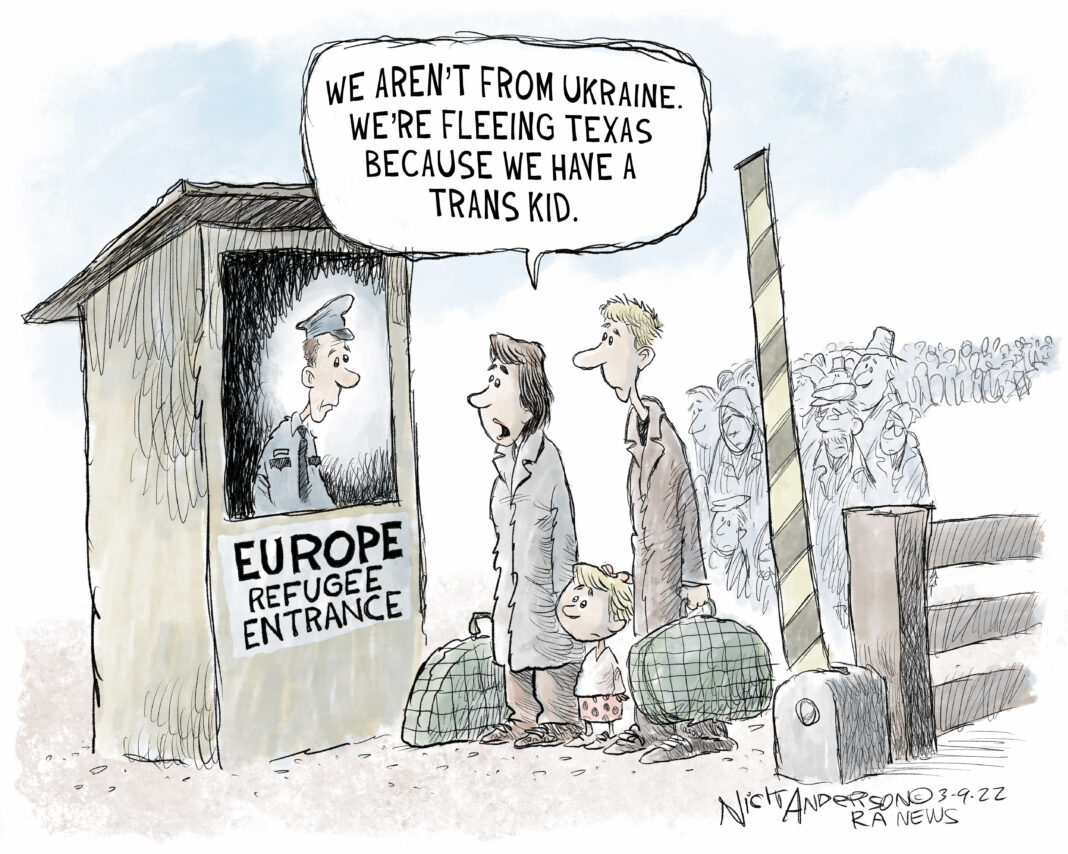
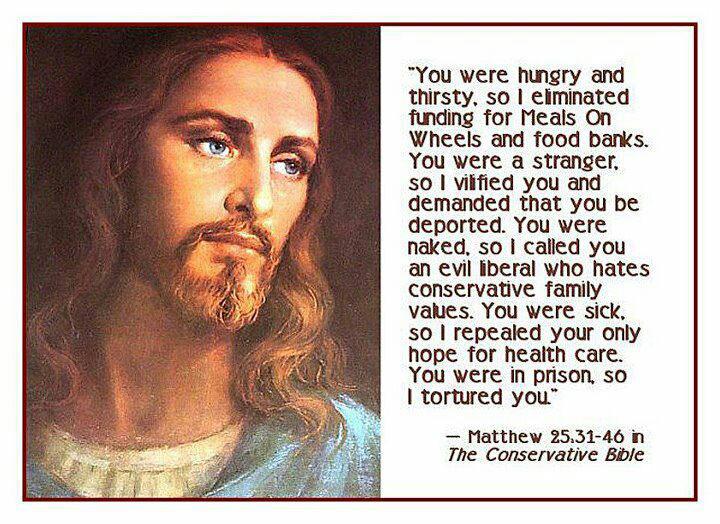


/cdn.vox-cdn.com/uploads/chorus_image/image/58388775/619309888.jpg.0.jpg)

 The Weekly Sift