

Hamas’ October 7 attacks on Israel were a horrifying beginning to a horrifying year of violence and death.
One year ago today, Hamas fighters from Gaza crossed into Israel, killing 1,139 people, including 695 Israeli civilians. Often, war produces civilian casualties because unfortunate people are in the wrong place at the wrong time, but here the civilians seem to have been specifically targeted. More than half the civilians were killed while attending a music festival. Another 250 Israelis, including 38 children, were taken back to Gaza as hostages.
The attack was both tactically brilliant and a moral atrocity. It succeeded largely because Israel had not imagined Hamas could pull off such a thing. Afterwards, the world wondered how anyone could do such a thing.
Immediate reactions. For a time, Israel was the object of more worldwide sympathy than perhaps at any moment since its founding, and certainly since its victory in the 1967 war. Many Americans remembered the aftermath of 9-11, when Le Monde’s top headline was “Nous sommes tous américains“. (“We are all Americans”.) We recalled both the rush of feeling that the world was behind us, and the regret of recognizing how badly we had screwed that up by launching wars we had no idea how to end. To the extent that we supported Israel — and how could we not on October 8? — Americans hoped Israelis would learn from our bad example.
On October 10, Thomas Friedman raised the exact question somebody should have asked George W. Bush on 9/12: “What do my worst enemies want me to do — and how can I do just the opposite?”
The October 7 attack had little military value. Rather, the monstrous attack was designed to provoke a response in kind, one that would show the world — especially the Arab world — what monsters the Israelis can be. Friedman’s advice: Don’t give them that response.
What Israel’s worst enemies — Hamas and Iran — want is for Israel to invade Gaza and get enmeshed in a strategic overreach there that would make America’s entanglement in Falluja look like a children’s birthday party. We are talking house-to-house fighting that would undermine whatever sympathy Israel has garnered on the world stage, deflect world attention from the murderous regime in Tehran and force Israel to stretch its forces to permanently occupy Gaza and the West Bank.
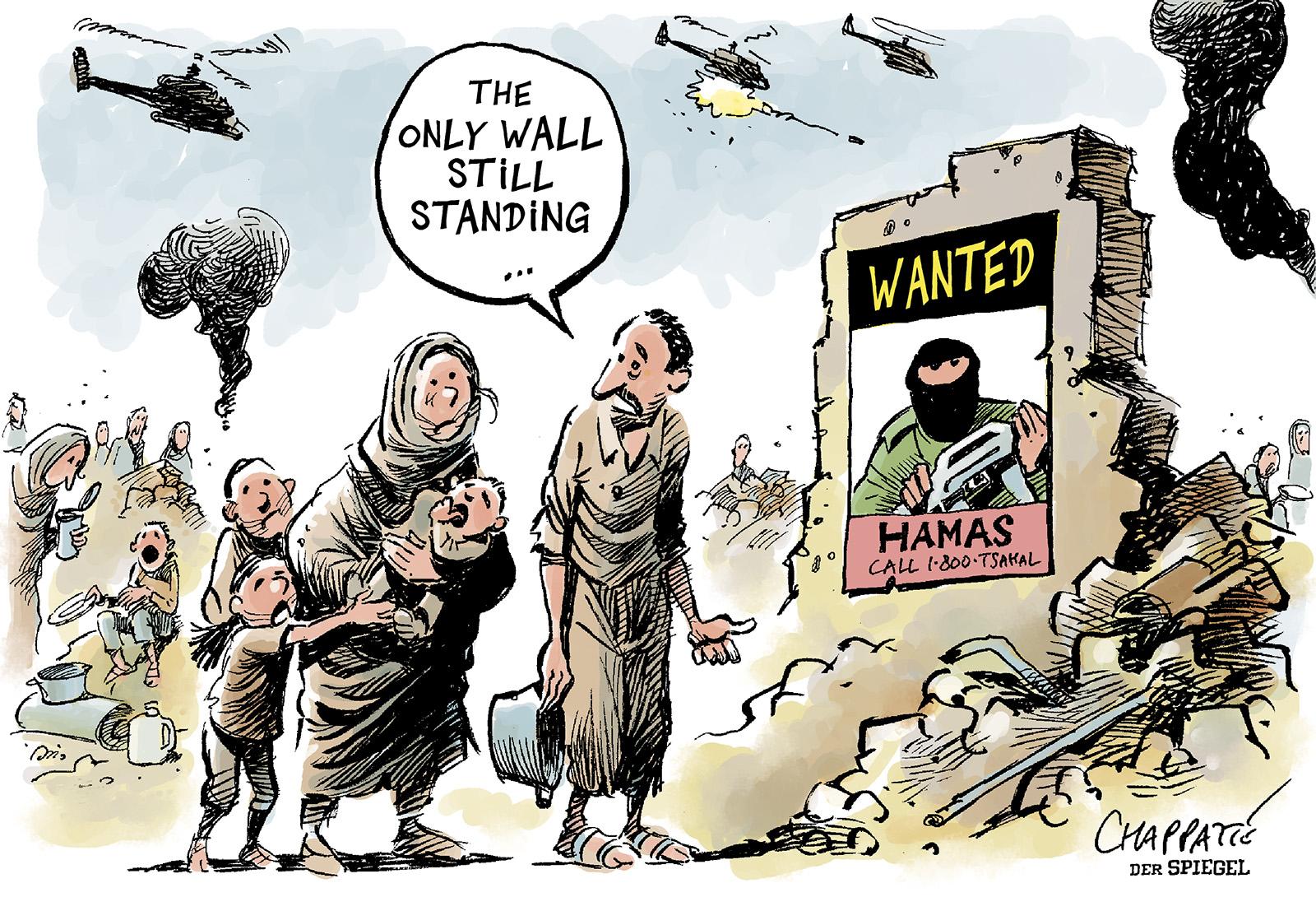
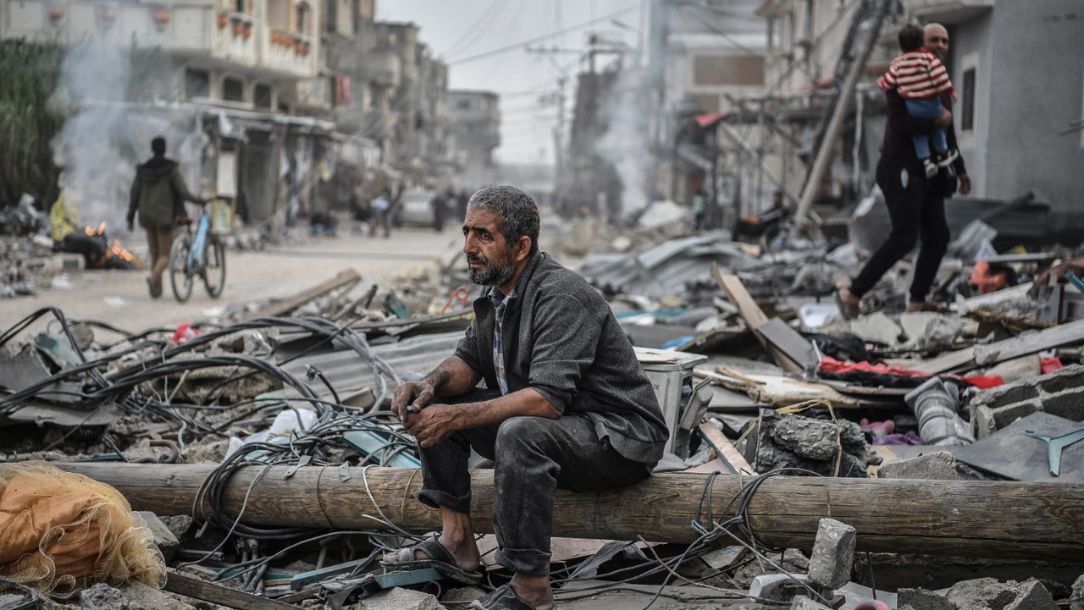
The wider war. But a year later, that’s where we are. Neighborhood-by-neighborhood fighting in densely populated Gaza, plus bombing that the Israelis claim is intended to minimize civilian casualties, has resulted in over 41,000 Gazan deaths, and 1.9 million displaced people. More than 300 aid workers have been killed. No one knows how many of the dead Gazans were Hamas fighters, but the estimated 14,000 dead children clearly were not. Israeli attacks have tapered off recently, but still continue. Yesterday:
For the first time in months, Israel sent a column of tanks into northern Gaza and launched major operations there, surrounding Jabalia, the largest of strip’s eight historic refugee camps, as strikes hit a mosque and a school in attacks that killed 24 and wounded nearly 100, according to the local Hamas-controlled government. … Sunday, Israel issued a new blanket evacuation order for all of the northern Gaza Strip, where hundreds of thousands of civilians remain, as a military spokesperson declared a “new phase of the war” against Hamas.
The Biden administration repeatedly has tried to broker a ceasefire-for-hostages deal. 105 hostages were released during a brief ceasefire and prisoner exchange in November, and each side blames the other for why further negotiations broke down. A few additional hostages have been rescued by Israel, some have died, and the fate of the rest is still unknown.
Meanwhile, the war continues to widen. Israel has been bombing Lebanon to target Hezbollah, and now has ground troops in southern Lebanon in what is described as “the largest military operation there since 2006”, killing an estimated 2,000 people so far. Iran has responded by firing ballistic missiles at Israel, the vast majority of which were shot down with help from the US.
Largely overshadowed by its Gaza operations is Israel’s simultaneous crackdown on the West Bank.
Israeli fire has killed at least 722 Palestinians in the West Bank since Oct. 7, Palestinian health officials say.
Victory? The Israeli military operations have had successes, killing top leaders of both Hamas and Hezbollah. Much of the Hezbollah leadership was lost in an imaginative pager attack. Vox’s Robert Greiner puts a triumphal spin on the current situation:
What this means is that we can stop fearing a wider regional war because it is already being fought, and Israel has largely won it. And with it, the relative deterrence Israel sought has been restored. … As for Palestine, its future is a question no more. Diplomats from the US, Europe, and the Arab world can save themselves the effort: There will be no negotiations worthy of the name and no solutions in Gaza or the West Bank, other than those unilaterally imposed by Israel and tacitly permitted by the US.
… Israel’s 40-year program of inexorable dispossession of Palestinians through land seizures and settlement, a process long slow and implicit, has become increasingly rapid and explicit since October 7. Even if occupied Palestinian lands aren’t formally annexed, a unitary Israeli state from the river to the sea is all but inevitable.
The Guardian’s Andrew Roth views Israel’s situation less favorably, arguing that the inexorable economics of missile/anti-missile struggles works against it: Offensive missiles are cheaper and easier to replace. If Iran keep firing, it can wear down the Iron Dome. At that point, protecting Israel’s cities would require not just an occasional raid, but a persistent and widespread bombing campaign against Iran.
Pushing my earlier 9-11 analogy a little further, I wonder if Israel is at its “Mission Accomplished” moment, paralleling where the US was in 2003, when resistance in both Afghanistan and Iraq seemed to have been crushed.
As The Economist puts it: “Israel has succeeded at hammering its enemies, but has not yet worked out how to end its wars.” Hamas and Hezbollah losses are significant, but in the long run should be easy to replace, now that a whole new generation has been given deeply personal reasons to hate Israel.
Contrary to Israeli claims that force will beat Palestinians into submission, survey after survey shows the reverse since Israel invaded Gaza. In a poll conducted in the West Bank by the Jerusalem Media and Communication Centre, support for “military resistance” grew from 40% in May this year to 51% in September, whereas support for “peaceful political action” fell from 44% to 36% in the same period.
Polling Gaza is probably impossible at the moment, but I would imagine that the swing in sentiment is even larger there.
The long view. I approach this conflict through the lens of an essay I wrote in 2004: Terrorist Strategy 101: a quiz. The quiz assumes you are a violent extremist, and its first two question presage where it’s going: “What is the first and biggest obstacle between you and victory?” and “Who is your best ally?”
The first and biggest obstacle to your victory is that the vast majority of the people who sympathize with your issue are not violent extremists. … Most people on both sides of your issue just wish the issue would go away. If you’re not careful, those apathetic majorities will get together and craft a compromise. And where’s your revolution then? So your first goal as a violent extremist is not to kill your enemies, but to radicalize the apathetic majority on your side of the issue. …
In radicalizing your apathetic sympathizers, you have no better ally than the violent extremists on the other side . Only they can convince your people that compromise is impossible. Only they can raise your countrymen’s level of fear and despair to the point that large numbers are willing to take up arms and follow your lead.
The picture the essay presents is of opposing pairs of extremists with a common interest in radicalizing the center. (“Inverting the Bell Curve” is how the quiz frames it.) The two extreme factions are trying to kill each other, but they also depend on each other. At the time, I was pointing out the symbiotic relationship between George W. Bush and Osama bin Laden. But I used Hamas/Israel as an example in a paragraph that looks eerie today:
Naive observers frequently decry the apparent counter-productivity of extremist attacks. Don’t the leaders of Hamas understand that every suicide bombing makes the Israelis that much more determined not to give the Palestinians a state? Don’t they realize that the Israeli government will strike back even harder, and inflict even more suffering on the Palestinian people? Of course they do; they’re not idiots. The Israeli response is exactly what they’re counting on. More airstrikes, more repression, more poverty — fewer opportunities for normal life to get in the way of the Great Struggle.
The cycle of violence may be vicious, but it is not pointless. Each round of strike-and-counterstrike makes the political center less tenable. The surviving radical leaders on each side energize their respective bases and cement their respective holds on power.
In this respect, both Hamas’ October 7 attacks and Netanyahu’s response have been enormously successful. Pre-10/7, the Palestinian situation was drifting towards irrelevance. In the October 10 article quoted earlier, Thomas Friedman flashed back to a picture that appeared in the Israeli press on October 3, of an Israeli government official visiting Saudi Arabia for a conference “wearing a traditional Jewish prayer shawl and yarmulke while holding up a Torah scroll with the Riyadh skyline in the window beyond.”
For Israeli Jews, that picture is a dream come true — the ultimate expression of finally being accepted in the Middle East, more than a century after the start of the Zionist movement to build a modern democratic state in the biblical homeland of the Jewish people. To be able to pray with a Torah in Saudi Arabia, the birthplace of Islam and the home of its two holiest cities, Mecca and Medina, is a level of acceptance that touches the soul of every Israeli Jew.
But that same photo ignites a powerful and emotional rage in many Palestinians, particularly those affiliated with the Islamist Muslim Brotherhood, including Hamas and Palestinian Islamic Jihad. For them, that picture is the full expression of the Israeli prime minister Benjamin Netanyahu’s supreme goal: to prove to all naysayers, indeed to rub their noses in the fact, that he can make peace with all the Arab states — even Saudi Arabia — and not have to give the Palestinians a single inch.
As far as diplomacy goes, that has been Netanyahu’s life’s mission: to prove to everyone that Israel can have its cake — acceptance by all the surrounding Arab states — and eat the Palestinians’ territory, too.
But Netanyahu was also facing political disaster: October 7 was not just a daring Hamas plan, it also pointed to security lapses on the Israeli side. The prime minister’s popularity plummeted. Simultaneously, his trial on corruption charges was crawling forward. An end to the war would also end the war cabinet Netanyahu headed, leading to elections that he would most likely lose.
But he has not brought the war to a conclusion, and so has not had to face either elections or jail. He continues to have no plan for what happens after the war. Now Israel’s tactical successes have redounded to his benefit, and it appears possible that he could even win another round of elections.
A world renewed by violence. Like Bush before him, Netanyahu is now offering visions of a military victory that reshapes the entire Middle East. A week ago, in a speech he gave in English so that it would be understood in Iran, Netanyahu said:
Our two ancient peoples, the Jewish people and the Persian people, will finally be at peace. Our two countries, Israel and Iran, will be at peace.
How will this happy day come to pass? Through regime change in Iran. Israel will change nothing, but Iran will change into a form Israel will find more congenial. And so there will be peace.
When Iran is finally free, and that moment will come a lot sooner than people think — everything will be different.
I can imagine no message better designed to prop up the Iranian regime. Going forward, every Iranian protester, every Iranian dissenter, can be cast as an agent of the Jews. Every critic of the regime shares responsibility for whatever bombs Israel decides to drop.
Does Netanyahu understand this? Of course he does. He’s not stupid. He understands that he needs the mullahs in Tehran as much as they need him. Otherwise, people across the region might get on with their lives and peace might break out. Then where would either flavor of extremist be?
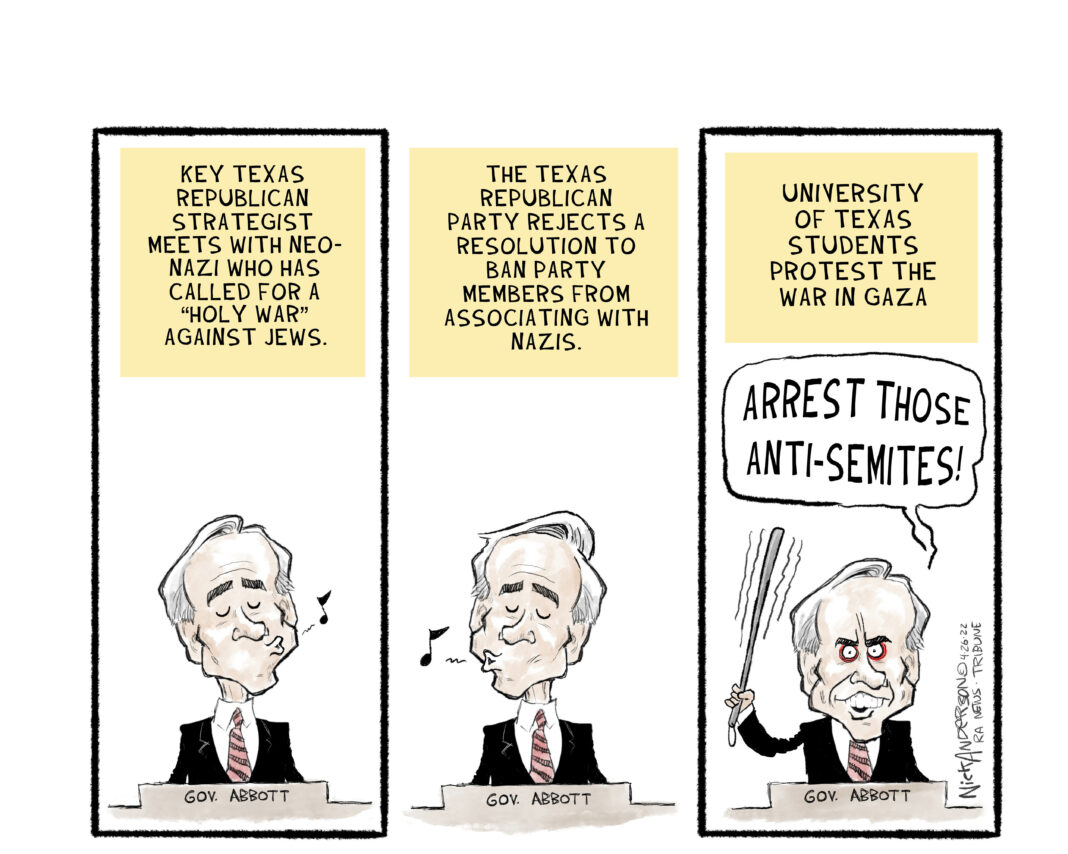
In the US. Sadly, the processes at work in Israel and Palestine have also been playing out here. For the most part, Americans are exchanging words and possibly threats rather than bombs, but here also the Bell Curve has been inverting. If you criticize Netanyahu, you must be antisemitic and support Hamas. If you criticize Hamas, you must support genocide against Palestinians.
Louisiana Senator John Kennedy’s grilling of Maya Berry, the executive director of the Arab American Institute, was far too typical. Ostensibly, the hearing was about hate crimes in the US, which victimize Jews and Muslims alike. But Kennedy would not listen to testimony about Muslim victims. “You support Hamas, do you not?” he asked Berry, and refused to hear her clear denials.
“Hamas is a foreign terrorist organization that I do not support, but you asking the executive director of the Arab American Institute that question very much puts the focus on the issue of hate in our country,” Berry responded.
“I got your answer and I appreciate it. You support Hezbollah, too, don’t you?” Kennedy continued. … “You just can’t bring yourself to say no, can you? You just can’t do it.”
The exchange ended with Kennedy telling Berry “You should hide your head in a bag.”
Attacking Israel is a losing political issue in the US (at least for now; Netanyahu risks changing that), so I can’t think of any parallel example where elected officials mistreat Jewish spokespeople. But what happens on college campuses, where Israel is much less popular, can be another story.
I find this trend very sad. There is no reason to bring the war to America. American Jews are not responsible for Netanyahu. American Palestinians are not responsible for Hamas. The suffering of either side does not justify victimizing the other.
America’s hands are not clean, and that needs to be discussed. But such a discussion does not benefit from demonization. There needs to be room for both sides to say, “I know this is wrong, but I don’t know how to fix it.” That common confession seems to me to be a necessary first step towards moving forward.
And if we can’t talk across our differences here, how can we expect them to do it over there, where people are dying?




 The Weekly Sift