
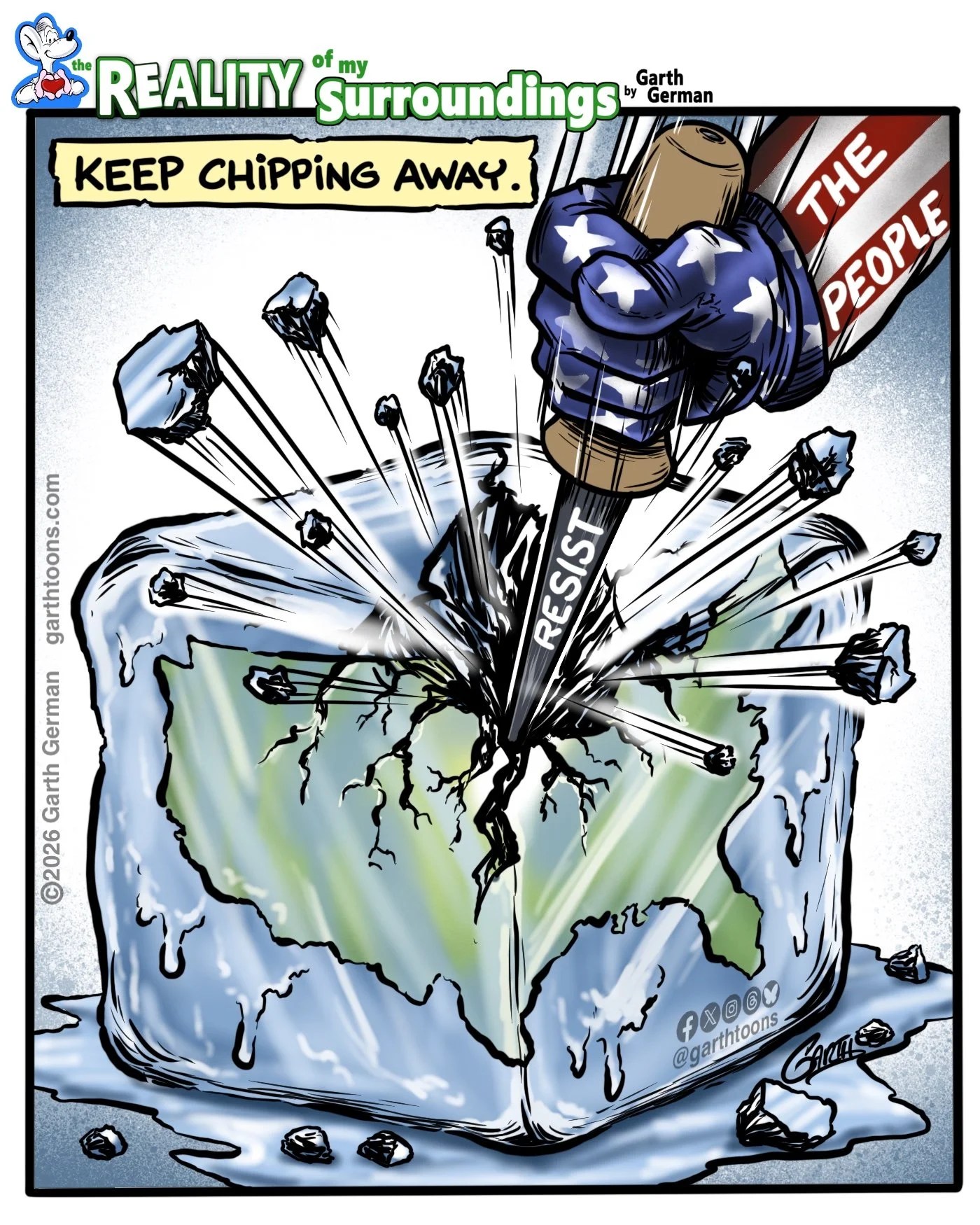
Trump is back-pedaling on Minneapolis. But has anything really changed yet?
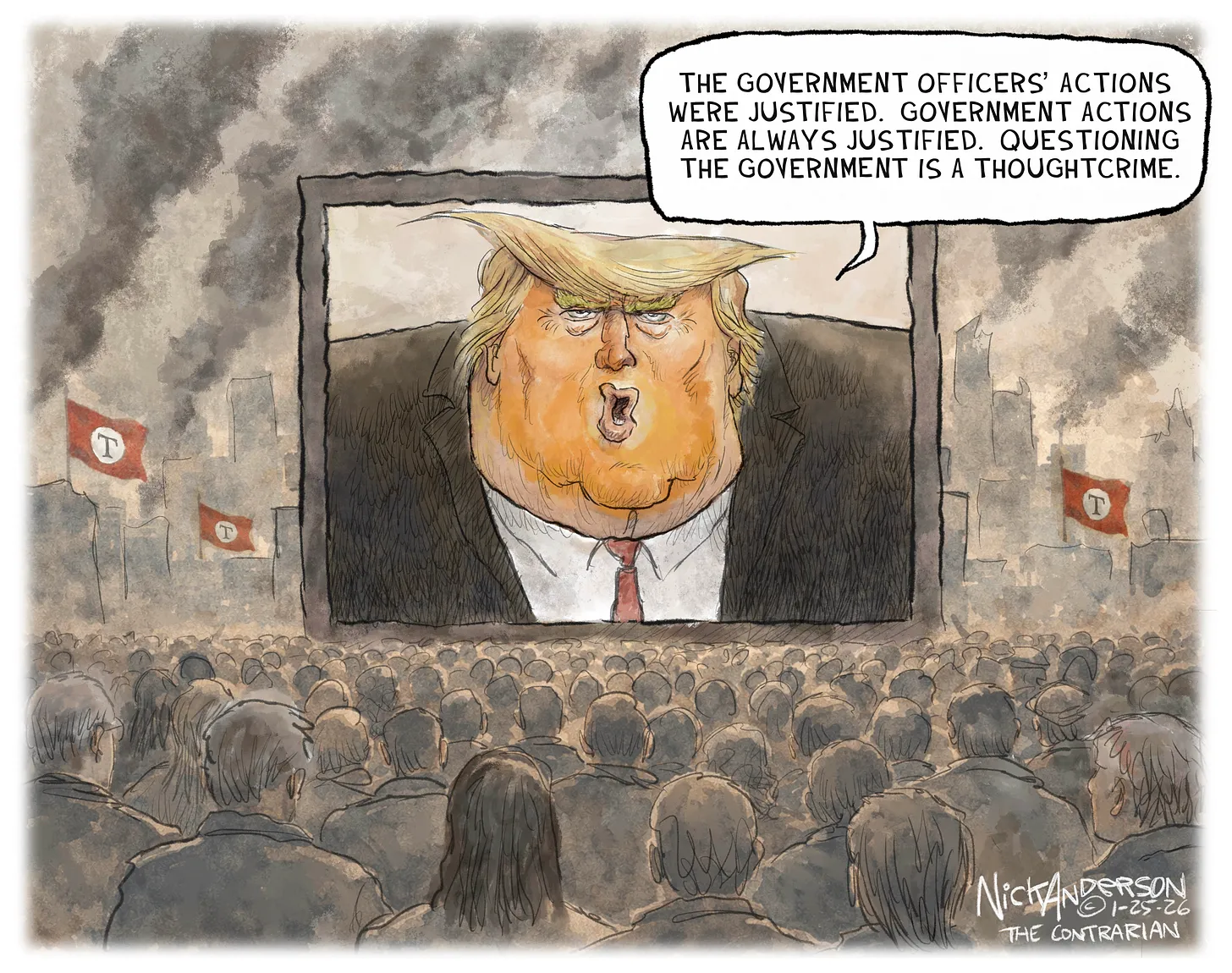
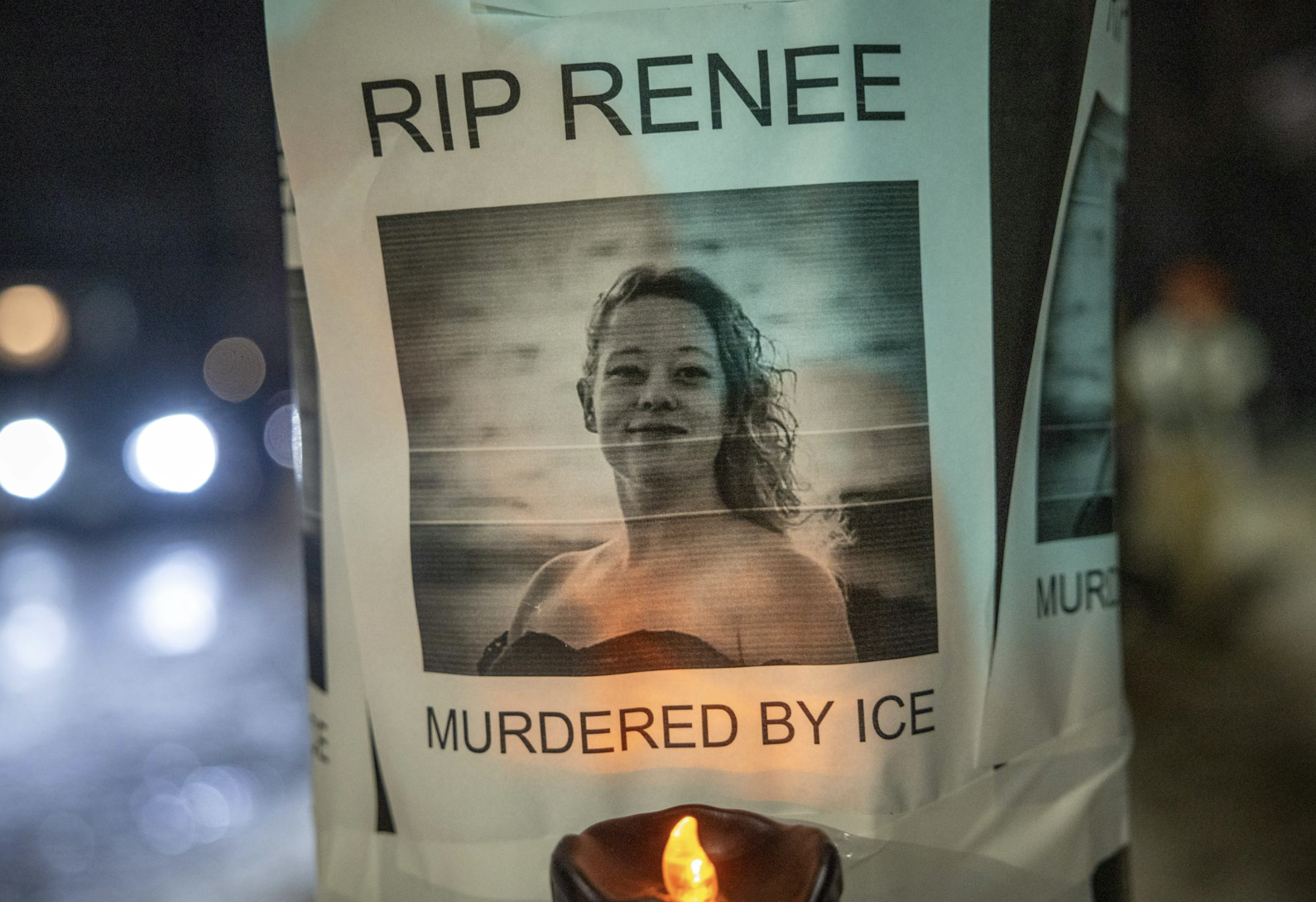
At this point, just about all observers agree that the occupation of Minneapolis has been a political and public-relations disaster for the Trump regime. The unjustifiable shooting deaths of Renee Good and Alex Pretti, blatantly and absurdly lying about Good and Pretti from the highest levels of government, detaining five-year-old Liam Ramos and sending him to a camp in Texas, pepper-spraying a guy whose head was already being smashed to the ground, indulging a quick trigger-finger on pepper spray, drive-by gassing a crowd of protesters with no apparent purpose beyond causing harm — it just got to be too much.
The abuses of power had gone far beyond any reasonable misunderstanding or the actions of a few bad apples. Either ICE’s Minneapolis invasion force was all bad apples, top to bottom, or (worse) they were doing precisely what Trump and Stephen Miller wanted them to do: terrorize a city that hadn’t supported Trump in any of his three races.
That was, to put it mildly, a bad look. Polls were turning against ICE, and against the regime’s handling of immigration as a whole, turning what had been Republicans’ best issue against them. Even Republicans in Congress were beginning to speak up. Democrats in the Senate were emboldened to demand curbs on ICE abuses be added to the DHS funding bill.
Something had to be done. So Trump
- pulled ICE commander Greg Bovino out of Minneapolis, replacing him with border czar Tom Homan
- softened his rhetoric against Minnesota Governor Tim Walz and Minneapolis Mayor Jacob Frey
- announced that the government would “de-escalate” following the Pretti shooting
- cooperated with Democrats isolating the DHS funding bill for debate, rather than trying to blame Democrats for a wider government shutdown
For his part, Homan announced three apparent changes in strategy, including giving Minnesota credit for the level of cooperation it had extended all along — possibly creating a “concession” he can point to as a reason to draw down force levels.

All of which raised a question: It sounds good, but how much has really changed? The 3000 militarized federal agents are still in Minneapolis. PBS is reporting little change on the ground.
A group of protesters blew whistles and pointed out federal officers in a vehicle on a north Minneapolis street. When the officers’ vehicle moved, a small convoy of activists followed in their cars for a few blocks until the officers stopped again. Associated Press journalists were in the neighborhood covering the enforcement actions. When the journalists got out of their car to document the encounter, officers with the federal Bureau of Prisons pushed one of them, threatened them with arrest and told them to get back in their car despite the reporters’ identifying themselves as media.
Officers from multiple federal agencies have been involved in the enforcement operations. From their car, the AP journalists saw at least one person being pepper sprayed and one detained, though it was unclear if that person was the target of the operation or a protester. Agents also broke car windows.
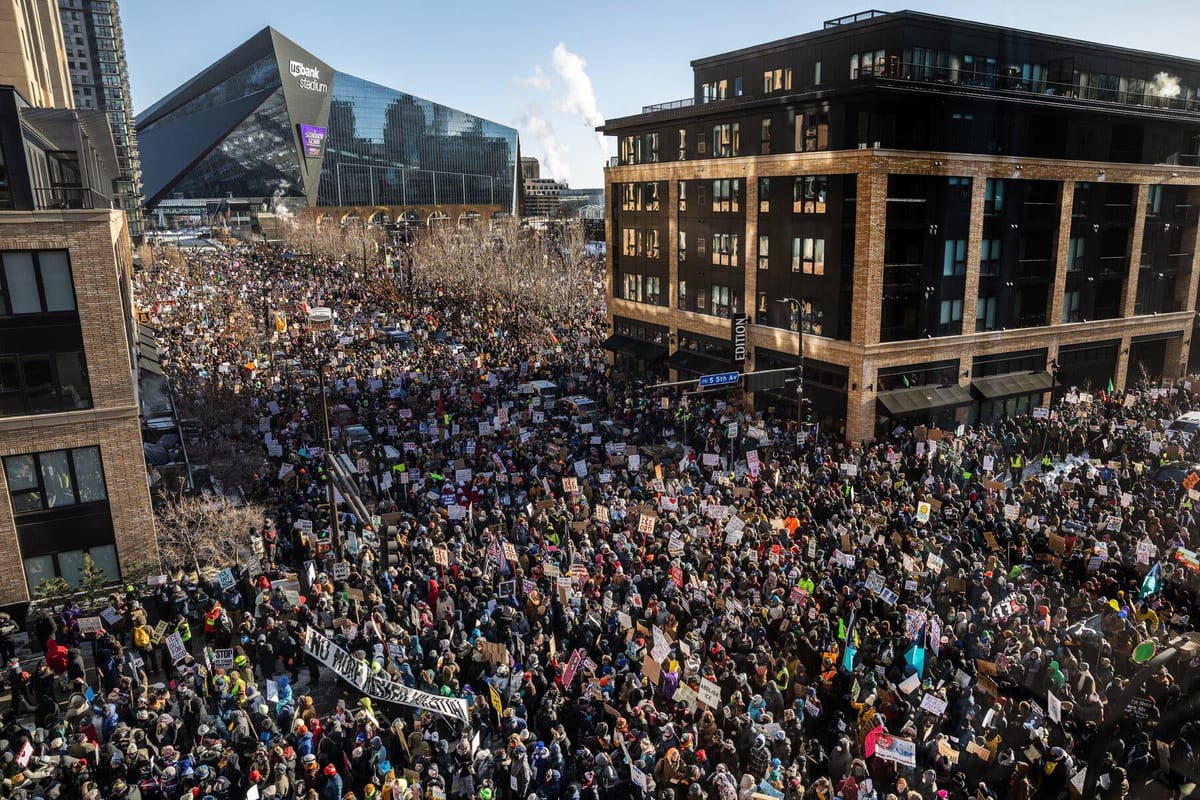
This weekend, anti-ICE protests were held across the country. In many cities these protests passed without incident. But some DHS troops continued to treat protesting Americans as the enemy. Saturday in Portland, Oregon DHS troops attacked protesting crowds with multiple chemical agents. Governor Tina Kotek released a statement:
Indiscriminate and unlawful uses of crowd control tools by federal agents must stop. Whether in Eugene or Portland, or in any city in Oregon, a federal presence that meets the public with unnecessary force is fundamentally unacceptable in our nation.
Portland Mayor Keith Wilson’s response was more pointed:
To those who continue to work for ICE: Resign. To those who control this facility: Leave. Through your use of violence and the trampling of the Constitution, you have lost all legitimacy and replaced it with shame. To those who continue to make these sickening decisions, go home, look in a mirror, and ask yourselves why you have gassed children. Ask yourselves why you continue to work for an agency responsible for murders on American streets. No one is forcing you to lie to yourself, even as your bosses continue to lie to the American people.
In this video from Portland, a phalanx of DHS troops retreats into a federal building while raining gas canisters down on protesters who seem to be doing nothing illegal, violent, or threatening.
In short, the regime’s response so far has been to try to shift the narrative without noticeably changing policies.

It remains to be seen what changes Congress will demand as it holds the DHS funding bill for two more weeks. Senate Democrats are proposing fairly modest reforms: ICE agents should lose their masks [1] and wear identification, be subject to the same use-of-force regulations as local police, and wear body cameras. They should stop entering homes on purely administrative warrants rather than warrants approved by a judge. [2]
Reforms discussed but not demanded
include an explicit ban on racial profiling during immigration stops; a prohibition on ICE raids at “sensitive locations” such as schools and churches; the elimination of arrest quotas; the withdrawal of federal agents from Minneapolis; a ban on the detainment of US citizens; and a mandatory review of all use-of-force incidents.
And one question remains unanswered: Even if Congress does pass a law reining ICE in, will it obey? A Minnesota judge has listed 96 court orders ICE has flouted. ICE routinely violates rights protected by the Constitution. Will it obey an explicit law or not?
To sum up: ICE’s abusive uses of force have turned the American public against that agency, and have stained the Trump regime in general. In retrospect, we may someday see that as a turning point in restoring American democracy. But that only happens if we don’t let up. Keep demonstrating, keep speaking out, keep holding Democrats’ feet to the fire, and do everything you can to break the Republican majorities in Congress come the fall elections.
[1] Believe it or not, unmasking is controversial. Republicans are afraid that ICE agents will be publicly identified and face harassment from the public. An official ICE FAQ says:
ICE law enforcement officers wear masks to prevent doxing, which can (and has) placed them and their families at risk.
All I can say to that is: cowards. State and local police don’t wear masks. DEA agents challenge murderous drug cartels, but they don’t wear masks. The FBI agents who searched Mar-a-Lago didn’t wear masks. Members of Congress don’t wear masks (even though Ilhan Omar got attacked this week). The prosecutors and judges in Trump’s trials didn’t wear masks. But the precious snowflakes of ICE have to wear masks.
[2] Jay Kuo explains why Democrats can’t just stop funding ICE altogether: Usually, lines in a budget bill have to be followed up by an appropriations bill. (That’s what Congress has been passing recently.) But Trump’s “Big Beautiful Bill” (which passed through the reconciliation process without Democratic votes) didn’t just budget money for ICE, it appropriated the money. In short: ICE is already funded. As long as Republicans have congressional majorities and party discipline, they can keep doing this.
If we really want to end ICE, we need to retake the House and Senate in 2026, then hold those chambers while winning the White House in 2028. For that reason, I can understand a long-game approach on reasonable and popular reforms, one that splinters the GOP now and helps win back congressional majorities in Congress for Democrats. Nothing is more important in the end, even if we must painfully accept that we can’t get every reform we want right now.
Back in December, Slate’s Mark Joseph Stern promoted the idea that the next Democratic president has to use the executive powers the Supreme Court has given Trump:
First, let’s remember that the Supreme Court has now effectively granted the president authority to impound federal funds duly appropriated by Congress and to abolish federal agencies established and funded by Congress. I think that is terrible and anti-constitutional. But thanks to the Supreme Court, that is now the law. So let’s talk about what President AOC can do with those powers in 2029. On Day 1, she needs to impound ICE’s budget. She needs to refuse to spend the billions of dollars that Congress has appropriated to the agency and fire tens of thousands of immigration agents immediately, starting with those who committed acts of violence and discrimination—which, by that point, may be almost all of them. Close as many immigrant detention facilities as possible and free the detainees.
Then turn to Customs and Border Protection. Fire CBP chief Greg Bovino. Fire every single agent who participated in the horrific operations in Chicago, D.C., and L.A. Refuse to pay out a penny in benefits to any agent who broke the law. Release all the information about ICE and CBP’s immigration sweeps, including the names of every agent who participated. Start investigations and prosecutions of any law-breaking agent whom Trump doesn’t pardon. Repurpose the billions of dollars in savings as a reparations fund for every victim. Run the reparations program through a new agency established by executive order. Pay to return noncitizens who were wrongly deported back to the country. Transform ICE and CBP’s headquarters into the nerve center of a new Truth and Reconciliation Agency, and use this extra money to pay out damages to the victims of the mass deportation campaign. This would be 100 percent legal under the precedent established by Trump and the Supreme Court.



 The Weekly Sift