
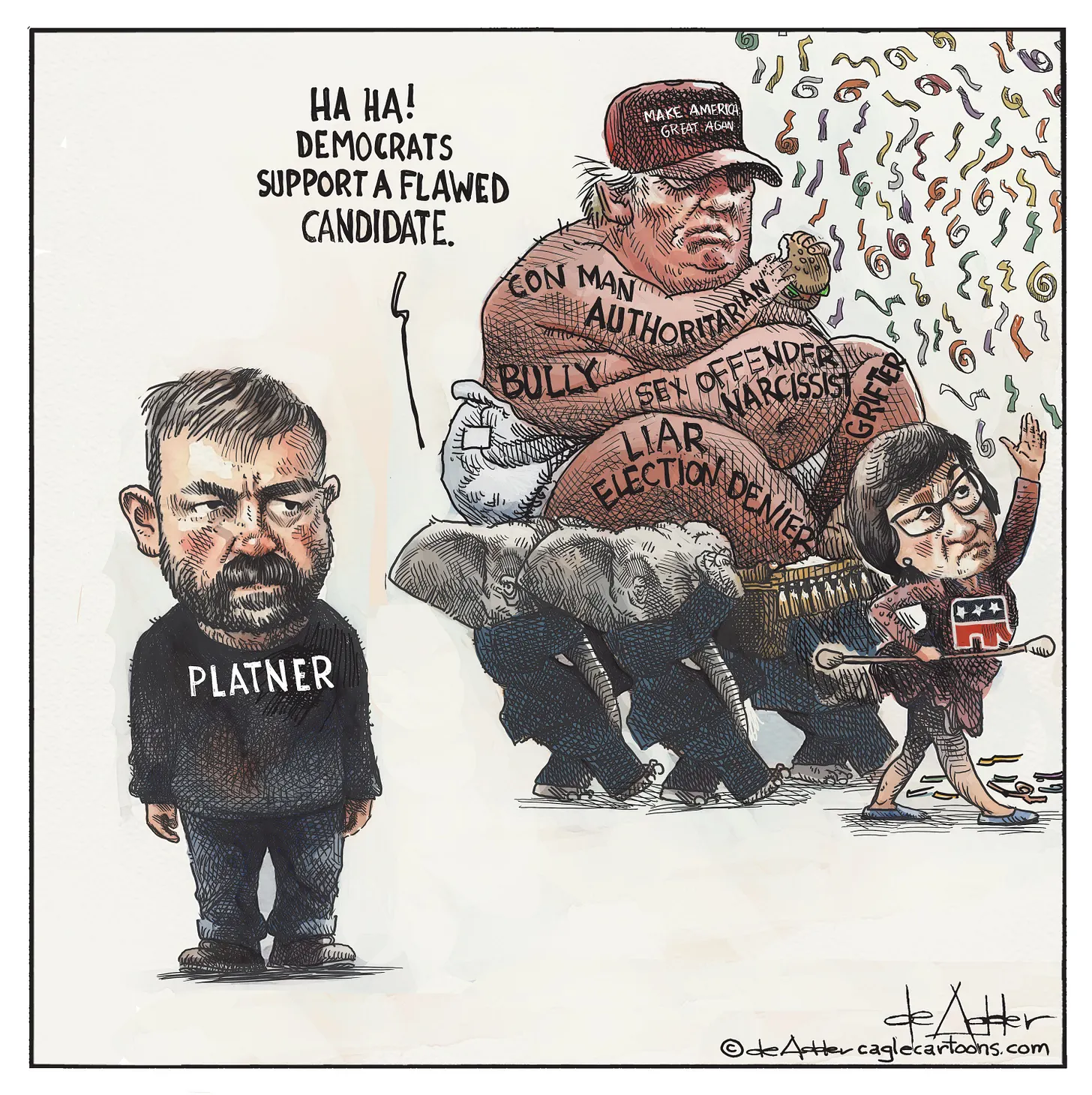
Can we buy a redemption story without sinking into the same moral morass Republicans have?
In spite of a variety of accusations (some of which he has admitted and apologized for), Graham Platner won the Maine Democratic primary to run for Susan Collins’ seat in the Senate.
His victory has prompted a lot of soul-searching among Democrats, including me. In a cycle when we want to spotlight the moral slime of the Trump administration and the Republican Party in general, we’d like more than ever to have squeaky-clean candidates like James Talarico in Texas. (Imagine being so blameless that when your opponents start lying about you, the best they can come up with is that you might be vegan.)
A lot of the case against Susan Collins is not so much that she is slimy herself, but that she enables slimeballs like Brett Kavanaugh, Donald Trump, and a host of others. She may be “concerned” about their conduct, but when push comes to shove her party can count on her vote. (The “believe women” campaign started with Christine Blasey Ford’s sexual assault accusation against Kavanaugh, which Collins paid lip service to, but ultimately wrote off. She also believed Kavanaugh’s assurances that Roe v Wade was safe, and believed the empty assurances Mitch McConnell gave her in exchange for her vote on the 2017 Trump tax cut. “Believe powerful men” is the actual rule Collins follows.)
So now we have another believe-women situation: a former Platner girlfriend (who happens to be a Republican political operative) says he was violently controlling (but never struck her).
he regularly grabbed her by the shoulders — sometimes hard enough to leave marks — and, on one occasion, yanked her out of a cab by her wrist after an argument when she wanted to stay in the car.
During one argument, she recalled, he twisted her arm behind her back, shoved her into a bedroom and held the door closed from the other side so she couldn’t get out, telling her to remain there until she was “calm.” Eventually, Ms. Fifield said, she fell asleep and left the next morning.
I wish I didn’t have to deal with this, but I do. To what extent am I willing to support a less-than-perfect candidate for the sake of the greater good? I’m inclined to go a long way, given the perilous state our democracy is in if Congress continues to refuse to contain the authoritarian drive of the Trump regime. But I’m aware that MAGA types make similar arguments for tolerating Trump’s moral/legal failings: They grossly exaggerate the harm they think Democrats are doing or would do, and see Trump as the lesser evil.
I also resent that the public only seems to have standards for Democrats. Trump can be a convicted felon, found by a jury to have sexually assaulted a woman, found by numerous courts to have committed fraud, and so on — and none of it matters. Only Democrats have to exhibit good character and live moral lives. In particular, I have no patience for Republicans (and supposedly “liberal” media outlets like the NYT) who find fault with Platner, but have far less to say about Ken Paxton, who is by far the scummier character.
But still, it rankles to be complicit in the racheting down of moral standards in American politics. And consequently it raises the question: If we support Platner, are we just doing what they’re doing?
The most thoughtful article I’ve found on this topic is “Rupture and Repair: When Problematic Figures Ask For Our Support“, written by Jay Kuo for The Big Picture blog. Kuo compares Democrats’ treatment of Platner and Hunter Biden (who is developing something of a following online) to Republicans’ treatment of Paxton and Pete Hegseth.
Several figures from both sides of the political spectrum have raised this very question. Some seek redemption for conduct they acknowledge. Others seek power for conduct they deny. The distance between those two postures turns out to matter enormously, even when the underlying behavior looks similar on the surface.
Kuo proposes a simple test: What if the accusations are true? What does that say about the person’s future conduct, and in particular about how they would use the power they are seeking?
The contrast with Biden and Platner is not that their alleged conduct was less serious than Hegseth’s and Paxton’s, though it objectively is. The contrast is structural. Hegseth’s alleged conduct was directly relevant to the specific institution he was being asked to lead. Paxton’s alleged crimes are the exercise of the very power he is seeking more of. Rather than acknowledge the rupture of trust and seek repair and forgiveness from supporters, they have demanded to be believed over their accusers. Their party, calculating that the political stakes justified the cost, has obliged.
(Kuo’s distinction seems meaningless to Megan McArdle, who sees Platner and Paxton alike as men of low character.) For the moment, let’s put aside the whattaboutism of Hegseth and Paxton, and focus that test on Platner. He got (and later covered) a tattoo that was based on an SS symbol. He posted derogatory things online about women and minorities. He is accused of treating a girlfriend badly and possibly cheating on his current wife. He acknowledges the majority of that behavior, claims ignorance about the symbolism of the tattoo, and denies the violent aspects of the girlfriend’s charges. He casts those events in a narrative in which he was scarred by combat and took some while to work things out.
The question Kuo would have us focus on is: Does anything in Platner’s current life or political positions resonate with a pro-Nazi, anti-woman, or anti-minority past? If something does, he should lose any benefit of the doubt.
What matters most though is not the rupture [of trust] itself but the repair that follows. Character is revealed in the willingness to face the damage, attempt repair and accept that forgiveness is not guaranteed. A child who breaks something and hides it learns only fear and concealment. A child who breaks something, admits it, and works to make it right learns something far more valuable. …
Importantly, repair cannot simply be declared by the person who caused the rupture. And it cannot become a way to sweep aside serious problems, particularly around misogyny and toxic behavior. It has to be tested over time, especially by how seriously a candidate like Platner treats the objections of the people harmed and the concerns of voters still unwilling to trust him.
So the next thing to do is listen to the people most likely to be harmed if Platner has not reformed and is still not who he is claiming to be.
Shay Stewart-Bouley is a Black Mainer who writes about race issues. In her opinion, Platner is nearly unique among Maine’s White politicians in his outreach to non-White and immigrant communities.
I can’t speak to who Graham Platner was when he was posting hurtful things on the internet, but I can say that in the nine months since he launched his campaign, I have seen a white man who has done a lot more community-building across racial lines than the majority of those who judge him—particularly the left-leaning progressives and leftists who are horrified that he has a legitimate shot at becoming the U.S. senator. Most certainly more than the average politician or aspiring politician. The fact that he chooses to build behind closed doors rather than turning BIPOC people into props to redeem himself is also a choice. For those who seek the performative, there is no doubt that a few shots of him speaking with Black and Brown audiences and seeing their reactions would probably steady their nerves—but do photo ops allow for depth and true connection?
… I don’t need a perfect candidate and watching him show up consistently for Maine’s BIPOC community and not use the community to repair his battered image matters to me. In some ways, knowing for months that at any moment he could have chosen to “prove” that he has changed by taking relational moments and turning them into soundbites and photo ops—but he didn’t—reveals a level of integrity that is important to me.
If you want to understand the positive aspects of his candidacy, and why so many Mainers chose to stand by him in the primary, read Sebastian Junger’s “I Just Had Breakfast with Graham Platner“. What comes through in this article is how the constant sniping about details of his past and background serves to divert attention from his message.
The heart and soul of what Platner had to say to me – and to voters – is that American politics are deeply corrupt, and that Democrats are often as bad as Republicans. He went on to say that the true division in this country isn’t between liberals and conservatives but between economic elites and everyone else. These elites, in his opinion, have fomented political divisions to stay in power because their main goal is economic monopoly; politics simply serve that purpose.
Perhaps The New York Times and Washington Post would prefer we not have that discussion. Junger goes on to quote Platner directly:
Here is my real point of contention with the liberal pundit class. Which is that they celebrate the suffering of working people who were tricked into voting for someone that was going to fuck them over. You shouldn’t celebrate that, you should be horrified by it…you should have compassion and empathy. Those people were tricked, they were propagandized, they were lied to. We are all in many ways being exploited and manipulated by the elites. To sit around and say, Ha, ha, you get what you voted for – no, man. Those are people in pain. You don’t laugh at people in pain, you help them, for Christ’s sake.
… The Ukrainians are resisting an armed invasion, and I absolutely support [them]. But I do think it makes it hard to support them when we are also supporting the Saudi regime and the Israelis in Lebanon right now. I’m an internationalist. I believe our foreign policy should be rooted in international institutions that we respect consistently. Vietnam wasn’t good for working Americans. Fucking around in South America in the 1980s was not good for working Americans. The wars in Iraq and Afghanistan were not good for working people. I’d like to see us invest money in the United States rather than in a bloated military apparatus. We have helped set up all these international court systems that are specifically designed to to protect corporate power and capital around the world…why don’t we do that to protect, say, labor rights around the world? [We need alliances so that] if a company flees one country to avoid taxation, other countries will impose the same tax rate.
… Establishment Democrats and normie liberal types love talking about fascism and authoritarianism. They use the words and then nobody does anything to prepare. I do believe these people [in the Trump administration] are fascists and will try to maybe interfere in the elections come November, weaponize or militarize federal law enforcement as a political tool. So, that’s why you have to fucking organize now…just saying so on MSNBC isn’t enough. Talk to the labor unions, talk to the community organizers, start building the mechanisms that we’re going to need. Resistance isn’t magic; it requires time and discipline and energy. The Trump administration is full of incompetent morons; of all the versions of this we can beat, it’s this version. What I’m very much worried about is if we don’t resist and defeat this version now, then the next version is actually competent.
All things considered, is that a point of view I want represented in the Senate? I think it is. You may make your own decision, but I encourage you to take a long look at Platner, and not just respond based on a few headlines in the corporate press.

