

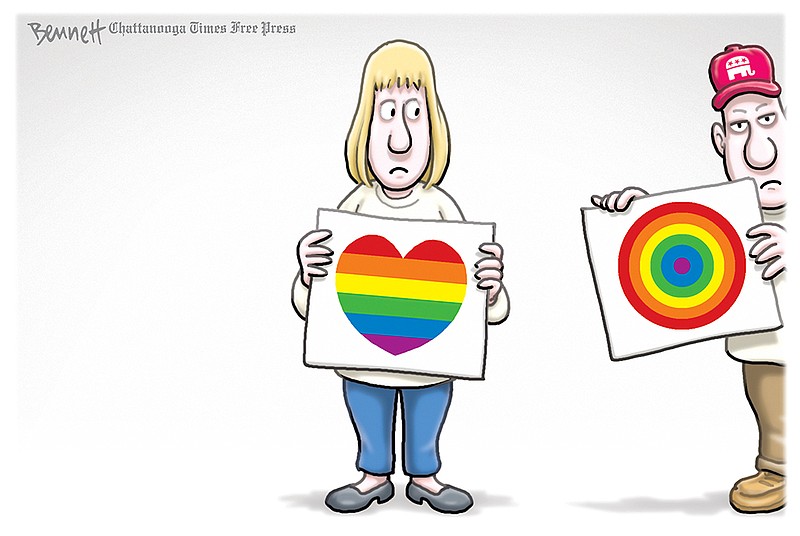
If we run away, how far will we have to go?
During the stretch run of the presidential campaign, $37 million worth of Trump ads connected Kamala Harris to trans people, especially transwomen and transwoman athletes. It’s hard to know whether those ads decided the election, but it’s not crazy to imagine that they did. This has started a debate among Democrats about how to handle trans-rights issues going forward.
Republicans sense an advantage, so they will make sure those issues don’t go away any time soon. Congresswoman Nancy Mace (R-SC) responded to Delaware electing transwoman Sarah McBride to Congress by proposing a bill to keep her out of women’s bathrooms and locker rooms in the Capitol. [1] WaPo’s Matt Bai laid out how this political trick works:
First, you single out someone transgender for unprompted cruelty. … Then you sit back and wait for Democrats to do the decent thing, which is to stand up for the right of any American to be left alone. At which point, Republican leaders step in to say, as House Speaker Mike Johnson did, that they’re “not going to engage in silly debates about this,” as if it were Democrats and not Republicans who are so obsessed with trans rights that they can’t stop thinking about who’s in the next stall.
Talk about obsessed: Of the current posts on Mace’s X-timeline, 76 of the first 79 are about her bathroom bill. All since November 20.

Bai’s model certainly captures how the issue played out in the recent campaign, as M. Gessen (who identifies as trans) observed:
In the wake of an election in which Donald Trump stoked fear about trans people — as in the much-discussed ad that warned “Kamala is for they/them. President Trump is for you” — Democrats are now debating how much the issue of trans rights hurt them and how fast they should retreat from it. Which is remarkable, because throughout her brief campaign, Kamala Harris was all but silent on the subject. It’s not clear how much further Democrats could actually retreat.
Unfortunately, the answer to that question is obvious: Democrats could get on board the anti-trans train and start their own fear-mongering about trans people. My Congressman, Seth Moulton [2], is showing the way:
I have two little girls, I don’t want them getting run over on a playing field by a male or formerly male athlete, but as a Democrat I’m supposed to be afraid to say that.
This is a tactic I remember well from junior high: If kids are picking on you for looking gay, find some kid who looks gayer and beat him up. Don’t stand up to cruelty, just make sure you’re on the inflicting side rather than the suffering side.
But while you’re doing that, make sure you don’t look cruel. So Moulton, who (like me) enjoys almost every kind of privilege American culture offers, is the victim here: People like him are “afraid” of the Big Bad Trans Community. But Seth himself is one of the few Democrats courageous enough to join in the smear against transathletes. He knows that the number of transathletes in women’s sports is vanishingly small [3], that identified-male-at-birth kids who have taken puberty blockers don’t have significant physical advantages over identified-female-at-birth kids, and that the only way Trump managed to find an example in the news that he could use to smear transathletes was to lie about a female Algerian boxer in the Olympics. But never mind that. His little girls are in danger and require his protection.
That’s how the game is played: Don’t attack. Just invent a “threat”, pin it on the target group, and then “defend” against that threat. You know: “They’re eating the dogs, they’re eating the cats.“
So let’s not kid ourselves about what the choice is. Democrats can’t just “stop spending so much time talking about trans issues”, because we never did that. Whatever we say or do, Republicans are going to try to connect us to the trans community. The only way out of that box is to actively join the lynch mob.
Is that really what you want to do?
Josh Marshall offers a historical parallel: the 2004 election, when George W. Bush won reelection over John Kerry. Like 2024, 2004 was a very discouraging election for liberals. Bush had won in 2000 despite losing the popular vote, so it was easy to look on his administration — torture, war based on lies, etc. — as an aberration. America wasn’t really like that. But then he got over 50% of the vote in 2004 (the only Republican to do so in the 21st century), so Democrats had a lot of soul-searching to do.
There’s at least a decent argument that Democrats lost the 2004 election over gay marriage. It certainly wasn’t the biggest issue. But Republicans, cynically and shrewdly, got state ballot initiatives banning gay marriage on the ballot in a number of key states. Ohio seemed like the keyest. … Who knows whether it actually turned the election. But it’s not a far-fetched argument given how close the result was. There’s no question that substantial majorities of voters opposed same-sex marriage rights at the time, though of course support varied from more liberal to more conservative states. …
I don’t think you get to the Obergefell decision in 2015 without 2004 or the whole range of marriage equality activism in the first years of this century. In fact, I’m also certain you don’t. And I guarantee it was an albatross and super annoying to tons of Democratic elected officials. It’s possible it cost Democrats the 2004 election. It generated all sorts of agita and in many cases anger that LGBT activists were pushing the envelope so hard.
Marshall allows that the parallel isn’t perfect, but it’s also not totally off-base. Neither is the comparison to civil rights in the 1960s — Marshall didn’t go there — when there were literal race riots in cities all over the country. Nixon won in 1968 largely because he could pose as the law-and-order candidate who would stand up to Black activism.
Once in a while, there’s going to be a political price to pay for refusing to beat down on whatever group is unpopular at the moment. We can’t ignore that price, but going the other way has a price as well.
One thing the gay-marriage comparison suggests is that we have no idea how trans issues will play in 2028 and beyond. Most voters in 2004 based their same-sex marriage opinion on ignorance: They did not know any gay couples with a public long-term commitment, so they had no basis on which to judge claims that same-sex marriage would lead to “the fall of Western Civilization itself“. Same thing now: Most Americans don’t know any openly trans people, so they’re easy to demonize.
A few years down the road, most Americans probably will know at least one or two such people, plus a handful of trans celebrities. [4] The conversation may be very different by then.
[1] In the WaPo, Style (not Politics) columnist Monica Hesse wonders if Mace knows how women’s bathrooms work.
Just so we’re all on the same page, here’s how public bathrooms work for women: Each restroom is cordoned off into multiple private stalls. Each stall has its own door, which fully shuts and locks. Each door either goes all the way to the ground or — more commonly — stops approximately 12 inches from the floor. This is not an open-plan urinal situation, is what I’m saying. This is a situation in which the most flesh anyone typically sees is a scandalous, tawdry swath of … ankle.
If, somehow, a sex pest were to infiltrate a women’s room and do something creepy — like attempting to spy under a stall — then the women using the restroom would and should call security to have the sex pest removed. That would be true whether the culprit was a cis woman, a trans woman, a man or six koalas in a trench coat. Creepy behavior should be policed; mere existence should not.
If Mace’s bill passes, though, it becomes someone’s job to check up on the genitalia of restroom users. The government itself becomes the “sex pest”.
[2] If you’re a Democrat who believes in human rights, including trans rights, and you’re thinking of running against Moulton in MA-6, please put me on your mailing list. I’ve been a very reluctant Moulton voter ever since he challenged Nancy Pelosi for Speaker in 2018. Politico wrote that Moulton looked like “a mansplaining young punk taking down a vastly more experienced woman”, which is generally how I see him. (I understood why Pelosi faced criticism from the left, even though I disagreed with that criticism. But that’s not where Moulton was coming from. He just wanted to be important.)
Moulton’s anti-trans turn has to be about his larger ambitions, because it isn’t forced by any local political necessity. Republicans didn’t even bother to field a candidate in MA-06 this year, so Moulton won with 97% of the vote.
[3] Apparently, one of those rare transathletes is on the women’s volleyball team at San Jose State. The WaPo outlines the current controversy there, as some schools are refusing to play against the Spartans. The article notes that the player meets the NCAA requirements for transwomen athletes (one year of testosterone suppression treatment), and quotes a rival athletic director:
I do think it is important to note, we have played against this athlete for the past two seasons and our student-athletes felt safe in the previous matches. She is not the best or most dominant hitter on the Spartans team.
[4] Slowing this process down is the core reason Republicans want to ban books like Gender Queer, a memoir that I learned a lot from. If you read such books, or attend plays like Becoming a Man, you may begin to think of people with nontraditional gender identities primarily as people. That will make it harder for Republicans to use fear to manipulate you.

 The Weekly Sift